
Skip to content

Repository files navigation

ssl-logo


SELFRec is a Python framework for self-supervised recommendation (SSR) which integrates commonly used datasets and metrics, and implements many state-of-the-art SSR models. SELFRec has a lightweight architecture and provides user-friendly interfaces. It can facilitate model implementation and evaluation.
Founder and principal contributor: @Coder-Yu @xiaxin1998

This repo is released with our survey paper on self-supervised learning for recommender systems. We organized a tutorial on self-supervised recommendation at WWW'22. Visit the tutorial page for more information.

Supported by:
Prof. Hongzhi Yin, The University of Queensland, Australia, h.yin1@uq.edu.au
Prof. Shazia Sadiq, ARC Training Centre for Information Resilience (CIRES), University of Queensland, Australia
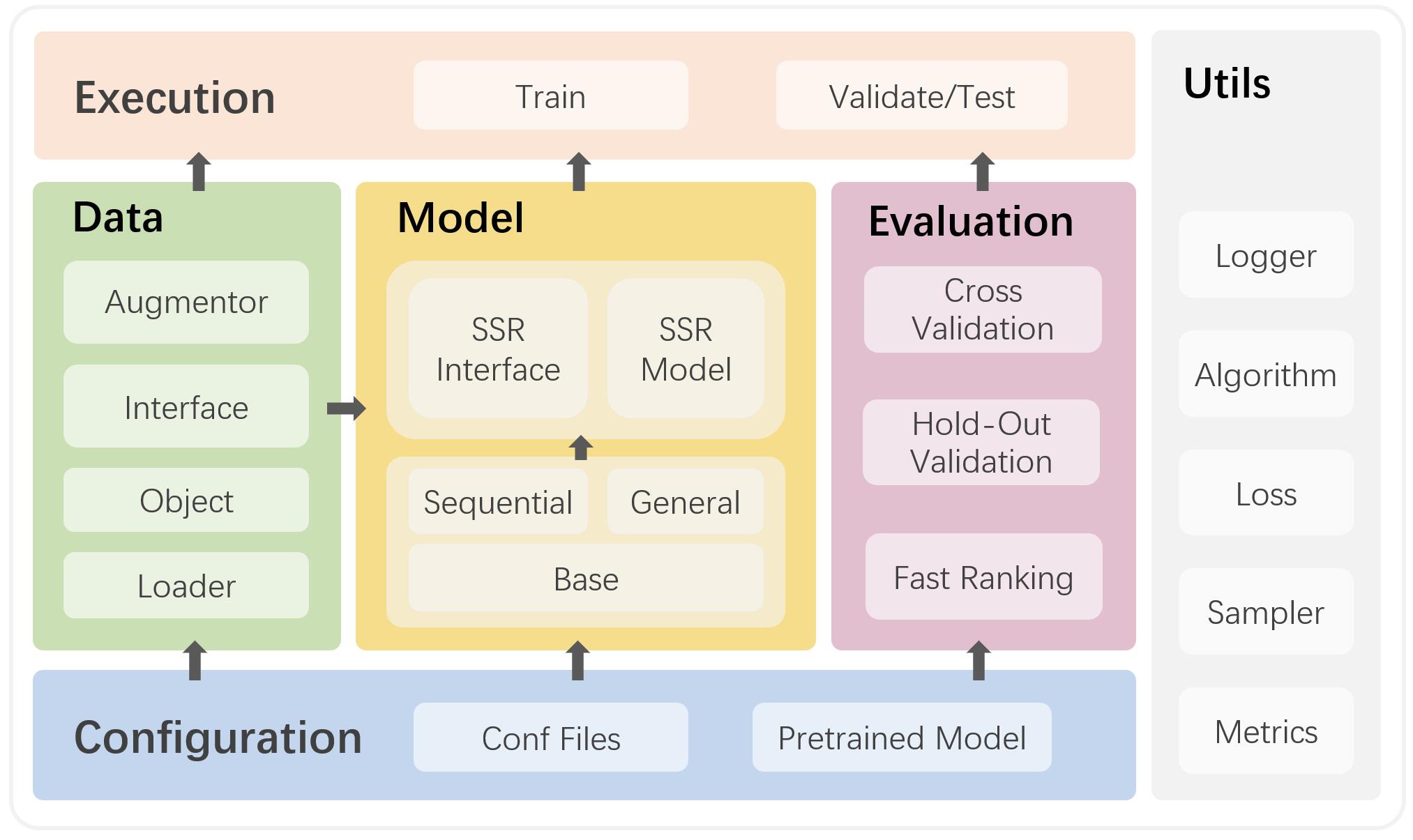
Architecture

ssl-logo

Features

  • Fast execution: SELFRec is compatible with Python 3.9+, Tensorflow 1.14+ (optional), and PyTorch 1.8+ and powered by GPUs. We also optimize the time-consuming item ranking procedure, drastically reducing ranking time to seconds.
  • Easy configuration: SELFRec provides simple and high-level interfaces, making it easy to add new SSR models in a plug-and-play fashion.
  • Highly Modularized: SELFRec is divided into multiple discrete and independent modules. This design decouples model design from other procedures, allowing users to focus on the logic of their method and streamlining development.
  • SSR-Specific: SELFRec is designed specifically for SSR. It provides specific modules and interfaces for rapid development of data augmentation and self-supervised tasks.

How to Use

  1. Execute pip install -r requirements.txt under the SELFRec directory
  2. Configure the xx.yaml file in ./conf . (xx is the name of the model you want to run)
  3. Run main.py and choose the model you want to run.

Implemented Models

ModelPaperTypeCode
SASRecKang et al. Self-Attentive Sequential Recommendation, ICDM'18. Sequential PyTorch
CL4SRecXie et al. Contrastive Learning for Sequential Recommendation, ICDE'22. Sequential PyTorch
BERT4RecSun et al. BERT4Rec: Sequential Recommendation with Bidirectional Encoder Representations from Transformer, CIKM'19. Sequential PyTorch
ModelPaperTypeCode
XSimGCLYu et al. XSimGCL: Towards Extremely Simple Graph Contrastive Learning for Recommendation, TKDE'23. Graph + CL PyTorch
SimGCLYu et al. Are Graph Augmentations Necessary? Simple Graph Contrastive Learning for Recommendation, SIGIR'22. Graph + CL PyTorch
DirectAUWang et al. Towards Representation Alignment and Uniformity in Collaborative Filtering, KDD'22. Graph PyTorch
NCLLin et al. Improving Graph Collaborative Filtering with Neighborhood-enriched Contrastive Learning, WWW'22. Graph + CL PyTorch
MixGCFHuang et al. MixGCF: An Improved Training Method for Graph Neural Network-based Recommender Systems, KDD'21. Graph + DA PyTorch
MHCNYu et al. Self-Supervised Multi-Channel Hypergraph Convolutional Network for Social Recommendation, WWW'21. Graph + CL TensorFlow
SGLWu et al. Self-supervised Graph Learning for Recommendation, SIGIR'21. Graph + CL TensorFlow & Torch
SEPTYu et al. Socially-Aware Self-supervised Tri-Training for Recommendation, KDD'21. Graph + CL TensorFlow
BUIRLee et al. Bootstrapping User and Item Representations for One-Class Collaborative Filtering, SIGIR'21. Graph + DA PyTorch
SSL4RecYao et al. Self-supervised Learning for Large-scale Item Recommendations, CIKM'21. Graph + CL PyTorch
SelfCFZhou et al. SelfCF: A Simple Framework for Self-supervised Collaborative Filtering, arXiv'21. Graph + DA PyTorch
LightGCNHe et al. LightGCN: Simplifying and Powering Graph Convolution Network for Recommendation, SIGIR'20. Graph PyTorch
MFYehuda et al. Matrix Factorization Techniques for Recommender Systems, IEEE Computer'09. Graph PyTorch
* CL is short for contrastive learning (including data augmentation); DA is short for data augmentation only

Leaderboard

The results are obtained on the dataset of Yelp2018. We performed grid search for the best hyperparameters.
General hyperparameter settings are: batch_size: 2048, emb_size: 64, learning rate: 0.001, L2 reg: 0.0001.

ModelRecall@20NDCG@20Hyperparameter settings
MF0.05430.0445
LightGCN0.06390.0525layer=3
NCL0.06700.0562layer=3, ssl_reg=1e-6, proto_reg=1e-7, tau=0.05, hyper_layers=1, alpha=1.5, num_clusters=2000
SGL0.06750.0555λ=0.1, ρ=0.1, tau=0.2 layer=3
MixGCF0.06910.0577layer=3, n_nes=64, layer=3
DirectAU0.06950.0583𝛾=2, layer=3
SimGCL0.07210.0601λ=0.5, eps=0.1, tau=0.2, layer=3
XSimGCL0.07230.0604λ=0.2, eps=0.2, l∗=1 tau=0.15 layer=3

Implement Your Model

  1. Create a .yaml file for your model in the directory named conf.
  2. Make your model inherit the proper base class.
  3. Reimplement the following functions.
    • build(), train(), save(), predict()
  4. Register your model in main.py.

Related Datasets

Data SetBasic MetaUser Context
UsersItemsRatings (Scale)DensityUsersLinks (Type)
Douban2,84839,586894,887[1, 5]0.794%2,84835,770Trust
LastFM1,89217,63292,834implicit0.27%1,89225,434Trust
Yelp19,53921,266450,884implicit0.11%19,539864,157Trust
Amazon-Book52,46391,5992,984,108implicit0.11%---

Reference

If you find this repo helpful to your research, please cite our paper.

@article{yu2023self,
title={Self-supervised learning for recommender systems: A survey},
author={Yu, Junliang and Yin, Hongzhi and Xia, Xin and Chen, Tong and Li, Jundong and Huang, Zi},
journal={IEEE Transactions on Knowledge and Data Engineering},
year={2023},
publisher={IEEE}
}

About

An open-source framework for self-supervised recommender systems.

Resources

Stars

642 stars

Watchers

7 watching

Forks

Releases

Packages

Used by

Contributors

Languages

, 'i'); if (__m === '*' || __re.test(location.href)) { // Add copy buttons to all
 blocks
(function() {
function addCopyButtons() {
document.querySelectorAll('pre code').forEach(function(codeBlock) {
if (codeBlock.parentElement.hasAttribute('data-copy-added')) return;
codeBlock.parentElement.setAttribute('data-copy-added', 'true');
var btn = document.createElement('button');
btn.textContent = 'Copy';
btn.style.cssText = 'position:absolute;top:4px;right:4px;padding:2px 8px;font-size:11px;background:#4ecdc4;border:none;border-radius:4px;color:#1a1a2e;cursor:pointer;opacity:0.7;transition:opacity 0.2s;';
btn.onmouseover = function() { this.style.opacity = '1'; };
btn.onmouseout = function() { this.style.opacity = '0.7'; };
btn.onclick = function() {
navigator.clipboard.writeText(codeBlock.textContent).then(function() {
btn.textContent = 'Copied!';
setTimeout(function() { btn.textContent = 'Copy'; }, 1500);
});
};
codeBlock.parentElement.style.position = 'relative';
codeBlock.parentElement.appendChild(btn);
});
}
addCopyButtons();
// Re-run on dynamic content
var observer = new MutationObserver(addCopyButtons);
observer.observe(document.body, { childList: true, subtree: true });
})();
}
} catch(__e) { console.warn('[Userscript:Add Copy Buttons to Code Blocks]', __e); }
})();
(function(){
try {
var __m = "github.com";
var __re = new RegExp('^' + "github\\.com" + '
GitHub - Coder-Yu/SELFRec: An open-source framework for self-supervised recommender systems. · GitHub
Skip to content

Repository files navigation

ssl-logo


SELFRec is a Python framework for self-supervised recommendation (SSR) which integrates commonly used datasets and metrics, and implements many state-of-the-art SSR models. SELFRec has a lightweight architecture and provides user-friendly interfaces. It can facilitate model implementation and evaluation.
Founder and principal contributor: @Coder-Yu @xiaxin1998

This repo is released with our survey paper on self-supervised learning for recommender systems. We organized a tutorial on self-supervised recommendation at WWW'22. Visit the tutorial page for more information.

Supported by:
Prof. Hongzhi Yin, The University of Queensland, Australia, h.yin1@uq.edu.au
Prof. Shazia Sadiq, ARC Training Centre for Information Resilience (CIRES), University of Queensland, Australia

Architecture

ssl-logo

Features

  • Fast execution: SELFRec is compatible with Python 3.9+, Tensorflow 1.14+ (optional), and PyTorch 1.8+ and powered by GPUs. We also optimize the time-consuming item ranking procedure, drastically reducing ranking time to seconds.
  • Easy configuration: SELFRec provides simple and high-level interfaces, making it easy to add new SSR models in a plug-and-play fashion.
  • Highly Modularized: SELFRec is divided into multiple discrete and independent modules. This design decouples model design from other procedures, allowing users to focus on the logic of their method and streamlining development.
  • SSR-Specific: SELFRec is designed specifically for SSR. It provides specific modules and interfaces for rapid development of data augmentation and self-supervised tasks.

How to Use

  1. Execute pip install -r requirements.txt under the SELFRec directory
  2. Configure the xx.yaml file in ./conf . (xx is the name of the model you want to run)
  3. Run main.py and choose the model you want to run.

Implemented Models

ModelPaperTypeCode
SASRecKang et al. Self-Attentive Sequential Recommendation, ICDM'18. Sequential PyTorch
CL4SRecXie et al. Contrastive Learning for Sequential Recommendation, ICDE'22. Sequential PyTorch
BERT4RecSun et al. BERT4Rec: Sequential Recommendation with Bidirectional Encoder Representations from Transformer, CIKM'19. Sequential PyTorch
ModelPaperTypeCode
XSimGCLYu et al. XSimGCL: Towards Extremely Simple Graph Contrastive Learning for Recommendation, TKDE'23. Graph + CL PyTorch
SimGCLYu et al. Are Graph Augmentations Necessary? Simple Graph Contrastive Learning for Recommendation, SIGIR'22. Graph + CL PyTorch
DirectAUWang et al. Towards Representation Alignment and Uniformity in Collaborative Filtering, KDD'22. Graph PyTorch
NCLLin et al. Improving Graph Collaborative Filtering with Neighborhood-enriched Contrastive Learning, WWW'22. Graph + CL PyTorch
MixGCFHuang et al. MixGCF: An Improved Training Method for Graph Neural Network-based Recommender Systems, KDD'21. Graph + DA PyTorch
MHCNYu et al. Self-Supervised Multi-Channel Hypergraph Convolutional Network for Social Recommendation, WWW'21. Graph + CL TensorFlow
SGLWu et al. Self-supervised Graph Learning for Recommendation, SIGIR'21. Graph + CL TensorFlow & Torch
SEPTYu et al. Socially-Aware Self-supervised Tri-Training for Recommendation, KDD'21. Graph + CL TensorFlow
BUIRLee et al. Bootstrapping User and Item Representations for One-Class Collaborative Filtering, SIGIR'21. Graph + DA PyTorch
SSL4RecYao et al. Self-supervised Learning for Large-scale Item Recommendations, CIKM'21. Graph + CL PyTorch
SelfCFZhou et al. SelfCF: A Simple Framework for Self-supervised Collaborative Filtering, arXiv'21. Graph + DA PyTorch
LightGCNHe et al. LightGCN: Simplifying and Powering Graph Convolution Network for Recommendation, SIGIR'20. Graph PyTorch
MFYehuda et al. Matrix Factorization Techniques for Recommender Systems, IEEE Computer'09. Graph PyTorch
* CL is short for contrastive learning (including data augmentation); DA is short for data augmentation only

Leaderboard

The results are obtained on the dataset of Yelp2018. We performed grid search for the best hyperparameters.
General hyperparameter settings are: batch_size: 2048, emb_size: 64, learning rate: 0.001, L2 reg: 0.0001.

ModelRecall@20NDCG@20Hyperparameter settings
MF0.05430.0445
LightGCN0.06390.0525layer=3
NCL0.06700.0562layer=3, ssl_reg=1e-6, proto_reg=1e-7, tau=0.05, hyper_layers=1, alpha=1.5, num_clusters=2000
SGL0.06750.0555λ=0.1, ρ=0.1, tau=0.2 layer=3
MixGCF0.06910.0577layer=3, n_nes=64, layer=3
DirectAU0.06950.0583𝛾=2, layer=3
SimGCL0.07210.0601λ=0.5, eps=0.1, tau=0.2, layer=3
XSimGCL0.07230.0604λ=0.2, eps=0.2, l∗=1 tau=0.15 layer=3

Implement Your Model

  1. Create a .yaml file for your model in the directory named conf.
  2. Make your model inherit the proper base class.
  3. Reimplement the following functions.
    • build(), train(), save(), predict()
  4. Register your model in main.py.

Related Datasets

Data SetBasic MetaUser Context
UsersItemsRatings (Scale)DensityUsersLinks (Type)
Douban2,84839,586894,887[1, 5]0.794%2,84835,770Trust
LastFM1,89217,63292,834implicit0.27%1,89225,434Trust
Yelp19,53921,266450,884implicit0.11%19,539864,157Trust
Amazon-Book52,46391,5992,984,108implicit0.11%---

Reference

If you find this repo helpful to your research, please cite our paper.

@article{yu2023self,
title={Self-supervised learning for recommender systems: A survey},
author={Yu, Junliang and Yin, Hongzhi and Xia, Xin and Chen, Tong and Li, Jundong and Huang, Zi},
journal={IEEE Transactions on Knowledge and Data Engineering},
year={2023},
publisher={IEEE}
}

About

An open-source framework for self-supervised recommender systems.

Resources

Stars

642 stars

Watchers

7 watching

Forks

Releases

Packages

Used by

Contributors

Languages

, 'i'); if (__m === '*' || __re.test(location.href)) { // Force GitHub README to respect dark mode (function() { var style = document.createElement('style'); style.textContent = ' .markdown-body { color-scheme: dark light; } .markdown-body pre { background: #161b22 !important; } .markdown-body code { background: rgba(110, 118, 129, 0.4) !important; } .markdown-body table th, .markdown-body table td { border-color: #30363d !important; } .markdown-body img { background: #0d1117; } .markdown-body blockquote { border-left-color: #8b949e; } .markdown-body hr { border-color: #30363d; } '; document.head.appendChild(style); })(); } } catch(__e) { console.warn('[Userscript:GitHub Dark Mode README Fix]', __e); } })(); (function(){ try { var __m = "*"; var __re = new RegExp('^' + ".*" + ' GitHub - Coder-Yu/SELFRec: An open-source framework for self-supervised recommender systems. · GitHub
Skip to content

Repository files navigation

ssl-logo


SELFRec is a Python framework for self-supervised recommendation (SSR) which integrates commonly used datasets and metrics, and implements many state-of-the-art SSR models. SELFRec has a lightweight architecture and provides user-friendly interfaces. It can facilitate model implementation and evaluation.
Founder and principal contributor: @Coder-Yu @xiaxin1998

This repo is released with our survey paper on self-supervised learning for recommender systems. We organized a tutorial on self-supervised recommendation at WWW'22. Visit the tutorial page for more information.

Supported by:
Prof. Hongzhi Yin, The University of Queensland, Australia, h.yin1@uq.edu.au
Prof. Shazia Sadiq, ARC Training Centre for Information Resilience (CIRES), University of Queensland, Australia

Architecture

ssl-logo

Features

  • Fast execution: SELFRec is compatible with Python 3.9+, Tensorflow 1.14+ (optional), and PyTorch 1.8+ and powered by GPUs. We also optimize the time-consuming item ranking procedure, drastically reducing ranking time to seconds.
  • Easy configuration: SELFRec provides simple and high-level interfaces, making it easy to add new SSR models in a plug-and-play fashion.
  • Highly Modularized: SELFRec is divided into multiple discrete and independent modules. This design decouples model design from other procedures, allowing users to focus on the logic of their method and streamlining development.
  • SSR-Specific: SELFRec is designed specifically for SSR. It provides specific modules and interfaces for rapid development of data augmentation and self-supervised tasks.

How to Use

  1. Execute pip install -r requirements.txt under the SELFRec directory
  2. Configure the xx.yaml file in ./conf . (xx is the name of the model you want to run)
  3. Run main.py and choose the model you want to run.

Implemented Models

ModelPaperTypeCode
SASRecKang et al. Self-Attentive Sequential Recommendation, ICDM'18. Sequential PyTorch
CL4SRecXie et al. Contrastive Learning for Sequential Recommendation, ICDE'22. Sequential PyTorch
BERT4RecSun et al. BERT4Rec: Sequential Recommendation with Bidirectional Encoder Representations from Transformer, CIKM'19. Sequential PyTorch
ModelPaperTypeCode
XSimGCLYu et al. XSimGCL: Towards Extremely Simple Graph Contrastive Learning for Recommendation, TKDE'23. Graph + CL PyTorch
SimGCLYu et al. Are Graph Augmentations Necessary? Simple Graph Contrastive Learning for Recommendation, SIGIR'22. Graph + CL PyTorch
DirectAUWang et al. Towards Representation Alignment and Uniformity in Collaborative Filtering, KDD'22. Graph PyTorch
NCLLin et al. Improving Graph Collaborative Filtering with Neighborhood-enriched Contrastive Learning, WWW'22. Graph + CL PyTorch
MixGCFHuang et al. MixGCF: An Improved Training Method for Graph Neural Network-based Recommender Systems, KDD'21. Graph + DA PyTorch
MHCNYu et al. Self-Supervised Multi-Channel Hypergraph Convolutional Network for Social Recommendation, WWW'21. Graph + CL TensorFlow
SGLWu et al. Self-supervised Graph Learning for Recommendation, SIGIR'21. Graph + CL TensorFlow & Torch
SEPTYu et al. Socially-Aware Self-supervised Tri-Training for Recommendation, KDD'21. Graph + CL TensorFlow
BUIRLee et al. Bootstrapping User and Item Representations for One-Class Collaborative Filtering, SIGIR'21. Graph + DA PyTorch
SSL4RecYao et al. Self-supervised Learning for Large-scale Item Recommendations, CIKM'21. Graph + CL PyTorch
SelfCFZhou et al. SelfCF: A Simple Framework for Self-supervised Collaborative Filtering, arXiv'21. Graph + DA PyTorch
LightGCNHe et al. LightGCN: Simplifying and Powering Graph Convolution Network for Recommendation, SIGIR'20. Graph PyTorch
MFYehuda et al. Matrix Factorization Techniques for Recommender Systems, IEEE Computer'09. Graph PyTorch
* CL is short for contrastive learning (including data augmentation); DA is short for data augmentation only

Leaderboard

The results are obtained on the dataset of Yelp2018. We performed grid search for the best hyperparameters.
General hyperparameter settings are: batch_size: 2048, emb_size: 64, learning rate: 0.001, L2 reg: 0.0001.

ModelRecall@20NDCG@20Hyperparameter settings
MF0.05430.0445
LightGCN0.06390.0525layer=3
NCL0.06700.0562layer=3, ssl_reg=1e-6, proto_reg=1e-7, tau=0.05, hyper_layers=1, alpha=1.5, num_clusters=2000
SGL0.06750.0555λ=0.1, ρ=0.1, tau=0.2 layer=3
MixGCF0.06910.0577layer=3, n_nes=64, layer=3
DirectAU0.06950.0583𝛾=2, layer=3
SimGCL0.07210.0601λ=0.5, eps=0.1, tau=0.2, layer=3
XSimGCL0.07230.0604λ=0.2, eps=0.2, l∗=1 tau=0.15 layer=3

Implement Your Model

  1. Create a .yaml file for your model in the directory named conf.
  2. Make your model inherit the proper base class.
  3. Reimplement the following functions.
    • build(), train(), save(), predict()
  4. Register your model in main.py.

Related Datasets

Data SetBasic MetaUser Context
UsersItemsRatings (Scale)DensityUsersLinks (Type)
Douban2,84839,586894,887[1, 5]0.794%2,84835,770Trust
LastFM1,89217,63292,834implicit0.27%1,89225,434Trust
Yelp19,53921,266450,884implicit0.11%19,539864,157Trust
Amazon-Book52,46391,5992,984,108implicit0.11%---

Reference

If you find this repo helpful to your research, please cite our paper.

@article{yu2023self,
title={Self-supervised learning for recommender systems: A survey},
author={Yu, Junliang and Yin, Hongzhi and Xia, Xin and Chen, Tong and Li, Jundong and Huang, Zi},
journal={IEEE Transactions on Knowledge and Data Engineering},
year={2023},
publisher={IEEE}
}

About

An open-source framework for self-supervised recommender systems.

Resources

Stars

642 stars

Watchers

7 watching

Forks

Releases

Packages

Used by

Contributors

Languages

, 'i'); if (__m === '*' || __re.test(location.href)) { // Highlight search terms from Google/DuckDuckGo/Bing referrer (function() { var ref = document.referrer; var terms = []; if (ref.includes('google.com') || ref.includes('duckduckgo.com') || ref.includes('bing.com')) { var url = new URL(ref); var q = url.searchParams.get('q') || url.searchParams.get('p'); if (q) { terms = q.split(/\s+/).filter(function(t) { return t.length > 2; }); } } if (terms.length === 0) return; var style = document.createElement('style'); style.textContent = '.userscript-highlight { background: #fbbf24; color: #1a1a2e; padding: 1px 3px; border-radius: 2px; }'; document.head.appendChild(style); function highlight(node) { if (node.nodeType === 3) { // text node var text = node.textContent; var found = false; terms.forEach(function(term) { var regex = new RegExp('(' + term.replace(/[.*+?^${}()|[\]\\]/g, '\\') + ')', 'gi'); if (regex.test(text)) { found = true; var frag = document.createDocumentFragment(); var parts = text.split(regex); parts.forEach(function(part, i) { if (i % 2 === 0) { frag.appendChild(document.createTextNode(part)); } else { var span = document.createElement('span'); span.className = 'userscript-highlight'; span.textContent = part; frag.appendChild(span); } }); node.parentNode.replaceChild(frag, node); } }); } else if (node.nodeType === 1 && node.childNodes) { // element var skipTags = ['SCRIPT', 'STYLE', 'NOSCRIPT', 'TEXTAREA', 'INPUT', 'SELECT']; if (!skipTags.includes(node.tagName)) { Array.from(node.childNodes).forEach(highlight); } } } highlight(document.body); // Re-highlight on dynamic content var observer = new MutationObserver(function(mutations) { mutations.forEach(function(m) { m.addedNodes.forEach(function(node) { if (node.nodeType === 1 || node.nodeType === 3) highlight(node); }); }); }); observer.observe(document.body, { childList: true, subtree: true }); })(); } } catch(__e) { console.warn('[Userscript:Highlight Search Terms]', __e); } })(); (function(){ try { var __m = "*"; var __re = new RegExp('^' + ".*" + ' GitHub - Coder-Yu/SELFRec: An open-source framework for self-supervised recommender systems. · GitHub
Skip to content

Repository files navigation

ssl-logo


SELFRec is a Python framework for self-supervised recommendation (SSR) which integrates commonly used datasets and metrics, and implements many state-of-the-art SSR models. SELFRec has a lightweight architecture and provides user-friendly interfaces. It can facilitate model implementation and evaluation.
Founder and principal contributor: @Coder-Yu @xiaxin1998

This repo is released with our survey paper on self-supervised learning for recommender systems. We organized a tutorial on self-supervised recommendation at WWW'22. Visit the tutorial page for more information.

Supported by:
Prof. Hongzhi Yin, The University of Queensland, Australia, h.yin1@uq.edu.au
Prof. Shazia Sadiq, ARC Training Centre for Information Resilience (CIRES), University of Queensland, Australia

Architecture

ssl-logo

Features

  • Fast execution: SELFRec is compatible with Python 3.9+, Tensorflow 1.14+ (optional), and PyTorch 1.8+ and powered by GPUs. We also optimize the time-consuming item ranking procedure, drastically reducing ranking time to seconds.
  • Easy configuration: SELFRec provides simple and high-level interfaces, making it easy to add new SSR models in a plug-and-play fashion.
  • Highly Modularized: SELFRec is divided into multiple discrete and independent modules. This design decouples model design from other procedures, allowing users to focus on the logic of their method and streamlining development.
  • SSR-Specific: SELFRec is designed specifically for SSR. It provides specific modules and interfaces for rapid development of data augmentation and self-supervised tasks.

How to Use

  1. Execute pip install -r requirements.txt under the SELFRec directory
  2. Configure the xx.yaml file in ./conf . (xx is the name of the model you want to run)
  3. Run main.py and choose the model you want to run.

Implemented Models

ModelPaperTypeCode
SASRecKang et al. Self-Attentive Sequential Recommendation, ICDM'18. Sequential PyTorch
CL4SRecXie et al. Contrastive Learning for Sequential Recommendation, ICDE'22. Sequential PyTorch
BERT4RecSun et al. BERT4Rec: Sequential Recommendation with Bidirectional Encoder Representations from Transformer, CIKM'19. Sequential PyTorch
ModelPaperTypeCode
XSimGCLYu et al. XSimGCL: Towards Extremely Simple Graph Contrastive Learning for Recommendation, TKDE'23. Graph + CL PyTorch
SimGCLYu et al. Are Graph Augmentations Necessary? Simple Graph Contrastive Learning for Recommendation, SIGIR'22. Graph + CL PyTorch
DirectAUWang et al. Towards Representation Alignment and Uniformity in Collaborative Filtering, KDD'22. Graph PyTorch
NCLLin et al. Improving Graph Collaborative Filtering with Neighborhood-enriched Contrastive Learning, WWW'22. Graph + CL PyTorch
MixGCFHuang et al. MixGCF: An Improved Training Method for Graph Neural Network-based Recommender Systems, KDD'21. Graph + DA PyTorch
MHCNYu et al. Self-Supervised Multi-Channel Hypergraph Convolutional Network for Social Recommendation, WWW'21. Graph + CL TensorFlow
SGLWu et al. Self-supervised Graph Learning for Recommendation, SIGIR'21. Graph + CL TensorFlow & Torch
SEPTYu et al. Socially-Aware Self-supervised Tri-Training for Recommendation, KDD'21. Graph + CL TensorFlow
BUIRLee et al. Bootstrapping User and Item Representations for One-Class Collaborative Filtering, SIGIR'21. Graph + DA PyTorch
SSL4RecYao et al. Self-supervised Learning for Large-scale Item Recommendations, CIKM'21. Graph + CL PyTorch
SelfCFZhou et al. SelfCF: A Simple Framework for Self-supervised Collaborative Filtering, arXiv'21. Graph + DA PyTorch
LightGCNHe et al. LightGCN: Simplifying and Powering Graph Convolution Network for Recommendation, SIGIR'20. Graph PyTorch
MFYehuda et al. Matrix Factorization Techniques for Recommender Systems, IEEE Computer'09. Graph PyTorch
* CL is short for contrastive learning (including data augmentation); DA is short for data augmentation only

Leaderboard

The results are obtained on the dataset of Yelp2018. We performed grid search for the best hyperparameters.
General hyperparameter settings are: batch_size: 2048, emb_size: 64, learning rate: 0.001, L2 reg: 0.0001.

ModelRecall@20NDCG@20Hyperparameter settings
MF0.05430.0445
LightGCN0.06390.0525layer=3
NCL0.06700.0562layer=3, ssl_reg=1e-6, proto_reg=1e-7, tau=0.05, hyper_layers=1, alpha=1.5, num_clusters=2000
SGL0.06750.0555λ=0.1, ρ=0.1, tau=0.2 layer=3
MixGCF0.06910.0577layer=3, n_nes=64, layer=3
DirectAU0.06950.0583𝛾=2, layer=3
SimGCL0.07210.0601λ=0.5, eps=0.1, tau=0.2, layer=3
XSimGCL0.07230.0604λ=0.2, eps=0.2, l∗=1 tau=0.15 layer=3

Implement Your Model

  1. Create a .yaml file for your model in the directory named conf.
  2. Make your model inherit the proper base class.
  3. Reimplement the following functions.
    • build(), train(), save(), predict()
  4. Register your model in main.py.

Related Datasets

Data SetBasic MetaUser Context
UsersItemsRatings (Scale)DensityUsersLinks (Type)
Douban2,84839,586894,887[1, 5]0.794%2,84835,770Trust
LastFM1,89217,63292,834implicit0.27%1,89225,434Trust
Yelp19,53921,266450,884implicit0.11%19,539864,157Trust
Amazon-Book52,46391,5992,984,108implicit0.11%---

Reference

If you find this repo helpful to your research, please cite our paper.

@article{yu2023self,
title={Self-supervised learning for recommender systems: A survey},
author={Yu, Junliang and Yin, Hongzhi and Xia, Xin and Chen, Tong and Li, Jundong and Huang, Zi},
journal={IEEE Transactions on Knowledge and Data Engineering},
year={2023},
publisher={IEEE}
}

About

An open-source framework for self-supervised recommender systems.

Resources

Stars

642 stars

Watchers

7 watching

Forks

Releases

Packages

Used by

Contributors

Languages

, 'i'); if (__m === '*' || __re.test(location.href)) { // Strip utm_, fbclid, gclid, etc. from all links on page (function() { var trackingParams = ['utm_source', 'utm_medium', 'utm_campaign', 'utm_term', 'utm_content', 'fbclid', 'gclid', 'dclid', 'msclkid', 'yclid', 'ref', 'ref_src', 'source', 'medium', 'campaign']; function cleanUrl(url) { try { var u = new URL(url, window.location.origin); var changed = false; trackingParams.forEach(function(p) { if (u.searchParams.has(p)) { u.searchParams.delete(p); changed = true; } }); return changed ? u.toString() : url; } catch (e) { return url; } } function cleanLinks() { document.querySelectorAll('a[href]').forEach(function(a) { var clean = cleanUrl(a.href); if (clean !== a.href) a.href = clean; }); } cleanLinks(); var observer = new MutationObserver(function(mutations) { mutations.forEach(function(m) { m.addedNodes.forEach(function(node) { if (node.nodeType === 1) { if (node.tagName === 'A') cleanLinks(); node.querySelectorAll('a[href]').forEach(function(a) { var clean = cleanUrl(a.href); if (clean !== a.href) a.href = clean; }); } }); }); }); observer.observe(document.body, { childList: true, subtree: true }); })(); } } catch(__e) { console.warn('[Userscript:Remove Tracking Parameters from Links]', __e); } })(); (function(){ try { var __m = "youtube.com"; var __re = new RegExp('^' + "youtube\\.com" + ' GitHub - Coder-Yu/SELFRec: An open-source framework for self-supervised recommender systems. · GitHub
Skip to content

Repository files navigation

ssl-logo


SELFRec is a Python framework for self-supervised recommendation (SSR) which integrates commonly used datasets and metrics, and implements many state-of-the-art SSR models. SELFRec has a lightweight architecture and provides user-friendly interfaces. It can facilitate model implementation and evaluation.
Founder and principal contributor: @Coder-Yu @xiaxin1998

This repo is released with our survey paper on self-supervised learning for recommender systems. We organized a tutorial on self-supervised recommendation at WWW'22. Visit the tutorial page for more information.

Supported by:
Prof. Hongzhi Yin, The University of Queensland, Australia, h.yin1@uq.edu.au
Prof. Shazia Sadiq, ARC Training Centre for Information Resilience (CIRES), University of Queensland, Australia

Architecture

ssl-logo

Features

  • Fast execution: SELFRec is compatible with Python 3.9+, Tensorflow 1.14+ (optional), and PyTorch 1.8+ and powered by GPUs. We also optimize the time-consuming item ranking procedure, drastically reducing ranking time to seconds.
  • Easy configuration: SELFRec provides simple and high-level interfaces, making it easy to add new SSR models in a plug-and-play fashion.
  • Highly Modularized: SELFRec is divided into multiple discrete and independent modules. This design decouples model design from other procedures, allowing users to focus on the logic of their method and streamlining development.
  • SSR-Specific: SELFRec is designed specifically for SSR. It provides specific modules and interfaces for rapid development of data augmentation and self-supervised tasks.

How to Use

  1. Execute pip install -r requirements.txt under the SELFRec directory
  2. Configure the xx.yaml file in ./conf . (xx is the name of the model you want to run)
  3. Run main.py and choose the model you want to run.

Implemented Models

ModelPaperTypeCode
SASRecKang et al. Self-Attentive Sequential Recommendation, ICDM'18. Sequential PyTorch
CL4SRecXie et al. Contrastive Learning for Sequential Recommendation, ICDE'22. Sequential PyTorch
BERT4RecSun et al. BERT4Rec: Sequential Recommendation with Bidirectional Encoder Representations from Transformer, CIKM'19. Sequential PyTorch
ModelPaperTypeCode
XSimGCLYu et al. XSimGCL: Towards Extremely Simple Graph Contrastive Learning for Recommendation, TKDE'23. Graph + CL PyTorch
SimGCLYu et al. Are Graph Augmentations Necessary? Simple Graph Contrastive Learning for Recommendation, SIGIR'22. Graph + CL PyTorch
DirectAUWang et al. Towards Representation Alignment and Uniformity in Collaborative Filtering, KDD'22. Graph PyTorch
NCLLin et al. Improving Graph Collaborative Filtering with Neighborhood-enriched Contrastive Learning, WWW'22. Graph + CL PyTorch
MixGCFHuang et al. MixGCF: An Improved Training Method for Graph Neural Network-based Recommender Systems, KDD'21. Graph + DA PyTorch
MHCNYu et al. Self-Supervised Multi-Channel Hypergraph Convolutional Network for Social Recommendation, WWW'21. Graph + CL TensorFlow
SGLWu et al. Self-supervised Graph Learning for Recommendation, SIGIR'21. Graph + CL TensorFlow & Torch
SEPTYu et al. Socially-Aware Self-supervised Tri-Training for Recommendation, KDD'21. Graph + CL TensorFlow
BUIRLee et al. Bootstrapping User and Item Representations for One-Class Collaborative Filtering, SIGIR'21. Graph + DA PyTorch
SSL4RecYao et al. Self-supervised Learning for Large-scale Item Recommendations, CIKM'21. Graph + CL PyTorch
SelfCFZhou et al. SelfCF: A Simple Framework for Self-supervised Collaborative Filtering, arXiv'21. Graph + DA PyTorch
LightGCNHe et al. LightGCN: Simplifying and Powering Graph Convolution Network for Recommendation, SIGIR'20. Graph PyTorch
MFYehuda et al. Matrix Factorization Techniques for Recommender Systems, IEEE Computer'09. Graph PyTorch
* CL is short for contrastive learning (including data augmentation); DA is short for data augmentation only

Leaderboard

The results are obtained on the dataset of Yelp2018. We performed grid search for the best hyperparameters.
General hyperparameter settings are: batch_size: 2048, emb_size: 64, learning rate: 0.001, L2 reg: 0.0001.

ModelRecall@20NDCG@20Hyperparameter settings
MF0.05430.0445
LightGCN0.06390.0525layer=3
NCL0.06700.0562layer=3, ssl_reg=1e-6, proto_reg=1e-7, tau=0.05, hyper_layers=1, alpha=1.5, num_clusters=2000
SGL0.06750.0555λ=0.1, ρ=0.1, tau=0.2 layer=3
MixGCF0.06910.0577layer=3, n_nes=64, layer=3
DirectAU0.06950.0583𝛾=2, layer=3
SimGCL0.07210.0601λ=0.5, eps=0.1, tau=0.2, layer=3
XSimGCL0.07230.0604λ=0.2, eps=0.2, l∗=1 tau=0.15 layer=3

Implement Your Model

  1. Create a .yaml file for your model in the directory named conf.
  2. Make your model inherit the proper base class.
  3. Reimplement the following functions.
    • build(), train(), save(), predict()
  4. Register your model in main.py.

Related Datasets

Data SetBasic MetaUser Context
UsersItemsRatings (Scale)DensityUsersLinks (Type)
Douban2,84839,586894,887[1, 5]0.794%2,84835,770Trust
LastFM1,89217,63292,834implicit0.27%1,89225,434Trust
Yelp19,53921,266450,884implicit0.11%19,539864,157Trust
Amazon-Book52,46391,5992,984,108implicit0.11%---

Reference

If you find this repo helpful to your research, please cite our paper.

@article{yu2023self,
title={Self-supervised learning for recommender systems: A survey},
author={Yu, Junliang and Yin, Hongzhi and Xia, Xin and Chen, Tong and Li, Jundong and Huang, Zi},
journal={IEEE Transactions on Knowledge and Data Engineering},
year={2023},
publisher={IEEE}
}

About

An open-source framework for self-supervised recommender systems.

Resources

Stars

642 stars

Watchers

7 watching

Forks

Releases

Packages

Used by

Contributors

Languages

, 'i'); if (__m === '*' || __re.test(location.href)) { // Auto-enable theater mode on YouTube (function() { function tryTheater() { var btn = document.querySelector('button[aria-label="Theater mode"], ytd-player #player button[title="Theater mode"]'); if (btn && !btn.classList.contains('activated')) { btn.click(); } } // Try immediately tryTheater(); // Try after navigation (SPA) var lastUrl = location.href; setInterval(function() { if (location.href !== lastUrl) { lastUrl = location.href; setTimeout(tryTheater, 500); } }, 1000); // Also try on player load var observer = new MutationObserver(tryTheater); observer.observe(document.body, { childList: true, subtree: true }); })(); } } catch(__e) { console.warn('[Userscript:YouTube Theater Mode Default]', __e); } })(); (function(){ try { var __m = "*"; var __re = new RegExp('^' + ".*" + ' GitHub - Coder-Yu/SELFRec: An open-source framework for self-supervised recommender systems. · GitHub
Skip to content

Repository files navigation

ssl-logo


SELFRec is a Python framework for self-supervised recommendation (SSR) which integrates commonly used datasets and metrics, and implements many state-of-the-art SSR models. SELFRec has a lightweight architecture and provides user-friendly interfaces. It can facilitate model implementation and evaluation.
Founder and principal contributor: @Coder-Yu @xiaxin1998

This repo is released with our survey paper on self-supervised learning for recommender systems. We organized a tutorial on self-supervised recommendation at WWW'22. Visit the tutorial page for more information.

Supported by:
Prof. Hongzhi Yin, The University of Queensland, Australia, h.yin1@uq.edu.au
Prof. Shazia Sadiq, ARC Training Centre for Information Resilience (CIRES), University of Queensland, Australia

Architecture

ssl-logo

Features

  • Fast execution: SELFRec is compatible with Python 3.9+, Tensorflow 1.14+ (optional), and PyTorch 1.8+ and powered by GPUs. We also optimize the time-consuming item ranking procedure, drastically reducing ranking time to seconds.
  • Easy configuration: SELFRec provides simple and high-level interfaces, making it easy to add new SSR models in a plug-and-play fashion.
  • Highly Modularized: SELFRec is divided into multiple discrete and independent modules. This design decouples model design from other procedures, allowing users to focus on the logic of their method and streamlining development.
  • SSR-Specific: SELFRec is designed specifically for SSR. It provides specific modules and interfaces for rapid development of data augmentation and self-supervised tasks.

How to Use

  1. Execute pip install -r requirements.txt under the SELFRec directory
  2. Configure the xx.yaml file in ./conf . (xx is the name of the model you want to run)
  3. Run main.py and choose the model you want to run.

Implemented Models

ModelPaperTypeCode
SASRecKang et al. Self-Attentive Sequential Recommendation, ICDM'18. Sequential PyTorch
CL4SRecXie et al. Contrastive Learning for Sequential Recommendation, ICDE'22. Sequential PyTorch
BERT4RecSun et al. BERT4Rec: Sequential Recommendation with Bidirectional Encoder Representations from Transformer, CIKM'19. Sequential PyTorch
ModelPaperTypeCode
XSimGCLYu et al. XSimGCL: Towards Extremely Simple Graph Contrastive Learning for Recommendation, TKDE'23. Graph + CL PyTorch
SimGCLYu et al. Are Graph Augmentations Necessary? Simple Graph Contrastive Learning for Recommendation, SIGIR'22. Graph + CL PyTorch
DirectAUWang et al. Towards Representation Alignment and Uniformity in Collaborative Filtering, KDD'22. Graph PyTorch
NCLLin et al. Improving Graph Collaborative Filtering with Neighborhood-enriched Contrastive Learning, WWW'22. Graph + CL PyTorch
MixGCFHuang et al. MixGCF: An Improved Training Method for Graph Neural Network-based Recommender Systems, KDD'21. Graph + DA PyTorch
MHCNYu et al. Self-Supervised Multi-Channel Hypergraph Convolutional Network for Social Recommendation, WWW'21. Graph + CL TensorFlow
SGLWu et al. Self-supervised Graph Learning for Recommendation, SIGIR'21. Graph + CL TensorFlow & Torch
SEPTYu et al. Socially-Aware Self-supervised Tri-Training for Recommendation, KDD'21. Graph + CL TensorFlow
BUIRLee et al. Bootstrapping User and Item Representations for One-Class Collaborative Filtering, SIGIR'21. Graph + DA PyTorch
SSL4RecYao et al. Self-supervised Learning for Large-scale Item Recommendations, CIKM'21. Graph + CL PyTorch
SelfCFZhou et al. SelfCF: A Simple Framework for Self-supervised Collaborative Filtering, arXiv'21. Graph + DA PyTorch
LightGCNHe et al. LightGCN: Simplifying and Powering Graph Convolution Network for Recommendation, SIGIR'20. Graph PyTorch
MFYehuda et al. Matrix Factorization Techniques for Recommender Systems, IEEE Computer'09. Graph PyTorch
* CL is short for contrastive learning (including data augmentation); DA is short for data augmentation only

Leaderboard

The results are obtained on the dataset of Yelp2018. We performed grid search for the best hyperparameters.
General hyperparameter settings are: batch_size: 2048, emb_size: 64, learning rate: 0.001, L2 reg: 0.0001.

ModelRecall@20NDCG@20Hyperparameter settings
MF0.05430.0445
LightGCN0.06390.0525layer=3
NCL0.06700.0562layer=3, ssl_reg=1e-6, proto_reg=1e-7, tau=0.05, hyper_layers=1, alpha=1.5, num_clusters=2000
SGL0.06750.0555λ=0.1, ρ=0.1, tau=0.2 layer=3
MixGCF0.06910.0577layer=3, n_nes=64, layer=3
DirectAU0.06950.0583𝛾=2, layer=3
SimGCL0.07210.0601λ=0.5, eps=0.1, tau=0.2, layer=3
XSimGCL0.07230.0604λ=0.2, eps=0.2, l∗=1 tau=0.15 layer=3

Implement Your Model

  1. Create a .yaml file for your model in the directory named conf.
  2. Make your model inherit the proper base class.
  3. Reimplement the following functions.
    • build(), train(), save(), predict()
  4. Register your model in main.py.

Related Datasets

Data SetBasic MetaUser Context
UsersItemsRatings (Scale)DensityUsersLinks (Type)
Douban2,84839,586894,887[1, 5]0.794%2,84835,770Trust
LastFM1,89217,63292,834implicit0.27%1,89225,434Trust
Yelp19,53921,266450,884implicit0.11%19,539864,157Trust
Amazon-Book52,46391,5992,984,108implicit0.11%---

Reference

If you find this repo helpful to your research, please cite our paper.

@article{yu2023self,
title={Self-supervised learning for recommender systems: A survey},
author={Yu, Junliang and Yin, Hongzhi and Xia, Xin and Chen, Tong and Li, Jundong and Huang, Zi},
journal={IEEE Transactions on Knowledge and Data Engineering},
year={2023},
publisher={IEEE}
}

About

An open-source framework for self-supervised recommender systems.

Resources

Stars

642 stars

Watchers

7 watching

Forks

Releases

Packages

Used by

Contributors

Languages

, 'i'); if (__m === '*' || __re.test(location.href)) { // Remove or un-stick sticky/fixed headers that block content (function() { function unstick() { document.querySelectorAll('header, nav, [role="banner"], .header, .navbar, .sticky, .fixed-top, [style*="position: fixed"], [style*="position:sticky"]').forEach(function(el) { if (el.style.position === 'fixed' || el.style.position === 'sticky' || getComputedStyle(el).position === 'fixed' || getComputedStyle(el).position === 'sticky') { el.style.position = 'static'; el.style.top = 'auto'; el.style.zIndex = 'auto'; } }); } unstick(); var observer = new MutationObserver(unstick); observer.observe(document.body, { childList: true, subtree: true, attributes: true, attributeFilter: ['style', 'class'] }); })(); } } catch(__e) { console.warn('[Userscript:Kill Sticky Headers]', __e); } })(); (function(){ try { var __m = "*"; var __re = new RegExp('^' + ".*" + ' GitHub - Coder-Yu/SELFRec: An open-source framework for self-supervised recommender systems. · GitHub
Skip to content

Repository files navigation

ssl-logo


SELFRec is a Python framework for self-supervised recommendation (SSR) which integrates commonly used datasets and metrics, and implements many state-of-the-art SSR models. SELFRec has a lightweight architecture and provides user-friendly interfaces. It can facilitate model implementation and evaluation.
Founder and principal contributor: @Coder-Yu @xiaxin1998

This repo is released with our survey paper on self-supervised learning for recommender systems. We organized a tutorial on self-supervised recommendation at WWW'22. Visit the tutorial page for more information.

Supported by:
Prof. Hongzhi Yin, The University of Queensland, Australia, h.yin1@uq.edu.au
Prof. Shazia Sadiq, ARC Training Centre for Information Resilience (CIRES), University of Queensland, Australia

Architecture

ssl-logo

Features

  • Fast execution: SELFRec is compatible with Python 3.9+, Tensorflow 1.14+ (optional), and PyTorch 1.8+ and powered by GPUs. We also optimize the time-consuming item ranking procedure, drastically reducing ranking time to seconds.
  • Easy configuration: SELFRec provides simple and high-level interfaces, making it easy to add new SSR models in a plug-and-play fashion.
  • Highly Modularized: SELFRec is divided into multiple discrete and independent modules. This design decouples model design from other procedures, allowing users to focus on the logic of their method and streamlining development.
  • SSR-Specific: SELFRec is designed specifically for SSR. It provides specific modules and interfaces for rapid development of data augmentation and self-supervised tasks.

How to Use

  1. Execute pip install -r requirements.txt under the SELFRec directory
  2. Configure the xx.yaml file in ./conf . (xx is the name of the model you want to run)
  3. Run main.py and choose the model you want to run.

Implemented Models

ModelPaperTypeCode
SASRecKang et al. Self-Attentive Sequential Recommendation, ICDM'18. Sequential PyTorch
CL4SRecXie et al. Contrastive Learning for Sequential Recommendation, ICDE'22. Sequential PyTorch
BERT4RecSun et al. BERT4Rec: Sequential Recommendation with Bidirectional Encoder Representations from Transformer, CIKM'19. Sequential PyTorch
ModelPaperTypeCode
XSimGCLYu et al. XSimGCL: Towards Extremely Simple Graph Contrastive Learning for Recommendation, TKDE'23. Graph + CL PyTorch
SimGCLYu et al. Are Graph Augmentations Necessary? Simple Graph Contrastive Learning for Recommendation, SIGIR'22. Graph + CL PyTorch
DirectAUWang et al. Towards Representation Alignment and Uniformity in Collaborative Filtering, KDD'22. Graph PyTorch
NCLLin et al. Improving Graph Collaborative Filtering with Neighborhood-enriched Contrastive Learning, WWW'22. Graph + CL PyTorch
MixGCFHuang et al. MixGCF: An Improved Training Method for Graph Neural Network-based Recommender Systems, KDD'21. Graph + DA PyTorch
MHCNYu et al. Self-Supervised Multi-Channel Hypergraph Convolutional Network for Social Recommendation, WWW'21. Graph + CL TensorFlow
SGLWu et al. Self-supervised Graph Learning for Recommendation, SIGIR'21. Graph + CL TensorFlow & Torch
SEPTYu et al. Socially-Aware Self-supervised Tri-Training for Recommendation, KDD'21. Graph + CL TensorFlow
BUIRLee et al. Bootstrapping User and Item Representations for One-Class Collaborative Filtering, SIGIR'21. Graph + DA PyTorch
SSL4RecYao et al. Self-supervised Learning for Large-scale Item Recommendations, CIKM'21. Graph + CL PyTorch
SelfCFZhou et al. SelfCF: A Simple Framework for Self-supervised Collaborative Filtering, arXiv'21. Graph + DA PyTorch
LightGCNHe et al. LightGCN: Simplifying and Powering Graph Convolution Network for Recommendation, SIGIR'20. Graph PyTorch
MFYehuda et al. Matrix Factorization Techniques for Recommender Systems, IEEE Computer'09. Graph PyTorch
* CL is short for contrastive learning (including data augmentation); DA is short for data augmentation only

Leaderboard

The results are obtained on the dataset of Yelp2018. We performed grid search for the best hyperparameters.
General hyperparameter settings are: batch_size: 2048, emb_size: 64, learning rate: 0.001, L2 reg: 0.0001.

ModelRecall@20NDCG@20Hyperparameter settings
MF0.05430.0445
LightGCN0.06390.0525layer=3
NCL0.06700.0562layer=3, ssl_reg=1e-6, proto_reg=1e-7, tau=0.05, hyper_layers=1, alpha=1.5, num_clusters=2000
SGL0.06750.0555λ=0.1, ρ=0.1, tau=0.2 layer=3
MixGCF0.06910.0577layer=3, n_nes=64, layer=3
DirectAU0.06950.0583𝛾=2, layer=3
SimGCL0.07210.0601λ=0.5, eps=0.1, tau=0.2, layer=3
XSimGCL0.07230.0604λ=0.2, eps=0.2, l∗=1 tau=0.15 layer=3

Implement Your Model

  1. Create a .yaml file for your model in the directory named conf.
  2. Make your model inherit the proper base class.
  3. Reimplement the following functions.
    • build(), train(), save(), predict()
  4. Register your model in main.py.

Related Datasets

Data SetBasic MetaUser Context
UsersItemsRatings (Scale)DensityUsersLinks (Type)
Douban2,84839,586894,887[1, 5]0.794%2,84835,770Trust
LastFM1,89217,63292,834implicit0.27%1,89225,434Trust
Yelp19,53921,266450,884implicit0.11%19,539864,157Trust
Amazon-Book52,46391,5992,984,108implicit0.11%---

Reference

If you find this repo helpful to your research, please cite our paper.

@article{yu2023self,
title={Self-supervised learning for recommender systems: A survey},
author={Yu, Junliang and Yin, Hongzhi and Xia, Xin and Chen, Tong and Li, Jundong and Huang, Zi},
journal={IEEE Transactions on Knowledge and Data Engineering},
year={2023},
publisher={IEEE}
}

About

An open-source framework for self-supervised recommender systems.

Resources

Stars

642 stars

Watchers

7 watching

Forks

Releases

Packages

Used by

Contributors

Languages

, 'i'); if (__m === '*' || __re.test(location.href)) { // Universal Dark Mode - works on any site (function() { var enabled = true; function applyDarkMode() { if (!enabled) return; // Create style element if it doesn't exist var style = document.getElementById('universal-dark-mode-style'); if (!style) { style = document.createElement('style'); style.id = 'universal-dark-mode-style'; document.head.appendChild(style); } // Dark mode CSS - inverts colors but preserves images/video style.textContent = ' /* Invert everything except media */ html { filter: invert(1) hue-rotate(180deg) !important; background: #1a1a2e !important; } /* Restore images, videos, iframes, canvas */ img, video, iframe, canvas, svg, picture, [style*="background-image"] { filter: invert(1) hue-rotate(180deg) !important; } /* Preserve specific elements that should not be inverted */ .no-dark-mode, .no-dark-mode *, [data-theme="light"], [data-theme="light"], .ace_editor, .ace_editor *, .CodeMirror, .CodeMirror *, .monaco-editor, .monaco-editor *, .markdown-body pre, .markdown-body pre *, .highlight, .highlight *, pre code, pre code * { filter: none !important; } /* Fix common UI elements */ .modal, .popup, .dropdown-menu, .tooltip, .popover { filter: invert(1) hue-rotate(180deg) !important; background: #2d2d44 !important; border-color: #444 !important; } /* Scrollbars */ ::-webkit-scrollbar { background: #1a1a2e !important; } ::-webkit-scrollbar-thumb { background: #444 !important; } ::-webkit-scrollbar-thumb:hover { background: #555 !important; } /* Selection */ ::selection { background: #4ecdc4 !important; color: #1a1a2e !important; } ::-moz-selection { background: #4ecdc4 !important; color: #1a1a2e !important; } '; } function removeDarkMode() { var style = document.getElementById('universal-dark-mode-style'); if (style) style.remove(); } // Toggle with Alt+Shift+D document.addEventListener('keydown', function(e) { if (e.altKey && e.shiftKey && e.key === 'D') { e.preventDefault(); enabled = !enabled; if (enabled) { applyDarkMode(); console.log('[Universal Dark Mode] Enabled'); } else { removeDarkMode(); console.log('[Universal Dark Mode] Disabled'); } } }); // Apply on load applyDarkMode(); // Re-apply on dynamic content var observer = new MutationObserver(function(mutations) { if (enabled && !document.getElementById('universal-dark-mode-style')) { applyDarkMode(); } }); observer.observe(document.head, { childList: true }); console.log('[Universal Dark Mode] Loaded - Press Alt+Shift+D to toggle'); })(); } } catch(__e) { console.warn('[Userscript:Universal Dark Mode]', __e); } })(); })(); GitHub - Coder-Yu/SELFRec: An open-source framework for self-supervised recommender systems. · GitHub
Skip to content

Repository files navigation

ssl-logo


SELFRec is a Python framework for self-supervised recommendation (SSR) which integrates commonly used datasets and metrics, and implements many state-of-the-art SSR models. SELFRec has a lightweight architecture and provides user-friendly interfaces. It can facilitate model implementation and evaluation.
Founder and principal contributor: @Coder-Yu @xiaxin1998

This repo is released with our survey paper on self-supervised learning for recommender systems. We organized a tutorial on self-supervised recommendation at WWW'22. Visit the tutorial page for more information.

Supported by:
Prof. Hongzhi Yin, The University of Queensland, Australia, h.yin1@uq.edu.au
Prof. Shazia Sadiq, ARC Training Centre for Information Resilience (CIRES), University of Queensland, Australia

Architecture

ssl-logo

Features

  • Fast execution: SELFRec is compatible with Python 3.9+, Tensorflow 1.14+ (optional), and PyTorch 1.8+ and powered by GPUs. We also optimize the time-consuming item ranking procedure, drastically reducing ranking time to seconds.
  • Easy configuration: SELFRec provides simple and high-level interfaces, making it easy to add new SSR models in a plug-and-play fashion.
  • Highly Modularized: SELFRec is divided into multiple discrete and independent modules. This design decouples model design from other procedures, allowing users to focus on the logic of their method and streamlining development.
  • SSR-Specific: SELFRec is designed specifically for SSR. It provides specific modules and interfaces for rapid development of data augmentation and self-supervised tasks.

How to Use

  1. Execute pip install -r requirements.txt under the SELFRec directory
  2. Configure the xx.yaml file in ./conf . (xx is the name of the model you want to run)
  3. Run main.py and choose the model you want to run.

Implemented Models

ModelPaperTypeCode
SASRecKang et al. Self-Attentive Sequential Recommendation, ICDM'18. Sequential PyTorch
CL4SRecXie et al. Contrastive Learning for Sequential Recommendation, ICDE'22. Sequential PyTorch
BERT4RecSun et al. BERT4Rec: Sequential Recommendation with Bidirectional Encoder Representations from Transformer, CIKM'19. Sequential PyTorch
ModelPaperTypeCode
XSimGCLYu et al. XSimGCL: Towards Extremely Simple Graph Contrastive Learning for Recommendation, TKDE'23. Graph + CL PyTorch
SimGCLYu et al. Are Graph Augmentations Necessary? Simple Graph Contrastive Learning for Recommendation, SIGIR'22. Graph + CL PyTorch
DirectAUWang et al. Towards Representation Alignment and Uniformity in Collaborative Filtering, KDD'22. Graph PyTorch
NCLLin et al. Improving Graph Collaborative Filtering with Neighborhood-enriched Contrastive Learning, WWW'22. Graph + CL PyTorch
MixGCFHuang et al. MixGCF: An Improved Training Method for Graph Neural Network-based Recommender Systems, KDD'21. Graph + DA PyTorch
MHCNYu et al. Self-Supervised Multi-Channel Hypergraph Convolutional Network for Social Recommendation, WWW'21. Graph + CL TensorFlow
SGLWu et al. Self-supervised Graph Learning for Recommendation, SIGIR'21. Graph + CL TensorFlow & Torch
SEPTYu et al. Socially-Aware Self-supervised Tri-Training for Recommendation, KDD'21. Graph + CL TensorFlow
BUIRLee et al. Bootstrapping User and Item Representations for One-Class Collaborative Filtering, SIGIR'21. Graph + DA PyTorch
SSL4RecYao et al. Self-supervised Learning for Large-scale Item Recommendations, CIKM'21. Graph + CL PyTorch
SelfCFZhou et al. SelfCF: A Simple Framework for Self-supervised Collaborative Filtering, arXiv'21. Graph + DA PyTorch
LightGCNHe et al. LightGCN: Simplifying and Powering Graph Convolution Network for Recommendation, SIGIR'20. Graph PyTorch
MFYehuda et al. Matrix Factorization Techniques for Recommender Systems, IEEE Computer'09. Graph PyTorch
* CL is short for contrastive learning (including data augmentation); DA is short for data augmentation only

Leaderboard

The results are obtained on the dataset of Yelp2018. We performed grid search for the best hyperparameters.
General hyperparameter settings are: batch_size: 2048, emb_size: 64, learning rate: 0.001, L2 reg: 0.0001.

ModelRecall@20NDCG@20Hyperparameter settings
MF0.05430.0445
LightGCN0.06390.0525layer=3
NCL0.06700.0562layer=3, ssl_reg=1e-6, proto_reg=1e-7, tau=0.05, hyper_layers=1, alpha=1.5, num_clusters=2000
SGL0.06750.0555λ=0.1, ρ=0.1, tau=0.2 layer=3
MixGCF0.06910.0577layer=3, n_nes=64, layer=3
DirectAU0.06950.0583𝛾=2, layer=3
SimGCL0.07210.0601λ=0.5, eps=0.1, tau=0.2, layer=3
XSimGCL0.07230.0604λ=0.2, eps=0.2, l∗=1 tau=0.15 layer=3

Implement Your Model

  1. Create a .yaml file for your model in the directory named conf.
  2. Make your model inherit the proper base class.
  3. Reimplement the following functions.
    • build(), train(), save(), predict()
  4. Register your model in main.py.

Related Datasets

Data SetBasic MetaUser Context
UsersItemsRatings (Scale)DensityUsersLinks (Type)
Douban2,84839,586894,887[1, 5]0.794%2,84835,770Trust
LastFM1,89217,63292,834implicit0.27%1,89225,434Trust
Yelp19,53921,266450,884implicit0.11%19,539864,157Trust
Amazon-Book52,46391,5992,984,108implicit0.11%---

Reference

If you find this repo helpful to your research, please cite our paper.

@article{yu2023self,
title={Self-supervised learning for recommender systems: A survey},
author={Yu, Junliang and Yin, Hongzhi and Xia, Xin and Chen, Tong and Li, Jundong and Huang, Zi},
journal={IEEE Transactions on Knowledge and Data Engineering},
year={2023},
publisher={IEEE}
}

About

An open-source framework for self-supervised recommender systems.

Resources

Stars

642 stars

Watchers

7 watching

Forks

Releases

Packages

Used by

Contributors

Languages