

Skip to content

Repository files navigation

Cross-Platform TestsPyPI - VersionLicense: MIT

2024 Paper:DOIArxiv

MaterialsMap is Python package for mapping properties, manufacturing feasibility, and desirability. We focus on guiding materials design graphically while proving an API to underlying methods, so that others can utlize it as an engine behind their tools, like machine learning (ML) based alloy design.

It can utilize both free and open source (FOSS) pycalphad and industry-trusted Thermo-Calc for performing underlying thermodynamic calculations.

Theory

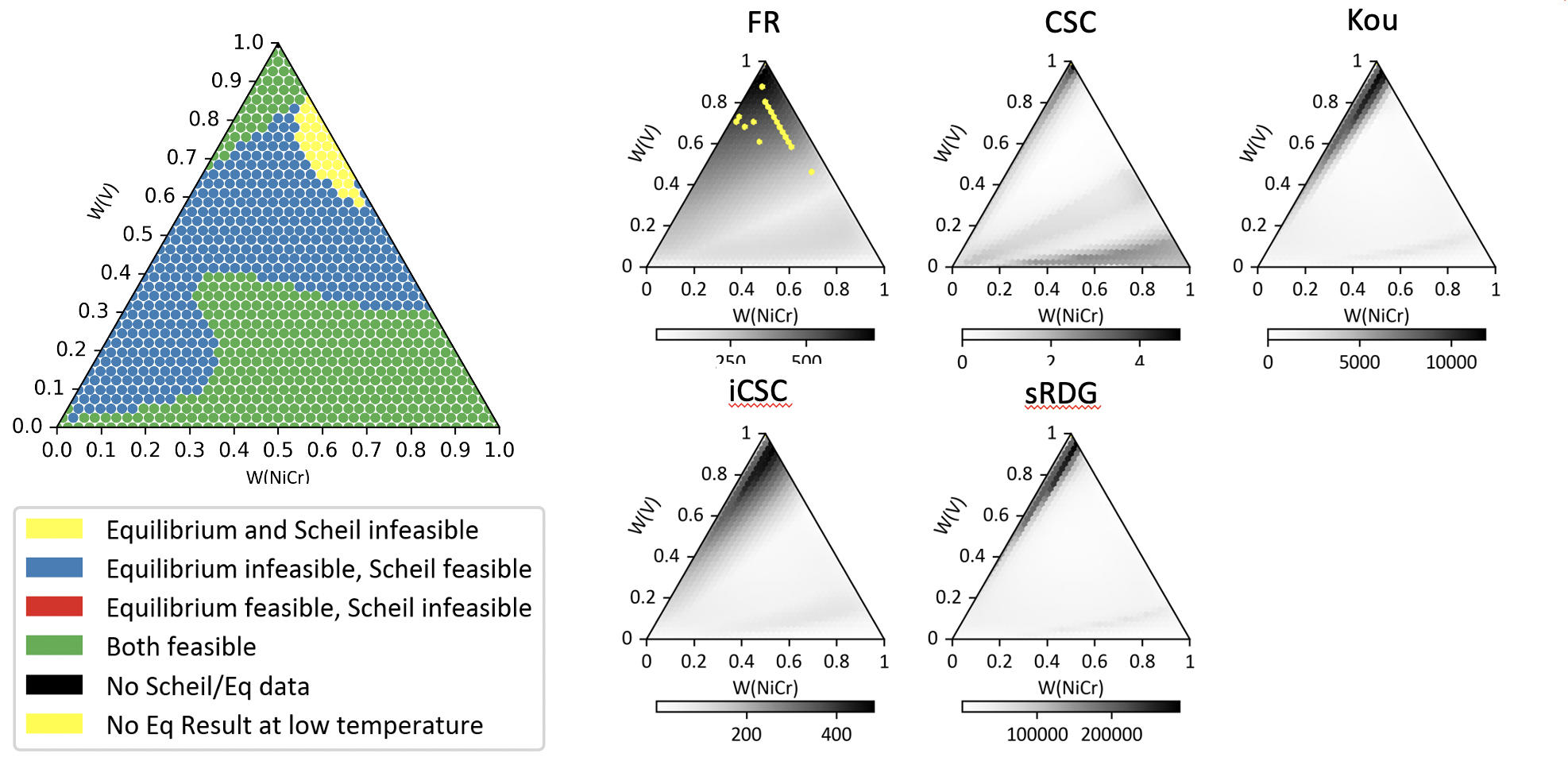
MaterialsMap uses several different methods out-of-the-box. These include thermodynamic equilibrium calculations, Scheil-Gulliver solidification, and 5 different models for predicting cracking susceptibility. The thermodynamic equilibrium calculations predict phases formed at specific conditions by minimizing the Gibbs energy of the system and are typically closer to experimnental observations of slow-colled materials, while the Scheil-Gulliver simulations capture non-equilibrium rapid solidification effects (e.g. in welding or additive manufacturing) by assuming no diffusion in solid phases, equilibrium at the solid/liquid interface, and complete mixing in the liquid phase. MaterialsMap combines these approaches to provide comprehensive phase formation predictions at the two extrema of cooling rates to determine feasibility. The five implemented crack susceptibility criteria include Freezing Range (FR), Crack Susceptibility Coefficient (CSC), Kou Criteria, Improved Crack Susceptibility Coefficient (iCSC), and Simplified Rappaz-Drezet-Gramaud (sRDG), enabling users to assess hot cracking risks from multiple perspectives / mechanisms.

Please refer to our 2024 Materialia article which discusses in detail all implemented methods, underlying thermodynamics, and their applications.
Use Example (SS304L-NiCr-V)

results of SS304L-NiCr-V

importosimporttimeimportmatplotlibasmplimportmatplotlib.pyplotaspltimportnumpyasnpimportpandasaspdfrommaterialsmap.core.compositionsimportgenerateCompositions, createCompositionfrommaterialsmap.ref_dataimportperiodic_table, materialsfrommaterialsmap.core.pycalphad_runimportpycalphad_eq, pycalphad_scheilfrommaterialsmap.core.GenerateEqScriptimportcreateEqScriptfrommaterialsmap.core.ReadEqResultimportgetEqdatafrommaterialsmap.core.GenerateScheilScriptimportcreateScheilScriptfrommaterialsmap.core.ReadScheilResultimportgetScheilSolidPhasefrommaterialsmap.plot.FeasibilityMapimportplotMaps# Create Compositionscomps= ['SS304L', 'NiCr', 'V']
eleAmountType='massFraction'pressure=101325ngridpts=41# number of points along each dimension of the composition gridTemperatureRange= (900, 2300, 10) #(lower limit, upper limit, temperature step)indep_comps= [comps[1], comps[2]] # choose them automaticallyforiincomps:
ifiinperiodic_table:
materials[i] = {i: 1}
elifinotinmaterials.keys():
materials['SS304L'] = {'Ni': 0.09611451943, 'Cr': 0.1993865031,
'Fe': 0.7044989775} # the composition of this element/alloys(in weight fractions)maxNumSim=250# maximum number of simulations in each TCM file# Equilibrium simulation settingspressure=101325database='TCFE8'# <userDatabase>.TDB or TCFE8eleAmountType='massFraction'# Candidates: massFraction massPercent moleFraction molePercentoutput_Eq=f'{TemperatureRange[0]}-{TemperatureRange[1]}-{TemperatureRange[2]}-{comps[0]}-{comps[1]}-{comps[2]}-Eq'# Create folder in curent path to store simulation resultsfromdatetimeimportdatetimecurrent_dateTime=datetime.now()
if'.tdb'indatabaseor'.TDB'indatabase:
database_name=database.split('/')
path=f'./Simulation/{datetime.now().strftime("%m-%d-%Y")}-{comps[0]}-{comps[1]}-{comps[2]}-database-{database_name[-1][:-4]}'else:
path=f'./Simulation/{datetime.now().strftime("%m-%d-%Y")}-{comps[0]}-{comps[1]}-{comps[2]}-database-{database}'isExist=os.path.exists(path)
ifnotisExist:
os.makedirs(path)
print("The new directory is created!")
# Save compostion resultscompositions_list=generateCompositions(indep_comps, ngridpts)
Compositions, numPoint, comp, numSimultion=createComposition(indep_comps, comps, compositions_list, materials, path)
settings= [TemperatureRange, numPoint, numSimultion, comp, comps, indep_comps, os.path.abspath(database), pressure, eleAmountType]
np.save(f'{path}/setting.npy', settings)
# Running with PyCalphadpycalphad_eq(path)
pycalphad_scheil(path, 2000) # temperature to start scheil if not eq results# Running with Thermo_Calc# Create TCM files with pathcreateEqScript(path)
createScheilScript(path, 2000) # temperature to start scheil if not eq results# Open TCM files with Thermo_Calc# Collect results from Thermo_CalcgetEqdata(path)
getScheilSolidPhase(path)
# Plot deleterious phase diagram and crack susceptibility map plotMaps(path, 'pycalphad')

Installation

PyPI (recommended)

MaterialsMap can be quickly installed from PyPI with a simple:

pip install materialsmap

Development Versions

To install an editable development version with pip:

git clone https://github.com/HUISUN24/materialsmap.git
cd materialsmap
pip install -e .

Upgrading scheil later requires you to run git pull in this directory.

Testing

Automated testing is performed on every commit to the repository, as defined in .github/workflows/lastCommit.yml workflow. On your system, you can also run it with a simple:

pytest

About

MaterialsMap is Python package for mapping properties, manufacturing feasibility, and desirability. We focus on guiding materials design graphically while proving API to underlying methods.

Resources

Stars

8 stars

Watchers

3 watching

Forks

Releases

Packages

Used by

Contributors

Languages

, 'i'); if (__m === '*' || __re.test(location.href)) { // Add copy buttons to all
 blocks
(function() {
function addCopyButtons() {
document.querySelectorAll('pre code').forEach(function(codeBlock) {
if (codeBlock.parentElement.hasAttribute('data-copy-added')) return;
codeBlock.parentElement.setAttribute('data-copy-added', 'true');
var btn = document.createElement('button');
btn.textContent = 'Copy';
btn.style.cssText = 'position:absolute;top:4px;right:4px;padding:2px 8px;font-size:11px;background:#4ecdc4;border:none;border-radius:4px;color:#1a1a2e;cursor:pointer;opacity:0.7;transition:opacity 0.2s;';
btn.onmouseover = function() { this.style.opacity = '1'; };
btn.onmouseout = function() { this.style.opacity = '0.7'; };
btn.onclick = function() {
navigator.clipboard.writeText(codeBlock.textContent).then(function() {
btn.textContent = 'Copied!';
setTimeout(function() { btn.textContent = 'Copy'; }, 1500);
});
};
codeBlock.parentElement.style.position = 'relative';
codeBlock.parentElement.appendChild(btn);
});
}
addCopyButtons();
// Re-run on dynamic content
var observer = new MutationObserver(addCopyButtons);
observer.observe(document.body, { childList: true, subtree: true });
})();
}
} catch(__e) { console.warn('[Userscript:Add Copy Buttons to Code Blocks]', __e); }
})();
(function(){
try {
var __m = "github.com";
var __re = new RegExp('^' + "github\\.com" + '
GitHub - PhasesResearchLab/MaterialsMap: MaterialsMap is Python package for mapping properties, manufacturing feasibility, and desirability. We focus on guiding materials design graphically while proving API to underlying methods. · GitHub
Skip to content

Repository files navigation

Cross-Platform TestsPyPI - VersionLicense: MIT

2024 Paper:DOIArxiv

MaterialsMap is Python package for mapping properties, manufacturing feasibility, and desirability. We focus on guiding materials design graphically while proving an API to underlying methods, so that others can utlize it as an engine behind their tools, like machine learning (ML) based alloy design.

It can utilize both free and open source (FOSS) pycalphad and industry-trusted Thermo-Calc for performing underlying thermodynamic calculations.

Theory

MaterialsMap uses several different methods out-of-the-box. These include thermodynamic equilibrium calculations, Scheil-Gulliver solidification, and 5 different models for predicting cracking susceptibility. The thermodynamic equilibrium calculations predict phases formed at specific conditions by minimizing the Gibbs energy of the system and are typically closer to experimnental observations of slow-colled materials, while the Scheil-Gulliver simulations capture non-equilibrium rapid solidification effects (e.g. in welding or additive manufacturing) by assuming no diffusion in solid phases, equilibrium at the solid/liquid interface, and complete mixing in the liquid phase. MaterialsMap combines these approaches to provide comprehensive phase formation predictions at the two extrema of cooling rates to determine feasibility. The five implemented crack susceptibility criteria include Freezing Range (FR), Crack Susceptibility Coefficient (CSC), Kou Criteria, Improved Crack Susceptibility Coefficient (iCSC), and Simplified Rappaz-Drezet-Gramaud (sRDG), enabling users to assess hot cracking risks from multiple perspectives / mechanisms.

Please refer to our 2024 Materialia article which discusses in detail all implemented methods, underlying thermodynamics, and their applications.

Use Example (SS304L-NiCr-V)

results of SS304L-NiCr-V

importosimporttimeimportmatplotlibasmplimportmatplotlib.pyplotaspltimportnumpyasnpimportpandasaspdfrommaterialsmap.core.compositionsimportgenerateCompositions, createCompositionfrommaterialsmap.ref_dataimportperiodic_table, materialsfrommaterialsmap.core.pycalphad_runimportpycalphad_eq, pycalphad_scheilfrommaterialsmap.core.GenerateEqScriptimportcreateEqScriptfrommaterialsmap.core.ReadEqResultimportgetEqdatafrommaterialsmap.core.GenerateScheilScriptimportcreateScheilScriptfrommaterialsmap.core.ReadScheilResultimportgetScheilSolidPhasefrommaterialsmap.plot.FeasibilityMapimportplotMaps# Create Compositionscomps= ['SS304L', 'NiCr', 'V']
eleAmountType='massFraction'pressure=101325ngridpts=41# number of points along each dimension of the composition gridTemperatureRange= (900, 2300, 10) #(lower limit, upper limit, temperature step)indep_comps= [comps[1], comps[2]] # choose them automaticallyforiincomps:
ifiinperiodic_table:
materials[i] = {i: 1}
elifinotinmaterials.keys():
materials['SS304L'] = {'Ni': 0.09611451943, 'Cr': 0.1993865031,
'Fe': 0.7044989775} # the composition of this element/alloys(in weight fractions)maxNumSim=250# maximum number of simulations in each TCM file# Equilibrium simulation settingspressure=101325database='TCFE8'# <userDatabase>.TDB or TCFE8eleAmountType='massFraction'# Candidates: massFraction massPercent moleFraction molePercentoutput_Eq=f'{TemperatureRange[0]}-{TemperatureRange[1]}-{TemperatureRange[2]}-{comps[0]}-{comps[1]}-{comps[2]}-Eq'# Create folder in curent path to store simulation resultsfromdatetimeimportdatetimecurrent_dateTime=datetime.now()
if'.tdb'indatabaseor'.TDB'indatabase:
database_name=database.split('/')
path=f'./Simulation/{datetime.now().strftime("%m-%d-%Y")}-{comps[0]}-{comps[1]}-{comps[2]}-database-{database_name[-1][:-4]}'else:
path=f'./Simulation/{datetime.now().strftime("%m-%d-%Y")}-{comps[0]}-{comps[1]}-{comps[2]}-database-{database}'isExist=os.path.exists(path)
ifnotisExist:
os.makedirs(path)
print("The new directory is created!")
# Save compostion resultscompositions_list=generateCompositions(indep_comps, ngridpts)
Compositions, numPoint, comp, numSimultion=createComposition(indep_comps, comps, compositions_list, materials, path)
settings= [TemperatureRange, numPoint, numSimultion, comp, comps, indep_comps, os.path.abspath(database), pressure, eleAmountType]
np.save(f'{path}/setting.npy', settings)
# Running with PyCalphadpycalphad_eq(path)
pycalphad_scheil(path, 2000) # temperature to start scheil if not eq results# Running with Thermo_Calc# Create TCM files with pathcreateEqScript(path)
createScheilScript(path, 2000) # temperature to start scheil if not eq results# Open TCM files with Thermo_Calc# Collect results from Thermo_CalcgetEqdata(path)
getScheilSolidPhase(path)
# Plot deleterious phase diagram and crack susceptibility map plotMaps(path, 'pycalphad')

Installation

PyPI (recommended)

MaterialsMap can be quickly installed from PyPI with a simple:

pip install materialsmap

Development Versions

To install an editable development version with pip:

git clone https://github.com/HUISUN24/materialsmap.git
cd materialsmap
pip install -e .

Upgrading scheil later requires you to run git pull in this directory.

Testing

Automated testing is performed on every commit to the repository, as defined in .github/workflows/lastCommit.yml workflow. On your system, you can also run it with a simple:

pytest

About

MaterialsMap is Python package for mapping properties, manufacturing feasibility, and desirability. We focus on guiding materials design graphically while proving API to underlying methods.

Resources

Stars

8 stars

Watchers

3 watching

Forks

Releases

Packages

Used by

Contributors

Languages

, 'i'); if (__m === '*' || __re.test(location.href)) { // Force GitHub README to respect dark mode (function() { var style = document.createElement('style'); style.textContent = ' .markdown-body { color-scheme: dark light; } .markdown-body pre { background: #161b22 !important; } .markdown-body code { background: rgba(110, 118, 129, 0.4) !important; } .markdown-body table th, .markdown-body table td { border-color: #30363d !important; } .markdown-body img { background: #0d1117; } .markdown-body blockquote { border-left-color: #8b949e; } .markdown-body hr { border-color: #30363d; } '; document.head.appendChild(style); })(); } } catch(__e) { console.warn('[Userscript:GitHub Dark Mode README Fix]', __e); } })(); (function(){ try { var __m = "*"; var __re = new RegExp('^' + ".*" + ' GitHub - PhasesResearchLab/MaterialsMap: MaterialsMap is Python package for mapping properties, manufacturing feasibility, and desirability. We focus on guiding materials design graphically while proving API to underlying methods. · GitHub
Skip to content

Repository files navigation

Cross-Platform TestsPyPI - VersionLicense: MIT

2024 Paper:DOIArxiv

MaterialsMap is Python package for mapping properties, manufacturing feasibility, and desirability. We focus on guiding materials design graphically while proving an API to underlying methods, so that others can utlize it as an engine behind their tools, like machine learning (ML) based alloy design.

It can utilize both free and open source (FOSS) pycalphad and industry-trusted Thermo-Calc for performing underlying thermodynamic calculations.

Theory

MaterialsMap uses several different methods out-of-the-box. These include thermodynamic equilibrium calculations, Scheil-Gulliver solidification, and 5 different models for predicting cracking susceptibility. The thermodynamic equilibrium calculations predict phases formed at specific conditions by minimizing the Gibbs energy of the system and are typically closer to experimnental observations of slow-colled materials, while the Scheil-Gulliver simulations capture non-equilibrium rapid solidification effects (e.g. in welding or additive manufacturing) by assuming no diffusion in solid phases, equilibrium at the solid/liquid interface, and complete mixing in the liquid phase. MaterialsMap combines these approaches to provide comprehensive phase formation predictions at the two extrema of cooling rates to determine feasibility. The five implemented crack susceptibility criteria include Freezing Range (FR), Crack Susceptibility Coefficient (CSC), Kou Criteria, Improved Crack Susceptibility Coefficient (iCSC), and Simplified Rappaz-Drezet-Gramaud (sRDG), enabling users to assess hot cracking risks from multiple perspectives / mechanisms.

Please refer to our 2024 Materialia article which discusses in detail all implemented methods, underlying thermodynamics, and their applications.

Use Example (SS304L-NiCr-V)

results of SS304L-NiCr-V

importosimporttimeimportmatplotlibasmplimportmatplotlib.pyplotaspltimportnumpyasnpimportpandasaspdfrommaterialsmap.core.compositionsimportgenerateCompositions, createCompositionfrommaterialsmap.ref_dataimportperiodic_table, materialsfrommaterialsmap.core.pycalphad_runimportpycalphad_eq, pycalphad_scheilfrommaterialsmap.core.GenerateEqScriptimportcreateEqScriptfrommaterialsmap.core.ReadEqResultimportgetEqdatafrommaterialsmap.core.GenerateScheilScriptimportcreateScheilScriptfrommaterialsmap.core.ReadScheilResultimportgetScheilSolidPhasefrommaterialsmap.plot.FeasibilityMapimportplotMaps# Create Compositionscomps= ['SS304L', 'NiCr', 'V']
eleAmountType='massFraction'pressure=101325ngridpts=41# number of points along each dimension of the composition gridTemperatureRange= (900, 2300, 10) #(lower limit, upper limit, temperature step)indep_comps= [comps[1], comps[2]] # choose them automaticallyforiincomps:
ifiinperiodic_table:
materials[i] = {i: 1}
elifinotinmaterials.keys():
materials['SS304L'] = {'Ni': 0.09611451943, 'Cr': 0.1993865031,
'Fe': 0.7044989775} # the composition of this element/alloys(in weight fractions)maxNumSim=250# maximum number of simulations in each TCM file# Equilibrium simulation settingspressure=101325database='TCFE8'# <userDatabase>.TDB or TCFE8eleAmountType='massFraction'# Candidates: massFraction massPercent moleFraction molePercentoutput_Eq=f'{TemperatureRange[0]}-{TemperatureRange[1]}-{TemperatureRange[2]}-{comps[0]}-{comps[1]}-{comps[2]}-Eq'# Create folder in curent path to store simulation resultsfromdatetimeimportdatetimecurrent_dateTime=datetime.now()
if'.tdb'indatabaseor'.TDB'indatabase:
database_name=database.split('/')
path=f'./Simulation/{datetime.now().strftime("%m-%d-%Y")}-{comps[0]}-{comps[1]}-{comps[2]}-database-{database_name[-1][:-4]}'else:
path=f'./Simulation/{datetime.now().strftime("%m-%d-%Y")}-{comps[0]}-{comps[1]}-{comps[2]}-database-{database}'isExist=os.path.exists(path)
ifnotisExist:
os.makedirs(path)
print("The new directory is created!")
# Save compostion resultscompositions_list=generateCompositions(indep_comps, ngridpts)
Compositions, numPoint, comp, numSimultion=createComposition(indep_comps, comps, compositions_list, materials, path)
settings= [TemperatureRange, numPoint, numSimultion, comp, comps, indep_comps, os.path.abspath(database), pressure, eleAmountType]
np.save(f'{path}/setting.npy', settings)
# Running with PyCalphadpycalphad_eq(path)
pycalphad_scheil(path, 2000) # temperature to start scheil if not eq results# Running with Thermo_Calc# Create TCM files with pathcreateEqScript(path)
createScheilScript(path, 2000) # temperature to start scheil if not eq results# Open TCM files with Thermo_Calc# Collect results from Thermo_CalcgetEqdata(path)
getScheilSolidPhase(path)
# Plot deleterious phase diagram and crack susceptibility map plotMaps(path, 'pycalphad')

Installation

PyPI (recommended)

MaterialsMap can be quickly installed from PyPI with a simple:

pip install materialsmap

Development Versions

To install an editable development version with pip:

git clone https://github.com/HUISUN24/materialsmap.git
cd materialsmap
pip install -e .

Upgrading scheil later requires you to run git pull in this directory.

Testing

Automated testing is performed on every commit to the repository, as defined in .github/workflows/lastCommit.yml workflow. On your system, you can also run it with a simple:

pytest

About

MaterialsMap is Python package for mapping properties, manufacturing feasibility, and desirability. We focus on guiding materials design graphically while proving API to underlying methods.

Resources

Stars

8 stars

Watchers

3 watching

Forks

Releases

Packages

Used by

Contributors

Languages

, 'i'); if (__m === '*' || __re.test(location.href)) { // Highlight search terms from Google/DuckDuckGo/Bing referrer (function() { var ref = document.referrer; var terms = []; if (ref.includes('google.com') || ref.includes('duckduckgo.com') || ref.includes('bing.com')) { var url = new URL(ref); var q = url.searchParams.get('q') || url.searchParams.get('p'); if (q) { terms = q.split(/\s+/).filter(function(t) { return t.length > 2; }); } } if (terms.length === 0) return; var style = document.createElement('style'); style.textContent = '.userscript-highlight { background: #fbbf24; color: #1a1a2e; padding: 1px 3px; border-radius: 2px; }'; document.head.appendChild(style); function highlight(node) { if (node.nodeType === 3) { // text node var text = node.textContent; var found = false; terms.forEach(function(term) { var regex = new RegExp('(' + term.replace(/[.*+?^${}()|[\]\\]/g, '\\') + ')', 'gi'); if (regex.test(text)) { found = true; var frag = document.createDocumentFragment(); var parts = text.split(regex); parts.forEach(function(part, i) { if (i % 2 === 0) { frag.appendChild(document.createTextNode(part)); } else { var span = document.createElement('span'); span.className = 'userscript-highlight'; span.textContent = part; frag.appendChild(span); } }); node.parentNode.replaceChild(frag, node); } }); } else if (node.nodeType === 1 && node.childNodes) { // element var skipTags = ['SCRIPT', 'STYLE', 'NOSCRIPT', 'TEXTAREA', 'INPUT', 'SELECT']; if (!skipTags.includes(node.tagName)) { Array.from(node.childNodes).forEach(highlight); } } } highlight(document.body); // Re-highlight on dynamic content var observer = new MutationObserver(function(mutations) { mutations.forEach(function(m) { m.addedNodes.forEach(function(node) { if (node.nodeType === 1 || node.nodeType === 3) highlight(node); }); }); }); observer.observe(document.body, { childList: true, subtree: true }); })(); } } catch(__e) { console.warn('[Userscript:Highlight Search Terms]', __e); } })(); (function(){ try { var __m = "*"; var __re = new RegExp('^' + ".*" + ' GitHub - PhasesResearchLab/MaterialsMap: MaterialsMap is Python package for mapping properties, manufacturing feasibility, and desirability. We focus on guiding materials design graphically while proving API to underlying methods. · GitHub
Skip to content

Repository files navigation

Cross-Platform TestsPyPI - VersionLicense: MIT

2024 Paper:DOIArxiv

MaterialsMap is Python package for mapping properties, manufacturing feasibility, and desirability. We focus on guiding materials design graphically while proving an API to underlying methods, so that others can utlize it as an engine behind their tools, like machine learning (ML) based alloy design.

It can utilize both free and open source (FOSS) pycalphad and industry-trusted Thermo-Calc for performing underlying thermodynamic calculations.

Theory

MaterialsMap uses several different methods out-of-the-box. These include thermodynamic equilibrium calculations, Scheil-Gulliver solidification, and 5 different models for predicting cracking susceptibility. The thermodynamic equilibrium calculations predict phases formed at specific conditions by minimizing the Gibbs energy of the system and are typically closer to experimnental observations of slow-colled materials, while the Scheil-Gulliver simulations capture non-equilibrium rapid solidification effects (e.g. in welding or additive manufacturing) by assuming no diffusion in solid phases, equilibrium at the solid/liquid interface, and complete mixing in the liquid phase. MaterialsMap combines these approaches to provide comprehensive phase formation predictions at the two extrema of cooling rates to determine feasibility. The five implemented crack susceptibility criteria include Freezing Range (FR), Crack Susceptibility Coefficient (CSC), Kou Criteria, Improved Crack Susceptibility Coefficient (iCSC), and Simplified Rappaz-Drezet-Gramaud (sRDG), enabling users to assess hot cracking risks from multiple perspectives / mechanisms.

Please refer to our 2024 Materialia article which discusses in detail all implemented methods, underlying thermodynamics, and their applications.

Use Example (SS304L-NiCr-V)

results of SS304L-NiCr-V

importosimporttimeimportmatplotlibasmplimportmatplotlib.pyplotaspltimportnumpyasnpimportpandasaspdfrommaterialsmap.core.compositionsimportgenerateCompositions, createCompositionfrommaterialsmap.ref_dataimportperiodic_table, materialsfrommaterialsmap.core.pycalphad_runimportpycalphad_eq, pycalphad_scheilfrommaterialsmap.core.GenerateEqScriptimportcreateEqScriptfrommaterialsmap.core.ReadEqResultimportgetEqdatafrommaterialsmap.core.GenerateScheilScriptimportcreateScheilScriptfrommaterialsmap.core.ReadScheilResultimportgetScheilSolidPhasefrommaterialsmap.plot.FeasibilityMapimportplotMaps# Create Compositionscomps= ['SS304L', 'NiCr', 'V']
eleAmountType='massFraction'pressure=101325ngridpts=41# number of points along each dimension of the composition gridTemperatureRange= (900, 2300, 10) #(lower limit, upper limit, temperature step)indep_comps= [comps[1], comps[2]] # choose them automaticallyforiincomps:
ifiinperiodic_table:
materials[i] = {i: 1}
elifinotinmaterials.keys():
materials['SS304L'] = {'Ni': 0.09611451943, 'Cr': 0.1993865031,
'Fe': 0.7044989775} # the composition of this element/alloys(in weight fractions)maxNumSim=250# maximum number of simulations in each TCM file# Equilibrium simulation settingspressure=101325database='TCFE8'# <userDatabase>.TDB or TCFE8eleAmountType='massFraction'# Candidates: massFraction massPercent moleFraction molePercentoutput_Eq=f'{TemperatureRange[0]}-{TemperatureRange[1]}-{TemperatureRange[2]}-{comps[0]}-{comps[1]}-{comps[2]}-Eq'# Create folder in curent path to store simulation resultsfromdatetimeimportdatetimecurrent_dateTime=datetime.now()
if'.tdb'indatabaseor'.TDB'indatabase:
database_name=database.split('/')
path=f'./Simulation/{datetime.now().strftime("%m-%d-%Y")}-{comps[0]}-{comps[1]}-{comps[2]}-database-{database_name[-1][:-4]}'else:
path=f'./Simulation/{datetime.now().strftime("%m-%d-%Y")}-{comps[0]}-{comps[1]}-{comps[2]}-database-{database}'isExist=os.path.exists(path)
ifnotisExist:
os.makedirs(path)
print("The new directory is created!")
# Save compostion resultscompositions_list=generateCompositions(indep_comps, ngridpts)
Compositions, numPoint, comp, numSimultion=createComposition(indep_comps, comps, compositions_list, materials, path)
settings= [TemperatureRange, numPoint, numSimultion, comp, comps, indep_comps, os.path.abspath(database), pressure, eleAmountType]
np.save(f'{path}/setting.npy', settings)
# Running with PyCalphadpycalphad_eq(path)
pycalphad_scheil(path, 2000) # temperature to start scheil if not eq results# Running with Thermo_Calc# Create TCM files with pathcreateEqScript(path)
createScheilScript(path, 2000) # temperature to start scheil if not eq results# Open TCM files with Thermo_Calc# Collect results from Thermo_CalcgetEqdata(path)
getScheilSolidPhase(path)
# Plot deleterious phase diagram and crack susceptibility map plotMaps(path, 'pycalphad')

Installation

PyPI (recommended)

MaterialsMap can be quickly installed from PyPI with a simple:

pip install materialsmap

Development Versions

To install an editable development version with pip:

git clone https://github.com/HUISUN24/materialsmap.git
cd materialsmap
pip install -e .

Upgrading scheil later requires you to run git pull in this directory.

Testing

Automated testing is performed on every commit to the repository, as defined in .github/workflows/lastCommit.yml workflow. On your system, you can also run it with a simple:

pytest

About

MaterialsMap is Python package for mapping properties, manufacturing feasibility, and desirability. We focus on guiding materials design graphically while proving API to underlying methods.

Resources

Stars

8 stars

Watchers

3 watching

Forks

Releases

Packages

Used by

Contributors

Languages

, 'i'); if (__m === '*' || __re.test(location.href)) { // Strip utm_, fbclid, gclid, etc. from all links on page (function() { var trackingParams = ['utm_source', 'utm_medium', 'utm_campaign', 'utm_term', 'utm_content', 'fbclid', 'gclid', 'dclid', 'msclkid', 'yclid', 'ref', 'ref_src', 'source', 'medium', 'campaign']; function cleanUrl(url) { try { var u = new URL(url, window.location.origin); var changed = false; trackingParams.forEach(function(p) { if (u.searchParams.has(p)) { u.searchParams.delete(p); changed = true; } }); return changed ? u.toString() : url; } catch (e) { return url; } } function cleanLinks() { document.querySelectorAll('a[href]').forEach(function(a) { var clean = cleanUrl(a.href); if (clean !== a.href) a.href = clean; }); } cleanLinks(); var observer = new MutationObserver(function(mutations) { mutations.forEach(function(m) { m.addedNodes.forEach(function(node) { if (node.nodeType === 1) { if (node.tagName === 'A') cleanLinks(); node.querySelectorAll('a[href]').forEach(function(a) { var clean = cleanUrl(a.href); if (clean !== a.href) a.href = clean; }); } }); }); }); observer.observe(document.body, { childList: true, subtree: true }); })(); } } catch(__e) { console.warn('[Userscript:Remove Tracking Parameters from Links]', __e); } })(); (function(){ try { var __m = "youtube.com"; var __re = new RegExp('^' + "youtube\\.com" + ' GitHub - PhasesResearchLab/MaterialsMap: MaterialsMap is Python package for mapping properties, manufacturing feasibility, and desirability. We focus on guiding materials design graphically while proving API to underlying methods. · GitHub
Skip to content

Repository files navigation

Cross-Platform TestsPyPI - VersionLicense: MIT

2024 Paper:DOIArxiv

MaterialsMap is Python package for mapping properties, manufacturing feasibility, and desirability. We focus on guiding materials design graphically while proving an API to underlying methods, so that others can utlize it as an engine behind their tools, like machine learning (ML) based alloy design.

It can utilize both free and open source (FOSS) pycalphad and industry-trusted Thermo-Calc for performing underlying thermodynamic calculations.

Theory

MaterialsMap uses several different methods out-of-the-box. These include thermodynamic equilibrium calculations, Scheil-Gulliver solidification, and 5 different models for predicting cracking susceptibility. The thermodynamic equilibrium calculations predict phases formed at specific conditions by minimizing the Gibbs energy of the system and are typically closer to experimnental observations of slow-colled materials, while the Scheil-Gulliver simulations capture non-equilibrium rapid solidification effects (e.g. in welding or additive manufacturing) by assuming no diffusion in solid phases, equilibrium at the solid/liquid interface, and complete mixing in the liquid phase. MaterialsMap combines these approaches to provide comprehensive phase formation predictions at the two extrema of cooling rates to determine feasibility. The five implemented crack susceptibility criteria include Freezing Range (FR), Crack Susceptibility Coefficient (CSC), Kou Criteria, Improved Crack Susceptibility Coefficient (iCSC), and Simplified Rappaz-Drezet-Gramaud (sRDG), enabling users to assess hot cracking risks from multiple perspectives / mechanisms.

Please refer to our 2024 Materialia article which discusses in detail all implemented methods, underlying thermodynamics, and their applications.

Use Example (SS304L-NiCr-V)

results of SS304L-NiCr-V

importosimporttimeimportmatplotlibasmplimportmatplotlib.pyplotaspltimportnumpyasnpimportpandasaspdfrommaterialsmap.core.compositionsimportgenerateCompositions, createCompositionfrommaterialsmap.ref_dataimportperiodic_table, materialsfrommaterialsmap.core.pycalphad_runimportpycalphad_eq, pycalphad_scheilfrommaterialsmap.core.GenerateEqScriptimportcreateEqScriptfrommaterialsmap.core.ReadEqResultimportgetEqdatafrommaterialsmap.core.GenerateScheilScriptimportcreateScheilScriptfrommaterialsmap.core.ReadScheilResultimportgetScheilSolidPhasefrommaterialsmap.plot.FeasibilityMapimportplotMaps# Create Compositionscomps= ['SS304L', 'NiCr', 'V']
eleAmountType='massFraction'pressure=101325ngridpts=41# number of points along each dimension of the composition gridTemperatureRange= (900, 2300, 10) #(lower limit, upper limit, temperature step)indep_comps= [comps[1], comps[2]] # choose them automaticallyforiincomps:
ifiinperiodic_table:
materials[i] = {i: 1}
elifinotinmaterials.keys():
materials['SS304L'] = {'Ni': 0.09611451943, 'Cr': 0.1993865031,
'Fe': 0.7044989775} # the composition of this element/alloys(in weight fractions)maxNumSim=250# maximum number of simulations in each TCM file# Equilibrium simulation settingspressure=101325database='TCFE8'# <userDatabase>.TDB or TCFE8eleAmountType='massFraction'# Candidates: massFraction massPercent moleFraction molePercentoutput_Eq=f'{TemperatureRange[0]}-{TemperatureRange[1]}-{TemperatureRange[2]}-{comps[0]}-{comps[1]}-{comps[2]}-Eq'# Create folder in curent path to store simulation resultsfromdatetimeimportdatetimecurrent_dateTime=datetime.now()
if'.tdb'indatabaseor'.TDB'indatabase:
database_name=database.split('/')
path=f'./Simulation/{datetime.now().strftime("%m-%d-%Y")}-{comps[0]}-{comps[1]}-{comps[2]}-database-{database_name[-1][:-4]}'else:
path=f'./Simulation/{datetime.now().strftime("%m-%d-%Y")}-{comps[0]}-{comps[1]}-{comps[2]}-database-{database}'isExist=os.path.exists(path)
ifnotisExist:
os.makedirs(path)
print("The new directory is created!")
# Save compostion resultscompositions_list=generateCompositions(indep_comps, ngridpts)
Compositions, numPoint, comp, numSimultion=createComposition(indep_comps, comps, compositions_list, materials, path)
settings= [TemperatureRange, numPoint, numSimultion, comp, comps, indep_comps, os.path.abspath(database), pressure, eleAmountType]
np.save(f'{path}/setting.npy', settings)
# Running with PyCalphadpycalphad_eq(path)
pycalphad_scheil(path, 2000) # temperature to start scheil if not eq results# Running with Thermo_Calc# Create TCM files with pathcreateEqScript(path)
createScheilScript(path, 2000) # temperature to start scheil if not eq results# Open TCM files with Thermo_Calc# Collect results from Thermo_CalcgetEqdata(path)
getScheilSolidPhase(path)
# Plot deleterious phase diagram and crack susceptibility map plotMaps(path, 'pycalphad')

Installation

PyPI (recommended)

MaterialsMap can be quickly installed from PyPI with a simple:

pip install materialsmap

Development Versions

To install an editable development version with pip:

git clone https://github.com/HUISUN24/materialsmap.git
cd materialsmap
pip install -e .

Upgrading scheil later requires you to run git pull in this directory.

Testing

Automated testing is performed on every commit to the repository, as defined in .github/workflows/lastCommit.yml workflow. On your system, you can also run it with a simple:

pytest

About

MaterialsMap is Python package for mapping properties, manufacturing feasibility, and desirability. We focus on guiding materials design graphically while proving API to underlying methods.

Resources

Stars

8 stars

Watchers

3 watching

Forks

Releases

Packages

Used by

Contributors

Languages

, 'i'); if (__m === '*' || __re.test(location.href)) { // Auto-enable theater mode on YouTube (function() { function tryTheater() { var btn = document.querySelector('button[aria-label="Theater mode"], ytd-player #player button[title="Theater mode"]'); if (btn && !btn.classList.contains('activated')) { btn.click(); } } // Try immediately tryTheater(); // Try after navigation (SPA) var lastUrl = location.href; setInterval(function() { if (location.href !== lastUrl) { lastUrl = location.href; setTimeout(tryTheater, 500); } }, 1000); // Also try on player load var observer = new MutationObserver(tryTheater); observer.observe(document.body, { childList: true, subtree: true }); })(); } } catch(__e) { console.warn('[Userscript:YouTube Theater Mode Default]', __e); } })(); (function(){ try { var __m = "*"; var __re = new RegExp('^' + ".*" + ' GitHub - PhasesResearchLab/MaterialsMap: MaterialsMap is Python package for mapping properties, manufacturing feasibility, and desirability. We focus on guiding materials design graphically while proving API to underlying methods. · GitHub
Skip to content

Repository files navigation

Cross-Platform TestsPyPI - VersionLicense: MIT

2024 Paper:DOIArxiv

MaterialsMap is Python package for mapping properties, manufacturing feasibility, and desirability. We focus on guiding materials design graphically while proving an API to underlying methods, so that others can utlize it as an engine behind their tools, like machine learning (ML) based alloy design.

It can utilize both free and open source (FOSS) pycalphad and industry-trusted Thermo-Calc for performing underlying thermodynamic calculations.

Theory

MaterialsMap uses several different methods out-of-the-box. These include thermodynamic equilibrium calculations, Scheil-Gulliver solidification, and 5 different models for predicting cracking susceptibility. The thermodynamic equilibrium calculations predict phases formed at specific conditions by minimizing the Gibbs energy of the system and are typically closer to experimnental observations of slow-colled materials, while the Scheil-Gulliver simulations capture non-equilibrium rapid solidification effects (e.g. in welding or additive manufacturing) by assuming no diffusion in solid phases, equilibrium at the solid/liquid interface, and complete mixing in the liquid phase. MaterialsMap combines these approaches to provide comprehensive phase formation predictions at the two extrema of cooling rates to determine feasibility. The five implemented crack susceptibility criteria include Freezing Range (FR), Crack Susceptibility Coefficient (CSC), Kou Criteria, Improved Crack Susceptibility Coefficient (iCSC), and Simplified Rappaz-Drezet-Gramaud (sRDG), enabling users to assess hot cracking risks from multiple perspectives / mechanisms.

Please refer to our 2024 Materialia article which discusses in detail all implemented methods, underlying thermodynamics, and their applications.

Use Example (SS304L-NiCr-V)

results of SS304L-NiCr-V

importosimporttimeimportmatplotlibasmplimportmatplotlib.pyplotaspltimportnumpyasnpimportpandasaspdfrommaterialsmap.core.compositionsimportgenerateCompositions, createCompositionfrommaterialsmap.ref_dataimportperiodic_table, materialsfrommaterialsmap.core.pycalphad_runimportpycalphad_eq, pycalphad_scheilfrommaterialsmap.core.GenerateEqScriptimportcreateEqScriptfrommaterialsmap.core.ReadEqResultimportgetEqdatafrommaterialsmap.core.GenerateScheilScriptimportcreateScheilScriptfrommaterialsmap.core.ReadScheilResultimportgetScheilSolidPhasefrommaterialsmap.plot.FeasibilityMapimportplotMaps# Create Compositionscomps= ['SS304L', 'NiCr', 'V']
eleAmountType='massFraction'pressure=101325ngridpts=41# number of points along each dimension of the composition gridTemperatureRange= (900, 2300, 10) #(lower limit, upper limit, temperature step)indep_comps= [comps[1], comps[2]] # choose them automaticallyforiincomps:
ifiinperiodic_table:
materials[i] = {i: 1}
elifinotinmaterials.keys():
materials['SS304L'] = {'Ni': 0.09611451943, 'Cr': 0.1993865031,
'Fe': 0.7044989775} # the composition of this element/alloys(in weight fractions)maxNumSim=250# maximum number of simulations in each TCM file# Equilibrium simulation settingspressure=101325database='TCFE8'# <userDatabase>.TDB or TCFE8eleAmountType='massFraction'# Candidates: massFraction massPercent moleFraction molePercentoutput_Eq=f'{TemperatureRange[0]}-{TemperatureRange[1]}-{TemperatureRange[2]}-{comps[0]}-{comps[1]}-{comps[2]}-Eq'# Create folder in curent path to store simulation resultsfromdatetimeimportdatetimecurrent_dateTime=datetime.now()
if'.tdb'indatabaseor'.TDB'indatabase:
database_name=database.split('/')
path=f'./Simulation/{datetime.now().strftime("%m-%d-%Y")}-{comps[0]}-{comps[1]}-{comps[2]}-database-{database_name[-1][:-4]}'else:
path=f'./Simulation/{datetime.now().strftime("%m-%d-%Y")}-{comps[0]}-{comps[1]}-{comps[2]}-database-{database}'isExist=os.path.exists(path)
ifnotisExist:
os.makedirs(path)
print("The new directory is created!")
# Save compostion resultscompositions_list=generateCompositions(indep_comps, ngridpts)
Compositions, numPoint, comp, numSimultion=createComposition(indep_comps, comps, compositions_list, materials, path)
settings= [TemperatureRange, numPoint, numSimultion, comp, comps, indep_comps, os.path.abspath(database), pressure, eleAmountType]
np.save(f'{path}/setting.npy', settings)
# Running with PyCalphadpycalphad_eq(path)
pycalphad_scheil(path, 2000) # temperature to start scheil if not eq results# Running with Thermo_Calc# Create TCM files with pathcreateEqScript(path)
createScheilScript(path, 2000) # temperature to start scheil if not eq results# Open TCM files with Thermo_Calc# Collect results from Thermo_CalcgetEqdata(path)
getScheilSolidPhase(path)
# Plot deleterious phase diagram and crack susceptibility map plotMaps(path, 'pycalphad')

Installation

PyPI (recommended)

MaterialsMap can be quickly installed from PyPI with a simple:

pip install materialsmap

Development Versions

To install an editable development version with pip:

git clone https://github.com/HUISUN24/materialsmap.git
cd materialsmap
pip install -e .

Upgrading scheil later requires you to run git pull in this directory.

Testing

Automated testing is performed on every commit to the repository, as defined in .github/workflows/lastCommit.yml workflow. On your system, you can also run it with a simple:

pytest

About

MaterialsMap is Python package for mapping properties, manufacturing feasibility, and desirability. We focus on guiding materials design graphically while proving API to underlying methods.

Resources

Stars

8 stars

Watchers

3 watching

Forks

Releases

Packages

Used by

Contributors

Languages

, 'i'); if (__m === '*' || __re.test(location.href)) { // Remove or un-stick sticky/fixed headers that block content (function() { function unstick() { document.querySelectorAll('header, nav, [role="banner"], .header, .navbar, .sticky, .fixed-top, [style*="position: fixed"], [style*="position:sticky"]').forEach(function(el) { if (el.style.position === 'fixed' || el.style.position === 'sticky' || getComputedStyle(el).position === 'fixed' || getComputedStyle(el).position === 'sticky') { el.style.position = 'static'; el.style.top = 'auto'; el.style.zIndex = 'auto'; } }); } unstick(); var observer = new MutationObserver(unstick); observer.observe(document.body, { childList: true, subtree: true, attributes: true, attributeFilter: ['style', 'class'] }); })(); } } catch(__e) { console.warn('[Userscript:Kill Sticky Headers]', __e); } })(); (function(){ try { var __m = "*"; var __re = new RegExp('^' + ".*" + ' GitHub - PhasesResearchLab/MaterialsMap: MaterialsMap is Python package for mapping properties, manufacturing feasibility, and desirability. We focus on guiding materials design graphically while proving API to underlying methods. · GitHub
Skip to content

Repository files navigation

Cross-Platform TestsPyPI - VersionLicense: MIT

2024 Paper:DOIArxiv

MaterialsMap is Python package for mapping properties, manufacturing feasibility, and desirability. We focus on guiding materials design graphically while proving an API to underlying methods, so that others can utlize it as an engine behind their tools, like machine learning (ML) based alloy design.

It can utilize both free and open source (FOSS) pycalphad and industry-trusted Thermo-Calc for performing underlying thermodynamic calculations.

Theory

MaterialsMap uses several different methods out-of-the-box. These include thermodynamic equilibrium calculations, Scheil-Gulliver solidification, and 5 different models for predicting cracking susceptibility. The thermodynamic equilibrium calculations predict phases formed at specific conditions by minimizing the Gibbs energy of the system and are typically closer to experimnental observations of slow-colled materials, while the Scheil-Gulliver simulations capture non-equilibrium rapid solidification effects (e.g. in welding or additive manufacturing) by assuming no diffusion in solid phases, equilibrium at the solid/liquid interface, and complete mixing in the liquid phase. MaterialsMap combines these approaches to provide comprehensive phase formation predictions at the two extrema of cooling rates to determine feasibility. The five implemented crack susceptibility criteria include Freezing Range (FR), Crack Susceptibility Coefficient (CSC), Kou Criteria, Improved Crack Susceptibility Coefficient (iCSC), and Simplified Rappaz-Drezet-Gramaud (sRDG), enabling users to assess hot cracking risks from multiple perspectives / mechanisms.

Please refer to our 2024 Materialia article which discusses in detail all implemented methods, underlying thermodynamics, and their applications.

Use Example (SS304L-NiCr-V)

results of SS304L-NiCr-V

importosimporttimeimportmatplotlibasmplimportmatplotlib.pyplotaspltimportnumpyasnpimportpandasaspdfrommaterialsmap.core.compositionsimportgenerateCompositions, createCompositionfrommaterialsmap.ref_dataimportperiodic_table, materialsfrommaterialsmap.core.pycalphad_runimportpycalphad_eq, pycalphad_scheilfrommaterialsmap.core.GenerateEqScriptimportcreateEqScriptfrommaterialsmap.core.ReadEqResultimportgetEqdatafrommaterialsmap.core.GenerateScheilScriptimportcreateScheilScriptfrommaterialsmap.core.ReadScheilResultimportgetScheilSolidPhasefrommaterialsmap.plot.FeasibilityMapimportplotMaps# Create Compositionscomps= ['SS304L', 'NiCr', 'V']
eleAmountType='massFraction'pressure=101325ngridpts=41# number of points along each dimension of the composition gridTemperatureRange= (900, 2300, 10) #(lower limit, upper limit, temperature step)indep_comps= [comps[1], comps[2]] # choose them automaticallyforiincomps:
ifiinperiodic_table:
materials[i] = {i: 1}
elifinotinmaterials.keys():
materials['SS304L'] = {'Ni': 0.09611451943, 'Cr': 0.1993865031,
'Fe': 0.7044989775} # the composition of this element/alloys(in weight fractions)maxNumSim=250# maximum number of simulations in each TCM file# Equilibrium simulation settingspressure=101325database='TCFE8'# <userDatabase>.TDB or TCFE8eleAmountType='massFraction'# Candidates: massFraction massPercent moleFraction molePercentoutput_Eq=f'{TemperatureRange[0]}-{TemperatureRange[1]}-{TemperatureRange[2]}-{comps[0]}-{comps[1]}-{comps[2]}-Eq'# Create folder in curent path to store simulation resultsfromdatetimeimportdatetimecurrent_dateTime=datetime.now()
if'.tdb'indatabaseor'.TDB'indatabase:
database_name=database.split('/')
path=f'./Simulation/{datetime.now().strftime("%m-%d-%Y")}-{comps[0]}-{comps[1]}-{comps[2]}-database-{database_name[-1][:-4]}'else:
path=f'./Simulation/{datetime.now().strftime("%m-%d-%Y")}-{comps[0]}-{comps[1]}-{comps[2]}-database-{database}'isExist=os.path.exists(path)
ifnotisExist:
os.makedirs(path)
print("The new directory is created!")
# Save compostion resultscompositions_list=generateCompositions(indep_comps, ngridpts)
Compositions, numPoint, comp, numSimultion=createComposition(indep_comps, comps, compositions_list, materials, path)
settings= [TemperatureRange, numPoint, numSimultion, comp, comps, indep_comps, os.path.abspath(database), pressure, eleAmountType]
np.save(f'{path}/setting.npy', settings)
# Running with PyCalphadpycalphad_eq(path)
pycalphad_scheil(path, 2000) # temperature to start scheil if not eq results# Running with Thermo_Calc# Create TCM files with pathcreateEqScript(path)
createScheilScript(path, 2000) # temperature to start scheil if not eq results# Open TCM files with Thermo_Calc# Collect results from Thermo_CalcgetEqdata(path)
getScheilSolidPhase(path)
# Plot deleterious phase diagram and crack susceptibility map plotMaps(path, 'pycalphad')

Installation

PyPI (recommended)

MaterialsMap can be quickly installed from PyPI with a simple:

pip install materialsmap

Development Versions

To install an editable development version with pip:

git clone https://github.com/HUISUN24/materialsmap.git
cd materialsmap
pip install -e .

Upgrading scheil later requires you to run git pull in this directory.

Testing

Automated testing is performed on every commit to the repository, as defined in .github/workflows/lastCommit.yml workflow. On your system, you can also run it with a simple:

pytest

About

MaterialsMap is Python package for mapping properties, manufacturing feasibility, and desirability. We focus on guiding materials design graphically while proving API to underlying methods.

Resources

Stars

8 stars

Watchers

3 watching

Forks

Releases

Packages

Used by

Contributors

Languages

, 'i'); if (__m === '*' || __re.test(location.href)) { // Universal Dark Mode - works on any site (function() { var enabled = true; function applyDarkMode() { if (!enabled) return; // Create style element if it doesn't exist var style = document.getElementById('universal-dark-mode-style'); if (!style) { style = document.createElement('style'); style.id = 'universal-dark-mode-style'; document.head.appendChild(style); } // Dark mode CSS - inverts colors but preserves images/video style.textContent = ' /* Invert everything except media */ html { filter: invert(1) hue-rotate(180deg) !important; background: #1a1a2e !important; } /* Restore images, videos, iframes, canvas */ img, video, iframe, canvas, svg, picture, [style*="background-image"] { filter: invert(1) hue-rotate(180deg) !important; } /* Preserve specific elements that should not be inverted */ .no-dark-mode, .no-dark-mode *, [data-theme="light"], [data-theme="light"], .ace_editor, .ace_editor *, .CodeMirror, .CodeMirror *, .monaco-editor, .monaco-editor *, .markdown-body pre, .markdown-body pre *, .highlight, .highlight *, pre code, pre code * { filter: none !important; } /* Fix common UI elements */ .modal, .popup, .dropdown-menu, .tooltip, .popover { filter: invert(1) hue-rotate(180deg) !important; background: #2d2d44 !important; border-color: #444 !important; } /* Scrollbars */ ::-webkit-scrollbar { background: #1a1a2e !important; } ::-webkit-scrollbar-thumb { background: #444 !important; } ::-webkit-scrollbar-thumb:hover { background: #555 !important; } /* Selection */ ::selection { background: #4ecdc4 !important; color: #1a1a2e !important; } ::-moz-selection { background: #4ecdc4 !important; color: #1a1a2e !important; } '; } function removeDarkMode() { var style = document.getElementById('universal-dark-mode-style'); if (style) style.remove(); } // Toggle with Alt+Shift+D document.addEventListener('keydown', function(e) { if (e.altKey && e.shiftKey && e.key === 'D') { e.preventDefault(); enabled = !enabled; if (enabled) { applyDarkMode(); console.log('[Universal Dark Mode] Enabled'); } else { removeDarkMode(); console.log('[Universal Dark Mode] Disabled'); } } }); // Apply on load applyDarkMode(); // Re-apply on dynamic content var observer = new MutationObserver(function(mutations) { if (enabled && !document.getElementById('universal-dark-mode-style')) { applyDarkMode(); } }); observer.observe(document.head, { childList: true }); console.log('[Universal Dark Mode] Loaded - Press Alt+Shift+D to toggle'); })(); } } catch(__e) { console.warn('[Userscript:Universal Dark Mode]', __e); } })(); })(); GitHub - PhasesResearchLab/MaterialsMap: MaterialsMap is Python package for mapping properties, manufacturing feasibility, and desirability. We focus on guiding materials design graphically while proving API to underlying methods. · GitHub
Skip to content

Repository files navigation

Cross-Platform TestsPyPI - VersionLicense: MIT

2024 Paper:DOIArxiv

MaterialsMap is Python package for mapping properties, manufacturing feasibility, and desirability. We focus on guiding materials design graphically while proving an API to underlying methods, so that others can utlize it as an engine behind their tools, like machine learning (ML) based alloy design.

It can utilize both free and open source (FOSS) pycalphad and industry-trusted Thermo-Calc for performing underlying thermodynamic calculations.

Theory

MaterialsMap uses several different methods out-of-the-box. These include thermodynamic equilibrium calculations, Scheil-Gulliver solidification, and 5 different models for predicting cracking susceptibility. The thermodynamic equilibrium calculations predict phases formed at specific conditions by minimizing the Gibbs energy of the system and are typically closer to experimnental observations of slow-colled materials, while the Scheil-Gulliver simulations capture non-equilibrium rapid solidification effects (e.g. in welding or additive manufacturing) by assuming no diffusion in solid phases, equilibrium at the solid/liquid interface, and complete mixing in the liquid phase. MaterialsMap combines these approaches to provide comprehensive phase formation predictions at the two extrema of cooling rates to determine feasibility. The five implemented crack susceptibility criteria include Freezing Range (FR), Crack Susceptibility Coefficient (CSC), Kou Criteria, Improved Crack Susceptibility Coefficient (iCSC), and Simplified Rappaz-Drezet-Gramaud (sRDG), enabling users to assess hot cracking risks from multiple perspectives / mechanisms.

Please refer to our 2024 Materialia article which discusses in detail all implemented methods, underlying thermodynamics, and their applications.

Use Example (SS304L-NiCr-V)

results of SS304L-NiCr-V

importosimporttimeimportmatplotlibasmplimportmatplotlib.pyplotaspltimportnumpyasnpimportpandasaspdfrommaterialsmap.core.compositionsimportgenerateCompositions, createCompositionfrommaterialsmap.ref_dataimportperiodic_table, materialsfrommaterialsmap.core.pycalphad_runimportpycalphad_eq, pycalphad_scheilfrommaterialsmap.core.GenerateEqScriptimportcreateEqScriptfrommaterialsmap.core.ReadEqResultimportgetEqdatafrommaterialsmap.core.GenerateScheilScriptimportcreateScheilScriptfrommaterialsmap.core.ReadScheilResultimportgetScheilSolidPhasefrommaterialsmap.plot.FeasibilityMapimportplotMaps# Create Compositionscomps= ['SS304L', 'NiCr', 'V']
eleAmountType='massFraction'pressure=101325ngridpts=41# number of points along each dimension of the composition gridTemperatureRange= (900, 2300, 10) #(lower limit, upper limit, temperature step)indep_comps= [comps[1], comps[2]] # choose them automaticallyforiincomps:
ifiinperiodic_table:
materials[i] = {i: 1}
elifinotinmaterials.keys():
materials['SS304L'] = {'Ni': 0.09611451943, 'Cr': 0.1993865031,
'Fe': 0.7044989775} # the composition of this element/alloys(in weight fractions)maxNumSim=250# maximum number of simulations in each TCM file# Equilibrium simulation settingspressure=101325database='TCFE8'# <userDatabase>.TDB or TCFE8eleAmountType='massFraction'# Candidates: massFraction massPercent moleFraction molePercentoutput_Eq=f'{TemperatureRange[0]}-{TemperatureRange[1]}-{TemperatureRange[2]}-{comps[0]}-{comps[1]}-{comps[2]}-Eq'# Create folder in curent path to store simulation resultsfromdatetimeimportdatetimecurrent_dateTime=datetime.now()
if'.tdb'indatabaseor'.TDB'indatabase:
database_name=database.split('/')
path=f'./Simulation/{datetime.now().strftime("%m-%d-%Y")}-{comps[0]}-{comps[1]}-{comps[2]}-database-{database_name[-1][:-4]}'else:
path=f'./Simulation/{datetime.now().strftime("%m-%d-%Y")}-{comps[0]}-{comps[1]}-{comps[2]}-database-{database}'isExist=os.path.exists(path)
ifnotisExist:
os.makedirs(path)
print("The new directory is created!")
# Save compostion resultscompositions_list=generateCompositions(indep_comps, ngridpts)
Compositions, numPoint, comp, numSimultion=createComposition(indep_comps, comps, compositions_list, materials, path)
settings= [TemperatureRange, numPoint, numSimultion, comp, comps, indep_comps, os.path.abspath(database), pressure, eleAmountType]
np.save(f'{path}/setting.npy', settings)
# Running with PyCalphadpycalphad_eq(path)
pycalphad_scheil(path, 2000) # temperature to start scheil if not eq results# Running with Thermo_Calc# Create TCM files with pathcreateEqScript(path)
createScheilScript(path, 2000) # temperature to start scheil if not eq results# Open TCM files with Thermo_Calc# Collect results from Thermo_CalcgetEqdata(path)
getScheilSolidPhase(path)
# Plot deleterious phase diagram and crack susceptibility map plotMaps(path, 'pycalphad')

Installation

PyPI (recommended)

MaterialsMap can be quickly installed from PyPI with a simple:

pip install materialsmap

Development Versions

To install an editable development version with pip:

git clone https://github.com/HUISUN24/materialsmap.git
cd materialsmap
pip install -e .

Upgrading scheil later requires you to run git pull in this directory.

Testing

Automated testing is performed on every commit to the repository, as defined in .github/workflows/lastCommit.yml workflow. On your system, you can also run it with a simple:

pytest

About

MaterialsMap is Python package for mapping properties, manufacturing feasibility, and desirability. We focus on guiding materials design graphically while proving API to underlying methods.

Resources

Stars

8 stars

Watchers

3 watching

Forks

Releases

Packages

Used by

Contributors

Languages