栈的特点是后入先出

根据这个特点可以临时保存一些数据,之后用到依次再弹出来,常用于 DFS 深度搜索
队列一般常用于 BFS 广度搜索,类似一层一层的搜索
设计一个支持 push,pop,top 操作,并能在常数时间内检索到最小元素的栈。
思路:用两个栈实现,一个最小栈始终保证最小值在顶部
classMinStack {
private:
stack<int>normalStack;
stack<int>min_stack;
public:
/** initialize your data structure here. */MinStack() {
min_stack.push(INT_MAX);
}
voidpush(intx) {
normalStack.push(x);
min_stack.push(min(min_stack.top(), x));
}
voidpop() {
normalStack.pop();
min_stack.pop();
}
inttop() {
returnnormalStack.top();
}
intgetMin() {
returnmin_stack.top();
}
};
evaluate-reverse-polish-notation
波兰表达式计算 > 输入: ["2", "1", "+", "3", "*"] > 输出: 9 解释: ((2 + 1) * 3) = 9
思路:通过栈保存原来的元素,遇到表达式弹出运算,再推入结果,重复这个过程
intevalRPN(vector<string>&tokens) {
if(tokens.size() ==0) return0;
stack<int>res;
for(strings : tokens){
if(s!="+"&&s!="-"&&s!="*"&&s!="/"){
res.push(stoi(s));
}else{
// 注意:a为被除数,b为除数intb=res.top(); res.pop();
inta=res.top(); res.pop();
if(s=="+") res.push(a+b);
if(s=="-") res.push(a-b);
if(s=="*") res.push(a*b);
if(s=="/") res.push(a / b);
}
}
returnres.top();
}给定一个经过编码的字符串,返回它解码后的字符串。 s = "3[a]2[bc]", 返回 "aaabcbc". s = "3[a2[c]]", 返回 "accaccacc". s = "2[abc]3[cd]ef", 返回 "abcabccdcdcdef".
思路:通过栈辅助进行操作
stringdecodeString(strings) {
stringres;
intnum=0;
stack<int>stackInt;
stack<string>stackStr;
for(charc : s){
if(c=='['){
stackInt.push(num);
num=0;
stackStr.push(res);
res="";
}elseif(c==']'){
inttimes=stackInt.top();
stackInt.pop();
for(inti=0; i<times; i++){
stackStr.top() +=res;
}
res=stackStr.top();
stackStr.pop();
}elseif(c >= '0'&&c <= '9'){
num=num*10+c-'0';
}else{
res=res+c;
}
}
returnres;
}
利用栈进行 DFS 递归搜索模板
booleanDFS(introot, inttarget) {
Set<Node>visited;
Stack<Node>s;
addroottos;
while (sisnotempty) {
Nodecur=thetopelementins;
returntrueifcuristarget;
for (Nodenext : theneighborsofcur) {
if (nextisnotinvisited) {
addnexttos;
addnexttovisited;
}
}
removecurfroms;
}
returnfalse;
}给定一个二叉树,返回它的中序遍历。
// 思路:通过stack 保存已经访问的元素,用于原路返回vector<int>inorderTraversal(TreeNode*root) {
vector<int>res;
if(root==NULL) returnres;
stack<TreeNode*>s;
s.push(root);
while(!s.empty()){
TreeNode*t=s.top();
s.pop();
if(t!=NULL){
if(t->right) s.push(t->right);
s.push(t);
s.push(NULL);
if(t->left) s.push(t->left);
}else{
res.push_back(s.top()->val);
s.pop();
}
}
returnres;
}给你无向连通图中一个节点的引用,请你返回该图的深拷贝(克隆)。
unordered_map<Node*, Node*>mp;
Node*cloneGraph(Node*node) {
if(node==NULL) returnnode;
if(mp.count(node)) returnmp[node];
const auto newNode=newNode(node->val);
mp[node] =newNode;
for(auto n : node->neighbors){
mp[node]->neighbors.push_back(cloneGraph(n));
}
returnmp[node];
}给定一个由 '1'(陆地)和 '0'(水)组成的的二维网格,计算岛屿的数量。一个岛被水包围,并且它是通过水平方向或垂直方向上相邻的陆地连接而成的。你可以假设网格的四个边均被水包围。
思路:通过深度搜索遍历可能性(注意标记已访问元素)
intnumIslands(vector<vector<char>>&grid) {
intcount=0;
for(inti=0; i<grid.size(); i++){
for(intj=0; j<grid[0].size(); j++){
if(grid[i][j] =='1'){
dfs(grid, i, j);
count++;
}
}
}
returncount;
}
voiddfs(vector<vector<char>>&grid, inti, intj){
if(i<0||i >= grid.size() ||j<0||j >= grid[0].size() ||grid[i][j] !='1'){
return;
}
grid[i][j] ='2';
dfs(grid, i+1, j);
dfs(grid, i-1, j);
dfs(grid, i, j+1);
dfs(grid, i, j-1);
}
largest-rectangle-in-histogram
给定 n 个非负整数,用来表示柱状图中各个柱子的高度。每个柱子彼此相邻,且宽度为 1 。 求在该柱状图中,能够勾勒出来的矩形的最大面积。
思路:求以当前柱子为高度的面积,即转化为寻找小于当前值的左右两边值
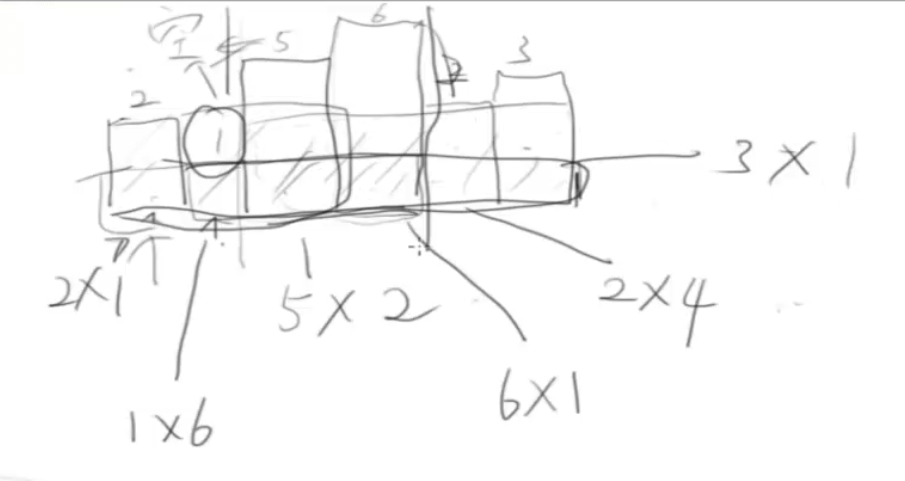
用栈保存小于当前值的左的元素
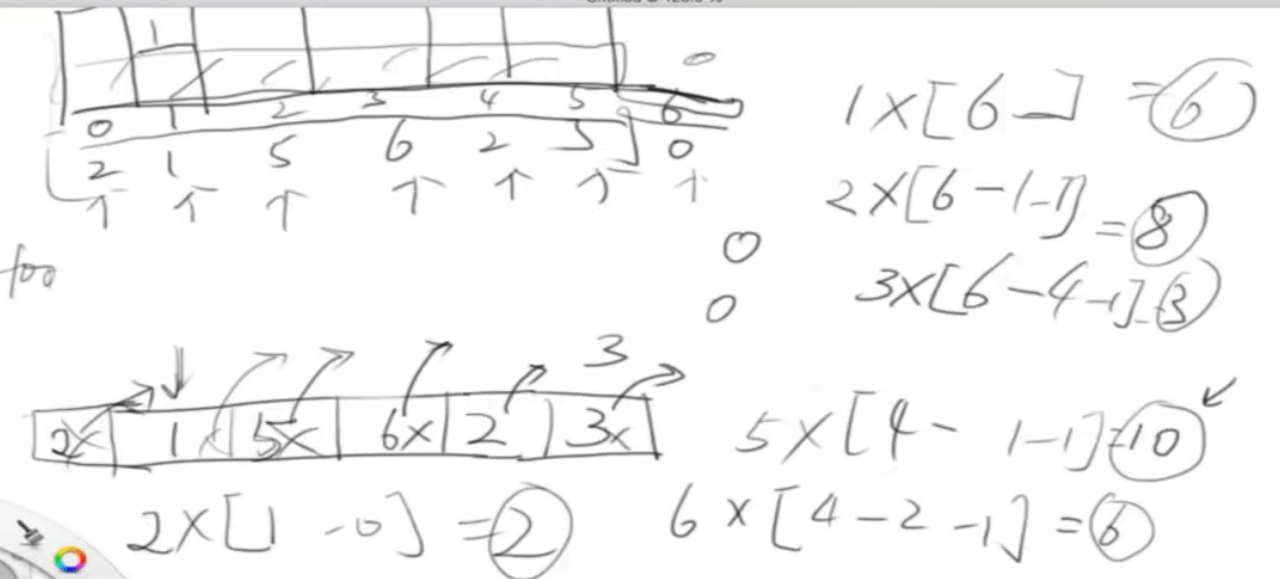
intlargestRectangleArea(vector<int>&heights) {
//基于各个高度的最大矩形是在出栈的时候计算的,因此必须要让所有高度都出栈。//这里是利用单调栈的性质让其全部出栈,即在原始数组后添一个0heights.push_back(0);
stack<int>s;
intmaxArea=0;
for(inti=0; i<heights.size(); i++){
while(!s.empty() &&heights[i] <heights[s.top()]){
inth=heights[s.top()];
s.pop();
intw=s.empty() ? i : i-s.top() -1;
maxArea=max(maxArea, h*w);
}
s.push(i);
}
returnmaxArea;
}常用于 BFS 宽度优先搜索
使用栈实现队列
classMyQueue {
public:
stack<int>inStack;
stack<int>outStack;
/** Initialize your data structure here. */MyQueue() {
}
/** Push element x to the back of queue. */voidpush(intx) {
inStack.push(x);
}
/** Removes the element from in front of queue and returns that element. */intpop() {
cheak();
inttop=outStack.top();
outStack.pop();
returntop;
}
/** Get the front element. */intpeek() {
cheak();
returnoutStack.top();
}
/** Returns whether the queue is empty. */boolempty() {
returninStack.empty() &&outStack.empty();
}
voidcheak(){
if(outStack.empty()){
while(!inStack.empty()){
outStack.push(inStack.top());
inStack.pop();
}
}
}
};
二叉树层次遍历
vector<vector<int>> levelOrder(TreeNode*root) {
vector<vector<int>> res;
if(root==NULL) returnres;
queue<TreeNode*>q;
q.push(root);
while(!q.empty()){
intsize=q.size();
res.push_back(vector<int>());
for(inti=0; i<size; i++){
TreeNode*t=q.front();
res.back().push_back(t->val);
q.pop();
if(t->left) q.push(t->left);
if(t->right) q.push(t->right);
}
}
returnres;
}给定一个由 0 和 1 组成的矩阵,找出每个元素到最近的 0 的距离。 两个相邻元素间的距离为 1
// BFS 从0进队列,弹出之后计算上下左右的结果,将上下左右重新进队列进行二层操作// 0 0 0 0// 0 x 0 0// x x x 0// 0 x 0 0// 0 0 0 0// 0 1 0 0// 1 x 1 0// 0 1 0 0// 0 0 0 0// 0 1 0 0// 1 2 1 0// 0 1 0 0vector<vector<int>> updateMatrix(vector<vector<int>>&matrix) {
intr=matrix.size(), c=matrix[0].size();
vector<pair<int, int>> directions= {{0, 1}, {0, -1}, {1, 0}, {-1, 0}};
vector<vector<int>> res(r, vector<int>(c, INT_MAX));
queue<pair<int, int>> q;
for(inti=0; i<r; i++){
for(intj=0; j<c; j++){
if(matrix[i][j] ==0){
res[i][j] =0;
q.push({i, j});
}
}
}
while(!q.empty()){
auto temp=q.front();
q.pop();
for(inti=0; i<4; i++){
intx=temp.first+directions[i].first;
inty=temp.second+directions[i].second;
if(x >= 0&&x<r&&y >= 0&&y<c){
if(res[x][y] >res[temp.first][temp.second] +1){
res[x][y] =res[temp.first][temp.second] +1;
q.push({x, y});
}
}
}
}
returnres;
}- 熟悉栈的使用场景
- 后入先出,保存临时值
- 利用栈 DFS 深度搜索
- 熟悉队列的使用场景
- 利用队列 BFS 广度搜索