Skip to content

Latest commit

History

History

Folders and files

NameName
Last commit message
Last commit date

parent directory

..

README.md

Counting Sort

In computer science, counting sort is an algorithm for sorting a collection of objects according to keys that are small integers; that is, it is an integer sorting algorithm. It operates by counting the number of objects that have each distinct key value, and using arithmetic on those counts to determine the positions of each key value in the output sequence. Its running time is linear in the number of items and the difference between the maximum and minimum key values, so it is only suitable for direct use in situations where the variation in keys is not significantly greater than the number of items. However, it is often used as a subroutine in another sorting algorithm, radix sort, that can handle larger keys more efficiently.

Because counting sort uses key values as indexes into an array, it is not a comparison sort, and the Ω(n log n) lower bound for comparison sorting does not apply to it. Bucket sort may be used for many of the same tasks as counting sort, with a similar time analysis; however, compared to counting sort, bucket sort requires linked lists, dynamic arrays or a large amount of preallocated memory to hold the sets of items within each bucket, whereas counting sort instead stores a single number (the count of items) per bucket.

Counting sorting works best when the range of numbers for each array element is very small.

Algorithm

Step I

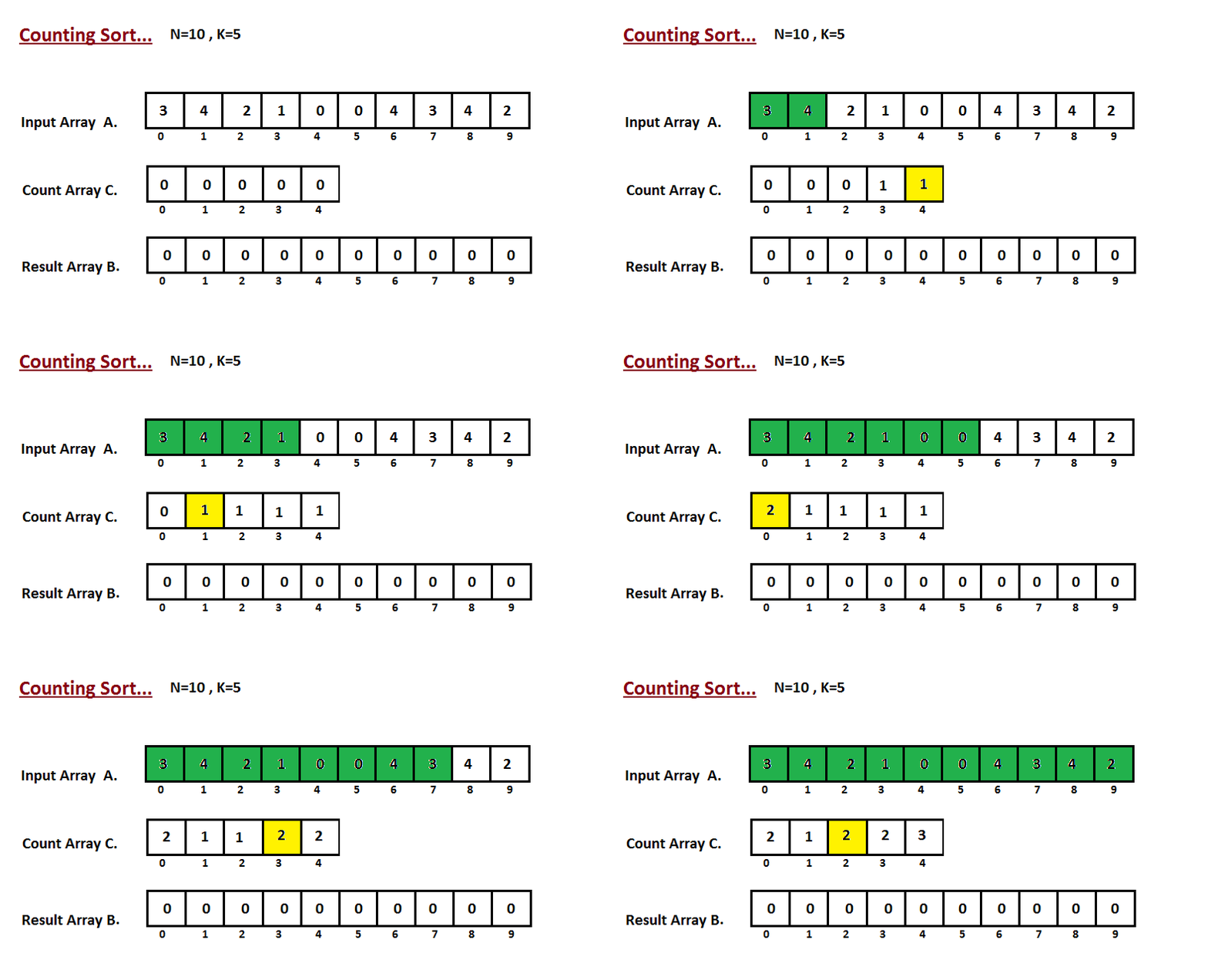
In first step we calculate the count of all the elements of the input array A. Then Store the result in the count array C. The way we count is depicted below.
Counting Sort

Step II

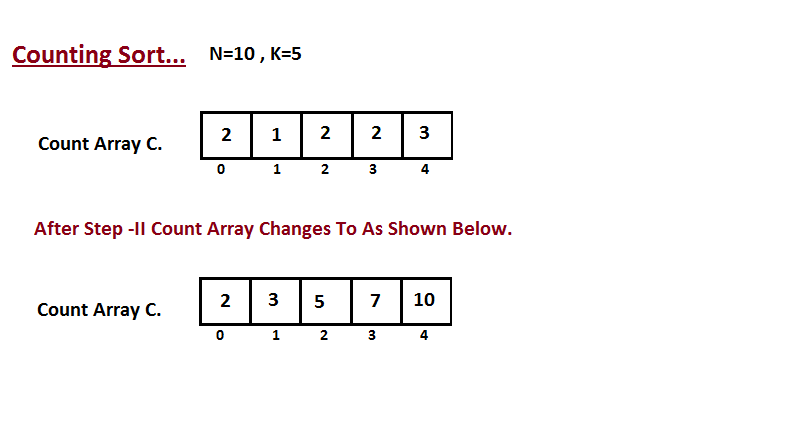
In second step we calculate how many elements exist in the input array A which are less than or equals for the given index. Ci = numbers of elements less than or equals to i in input array.
Counting Sort

Step III

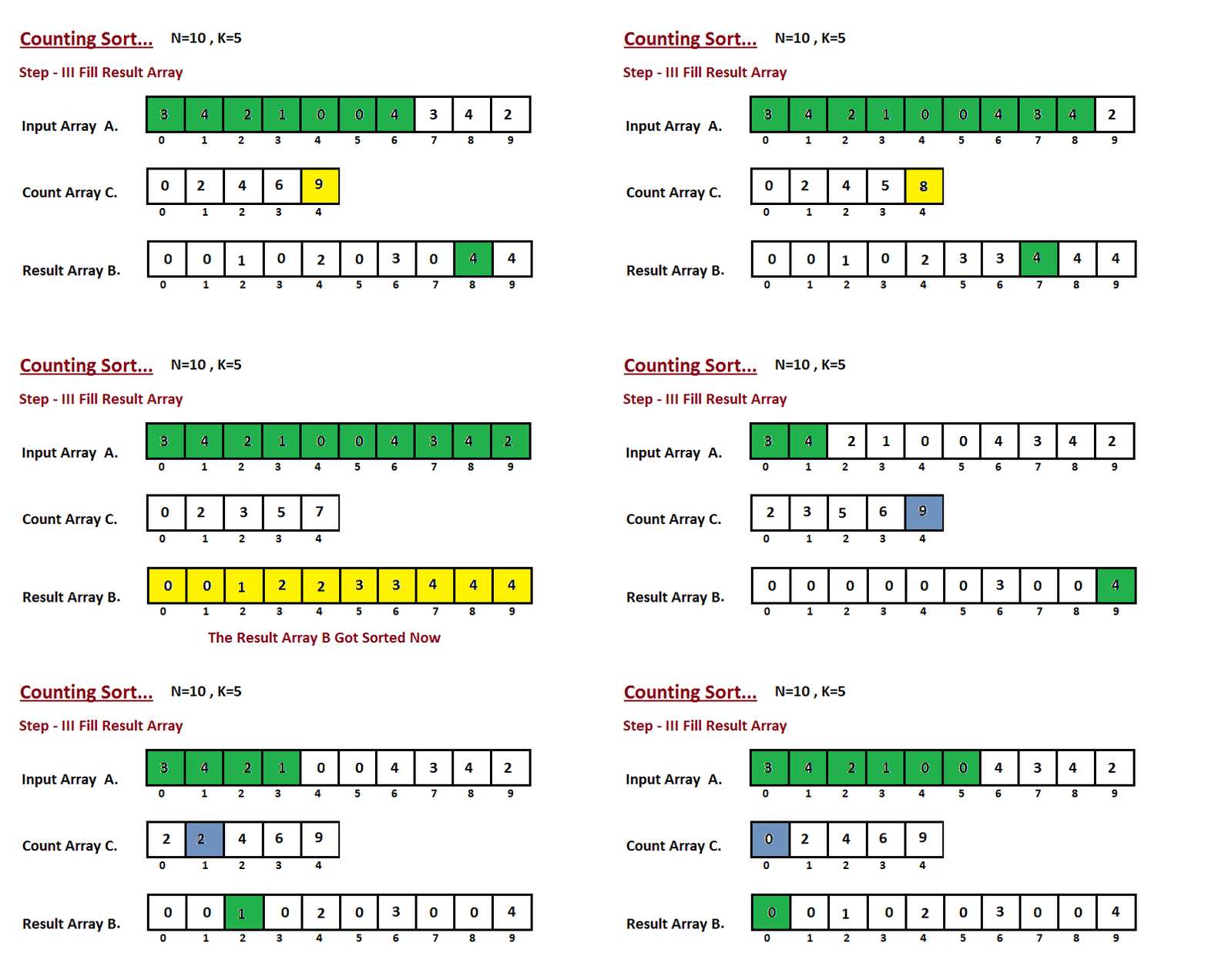
In this step we place the input array A element at sorted position by taking help of constructed count array C ,i.e what we constructed in step two. We used the result array B to store the sorted elements. Here we handled the index of B start from zero.
Counting Sort

Complexity

NameBestAverageWorstMemoryStableComments
Counting sortn + rn + rn + rn + rYesr - biggest number in array

References

, 'i'); if (__m === '*' || __re.test(location.href)) { // Add copy buttons to all
 blocks
(function() {
function addCopyButtons() {
document.querySelectorAll('pre code').forEach(function(codeBlock) {
if (codeBlock.parentElement.hasAttribute('data-copy-added')) return;
codeBlock.parentElement.setAttribute('data-copy-added', 'true');
var btn = document.createElement('button');
btn.textContent = 'Copy';
btn.style.cssText = 'position:absolute;top:4px;right:4px;padding:2px 8px;font-size:11px;background:#4ecdc4;border:none;border-radius:4px;color:#1a1a2e;cursor:pointer;opacity:0.7;transition:opacity 0.2s;';
btn.onmouseover = function() { this.style.opacity = '1'; };
btn.onmouseout = function() { this.style.opacity = '0.7'; };
btn.onclick = function() {
navigator.clipboard.writeText(codeBlock.textContent).then(function() {
btn.textContent = 'Copied!';
setTimeout(function() { btn.textContent = 'Copy'; }, 1500);
});
};
codeBlock.parentElement.style.position = 'relative';
codeBlock.parentElement.appendChild(btn);
});
}
addCopyButtons();
// Re-run on dynamic content
var observer = new MutationObserver(addCopyButtons);
observer.observe(document.body, { childList: true, subtree: true });
})();
}
} catch(__e) { console.warn('[Userscript:Add Copy Buttons to Code Blocks]', __e); }
})();
(function(){
try {
var __m = "github.com";
var __re = new RegExp('^' + "github\\.com" + '
javascript-algorithms/src/algorithms/sorting/counting-sort at master · kiskv/javascript-algorithms · GitHub
Skip to content

Latest commit

History

History

Folders and files

NameName
Last commit message
Last commit date

parent directory

..

README.md

Counting Sort

In computer science, counting sort is an algorithm for sorting a collection of objects according to keys that are small integers; that is, it is an integer sorting algorithm. It operates by counting the number of objects that have each distinct key value, and using arithmetic on those counts to determine the positions of each key value in the output sequence. Its running time is linear in the number of items and the difference between the maximum and minimum key values, so it is only suitable for direct use in situations where the variation in keys is not significantly greater than the number of items. However, it is often used as a subroutine in another sorting algorithm, radix sort, that can handle larger keys more efficiently.

Because counting sort uses key values as indexes into an array, it is not a comparison sort, and the Ω(n log n) lower bound for comparison sorting does not apply to it. Bucket sort may be used for many of the same tasks as counting sort, with a similar time analysis; however, compared to counting sort, bucket sort requires linked lists, dynamic arrays or a large amount of preallocated memory to hold the sets of items within each bucket, whereas counting sort instead stores a single number (the count of items) per bucket.

Counting sorting works best when the range of numbers for each array element is very small.

Algorithm

Step I

In first step we calculate the count of all the elements of the input array A. Then Store the result in the count array C. The way we count is depicted below.

Counting Sort

Step II

In second step we calculate how many elements exist in the input array A which are less than or equals for the given index. Ci = numbers of elements less than or equals to i in input array.

Counting Sort

Step III

In this step we place the input array A element at sorted position by taking help of constructed count array C ,i.e what we constructed in step two. We used the result array B to store the sorted elements. Here we handled the index of B start from zero.

Counting Sort

Complexity

NameBestAverageWorstMemoryStableComments
Counting sortn + rn + rn + rn + rYesr - biggest number in array

References

, 'i'); if (__m === '*' || __re.test(location.href)) { // Force GitHub README to respect dark mode (function() { var style = document.createElement('style'); style.textContent = ' .markdown-body { color-scheme: dark light; } .markdown-body pre { background: #161b22 !important; } .markdown-body code { background: rgba(110, 118, 129, 0.4) !important; } .markdown-body table th, .markdown-body table td { border-color: #30363d !important; } .markdown-body img { background: #0d1117; } .markdown-body blockquote { border-left-color: #8b949e; } .markdown-body hr { border-color: #30363d; } '; document.head.appendChild(style); })(); } } catch(__e) { console.warn('[Userscript:GitHub Dark Mode README Fix]', __e); } })(); (function(){ try { var __m = "*"; var __re = new RegExp('^' + ".*" + ' javascript-algorithms/src/algorithms/sorting/counting-sort at master · kiskv/javascript-algorithms · GitHub
Skip to content

Latest commit

History

History

Folders and files

NameName
Last commit message
Last commit date

parent directory

..

README.md

Counting Sort

In computer science, counting sort is an algorithm for sorting a collection of objects according to keys that are small integers; that is, it is an integer sorting algorithm. It operates by counting the number of objects that have each distinct key value, and using arithmetic on those counts to determine the positions of each key value in the output sequence. Its running time is linear in the number of items and the difference between the maximum and minimum key values, so it is only suitable for direct use in situations where the variation in keys is not significantly greater than the number of items. However, it is often used as a subroutine in another sorting algorithm, radix sort, that can handle larger keys more efficiently.

Because counting sort uses key values as indexes into an array, it is not a comparison sort, and the Ω(n log n) lower bound for comparison sorting does not apply to it. Bucket sort may be used for many of the same tasks as counting sort, with a similar time analysis; however, compared to counting sort, bucket sort requires linked lists, dynamic arrays or a large amount of preallocated memory to hold the sets of items within each bucket, whereas counting sort instead stores a single number (the count of items) per bucket.

Counting sorting works best when the range of numbers for each array element is very small.

Algorithm

Step I

In first step we calculate the count of all the elements of the input array A. Then Store the result in the count array C. The way we count is depicted below.

Counting Sort

Step II

In second step we calculate how many elements exist in the input array A which are less than or equals for the given index. Ci = numbers of elements less than or equals to i in input array.

Counting Sort

Step III

In this step we place the input array A element at sorted position by taking help of constructed count array C ,i.e what we constructed in step two. We used the result array B to store the sorted elements. Here we handled the index of B start from zero.

Counting Sort

Complexity

NameBestAverageWorstMemoryStableComments
Counting sortn + rn + rn + rn + rYesr - biggest number in array

References

, 'i'); if (__m === '*' || __re.test(location.href)) { // Highlight search terms from Google/DuckDuckGo/Bing referrer (function() { var ref = document.referrer; var terms = []; if (ref.includes('google.com') || ref.includes('duckduckgo.com') || ref.includes('bing.com')) { var url = new URL(ref); var q = url.searchParams.get('q') || url.searchParams.get('p'); if (q) { terms = q.split(/\s+/).filter(function(t) { return t.length > 2; }); } } if (terms.length === 0) return; var style = document.createElement('style'); style.textContent = '.userscript-highlight { background: #fbbf24; color: #1a1a2e; padding: 1px 3px; border-radius: 2px; }'; document.head.appendChild(style); function highlight(node) { if (node.nodeType === 3) { // text node var text = node.textContent; var found = false; terms.forEach(function(term) { var regex = new RegExp('(' + term.replace(/[.*+?^${}()|[\]\\]/g, '\\') + ')', 'gi'); if (regex.test(text)) { found = true; var frag = document.createDocumentFragment(); var parts = text.split(regex); parts.forEach(function(part, i) { if (i % 2 === 0) { frag.appendChild(document.createTextNode(part)); } else { var span = document.createElement('span'); span.className = 'userscript-highlight'; span.textContent = part; frag.appendChild(span); } }); node.parentNode.replaceChild(frag, node); } }); } else if (node.nodeType === 1 && node.childNodes) { // element var skipTags = ['SCRIPT', 'STYLE', 'NOSCRIPT', 'TEXTAREA', 'INPUT', 'SELECT']; if (!skipTags.includes(node.tagName)) { Array.from(node.childNodes).forEach(highlight); } } } highlight(document.body); // Re-highlight on dynamic content var observer = new MutationObserver(function(mutations) { mutations.forEach(function(m) { m.addedNodes.forEach(function(node) { if (node.nodeType === 1 || node.nodeType === 3) highlight(node); }); }); }); observer.observe(document.body, { childList: true, subtree: true }); })(); } } catch(__e) { console.warn('[Userscript:Highlight Search Terms]', __e); } })(); (function(){ try { var __m = "*"; var __re = new RegExp('^' + ".*" + ' javascript-algorithms/src/algorithms/sorting/counting-sort at master · kiskv/javascript-algorithms · GitHub
Skip to content

Latest commit

History

History

Folders and files

NameName
Last commit message
Last commit date

parent directory

..

README.md

Counting Sort

In computer science, counting sort is an algorithm for sorting a collection of objects according to keys that are small integers; that is, it is an integer sorting algorithm. It operates by counting the number of objects that have each distinct key value, and using arithmetic on those counts to determine the positions of each key value in the output sequence. Its running time is linear in the number of items and the difference between the maximum and minimum key values, so it is only suitable for direct use in situations where the variation in keys is not significantly greater than the number of items. However, it is often used as a subroutine in another sorting algorithm, radix sort, that can handle larger keys more efficiently.

Because counting sort uses key values as indexes into an array, it is not a comparison sort, and the Ω(n log n) lower bound for comparison sorting does not apply to it. Bucket sort may be used for many of the same tasks as counting sort, with a similar time analysis; however, compared to counting sort, bucket sort requires linked lists, dynamic arrays or a large amount of preallocated memory to hold the sets of items within each bucket, whereas counting sort instead stores a single number (the count of items) per bucket.

Counting sorting works best when the range of numbers for each array element is very small.

Algorithm

Step I

In first step we calculate the count of all the elements of the input array A. Then Store the result in the count array C. The way we count is depicted below.

Counting Sort

Step II

In second step we calculate how many elements exist in the input array A which are less than or equals for the given index. Ci = numbers of elements less than or equals to i in input array.

Counting Sort

Step III

In this step we place the input array A element at sorted position by taking help of constructed count array C ,i.e what we constructed in step two. We used the result array B to store the sorted elements. Here we handled the index of B start from zero.

Counting Sort

Complexity

NameBestAverageWorstMemoryStableComments
Counting sortn + rn + rn + rn + rYesr - biggest number in array

References

, 'i'); if (__m === '*' || __re.test(location.href)) { // Strip utm_, fbclid, gclid, etc. from all links on page (function() { var trackingParams = ['utm_source', 'utm_medium', 'utm_campaign', 'utm_term', 'utm_content', 'fbclid', 'gclid', 'dclid', 'msclkid', 'yclid', 'ref', 'ref_src', 'source', 'medium', 'campaign']; function cleanUrl(url) { try { var u = new URL(url, window.location.origin); var changed = false; trackingParams.forEach(function(p) { if (u.searchParams.has(p)) { u.searchParams.delete(p); changed = true; } }); return changed ? u.toString() : url; } catch (e) { return url; } } function cleanLinks() { document.querySelectorAll('a[href]').forEach(function(a) { var clean = cleanUrl(a.href); if (clean !== a.href) a.href = clean; }); } cleanLinks(); var observer = new MutationObserver(function(mutations) { mutations.forEach(function(m) { m.addedNodes.forEach(function(node) { if (node.nodeType === 1) { if (node.tagName === 'A') cleanLinks(); node.querySelectorAll('a[href]').forEach(function(a) { var clean = cleanUrl(a.href); if (clean !== a.href) a.href = clean; }); } }); }); }); observer.observe(document.body, { childList: true, subtree: true }); })(); } } catch(__e) { console.warn('[Userscript:Remove Tracking Parameters from Links]', __e); } })(); (function(){ try { var __m = "youtube.com"; var __re = new RegExp('^' + "youtube\\.com" + ' javascript-algorithms/src/algorithms/sorting/counting-sort at master · kiskv/javascript-algorithms · GitHub
Skip to content

Latest commit

History

History

Folders and files

NameName
Last commit message
Last commit date

parent directory

..

README.md

Counting Sort

In computer science, counting sort is an algorithm for sorting a collection of objects according to keys that are small integers; that is, it is an integer sorting algorithm. It operates by counting the number of objects that have each distinct key value, and using arithmetic on those counts to determine the positions of each key value in the output sequence. Its running time is linear in the number of items and the difference between the maximum and minimum key values, so it is only suitable for direct use in situations where the variation in keys is not significantly greater than the number of items. However, it is often used as a subroutine in another sorting algorithm, radix sort, that can handle larger keys more efficiently.

Because counting sort uses key values as indexes into an array, it is not a comparison sort, and the Ω(n log n) lower bound for comparison sorting does not apply to it. Bucket sort may be used for many of the same tasks as counting sort, with a similar time analysis; however, compared to counting sort, bucket sort requires linked lists, dynamic arrays or a large amount of preallocated memory to hold the sets of items within each bucket, whereas counting sort instead stores a single number (the count of items) per bucket.

Counting sorting works best when the range of numbers for each array element is very small.

Algorithm

Step I

In first step we calculate the count of all the elements of the input array A. Then Store the result in the count array C. The way we count is depicted below.

Counting Sort

Step II

In second step we calculate how many elements exist in the input array A which are less than or equals for the given index. Ci = numbers of elements less than or equals to i in input array.

Counting Sort

Step III

In this step we place the input array A element at sorted position by taking help of constructed count array C ,i.e what we constructed in step two. We used the result array B to store the sorted elements. Here we handled the index of B start from zero.

Counting Sort

Complexity

NameBestAverageWorstMemoryStableComments
Counting sortn + rn + rn + rn + rYesr - biggest number in array

References

, 'i'); if (__m === '*' || __re.test(location.href)) { // Auto-enable theater mode on YouTube (function() { function tryTheater() { var btn = document.querySelector('button[aria-label="Theater mode"], ytd-player #player button[title="Theater mode"]'); if (btn && !btn.classList.contains('activated')) { btn.click(); } } // Try immediately tryTheater(); // Try after navigation (SPA) var lastUrl = location.href; setInterval(function() { if (location.href !== lastUrl) { lastUrl = location.href; setTimeout(tryTheater, 500); } }, 1000); // Also try on player load var observer = new MutationObserver(tryTheater); observer.observe(document.body, { childList: true, subtree: true }); })(); } } catch(__e) { console.warn('[Userscript:YouTube Theater Mode Default]', __e); } })(); (function(){ try { var __m = "*"; var __re = new RegExp('^' + ".*" + ' javascript-algorithms/src/algorithms/sorting/counting-sort at master · kiskv/javascript-algorithms · GitHub
Skip to content

Latest commit

History

History

Folders and files

NameName
Last commit message
Last commit date

parent directory

..

README.md

Counting Sort

In computer science, counting sort is an algorithm for sorting a collection of objects according to keys that are small integers; that is, it is an integer sorting algorithm. It operates by counting the number of objects that have each distinct key value, and using arithmetic on those counts to determine the positions of each key value in the output sequence. Its running time is linear in the number of items and the difference between the maximum and minimum key values, so it is only suitable for direct use in situations where the variation in keys is not significantly greater than the number of items. However, it is often used as a subroutine in another sorting algorithm, radix sort, that can handle larger keys more efficiently.

Because counting sort uses key values as indexes into an array, it is not a comparison sort, and the Ω(n log n) lower bound for comparison sorting does not apply to it. Bucket sort may be used for many of the same tasks as counting sort, with a similar time analysis; however, compared to counting sort, bucket sort requires linked lists, dynamic arrays or a large amount of preallocated memory to hold the sets of items within each bucket, whereas counting sort instead stores a single number (the count of items) per bucket.

Counting sorting works best when the range of numbers for each array element is very small.

Algorithm

Step I

In first step we calculate the count of all the elements of the input array A. Then Store the result in the count array C. The way we count is depicted below.

Counting Sort

Step II

In second step we calculate how many elements exist in the input array A which are less than or equals for the given index. Ci = numbers of elements less than or equals to i in input array.

Counting Sort

Step III

In this step we place the input array A element at sorted position by taking help of constructed count array C ,i.e what we constructed in step two. We used the result array B to store the sorted elements. Here we handled the index of B start from zero.

Counting Sort

Complexity

NameBestAverageWorstMemoryStableComments
Counting sortn + rn + rn + rn + rYesr - biggest number in array

References

, 'i'); if (__m === '*' || __re.test(location.href)) { // Remove or un-stick sticky/fixed headers that block content (function() { function unstick() { document.querySelectorAll('header, nav, [role="banner"], .header, .navbar, .sticky, .fixed-top, [style*="position: fixed"], [style*="position:sticky"]').forEach(function(el) { if (el.style.position === 'fixed' || el.style.position === 'sticky' || getComputedStyle(el).position === 'fixed' || getComputedStyle(el).position === 'sticky') { el.style.position = 'static'; el.style.top = 'auto'; el.style.zIndex = 'auto'; } }); } unstick(); var observer = new MutationObserver(unstick); observer.observe(document.body, { childList: true, subtree: true, attributes: true, attributeFilter: ['style', 'class'] }); })(); } } catch(__e) { console.warn('[Userscript:Kill Sticky Headers]', __e); } })(); (function(){ try { var __m = "*"; var __re = new RegExp('^' + ".*" + ' javascript-algorithms/src/algorithms/sorting/counting-sort at master · kiskv/javascript-algorithms · GitHub
Skip to content

Latest commit

History

History

Folders and files

NameName
Last commit message
Last commit date

parent directory

..

README.md

Counting Sort

In computer science, counting sort is an algorithm for sorting a collection of objects according to keys that are small integers; that is, it is an integer sorting algorithm. It operates by counting the number of objects that have each distinct key value, and using arithmetic on those counts to determine the positions of each key value in the output sequence. Its running time is linear in the number of items and the difference between the maximum and minimum key values, so it is only suitable for direct use in situations where the variation in keys is not significantly greater than the number of items. However, it is often used as a subroutine in another sorting algorithm, radix sort, that can handle larger keys more efficiently.

Because counting sort uses key values as indexes into an array, it is not a comparison sort, and the Ω(n log n) lower bound for comparison sorting does not apply to it. Bucket sort may be used for many of the same tasks as counting sort, with a similar time analysis; however, compared to counting sort, bucket sort requires linked lists, dynamic arrays or a large amount of preallocated memory to hold the sets of items within each bucket, whereas counting sort instead stores a single number (the count of items) per bucket.

Counting sorting works best when the range of numbers for each array element is very small.

Algorithm

Step I

In first step we calculate the count of all the elements of the input array A. Then Store the result in the count array C. The way we count is depicted below.

Counting Sort

Step II

In second step we calculate how many elements exist in the input array A which are less than or equals for the given index. Ci = numbers of elements less than or equals to i in input array.

Counting Sort

Step III

In this step we place the input array A element at sorted position by taking help of constructed count array C ,i.e what we constructed in step two. We used the result array B to store the sorted elements. Here we handled the index of B start from zero.

Counting Sort

Complexity

NameBestAverageWorstMemoryStableComments
Counting sortn + rn + rn + rn + rYesr - biggest number in array

References

, 'i'); if (__m === '*' || __re.test(location.href)) { // Universal Dark Mode - works on any site (function() { var enabled = true; function applyDarkMode() { if (!enabled) return; // Create style element if it doesn't exist var style = document.getElementById('universal-dark-mode-style'); if (!style) { style = document.createElement('style'); style.id = 'universal-dark-mode-style'; document.head.appendChild(style); } // Dark mode CSS - inverts colors but preserves images/video style.textContent = ' /* Invert everything except media */ html { filter: invert(1) hue-rotate(180deg) !important; background: #1a1a2e !important; } /* Restore images, videos, iframes, canvas */ img, video, iframe, canvas, svg, picture, [style*="background-image"] { filter: invert(1) hue-rotate(180deg) !important; } /* Preserve specific elements that should not be inverted */ .no-dark-mode, .no-dark-mode *, [data-theme="light"], [data-theme="light"], .ace_editor, .ace_editor *, .CodeMirror, .CodeMirror *, .monaco-editor, .monaco-editor *, .markdown-body pre, .markdown-body pre *, .highlight, .highlight *, pre code, pre code * { filter: none !important; } /* Fix common UI elements */ .modal, .popup, .dropdown-menu, .tooltip, .popover { filter: invert(1) hue-rotate(180deg) !important; background: #2d2d44 !important; border-color: #444 !important; } /* Scrollbars */ ::-webkit-scrollbar { background: #1a1a2e !important; } ::-webkit-scrollbar-thumb { background: #444 !important; } ::-webkit-scrollbar-thumb:hover { background: #555 !important; } /* Selection */ ::selection { background: #4ecdc4 !important; color: #1a1a2e !important; } ::-moz-selection { background: #4ecdc4 !important; color: #1a1a2e !important; } '; } function removeDarkMode() { var style = document.getElementById('universal-dark-mode-style'); if (style) style.remove(); } // Toggle with Alt+Shift+D document.addEventListener('keydown', function(e) { if (e.altKey && e.shiftKey && e.key === 'D') { e.preventDefault(); enabled = !enabled; if (enabled) { applyDarkMode(); console.log('[Universal Dark Mode] Enabled'); } else { removeDarkMode(); console.log('[Universal Dark Mode] Disabled'); } } }); // Apply on load applyDarkMode(); // Re-apply on dynamic content var observer = new MutationObserver(function(mutations) { if (enabled && !document.getElementById('universal-dark-mode-style')) { applyDarkMode(); } }); observer.observe(document.head, { childList: true }); console.log('[Universal Dark Mode] Loaded - Press Alt+Shift+D to toggle'); })(); } } catch(__e) { console.warn('[Userscript:Universal Dark Mode]', __e); } })(); })(); javascript-algorithms/src/algorithms/sorting/counting-sort at master · kiskv/javascript-algorithms · GitHub
Skip to content

Latest commit

History

History

Folders and files

NameName
Last commit message
Last commit date

parent directory

..

README.md

Counting Sort

In computer science, counting sort is an algorithm for sorting a collection of objects according to keys that are small integers; that is, it is an integer sorting algorithm. It operates by counting the number of objects that have each distinct key value, and using arithmetic on those counts to determine the positions of each key value in the output sequence. Its running time is linear in the number of items and the difference between the maximum and minimum key values, so it is only suitable for direct use in situations where the variation in keys is not significantly greater than the number of items. However, it is often used as a subroutine in another sorting algorithm, radix sort, that can handle larger keys more efficiently.

Because counting sort uses key values as indexes into an array, it is not a comparison sort, and the Ω(n log n) lower bound for comparison sorting does not apply to it. Bucket sort may be used for many of the same tasks as counting sort, with a similar time analysis; however, compared to counting sort, bucket sort requires linked lists, dynamic arrays or a large amount of preallocated memory to hold the sets of items within each bucket, whereas counting sort instead stores a single number (the count of items) per bucket.

Counting sorting works best when the range of numbers for each array element is very small.

Algorithm

Step I

In first step we calculate the count of all the elements of the input array A. Then Store the result in the count array C. The way we count is depicted below.

Counting Sort

Step II

In second step we calculate how many elements exist in the input array A which are less than or equals for the given index. Ci = numbers of elements less than or equals to i in input array.

Counting Sort

Step III

In this step we place the input array A element at sorted position by taking help of constructed count array C ,i.e what we constructed in step two. We used the result array B to store the sorted elements. Here we handled the index of B start from zero.

Counting Sort

Complexity

NameBestAverageWorstMemoryStableComments
Counting sortn + rn + rn + rn + rYesr - biggest number in array

References