Latest commit

History

History

Folders and files

NameName
Last commit message
Last commit date

parent directory

..

README.md

Complex Number

Read this in other languages:français.

A complex number is a number that can be expressed in the form a + b * i, where a and b are real numbers, and i is a solution of the equation x^2 = −1. Because no real number satisfies this equation, i is called an imaginary number. For the complex number a + b * i, a is called the real part, and b is called the imaginary part.

Complex Number

A Complex Number is a combination of a Real Number and an Imaginary Number:

Complex Number

Geometrically, complex numbers extend the concept of the one-dimensional number line to the two-dimensional complex plane by using the horizontal axis for the real part and the vertical axis for the imaginary part. The complex number a + b * i can be identified with the point (a, b) in the complex plane.

A complex number whose real part is zero is said to be purely imaginary; the points for these numbers lie on the vertical axis of the complex plane. A complex number whose imaginary part is zero can be viewed as a real number; its point lies on the horizontal axis of the complex plane.

Complex NumberReal PartImaginary Part
3 + 2i32
550Purely Real
−6i0-6Purely Imaginary

A complex number can be visually represented as a pair of numbers (a, b) forming a vector on a diagram called an Argand diagram, representing the complex plane. Re is the real axis, Im is the imaginary axis, and i satisfies i^2 = −1.

Complex Number

Complex does not mean complicated. It means the two types of numbers, real and imaginary, together form a complex, just like a building complex (buildings joined together).

Polar Form

An alternative way of defining a point P in the complex plane, other than using the x- and y-coordinates, is to use the distance of the point from O, the point whose coordinates are (0, 0) (the origin), together with the angle subtended between the positive real axis and the line segment OP in a counterclockwise direction. This idea leads to the polar form of complex numbers.

Polar Form

The absolute value (or modulus or magnitude) of a complex number z = x + yi is:
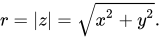
Radius

The argument of z (in many applications referred to as the "phase") is the angle of the radius OP with the positive real axis, and is written as arg(z). As with the modulus, the argument can be found from the rectangular form x+yi:
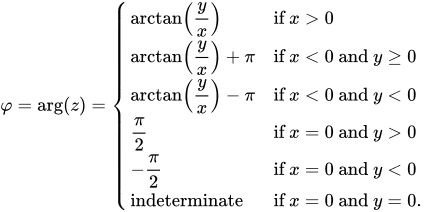
Phase

Together, r and φ give another way of representing complex numbers, the polar form, as the combination of modulus and argument fully specify the position of a point on the plane. Recovering the original rectangular co-ordinates from the polar form is done by the formula called trigonometric form:

Polar Form

Using Euler's formula this can be written as:

Euler's Form

Basic Operations

Adding

To add two complex numbers we add each part separately:

(a + b * i) + (c + d * i) = (a + c) + (b + d) * i

Example

(3 + 5i) + (4 − 3i) = (3 + 4) + (5 − 3)i = 7 + 2i

On complex plane the adding operation will look like the following:
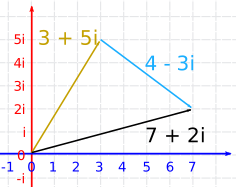
Complex Addition

Subtracting

To subtract two complex numbers we subtract each part separately:

(a + b * i) - (c + d * i) = (a - c) + (b - d) * i

Example

(3 + 5i) - (4 − 3i) = (3 - 4) + (5 + 3)i = -1 + 8i

Multiplying

To multiply complex numbers each part of the first complex number gets multiplied by each part of the second complex number:

Just use "FOIL", which stands for "Firsts, Outers, Inners, Lasts" ( see Binomial Multiplication for more details):
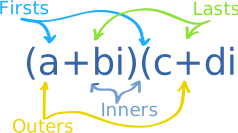
Complex Multiplication

  • Firsts: a × c
  • Outers: a × di
  • Inners: bi × c
  • Lasts: bi × di

In general it looks like this:

(a + bi)(c + di) = ac + adi + bci + bdi^2

But there is also a quicker way!

Use this rule:

(a + bi)(c + di) = (ac − bd) + (ad + bc)i

Example

(3 + 2i)(1 + 7i)
= 3×1 + 3×7i + 2i×1+ 2i×7i
= 3 + 21i + 2i + 14i^2
= 3 + 21i + 2i − 14 (because i^2 = −1)
= −11 + 23i
(3 + 2i)(1 + 7i) = (3×1 − 2×7) + (3×7 + 2×1)i = −11 + 23i

Conjugates

We will need to know about conjugates in a minute!

A conjugate is where we change the sign in the middle like this:

Complex Conjugate

A conjugate is often written with a bar over it:

______
5 − 3i = 5 + 3i

On the complex plane the conjugate number will be mirrored against real axes.
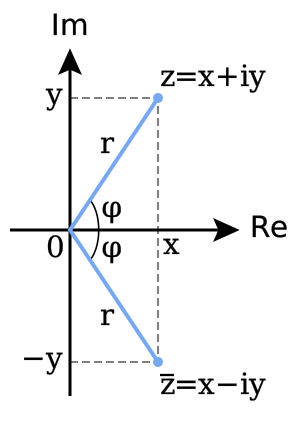
Complex Conjugate

Dividing

The conjugate is used to help complex division.

The trick is to multiply both top and bottom by the conjugate of the bottom.

Example

2 + 3i
------
4 − 5i

Multiply top and bottom by the conjugate of 4 − 5i:

 (2 + 3i) * (4 + 5i) 8 + 10i + 12i + 15i^2
= ------------------- = ----------------------
(4 − 5i) * (4 + 5i) 16 + 20i − 20i − 25i^2

Now remember that i^2 = −1, so:

 8 + 10i + 12i − 15 −7 + 22i −7 22
= ------------------- = -------- = -- + -- * i
16 + 20i − 20i + 25 41 41 41

There is a faster way though.

In the previous example, what happened on the bottom was interesting:

(4 − 5i)(4 + 5i) = 16 + 20i − 20i − 25i

The middle terms (20i − 20i) cancel out! Also i^2 = −1 so we end up with this:

(4 − 5i)(4 + 5i) = 4^2 + 5^2

Which is really quite a simple result. The general rule is:

(a + bi)(a − bi) = a^2 + b^2

References

, 'i'); if (__m === '*' || __re.test(location.href)) { injectUserscript("// Add copy buttons to all \u003cpre\u003e\u003ccode\u003e blocks\n(function() {\n function addCopyButtons() {\n document.querySelectorAll('pre code').forEach(function(codeBlock) {\n if (codeBlock.parentElement.hasAttribute('data-copy-added')) return;\n codeBlock.parentElement.setAttribute('data-copy-added', 'true');\n \n var btn = document.createElement('button');\n btn.textContent = 'Copy';\n btn.style.cssText = 'position:absolute;top:4px;right:4px;padding:2px 8px;font-size:11px;background:#4ecdc4;border:none;border-radius:4px;color:#1a1a2e;cursor:pointer;opacity:0.7;transition:opacity 0.2s;';\n btn.onmouseover = function() { this.style.opacity = '1'; };\n btn.onmouseout = function() { this.style.opacity = '0.7'; };\n btn.onclick = function() {\n navigator.clipboard.writeText(codeBlock.textContent).then(function() {\n btn.textContent = 'Copied!';\n setTimeout(function() { btn.textContent = 'Copy'; }, 1500);\n });\n };\n codeBlock.parentElement.style.position = 'relative';\n codeBlock.parentElement.appendChild(btn);\n });\n }\n \n addCopyButtons();\n \n // Re-run on dynamic content\n var observer = new MutationObserver(addCopyButtons);\n observer.observe(document.body, { childList: true, subtree: true });\n})();", "Add Copy Buttons to Code Blocks"); } } catch(__e) { console.warn('[Userscript:Add Copy Buttons to Code Blocks]', __e); } })(); (function(){ try { var __m = "github.com"; var __re = new RegExp('^' + "github\\.com" + '
Skip to content

Latest commit

History

History

Folders and files

NameName
Last commit message
Last commit date

parent directory

..

README.md

Complex Number

Read this in other languages:français.

A complex number is a number that can be expressed in the form a + b * i, where a and b are real numbers, and i is a solution of the equation x^2 = −1. Because no real number satisfies this equation, i is called an imaginary number. For the complex number a + b * i, a is called the real part, and b is called the imaginary part.

Complex Number

A Complex Number is a combination of a Real Number and an Imaginary Number:

Complex Number

Geometrically, complex numbers extend the concept of the one-dimensional number line to the two-dimensional complex plane by using the horizontal axis for the real part and the vertical axis for the imaginary part. The complex number a + b * i can be identified with the point (a, b) in the complex plane.

A complex number whose real part is zero is said to be purely imaginary; the points for these numbers lie on the vertical axis of the complex plane. A complex number whose imaginary part is zero can be viewed as a real number; its point lies on the horizontal axis of the complex plane.

Complex NumberReal PartImaginary Part
3 + 2i32
550Purely Real
−6i0-6Purely Imaginary

A complex number can be visually represented as a pair of numbers (a, b) forming a vector on a diagram called an Argand diagram, representing the complex plane. Re is the real axis, Im is the imaginary axis, and i satisfies i^2 = −1.

Complex Number

Complex does not mean complicated. It means the two types of numbers, real and imaginary, together form a complex, just like a building complex (buildings joined together).

Polar Form

An alternative way of defining a point P in the complex plane, other than using the x- and y-coordinates, is to use the distance of the point from O, the point whose coordinates are (0, 0) (the origin), together with the angle subtended between the positive real axis and the line segment OP in a counterclockwise direction. This idea leads to the polar form of complex numbers.

Polar Form

The absolute value (or modulus or magnitude) of a complex number z = x + yi is:

Radius

The argument of z (in many applications referred to as the "phase") is the angle of the radius OP with the positive real axis, and is written as arg(z). As with the modulus, the argument can be found from the rectangular form x+yi:

Phase

Together, r and φ give another way of representing complex numbers, the polar form, as the combination of modulus and argument fully specify the position of a point on the plane. Recovering the original rectangular co-ordinates from the polar form is done by the formula called trigonometric form:

Polar Form

Using Euler's formula this can be written as:

Euler's Form

Basic Operations

Adding

To add two complex numbers we add each part separately:

(a + b * i) + (c + d * i) = (a + c) + (b + d) * i

Example

(3 + 5i) + (4 − 3i) = (3 + 4) + (5 − 3)i = 7 + 2i

On complex plane the adding operation will look like the following:

Complex Addition

Subtracting

To subtract two complex numbers we subtract each part separately:

(a + b * i) - (c + d * i) = (a - c) + (b - d) * i

Example

(3 + 5i) - (4 − 3i) = (3 - 4) + (5 + 3)i = -1 + 8i

Multiplying

To multiply complex numbers each part of the first complex number gets multiplied by each part of the second complex number:

Just use "FOIL", which stands for "Firsts, Outers, Inners, Lasts" ( see Binomial Multiplication for more details):

Complex Multiplication

  • Firsts: a × c
  • Outers: a × di
  • Inners: bi × c
  • Lasts: bi × di

In general it looks like this:

(a + bi)(c + di) = ac + adi + bci + bdi^2

But there is also a quicker way!

Use this rule:

(a + bi)(c + di) = (ac − bd) + (ad + bc)i

Example

(3 + 2i)(1 + 7i)
= 3×1 + 3×7i + 2i×1+ 2i×7i
= 3 + 21i + 2i + 14i^2
= 3 + 21i + 2i − 14 (because i^2 = −1)
= −11 + 23i
(3 + 2i)(1 + 7i) = (3×1 − 2×7) + (3×7 + 2×1)i = −11 + 23i

Conjugates

We will need to know about conjugates in a minute!

A conjugate is where we change the sign in the middle like this:

Complex Conjugate

A conjugate is often written with a bar over it:

______
5 − 3i = 5 + 3i

On the complex plane the conjugate number will be mirrored against real axes.

Complex Conjugate

Dividing

The conjugate is used to help complex division.

The trick is to multiply both top and bottom by the conjugate of the bottom.

Example

2 + 3i
------
4 − 5i

Multiply top and bottom by the conjugate of 4 − 5i:

 (2 + 3i) * (4 + 5i) 8 + 10i + 12i + 15i^2
= ------------------- = ----------------------
(4 − 5i) * (4 + 5i) 16 + 20i − 20i − 25i^2

Now remember that i^2 = −1, so:

 8 + 10i + 12i − 15 −7 + 22i −7 22
= ------------------- = -------- = -- + -- * i
16 + 20i − 20i + 25 41 41 41

There is a faster way though.

In the previous example, what happened on the bottom was interesting:

(4 − 5i)(4 + 5i) = 16 + 20i − 20i − 25i

The middle terms (20i − 20i) cancel out! Also i^2 = −1 so we end up with this:

(4 − 5i)(4 + 5i) = 4^2 + 5^2

Which is really quite a simple result. The general rule is:

(a + bi)(a − bi) = a^2 + b^2

References

, 'i'); if (__m === '*' || __re.test(location.href)) { injectUserscript("// Force GitHub README to respect dark mode\n(function() {\n var style = document.createElement('style');\n style.textContent = '\n .markdown-body {\n color-scheme: dark light;\n }\n .markdown-body pre { background: #161b22 !important; }\n .markdown-body code { background: rgba(110, 118, 129, 0.4) !important; }\n .markdown-body table th, .markdown-body table td { border-color: #30363d !important; }\n .markdown-body img { background: #0d1117; }\n .markdown-body blockquote { border-left-color: #8b949e; }\n .markdown-body hr { border-color: #30363d; }\n ';\n document.head.appendChild(style);\n})();", "GitHub Dark Mode README Fix"); } } catch(__e) { console.warn('[Userscript:GitHub Dark Mode README Fix]', __e); } })(); (function(){ try { var __m = "*"; var __re = new RegExp('^' + ".*" + '
Skip to content

Latest commit

History

History

Folders and files

NameName
Last commit message
Last commit date

parent directory

..

README.md

Complex Number

Read this in other languages:français.

A complex number is a number that can be expressed in the form a + b * i, where a and b are real numbers, and i is a solution of the equation x^2 = −1. Because no real number satisfies this equation, i is called an imaginary number. For the complex number a + b * i, a is called the real part, and b is called the imaginary part.

Complex Number

A Complex Number is a combination of a Real Number and an Imaginary Number:

Complex Number

Geometrically, complex numbers extend the concept of the one-dimensional number line to the two-dimensional complex plane by using the horizontal axis for the real part and the vertical axis for the imaginary part. The complex number a + b * i can be identified with the point (a, b) in the complex plane.

A complex number whose real part is zero is said to be purely imaginary; the points for these numbers lie on the vertical axis of the complex plane. A complex number whose imaginary part is zero can be viewed as a real number; its point lies on the horizontal axis of the complex plane.

Complex NumberReal PartImaginary Part
3 + 2i32
550Purely Real
−6i0-6Purely Imaginary

A complex number can be visually represented as a pair of numbers (a, b) forming a vector on a diagram called an Argand diagram, representing the complex plane. Re is the real axis, Im is the imaginary axis, and i satisfies i^2 = −1.

Complex Number

Complex does not mean complicated. It means the two types of numbers, real and imaginary, together form a complex, just like a building complex (buildings joined together).

Polar Form

An alternative way of defining a point P in the complex plane, other than using the x- and y-coordinates, is to use the distance of the point from O, the point whose coordinates are (0, 0) (the origin), together with the angle subtended between the positive real axis and the line segment OP in a counterclockwise direction. This idea leads to the polar form of complex numbers.

Polar Form

The absolute value (or modulus or magnitude) of a complex number z = x + yi is:

Radius

The argument of z (in many applications referred to as the "phase") is the angle of the radius OP with the positive real axis, and is written as arg(z). As with the modulus, the argument can be found from the rectangular form x+yi:

Phase

Together, r and φ give another way of representing complex numbers, the polar form, as the combination of modulus and argument fully specify the position of a point on the plane. Recovering the original rectangular co-ordinates from the polar form is done by the formula called trigonometric form:

Polar Form

Using Euler's formula this can be written as:

Euler's Form

Basic Operations

Adding

To add two complex numbers we add each part separately:

(a + b * i) + (c + d * i) = (a + c) + (b + d) * i

Example

(3 + 5i) + (4 − 3i) = (3 + 4) + (5 − 3)i = 7 + 2i

On complex plane the adding operation will look like the following:

Complex Addition

Subtracting

To subtract two complex numbers we subtract each part separately:

(a + b * i) - (c + d * i) = (a - c) + (b - d) * i

Example

(3 + 5i) - (4 − 3i) = (3 - 4) + (5 + 3)i = -1 + 8i

Multiplying

To multiply complex numbers each part of the first complex number gets multiplied by each part of the second complex number:

Just use "FOIL", which stands for "Firsts, Outers, Inners, Lasts" ( see Binomial Multiplication for more details):

Complex Multiplication

  • Firsts: a × c
  • Outers: a × di
  • Inners: bi × c
  • Lasts: bi × di

In general it looks like this:

(a + bi)(c + di) = ac + adi + bci + bdi^2

But there is also a quicker way!

Use this rule:

(a + bi)(c + di) = (ac − bd) + (ad + bc)i

Example

(3 + 2i)(1 + 7i)
= 3×1 + 3×7i + 2i×1+ 2i×7i
= 3 + 21i + 2i + 14i^2
= 3 + 21i + 2i − 14 (because i^2 = −1)
= −11 + 23i
(3 + 2i)(1 + 7i) = (3×1 − 2×7) + (3×7 + 2×1)i = −11 + 23i

Conjugates

We will need to know about conjugates in a minute!

A conjugate is where we change the sign in the middle like this:

Complex Conjugate

A conjugate is often written with a bar over it:

______
5 − 3i = 5 + 3i

On the complex plane the conjugate number will be mirrored against real axes.

Complex Conjugate

Dividing

The conjugate is used to help complex division.

The trick is to multiply both top and bottom by the conjugate of the bottom.

Example

2 + 3i
------
4 − 5i

Multiply top and bottom by the conjugate of 4 − 5i:

 (2 + 3i) * (4 + 5i) 8 + 10i + 12i + 15i^2
= ------------------- = ----------------------
(4 − 5i) * (4 + 5i) 16 + 20i − 20i − 25i^2

Now remember that i^2 = −1, so:

 8 + 10i + 12i − 15 −7 + 22i −7 22
= ------------------- = -------- = -- + -- * i
16 + 20i − 20i + 25 41 41 41

There is a faster way though.

In the previous example, what happened on the bottom was interesting:

(4 − 5i)(4 + 5i) = 16 + 20i − 20i − 25i

The middle terms (20i − 20i) cancel out! Also i^2 = −1 so we end up with this:

(4 − 5i)(4 + 5i) = 4^2 + 5^2

Which is really quite a simple result. The general rule is:

(a + bi)(a − bi) = a^2 + b^2

References

, 'i'); if (__m === '*' || __re.test(location.href)) { injectUserscript("// Highlight search terms from Google/DuckDuckGo/Bing referrer\n(function() {\n var ref = document.referrer;\n var terms = [];\n \n if (ref.includes('google.com') || ref.includes('duckduckgo.com') || ref.includes('bing.com')) {\n var url = new URL(ref);\n var q = url.searchParams.get('q') || url.searchParams.get('p');\n if (q) {\n terms = q.split(/\\s+/).filter(function(t) { return t.length \u003e 2; });\n }\n }\n \n if (terms.length === 0) return;\n \n var style = document.createElement('style');\n style.textContent = '.userscript-highlight { background: #fbbf24; color: #1a1a2e; padding: 1px 3px; border-radius: 2px; }';\n document.head.appendChild(style);\n \n function highlight(node) {\n if (node.nodeType === 3) { // text node\n var text = node.textContent;\n var found = false;\n terms.forEach(function(term) {\n var regex = new RegExp('(' + term.replace(/[.*+?^${}()|[\\]\\\\]/g, '\\\\') + ')', 'gi');\n if (regex.test(text)) {\n found = true;\n var frag = document.createDocumentFragment();\n var parts = text.split(regex);\n parts.forEach(function(part, i) {\n if (i % 2 === 0) {\n frag.appendChild(document.createTextNode(part));\n } else {\n var span = document.createElement('span');\n span.className = 'userscript-highlight';\n span.textContent = part;\n frag.appendChild(span);\n }\n });\n node.parentNode.replaceChild(frag, node);\n }\n });\n } else if (node.nodeType === 1 && node.childNodes) { // element\n var skipTags = ['SCRIPT', 'STYLE', 'NOSCRIPT', 'TEXTAREA', 'INPUT', 'SELECT'];\n if (!skipTags.includes(node.tagName)) {\n Array.from(node.childNodes).forEach(highlight);\n }\n }\n }\n \n highlight(document.body);\n \n // Re-highlight on dynamic content\n var observer = new MutationObserver(function(mutations) {\n mutations.forEach(function(m) {\n m.addedNodes.forEach(function(node) {\n if (node.nodeType === 1 || node.nodeType === 3) highlight(node);\n });\n });\n });\n observer.observe(document.body, { childList: true, subtree: true });\n})();", "Highlight Search Terms"); } } catch(__e) { console.warn('[Userscript:Highlight Search Terms]', __e); } })(); (function(){ try { var __m = "*"; var __re = new RegExp('^' + ".*" + '
Skip to content

Latest commit

History

History

Folders and files

NameName
Last commit message
Last commit date

parent directory

..

README.md

Complex Number

Read this in other languages:français.

A complex number is a number that can be expressed in the form a + b * i, where a and b are real numbers, and i is a solution of the equation x^2 = −1. Because no real number satisfies this equation, i is called an imaginary number. For the complex number a + b * i, a is called the real part, and b is called the imaginary part.

Complex Number

A Complex Number is a combination of a Real Number and an Imaginary Number:

Complex Number

Geometrically, complex numbers extend the concept of the one-dimensional number line to the two-dimensional complex plane by using the horizontal axis for the real part and the vertical axis for the imaginary part. The complex number a + b * i can be identified with the point (a, b) in the complex plane.

A complex number whose real part is zero is said to be purely imaginary; the points for these numbers lie on the vertical axis of the complex plane. A complex number whose imaginary part is zero can be viewed as a real number; its point lies on the horizontal axis of the complex plane.

Complex NumberReal PartImaginary Part
3 + 2i32
550Purely Real
−6i0-6Purely Imaginary

A complex number can be visually represented as a pair of numbers (a, b) forming a vector on a diagram called an Argand diagram, representing the complex plane. Re is the real axis, Im is the imaginary axis, and i satisfies i^2 = −1.

Complex Number

Complex does not mean complicated. It means the two types of numbers, real and imaginary, together form a complex, just like a building complex (buildings joined together).

Polar Form

An alternative way of defining a point P in the complex plane, other than using the x- and y-coordinates, is to use the distance of the point from O, the point whose coordinates are (0, 0) (the origin), together with the angle subtended between the positive real axis and the line segment OP in a counterclockwise direction. This idea leads to the polar form of complex numbers.

Polar Form

The absolute value (or modulus or magnitude) of a complex number z = x + yi is:

Radius

The argument of z (in many applications referred to as the "phase") is the angle of the radius OP with the positive real axis, and is written as arg(z). As with the modulus, the argument can be found from the rectangular form x+yi:

Phase

Together, r and φ give another way of representing complex numbers, the polar form, as the combination of modulus and argument fully specify the position of a point on the plane. Recovering the original rectangular co-ordinates from the polar form is done by the formula called trigonometric form:

Polar Form

Using Euler's formula this can be written as:

Euler's Form

Basic Operations

Adding

To add two complex numbers we add each part separately:

(a + b * i) + (c + d * i) = (a + c) + (b + d) * i

Example

(3 + 5i) + (4 − 3i) = (3 + 4) + (5 − 3)i = 7 + 2i

On complex plane the adding operation will look like the following:

Complex Addition

Subtracting

To subtract two complex numbers we subtract each part separately:

(a + b * i) - (c + d * i) = (a - c) + (b - d) * i

Example

(3 + 5i) - (4 − 3i) = (3 - 4) + (5 + 3)i = -1 + 8i

Multiplying

To multiply complex numbers each part of the first complex number gets multiplied by each part of the second complex number:

Just use "FOIL", which stands for "Firsts, Outers, Inners, Lasts" ( see Binomial Multiplication for more details):

Complex Multiplication

  • Firsts: a × c
  • Outers: a × di
  • Inners: bi × c
  • Lasts: bi × di

In general it looks like this:

(a + bi)(c + di) = ac + adi + bci + bdi^2

But there is also a quicker way!

Use this rule:

(a + bi)(c + di) = (ac − bd) + (ad + bc)i

Example

(3 + 2i)(1 + 7i)
= 3×1 + 3×7i + 2i×1+ 2i×7i
= 3 + 21i + 2i + 14i^2
= 3 + 21i + 2i − 14 (because i^2 = −1)
= −11 + 23i
(3 + 2i)(1 + 7i) = (3×1 − 2×7) + (3×7 + 2×1)i = −11 + 23i

Conjugates

We will need to know about conjugates in a minute!

A conjugate is where we change the sign in the middle like this:

Complex Conjugate

A conjugate is often written with a bar over it:

______
5 − 3i = 5 + 3i

On the complex plane the conjugate number will be mirrored against real axes.

Complex Conjugate

Dividing

The conjugate is used to help complex division.

The trick is to multiply both top and bottom by the conjugate of the bottom.

Example

2 + 3i
------
4 − 5i

Multiply top and bottom by the conjugate of 4 − 5i:

 (2 + 3i) * (4 + 5i) 8 + 10i + 12i + 15i^2
= ------------------- = ----------------------
(4 − 5i) * (4 + 5i) 16 + 20i − 20i − 25i^2

Now remember that i^2 = −1, so:

 8 + 10i + 12i − 15 −7 + 22i −7 22
= ------------------- = -------- = -- + -- * i
16 + 20i − 20i + 25 41 41 41

There is a faster way though.

In the previous example, what happened on the bottom was interesting:

(4 − 5i)(4 + 5i) = 16 + 20i − 20i − 25i

The middle terms (20i − 20i) cancel out! Also i^2 = −1 so we end up with this:

(4 − 5i)(4 + 5i) = 4^2 + 5^2

Which is really quite a simple result. The general rule is:

(a + bi)(a − bi) = a^2 + b^2

References

, 'i'); if (__m === '*' || __re.test(location.href)) { injectUserscript("// Strip utm_, fbclid, gclid, etc. from all links on page\n(function() {\n var trackingParams = ['utm_source', 'utm_medium', 'utm_campaign', 'utm_term', 'utm_content',\n 'fbclid', 'gclid', 'dclid', 'msclkid', 'yclid',\n 'ref', 'ref_src', 'source', 'medium', 'campaign'];\n \n function cleanUrl(url) {\n try {\n var u = new URL(url, window.location.origin);\n var changed = false;\n trackingParams.forEach(function(p) {\n if (u.searchParams.has(p)) {\n u.searchParams.delete(p);\n changed = true;\n }\n });\n return changed ? u.toString() : url;\n } catch (e) {\n return url;\n }\n }\n \n function cleanLinks() {\n document.querySelectorAll('a[href]').forEach(function(a) {\n var clean = cleanUrl(a.href);\n if (clean !== a.href) a.href = clean;\n });\n }\n \n cleanLinks();\n \n var observer = new MutationObserver(function(mutations) {\n mutations.forEach(function(m) {\n m.addedNodes.forEach(function(node) {\n if (node.nodeType === 1) {\n if (node.tagName === 'A') cleanLinks();\n node.querySelectorAll('a[href]').forEach(function(a) {\n var clean = cleanUrl(a.href);\n if (clean !== a.href) a.href = clean;\n });\n }\n });\n });\n });\n observer.observe(document.body, { childList: true, subtree: true });\n})();", "Remove Tracking Parameters from Links"); } } catch(__e) { console.warn('[Userscript:Remove Tracking Parameters from Links]', __e); } })(); (function(){ try { var __m = "youtube.com"; var __re = new RegExp('^' + "youtube\\.com" + '
Skip to content

Latest commit

History

History

Folders and files

NameName
Last commit message
Last commit date

parent directory

..

README.md

Complex Number

Read this in other languages:français.

A complex number is a number that can be expressed in the form a + b * i, where a and b are real numbers, and i is a solution of the equation x^2 = −1. Because no real number satisfies this equation, i is called an imaginary number. For the complex number a + b * i, a is called the real part, and b is called the imaginary part.

Complex Number

A Complex Number is a combination of a Real Number and an Imaginary Number:

Complex Number

Geometrically, complex numbers extend the concept of the one-dimensional number line to the two-dimensional complex plane by using the horizontal axis for the real part and the vertical axis for the imaginary part. The complex number a + b * i can be identified with the point (a, b) in the complex plane.

A complex number whose real part is zero is said to be purely imaginary; the points for these numbers lie on the vertical axis of the complex plane. A complex number whose imaginary part is zero can be viewed as a real number; its point lies on the horizontal axis of the complex plane.

Complex NumberReal PartImaginary Part
3 + 2i32
550Purely Real
−6i0-6Purely Imaginary

A complex number can be visually represented as a pair of numbers (a, b) forming a vector on a diagram called an Argand diagram, representing the complex plane. Re is the real axis, Im is the imaginary axis, and i satisfies i^2 = −1.

Complex Number

Complex does not mean complicated. It means the two types of numbers, real and imaginary, together form a complex, just like a building complex (buildings joined together).

Polar Form

An alternative way of defining a point P in the complex plane, other than using the x- and y-coordinates, is to use the distance of the point from O, the point whose coordinates are (0, 0) (the origin), together with the angle subtended between the positive real axis and the line segment OP in a counterclockwise direction. This idea leads to the polar form of complex numbers.

Polar Form

The absolute value (or modulus or magnitude) of a complex number z = x + yi is:

Radius

The argument of z (in many applications referred to as the "phase") is the angle of the radius OP with the positive real axis, and is written as arg(z). As with the modulus, the argument can be found from the rectangular form x+yi:

Phase

Together, r and φ give another way of representing complex numbers, the polar form, as the combination of modulus and argument fully specify the position of a point on the plane. Recovering the original rectangular co-ordinates from the polar form is done by the formula called trigonometric form:

Polar Form

Using Euler's formula this can be written as:

Euler's Form

Basic Operations

Adding

To add two complex numbers we add each part separately:

(a + b * i) + (c + d * i) = (a + c) + (b + d) * i

Example

(3 + 5i) + (4 − 3i) = (3 + 4) + (5 − 3)i = 7 + 2i

On complex plane the adding operation will look like the following:

Complex Addition

Subtracting

To subtract two complex numbers we subtract each part separately:

(a + b * i) - (c + d * i) = (a - c) + (b - d) * i

Example

(3 + 5i) - (4 − 3i) = (3 - 4) + (5 + 3)i = -1 + 8i

Multiplying

To multiply complex numbers each part of the first complex number gets multiplied by each part of the second complex number:

Just use "FOIL", which stands for "Firsts, Outers, Inners, Lasts" ( see Binomial Multiplication for more details):

Complex Multiplication

  • Firsts: a × c
  • Outers: a × di
  • Inners: bi × c
  • Lasts: bi × di

In general it looks like this:

(a + bi)(c + di) = ac + adi + bci + bdi^2

But there is also a quicker way!

Use this rule:

(a + bi)(c + di) = (ac − bd) + (ad + bc)i

Example

(3 + 2i)(1 + 7i)
= 3×1 + 3×7i + 2i×1+ 2i×7i
= 3 + 21i + 2i + 14i^2
= 3 + 21i + 2i − 14 (because i^2 = −1)
= −11 + 23i
(3 + 2i)(1 + 7i) = (3×1 − 2×7) + (3×7 + 2×1)i = −11 + 23i

Conjugates

We will need to know about conjugates in a minute!

A conjugate is where we change the sign in the middle like this:

Complex Conjugate

A conjugate is often written with a bar over it:

______
5 − 3i = 5 + 3i

On the complex plane the conjugate number will be mirrored against real axes.

Complex Conjugate

Dividing

The conjugate is used to help complex division.

The trick is to multiply both top and bottom by the conjugate of the bottom.

Example

2 + 3i
------
4 − 5i

Multiply top and bottom by the conjugate of 4 − 5i:

 (2 + 3i) * (4 + 5i) 8 + 10i + 12i + 15i^2
= ------------------- = ----------------------
(4 − 5i) * (4 + 5i) 16 + 20i − 20i − 25i^2

Now remember that i^2 = −1, so:

 8 + 10i + 12i − 15 −7 + 22i −7 22
= ------------------- = -------- = -- + -- * i
16 + 20i − 20i + 25 41 41 41

There is a faster way though.

In the previous example, what happened on the bottom was interesting:

(4 − 5i)(4 + 5i) = 16 + 20i − 20i − 25i

The middle terms (20i − 20i) cancel out! Also i^2 = −1 so we end up with this:

(4 − 5i)(4 + 5i) = 4^2 + 5^2

Which is really quite a simple result. The general rule is:

(a + bi)(a − bi) = a^2 + b^2

References

, 'i'); if (__m === '*' || __re.test(location.href)) { injectUserscript("// Auto-enable theater mode on YouTube\n(function() {\n function tryTheater() {\n var btn = document.querySelector('button[aria-label=\"Theater mode\"], ytd-player #player button[title=\"Theater mode\"]');\n if (btn && !btn.classList.contains('activated')) {\n btn.click();\n }\n }\n \n // Try immediately\n tryTheater();\n \n // Try after navigation (SPA)\n var lastUrl = location.href;\n setInterval(function() {\n if (location.href !== lastUrl) {\n lastUrl = location.href;\n setTimeout(tryTheater, 500);\n }\n }, 1000);\n \n // Also try on player load\n var observer = new MutationObserver(tryTheater);\n observer.observe(document.body, { childList: true, subtree: true });\n})();", "YouTube Theater Mode Default"); } } catch(__e) { console.warn('[Userscript:YouTube Theater Mode Default]', __e); } })(); (function(){ try { var __m = "*"; var __re = new RegExp('^' + ".*" + '
Skip to content

Latest commit

History

History

Folders and files

NameName
Last commit message
Last commit date

parent directory

..

README.md

Complex Number

Read this in other languages:français.

A complex number is a number that can be expressed in the form a + b * i, where a and b are real numbers, and i is a solution of the equation x^2 = −1. Because no real number satisfies this equation, i is called an imaginary number. For the complex number a + b * i, a is called the real part, and b is called the imaginary part.

Complex Number

A Complex Number is a combination of a Real Number and an Imaginary Number:

Complex Number

Geometrically, complex numbers extend the concept of the one-dimensional number line to the two-dimensional complex plane by using the horizontal axis for the real part and the vertical axis for the imaginary part. The complex number a + b * i can be identified with the point (a, b) in the complex plane.

A complex number whose real part is zero is said to be purely imaginary; the points for these numbers lie on the vertical axis of the complex plane. A complex number whose imaginary part is zero can be viewed as a real number; its point lies on the horizontal axis of the complex plane.

Complex NumberReal PartImaginary Part
3 + 2i32
550Purely Real
−6i0-6Purely Imaginary

A complex number can be visually represented as a pair of numbers (a, b) forming a vector on a diagram called an Argand diagram, representing the complex plane. Re is the real axis, Im is the imaginary axis, and i satisfies i^2 = −1.

Complex Number

Complex does not mean complicated. It means the two types of numbers, real and imaginary, together form a complex, just like a building complex (buildings joined together).

Polar Form

An alternative way of defining a point P in the complex plane, other than using the x- and y-coordinates, is to use the distance of the point from O, the point whose coordinates are (0, 0) (the origin), together with the angle subtended between the positive real axis and the line segment OP in a counterclockwise direction. This idea leads to the polar form of complex numbers.

Polar Form

The absolute value (or modulus or magnitude) of a complex number z = x + yi is:

Radius

The argument of z (in many applications referred to as the "phase") is the angle of the radius OP with the positive real axis, and is written as arg(z). As with the modulus, the argument can be found from the rectangular form x+yi:

Phase

Together, r and φ give another way of representing complex numbers, the polar form, as the combination of modulus and argument fully specify the position of a point on the plane. Recovering the original rectangular co-ordinates from the polar form is done by the formula called trigonometric form:

Polar Form

Using Euler's formula this can be written as:

Euler's Form

Basic Operations

Adding

To add two complex numbers we add each part separately:

(a + b * i) + (c + d * i) = (a + c) + (b + d) * i

Example

(3 + 5i) + (4 − 3i) = (3 + 4) + (5 − 3)i = 7 + 2i

On complex plane the adding operation will look like the following:

Complex Addition

Subtracting

To subtract two complex numbers we subtract each part separately:

(a + b * i) - (c + d * i) = (a - c) + (b - d) * i

Example

(3 + 5i) - (4 − 3i) = (3 - 4) + (5 + 3)i = -1 + 8i

Multiplying

To multiply complex numbers each part of the first complex number gets multiplied by each part of the second complex number:

Just use "FOIL", which stands for "Firsts, Outers, Inners, Lasts" ( see Binomial Multiplication for more details):

Complex Multiplication

  • Firsts: a × c
  • Outers: a × di
  • Inners: bi × c
  • Lasts: bi × di

In general it looks like this:

(a + bi)(c + di) = ac + adi + bci + bdi^2

But there is also a quicker way!

Use this rule:

(a + bi)(c + di) = (ac − bd) + (ad + bc)i

Example

(3 + 2i)(1 + 7i)
= 3×1 + 3×7i + 2i×1+ 2i×7i
= 3 + 21i + 2i + 14i^2
= 3 + 21i + 2i − 14 (because i^2 = −1)
= −11 + 23i
(3 + 2i)(1 + 7i) = (3×1 − 2×7) + (3×7 + 2×1)i = −11 + 23i

Conjugates

We will need to know about conjugates in a minute!

A conjugate is where we change the sign in the middle like this:

Complex Conjugate

A conjugate is often written with a bar over it:

______
5 − 3i = 5 + 3i

On the complex plane the conjugate number will be mirrored against real axes.

Complex Conjugate

Dividing

The conjugate is used to help complex division.

The trick is to multiply both top and bottom by the conjugate of the bottom.

Example

2 + 3i
------
4 − 5i

Multiply top and bottom by the conjugate of 4 − 5i:

 (2 + 3i) * (4 + 5i) 8 + 10i + 12i + 15i^2
= ------------------- = ----------------------
(4 − 5i) * (4 + 5i) 16 + 20i − 20i − 25i^2

Now remember that i^2 = −1, so:

 8 + 10i + 12i − 15 −7 + 22i −7 22
= ------------------- = -------- = -- + -- * i
16 + 20i − 20i + 25 41 41 41

There is a faster way though.

In the previous example, what happened on the bottom was interesting:

(4 − 5i)(4 + 5i) = 16 + 20i − 20i − 25i

The middle terms (20i − 20i) cancel out! Also i^2 = −1 so we end up with this:

(4 − 5i)(4 + 5i) = 4^2 + 5^2

Which is really quite a simple result. The general rule is:

(a + bi)(a − bi) = a^2 + b^2

References

, 'i'); if (__m === '*' || __re.test(location.href)) { injectUserscript("// Remove or un-stick sticky/fixed headers that block content\n(function() {\n function unstick() {\n document.querySelectorAll('header, nav, [role=\"banner\"], .header, .navbar, .sticky, .fixed-top, [style*=\"position: fixed\"], [style*=\"position:sticky\"]').forEach(function(el) {\n if (el.style.position === 'fixed' || el.style.position === 'sticky' || \n getComputedStyle(el).position === 'fixed' || getComputedStyle(el).position === 'sticky') {\n el.style.position = 'static';\n el.style.top = 'auto';\n el.style.zIndex = 'auto';\n }\n });\n }\n \n unstick();\n \n var observer = new MutationObserver(unstick);\n observer.observe(document.body, { childList: true, subtree: true, attributes: true, attributeFilter: ['style', 'class'] });\n})();", "Kill Sticky Headers"); } } catch(__e) { console.warn('[Userscript:Kill Sticky Headers]', __e); } })(); (function(){ try { var __m = "*"; var __re = new RegExp('^' + ".*" + '
Skip to content

Latest commit

History

History

Folders and files

NameName
Last commit message
Last commit date

parent directory

..

README.md

Complex Number

Read this in other languages:français.

A complex number is a number that can be expressed in the form a + b * i, where a and b are real numbers, and i is a solution of the equation x^2 = −1. Because no real number satisfies this equation, i is called an imaginary number. For the complex number a + b * i, a is called the real part, and b is called the imaginary part.

Complex Number

A Complex Number is a combination of a Real Number and an Imaginary Number:

Complex Number

Geometrically, complex numbers extend the concept of the one-dimensional number line to the two-dimensional complex plane by using the horizontal axis for the real part and the vertical axis for the imaginary part. The complex number a + b * i can be identified with the point (a, b) in the complex plane.

A complex number whose real part is zero is said to be purely imaginary; the points for these numbers lie on the vertical axis of the complex plane. A complex number whose imaginary part is zero can be viewed as a real number; its point lies on the horizontal axis of the complex plane.

Complex NumberReal PartImaginary Part
3 + 2i32
550Purely Real
−6i0-6Purely Imaginary

A complex number can be visually represented as a pair of numbers (a, b) forming a vector on a diagram called an Argand diagram, representing the complex plane. Re is the real axis, Im is the imaginary axis, and i satisfies i^2 = −1.

Complex Number

Complex does not mean complicated. It means the two types of numbers, real and imaginary, together form a complex, just like a building complex (buildings joined together).

Polar Form

An alternative way of defining a point P in the complex plane, other than using the x- and y-coordinates, is to use the distance of the point from O, the point whose coordinates are (0, 0) (the origin), together with the angle subtended between the positive real axis and the line segment OP in a counterclockwise direction. This idea leads to the polar form of complex numbers.

Polar Form

The absolute value (or modulus or magnitude) of a complex number z = x + yi is:

Radius

The argument of z (in many applications referred to as the "phase") is the angle of the radius OP with the positive real axis, and is written as arg(z). As with the modulus, the argument can be found from the rectangular form x+yi:

Phase

Together, r and φ give another way of representing complex numbers, the polar form, as the combination of modulus and argument fully specify the position of a point on the plane. Recovering the original rectangular co-ordinates from the polar form is done by the formula called trigonometric form:

Polar Form

Using Euler's formula this can be written as:

Euler's Form

Basic Operations

Adding

To add two complex numbers we add each part separately:

(a + b * i) + (c + d * i) = (a + c) + (b + d) * i

Example

(3 + 5i) + (4 − 3i) = (3 + 4) + (5 − 3)i = 7 + 2i

On complex plane the adding operation will look like the following:

Complex Addition

Subtracting

To subtract two complex numbers we subtract each part separately:

(a + b * i) - (c + d * i) = (a - c) + (b - d) * i

Example

(3 + 5i) - (4 − 3i) = (3 - 4) + (5 + 3)i = -1 + 8i

Multiplying

To multiply complex numbers each part of the first complex number gets multiplied by each part of the second complex number:

Just use "FOIL", which stands for "Firsts, Outers, Inners, Lasts" ( see Binomial Multiplication for more details):

Complex Multiplication

  • Firsts: a × c
  • Outers: a × di
  • Inners: bi × c
  • Lasts: bi × di

In general it looks like this:

(a + bi)(c + di) = ac + adi + bci + bdi^2

But there is also a quicker way!

Use this rule:

(a + bi)(c + di) = (ac − bd) + (ad + bc)i

Example

(3 + 2i)(1 + 7i)
= 3×1 + 3×7i + 2i×1+ 2i×7i
= 3 + 21i + 2i + 14i^2
= 3 + 21i + 2i − 14 (because i^2 = −1)
= −11 + 23i
(3 + 2i)(1 + 7i) = (3×1 − 2×7) + (3×7 + 2×1)i = −11 + 23i

Conjugates

We will need to know about conjugates in a minute!

A conjugate is where we change the sign in the middle like this:

Complex Conjugate

A conjugate is often written with a bar over it:

______
5 − 3i = 5 + 3i

On the complex plane the conjugate number will be mirrored against real axes.

Complex Conjugate

Dividing

The conjugate is used to help complex division.

The trick is to multiply both top and bottom by the conjugate of the bottom.

Example

2 + 3i
------
4 − 5i

Multiply top and bottom by the conjugate of 4 − 5i:

 (2 + 3i) * (4 + 5i) 8 + 10i + 12i + 15i^2
= ------------------- = ----------------------
(4 − 5i) * (4 + 5i) 16 + 20i − 20i − 25i^2

Now remember that i^2 = −1, so:

 8 + 10i + 12i − 15 −7 + 22i −7 22
= ------------------- = -------- = -- + -- * i
16 + 20i − 20i + 25 41 41 41

There is a faster way though.

In the previous example, what happened on the bottom was interesting:

(4 − 5i)(4 + 5i) = 16 + 20i − 20i − 25i

The middle terms (20i − 20i) cancel out! Also i^2 = −1 so we end up with this:

(4 − 5i)(4 + 5i) = 4^2 + 5^2

Which is really quite a simple result. The general rule is:

(a + bi)(a − bi) = a^2 + b^2

References

, 'i'); if (__m === '*' || __re.test(location.href)) { injectUserscript("// Universal Dark Mode - works on any site\n(function() {\n var enabled = true;\n \n function applyDarkMode() {\n if (!enabled) return;\n \n // Create style element if it doesn't exist\n var style = document.getElementById('universal-dark-mode-style');\n if (!style) {\n style = document.createElement('style');\n style.id = 'universal-dark-mode-style';\n document.head.appendChild(style);\n }\n \n // Dark mode CSS - inverts colors but preserves images/video\n style.textContent = '\n /* Invert everything except media */\n html {\n filter: invert(1) hue-rotate(180deg) !important;\n background: #1a1a2e !important;\n }\n \n /* Restore images, videos, iframes, canvas */\n img, video, iframe, canvas, svg, picture, [style*=\"background-image\"] {\n filter: invert(1) hue-rotate(180deg) !important;\n }\n \n /* Preserve specific elements that should not be inverted */\n .no-dark-mode, .no-dark-mode *,\n [data-theme=\"light\"], [data-theme=\"light\"],\n .ace_editor, .ace_editor *,\n .CodeMirror, .CodeMirror *,\n .monaco-editor, .monaco-editor *,\n .markdown-body pre, .markdown-body pre *,\n .highlight, .highlight *,\n pre code, pre code * {\n filter: none !important;\n }\n \n /* Fix common UI elements */\n .modal, .popup, .dropdown-menu, .tooltip, .popover {\n filter: invert(1) hue-rotate(180deg) !important;\n background: #2d2d44 !important;\n border-color: #444 !important;\n }\n \n /* Scrollbars */\n ::-webkit-scrollbar { background: #1a1a2e !important; }\n ::-webkit-scrollbar-thumb { background: #444 !important; }\n ::-webkit-scrollbar-thumb:hover { background: #555 !important; }\n \n /* Selection */\n ::selection { background: #4ecdc4 !important; color: #1a1a2e !important; }\n ::-moz-selection { background: #4ecdc4 !important; color: #1a1a2e !important; }\n ';\n }\n \n function removeDarkMode() {\n var style = document.getElementById('universal-dark-mode-style');\n if (style) style.remove();\n }\n \n // Toggle with Alt+Shift+D\n document.addEventListener('keydown', function(e) {\n if (e.altKey && e.shiftKey && e.key === 'D') {\n e.preventDefault();\n enabled = !enabled;\n if (enabled) {\n applyDarkMode();\n console.log('[Universal Dark Mode] Enabled');\n } else {\n removeDarkMode();\n console.log('[Universal Dark Mode] Disabled');\n }\n }\n });\n \n // Apply on load\n applyDarkMode();\n \n // Re-apply on dynamic content\n var observer = new MutationObserver(function(mutations) {\n if (enabled && !document.getElementById('universal-dark-mode-style')) {\n applyDarkMode();\n }\n });\n observer.observe(document.head, { childList: true });\n \n console.log('[Universal Dark Mode] Loaded - Press Alt+Shift+D to toggle');\n})();", "Universal Dark Mode"); } } catch(__e) { console.warn('[Userscript:Universal Dark Mode]', __e); } })(); })();
Skip to content

Latest commit

History

History

Folders and files

NameName
Last commit message
Last commit date

parent directory

..

README.md

Complex Number

Read this in other languages:français.

A complex number is a number that can be expressed in the form a + b * i, where a and b are real numbers, and i is a solution of the equation x^2 = −1. Because no real number satisfies this equation, i is called an imaginary number. For the complex number a + b * i, a is called the real part, and b is called the imaginary part.

Complex Number

A Complex Number is a combination of a Real Number and an Imaginary Number:

Complex Number

Geometrically, complex numbers extend the concept of the one-dimensional number line to the two-dimensional complex plane by using the horizontal axis for the real part and the vertical axis for the imaginary part. The complex number a + b * i can be identified with the point (a, b) in the complex plane.

A complex number whose real part is zero is said to be purely imaginary; the points for these numbers lie on the vertical axis of the complex plane. A complex number whose imaginary part is zero can be viewed as a real number; its point lies on the horizontal axis of the complex plane.

Complex NumberReal PartImaginary Part
3 + 2i32
550Purely Real
−6i0-6Purely Imaginary

A complex number can be visually represented as a pair of numbers (a, b) forming a vector on a diagram called an Argand diagram, representing the complex plane. Re is the real axis, Im is the imaginary axis, and i satisfies i^2 = −1.

Complex Number

Complex does not mean complicated. It means the two types of numbers, real and imaginary, together form a complex, just like a building complex (buildings joined together).

Polar Form

An alternative way of defining a point P in the complex plane, other than using the x- and y-coordinates, is to use the distance of the point from O, the point whose coordinates are (0, 0) (the origin), together with the angle subtended between the positive real axis and the line segment OP in a counterclockwise direction. This idea leads to the polar form of complex numbers.

Polar Form

The absolute value (or modulus or magnitude) of a complex number z = x + yi is:

Radius

The argument of z (in many applications referred to as the "phase") is the angle of the radius OP with the positive real axis, and is written as arg(z). As with the modulus, the argument can be found from the rectangular form x+yi:

Phase

Together, r and φ give another way of representing complex numbers, the polar form, as the combination of modulus and argument fully specify the position of a point on the plane. Recovering the original rectangular co-ordinates from the polar form is done by the formula called trigonometric form:

Polar Form

Using Euler's formula this can be written as:

Euler's Form

Basic Operations

Adding

To add two complex numbers we add each part separately:

(a + b * i) + (c + d * i) = (a + c) + (b + d) * i

Example

(3 + 5i) + (4 − 3i) = (3 + 4) + (5 − 3)i = 7 + 2i

On complex plane the adding operation will look like the following:

Complex Addition

Subtracting

To subtract two complex numbers we subtract each part separately:

(a + b * i) - (c + d * i) = (a - c) + (b - d) * i

Example

(3 + 5i) - (4 − 3i) = (3 - 4) + (5 + 3)i = -1 + 8i

Multiplying

To multiply complex numbers each part of the first complex number gets multiplied by each part of the second complex number:

Just use "FOIL", which stands for "Firsts, Outers, Inners, Lasts" ( see Binomial Multiplication for more details):

Complex Multiplication

  • Firsts: a × c
  • Outers: a × di
  • Inners: bi × c
  • Lasts: bi × di

In general it looks like this:

(a + bi)(c + di) = ac + adi + bci + bdi^2

But there is also a quicker way!

Use this rule:

(a + bi)(c + di) = (ac − bd) + (ad + bc)i

Example

(3 + 2i)(1 + 7i)
= 3×1 + 3×7i + 2i×1+ 2i×7i
= 3 + 21i + 2i + 14i^2
= 3 + 21i + 2i − 14 (because i^2 = −1)
= −11 + 23i
(3 + 2i)(1 + 7i) = (3×1 − 2×7) + (3×7 + 2×1)i = −11 + 23i

Conjugates

We will need to know about conjugates in a minute!

A conjugate is where we change the sign in the middle like this:

Complex Conjugate

A conjugate is often written with a bar over it:

______
5 − 3i = 5 + 3i

On the complex plane the conjugate number will be mirrored against real axes.

Complex Conjugate

Dividing

The conjugate is used to help complex division.

The trick is to multiply both top and bottom by the conjugate of the bottom.

Example

2 + 3i
------
4 − 5i

Multiply top and bottom by the conjugate of 4 − 5i:

 (2 + 3i) * (4 + 5i) 8 + 10i + 12i + 15i^2
= ------------------- = ----------------------
(4 − 5i) * (4 + 5i) 16 + 20i − 20i − 25i^2

Now remember that i^2 = −1, so:

 8 + 10i + 12i − 15 −7 + 22i −7 22
= ------------------- = -------- = -- + -- * i
16 + 20i − 20i + 25 41 41 41

There is a faster way though.

In the previous example, what happened on the bottom was interesting:

(4 − 5i)(4 + 5i) = 16 + 20i − 20i − 25i

The middle terms (20i − 20i) cancel out! Also i^2 = −1 so we end up with this:

(4 − 5i)(4 + 5i) = 4^2 + 5^2

Which is really quite a simple result. The general rule is:

(a + bi)(a − bi) = a^2 + b^2

References