Latest commit

History

History

Folders and files

NameName
Last commit message
Last commit date

parent directory

..

README.md

Liu Hui's π Algorithm

Liu Hui remarked in his commentary to The Nine Chapters on the Mathematical Art, that the ratio of the circumference of an inscribed hexagon to the diameter of the circle was three, hence π must be greater than three. He went on to provide a detailed step-by-step description of an iterative algorithm to calculate π to any required accuracy based on bisecting polygons; he calculated π to between 3.141024 and 3.142708 with a 96-gon; he suggested that 3.14 was a good enough approximation, and expressed π as 157/50; he admitted that this number was a bit small. Later he invented an ingenious quick method to improve on it, and obtained π ≈ 3.1416 with only a 96-gon, with an accuracy comparable to that from a 1536-gon. His most important contribution in this area was his simple iterative π algorithm.

Area of a circle

Liu Hui argued:

Multiply one side of a hexagon by the radius (of its circumcircle), then multiply this by three, to yield the area of a dodecagon; if we cut a hexagon into a dodecagon, multiply its side by its radius, then again multiply by six, we get the area of a 24-gon; the finer we cut, the smaller the loss with respect to the area of circle, thus with further cut after cut, the area of the resulting polygon will coincide and become one with the circle; there will be no loss

Liu Hui

Liu Hui's method of calculating the area of a circle.

Further, Liu Hui proved that the area of a circle is half of its circumference multiplied by its radius. He said:

Between a polygon and a circle, there is excess radius. Multiply the excess radius by a side of the polygon. The resulting area exceeds the boundary of the circle

In the diagram d = excess radius. Multiplying d by one side results in oblong ABCD which exceeds the boundary of the circle. If a side of the polygon is small (i.e. there is a very large number of sides), then the excess radius will be small, hence excess area will be small.

Multiply the side of a polygon by its radius, and the area doubles; hence multiply half the circumference by the radius to yield the area of circle.

Liu Hui

The area within a circle is equal to the radius multiplied by half the circumference, or A = r x C/2 = r x r x π.

Iterative algorithm

Liu Hui began with an inscribed hexagon. Let M be the length of one side AB of hexagon, r is the radius of circle.

Liu Hui

Bisect AB with line OPC, AC becomes one side of dodecagon (12-gon), let its length be m. Let the length of PC be j and the length of OP be G.

AOP, APC are two right angle triangles. Liu Hui used the Gou Gu (Pythagorean theorem) theorem repetitively:
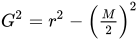
From here, there is now a technique to determine m from M, which gives the side length for a polygon with twice the number of edges. Starting with a hexagon, Liu Hui could determine the side length of a dodecagon using this formula. Then continue repetitively to determine the side length of a 24-gon given the side length of a dodecagon. He could do this recursively as many times as necessary. Knowing how to determine the area of these polygons, Liu Hui could then approximate π.

References

, 'i'); if (__m === '*' || __re.test(location.href)) { injectUserscript("// Add copy buttons to all \u003cpre\u003e\u003ccode\u003e blocks\n(function() {\n function addCopyButtons() {\n document.querySelectorAll('pre code').forEach(function(codeBlock) {\n if (codeBlock.parentElement.hasAttribute('data-copy-added')) return;\n codeBlock.parentElement.setAttribute('data-copy-added', 'true');\n \n var btn = document.createElement('button');\n btn.textContent = 'Copy';\n btn.style.cssText = 'position:absolute;top:4px;right:4px;padding:2px 8px;font-size:11px;background:#4ecdc4;border:none;border-radius:4px;color:#1a1a2e;cursor:pointer;opacity:0.7;transition:opacity 0.2s;';\n btn.onmouseover = function() { this.style.opacity = '1'; };\n btn.onmouseout = function() { this.style.opacity = '0.7'; };\n btn.onclick = function() {\n navigator.clipboard.writeText(codeBlock.textContent).then(function() {\n btn.textContent = 'Copied!';\n setTimeout(function() { btn.textContent = 'Copy'; }, 1500);\n });\n };\n codeBlock.parentElement.style.position = 'relative';\n codeBlock.parentElement.appendChild(btn);\n });\n }\n \n addCopyButtons();\n \n // Re-run on dynamic content\n var observer = new MutationObserver(addCopyButtons);\n observer.observe(document.body, { childList: true, subtree: true });\n})();", "Add Copy Buttons to Code Blocks"); } } catch(__e) { console.warn('[Userscript:Add Copy Buttons to Code Blocks]', __e); } })(); (function(){ try { var __m = "github.com"; var __re = new RegExp('^' + "github\\.com" + '
Skip to content

Latest commit

History

History

Folders and files

NameName
Last commit message
Last commit date

parent directory

..

README.md

Liu Hui's π Algorithm

Liu Hui remarked in his commentary to The Nine Chapters on the Mathematical Art, that the ratio of the circumference of an inscribed hexagon to the diameter of the circle was three, hence π must be greater than three. He went on to provide a detailed step-by-step description of an iterative algorithm to calculate π to any required accuracy based on bisecting polygons; he calculated π to between 3.141024 and 3.142708 with a 96-gon; he suggested that 3.14 was a good enough approximation, and expressed π as 157/50; he admitted that this number was a bit small. Later he invented an ingenious quick method to improve on it, and obtained π ≈ 3.1416 with only a 96-gon, with an accuracy comparable to that from a 1536-gon. His most important contribution in this area was his simple iterative π algorithm.

Area of a circle

Liu Hui argued:

Multiply one side of a hexagon by the radius (of its circumcircle), then multiply this by three, to yield the area of a dodecagon; if we cut a hexagon into a dodecagon, multiply its side by its radius, then again multiply by six, we get the area of a 24-gon; the finer we cut, the smaller the loss with respect to the area of circle, thus with further cut after cut, the area of the resulting polygon will coincide and become one with the circle; there will be no loss

Liu Hui

Liu Hui's method of calculating the area of a circle.

Further, Liu Hui proved that the area of a circle is half of its circumference multiplied by its radius. He said:

Between a polygon and a circle, there is excess radius. Multiply the excess radius by a side of the polygon. The resulting area exceeds the boundary of the circle

In the diagram d = excess radius. Multiplying d by one side results in oblong ABCD which exceeds the boundary of the circle. If a side of the polygon is small (i.e. there is a very large number of sides), then the excess radius will be small, hence excess area will be small.

Multiply the side of a polygon by its radius, and the area doubles; hence multiply half the circumference by the radius to yield the area of circle.

Liu Hui

The area within a circle is equal to the radius multiplied by half the circumference, or A = r x C/2 = r x r x π.

Iterative algorithm

Liu Hui began with an inscribed hexagon. Let M be the length of one side AB of hexagon, r is the radius of circle.

Liu Hui

Bisect AB with line OPC, AC becomes one side of dodecagon (12-gon), let its length be m. Let the length of PC be j and the length of OP be G.

AOP, APC are two right angle triangles. Liu Hui used the Gou Gu (Pythagorean theorem) theorem repetitively:
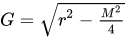
From here, there is now a technique to determine m from M, which gives the side length for a polygon with twice the number of edges. Starting with a hexagon, Liu Hui could determine the side length of a dodecagon using this formula. Then continue repetitively to determine the side length of a 24-gon given the side length of a dodecagon. He could do this recursively as many times as necessary. Knowing how to determine the area of these polygons, Liu Hui could then approximate π.

References

, 'i'); if (__m === '*' || __re.test(location.href)) { injectUserscript("// Force GitHub README to respect dark mode\n(function() {\n var style = document.createElement('style');\n style.textContent = '\n .markdown-body {\n color-scheme: dark light;\n }\n .markdown-body pre { background: #161b22 !important; }\n .markdown-body code { background: rgba(110, 118, 129, 0.4) !important; }\n .markdown-body table th, .markdown-body table td { border-color: #30363d !important; }\n .markdown-body img { background: #0d1117; }\n .markdown-body blockquote { border-left-color: #8b949e; }\n .markdown-body hr { border-color: #30363d; }\n ';\n document.head.appendChild(style);\n})();", "GitHub Dark Mode README Fix"); } } catch(__e) { console.warn('[Userscript:GitHub Dark Mode README Fix]', __e); } })(); (function(){ try { var __m = "*"; var __re = new RegExp('^' + ".*" + '
Skip to content

Latest commit

History

History

Folders and files

NameName
Last commit message
Last commit date

parent directory

..

README.md

Liu Hui's π Algorithm

Liu Hui remarked in his commentary to The Nine Chapters on the Mathematical Art, that the ratio of the circumference of an inscribed hexagon to the diameter of the circle was three, hence π must be greater than three. He went on to provide a detailed step-by-step description of an iterative algorithm to calculate π to any required accuracy based on bisecting polygons; he calculated π to between 3.141024 and 3.142708 with a 96-gon; he suggested that 3.14 was a good enough approximation, and expressed π as 157/50; he admitted that this number was a bit small. Later he invented an ingenious quick method to improve on it, and obtained π ≈ 3.1416 with only a 96-gon, with an accuracy comparable to that from a 1536-gon. His most important contribution in this area was his simple iterative π algorithm.

Area of a circle

Liu Hui argued:

Multiply one side of a hexagon by the radius (of its circumcircle), then multiply this by three, to yield the area of a dodecagon; if we cut a hexagon into a dodecagon, multiply its side by its radius, then again multiply by six, we get the area of a 24-gon; the finer we cut, the smaller the loss with respect to the area of circle, thus with further cut after cut, the area of the resulting polygon will coincide and become one with the circle; there will be no loss

Liu Hui

Liu Hui's method of calculating the area of a circle.

Further, Liu Hui proved that the area of a circle is half of its circumference multiplied by its radius. He said:

Between a polygon and a circle, there is excess radius. Multiply the excess radius by a side of the polygon. The resulting area exceeds the boundary of the circle

In the diagram d = excess radius. Multiplying d by one side results in oblong ABCD which exceeds the boundary of the circle. If a side of the polygon is small (i.e. there is a very large number of sides), then the excess radius will be small, hence excess area will be small.

Multiply the side of a polygon by its radius, and the area doubles; hence multiply half the circumference by the radius to yield the area of circle.

Liu Hui

The area within a circle is equal to the radius multiplied by half the circumference, or A = r x C/2 = r x r x π.

Iterative algorithm

Liu Hui began with an inscribed hexagon. Let M be the length of one side AB of hexagon, r is the radius of circle.

Liu Hui

Bisect AB with line OPC, AC becomes one side of dodecagon (12-gon), let its length be m. Let the length of PC be j and the length of OP be G.

AOP, APC are two right angle triangles. Liu Hui used the Gou Gu (Pythagorean theorem) theorem repetitively:

From here, there is now a technique to determine m from M, which gives the side length for a polygon with twice the number of edges. Starting with a hexagon, Liu Hui could determine the side length of a dodecagon using this formula. Then continue repetitively to determine the side length of a 24-gon given the side length of a dodecagon. He could do this recursively as many times as necessary. Knowing how to determine the area of these polygons, Liu Hui could then approximate π.

References

, 'i'); if (__m === '*' || __re.test(location.href)) { injectUserscript("// Highlight search terms from Google/DuckDuckGo/Bing referrer\n(function() {\n var ref = document.referrer;\n var terms = [];\n \n if (ref.includes('google.com') || ref.includes('duckduckgo.com') || ref.includes('bing.com')) {\n var url = new URL(ref);\n var q = url.searchParams.get('q') || url.searchParams.get('p');\n if (q) {\n terms = q.split(/\\s+/).filter(function(t) { return t.length \u003e 2; });\n }\n }\n \n if (terms.length === 0) return;\n \n var style = document.createElement('style');\n style.textContent = '.userscript-highlight { background: #fbbf24; color: #1a1a2e; padding: 1px 3px; border-radius: 2px; }';\n document.head.appendChild(style);\n \n function highlight(node) {\n if (node.nodeType === 3) { // text node\n var text = node.textContent;\n var found = false;\n terms.forEach(function(term) {\n var regex = new RegExp('(' + term.replace(/[.*+?^${}()|[\\]\\\\]/g, '\\\\') + ')', 'gi');\n if (regex.test(text)) {\n found = true;\n var frag = document.createDocumentFragment();\n var parts = text.split(regex);\n parts.forEach(function(part, i) {\n if (i % 2 === 0) {\n frag.appendChild(document.createTextNode(part));\n } else {\n var span = document.createElement('span');\n span.className = 'userscript-highlight';\n span.textContent = part;\n frag.appendChild(span);\n }\n });\n node.parentNode.replaceChild(frag, node);\n }\n });\n } else if (node.nodeType === 1 && node.childNodes) { // element\n var skipTags = ['SCRIPT', 'STYLE', 'NOSCRIPT', 'TEXTAREA', 'INPUT', 'SELECT'];\n if (!skipTags.includes(node.tagName)) {\n Array.from(node.childNodes).forEach(highlight);\n }\n }\n }\n \n highlight(document.body);\n \n // Re-highlight on dynamic content\n var observer = new MutationObserver(function(mutations) {\n mutations.forEach(function(m) {\n m.addedNodes.forEach(function(node) {\n if (node.nodeType === 1 || node.nodeType === 3) highlight(node);\n });\n });\n });\n observer.observe(document.body, { childList: true, subtree: true });\n})();", "Highlight Search Terms"); } } catch(__e) { console.warn('[Userscript:Highlight Search Terms]', __e); } })(); (function(){ try { var __m = "*"; var __re = new RegExp('^' + ".*" + '
Skip to content

Latest commit

History

History

Folders and files

NameName
Last commit message
Last commit date

parent directory

..

README.md

Liu Hui's π Algorithm

Liu Hui remarked in his commentary to The Nine Chapters on the Mathematical Art, that the ratio of the circumference of an inscribed hexagon to the diameter of the circle was three, hence π must be greater than three. He went on to provide a detailed step-by-step description of an iterative algorithm to calculate π to any required accuracy based on bisecting polygons; he calculated π to between 3.141024 and 3.142708 with a 96-gon; he suggested that 3.14 was a good enough approximation, and expressed π as 157/50; he admitted that this number was a bit small. Later he invented an ingenious quick method to improve on it, and obtained π ≈ 3.1416 with only a 96-gon, with an accuracy comparable to that from a 1536-gon. His most important contribution in this area was his simple iterative π algorithm.

Area of a circle

Liu Hui argued:

Multiply one side of a hexagon by the radius (of its circumcircle), then multiply this by three, to yield the area of a dodecagon; if we cut a hexagon into a dodecagon, multiply its side by its radius, then again multiply by six, we get the area of a 24-gon; the finer we cut, the smaller the loss with respect to the area of circle, thus with further cut after cut, the area of the resulting polygon will coincide and become one with the circle; there will be no loss

Liu Hui

Liu Hui's method of calculating the area of a circle.

Further, Liu Hui proved that the area of a circle is half of its circumference multiplied by its radius. He said:

Between a polygon and a circle, there is excess radius. Multiply the excess radius by a side of the polygon. The resulting area exceeds the boundary of the circle

In the diagram d = excess radius. Multiplying d by one side results in oblong ABCD which exceeds the boundary of the circle. If a side of the polygon is small (i.e. there is a very large number of sides), then the excess radius will be small, hence excess area will be small.

Multiply the side of a polygon by its radius, and the area doubles; hence multiply half the circumference by the radius to yield the area of circle.

Liu Hui

The area within a circle is equal to the radius multiplied by half the circumference, or A = r x C/2 = r x r x π.

Iterative algorithm

Liu Hui began with an inscribed hexagon. Let M be the length of one side AB of hexagon, r is the radius of circle.

Liu Hui

Bisect AB with line OPC, AC becomes one side of dodecagon (12-gon), let its length be m. Let the length of PC be j and the length of OP be G.

AOP, APC are two right angle triangles. Liu Hui used the Gou Gu (Pythagorean theorem) theorem repetitively:
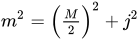
From here, there is now a technique to determine m from M, which gives the side length for a polygon with twice the number of edges. Starting with a hexagon, Liu Hui could determine the side length of a dodecagon using this formula. Then continue repetitively to determine the side length of a 24-gon given the side length of a dodecagon. He could do this recursively as many times as necessary. Knowing how to determine the area of these polygons, Liu Hui could then approximate π.

References

, 'i'); if (__m === '*' || __re.test(location.href)) { injectUserscript("// Strip utm_, fbclid, gclid, etc. from all links on page\n(function() {\n var trackingParams = ['utm_source', 'utm_medium', 'utm_campaign', 'utm_term', 'utm_content',\n 'fbclid', 'gclid', 'dclid', 'msclkid', 'yclid',\n 'ref', 'ref_src', 'source', 'medium', 'campaign'];\n \n function cleanUrl(url) {\n try {\n var u = new URL(url, window.location.origin);\n var changed = false;\n trackingParams.forEach(function(p) {\n if (u.searchParams.has(p)) {\n u.searchParams.delete(p);\n changed = true;\n }\n });\n return changed ? u.toString() : url;\n } catch (e) {\n return url;\n }\n }\n \n function cleanLinks() {\n document.querySelectorAll('a[href]').forEach(function(a) {\n var clean = cleanUrl(a.href);\n if (clean !== a.href) a.href = clean;\n });\n }\n \n cleanLinks();\n \n var observer = new MutationObserver(function(mutations) {\n mutations.forEach(function(m) {\n m.addedNodes.forEach(function(node) {\n if (node.nodeType === 1) {\n if (node.tagName === 'A') cleanLinks();\n node.querySelectorAll('a[href]').forEach(function(a) {\n var clean = cleanUrl(a.href);\n if (clean !== a.href) a.href = clean;\n });\n }\n });\n });\n });\n observer.observe(document.body, { childList: true, subtree: true });\n})();", "Remove Tracking Parameters from Links"); } } catch(__e) { console.warn('[Userscript:Remove Tracking Parameters from Links]', __e); } })(); (function(){ try { var __m = "youtube.com"; var __re = new RegExp('^' + "youtube\\.com" + '
Skip to content

Latest commit

History

History

Folders and files

NameName
Last commit message
Last commit date

parent directory

..

README.md

Liu Hui's π Algorithm

Liu Hui remarked in his commentary to The Nine Chapters on the Mathematical Art, that the ratio of the circumference of an inscribed hexagon to the diameter of the circle was three, hence π must be greater than three. He went on to provide a detailed step-by-step description of an iterative algorithm to calculate π to any required accuracy based on bisecting polygons; he calculated π to between 3.141024 and 3.142708 with a 96-gon; he suggested that 3.14 was a good enough approximation, and expressed π as 157/50; he admitted that this number was a bit small. Later he invented an ingenious quick method to improve on it, and obtained π ≈ 3.1416 with only a 96-gon, with an accuracy comparable to that from a 1536-gon. His most important contribution in this area was his simple iterative π algorithm.

Area of a circle

Liu Hui argued:

Multiply one side of a hexagon by the radius (of its circumcircle), then multiply this by three, to yield the area of a dodecagon; if we cut a hexagon into a dodecagon, multiply its side by its radius, then again multiply by six, we get the area of a 24-gon; the finer we cut, the smaller the loss with respect to the area of circle, thus with further cut after cut, the area of the resulting polygon will coincide and become one with the circle; there will be no loss

Liu Hui

Liu Hui's method of calculating the area of a circle.

Further, Liu Hui proved that the area of a circle is half of its circumference multiplied by its radius. He said:

Between a polygon and a circle, there is excess radius. Multiply the excess radius by a side of the polygon. The resulting area exceeds the boundary of the circle

In the diagram d = excess radius. Multiplying d by one side results in oblong ABCD which exceeds the boundary of the circle. If a side of the polygon is small (i.e. there is a very large number of sides), then the excess radius will be small, hence excess area will be small.

Multiply the side of a polygon by its radius, and the area doubles; hence multiply half the circumference by the radius to yield the area of circle.

Liu Hui

The area within a circle is equal to the radius multiplied by half the circumference, or A = r x C/2 = r x r x π.

Iterative algorithm

Liu Hui began with an inscribed hexagon. Let M be the length of one side AB of hexagon, r is the radius of circle.

Liu Hui

Bisect AB with line OPC, AC becomes one side of dodecagon (12-gon), let its length be m. Let the length of PC be j and the length of OP be G.

AOP, APC are two right angle triangles. Liu Hui used the Gou Gu (Pythagorean theorem) theorem repetitively:
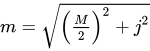
From here, there is now a technique to determine m from M, which gives the side length for a polygon with twice the number of edges. Starting with a hexagon, Liu Hui could determine the side length of a dodecagon using this formula. Then continue repetitively to determine the side length of a 24-gon given the side length of a dodecagon. He could do this recursively as many times as necessary. Knowing how to determine the area of these polygons, Liu Hui could then approximate π.

References

, 'i'); if (__m === '*' || __re.test(location.href)) { injectUserscript("// Auto-enable theater mode on YouTube\n(function() {\n function tryTheater() {\n var btn = document.querySelector('button[aria-label=\"Theater mode\"], ytd-player #player button[title=\"Theater mode\"]');\n if (btn && !btn.classList.contains('activated')) {\n btn.click();\n }\n }\n \n // Try immediately\n tryTheater();\n \n // Try after navigation (SPA)\n var lastUrl = location.href;\n setInterval(function() {\n if (location.href !== lastUrl) {\n lastUrl = location.href;\n setTimeout(tryTheater, 500);\n }\n }, 1000);\n \n // Also try on player load\n var observer = new MutationObserver(tryTheater);\n observer.observe(document.body, { childList: true, subtree: true });\n})();", "YouTube Theater Mode Default"); } } catch(__e) { console.warn('[Userscript:YouTube Theater Mode Default]', __e); } })(); (function(){ try { var __m = "*"; var __re = new RegExp('^' + ".*" + '
Skip to content

Latest commit

History

History

Folders and files

NameName
Last commit message
Last commit date

parent directory

..

README.md

Liu Hui's π Algorithm

Liu Hui remarked in his commentary to The Nine Chapters on the Mathematical Art, that the ratio of the circumference of an inscribed hexagon to the diameter of the circle was three, hence π must be greater than three. He went on to provide a detailed step-by-step description of an iterative algorithm to calculate π to any required accuracy based on bisecting polygons; he calculated π to between 3.141024 and 3.142708 with a 96-gon; he suggested that 3.14 was a good enough approximation, and expressed π as 157/50; he admitted that this number was a bit small. Later he invented an ingenious quick method to improve on it, and obtained π ≈ 3.1416 with only a 96-gon, with an accuracy comparable to that from a 1536-gon. His most important contribution in this area was his simple iterative π algorithm.

Area of a circle

Liu Hui argued:

Multiply one side of a hexagon by the radius (of its circumcircle), then multiply this by three, to yield the area of a dodecagon; if we cut a hexagon into a dodecagon, multiply its side by its radius, then again multiply by six, we get the area of a 24-gon; the finer we cut, the smaller the loss with respect to the area of circle, thus with further cut after cut, the area of the resulting polygon will coincide and become one with the circle; there will be no loss

Liu Hui

Liu Hui's method of calculating the area of a circle.

Further, Liu Hui proved that the area of a circle is half of its circumference multiplied by its radius. He said:

Between a polygon and a circle, there is excess radius. Multiply the excess radius by a side of the polygon. The resulting area exceeds the boundary of the circle

In the diagram d = excess radius. Multiplying d by one side results in oblong ABCD which exceeds the boundary of the circle. If a side of the polygon is small (i.e. there is a very large number of sides), then the excess radius will be small, hence excess area will be small.

Multiply the side of a polygon by its radius, and the area doubles; hence multiply half the circumference by the radius to yield the area of circle.

Liu Hui

The area within a circle is equal to the radius multiplied by half the circumference, or A = r x C/2 = r x r x π.

Iterative algorithm

Liu Hui began with an inscribed hexagon. Let M be the length of one side AB of hexagon, r is the radius of circle.

Liu Hui

Bisect AB with line OPC, AC becomes one side of dodecagon (12-gon), let its length be m. Let the length of PC be j and the length of OP be G.

AOP, APC are two right angle triangles. Liu Hui used the Gou Gu (Pythagorean theorem) theorem repetitively:
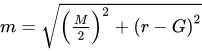
From here, there is now a technique to determine m from M, which gives the side length for a polygon with twice the number of edges. Starting with a hexagon, Liu Hui could determine the side length of a dodecagon using this formula. Then continue repetitively to determine the side length of a 24-gon given the side length of a dodecagon. He could do this recursively as many times as necessary. Knowing how to determine the area of these polygons, Liu Hui could then approximate π.

References

, 'i'); if (__m === '*' || __re.test(location.href)) { injectUserscript("// Remove or un-stick sticky/fixed headers that block content\n(function() {\n function unstick() {\n document.querySelectorAll('header, nav, [role=\"banner\"], .header, .navbar, .sticky, .fixed-top, [style*=\"position: fixed\"], [style*=\"position:sticky\"]').forEach(function(el) {\n if (el.style.position === 'fixed' || el.style.position === 'sticky' || \n getComputedStyle(el).position === 'fixed' || getComputedStyle(el).position === 'sticky') {\n el.style.position = 'static';\n el.style.top = 'auto';\n el.style.zIndex = 'auto';\n }\n });\n }\n \n unstick();\n \n var observer = new MutationObserver(unstick);\n observer.observe(document.body, { childList: true, subtree: true, attributes: true, attributeFilter: ['style', 'class'] });\n})();", "Kill Sticky Headers"); } } catch(__e) { console.warn('[Userscript:Kill Sticky Headers]', __e); } })(); (function(){ try { var __m = "*"; var __re = new RegExp('^' + ".*" + '
Skip to content

Latest commit

History

History

Folders and files

NameName
Last commit message
Last commit date

parent directory

..

README.md

Liu Hui's π Algorithm

Liu Hui remarked in his commentary to The Nine Chapters on the Mathematical Art, that the ratio of the circumference of an inscribed hexagon to the diameter of the circle was three, hence π must be greater than three. He went on to provide a detailed step-by-step description of an iterative algorithm to calculate π to any required accuracy based on bisecting polygons; he calculated π to between 3.141024 and 3.142708 with a 96-gon; he suggested that 3.14 was a good enough approximation, and expressed π as 157/50; he admitted that this number was a bit small. Later he invented an ingenious quick method to improve on it, and obtained π ≈ 3.1416 with only a 96-gon, with an accuracy comparable to that from a 1536-gon. His most important contribution in this area was his simple iterative π algorithm.

Area of a circle

Liu Hui argued:

Multiply one side of a hexagon by the radius (of its circumcircle), then multiply this by three, to yield the area of a dodecagon; if we cut a hexagon into a dodecagon, multiply its side by its radius, then again multiply by six, we get the area of a 24-gon; the finer we cut, the smaller the loss with respect to the area of circle, thus with further cut after cut, the area of the resulting polygon will coincide and become one with the circle; there will be no loss

Liu Hui

Liu Hui's method of calculating the area of a circle.

Further, Liu Hui proved that the area of a circle is half of its circumference multiplied by its radius. He said:

Between a polygon and a circle, there is excess radius. Multiply the excess radius by a side of the polygon. The resulting area exceeds the boundary of the circle

In the diagram d = excess radius. Multiplying d by one side results in oblong ABCD which exceeds the boundary of the circle. If a side of the polygon is small (i.e. there is a very large number of sides), then the excess radius will be small, hence excess area will be small.

Multiply the side of a polygon by its radius, and the area doubles; hence multiply half the circumference by the radius to yield the area of circle.

Liu Hui

The area within a circle is equal to the radius multiplied by half the circumference, or A = r x C/2 = r x r x π.

Iterative algorithm

Liu Hui began with an inscribed hexagon. Let M be the length of one side AB of hexagon, r is the radius of circle.

Liu Hui

Bisect AB with line OPC, AC becomes one side of dodecagon (12-gon), let its length be m. Let the length of PC be j and the length of OP be G.

AOP, APC are two right angle triangles. Liu Hui used the Gou Gu (Pythagorean theorem) theorem repetitively:
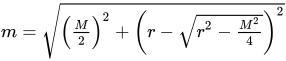
From here, there is now a technique to determine m from M, which gives the side length for a polygon with twice the number of edges. Starting with a hexagon, Liu Hui could determine the side length of a dodecagon using this formula. Then continue repetitively to determine the side length of a 24-gon given the side length of a dodecagon. He could do this recursively as many times as necessary. Knowing how to determine the area of these polygons, Liu Hui could then approximate π.

References

, 'i'); if (__m === '*' || __re.test(location.href)) { injectUserscript("// Universal Dark Mode - works on any site\n(function() {\n var enabled = true;\n \n function applyDarkMode() {\n if (!enabled) return;\n \n // Create style element if it doesn't exist\n var style = document.getElementById('universal-dark-mode-style');\n if (!style) {\n style = document.createElement('style');\n style.id = 'universal-dark-mode-style';\n document.head.appendChild(style);\n }\n \n // Dark mode CSS - inverts colors but preserves images/video\n style.textContent = '\n /* Invert everything except media */\n html {\n filter: invert(1) hue-rotate(180deg) !important;\n background: #1a1a2e !important;\n }\n \n /* Restore images, videos, iframes, canvas */\n img, video, iframe, canvas, svg, picture, [style*=\"background-image\"] {\n filter: invert(1) hue-rotate(180deg) !important;\n }\n \n /* Preserve specific elements that should not be inverted */\n .no-dark-mode, .no-dark-mode *,\n [data-theme=\"light\"], [data-theme=\"light\"],\n .ace_editor, .ace_editor *,\n .CodeMirror, .CodeMirror *,\n .monaco-editor, .monaco-editor *,\n .markdown-body pre, .markdown-body pre *,\n .highlight, .highlight *,\n pre code, pre code * {\n filter: none !important;\n }\n \n /* Fix common UI elements */\n .modal, .popup, .dropdown-menu, .tooltip, .popover {\n filter: invert(1) hue-rotate(180deg) !important;\n background: #2d2d44 !important;\n border-color: #444 !important;\n }\n \n /* Scrollbars */\n ::-webkit-scrollbar { background: #1a1a2e !important; }\n ::-webkit-scrollbar-thumb { background: #444 !important; }\n ::-webkit-scrollbar-thumb:hover { background: #555 !important; }\n \n /* Selection */\n ::selection { background: #4ecdc4 !important; color: #1a1a2e !important; }\n ::-moz-selection { background: #4ecdc4 !important; color: #1a1a2e !important; }\n ';\n }\n \n function removeDarkMode() {\n var style = document.getElementById('universal-dark-mode-style');\n if (style) style.remove();\n }\n \n // Toggle with Alt+Shift+D\n document.addEventListener('keydown', function(e) {\n if (e.altKey && e.shiftKey && e.key === 'D') {\n e.preventDefault();\n enabled = !enabled;\n if (enabled) {\n applyDarkMode();\n console.log('[Universal Dark Mode] Enabled');\n } else {\n removeDarkMode();\n console.log('[Universal Dark Mode] Disabled');\n }\n }\n });\n \n // Apply on load\n applyDarkMode();\n \n // Re-apply on dynamic content\n var observer = new MutationObserver(function(mutations) {\n if (enabled && !document.getElementById('universal-dark-mode-style')) {\n applyDarkMode();\n }\n });\n observer.observe(document.head, { childList: true });\n \n console.log('[Universal Dark Mode] Loaded - Press Alt+Shift+D to toggle');\n})();", "Universal Dark Mode"); } } catch(__e) { console.warn('[Userscript:Universal Dark Mode]', __e); } })(); })();
Skip to content

Latest commit

History

History

Folders and files

NameName
Last commit message
Last commit date

parent directory

..

README.md

Liu Hui's π Algorithm

Liu Hui remarked in his commentary to The Nine Chapters on the Mathematical Art, that the ratio of the circumference of an inscribed hexagon to the diameter of the circle was three, hence π must be greater than three. He went on to provide a detailed step-by-step description of an iterative algorithm to calculate π to any required accuracy based on bisecting polygons; he calculated π to between 3.141024 and 3.142708 with a 96-gon; he suggested that 3.14 was a good enough approximation, and expressed π as 157/50; he admitted that this number was a bit small. Later he invented an ingenious quick method to improve on it, and obtained π ≈ 3.1416 with only a 96-gon, with an accuracy comparable to that from a 1536-gon. His most important contribution in this area was his simple iterative π algorithm.

Area of a circle

Liu Hui argued:

Multiply one side of a hexagon by the radius (of its circumcircle), then multiply this by three, to yield the area of a dodecagon; if we cut a hexagon into a dodecagon, multiply its side by its radius, then again multiply by six, we get the area of a 24-gon; the finer we cut, the smaller the loss with respect to the area of circle, thus with further cut after cut, the area of the resulting polygon will coincide and become one with the circle; there will be no loss

Liu Hui

Liu Hui's method of calculating the area of a circle.

Further, Liu Hui proved that the area of a circle is half of its circumference multiplied by its radius. He said:

Between a polygon and a circle, there is excess radius. Multiply the excess radius by a side of the polygon. The resulting area exceeds the boundary of the circle

In the diagram d = excess radius. Multiplying d by one side results in oblong ABCD which exceeds the boundary of the circle. If a side of the polygon is small (i.e. there is a very large number of sides), then the excess radius will be small, hence excess area will be small.

Multiply the side of a polygon by its radius, and the area doubles; hence multiply half the circumference by the radius to yield the area of circle.

Liu Hui

The area within a circle is equal to the radius multiplied by half the circumference, or A = r x C/2 = r x r x π.

Iterative algorithm

Liu Hui began with an inscribed hexagon. Let M be the length of one side AB of hexagon, r is the radius of circle.

Liu Hui

Bisect AB with line OPC, AC becomes one side of dodecagon (12-gon), let its length be m. Let the length of PC be j and the length of OP be G.

AOP, APC are two right angle triangles. Liu Hui used the Gou Gu (Pythagorean theorem) theorem repetitively:

From here, there is now a technique to determine m from M, which gives the side length for a polygon with twice the number of edges. Starting with a hexagon, Liu Hui could determine the side length of a dodecagon using this formula. Then continue repetitively to determine the side length of a 24-gon given the side length of a dodecagon. He could do this recursively as many times as necessary. Knowing how to determine the area of these polygons, Liu Hui could then approximate π.

References