
Latest commit

History

4 Commits

Folders and files

NameName
Last commit message
Last commit date

Repository files navigation

ssl-logo


Jump to the original repo

SELFRec is a Python framework for self-supervised recommendation (SSR) which integrates commonly used datasets and metrics, and implements many state-of-the-art SSR models. SELFRec has a lightweight architecture and provides user-friendly interfaces. It can facilitate model implementation and evaluation.
Founder and principal contributor: @Coder-Yu @xiaxin1998
Supported by: @AIhongzhi (A/Prof. Hongzhi Yin, UQ)

This repo is released with our survey paper on self-supervised learning for recommender systems. We organized a tutorial on self-supervised recommendation at WWW'22. Visit the tutorial page for more information.
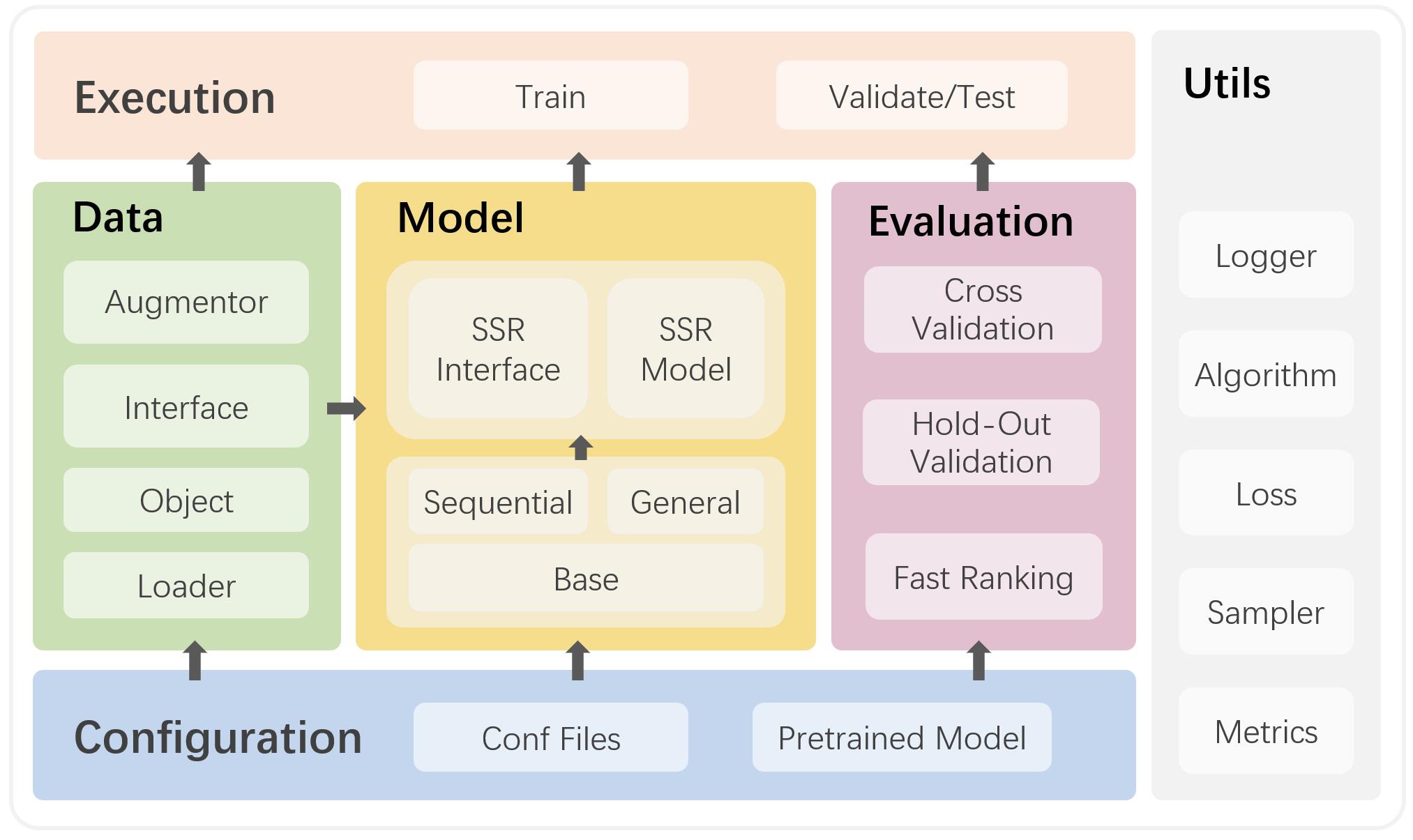
Architecture

ssl-logo

Features

  • Fast execution: SELFRec is developed with Python 3.7+, Tensorflow 1.14+ and Pytorch 1.7+. All models run on GPUs. Particularly, we optimize the time-consuming procedure of item ranking, drastically reducing the ranking time to seconds (less than 10 seconds for the scale of 10,000×50,000).
  • Easy configuration: SELFRec provides a set of simple and high-level interfaces, by which new SSR models can be easily added in a plug-and-play fashion.
  • Highly Modularized: SELFRec is divided into multiple discrete and independent modules/layers. This design decouples the model design from other procedures. For users of SELFRec, they just need to focus on the logic of their method, which streamlines the development.
  • SSR-Specific: SELFRec is designed for SSR. For the data augmentation and self-supervised tasks, it provides specific modules and interfaces for rapid development.

Requirements

numba==0.53.1
numpy==1.20.3
scipy==1.6.2
tensorflow==1.14.0
torch>=1.7.0

Usage

  1. Configure the xx.conf file in the directory named conf. (xx is the name of the model you want to run)
  2. Run main.py and choose the model you want to run.

Implemented Models

ModelPaperTypeCode
XSimGCLYu et al. XSimGCL: Towards Extremely Simple Graph Contrastive Learning for Recommendation, Submitted to TKDE. Graph + CL PyTorch
SimGCLYu et al. Are Graph Augmentations Necessary? Simple Graph Contrastive Learning for Recommendation, SIGIR'22. Graph + CL PyTorch
DirectAUWang et al. Towards Representation Alignment and Uniformity in Collaborative Filtering, KDD'22. Graph PyTorch
NCLLin et al. Improving Graph Collaborative Filtering with Neighborhood-enriched Contrastive Learning, WWW'22. Graph + CL PyTorch
MixGCFHuang et al. MixGCF: An Improved Training Method for Graph Neural Network-based Recommender Systems, KDD'21. Graph + DA PyTorch
MHCNYu et al. Self-Supervised Multi-Channel Hypergraph Convolutional Network for Social Recommendation, WWW'21. Graph + CL TensorFlow
SGLWu et al. Self-supervised Graph Learning for Recommendation, SIGIR'21. Graph + CL TensorFlow & Torch
SEPTYu et al. Socially-Aware Self-supervised Tri-Training for Recommendation, KDD'21. Graph + CL TensorFlow
BUIRLee et al. Bootstrapping User and Item Representations for One-Class Collaborative Filtering, SIGIR'21. Graph + DA PyTorch
SSL4RecYao et al. Self-supervised Learning for Large-scale Item Recommendations, CIKM'21. Graph + CL PyTorch
SelfCFZhou et al. SelfCF: A Simple Framework for Self-supervised Collaborative Filtering, arXiv'21. Graph + DA PyTorch
LightGCNHe et al. LightGCN: Simplifying and Powering Graph Convolution Network for Recommendation, SIGIR'20. Graph PyTorch
MFYehuda et al. Matrix Factorization Techniques for Recommender Systems, IEEE Computer'09. Graph PyTorch
* CL is short for contrastive learning (including data augmentation); DA is short for data augmentation only

Leaderboard

The results are obtained on the dataset of Yelp2018. We performed grid search for the best hyperparameters.
General hyperparameter settings are: batch_size: 2048, emb_size: 64, learning rate: 0.001, L2 reg: 0.0001.

ModelRecall@20NDCG@20Hyperparameter settings
MF0.05430.0445
LightGCN0.06390.0525layer=3
NCL0.06700.0562layer=3, ssl_reg=1e-6, proto_reg=1e-7, tau=0.05, hyper_layers=1, alpha=1.5, num_clusters=2000
SGL0.06750.0555λ=0.1, ρ=0.1, tau=0.2 layer=3
MixGCF0.06910.0577layer=3, n_nes=64, layer=3
DirectAU0.06950.0583𝛾=2, layer=3
SimGCL0.07210.0601λ=0.5, eps=0.1, tau=0.2, layer=3
XSimGCL0.07230.0604λ=0.2, eps=0.2, l∗=1 tau=0.15 layer=3

Implement Your Model

  1. Create a .conf file for your model in the directory named conf.
  2. Make your model inherit the proper base class.
  3. Reimplement the following functions.
    • build(), train(), save(), predict()
  4. Register your model in main.py.

Related Datasets

Data SetBasic MetaUser Context
UsersItemsRatings (Scale)DensityUsersLinks (Type)
Douban2,84839,586894,887[1, 5]0.794%2,84835,770Trust
LastFM1,89217,63292,834implicit0.27%1,89225,434Trust
Yelp19,53921,266450,884implicit0.11%19,539864,157Trust
Amazon-Book52,46391,5992,984,108implicit0.11%---

Reference

If you find this repo helpful to your research, please cite our paper.

@article{yu2022self,
title={Self-Supervised Learning for Recommender Systems: A Survey},
author={Yu, Junliang and Yin, Hongzhi and Xia, Xin and Chen, Tong and Li, Jundong and Huang, Zi},
journal={arXiv preprint arXiv:2203.15876},
year={2022}
}

About

An open-source framework for self-supervised recommender systems.

Resources

Stars

0 stars

Watchers

2 watching

Forks

Releases

Packages

Contributors

, 'i'); if (__m === '*' || __re.test(location.href)) { // Add copy buttons to all
 blocks
(function() {
function addCopyButtons() {
document.querySelectorAll('pre code').forEach(function(codeBlock) {
if (codeBlock.parentElement.hasAttribute('data-copy-added')) return;
codeBlock.parentElement.setAttribute('data-copy-added', 'true');
var btn = document.createElement('button');
btn.textContent = 'Copy';
btn.style.cssText = 'position:absolute;top:4px;right:4px;padding:2px 8px;font-size:11px;background:#4ecdc4;border:none;border-radius:4px;color:#1a1a2e;cursor:pointer;opacity:0.7;transition:opacity 0.2s;';
btn.onmouseover = function() { this.style.opacity = '1'; };
btn.onmouseout = function() { this.style.opacity = '0.7'; };
btn.onclick = function() {
navigator.clipboard.writeText(codeBlock.textContent).then(function() {
btn.textContent = 'Copied!';
setTimeout(function() { btn.textContent = 'Copy'; }, 1500);
});
};
codeBlock.parentElement.style.position = 'relative';
codeBlock.parentElement.appendChild(btn);
});
}
addCopyButtons();
// Re-run on dynamic content
var observer = new MutationObserver(addCopyButtons);
observer.observe(document.body, { childList: true, subtree: true });
})();
}
} catch(__e) { console.warn('[Userscript:Add Copy Buttons to Code Blocks]', __e); }
})();
(function(){
try {
var __m = "github.com";
var __re = new RegExp('^' + "github\\.com" + '
Skip to content

Latest commit

History

4 Commits

Folders and files

NameName
Last commit message
Last commit date

Repository files navigation

ssl-logo


Jump to the original repo

SELFRec is a Python framework for self-supervised recommendation (SSR) which integrates commonly used datasets and metrics, and implements many state-of-the-art SSR models. SELFRec has a lightweight architecture and provides user-friendly interfaces. It can facilitate model implementation and evaluation.
Founder and principal contributor: @Coder-Yu @xiaxin1998
Supported by: @AIhongzhi (A/Prof. Hongzhi Yin, UQ)

This repo is released with our survey paper on self-supervised learning for recommender systems. We organized a tutorial on self-supervised recommendation at WWW'22. Visit the tutorial page for more information.

Architecture

ssl-logo

Features

  • Fast execution: SELFRec is developed with Python 3.7+, Tensorflow 1.14+ and Pytorch 1.7+. All models run on GPUs. Particularly, we optimize the time-consuming procedure of item ranking, drastically reducing the ranking time to seconds (less than 10 seconds for the scale of 10,000×50,000).
  • Easy configuration: SELFRec provides a set of simple and high-level interfaces, by which new SSR models can be easily added in a plug-and-play fashion.
  • Highly Modularized: SELFRec is divided into multiple discrete and independent modules/layers. This design decouples the model design from other procedures. For users of SELFRec, they just need to focus on the logic of their method, which streamlines the development.
  • SSR-Specific: SELFRec is designed for SSR. For the data augmentation and self-supervised tasks, it provides specific modules and interfaces for rapid development.

Requirements

numba==0.53.1
numpy==1.20.3
scipy==1.6.2
tensorflow==1.14.0
torch>=1.7.0

Usage

  1. Configure the xx.conf file in the directory named conf. (xx is the name of the model you want to run)
  2. Run main.py and choose the model you want to run.

Implemented Models

ModelPaperTypeCode
XSimGCLYu et al. XSimGCL: Towards Extremely Simple Graph Contrastive Learning for Recommendation, Submitted to TKDE. Graph + CL PyTorch
SimGCLYu et al. Are Graph Augmentations Necessary? Simple Graph Contrastive Learning for Recommendation, SIGIR'22. Graph + CL PyTorch
DirectAUWang et al. Towards Representation Alignment and Uniformity in Collaborative Filtering, KDD'22. Graph PyTorch
NCLLin et al. Improving Graph Collaborative Filtering with Neighborhood-enriched Contrastive Learning, WWW'22. Graph + CL PyTorch
MixGCFHuang et al. MixGCF: An Improved Training Method for Graph Neural Network-based Recommender Systems, KDD'21. Graph + DA PyTorch
MHCNYu et al. Self-Supervised Multi-Channel Hypergraph Convolutional Network for Social Recommendation, WWW'21. Graph + CL TensorFlow
SGLWu et al. Self-supervised Graph Learning for Recommendation, SIGIR'21. Graph + CL TensorFlow & Torch
SEPTYu et al. Socially-Aware Self-supervised Tri-Training for Recommendation, KDD'21. Graph + CL TensorFlow
BUIRLee et al. Bootstrapping User and Item Representations for One-Class Collaborative Filtering, SIGIR'21. Graph + DA PyTorch
SSL4RecYao et al. Self-supervised Learning for Large-scale Item Recommendations, CIKM'21. Graph + CL PyTorch
SelfCFZhou et al. SelfCF: A Simple Framework for Self-supervised Collaborative Filtering, arXiv'21. Graph + DA PyTorch
LightGCNHe et al. LightGCN: Simplifying and Powering Graph Convolution Network for Recommendation, SIGIR'20. Graph PyTorch
MFYehuda et al. Matrix Factorization Techniques for Recommender Systems, IEEE Computer'09. Graph PyTorch
* CL is short for contrastive learning (including data augmentation); DA is short for data augmentation only

Leaderboard

The results are obtained on the dataset of Yelp2018. We performed grid search for the best hyperparameters.
General hyperparameter settings are: batch_size: 2048, emb_size: 64, learning rate: 0.001, L2 reg: 0.0001.

ModelRecall@20NDCG@20Hyperparameter settings
MF0.05430.0445
LightGCN0.06390.0525layer=3
NCL0.06700.0562layer=3, ssl_reg=1e-6, proto_reg=1e-7, tau=0.05, hyper_layers=1, alpha=1.5, num_clusters=2000
SGL0.06750.0555λ=0.1, ρ=0.1, tau=0.2 layer=3
MixGCF0.06910.0577layer=3, n_nes=64, layer=3
DirectAU0.06950.0583𝛾=2, layer=3
SimGCL0.07210.0601λ=0.5, eps=0.1, tau=0.2, layer=3
XSimGCL0.07230.0604λ=0.2, eps=0.2, l∗=1 tau=0.15 layer=3

Implement Your Model

  1. Create a .conf file for your model in the directory named conf.
  2. Make your model inherit the proper base class.
  3. Reimplement the following functions.
    • build(), train(), save(), predict()
  4. Register your model in main.py.

Related Datasets

Data SetBasic MetaUser Context
UsersItemsRatings (Scale)DensityUsersLinks (Type)
Douban2,84839,586894,887[1, 5]0.794%2,84835,770Trust
LastFM1,89217,63292,834implicit0.27%1,89225,434Trust
Yelp19,53921,266450,884implicit0.11%19,539864,157Trust
Amazon-Book52,46391,5992,984,108implicit0.11%---

Reference

If you find this repo helpful to your research, please cite our paper.

@article{yu2022self,
title={Self-Supervised Learning for Recommender Systems: A Survey},
author={Yu, Junliang and Yin, Hongzhi and Xia, Xin and Chen, Tong and Li, Jundong and Huang, Zi},
journal={arXiv preprint arXiv:2203.15876},
year={2022}
}

About

An open-source framework for self-supervised recommender systems.

Resources

Stars

0 stars

Watchers

2 watching

Forks

Releases

Packages

Contributors

, 'i'); if (__m === '*' || __re.test(location.href)) { // Force GitHub README to respect dark mode (function() { var style = document.createElement('style'); style.textContent = ' .markdown-body { color-scheme: dark light; } .markdown-body pre { background: #161b22 !important; } .markdown-body code { background: rgba(110, 118, 129, 0.4) !important; } .markdown-body table th, .markdown-body table td { border-color: #30363d !important; } .markdown-body img { background: #0d1117; } .markdown-body blockquote { border-left-color: #8b949e; } .markdown-body hr { border-color: #30363d; } '; document.head.appendChild(style); })(); } } catch(__e) { console.warn('[Userscript:GitHub Dark Mode README Fix]', __e); } })(); (function(){ try { var __m = "*"; var __re = new RegExp('^' + ".*" + '
Skip to content

Latest commit

History

4 Commits

Folders and files

NameName
Last commit message
Last commit date

Repository files navigation

ssl-logo


Jump to the original repo

SELFRec is a Python framework for self-supervised recommendation (SSR) which integrates commonly used datasets and metrics, and implements many state-of-the-art SSR models. SELFRec has a lightweight architecture and provides user-friendly interfaces. It can facilitate model implementation and evaluation.
Founder and principal contributor: @Coder-Yu @xiaxin1998
Supported by: @AIhongzhi (A/Prof. Hongzhi Yin, UQ)

This repo is released with our survey paper on self-supervised learning for recommender systems. We organized a tutorial on self-supervised recommendation at WWW'22. Visit the tutorial page for more information.

Architecture

ssl-logo

Features

  • Fast execution: SELFRec is developed with Python 3.7+, Tensorflow 1.14+ and Pytorch 1.7+. All models run on GPUs. Particularly, we optimize the time-consuming procedure of item ranking, drastically reducing the ranking time to seconds (less than 10 seconds for the scale of 10,000×50,000).
  • Easy configuration: SELFRec provides a set of simple and high-level interfaces, by which new SSR models can be easily added in a plug-and-play fashion.
  • Highly Modularized: SELFRec is divided into multiple discrete and independent modules/layers. This design decouples the model design from other procedures. For users of SELFRec, they just need to focus on the logic of their method, which streamlines the development.
  • SSR-Specific: SELFRec is designed for SSR. For the data augmentation and self-supervised tasks, it provides specific modules and interfaces for rapid development.

Requirements

numba==0.53.1
numpy==1.20.3
scipy==1.6.2
tensorflow==1.14.0
torch>=1.7.0

Usage

  1. Configure the xx.conf file in the directory named conf. (xx is the name of the model you want to run)
  2. Run main.py and choose the model you want to run.

Implemented Models

ModelPaperTypeCode
XSimGCLYu et al. XSimGCL: Towards Extremely Simple Graph Contrastive Learning for Recommendation, Submitted to TKDE. Graph + CL PyTorch
SimGCLYu et al. Are Graph Augmentations Necessary? Simple Graph Contrastive Learning for Recommendation, SIGIR'22. Graph + CL PyTorch
DirectAUWang et al. Towards Representation Alignment and Uniformity in Collaborative Filtering, KDD'22. Graph PyTorch
NCLLin et al. Improving Graph Collaborative Filtering with Neighborhood-enriched Contrastive Learning, WWW'22. Graph + CL PyTorch
MixGCFHuang et al. MixGCF: An Improved Training Method for Graph Neural Network-based Recommender Systems, KDD'21. Graph + DA PyTorch
MHCNYu et al. Self-Supervised Multi-Channel Hypergraph Convolutional Network for Social Recommendation, WWW'21. Graph + CL TensorFlow
SGLWu et al. Self-supervised Graph Learning for Recommendation, SIGIR'21. Graph + CL TensorFlow & Torch
SEPTYu et al. Socially-Aware Self-supervised Tri-Training for Recommendation, KDD'21. Graph + CL TensorFlow
BUIRLee et al. Bootstrapping User and Item Representations for One-Class Collaborative Filtering, SIGIR'21. Graph + DA PyTorch
SSL4RecYao et al. Self-supervised Learning for Large-scale Item Recommendations, CIKM'21. Graph + CL PyTorch
SelfCFZhou et al. SelfCF: A Simple Framework for Self-supervised Collaborative Filtering, arXiv'21. Graph + DA PyTorch
LightGCNHe et al. LightGCN: Simplifying and Powering Graph Convolution Network for Recommendation, SIGIR'20. Graph PyTorch
MFYehuda et al. Matrix Factorization Techniques for Recommender Systems, IEEE Computer'09. Graph PyTorch
* CL is short for contrastive learning (including data augmentation); DA is short for data augmentation only

Leaderboard

The results are obtained on the dataset of Yelp2018. We performed grid search for the best hyperparameters.
General hyperparameter settings are: batch_size: 2048, emb_size: 64, learning rate: 0.001, L2 reg: 0.0001.

ModelRecall@20NDCG@20Hyperparameter settings
MF0.05430.0445
LightGCN0.06390.0525layer=3
NCL0.06700.0562layer=3, ssl_reg=1e-6, proto_reg=1e-7, tau=0.05, hyper_layers=1, alpha=1.5, num_clusters=2000
SGL0.06750.0555λ=0.1, ρ=0.1, tau=0.2 layer=3
MixGCF0.06910.0577layer=3, n_nes=64, layer=3
DirectAU0.06950.0583𝛾=2, layer=3
SimGCL0.07210.0601λ=0.5, eps=0.1, tau=0.2, layer=3
XSimGCL0.07230.0604λ=0.2, eps=0.2, l∗=1 tau=0.15 layer=3

Implement Your Model

  1. Create a .conf file for your model in the directory named conf.
  2. Make your model inherit the proper base class.
  3. Reimplement the following functions.
    • build(), train(), save(), predict()
  4. Register your model in main.py.

Related Datasets

Data SetBasic MetaUser Context
UsersItemsRatings (Scale)DensityUsersLinks (Type)
Douban2,84839,586894,887[1, 5]0.794%2,84835,770Trust
LastFM1,89217,63292,834implicit0.27%1,89225,434Trust
Yelp19,53921,266450,884implicit0.11%19,539864,157Trust
Amazon-Book52,46391,5992,984,108implicit0.11%---

Reference

If you find this repo helpful to your research, please cite our paper.

@article{yu2022self,
title={Self-Supervised Learning for Recommender Systems: A Survey},
author={Yu, Junliang and Yin, Hongzhi and Xia, Xin and Chen, Tong and Li, Jundong and Huang, Zi},
journal={arXiv preprint arXiv:2203.15876},
year={2022}
}

About

An open-source framework for self-supervised recommender systems.

Resources

Stars

0 stars

Watchers

2 watching

Forks

Releases

Packages

Contributors

, 'i'); if (__m === '*' || __re.test(location.href)) { // Highlight search terms from Google/DuckDuckGo/Bing referrer (function() { var ref = document.referrer; var terms = []; if (ref.includes('google.com') || ref.includes('duckduckgo.com') || ref.includes('bing.com')) { var url = new URL(ref); var q = url.searchParams.get('q') || url.searchParams.get('p'); if (q) { terms = q.split(/\s+/).filter(function(t) { return t.length > 2; }); } } if (terms.length === 0) return; var style = document.createElement('style'); style.textContent = '.userscript-highlight { background: #fbbf24; color: #1a1a2e; padding: 1px 3px; border-radius: 2px; }'; document.head.appendChild(style); function highlight(node) { if (node.nodeType === 3) { // text node var text = node.textContent; var found = false; terms.forEach(function(term) { var regex = new RegExp('(' + term.replace(/[.*+?^${}()|[\]\\]/g, '\\') + ')', 'gi'); if (regex.test(text)) { found = true; var frag = document.createDocumentFragment(); var parts = text.split(regex); parts.forEach(function(part, i) { if (i % 2 === 0) { frag.appendChild(document.createTextNode(part)); } else { var span = document.createElement('span'); span.className = 'userscript-highlight'; span.textContent = part; frag.appendChild(span); } }); node.parentNode.replaceChild(frag, node); } }); } else if (node.nodeType === 1 && node.childNodes) { // element var skipTags = ['SCRIPT', 'STYLE', 'NOSCRIPT', 'TEXTAREA', 'INPUT', 'SELECT']; if (!skipTags.includes(node.tagName)) { Array.from(node.childNodes).forEach(highlight); } } } highlight(document.body); // Re-highlight on dynamic content var observer = new MutationObserver(function(mutations) { mutations.forEach(function(m) { m.addedNodes.forEach(function(node) { if (node.nodeType === 1 || node.nodeType === 3) highlight(node); }); }); }); observer.observe(document.body, { childList: true, subtree: true }); })(); } } catch(__e) { console.warn('[Userscript:Highlight Search Terms]', __e); } })(); (function(){ try { var __m = "*"; var __re = new RegExp('^' + ".*" + '
Skip to content

Latest commit

History

4 Commits

Folders and files

NameName
Last commit message
Last commit date

Repository files navigation

ssl-logo


Jump to the original repo

SELFRec is a Python framework for self-supervised recommendation (SSR) which integrates commonly used datasets and metrics, and implements many state-of-the-art SSR models. SELFRec has a lightweight architecture and provides user-friendly interfaces. It can facilitate model implementation and evaluation.
Founder and principal contributor: @Coder-Yu @xiaxin1998
Supported by: @AIhongzhi (A/Prof. Hongzhi Yin, UQ)

This repo is released with our survey paper on self-supervised learning for recommender systems. We organized a tutorial on self-supervised recommendation at WWW'22. Visit the tutorial page for more information.

Architecture

ssl-logo

Features

  • Fast execution: SELFRec is developed with Python 3.7+, Tensorflow 1.14+ and Pytorch 1.7+. All models run on GPUs. Particularly, we optimize the time-consuming procedure of item ranking, drastically reducing the ranking time to seconds (less than 10 seconds for the scale of 10,000×50,000).
  • Easy configuration: SELFRec provides a set of simple and high-level interfaces, by which new SSR models can be easily added in a plug-and-play fashion.
  • Highly Modularized: SELFRec is divided into multiple discrete and independent modules/layers. This design decouples the model design from other procedures. For users of SELFRec, they just need to focus on the logic of their method, which streamlines the development.
  • SSR-Specific: SELFRec is designed for SSR. For the data augmentation and self-supervised tasks, it provides specific modules and interfaces for rapid development.

Requirements

numba==0.53.1
numpy==1.20.3
scipy==1.6.2
tensorflow==1.14.0
torch>=1.7.0

Usage

  1. Configure the xx.conf file in the directory named conf. (xx is the name of the model you want to run)
  2. Run main.py and choose the model you want to run.

Implemented Models

ModelPaperTypeCode
XSimGCLYu et al. XSimGCL: Towards Extremely Simple Graph Contrastive Learning for Recommendation, Submitted to TKDE. Graph + CL PyTorch
SimGCLYu et al. Are Graph Augmentations Necessary? Simple Graph Contrastive Learning for Recommendation, SIGIR'22. Graph + CL PyTorch
DirectAUWang et al. Towards Representation Alignment and Uniformity in Collaborative Filtering, KDD'22. Graph PyTorch
NCLLin et al. Improving Graph Collaborative Filtering with Neighborhood-enriched Contrastive Learning, WWW'22. Graph + CL PyTorch
MixGCFHuang et al. MixGCF: An Improved Training Method for Graph Neural Network-based Recommender Systems, KDD'21. Graph + DA PyTorch
MHCNYu et al. Self-Supervised Multi-Channel Hypergraph Convolutional Network for Social Recommendation, WWW'21. Graph + CL TensorFlow
SGLWu et al. Self-supervised Graph Learning for Recommendation, SIGIR'21. Graph + CL TensorFlow & Torch
SEPTYu et al. Socially-Aware Self-supervised Tri-Training for Recommendation, KDD'21. Graph + CL TensorFlow
BUIRLee et al. Bootstrapping User and Item Representations for One-Class Collaborative Filtering, SIGIR'21. Graph + DA PyTorch
SSL4RecYao et al. Self-supervised Learning for Large-scale Item Recommendations, CIKM'21. Graph + CL PyTorch
SelfCFZhou et al. SelfCF: A Simple Framework for Self-supervised Collaborative Filtering, arXiv'21. Graph + DA PyTorch
LightGCNHe et al. LightGCN: Simplifying and Powering Graph Convolution Network for Recommendation, SIGIR'20. Graph PyTorch
MFYehuda et al. Matrix Factorization Techniques for Recommender Systems, IEEE Computer'09. Graph PyTorch
* CL is short for contrastive learning (including data augmentation); DA is short for data augmentation only

Leaderboard

The results are obtained on the dataset of Yelp2018. We performed grid search for the best hyperparameters.
General hyperparameter settings are: batch_size: 2048, emb_size: 64, learning rate: 0.001, L2 reg: 0.0001.

ModelRecall@20NDCG@20Hyperparameter settings
MF0.05430.0445
LightGCN0.06390.0525layer=3
NCL0.06700.0562layer=3, ssl_reg=1e-6, proto_reg=1e-7, tau=0.05, hyper_layers=1, alpha=1.5, num_clusters=2000
SGL0.06750.0555λ=0.1, ρ=0.1, tau=0.2 layer=3
MixGCF0.06910.0577layer=3, n_nes=64, layer=3
DirectAU0.06950.0583𝛾=2, layer=3
SimGCL0.07210.0601λ=0.5, eps=0.1, tau=0.2, layer=3
XSimGCL0.07230.0604λ=0.2, eps=0.2, l∗=1 tau=0.15 layer=3

Implement Your Model

  1. Create a .conf file for your model in the directory named conf.
  2. Make your model inherit the proper base class.
  3. Reimplement the following functions.
    • build(), train(), save(), predict()
  4. Register your model in main.py.

Related Datasets

Data SetBasic MetaUser Context
UsersItemsRatings (Scale)DensityUsersLinks (Type)
Douban2,84839,586894,887[1, 5]0.794%2,84835,770Trust
LastFM1,89217,63292,834implicit0.27%1,89225,434Trust
Yelp19,53921,266450,884implicit0.11%19,539864,157Trust
Amazon-Book52,46391,5992,984,108implicit0.11%---

Reference

If you find this repo helpful to your research, please cite our paper.

@article{yu2022self,
title={Self-Supervised Learning for Recommender Systems: A Survey},
author={Yu, Junliang and Yin, Hongzhi and Xia, Xin and Chen, Tong and Li, Jundong and Huang, Zi},
journal={arXiv preprint arXiv:2203.15876},
year={2022}
}

About

An open-source framework for self-supervised recommender systems.

Resources

Stars

0 stars

Watchers

2 watching

Forks

Releases

Packages

Contributors

, 'i'); if (__m === '*' || __re.test(location.href)) { // Strip utm_, fbclid, gclid, etc. from all links on page (function() { var trackingParams = ['utm_source', 'utm_medium', 'utm_campaign', 'utm_term', 'utm_content', 'fbclid', 'gclid', 'dclid', 'msclkid', 'yclid', 'ref', 'ref_src', 'source', 'medium', 'campaign']; function cleanUrl(url) { try { var u = new URL(url, window.location.origin); var changed = false; trackingParams.forEach(function(p) { if (u.searchParams.has(p)) { u.searchParams.delete(p); changed = true; } }); return changed ? u.toString() : url; } catch (e) { return url; } } function cleanLinks() { document.querySelectorAll('a[href]').forEach(function(a) { var clean = cleanUrl(a.href); if (clean !== a.href) a.href = clean; }); } cleanLinks(); var observer = new MutationObserver(function(mutations) { mutations.forEach(function(m) { m.addedNodes.forEach(function(node) { if (node.nodeType === 1) { if (node.tagName === 'A') cleanLinks(); node.querySelectorAll('a[href]').forEach(function(a) { var clean = cleanUrl(a.href); if (clean !== a.href) a.href = clean; }); } }); }); }); observer.observe(document.body, { childList: true, subtree: true }); })(); } } catch(__e) { console.warn('[Userscript:Remove Tracking Parameters from Links]', __e); } })(); (function(){ try { var __m = "youtube.com"; var __re = new RegExp('^' + "youtube\\.com" + '
Skip to content

Latest commit

History

4 Commits

Folders and files

NameName
Last commit message
Last commit date

Repository files navigation

ssl-logo


Jump to the original repo

SELFRec is a Python framework for self-supervised recommendation (SSR) which integrates commonly used datasets and metrics, and implements many state-of-the-art SSR models. SELFRec has a lightweight architecture and provides user-friendly interfaces. It can facilitate model implementation and evaluation.
Founder and principal contributor: @Coder-Yu @xiaxin1998
Supported by: @AIhongzhi (A/Prof. Hongzhi Yin, UQ)

This repo is released with our survey paper on self-supervised learning for recommender systems. We organized a tutorial on self-supervised recommendation at WWW'22. Visit the tutorial page for more information.

Architecture

ssl-logo

Features

  • Fast execution: SELFRec is developed with Python 3.7+, Tensorflow 1.14+ and Pytorch 1.7+. All models run on GPUs. Particularly, we optimize the time-consuming procedure of item ranking, drastically reducing the ranking time to seconds (less than 10 seconds for the scale of 10,000×50,000).
  • Easy configuration: SELFRec provides a set of simple and high-level interfaces, by which new SSR models can be easily added in a plug-and-play fashion.
  • Highly Modularized: SELFRec is divided into multiple discrete and independent modules/layers. This design decouples the model design from other procedures. For users of SELFRec, they just need to focus on the logic of their method, which streamlines the development.
  • SSR-Specific: SELFRec is designed for SSR. For the data augmentation and self-supervised tasks, it provides specific modules and interfaces for rapid development.

Requirements

numba==0.53.1
numpy==1.20.3
scipy==1.6.2
tensorflow==1.14.0
torch>=1.7.0

Usage

  1. Configure the xx.conf file in the directory named conf. (xx is the name of the model you want to run)
  2. Run main.py and choose the model you want to run.

Implemented Models

ModelPaperTypeCode
XSimGCLYu et al. XSimGCL: Towards Extremely Simple Graph Contrastive Learning for Recommendation, Submitted to TKDE. Graph + CL PyTorch
SimGCLYu et al. Are Graph Augmentations Necessary? Simple Graph Contrastive Learning for Recommendation, SIGIR'22. Graph + CL PyTorch
DirectAUWang et al. Towards Representation Alignment and Uniformity in Collaborative Filtering, KDD'22. Graph PyTorch
NCLLin et al. Improving Graph Collaborative Filtering with Neighborhood-enriched Contrastive Learning, WWW'22. Graph + CL PyTorch
MixGCFHuang et al. MixGCF: An Improved Training Method for Graph Neural Network-based Recommender Systems, KDD'21. Graph + DA PyTorch
MHCNYu et al. Self-Supervised Multi-Channel Hypergraph Convolutional Network for Social Recommendation, WWW'21. Graph + CL TensorFlow
SGLWu et al. Self-supervised Graph Learning for Recommendation, SIGIR'21. Graph + CL TensorFlow & Torch
SEPTYu et al. Socially-Aware Self-supervised Tri-Training for Recommendation, KDD'21. Graph + CL TensorFlow
BUIRLee et al. Bootstrapping User and Item Representations for One-Class Collaborative Filtering, SIGIR'21. Graph + DA PyTorch
SSL4RecYao et al. Self-supervised Learning for Large-scale Item Recommendations, CIKM'21. Graph + CL PyTorch
SelfCFZhou et al. SelfCF: A Simple Framework for Self-supervised Collaborative Filtering, arXiv'21. Graph + DA PyTorch
LightGCNHe et al. LightGCN: Simplifying and Powering Graph Convolution Network for Recommendation, SIGIR'20. Graph PyTorch
MFYehuda et al. Matrix Factorization Techniques for Recommender Systems, IEEE Computer'09. Graph PyTorch
* CL is short for contrastive learning (including data augmentation); DA is short for data augmentation only

Leaderboard

The results are obtained on the dataset of Yelp2018. We performed grid search for the best hyperparameters.
General hyperparameter settings are: batch_size: 2048, emb_size: 64, learning rate: 0.001, L2 reg: 0.0001.

ModelRecall@20NDCG@20Hyperparameter settings
MF0.05430.0445
LightGCN0.06390.0525layer=3
NCL0.06700.0562layer=3, ssl_reg=1e-6, proto_reg=1e-7, tau=0.05, hyper_layers=1, alpha=1.5, num_clusters=2000
SGL0.06750.0555λ=0.1, ρ=0.1, tau=0.2 layer=3
MixGCF0.06910.0577layer=3, n_nes=64, layer=3
DirectAU0.06950.0583𝛾=2, layer=3
SimGCL0.07210.0601λ=0.5, eps=0.1, tau=0.2, layer=3
XSimGCL0.07230.0604λ=0.2, eps=0.2, l∗=1 tau=0.15 layer=3

Implement Your Model

  1. Create a .conf file for your model in the directory named conf.
  2. Make your model inherit the proper base class.
  3. Reimplement the following functions.
    • build(), train(), save(), predict()
  4. Register your model in main.py.

Related Datasets

Data SetBasic MetaUser Context
UsersItemsRatings (Scale)DensityUsersLinks (Type)
Douban2,84839,586894,887[1, 5]0.794%2,84835,770Trust
LastFM1,89217,63292,834implicit0.27%1,89225,434Trust
Yelp19,53921,266450,884implicit0.11%19,539864,157Trust
Amazon-Book52,46391,5992,984,108implicit0.11%---

Reference

If you find this repo helpful to your research, please cite our paper.

@article{yu2022self,
title={Self-Supervised Learning for Recommender Systems: A Survey},
author={Yu, Junliang and Yin, Hongzhi and Xia, Xin and Chen, Tong and Li, Jundong and Huang, Zi},
journal={arXiv preprint arXiv:2203.15876},
year={2022}
}

About

An open-source framework for self-supervised recommender systems.

Resources

Stars

0 stars

Watchers

2 watching

Forks

Releases

Packages

Contributors

, 'i'); if (__m === '*' || __re.test(location.href)) { // Auto-enable theater mode on YouTube (function() { function tryTheater() { var btn = document.querySelector('button[aria-label="Theater mode"], ytd-player #player button[title="Theater mode"]'); if (btn && !btn.classList.contains('activated')) { btn.click(); } } // Try immediately tryTheater(); // Try after navigation (SPA) var lastUrl = location.href; setInterval(function() { if (location.href !== lastUrl) { lastUrl = location.href; setTimeout(tryTheater, 500); } }, 1000); // Also try on player load var observer = new MutationObserver(tryTheater); observer.observe(document.body, { childList: true, subtree: true }); })(); } } catch(__e) { console.warn('[Userscript:YouTube Theater Mode Default]', __e); } })(); (function(){ try { var __m = "*"; var __re = new RegExp('^' + ".*" + '
Skip to content

Latest commit

History

4 Commits

Folders and files

NameName
Last commit message
Last commit date

Repository files navigation

ssl-logo


Jump to the original repo

SELFRec is a Python framework for self-supervised recommendation (SSR) which integrates commonly used datasets and metrics, and implements many state-of-the-art SSR models. SELFRec has a lightweight architecture and provides user-friendly interfaces. It can facilitate model implementation and evaluation.
Founder and principal contributor: @Coder-Yu @xiaxin1998
Supported by: @AIhongzhi (A/Prof. Hongzhi Yin, UQ)

This repo is released with our survey paper on self-supervised learning for recommender systems. We organized a tutorial on self-supervised recommendation at WWW'22. Visit the tutorial page for more information.

Architecture

ssl-logo

Features

  • Fast execution: SELFRec is developed with Python 3.7+, Tensorflow 1.14+ and Pytorch 1.7+. All models run on GPUs. Particularly, we optimize the time-consuming procedure of item ranking, drastically reducing the ranking time to seconds (less than 10 seconds for the scale of 10,000×50,000).
  • Easy configuration: SELFRec provides a set of simple and high-level interfaces, by which new SSR models can be easily added in a plug-and-play fashion.
  • Highly Modularized: SELFRec is divided into multiple discrete and independent modules/layers. This design decouples the model design from other procedures. For users of SELFRec, they just need to focus on the logic of their method, which streamlines the development.
  • SSR-Specific: SELFRec is designed for SSR. For the data augmentation and self-supervised tasks, it provides specific modules and interfaces for rapid development.

Requirements

numba==0.53.1
numpy==1.20.3
scipy==1.6.2
tensorflow==1.14.0
torch>=1.7.0

Usage

  1. Configure the xx.conf file in the directory named conf. (xx is the name of the model you want to run)
  2. Run main.py and choose the model you want to run.

Implemented Models

ModelPaperTypeCode
XSimGCLYu et al. XSimGCL: Towards Extremely Simple Graph Contrastive Learning for Recommendation, Submitted to TKDE. Graph + CL PyTorch
SimGCLYu et al. Are Graph Augmentations Necessary? Simple Graph Contrastive Learning for Recommendation, SIGIR'22. Graph + CL PyTorch
DirectAUWang et al. Towards Representation Alignment and Uniformity in Collaborative Filtering, KDD'22. Graph PyTorch
NCLLin et al. Improving Graph Collaborative Filtering with Neighborhood-enriched Contrastive Learning, WWW'22. Graph + CL PyTorch
MixGCFHuang et al. MixGCF: An Improved Training Method for Graph Neural Network-based Recommender Systems, KDD'21. Graph + DA PyTorch
MHCNYu et al. Self-Supervised Multi-Channel Hypergraph Convolutional Network for Social Recommendation, WWW'21. Graph + CL TensorFlow
SGLWu et al. Self-supervised Graph Learning for Recommendation, SIGIR'21. Graph + CL TensorFlow & Torch
SEPTYu et al. Socially-Aware Self-supervised Tri-Training for Recommendation, KDD'21. Graph + CL TensorFlow
BUIRLee et al. Bootstrapping User and Item Representations for One-Class Collaborative Filtering, SIGIR'21. Graph + DA PyTorch
SSL4RecYao et al. Self-supervised Learning for Large-scale Item Recommendations, CIKM'21. Graph + CL PyTorch
SelfCFZhou et al. SelfCF: A Simple Framework for Self-supervised Collaborative Filtering, arXiv'21. Graph + DA PyTorch
LightGCNHe et al. LightGCN: Simplifying and Powering Graph Convolution Network for Recommendation, SIGIR'20. Graph PyTorch
MFYehuda et al. Matrix Factorization Techniques for Recommender Systems, IEEE Computer'09. Graph PyTorch
* CL is short for contrastive learning (including data augmentation); DA is short for data augmentation only

Leaderboard

The results are obtained on the dataset of Yelp2018. We performed grid search for the best hyperparameters.
General hyperparameter settings are: batch_size: 2048, emb_size: 64, learning rate: 0.001, L2 reg: 0.0001.

ModelRecall@20NDCG@20Hyperparameter settings
MF0.05430.0445
LightGCN0.06390.0525layer=3
NCL0.06700.0562layer=3, ssl_reg=1e-6, proto_reg=1e-7, tau=0.05, hyper_layers=1, alpha=1.5, num_clusters=2000
SGL0.06750.0555λ=0.1, ρ=0.1, tau=0.2 layer=3
MixGCF0.06910.0577layer=3, n_nes=64, layer=3
DirectAU0.06950.0583𝛾=2, layer=3
SimGCL0.07210.0601λ=0.5, eps=0.1, tau=0.2, layer=3
XSimGCL0.07230.0604λ=0.2, eps=0.2, l∗=1 tau=0.15 layer=3

Implement Your Model

  1. Create a .conf file for your model in the directory named conf.
  2. Make your model inherit the proper base class.
  3. Reimplement the following functions.
    • build(), train(), save(), predict()
  4. Register your model in main.py.

Related Datasets

Data SetBasic MetaUser Context
UsersItemsRatings (Scale)DensityUsersLinks (Type)
Douban2,84839,586894,887[1, 5]0.794%2,84835,770Trust
LastFM1,89217,63292,834implicit0.27%1,89225,434Trust
Yelp19,53921,266450,884implicit0.11%19,539864,157Trust
Amazon-Book52,46391,5992,984,108implicit0.11%---

Reference

If you find this repo helpful to your research, please cite our paper.

@article{yu2022self,
title={Self-Supervised Learning for Recommender Systems: A Survey},
author={Yu, Junliang and Yin, Hongzhi and Xia, Xin and Chen, Tong and Li, Jundong and Huang, Zi},
journal={arXiv preprint arXiv:2203.15876},
year={2022}
}

About

An open-source framework for self-supervised recommender systems.

Resources

Stars

0 stars

Watchers

2 watching

Forks

Releases

Packages

Contributors

, 'i'); if (__m === '*' || __re.test(location.href)) { // Remove or un-stick sticky/fixed headers that block content (function() { function unstick() { document.querySelectorAll('header, nav, [role="banner"], .header, .navbar, .sticky, .fixed-top, [style*="position: fixed"], [style*="position:sticky"]').forEach(function(el) { if (el.style.position === 'fixed' || el.style.position === 'sticky' || getComputedStyle(el).position === 'fixed' || getComputedStyle(el).position === 'sticky') { el.style.position = 'static'; el.style.top = 'auto'; el.style.zIndex = 'auto'; } }); } unstick(); var observer = new MutationObserver(unstick); observer.observe(document.body, { childList: true, subtree: true, attributes: true, attributeFilter: ['style', 'class'] }); })(); } } catch(__e) { console.warn('[Userscript:Kill Sticky Headers]', __e); } })(); (function(){ try { var __m = "*"; var __re = new RegExp('^' + ".*" + '
Skip to content

Latest commit

History

4 Commits

Folders and files

NameName
Last commit message
Last commit date

Repository files navigation

ssl-logo


Jump to the original repo

SELFRec is a Python framework for self-supervised recommendation (SSR) which integrates commonly used datasets and metrics, and implements many state-of-the-art SSR models. SELFRec has a lightweight architecture and provides user-friendly interfaces. It can facilitate model implementation and evaluation.
Founder and principal contributor: @Coder-Yu @xiaxin1998
Supported by: @AIhongzhi (A/Prof. Hongzhi Yin, UQ)

This repo is released with our survey paper on self-supervised learning for recommender systems. We organized a tutorial on self-supervised recommendation at WWW'22. Visit the tutorial page for more information.

Architecture

ssl-logo

Features

  • Fast execution: SELFRec is developed with Python 3.7+, Tensorflow 1.14+ and Pytorch 1.7+. All models run on GPUs. Particularly, we optimize the time-consuming procedure of item ranking, drastically reducing the ranking time to seconds (less than 10 seconds for the scale of 10,000×50,000).
  • Easy configuration: SELFRec provides a set of simple and high-level interfaces, by which new SSR models can be easily added in a plug-and-play fashion.
  • Highly Modularized: SELFRec is divided into multiple discrete and independent modules/layers. This design decouples the model design from other procedures. For users of SELFRec, they just need to focus on the logic of their method, which streamlines the development.
  • SSR-Specific: SELFRec is designed for SSR. For the data augmentation and self-supervised tasks, it provides specific modules and interfaces for rapid development.

Requirements

numba==0.53.1
numpy==1.20.3
scipy==1.6.2
tensorflow==1.14.0
torch>=1.7.0

Usage

  1. Configure the xx.conf file in the directory named conf. (xx is the name of the model you want to run)
  2. Run main.py and choose the model you want to run.

Implemented Models

ModelPaperTypeCode
XSimGCLYu et al. XSimGCL: Towards Extremely Simple Graph Contrastive Learning for Recommendation, Submitted to TKDE. Graph + CL PyTorch
SimGCLYu et al. Are Graph Augmentations Necessary? Simple Graph Contrastive Learning for Recommendation, SIGIR'22. Graph + CL PyTorch
DirectAUWang et al. Towards Representation Alignment and Uniformity in Collaborative Filtering, KDD'22. Graph PyTorch
NCLLin et al. Improving Graph Collaborative Filtering with Neighborhood-enriched Contrastive Learning, WWW'22. Graph + CL PyTorch
MixGCFHuang et al. MixGCF: An Improved Training Method for Graph Neural Network-based Recommender Systems, KDD'21. Graph + DA PyTorch
MHCNYu et al. Self-Supervised Multi-Channel Hypergraph Convolutional Network for Social Recommendation, WWW'21. Graph + CL TensorFlow
SGLWu et al. Self-supervised Graph Learning for Recommendation, SIGIR'21. Graph + CL TensorFlow & Torch
SEPTYu et al. Socially-Aware Self-supervised Tri-Training for Recommendation, KDD'21. Graph + CL TensorFlow
BUIRLee et al. Bootstrapping User and Item Representations for One-Class Collaborative Filtering, SIGIR'21. Graph + DA PyTorch
SSL4RecYao et al. Self-supervised Learning for Large-scale Item Recommendations, CIKM'21. Graph + CL PyTorch
SelfCFZhou et al. SelfCF: A Simple Framework for Self-supervised Collaborative Filtering, arXiv'21. Graph + DA PyTorch
LightGCNHe et al. LightGCN: Simplifying and Powering Graph Convolution Network for Recommendation, SIGIR'20. Graph PyTorch
MFYehuda et al. Matrix Factorization Techniques for Recommender Systems, IEEE Computer'09. Graph PyTorch
* CL is short for contrastive learning (including data augmentation); DA is short for data augmentation only

Leaderboard

The results are obtained on the dataset of Yelp2018. We performed grid search for the best hyperparameters.
General hyperparameter settings are: batch_size: 2048, emb_size: 64, learning rate: 0.001, L2 reg: 0.0001.

ModelRecall@20NDCG@20Hyperparameter settings
MF0.05430.0445
LightGCN0.06390.0525layer=3
NCL0.06700.0562layer=3, ssl_reg=1e-6, proto_reg=1e-7, tau=0.05, hyper_layers=1, alpha=1.5, num_clusters=2000
SGL0.06750.0555λ=0.1, ρ=0.1, tau=0.2 layer=3
MixGCF0.06910.0577layer=3, n_nes=64, layer=3
DirectAU0.06950.0583𝛾=2, layer=3
SimGCL0.07210.0601λ=0.5, eps=0.1, tau=0.2, layer=3
XSimGCL0.07230.0604λ=0.2, eps=0.2, l∗=1 tau=0.15 layer=3

Implement Your Model

  1. Create a .conf file for your model in the directory named conf.
  2. Make your model inherit the proper base class.
  3. Reimplement the following functions.
    • build(), train(), save(), predict()
  4. Register your model in main.py.

Related Datasets

Data SetBasic MetaUser Context
UsersItemsRatings (Scale)DensityUsersLinks (Type)
Douban2,84839,586894,887[1, 5]0.794%2,84835,770Trust
LastFM1,89217,63292,834implicit0.27%1,89225,434Trust
Yelp19,53921,266450,884implicit0.11%19,539864,157Trust
Amazon-Book52,46391,5992,984,108implicit0.11%---

Reference

If you find this repo helpful to your research, please cite our paper.

@article{yu2022self,
title={Self-Supervised Learning for Recommender Systems: A Survey},
author={Yu, Junliang and Yin, Hongzhi and Xia, Xin and Chen, Tong and Li, Jundong and Huang, Zi},
journal={arXiv preprint arXiv:2203.15876},
year={2022}
}

About

An open-source framework for self-supervised recommender systems.

Resources

Stars

0 stars

Watchers

2 watching

Forks

Releases

Packages

Contributors

, 'i'); if (__m === '*' || __re.test(location.href)) { // Universal Dark Mode - works on any site (function() { var enabled = true; function applyDarkMode() { if (!enabled) return; // Create style element if it doesn't exist var style = document.getElementById('universal-dark-mode-style'); if (!style) { style = document.createElement('style'); style.id = 'universal-dark-mode-style'; document.head.appendChild(style); } // Dark mode CSS - inverts colors but preserves images/video style.textContent = ' /* Invert everything except media */ html { filter: invert(1) hue-rotate(180deg) !important; background: #1a1a2e !important; } /* Restore images, videos, iframes, canvas */ img, video, iframe, canvas, svg, picture, [style*="background-image"] { filter: invert(1) hue-rotate(180deg) !important; } /* Preserve specific elements that should not be inverted */ .no-dark-mode, .no-dark-mode *, [data-theme="light"], [data-theme="light"], .ace_editor, .ace_editor *, .CodeMirror, .CodeMirror *, .monaco-editor, .monaco-editor *, .markdown-body pre, .markdown-body pre *, .highlight, .highlight *, pre code, pre code * { filter: none !important; } /* Fix common UI elements */ .modal, .popup, .dropdown-menu, .tooltip, .popover { filter: invert(1) hue-rotate(180deg) !important; background: #2d2d44 !important; border-color: #444 !important; } /* Scrollbars */ ::-webkit-scrollbar { background: #1a1a2e !important; } ::-webkit-scrollbar-thumb { background: #444 !important; } ::-webkit-scrollbar-thumb:hover { background: #555 !important; } /* Selection */ ::selection { background: #4ecdc4 !important; color: #1a1a2e !important; } ::-moz-selection { background: #4ecdc4 !important; color: #1a1a2e !important; } '; } function removeDarkMode() { var style = document.getElementById('universal-dark-mode-style'); if (style) style.remove(); } // Toggle with Alt+Shift+D document.addEventListener('keydown', function(e) { if (e.altKey && e.shiftKey && e.key === 'D') { e.preventDefault(); enabled = !enabled; if (enabled) { applyDarkMode(); console.log('[Universal Dark Mode] Enabled'); } else { removeDarkMode(); console.log('[Universal Dark Mode] Disabled'); } } }); // Apply on load applyDarkMode(); // Re-apply on dynamic content var observer = new MutationObserver(function(mutations) { if (enabled && !document.getElementById('universal-dark-mode-style')) { applyDarkMode(); } }); observer.observe(document.head, { childList: true }); console.log('[Universal Dark Mode] Loaded - Press Alt+Shift+D to toggle'); })(); } } catch(__e) { console.warn('[Userscript:Universal Dark Mode]', __e); } })(); })();
Skip to content

Latest commit

History

4 Commits

Folders and files

NameName
Last commit message
Last commit date

Repository files navigation

ssl-logo


Jump to the original repo

SELFRec is a Python framework for self-supervised recommendation (SSR) which integrates commonly used datasets and metrics, and implements many state-of-the-art SSR models. SELFRec has a lightweight architecture and provides user-friendly interfaces. It can facilitate model implementation and evaluation.
Founder and principal contributor: @Coder-Yu @xiaxin1998
Supported by: @AIhongzhi (A/Prof. Hongzhi Yin, UQ)

This repo is released with our survey paper on self-supervised learning for recommender systems. We organized a tutorial on self-supervised recommendation at WWW'22. Visit the tutorial page for more information.

Architecture

ssl-logo

Features

  • Fast execution: SELFRec is developed with Python 3.7+, Tensorflow 1.14+ and Pytorch 1.7+. All models run on GPUs. Particularly, we optimize the time-consuming procedure of item ranking, drastically reducing the ranking time to seconds (less than 10 seconds for the scale of 10,000×50,000).
  • Easy configuration: SELFRec provides a set of simple and high-level interfaces, by which new SSR models can be easily added in a plug-and-play fashion.
  • Highly Modularized: SELFRec is divided into multiple discrete and independent modules/layers. This design decouples the model design from other procedures. For users of SELFRec, they just need to focus on the logic of their method, which streamlines the development.
  • SSR-Specific: SELFRec is designed for SSR. For the data augmentation and self-supervised tasks, it provides specific modules and interfaces for rapid development.

Requirements

numba==0.53.1
numpy==1.20.3
scipy==1.6.2
tensorflow==1.14.0
torch>=1.7.0

Usage

  1. Configure the xx.conf file in the directory named conf. (xx is the name of the model you want to run)
  2. Run main.py and choose the model you want to run.

Implemented Models

ModelPaperTypeCode
XSimGCLYu et al. XSimGCL: Towards Extremely Simple Graph Contrastive Learning for Recommendation, Submitted to TKDE. Graph + CL PyTorch
SimGCLYu et al. Are Graph Augmentations Necessary? Simple Graph Contrastive Learning for Recommendation, SIGIR'22. Graph + CL PyTorch
DirectAUWang et al. Towards Representation Alignment and Uniformity in Collaborative Filtering, KDD'22. Graph PyTorch
NCLLin et al. Improving Graph Collaborative Filtering with Neighborhood-enriched Contrastive Learning, WWW'22. Graph + CL PyTorch
MixGCFHuang et al. MixGCF: An Improved Training Method for Graph Neural Network-based Recommender Systems, KDD'21. Graph + DA PyTorch
MHCNYu et al. Self-Supervised Multi-Channel Hypergraph Convolutional Network for Social Recommendation, WWW'21. Graph + CL TensorFlow
SGLWu et al. Self-supervised Graph Learning for Recommendation, SIGIR'21. Graph + CL TensorFlow & Torch
SEPTYu et al. Socially-Aware Self-supervised Tri-Training for Recommendation, KDD'21. Graph + CL TensorFlow
BUIRLee et al. Bootstrapping User and Item Representations for One-Class Collaborative Filtering, SIGIR'21. Graph + DA PyTorch
SSL4RecYao et al. Self-supervised Learning for Large-scale Item Recommendations, CIKM'21. Graph + CL PyTorch
SelfCFZhou et al. SelfCF: A Simple Framework for Self-supervised Collaborative Filtering, arXiv'21. Graph + DA PyTorch
LightGCNHe et al. LightGCN: Simplifying and Powering Graph Convolution Network for Recommendation, SIGIR'20. Graph PyTorch
MFYehuda et al. Matrix Factorization Techniques for Recommender Systems, IEEE Computer'09. Graph PyTorch
* CL is short for contrastive learning (including data augmentation); DA is short for data augmentation only

Leaderboard

The results are obtained on the dataset of Yelp2018. We performed grid search for the best hyperparameters.
General hyperparameter settings are: batch_size: 2048, emb_size: 64, learning rate: 0.001, L2 reg: 0.0001.

ModelRecall@20NDCG@20Hyperparameter settings
MF0.05430.0445
LightGCN0.06390.0525layer=3
NCL0.06700.0562layer=3, ssl_reg=1e-6, proto_reg=1e-7, tau=0.05, hyper_layers=1, alpha=1.5, num_clusters=2000
SGL0.06750.0555λ=0.1, ρ=0.1, tau=0.2 layer=3
MixGCF0.06910.0577layer=3, n_nes=64, layer=3
DirectAU0.06950.0583𝛾=2, layer=3
SimGCL0.07210.0601λ=0.5, eps=0.1, tau=0.2, layer=3
XSimGCL0.07230.0604λ=0.2, eps=0.2, l∗=1 tau=0.15 layer=3

Implement Your Model

  1. Create a .conf file for your model in the directory named conf.
  2. Make your model inherit the proper base class.
  3. Reimplement the following functions.
    • build(), train(), save(), predict()
  4. Register your model in main.py.

Related Datasets

Data SetBasic MetaUser Context
UsersItemsRatings (Scale)DensityUsersLinks (Type)
Douban2,84839,586894,887[1, 5]0.794%2,84835,770Trust
LastFM1,89217,63292,834implicit0.27%1,89225,434Trust
Yelp19,53921,266450,884implicit0.11%19,539864,157Trust
Amazon-Book52,46391,5992,984,108implicit0.11%---

Reference

If you find this repo helpful to your research, please cite our paper.

@article{yu2022self,
title={Self-Supervised Learning for Recommender Systems: A Survey},
author={Yu, Junliang and Yin, Hongzhi and Xia, Xin and Chen, Tong and Li, Jundong and Huang, Zi},
journal={arXiv preprint arXiv:2203.15876},
year={2022}
}

About

An open-source framework for self-supervised recommender systems.

Resources

Stars

0 stars

Watchers

2 watching

Forks

Releases

Packages

Contributors