

tkseem (تقسيم) is a tokenization library that encapsulates different approaches for tokenization and preprocessing of Arabic text.
Please visit readthedocs for the full documentation.
pip install tkseem
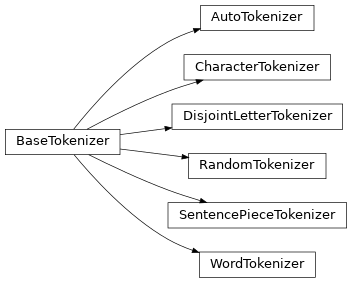
importtkseemastktokenizer=tk.WordTokenizer()
tokenizer.train('samples/data.txt')
tokenizer.tokenize("السلام عليكم")
tokenizer.encode("السلام عليكم")
tokenizer.decode([536, 829])tokenizer.tokenize(open('data/raw/train.txt').read(), use_cache=True)importtkseemastktokenizer=tk.WordTokenizer()
tokenizer.train('samples/data.txt')
# save the modeltokenizer.save_model('vocab.pl')
# load the modeltokenizer=tk.WordTokenizer()
tokenizer.load_model('vocab.pl')importtkseemastkimporttimeimportseabornassnsimportpandasaspddefcalc_time(fun):
start_time=time.time()
fun().train()
returntime.time() -start_timerunning_times= {}
running_times['Word'] =calc_time(tk.WordTokenizer)
running_times['SP'] =calc_time(tk.SentencePieceTokenizer)
running_times['Random'] =calc_time(tk.RandomTokenizer)
running_times['Disjoint'] =calc_time(tk.DisjointLetterTokenizer)
running_times['Char'] =calc_time(tk.CharacterTokenizer)We show how to use tkseem to train some nlp models.
| Name | Description | Notebook |
|---|---|---|
| Demo | Explain the syntax of all tokenizers. |  |
| Sentiment Classification | WordTokenizer for processing sentences and then train a classifier for sentiment classification. | |
| Meter Classification | CharacterTokenizer for meter classification using bidirectional GRUs. | |
| Translation | Seq-to-seq model with attention. | |
| Question Answering | Sequence to Sequence Model | |
@misc{tkseem2020,
author = {Zaid Alyafeai and Maged Saeed},
title = {tkseem: A Tokenization Library for Arabic.},
year = {2020},
publisher = {GitHub},
journal = {GitHub repository},
howpublished = {\url{https://github.com/ARBML/tkseem}}
}
This is an open source project where we encourage contributions from the community.
MIT license.