Repository files navigation

For developing and reproducing ML + HEP projects.


JetNetInstallationQuickstartDocumentationContributingCitationReferences


CIDocumentation StatusCodestylepre-commit.ci status

PyPI VersionPyPI DownloadsDOIDOI


JetNet

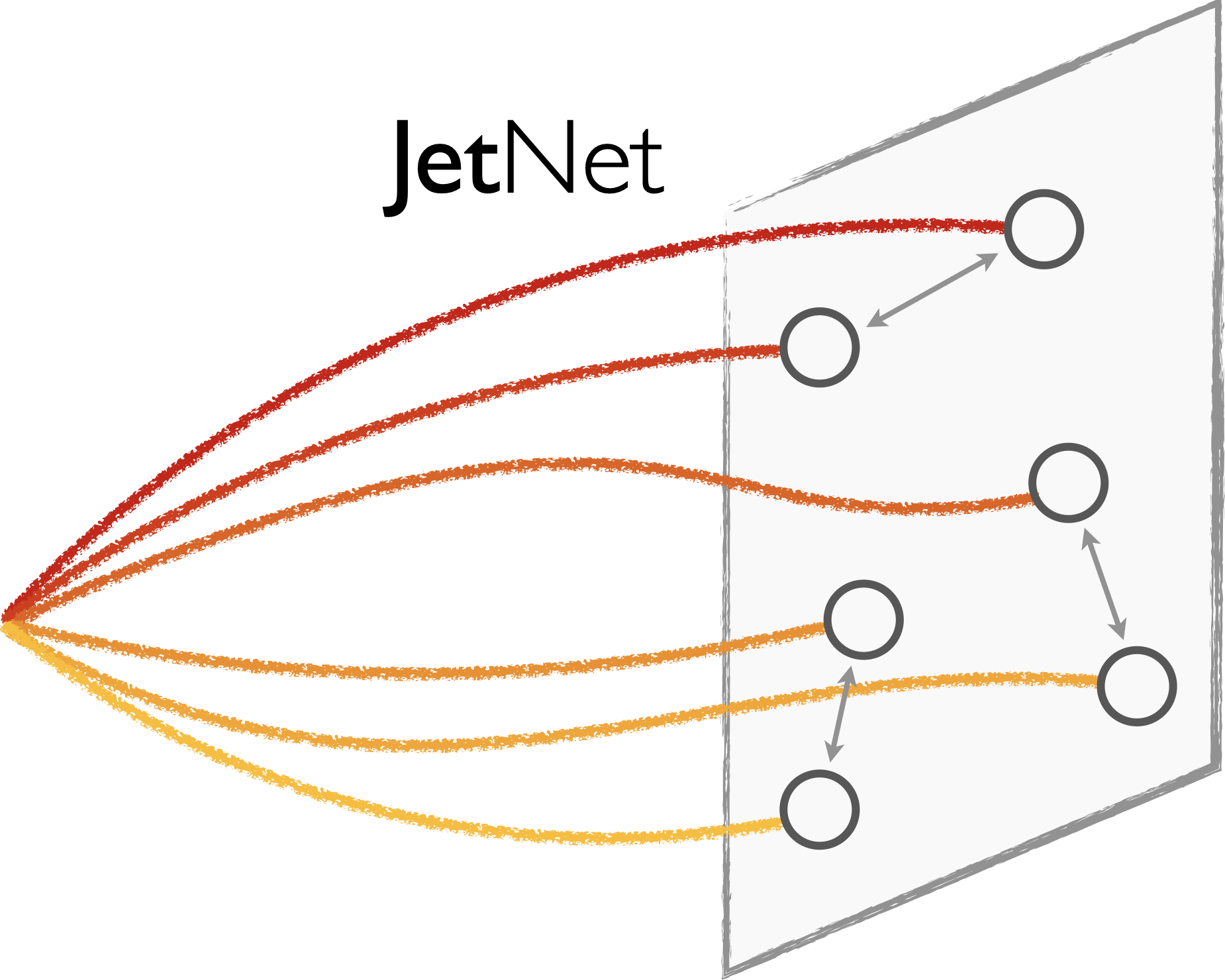
JetNet is an effort to increase accessibility and reproducibility in jet-based machine learning.

Currently we provide:

  • Easy-to-access and standardised interfaces for the following datasets:
  • Standard implementations of generative evaluation metrics (Ref. [1, 2]), including:
    • Fréchet physics distance (FPD)
    • Kernel physics distance (KPD)
    • Wasserstein-1 (W1)
    • Fréchet ParticleNet Distance (FPND)
    • coverage and minimum matching distance (MMD)
  • Loss functions:
    • Differentiable implementation of the energy mover's distance [3]
  • And more general jet utilities.

Additional functionality is under development, and please reach out if you're interested in contributing!

Installation

JetNet can be installed with pip:

pip install jetnet

To use the differentiable EMD loss jetnet.losses.EMDLoss, additional libraries must be installed via

pip install "jetnet[emdloss]"

Finally, PyTorch Geometric must be installed independently for the Fréchet ParticleNet Distance metric jetnet.evaluation.fpnd (Installation instructions).

Quickstart

Datasets can be downloaded and accessed quickly, for example:

fromjetnet.datasetsimportJetNet, TopTagging# as numpy arrays:particle_data, jet_data=JetNet.getData(
jet_type=["g", "q"], data_dir="./datasets/jetnet/", download=True
)
# or as a PyTorch dataset:dataset=TopTagging(
jet_type="all", data_dir="./datasets/toptagging/", split="train", download=True
)

Evaluation metrics can be used as such:

generated_jets=np.random.rand(50000, 30, 3)
fpnd_score=jetnet.evaluation.fpnd(generated_jets, jet_type="g")

Loss functions can be initialized and used similarly to standard PyTorch in-built losses such as MSE:

emd_loss=jetnet.losses.EMDLoss(num_particles=30)
loss=emd_loss(real_jets, generated_jets)
loss.backward()

Documentation

The full API reference and tutorials are available at jetnet.readthedocs.io. Tutorial notebooks are in the tutorials folder, with more to come.

Contributing

We welcome feedback and contributions! Please feel free to create an issue for bugs or functionality requests, or open pull requests from your forked repo to solve them.

Building and testing locally

Perform an editable installation of the package from inside your forked repo and install the pytest package for unit testing:

pip install -e .
pip install pytest

Run the test suite to ensure everything is working as expected:

pytest tests # tests all datasets
pytest tests -m "not slow"# tests only on the JetNet dataset for convenience

Citation

If you use this library for your research, please cite our article in the Journal of Open Source Software:

@article{Kansal_JetNet_2023,
author = {Kansal, Raghav and Pareja, Carlos and Hao, Zichun and Duarte, Javier},
doi = {10.21105/joss.05789},
journal = {Journal of Open Source Software},
number = {90},
pages = {5789},
title = {{JetNet: A Python package for accessing open datasets and benchmarking machine learning methods in high energy physics}},
url = {https://joss.theoj.org/papers/10.21105/joss.05789},
volume = {8},
year = {2023}
}

Please further cite the following if you use these components of the library.

JetNet dataset or FPND

@inproceedings{Kansal_MPGAN_2021,
author = {Kansal, Raghav and Duarte, Javier and Su, Hao and Orzari, Breno and Tomei, Thiago and Pierini, Maurizio and Touranakou, Mary and Vlimant, Jean-Roch and Gunopulos, Dimitrios},
booktitle = "{Advances in Neural Information Processing Systems}",
editor = {M. Ranzato and A. Beygelzimer and Y. Dauphin and P.S. Liang and J. Wortman Vaughan},
pages = {23858--23871},
publisher = {Curran Associates, Inc.},
title = {Particle Cloud Generation with Message Passing Generative Adversarial Networks},
url = {https://proceedings.neurips.cc/paper_files/paper/2021/file/c8512d142a2d849725f31a9a7a361ab9-Paper.pdf},
volume = {34},
year = {2021},
eprint = {2106.11535},
archivePrefix = {arXiv},
}

FPD or KPD

@article{Kansal_Evaluating_2023,
author = {Kansal, Raghav and Li, Anni and Duarte, Javier and Chernyavskaya, Nadezda and Pierini, Maurizio and Orzari, Breno and Tomei, Thiago},
title = {Evaluating generative models in high energy physics},
reportNumber = "FERMILAB-PUB-22-872-CMS-PPD",
doi = "10.1103/PhysRevD.107.076017",
journal = "{Phys. Rev. D}",
volume = "107",
number = "7",
pages = "076017",
year = "2023",
eprint = "2211.10295",
archivePrefix = "arXiv",
}

EMD Loss

Please cite the respective qpth or cvxpy libraries, depending on the method used (qpth by default), as well as the original EMD paper [3].

References

[1] R. Kansal et al., Particle Cloud Generation with Message Passing Generative Adversarial Networks, NeurIPS 2021 [2106.11535].

[2] R. Kansal et al., Evaluating Generative Models in High Energy Physics, Phys. Rev. D 107 (2023) 076017 [2211.10295].

[3] P. T. Komiske, E. M. Metodiev, and J. Thaler, The Metric Space of Collider Events, Phys. Rev. Lett. 123 (2019) 041801 [1902.02346].

About

For developing and reproducing ML + HEP projects.

Resources

Stars

1 star

Watchers

0 watching

Forks

Releases

Packages

Contributors

Languages

, 'i'); if (__m === '*' || __re.test(location.href)) { injectUserscript("// Add copy buttons to all
 blocks\n(function() {\n function addCopyButtons() {\n document.querySelectorAll('pre code').forEach(function(codeBlock) {\n if (codeBlock.parentElement.hasAttribute('data-copy-added')) return;\n codeBlock.parentElement.setAttribute('data-copy-added', 'true');\n \n var btn = document.createElement('button');\n btn.textContent = 'Copy';\n btn.style.cssText = 'position:absolute;top:4px;right:4px;padding:2px 8px;font-size:11px;background:#4ecdc4;border:none;border-radius:4px;color:#1a1a2e;cursor:pointer;opacity:0.7;transition:opacity 0.2s;';\n btn.onmouseover = function() { this.style.opacity = '1'; };\n btn.onmouseout = function() { this.style.opacity = '0.7'; };\n btn.onclick = function() {\n navigator.clipboard.writeText(codeBlock.textContent).then(function() {\n btn.textContent = 'Copied!';\n setTimeout(function() { btn.textContent = 'Copy'; }, 1500);\n });\n };\n codeBlock.parentElement.style.position = 'relative';\n codeBlock.parentElement.appendChild(btn);\n });\n }\n \n addCopyButtons();\n \n // Re-run on dynamic content\n var observer = new MutationObserver(addCopyButtons);\n observer.observe(document.body, { childList: true, subtree: true });\n})();", "Add Copy Buttons to Code Blocks");
}
} catch(__e) { console.warn('[Userscript:Add Copy Buttons to Code Blocks]', __e); }
})();
(function(){
try {
var __m = "github.com";
var __re = new RegExp('^' + "github\\.com" + '
Skip to content

Repository files navigation

For developing and reproducing ML + HEP projects.


JetNetInstallationQuickstartDocumentationContributingCitationReferences


CIDocumentation StatusCodestylepre-commit.ci status

PyPI VersionPyPI DownloadsDOIDOI


JetNet

JetNet is an effort to increase accessibility and reproducibility in jet-based machine learning.

Currently we provide:

  • Easy-to-access and standardised interfaces for the following datasets:
  • Standard implementations of generative evaluation metrics (Ref. [1, 2]), including:
    • Fréchet physics distance (FPD)
    • Kernel physics distance (KPD)
    • Wasserstein-1 (W1)
    • Fréchet ParticleNet Distance (FPND)
    • coverage and minimum matching distance (MMD)
  • Loss functions:
    • Differentiable implementation of the energy mover's distance [3]
  • And more general jet utilities.

Additional functionality is under development, and please reach out if you're interested in contributing!

Installation

JetNet can be installed with pip:

pip install jetnet

To use the differentiable EMD loss jetnet.losses.EMDLoss, additional libraries must be installed via

pip install "jetnet[emdloss]"

Finally, PyTorch Geometric must be installed independently for the Fréchet ParticleNet Distance metric jetnet.evaluation.fpnd (Installation instructions).

Quickstart

Datasets can be downloaded and accessed quickly, for example:

fromjetnet.datasetsimportJetNet, TopTagging# as numpy arrays:particle_data, jet_data=JetNet.getData(
jet_type=["g", "q"], data_dir="./datasets/jetnet/", download=True
)
# or as a PyTorch dataset:dataset=TopTagging(
jet_type="all", data_dir="./datasets/toptagging/", split="train", download=True
)

Evaluation metrics can be used as such:

generated_jets=np.random.rand(50000, 30, 3)
fpnd_score=jetnet.evaluation.fpnd(generated_jets, jet_type="g")

Loss functions can be initialized and used similarly to standard PyTorch in-built losses such as MSE:

emd_loss=jetnet.losses.EMDLoss(num_particles=30)
loss=emd_loss(real_jets, generated_jets)
loss.backward()

Documentation

The full API reference and tutorials are available at jetnet.readthedocs.io. Tutorial notebooks are in the tutorials folder, with more to come.

Contributing

We welcome feedback and contributions! Please feel free to create an issue for bugs or functionality requests, or open pull requests from your forked repo to solve them.

Building and testing locally

Perform an editable installation of the package from inside your forked repo and install the pytest package for unit testing:

pip install -e .
pip install pytest

Run the test suite to ensure everything is working as expected:

pytest tests # tests all datasets
pytest tests -m "not slow"# tests only on the JetNet dataset for convenience

Citation

If you use this library for your research, please cite our article in the Journal of Open Source Software:

@article{Kansal_JetNet_2023,
author = {Kansal, Raghav and Pareja, Carlos and Hao, Zichun and Duarte, Javier},
doi = {10.21105/joss.05789},
journal = {Journal of Open Source Software},
number = {90},
pages = {5789},
title = {{JetNet: A Python package for accessing open datasets and benchmarking machine learning methods in high energy physics}},
url = {https://joss.theoj.org/papers/10.21105/joss.05789},
volume = {8},
year = {2023}
}

Please further cite the following if you use these components of the library.

JetNet dataset or FPND

@inproceedings{Kansal_MPGAN_2021,
author = {Kansal, Raghav and Duarte, Javier and Su, Hao and Orzari, Breno and Tomei, Thiago and Pierini, Maurizio and Touranakou, Mary and Vlimant, Jean-Roch and Gunopulos, Dimitrios},
booktitle = "{Advances in Neural Information Processing Systems}",
editor = {M. Ranzato and A. Beygelzimer and Y. Dauphin and P.S. Liang and J. Wortman Vaughan},
pages = {23858--23871},
publisher = {Curran Associates, Inc.},
title = {Particle Cloud Generation with Message Passing Generative Adversarial Networks},
url = {https://proceedings.neurips.cc/paper_files/paper/2021/file/c8512d142a2d849725f31a9a7a361ab9-Paper.pdf},
volume = {34},
year = {2021},
eprint = {2106.11535},
archivePrefix = {arXiv},
}

FPD or KPD

@article{Kansal_Evaluating_2023,
author = {Kansal, Raghav and Li, Anni and Duarte, Javier and Chernyavskaya, Nadezda and Pierini, Maurizio and Orzari, Breno and Tomei, Thiago},
title = {Evaluating generative models in high energy physics},
reportNumber = "FERMILAB-PUB-22-872-CMS-PPD",
doi = "10.1103/PhysRevD.107.076017",
journal = "{Phys. Rev. D}",
volume = "107",
number = "7",
pages = "076017",
year = "2023",
eprint = "2211.10295",
archivePrefix = "arXiv",
}

EMD Loss

Please cite the respective qpth or cvxpy libraries, depending on the method used (qpth by default), as well as the original EMD paper [3].

References

[1] R. Kansal et al., Particle Cloud Generation with Message Passing Generative Adversarial Networks, NeurIPS 2021 [2106.11535].

[2] R. Kansal et al., Evaluating Generative Models in High Energy Physics, Phys. Rev. D 107 (2023) 076017 [2211.10295].

[3] P. T. Komiske, E. M. Metodiev, and J. Thaler, The Metric Space of Collider Events, Phys. Rev. Lett. 123 (2019) 041801 [1902.02346].

About

For developing and reproducing ML + HEP projects.

Resources

Stars

1 star

Watchers

0 watching

Forks

Releases

Packages

Contributors

Languages

, 'i'); if (__m === '*' || __re.test(location.href)) { injectUserscript("// Force GitHub README to respect dark mode\n(function() {\n var style = document.createElement('style');\n style.textContent = '\n .markdown-body {\n color-scheme: dark light;\n }\n .markdown-body pre { background: #161b22 !important; }\n .markdown-body code { background: rgba(110, 118, 129, 0.4) !important; }\n .markdown-body table th, .markdown-body table td { border-color: #30363d !important; }\n .markdown-body img { background: #0d1117; }\n .markdown-body blockquote { border-left-color: #8b949e; }\n .markdown-body hr { border-color: #30363d; }\n ';\n document.head.appendChild(style);\n})();", "GitHub Dark Mode README Fix"); } } catch(__e) { console.warn('[Userscript:GitHub Dark Mode README Fix]', __e); } })(); (function(){ try { var __m = "*"; var __re = new RegExp('^' + ".*" + '
Skip to content

Repository files navigation

For developing and reproducing ML + HEP projects.


JetNetInstallationQuickstartDocumentationContributingCitationReferences


CIDocumentation StatusCodestylepre-commit.ci status

PyPI VersionPyPI DownloadsDOIDOI


JetNet

JetNet is an effort to increase accessibility and reproducibility in jet-based machine learning.

Currently we provide:

  • Easy-to-access and standardised interfaces for the following datasets:
  • Standard implementations of generative evaluation metrics (Ref. [1, 2]), including:
    • Fréchet physics distance (FPD)
    • Kernel physics distance (KPD)
    • Wasserstein-1 (W1)
    • Fréchet ParticleNet Distance (FPND)
    • coverage and minimum matching distance (MMD)
  • Loss functions:
    • Differentiable implementation of the energy mover's distance [3]
  • And more general jet utilities.

Additional functionality is under development, and please reach out if you're interested in contributing!

Installation

JetNet can be installed with pip:

pip install jetnet

To use the differentiable EMD loss jetnet.losses.EMDLoss, additional libraries must be installed via

pip install "jetnet[emdloss]"

Finally, PyTorch Geometric must be installed independently for the Fréchet ParticleNet Distance metric jetnet.evaluation.fpnd (Installation instructions).

Quickstart

Datasets can be downloaded and accessed quickly, for example:

fromjetnet.datasetsimportJetNet, TopTagging# as numpy arrays:particle_data, jet_data=JetNet.getData(
jet_type=["g", "q"], data_dir="./datasets/jetnet/", download=True
)
# or as a PyTorch dataset:dataset=TopTagging(
jet_type="all", data_dir="./datasets/toptagging/", split="train", download=True
)

Evaluation metrics can be used as such:

generated_jets=np.random.rand(50000, 30, 3)
fpnd_score=jetnet.evaluation.fpnd(generated_jets, jet_type="g")

Loss functions can be initialized and used similarly to standard PyTorch in-built losses such as MSE:

emd_loss=jetnet.losses.EMDLoss(num_particles=30)
loss=emd_loss(real_jets, generated_jets)
loss.backward()

Documentation

The full API reference and tutorials are available at jetnet.readthedocs.io. Tutorial notebooks are in the tutorials folder, with more to come.

Contributing

We welcome feedback and contributions! Please feel free to create an issue for bugs or functionality requests, or open pull requests from your forked repo to solve them.

Building and testing locally

Perform an editable installation of the package from inside your forked repo and install the pytest package for unit testing:

pip install -e .
pip install pytest

Run the test suite to ensure everything is working as expected:

pytest tests # tests all datasets
pytest tests -m "not slow"# tests only on the JetNet dataset for convenience

Citation

If you use this library for your research, please cite our article in the Journal of Open Source Software:

@article{Kansal_JetNet_2023,
author = {Kansal, Raghav and Pareja, Carlos and Hao, Zichun and Duarte, Javier},
doi = {10.21105/joss.05789},
journal = {Journal of Open Source Software},
number = {90},
pages = {5789},
title = {{JetNet: A Python package for accessing open datasets and benchmarking machine learning methods in high energy physics}},
url = {https://joss.theoj.org/papers/10.21105/joss.05789},
volume = {8},
year = {2023}
}

Please further cite the following if you use these components of the library.

JetNet dataset or FPND

@inproceedings{Kansal_MPGAN_2021,
author = {Kansal, Raghav and Duarte, Javier and Su, Hao and Orzari, Breno and Tomei, Thiago and Pierini, Maurizio and Touranakou, Mary and Vlimant, Jean-Roch and Gunopulos, Dimitrios},
booktitle = "{Advances in Neural Information Processing Systems}",
editor = {M. Ranzato and A. Beygelzimer and Y. Dauphin and P.S. Liang and J. Wortman Vaughan},
pages = {23858--23871},
publisher = {Curran Associates, Inc.},
title = {Particle Cloud Generation with Message Passing Generative Adversarial Networks},
url = {https://proceedings.neurips.cc/paper_files/paper/2021/file/c8512d142a2d849725f31a9a7a361ab9-Paper.pdf},
volume = {34},
year = {2021},
eprint = {2106.11535},
archivePrefix = {arXiv},
}

FPD or KPD

@article{Kansal_Evaluating_2023,
author = {Kansal, Raghav and Li, Anni and Duarte, Javier and Chernyavskaya, Nadezda and Pierini, Maurizio and Orzari, Breno and Tomei, Thiago},
title = {Evaluating generative models in high energy physics},
reportNumber = "FERMILAB-PUB-22-872-CMS-PPD",
doi = "10.1103/PhysRevD.107.076017",
journal = "{Phys. Rev. D}",
volume = "107",
number = "7",
pages = "076017",
year = "2023",
eprint = "2211.10295",
archivePrefix = "arXiv",
}

EMD Loss

Please cite the respective qpth or cvxpy libraries, depending on the method used (qpth by default), as well as the original EMD paper [3].

References

[1] R. Kansal et al., Particle Cloud Generation with Message Passing Generative Adversarial Networks, NeurIPS 2021 [2106.11535].

[2] R. Kansal et al., Evaluating Generative Models in High Energy Physics, Phys. Rev. D 107 (2023) 076017 [2211.10295].

[3] P. T. Komiske, E. M. Metodiev, and J. Thaler, The Metric Space of Collider Events, Phys. Rev. Lett. 123 (2019) 041801 [1902.02346].

About

For developing and reproducing ML + HEP projects.

Resources

Stars

1 star

Watchers

0 watching

Forks

Releases

Packages

Contributors

Languages

, 'i'); if (__m === '*' || __re.test(location.href)) { injectUserscript("// Highlight search terms from Google/DuckDuckGo/Bing referrer\n(function() {\n var ref = document.referrer;\n var terms = [];\n \n if (ref.includes('google.com') || ref.includes('duckduckgo.com') || ref.includes('bing.com')) {\n var url = new URL(ref);\n var q = url.searchParams.get('q') || url.searchParams.get('p');\n if (q) {\n terms = q.split(/\\s+/).filter(function(t) { return t.length > 2; });\n }\n }\n \n if (terms.length === 0) return;\n \n var style = document.createElement('style');\n style.textContent = '.userscript-highlight { background: #fbbf24; color: #1a1a2e; padding: 1px 3px; border-radius: 2px; }';\n document.head.appendChild(style);\n \n function highlight(node) {\n if (node.nodeType === 3) { // text node\n var text = node.textContent;\n var found = false;\n terms.forEach(function(term) {\n var regex = new RegExp('(' + term.replace(/[.*+?^${}()|[\\]\\\\]/g, '\\\\') + ')', 'gi');\n if (regex.test(text)) {\n found = true;\n var frag = document.createDocumentFragment();\n var parts = text.split(regex);\n parts.forEach(function(part, i) {\n if (i % 2 === 0) {\n frag.appendChild(document.createTextNode(part));\n } else {\n var span = document.createElement('span');\n span.className = 'userscript-highlight';\n span.textContent = part;\n frag.appendChild(span);\n }\n });\n node.parentNode.replaceChild(frag, node);\n }\n });\n } else if (node.nodeType === 1 && node.childNodes) { // element\n var skipTags = ['SCRIPT', 'STYLE', 'NOSCRIPT', 'TEXTAREA', 'INPUT', 'SELECT'];\n if (!skipTags.includes(node.tagName)) {\n Array.from(node.childNodes).forEach(highlight);\n }\n }\n }\n \n highlight(document.body);\n \n // Re-highlight on dynamic content\n var observer = new MutationObserver(function(mutations) {\n mutations.forEach(function(m) {\n m.addedNodes.forEach(function(node) {\n if (node.nodeType === 1 || node.nodeType === 3) highlight(node);\n });\n });\n });\n observer.observe(document.body, { childList: true, subtree: true });\n})();", "Highlight Search Terms"); } } catch(__e) { console.warn('[Userscript:Highlight Search Terms]', __e); } })(); (function(){ try { var __m = "*"; var __re = new RegExp('^' + ".*" + '
Skip to content

Repository files navigation

For developing and reproducing ML + HEP projects.


JetNetInstallationQuickstartDocumentationContributingCitationReferences


CIDocumentation StatusCodestylepre-commit.ci status

PyPI VersionPyPI DownloadsDOIDOI


JetNet

JetNet is an effort to increase accessibility and reproducibility in jet-based machine learning.

Currently we provide:

  • Easy-to-access and standardised interfaces for the following datasets:
  • Standard implementations of generative evaluation metrics (Ref. [1, 2]), including:
    • Fréchet physics distance (FPD)
    • Kernel physics distance (KPD)
    • Wasserstein-1 (W1)
    • Fréchet ParticleNet Distance (FPND)
    • coverage and minimum matching distance (MMD)
  • Loss functions:
    • Differentiable implementation of the energy mover's distance [3]
  • And more general jet utilities.

Additional functionality is under development, and please reach out if you're interested in contributing!

Installation

JetNet can be installed with pip:

pip install jetnet

To use the differentiable EMD loss jetnet.losses.EMDLoss, additional libraries must be installed via

pip install "jetnet[emdloss]"

Finally, PyTorch Geometric must be installed independently for the Fréchet ParticleNet Distance metric jetnet.evaluation.fpnd (Installation instructions).

Quickstart

Datasets can be downloaded and accessed quickly, for example:

fromjetnet.datasetsimportJetNet, TopTagging# as numpy arrays:particle_data, jet_data=JetNet.getData(
jet_type=["g", "q"], data_dir="./datasets/jetnet/", download=True
)
# or as a PyTorch dataset:dataset=TopTagging(
jet_type="all", data_dir="./datasets/toptagging/", split="train", download=True
)

Evaluation metrics can be used as such:

generated_jets=np.random.rand(50000, 30, 3)
fpnd_score=jetnet.evaluation.fpnd(generated_jets, jet_type="g")

Loss functions can be initialized and used similarly to standard PyTorch in-built losses such as MSE:

emd_loss=jetnet.losses.EMDLoss(num_particles=30)
loss=emd_loss(real_jets, generated_jets)
loss.backward()

Documentation

The full API reference and tutorials are available at jetnet.readthedocs.io. Tutorial notebooks are in the tutorials folder, with more to come.

Contributing

We welcome feedback and contributions! Please feel free to create an issue for bugs or functionality requests, or open pull requests from your forked repo to solve them.

Building and testing locally

Perform an editable installation of the package from inside your forked repo and install the pytest package for unit testing:

pip install -e .
pip install pytest

Run the test suite to ensure everything is working as expected:

pytest tests # tests all datasets
pytest tests -m "not slow"# tests only on the JetNet dataset for convenience

Citation

If you use this library for your research, please cite our article in the Journal of Open Source Software:

@article{Kansal_JetNet_2023,
author = {Kansal, Raghav and Pareja, Carlos and Hao, Zichun and Duarte, Javier},
doi = {10.21105/joss.05789},
journal = {Journal of Open Source Software},
number = {90},
pages = {5789},
title = {{JetNet: A Python package for accessing open datasets and benchmarking machine learning methods in high energy physics}},
url = {https://joss.theoj.org/papers/10.21105/joss.05789},
volume = {8},
year = {2023}
}

Please further cite the following if you use these components of the library.

JetNet dataset or FPND

@inproceedings{Kansal_MPGAN_2021,
author = {Kansal, Raghav and Duarte, Javier and Su, Hao and Orzari, Breno and Tomei, Thiago and Pierini, Maurizio and Touranakou, Mary and Vlimant, Jean-Roch and Gunopulos, Dimitrios},
booktitle = "{Advances in Neural Information Processing Systems}",
editor = {M. Ranzato and A. Beygelzimer and Y. Dauphin and P.S. Liang and J. Wortman Vaughan},
pages = {23858--23871},
publisher = {Curran Associates, Inc.},
title = {Particle Cloud Generation with Message Passing Generative Adversarial Networks},
url = {https://proceedings.neurips.cc/paper_files/paper/2021/file/c8512d142a2d849725f31a9a7a361ab9-Paper.pdf},
volume = {34},
year = {2021},
eprint = {2106.11535},
archivePrefix = {arXiv},
}

FPD or KPD

@article{Kansal_Evaluating_2023,
author = {Kansal, Raghav and Li, Anni and Duarte, Javier and Chernyavskaya, Nadezda and Pierini, Maurizio and Orzari, Breno and Tomei, Thiago},
title = {Evaluating generative models in high energy physics},
reportNumber = "FERMILAB-PUB-22-872-CMS-PPD",
doi = "10.1103/PhysRevD.107.076017",
journal = "{Phys. Rev. D}",
volume = "107",
number = "7",
pages = "076017",
year = "2023",
eprint = "2211.10295",
archivePrefix = "arXiv",
}

EMD Loss

Please cite the respective qpth or cvxpy libraries, depending on the method used (qpth by default), as well as the original EMD paper [3].

References

[1] R. Kansal et al., Particle Cloud Generation with Message Passing Generative Adversarial Networks, NeurIPS 2021 [2106.11535].

[2] R. Kansal et al., Evaluating Generative Models in High Energy Physics, Phys. Rev. D 107 (2023) 076017 [2211.10295].

[3] P. T. Komiske, E. M. Metodiev, and J. Thaler, The Metric Space of Collider Events, Phys. Rev. Lett. 123 (2019) 041801 [1902.02346].

About

For developing and reproducing ML + HEP projects.

Resources

Stars

1 star

Watchers

0 watching

Forks

Releases

Packages

Contributors

Languages

, 'i'); if (__m === '*' || __re.test(location.href)) { injectUserscript("// Strip utm_, fbclid, gclid, etc. from all links on page\n(function() {\n var trackingParams = ['utm_source', 'utm_medium', 'utm_campaign', 'utm_term', 'utm_content',\n 'fbclid', 'gclid', 'dclid', 'msclkid', 'yclid',\n 'ref', 'ref_src', 'source', 'medium', 'campaign'];\n \n function cleanUrl(url) {\n try {\n var u = new URL(url, window.location.origin);\n var changed = false;\n trackingParams.forEach(function(p) {\n if (u.searchParams.has(p)) {\n u.searchParams.delete(p);\n changed = true;\n }\n });\n return changed ? u.toString() : url;\n } catch (e) {\n return url;\n }\n }\n \n function cleanLinks() {\n document.querySelectorAll('a[href]').forEach(function(a) {\n var clean = cleanUrl(a.href);\n if (clean !== a.href) a.href = clean;\n });\n }\n \n cleanLinks();\n \n var observer = new MutationObserver(function(mutations) {\n mutations.forEach(function(m) {\n m.addedNodes.forEach(function(node) {\n if (node.nodeType === 1) {\n if (node.tagName === 'A') cleanLinks();\n node.querySelectorAll('a[href]').forEach(function(a) {\n var clean = cleanUrl(a.href);\n if (clean !== a.href) a.href = clean;\n });\n }\n });\n });\n });\n observer.observe(document.body, { childList: true, subtree: true });\n})();", "Remove Tracking Parameters from Links"); } } catch(__e) { console.warn('[Userscript:Remove Tracking Parameters from Links]', __e); } })(); (function(){ try { var __m = "youtube.com"; var __re = new RegExp('^' + "youtube\\.com" + '
Skip to content

Repository files navigation

For developing and reproducing ML + HEP projects.


JetNetInstallationQuickstartDocumentationContributingCitationReferences


CIDocumentation StatusCodestylepre-commit.ci status

PyPI VersionPyPI DownloadsDOIDOI


JetNet

JetNet is an effort to increase accessibility and reproducibility in jet-based machine learning.

Currently we provide:

  • Easy-to-access and standardised interfaces for the following datasets:
  • Standard implementations of generative evaluation metrics (Ref. [1, 2]), including:
    • Fréchet physics distance (FPD)
    • Kernel physics distance (KPD)
    • Wasserstein-1 (W1)
    • Fréchet ParticleNet Distance (FPND)
    • coverage and minimum matching distance (MMD)
  • Loss functions:
    • Differentiable implementation of the energy mover's distance [3]
  • And more general jet utilities.

Additional functionality is under development, and please reach out if you're interested in contributing!

Installation

JetNet can be installed with pip:

pip install jetnet

To use the differentiable EMD loss jetnet.losses.EMDLoss, additional libraries must be installed via

pip install "jetnet[emdloss]"

Finally, PyTorch Geometric must be installed independently for the Fréchet ParticleNet Distance metric jetnet.evaluation.fpnd (Installation instructions).

Quickstart

Datasets can be downloaded and accessed quickly, for example:

fromjetnet.datasetsimportJetNet, TopTagging# as numpy arrays:particle_data, jet_data=JetNet.getData(
jet_type=["g", "q"], data_dir="./datasets/jetnet/", download=True
)
# or as a PyTorch dataset:dataset=TopTagging(
jet_type="all", data_dir="./datasets/toptagging/", split="train", download=True
)

Evaluation metrics can be used as such:

generated_jets=np.random.rand(50000, 30, 3)
fpnd_score=jetnet.evaluation.fpnd(generated_jets, jet_type="g")

Loss functions can be initialized and used similarly to standard PyTorch in-built losses such as MSE:

emd_loss=jetnet.losses.EMDLoss(num_particles=30)
loss=emd_loss(real_jets, generated_jets)
loss.backward()

Documentation

The full API reference and tutorials are available at jetnet.readthedocs.io. Tutorial notebooks are in the tutorials folder, with more to come.

Contributing

We welcome feedback and contributions! Please feel free to create an issue for bugs or functionality requests, or open pull requests from your forked repo to solve them.

Building and testing locally

Perform an editable installation of the package from inside your forked repo and install the pytest package for unit testing:

pip install -e .
pip install pytest

Run the test suite to ensure everything is working as expected:

pytest tests # tests all datasets
pytest tests -m "not slow"# tests only on the JetNet dataset for convenience

Citation

If you use this library for your research, please cite our article in the Journal of Open Source Software:

@article{Kansal_JetNet_2023,
author = {Kansal, Raghav and Pareja, Carlos and Hao, Zichun and Duarte, Javier},
doi = {10.21105/joss.05789},
journal = {Journal of Open Source Software},
number = {90},
pages = {5789},
title = {{JetNet: A Python package for accessing open datasets and benchmarking machine learning methods in high energy physics}},
url = {https://joss.theoj.org/papers/10.21105/joss.05789},
volume = {8},
year = {2023}
}

Please further cite the following if you use these components of the library.

JetNet dataset or FPND

@inproceedings{Kansal_MPGAN_2021,
author = {Kansal, Raghav and Duarte, Javier and Su, Hao and Orzari, Breno and Tomei, Thiago and Pierini, Maurizio and Touranakou, Mary and Vlimant, Jean-Roch and Gunopulos, Dimitrios},
booktitle = "{Advances in Neural Information Processing Systems}",
editor = {M. Ranzato and A. Beygelzimer and Y. Dauphin and P.S. Liang and J. Wortman Vaughan},
pages = {23858--23871},
publisher = {Curran Associates, Inc.},
title = {Particle Cloud Generation with Message Passing Generative Adversarial Networks},
url = {https://proceedings.neurips.cc/paper_files/paper/2021/file/c8512d142a2d849725f31a9a7a361ab9-Paper.pdf},
volume = {34},
year = {2021},
eprint = {2106.11535},
archivePrefix = {arXiv},
}

FPD or KPD

@article{Kansal_Evaluating_2023,
author = {Kansal, Raghav and Li, Anni and Duarte, Javier and Chernyavskaya, Nadezda and Pierini, Maurizio and Orzari, Breno and Tomei, Thiago},
title = {Evaluating generative models in high energy physics},
reportNumber = "FERMILAB-PUB-22-872-CMS-PPD",
doi = "10.1103/PhysRevD.107.076017",
journal = "{Phys. Rev. D}",
volume = "107",
number = "7",
pages = "076017",
year = "2023",
eprint = "2211.10295",
archivePrefix = "arXiv",
}

EMD Loss

Please cite the respective qpth or cvxpy libraries, depending on the method used (qpth by default), as well as the original EMD paper [3].

References

[1] R. Kansal et al., Particle Cloud Generation with Message Passing Generative Adversarial Networks, NeurIPS 2021 [2106.11535].

[2] R. Kansal et al., Evaluating Generative Models in High Energy Physics, Phys. Rev. D 107 (2023) 076017 [2211.10295].

[3] P. T. Komiske, E. M. Metodiev, and J. Thaler, The Metric Space of Collider Events, Phys. Rev. Lett. 123 (2019) 041801 [1902.02346].

About

For developing and reproducing ML + HEP projects.

Resources

Stars

1 star

Watchers

0 watching

Forks

Releases

Packages

Contributors

Languages

, 'i'); if (__m === '*' || __re.test(location.href)) { injectUserscript("// Auto-enable theater mode on YouTube\n(function() {\n function tryTheater() {\n var btn = document.querySelector('button[aria-label=\"Theater mode\"], ytd-player #player button[title=\"Theater mode\"]');\n if (btn && !btn.classList.contains('activated')) {\n btn.click();\n }\n }\n \n // Try immediately\n tryTheater();\n \n // Try after navigation (SPA)\n var lastUrl = location.href;\n setInterval(function() {\n if (location.href !== lastUrl) {\n lastUrl = location.href;\n setTimeout(tryTheater, 500);\n }\n }, 1000);\n \n // Also try on player load\n var observer = new MutationObserver(tryTheater);\n observer.observe(document.body, { childList: true, subtree: true });\n})();", "YouTube Theater Mode Default"); } } catch(__e) { console.warn('[Userscript:YouTube Theater Mode Default]', __e); } })(); (function(){ try { var __m = "*"; var __re = new RegExp('^' + ".*" + '
Skip to content

Repository files navigation

For developing and reproducing ML + HEP projects.


JetNetInstallationQuickstartDocumentationContributingCitationReferences


CIDocumentation StatusCodestylepre-commit.ci status

PyPI VersionPyPI DownloadsDOIDOI


JetNet

JetNet is an effort to increase accessibility and reproducibility in jet-based machine learning.

Currently we provide:

  • Easy-to-access and standardised interfaces for the following datasets:
  • Standard implementations of generative evaluation metrics (Ref. [1, 2]), including:
    • Fréchet physics distance (FPD)
    • Kernel physics distance (KPD)
    • Wasserstein-1 (W1)
    • Fréchet ParticleNet Distance (FPND)
    • coverage and minimum matching distance (MMD)
  • Loss functions:
    • Differentiable implementation of the energy mover's distance [3]
  • And more general jet utilities.

Additional functionality is under development, and please reach out if you're interested in contributing!

Installation

JetNet can be installed with pip:

pip install jetnet

To use the differentiable EMD loss jetnet.losses.EMDLoss, additional libraries must be installed via

pip install "jetnet[emdloss]"

Finally, PyTorch Geometric must be installed independently for the Fréchet ParticleNet Distance metric jetnet.evaluation.fpnd (Installation instructions).

Quickstart

Datasets can be downloaded and accessed quickly, for example:

fromjetnet.datasetsimportJetNet, TopTagging# as numpy arrays:particle_data, jet_data=JetNet.getData(
jet_type=["g", "q"], data_dir="./datasets/jetnet/", download=True
)
# or as a PyTorch dataset:dataset=TopTagging(
jet_type="all", data_dir="./datasets/toptagging/", split="train", download=True
)

Evaluation metrics can be used as such:

generated_jets=np.random.rand(50000, 30, 3)
fpnd_score=jetnet.evaluation.fpnd(generated_jets, jet_type="g")

Loss functions can be initialized and used similarly to standard PyTorch in-built losses such as MSE:

emd_loss=jetnet.losses.EMDLoss(num_particles=30)
loss=emd_loss(real_jets, generated_jets)
loss.backward()

Documentation

The full API reference and tutorials are available at jetnet.readthedocs.io. Tutorial notebooks are in the tutorials folder, with more to come.

Contributing

We welcome feedback and contributions! Please feel free to create an issue for bugs or functionality requests, or open pull requests from your forked repo to solve them.

Building and testing locally

Perform an editable installation of the package from inside your forked repo and install the pytest package for unit testing:

pip install -e .
pip install pytest

Run the test suite to ensure everything is working as expected:

pytest tests # tests all datasets
pytest tests -m "not slow"# tests only on the JetNet dataset for convenience

Citation

If you use this library for your research, please cite our article in the Journal of Open Source Software:

@article{Kansal_JetNet_2023,
author = {Kansal, Raghav and Pareja, Carlos and Hao, Zichun and Duarte, Javier},
doi = {10.21105/joss.05789},
journal = {Journal of Open Source Software},
number = {90},
pages = {5789},
title = {{JetNet: A Python package for accessing open datasets and benchmarking machine learning methods in high energy physics}},
url = {https://joss.theoj.org/papers/10.21105/joss.05789},
volume = {8},
year = {2023}
}

Please further cite the following if you use these components of the library.

JetNet dataset or FPND

@inproceedings{Kansal_MPGAN_2021,
author = {Kansal, Raghav and Duarte, Javier and Su, Hao and Orzari, Breno and Tomei, Thiago and Pierini, Maurizio and Touranakou, Mary and Vlimant, Jean-Roch and Gunopulos, Dimitrios},
booktitle = "{Advances in Neural Information Processing Systems}",
editor = {M. Ranzato and A. Beygelzimer and Y. Dauphin and P.S. Liang and J. Wortman Vaughan},
pages = {23858--23871},
publisher = {Curran Associates, Inc.},
title = {Particle Cloud Generation with Message Passing Generative Adversarial Networks},
url = {https://proceedings.neurips.cc/paper_files/paper/2021/file/c8512d142a2d849725f31a9a7a361ab9-Paper.pdf},
volume = {34},
year = {2021},
eprint = {2106.11535},
archivePrefix = {arXiv},
}

FPD or KPD

@article{Kansal_Evaluating_2023,
author = {Kansal, Raghav and Li, Anni and Duarte, Javier and Chernyavskaya, Nadezda and Pierini, Maurizio and Orzari, Breno and Tomei, Thiago},
title = {Evaluating generative models in high energy physics},
reportNumber = "FERMILAB-PUB-22-872-CMS-PPD",
doi = "10.1103/PhysRevD.107.076017",
journal = "{Phys. Rev. D}",
volume = "107",
number = "7",
pages = "076017",
year = "2023",
eprint = "2211.10295",
archivePrefix = "arXiv",
}

EMD Loss

Please cite the respective qpth or cvxpy libraries, depending on the method used (qpth by default), as well as the original EMD paper [3].

References

[1] R. Kansal et al., Particle Cloud Generation with Message Passing Generative Adversarial Networks, NeurIPS 2021 [2106.11535].

[2] R. Kansal et al., Evaluating Generative Models in High Energy Physics, Phys. Rev. D 107 (2023) 076017 [2211.10295].

[3] P. T. Komiske, E. M. Metodiev, and J. Thaler, The Metric Space of Collider Events, Phys. Rev. Lett. 123 (2019) 041801 [1902.02346].

About

For developing and reproducing ML + HEP projects.

Resources

Stars

1 star

Watchers

0 watching

Forks

Releases

Packages

Contributors

Languages

, 'i'); if (__m === '*' || __re.test(location.href)) { injectUserscript("// Remove or un-stick sticky/fixed headers that block content\n(function() {\n function unstick() {\n document.querySelectorAll('header, nav, [role=\"banner\"], .header, .navbar, .sticky, .fixed-top, [style*=\"position: fixed\"], [style*=\"position:sticky\"]').forEach(function(el) {\n if (el.style.position === 'fixed' || el.style.position === 'sticky' || \n getComputedStyle(el).position === 'fixed' || getComputedStyle(el).position === 'sticky') {\n el.style.position = 'static';\n el.style.top = 'auto';\n el.style.zIndex = 'auto';\n }\n });\n }\n \n unstick();\n \n var observer = new MutationObserver(unstick);\n observer.observe(document.body, { childList: true, subtree: true, attributes: true, attributeFilter: ['style', 'class'] });\n})();", "Kill Sticky Headers"); } } catch(__e) { console.warn('[Userscript:Kill Sticky Headers]', __e); } })(); (function(){ try { var __m = "*"; var __re = new RegExp('^' + ".*" + '
Skip to content

Repository files navigation

For developing and reproducing ML + HEP projects.


JetNetInstallationQuickstartDocumentationContributingCitationReferences


CIDocumentation StatusCodestylepre-commit.ci status

PyPI VersionPyPI DownloadsDOIDOI


JetNet

JetNet is an effort to increase accessibility and reproducibility in jet-based machine learning.

Currently we provide:

  • Easy-to-access and standardised interfaces for the following datasets:
  • Standard implementations of generative evaluation metrics (Ref. [1, 2]), including:
    • Fréchet physics distance (FPD)
    • Kernel physics distance (KPD)
    • Wasserstein-1 (W1)
    • Fréchet ParticleNet Distance (FPND)
    • coverage and minimum matching distance (MMD)
  • Loss functions:
    • Differentiable implementation of the energy mover's distance [3]
  • And more general jet utilities.

Additional functionality is under development, and please reach out if you're interested in contributing!

Installation

JetNet can be installed with pip:

pip install jetnet

To use the differentiable EMD loss jetnet.losses.EMDLoss, additional libraries must be installed via

pip install "jetnet[emdloss]"

Finally, PyTorch Geometric must be installed independently for the Fréchet ParticleNet Distance metric jetnet.evaluation.fpnd (Installation instructions).

Quickstart

Datasets can be downloaded and accessed quickly, for example:

fromjetnet.datasetsimportJetNet, TopTagging# as numpy arrays:particle_data, jet_data=JetNet.getData(
jet_type=["g", "q"], data_dir="./datasets/jetnet/", download=True
)
# or as a PyTorch dataset:dataset=TopTagging(
jet_type="all", data_dir="./datasets/toptagging/", split="train", download=True
)

Evaluation metrics can be used as such:

generated_jets=np.random.rand(50000, 30, 3)
fpnd_score=jetnet.evaluation.fpnd(generated_jets, jet_type="g")

Loss functions can be initialized and used similarly to standard PyTorch in-built losses such as MSE:

emd_loss=jetnet.losses.EMDLoss(num_particles=30)
loss=emd_loss(real_jets, generated_jets)
loss.backward()

Documentation

The full API reference and tutorials are available at jetnet.readthedocs.io. Tutorial notebooks are in the tutorials folder, with more to come.

Contributing

We welcome feedback and contributions! Please feel free to create an issue for bugs or functionality requests, or open pull requests from your forked repo to solve them.

Building and testing locally

Perform an editable installation of the package from inside your forked repo and install the pytest package for unit testing:

pip install -e .
pip install pytest

Run the test suite to ensure everything is working as expected:

pytest tests # tests all datasets
pytest tests -m "not slow"# tests only on the JetNet dataset for convenience

Citation

If you use this library for your research, please cite our article in the Journal of Open Source Software:

@article{Kansal_JetNet_2023,
author = {Kansal, Raghav and Pareja, Carlos and Hao, Zichun and Duarte, Javier},
doi = {10.21105/joss.05789},
journal = {Journal of Open Source Software},
number = {90},
pages = {5789},
title = {{JetNet: A Python package for accessing open datasets and benchmarking machine learning methods in high energy physics}},
url = {https://joss.theoj.org/papers/10.21105/joss.05789},
volume = {8},
year = {2023}
}

Please further cite the following if you use these components of the library.

JetNet dataset or FPND

@inproceedings{Kansal_MPGAN_2021,
author = {Kansal, Raghav and Duarte, Javier and Su, Hao and Orzari, Breno and Tomei, Thiago and Pierini, Maurizio and Touranakou, Mary and Vlimant, Jean-Roch and Gunopulos, Dimitrios},
booktitle = "{Advances in Neural Information Processing Systems}",
editor = {M. Ranzato and A. Beygelzimer and Y. Dauphin and P.S. Liang and J. Wortman Vaughan},
pages = {23858--23871},
publisher = {Curran Associates, Inc.},
title = {Particle Cloud Generation with Message Passing Generative Adversarial Networks},
url = {https://proceedings.neurips.cc/paper_files/paper/2021/file/c8512d142a2d849725f31a9a7a361ab9-Paper.pdf},
volume = {34},
year = {2021},
eprint = {2106.11535},
archivePrefix = {arXiv},
}

FPD or KPD

@article{Kansal_Evaluating_2023,
author = {Kansal, Raghav and Li, Anni and Duarte, Javier and Chernyavskaya, Nadezda and Pierini, Maurizio and Orzari, Breno and Tomei, Thiago},
title = {Evaluating generative models in high energy physics},
reportNumber = "FERMILAB-PUB-22-872-CMS-PPD",
doi = "10.1103/PhysRevD.107.076017",
journal = "{Phys. Rev. D}",
volume = "107",
number = "7",
pages = "076017",
year = "2023",
eprint = "2211.10295",
archivePrefix = "arXiv",
}

EMD Loss

Please cite the respective qpth or cvxpy libraries, depending on the method used (qpth by default), as well as the original EMD paper [3].

References

[1] R. Kansal et al., Particle Cloud Generation with Message Passing Generative Adversarial Networks, NeurIPS 2021 [2106.11535].

[2] R. Kansal et al., Evaluating Generative Models in High Energy Physics, Phys. Rev. D 107 (2023) 076017 [2211.10295].

[3] P. T. Komiske, E. M. Metodiev, and J. Thaler, The Metric Space of Collider Events, Phys. Rev. Lett. 123 (2019) 041801 [1902.02346].

About

For developing and reproducing ML + HEP projects.

Resources

Stars

1 star

Watchers

0 watching

Forks

Releases

Packages

Contributors

Languages

, 'i'); if (__m === '*' || __re.test(location.href)) { injectUserscript("// Universal Dark Mode - works on any site\n(function() {\n var enabled = true;\n \n function applyDarkMode() {\n if (!enabled) return;\n \n // Create style element if it doesn't exist\n var style = document.getElementById('universal-dark-mode-style');\n if (!style) {\n style = document.createElement('style');\n style.id = 'universal-dark-mode-style';\n document.head.appendChild(style);\n }\n \n // Dark mode CSS - inverts colors but preserves images/video\n style.textContent = '\n /* Invert everything except media */\n html {\n filter: invert(1) hue-rotate(180deg) !important;\n background: #1a1a2e !important;\n }\n \n /* Restore images, videos, iframes, canvas */\n img, video, iframe, canvas, svg, picture, [style*=\"background-image\"] {\n filter: invert(1) hue-rotate(180deg) !important;\n }\n \n /* Preserve specific elements that should not be inverted */\n .no-dark-mode, .no-dark-mode *,\n [data-theme=\"light\"], [data-theme=\"light\"],\n .ace_editor, .ace_editor *,\n .CodeMirror, .CodeMirror *,\n .monaco-editor, .monaco-editor *,\n .markdown-body pre, .markdown-body pre *,\n .highlight, .highlight *,\n pre code, pre code * {\n filter: none !important;\n }\n \n /* Fix common UI elements */\n .modal, .popup, .dropdown-menu, .tooltip, .popover {\n filter: invert(1) hue-rotate(180deg) !important;\n background: #2d2d44 !important;\n border-color: #444 !important;\n }\n \n /* Scrollbars */\n ::-webkit-scrollbar { background: #1a1a2e !important; }\n ::-webkit-scrollbar-thumb { background: #444 !important; }\n ::-webkit-scrollbar-thumb:hover { background: #555 !important; }\n \n /* Selection */\n ::selection { background: #4ecdc4 !important; color: #1a1a2e !important; }\n ::-moz-selection { background: #4ecdc4 !important; color: #1a1a2e !important; }\n ';\n }\n \n function removeDarkMode() {\n var style = document.getElementById('universal-dark-mode-style');\n if (style) style.remove();\n }\n \n // Toggle with Alt+Shift+D\n document.addEventListener('keydown', function(e) {\n if (e.altKey && e.shiftKey && e.key === 'D') {\n e.preventDefault();\n enabled = !enabled;\n if (enabled) {\n applyDarkMode();\n console.log('[Universal Dark Mode] Enabled');\n } else {\n removeDarkMode();\n console.log('[Universal Dark Mode] Disabled');\n }\n }\n });\n \n // Apply on load\n applyDarkMode();\n \n // Re-apply on dynamic content\n var observer = new MutationObserver(function(mutations) {\n if (enabled && !document.getElementById('universal-dark-mode-style')) {\n applyDarkMode();\n }\n });\n observer.observe(document.head, { childList: true });\n \n console.log('[Universal Dark Mode] Loaded - Press Alt+Shift+D to toggle');\n})();", "Universal Dark Mode"); } } catch(__e) { console.warn('[Userscript:Universal Dark Mode]', __e); } })(); })();
Skip to content

Repository files navigation

For developing and reproducing ML + HEP projects.


JetNetInstallationQuickstartDocumentationContributingCitationReferences


CIDocumentation StatusCodestylepre-commit.ci status

PyPI VersionPyPI DownloadsDOIDOI


JetNet

JetNet is an effort to increase accessibility and reproducibility in jet-based machine learning.

Currently we provide:

  • Easy-to-access and standardised interfaces for the following datasets:
  • Standard implementations of generative evaluation metrics (Ref. [1, 2]), including:
    • Fréchet physics distance (FPD)
    • Kernel physics distance (KPD)
    • Wasserstein-1 (W1)
    • Fréchet ParticleNet Distance (FPND)
    • coverage and minimum matching distance (MMD)
  • Loss functions:
    • Differentiable implementation of the energy mover's distance [3]
  • And more general jet utilities.

Additional functionality is under development, and please reach out if you're interested in contributing!

Installation

JetNet can be installed with pip:

pip install jetnet

To use the differentiable EMD loss jetnet.losses.EMDLoss, additional libraries must be installed via

pip install "jetnet[emdloss]"

Finally, PyTorch Geometric must be installed independently for the Fréchet ParticleNet Distance metric jetnet.evaluation.fpnd (Installation instructions).

Quickstart

Datasets can be downloaded and accessed quickly, for example:

fromjetnet.datasetsimportJetNet, TopTagging# as numpy arrays:particle_data, jet_data=JetNet.getData(
jet_type=["g", "q"], data_dir="./datasets/jetnet/", download=True
)
# or as a PyTorch dataset:dataset=TopTagging(
jet_type="all", data_dir="./datasets/toptagging/", split="train", download=True
)

Evaluation metrics can be used as such:

generated_jets=np.random.rand(50000, 30, 3)
fpnd_score=jetnet.evaluation.fpnd(generated_jets, jet_type="g")

Loss functions can be initialized and used similarly to standard PyTorch in-built losses such as MSE:

emd_loss=jetnet.losses.EMDLoss(num_particles=30)
loss=emd_loss(real_jets, generated_jets)
loss.backward()

Documentation

The full API reference and tutorials are available at jetnet.readthedocs.io. Tutorial notebooks are in the tutorials folder, with more to come.

Contributing

We welcome feedback and contributions! Please feel free to create an issue for bugs or functionality requests, or open pull requests from your forked repo to solve them.

Building and testing locally

Perform an editable installation of the package from inside your forked repo and install the pytest package for unit testing:

pip install -e .
pip install pytest

Run the test suite to ensure everything is working as expected:

pytest tests # tests all datasets
pytest tests -m "not slow"# tests only on the JetNet dataset for convenience

Citation

If you use this library for your research, please cite our article in the Journal of Open Source Software:

@article{Kansal_JetNet_2023,
author = {Kansal, Raghav and Pareja, Carlos and Hao, Zichun and Duarte, Javier},
doi = {10.21105/joss.05789},
journal = {Journal of Open Source Software},
number = {90},
pages = {5789},
title = {{JetNet: A Python package for accessing open datasets and benchmarking machine learning methods in high energy physics}},
url = {https://joss.theoj.org/papers/10.21105/joss.05789},
volume = {8},
year = {2023}
}

Please further cite the following if you use these components of the library.

JetNet dataset or FPND

@inproceedings{Kansal_MPGAN_2021,
author = {Kansal, Raghav and Duarte, Javier and Su, Hao and Orzari, Breno and Tomei, Thiago and Pierini, Maurizio and Touranakou, Mary and Vlimant, Jean-Roch and Gunopulos, Dimitrios},
booktitle = "{Advances in Neural Information Processing Systems}",
editor = {M. Ranzato and A. Beygelzimer and Y. Dauphin and P.S. Liang and J. Wortman Vaughan},
pages = {23858--23871},
publisher = {Curran Associates, Inc.},
title = {Particle Cloud Generation with Message Passing Generative Adversarial Networks},
url = {https://proceedings.neurips.cc/paper_files/paper/2021/file/c8512d142a2d849725f31a9a7a361ab9-Paper.pdf},
volume = {34},
year = {2021},
eprint = {2106.11535},
archivePrefix = {arXiv},
}

FPD or KPD

@article{Kansal_Evaluating_2023,
author = {Kansal, Raghav and Li, Anni and Duarte, Javier and Chernyavskaya, Nadezda and Pierini, Maurizio and Orzari, Breno and Tomei, Thiago},
title = {Evaluating generative models in high energy physics},
reportNumber = "FERMILAB-PUB-22-872-CMS-PPD",
doi = "10.1103/PhysRevD.107.076017",
journal = "{Phys. Rev. D}",
volume = "107",
number = "7",
pages = "076017",
year = "2023",
eprint = "2211.10295",
archivePrefix = "arXiv",
}

EMD Loss

Please cite the respective qpth or cvxpy libraries, depending on the method used (qpth by default), as well as the original EMD paper [3].

References

[1] R. Kansal et al., Particle Cloud Generation with Message Passing Generative Adversarial Networks, NeurIPS 2021 [2106.11535].

[2] R. Kansal et al., Evaluating Generative Models in High Energy Physics, Phys. Rev. D 107 (2023) 076017 [2211.10295].

[3] P. T. Komiske, E. M. Metodiev, and J. Thaler, The Metric Space of Collider Events, Phys. Rev. Lett. 123 (2019) 041801 [1902.02346].

About

For developing and reproducing ML + HEP projects.

Resources

Stars

1 star

Watchers

0 watching

Forks

Releases

Packages

Contributors

Languages


