Skip to content

Repository files navigation

Deep Segmentation

This repository contains several CNNs for semantic segmentation (U-Net, SegNet, ResNet, FractalNet) using Keras library. The code was developed assuming the use of depth data (e.g. Kinect, Asus Xtion Pro Live).

This project has been included in the paper "Convolutional Networks for Semantic Heads Segmentation using Top-View Depth Data in Crowded Environment" accepted in Internation Conference on Pattern Recognition (ICPR), 2018.

If you find this code useful, we encourage you to cite the paper. BibTeX:

@conference {liciotti2018convolutional,
title = {Convolutional Networks for Semantic Heads Segmentation using Top-View Depth Data in Crowded Environment},
booktitle = {2018 24th International Conference on Pattern Recognition (ICPR)},
year = {2018},
month = {Aug},
pages = {1384-1389},
abstract = {Detecting and tracking people is a challenging task in a persistent crowded environment (i.e. retail, airport, station, etc.) for human behaviour analysis of security purposes. This paper introduces an approach to track and detect people in cases of heavy occlusions based on CNNs for semantic segmentation using top-view depth visual data. The purpose is the design of a novel U-Net architecture, U-Net3, that has been modified compared to the previous ones at the end of each layer. In particular, a batch normalization is added after the first ReLU activation function and after each max-pooling and up-sampling functions. The approach was applied and tested on a new and public available dataset, TVHeads Dataset, consisting of depth images of people recorded from an RGB-D camera installed in top-view configuration. Our variant outperforms baseline architectures while remaining computationally efficient at inference time. Results show high accuracy, demonstrating the effectiveness and suitability of our approach.},
keywords = {Cameras, Computer architecture, Fractals, Head, Image segmentation, Semantics, Training},
issn = {1051-4651},
doi = {10.1109/ICPR.2018.8545397},
author = {Daniele Liciotti and Marina Paolanti and R. Pietrini and Emanuele Frontoni and Primo Zingaretti}
}

The code has been tested on:

  • Ubuntu 16.04
  • Python 3.5.2
  • Keras 2.2.2
  • TensorFlow 1.7.0

You can test these scripts on the following datasets:
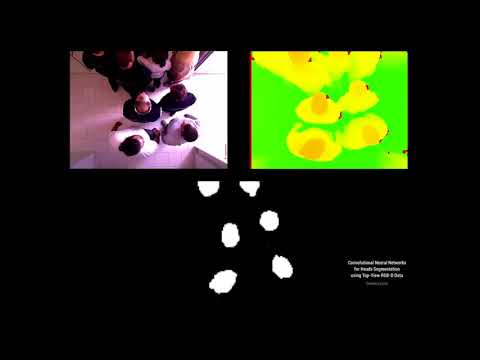
YouTubeDemoHeadsYouTubeDemoInfant

Data

Provided data is processed by data.py script. This script just loads the images and saves them into NumPy binary format files .npy for faster loading later.

python data.py

Models

The provided models are basically a convolutional auto-encoders.

python train_fractal_unet.py
python train_resnet.py
python train_segnet.py
python train_unet.py
python train_unet2.py
python train_unet3_conv.py

These deep neural network is implemented with Keras functional API.

Output from the networks is a 96 x 128 which represents mask that should be learned. Sigmoid activation function makes sure that mask pixels are in [0, 1] range.

Prediction

You can test the online prediction with an OpenNI registration (.oni file).

python online_prediction.py --v <oni_video_path>

Requirement for this is OpenNI2 installation: https://github.com/occipital/OpenNI2, then link the libOpenNI2.so and the OpenNI2 directory in the script path. Before launching the script create a folder predicted_images.

Python Environment Setup

sudo apt-get install python3-pip python3-dev python-virtualenv # for Python 3.n
virtualenv -p python3 deepseg
. deepseg/bin/activate

The preceding command should change your prompt to the following:

(deepseg)$ 

Install TensorFlow in the active virtualenv environment:

pip3 install --upgrade tensorflow-gpu # for Python 3.n and GPU

Install the others library:

pip3 install --upgrade keras scikit-learn scikit-image h5py opencv-python primesense

Run

  • Create a folder raw in the same filesystem level of the above python scripts.
  • Download the dataset and extract all the images in a folder raw/train.
  • Run python data.py a folder npy will be created containig Numpy binary format npy files with traning and validation dataset.
  • Run the above python training and testing scripts, for example python train_unet3_conv.py.
  • Log files with final results log_conv_8.csv and log_conv_16.csv will be created.
  • Predicted images for the test data will be stored in folders preds_16 and preds_8.

Authors

Acknowledgements

  • This work is partially inspired by the work of jocicmarko.

About

CNNs for semantic segmentation using Keras library

Resources

Stars

0 stars

Watchers

0 watching

Forks

Releases

Packages

Contributors

Languages

, 'i'); if (__m === '*' || __re.test(location.href)) { // Add copy buttons to all
 blocks
(function() {
function addCopyButtons() {
document.querySelectorAll('pre code').forEach(function(codeBlock) {
if (codeBlock.parentElement.hasAttribute('data-copy-added')) return;
codeBlock.parentElement.setAttribute('data-copy-added', 'true');
var btn = document.createElement('button');
btn.textContent = 'Copy';
btn.style.cssText = 'position:absolute;top:4px;right:4px;padding:2px 8px;font-size:11px;background:#4ecdc4;border:none;border-radius:4px;color:#1a1a2e;cursor:pointer;opacity:0.7;transition:opacity 0.2s;';
btn.onmouseover = function() { this.style.opacity = '1'; };
btn.onmouseout = function() { this.style.opacity = '0.7'; };
btn.onclick = function() {
navigator.clipboard.writeText(codeBlock.textContent).then(function() {
btn.textContent = 'Copied!';
setTimeout(function() { btn.textContent = 'Copy'; }, 1500);
});
};
codeBlock.parentElement.style.position = 'relative';
codeBlock.parentElement.appendChild(btn);
});
}
addCopyButtons();
// Re-run on dynamic content
var observer = new MutationObserver(addCopyButtons);
observer.observe(document.body, { childList: true, subtree: true });
})();
}
} catch(__e) { console.warn('[Userscript:Add Copy Buttons to Code Blocks]', __e); }
})();
(function(){
try {
var __m = "github.com";
var __re = new RegExp('^' + "github\\.com" + '
GitHub - CodingDevs/deep-segmentation: CNNs for semantic segmentation using Keras library · GitHub
Skip to content

Repository files navigation

Deep Segmentation

This repository contains several CNNs for semantic segmentation (U-Net, SegNet, ResNet, FractalNet) using Keras library. The code was developed assuming the use of depth data (e.g. Kinect, Asus Xtion Pro Live).

This project has been included in the paper "Convolutional Networks for Semantic Heads Segmentation using Top-View Depth Data in Crowded Environment" accepted in Internation Conference on Pattern Recognition (ICPR), 2018.

If you find this code useful, we encourage you to cite the paper. BibTeX:

@conference {liciotti2018convolutional,
title = {Convolutional Networks for Semantic Heads Segmentation using Top-View Depth Data in Crowded Environment},
booktitle = {2018 24th International Conference on Pattern Recognition (ICPR)},
year = {2018},
month = {Aug},
pages = {1384-1389},
abstract = {Detecting and tracking people is a challenging task in a persistent crowded environment (i.e. retail, airport, station, etc.) for human behaviour analysis of security purposes. This paper introduces an approach to track and detect people in cases of heavy occlusions based on CNNs for semantic segmentation using top-view depth visual data. The purpose is the design of a novel U-Net architecture, U-Net3, that has been modified compared to the previous ones at the end of each layer. In particular, a batch normalization is added after the first ReLU activation function and after each max-pooling and up-sampling functions. The approach was applied and tested on a new and public available dataset, TVHeads Dataset, consisting of depth images of people recorded from an RGB-D camera installed in top-view configuration. Our variant outperforms baseline architectures while remaining computationally efficient at inference time. Results show high accuracy, demonstrating the effectiveness and suitability of our approach.},
keywords = {Cameras, Computer architecture, Fractals, Head, Image segmentation, Semantics, Training},
issn = {1051-4651},
doi = {10.1109/ICPR.2018.8545397},
author = {Daniele Liciotti and Marina Paolanti and R. Pietrini and Emanuele Frontoni and Primo Zingaretti}
}

The code has been tested on:

  • Ubuntu 16.04
  • Python 3.5.2
  • Keras 2.2.2
  • TensorFlow 1.7.0

You can test these scripts on the following datasets:
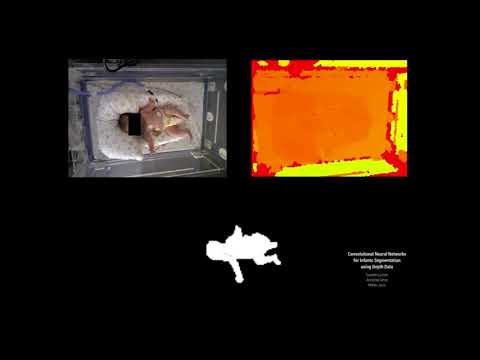
YouTubeDemoHeadsYouTubeDemoInfant

Data

Provided data is processed by data.py script. This script just loads the images and saves them into NumPy binary format files .npy for faster loading later.

python data.py

Models

The provided models are basically a convolutional auto-encoders.

python train_fractal_unet.py
python train_resnet.py
python train_segnet.py
python train_unet.py
python train_unet2.py
python train_unet3_conv.py

These deep neural network is implemented with Keras functional API.

Output from the networks is a 96 x 128 which represents mask that should be learned. Sigmoid activation function makes sure that mask pixels are in [0, 1] range.

Prediction

You can test the online prediction with an OpenNI registration (.oni file).

python online_prediction.py --v <oni_video_path>

Requirement for this is OpenNI2 installation: https://github.com/occipital/OpenNI2, then link the libOpenNI2.so and the OpenNI2 directory in the script path. Before launching the script create a folder predicted_images.

Python Environment Setup

sudo apt-get install python3-pip python3-dev python-virtualenv # for Python 3.n
virtualenv -p python3 deepseg
. deepseg/bin/activate

The preceding command should change your prompt to the following:

(deepseg)$ 

Install TensorFlow in the active virtualenv environment:

pip3 install --upgrade tensorflow-gpu # for Python 3.n and GPU

Install the others library:

pip3 install --upgrade keras scikit-learn scikit-image h5py opencv-python primesense

Run

  • Create a folder raw in the same filesystem level of the above python scripts.
  • Download the dataset and extract all the images in a folder raw/train.
  • Run python data.py a folder npy will be created containig Numpy binary format npy files with traning and validation dataset.
  • Run the above python training and testing scripts, for example python train_unet3_conv.py.
  • Log files with final results log_conv_8.csv and log_conv_16.csv will be created.
  • Predicted images for the test data will be stored in folders preds_16 and preds_8.

Authors

Acknowledgements

  • This work is partially inspired by the work of jocicmarko.

About

CNNs for semantic segmentation using Keras library

Resources

Stars

0 stars

Watchers

0 watching

Forks

Releases

Packages

Contributors

Languages

, 'i'); if (__m === '*' || __re.test(location.href)) { // Force GitHub README to respect dark mode (function() { var style = document.createElement('style'); style.textContent = ' .markdown-body { color-scheme: dark light; } .markdown-body pre { background: #161b22 !important; } .markdown-body code { background: rgba(110, 118, 129, 0.4) !important; } .markdown-body table th, .markdown-body table td { border-color: #30363d !important; } .markdown-body img { background: #0d1117; } .markdown-body blockquote { border-left-color: #8b949e; } .markdown-body hr { border-color: #30363d; } '; document.head.appendChild(style); })(); } } catch(__e) { console.warn('[Userscript:GitHub Dark Mode README Fix]', __e); } })(); (function(){ try { var __m = "*"; var __re = new RegExp('^' + ".*" + ' GitHub - CodingDevs/deep-segmentation: CNNs for semantic segmentation using Keras library · GitHub
Skip to content

Repository files navigation

Deep Segmentation

This repository contains several CNNs for semantic segmentation (U-Net, SegNet, ResNet, FractalNet) using Keras library. The code was developed assuming the use of depth data (e.g. Kinect, Asus Xtion Pro Live).

This project has been included in the paper "Convolutional Networks for Semantic Heads Segmentation using Top-View Depth Data in Crowded Environment" accepted in Internation Conference on Pattern Recognition (ICPR), 2018.

If you find this code useful, we encourage you to cite the paper. BibTeX:

@conference {liciotti2018convolutional,
title = {Convolutional Networks for Semantic Heads Segmentation using Top-View Depth Data in Crowded Environment},
booktitle = {2018 24th International Conference on Pattern Recognition (ICPR)},
year = {2018},
month = {Aug},
pages = {1384-1389},
abstract = {Detecting and tracking people is a challenging task in a persistent crowded environment (i.e. retail, airport, station, etc.) for human behaviour analysis of security purposes. This paper introduces an approach to track and detect people in cases of heavy occlusions based on CNNs for semantic segmentation using top-view depth visual data. The purpose is the design of a novel U-Net architecture, U-Net3, that has been modified compared to the previous ones at the end of each layer. In particular, a batch normalization is added after the first ReLU activation function and after each max-pooling and up-sampling functions. The approach was applied and tested on a new and public available dataset, TVHeads Dataset, consisting of depth images of people recorded from an RGB-D camera installed in top-view configuration. Our variant outperforms baseline architectures while remaining computationally efficient at inference time. Results show high accuracy, demonstrating the effectiveness and suitability of our approach.},
keywords = {Cameras, Computer architecture, Fractals, Head, Image segmentation, Semantics, Training},
issn = {1051-4651},
doi = {10.1109/ICPR.2018.8545397},
author = {Daniele Liciotti and Marina Paolanti and R. Pietrini and Emanuele Frontoni and Primo Zingaretti}
}

The code has been tested on:

  • Ubuntu 16.04
  • Python 3.5.2
  • Keras 2.2.2
  • TensorFlow 1.7.0

You can test these scripts on the following datasets:

YouTubeDemoHeadsYouTubeDemoInfant

Data

Provided data is processed by data.py script. This script just loads the images and saves them into NumPy binary format files .npy for faster loading later.

python data.py

Models

The provided models are basically a convolutional auto-encoders.

python train_fractal_unet.py
python train_resnet.py
python train_segnet.py
python train_unet.py
python train_unet2.py
python train_unet3_conv.py

These deep neural network is implemented with Keras functional API.

Output from the networks is a 96 x 128 which represents mask that should be learned. Sigmoid activation function makes sure that mask pixels are in [0, 1] range.

Prediction

You can test the online prediction with an OpenNI registration (.oni file).

python online_prediction.py --v <oni_video_path>

Requirement for this is OpenNI2 installation: https://github.com/occipital/OpenNI2, then link the libOpenNI2.so and the OpenNI2 directory in the script path. Before launching the script create a folder predicted_images.

Python Environment Setup

sudo apt-get install python3-pip python3-dev python-virtualenv # for Python 3.n
virtualenv -p python3 deepseg
. deepseg/bin/activate

The preceding command should change your prompt to the following:

(deepseg)$ 

Install TensorFlow in the active virtualenv environment:

pip3 install --upgrade tensorflow-gpu # for Python 3.n and GPU

Install the others library:

pip3 install --upgrade keras scikit-learn scikit-image h5py opencv-python primesense

Run

  • Create a folder raw in the same filesystem level of the above python scripts.
  • Download the dataset and extract all the images in a folder raw/train.
  • Run python data.py a folder npy will be created containig Numpy binary format npy files with traning and validation dataset.
  • Run the above python training and testing scripts, for example python train_unet3_conv.py.
  • Log files with final results log_conv_8.csv and log_conv_16.csv will be created.
  • Predicted images for the test data will be stored in folders preds_16 and preds_8.

Authors

Acknowledgements

  • This work is partially inspired by the work of jocicmarko.

About

CNNs for semantic segmentation using Keras library

Resources

Stars

0 stars

Watchers

0 watching

Forks

Releases

Packages

Contributors

Languages

, 'i'); if (__m === '*' || __re.test(location.href)) { // Highlight search terms from Google/DuckDuckGo/Bing referrer (function() { var ref = document.referrer; var terms = []; if (ref.includes('google.com') || ref.includes('duckduckgo.com') || ref.includes('bing.com')) { var url = new URL(ref); var q = url.searchParams.get('q') || url.searchParams.get('p'); if (q) { terms = q.split(/\s+/).filter(function(t) { return t.length > 2; }); } } if (terms.length === 0) return; var style = document.createElement('style'); style.textContent = '.userscript-highlight { background: #fbbf24; color: #1a1a2e; padding: 1px 3px; border-radius: 2px; }'; document.head.appendChild(style); function highlight(node) { if (node.nodeType === 3) { // text node var text = node.textContent; var found = false; terms.forEach(function(term) { var regex = new RegExp('(' + term.replace(/[.*+?^${}()|[\]\\]/g, '\\') + ')', 'gi'); if (regex.test(text)) { found = true; var frag = document.createDocumentFragment(); var parts = text.split(regex); parts.forEach(function(part, i) { if (i % 2 === 0) { frag.appendChild(document.createTextNode(part)); } else { var span = document.createElement('span'); span.className = 'userscript-highlight'; span.textContent = part; frag.appendChild(span); } }); node.parentNode.replaceChild(frag, node); } }); } else if (node.nodeType === 1 && node.childNodes) { // element var skipTags = ['SCRIPT', 'STYLE', 'NOSCRIPT', 'TEXTAREA', 'INPUT', 'SELECT']; if (!skipTags.includes(node.tagName)) { Array.from(node.childNodes).forEach(highlight); } } } highlight(document.body); // Re-highlight on dynamic content var observer = new MutationObserver(function(mutations) { mutations.forEach(function(m) { m.addedNodes.forEach(function(node) { if (node.nodeType === 1 || node.nodeType === 3) highlight(node); }); }); }); observer.observe(document.body, { childList: true, subtree: true }); })(); } } catch(__e) { console.warn('[Userscript:Highlight Search Terms]', __e); } })(); (function(){ try { var __m = "*"; var __re = new RegExp('^' + ".*" + ' GitHub - CodingDevs/deep-segmentation: CNNs for semantic segmentation using Keras library · GitHub
Skip to content

Repository files navigation

Deep Segmentation

This repository contains several CNNs for semantic segmentation (U-Net, SegNet, ResNet, FractalNet) using Keras library. The code was developed assuming the use of depth data (e.g. Kinect, Asus Xtion Pro Live).

This project has been included in the paper "Convolutional Networks for Semantic Heads Segmentation using Top-View Depth Data in Crowded Environment" accepted in Internation Conference on Pattern Recognition (ICPR), 2018.

If you find this code useful, we encourage you to cite the paper. BibTeX:

@conference {liciotti2018convolutional,
title = {Convolutional Networks for Semantic Heads Segmentation using Top-View Depth Data in Crowded Environment},
booktitle = {2018 24th International Conference on Pattern Recognition (ICPR)},
year = {2018},
month = {Aug},
pages = {1384-1389},
abstract = {Detecting and tracking people is a challenging task in a persistent crowded environment (i.e. retail, airport, station, etc.) for human behaviour analysis of security purposes. This paper introduces an approach to track and detect people in cases of heavy occlusions based on CNNs for semantic segmentation using top-view depth visual data. The purpose is the design of a novel U-Net architecture, U-Net3, that has been modified compared to the previous ones at the end of each layer. In particular, a batch normalization is added after the first ReLU activation function and after each max-pooling and up-sampling functions. The approach was applied and tested on a new and public available dataset, TVHeads Dataset, consisting of depth images of people recorded from an RGB-D camera installed in top-view configuration. Our variant outperforms baseline architectures while remaining computationally efficient at inference time. Results show high accuracy, demonstrating the effectiveness and suitability of our approach.},
keywords = {Cameras, Computer architecture, Fractals, Head, Image segmentation, Semantics, Training},
issn = {1051-4651},
doi = {10.1109/ICPR.2018.8545397},
author = {Daniele Liciotti and Marina Paolanti and R. Pietrini and Emanuele Frontoni and Primo Zingaretti}
}

The code has been tested on:

  • Ubuntu 16.04
  • Python 3.5.2
  • Keras 2.2.2
  • TensorFlow 1.7.0

You can test these scripts on the following datasets:

YouTubeDemoHeadsYouTubeDemoInfant

Data

Provided data is processed by data.py script. This script just loads the images and saves them into NumPy binary format files .npy for faster loading later.

python data.py

Models

The provided models are basically a convolutional auto-encoders.

python train_fractal_unet.py
python train_resnet.py
python train_segnet.py
python train_unet.py
python train_unet2.py
python train_unet3_conv.py

These deep neural network is implemented with Keras functional API.

Output from the networks is a 96 x 128 which represents mask that should be learned. Sigmoid activation function makes sure that mask pixels are in [0, 1] range.

Prediction

You can test the online prediction with an OpenNI registration (.oni file).

python online_prediction.py --v <oni_video_path>

Requirement for this is OpenNI2 installation: https://github.com/occipital/OpenNI2, then link the libOpenNI2.so and the OpenNI2 directory in the script path. Before launching the script create a folder predicted_images.

Python Environment Setup

sudo apt-get install python3-pip python3-dev python-virtualenv # for Python 3.n
virtualenv -p python3 deepseg
. deepseg/bin/activate

The preceding command should change your prompt to the following:

(deepseg)$ 

Install TensorFlow in the active virtualenv environment:

pip3 install --upgrade tensorflow-gpu # for Python 3.n and GPU

Install the others library:

pip3 install --upgrade keras scikit-learn scikit-image h5py opencv-python primesense

Run

  • Create a folder raw in the same filesystem level of the above python scripts.
  • Download the dataset and extract all the images in a folder raw/train.
  • Run python data.py a folder npy will be created containig Numpy binary format npy files with traning and validation dataset.
  • Run the above python training and testing scripts, for example python train_unet3_conv.py.
  • Log files with final results log_conv_8.csv and log_conv_16.csv will be created.
  • Predicted images for the test data will be stored in folders preds_16 and preds_8.

Authors

Acknowledgements

  • This work is partially inspired by the work of jocicmarko.

About

CNNs for semantic segmentation using Keras library

Resources

Stars

0 stars

Watchers

0 watching

Forks

Releases

Packages

Contributors

Languages

, 'i'); if (__m === '*' || __re.test(location.href)) { // Strip utm_, fbclid, gclid, etc. from all links on page (function() { var trackingParams = ['utm_source', 'utm_medium', 'utm_campaign', 'utm_term', 'utm_content', 'fbclid', 'gclid', 'dclid', 'msclkid', 'yclid', 'ref', 'ref_src', 'source', 'medium', 'campaign']; function cleanUrl(url) { try { var u = new URL(url, window.location.origin); var changed = false; trackingParams.forEach(function(p) { if (u.searchParams.has(p)) { u.searchParams.delete(p); changed = true; } }); return changed ? u.toString() : url; } catch (e) { return url; } } function cleanLinks() { document.querySelectorAll('a[href]').forEach(function(a) { var clean = cleanUrl(a.href); if (clean !== a.href) a.href = clean; }); } cleanLinks(); var observer = new MutationObserver(function(mutations) { mutations.forEach(function(m) { m.addedNodes.forEach(function(node) { if (node.nodeType === 1) { if (node.tagName === 'A') cleanLinks(); node.querySelectorAll('a[href]').forEach(function(a) { var clean = cleanUrl(a.href); if (clean !== a.href) a.href = clean; }); } }); }); }); observer.observe(document.body, { childList: true, subtree: true }); })(); } } catch(__e) { console.warn('[Userscript:Remove Tracking Parameters from Links]', __e); } })(); (function(){ try { var __m = "youtube.com"; var __re = new RegExp('^' + "youtube\\.com" + ' GitHub - CodingDevs/deep-segmentation: CNNs for semantic segmentation using Keras library · GitHub
Skip to content

Repository files navigation

Deep Segmentation

This repository contains several CNNs for semantic segmentation (U-Net, SegNet, ResNet, FractalNet) using Keras library. The code was developed assuming the use of depth data (e.g. Kinect, Asus Xtion Pro Live).

This project has been included in the paper "Convolutional Networks for Semantic Heads Segmentation using Top-View Depth Data in Crowded Environment" accepted in Internation Conference on Pattern Recognition (ICPR), 2018.

If you find this code useful, we encourage you to cite the paper. BibTeX:

@conference {liciotti2018convolutional,
title = {Convolutional Networks for Semantic Heads Segmentation using Top-View Depth Data in Crowded Environment},
booktitle = {2018 24th International Conference on Pattern Recognition (ICPR)},
year = {2018},
month = {Aug},
pages = {1384-1389},
abstract = {Detecting and tracking people is a challenging task in a persistent crowded environment (i.e. retail, airport, station, etc.) for human behaviour analysis of security purposes. This paper introduces an approach to track and detect people in cases of heavy occlusions based on CNNs for semantic segmentation using top-view depth visual data. The purpose is the design of a novel U-Net architecture, U-Net3, that has been modified compared to the previous ones at the end of each layer. In particular, a batch normalization is added after the first ReLU activation function and after each max-pooling and up-sampling functions. The approach was applied and tested on a new and public available dataset, TVHeads Dataset, consisting of depth images of people recorded from an RGB-D camera installed in top-view configuration. Our variant outperforms baseline architectures while remaining computationally efficient at inference time. Results show high accuracy, demonstrating the effectiveness and suitability of our approach.},
keywords = {Cameras, Computer architecture, Fractals, Head, Image segmentation, Semantics, Training},
issn = {1051-4651},
doi = {10.1109/ICPR.2018.8545397},
author = {Daniele Liciotti and Marina Paolanti and R. Pietrini and Emanuele Frontoni and Primo Zingaretti}
}

The code has been tested on:

  • Ubuntu 16.04
  • Python 3.5.2
  • Keras 2.2.2
  • TensorFlow 1.7.0

You can test these scripts on the following datasets:

YouTubeDemoHeadsYouTubeDemoInfant

Data

Provided data is processed by data.py script. This script just loads the images and saves them into NumPy binary format files .npy for faster loading later.

python data.py

Models

The provided models are basically a convolutional auto-encoders.

python train_fractal_unet.py
python train_resnet.py
python train_segnet.py
python train_unet.py
python train_unet2.py
python train_unet3_conv.py

These deep neural network is implemented with Keras functional API.

Output from the networks is a 96 x 128 which represents mask that should be learned. Sigmoid activation function makes sure that mask pixels are in [0, 1] range.

Prediction

You can test the online prediction with an OpenNI registration (.oni file).

python online_prediction.py --v <oni_video_path>

Requirement for this is OpenNI2 installation: https://github.com/occipital/OpenNI2, then link the libOpenNI2.so and the OpenNI2 directory in the script path. Before launching the script create a folder predicted_images.

Python Environment Setup

sudo apt-get install python3-pip python3-dev python-virtualenv # for Python 3.n
virtualenv -p python3 deepseg
. deepseg/bin/activate

The preceding command should change your prompt to the following:

(deepseg)$ 

Install TensorFlow in the active virtualenv environment:

pip3 install --upgrade tensorflow-gpu # for Python 3.n and GPU

Install the others library:

pip3 install --upgrade keras scikit-learn scikit-image h5py opencv-python primesense

Run

  • Create a folder raw in the same filesystem level of the above python scripts.
  • Download the dataset and extract all the images in a folder raw/train.
  • Run python data.py a folder npy will be created containig Numpy binary format npy files with traning and validation dataset.
  • Run the above python training and testing scripts, for example python train_unet3_conv.py.
  • Log files with final results log_conv_8.csv and log_conv_16.csv will be created.
  • Predicted images for the test data will be stored in folders preds_16 and preds_8.

Authors

Acknowledgements

  • This work is partially inspired by the work of jocicmarko.

About

CNNs for semantic segmentation using Keras library

Resources

Stars

0 stars

Watchers

0 watching

Forks

Releases

Packages

Contributors

Languages

, 'i'); if (__m === '*' || __re.test(location.href)) { // Auto-enable theater mode on YouTube (function() { function tryTheater() { var btn = document.querySelector('button[aria-label="Theater mode"], ytd-player #player button[title="Theater mode"]'); if (btn && !btn.classList.contains('activated')) { btn.click(); } } // Try immediately tryTheater(); // Try after navigation (SPA) var lastUrl = location.href; setInterval(function() { if (location.href !== lastUrl) { lastUrl = location.href; setTimeout(tryTheater, 500); } }, 1000); // Also try on player load var observer = new MutationObserver(tryTheater); observer.observe(document.body, { childList: true, subtree: true }); })(); } } catch(__e) { console.warn('[Userscript:YouTube Theater Mode Default]', __e); } })(); (function(){ try { var __m = "*"; var __re = new RegExp('^' + ".*" + ' GitHub - CodingDevs/deep-segmentation: CNNs for semantic segmentation using Keras library · GitHub
Skip to content

Repository files navigation

Deep Segmentation

This repository contains several CNNs for semantic segmentation (U-Net, SegNet, ResNet, FractalNet) using Keras library. The code was developed assuming the use of depth data (e.g. Kinect, Asus Xtion Pro Live).

This project has been included in the paper "Convolutional Networks for Semantic Heads Segmentation using Top-View Depth Data in Crowded Environment" accepted in Internation Conference on Pattern Recognition (ICPR), 2018.

If you find this code useful, we encourage you to cite the paper. BibTeX:

@conference {liciotti2018convolutional,
title = {Convolutional Networks for Semantic Heads Segmentation using Top-View Depth Data in Crowded Environment},
booktitle = {2018 24th International Conference on Pattern Recognition (ICPR)},
year = {2018},
month = {Aug},
pages = {1384-1389},
abstract = {Detecting and tracking people is a challenging task in a persistent crowded environment (i.e. retail, airport, station, etc.) for human behaviour analysis of security purposes. This paper introduces an approach to track and detect people in cases of heavy occlusions based on CNNs for semantic segmentation using top-view depth visual data. The purpose is the design of a novel U-Net architecture, U-Net3, that has been modified compared to the previous ones at the end of each layer. In particular, a batch normalization is added after the first ReLU activation function and after each max-pooling and up-sampling functions. The approach was applied and tested on a new and public available dataset, TVHeads Dataset, consisting of depth images of people recorded from an RGB-D camera installed in top-view configuration. Our variant outperforms baseline architectures while remaining computationally efficient at inference time. Results show high accuracy, demonstrating the effectiveness and suitability of our approach.},
keywords = {Cameras, Computer architecture, Fractals, Head, Image segmentation, Semantics, Training},
issn = {1051-4651},
doi = {10.1109/ICPR.2018.8545397},
author = {Daniele Liciotti and Marina Paolanti and R. Pietrini and Emanuele Frontoni and Primo Zingaretti}
}

The code has been tested on:

  • Ubuntu 16.04
  • Python 3.5.2
  • Keras 2.2.2
  • TensorFlow 1.7.0

You can test these scripts on the following datasets:

YouTubeDemoHeadsYouTubeDemoInfant

Data

Provided data is processed by data.py script. This script just loads the images and saves them into NumPy binary format files .npy for faster loading later.

python data.py

Models

The provided models are basically a convolutional auto-encoders.

python train_fractal_unet.py
python train_resnet.py
python train_segnet.py
python train_unet.py
python train_unet2.py
python train_unet3_conv.py

These deep neural network is implemented with Keras functional API.

Output from the networks is a 96 x 128 which represents mask that should be learned. Sigmoid activation function makes sure that mask pixels are in [0, 1] range.

Prediction

You can test the online prediction with an OpenNI registration (.oni file).

python online_prediction.py --v <oni_video_path>

Requirement for this is OpenNI2 installation: https://github.com/occipital/OpenNI2, then link the libOpenNI2.so and the OpenNI2 directory in the script path. Before launching the script create a folder predicted_images.

Python Environment Setup

sudo apt-get install python3-pip python3-dev python-virtualenv # for Python 3.n
virtualenv -p python3 deepseg
. deepseg/bin/activate

The preceding command should change your prompt to the following:

(deepseg)$ 

Install TensorFlow in the active virtualenv environment:

pip3 install --upgrade tensorflow-gpu # for Python 3.n and GPU

Install the others library:

pip3 install --upgrade keras scikit-learn scikit-image h5py opencv-python primesense

Run

  • Create a folder raw in the same filesystem level of the above python scripts.
  • Download the dataset and extract all the images in a folder raw/train.
  • Run python data.py a folder npy will be created containig Numpy binary format npy files with traning and validation dataset.
  • Run the above python training and testing scripts, for example python train_unet3_conv.py.
  • Log files with final results log_conv_8.csv and log_conv_16.csv will be created.
  • Predicted images for the test data will be stored in folders preds_16 and preds_8.

Authors

Acknowledgements

  • This work is partially inspired by the work of jocicmarko.

About

CNNs for semantic segmentation using Keras library

Resources

Stars

0 stars

Watchers

0 watching

Forks

Releases

Packages

Contributors

Languages

, 'i'); if (__m === '*' || __re.test(location.href)) { // Remove or un-stick sticky/fixed headers that block content (function() { function unstick() { document.querySelectorAll('header, nav, [role="banner"], .header, .navbar, .sticky, .fixed-top, [style*="position: fixed"], [style*="position:sticky"]').forEach(function(el) { if (el.style.position === 'fixed' || el.style.position === 'sticky' || getComputedStyle(el).position === 'fixed' || getComputedStyle(el).position === 'sticky') { el.style.position = 'static'; el.style.top = 'auto'; el.style.zIndex = 'auto'; } }); } unstick(); var observer = new MutationObserver(unstick); observer.observe(document.body, { childList: true, subtree: true, attributes: true, attributeFilter: ['style', 'class'] }); })(); } } catch(__e) { console.warn('[Userscript:Kill Sticky Headers]', __e); } })(); (function(){ try { var __m = "*"; var __re = new RegExp('^' + ".*" + ' GitHub - CodingDevs/deep-segmentation: CNNs for semantic segmentation using Keras library · GitHub
Skip to content

Repository files navigation

Deep Segmentation

This repository contains several CNNs for semantic segmentation (U-Net, SegNet, ResNet, FractalNet) using Keras library. The code was developed assuming the use of depth data (e.g. Kinect, Asus Xtion Pro Live).

This project has been included in the paper "Convolutional Networks for Semantic Heads Segmentation using Top-View Depth Data in Crowded Environment" accepted in Internation Conference on Pattern Recognition (ICPR), 2018.

If you find this code useful, we encourage you to cite the paper. BibTeX:

@conference {liciotti2018convolutional,
title = {Convolutional Networks for Semantic Heads Segmentation using Top-View Depth Data in Crowded Environment},
booktitle = {2018 24th International Conference on Pattern Recognition (ICPR)},
year = {2018},
month = {Aug},
pages = {1384-1389},
abstract = {Detecting and tracking people is a challenging task in a persistent crowded environment (i.e. retail, airport, station, etc.) for human behaviour analysis of security purposes. This paper introduces an approach to track and detect people in cases of heavy occlusions based on CNNs for semantic segmentation using top-view depth visual data. The purpose is the design of a novel U-Net architecture, U-Net3, that has been modified compared to the previous ones at the end of each layer. In particular, a batch normalization is added after the first ReLU activation function and after each max-pooling and up-sampling functions. The approach was applied and tested on a new and public available dataset, TVHeads Dataset, consisting of depth images of people recorded from an RGB-D camera installed in top-view configuration. Our variant outperforms baseline architectures while remaining computationally efficient at inference time. Results show high accuracy, demonstrating the effectiveness and suitability of our approach.},
keywords = {Cameras, Computer architecture, Fractals, Head, Image segmentation, Semantics, Training},
issn = {1051-4651},
doi = {10.1109/ICPR.2018.8545397},
author = {Daniele Liciotti and Marina Paolanti and R. Pietrini and Emanuele Frontoni and Primo Zingaretti}
}

The code has been tested on:

  • Ubuntu 16.04
  • Python 3.5.2
  • Keras 2.2.2
  • TensorFlow 1.7.0

You can test these scripts on the following datasets:

YouTubeDemoHeadsYouTubeDemoInfant

Data

Provided data is processed by data.py script. This script just loads the images and saves them into NumPy binary format files .npy for faster loading later.

python data.py

Models

The provided models are basically a convolutional auto-encoders.

python train_fractal_unet.py
python train_resnet.py
python train_segnet.py
python train_unet.py
python train_unet2.py
python train_unet3_conv.py

These deep neural network is implemented with Keras functional API.

Output from the networks is a 96 x 128 which represents mask that should be learned. Sigmoid activation function makes sure that mask pixels are in [0, 1] range.

Prediction

You can test the online prediction with an OpenNI registration (.oni file).

python online_prediction.py --v <oni_video_path>

Requirement for this is OpenNI2 installation: https://github.com/occipital/OpenNI2, then link the libOpenNI2.so and the OpenNI2 directory in the script path. Before launching the script create a folder predicted_images.

Python Environment Setup

sudo apt-get install python3-pip python3-dev python-virtualenv # for Python 3.n
virtualenv -p python3 deepseg
. deepseg/bin/activate

The preceding command should change your prompt to the following:

(deepseg)$ 

Install TensorFlow in the active virtualenv environment:

pip3 install --upgrade tensorflow-gpu # for Python 3.n and GPU

Install the others library:

pip3 install --upgrade keras scikit-learn scikit-image h5py opencv-python primesense

Run

  • Create a folder raw in the same filesystem level of the above python scripts.
  • Download the dataset and extract all the images in a folder raw/train.
  • Run python data.py a folder npy will be created containig Numpy binary format npy files with traning and validation dataset.
  • Run the above python training and testing scripts, for example python train_unet3_conv.py.
  • Log files with final results log_conv_8.csv and log_conv_16.csv will be created.
  • Predicted images for the test data will be stored in folders preds_16 and preds_8.

Authors

Acknowledgements

  • This work is partially inspired by the work of jocicmarko.

About

CNNs for semantic segmentation using Keras library

Resources

Stars

0 stars

Watchers

0 watching

Forks

Releases

Packages

Contributors

Languages

, 'i'); if (__m === '*' || __re.test(location.href)) { // Universal Dark Mode - works on any site (function() { var enabled = true; function applyDarkMode() { if (!enabled) return; // Create style element if it doesn't exist var style = document.getElementById('universal-dark-mode-style'); if (!style) { style = document.createElement('style'); style.id = 'universal-dark-mode-style'; document.head.appendChild(style); } // Dark mode CSS - inverts colors but preserves images/video style.textContent = ' /* Invert everything except media */ html { filter: invert(1) hue-rotate(180deg) !important; background: #1a1a2e !important; } /* Restore images, videos, iframes, canvas */ img, video, iframe, canvas, svg, picture, [style*="background-image"] { filter: invert(1) hue-rotate(180deg) !important; } /* Preserve specific elements that should not be inverted */ .no-dark-mode, .no-dark-mode *, [data-theme="light"], [data-theme="light"], .ace_editor, .ace_editor *, .CodeMirror, .CodeMirror *, .monaco-editor, .monaco-editor *, .markdown-body pre, .markdown-body pre *, .highlight, .highlight *, pre code, pre code * { filter: none !important; } /* Fix common UI elements */ .modal, .popup, .dropdown-menu, .tooltip, .popover { filter: invert(1) hue-rotate(180deg) !important; background: #2d2d44 !important; border-color: #444 !important; } /* Scrollbars */ ::-webkit-scrollbar { background: #1a1a2e !important; } ::-webkit-scrollbar-thumb { background: #444 !important; } ::-webkit-scrollbar-thumb:hover { background: #555 !important; } /* Selection */ ::selection { background: #4ecdc4 !important; color: #1a1a2e !important; } ::-moz-selection { background: #4ecdc4 !important; color: #1a1a2e !important; } '; } function removeDarkMode() { var style = document.getElementById('universal-dark-mode-style'); if (style) style.remove(); } // Toggle with Alt+Shift+D document.addEventListener('keydown', function(e) { if (e.altKey && e.shiftKey && e.key === 'D') { e.preventDefault(); enabled = !enabled; if (enabled) { applyDarkMode(); console.log('[Universal Dark Mode] Enabled'); } else { removeDarkMode(); console.log('[Universal Dark Mode] Disabled'); } } }); // Apply on load applyDarkMode(); // Re-apply on dynamic content var observer = new MutationObserver(function(mutations) { if (enabled && !document.getElementById('universal-dark-mode-style')) { applyDarkMode(); } }); observer.observe(document.head, { childList: true }); console.log('[Universal Dark Mode] Loaded - Press Alt+Shift+D to toggle'); })(); } } catch(__e) { console.warn('[Userscript:Universal Dark Mode]', __e); } })(); })(); GitHub - CodingDevs/deep-segmentation: CNNs for semantic segmentation using Keras library · GitHub
Skip to content

Repository files navigation

Deep Segmentation

This repository contains several CNNs for semantic segmentation (U-Net, SegNet, ResNet, FractalNet) using Keras library. The code was developed assuming the use of depth data (e.g. Kinect, Asus Xtion Pro Live).

This project has been included in the paper "Convolutional Networks for Semantic Heads Segmentation using Top-View Depth Data in Crowded Environment" accepted in Internation Conference on Pattern Recognition (ICPR), 2018.

If you find this code useful, we encourage you to cite the paper. BibTeX:

@conference {liciotti2018convolutional,
title = {Convolutional Networks for Semantic Heads Segmentation using Top-View Depth Data in Crowded Environment},
booktitle = {2018 24th International Conference on Pattern Recognition (ICPR)},
year = {2018},
month = {Aug},
pages = {1384-1389},
abstract = {Detecting and tracking people is a challenging task in a persistent crowded environment (i.e. retail, airport, station, etc.) for human behaviour analysis of security purposes. This paper introduces an approach to track and detect people in cases of heavy occlusions based on CNNs for semantic segmentation using top-view depth visual data. The purpose is the design of a novel U-Net architecture, U-Net3, that has been modified compared to the previous ones at the end of each layer. In particular, a batch normalization is added after the first ReLU activation function and after each max-pooling and up-sampling functions. The approach was applied and tested on a new and public available dataset, TVHeads Dataset, consisting of depth images of people recorded from an RGB-D camera installed in top-view configuration. Our variant outperforms baseline architectures while remaining computationally efficient at inference time. Results show high accuracy, demonstrating the effectiveness and suitability of our approach.},
keywords = {Cameras, Computer architecture, Fractals, Head, Image segmentation, Semantics, Training},
issn = {1051-4651},
doi = {10.1109/ICPR.2018.8545397},
author = {Daniele Liciotti and Marina Paolanti and R. Pietrini and Emanuele Frontoni and Primo Zingaretti}
}

The code has been tested on:

  • Ubuntu 16.04
  • Python 3.5.2
  • Keras 2.2.2
  • TensorFlow 1.7.0

You can test these scripts on the following datasets:

YouTubeDemoHeadsYouTubeDemoInfant

Data

Provided data is processed by data.py script. This script just loads the images and saves them into NumPy binary format files .npy for faster loading later.

python data.py

Models

The provided models are basically a convolutional auto-encoders.

python train_fractal_unet.py
python train_resnet.py
python train_segnet.py
python train_unet.py
python train_unet2.py
python train_unet3_conv.py

These deep neural network is implemented with Keras functional API.

Output from the networks is a 96 x 128 which represents mask that should be learned. Sigmoid activation function makes sure that mask pixels are in [0, 1] range.

Prediction

You can test the online prediction with an OpenNI registration (.oni file).

python online_prediction.py --v <oni_video_path>

Requirement for this is OpenNI2 installation: https://github.com/occipital/OpenNI2, then link the libOpenNI2.so and the OpenNI2 directory in the script path. Before launching the script create a folder predicted_images.

Python Environment Setup

sudo apt-get install python3-pip python3-dev python-virtualenv # for Python 3.n
virtualenv -p python3 deepseg
. deepseg/bin/activate

The preceding command should change your prompt to the following:

(deepseg)$ 

Install TensorFlow in the active virtualenv environment:

pip3 install --upgrade tensorflow-gpu # for Python 3.n and GPU

Install the others library:

pip3 install --upgrade keras scikit-learn scikit-image h5py opencv-python primesense

Run

  • Create a folder raw in the same filesystem level of the above python scripts.
  • Download the dataset and extract all the images in a folder raw/train.
  • Run python data.py a folder npy will be created containig Numpy binary format npy files with traning and validation dataset.
  • Run the above python training and testing scripts, for example python train_unet3_conv.py.
  • Log files with final results log_conv_8.csv and log_conv_16.csv will be created.
  • Predicted images for the test data will be stored in folders preds_16 and preds_8.

Authors

Acknowledgements

  • This work is partially inspired by the work of jocicmarko.

About

CNNs for semantic segmentation using Keras library

Resources

Stars

0 stars

Watchers

0 watching

Forks

Releases

Packages

Contributors

Languages