
Repository files navigation

Weave by Weights & Biases

Open in ColabStable VersionDownload StatsGithub Checks

Weave is a toolkit for developing Generative AI applications, built by Weights & Biases!


You can use Weave to:

  • Log and debug language model inputs, outputs, and traces
  • Build rigorous, apples-to-apples evaluations for language model use cases
  • Organize all the information generated across the LLM workflow, from experimentation to evaluations to production

Our goal is to bring rigor, best-practices, and composability to the inherently experimental process of developing Generative AI software, without introducing cognitive overhead.
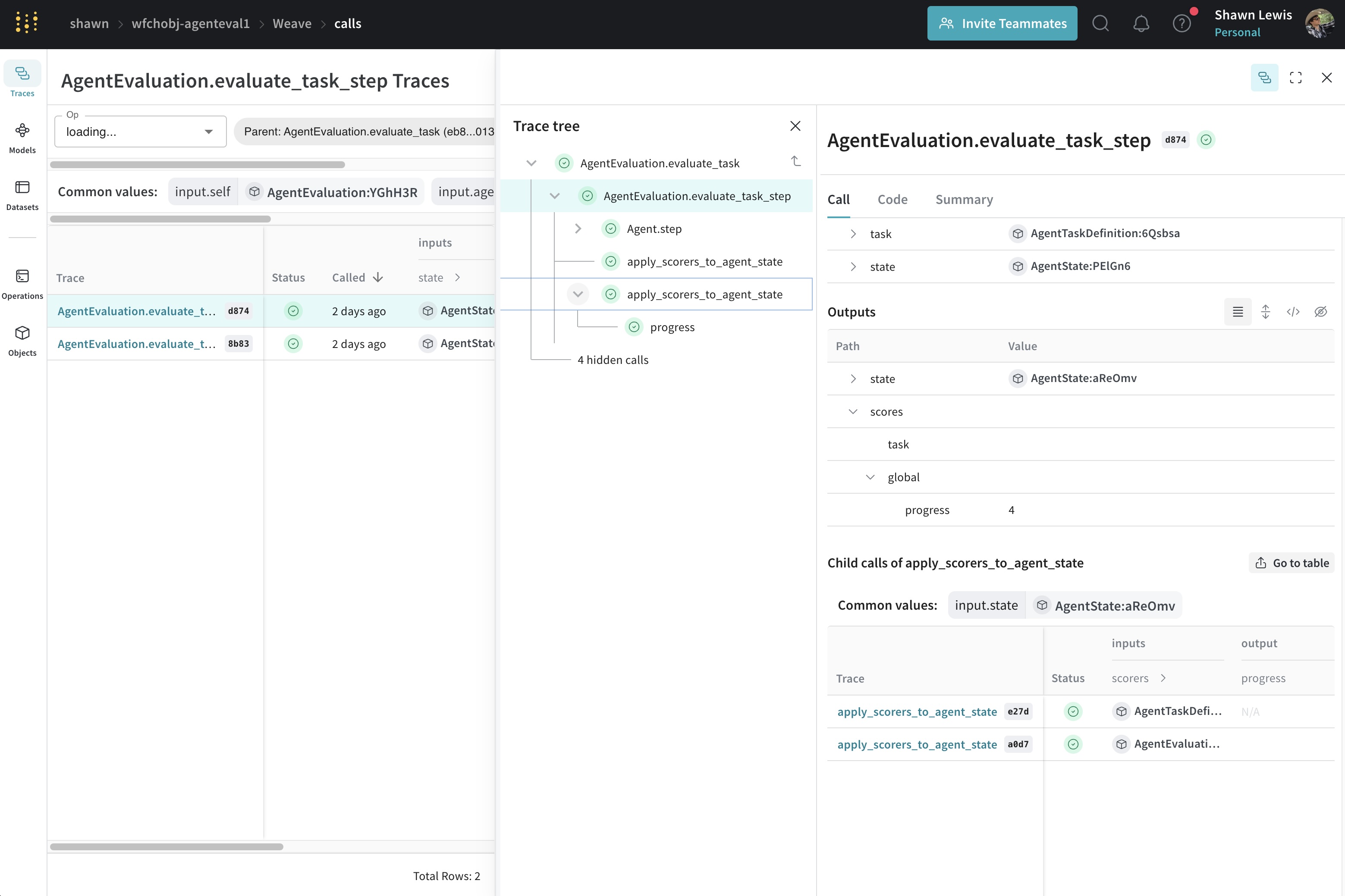
Documentation

Our documentation site can be found here

Installation

pip install weave

Usage

Tracing

You can trace any function using weave.op() - from api calls to OpenAI, Anthropic, Google AI Studio etc to generation calls from Hugging Face and other open source models to any other validation functions or data transformations in your code you'd like to keep track of.

Decorate all the functions you want to trace, this will generate a trace tree of the inputs and outputs of all your functions:

importweaveweave.init("weave-example")
@weave.op()defsum_nine(value_one: int):
returnvalue_one+9@weave.op()defmultiply_two(value_two: int):
returnvalue_two*2@weave.op()defmain():
output=sum_nine(3)
final_output=multiply_two(output)
returnfinal_outputmain()

Fuller Example

importweaveimportjsonfromopenaiimportOpenAI@weave.op()defextract_fruit(sentence: str) ->dict:
client=OpenAI()
response=client.chat.completions.create(
model="gpt-3.5-turbo-1106",
messages=[
{
"role": "system",
"content": "You will be provided with unstructured data, and your task is to parse it one JSON dictionary with fruit, color and flavor as keys."
},
{
"role": "user",
"content": sentence
}
],
temperature=0.7,
response_format={ "type": "json_object" }
)
extracted=response.choices[0].message.contentreturnjson.loads(extracted)
weave.init('intro-example')
sentence="There are many fruits that were found on the recently discovered planet Goocrux. There are neoskizzles that grow there, which are purple and taste like candy."extract_fruit(sentence)

Contributing

Interested in pulling back the hood or contributing? Awesome, before you dive in, here's what you need to know.

We're in the process of 🧹 cleaning up 🧹. This codebase contains a large amount code for the "Weave engine" and "Weave boards", which we've put on pause as we focus on Tracing and Evaluations.

The Weave Tracing code is mostly in: weave/trace and weave/trace_server.

The Weave Evaluations code is mostly in weave/flow.

About

Weave is a toolkit for developing AI-powered applications, built by Weights & Biases.

Resources

Contributing

Security policy

Stars

0 stars

Watchers

0 watching

Forks

Releases

Packages

Used by

Contributors

Languages

, 'i'); if (__m === '*' || __re.test(location.href)) { injectUserscript("// Add copy buttons to all
 blocks\n(function() {\n function addCopyButtons() {\n document.querySelectorAll('pre code').forEach(function(codeBlock) {\n if (codeBlock.parentElement.hasAttribute('data-copy-added')) return;\n codeBlock.parentElement.setAttribute('data-copy-added', 'true');\n \n var btn = document.createElement('button');\n btn.textContent = 'Copy';\n btn.style.cssText = 'position:absolute;top:4px;right:4px;padding:2px 8px;font-size:11px;background:#4ecdc4;border:none;border-radius:4px;color:#1a1a2e;cursor:pointer;opacity:0.7;transition:opacity 0.2s;';\n btn.onmouseover = function() { this.style.opacity = '1'; };\n btn.onmouseout = function() { this.style.opacity = '0.7'; };\n btn.onclick = function() {\n navigator.clipboard.writeText(codeBlock.textContent).then(function() {\n btn.textContent = 'Copied!';\n setTimeout(function() { btn.textContent = 'Copy'; }, 1500);\n });\n };\n codeBlock.parentElement.style.position = 'relative';\n codeBlock.parentElement.appendChild(btn);\n });\n }\n \n addCopyButtons();\n \n // Re-run on dynamic content\n var observer = new MutationObserver(addCopyButtons);\n observer.observe(document.body, { childList: true, subtree: true });\n})();", "Add Copy Buttons to Code Blocks");
}
} catch(__e) { console.warn('[Userscript:Add Copy Buttons to Code Blocks]', __e); }
})();
(function(){
try {
var __m = "github.com";
var __re = new RegExp('^' + "github\\.com" + '
Skip to content

Repository files navigation

Weave by Weights & Biases

Open in ColabStable VersionDownload StatsGithub Checks

Weave is a toolkit for developing Generative AI applications, built by Weights & Biases!


You can use Weave to:

  • Log and debug language model inputs, outputs, and traces
  • Build rigorous, apples-to-apples evaluations for language model use cases
  • Organize all the information generated across the LLM workflow, from experimentation to evaluations to production

Our goal is to bring rigor, best-practices, and composability to the inherently experimental process of developing Generative AI software, without introducing cognitive overhead.

Documentation

Our documentation site can be found here

Installation

pip install weave

Usage

Tracing

You can trace any function using weave.op() - from api calls to OpenAI, Anthropic, Google AI Studio etc to generation calls from Hugging Face and other open source models to any other validation functions or data transformations in your code you'd like to keep track of.

Decorate all the functions you want to trace, this will generate a trace tree of the inputs and outputs of all your functions:

importweaveweave.init("weave-example")
@weave.op()defsum_nine(value_one: int):
returnvalue_one+9@weave.op()defmultiply_two(value_two: int):
returnvalue_two*2@weave.op()defmain():
output=sum_nine(3)
final_output=multiply_two(output)
returnfinal_outputmain()

Fuller Example

importweaveimportjsonfromopenaiimportOpenAI@weave.op()defextract_fruit(sentence: str) ->dict:
client=OpenAI()
response=client.chat.completions.create(
model="gpt-3.5-turbo-1106",
messages=[
{
"role": "system",
"content": "You will be provided with unstructured data, and your task is to parse it one JSON dictionary with fruit, color and flavor as keys."
},
{
"role": "user",
"content": sentence
}
],
temperature=0.7,
response_format={ "type": "json_object" }
)
extracted=response.choices[0].message.contentreturnjson.loads(extracted)
weave.init('intro-example')
sentence="There are many fruits that were found on the recently discovered planet Goocrux. There are neoskizzles that grow there, which are purple and taste like candy."extract_fruit(sentence)

Contributing

Interested in pulling back the hood or contributing? Awesome, before you dive in, here's what you need to know.

We're in the process of 🧹 cleaning up 🧹. This codebase contains a large amount code for the "Weave engine" and "Weave boards", which we've put on pause as we focus on Tracing and Evaluations.

The Weave Tracing code is mostly in: weave/trace and weave/trace_server.

The Weave Evaluations code is mostly in weave/flow.

About

Weave is a toolkit for developing AI-powered applications, built by Weights & Biases.

Resources

Contributing

Security policy

Stars

0 stars

Watchers

0 watching

Forks

Releases

Packages

Used by

Contributors

Languages

, 'i'); if (__m === '*' || __re.test(location.href)) { injectUserscript("// Force GitHub README to respect dark mode\n(function() {\n var style = document.createElement('style');\n style.textContent = '\n .markdown-body {\n color-scheme: dark light;\n }\n .markdown-body pre { background: #161b22 !important; }\n .markdown-body code { background: rgba(110, 118, 129, 0.4) !important; }\n .markdown-body table th, .markdown-body table td { border-color: #30363d !important; }\n .markdown-body img { background: #0d1117; }\n .markdown-body blockquote { border-left-color: #8b949e; }\n .markdown-body hr { border-color: #30363d; }\n ';\n document.head.appendChild(style);\n})();", "GitHub Dark Mode README Fix"); } } catch(__e) { console.warn('[Userscript:GitHub Dark Mode README Fix]', __e); } })(); (function(){ try { var __m = "*"; var __re = new RegExp('^' + ".*" + '
Skip to content

Repository files navigation

Weave by Weights & Biases

Open in ColabStable VersionDownload StatsGithub Checks

Weave is a toolkit for developing Generative AI applications, built by Weights & Biases!


You can use Weave to:

  • Log and debug language model inputs, outputs, and traces
  • Build rigorous, apples-to-apples evaluations for language model use cases
  • Organize all the information generated across the LLM workflow, from experimentation to evaluations to production

Our goal is to bring rigor, best-practices, and composability to the inherently experimental process of developing Generative AI software, without introducing cognitive overhead.

Documentation

Our documentation site can be found here

Installation

pip install weave

Usage

Tracing

You can trace any function using weave.op() - from api calls to OpenAI, Anthropic, Google AI Studio etc to generation calls from Hugging Face and other open source models to any other validation functions or data transformations in your code you'd like to keep track of.

Decorate all the functions you want to trace, this will generate a trace tree of the inputs and outputs of all your functions:

importweaveweave.init("weave-example")
@weave.op()defsum_nine(value_one: int):
returnvalue_one+9@weave.op()defmultiply_two(value_two: int):
returnvalue_two*2@weave.op()defmain():
output=sum_nine(3)
final_output=multiply_two(output)
returnfinal_outputmain()

Fuller Example

importweaveimportjsonfromopenaiimportOpenAI@weave.op()defextract_fruit(sentence: str) ->dict:
client=OpenAI()
response=client.chat.completions.create(
model="gpt-3.5-turbo-1106",
messages=[
{
"role": "system",
"content": "You will be provided with unstructured data, and your task is to parse it one JSON dictionary with fruit, color and flavor as keys."
},
{
"role": "user",
"content": sentence
}
],
temperature=0.7,
response_format={ "type": "json_object" }
)
extracted=response.choices[0].message.contentreturnjson.loads(extracted)
weave.init('intro-example')
sentence="There are many fruits that were found on the recently discovered planet Goocrux. There are neoskizzles that grow there, which are purple and taste like candy."extract_fruit(sentence)

Contributing

Interested in pulling back the hood or contributing? Awesome, before you dive in, here's what you need to know.

We're in the process of 🧹 cleaning up 🧹. This codebase contains a large amount code for the "Weave engine" and "Weave boards", which we've put on pause as we focus on Tracing and Evaluations.

The Weave Tracing code is mostly in: weave/trace and weave/trace_server.

The Weave Evaluations code is mostly in weave/flow.

About

Weave is a toolkit for developing AI-powered applications, built by Weights & Biases.

Resources

Contributing

Security policy

Stars

0 stars

Watchers

0 watching

Forks

Releases

Packages

Used by

Contributors

Languages

, 'i'); if (__m === '*' || __re.test(location.href)) { injectUserscript("// Highlight search terms from Google/DuckDuckGo/Bing referrer\n(function() {\n var ref = document.referrer;\n var terms = [];\n \n if (ref.includes('google.com') || ref.includes('duckduckgo.com') || ref.includes('bing.com')) {\n var url = new URL(ref);\n var q = url.searchParams.get('q') || url.searchParams.get('p');\n if (q) {\n terms = q.split(/\\s+/).filter(function(t) { return t.length > 2; });\n }\n }\n \n if (terms.length === 0) return;\n \n var style = document.createElement('style');\n style.textContent = '.userscript-highlight { background: #fbbf24; color: #1a1a2e; padding: 1px 3px; border-radius: 2px; }';\n document.head.appendChild(style);\n \n function highlight(node) {\n if (node.nodeType === 3) { // text node\n var text = node.textContent;\n var found = false;\n terms.forEach(function(term) {\n var regex = new RegExp('(' + term.replace(/[.*+?^${}()|[\\]\\\\]/g, '\\\\') + ')', 'gi');\n if (regex.test(text)) {\n found = true;\n var frag = document.createDocumentFragment();\n var parts = text.split(regex);\n parts.forEach(function(part, i) {\n if (i % 2 === 0) {\n frag.appendChild(document.createTextNode(part));\n } else {\n var span = document.createElement('span');\n span.className = 'userscript-highlight';\n span.textContent = part;\n frag.appendChild(span);\n }\n });\n node.parentNode.replaceChild(frag, node);\n }\n });\n } else if (node.nodeType === 1 && node.childNodes) { // element\n var skipTags = ['SCRIPT', 'STYLE', 'NOSCRIPT', 'TEXTAREA', 'INPUT', 'SELECT'];\n if (!skipTags.includes(node.tagName)) {\n Array.from(node.childNodes).forEach(highlight);\n }\n }\n }\n \n highlight(document.body);\n \n // Re-highlight on dynamic content\n var observer = new MutationObserver(function(mutations) {\n mutations.forEach(function(m) {\n m.addedNodes.forEach(function(node) {\n if (node.nodeType === 1 || node.nodeType === 3) highlight(node);\n });\n });\n });\n observer.observe(document.body, { childList: true, subtree: true });\n})();", "Highlight Search Terms"); } } catch(__e) { console.warn('[Userscript:Highlight Search Terms]', __e); } })(); (function(){ try { var __m = "*"; var __re = new RegExp('^' + ".*" + '
Skip to content

Repository files navigation

Weave by Weights & Biases

Open in ColabStable VersionDownload StatsGithub Checks

Weave is a toolkit for developing Generative AI applications, built by Weights & Biases!


You can use Weave to:

  • Log and debug language model inputs, outputs, and traces
  • Build rigorous, apples-to-apples evaluations for language model use cases
  • Organize all the information generated across the LLM workflow, from experimentation to evaluations to production

Our goal is to bring rigor, best-practices, and composability to the inherently experimental process of developing Generative AI software, without introducing cognitive overhead.

Documentation

Our documentation site can be found here

Installation

pip install weave

Usage

Tracing

You can trace any function using weave.op() - from api calls to OpenAI, Anthropic, Google AI Studio etc to generation calls from Hugging Face and other open source models to any other validation functions or data transformations in your code you'd like to keep track of.

Decorate all the functions you want to trace, this will generate a trace tree of the inputs and outputs of all your functions:

importweaveweave.init("weave-example")
@weave.op()defsum_nine(value_one: int):
returnvalue_one+9@weave.op()defmultiply_two(value_two: int):
returnvalue_two*2@weave.op()defmain():
output=sum_nine(3)
final_output=multiply_two(output)
returnfinal_outputmain()

Fuller Example

importweaveimportjsonfromopenaiimportOpenAI@weave.op()defextract_fruit(sentence: str) ->dict:
client=OpenAI()
response=client.chat.completions.create(
model="gpt-3.5-turbo-1106",
messages=[
{
"role": "system",
"content": "You will be provided with unstructured data, and your task is to parse it one JSON dictionary with fruit, color and flavor as keys."
},
{
"role": "user",
"content": sentence
}
],
temperature=0.7,
response_format={ "type": "json_object" }
)
extracted=response.choices[0].message.contentreturnjson.loads(extracted)
weave.init('intro-example')
sentence="There are many fruits that were found on the recently discovered planet Goocrux. There are neoskizzles that grow there, which are purple and taste like candy."extract_fruit(sentence)

Contributing

Interested in pulling back the hood or contributing? Awesome, before you dive in, here's what you need to know.

We're in the process of 🧹 cleaning up 🧹. This codebase contains a large amount code for the "Weave engine" and "Weave boards", which we've put on pause as we focus on Tracing and Evaluations.

The Weave Tracing code is mostly in: weave/trace and weave/trace_server.

The Weave Evaluations code is mostly in weave/flow.

About

Weave is a toolkit for developing AI-powered applications, built by Weights & Biases.

Resources

Contributing

Security policy

Stars

0 stars

Watchers

0 watching

Forks

Releases

Packages

Used by

Contributors

Languages

, 'i'); if (__m === '*' || __re.test(location.href)) { injectUserscript("// Strip utm_, fbclid, gclid, etc. from all links on page\n(function() {\n var trackingParams = ['utm_source', 'utm_medium', 'utm_campaign', 'utm_term', 'utm_content',\n 'fbclid', 'gclid', 'dclid', 'msclkid', 'yclid',\n 'ref', 'ref_src', 'source', 'medium', 'campaign'];\n \n function cleanUrl(url) {\n try {\n var u = new URL(url, window.location.origin);\n var changed = false;\n trackingParams.forEach(function(p) {\n if (u.searchParams.has(p)) {\n u.searchParams.delete(p);\n changed = true;\n }\n });\n return changed ? u.toString() : url;\n } catch (e) {\n return url;\n }\n }\n \n function cleanLinks() {\n document.querySelectorAll('a[href]').forEach(function(a) {\n var clean = cleanUrl(a.href);\n if (clean !== a.href) a.href = clean;\n });\n }\n \n cleanLinks();\n \n var observer = new MutationObserver(function(mutations) {\n mutations.forEach(function(m) {\n m.addedNodes.forEach(function(node) {\n if (node.nodeType === 1) {\n if (node.tagName === 'A') cleanLinks();\n node.querySelectorAll('a[href]').forEach(function(a) {\n var clean = cleanUrl(a.href);\n if (clean !== a.href) a.href = clean;\n });\n }\n });\n });\n });\n observer.observe(document.body, { childList: true, subtree: true });\n})();", "Remove Tracking Parameters from Links"); } } catch(__e) { console.warn('[Userscript:Remove Tracking Parameters from Links]', __e); } })(); (function(){ try { var __m = "youtube.com"; var __re = new RegExp('^' + "youtube\\.com" + '
Skip to content

Repository files navigation

Weave by Weights & Biases

Open in ColabStable VersionDownload StatsGithub Checks

Weave is a toolkit for developing Generative AI applications, built by Weights & Biases!


You can use Weave to:

  • Log and debug language model inputs, outputs, and traces
  • Build rigorous, apples-to-apples evaluations for language model use cases
  • Organize all the information generated across the LLM workflow, from experimentation to evaluations to production

Our goal is to bring rigor, best-practices, and composability to the inherently experimental process of developing Generative AI software, without introducing cognitive overhead.

Documentation

Our documentation site can be found here

Installation

pip install weave

Usage

Tracing

You can trace any function using weave.op() - from api calls to OpenAI, Anthropic, Google AI Studio etc to generation calls from Hugging Face and other open source models to any other validation functions or data transformations in your code you'd like to keep track of.

Decorate all the functions you want to trace, this will generate a trace tree of the inputs and outputs of all your functions:

importweaveweave.init("weave-example")
@weave.op()defsum_nine(value_one: int):
returnvalue_one+9@weave.op()defmultiply_two(value_two: int):
returnvalue_two*2@weave.op()defmain():
output=sum_nine(3)
final_output=multiply_two(output)
returnfinal_outputmain()

Fuller Example

importweaveimportjsonfromopenaiimportOpenAI@weave.op()defextract_fruit(sentence: str) ->dict:
client=OpenAI()
response=client.chat.completions.create(
model="gpt-3.5-turbo-1106",
messages=[
{
"role": "system",
"content": "You will be provided with unstructured data, and your task is to parse it one JSON dictionary with fruit, color and flavor as keys."
},
{
"role": "user",
"content": sentence
}
],
temperature=0.7,
response_format={ "type": "json_object" }
)
extracted=response.choices[0].message.contentreturnjson.loads(extracted)
weave.init('intro-example')
sentence="There are many fruits that were found on the recently discovered planet Goocrux. There are neoskizzles that grow there, which are purple and taste like candy."extract_fruit(sentence)

Contributing

Interested in pulling back the hood or contributing? Awesome, before you dive in, here's what you need to know.

We're in the process of 🧹 cleaning up 🧹. This codebase contains a large amount code for the "Weave engine" and "Weave boards", which we've put on pause as we focus on Tracing and Evaluations.

The Weave Tracing code is mostly in: weave/trace and weave/trace_server.

The Weave Evaluations code is mostly in weave/flow.

About

Weave is a toolkit for developing AI-powered applications, built by Weights & Biases.

Resources

Contributing

Security policy

Stars

0 stars

Watchers

0 watching

Forks

Releases

Packages

Used by

Contributors

Languages

, 'i'); if (__m === '*' || __re.test(location.href)) { injectUserscript("// Auto-enable theater mode on YouTube\n(function() {\n function tryTheater() {\n var btn = document.querySelector('button[aria-label=\"Theater mode\"], ytd-player #player button[title=\"Theater mode\"]');\n if (btn && !btn.classList.contains('activated')) {\n btn.click();\n }\n }\n \n // Try immediately\n tryTheater();\n \n // Try after navigation (SPA)\n var lastUrl = location.href;\n setInterval(function() {\n if (location.href !== lastUrl) {\n lastUrl = location.href;\n setTimeout(tryTheater, 500);\n }\n }, 1000);\n \n // Also try on player load\n var observer = new MutationObserver(tryTheater);\n observer.observe(document.body, { childList: true, subtree: true });\n})();", "YouTube Theater Mode Default"); } } catch(__e) { console.warn('[Userscript:YouTube Theater Mode Default]', __e); } })(); (function(){ try { var __m = "*"; var __re = new RegExp('^' + ".*" + '
Skip to content

Repository files navigation

Weave by Weights & Biases

Open in ColabStable VersionDownload StatsGithub Checks

Weave is a toolkit for developing Generative AI applications, built by Weights & Biases!


You can use Weave to:

  • Log and debug language model inputs, outputs, and traces
  • Build rigorous, apples-to-apples evaluations for language model use cases
  • Organize all the information generated across the LLM workflow, from experimentation to evaluations to production

Our goal is to bring rigor, best-practices, and composability to the inherently experimental process of developing Generative AI software, without introducing cognitive overhead.

Documentation

Our documentation site can be found here

Installation

pip install weave

Usage

Tracing

You can trace any function using weave.op() - from api calls to OpenAI, Anthropic, Google AI Studio etc to generation calls from Hugging Face and other open source models to any other validation functions or data transformations in your code you'd like to keep track of.

Decorate all the functions you want to trace, this will generate a trace tree of the inputs and outputs of all your functions:

importweaveweave.init("weave-example")
@weave.op()defsum_nine(value_one: int):
returnvalue_one+9@weave.op()defmultiply_two(value_two: int):
returnvalue_two*2@weave.op()defmain():
output=sum_nine(3)
final_output=multiply_two(output)
returnfinal_outputmain()

Fuller Example

importweaveimportjsonfromopenaiimportOpenAI@weave.op()defextract_fruit(sentence: str) ->dict:
client=OpenAI()
response=client.chat.completions.create(
model="gpt-3.5-turbo-1106",
messages=[
{
"role": "system",
"content": "You will be provided with unstructured data, and your task is to parse it one JSON dictionary with fruit, color and flavor as keys."
},
{
"role": "user",
"content": sentence
}
],
temperature=0.7,
response_format={ "type": "json_object" }
)
extracted=response.choices[0].message.contentreturnjson.loads(extracted)
weave.init('intro-example')
sentence="There are many fruits that were found on the recently discovered planet Goocrux. There are neoskizzles that grow there, which are purple and taste like candy."extract_fruit(sentence)

Contributing

Interested in pulling back the hood or contributing? Awesome, before you dive in, here's what you need to know.

We're in the process of 🧹 cleaning up 🧹. This codebase contains a large amount code for the "Weave engine" and "Weave boards", which we've put on pause as we focus on Tracing and Evaluations.

The Weave Tracing code is mostly in: weave/trace and weave/trace_server.

The Weave Evaluations code is mostly in weave/flow.

About

Weave is a toolkit for developing AI-powered applications, built by Weights & Biases.

Resources

Contributing

Security policy

Stars

0 stars

Watchers

0 watching

Forks

Releases

Packages

Used by

Contributors

Languages

, 'i'); if (__m === '*' || __re.test(location.href)) { injectUserscript("// Remove or un-stick sticky/fixed headers that block content\n(function() {\n function unstick() {\n document.querySelectorAll('header, nav, [role=\"banner\"], .header, .navbar, .sticky, .fixed-top, [style*=\"position: fixed\"], [style*=\"position:sticky\"]').forEach(function(el) {\n if (el.style.position === 'fixed' || el.style.position === 'sticky' || \n getComputedStyle(el).position === 'fixed' || getComputedStyle(el).position === 'sticky') {\n el.style.position = 'static';\n el.style.top = 'auto';\n el.style.zIndex = 'auto';\n }\n });\n }\n \n unstick();\n \n var observer = new MutationObserver(unstick);\n observer.observe(document.body, { childList: true, subtree: true, attributes: true, attributeFilter: ['style', 'class'] });\n})();", "Kill Sticky Headers"); } } catch(__e) { console.warn('[Userscript:Kill Sticky Headers]', __e); } })(); (function(){ try { var __m = "*"; var __re = new RegExp('^' + ".*" + '
Skip to content

Repository files navigation

Weave by Weights & Biases

Open in ColabStable VersionDownload StatsGithub Checks

Weave is a toolkit for developing Generative AI applications, built by Weights & Biases!


You can use Weave to:

  • Log and debug language model inputs, outputs, and traces
  • Build rigorous, apples-to-apples evaluations for language model use cases
  • Organize all the information generated across the LLM workflow, from experimentation to evaluations to production

Our goal is to bring rigor, best-practices, and composability to the inherently experimental process of developing Generative AI software, without introducing cognitive overhead.

Documentation

Our documentation site can be found here

Installation

pip install weave

Usage

Tracing

You can trace any function using weave.op() - from api calls to OpenAI, Anthropic, Google AI Studio etc to generation calls from Hugging Face and other open source models to any other validation functions or data transformations in your code you'd like to keep track of.

Decorate all the functions you want to trace, this will generate a trace tree of the inputs and outputs of all your functions:

importweaveweave.init("weave-example")
@weave.op()defsum_nine(value_one: int):
returnvalue_one+9@weave.op()defmultiply_two(value_two: int):
returnvalue_two*2@weave.op()defmain():
output=sum_nine(3)
final_output=multiply_two(output)
returnfinal_outputmain()

Fuller Example

importweaveimportjsonfromopenaiimportOpenAI@weave.op()defextract_fruit(sentence: str) ->dict:
client=OpenAI()
response=client.chat.completions.create(
model="gpt-3.5-turbo-1106",
messages=[
{
"role": "system",
"content": "You will be provided with unstructured data, and your task is to parse it one JSON dictionary with fruit, color and flavor as keys."
},
{
"role": "user",
"content": sentence
}
],
temperature=0.7,
response_format={ "type": "json_object" }
)
extracted=response.choices[0].message.contentreturnjson.loads(extracted)
weave.init('intro-example')
sentence="There are many fruits that were found on the recently discovered planet Goocrux. There are neoskizzles that grow there, which are purple and taste like candy."extract_fruit(sentence)

Contributing

Interested in pulling back the hood or contributing? Awesome, before you dive in, here's what you need to know.

We're in the process of 🧹 cleaning up 🧹. This codebase contains a large amount code for the "Weave engine" and "Weave boards", which we've put on pause as we focus on Tracing and Evaluations.

The Weave Tracing code is mostly in: weave/trace and weave/trace_server.

The Weave Evaluations code is mostly in weave/flow.

About

Weave is a toolkit for developing AI-powered applications, built by Weights & Biases.

Resources

Contributing

Security policy

Stars

0 stars

Watchers

0 watching

Forks

Releases

Packages

Used by

Contributors

Languages

, 'i'); if (__m === '*' || __re.test(location.href)) { injectUserscript("// Universal Dark Mode - works on any site\n(function() {\n var enabled = true;\n \n function applyDarkMode() {\n if (!enabled) return;\n \n // Create style element if it doesn't exist\n var style = document.getElementById('universal-dark-mode-style');\n if (!style) {\n style = document.createElement('style');\n style.id = 'universal-dark-mode-style';\n document.head.appendChild(style);\n }\n \n // Dark mode CSS - inverts colors but preserves images/video\n style.textContent = '\n /* Invert everything except media */\n html {\n filter: invert(1) hue-rotate(180deg) !important;\n background: #1a1a2e !important;\n }\n \n /* Restore images, videos, iframes, canvas */\n img, video, iframe, canvas, svg, picture, [style*=\"background-image\"] {\n filter: invert(1) hue-rotate(180deg) !important;\n }\n \n /* Preserve specific elements that should not be inverted */\n .no-dark-mode, .no-dark-mode *,\n [data-theme=\"light\"], [data-theme=\"light\"],\n .ace_editor, .ace_editor *,\n .CodeMirror, .CodeMirror *,\n .monaco-editor, .monaco-editor *,\n .markdown-body pre, .markdown-body pre *,\n .highlight, .highlight *,\n pre code, pre code * {\n filter: none !important;\n }\n \n /* Fix common UI elements */\n .modal, .popup, .dropdown-menu, .tooltip, .popover {\n filter: invert(1) hue-rotate(180deg) !important;\n background: #2d2d44 !important;\n border-color: #444 !important;\n }\n \n /* Scrollbars */\n ::-webkit-scrollbar { background: #1a1a2e !important; }\n ::-webkit-scrollbar-thumb { background: #444 !important; }\n ::-webkit-scrollbar-thumb:hover { background: #555 !important; }\n \n /* Selection */\n ::selection { background: #4ecdc4 !important; color: #1a1a2e !important; }\n ::-moz-selection { background: #4ecdc4 !important; color: #1a1a2e !important; }\n ';\n }\n \n function removeDarkMode() {\n var style = document.getElementById('universal-dark-mode-style');\n if (style) style.remove();\n }\n \n // Toggle with Alt+Shift+D\n document.addEventListener('keydown', function(e) {\n if (e.altKey && e.shiftKey && e.key === 'D') {\n e.preventDefault();\n enabled = !enabled;\n if (enabled) {\n applyDarkMode();\n console.log('[Universal Dark Mode] Enabled');\n } else {\n removeDarkMode();\n console.log('[Universal Dark Mode] Disabled');\n }\n }\n });\n \n // Apply on load\n applyDarkMode();\n \n // Re-apply on dynamic content\n var observer = new MutationObserver(function(mutations) {\n if (enabled && !document.getElementById('universal-dark-mode-style')) {\n applyDarkMode();\n }\n });\n observer.observe(document.head, { childList: true });\n \n console.log('[Universal Dark Mode] Loaded - Press Alt+Shift+D to toggle');\n})();", "Universal Dark Mode"); } } catch(__e) { console.warn('[Userscript:Universal Dark Mode]', __e); } })(); })();
Skip to content

Repository files navigation

Weave by Weights & Biases

Open in ColabStable VersionDownload StatsGithub Checks

Weave is a toolkit for developing Generative AI applications, built by Weights & Biases!


You can use Weave to:

  • Log and debug language model inputs, outputs, and traces
  • Build rigorous, apples-to-apples evaluations for language model use cases
  • Organize all the information generated across the LLM workflow, from experimentation to evaluations to production

Our goal is to bring rigor, best-practices, and composability to the inherently experimental process of developing Generative AI software, without introducing cognitive overhead.

Documentation

Our documentation site can be found here

Installation

pip install weave

Usage

Tracing

You can trace any function using weave.op() - from api calls to OpenAI, Anthropic, Google AI Studio etc to generation calls from Hugging Face and other open source models to any other validation functions or data transformations in your code you'd like to keep track of.

Decorate all the functions you want to trace, this will generate a trace tree of the inputs and outputs of all your functions:

importweaveweave.init("weave-example")
@weave.op()defsum_nine(value_one: int):
returnvalue_one+9@weave.op()defmultiply_two(value_two: int):
returnvalue_two*2@weave.op()defmain():
output=sum_nine(3)
final_output=multiply_two(output)
returnfinal_outputmain()

Fuller Example

importweaveimportjsonfromopenaiimportOpenAI@weave.op()defextract_fruit(sentence: str) ->dict:
client=OpenAI()
response=client.chat.completions.create(
model="gpt-3.5-turbo-1106",
messages=[
{
"role": "system",
"content": "You will be provided with unstructured data, and your task is to parse it one JSON dictionary with fruit, color and flavor as keys."
},
{
"role": "user",
"content": sentence
}
],
temperature=0.7,
response_format={ "type": "json_object" }
)
extracted=response.choices[0].message.contentreturnjson.loads(extracted)
weave.init('intro-example')
sentence="There are many fruits that were found on the recently discovered planet Goocrux. There are neoskizzles that grow there, which are purple and taste like candy."extract_fruit(sentence)

Contributing

Interested in pulling back the hood or contributing? Awesome, before you dive in, here's what you need to know.

We're in the process of 🧹 cleaning up 🧹. This codebase contains a large amount code for the "Weave engine" and "Weave boards", which we've put on pause as we focus on Tracing and Evaluations.

The Weave Tracing code is mostly in: weave/trace and weave/trace_server.

The Weave Evaluations code is mostly in weave/flow.

About

Weave is a toolkit for developing AI-powered applications, built by Weights & Biases.

Resources

Contributing

Security policy

Stars

0 stars

Watchers

0 watching

Forks

Releases

Packages

Used by

Contributors

Languages