Latest commit

History

20 Commits

Folders and files

NameName
Last commit message
Last commit date

Repository files navigation

Skeleton Network

build net work from nd skeleton image

graph = sknw.build_sknw(ske, multi=False, iso=True, ring=True, full=True)

ske: should be a nd skeleton image

multi: if True,a multigraph is retured, which allows more than one edge between two nodes and self-self edge.

iso: if True, return one-pixel node

ring: if True, return ring without any branch (and insert a self-connected node in the ring)

full: if True, every edge start from the node's centroid. else touch the node block but not from the centroid.

return: is a networkx Graph object

image

graph detail:

graph.nodes[id]['pts'] : Numpy(x, n), coordinates of nodes points

graph.nodes[id]['o']: Numpy(n), centroid of the node

graph.edge(id1, id2)['pts']: Numpy(x, n), sequence of the edge point

graph.edge(id1, id2)['weight']: float, length of this edge

if it's a multigraph, you must add a index after two node id to get the edge, like: graph.edge(id1, id2)[0].

Build Graph:

build Graph by Skeleton, then plot as a vector Graph in matplotlib.

fromskimage.morphologyimportskeletonizefromskimageimportdataimportsknw# open and skeletonizeimg=data.horse()
ske=skeletonize(~img).astype(np.uint16)
# build graph from skeletongraph=sknw.build_sknw(ske)
# draw imageplt.imshow(img, cmap='gray')
# draw edges by ptsfor (s,e) ingraph.edges():
ps=graph[s][e]['pts']
plt.plot(ps[:,1], ps[:,0], 'green')
# draw node by onodes=graph.nodes()
ps=np.array([nodes[i]['o'] foriinnodes])
plt.plot(ps[:,1], ps[:,0], 'r.')
# title and showplt.title('Build Graph')
plt.show()

Find Path

then you can use networkx do what you want

3D Skeleton

sknw can works on nd image, this is a 3d demo by mayavi

About ImagePy

https://github.com/Image-Py/imagepy

ImagePy is my opensource image processihng framework. It is the ImageJ of Python, you can wrap any numpy based function esaily. And sknw is a sub module of ImagePy. You can use sknw without any code.
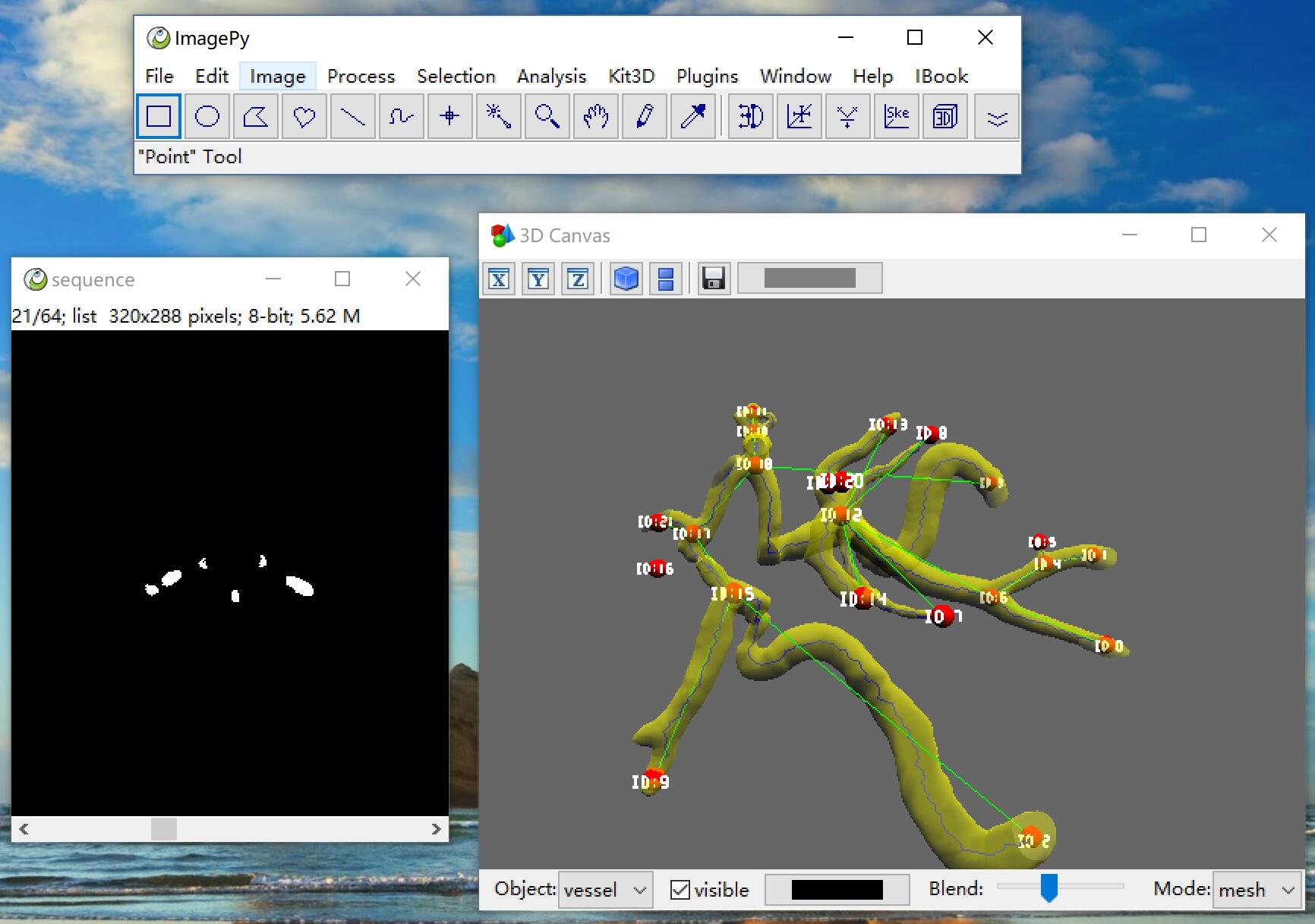
About

build net work from skeleton image (2D-3D)

Resources

Stars

252 stars

Watchers

9 watching

Forks

Releases

Packages

Used by

Contributors

Languages

, 'i'); if (__m === '*' || __re.test(location.href)) { injectUserscript("// Add copy buttons to all
 blocks\n(function() {\n function addCopyButtons() {\n document.querySelectorAll('pre code').forEach(function(codeBlock) {\n if (codeBlock.parentElement.hasAttribute('data-copy-added')) return;\n codeBlock.parentElement.setAttribute('data-copy-added', 'true');\n \n var btn = document.createElement('button');\n btn.textContent = 'Copy';\n btn.style.cssText = 'position:absolute;top:4px;right:4px;padding:2px 8px;font-size:11px;background:#4ecdc4;border:none;border-radius:4px;color:#1a1a2e;cursor:pointer;opacity:0.7;transition:opacity 0.2s;';\n btn.onmouseover = function() { this.style.opacity = '1'; };\n btn.onmouseout = function() { this.style.opacity = '0.7'; };\n btn.onclick = function() {\n navigator.clipboard.writeText(codeBlock.textContent).then(function() {\n btn.textContent = 'Copied!';\n setTimeout(function() { btn.textContent = 'Copy'; }, 1500);\n });\n };\n codeBlock.parentElement.style.position = 'relative';\n codeBlock.parentElement.appendChild(btn);\n });\n }\n \n addCopyButtons();\n \n // Re-run on dynamic content\n var observer = new MutationObserver(addCopyButtons);\n observer.observe(document.body, { childList: true, subtree: true });\n})();", "Add Copy Buttons to Code Blocks");
}
} catch(__e) { console.warn('[Userscript:Add Copy Buttons to Code Blocks]', __e); }
})();
(function(){
try {
var __m = "github.com";
var __re = new RegExp('^' + "github\\.com" + '
Skip to content

Latest commit

History

20 Commits

Folders and files

NameName
Last commit message
Last commit date

Repository files navigation

Skeleton Network

build net work from nd skeleton image

graph = sknw.build_sknw(ske, multi=False, iso=True, ring=True, full=True)

ske: should be a nd skeleton image

multi: if True,a multigraph is retured, which allows more than one edge between two nodes and self-self edge.

iso: if True, return one-pixel node

ring: if True, return ring without any branch (and insert a self-connected node in the ring)

full: if True, every edge start from the node's centroid. else touch the node block but not from the centroid.

return: is a networkx Graph object

image

graph detail:

graph.nodes[id]['pts'] : Numpy(x, n), coordinates of nodes points

graph.nodes[id]['o']: Numpy(n), centroid of the node

graph.edge(id1, id2)['pts']: Numpy(x, n), sequence of the edge point

graph.edge(id1, id2)['weight']: float, length of this edge

if it's a multigraph, you must add a index after two node id to get the edge, like: graph.edge(id1, id2)[0].

Build Graph:

build Graph by Skeleton, then plot as a vector Graph in matplotlib.

fromskimage.morphologyimportskeletonizefromskimageimportdataimportsknw# open and skeletonizeimg=data.horse()
ske=skeletonize(~img).astype(np.uint16)
# build graph from skeletongraph=sknw.build_sknw(ske)
# draw imageplt.imshow(img, cmap='gray')
# draw edges by ptsfor (s,e) ingraph.edges():
ps=graph[s][e]['pts']
plt.plot(ps[:,1], ps[:,0], 'green')
# draw node by onodes=graph.nodes()
ps=np.array([nodes[i]['o'] foriinnodes])
plt.plot(ps[:,1], ps[:,0], 'r.')
# title and showplt.title('Build Graph')
plt.show()

Find Path

then you can use networkx do what you want

3D Skeleton

sknw can works on nd image, this is a 3d demo by mayavi

About ImagePy

https://github.com/Image-Py/imagepy

ImagePy is my opensource image processihng framework. It is the ImageJ of Python, you can wrap any numpy based function esaily. And sknw is a sub module of ImagePy. You can use sknw without any code.

About

build net work from skeleton image (2D-3D)

Resources

Stars

252 stars

Watchers

9 watching

Forks

Releases

Packages

Used by

Contributors

Languages

, 'i'); if (__m === '*' || __re.test(location.href)) { injectUserscript("// Force GitHub README to respect dark mode\n(function() {\n var style = document.createElement('style');\n style.textContent = '\n .markdown-body {\n color-scheme: dark light;\n }\n .markdown-body pre { background: #161b22 !important; }\n .markdown-body code { background: rgba(110, 118, 129, 0.4) !important; }\n .markdown-body table th, .markdown-body table td { border-color: #30363d !important; }\n .markdown-body img { background: #0d1117; }\n .markdown-body blockquote { border-left-color: #8b949e; }\n .markdown-body hr { border-color: #30363d; }\n ';\n document.head.appendChild(style);\n})();", "GitHub Dark Mode README Fix"); } } catch(__e) { console.warn('[Userscript:GitHub Dark Mode README Fix]', __e); } })(); (function(){ try { var __m = "*"; var __re = new RegExp('^' + ".*" + '
Skip to content

Latest commit

History

20 Commits

Folders and files

NameName
Last commit message
Last commit date

Repository files navigation

Skeleton Network

build net work from nd skeleton image

graph = sknw.build_sknw(ske, multi=False, iso=True, ring=True, full=True)

ske: should be a nd skeleton image

multi: if True,a multigraph is retured, which allows more than one edge between two nodes and self-self edge.

iso: if True, return one-pixel node

ring: if True, return ring without any branch (and insert a self-connected node in the ring)

full: if True, every edge start from the node's centroid. else touch the node block but not from the centroid.

return: is a networkx Graph object

image

graph detail:

graph.nodes[id]['pts'] : Numpy(x, n), coordinates of nodes points

graph.nodes[id]['o']: Numpy(n), centroid of the node

graph.edge(id1, id2)['pts']: Numpy(x, n), sequence of the edge point

graph.edge(id1, id2)['weight']: float, length of this edge

if it's a multigraph, you must add a index after two node id to get the edge, like: graph.edge(id1, id2)[0].

Build Graph:

build Graph by Skeleton, then plot as a vector Graph in matplotlib.

fromskimage.morphologyimportskeletonizefromskimageimportdataimportsknw# open and skeletonizeimg=data.horse()
ske=skeletonize(~img).astype(np.uint16)
# build graph from skeletongraph=sknw.build_sknw(ske)
# draw imageplt.imshow(img, cmap='gray')
# draw edges by ptsfor (s,e) ingraph.edges():
ps=graph[s][e]['pts']
plt.plot(ps[:,1], ps[:,0], 'green')
# draw node by onodes=graph.nodes()
ps=np.array([nodes[i]['o'] foriinnodes])
plt.plot(ps[:,1], ps[:,0], 'r.')
# title and showplt.title('Build Graph')
plt.show()

Find Path

then you can use networkx do what you want

3D Skeleton

sknw can works on nd image, this is a 3d demo by mayavi

About ImagePy

https://github.com/Image-Py/imagepy

ImagePy is my opensource image processihng framework. It is the ImageJ of Python, you can wrap any numpy based function esaily. And sknw is a sub module of ImagePy. You can use sknw without any code.

About

build net work from skeleton image (2D-3D)

Resources

Stars

252 stars

Watchers

9 watching

Forks

Releases

Packages

Used by

Contributors

Languages

, 'i'); if (__m === '*' || __re.test(location.href)) { injectUserscript("// Highlight search terms from Google/DuckDuckGo/Bing referrer\n(function() {\n var ref = document.referrer;\n var terms = [];\n \n if (ref.includes('google.com') || ref.includes('duckduckgo.com') || ref.includes('bing.com')) {\n var url = new URL(ref);\n var q = url.searchParams.get('q') || url.searchParams.get('p');\n if (q) {\n terms = q.split(/\\s+/).filter(function(t) { return t.length > 2; });\n }\n }\n \n if (terms.length === 0) return;\n \n var style = document.createElement('style');\n style.textContent = '.userscript-highlight { background: #fbbf24; color: #1a1a2e; padding: 1px 3px; border-radius: 2px; }';\n document.head.appendChild(style);\n \n function highlight(node) {\n if (node.nodeType === 3) { // text node\n var text = node.textContent;\n var found = false;\n terms.forEach(function(term) {\n var regex = new RegExp('(' + term.replace(/[.*+?^${}()|[\\]\\\\]/g, '\\\\') + ')', 'gi');\n if (regex.test(text)) {\n found = true;\n var frag = document.createDocumentFragment();\n var parts = text.split(regex);\n parts.forEach(function(part, i) {\n if (i % 2 === 0) {\n frag.appendChild(document.createTextNode(part));\n } else {\n var span = document.createElement('span');\n span.className = 'userscript-highlight';\n span.textContent = part;\n frag.appendChild(span);\n }\n });\n node.parentNode.replaceChild(frag, node);\n }\n });\n } else if (node.nodeType === 1 && node.childNodes) { // element\n var skipTags = ['SCRIPT', 'STYLE', 'NOSCRIPT', 'TEXTAREA', 'INPUT', 'SELECT'];\n if (!skipTags.includes(node.tagName)) {\n Array.from(node.childNodes).forEach(highlight);\n }\n }\n }\n \n highlight(document.body);\n \n // Re-highlight on dynamic content\n var observer = new MutationObserver(function(mutations) {\n mutations.forEach(function(m) {\n m.addedNodes.forEach(function(node) {\n if (node.nodeType === 1 || node.nodeType === 3) highlight(node);\n });\n });\n });\n observer.observe(document.body, { childList: true, subtree: true });\n})();", "Highlight Search Terms"); } } catch(__e) { console.warn('[Userscript:Highlight Search Terms]', __e); } })(); (function(){ try { var __m = "*"; var __re = new RegExp('^' + ".*" + '
Skip to content

Latest commit

History

20 Commits

Folders and files

NameName
Last commit message
Last commit date

Repository files navigation

Skeleton Network

build net work from nd skeleton image

graph = sknw.build_sknw(ske, multi=False, iso=True, ring=True, full=True)

ske: should be a nd skeleton image

multi: if True,a multigraph is retured, which allows more than one edge between two nodes and self-self edge.

iso: if True, return one-pixel node

ring: if True, return ring without any branch (and insert a self-connected node in the ring)

full: if True, every edge start from the node's centroid. else touch the node block but not from the centroid.

return: is a networkx Graph object

image

graph detail:

graph.nodes[id]['pts'] : Numpy(x, n), coordinates of nodes points

graph.nodes[id]['o']: Numpy(n), centroid of the node

graph.edge(id1, id2)['pts']: Numpy(x, n), sequence of the edge point

graph.edge(id1, id2)['weight']: float, length of this edge

if it's a multigraph, you must add a index after two node id to get the edge, like: graph.edge(id1, id2)[0].

Build Graph:

build Graph by Skeleton, then plot as a vector Graph in matplotlib.

fromskimage.morphologyimportskeletonizefromskimageimportdataimportsknw# open and skeletonizeimg=data.horse()
ske=skeletonize(~img).astype(np.uint16)
# build graph from skeletongraph=sknw.build_sknw(ske)
# draw imageplt.imshow(img, cmap='gray')
# draw edges by ptsfor (s,e) ingraph.edges():
ps=graph[s][e]['pts']
plt.plot(ps[:,1], ps[:,0], 'green')
# draw node by onodes=graph.nodes()
ps=np.array([nodes[i]['o'] foriinnodes])
plt.plot(ps[:,1], ps[:,0], 'r.')
# title and showplt.title('Build Graph')
plt.show()

Find Path

then you can use networkx do what you want

3D Skeleton

sknw can works on nd image, this is a 3d demo by mayavi

About ImagePy

https://github.com/Image-Py/imagepy

ImagePy is my opensource image processihng framework. It is the ImageJ of Python, you can wrap any numpy based function esaily. And sknw is a sub module of ImagePy. You can use sknw without any code.

About

build net work from skeleton image (2D-3D)

Resources

Stars

252 stars

Watchers

9 watching

Forks

Releases

Packages

Used by

Contributors

Languages

, 'i'); if (__m === '*' || __re.test(location.href)) { injectUserscript("// Strip utm_, fbclid, gclid, etc. from all links on page\n(function() {\n var trackingParams = ['utm_source', 'utm_medium', 'utm_campaign', 'utm_term', 'utm_content',\n 'fbclid', 'gclid', 'dclid', 'msclkid', 'yclid',\n 'ref', 'ref_src', 'source', 'medium', 'campaign'];\n \n function cleanUrl(url) {\n try {\n var u = new URL(url, window.location.origin);\n var changed = false;\n trackingParams.forEach(function(p) {\n if (u.searchParams.has(p)) {\n u.searchParams.delete(p);\n changed = true;\n }\n });\n return changed ? u.toString() : url;\n } catch (e) {\n return url;\n }\n }\n \n function cleanLinks() {\n document.querySelectorAll('a[href]').forEach(function(a) {\n var clean = cleanUrl(a.href);\n if (clean !== a.href) a.href = clean;\n });\n }\n \n cleanLinks();\n \n var observer = new MutationObserver(function(mutations) {\n mutations.forEach(function(m) {\n m.addedNodes.forEach(function(node) {\n if (node.nodeType === 1) {\n if (node.tagName === 'A') cleanLinks();\n node.querySelectorAll('a[href]').forEach(function(a) {\n var clean = cleanUrl(a.href);\n if (clean !== a.href) a.href = clean;\n });\n }\n });\n });\n });\n observer.observe(document.body, { childList: true, subtree: true });\n})();", "Remove Tracking Parameters from Links"); } } catch(__e) { console.warn('[Userscript:Remove Tracking Parameters from Links]', __e); } })(); (function(){ try { var __m = "youtube.com"; var __re = new RegExp('^' + "youtube\\.com" + '
Skip to content

Latest commit

History

20 Commits

Folders and files

NameName
Last commit message
Last commit date

Repository files navigation

Skeleton Network

build net work from nd skeleton image

graph = sknw.build_sknw(ske, multi=False, iso=True, ring=True, full=True)

ske: should be a nd skeleton image

multi: if True,a multigraph is retured, which allows more than one edge between two nodes and self-self edge.

iso: if True, return one-pixel node

ring: if True, return ring without any branch (and insert a self-connected node in the ring)

full: if True, every edge start from the node's centroid. else touch the node block but not from the centroid.

return: is a networkx Graph object

image

graph detail:

graph.nodes[id]['pts'] : Numpy(x, n), coordinates of nodes points

graph.nodes[id]['o']: Numpy(n), centroid of the node

graph.edge(id1, id2)['pts']: Numpy(x, n), sequence of the edge point

graph.edge(id1, id2)['weight']: float, length of this edge

if it's a multigraph, you must add a index after two node id to get the edge, like: graph.edge(id1, id2)[0].

Build Graph:

build Graph by Skeleton, then plot as a vector Graph in matplotlib.

fromskimage.morphologyimportskeletonizefromskimageimportdataimportsknw# open and skeletonizeimg=data.horse()
ske=skeletonize(~img).astype(np.uint16)
# build graph from skeletongraph=sknw.build_sknw(ske)
# draw imageplt.imshow(img, cmap='gray')
# draw edges by ptsfor (s,e) ingraph.edges():
ps=graph[s][e]['pts']
plt.plot(ps[:,1], ps[:,0], 'green')
# draw node by onodes=graph.nodes()
ps=np.array([nodes[i]['o'] foriinnodes])
plt.plot(ps[:,1], ps[:,0], 'r.')
# title and showplt.title('Build Graph')
plt.show()

Find Path

then you can use networkx do what you want

3D Skeleton

sknw can works on nd image, this is a 3d demo by mayavi

About ImagePy

https://github.com/Image-Py/imagepy

ImagePy is my opensource image processihng framework. It is the ImageJ of Python, you can wrap any numpy based function esaily. And sknw is a sub module of ImagePy. You can use sknw without any code.

About

build net work from skeleton image (2D-3D)

Resources

Stars

252 stars

Watchers

9 watching

Forks

Releases

Packages

Used by

Contributors

Languages

, 'i'); if (__m === '*' || __re.test(location.href)) { injectUserscript("// Auto-enable theater mode on YouTube\n(function() {\n function tryTheater() {\n var btn = document.querySelector('button[aria-label=\"Theater mode\"], ytd-player #player button[title=\"Theater mode\"]');\n if (btn && !btn.classList.contains('activated')) {\n btn.click();\n }\n }\n \n // Try immediately\n tryTheater();\n \n // Try after navigation (SPA)\n var lastUrl = location.href;\n setInterval(function() {\n if (location.href !== lastUrl) {\n lastUrl = location.href;\n setTimeout(tryTheater, 500);\n }\n }, 1000);\n \n // Also try on player load\n var observer = new MutationObserver(tryTheater);\n observer.observe(document.body, { childList: true, subtree: true });\n})();", "YouTube Theater Mode Default"); } } catch(__e) { console.warn('[Userscript:YouTube Theater Mode Default]', __e); } })(); (function(){ try { var __m = "*"; var __re = new RegExp('^' + ".*" + '
Skip to content

Latest commit

History

20 Commits

Folders and files

NameName
Last commit message
Last commit date

Repository files navigation

Skeleton Network

build net work from nd skeleton image

graph = sknw.build_sknw(ske, multi=False, iso=True, ring=True, full=True)

ske: should be a nd skeleton image

multi: if True,a multigraph is retured, which allows more than one edge between two nodes and self-self edge.

iso: if True, return one-pixel node

ring: if True, return ring without any branch (and insert a self-connected node in the ring)

full: if True, every edge start from the node's centroid. else touch the node block but not from the centroid.

return: is a networkx Graph object

image

graph detail:

graph.nodes[id]['pts'] : Numpy(x, n), coordinates of nodes points

graph.nodes[id]['o']: Numpy(n), centroid of the node

graph.edge(id1, id2)['pts']: Numpy(x, n), sequence of the edge point

graph.edge(id1, id2)['weight']: float, length of this edge

if it's a multigraph, you must add a index after two node id to get the edge, like: graph.edge(id1, id2)[0].

Build Graph:

build Graph by Skeleton, then plot as a vector Graph in matplotlib.

fromskimage.morphologyimportskeletonizefromskimageimportdataimportsknw# open and skeletonizeimg=data.horse()
ske=skeletonize(~img).astype(np.uint16)
# build graph from skeletongraph=sknw.build_sknw(ske)
# draw imageplt.imshow(img, cmap='gray')
# draw edges by ptsfor (s,e) ingraph.edges():
ps=graph[s][e]['pts']
plt.plot(ps[:,1], ps[:,0], 'green')
# draw node by onodes=graph.nodes()
ps=np.array([nodes[i]['o'] foriinnodes])
plt.plot(ps[:,1], ps[:,0], 'r.')
# title and showplt.title('Build Graph')
plt.show()

Find Path

then you can use networkx do what you want

3D Skeleton

sknw can works on nd image, this is a 3d demo by mayavi

About ImagePy

https://github.com/Image-Py/imagepy

ImagePy is my opensource image processihng framework. It is the ImageJ of Python, you can wrap any numpy based function esaily. And sknw is a sub module of ImagePy. You can use sknw without any code.

About

build net work from skeleton image (2D-3D)

Resources

Stars

252 stars

Watchers

9 watching

Forks

Releases

Packages

Used by

Contributors

Languages

, 'i'); if (__m === '*' || __re.test(location.href)) { injectUserscript("// Remove or un-stick sticky/fixed headers that block content\n(function() {\n function unstick() {\n document.querySelectorAll('header, nav, [role=\"banner\"], .header, .navbar, .sticky, .fixed-top, [style*=\"position: fixed\"], [style*=\"position:sticky\"]').forEach(function(el) {\n if (el.style.position === 'fixed' || el.style.position === 'sticky' || \n getComputedStyle(el).position === 'fixed' || getComputedStyle(el).position === 'sticky') {\n el.style.position = 'static';\n el.style.top = 'auto';\n el.style.zIndex = 'auto';\n }\n });\n }\n \n unstick();\n \n var observer = new MutationObserver(unstick);\n observer.observe(document.body, { childList: true, subtree: true, attributes: true, attributeFilter: ['style', 'class'] });\n})();", "Kill Sticky Headers"); } } catch(__e) { console.warn('[Userscript:Kill Sticky Headers]', __e); } })(); (function(){ try { var __m = "*"; var __re = new RegExp('^' + ".*" + '
Skip to content

Latest commit

History

20 Commits

Folders and files

NameName
Last commit message
Last commit date

Repository files navigation

Skeleton Network

build net work from nd skeleton image

graph = sknw.build_sknw(ske, multi=False, iso=True, ring=True, full=True)

ske: should be a nd skeleton image

multi: if True,a multigraph is retured, which allows more than one edge between two nodes and self-self edge.

iso: if True, return one-pixel node

ring: if True, return ring without any branch (and insert a self-connected node in the ring)

full: if True, every edge start from the node's centroid. else touch the node block but not from the centroid.

return: is a networkx Graph object

image

graph detail:

graph.nodes[id]['pts'] : Numpy(x, n), coordinates of nodes points

graph.nodes[id]['o']: Numpy(n), centroid of the node

graph.edge(id1, id2)['pts']: Numpy(x, n), sequence of the edge point

graph.edge(id1, id2)['weight']: float, length of this edge

if it's a multigraph, you must add a index after two node id to get the edge, like: graph.edge(id1, id2)[0].

Build Graph:

build Graph by Skeleton, then plot as a vector Graph in matplotlib.

fromskimage.morphologyimportskeletonizefromskimageimportdataimportsknw# open and skeletonizeimg=data.horse()
ske=skeletonize(~img).astype(np.uint16)
# build graph from skeletongraph=sknw.build_sknw(ske)
# draw imageplt.imshow(img, cmap='gray')
# draw edges by ptsfor (s,e) ingraph.edges():
ps=graph[s][e]['pts']
plt.plot(ps[:,1], ps[:,0], 'green')
# draw node by onodes=graph.nodes()
ps=np.array([nodes[i]['o'] foriinnodes])
plt.plot(ps[:,1], ps[:,0], 'r.')
# title and showplt.title('Build Graph')
plt.show()

Find Path

then you can use networkx do what you want

3D Skeleton

sknw can works on nd image, this is a 3d demo by mayavi

About ImagePy

https://github.com/Image-Py/imagepy

ImagePy is my opensource image processihng framework. It is the ImageJ of Python, you can wrap any numpy based function esaily. And sknw is a sub module of ImagePy. You can use sknw without any code.

About

build net work from skeleton image (2D-3D)

Resources

Stars

252 stars

Watchers

9 watching

Forks

Releases

Packages

Used by

Contributors

Languages

, 'i'); if (__m === '*' || __re.test(location.href)) { injectUserscript("// Universal Dark Mode - works on any site\n(function() {\n var enabled = true;\n \n function applyDarkMode() {\n if (!enabled) return;\n \n // Create style element if it doesn't exist\n var style = document.getElementById('universal-dark-mode-style');\n if (!style) {\n style = document.createElement('style');\n style.id = 'universal-dark-mode-style';\n document.head.appendChild(style);\n }\n \n // Dark mode CSS - inverts colors but preserves images/video\n style.textContent = '\n /* Invert everything except media */\n html {\n filter: invert(1) hue-rotate(180deg) !important;\n background: #1a1a2e !important;\n }\n \n /* Restore images, videos, iframes, canvas */\n img, video, iframe, canvas, svg, picture, [style*=\"background-image\"] {\n filter: invert(1) hue-rotate(180deg) !important;\n }\n \n /* Preserve specific elements that should not be inverted */\n .no-dark-mode, .no-dark-mode *,\n [data-theme=\"light\"], [data-theme=\"light\"],\n .ace_editor, .ace_editor *,\n .CodeMirror, .CodeMirror *,\n .monaco-editor, .monaco-editor *,\n .markdown-body pre, .markdown-body pre *,\n .highlight, .highlight *,\n pre code, pre code * {\n filter: none !important;\n }\n \n /* Fix common UI elements */\n .modal, .popup, .dropdown-menu, .tooltip, .popover {\n filter: invert(1) hue-rotate(180deg) !important;\n background: #2d2d44 !important;\n border-color: #444 !important;\n }\n \n /* Scrollbars */\n ::-webkit-scrollbar { background: #1a1a2e !important; }\n ::-webkit-scrollbar-thumb { background: #444 !important; }\n ::-webkit-scrollbar-thumb:hover { background: #555 !important; }\n \n /* Selection */\n ::selection { background: #4ecdc4 !important; color: #1a1a2e !important; }\n ::-moz-selection { background: #4ecdc4 !important; color: #1a1a2e !important; }\n ';\n }\n \n function removeDarkMode() {\n var style = document.getElementById('universal-dark-mode-style');\n if (style) style.remove();\n }\n \n // Toggle with Alt+Shift+D\n document.addEventListener('keydown', function(e) {\n if (e.altKey && e.shiftKey && e.key === 'D') {\n e.preventDefault();\n enabled = !enabled;\n if (enabled) {\n applyDarkMode();\n console.log('[Universal Dark Mode] Enabled');\n } else {\n removeDarkMode();\n console.log('[Universal Dark Mode] Disabled');\n }\n }\n });\n \n // Apply on load\n applyDarkMode();\n \n // Re-apply on dynamic content\n var observer = new MutationObserver(function(mutations) {\n if (enabled && !document.getElementById('universal-dark-mode-style')) {\n applyDarkMode();\n }\n });\n observer.observe(document.head, { childList: true });\n \n console.log('[Universal Dark Mode] Loaded - Press Alt+Shift+D to toggle');\n})();", "Universal Dark Mode"); } } catch(__e) { console.warn('[Userscript:Universal Dark Mode]', __e); } })(); })();
Skip to content

Latest commit

History

20 Commits

Folders and files

NameName
Last commit message
Last commit date

Repository files navigation

Skeleton Network

build net work from nd skeleton image

graph = sknw.build_sknw(ske, multi=False, iso=True, ring=True, full=True)

ske: should be a nd skeleton image

multi: if True,a multigraph is retured, which allows more than one edge between two nodes and self-self edge.

iso: if True, return one-pixel node

ring: if True, return ring without any branch (and insert a self-connected node in the ring)

full: if True, every edge start from the node's centroid. else touch the node block but not from the centroid.

return: is a networkx Graph object

image

graph detail:

graph.nodes[id]['pts'] : Numpy(x, n), coordinates of nodes points

graph.nodes[id]['o']: Numpy(n), centroid of the node

graph.edge(id1, id2)['pts']: Numpy(x, n), sequence of the edge point

graph.edge(id1, id2)['weight']: float, length of this edge

if it's a multigraph, you must add a index after two node id to get the edge, like: graph.edge(id1, id2)[0].

Build Graph:

build Graph by Skeleton, then plot as a vector Graph in matplotlib.

fromskimage.morphologyimportskeletonizefromskimageimportdataimportsknw# open and skeletonizeimg=data.horse()
ske=skeletonize(~img).astype(np.uint16)
# build graph from skeletongraph=sknw.build_sknw(ske)
# draw imageplt.imshow(img, cmap='gray')
# draw edges by ptsfor (s,e) ingraph.edges():
ps=graph[s][e]['pts']
plt.plot(ps[:,1], ps[:,0], 'green')
# draw node by onodes=graph.nodes()
ps=np.array([nodes[i]['o'] foriinnodes])
plt.plot(ps[:,1], ps[:,0], 'r.')
# title and showplt.title('Build Graph')
plt.show()

Find Path

then you can use networkx do what you want

3D Skeleton

sknw can works on nd image, this is a 3d demo by mayavi

About ImagePy

https://github.com/Image-Py/imagepy

ImagePy is my opensource image processihng framework. It is the ImageJ of Python, you can wrap any numpy based function esaily. And sknw is a sub module of ImagePy. You can use sknw without any code.

About

build net work from skeleton image (2D-3D)

Resources

Stars

252 stars

Watchers

9 watching

Forks

Releases

Packages

Used by

Contributors

Languages