This is a Code Nummy about numerical rootfinding via bisection. Please check out the other Code Nummies.
Rootfinding is a central problem in maths. If there is no analytic solution for an equation, e.g. x = cos(x), numeric
rootfinding yields an approximated solution for the equation, by solving 0 = cos(x) - x.
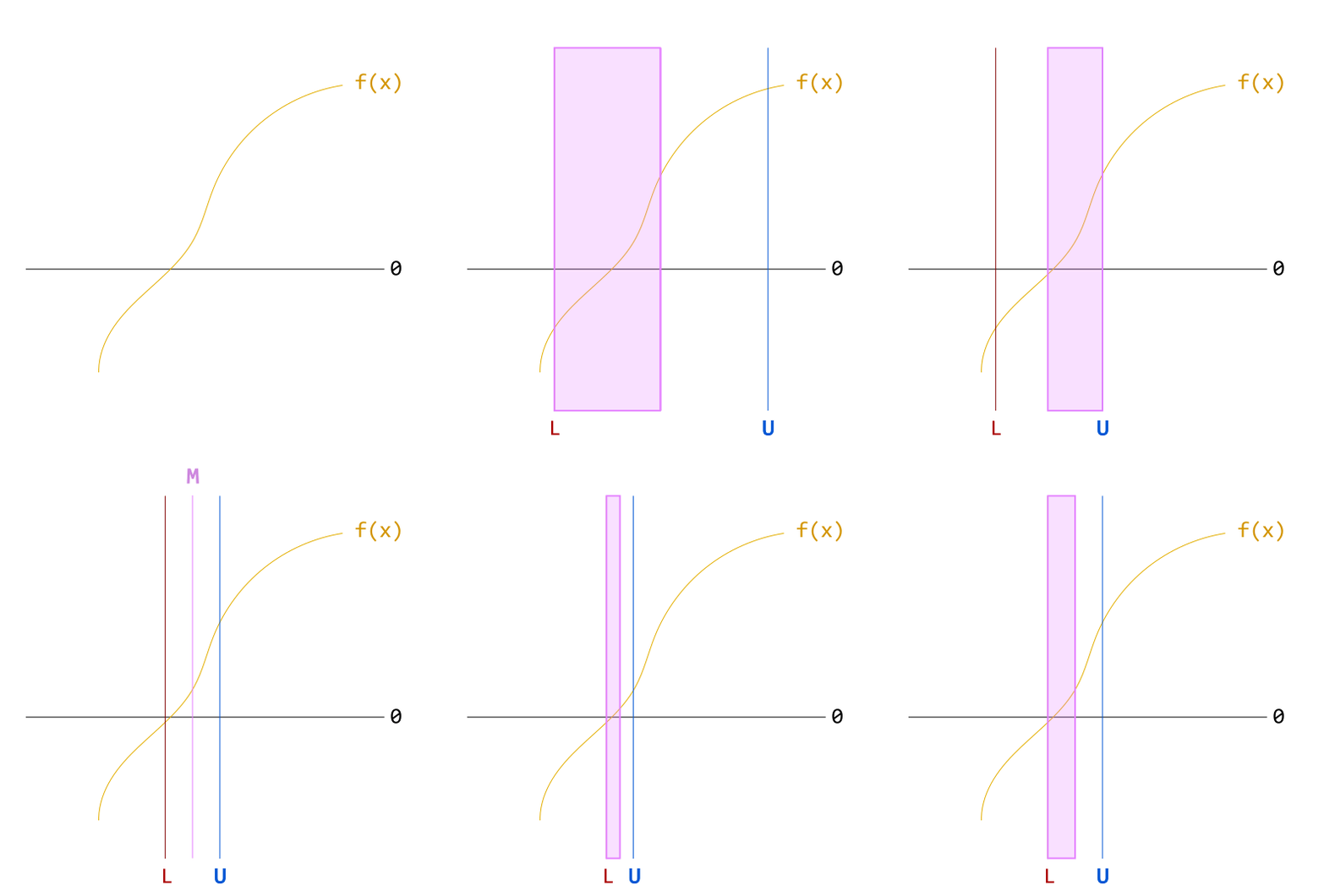
We know that a function f(x) has a zero at x0 in the range [L;U]. The idea of bisection is to divide the search
interval in two halves in each iteration and to discard the half that does not contain the root. The iteration cycle
will stop once a sufficient precision delta is reached (how far off is the function value from 0?).
- Calculate the mean value of
LandUasM = (L + U) / 2 - Check the calculated function value is close enough to zero:
- If
abs(f(M)) <= delta- stop the iteration and use
x0 = M
- stop the iteration and use
- If
- Check which half of the search interval to discard
- If
sgn(f(M)) == sgn(f(L))- set
L = M
- set
- Else
- set
U = M
- set
- If
- continue at 1.
With sgn(x) being the sign function.
- Minimal knowledge about
f(x)needed - Constantly increases precision with each iteration
- Works also for functions that can not be expressed analytically.
- Works only for functions of one variable
- Comparably slow convergence.
- Does not work if zero is of even order
- Does not work if there is an even number of zeros in the range
[L;U]
Let's start with implementing the bisection algorithm.
The first step will be to implement the calculation of the mean of two values. A function implementation can be
found in src/calcaulate_mean as calculate_mean(L, U). It is your task to write a proper implementation.
The respective tests can be found in tests/calculate_mean_test.
Now it is time for the actual bisection. replace the fake
function bisect(function, L, U, delta)
in src/bisection. The tests in tests/bisection_test will show you if your implementation is correct.
Feel free to test the bisection with your own
Note that c++ and python do unfortunately not provide a function to calculate the sign of a value.
For this you can use the provided (and tested) template function in src/sgn
- What happens, if
- the range
[L;U]does not contain any zero? - the range
[L;U]contains two zeros of first order? I.e.f(x) = x*x - 2in the range[-2;2]. - the range contains three zeros of first order? I.e.
f(x) = (x-1) * (x-1) * (x-1) - x * x +1in the range[-1;4]. - the range contains one zero of second order? I.e.
f(x) = x * xin the range[-1;1].
- the range