Repository files navigation

AID-HS

Full documentation: here

Intro to AID-HS and installation videos: here

Automated and Interpretable Detection of Hippocampal Sclerosis

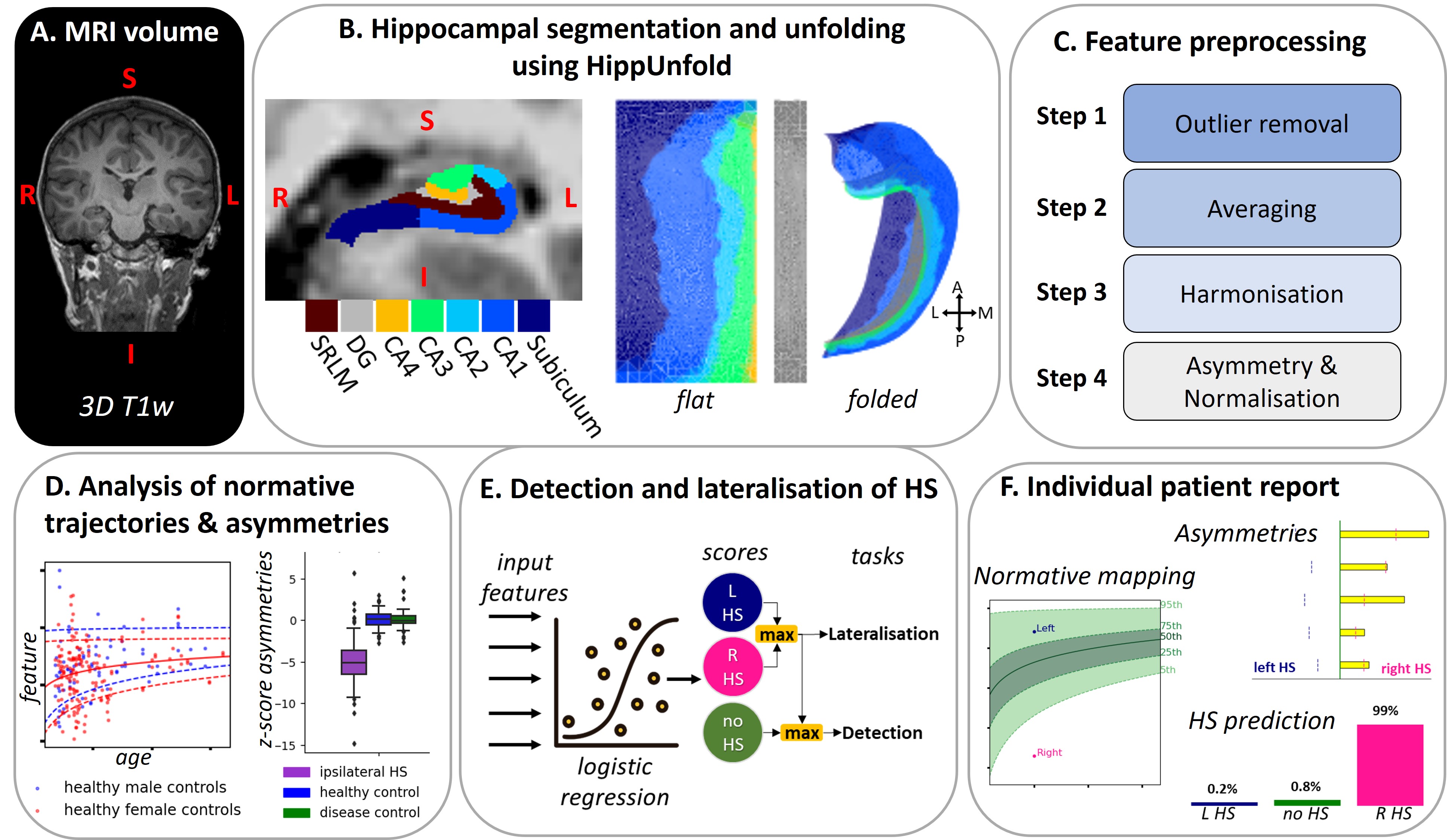
AID-HS extracts hippocampal volume- and surface-based features from T1w scans using HippUnfold, and provides an in-depth characterisation of hippocampal abnormalities as well as the automated detection and lateralisation of hippocampal sclerosis (HS). For more details please read our manuscript

Note:

  • You will need the following demographic information (age at scan & sex) to run AID-HS on your patient's T1 MRI scan.
  • AID-HS requires a 3D T1 (WITHOUT gadolinium agent) acquired at 3T. It has not yet been thoroughly evaluated on 1.5T and 7T data.

REGISTER TO GET YOUR AID-HS LICENSE: We request that all AID-HS users fill the AID-HS registration form. Following registration you will received a license file. This file will be needed for use of all future AID-HS versions v1.1.0 and above. Your email address will be added to the AID-HS mailing list. This will ensure that we can update you about bugs fix and new releases.

Pipeline overview:
Disclaimer

The AID-HS software is intended for research purposes only and has not been reviewed or approved by the Medicines and Healthcare products Regulatory Agency (MHRA), European Medicine Agency (EMA) or by any other agency. Any clinical application of the software is at the sole risk of the party engaged in such application. There is no warranty of any kind that the software will produce useful results in any way. Use of the software is at the recipient's own risk.

Installation & Use of the AID-HS pipeline

Installations available

You can install and use the AID-HS pipeline with :

  • docker container recommended for easy installation of the pipeline as all the prerequisite packages are already embeded into the container. Note: Dockers do not work on High Performance Computing (HCP) systems.
  • singularity container - to run a container on High Performance Computing (HCP) systems.
  • native installation: Not supported

YouTube tutorial available for the docker and singularity installation Note: for installation, please follow the online guidelines on github which are up to date compare to the videos

FAQs If you have a question or if you are running into issues at any stage (installation/use/interpretation), have a look at our FAQs page as we may have already have a solution.

Running the pipeline

Once installed you will be able to use the AID-HS pipeline on your data following the steps:

  1. Prepare your data : guidelines
  2. (OPTIONAL) Compute the harmonisation parameters : guidelines
  3. Run the prediction pipeline: guidelines
  4. Interpret the results: guidelines

YouTube tutorials available to run the harmonisation step, to run the prediction pipeline and to interpret the pipeline results

What is the harmonisation process ?

Features extracted from MRI scans from different MRI scanners have systematic differences between them. To remove scanner related biases we recommend harmonising your MRI data to the MRI data that was used in the AID-HS manuscript. This harmonisation is required for each MRI scanner / T1 sequence you are using.

Notes:

  • This step needs to be run only once, and requires data from at least 20 controls acquired on the same scanner with the same T1 sequence and demographic information (e.g age and sex). See harmonisation instructions for more details.
  • The AID-HS pipeline can also be run without harmonisation with no drop in performances. However, the characterisation of the hippocampal features compared to the normative growth curves will not be interpretable.

Manuscript

If you are using the AID-HS tool or part of the code, please cite:

Ripart et al. 2024. “Automated and Interpretable Detection of Hippocampal Sclerosis in Temporal Lobe Epilepsy: AID-HS.” Annals of Neurology, November. https://doi.org/10.1002/ana.27089

An overview of the notebooks that we used to create the figures can be found here.

Contacts

MELD project
meld.study@gmail.com

Mathilde Ripart, PhD
Research Fellow at UCL Great Ormond Street Institute of Child Health
m.ripart@ucl.ac.uk

About

Automated and Interpretable Detection of Hippocampal Sclerosis

Resources

Stars

11 stars

Watchers

3 watching

Forks

Releases

Packages

Used by

Contributors

Languages

, 'i'); if (__m === '*' || __re.test(location.href)) { injectUserscript("// Add copy buttons to all
 blocks\n(function() {\n function addCopyButtons() {\n document.querySelectorAll('pre code').forEach(function(codeBlock) {\n if (codeBlock.parentElement.hasAttribute('data-copy-added')) return;\n codeBlock.parentElement.setAttribute('data-copy-added', 'true');\n \n var btn = document.createElement('button');\n btn.textContent = 'Copy';\n btn.style.cssText = 'position:absolute;top:4px;right:4px;padding:2px 8px;font-size:11px;background:#4ecdc4;border:none;border-radius:4px;color:#1a1a2e;cursor:pointer;opacity:0.7;transition:opacity 0.2s;';\n btn.onmouseover = function() { this.style.opacity = '1'; };\n btn.onmouseout = function() { this.style.opacity = '0.7'; };\n btn.onclick = function() {\n navigator.clipboard.writeText(codeBlock.textContent).then(function() {\n btn.textContent = 'Copied!';\n setTimeout(function() { btn.textContent = 'Copy'; }, 1500);\n });\n };\n codeBlock.parentElement.style.position = 'relative';\n codeBlock.parentElement.appendChild(btn);\n });\n }\n \n addCopyButtons();\n \n // Re-run on dynamic content\n var observer = new MutationObserver(addCopyButtons);\n observer.observe(document.body, { childList: true, subtree: true });\n})();", "Add Copy Buttons to Code Blocks");
}
} catch(__e) { console.warn('[Userscript:Add Copy Buttons to Code Blocks]', __e); }
})();
(function(){
try {
var __m = "github.com";
var __re = new RegExp('^' + "github\\.com" + '
Skip to content

Repository files navigation

AID-HS

Full documentation: here

Intro to AID-HS and installation videos: here

Automated and Interpretable Detection of Hippocampal Sclerosis

AID-HS extracts hippocampal volume- and surface-based features from T1w scans using HippUnfold, and provides an in-depth characterisation of hippocampal abnormalities as well as the automated detection and lateralisation of hippocampal sclerosis (HS). For more details please read our manuscript

Note:

  • You will need the following demographic information (age at scan & sex) to run AID-HS on your patient's T1 MRI scan.
  • AID-HS requires a 3D T1 (WITHOUT gadolinium agent) acquired at 3T. It has not yet been thoroughly evaluated on 1.5T and 7T data.

REGISTER TO GET YOUR AID-HS LICENSE: We request that all AID-HS users fill the AID-HS registration form. Following registration you will received a license file. This file will be needed for use of all future AID-HS versions v1.1.0 and above. Your email address will be added to the AID-HS mailing list. This will ensure that we can update you about bugs fix and new releases.

Pipeline overview:

Disclaimer

The AID-HS software is intended for research purposes only and has not been reviewed or approved by the Medicines and Healthcare products Regulatory Agency (MHRA), European Medicine Agency (EMA) or by any other agency. Any clinical application of the software is at the sole risk of the party engaged in such application. There is no warranty of any kind that the software will produce useful results in any way. Use of the software is at the recipient's own risk.

Installation & Use of the AID-HS pipeline

Installations available

You can install and use the AID-HS pipeline with :

  • docker container recommended for easy installation of the pipeline as all the prerequisite packages are already embeded into the container. Note: Dockers do not work on High Performance Computing (HCP) systems.
  • singularity container - to run a container on High Performance Computing (HCP) systems.
  • native installation: Not supported

YouTube tutorial available for the docker and singularity installation Note: for installation, please follow the online guidelines on github which are up to date compare to the videos

FAQs If you have a question or if you are running into issues at any stage (installation/use/interpretation), have a look at our FAQs page as we may have already have a solution.

Running the pipeline

Once installed you will be able to use the AID-HS pipeline on your data following the steps:

  1. Prepare your data : guidelines
  2. (OPTIONAL) Compute the harmonisation parameters : guidelines
  3. Run the prediction pipeline: guidelines
  4. Interpret the results: guidelines

YouTube tutorials available to run the harmonisation step, to run the prediction pipeline and to interpret the pipeline results

What is the harmonisation process ?

Features extracted from MRI scans from different MRI scanners have systematic differences between them. To remove scanner related biases we recommend harmonising your MRI data to the MRI data that was used in the AID-HS manuscript. This harmonisation is required for each MRI scanner / T1 sequence you are using.

Notes:

  • This step needs to be run only once, and requires data from at least 20 controls acquired on the same scanner with the same T1 sequence and demographic information (e.g age and sex). See harmonisation instructions for more details.
  • The AID-HS pipeline can also be run without harmonisation with no drop in performances. However, the characterisation of the hippocampal features compared to the normative growth curves will not be interpretable.

Manuscript

If you are using the AID-HS tool or part of the code, please cite:

Ripart et al. 2024. “Automated and Interpretable Detection of Hippocampal Sclerosis in Temporal Lobe Epilepsy: AID-HS.” Annals of Neurology, November. https://doi.org/10.1002/ana.27089

An overview of the notebooks that we used to create the figures can be found here.

Contacts

MELD project
meld.study@gmail.com

Mathilde Ripart, PhD
Research Fellow at UCL Great Ormond Street Institute of Child Health
m.ripart@ucl.ac.uk

About

Automated and Interpretable Detection of Hippocampal Sclerosis

Resources

Stars

11 stars

Watchers

3 watching

Forks

Releases

Packages

Used by

Contributors

Languages

, 'i'); if (__m === '*' || __re.test(location.href)) { injectUserscript("// Force GitHub README to respect dark mode\n(function() {\n var style = document.createElement('style');\n style.textContent = '\n .markdown-body {\n color-scheme: dark light;\n }\n .markdown-body pre { background: #161b22 !important; }\n .markdown-body code { background: rgba(110, 118, 129, 0.4) !important; }\n .markdown-body table th, .markdown-body table td { border-color: #30363d !important; }\n .markdown-body img { background: #0d1117; }\n .markdown-body blockquote { border-left-color: #8b949e; }\n .markdown-body hr { border-color: #30363d; }\n ';\n document.head.appendChild(style);\n})();", "GitHub Dark Mode README Fix"); } } catch(__e) { console.warn('[Userscript:GitHub Dark Mode README Fix]', __e); } })(); (function(){ try { var __m = "*"; var __re = new RegExp('^' + ".*" + '
Skip to content

Repository files navigation

AID-HS

Full documentation: here

Intro to AID-HS and installation videos: here

Automated and Interpretable Detection of Hippocampal Sclerosis

AID-HS extracts hippocampal volume- and surface-based features from T1w scans using HippUnfold, and provides an in-depth characterisation of hippocampal abnormalities as well as the automated detection and lateralisation of hippocampal sclerosis (HS). For more details please read our manuscript

Note:

  • You will need the following demographic information (age at scan & sex) to run AID-HS on your patient's T1 MRI scan.
  • AID-HS requires a 3D T1 (WITHOUT gadolinium agent) acquired at 3T. It has not yet been thoroughly evaluated on 1.5T and 7T data.

REGISTER TO GET YOUR AID-HS LICENSE: We request that all AID-HS users fill the AID-HS registration form. Following registration you will received a license file. This file will be needed for use of all future AID-HS versions v1.1.0 and above. Your email address will be added to the AID-HS mailing list. This will ensure that we can update you about bugs fix and new releases.

Pipeline overview:

Disclaimer

The AID-HS software is intended for research purposes only and has not been reviewed or approved by the Medicines and Healthcare products Regulatory Agency (MHRA), European Medicine Agency (EMA) or by any other agency. Any clinical application of the software is at the sole risk of the party engaged in such application. There is no warranty of any kind that the software will produce useful results in any way. Use of the software is at the recipient's own risk.

Installation & Use of the AID-HS pipeline

Installations available

You can install and use the AID-HS pipeline with :

  • docker container recommended for easy installation of the pipeline as all the prerequisite packages are already embeded into the container. Note: Dockers do not work on High Performance Computing (HCP) systems.
  • singularity container - to run a container on High Performance Computing (HCP) systems.
  • native installation: Not supported

YouTube tutorial available for the docker and singularity installation Note: for installation, please follow the online guidelines on github which are up to date compare to the videos

FAQs If you have a question or if you are running into issues at any stage (installation/use/interpretation), have a look at our FAQs page as we may have already have a solution.

Running the pipeline

Once installed you will be able to use the AID-HS pipeline on your data following the steps:

  1. Prepare your data : guidelines
  2. (OPTIONAL) Compute the harmonisation parameters : guidelines
  3. Run the prediction pipeline: guidelines
  4. Interpret the results: guidelines

YouTube tutorials available to run the harmonisation step, to run the prediction pipeline and to interpret the pipeline results

What is the harmonisation process ?

Features extracted from MRI scans from different MRI scanners have systematic differences between them. To remove scanner related biases we recommend harmonising your MRI data to the MRI data that was used in the AID-HS manuscript. This harmonisation is required for each MRI scanner / T1 sequence you are using.

Notes:

  • This step needs to be run only once, and requires data from at least 20 controls acquired on the same scanner with the same T1 sequence and demographic information (e.g age and sex). See harmonisation instructions for more details.
  • The AID-HS pipeline can also be run without harmonisation with no drop in performances. However, the characterisation of the hippocampal features compared to the normative growth curves will not be interpretable.

Manuscript

If you are using the AID-HS tool or part of the code, please cite:

Ripart et al. 2024. “Automated and Interpretable Detection of Hippocampal Sclerosis in Temporal Lobe Epilepsy: AID-HS.” Annals of Neurology, November. https://doi.org/10.1002/ana.27089

An overview of the notebooks that we used to create the figures can be found here.

Contacts

MELD project
meld.study@gmail.com

Mathilde Ripart, PhD
Research Fellow at UCL Great Ormond Street Institute of Child Health
m.ripart@ucl.ac.uk

About

Automated and Interpretable Detection of Hippocampal Sclerosis

Resources

Stars

11 stars

Watchers

3 watching

Forks

Releases

Packages

Used by

Contributors

Languages

, 'i'); if (__m === '*' || __re.test(location.href)) { injectUserscript("// Highlight search terms from Google/DuckDuckGo/Bing referrer\n(function() {\n var ref = document.referrer;\n var terms = [];\n \n if (ref.includes('google.com') || ref.includes('duckduckgo.com') || ref.includes('bing.com')) {\n var url = new URL(ref);\n var q = url.searchParams.get('q') || url.searchParams.get('p');\n if (q) {\n terms = q.split(/\\s+/).filter(function(t) { return t.length > 2; });\n }\n }\n \n if (terms.length === 0) return;\n \n var style = document.createElement('style');\n style.textContent = '.userscript-highlight { background: #fbbf24; color: #1a1a2e; padding: 1px 3px; border-radius: 2px; }';\n document.head.appendChild(style);\n \n function highlight(node) {\n if (node.nodeType === 3) { // text node\n var text = node.textContent;\n var found = false;\n terms.forEach(function(term) {\n var regex = new RegExp('(' + term.replace(/[.*+?^${}()|[\\]\\\\]/g, '\\\\') + ')', 'gi');\n if (regex.test(text)) {\n found = true;\n var frag = document.createDocumentFragment();\n var parts = text.split(regex);\n parts.forEach(function(part, i) {\n if (i % 2 === 0) {\n frag.appendChild(document.createTextNode(part));\n } else {\n var span = document.createElement('span');\n span.className = 'userscript-highlight';\n span.textContent = part;\n frag.appendChild(span);\n }\n });\n node.parentNode.replaceChild(frag, node);\n }\n });\n } else if (node.nodeType === 1 && node.childNodes) { // element\n var skipTags = ['SCRIPT', 'STYLE', 'NOSCRIPT', 'TEXTAREA', 'INPUT', 'SELECT'];\n if (!skipTags.includes(node.tagName)) {\n Array.from(node.childNodes).forEach(highlight);\n }\n }\n }\n \n highlight(document.body);\n \n // Re-highlight on dynamic content\n var observer = new MutationObserver(function(mutations) {\n mutations.forEach(function(m) {\n m.addedNodes.forEach(function(node) {\n if (node.nodeType === 1 || node.nodeType === 3) highlight(node);\n });\n });\n });\n observer.observe(document.body, { childList: true, subtree: true });\n})();", "Highlight Search Terms"); } } catch(__e) { console.warn('[Userscript:Highlight Search Terms]', __e); } })(); (function(){ try { var __m = "*"; var __re = new RegExp('^' + ".*" + '
Skip to content

Repository files navigation

AID-HS

Full documentation: here

Intro to AID-HS and installation videos: here

Automated and Interpretable Detection of Hippocampal Sclerosis

AID-HS extracts hippocampal volume- and surface-based features from T1w scans using HippUnfold, and provides an in-depth characterisation of hippocampal abnormalities as well as the automated detection and lateralisation of hippocampal sclerosis (HS). For more details please read our manuscript

Note:

  • You will need the following demographic information (age at scan & sex) to run AID-HS on your patient's T1 MRI scan.
  • AID-HS requires a 3D T1 (WITHOUT gadolinium agent) acquired at 3T. It has not yet been thoroughly evaluated on 1.5T and 7T data.

REGISTER TO GET YOUR AID-HS LICENSE: We request that all AID-HS users fill the AID-HS registration form. Following registration you will received a license file. This file will be needed for use of all future AID-HS versions v1.1.0 and above. Your email address will be added to the AID-HS mailing list. This will ensure that we can update you about bugs fix and new releases.

Pipeline overview:

Disclaimer

The AID-HS software is intended for research purposes only and has not been reviewed or approved by the Medicines and Healthcare products Regulatory Agency (MHRA), European Medicine Agency (EMA) or by any other agency. Any clinical application of the software is at the sole risk of the party engaged in such application. There is no warranty of any kind that the software will produce useful results in any way. Use of the software is at the recipient's own risk.

Installation & Use of the AID-HS pipeline

Installations available

You can install and use the AID-HS pipeline with :

  • docker container recommended for easy installation of the pipeline as all the prerequisite packages are already embeded into the container. Note: Dockers do not work on High Performance Computing (HCP) systems.
  • singularity container - to run a container on High Performance Computing (HCP) systems.
  • native installation: Not supported

YouTube tutorial available for the docker and singularity installation Note: for installation, please follow the online guidelines on github which are up to date compare to the videos

FAQs If you have a question or if you are running into issues at any stage (installation/use/interpretation), have a look at our FAQs page as we may have already have a solution.

Running the pipeline

Once installed you will be able to use the AID-HS pipeline on your data following the steps:

  1. Prepare your data : guidelines
  2. (OPTIONAL) Compute the harmonisation parameters : guidelines
  3. Run the prediction pipeline: guidelines
  4. Interpret the results: guidelines

YouTube tutorials available to run the harmonisation step, to run the prediction pipeline and to interpret the pipeline results

What is the harmonisation process ?

Features extracted from MRI scans from different MRI scanners have systematic differences between them. To remove scanner related biases we recommend harmonising your MRI data to the MRI data that was used in the AID-HS manuscript. This harmonisation is required for each MRI scanner / T1 sequence you are using.

Notes:

  • This step needs to be run only once, and requires data from at least 20 controls acquired on the same scanner with the same T1 sequence and demographic information (e.g age and sex). See harmonisation instructions for more details.
  • The AID-HS pipeline can also be run without harmonisation with no drop in performances. However, the characterisation of the hippocampal features compared to the normative growth curves will not be interpretable.

Manuscript

If you are using the AID-HS tool or part of the code, please cite:

Ripart et al. 2024. “Automated and Interpretable Detection of Hippocampal Sclerosis in Temporal Lobe Epilepsy: AID-HS.” Annals of Neurology, November. https://doi.org/10.1002/ana.27089

An overview of the notebooks that we used to create the figures can be found here.

Contacts

MELD project
meld.study@gmail.com

Mathilde Ripart, PhD
Research Fellow at UCL Great Ormond Street Institute of Child Health
m.ripart@ucl.ac.uk

About

Automated and Interpretable Detection of Hippocampal Sclerosis

Resources

Stars

11 stars

Watchers

3 watching

Forks

Releases

Packages

Used by

Contributors

Languages

, 'i'); if (__m === '*' || __re.test(location.href)) { injectUserscript("// Strip utm_, fbclid, gclid, etc. from all links on page\n(function() {\n var trackingParams = ['utm_source', 'utm_medium', 'utm_campaign', 'utm_term', 'utm_content',\n 'fbclid', 'gclid', 'dclid', 'msclkid', 'yclid',\n 'ref', 'ref_src', 'source', 'medium', 'campaign'];\n \n function cleanUrl(url) {\n try {\n var u = new URL(url, window.location.origin);\n var changed = false;\n trackingParams.forEach(function(p) {\n if (u.searchParams.has(p)) {\n u.searchParams.delete(p);\n changed = true;\n }\n });\n return changed ? u.toString() : url;\n } catch (e) {\n return url;\n }\n }\n \n function cleanLinks() {\n document.querySelectorAll('a[href]').forEach(function(a) {\n var clean = cleanUrl(a.href);\n if (clean !== a.href) a.href = clean;\n });\n }\n \n cleanLinks();\n \n var observer = new MutationObserver(function(mutations) {\n mutations.forEach(function(m) {\n m.addedNodes.forEach(function(node) {\n if (node.nodeType === 1) {\n if (node.tagName === 'A') cleanLinks();\n node.querySelectorAll('a[href]').forEach(function(a) {\n var clean = cleanUrl(a.href);\n if (clean !== a.href) a.href = clean;\n });\n }\n });\n });\n });\n observer.observe(document.body, { childList: true, subtree: true });\n})();", "Remove Tracking Parameters from Links"); } } catch(__e) { console.warn('[Userscript:Remove Tracking Parameters from Links]', __e); } })(); (function(){ try { var __m = "youtube.com"; var __re = new RegExp('^' + "youtube\\.com" + '
Skip to content

Repository files navigation

AID-HS

Full documentation: here

Intro to AID-HS and installation videos: here

Automated and Interpretable Detection of Hippocampal Sclerosis

AID-HS extracts hippocampal volume- and surface-based features from T1w scans using HippUnfold, and provides an in-depth characterisation of hippocampal abnormalities as well as the automated detection and lateralisation of hippocampal sclerosis (HS). For more details please read our manuscript

Note:

  • You will need the following demographic information (age at scan & sex) to run AID-HS on your patient's T1 MRI scan.
  • AID-HS requires a 3D T1 (WITHOUT gadolinium agent) acquired at 3T. It has not yet been thoroughly evaluated on 1.5T and 7T data.

REGISTER TO GET YOUR AID-HS LICENSE: We request that all AID-HS users fill the AID-HS registration form. Following registration you will received a license file. This file will be needed for use of all future AID-HS versions v1.1.0 and above. Your email address will be added to the AID-HS mailing list. This will ensure that we can update you about bugs fix and new releases.

Pipeline overview:

Disclaimer

The AID-HS software is intended for research purposes only and has not been reviewed or approved by the Medicines and Healthcare products Regulatory Agency (MHRA), European Medicine Agency (EMA) or by any other agency. Any clinical application of the software is at the sole risk of the party engaged in such application. There is no warranty of any kind that the software will produce useful results in any way. Use of the software is at the recipient's own risk.

Installation & Use of the AID-HS pipeline

Installations available

You can install and use the AID-HS pipeline with :

  • docker container recommended for easy installation of the pipeline as all the prerequisite packages are already embeded into the container. Note: Dockers do not work on High Performance Computing (HCP) systems.
  • singularity container - to run a container on High Performance Computing (HCP) systems.
  • native installation: Not supported

YouTube tutorial available for the docker and singularity installation Note: for installation, please follow the online guidelines on github which are up to date compare to the videos

FAQs If you have a question or if you are running into issues at any stage (installation/use/interpretation), have a look at our FAQs page as we may have already have a solution.

Running the pipeline

Once installed you will be able to use the AID-HS pipeline on your data following the steps:

  1. Prepare your data : guidelines
  2. (OPTIONAL) Compute the harmonisation parameters : guidelines
  3. Run the prediction pipeline: guidelines
  4. Interpret the results: guidelines

YouTube tutorials available to run the harmonisation step, to run the prediction pipeline and to interpret the pipeline results

What is the harmonisation process ?

Features extracted from MRI scans from different MRI scanners have systematic differences between them. To remove scanner related biases we recommend harmonising your MRI data to the MRI data that was used in the AID-HS manuscript. This harmonisation is required for each MRI scanner / T1 sequence you are using.

Notes:

  • This step needs to be run only once, and requires data from at least 20 controls acquired on the same scanner with the same T1 sequence and demographic information (e.g age and sex). See harmonisation instructions for more details.
  • The AID-HS pipeline can also be run without harmonisation with no drop in performances. However, the characterisation of the hippocampal features compared to the normative growth curves will not be interpretable.

Manuscript

If you are using the AID-HS tool or part of the code, please cite:

Ripart et al. 2024. “Automated and Interpretable Detection of Hippocampal Sclerosis in Temporal Lobe Epilepsy: AID-HS.” Annals of Neurology, November. https://doi.org/10.1002/ana.27089

An overview of the notebooks that we used to create the figures can be found here.

Contacts

MELD project
meld.study@gmail.com

Mathilde Ripart, PhD
Research Fellow at UCL Great Ormond Street Institute of Child Health
m.ripart@ucl.ac.uk

About

Automated and Interpretable Detection of Hippocampal Sclerosis

Resources

Stars

11 stars

Watchers

3 watching

Forks

Releases

Packages

Used by

Contributors

Languages

, 'i'); if (__m === '*' || __re.test(location.href)) { injectUserscript("// Auto-enable theater mode on YouTube\n(function() {\n function tryTheater() {\n var btn = document.querySelector('button[aria-label=\"Theater mode\"], ytd-player #player button[title=\"Theater mode\"]');\n if (btn && !btn.classList.contains('activated')) {\n btn.click();\n }\n }\n \n // Try immediately\n tryTheater();\n \n // Try after navigation (SPA)\n var lastUrl = location.href;\n setInterval(function() {\n if (location.href !== lastUrl) {\n lastUrl = location.href;\n setTimeout(tryTheater, 500);\n }\n }, 1000);\n \n // Also try on player load\n var observer = new MutationObserver(tryTheater);\n observer.observe(document.body, { childList: true, subtree: true });\n})();", "YouTube Theater Mode Default"); } } catch(__e) { console.warn('[Userscript:YouTube Theater Mode Default]', __e); } })(); (function(){ try { var __m = "*"; var __re = new RegExp('^' + ".*" + '
Skip to content

Repository files navigation

AID-HS

Full documentation: here

Intro to AID-HS and installation videos: here

Automated and Interpretable Detection of Hippocampal Sclerosis

AID-HS extracts hippocampal volume- and surface-based features from T1w scans using HippUnfold, and provides an in-depth characterisation of hippocampal abnormalities as well as the automated detection and lateralisation of hippocampal sclerosis (HS). For more details please read our manuscript

Note:

  • You will need the following demographic information (age at scan & sex) to run AID-HS on your patient's T1 MRI scan.
  • AID-HS requires a 3D T1 (WITHOUT gadolinium agent) acquired at 3T. It has not yet been thoroughly evaluated on 1.5T and 7T data.

REGISTER TO GET YOUR AID-HS LICENSE: We request that all AID-HS users fill the AID-HS registration form. Following registration you will received a license file. This file will be needed for use of all future AID-HS versions v1.1.0 and above. Your email address will be added to the AID-HS mailing list. This will ensure that we can update you about bugs fix and new releases.

Pipeline overview:

Disclaimer

The AID-HS software is intended for research purposes only and has not been reviewed or approved by the Medicines and Healthcare products Regulatory Agency (MHRA), European Medicine Agency (EMA) or by any other agency. Any clinical application of the software is at the sole risk of the party engaged in such application. There is no warranty of any kind that the software will produce useful results in any way. Use of the software is at the recipient's own risk.

Installation & Use of the AID-HS pipeline

Installations available

You can install and use the AID-HS pipeline with :

  • docker container recommended for easy installation of the pipeline as all the prerequisite packages are already embeded into the container. Note: Dockers do not work on High Performance Computing (HCP) systems.
  • singularity container - to run a container on High Performance Computing (HCP) systems.
  • native installation: Not supported

YouTube tutorial available for the docker and singularity installation Note: for installation, please follow the online guidelines on github which are up to date compare to the videos

FAQs If you have a question or if you are running into issues at any stage (installation/use/interpretation), have a look at our FAQs page as we may have already have a solution.

Running the pipeline

Once installed you will be able to use the AID-HS pipeline on your data following the steps:

  1. Prepare your data : guidelines
  2. (OPTIONAL) Compute the harmonisation parameters : guidelines
  3. Run the prediction pipeline: guidelines
  4. Interpret the results: guidelines

YouTube tutorials available to run the harmonisation step, to run the prediction pipeline and to interpret the pipeline results

What is the harmonisation process ?

Features extracted from MRI scans from different MRI scanners have systematic differences between them. To remove scanner related biases we recommend harmonising your MRI data to the MRI data that was used in the AID-HS manuscript. This harmonisation is required for each MRI scanner / T1 sequence you are using.

Notes:

  • This step needs to be run only once, and requires data from at least 20 controls acquired on the same scanner with the same T1 sequence and demographic information (e.g age and sex). See harmonisation instructions for more details.
  • The AID-HS pipeline can also be run without harmonisation with no drop in performances. However, the characterisation of the hippocampal features compared to the normative growth curves will not be interpretable.

Manuscript

If you are using the AID-HS tool or part of the code, please cite:

Ripart et al. 2024. “Automated and Interpretable Detection of Hippocampal Sclerosis in Temporal Lobe Epilepsy: AID-HS.” Annals of Neurology, November. https://doi.org/10.1002/ana.27089

An overview of the notebooks that we used to create the figures can be found here.

Contacts

MELD project
meld.study@gmail.com

Mathilde Ripart, PhD
Research Fellow at UCL Great Ormond Street Institute of Child Health
m.ripart@ucl.ac.uk

About

Automated and Interpretable Detection of Hippocampal Sclerosis

Resources

Stars

11 stars

Watchers

3 watching

Forks

Releases

Packages

Used by

Contributors

Languages

, 'i'); if (__m === '*' || __re.test(location.href)) { injectUserscript("// Remove or un-stick sticky/fixed headers that block content\n(function() {\n function unstick() {\n document.querySelectorAll('header, nav, [role=\"banner\"], .header, .navbar, .sticky, .fixed-top, [style*=\"position: fixed\"], [style*=\"position:sticky\"]').forEach(function(el) {\n if (el.style.position === 'fixed' || el.style.position === 'sticky' || \n getComputedStyle(el).position === 'fixed' || getComputedStyle(el).position === 'sticky') {\n el.style.position = 'static';\n el.style.top = 'auto';\n el.style.zIndex = 'auto';\n }\n });\n }\n \n unstick();\n \n var observer = new MutationObserver(unstick);\n observer.observe(document.body, { childList: true, subtree: true, attributes: true, attributeFilter: ['style', 'class'] });\n})();", "Kill Sticky Headers"); } } catch(__e) { console.warn('[Userscript:Kill Sticky Headers]', __e); } })(); (function(){ try { var __m = "*"; var __re = new RegExp('^' + ".*" + '
Skip to content

Repository files navigation

AID-HS

Full documentation: here

Intro to AID-HS and installation videos: here

Automated and Interpretable Detection of Hippocampal Sclerosis

AID-HS extracts hippocampal volume- and surface-based features from T1w scans using HippUnfold, and provides an in-depth characterisation of hippocampal abnormalities as well as the automated detection and lateralisation of hippocampal sclerosis (HS). For more details please read our manuscript

Note:

  • You will need the following demographic information (age at scan & sex) to run AID-HS on your patient's T1 MRI scan.
  • AID-HS requires a 3D T1 (WITHOUT gadolinium agent) acquired at 3T. It has not yet been thoroughly evaluated on 1.5T and 7T data.

REGISTER TO GET YOUR AID-HS LICENSE: We request that all AID-HS users fill the AID-HS registration form. Following registration you will received a license file. This file will be needed for use of all future AID-HS versions v1.1.0 and above. Your email address will be added to the AID-HS mailing list. This will ensure that we can update you about bugs fix and new releases.

Pipeline overview:

Disclaimer

The AID-HS software is intended for research purposes only and has not been reviewed or approved by the Medicines and Healthcare products Regulatory Agency (MHRA), European Medicine Agency (EMA) or by any other agency. Any clinical application of the software is at the sole risk of the party engaged in such application. There is no warranty of any kind that the software will produce useful results in any way. Use of the software is at the recipient's own risk.

Installation & Use of the AID-HS pipeline

Installations available

You can install and use the AID-HS pipeline with :

  • docker container recommended for easy installation of the pipeline as all the prerequisite packages are already embeded into the container. Note: Dockers do not work on High Performance Computing (HCP) systems.
  • singularity container - to run a container on High Performance Computing (HCP) systems.
  • native installation: Not supported

YouTube tutorial available for the docker and singularity installation Note: for installation, please follow the online guidelines on github which are up to date compare to the videos

FAQs If you have a question or if you are running into issues at any stage (installation/use/interpretation), have a look at our FAQs page as we may have already have a solution.

Running the pipeline

Once installed you will be able to use the AID-HS pipeline on your data following the steps:

  1. Prepare your data : guidelines
  2. (OPTIONAL) Compute the harmonisation parameters : guidelines
  3. Run the prediction pipeline: guidelines
  4. Interpret the results: guidelines

YouTube tutorials available to run the harmonisation step, to run the prediction pipeline and to interpret the pipeline results

What is the harmonisation process ?

Features extracted from MRI scans from different MRI scanners have systematic differences between them. To remove scanner related biases we recommend harmonising your MRI data to the MRI data that was used in the AID-HS manuscript. This harmonisation is required for each MRI scanner / T1 sequence you are using.

Notes:

  • This step needs to be run only once, and requires data from at least 20 controls acquired on the same scanner with the same T1 sequence and demographic information (e.g age and sex). See harmonisation instructions for more details.
  • The AID-HS pipeline can also be run without harmonisation with no drop in performances. However, the characterisation of the hippocampal features compared to the normative growth curves will not be interpretable.

Manuscript

If you are using the AID-HS tool or part of the code, please cite:

Ripart et al. 2024. “Automated and Interpretable Detection of Hippocampal Sclerosis in Temporal Lobe Epilepsy: AID-HS.” Annals of Neurology, November. https://doi.org/10.1002/ana.27089

An overview of the notebooks that we used to create the figures can be found here.

Contacts

MELD project
meld.study@gmail.com

Mathilde Ripart, PhD
Research Fellow at UCL Great Ormond Street Institute of Child Health
m.ripart@ucl.ac.uk

About

Automated and Interpretable Detection of Hippocampal Sclerosis

Resources

Stars

11 stars

Watchers

3 watching

Forks

Releases

Packages

Used by

Contributors

Languages

, 'i'); if (__m === '*' || __re.test(location.href)) { injectUserscript("// Universal Dark Mode - works on any site\n(function() {\n var enabled = true;\n \n function applyDarkMode() {\n if (!enabled) return;\n \n // Create style element if it doesn't exist\n var style = document.getElementById('universal-dark-mode-style');\n if (!style) {\n style = document.createElement('style');\n style.id = 'universal-dark-mode-style';\n document.head.appendChild(style);\n }\n \n // Dark mode CSS - inverts colors but preserves images/video\n style.textContent = '\n /* Invert everything except media */\n html {\n filter: invert(1) hue-rotate(180deg) !important;\n background: #1a1a2e !important;\n }\n \n /* Restore images, videos, iframes, canvas */\n img, video, iframe, canvas, svg, picture, [style*=\"background-image\"] {\n filter: invert(1) hue-rotate(180deg) !important;\n }\n \n /* Preserve specific elements that should not be inverted */\n .no-dark-mode, .no-dark-mode *,\n [data-theme=\"light\"], [data-theme=\"light\"],\n .ace_editor, .ace_editor *,\n .CodeMirror, .CodeMirror *,\n .monaco-editor, .monaco-editor *,\n .markdown-body pre, .markdown-body pre *,\n .highlight, .highlight *,\n pre code, pre code * {\n filter: none !important;\n }\n \n /* Fix common UI elements */\n .modal, .popup, .dropdown-menu, .tooltip, .popover {\n filter: invert(1) hue-rotate(180deg) !important;\n background: #2d2d44 !important;\n border-color: #444 !important;\n }\n \n /* Scrollbars */\n ::-webkit-scrollbar { background: #1a1a2e !important; }\n ::-webkit-scrollbar-thumb { background: #444 !important; }\n ::-webkit-scrollbar-thumb:hover { background: #555 !important; }\n \n /* Selection */\n ::selection { background: #4ecdc4 !important; color: #1a1a2e !important; }\n ::-moz-selection { background: #4ecdc4 !important; color: #1a1a2e !important; }\n ';\n }\n \n function removeDarkMode() {\n var style = document.getElementById('universal-dark-mode-style');\n if (style) style.remove();\n }\n \n // Toggle with Alt+Shift+D\n document.addEventListener('keydown', function(e) {\n if (e.altKey && e.shiftKey && e.key === 'D') {\n e.preventDefault();\n enabled = !enabled;\n if (enabled) {\n applyDarkMode();\n console.log('[Universal Dark Mode] Enabled');\n } else {\n removeDarkMode();\n console.log('[Universal Dark Mode] Disabled');\n }\n }\n });\n \n // Apply on load\n applyDarkMode();\n \n // Re-apply on dynamic content\n var observer = new MutationObserver(function(mutations) {\n if (enabled && !document.getElementById('universal-dark-mode-style')) {\n applyDarkMode();\n }\n });\n observer.observe(document.head, { childList: true });\n \n console.log('[Universal Dark Mode] Loaded - Press Alt+Shift+D to toggle');\n})();", "Universal Dark Mode"); } } catch(__e) { console.warn('[Userscript:Universal Dark Mode]', __e); } })(); })();
Skip to content

Repository files navigation

AID-HS

Full documentation: here

Intro to AID-HS and installation videos: here

Automated and Interpretable Detection of Hippocampal Sclerosis

AID-HS extracts hippocampal volume- and surface-based features from T1w scans using HippUnfold, and provides an in-depth characterisation of hippocampal abnormalities as well as the automated detection and lateralisation of hippocampal sclerosis (HS). For more details please read our manuscript

Note:

  • You will need the following demographic information (age at scan & sex) to run AID-HS on your patient's T1 MRI scan.
  • AID-HS requires a 3D T1 (WITHOUT gadolinium agent) acquired at 3T. It has not yet been thoroughly evaluated on 1.5T and 7T data.

REGISTER TO GET YOUR AID-HS LICENSE: We request that all AID-HS users fill the AID-HS registration form. Following registration you will received a license file. This file will be needed for use of all future AID-HS versions v1.1.0 and above. Your email address will be added to the AID-HS mailing list. This will ensure that we can update you about bugs fix and new releases.

Pipeline overview:

Disclaimer

The AID-HS software is intended for research purposes only and has not been reviewed or approved by the Medicines and Healthcare products Regulatory Agency (MHRA), European Medicine Agency (EMA) or by any other agency. Any clinical application of the software is at the sole risk of the party engaged in such application. There is no warranty of any kind that the software will produce useful results in any way. Use of the software is at the recipient's own risk.

Installation & Use of the AID-HS pipeline

Installations available

You can install and use the AID-HS pipeline with :

  • docker container recommended for easy installation of the pipeline as all the prerequisite packages are already embeded into the container. Note: Dockers do not work on High Performance Computing (HCP) systems.
  • singularity container - to run a container on High Performance Computing (HCP) systems.
  • native installation: Not supported

YouTube tutorial available for the docker and singularity installation Note: for installation, please follow the online guidelines on github which are up to date compare to the videos

FAQs If you have a question or if you are running into issues at any stage (installation/use/interpretation), have a look at our FAQs page as we may have already have a solution.

Running the pipeline

Once installed you will be able to use the AID-HS pipeline on your data following the steps:

  1. Prepare your data : guidelines
  2. (OPTIONAL) Compute the harmonisation parameters : guidelines
  3. Run the prediction pipeline: guidelines
  4. Interpret the results: guidelines

YouTube tutorials available to run the harmonisation step, to run the prediction pipeline and to interpret the pipeline results

What is the harmonisation process ?

Features extracted from MRI scans from different MRI scanners have systematic differences between them. To remove scanner related biases we recommend harmonising your MRI data to the MRI data that was used in the AID-HS manuscript. This harmonisation is required for each MRI scanner / T1 sequence you are using.

Notes:

  • This step needs to be run only once, and requires data from at least 20 controls acquired on the same scanner with the same T1 sequence and demographic information (e.g age and sex). See harmonisation instructions for more details.
  • The AID-HS pipeline can also be run without harmonisation with no drop in performances. However, the characterisation of the hippocampal features compared to the normative growth curves will not be interpretable.

Manuscript

If you are using the AID-HS tool or part of the code, please cite:

Ripart et al. 2024. “Automated and Interpretable Detection of Hippocampal Sclerosis in Temporal Lobe Epilepsy: AID-HS.” Annals of Neurology, November. https://doi.org/10.1002/ana.27089

An overview of the notebooks that we used to create the figures can be found here.

Contacts

MELD project
meld.study@gmail.com

Mathilde Ripart, PhD
Research Fellow at UCL Great Ormond Street Institute of Child Health
m.ripart@ucl.ac.uk

About

Automated and Interpretable Detection of Hippocampal Sclerosis

Resources

Stars

11 stars

Watchers

3 watching

Forks

Releases

Packages

Used by

Contributors

Languages