Latest commit

History

61 Commits

Folders and files

NameName
Last commit message
Last commit date

Repository files navigation

TLR: Time-Lagged Recurrence ($\alpha_\eta$)

Daily Regression TestsDOI

Python code and Jupyter notebooks support the PNAS manuscript "Time-lagged recurrence: A data-driven method to estimate the predictability of dynamical systems," which introduces the Time-Lagged Recurrence (TLR) as a novel predictability index.

The paper is available (free access) here: https://www.pnas.org/doi/10.1073/pnas.2420252122

Citation to the paper:

@article{dong2025time,
title={Time-lagged recurrence: A data-driven method to estimate the predictability of dynamical systems},
author={Dong, Chenyu and Faranda, Davide and Gualandi, Adriano and Lucarini, Valerio and Mengaldo, Gianmarco},
journal={Proceedings of the National Academy of Sciences},
volume={122},
number={20},
pages={e2420252122},
year={2025},
publisher={National Academy of Sciences}
}

Introduction

Nonlinear dynamical systems are ubiquitous in nature and they are hard to forecast. Not only they may be sensitive to small perturbations in their initial conditions, but they are often composed of processes acting at multiple scales. Classical approaches based on the Lyapunov spectrum rely on the knowledge of the dynamic forward operator, or of a data-derived approximation of it. This operator is typically unknown, or the data are too noisy to derive a faithful representation. Here, we propose a new data-driven approach to analyze the local predictability of dynamical systems. This method, based on the concept of recurrence, is closely linked to the well-established framework of local dynamical indices. Applied to both idealized systems and real-world datasets, this new index shows results consistent with existing knowledge, proving its effectiveness in estimating local predictability. Additionally, we discuss its relationship with local dynamical indices, illustrating how it complements the previous framework as a more direct measure of predictability. Furthermore, we explore its reflection of the scale-dependent nature of predictability, its extension that includes a weighting strategy, and its real-time application. We believe these aspects collectively demonstrate its potential as a powerful diagnostic tool for complex systems.
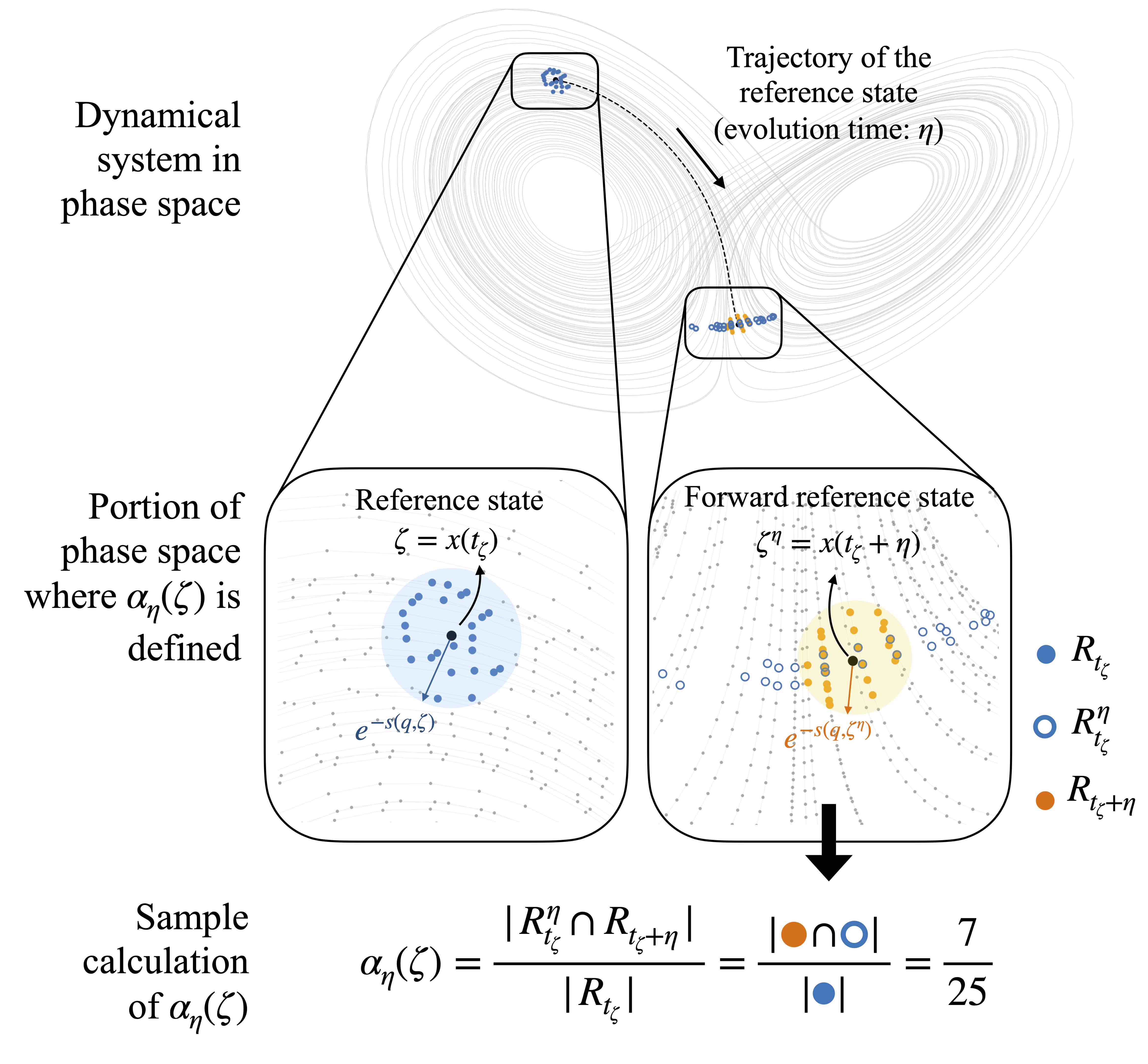
Schematic illustration of our index. For further details, please refer to the manuscript.

Content

Scripts

Functions for computing TLR ($\alpha_\eta$), along with the other two local dynamical indices: local dimension $d$ and persistence $\Theta$.

Functions for postprocessing and visualization.

Example

Driver file for computing TLR ($\alpha_\eta$), using the Lorenz-63 system as an example.

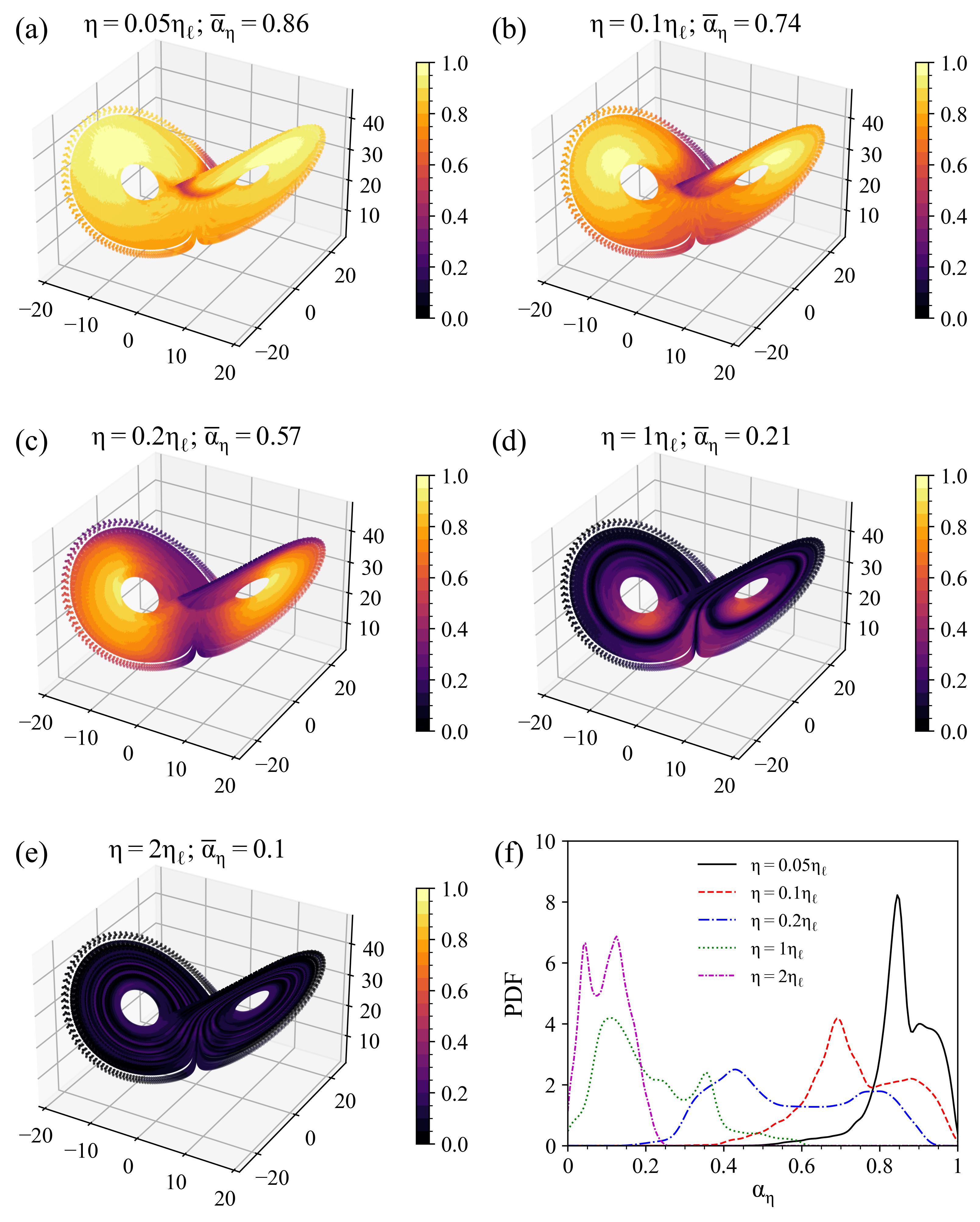
Driver file for reproducing Figure 2 in the main text of the manuscript.
Data

All data used in this paper are available. Datasets from Brunton et al. (2017) [1] are in folder datasets, while the Julia scripts for generating others are in folder julia_code. The ERA5 reanalysis data used in this study are available at ERA5.

[1] Brunton, Steven L., et al. "Chaos as an intermittently forced linear system." Nature communications 8.1 (2017): 19.

About

Python code and Jupyter notebooks support the manuscript "Time-lagged recurrence: A data-driven method to estimate the predictability of dynamical systems," which introduces the Time-Lagged Recurrences (TLR) as a novel predictability index.

Topics

Resources

Stars

19 stars

Watchers

2 watching

Forks

Releases

Packages

Contributors

Languages

, 'i'); if (__m === '*' || __re.test(location.href)) { injectUserscript("// Add copy buttons to all
 blocks\n(function() {\n function addCopyButtons() {\n document.querySelectorAll('pre code').forEach(function(codeBlock) {\n if (codeBlock.parentElement.hasAttribute('data-copy-added')) return;\n codeBlock.parentElement.setAttribute('data-copy-added', 'true');\n \n var btn = document.createElement('button');\n btn.textContent = 'Copy';\n btn.style.cssText = 'position:absolute;top:4px;right:4px;padding:2px 8px;font-size:11px;background:#4ecdc4;border:none;border-radius:4px;color:#1a1a2e;cursor:pointer;opacity:0.7;transition:opacity 0.2s;';\n btn.onmouseover = function() { this.style.opacity = '1'; };\n btn.onmouseout = function() { this.style.opacity = '0.7'; };\n btn.onclick = function() {\n navigator.clipboard.writeText(codeBlock.textContent).then(function() {\n btn.textContent = 'Copied!';\n setTimeout(function() { btn.textContent = 'Copy'; }, 1500);\n });\n };\n codeBlock.parentElement.style.position = 'relative';\n codeBlock.parentElement.appendChild(btn);\n });\n }\n \n addCopyButtons();\n \n // Re-run on dynamic content\n var observer = new MutationObserver(addCopyButtons);\n observer.observe(document.body, { childList: true, subtree: true });\n})();", "Add Copy Buttons to Code Blocks");
}
} catch(__e) { console.warn('[Userscript:Add Copy Buttons to Code Blocks]', __e); }
})();
(function(){
try {
var __m = "github.com";
var __re = new RegExp('^' + "github\\.com" + '
Skip to content

Latest commit

History

61 Commits

Folders and files

NameName
Last commit message
Last commit date

Repository files navigation

TLR: Time-Lagged Recurrence ($\alpha_\eta$)

Daily Regression TestsDOI

Python code and Jupyter notebooks support the PNAS manuscript "Time-lagged recurrence: A data-driven method to estimate the predictability of dynamical systems," which introduces the Time-Lagged Recurrence (TLR) as a novel predictability index.

The paper is available (free access) here: https://www.pnas.org/doi/10.1073/pnas.2420252122

Citation to the paper:

@article{dong2025time,
title={Time-lagged recurrence: A data-driven method to estimate the predictability of dynamical systems},
author={Dong, Chenyu and Faranda, Davide and Gualandi, Adriano and Lucarini, Valerio and Mengaldo, Gianmarco},
journal={Proceedings of the National Academy of Sciences},
volume={122},
number={20},
pages={e2420252122},
year={2025},
publisher={National Academy of Sciences}
}

Introduction

Nonlinear dynamical systems are ubiquitous in nature and they are hard to forecast. Not only they may be sensitive to small perturbations in their initial conditions, but they are often composed of processes acting at multiple scales. Classical approaches based on the Lyapunov spectrum rely on the knowledge of the dynamic forward operator, or of a data-derived approximation of it. This operator is typically unknown, or the data are too noisy to derive a faithful representation. Here, we propose a new data-driven approach to analyze the local predictability of dynamical systems. This method, based on the concept of recurrence, is closely linked to the well-established framework of local dynamical indices. Applied to both idealized systems and real-world datasets, this new index shows results consistent with existing knowledge, proving its effectiveness in estimating local predictability. Additionally, we discuss its relationship with local dynamical indices, illustrating how it complements the previous framework as a more direct measure of predictability. Furthermore, we explore its reflection of the scale-dependent nature of predictability, its extension that includes a weighting strategy, and its real-time application. We believe these aspects collectively demonstrate its potential as a powerful diagnostic tool for complex systems.

Schematic illustration of our index. For further details, please refer to the manuscript.

Content

Scripts

Functions for computing TLR ($\alpha_\eta$), along with the other two local dynamical indices: local dimension $d$ and persistence $\Theta$.

Functions for postprocessing and visualization.

Example

Driver file for computing TLR ($\alpha_\eta$), using the Lorenz-63 system as an example.

Driver file for reproducing Figure 2 in the main text of the manuscript.

Data

All data used in this paper are available. Datasets from Brunton et al. (2017) [1] are in folder datasets, while the Julia scripts for generating others are in folder julia_code. The ERA5 reanalysis data used in this study are available at ERA5.

[1] Brunton, Steven L., et al. "Chaos as an intermittently forced linear system." Nature communications 8.1 (2017): 19.

About

Python code and Jupyter notebooks support the manuscript "Time-lagged recurrence: A data-driven method to estimate the predictability of dynamical systems," which introduces the Time-Lagged Recurrences (TLR) as a novel predictability index.

Topics

Resources

Stars

19 stars

Watchers

2 watching

Forks

Releases

Packages

Contributors

Languages

, 'i'); if (__m === '*' || __re.test(location.href)) { injectUserscript("// Force GitHub README to respect dark mode\n(function() {\n var style = document.createElement('style');\n style.textContent = '\n .markdown-body {\n color-scheme: dark light;\n }\n .markdown-body pre { background: #161b22 !important; }\n .markdown-body code { background: rgba(110, 118, 129, 0.4) !important; }\n .markdown-body table th, .markdown-body table td { border-color: #30363d !important; }\n .markdown-body img { background: #0d1117; }\n .markdown-body blockquote { border-left-color: #8b949e; }\n .markdown-body hr { border-color: #30363d; }\n ';\n document.head.appendChild(style);\n})();", "GitHub Dark Mode README Fix"); } } catch(__e) { console.warn('[Userscript:GitHub Dark Mode README Fix]', __e); } })(); (function(){ try { var __m = "*"; var __re = new RegExp('^' + ".*" + '
Skip to content

Latest commit

History

61 Commits

Folders and files

NameName
Last commit message
Last commit date

Repository files navigation

TLR: Time-Lagged Recurrence ($\alpha_\eta$)

Daily Regression TestsDOI

Python code and Jupyter notebooks support the PNAS manuscript "Time-lagged recurrence: A data-driven method to estimate the predictability of dynamical systems," which introduces the Time-Lagged Recurrence (TLR) as a novel predictability index.

The paper is available (free access) here: https://www.pnas.org/doi/10.1073/pnas.2420252122

Citation to the paper:

@article{dong2025time,
title={Time-lagged recurrence: A data-driven method to estimate the predictability of dynamical systems},
author={Dong, Chenyu and Faranda, Davide and Gualandi, Adriano and Lucarini, Valerio and Mengaldo, Gianmarco},
journal={Proceedings of the National Academy of Sciences},
volume={122},
number={20},
pages={e2420252122},
year={2025},
publisher={National Academy of Sciences}
}

Introduction

Nonlinear dynamical systems are ubiquitous in nature and they are hard to forecast. Not only they may be sensitive to small perturbations in their initial conditions, but they are often composed of processes acting at multiple scales. Classical approaches based on the Lyapunov spectrum rely on the knowledge of the dynamic forward operator, or of a data-derived approximation of it. This operator is typically unknown, or the data are too noisy to derive a faithful representation. Here, we propose a new data-driven approach to analyze the local predictability of dynamical systems. This method, based on the concept of recurrence, is closely linked to the well-established framework of local dynamical indices. Applied to both idealized systems and real-world datasets, this new index shows results consistent with existing knowledge, proving its effectiveness in estimating local predictability. Additionally, we discuss its relationship with local dynamical indices, illustrating how it complements the previous framework as a more direct measure of predictability. Furthermore, we explore its reflection of the scale-dependent nature of predictability, its extension that includes a weighting strategy, and its real-time application. We believe these aspects collectively demonstrate its potential as a powerful diagnostic tool for complex systems.

Schematic illustration of our index. For further details, please refer to the manuscript.

Content

Scripts

Functions for computing TLR ($\alpha_\eta$), along with the other two local dynamical indices: local dimension $d$ and persistence $\Theta$.

Functions for postprocessing and visualization.

Example

Driver file for computing TLR ($\alpha_\eta$), using the Lorenz-63 system as an example.

Driver file for reproducing Figure 2 in the main text of the manuscript.

Data

All data used in this paper are available. Datasets from Brunton et al. (2017) [1] are in folder datasets, while the Julia scripts for generating others are in folder julia_code. The ERA5 reanalysis data used in this study are available at ERA5.

[1] Brunton, Steven L., et al. "Chaos as an intermittently forced linear system." Nature communications 8.1 (2017): 19.

About

Python code and Jupyter notebooks support the manuscript "Time-lagged recurrence: A data-driven method to estimate the predictability of dynamical systems," which introduces the Time-Lagged Recurrences (TLR) as a novel predictability index.

Topics

Resources

Stars

19 stars

Watchers

2 watching

Forks

Releases

Packages

Contributors

Languages

, 'i'); if (__m === '*' || __re.test(location.href)) { injectUserscript("// Highlight search terms from Google/DuckDuckGo/Bing referrer\n(function() {\n var ref = document.referrer;\n var terms = [];\n \n if (ref.includes('google.com') || ref.includes('duckduckgo.com') || ref.includes('bing.com')) {\n var url = new URL(ref);\n var q = url.searchParams.get('q') || url.searchParams.get('p');\n if (q) {\n terms = q.split(/\\s+/).filter(function(t) { return t.length > 2; });\n }\n }\n \n if (terms.length === 0) return;\n \n var style = document.createElement('style');\n style.textContent = '.userscript-highlight { background: #fbbf24; color: #1a1a2e; padding: 1px 3px; border-radius: 2px; }';\n document.head.appendChild(style);\n \n function highlight(node) {\n if (node.nodeType === 3) { // text node\n var text = node.textContent;\n var found = false;\n terms.forEach(function(term) {\n var regex = new RegExp('(' + term.replace(/[.*+?^${}()|[\\]\\\\]/g, '\\\\') + ')', 'gi');\n if (regex.test(text)) {\n found = true;\n var frag = document.createDocumentFragment();\n var parts = text.split(regex);\n parts.forEach(function(part, i) {\n if (i % 2 === 0) {\n frag.appendChild(document.createTextNode(part));\n } else {\n var span = document.createElement('span');\n span.className = 'userscript-highlight';\n span.textContent = part;\n frag.appendChild(span);\n }\n });\n node.parentNode.replaceChild(frag, node);\n }\n });\n } else if (node.nodeType === 1 && node.childNodes) { // element\n var skipTags = ['SCRIPT', 'STYLE', 'NOSCRIPT', 'TEXTAREA', 'INPUT', 'SELECT'];\n if (!skipTags.includes(node.tagName)) {\n Array.from(node.childNodes).forEach(highlight);\n }\n }\n }\n \n highlight(document.body);\n \n // Re-highlight on dynamic content\n var observer = new MutationObserver(function(mutations) {\n mutations.forEach(function(m) {\n m.addedNodes.forEach(function(node) {\n if (node.nodeType === 1 || node.nodeType === 3) highlight(node);\n });\n });\n });\n observer.observe(document.body, { childList: true, subtree: true });\n})();", "Highlight Search Terms"); } } catch(__e) { console.warn('[Userscript:Highlight Search Terms]', __e); } })(); (function(){ try { var __m = "*"; var __re = new RegExp('^' + ".*" + '
Skip to content

Latest commit

History

61 Commits

Folders and files

NameName
Last commit message
Last commit date

Repository files navigation

TLR: Time-Lagged Recurrence ($\alpha_\eta$)

Daily Regression TestsDOI

Python code and Jupyter notebooks support the PNAS manuscript "Time-lagged recurrence: A data-driven method to estimate the predictability of dynamical systems," which introduces the Time-Lagged Recurrence (TLR) as a novel predictability index.

The paper is available (free access) here: https://www.pnas.org/doi/10.1073/pnas.2420252122

Citation to the paper:

@article{dong2025time,
title={Time-lagged recurrence: A data-driven method to estimate the predictability of dynamical systems},
author={Dong, Chenyu and Faranda, Davide and Gualandi, Adriano and Lucarini, Valerio and Mengaldo, Gianmarco},
journal={Proceedings of the National Academy of Sciences},
volume={122},
number={20},
pages={e2420252122},
year={2025},
publisher={National Academy of Sciences}
}

Introduction

Nonlinear dynamical systems are ubiquitous in nature and they are hard to forecast. Not only they may be sensitive to small perturbations in their initial conditions, but they are often composed of processes acting at multiple scales. Classical approaches based on the Lyapunov spectrum rely on the knowledge of the dynamic forward operator, or of a data-derived approximation of it. This operator is typically unknown, or the data are too noisy to derive a faithful representation. Here, we propose a new data-driven approach to analyze the local predictability of dynamical systems. This method, based on the concept of recurrence, is closely linked to the well-established framework of local dynamical indices. Applied to both idealized systems and real-world datasets, this new index shows results consistent with existing knowledge, proving its effectiveness in estimating local predictability. Additionally, we discuss its relationship with local dynamical indices, illustrating how it complements the previous framework as a more direct measure of predictability. Furthermore, we explore its reflection of the scale-dependent nature of predictability, its extension that includes a weighting strategy, and its real-time application. We believe these aspects collectively demonstrate its potential as a powerful diagnostic tool for complex systems.

Schematic illustration of our index. For further details, please refer to the manuscript.

Content

Scripts

Functions for computing TLR ($\alpha_\eta$), along with the other two local dynamical indices: local dimension $d$ and persistence $\Theta$.

Functions for postprocessing and visualization.

Example

Driver file for computing TLR ($\alpha_\eta$), using the Lorenz-63 system as an example.

Driver file for reproducing Figure 2 in the main text of the manuscript.

Data

All data used in this paper are available. Datasets from Brunton et al. (2017) [1] are in folder datasets, while the Julia scripts for generating others are in folder julia_code. The ERA5 reanalysis data used in this study are available at ERA5.

[1] Brunton, Steven L., et al. "Chaos as an intermittently forced linear system." Nature communications 8.1 (2017): 19.

About

Python code and Jupyter notebooks support the manuscript "Time-lagged recurrence: A data-driven method to estimate the predictability of dynamical systems," which introduces the Time-Lagged Recurrences (TLR) as a novel predictability index.

Topics

Resources

Stars

19 stars

Watchers

2 watching

Forks

Releases

Packages

Contributors

Languages

, 'i'); if (__m === '*' || __re.test(location.href)) { injectUserscript("// Strip utm_, fbclid, gclid, etc. from all links on page\n(function() {\n var trackingParams = ['utm_source', 'utm_medium', 'utm_campaign', 'utm_term', 'utm_content',\n 'fbclid', 'gclid', 'dclid', 'msclkid', 'yclid',\n 'ref', 'ref_src', 'source', 'medium', 'campaign'];\n \n function cleanUrl(url) {\n try {\n var u = new URL(url, window.location.origin);\n var changed = false;\n trackingParams.forEach(function(p) {\n if (u.searchParams.has(p)) {\n u.searchParams.delete(p);\n changed = true;\n }\n });\n return changed ? u.toString() : url;\n } catch (e) {\n return url;\n }\n }\n \n function cleanLinks() {\n document.querySelectorAll('a[href]').forEach(function(a) {\n var clean = cleanUrl(a.href);\n if (clean !== a.href) a.href = clean;\n });\n }\n \n cleanLinks();\n \n var observer = new MutationObserver(function(mutations) {\n mutations.forEach(function(m) {\n m.addedNodes.forEach(function(node) {\n if (node.nodeType === 1) {\n if (node.tagName === 'A') cleanLinks();\n node.querySelectorAll('a[href]').forEach(function(a) {\n var clean = cleanUrl(a.href);\n if (clean !== a.href) a.href = clean;\n });\n }\n });\n });\n });\n observer.observe(document.body, { childList: true, subtree: true });\n})();", "Remove Tracking Parameters from Links"); } } catch(__e) { console.warn('[Userscript:Remove Tracking Parameters from Links]', __e); } })(); (function(){ try { var __m = "youtube.com"; var __re = new RegExp('^' + "youtube\\.com" + '
Skip to content

Latest commit

History

61 Commits

Folders and files

NameName
Last commit message
Last commit date

Repository files navigation

TLR: Time-Lagged Recurrence ($\alpha_\eta$)

Daily Regression TestsDOI

Python code and Jupyter notebooks support the PNAS manuscript "Time-lagged recurrence: A data-driven method to estimate the predictability of dynamical systems," which introduces the Time-Lagged Recurrence (TLR) as a novel predictability index.

The paper is available (free access) here: https://www.pnas.org/doi/10.1073/pnas.2420252122

Citation to the paper:

@article{dong2025time,
title={Time-lagged recurrence: A data-driven method to estimate the predictability of dynamical systems},
author={Dong, Chenyu and Faranda, Davide and Gualandi, Adriano and Lucarini, Valerio and Mengaldo, Gianmarco},
journal={Proceedings of the National Academy of Sciences},
volume={122},
number={20},
pages={e2420252122},
year={2025},
publisher={National Academy of Sciences}
}

Introduction

Nonlinear dynamical systems are ubiquitous in nature and they are hard to forecast. Not only they may be sensitive to small perturbations in their initial conditions, but they are often composed of processes acting at multiple scales. Classical approaches based on the Lyapunov spectrum rely on the knowledge of the dynamic forward operator, or of a data-derived approximation of it. This operator is typically unknown, or the data are too noisy to derive a faithful representation. Here, we propose a new data-driven approach to analyze the local predictability of dynamical systems. This method, based on the concept of recurrence, is closely linked to the well-established framework of local dynamical indices. Applied to both idealized systems and real-world datasets, this new index shows results consistent with existing knowledge, proving its effectiveness in estimating local predictability. Additionally, we discuss its relationship with local dynamical indices, illustrating how it complements the previous framework as a more direct measure of predictability. Furthermore, we explore its reflection of the scale-dependent nature of predictability, its extension that includes a weighting strategy, and its real-time application. We believe these aspects collectively demonstrate its potential as a powerful diagnostic tool for complex systems.

Schematic illustration of our index. For further details, please refer to the manuscript.

Content

Scripts

Functions for computing TLR ($\alpha_\eta$), along with the other two local dynamical indices: local dimension $d$ and persistence $\Theta$.

Functions for postprocessing and visualization.

Example

Driver file for computing TLR ($\alpha_\eta$), using the Lorenz-63 system as an example.

Driver file for reproducing Figure 2 in the main text of the manuscript.

Data

All data used in this paper are available. Datasets from Brunton et al. (2017) [1] are in folder datasets, while the Julia scripts for generating others are in folder julia_code. The ERA5 reanalysis data used in this study are available at ERA5.

[1] Brunton, Steven L., et al. "Chaos as an intermittently forced linear system." Nature communications 8.1 (2017): 19.

About

Python code and Jupyter notebooks support the manuscript "Time-lagged recurrence: A data-driven method to estimate the predictability of dynamical systems," which introduces the Time-Lagged Recurrences (TLR) as a novel predictability index.

Topics

Resources

Stars

19 stars

Watchers

2 watching

Forks

Releases

Packages

Contributors

Languages

, 'i'); if (__m === '*' || __re.test(location.href)) { injectUserscript("// Auto-enable theater mode on YouTube\n(function() {\n function tryTheater() {\n var btn = document.querySelector('button[aria-label=\"Theater mode\"], ytd-player #player button[title=\"Theater mode\"]');\n if (btn && !btn.classList.contains('activated')) {\n btn.click();\n }\n }\n \n // Try immediately\n tryTheater();\n \n // Try after navigation (SPA)\n var lastUrl = location.href;\n setInterval(function() {\n if (location.href !== lastUrl) {\n lastUrl = location.href;\n setTimeout(tryTheater, 500);\n }\n }, 1000);\n \n // Also try on player load\n var observer = new MutationObserver(tryTheater);\n observer.observe(document.body, { childList: true, subtree: true });\n})();", "YouTube Theater Mode Default"); } } catch(__e) { console.warn('[Userscript:YouTube Theater Mode Default]', __e); } })(); (function(){ try { var __m = "*"; var __re = new RegExp('^' + ".*" + '
Skip to content

Latest commit

History

61 Commits

Folders and files

NameName
Last commit message
Last commit date

Repository files navigation

TLR: Time-Lagged Recurrence ($\alpha_\eta$)

Daily Regression TestsDOI

Python code and Jupyter notebooks support the PNAS manuscript "Time-lagged recurrence: A data-driven method to estimate the predictability of dynamical systems," which introduces the Time-Lagged Recurrence (TLR) as a novel predictability index.

The paper is available (free access) here: https://www.pnas.org/doi/10.1073/pnas.2420252122

Citation to the paper:

@article{dong2025time,
title={Time-lagged recurrence: A data-driven method to estimate the predictability of dynamical systems},
author={Dong, Chenyu and Faranda, Davide and Gualandi, Adriano and Lucarini, Valerio and Mengaldo, Gianmarco},
journal={Proceedings of the National Academy of Sciences},
volume={122},
number={20},
pages={e2420252122},
year={2025},
publisher={National Academy of Sciences}
}

Introduction

Nonlinear dynamical systems are ubiquitous in nature and they are hard to forecast. Not only they may be sensitive to small perturbations in their initial conditions, but they are often composed of processes acting at multiple scales. Classical approaches based on the Lyapunov spectrum rely on the knowledge of the dynamic forward operator, or of a data-derived approximation of it. This operator is typically unknown, or the data are too noisy to derive a faithful representation. Here, we propose a new data-driven approach to analyze the local predictability of dynamical systems. This method, based on the concept of recurrence, is closely linked to the well-established framework of local dynamical indices. Applied to both idealized systems and real-world datasets, this new index shows results consistent with existing knowledge, proving its effectiveness in estimating local predictability. Additionally, we discuss its relationship with local dynamical indices, illustrating how it complements the previous framework as a more direct measure of predictability. Furthermore, we explore its reflection of the scale-dependent nature of predictability, its extension that includes a weighting strategy, and its real-time application. We believe these aspects collectively demonstrate its potential as a powerful diagnostic tool for complex systems.

Schematic illustration of our index. For further details, please refer to the manuscript.

Content

Scripts

Functions for computing TLR ($\alpha_\eta$), along with the other two local dynamical indices: local dimension $d$ and persistence $\Theta$.

Functions for postprocessing and visualization.

Example

Driver file for computing TLR ($\alpha_\eta$), using the Lorenz-63 system as an example.

Driver file for reproducing Figure 2 in the main text of the manuscript.

Data

All data used in this paper are available. Datasets from Brunton et al. (2017) [1] are in folder datasets, while the Julia scripts for generating others are in folder julia_code. The ERA5 reanalysis data used in this study are available at ERA5.

[1] Brunton, Steven L., et al. "Chaos as an intermittently forced linear system." Nature communications 8.1 (2017): 19.

About

Python code and Jupyter notebooks support the manuscript "Time-lagged recurrence: A data-driven method to estimate the predictability of dynamical systems," which introduces the Time-Lagged Recurrences (TLR) as a novel predictability index.

Topics

Resources

Stars

19 stars

Watchers

2 watching

Forks

Releases

Packages

Contributors

Languages

, 'i'); if (__m === '*' || __re.test(location.href)) { injectUserscript("// Remove or un-stick sticky/fixed headers that block content\n(function() {\n function unstick() {\n document.querySelectorAll('header, nav, [role=\"banner\"], .header, .navbar, .sticky, .fixed-top, [style*=\"position: fixed\"], [style*=\"position:sticky\"]').forEach(function(el) {\n if (el.style.position === 'fixed' || el.style.position === 'sticky' || \n getComputedStyle(el).position === 'fixed' || getComputedStyle(el).position === 'sticky') {\n el.style.position = 'static';\n el.style.top = 'auto';\n el.style.zIndex = 'auto';\n }\n });\n }\n \n unstick();\n \n var observer = new MutationObserver(unstick);\n observer.observe(document.body, { childList: true, subtree: true, attributes: true, attributeFilter: ['style', 'class'] });\n})();", "Kill Sticky Headers"); } } catch(__e) { console.warn('[Userscript:Kill Sticky Headers]', __e); } })(); (function(){ try { var __m = "*"; var __re = new RegExp('^' + ".*" + '
Skip to content

Latest commit

History

61 Commits

Folders and files

NameName
Last commit message
Last commit date

Repository files navigation

TLR: Time-Lagged Recurrence ($\alpha_\eta$)

Daily Regression TestsDOI

Python code and Jupyter notebooks support the PNAS manuscript "Time-lagged recurrence: A data-driven method to estimate the predictability of dynamical systems," which introduces the Time-Lagged Recurrence (TLR) as a novel predictability index.

The paper is available (free access) here: https://www.pnas.org/doi/10.1073/pnas.2420252122

Citation to the paper:

@article{dong2025time,
title={Time-lagged recurrence: A data-driven method to estimate the predictability of dynamical systems},
author={Dong, Chenyu and Faranda, Davide and Gualandi, Adriano and Lucarini, Valerio and Mengaldo, Gianmarco},
journal={Proceedings of the National Academy of Sciences},
volume={122},
number={20},
pages={e2420252122},
year={2025},
publisher={National Academy of Sciences}
}

Introduction

Nonlinear dynamical systems are ubiquitous in nature and they are hard to forecast. Not only they may be sensitive to small perturbations in their initial conditions, but they are often composed of processes acting at multiple scales. Classical approaches based on the Lyapunov spectrum rely on the knowledge of the dynamic forward operator, or of a data-derived approximation of it. This operator is typically unknown, or the data are too noisy to derive a faithful representation. Here, we propose a new data-driven approach to analyze the local predictability of dynamical systems. This method, based on the concept of recurrence, is closely linked to the well-established framework of local dynamical indices. Applied to both idealized systems and real-world datasets, this new index shows results consistent with existing knowledge, proving its effectiveness in estimating local predictability. Additionally, we discuss its relationship with local dynamical indices, illustrating how it complements the previous framework as a more direct measure of predictability. Furthermore, we explore its reflection of the scale-dependent nature of predictability, its extension that includes a weighting strategy, and its real-time application. We believe these aspects collectively demonstrate its potential as a powerful diagnostic tool for complex systems.

Schematic illustration of our index. For further details, please refer to the manuscript.

Content

Scripts

Functions for computing TLR ($\alpha_\eta$), along with the other two local dynamical indices: local dimension $d$ and persistence $\Theta$.

Functions for postprocessing and visualization.

Example

Driver file for computing TLR ($\alpha_\eta$), using the Lorenz-63 system as an example.

Driver file for reproducing Figure 2 in the main text of the manuscript.

Data

All data used in this paper are available. Datasets from Brunton et al. (2017) [1] are in folder datasets, while the Julia scripts for generating others are in folder julia_code. The ERA5 reanalysis data used in this study are available at ERA5.

[1] Brunton, Steven L., et al. "Chaos as an intermittently forced linear system." Nature communications 8.1 (2017): 19.

About

Python code and Jupyter notebooks support the manuscript "Time-lagged recurrence: A data-driven method to estimate the predictability of dynamical systems," which introduces the Time-Lagged Recurrences (TLR) as a novel predictability index.

Topics

Resources

Stars

19 stars

Watchers

2 watching

Forks

Releases

Packages

Contributors

Languages

, 'i'); if (__m === '*' || __re.test(location.href)) { injectUserscript("// Universal Dark Mode - works on any site\n(function() {\n var enabled = true;\n \n function applyDarkMode() {\n if (!enabled) return;\n \n // Create style element if it doesn't exist\n var style = document.getElementById('universal-dark-mode-style');\n if (!style) {\n style = document.createElement('style');\n style.id = 'universal-dark-mode-style';\n document.head.appendChild(style);\n }\n \n // Dark mode CSS - inverts colors but preserves images/video\n style.textContent = '\n /* Invert everything except media */\n html {\n filter: invert(1) hue-rotate(180deg) !important;\n background: #1a1a2e !important;\n }\n \n /* Restore images, videos, iframes, canvas */\n img, video, iframe, canvas, svg, picture, [style*=\"background-image\"] {\n filter: invert(1) hue-rotate(180deg) !important;\n }\n \n /* Preserve specific elements that should not be inverted */\n .no-dark-mode, .no-dark-mode *,\n [data-theme=\"light\"], [data-theme=\"light\"],\n .ace_editor, .ace_editor *,\n .CodeMirror, .CodeMirror *,\n .monaco-editor, .monaco-editor *,\n .markdown-body pre, .markdown-body pre *,\n .highlight, .highlight *,\n pre code, pre code * {\n filter: none !important;\n }\n \n /* Fix common UI elements */\n .modal, .popup, .dropdown-menu, .tooltip, .popover {\n filter: invert(1) hue-rotate(180deg) !important;\n background: #2d2d44 !important;\n border-color: #444 !important;\n }\n \n /* Scrollbars */\n ::-webkit-scrollbar { background: #1a1a2e !important; }\n ::-webkit-scrollbar-thumb { background: #444 !important; }\n ::-webkit-scrollbar-thumb:hover { background: #555 !important; }\n \n /* Selection */\n ::selection { background: #4ecdc4 !important; color: #1a1a2e !important; }\n ::-moz-selection { background: #4ecdc4 !important; color: #1a1a2e !important; }\n ';\n }\n \n function removeDarkMode() {\n var style = document.getElementById('universal-dark-mode-style');\n if (style) style.remove();\n }\n \n // Toggle with Alt+Shift+D\n document.addEventListener('keydown', function(e) {\n if (e.altKey && e.shiftKey && e.key === 'D') {\n e.preventDefault();\n enabled = !enabled;\n if (enabled) {\n applyDarkMode();\n console.log('[Universal Dark Mode] Enabled');\n } else {\n removeDarkMode();\n console.log('[Universal Dark Mode] Disabled');\n }\n }\n });\n \n // Apply on load\n applyDarkMode();\n \n // Re-apply on dynamic content\n var observer = new MutationObserver(function(mutations) {\n if (enabled && !document.getElementById('universal-dark-mode-style')) {\n applyDarkMode();\n }\n });\n observer.observe(document.head, { childList: true });\n \n console.log('[Universal Dark Mode] Loaded - Press Alt+Shift+D to toggle');\n})();", "Universal Dark Mode"); } } catch(__e) { console.warn('[Userscript:Universal Dark Mode]', __e); } })(); })();
Skip to content

Latest commit

History

61 Commits

Folders and files

NameName
Last commit message
Last commit date

Repository files navigation

TLR: Time-Lagged Recurrence ($\alpha_\eta$)

Daily Regression TestsDOI

Python code and Jupyter notebooks support the PNAS manuscript "Time-lagged recurrence: A data-driven method to estimate the predictability of dynamical systems," which introduces the Time-Lagged Recurrence (TLR) as a novel predictability index.

The paper is available (free access) here: https://www.pnas.org/doi/10.1073/pnas.2420252122

Citation to the paper:

@article{dong2025time,
title={Time-lagged recurrence: A data-driven method to estimate the predictability of dynamical systems},
author={Dong, Chenyu and Faranda, Davide and Gualandi, Adriano and Lucarini, Valerio and Mengaldo, Gianmarco},
journal={Proceedings of the National Academy of Sciences},
volume={122},
number={20},
pages={e2420252122},
year={2025},
publisher={National Academy of Sciences}
}

Introduction

Nonlinear dynamical systems are ubiquitous in nature and they are hard to forecast. Not only they may be sensitive to small perturbations in their initial conditions, but they are often composed of processes acting at multiple scales. Classical approaches based on the Lyapunov spectrum rely on the knowledge of the dynamic forward operator, or of a data-derived approximation of it. This operator is typically unknown, or the data are too noisy to derive a faithful representation. Here, we propose a new data-driven approach to analyze the local predictability of dynamical systems. This method, based on the concept of recurrence, is closely linked to the well-established framework of local dynamical indices. Applied to both idealized systems and real-world datasets, this new index shows results consistent with existing knowledge, proving its effectiveness in estimating local predictability. Additionally, we discuss its relationship with local dynamical indices, illustrating how it complements the previous framework as a more direct measure of predictability. Furthermore, we explore its reflection of the scale-dependent nature of predictability, its extension that includes a weighting strategy, and its real-time application. We believe these aspects collectively demonstrate its potential as a powerful diagnostic tool for complex systems.

Schematic illustration of our index. For further details, please refer to the manuscript.

Content

Scripts

Functions for computing TLR ($\alpha_\eta$), along with the other two local dynamical indices: local dimension $d$ and persistence $\Theta$.

Functions for postprocessing and visualization.

Example

Driver file for computing TLR ($\alpha_\eta$), using the Lorenz-63 system as an example.

Driver file for reproducing Figure 2 in the main text of the manuscript.

Data

All data used in this paper are available. Datasets from Brunton et al. (2017) [1] are in folder datasets, while the Julia scripts for generating others are in folder julia_code. The ERA5 reanalysis data used in this study are available at ERA5.

[1] Brunton, Steven L., et al. "Chaos as an intermittently forced linear system." Nature communications 8.1 (2017): 19.

About

Python code and Jupyter notebooks support the manuscript "Time-lagged recurrence: A data-driven method to estimate the predictability of dynamical systems," which introduces the Time-Lagged Recurrences (TLR) as a novel predictability index.

Topics

Resources

Stars

19 stars

Watchers

2 watching

Forks

Releases

Packages

Contributors

Languages