Grounded execution. Long horizons.
Metis is a Codex skill for keeping difficult work tied to the original request, a current plan, and evidence of completion. Use it for one agent working through many context resets, or for managers coordinating parallel work under a director.
 · MIT · Codex skill · Standalone HTML · Early release

Get started · How it works · Dashboard · Pandora · Future executives
Long-running agents can lose the objective, follow stale plans, or keep polishing a detail that no longer matters. Metis gives them a written place to recover and explicit points at which to use it.
- Preserve the exact request, derive a concise contract, and work through verifiable phases.
- Reground after compaction, handoffs, changed instructions, stalled progress, and phase boundaries.
- Give each work package one owner. Separate implementation, acceptance, and release.
- Finish with a request audit and a compact archive, not a growing pile of old active plans.
The intended range is a single long-running agent through large workflows of roughly 100 agents across multiple managers reporting to a director. That is a coordination design target, not a benchmark or a guaranteed simultaneous-agent limit. Actual concurrency, cost, tools, and run duration depend on your host and account. Start with the smallest team the dependencies justify.
Metis is an execution protocol, an optional dashboard, and a small validation utility. It is not an agent runtime, background scheduler, or guarantee against drift.
Install this repository as the metis skill folder. Keep SKILL.md, agents/, references/, scripts/, and assets/ together. Review the instructions before installation; don't overwrite an existing customized skill.
You can ask Codex's skill installer:
Install the Metis skill from https://github.com/RedLynx101/Metis
For a manual, project-local installation, clone into .agents/skills/metis inside the project where you want to use it. Codex also supports user-scoped skills; consult the current skill-location guide. Existing installations can keep their working skill location.
Start a fresh session if needed for discovery, then give it real work:
Use $metis to implement this project through evidence-backed phases.
Keep the scope in my request, verify the finished result, and report any blockers.
Automatic selection is also enabled for substantial authorized work. Quick questions and discussion-only planning do not need Metis execution records.
Goals remain explicit in every role. Say “set a goal” or use /goal when you want persistent goal mode. Metis maintains durable files without it. Neither skill activation nor a goal grants permission to publish, spend, delete durable data, or direct other primary tasks.
Request → Contract + active plan → Bounded work → Evidence → Acceptance
↑ │
└──── Reground or replan ────────┘
| Mode | Responsibility |
|---|---|
| Single primary agent | Execute and verify one active plan; audit against both the derived contract and the original request. |
| Director | Director-only by default: assign and steer managers, preserve grounded state, wait for material batches, and accept results. |
| Managers | Own bounded work packages, use permitted internal subagents, test their work, and return evidence to the director. |
The separation is deliberate. Managers benefit from detailed implementation context. The director keeps a smaller coordination context and can redirect stale work, narrow a stalled assignment, or arrange a fresh handoff. Managers mark tested work implemented; the director runs a bounded plan-based acceptance gate before marking it verified. Final integration checks cover what individual phases cannot prove.
After director activation, existing execution and implementation-heavy integration are transferred to named managers with an acknowledgment before the director waits. Hybrid execution requires an explicit bounded exception. Quiet waiting is not failure, and repeated status polling is not progress.
Both modes share work/metis/ for new projects: a recovery map, operating profile,
compact index, active plan, inert queue, and archive. Existing roots and charters
remain valid—no automatic migration. The profile remembers team/model preferences
and autonomy; optional usage policies define drain, stop, and resume boundaries.
Operating decisions and file lifecycle → · Full skill · Conditional director protocol
The optional HTML dashboard opens locally with no server, external fonts, libraries, or network dependency. Download or clone the repository to open it; GitHub displays the HTML source.

One dashboard represents one active plan. Phase widths follow work-item counts; progress fill represents verified criteria. Filter by status or assigned agent, expand evidence, inspect waits, or export the complete JSON snapshot. Primary sessions appear in the team tree; internal subagents are represented only by optional declared budgets, not live telemetry.
Ink appearance and named work-package ownership


These are real browser captures of bundled sample data, not a completed project or a 100-agent run. Image provenance and artwork prompt →
Metis coordinates the work. Pandora keeps multiple projects visible on your Windows desktop.
For a large build, directors can each manage independent plans while their managers execute bounded packages. Each plan connected to Pandora exposes a local snapshot in the same versioned JSON format. Pandora's Projects dock reads those registered snapshots together, so you can see which project needs a decision, which phase is active, and who owns the work without opening every agent conversation.
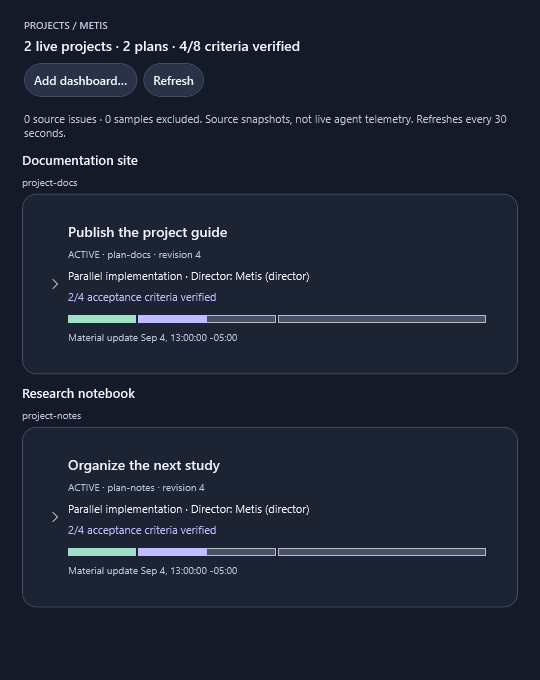
Pandora's image shows actual WPF controls rendered with synthetic content. It is a read-only view: no agent dispatch, approval, plan editing, or live usage measurement. Directors retain authority and source ownership. Plans do not need a shared mutable global file.
Connect your first project → · Machine-readable state contract · JSON Schema
The protocol, dashboard, and Node utility are available now. The optional executive layer above multiple directors is a future design note, not an active role or automatic permission to start queued projects.
Use a supported Node.js LTS release for the optional utility; no package installation is required:
node --test scripts/dashboard.test.mjs
node scripts/dashboard.mjs check assets/progress-dashboard.html
Validation checks structure and consistency, not whether the underlying evidence is true. Protocol review scenarios cover adoption, ownership, waiting, budgets, and compatibility. They are review cases, not proof that every model will follow the protocol; large-team performance has not been benchmarked here.
Created by Noah Hicks. Named for Metis of Greek mythology; the visual identity uses restrained Greco-Deco geometry. Matt Shumer's manager/implementer loop inspired the initial phase-and-handoff model; Metis adds explicit authority, durable recovery, layered verification, and a shared dashboard contract.