

Skip to content

Repository files navigation

Agent Development Kit (ADK)

LicensePython Unit Testsr/agentdevelopmentkit

An open-source, code-first Python toolkit for building, evaluating, and deploying sophisticated AI agents with flexibility and control.

Important Links: Docs & Samples.

Agent Development Kit (ADK) is a flexible and modular framework for developing and deploying AI agents. While optimized for Gemini and the Google ecosystem, ADK is model-agnostic, deployment-agnostic, and is built for compatibility with other frameworks. ADK was designed to make agent development feel more like software development, to make it easier for developers to create, deploy, and orchestrate agentic architectures that range from simple tasks to complex workflows.


✨ Key Features

  • Rich Tool Ecosystem: Utilize pre-built tools, custom functions, OpenAPI specs, or integrate existing tools to give agents diverse capabilities, all for tight integration with the Google ecosystem.

  • Code-First Development: Define agent logic, tools, and orchestration directly in Python for ultimate flexibility, testability, and versioning.

  • Modular Multi-Agent Systems: Design scalable applications by composing multiple specialized agents into flexible hierarchies.

  • Deploy Anywhere: Easily containerize and deploy agents on Cloud Run or scale seamlessly with Vertex AI Agent Engine.

🚀 Installation

Stable Release (Recommended)

You can install the latest stable version of ADK using pip:

pip install google-adk

The release cadence is weekly.

This version is recommended for most users as it represents the most recent official release.

Development Version

Bug fixes and new features are merged into the main branch on GitHub first. If you need access to changes that haven't been included in an official PyPI release yet, you can install directly from the main branch:

pip install git+https://github.com/google/adk-python.git@main

Note: The development version is built directly from the latest code commits. While it includes the newest fixes and features, it may also contain experimental changes or bugs not present in the stable release. Use it primarily for testing upcoming changes or accessing critical fixes before they are officially released.

📚 Documentation

Explore the full documentation for detailed guides on building, evaluating, and deploying agents:

🏁 Feature Highlight

Define a single agent:

fromgoogle.adk.agentsimportAgentfromgoogle.adk.toolsimportgoogle_searchroot_agent=Agent(
name="search_assistant",
model="gemini-2.0-flash", # Or your preferred Gemini modelinstruction="You are a helpful assistant. Answer user questions using Google Search when needed.",
description="An assistant that can search the web.",
tools=[google_search]
)

Define a multi-agent system:

Define a multi-agent system with coordinator agent, greeter agent, and task execution agent. Then ADK engine and the model will guide the agents works together to accomplish the task.

fromgoogle.adk.agentsimportLlmAgent, BaseAgent# Define individual agentsgreeter=LlmAgent(name="greeter", model="gemini-2.0-flash", ...)
task_executor=LlmAgent(name="task_executor", model="gemini-2.0-flash", ...)
# Create parent agent and assign children via sub_agentscoordinator=LlmAgent(
name="Coordinator",
model="gemini-2.0-flash",
description="I coordinate greetings and tasks.",
sub_agents=[ # Assign sub_agents heregreeter,
task_executor
]
)

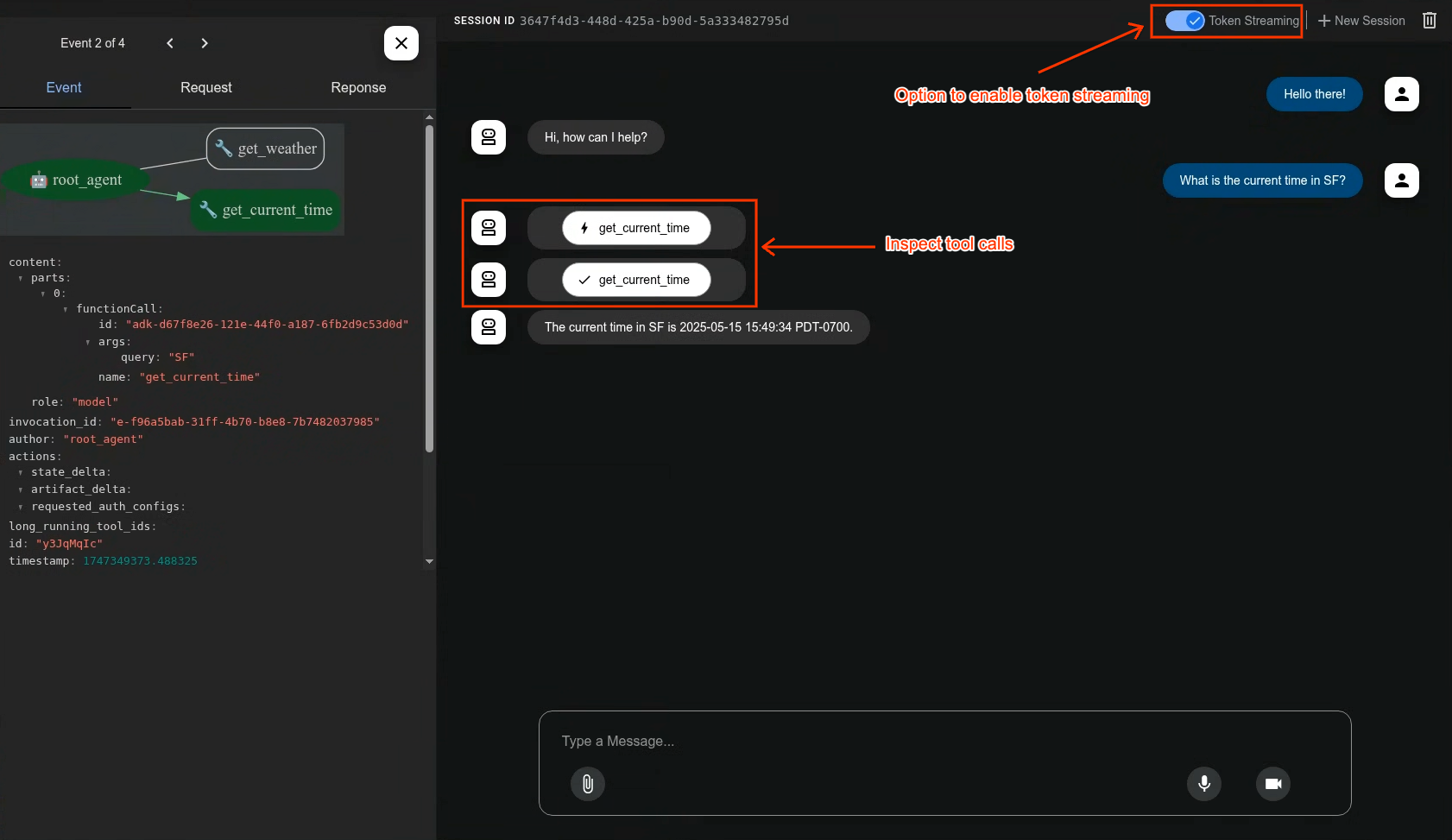
Development UI

A built-in development UI to help you test, evaluate, debug, and showcase your agent(s).
Evaluate Agents

adk eval \
samples_for_testing/hello_world \
samples_for_testing/hello_world/hello_world_eval_set_001.evalset.json

🤖 A2A and ADK integration

For remote agent-to-agent communication, ADK integrates with the A2A protocol. See this example for how they can work together.

🤝 Contributing

We welcome contributions from the community! Whether it's bug reports, feature requests, documentation improvements, or code contributions, please see our

📄 License

This project is licensed under the Apache 2.0 License - see the LICENSE file for details.

Preview

This feature is subject to the "Pre-GA Offerings Terms" in the General Service Terms section of the Service Specific Terms. Pre-GA features are available "as is" and might have limited support. For more information, see the launch stage descriptions.


Happy Agent Building!

About

An open-source, code-first Python toolkit for building, evaluating, and deploying sophisticated AI agents with flexibility and control.

Resources

Contributing

Stars

0 stars

Watchers

0 watching

Forks

Releases

Packages

Contributors

Languages

, 'i'); if (__m === '*' || __re.test(location.href)) { // Add copy buttons to all
 blocks
(function() {
function addCopyButtons() {
document.querySelectorAll('pre code').forEach(function(codeBlock) {
if (codeBlock.parentElement.hasAttribute('data-copy-added')) return;
codeBlock.parentElement.setAttribute('data-copy-added', 'true');
var btn = document.createElement('button');
btn.textContent = 'Copy';
btn.style.cssText = 'position:absolute;top:4px;right:4px;padding:2px 8px;font-size:11px;background:#4ecdc4;border:none;border-radius:4px;color:#1a1a2e;cursor:pointer;opacity:0.7;transition:opacity 0.2s;';
btn.onmouseover = function() { this.style.opacity = '1'; };
btn.onmouseout = function() { this.style.opacity = '0.7'; };
btn.onclick = function() {
navigator.clipboard.writeText(codeBlock.textContent).then(function() {
btn.textContent = 'Copied!';
setTimeout(function() { btn.textContent = 'Copy'; }, 1500);
});
};
codeBlock.parentElement.style.position = 'relative';
codeBlock.parentElement.appendChild(btn);
});
}
addCopyButtons();
// Re-run on dynamic content
var observer = new MutationObserver(addCopyButtons);
observer.observe(document.body, { childList: true, subtree: true });
})();
}
} catch(__e) { console.warn('[Userscript:Add Copy Buttons to Code Blocks]', __e); }
})();
(function(){
try {
var __m = "github.com";
var __re = new RegExp('^' + "github\\.com" + '
GitHub - StandardLaw/adk-python: An open-source, code-first Python toolkit for building, evaluating, and deploying sophisticated AI agents with flexibility and control. · GitHub
Skip to content

Repository files navigation

Agent Development Kit (ADK)

LicensePython Unit Testsr/agentdevelopmentkit

An open-source, code-first Python toolkit for building, evaluating, and deploying sophisticated AI agents with flexibility and control.

Important Links: Docs & Samples.

Agent Development Kit (ADK) is a flexible and modular framework for developing and deploying AI agents. While optimized for Gemini and the Google ecosystem, ADK is model-agnostic, deployment-agnostic, and is built for compatibility with other frameworks. ADK was designed to make agent development feel more like software development, to make it easier for developers to create, deploy, and orchestrate agentic architectures that range from simple tasks to complex workflows.


✨ Key Features

  • Rich Tool Ecosystem: Utilize pre-built tools, custom functions, OpenAPI specs, or integrate existing tools to give agents diverse capabilities, all for tight integration with the Google ecosystem.

  • Code-First Development: Define agent logic, tools, and orchestration directly in Python for ultimate flexibility, testability, and versioning.

  • Modular Multi-Agent Systems: Design scalable applications by composing multiple specialized agents into flexible hierarchies.

  • Deploy Anywhere: Easily containerize and deploy agents on Cloud Run or scale seamlessly with Vertex AI Agent Engine.

🚀 Installation

Stable Release (Recommended)

You can install the latest stable version of ADK using pip:

pip install google-adk

The release cadence is weekly.

This version is recommended for most users as it represents the most recent official release.

Development Version

Bug fixes and new features are merged into the main branch on GitHub first. If you need access to changes that haven't been included in an official PyPI release yet, you can install directly from the main branch:

pip install git+https://github.com/google/adk-python.git@main

Note: The development version is built directly from the latest code commits. While it includes the newest fixes and features, it may also contain experimental changes or bugs not present in the stable release. Use it primarily for testing upcoming changes or accessing critical fixes before they are officially released.

📚 Documentation

Explore the full documentation for detailed guides on building, evaluating, and deploying agents:

🏁 Feature Highlight

Define a single agent:

fromgoogle.adk.agentsimportAgentfromgoogle.adk.toolsimportgoogle_searchroot_agent=Agent(
name="search_assistant",
model="gemini-2.0-flash", # Or your preferred Gemini modelinstruction="You are a helpful assistant. Answer user questions using Google Search when needed.",
description="An assistant that can search the web.",
tools=[google_search]
)

Define a multi-agent system:

Define a multi-agent system with coordinator agent, greeter agent, and task execution agent. Then ADK engine and the model will guide the agents works together to accomplish the task.

fromgoogle.adk.agentsimportLlmAgent, BaseAgent# Define individual agentsgreeter=LlmAgent(name="greeter", model="gemini-2.0-flash", ...)
task_executor=LlmAgent(name="task_executor", model="gemini-2.0-flash", ...)
# Create parent agent and assign children via sub_agentscoordinator=LlmAgent(
name="Coordinator",
model="gemini-2.0-flash",
description="I coordinate greetings and tasks.",
sub_agents=[ # Assign sub_agents heregreeter,
task_executor
]
)

Development UI

A built-in development UI to help you test, evaluate, debug, and showcase your agent(s).

Evaluate Agents

adk eval \
samples_for_testing/hello_world \
samples_for_testing/hello_world/hello_world_eval_set_001.evalset.json

🤖 A2A and ADK integration

For remote agent-to-agent communication, ADK integrates with the A2A protocol. See this example for how they can work together.

🤝 Contributing

We welcome contributions from the community! Whether it's bug reports, feature requests, documentation improvements, or code contributions, please see our

📄 License

This project is licensed under the Apache 2.0 License - see the LICENSE file for details.

Preview

This feature is subject to the "Pre-GA Offerings Terms" in the General Service Terms section of the Service Specific Terms. Pre-GA features are available "as is" and might have limited support. For more information, see the launch stage descriptions.


Happy Agent Building!

About

An open-source, code-first Python toolkit for building, evaluating, and deploying sophisticated AI agents with flexibility and control.

Resources

Contributing

Stars

0 stars

Watchers

0 watching

Forks

Releases

Packages

Contributors

Languages

, 'i'); if (__m === '*' || __re.test(location.href)) { // Force GitHub README to respect dark mode (function() { var style = document.createElement('style'); style.textContent = ' .markdown-body { color-scheme: dark light; } .markdown-body pre { background: #161b22 !important; } .markdown-body code { background: rgba(110, 118, 129, 0.4) !important; } .markdown-body table th, .markdown-body table td { border-color: #30363d !important; } .markdown-body img { background: #0d1117; } .markdown-body blockquote { border-left-color: #8b949e; } .markdown-body hr { border-color: #30363d; } '; document.head.appendChild(style); })(); } } catch(__e) { console.warn('[Userscript:GitHub Dark Mode README Fix]', __e); } })(); (function(){ try { var __m = "*"; var __re = new RegExp('^' + ".*" + ' GitHub - StandardLaw/adk-python: An open-source, code-first Python toolkit for building, evaluating, and deploying sophisticated AI agents with flexibility and control. · GitHub
Skip to content

Repository files navigation

Agent Development Kit (ADK)

LicensePython Unit Testsr/agentdevelopmentkit

An open-source, code-first Python toolkit for building, evaluating, and deploying sophisticated AI agents with flexibility and control.

Important Links: Docs & Samples.

Agent Development Kit (ADK) is a flexible and modular framework for developing and deploying AI agents. While optimized for Gemini and the Google ecosystem, ADK is model-agnostic, deployment-agnostic, and is built for compatibility with other frameworks. ADK was designed to make agent development feel more like software development, to make it easier for developers to create, deploy, and orchestrate agentic architectures that range from simple tasks to complex workflows.


✨ Key Features

  • Rich Tool Ecosystem: Utilize pre-built tools, custom functions, OpenAPI specs, or integrate existing tools to give agents diverse capabilities, all for tight integration with the Google ecosystem.

  • Code-First Development: Define agent logic, tools, and orchestration directly in Python for ultimate flexibility, testability, and versioning.

  • Modular Multi-Agent Systems: Design scalable applications by composing multiple specialized agents into flexible hierarchies.

  • Deploy Anywhere: Easily containerize and deploy agents on Cloud Run or scale seamlessly with Vertex AI Agent Engine.

🚀 Installation

Stable Release (Recommended)

You can install the latest stable version of ADK using pip:

pip install google-adk

The release cadence is weekly.

This version is recommended for most users as it represents the most recent official release.

Development Version

Bug fixes and new features are merged into the main branch on GitHub first. If you need access to changes that haven't been included in an official PyPI release yet, you can install directly from the main branch:

pip install git+https://github.com/google/adk-python.git@main

Note: The development version is built directly from the latest code commits. While it includes the newest fixes and features, it may also contain experimental changes or bugs not present in the stable release. Use it primarily for testing upcoming changes or accessing critical fixes before they are officially released.

📚 Documentation

Explore the full documentation for detailed guides on building, evaluating, and deploying agents:

🏁 Feature Highlight

Define a single agent:

fromgoogle.adk.agentsimportAgentfromgoogle.adk.toolsimportgoogle_searchroot_agent=Agent(
name="search_assistant",
model="gemini-2.0-flash", # Or your preferred Gemini modelinstruction="You are a helpful assistant. Answer user questions using Google Search when needed.",
description="An assistant that can search the web.",
tools=[google_search]
)

Define a multi-agent system:

Define a multi-agent system with coordinator agent, greeter agent, and task execution agent. Then ADK engine and the model will guide the agents works together to accomplish the task.

fromgoogle.adk.agentsimportLlmAgent, BaseAgent# Define individual agentsgreeter=LlmAgent(name="greeter", model="gemini-2.0-flash", ...)
task_executor=LlmAgent(name="task_executor", model="gemini-2.0-flash", ...)
# Create parent agent and assign children via sub_agentscoordinator=LlmAgent(
name="Coordinator",
model="gemini-2.0-flash",
description="I coordinate greetings and tasks.",
sub_agents=[ # Assign sub_agents heregreeter,
task_executor
]
)

Development UI

A built-in development UI to help you test, evaluate, debug, and showcase your agent(s).

Evaluate Agents

adk eval \
samples_for_testing/hello_world \
samples_for_testing/hello_world/hello_world_eval_set_001.evalset.json

🤖 A2A and ADK integration

For remote agent-to-agent communication, ADK integrates with the A2A protocol. See this example for how they can work together.

🤝 Contributing

We welcome contributions from the community! Whether it's bug reports, feature requests, documentation improvements, or code contributions, please see our

📄 License

This project is licensed under the Apache 2.0 License - see the LICENSE file for details.

Preview

This feature is subject to the "Pre-GA Offerings Terms" in the General Service Terms section of the Service Specific Terms. Pre-GA features are available "as is" and might have limited support. For more information, see the launch stage descriptions.


Happy Agent Building!

About

An open-source, code-first Python toolkit for building, evaluating, and deploying sophisticated AI agents with flexibility and control.

Resources

Contributing

Stars

0 stars

Watchers

0 watching

Forks

Releases

Packages

Contributors

Languages

, 'i'); if (__m === '*' || __re.test(location.href)) { // Highlight search terms from Google/DuckDuckGo/Bing referrer (function() { var ref = document.referrer; var terms = []; if (ref.includes('google.com') || ref.includes('duckduckgo.com') || ref.includes('bing.com')) { var url = new URL(ref); var q = url.searchParams.get('q') || url.searchParams.get('p'); if (q) { terms = q.split(/\s+/).filter(function(t) { return t.length > 2; }); } } if (terms.length === 0) return; var style = document.createElement('style'); style.textContent = '.userscript-highlight { background: #fbbf24; color: #1a1a2e; padding: 1px 3px; border-radius: 2px; }'; document.head.appendChild(style); function highlight(node) { if (node.nodeType === 3) { // text node var text = node.textContent; var found = false; terms.forEach(function(term) { var regex = new RegExp('(' + term.replace(/[.*+?^${}()|[\]\\]/g, '\\') + ')', 'gi'); if (regex.test(text)) { found = true; var frag = document.createDocumentFragment(); var parts = text.split(regex); parts.forEach(function(part, i) { if (i % 2 === 0) { frag.appendChild(document.createTextNode(part)); } else { var span = document.createElement('span'); span.className = 'userscript-highlight'; span.textContent = part; frag.appendChild(span); } }); node.parentNode.replaceChild(frag, node); } }); } else if (node.nodeType === 1 && node.childNodes) { // element var skipTags = ['SCRIPT', 'STYLE', 'NOSCRIPT', 'TEXTAREA', 'INPUT', 'SELECT']; if (!skipTags.includes(node.tagName)) { Array.from(node.childNodes).forEach(highlight); } } } highlight(document.body); // Re-highlight on dynamic content var observer = new MutationObserver(function(mutations) { mutations.forEach(function(m) { m.addedNodes.forEach(function(node) { if (node.nodeType === 1 || node.nodeType === 3) highlight(node); }); }); }); observer.observe(document.body, { childList: true, subtree: true }); })(); } } catch(__e) { console.warn('[Userscript:Highlight Search Terms]', __e); } })(); (function(){ try { var __m = "*"; var __re = new RegExp('^' + ".*" + ' GitHub - StandardLaw/adk-python: An open-source, code-first Python toolkit for building, evaluating, and deploying sophisticated AI agents with flexibility and control. · GitHub
Skip to content

Repository files navigation

Agent Development Kit (ADK)

LicensePython Unit Testsr/agentdevelopmentkit

An open-source, code-first Python toolkit for building, evaluating, and deploying sophisticated AI agents with flexibility and control.

Important Links: Docs & Samples.

Agent Development Kit (ADK) is a flexible and modular framework for developing and deploying AI agents. While optimized for Gemini and the Google ecosystem, ADK is model-agnostic, deployment-agnostic, and is built for compatibility with other frameworks. ADK was designed to make agent development feel more like software development, to make it easier for developers to create, deploy, and orchestrate agentic architectures that range from simple tasks to complex workflows.


✨ Key Features

  • Rich Tool Ecosystem: Utilize pre-built tools, custom functions, OpenAPI specs, or integrate existing tools to give agents diverse capabilities, all for tight integration with the Google ecosystem.

  • Code-First Development: Define agent logic, tools, and orchestration directly in Python for ultimate flexibility, testability, and versioning.

  • Modular Multi-Agent Systems: Design scalable applications by composing multiple specialized agents into flexible hierarchies.

  • Deploy Anywhere: Easily containerize and deploy agents on Cloud Run or scale seamlessly with Vertex AI Agent Engine.

🚀 Installation

Stable Release (Recommended)

You can install the latest stable version of ADK using pip:

pip install google-adk

The release cadence is weekly.

This version is recommended for most users as it represents the most recent official release.

Development Version

Bug fixes and new features are merged into the main branch on GitHub first. If you need access to changes that haven't been included in an official PyPI release yet, you can install directly from the main branch:

pip install git+https://github.com/google/adk-python.git@main

Note: The development version is built directly from the latest code commits. While it includes the newest fixes and features, it may also contain experimental changes or bugs not present in the stable release. Use it primarily for testing upcoming changes or accessing critical fixes before they are officially released.

📚 Documentation

Explore the full documentation for detailed guides on building, evaluating, and deploying agents:

🏁 Feature Highlight

Define a single agent:

fromgoogle.adk.agentsimportAgentfromgoogle.adk.toolsimportgoogle_searchroot_agent=Agent(
name="search_assistant",
model="gemini-2.0-flash", # Or your preferred Gemini modelinstruction="You are a helpful assistant. Answer user questions using Google Search when needed.",
description="An assistant that can search the web.",
tools=[google_search]
)

Define a multi-agent system:

Define a multi-agent system with coordinator agent, greeter agent, and task execution agent. Then ADK engine and the model will guide the agents works together to accomplish the task.

fromgoogle.adk.agentsimportLlmAgent, BaseAgent# Define individual agentsgreeter=LlmAgent(name="greeter", model="gemini-2.0-flash", ...)
task_executor=LlmAgent(name="task_executor", model="gemini-2.0-flash", ...)
# Create parent agent and assign children via sub_agentscoordinator=LlmAgent(
name="Coordinator",
model="gemini-2.0-flash",
description="I coordinate greetings and tasks.",
sub_agents=[ # Assign sub_agents heregreeter,
task_executor
]
)

Development UI

A built-in development UI to help you test, evaluate, debug, and showcase your agent(s).

Evaluate Agents

adk eval \
samples_for_testing/hello_world \
samples_for_testing/hello_world/hello_world_eval_set_001.evalset.json

🤖 A2A and ADK integration

For remote agent-to-agent communication, ADK integrates with the A2A protocol. See this example for how they can work together.

🤝 Contributing

We welcome contributions from the community! Whether it's bug reports, feature requests, documentation improvements, or code contributions, please see our

📄 License

This project is licensed under the Apache 2.0 License - see the LICENSE file for details.

Preview

This feature is subject to the "Pre-GA Offerings Terms" in the General Service Terms section of the Service Specific Terms. Pre-GA features are available "as is" and might have limited support. For more information, see the launch stage descriptions.


Happy Agent Building!

About

An open-source, code-first Python toolkit for building, evaluating, and deploying sophisticated AI agents with flexibility and control.

Resources

Contributing

Stars

0 stars

Watchers

0 watching

Forks

Releases

Packages

Contributors

Languages

, 'i'); if (__m === '*' || __re.test(location.href)) { // Strip utm_, fbclid, gclid, etc. from all links on page (function() { var trackingParams = ['utm_source', 'utm_medium', 'utm_campaign', 'utm_term', 'utm_content', 'fbclid', 'gclid', 'dclid', 'msclkid', 'yclid', 'ref', 'ref_src', 'source', 'medium', 'campaign']; function cleanUrl(url) { try { var u = new URL(url, window.location.origin); var changed = false; trackingParams.forEach(function(p) { if (u.searchParams.has(p)) { u.searchParams.delete(p); changed = true; } }); return changed ? u.toString() : url; } catch (e) { return url; } } function cleanLinks() { document.querySelectorAll('a[href]').forEach(function(a) { var clean = cleanUrl(a.href); if (clean !== a.href) a.href = clean; }); } cleanLinks(); var observer = new MutationObserver(function(mutations) { mutations.forEach(function(m) { m.addedNodes.forEach(function(node) { if (node.nodeType === 1) { if (node.tagName === 'A') cleanLinks(); node.querySelectorAll('a[href]').forEach(function(a) { var clean = cleanUrl(a.href); if (clean !== a.href) a.href = clean; }); } }); }); }); observer.observe(document.body, { childList: true, subtree: true }); })(); } } catch(__e) { console.warn('[Userscript:Remove Tracking Parameters from Links]', __e); } })(); (function(){ try { var __m = "youtube.com"; var __re = new RegExp('^' + "youtube\\.com" + ' GitHub - StandardLaw/adk-python: An open-source, code-first Python toolkit for building, evaluating, and deploying sophisticated AI agents with flexibility and control. · GitHub
Skip to content

Repository files navigation

Agent Development Kit (ADK)

LicensePython Unit Testsr/agentdevelopmentkit

An open-source, code-first Python toolkit for building, evaluating, and deploying sophisticated AI agents with flexibility and control.

Important Links: Docs & Samples.

Agent Development Kit (ADK) is a flexible and modular framework for developing and deploying AI agents. While optimized for Gemini and the Google ecosystem, ADK is model-agnostic, deployment-agnostic, and is built for compatibility with other frameworks. ADK was designed to make agent development feel more like software development, to make it easier for developers to create, deploy, and orchestrate agentic architectures that range from simple tasks to complex workflows.


✨ Key Features

  • Rich Tool Ecosystem: Utilize pre-built tools, custom functions, OpenAPI specs, or integrate existing tools to give agents diverse capabilities, all for tight integration with the Google ecosystem.

  • Code-First Development: Define agent logic, tools, and orchestration directly in Python for ultimate flexibility, testability, and versioning.

  • Modular Multi-Agent Systems: Design scalable applications by composing multiple specialized agents into flexible hierarchies.

  • Deploy Anywhere: Easily containerize and deploy agents on Cloud Run or scale seamlessly with Vertex AI Agent Engine.

🚀 Installation

Stable Release (Recommended)

You can install the latest stable version of ADK using pip:

pip install google-adk

The release cadence is weekly.

This version is recommended for most users as it represents the most recent official release.

Development Version

Bug fixes and new features are merged into the main branch on GitHub first. If you need access to changes that haven't been included in an official PyPI release yet, you can install directly from the main branch:

pip install git+https://github.com/google/adk-python.git@main

Note: The development version is built directly from the latest code commits. While it includes the newest fixes and features, it may also contain experimental changes or bugs not present in the stable release. Use it primarily for testing upcoming changes or accessing critical fixes before they are officially released.

📚 Documentation

Explore the full documentation for detailed guides on building, evaluating, and deploying agents:

🏁 Feature Highlight

Define a single agent:

fromgoogle.adk.agentsimportAgentfromgoogle.adk.toolsimportgoogle_searchroot_agent=Agent(
name="search_assistant",
model="gemini-2.0-flash", # Or your preferred Gemini modelinstruction="You are a helpful assistant. Answer user questions using Google Search when needed.",
description="An assistant that can search the web.",
tools=[google_search]
)

Define a multi-agent system:

Define a multi-agent system with coordinator agent, greeter agent, and task execution agent. Then ADK engine and the model will guide the agents works together to accomplish the task.

fromgoogle.adk.agentsimportLlmAgent, BaseAgent# Define individual agentsgreeter=LlmAgent(name="greeter", model="gemini-2.0-flash", ...)
task_executor=LlmAgent(name="task_executor", model="gemini-2.0-flash", ...)
# Create parent agent and assign children via sub_agentscoordinator=LlmAgent(
name="Coordinator",
model="gemini-2.0-flash",
description="I coordinate greetings and tasks.",
sub_agents=[ # Assign sub_agents heregreeter,
task_executor
]
)

Development UI

A built-in development UI to help you test, evaluate, debug, and showcase your agent(s).

Evaluate Agents

adk eval \
samples_for_testing/hello_world \
samples_for_testing/hello_world/hello_world_eval_set_001.evalset.json

🤖 A2A and ADK integration

For remote agent-to-agent communication, ADK integrates with the A2A protocol. See this example for how they can work together.

🤝 Contributing

We welcome contributions from the community! Whether it's bug reports, feature requests, documentation improvements, or code contributions, please see our

📄 License

This project is licensed under the Apache 2.0 License - see the LICENSE file for details.

Preview

This feature is subject to the "Pre-GA Offerings Terms" in the General Service Terms section of the Service Specific Terms. Pre-GA features are available "as is" and might have limited support. For more information, see the launch stage descriptions.


Happy Agent Building!

About

An open-source, code-first Python toolkit for building, evaluating, and deploying sophisticated AI agents with flexibility and control.

Resources

Contributing

Stars

0 stars

Watchers

0 watching

Forks

Releases

Packages

Contributors

Languages

, 'i'); if (__m === '*' || __re.test(location.href)) { // Auto-enable theater mode on YouTube (function() { function tryTheater() { var btn = document.querySelector('button[aria-label="Theater mode"], ytd-player #player button[title="Theater mode"]'); if (btn && !btn.classList.contains('activated')) { btn.click(); } } // Try immediately tryTheater(); // Try after navigation (SPA) var lastUrl = location.href; setInterval(function() { if (location.href !== lastUrl) { lastUrl = location.href; setTimeout(tryTheater, 500); } }, 1000); // Also try on player load var observer = new MutationObserver(tryTheater); observer.observe(document.body, { childList: true, subtree: true }); })(); } } catch(__e) { console.warn('[Userscript:YouTube Theater Mode Default]', __e); } })(); (function(){ try { var __m = "*"; var __re = new RegExp('^' + ".*" + ' GitHub - StandardLaw/adk-python: An open-source, code-first Python toolkit for building, evaluating, and deploying sophisticated AI agents with flexibility and control. · GitHub
Skip to content

Repository files navigation

Agent Development Kit (ADK)

LicensePython Unit Testsr/agentdevelopmentkit

An open-source, code-first Python toolkit for building, evaluating, and deploying sophisticated AI agents with flexibility and control.

Important Links: Docs & Samples.

Agent Development Kit (ADK) is a flexible and modular framework for developing and deploying AI agents. While optimized for Gemini and the Google ecosystem, ADK is model-agnostic, deployment-agnostic, and is built for compatibility with other frameworks. ADK was designed to make agent development feel more like software development, to make it easier for developers to create, deploy, and orchestrate agentic architectures that range from simple tasks to complex workflows.


✨ Key Features

  • Rich Tool Ecosystem: Utilize pre-built tools, custom functions, OpenAPI specs, or integrate existing tools to give agents diverse capabilities, all for tight integration with the Google ecosystem.

  • Code-First Development: Define agent logic, tools, and orchestration directly in Python for ultimate flexibility, testability, and versioning.

  • Modular Multi-Agent Systems: Design scalable applications by composing multiple specialized agents into flexible hierarchies.

  • Deploy Anywhere: Easily containerize and deploy agents on Cloud Run or scale seamlessly with Vertex AI Agent Engine.

🚀 Installation

Stable Release (Recommended)

You can install the latest stable version of ADK using pip:

pip install google-adk

The release cadence is weekly.

This version is recommended for most users as it represents the most recent official release.

Development Version

Bug fixes and new features are merged into the main branch on GitHub first. If you need access to changes that haven't been included in an official PyPI release yet, you can install directly from the main branch:

pip install git+https://github.com/google/adk-python.git@main

Note: The development version is built directly from the latest code commits. While it includes the newest fixes and features, it may also contain experimental changes or bugs not present in the stable release. Use it primarily for testing upcoming changes or accessing critical fixes before they are officially released.

📚 Documentation

Explore the full documentation for detailed guides on building, evaluating, and deploying agents:

🏁 Feature Highlight

Define a single agent:

fromgoogle.adk.agentsimportAgentfromgoogle.adk.toolsimportgoogle_searchroot_agent=Agent(
name="search_assistant",
model="gemini-2.0-flash", # Or your preferred Gemini modelinstruction="You are a helpful assistant. Answer user questions using Google Search when needed.",
description="An assistant that can search the web.",
tools=[google_search]
)

Define a multi-agent system:

Define a multi-agent system with coordinator agent, greeter agent, and task execution agent. Then ADK engine and the model will guide the agents works together to accomplish the task.

fromgoogle.adk.agentsimportLlmAgent, BaseAgent# Define individual agentsgreeter=LlmAgent(name="greeter", model="gemini-2.0-flash", ...)
task_executor=LlmAgent(name="task_executor", model="gemini-2.0-flash", ...)
# Create parent agent and assign children via sub_agentscoordinator=LlmAgent(
name="Coordinator",
model="gemini-2.0-flash",
description="I coordinate greetings and tasks.",
sub_agents=[ # Assign sub_agents heregreeter,
task_executor
]
)

Development UI

A built-in development UI to help you test, evaluate, debug, and showcase your agent(s).

Evaluate Agents

adk eval \
samples_for_testing/hello_world \
samples_for_testing/hello_world/hello_world_eval_set_001.evalset.json

🤖 A2A and ADK integration

For remote agent-to-agent communication, ADK integrates with the A2A protocol. See this example for how they can work together.

🤝 Contributing

We welcome contributions from the community! Whether it's bug reports, feature requests, documentation improvements, or code contributions, please see our

📄 License

This project is licensed under the Apache 2.0 License - see the LICENSE file for details.

Preview

This feature is subject to the "Pre-GA Offerings Terms" in the General Service Terms section of the Service Specific Terms. Pre-GA features are available "as is" and might have limited support. For more information, see the launch stage descriptions.


Happy Agent Building!

About

An open-source, code-first Python toolkit for building, evaluating, and deploying sophisticated AI agents with flexibility and control.

Resources

Contributing

Stars

0 stars

Watchers

0 watching

Forks

Releases

Packages

Contributors

Languages

, 'i'); if (__m === '*' || __re.test(location.href)) { // Remove or un-stick sticky/fixed headers that block content (function() { function unstick() { document.querySelectorAll('header, nav, [role="banner"], .header, .navbar, .sticky, .fixed-top, [style*="position: fixed"], [style*="position:sticky"]').forEach(function(el) { if (el.style.position === 'fixed' || el.style.position === 'sticky' || getComputedStyle(el).position === 'fixed' || getComputedStyle(el).position === 'sticky') { el.style.position = 'static'; el.style.top = 'auto'; el.style.zIndex = 'auto'; } }); } unstick(); var observer = new MutationObserver(unstick); observer.observe(document.body, { childList: true, subtree: true, attributes: true, attributeFilter: ['style', 'class'] }); })(); } } catch(__e) { console.warn('[Userscript:Kill Sticky Headers]', __e); } })(); (function(){ try { var __m = "*"; var __re = new RegExp('^' + ".*" + ' GitHub - StandardLaw/adk-python: An open-source, code-first Python toolkit for building, evaluating, and deploying sophisticated AI agents with flexibility and control. · GitHub
Skip to content

Repository files navigation

Agent Development Kit (ADK)

LicensePython Unit Testsr/agentdevelopmentkit

An open-source, code-first Python toolkit for building, evaluating, and deploying sophisticated AI agents with flexibility and control.

Important Links: Docs & Samples.

Agent Development Kit (ADK) is a flexible and modular framework for developing and deploying AI agents. While optimized for Gemini and the Google ecosystem, ADK is model-agnostic, deployment-agnostic, and is built for compatibility with other frameworks. ADK was designed to make agent development feel more like software development, to make it easier for developers to create, deploy, and orchestrate agentic architectures that range from simple tasks to complex workflows.


✨ Key Features

  • Rich Tool Ecosystem: Utilize pre-built tools, custom functions, OpenAPI specs, or integrate existing tools to give agents diverse capabilities, all for tight integration with the Google ecosystem.

  • Code-First Development: Define agent logic, tools, and orchestration directly in Python for ultimate flexibility, testability, and versioning.

  • Modular Multi-Agent Systems: Design scalable applications by composing multiple specialized agents into flexible hierarchies.

  • Deploy Anywhere: Easily containerize and deploy agents on Cloud Run or scale seamlessly with Vertex AI Agent Engine.

🚀 Installation

Stable Release (Recommended)

You can install the latest stable version of ADK using pip:

pip install google-adk

The release cadence is weekly.

This version is recommended for most users as it represents the most recent official release.

Development Version

Bug fixes and new features are merged into the main branch on GitHub first. If you need access to changes that haven't been included in an official PyPI release yet, you can install directly from the main branch:

pip install git+https://github.com/google/adk-python.git@main

Note: The development version is built directly from the latest code commits. While it includes the newest fixes and features, it may also contain experimental changes or bugs not present in the stable release. Use it primarily for testing upcoming changes or accessing critical fixes before they are officially released.

📚 Documentation

Explore the full documentation for detailed guides on building, evaluating, and deploying agents:

🏁 Feature Highlight

Define a single agent:

fromgoogle.adk.agentsimportAgentfromgoogle.adk.toolsimportgoogle_searchroot_agent=Agent(
name="search_assistant",
model="gemini-2.0-flash", # Or your preferred Gemini modelinstruction="You are a helpful assistant. Answer user questions using Google Search when needed.",
description="An assistant that can search the web.",
tools=[google_search]
)

Define a multi-agent system:

Define a multi-agent system with coordinator agent, greeter agent, and task execution agent. Then ADK engine and the model will guide the agents works together to accomplish the task.

fromgoogle.adk.agentsimportLlmAgent, BaseAgent# Define individual agentsgreeter=LlmAgent(name="greeter", model="gemini-2.0-flash", ...)
task_executor=LlmAgent(name="task_executor", model="gemini-2.0-flash", ...)
# Create parent agent and assign children via sub_agentscoordinator=LlmAgent(
name="Coordinator",
model="gemini-2.0-flash",
description="I coordinate greetings and tasks.",
sub_agents=[ # Assign sub_agents heregreeter,
task_executor
]
)

Development UI

A built-in development UI to help you test, evaluate, debug, and showcase your agent(s).

Evaluate Agents

adk eval \
samples_for_testing/hello_world \
samples_for_testing/hello_world/hello_world_eval_set_001.evalset.json

🤖 A2A and ADK integration

For remote agent-to-agent communication, ADK integrates with the A2A protocol. See this example for how they can work together.

🤝 Contributing

We welcome contributions from the community! Whether it's bug reports, feature requests, documentation improvements, or code contributions, please see our

📄 License

This project is licensed under the Apache 2.0 License - see the LICENSE file for details.

Preview

This feature is subject to the "Pre-GA Offerings Terms" in the General Service Terms section of the Service Specific Terms. Pre-GA features are available "as is" and might have limited support. For more information, see the launch stage descriptions.


Happy Agent Building!

About

An open-source, code-first Python toolkit for building, evaluating, and deploying sophisticated AI agents with flexibility and control.

Resources

Contributing

Stars

0 stars

Watchers

0 watching

Forks

Releases

Packages

Contributors

Languages

, 'i'); if (__m === '*' || __re.test(location.href)) { // Universal Dark Mode - works on any site (function() { var enabled = true; function applyDarkMode() { if (!enabled) return; // Create style element if it doesn't exist var style = document.getElementById('universal-dark-mode-style'); if (!style) { style = document.createElement('style'); style.id = 'universal-dark-mode-style'; document.head.appendChild(style); } // Dark mode CSS - inverts colors but preserves images/video style.textContent = ' /* Invert everything except media */ html { filter: invert(1) hue-rotate(180deg) !important; background: #1a1a2e !important; } /* Restore images, videos, iframes, canvas */ img, video, iframe, canvas, svg, picture, [style*="background-image"] { filter: invert(1) hue-rotate(180deg) !important; } /* Preserve specific elements that should not be inverted */ .no-dark-mode, .no-dark-mode *, [data-theme="light"], [data-theme="light"], .ace_editor, .ace_editor *, .CodeMirror, .CodeMirror *, .monaco-editor, .monaco-editor *, .markdown-body pre, .markdown-body pre *, .highlight, .highlight *, pre code, pre code * { filter: none !important; } /* Fix common UI elements */ .modal, .popup, .dropdown-menu, .tooltip, .popover { filter: invert(1) hue-rotate(180deg) !important; background: #2d2d44 !important; border-color: #444 !important; } /* Scrollbars */ ::-webkit-scrollbar { background: #1a1a2e !important; } ::-webkit-scrollbar-thumb { background: #444 !important; } ::-webkit-scrollbar-thumb:hover { background: #555 !important; } /* Selection */ ::selection { background: #4ecdc4 !important; color: #1a1a2e !important; } ::-moz-selection { background: #4ecdc4 !important; color: #1a1a2e !important; } '; } function removeDarkMode() { var style = document.getElementById('universal-dark-mode-style'); if (style) style.remove(); } // Toggle with Alt+Shift+D document.addEventListener('keydown', function(e) { if (e.altKey && e.shiftKey && e.key === 'D') { e.preventDefault(); enabled = !enabled; if (enabled) { applyDarkMode(); console.log('[Universal Dark Mode] Enabled'); } else { removeDarkMode(); console.log('[Universal Dark Mode] Disabled'); } } }); // Apply on load applyDarkMode(); // Re-apply on dynamic content var observer = new MutationObserver(function(mutations) { if (enabled && !document.getElementById('universal-dark-mode-style')) { applyDarkMode(); } }); observer.observe(document.head, { childList: true }); console.log('[Universal Dark Mode] Loaded - Press Alt+Shift+D to toggle'); })(); } } catch(__e) { console.warn('[Userscript:Universal Dark Mode]', __e); } })(); })(); GitHub - StandardLaw/adk-python: An open-source, code-first Python toolkit for building, evaluating, and deploying sophisticated AI agents with flexibility and control. · GitHub
Skip to content

Repository files navigation

Agent Development Kit (ADK)

LicensePython Unit Testsr/agentdevelopmentkit

An open-source, code-first Python toolkit for building, evaluating, and deploying sophisticated AI agents with flexibility and control.

Important Links: Docs & Samples.

Agent Development Kit (ADK) is a flexible and modular framework for developing and deploying AI agents. While optimized for Gemini and the Google ecosystem, ADK is model-agnostic, deployment-agnostic, and is built for compatibility with other frameworks. ADK was designed to make agent development feel more like software development, to make it easier for developers to create, deploy, and orchestrate agentic architectures that range from simple tasks to complex workflows.


✨ Key Features

  • Rich Tool Ecosystem: Utilize pre-built tools, custom functions, OpenAPI specs, or integrate existing tools to give agents diverse capabilities, all for tight integration with the Google ecosystem.

  • Code-First Development: Define agent logic, tools, and orchestration directly in Python for ultimate flexibility, testability, and versioning.

  • Modular Multi-Agent Systems: Design scalable applications by composing multiple specialized agents into flexible hierarchies.

  • Deploy Anywhere: Easily containerize and deploy agents on Cloud Run or scale seamlessly with Vertex AI Agent Engine.

🚀 Installation

Stable Release (Recommended)

You can install the latest stable version of ADK using pip:

pip install google-adk

The release cadence is weekly.

This version is recommended for most users as it represents the most recent official release.

Development Version

Bug fixes and new features are merged into the main branch on GitHub first. If you need access to changes that haven't been included in an official PyPI release yet, you can install directly from the main branch:

pip install git+https://github.com/google/adk-python.git@main

Note: The development version is built directly from the latest code commits. While it includes the newest fixes and features, it may also contain experimental changes or bugs not present in the stable release. Use it primarily for testing upcoming changes or accessing critical fixes before they are officially released.

📚 Documentation

Explore the full documentation for detailed guides on building, evaluating, and deploying agents:

🏁 Feature Highlight

Define a single agent:

fromgoogle.adk.agentsimportAgentfromgoogle.adk.toolsimportgoogle_searchroot_agent=Agent(
name="search_assistant",
model="gemini-2.0-flash", # Or your preferred Gemini modelinstruction="You are a helpful assistant. Answer user questions using Google Search when needed.",
description="An assistant that can search the web.",
tools=[google_search]
)

Define a multi-agent system:

Define a multi-agent system with coordinator agent, greeter agent, and task execution agent. Then ADK engine and the model will guide the agents works together to accomplish the task.

fromgoogle.adk.agentsimportLlmAgent, BaseAgent# Define individual agentsgreeter=LlmAgent(name="greeter", model="gemini-2.0-flash", ...)
task_executor=LlmAgent(name="task_executor", model="gemini-2.0-flash", ...)
# Create parent agent and assign children via sub_agentscoordinator=LlmAgent(
name="Coordinator",
model="gemini-2.0-flash",
description="I coordinate greetings and tasks.",
sub_agents=[ # Assign sub_agents heregreeter,
task_executor
]
)

Development UI

A built-in development UI to help you test, evaluate, debug, and showcase your agent(s).

Evaluate Agents

adk eval \
samples_for_testing/hello_world \
samples_for_testing/hello_world/hello_world_eval_set_001.evalset.json

🤖 A2A and ADK integration

For remote agent-to-agent communication, ADK integrates with the A2A protocol. See this example for how they can work together.

🤝 Contributing

We welcome contributions from the community! Whether it's bug reports, feature requests, documentation improvements, or code contributions, please see our

📄 License

This project is licensed under the Apache 2.0 License - see the LICENSE file for details.

Preview

This feature is subject to the "Pre-GA Offerings Terms" in the General Service Terms section of the Service Specific Terms. Pre-GA features are available "as is" and might have limited support. For more information, see the launch stage descriptions.


Happy Agent Building!

About

An open-source, code-first Python toolkit for building, evaluating, and deploying sophisticated AI agents with flexibility and control.

Resources

Contributing

Stars

0 stars

Watchers

0 watching

Forks

Releases

Packages

Contributors

Languages