Repository files navigation

Plus4Serial

Plus4Serial is an Open Hardware Serial Port Adapter that plugs into the Commodore Plus/4 User Port, turning it into a fully-functional RS-232 interface.
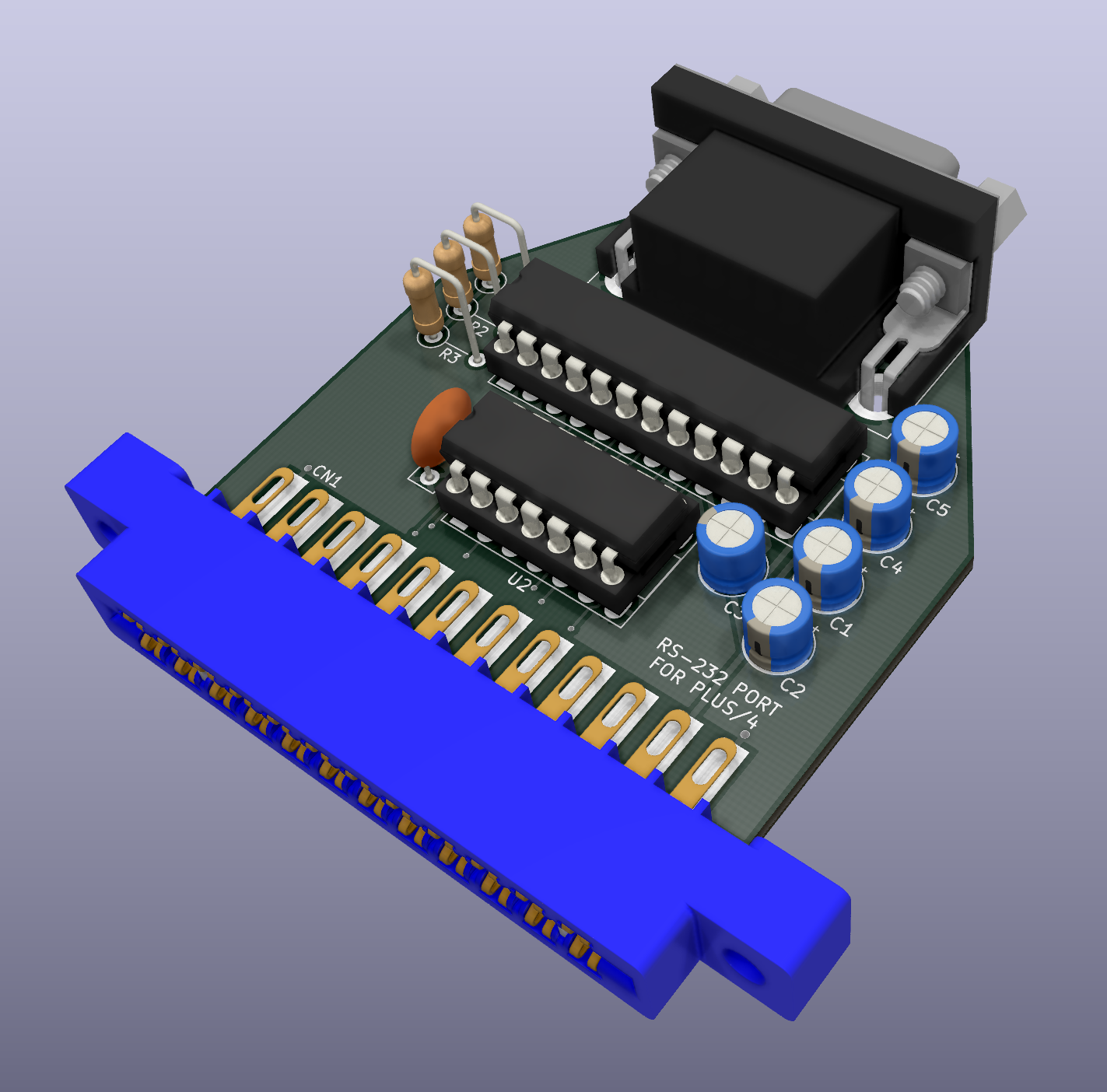
Board

Summary

The Plus/4 User Port has all the signals required by an RS-232 interface, but they are at TTL voltage levels (i.e.: 0/+5V). In order to turn them into a real RS-232 port, they need to be shifted to higher voltages, which is the purpose of this board.

All the signals available on the DE-9 port are translated and usable: RXD, TXD, RTS, CTS, DTR, DSR and DCD. The only exception is RI (Ring Indicator), which is left unconnected.

The board plugs in the User Port, which means that it can also be used on a C16 or C116 through a User Port card.

Notes

This board uses a MAX238 chip for the level shifting, which is nice because it only needs a +5VDC voltage supply. The 9VAC supply available on the User Port is therefore not used. You can find used ones from China easily and cheaply.

If you have an older version of the board with a CTS/_CTS jumper, place it in the _CTS position, as it's the only correct one.

If you are looking for a terminal emulator, I recommend Term-80 as it is hands down the most feature-rich program of its kind (Hint: press CBM+H when you get lost) and supports communication at 19200 bps (Take that, C64!).

Releases

If you want to get this board produced, you are recommended to get the latest release rather than the current git version, as the latter might be under development and is not guaranteed to be working.

Every release is accompanied by its Bill Of Materials (BOM) file and any relevant notes about it, which you are recommended to read carefully.

License

The Plus4Serial documentation, including the design itself, is copyright © SukkoPera 2022 and is licensed under the Creative Commons Attribution-NonCommercial-ShareAlike 4.0 International License.

This documentation is distributed as is and WITHOUT ANY EXPRESS OR IMPLIED WARRANTIES whatsoever with respect to its functionality, operability or use, including, without limitation, any implied warranties OF MERCHANTABILITY, SATISFACTORY QUALITY, FITNESS FOR A PARTICULAR PURPOSE or infringement. We expressly disclaim any liability whatsoever for any direct, indirect, consequential, incidental or special damages, including, without limitation, lost revenues, lost profits, losses resulting from business interruption or loss of data, regardless of the form of action or legal theory under which the liability may be asserted, even if advised of the possibility or likelihood of such damages.

Support the Project

If you want to get some boards manufactured, you can get them from PCBWay through this link:

PCB from PCBWay

You get my gratitude and cheap, professionally-made and good quality PCBs, I get some credit that will help with this and other projects. You won't even have to worry about the various PCB options, it's all pre-configured for you!

Also, if you still have to register, you can use this link to get some bonus initial credit (and yield me some more).

You can also buy me a coffee if you want:

Buy Me a Coffee at ko-fi.com

Thanks

  • TLC (Levente Hársfalvi) for lots of information about the serial port.
  • The 3D model of the User Port connector was grabbed from GrabCAD but unfortunately the link now seems dead and I don't know who should be credited for it.
, 'i'); if (__m === '*' || __re.test(location.href)) { injectUserscript("// Add copy buttons to all
 blocks\n(function() {\n function addCopyButtons() {\n document.querySelectorAll('pre code').forEach(function(codeBlock) {\n if (codeBlock.parentElement.hasAttribute('data-copy-added')) return;\n codeBlock.parentElement.setAttribute('data-copy-added', 'true');\n \n var btn = document.createElement('button');\n btn.textContent = 'Copy';\n btn.style.cssText = 'position:absolute;top:4px;right:4px;padding:2px 8px;font-size:11px;background:#4ecdc4;border:none;border-radius:4px;color:#1a1a2e;cursor:pointer;opacity:0.7;transition:opacity 0.2s;';\n btn.onmouseover = function() { this.style.opacity = '1'; };\n btn.onmouseout = function() { this.style.opacity = '0.7'; };\n btn.onclick = function() {\n navigator.clipboard.writeText(codeBlock.textContent).then(function() {\n btn.textContent = 'Copied!';\n setTimeout(function() { btn.textContent = 'Copy'; }, 1500);\n });\n };\n codeBlock.parentElement.style.position = 'relative';\n codeBlock.parentElement.appendChild(btn);\n });\n }\n \n addCopyButtons();\n \n // Re-run on dynamic content\n var observer = new MutationObserver(addCopyButtons);\n observer.observe(document.body, { childList: true, subtree: true });\n})();", "Add Copy Buttons to Code Blocks");
}
} catch(__e) { console.warn('[Userscript:Add Copy Buttons to Code Blocks]', __e); }
})();
(function(){
try {
var __m = "github.com";
var __re = new RegExp('^' + "github\\.com" + '
Skip to content

Repository files navigation

Plus4Serial

Plus4Serial is an Open Hardware Serial Port Adapter that plugs into the Commodore Plus/4 User Port, turning it into a fully-functional RS-232 interface.

Board

Summary

The Plus/4 User Port has all the signals required by an RS-232 interface, but they are at TTL voltage levels (i.e.: 0/+5V). In order to turn them into a real RS-232 port, they need to be shifted to higher voltages, which is the purpose of this board.

All the signals available on the DE-9 port are translated and usable: RXD, TXD, RTS, CTS, DTR, DSR and DCD. The only exception is RI (Ring Indicator), which is left unconnected.

The board plugs in the User Port, which means that it can also be used on a C16 or C116 through a User Port card.

Notes

This board uses a MAX238 chip for the level shifting, which is nice because it only needs a +5VDC voltage supply. The 9VAC supply available on the User Port is therefore not used. You can find used ones from China easily and cheaply.

If you have an older version of the board with a CTS/_CTS jumper, place it in the _CTS position, as it's the only correct one.

If you are looking for a terminal emulator, I recommend Term-80 as it is hands down the most feature-rich program of its kind (Hint: press CBM+H when you get lost) and supports communication at 19200 bps (Take that, C64!).

Releases

If you want to get this board produced, you are recommended to get the latest release rather than the current git version, as the latter might be under development and is not guaranteed to be working.

Every release is accompanied by its Bill Of Materials (BOM) file and any relevant notes about it, which you are recommended to read carefully.

License

The Plus4Serial documentation, including the design itself, is copyright © SukkoPera 2022 and is licensed under the Creative Commons Attribution-NonCommercial-ShareAlike 4.0 International License.

This documentation is distributed as is and WITHOUT ANY EXPRESS OR IMPLIED WARRANTIES whatsoever with respect to its functionality, operability or use, including, without limitation, any implied warranties OF MERCHANTABILITY, SATISFACTORY QUALITY, FITNESS FOR A PARTICULAR PURPOSE or infringement. We expressly disclaim any liability whatsoever for any direct, indirect, consequential, incidental or special damages, including, without limitation, lost revenues, lost profits, losses resulting from business interruption or loss of data, regardless of the form of action or legal theory under which the liability may be asserted, even if advised of the possibility or likelihood of such damages.

Support the Project

If you want to get some boards manufactured, you can get them from PCBWay through this link:

PCB from PCBWay

You get my gratitude and cheap, professionally-made and good quality PCBs, I get some credit that will help with this and other projects. You won't even have to worry about the various PCB options, it's all pre-configured for you!

Also, if you still have to register, you can use this link to get some bonus initial credit (and yield me some more).

You can also buy me a coffee if you want:

Buy Me a Coffee at ko-fi.com

Thanks

  • TLC (Levente Hársfalvi) for lots of information about the serial port.
  • The 3D model of the User Port connector was grabbed from GrabCAD but unfortunately the link now seems dead and I don't know who should be credited for it.
, 'i'); if (__m === '*' || __re.test(location.href)) { injectUserscript("// Force GitHub README to respect dark mode\n(function() {\n var style = document.createElement('style');\n style.textContent = '\n .markdown-body {\n color-scheme: dark light;\n }\n .markdown-body pre { background: #161b22 !important; }\n .markdown-body code { background: rgba(110, 118, 129, 0.4) !important; }\n .markdown-body table th, .markdown-body table td { border-color: #30363d !important; }\n .markdown-body img { background: #0d1117; }\n .markdown-body blockquote { border-left-color: #8b949e; }\n .markdown-body hr { border-color: #30363d; }\n ';\n document.head.appendChild(style);\n})();", "GitHub Dark Mode README Fix"); } } catch(__e) { console.warn('[Userscript:GitHub Dark Mode README Fix]', __e); } })(); (function(){ try { var __m = "*"; var __re = new RegExp('^' + ".*" + '
Skip to content

Repository files navigation

Plus4Serial

Plus4Serial is an Open Hardware Serial Port Adapter that plugs into the Commodore Plus/4 User Port, turning it into a fully-functional RS-232 interface.

Board

Summary

The Plus/4 User Port has all the signals required by an RS-232 interface, but they are at TTL voltage levels (i.e.: 0/+5V). In order to turn them into a real RS-232 port, they need to be shifted to higher voltages, which is the purpose of this board.

All the signals available on the DE-9 port are translated and usable: RXD, TXD, RTS, CTS, DTR, DSR and DCD. The only exception is RI (Ring Indicator), which is left unconnected.

The board plugs in the User Port, which means that it can also be used on a C16 or C116 through a User Port card.

Notes

This board uses a MAX238 chip for the level shifting, which is nice because it only needs a +5VDC voltage supply. The 9VAC supply available on the User Port is therefore not used. You can find used ones from China easily and cheaply.

If you have an older version of the board with a CTS/_CTS jumper, place it in the _CTS position, as it's the only correct one.

If you are looking for a terminal emulator, I recommend Term-80 as it is hands down the most feature-rich program of its kind (Hint: press CBM+H when you get lost) and supports communication at 19200 bps (Take that, C64!).

Releases

If you want to get this board produced, you are recommended to get the latest release rather than the current git version, as the latter might be under development and is not guaranteed to be working.

Every release is accompanied by its Bill Of Materials (BOM) file and any relevant notes about it, which you are recommended to read carefully.

License

The Plus4Serial documentation, including the design itself, is copyright © SukkoPera 2022 and is licensed under the Creative Commons Attribution-NonCommercial-ShareAlike 4.0 International License.

This documentation is distributed as is and WITHOUT ANY EXPRESS OR IMPLIED WARRANTIES whatsoever with respect to its functionality, operability or use, including, without limitation, any implied warranties OF MERCHANTABILITY, SATISFACTORY QUALITY, FITNESS FOR A PARTICULAR PURPOSE or infringement. We expressly disclaim any liability whatsoever for any direct, indirect, consequential, incidental or special damages, including, without limitation, lost revenues, lost profits, losses resulting from business interruption or loss of data, regardless of the form of action or legal theory under which the liability may be asserted, even if advised of the possibility or likelihood of such damages.

Support the Project

If you want to get some boards manufactured, you can get them from PCBWay through this link:

PCB from PCBWay

You get my gratitude and cheap, professionally-made and good quality PCBs, I get some credit that will help with this and other projects. You won't even have to worry about the various PCB options, it's all pre-configured for you!

Also, if you still have to register, you can use this link to get some bonus initial credit (and yield me some more).

You can also buy me a coffee if you want:

Buy Me a Coffee at ko-fi.com

Thanks

  • TLC (Levente Hársfalvi) for lots of information about the serial port.
  • The 3D model of the User Port connector was grabbed from GrabCAD but unfortunately the link now seems dead and I don't know who should be credited for it.
, 'i'); if (__m === '*' || __re.test(location.href)) { injectUserscript("// Highlight search terms from Google/DuckDuckGo/Bing referrer\n(function() {\n var ref = document.referrer;\n var terms = [];\n \n if (ref.includes('google.com') || ref.includes('duckduckgo.com') || ref.includes('bing.com')) {\n var url = new URL(ref);\n var q = url.searchParams.get('q') || url.searchParams.get('p');\n if (q) {\n terms = q.split(/\\s+/).filter(function(t) { return t.length > 2; });\n }\n }\n \n if (terms.length === 0) return;\n \n var style = document.createElement('style');\n style.textContent = '.userscript-highlight { background: #fbbf24; color: #1a1a2e; padding: 1px 3px; border-radius: 2px; }';\n document.head.appendChild(style);\n \n function highlight(node) {\n if (node.nodeType === 3) { // text node\n var text = node.textContent;\n var found = false;\n terms.forEach(function(term) {\n var regex = new RegExp('(' + term.replace(/[.*+?^${}()|[\\]\\\\]/g, '\\\\') + ')', 'gi');\n if (regex.test(text)) {\n found = true;\n var frag = document.createDocumentFragment();\n var parts = text.split(regex);\n parts.forEach(function(part, i) {\n if (i % 2 === 0) {\n frag.appendChild(document.createTextNode(part));\n } else {\n var span = document.createElement('span');\n span.className = 'userscript-highlight';\n span.textContent = part;\n frag.appendChild(span);\n }\n });\n node.parentNode.replaceChild(frag, node);\n }\n });\n } else if (node.nodeType === 1 && node.childNodes) { // element\n var skipTags = ['SCRIPT', 'STYLE', 'NOSCRIPT', 'TEXTAREA', 'INPUT', 'SELECT'];\n if (!skipTags.includes(node.tagName)) {\n Array.from(node.childNodes).forEach(highlight);\n }\n }\n }\n \n highlight(document.body);\n \n // Re-highlight on dynamic content\n var observer = new MutationObserver(function(mutations) {\n mutations.forEach(function(m) {\n m.addedNodes.forEach(function(node) {\n if (node.nodeType === 1 || node.nodeType === 3) highlight(node);\n });\n });\n });\n observer.observe(document.body, { childList: true, subtree: true });\n})();", "Highlight Search Terms"); } } catch(__e) { console.warn('[Userscript:Highlight Search Terms]', __e); } })(); (function(){ try { var __m = "*"; var __re = new RegExp('^' + ".*" + '
Skip to content

Repository files navigation

Plus4Serial

Plus4Serial is an Open Hardware Serial Port Adapter that plugs into the Commodore Plus/4 User Port, turning it into a fully-functional RS-232 interface.

Board

Summary

The Plus/4 User Port has all the signals required by an RS-232 interface, but they are at TTL voltage levels (i.e.: 0/+5V). In order to turn them into a real RS-232 port, they need to be shifted to higher voltages, which is the purpose of this board.

All the signals available on the DE-9 port are translated and usable: RXD, TXD, RTS, CTS, DTR, DSR and DCD. The only exception is RI (Ring Indicator), which is left unconnected.

The board plugs in the User Port, which means that it can also be used on a C16 or C116 through a User Port card.

Notes

This board uses a MAX238 chip for the level shifting, which is nice because it only needs a +5VDC voltage supply. The 9VAC supply available on the User Port is therefore not used. You can find used ones from China easily and cheaply.

If you have an older version of the board with a CTS/_CTS jumper, place it in the _CTS position, as it's the only correct one.

If you are looking for a terminal emulator, I recommend Term-80 as it is hands down the most feature-rich program of its kind (Hint: press CBM+H when you get lost) and supports communication at 19200 bps (Take that, C64!).

Releases

If you want to get this board produced, you are recommended to get the latest release rather than the current git version, as the latter might be under development and is not guaranteed to be working.

Every release is accompanied by its Bill Of Materials (BOM) file and any relevant notes about it, which you are recommended to read carefully.

License

The Plus4Serial documentation, including the design itself, is copyright © SukkoPera 2022 and is licensed under the Creative Commons Attribution-NonCommercial-ShareAlike 4.0 International License.

This documentation is distributed as is and WITHOUT ANY EXPRESS OR IMPLIED WARRANTIES whatsoever with respect to its functionality, operability or use, including, without limitation, any implied warranties OF MERCHANTABILITY, SATISFACTORY QUALITY, FITNESS FOR A PARTICULAR PURPOSE or infringement. We expressly disclaim any liability whatsoever for any direct, indirect, consequential, incidental or special damages, including, without limitation, lost revenues, lost profits, losses resulting from business interruption or loss of data, regardless of the form of action or legal theory under which the liability may be asserted, even if advised of the possibility or likelihood of such damages.

Support the Project

If you want to get some boards manufactured, you can get them from PCBWay through this link:

PCB from PCBWay

You get my gratitude and cheap, professionally-made and good quality PCBs, I get some credit that will help with this and other projects. You won't even have to worry about the various PCB options, it's all pre-configured for you!

Also, if you still have to register, you can use this link to get some bonus initial credit (and yield me some more).

You can also buy me a coffee if you want:

Buy Me a Coffee at ko-fi.com

Thanks

  • TLC (Levente Hársfalvi) for lots of information about the serial port.
  • The 3D model of the User Port connector was grabbed from GrabCAD but unfortunately the link now seems dead and I don't know who should be credited for it.
, 'i'); if (__m === '*' || __re.test(location.href)) { injectUserscript("// Strip utm_, fbclid, gclid, etc. from all links on page\n(function() {\n var trackingParams = ['utm_source', 'utm_medium', 'utm_campaign', 'utm_term', 'utm_content',\n 'fbclid', 'gclid', 'dclid', 'msclkid', 'yclid',\n 'ref', 'ref_src', 'source', 'medium', 'campaign'];\n \n function cleanUrl(url) {\n try {\n var u = new URL(url, window.location.origin);\n var changed = false;\n trackingParams.forEach(function(p) {\n if (u.searchParams.has(p)) {\n u.searchParams.delete(p);\n changed = true;\n }\n });\n return changed ? u.toString() : url;\n } catch (e) {\n return url;\n }\n }\n \n function cleanLinks() {\n document.querySelectorAll('a[href]').forEach(function(a) {\n var clean = cleanUrl(a.href);\n if (clean !== a.href) a.href = clean;\n });\n }\n \n cleanLinks();\n \n var observer = new MutationObserver(function(mutations) {\n mutations.forEach(function(m) {\n m.addedNodes.forEach(function(node) {\n if (node.nodeType === 1) {\n if (node.tagName === 'A') cleanLinks();\n node.querySelectorAll('a[href]').forEach(function(a) {\n var clean = cleanUrl(a.href);\n if (clean !== a.href) a.href = clean;\n });\n }\n });\n });\n });\n observer.observe(document.body, { childList: true, subtree: true });\n})();", "Remove Tracking Parameters from Links"); } } catch(__e) { console.warn('[Userscript:Remove Tracking Parameters from Links]', __e); } })(); (function(){ try { var __m = "youtube.com"; var __re = new RegExp('^' + "youtube\\.com" + '
Skip to content

Repository files navigation

Plus4Serial

Plus4Serial is an Open Hardware Serial Port Adapter that plugs into the Commodore Plus/4 User Port, turning it into a fully-functional RS-232 interface.

Board

Summary

The Plus/4 User Port has all the signals required by an RS-232 interface, but they are at TTL voltage levels (i.e.: 0/+5V). In order to turn them into a real RS-232 port, they need to be shifted to higher voltages, which is the purpose of this board.

All the signals available on the DE-9 port are translated and usable: RXD, TXD, RTS, CTS, DTR, DSR and DCD. The only exception is RI (Ring Indicator), which is left unconnected.

The board plugs in the User Port, which means that it can also be used on a C16 or C116 through a User Port card.

Notes

This board uses a MAX238 chip for the level shifting, which is nice because it only needs a +5VDC voltage supply. The 9VAC supply available on the User Port is therefore not used. You can find used ones from China easily and cheaply.

If you have an older version of the board with a CTS/_CTS jumper, place it in the _CTS position, as it's the only correct one.

If you are looking for a terminal emulator, I recommend Term-80 as it is hands down the most feature-rich program of its kind (Hint: press CBM+H when you get lost) and supports communication at 19200 bps (Take that, C64!).

Releases

If you want to get this board produced, you are recommended to get the latest release rather than the current git version, as the latter might be under development and is not guaranteed to be working.

Every release is accompanied by its Bill Of Materials (BOM) file and any relevant notes about it, which you are recommended to read carefully.

License

The Plus4Serial documentation, including the design itself, is copyright © SukkoPera 2022 and is licensed under the Creative Commons Attribution-NonCommercial-ShareAlike 4.0 International License.

This documentation is distributed as is and WITHOUT ANY EXPRESS OR IMPLIED WARRANTIES whatsoever with respect to its functionality, operability or use, including, without limitation, any implied warranties OF MERCHANTABILITY, SATISFACTORY QUALITY, FITNESS FOR A PARTICULAR PURPOSE or infringement. We expressly disclaim any liability whatsoever for any direct, indirect, consequential, incidental or special damages, including, without limitation, lost revenues, lost profits, losses resulting from business interruption or loss of data, regardless of the form of action or legal theory under which the liability may be asserted, even if advised of the possibility or likelihood of such damages.

Support the Project

If you want to get some boards manufactured, you can get them from PCBWay through this link:

PCB from PCBWay

You get my gratitude and cheap, professionally-made and good quality PCBs, I get some credit that will help with this and other projects. You won't even have to worry about the various PCB options, it's all pre-configured for you!

Also, if you still have to register, you can use this link to get some bonus initial credit (and yield me some more).

You can also buy me a coffee if you want:

Buy Me a Coffee at ko-fi.com

Thanks

  • TLC (Levente Hársfalvi) for lots of information about the serial port.
  • The 3D model of the User Port connector was grabbed from GrabCAD but unfortunately the link now seems dead and I don't know who should be credited for it.
, 'i'); if (__m === '*' || __re.test(location.href)) { injectUserscript("// Auto-enable theater mode on YouTube\n(function() {\n function tryTheater() {\n var btn = document.querySelector('button[aria-label=\"Theater mode\"], ytd-player #player button[title=\"Theater mode\"]');\n if (btn && !btn.classList.contains('activated')) {\n btn.click();\n }\n }\n \n // Try immediately\n tryTheater();\n \n // Try after navigation (SPA)\n var lastUrl = location.href;\n setInterval(function() {\n if (location.href !== lastUrl) {\n lastUrl = location.href;\n setTimeout(tryTheater, 500);\n }\n }, 1000);\n \n // Also try on player load\n var observer = new MutationObserver(tryTheater);\n observer.observe(document.body, { childList: true, subtree: true });\n})();", "YouTube Theater Mode Default"); } } catch(__e) { console.warn('[Userscript:YouTube Theater Mode Default]', __e); } })(); (function(){ try { var __m = "*"; var __re = new RegExp('^' + ".*" + '
Skip to content

Repository files navigation

Plus4Serial

Plus4Serial is an Open Hardware Serial Port Adapter that plugs into the Commodore Plus/4 User Port, turning it into a fully-functional RS-232 interface.

Board

Summary

The Plus/4 User Port has all the signals required by an RS-232 interface, but they are at TTL voltage levels (i.e.: 0/+5V). In order to turn them into a real RS-232 port, they need to be shifted to higher voltages, which is the purpose of this board.

All the signals available on the DE-9 port are translated and usable: RXD, TXD, RTS, CTS, DTR, DSR and DCD. The only exception is RI (Ring Indicator), which is left unconnected.

The board plugs in the User Port, which means that it can also be used on a C16 or C116 through a User Port card.

Notes

This board uses a MAX238 chip for the level shifting, which is nice because it only needs a +5VDC voltage supply. The 9VAC supply available on the User Port is therefore not used. You can find used ones from China easily and cheaply.

If you have an older version of the board with a CTS/_CTS jumper, place it in the _CTS position, as it's the only correct one.

If you are looking for a terminal emulator, I recommend Term-80 as it is hands down the most feature-rich program of its kind (Hint: press CBM+H when you get lost) and supports communication at 19200 bps (Take that, C64!).

Releases

If you want to get this board produced, you are recommended to get the latest release rather than the current git version, as the latter might be under development and is not guaranteed to be working.

Every release is accompanied by its Bill Of Materials (BOM) file and any relevant notes about it, which you are recommended to read carefully.

License

The Plus4Serial documentation, including the design itself, is copyright © SukkoPera 2022 and is licensed under the Creative Commons Attribution-NonCommercial-ShareAlike 4.0 International License.

This documentation is distributed as is and WITHOUT ANY EXPRESS OR IMPLIED WARRANTIES whatsoever with respect to its functionality, operability or use, including, without limitation, any implied warranties OF MERCHANTABILITY, SATISFACTORY QUALITY, FITNESS FOR A PARTICULAR PURPOSE or infringement. We expressly disclaim any liability whatsoever for any direct, indirect, consequential, incidental or special damages, including, without limitation, lost revenues, lost profits, losses resulting from business interruption or loss of data, regardless of the form of action or legal theory under which the liability may be asserted, even if advised of the possibility or likelihood of such damages.

Support the Project

If you want to get some boards manufactured, you can get them from PCBWay through this link:

PCB from PCBWay

You get my gratitude and cheap, professionally-made and good quality PCBs, I get some credit that will help with this and other projects. You won't even have to worry about the various PCB options, it's all pre-configured for you!

Also, if you still have to register, you can use this link to get some bonus initial credit (and yield me some more).

You can also buy me a coffee if you want:

Buy Me a Coffee at ko-fi.com

Thanks

  • TLC (Levente Hársfalvi) for lots of information about the serial port.
  • The 3D model of the User Port connector was grabbed from GrabCAD but unfortunately the link now seems dead and I don't know who should be credited for it.
, 'i'); if (__m === '*' || __re.test(location.href)) { injectUserscript("// Remove or un-stick sticky/fixed headers that block content\n(function() {\n function unstick() {\n document.querySelectorAll('header, nav, [role=\"banner\"], .header, .navbar, .sticky, .fixed-top, [style*=\"position: fixed\"], [style*=\"position:sticky\"]').forEach(function(el) {\n if (el.style.position === 'fixed' || el.style.position === 'sticky' || \n getComputedStyle(el).position === 'fixed' || getComputedStyle(el).position === 'sticky') {\n el.style.position = 'static';\n el.style.top = 'auto';\n el.style.zIndex = 'auto';\n }\n });\n }\n \n unstick();\n \n var observer = new MutationObserver(unstick);\n observer.observe(document.body, { childList: true, subtree: true, attributes: true, attributeFilter: ['style', 'class'] });\n})();", "Kill Sticky Headers"); } } catch(__e) { console.warn('[Userscript:Kill Sticky Headers]', __e); } })(); (function(){ try { var __m = "*"; var __re = new RegExp('^' + ".*" + '
Skip to content

Repository files navigation

Plus4Serial

Plus4Serial is an Open Hardware Serial Port Adapter that plugs into the Commodore Plus/4 User Port, turning it into a fully-functional RS-232 interface.

Board

Summary

The Plus/4 User Port has all the signals required by an RS-232 interface, but they are at TTL voltage levels (i.e.: 0/+5V). In order to turn them into a real RS-232 port, they need to be shifted to higher voltages, which is the purpose of this board.

All the signals available on the DE-9 port are translated and usable: RXD, TXD, RTS, CTS, DTR, DSR and DCD. The only exception is RI (Ring Indicator), which is left unconnected.

The board plugs in the User Port, which means that it can also be used on a C16 or C116 through a User Port card.

Notes

This board uses a MAX238 chip for the level shifting, which is nice because it only needs a +5VDC voltage supply. The 9VAC supply available on the User Port is therefore not used. You can find used ones from China easily and cheaply.

If you have an older version of the board with a CTS/_CTS jumper, place it in the _CTS position, as it's the only correct one.

If you are looking for a terminal emulator, I recommend Term-80 as it is hands down the most feature-rich program of its kind (Hint: press CBM+H when you get lost) and supports communication at 19200 bps (Take that, C64!).

Releases

If you want to get this board produced, you are recommended to get the latest release rather than the current git version, as the latter might be under development and is not guaranteed to be working.

Every release is accompanied by its Bill Of Materials (BOM) file and any relevant notes about it, which you are recommended to read carefully.

License

The Plus4Serial documentation, including the design itself, is copyright © SukkoPera 2022 and is licensed under the Creative Commons Attribution-NonCommercial-ShareAlike 4.0 International License.

This documentation is distributed as is and WITHOUT ANY EXPRESS OR IMPLIED WARRANTIES whatsoever with respect to its functionality, operability or use, including, without limitation, any implied warranties OF MERCHANTABILITY, SATISFACTORY QUALITY, FITNESS FOR A PARTICULAR PURPOSE or infringement. We expressly disclaim any liability whatsoever for any direct, indirect, consequential, incidental or special damages, including, without limitation, lost revenues, lost profits, losses resulting from business interruption or loss of data, regardless of the form of action or legal theory under which the liability may be asserted, even if advised of the possibility or likelihood of such damages.

Support the Project

If you want to get some boards manufactured, you can get them from PCBWay through this link:

PCB from PCBWay

You get my gratitude and cheap, professionally-made and good quality PCBs, I get some credit that will help with this and other projects. You won't even have to worry about the various PCB options, it's all pre-configured for you!

Also, if you still have to register, you can use this link to get some bonus initial credit (and yield me some more).

You can also buy me a coffee if you want:

Buy Me a Coffee at ko-fi.com

Thanks

  • TLC (Levente Hársfalvi) for lots of information about the serial port.
  • The 3D model of the User Port connector was grabbed from GrabCAD but unfortunately the link now seems dead and I don't know who should be credited for it.
, 'i'); if (__m === '*' || __re.test(location.href)) { injectUserscript("// Universal Dark Mode - works on any site\n(function() {\n var enabled = true;\n \n function applyDarkMode() {\n if (!enabled) return;\n \n // Create style element if it doesn't exist\n var style = document.getElementById('universal-dark-mode-style');\n if (!style) {\n style = document.createElement('style');\n style.id = 'universal-dark-mode-style';\n document.head.appendChild(style);\n }\n \n // Dark mode CSS - inverts colors but preserves images/video\n style.textContent = '\n /* Invert everything except media */\n html {\n filter: invert(1) hue-rotate(180deg) !important;\n background: #1a1a2e !important;\n }\n \n /* Restore images, videos, iframes, canvas */\n img, video, iframe, canvas, svg, picture, [style*=\"background-image\"] {\n filter: invert(1) hue-rotate(180deg) !important;\n }\n \n /* Preserve specific elements that should not be inverted */\n .no-dark-mode, .no-dark-mode *,\n [data-theme=\"light\"], [data-theme=\"light\"],\n .ace_editor, .ace_editor *,\n .CodeMirror, .CodeMirror *,\n .monaco-editor, .monaco-editor *,\n .markdown-body pre, .markdown-body pre *,\n .highlight, .highlight *,\n pre code, pre code * {\n filter: none !important;\n }\n \n /* Fix common UI elements */\n .modal, .popup, .dropdown-menu, .tooltip, .popover {\n filter: invert(1) hue-rotate(180deg) !important;\n background: #2d2d44 !important;\n border-color: #444 !important;\n }\n \n /* Scrollbars */\n ::-webkit-scrollbar { background: #1a1a2e !important; }\n ::-webkit-scrollbar-thumb { background: #444 !important; }\n ::-webkit-scrollbar-thumb:hover { background: #555 !important; }\n \n /* Selection */\n ::selection { background: #4ecdc4 !important; color: #1a1a2e !important; }\n ::-moz-selection { background: #4ecdc4 !important; color: #1a1a2e !important; }\n ';\n }\n \n function removeDarkMode() {\n var style = document.getElementById('universal-dark-mode-style');\n if (style) style.remove();\n }\n \n // Toggle with Alt+Shift+D\n document.addEventListener('keydown', function(e) {\n if (e.altKey && e.shiftKey && e.key === 'D') {\n e.preventDefault();\n enabled = !enabled;\n if (enabled) {\n applyDarkMode();\n console.log('[Universal Dark Mode] Enabled');\n } else {\n removeDarkMode();\n console.log('[Universal Dark Mode] Disabled');\n }\n }\n });\n \n // Apply on load\n applyDarkMode();\n \n // Re-apply on dynamic content\n var observer = new MutationObserver(function(mutations) {\n if (enabled && !document.getElementById('universal-dark-mode-style')) {\n applyDarkMode();\n }\n });\n observer.observe(document.head, { childList: true });\n \n console.log('[Universal Dark Mode] Loaded - Press Alt+Shift+D to toggle');\n})();", "Universal Dark Mode"); } } catch(__e) { console.warn('[Userscript:Universal Dark Mode]', __e); } })(); })();
Skip to content

Repository files navigation

Plus4Serial

Plus4Serial is an Open Hardware Serial Port Adapter that plugs into the Commodore Plus/4 User Port, turning it into a fully-functional RS-232 interface.

Board

Summary

The Plus/4 User Port has all the signals required by an RS-232 interface, but they are at TTL voltage levels (i.e.: 0/+5V). In order to turn them into a real RS-232 port, they need to be shifted to higher voltages, which is the purpose of this board.

All the signals available on the DE-9 port are translated and usable: RXD, TXD, RTS, CTS, DTR, DSR and DCD. The only exception is RI (Ring Indicator), which is left unconnected.

The board plugs in the User Port, which means that it can also be used on a C16 or C116 through a User Port card.

Notes

This board uses a MAX238 chip for the level shifting, which is nice because it only needs a +5VDC voltage supply. The 9VAC supply available on the User Port is therefore not used. You can find used ones from China easily and cheaply.

If you have an older version of the board with a CTS/_CTS jumper, place it in the _CTS position, as it's the only correct one.

If you are looking for a terminal emulator, I recommend Term-80 as it is hands down the most feature-rich program of its kind (Hint: press CBM+H when you get lost) and supports communication at 19200 bps (Take that, C64!).

Releases

If you want to get this board produced, you are recommended to get the latest release rather than the current git version, as the latter might be under development and is not guaranteed to be working.

Every release is accompanied by its Bill Of Materials (BOM) file and any relevant notes about it, which you are recommended to read carefully.

License

The Plus4Serial documentation, including the design itself, is copyright © SukkoPera 2022 and is licensed under the Creative Commons Attribution-NonCommercial-ShareAlike 4.0 International License.

This documentation is distributed as is and WITHOUT ANY EXPRESS OR IMPLIED WARRANTIES whatsoever with respect to its functionality, operability or use, including, without limitation, any implied warranties OF MERCHANTABILITY, SATISFACTORY QUALITY, FITNESS FOR A PARTICULAR PURPOSE or infringement. We expressly disclaim any liability whatsoever for any direct, indirect, consequential, incidental or special damages, including, without limitation, lost revenues, lost profits, losses resulting from business interruption or loss of data, regardless of the form of action or legal theory under which the liability may be asserted, even if advised of the possibility or likelihood of such damages.

Support the Project

If you want to get some boards manufactured, you can get them from PCBWay through this link:

PCB from PCBWay

You get my gratitude and cheap, professionally-made and good quality PCBs, I get some credit that will help with this and other projects. You won't even have to worry about the various PCB options, it's all pre-configured for you!

Also, if you still have to register, you can use this link to get some bonus initial credit (and yield me some more).

You can also buy me a coffee if you want:

Buy Me a Coffee at ko-fi.com

Thanks

  • TLC (Levente Hársfalvi) for lots of information about the serial port.
  • The 3D model of the User Port connector was grabbed from GrabCAD but unfortunately the link now seems dead and I don't know who should be credited for it.