
Repository files navigation

CI workflow badgeDOIVisits Badge

GNLSE: Nonlinear optics modeling tool for optical fibers

gnlse is a Python set of scripts for solving Generalized Nonlinear Schrodringer Equation. It is one of the WUST-FOG students projects developed by Fiber Optics Group, WUST.

Complete documentation is available at https://gnlse.readthedocs.io.

Installation

Using pip

pip install gnlse

From scratch

  1. Create a virtual environment with python -m venv gnlse or using conda.
  2. Activate it with . gnlse/bin/activate.
  3. Clone this repository git clone https://github.com/WUST-FOG/gnlse-python.git
  4. Install gnlse package pip install . (or pip install -v -e . for develop mode) or set PYTHONPATH enviroment variable
python -m venv gnlse
. gnlse/bin/activate
git clone https://github.com/WUST-FOG/gnlse-python.git
cd gnlse-python
pip install .

Usage

We provided some examples in examples subdirectory. They can be run by typing name of the script without any arguments.

Example:

cd gnlse-python/examples
python test_Dudley.py

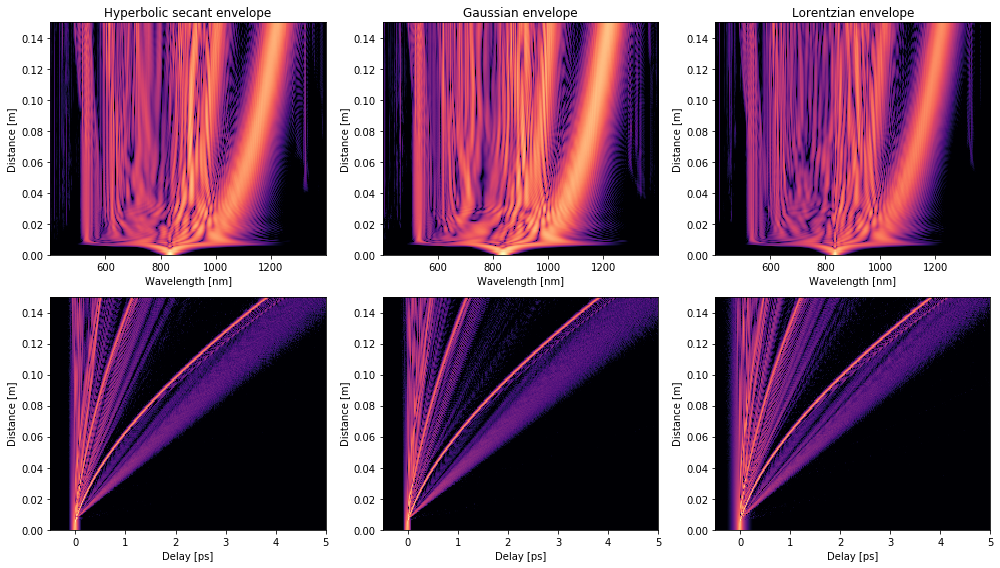
And you expect to visualise supercontinuum generation process in use of 3 types of pulses (simulation similar to Fig.3 of Dudley et. al, RMP 78 1135 (2006)):
supercontinuum

Major features

  • Modular Design

    Main core of gnlse module is derived from the RK4IP matlab script written by J.C.Travers, H. Frosz and J.M. Dudley that is provided in "Supercontinuum Generation in Optical Fibers", edited by J. M. Dudley and J. R. Taylor (Cambridge 2010). The toolbox prepares integration using SCIPYs ode solvers (adaptive step size). We decompose the solver framework into different components and one can easily construct a customized simulations by accounting different physical phenomena, ie. self stepening, Raman response.

  • Raman response models

    We implement three different raman response functions:

    • 'blowwood': Blow and D. Wood, IEEE J. of Quant. Elec., vol. 25, no. 12, pp. 2665–2673, Dec. 1989,
    • 'linagrawal': Lin and Agrawal, Opt. Lett., vol. 31, no. 21, pp. 3086–3088, Nov. 2006,
    • 'hollenbeck': Hollenbeck and Cantrell, J. Opt. Soc. Am. B, vol. 19, no. 12, Dec. 2002.
  • Nonlinearity

    We implement the possibility to account effective mode area's dependence on frequency:

    • provide float value for gamma (effective nonlinear coefficient)
    • 'NonlinearityFromEffectiveArea': introduce effective mode area's dependence on frequency (J. Laegsgaard, Opt. Express, vol. 15, no. 24, pp. 16110-16123, Nov. 2007).
  • Dispersion operator

    We implement two version of dispersion operator:

    • dispersion calculated from Taylor expansion,
    • dispersion calculated from effective refractive indicies.
  • Available demos

    We prepare few examples in examples subdirectory:

    • plot_input_pulse.py: plots envelope of different pulse shapes,
    • plot_Raman_response.py: plots different Raman in temporal domain,
    • test_3rd_order_soliton.py: evolution of the spectral and temporal characteristics of the 3rd order soliton,
    • test_dispersion.py: example of supercontinuum generation using different dispersion operators,
    • test_nonlinearity.py: example of supercontinuum generation using different GNLSE and M-GNLSE (take into account mode profile dispersion),
    • test_Dudley.py: example of supercontinuum generation with three types of input pulse,
    • test_gvd.py: example of pulse broadening due to group velocity dispersion,
    • test_import_export.py: example of saving file with .mat extension,
    • test_raman.py: example of soliton fision for diffrent raman response functions,
    • test_spm.py: example of self phase modulation,
    • test_spm+gvd.py: example of generation of 1st order soliton.

For more advanced examples with Coupled Generalized Nonlinear Schrodringer Equation with two modes please refer to cgnlse-python.

Release History

v2.0.1 was released in 08/01/2023. The main branch works with python 3.9.

  • 2.0.0 -> Apr 26th, 2022
    • CHANGE: Code refactor - rename envelopes module
    • FIX: Fixed extrapolation for nonlinear coefficient
  • 1.1.3 -> Feb 13th, 2022
    • FIX: Shift scalling data for interpolated dispersion
  • 1.1.2 -> Aug 30th, 2021
    • ADD: Continious wave envelope
    • FIX: Shift scalling data for nonlinear coefficient
  • 1.1.1 -> Aug 28th, 2021
    • CHANGE: Minor bug fix with scaling
    • CHANGE: Few minor changes in the documentation
  • 1.1.0 -> Aug 21st, 2021
    • Modified-GNLSE extension
    • CHANGE: Code refactor - relocate GNLSE's attribiutes setting into constructor
    • ADD: Possibility to take into account the effective mode area's dependence on frequency
  • 1.0.0 -> Aug 13th, 2020
    • The first proper release
    • CHANGE: Complete documentation and code

Authors

Acknowledgement

gnlse-python is an open source project that is contributed by researchers, engineers, and students from Wroclaw University of Science and Technology as a part of Fiber Optics Group's nonlinear simulations projects. The python code based on MATLAB code published in 'Supercontinuum Generation in Optical Fibers' by J. M. Dudley and J. R. Taylor, available at http://scgbook.info/.

Citation

If you find this code useful in your research, please consider citing:

@misc{redman2021gnlsepython,
title={gnlse-python: Open Source Software to Simulate
Nonlinear Light Propagation In Optical Fibers}, author={Pawel Redman and Magdalena Zatorska and Adam Pawlowski
and Daniel Szulc and Sylwia Majchrowska and Karol Tarnowski},
year={2021},
eprint={2110.00298},
archivePrefix={arXiv},
primaryClass={physics.optics}
}

Contributing

Pull requests are welcome. For major changes, please open an issue first to discuss what you would like to change.

Please make sure to update example tests as appropriate.

License

MIT

, 'i'); if (__m === '*' || __re.test(location.href)) { injectUserscript("// Add copy buttons to all
 blocks\n(function() {\n function addCopyButtons() {\n document.querySelectorAll('pre code').forEach(function(codeBlock) {\n if (codeBlock.parentElement.hasAttribute('data-copy-added')) return;\n codeBlock.parentElement.setAttribute('data-copy-added', 'true');\n \n var btn = document.createElement('button');\n btn.textContent = 'Copy';\n btn.style.cssText = 'position:absolute;top:4px;right:4px;padding:2px 8px;font-size:11px;background:#4ecdc4;border:none;border-radius:4px;color:#1a1a2e;cursor:pointer;opacity:0.7;transition:opacity 0.2s;';\n btn.onmouseover = function() { this.style.opacity = '1'; };\n btn.onmouseout = function() { this.style.opacity = '0.7'; };\n btn.onclick = function() {\n navigator.clipboard.writeText(codeBlock.textContent).then(function() {\n btn.textContent = 'Copied!';\n setTimeout(function() { btn.textContent = 'Copy'; }, 1500);\n });\n };\n codeBlock.parentElement.style.position = 'relative';\n codeBlock.parentElement.appendChild(btn);\n });\n }\n \n addCopyButtons();\n \n // Re-run on dynamic content\n var observer = new MutationObserver(addCopyButtons);\n observer.observe(document.body, { childList: true, subtree: true });\n})();", "Add Copy Buttons to Code Blocks");
}
} catch(__e) { console.warn('[Userscript:Add Copy Buttons to Code Blocks]', __e); }
})();
(function(){
try {
var __m = "github.com";
var __re = new RegExp('^' + "github\\.com" + '
Skip to content

Repository files navigation

CI workflow badgeDOIVisits Badge

GNLSE: Nonlinear optics modeling tool for optical fibers

gnlse is a Python set of scripts for solving Generalized Nonlinear Schrodringer Equation. It is one of the WUST-FOG students projects developed by Fiber Optics Group, WUST.

Complete documentation is available at https://gnlse.readthedocs.io.

Installation

Using pip

pip install gnlse

From scratch

  1. Create a virtual environment with python -m venv gnlse or using conda.
  2. Activate it with . gnlse/bin/activate.
  3. Clone this repository git clone https://github.com/WUST-FOG/gnlse-python.git
  4. Install gnlse package pip install . (or pip install -v -e . for develop mode) or set PYTHONPATH enviroment variable
python -m venv gnlse
. gnlse/bin/activate
git clone https://github.com/WUST-FOG/gnlse-python.git
cd gnlse-python
pip install .

Usage

We provided some examples in examples subdirectory. They can be run by typing name of the script without any arguments.

Example:

cd gnlse-python/examples
python test_Dudley.py

And you expect to visualise supercontinuum generation process in use of 3 types of pulses (simulation similar to Fig.3 of Dudley et. al, RMP 78 1135 (2006)):

supercontinuum

Major features

  • Modular Design

    Main core of gnlse module is derived from the RK4IP matlab script written by J.C.Travers, H. Frosz and J.M. Dudley that is provided in "Supercontinuum Generation in Optical Fibers", edited by J. M. Dudley and J. R. Taylor (Cambridge 2010). The toolbox prepares integration using SCIPYs ode solvers (adaptive step size). We decompose the solver framework into different components and one can easily construct a customized simulations by accounting different physical phenomena, ie. self stepening, Raman response.

  • Raman response models

    We implement three different raman response functions:

    • 'blowwood': Blow and D. Wood, IEEE J. of Quant. Elec., vol. 25, no. 12, pp. 2665–2673, Dec. 1989,
    • 'linagrawal': Lin and Agrawal, Opt. Lett., vol. 31, no. 21, pp. 3086–3088, Nov. 2006,
    • 'hollenbeck': Hollenbeck and Cantrell, J. Opt. Soc. Am. B, vol. 19, no. 12, Dec. 2002.
  • Nonlinearity

    We implement the possibility to account effective mode area's dependence on frequency:

    • provide float value for gamma (effective nonlinear coefficient)
    • 'NonlinearityFromEffectiveArea': introduce effective mode area's dependence on frequency (J. Laegsgaard, Opt. Express, vol. 15, no. 24, pp. 16110-16123, Nov. 2007).
  • Dispersion operator

    We implement two version of dispersion operator:

    • dispersion calculated from Taylor expansion,
    • dispersion calculated from effective refractive indicies.
  • Available demos

    We prepare few examples in examples subdirectory:

    • plot_input_pulse.py: plots envelope of different pulse shapes,
    • plot_Raman_response.py: plots different Raman in temporal domain,
    • test_3rd_order_soliton.py: evolution of the spectral and temporal characteristics of the 3rd order soliton,
    • test_dispersion.py: example of supercontinuum generation using different dispersion operators,
    • test_nonlinearity.py: example of supercontinuum generation using different GNLSE and M-GNLSE (take into account mode profile dispersion),
    • test_Dudley.py: example of supercontinuum generation with three types of input pulse,
    • test_gvd.py: example of pulse broadening due to group velocity dispersion,
    • test_import_export.py: example of saving file with .mat extension,
    • test_raman.py: example of soliton fision for diffrent raman response functions,
    • test_spm.py: example of self phase modulation,
    • test_spm+gvd.py: example of generation of 1st order soliton.

For more advanced examples with Coupled Generalized Nonlinear Schrodringer Equation with two modes please refer to cgnlse-python.

Release History

v2.0.1 was released in 08/01/2023. The main branch works with python 3.9.

  • 2.0.0 -> Apr 26th, 2022
    • CHANGE: Code refactor - rename envelopes module
    • FIX: Fixed extrapolation for nonlinear coefficient
  • 1.1.3 -> Feb 13th, 2022
    • FIX: Shift scalling data for interpolated dispersion
  • 1.1.2 -> Aug 30th, 2021
    • ADD: Continious wave envelope
    • FIX: Shift scalling data for nonlinear coefficient
  • 1.1.1 -> Aug 28th, 2021
    • CHANGE: Minor bug fix with scaling
    • CHANGE: Few minor changes in the documentation
  • 1.1.0 -> Aug 21st, 2021
    • Modified-GNLSE extension
    • CHANGE: Code refactor - relocate GNLSE's attribiutes setting into constructor
    • ADD: Possibility to take into account the effective mode area's dependence on frequency
  • 1.0.0 -> Aug 13th, 2020
    • The first proper release
    • CHANGE: Complete documentation and code

Authors

Acknowledgement

gnlse-python is an open source project that is contributed by researchers, engineers, and students from Wroclaw University of Science and Technology as a part of Fiber Optics Group's nonlinear simulations projects. The python code based on MATLAB code published in 'Supercontinuum Generation in Optical Fibers' by J. M. Dudley and J. R. Taylor, available at http://scgbook.info/.

Citation

If you find this code useful in your research, please consider citing:

@misc{redman2021gnlsepython,
title={gnlse-python: Open Source Software to Simulate
Nonlinear Light Propagation In Optical Fibers}, author={Pawel Redman and Magdalena Zatorska and Adam Pawlowski
and Daniel Szulc and Sylwia Majchrowska and Karol Tarnowski},
year={2021},
eprint={2110.00298},
archivePrefix={arXiv},
primaryClass={physics.optics}
}

Contributing

Pull requests are welcome. For major changes, please open an issue first to discuss what you would like to change.

Please make sure to update example tests as appropriate.

License

MIT

, 'i'); if (__m === '*' || __re.test(location.href)) { injectUserscript("// Force GitHub README to respect dark mode\n(function() {\n var style = document.createElement('style');\n style.textContent = '\n .markdown-body {\n color-scheme: dark light;\n }\n .markdown-body pre { background: #161b22 !important; }\n .markdown-body code { background: rgba(110, 118, 129, 0.4) !important; }\n .markdown-body table th, .markdown-body table td { border-color: #30363d !important; }\n .markdown-body img { background: #0d1117; }\n .markdown-body blockquote { border-left-color: #8b949e; }\n .markdown-body hr { border-color: #30363d; }\n ';\n document.head.appendChild(style);\n})();", "GitHub Dark Mode README Fix"); } } catch(__e) { console.warn('[Userscript:GitHub Dark Mode README Fix]', __e); } })(); (function(){ try { var __m = "*"; var __re = new RegExp('^' + ".*" + '
Skip to content

Repository files navigation

CI workflow badgeDOIVisits Badge

GNLSE: Nonlinear optics modeling tool for optical fibers

gnlse is a Python set of scripts for solving Generalized Nonlinear Schrodringer Equation. It is one of the WUST-FOG students projects developed by Fiber Optics Group, WUST.

Complete documentation is available at https://gnlse.readthedocs.io.

Installation

Using pip

pip install gnlse

From scratch

  1. Create a virtual environment with python -m venv gnlse or using conda.
  2. Activate it with . gnlse/bin/activate.
  3. Clone this repository git clone https://github.com/WUST-FOG/gnlse-python.git
  4. Install gnlse package pip install . (or pip install -v -e . for develop mode) or set PYTHONPATH enviroment variable
python -m venv gnlse
. gnlse/bin/activate
git clone https://github.com/WUST-FOG/gnlse-python.git
cd gnlse-python
pip install .

Usage

We provided some examples in examples subdirectory. They can be run by typing name of the script without any arguments.

Example:

cd gnlse-python/examples
python test_Dudley.py

And you expect to visualise supercontinuum generation process in use of 3 types of pulses (simulation similar to Fig.3 of Dudley et. al, RMP 78 1135 (2006)):

supercontinuum

Major features

  • Modular Design

    Main core of gnlse module is derived from the RK4IP matlab script written by J.C.Travers, H. Frosz and J.M. Dudley that is provided in "Supercontinuum Generation in Optical Fibers", edited by J. M. Dudley and J. R. Taylor (Cambridge 2010). The toolbox prepares integration using SCIPYs ode solvers (adaptive step size). We decompose the solver framework into different components and one can easily construct a customized simulations by accounting different physical phenomena, ie. self stepening, Raman response.

  • Raman response models

    We implement three different raman response functions:

    • 'blowwood': Blow and D. Wood, IEEE J. of Quant. Elec., vol. 25, no. 12, pp. 2665–2673, Dec. 1989,
    • 'linagrawal': Lin and Agrawal, Opt. Lett., vol. 31, no. 21, pp. 3086–3088, Nov. 2006,
    • 'hollenbeck': Hollenbeck and Cantrell, J. Opt. Soc. Am. B, vol. 19, no. 12, Dec. 2002.
  • Nonlinearity

    We implement the possibility to account effective mode area's dependence on frequency:

    • provide float value for gamma (effective nonlinear coefficient)
    • 'NonlinearityFromEffectiveArea': introduce effective mode area's dependence on frequency (J. Laegsgaard, Opt. Express, vol. 15, no. 24, pp. 16110-16123, Nov. 2007).
  • Dispersion operator

    We implement two version of dispersion operator:

    • dispersion calculated from Taylor expansion,
    • dispersion calculated from effective refractive indicies.
  • Available demos

    We prepare few examples in examples subdirectory:

    • plot_input_pulse.py: plots envelope of different pulse shapes,
    • plot_Raman_response.py: plots different Raman in temporal domain,
    • test_3rd_order_soliton.py: evolution of the spectral and temporal characteristics of the 3rd order soliton,
    • test_dispersion.py: example of supercontinuum generation using different dispersion operators,
    • test_nonlinearity.py: example of supercontinuum generation using different GNLSE and M-GNLSE (take into account mode profile dispersion),
    • test_Dudley.py: example of supercontinuum generation with three types of input pulse,
    • test_gvd.py: example of pulse broadening due to group velocity dispersion,
    • test_import_export.py: example of saving file with .mat extension,
    • test_raman.py: example of soliton fision for diffrent raman response functions,
    • test_spm.py: example of self phase modulation,
    • test_spm+gvd.py: example of generation of 1st order soliton.

For more advanced examples with Coupled Generalized Nonlinear Schrodringer Equation with two modes please refer to cgnlse-python.

Release History

v2.0.1 was released in 08/01/2023. The main branch works with python 3.9.

  • 2.0.0 -> Apr 26th, 2022
    • CHANGE: Code refactor - rename envelopes module
    • FIX: Fixed extrapolation for nonlinear coefficient
  • 1.1.3 -> Feb 13th, 2022
    • FIX: Shift scalling data for interpolated dispersion
  • 1.1.2 -> Aug 30th, 2021
    • ADD: Continious wave envelope
    • FIX: Shift scalling data for nonlinear coefficient
  • 1.1.1 -> Aug 28th, 2021
    • CHANGE: Minor bug fix with scaling
    • CHANGE: Few minor changes in the documentation
  • 1.1.0 -> Aug 21st, 2021
    • Modified-GNLSE extension
    • CHANGE: Code refactor - relocate GNLSE's attribiutes setting into constructor
    • ADD: Possibility to take into account the effective mode area's dependence on frequency
  • 1.0.0 -> Aug 13th, 2020
    • The first proper release
    • CHANGE: Complete documentation and code

Authors

Acknowledgement

gnlse-python is an open source project that is contributed by researchers, engineers, and students from Wroclaw University of Science and Technology as a part of Fiber Optics Group's nonlinear simulations projects. The python code based on MATLAB code published in 'Supercontinuum Generation in Optical Fibers' by J. M. Dudley and J. R. Taylor, available at http://scgbook.info/.

Citation

If you find this code useful in your research, please consider citing:

@misc{redman2021gnlsepython,
title={gnlse-python: Open Source Software to Simulate
Nonlinear Light Propagation In Optical Fibers}, author={Pawel Redman and Magdalena Zatorska and Adam Pawlowski
and Daniel Szulc and Sylwia Majchrowska and Karol Tarnowski},
year={2021},
eprint={2110.00298},
archivePrefix={arXiv},
primaryClass={physics.optics}
}

Contributing

Pull requests are welcome. For major changes, please open an issue first to discuss what you would like to change.

Please make sure to update example tests as appropriate.

License

MIT

, 'i'); if (__m === '*' || __re.test(location.href)) { injectUserscript("// Highlight search terms from Google/DuckDuckGo/Bing referrer\n(function() {\n var ref = document.referrer;\n var terms = [];\n \n if (ref.includes('google.com') || ref.includes('duckduckgo.com') || ref.includes('bing.com')) {\n var url = new URL(ref);\n var q = url.searchParams.get('q') || url.searchParams.get('p');\n if (q) {\n terms = q.split(/\\s+/).filter(function(t) { return t.length > 2; });\n }\n }\n \n if (terms.length === 0) return;\n \n var style = document.createElement('style');\n style.textContent = '.userscript-highlight { background: #fbbf24; color: #1a1a2e; padding: 1px 3px; border-radius: 2px; }';\n document.head.appendChild(style);\n \n function highlight(node) {\n if (node.nodeType === 3) { // text node\n var text = node.textContent;\n var found = false;\n terms.forEach(function(term) {\n var regex = new RegExp('(' + term.replace(/[.*+?^${}()|[\\]\\\\]/g, '\\\\') + ')', 'gi');\n if (regex.test(text)) {\n found = true;\n var frag = document.createDocumentFragment();\n var parts = text.split(regex);\n parts.forEach(function(part, i) {\n if (i % 2 === 0) {\n frag.appendChild(document.createTextNode(part));\n } else {\n var span = document.createElement('span');\n span.className = 'userscript-highlight';\n span.textContent = part;\n frag.appendChild(span);\n }\n });\n node.parentNode.replaceChild(frag, node);\n }\n });\n } else if (node.nodeType === 1 && node.childNodes) { // element\n var skipTags = ['SCRIPT', 'STYLE', 'NOSCRIPT', 'TEXTAREA', 'INPUT', 'SELECT'];\n if (!skipTags.includes(node.tagName)) {\n Array.from(node.childNodes).forEach(highlight);\n }\n }\n }\n \n highlight(document.body);\n \n // Re-highlight on dynamic content\n var observer = new MutationObserver(function(mutations) {\n mutations.forEach(function(m) {\n m.addedNodes.forEach(function(node) {\n if (node.nodeType === 1 || node.nodeType === 3) highlight(node);\n });\n });\n });\n observer.observe(document.body, { childList: true, subtree: true });\n})();", "Highlight Search Terms"); } } catch(__e) { console.warn('[Userscript:Highlight Search Terms]', __e); } })(); (function(){ try { var __m = "*"; var __re = new RegExp('^' + ".*" + '
Skip to content

Repository files navigation

CI workflow badgeDOIVisits Badge

GNLSE: Nonlinear optics modeling tool for optical fibers

gnlse is a Python set of scripts for solving Generalized Nonlinear Schrodringer Equation. It is one of the WUST-FOG students projects developed by Fiber Optics Group, WUST.

Complete documentation is available at https://gnlse.readthedocs.io.

Installation

Using pip

pip install gnlse

From scratch

  1. Create a virtual environment with python -m venv gnlse or using conda.
  2. Activate it with . gnlse/bin/activate.
  3. Clone this repository git clone https://github.com/WUST-FOG/gnlse-python.git
  4. Install gnlse package pip install . (or pip install -v -e . for develop mode) or set PYTHONPATH enviroment variable
python -m venv gnlse
. gnlse/bin/activate
git clone https://github.com/WUST-FOG/gnlse-python.git
cd gnlse-python
pip install .

Usage

We provided some examples in examples subdirectory. They can be run by typing name of the script without any arguments.

Example:

cd gnlse-python/examples
python test_Dudley.py

And you expect to visualise supercontinuum generation process in use of 3 types of pulses (simulation similar to Fig.3 of Dudley et. al, RMP 78 1135 (2006)):

supercontinuum

Major features

  • Modular Design

    Main core of gnlse module is derived from the RK4IP matlab script written by J.C.Travers, H. Frosz and J.M. Dudley that is provided in "Supercontinuum Generation in Optical Fibers", edited by J. M. Dudley and J. R. Taylor (Cambridge 2010). The toolbox prepares integration using SCIPYs ode solvers (adaptive step size). We decompose the solver framework into different components and one can easily construct a customized simulations by accounting different physical phenomena, ie. self stepening, Raman response.

  • Raman response models

    We implement three different raman response functions:

    • 'blowwood': Blow and D. Wood, IEEE J. of Quant. Elec., vol. 25, no. 12, pp. 2665–2673, Dec. 1989,
    • 'linagrawal': Lin and Agrawal, Opt. Lett., vol. 31, no. 21, pp. 3086–3088, Nov. 2006,
    • 'hollenbeck': Hollenbeck and Cantrell, J. Opt. Soc. Am. B, vol. 19, no. 12, Dec. 2002.
  • Nonlinearity

    We implement the possibility to account effective mode area's dependence on frequency:

    • provide float value for gamma (effective nonlinear coefficient)
    • 'NonlinearityFromEffectiveArea': introduce effective mode area's dependence on frequency (J. Laegsgaard, Opt. Express, vol. 15, no. 24, pp. 16110-16123, Nov. 2007).
  • Dispersion operator

    We implement two version of dispersion operator:

    • dispersion calculated from Taylor expansion,
    • dispersion calculated from effective refractive indicies.
  • Available demos

    We prepare few examples in examples subdirectory:

    • plot_input_pulse.py: plots envelope of different pulse shapes,
    • plot_Raman_response.py: plots different Raman in temporal domain,
    • test_3rd_order_soliton.py: evolution of the spectral and temporal characteristics of the 3rd order soliton,
    • test_dispersion.py: example of supercontinuum generation using different dispersion operators,
    • test_nonlinearity.py: example of supercontinuum generation using different GNLSE and M-GNLSE (take into account mode profile dispersion),
    • test_Dudley.py: example of supercontinuum generation with three types of input pulse,
    • test_gvd.py: example of pulse broadening due to group velocity dispersion,
    • test_import_export.py: example of saving file with .mat extension,
    • test_raman.py: example of soliton fision for diffrent raman response functions,
    • test_spm.py: example of self phase modulation,
    • test_spm+gvd.py: example of generation of 1st order soliton.

For more advanced examples with Coupled Generalized Nonlinear Schrodringer Equation with two modes please refer to cgnlse-python.

Release History

v2.0.1 was released in 08/01/2023. The main branch works with python 3.9.

  • 2.0.0 -> Apr 26th, 2022
    • CHANGE: Code refactor - rename envelopes module
    • FIX: Fixed extrapolation for nonlinear coefficient
  • 1.1.3 -> Feb 13th, 2022
    • FIX: Shift scalling data for interpolated dispersion
  • 1.1.2 -> Aug 30th, 2021
    • ADD: Continious wave envelope
    • FIX: Shift scalling data for nonlinear coefficient
  • 1.1.1 -> Aug 28th, 2021
    • CHANGE: Minor bug fix with scaling
    • CHANGE: Few minor changes in the documentation
  • 1.1.0 -> Aug 21st, 2021
    • Modified-GNLSE extension
    • CHANGE: Code refactor - relocate GNLSE's attribiutes setting into constructor
    • ADD: Possibility to take into account the effective mode area's dependence on frequency
  • 1.0.0 -> Aug 13th, 2020
    • The first proper release
    • CHANGE: Complete documentation and code

Authors

Acknowledgement

gnlse-python is an open source project that is contributed by researchers, engineers, and students from Wroclaw University of Science and Technology as a part of Fiber Optics Group's nonlinear simulations projects. The python code based on MATLAB code published in 'Supercontinuum Generation in Optical Fibers' by J. M. Dudley and J. R. Taylor, available at http://scgbook.info/.

Citation

If you find this code useful in your research, please consider citing:

@misc{redman2021gnlsepython,
title={gnlse-python: Open Source Software to Simulate
Nonlinear Light Propagation In Optical Fibers}, author={Pawel Redman and Magdalena Zatorska and Adam Pawlowski
and Daniel Szulc and Sylwia Majchrowska and Karol Tarnowski},
year={2021},
eprint={2110.00298},
archivePrefix={arXiv},
primaryClass={physics.optics}
}

Contributing

Pull requests are welcome. For major changes, please open an issue first to discuss what you would like to change.

Please make sure to update example tests as appropriate.

License

MIT

, 'i'); if (__m === '*' || __re.test(location.href)) { injectUserscript("// Strip utm_, fbclid, gclid, etc. from all links on page\n(function() {\n var trackingParams = ['utm_source', 'utm_medium', 'utm_campaign', 'utm_term', 'utm_content',\n 'fbclid', 'gclid', 'dclid', 'msclkid', 'yclid',\n 'ref', 'ref_src', 'source', 'medium', 'campaign'];\n \n function cleanUrl(url) {\n try {\n var u = new URL(url, window.location.origin);\n var changed = false;\n trackingParams.forEach(function(p) {\n if (u.searchParams.has(p)) {\n u.searchParams.delete(p);\n changed = true;\n }\n });\n return changed ? u.toString() : url;\n } catch (e) {\n return url;\n }\n }\n \n function cleanLinks() {\n document.querySelectorAll('a[href]').forEach(function(a) {\n var clean = cleanUrl(a.href);\n if (clean !== a.href) a.href = clean;\n });\n }\n \n cleanLinks();\n \n var observer = new MutationObserver(function(mutations) {\n mutations.forEach(function(m) {\n m.addedNodes.forEach(function(node) {\n if (node.nodeType === 1) {\n if (node.tagName === 'A') cleanLinks();\n node.querySelectorAll('a[href]').forEach(function(a) {\n var clean = cleanUrl(a.href);\n if (clean !== a.href) a.href = clean;\n });\n }\n });\n });\n });\n observer.observe(document.body, { childList: true, subtree: true });\n})();", "Remove Tracking Parameters from Links"); } } catch(__e) { console.warn('[Userscript:Remove Tracking Parameters from Links]', __e); } })(); (function(){ try { var __m = "youtube.com"; var __re = new RegExp('^' + "youtube\\.com" + '
Skip to content

Repository files navigation

CI workflow badgeDOIVisits Badge

GNLSE: Nonlinear optics modeling tool for optical fibers

gnlse is a Python set of scripts for solving Generalized Nonlinear Schrodringer Equation. It is one of the WUST-FOG students projects developed by Fiber Optics Group, WUST.

Complete documentation is available at https://gnlse.readthedocs.io.

Installation

Using pip

pip install gnlse

From scratch

  1. Create a virtual environment with python -m venv gnlse or using conda.
  2. Activate it with . gnlse/bin/activate.
  3. Clone this repository git clone https://github.com/WUST-FOG/gnlse-python.git
  4. Install gnlse package pip install . (or pip install -v -e . for develop mode) or set PYTHONPATH enviroment variable
python -m venv gnlse
. gnlse/bin/activate
git clone https://github.com/WUST-FOG/gnlse-python.git
cd gnlse-python
pip install .

Usage

We provided some examples in examples subdirectory. They can be run by typing name of the script without any arguments.

Example:

cd gnlse-python/examples
python test_Dudley.py

And you expect to visualise supercontinuum generation process in use of 3 types of pulses (simulation similar to Fig.3 of Dudley et. al, RMP 78 1135 (2006)):

supercontinuum

Major features

  • Modular Design

    Main core of gnlse module is derived from the RK4IP matlab script written by J.C.Travers, H. Frosz and J.M. Dudley that is provided in "Supercontinuum Generation in Optical Fibers", edited by J. M. Dudley and J. R. Taylor (Cambridge 2010). The toolbox prepares integration using SCIPYs ode solvers (adaptive step size). We decompose the solver framework into different components and one can easily construct a customized simulations by accounting different physical phenomena, ie. self stepening, Raman response.

  • Raman response models

    We implement three different raman response functions:

    • 'blowwood': Blow and D. Wood, IEEE J. of Quant. Elec., vol. 25, no. 12, pp. 2665–2673, Dec. 1989,
    • 'linagrawal': Lin and Agrawal, Opt. Lett., vol. 31, no. 21, pp. 3086–3088, Nov. 2006,
    • 'hollenbeck': Hollenbeck and Cantrell, J. Opt. Soc. Am. B, vol. 19, no. 12, Dec. 2002.
  • Nonlinearity

    We implement the possibility to account effective mode area's dependence on frequency:

    • provide float value for gamma (effective nonlinear coefficient)
    • 'NonlinearityFromEffectiveArea': introduce effective mode area's dependence on frequency (J. Laegsgaard, Opt. Express, vol. 15, no. 24, pp. 16110-16123, Nov. 2007).
  • Dispersion operator

    We implement two version of dispersion operator:

    • dispersion calculated from Taylor expansion,
    • dispersion calculated from effective refractive indicies.
  • Available demos

    We prepare few examples in examples subdirectory:

    • plot_input_pulse.py: plots envelope of different pulse shapes,
    • plot_Raman_response.py: plots different Raman in temporal domain,
    • test_3rd_order_soliton.py: evolution of the spectral and temporal characteristics of the 3rd order soliton,
    • test_dispersion.py: example of supercontinuum generation using different dispersion operators,
    • test_nonlinearity.py: example of supercontinuum generation using different GNLSE and M-GNLSE (take into account mode profile dispersion),
    • test_Dudley.py: example of supercontinuum generation with three types of input pulse,
    • test_gvd.py: example of pulse broadening due to group velocity dispersion,
    • test_import_export.py: example of saving file with .mat extension,
    • test_raman.py: example of soliton fision for diffrent raman response functions,
    • test_spm.py: example of self phase modulation,
    • test_spm+gvd.py: example of generation of 1st order soliton.

For more advanced examples with Coupled Generalized Nonlinear Schrodringer Equation with two modes please refer to cgnlse-python.

Release History

v2.0.1 was released in 08/01/2023. The main branch works with python 3.9.

  • 2.0.0 -> Apr 26th, 2022
    • CHANGE: Code refactor - rename envelopes module
    • FIX: Fixed extrapolation for nonlinear coefficient
  • 1.1.3 -> Feb 13th, 2022
    • FIX: Shift scalling data for interpolated dispersion
  • 1.1.2 -> Aug 30th, 2021
    • ADD: Continious wave envelope
    • FIX: Shift scalling data for nonlinear coefficient
  • 1.1.1 -> Aug 28th, 2021
    • CHANGE: Minor bug fix with scaling
    • CHANGE: Few minor changes in the documentation
  • 1.1.0 -> Aug 21st, 2021
    • Modified-GNLSE extension
    • CHANGE: Code refactor - relocate GNLSE's attribiutes setting into constructor
    • ADD: Possibility to take into account the effective mode area's dependence on frequency
  • 1.0.0 -> Aug 13th, 2020
    • The first proper release
    • CHANGE: Complete documentation and code

Authors

Acknowledgement

gnlse-python is an open source project that is contributed by researchers, engineers, and students from Wroclaw University of Science and Technology as a part of Fiber Optics Group's nonlinear simulations projects. The python code based on MATLAB code published in 'Supercontinuum Generation in Optical Fibers' by J. M. Dudley and J. R. Taylor, available at http://scgbook.info/.

Citation

If you find this code useful in your research, please consider citing:

@misc{redman2021gnlsepython,
title={gnlse-python: Open Source Software to Simulate
Nonlinear Light Propagation In Optical Fibers}, author={Pawel Redman and Magdalena Zatorska and Adam Pawlowski
and Daniel Szulc and Sylwia Majchrowska and Karol Tarnowski},
year={2021},
eprint={2110.00298},
archivePrefix={arXiv},
primaryClass={physics.optics}
}

Contributing

Pull requests are welcome. For major changes, please open an issue first to discuss what you would like to change.

Please make sure to update example tests as appropriate.

License

MIT

, 'i'); if (__m === '*' || __re.test(location.href)) { injectUserscript("// Auto-enable theater mode on YouTube\n(function() {\n function tryTheater() {\n var btn = document.querySelector('button[aria-label=\"Theater mode\"], ytd-player #player button[title=\"Theater mode\"]');\n if (btn && !btn.classList.contains('activated')) {\n btn.click();\n }\n }\n \n // Try immediately\n tryTheater();\n \n // Try after navigation (SPA)\n var lastUrl = location.href;\n setInterval(function() {\n if (location.href !== lastUrl) {\n lastUrl = location.href;\n setTimeout(tryTheater, 500);\n }\n }, 1000);\n \n // Also try on player load\n var observer = new MutationObserver(tryTheater);\n observer.observe(document.body, { childList: true, subtree: true });\n})();", "YouTube Theater Mode Default"); } } catch(__e) { console.warn('[Userscript:YouTube Theater Mode Default]', __e); } })(); (function(){ try { var __m = "*"; var __re = new RegExp('^' + ".*" + '
Skip to content

Repository files navigation

CI workflow badgeDOIVisits Badge

GNLSE: Nonlinear optics modeling tool for optical fibers

gnlse is a Python set of scripts for solving Generalized Nonlinear Schrodringer Equation. It is one of the WUST-FOG students projects developed by Fiber Optics Group, WUST.

Complete documentation is available at https://gnlse.readthedocs.io.

Installation

Using pip

pip install gnlse

From scratch

  1. Create a virtual environment with python -m venv gnlse or using conda.
  2. Activate it with . gnlse/bin/activate.
  3. Clone this repository git clone https://github.com/WUST-FOG/gnlse-python.git
  4. Install gnlse package pip install . (or pip install -v -e . for develop mode) or set PYTHONPATH enviroment variable
python -m venv gnlse
. gnlse/bin/activate
git clone https://github.com/WUST-FOG/gnlse-python.git
cd gnlse-python
pip install .

Usage

We provided some examples in examples subdirectory. They can be run by typing name of the script without any arguments.

Example:

cd gnlse-python/examples
python test_Dudley.py

And you expect to visualise supercontinuum generation process in use of 3 types of pulses (simulation similar to Fig.3 of Dudley et. al, RMP 78 1135 (2006)):

supercontinuum

Major features

  • Modular Design

    Main core of gnlse module is derived from the RK4IP matlab script written by J.C.Travers, H. Frosz and J.M. Dudley that is provided in "Supercontinuum Generation in Optical Fibers", edited by J. M. Dudley and J. R. Taylor (Cambridge 2010). The toolbox prepares integration using SCIPYs ode solvers (adaptive step size). We decompose the solver framework into different components and one can easily construct a customized simulations by accounting different physical phenomena, ie. self stepening, Raman response.

  • Raman response models

    We implement three different raman response functions:

    • 'blowwood': Blow and D. Wood, IEEE J. of Quant. Elec., vol. 25, no. 12, pp. 2665–2673, Dec. 1989,
    • 'linagrawal': Lin and Agrawal, Opt. Lett., vol. 31, no. 21, pp. 3086–3088, Nov. 2006,
    • 'hollenbeck': Hollenbeck and Cantrell, J. Opt. Soc. Am. B, vol. 19, no. 12, Dec. 2002.
  • Nonlinearity

    We implement the possibility to account effective mode area's dependence on frequency:

    • provide float value for gamma (effective nonlinear coefficient)
    • 'NonlinearityFromEffectiveArea': introduce effective mode area's dependence on frequency (J. Laegsgaard, Opt. Express, vol. 15, no. 24, pp. 16110-16123, Nov. 2007).
  • Dispersion operator

    We implement two version of dispersion operator:

    • dispersion calculated from Taylor expansion,
    • dispersion calculated from effective refractive indicies.
  • Available demos

    We prepare few examples in examples subdirectory:

    • plot_input_pulse.py: plots envelope of different pulse shapes,
    • plot_Raman_response.py: plots different Raman in temporal domain,
    • test_3rd_order_soliton.py: evolution of the spectral and temporal characteristics of the 3rd order soliton,
    • test_dispersion.py: example of supercontinuum generation using different dispersion operators,
    • test_nonlinearity.py: example of supercontinuum generation using different GNLSE and M-GNLSE (take into account mode profile dispersion),
    • test_Dudley.py: example of supercontinuum generation with three types of input pulse,
    • test_gvd.py: example of pulse broadening due to group velocity dispersion,
    • test_import_export.py: example of saving file with .mat extension,
    • test_raman.py: example of soliton fision for diffrent raman response functions,
    • test_spm.py: example of self phase modulation,
    • test_spm+gvd.py: example of generation of 1st order soliton.

For more advanced examples with Coupled Generalized Nonlinear Schrodringer Equation with two modes please refer to cgnlse-python.

Release History

v2.0.1 was released in 08/01/2023. The main branch works with python 3.9.

  • 2.0.0 -> Apr 26th, 2022
    • CHANGE: Code refactor - rename envelopes module
    • FIX: Fixed extrapolation for nonlinear coefficient
  • 1.1.3 -> Feb 13th, 2022
    • FIX: Shift scalling data for interpolated dispersion
  • 1.1.2 -> Aug 30th, 2021
    • ADD: Continious wave envelope
    • FIX: Shift scalling data for nonlinear coefficient
  • 1.1.1 -> Aug 28th, 2021
    • CHANGE: Minor bug fix with scaling
    • CHANGE: Few minor changes in the documentation
  • 1.1.0 -> Aug 21st, 2021
    • Modified-GNLSE extension
    • CHANGE: Code refactor - relocate GNLSE's attribiutes setting into constructor
    • ADD: Possibility to take into account the effective mode area's dependence on frequency
  • 1.0.0 -> Aug 13th, 2020
    • The first proper release
    • CHANGE: Complete documentation and code

Authors

Acknowledgement

gnlse-python is an open source project that is contributed by researchers, engineers, and students from Wroclaw University of Science and Technology as a part of Fiber Optics Group's nonlinear simulations projects. The python code based on MATLAB code published in 'Supercontinuum Generation in Optical Fibers' by J. M. Dudley and J. R. Taylor, available at http://scgbook.info/.

Citation

If you find this code useful in your research, please consider citing:

@misc{redman2021gnlsepython,
title={gnlse-python: Open Source Software to Simulate
Nonlinear Light Propagation In Optical Fibers}, author={Pawel Redman and Magdalena Zatorska and Adam Pawlowski
and Daniel Szulc and Sylwia Majchrowska and Karol Tarnowski},
year={2021},
eprint={2110.00298},
archivePrefix={arXiv},
primaryClass={physics.optics}
}

Contributing

Pull requests are welcome. For major changes, please open an issue first to discuss what you would like to change.

Please make sure to update example tests as appropriate.

License

MIT

, 'i'); if (__m === '*' || __re.test(location.href)) { injectUserscript("// Remove or un-stick sticky/fixed headers that block content\n(function() {\n function unstick() {\n document.querySelectorAll('header, nav, [role=\"banner\"], .header, .navbar, .sticky, .fixed-top, [style*=\"position: fixed\"], [style*=\"position:sticky\"]').forEach(function(el) {\n if (el.style.position === 'fixed' || el.style.position === 'sticky' || \n getComputedStyle(el).position === 'fixed' || getComputedStyle(el).position === 'sticky') {\n el.style.position = 'static';\n el.style.top = 'auto';\n el.style.zIndex = 'auto';\n }\n });\n }\n \n unstick();\n \n var observer = new MutationObserver(unstick);\n observer.observe(document.body, { childList: true, subtree: true, attributes: true, attributeFilter: ['style', 'class'] });\n})();", "Kill Sticky Headers"); } } catch(__e) { console.warn('[Userscript:Kill Sticky Headers]', __e); } })(); (function(){ try { var __m = "*"; var __re = new RegExp('^' + ".*" + '
Skip to content

Repository files navigation

CI workflow badgeDOIVisits Badge

GNLSE: Nonlinear optics modeling tool for optical fibers

gnlse is a Python set of scripts for solving Generalized Nonlinear Schrodringer Equation. It is one of the WUST-FOG students projects developed by Fiber Optics Group, WUST.

Complete documentation is available at https://gnlse.readthedocs.io.

Installation

Using pip

pip install gnlse

From scratch

  1. Create a virtual environment with python -m venv gnlse or using conda.
  2. Activate it with . gnlse/bin/activate.
  3. Clone this repository git clone https://github.com/WUST-FOG/gnlse-python.git
  4. Install gnlse package pip install . (or pip install -v -e . for develop mode) or set PYTHONPATH enviroment variable
python -m venv gnlse
. gnlse/bin/activate
git clone https://github.com/WUST-FOG/gnlse-python.git
cd gnlse-python
pip install .

Usage

We provided some examples in examples subdirectory. They can be run by typing name of the script without any arguments.

Example:

cd gnlse-python/examples
python test_Dudley.py

And you expect to visualise supercontinuum generation process in use of 3 types of pulses (simulation similar to Fig.3 of Dudley et. al, RMP 78 1135 (2006)):

supercontinuum

Major features

  • Modular Design

    Main core of gnlse module is derived from the RK4IP matlab script written by J.C.Travers, H. Frosz and J.M. Dudley that is provided in "Supercontinuum Generation in Optical Fibers", edited by J. M. Dudley and J. R. Taylor (Cambridge 2010). The toolbox prepares integration using SCIPYs ode solvers (adaptive step size). We decompose the solver framework into different components and one can easily construct a customized simulations by accounting different physical phenomena, ie. self stepening, Raman response.

  • Raman response models

    We implement three different raman response functions:

    • 'blowwood': Blow and D. Wood, IEEE J. of Quant. Elec., vol. 25, no. 12, pp. 2665–2673, Dec. 1989,
    • 'linagrawal': Lin and Agrawal, Opt. Lett., vol. 31, no. 21, pp. 3086–3088, Nov. 2006,
    • 'hollenbeck': Hollenbeck and Cantrell, J. Opt. Soc. Am. B, vol. 19, no. 12, Dec. 2002.
  • Nonlinearity

    We implement the possibility to account effective mode area's dependence on frequency:

    • provide float value for gamma (effective nonlinear coefficient)
    • 'NonlinearityFromEffectiveArea': introduce effective mode area's dependence on frequency (J. Laegsgaard, Opt. Express, vol. 15, no. 24, pp. 16110-16123, Nov. 2007).
  • Dispersion operator

    We implement two version of dispersion operator:

    • dispersion calculated from Taylor expansion,
    • dispersion calculated from effective refractive indicies.
  • Available demos

    We prepare few examples in examples subdirectory:

    • plot_input_pulse.py: plots envelope of different pulse shapes,
    • plot_Raman_response.py: plots different Raman in temporal domain,
    • test_3rd_order_soliton.py: evolution of the spectral and temporal characteristics of the 3rd order soliton,
    • test_dispersion.py: example of supercontinuum generation using different dispersion operators,
    • test_nonlinearity.py: example of supercontinuum generation using different GNLSE and M-GNLSE (take into account mode profile dispersion),
    • test_Dudley.py: example of supercontinuum generation with three types of input pulse,
    • test_gvd.py: example of pulse broadening due to group velocity dispersion,
    • test_import_export.py: example of saving file with .mat extension,
    • test_raman.py: example of soliton fision for diffrent raman response functions,
    • test_spm.py: example of self phase modulation,
    • test_spm+gvd.py: example of generation of 1st order soliton.

For more advanced examples with Coupled Generalized Nonlinear Schrodringer Equation with two modes please refer to cgnlse-python.

Release History

v2.0.1 was released in 08/01/2023. The main branch works with python 3.9.

  • 2.0.0 -> Apr 26th, 2022
    • CHANGE: Code refactor - rename envelopes module
    • FIX: Fixed extrapolation for nonlinear coefficient
  • 1.1.3 -> Feb 13th, 2022
    • FIX: Shift scalling data for interpolated dispersion
  • 1.1.2 -> Aug 30th, 2021
    • ADD: Continious wave envelope
    • FIX: Shift scalling data for nonlinear coefficient
  • 1.1.1 -> Aug 28th, 2021
    • CHANGE: Minor bug fix with scaling
    • CHANGE: Few minor changes in the documentation
  • 1.1.0 -> Aug 21st, 2021
    • Modified-GNLSE extension
    • CHANGE: Code refactor - relocate GNLSE's attribiutes setting into constructor
    • ADD: Possibility to take into account the effective mode area's dependence on frequency
  • 1.0.0 -> Aug 13th, 2020
    • The first proper release
    • CHANGE: Complete documentation and code

Authors

Acknowledgement

gnlse-python is an open source project that is contributed by researchers, engineers, and students from Wroclaw University of Science and Technology as a part of Fiber Optics Group's nonlinear simulations projects. The python code based on MATLAB code published in 'Supercontinuum Generation in Optical Fibers' by J. M. Dudley and J. R. Taylor, available at http://scgbook.info/.

Citation

If you find this code useful in your research, please consider citing:

@misc{redman2021gnlsepython,
title={gnlse-python: Open Source Software to Simulate
Nonlinear Light Propagation In Optical Fibers}, author={Pawel Redman and Magdalena Zatorska and Adam Pawlowski
and Daniel Szulc and Sylwia Majchrowska and Karol Tarnowski},
year={2021},
eprint={2110.00298},
archivePrefix={arXiv},
primaryClass={physics.optics}
}

Contributing

Pull requests are welcome. For major changes, please open an issue first to discuss what you would like to change.

Please make sure to update example tests as appropriate.

License

MIT

, 'i'); if (__m === '*' || __re.test(location.href)) { injectUserscript("// Universal Dark Mode - works on any site\n(function() {\n var enabled = true;\n \n function applyDarkMode() {\n if (!enabled) return;\n \n // Create style element if it doesn't exist\n var style = document.getElementById('universal-dark-mode-style');\n if (!style) {\n style = document.createElement('style');\n style.id = 'universal-dark-mode-style';\n document.head.appendChild(style);\n }\n \n // Dark mode CSS - inverts colors but preserves images/video\n style.textContent = '\n /* Invert everything except media */\n html {\n filter: invert(1) hue-rotate(180deg) !important;\n background: #1a1a2e !important;\n }\n \n /* Restore images, videos, iframes, canvas */\n img, video, iframe, canvas, svg, picture, [style*=\"background-image\"] {\n filter: invert(1) hue-rotate(180deg) !important;\n }\n \n /* Preserve specific elements that should not be inverted */\n .no-dark-mode, .no-dark-mode *,\n [data-theme=\"light\"], [data-theme=\"light\"],\n .ace_editor, .ace_editor *,\n .CodeMirror, .CodeMirror *,\n .monaco-editor, .monaco-editor *,\n .markdown-body pre, .markdown-body pre *,\n .highlight, .highlight *,\n pre code, pre code * {\n filter: none !important;\n }\n \n /* Fix common UI elements */\n .modal, .popup, .dropdown-menu, .tooltip, .popover {\n filter: invert(1) hue-rotate(180deg) !important;\n background: #2d2d44 !important;\n border-color: #444 !important;\n }\n \n /* Scrollbars */\n ::-webkit-scrollbar { background: #1a1a2e !important; }\n ::-webkit-scrollbar-thumb { background: #444 !important; }\n ::-webkit-scrollbar-thumb:hover { background: #555 !important; }\n \n /* Selection */\n ::selection { background: #4ecdc4 !important; color: #1a1a2e !important; }\n ::-moz-selection { background: #4ecdc4 !important; color: #1a1a2e !important; }\n ';\n }\n \n function removeDarkMode() {\n var style = document.getElementById('universal-dark-mode-style');\n if (style) style.remove();\n }\n \n // Toggle with Alt+Shift+D\n document.addEventListener('keydown', function(e) {\n if (e.altKey && e.shiftKey && e.key === 'D') {\n e.preventDefault();\n enabled = !enabled;\n if (enabled) {\n applyDarkMode();\n console.log('[Universal Dark Mode] Enabled');\n } else {\n removeDarkMode();\n console.log('[Universal Dark Mode] Disabled');\n }\n }\n });\n \n // Apply on load\n applyDarkMode();\n \n // Re-apply on dynamic content\n var observer = new MutationObserver(function(mutations) {\n if (enabled && !document.getElementById('universal-dark-mode-style')) {\n applyDarkMode();\n }\n });\n observer.observe(document.head, { childList: true });\n \n console.log('[Universal Dark Mode] Loaded - Press Alt+Shift+D to toggle');\n})();", "Universal Dark Mode"); } } catch(__e) { console.warn('[Userscript:Universal Dark Mode]', __e); } })(); })();
Skip to content

Repository files navigation

CI workflow badgeDOIVisits Badge

GNLSE: Nonlinear optics modeling tool for optical fibers

gnlse is a Python set of scripts for solving Generalized Nonlinear Schrodringer Equation. It is one of the WUST-FOG students projects developed by Fiber Optics Group, WUST.

Complete documentation is available at https://gnlse.readthedocs.io.

Installation

Using pip

pip install gnlse

From scratch

  1. Create a virtual environment with python -m venv gnlse or using conda.
  2. Activate it with . gnlse/bin/activate.
  3. Clone this repository git clone https://github.com/WUST-FOG/gnlse-python.git
  4. Install gnlse package pip install . (or pip install -v -e . for develop mode) or set PYTHONPATH enviroment variable
python -m venv gnlse
. gnlse/bin/activate
git clone https://github.com/WUST-FOG/gnlse-python.git
cd gnlse-python
pip install .

Usage

We provided some examples in examples subdirectory. They can be run by typing name of the script without any arguments.

Example:

cd gnlse-python/examples
python test_Dudley.py

And you expect to visualise supercontinuum generation process in use of 3 types of pulses (simulation similar to Fig.3 of Dudley et. al, RMP 78 1135 (2006)):

supercontinuum

Major features

  • Modular Design

    Main core of gnlse module is derived from the RK4IP matlab script written by J.C.Travers, H. Frosz and J.M. Dudley that is provided in "Supercontinuum Generation in Optical Fibers", edited by J. M. Dudley and J. R. Taylor (Cambridge 2010). The toolbox prepares integration using SCIPYs ode solvers (adaptive step size). We decompose the solver framework into different components and one can easily construct a customized simulations by accounting different physical phenomena, ie. self stepening, Raman response.

  • Raman response models

    We implement three different raman response functions:

    • 'blowwood': Blow and D. Wood, IEEE J. of Quant. Elec., vol. 25, no. 12, pp. 2665–2673, Dec. 1989,
    • 'linagrawal': Lin and Agrawal, Opt. Lett., vol. 31, no. 21, pp. 3086–3088, Nov. 2006,
    • 'hollenbeck': Hollenbeck and Cantrell, J. Opt. Soc. Am. B, vol. 19, no. 12, Dec. 2002.
  • Nonlinearity

    We implement the possibility to account effective mode area's dependence on frequency:

    • provide float value for gamma (effective nonlinear coefficient)
    • 'NonlinearityFromEffectiveArea': introduce effective mode area's dependence on frequency (J. Laegsgaard, Opt. Express, vol. 15, no. 24, pp. 16110-16123, Nov. 2007).
  • Dispersion operator

    We implement two version of dispersion operator:

    • dispersion calculated from Taylor expansion,
    • dispersion calculated from effective refractive indicies.
  • Available demos

    We prepare few examples in examples subdirectory:

    • plot_input_pulse.py: plots envelope of different pulse shapes,
    • plot_Raman_response.py: plots different Raman in temporal domain,
    • test_3rd_order_soliton.py: evolution of the spectral and temporal characteristics of the 3rd order soliton,
    • test_dispersion.py: example of supercontinuum generation using different dispersion operators,
    • test_nonlinearity.py: example of supercontinuum generation using different GNLSE and M-GNLSE (take into account mode profile dispersion),
    • test_Dudley.py: example of supercontinuum generation with three types of input pulse,
    • test_gvd.py: example of pulse broadening due to group velocity dispersion,
    • test_import_export.py: example of saving file with .mat extension,
    • test_raman.py: example of soliton fision for diffrent raman response functions,
    • test_spm.py: example of self phase modulation,
    • test_spm+gvd.py: example of generation of 1st order soliton.

For more advanced examples with Coupled Generalized Nonlinear Schrodringer Equation with two modes please refer to cgnlse-python.

Release History

v2.0.1 was released in 08/01/2023. The main branch works with python 3.9.

  • 2.0.0 -> Apr 26th, 2022
    • CHANGE: Code refactor - rename envelopes module
    • FIX: Fixed extrapolation for nonlinear coefficient
  • 1.1.3 -> Feb 13th, 2022
    • FIX: Shift scalling data for interpolated dispersion
  • 1.1.2 -> Aug 30th, 2021
    • ADD: Continious wave envelope
    • FIX: Shift scalling data for nonlinear coefficient
  • 1.1.1 -> Aug 28th, 2021
    • CHANGE: Minor bug fix with scaling
    • CHANGE: Few minor changes in the documentation
  • 1.1.0 -> Aug 21st, 2021
    • Modified-GNLSE extension
    • CHANGE: Code refactor - relocate GNLSE's attribiutes setting into constructor
    • ADD: Possibility to take into account the effective mode area's dependence on frequency
  • 1.0.0 -> Aug 13th, 2020
    • The first proper release
    • CHANGE: Complete documentation and code

Authors

Acknowledgement

gnlse-python is an open source project that is contributed by researchers, engineers, and students from Wroclaw University of Science and Technology as a part of Fiber Optics Group's nonlinear simulations projects. The python code based on MATLAB code published in 'Supercontinuum Generation in Optical Fibers' by J. M. Dudley and J. R. Taylor, available at http://scgbook.info/.

Citation

If you find this code useful in your research, please consider citing:

@misc{redman2021gnlsepython,
title={gnlse-python: Open Source Software to Simulate
Nonlinear Light Propagation In Optical Fibers}, author={Pawel Redman and Magdalena Zatorska and Adam Pawlowski
and Daniel Szulc and Sylwia Majchrowska and Karol Tarnowski},
year={2021},
eprint={2110.00298},
archivePrefix={arXiv},
primaryClass={physics.optics}
}

Contributing

Pull requests are welcome. For major changes, please open an issue first to discuss what you would like to change.

Please make sure to update example tests as appropriate.

License

MIT