


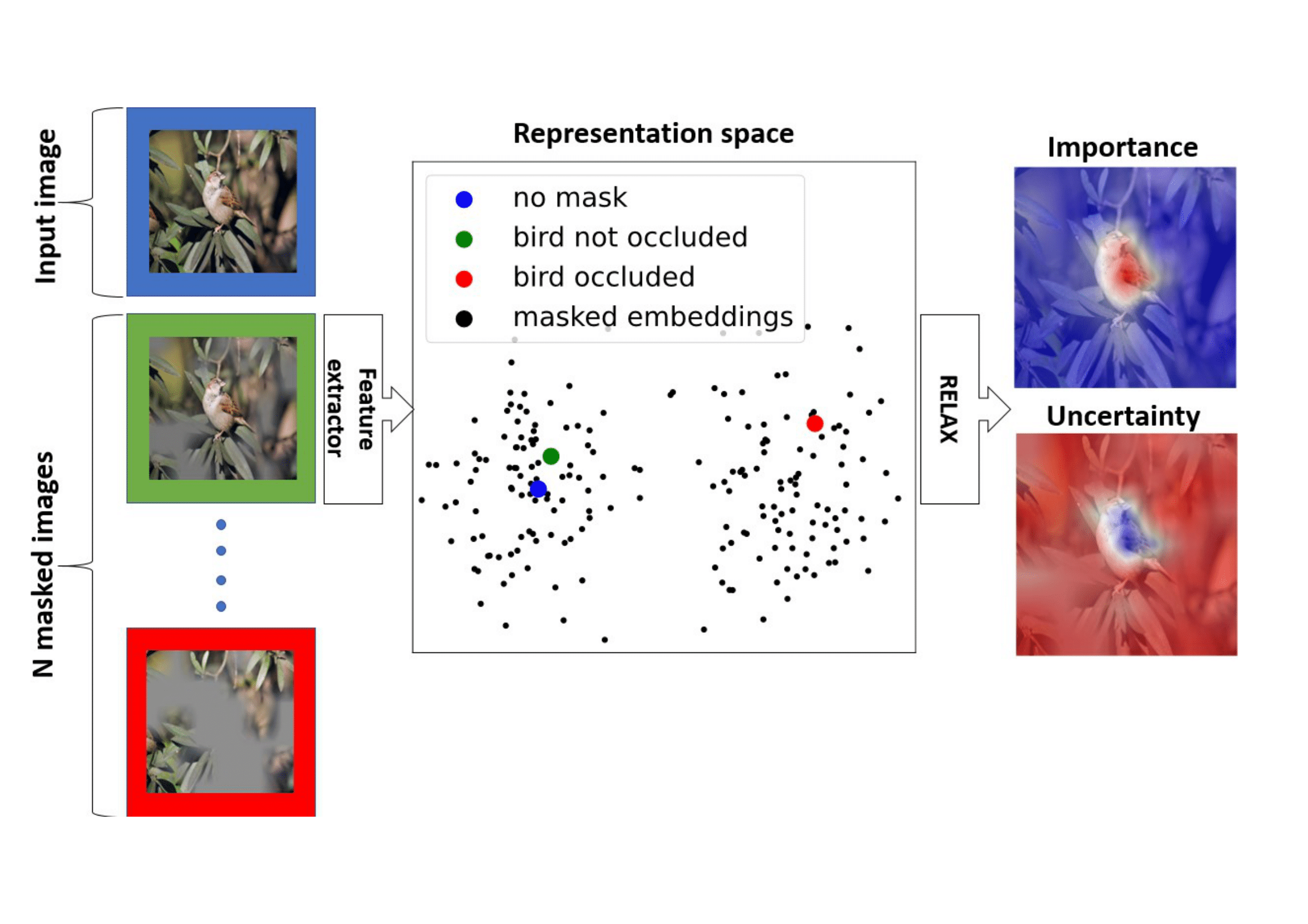
This repository contains code for RELAX, a framework for representation learning explainability. RELAX is based on perturbation-based explainability and works by measuring the change in the representation space as parts of the input are masked out.
When should you use RELAX? If your output is a vector representation and you have no label information.
More information can be found in the paper: RELAX: Representation Learning Explainability Wickstrøm et al., 2023, IJCV, arXiv.
You can see RELAX used in practice in medical image retrieval in the paper: A clinically motivated self-supervised approach for content-based image retrieval of CT liver images Wickstrøm et al., 2023, arXiv.
RELAX can be installed using pip:
pip install relax-xai
This also installs the required dependencies (torch and torchvision). To install the latest version from source:
pip install git+https://github.com/Wickstrom/RELAX.git
Here is a very simple example showing the basic structure for how to use RELAX. The input is assumed to be organized in (channel, height, width)-format, and preprocessed using the Imagenet normalization (for encoders pretrained on Imagenet). The imagenet_image_transforms function also reshapes the image into a square image ((224 x 224) by default) and places the image on the desired device.
import torch
import torchvision
import torch.nn as nn
from relax_xai import RELAX
from relax_xai.utils import imagenet_image_transforms

x = torch.rand(3, 313, 210)  # Generate some random data.
x = imagenet_image_transforms(device="cpu", new_shape_of_image=224)(
    x
)  # Resize image and apply Imagenet normalization.

alexnet = torchvision.models.alexnet()  # Load Alexnet model
encoder = nn.Sequential(
    alexnet.features, alexnet.avgpool, nn.Flatten()
)  # Remove classification head and only keep encoder part.
encoder.eval()  # Put encoder in evaluation mode.


relax = RELAX(x, encoder)  # Initialize RELAX
relax.forward()  # Run RELAX (gradient tracking is disabled internally).

# The importance-heatmap produced by RELAX, and its associated uncertainty, can be
# accessed in relax.importance and relax.uncertainty. Also, an uncertainty-filtered
# version of relax.importance (U-RELAX) can be accessed in relax.u_relax.The notebooks-folder contains a notebook called getting_started_with_relax, where you can test out RELAX. We recommend to use Google Colab with GPU-support enabled to speed up computation: open the notebook in Colab.
There are several hyperparameters that can affect the performance of RELAX. Masking-related hyperparameters are passed as keyword arguments to relax.forward(...).
batch_sizeandnum_batches: The number of masks used is governed by these two parameters. The total number of masks is batch_size*num_batches. Since the default number of masks is high (3000), we need to perform the masking+encoding in a batch-wise manner to avoid out-of-memory issues. The default number of masks is determined using a bound on the estimator of importance (see paper for more details). Reducing eitherbatch_sizeornum_batcheswill make RELAX faster, but could decrease the quality of the explanations.num_cellsandprobability_of_drop: A mask in RELAX is generated following the same procedure as in RISE. In this procedure, an image (num_cellsxnum_cells) smaller than the original image, with each pixel following a Bernoulli distribution withprobability_of_drop, is randomly sampled. The default value fornum_cellsis 7 andprobability_of_dropis 0.5. This is selected with images of size (224 x 224) in mind. This selection can also work okay for images of smaller sizes (112 x 112) or larger size (224 x 224), but for smaller or bigger than this it is likely necessary to tune these hyperparameters.
If you find RELAX interesting and use it in your research, cite it using the BibTeX annotation below (also available as CITATION.cff):
@article{wickstrom2023relax,
  author  = {Wickstr\o{}m, Kristoffer K. and Trosten, Daniel J. and L\o{}kse, Sigurd and Boubekki, Ahc\`{e}ne and Mikalsen, Karl \o{}yvind and Kampffmeyer, Michael C. and Jenssen, Robert},
  title   = {RELAX: Representation Learning Explainability},
  journal = {International Journal of Computer Vision},
  year    = {2023},
  volume  = {131},
  number  = {6},
  pages   = {1584–1610},
  doi     = {https://doi.org/10.1007/s11263-023-01773-2}
}Contributions are welcome! See CONTRIBUTING.md for how to set up a development environment and the release process.
RELAX is released under the MIT License.