English | 简体中文



Continuum lets an Elixir function survive your application crashing halfway through it.
defrun(%{order_id: id,items: items})do{:ok,validated}=activityValidation.check(items){:ok,charge}=activityPayments.charge(id,validated.total)# ─── kill -9 the entire VM right here ───{:ok,shipment}=activityFulfillment.ship(id){:ok,%{charge: charge,shipment: shipment}}endKill the node on that middle line and nothing is lost and nothing is repeated.
The process is gone; the run is not. A new VM picks the run up, executes
run/1 again from the top, replays the charge out of the journal instead of
calling the payment gateway a second time, and carries on into ship.
Continuum is a durable execution engine — Temporal's programming model, but OTP-native and Postgres-backed. No separate cluster service, no paid SaaS dependency, no polyglot SDK. It lives in your application's supervision tree and uses the database you already run.
mix continuum.demo is not a diagram. It runs that workflow against a real
Postgres, and then really kills the BEAM.

What you just watched, in order:
- Start a checkout run.
ChargeCardexecutes and commits its result to the journal.:erlang.halt/1— no graceful shutdown, noterminate/2, no cleanup.- Start a brand new VM.
- Boot recovery and the dispatcher find a run leased by a node that no longer exists.
- The workflow body runs again from its first line — and the charge does not happen again.
ShipOrderruns for the first time, and the run completes.
docker compose up -d # Postgres on localhost:5433
mix continuum.demo # phase 1: charge the card, then kill the VM
mix continuum.demo --resume # phase 2: replay, ship, never re-charge
The same demo as plain text, if your client blocks GIFs
$ mix continuum.demo
── phase 1 — a checkout that dies halfway through ────────────────────
[demo] starting checkout for order #123 (4200 cents)
[continuum] run ac7e3425 started
[workflow] checkout started
[continuum] activity scheduled: ContinuumDemo.ChargeCard.run
[continuum] run ac7e3425 suspended — waiting on durable work
[continuum] activity completed: ContinuumDemo.ChargeCard.run
[workflow] card charged pay_5b1a7dbe
[demo] *** KILLING THE BEAM (erlang:halt/1, no shutdown, no cleanup) ***
[demo] the shipment has not been scheduled — the charge is already journaled
$ mix continuum.demo --resume
── phase 2 — a brand new VM picks the run back up ────────────────────
[continuum] found run ac7e3425 in state=suspended, leased by a node that no longer exists
── continuum_events for run ac7e3425 ─────────────────────────────────
0 18:09:44.495 workflow_log %{message: "checkout started", ...}
1 18:09:44.498 activity_scheduled %{mfa: {ContinuumDemo.ChargeCard, :run, ...}}
2 18:09:45.488 activity_completed %{mfa: {ContinuumDemo.ChargeCard, :run, ...}}
3 18:09:45.505 workflow_log %{message: "card charged pay_5b1a7dbe", ...}
[demo] the charge is already journaled, so replay will not re-run it
[continuum] dispatcher claimed 1 orphaned run(s) — lease had expired
[continuum] run ac7e3425 resumed — replaying its journal from event 0
[continuum] activity scheduled: ContinuumDemo.ShipOrder.run
[continuum] activity completed: ContinuumDemo.ShipOrder.run
[workflow] order shipped ship_c66c1cbb
[continuum] run ac7e3425 completed
[demo] this VM took 1.2s to finish someone else's work
── verdict ───────────────────────────────────────────────────────────
✓ card charged exactly once — 1 CHARGE line(s) in the ledger
✓ order shipped exactly once — 1 SHIP line(s) in the ledger
✓ replay stayed silent — this VM printed 1 workflow log line, not the 3 in the journal
✓ the whole function body ran again, harmlessly — run/1 executed twice;
its side effects executed once each
The function survived the VM dying halfway through it.
The demo's activities append to tmp/continuum_demo/ledger.log, which stands in
for the outside world. That file, not the log lines, is the actual claim:
2026-08-26T18:09:45.486Z CHARGE order=123 payment=pay_5b1a7dbe cents=4200
2026-08-26T18:10:07.132Z SHIP order=123 shipment=ship_c66c1cbb
One CHARGE. ChargeCard deliberately declares no idempotency key, so
nothing deduplicated a second call to the gateway — there was no second call.
Run mix continuum.demo --observer in a second terminal to watch the same
journal fill in through the Observer LiveView while it happens, and
mix continuum.demo --help for the rest. The workflow, the activities, and the
kill switch are about 150 lines in dev/demo/.
run/1 is a pure function of its journal. Every effect — activity,
await signal, timer, Continuum.now/0, even Continuum.log/2 — goes through
one bridge that either replays the recorded result sitting at the current
cursor, or suspends the run to go produce a new one. Re-executing the body
from the top is therefore free of side effects right up to the point where
history ends.
That only holds if the code between effects is deterministic, so Continuum
does not ask you to be careful about it. A compile-time AST scanner rejects
DateTime.utc_now/0, :rand.uniform/0, :ets.*, send/2, File.*, Logger.*
and friends inside workflow code, each with a remediation hint naming the
replacement. Every cursor position also carries a structured identity
({kind, module, function, line, hash, ordinal}), so editing a workflow under a
run that is mid-flight raises a loud Continuum.ReplayDriftError instead of
silently taking a different branch than the one that was journaled.
Postgres is the only moving part — journal, lease store, timer wheel, and signal bus. Every write is a compare-and-set on a fencing token, so a node you thought was dead cannot come back and write into the history of a run somebody else has already taken over.
Continuum is to durable execution what Phoenix is to web and Oban is to job queues: the obvious answer to "how do I run a multi-step business process that survives a crash?" for Elixir-first teams.
- Straight-line code. Express orchestration as ordinary Elixir control
flow —
case,with, comprehensions. Effects go throughactivity/2,await signal, andtimer; everything else is pure. - Deterministic replay. A run re-executes from the top on every wake.
Structured cursor identity means any divergence between replay and the
original execution surfaces as a loud
Continuum.ReplayDriftError, never silent corruption. - One dependency. Postgres is the only thing you need to operate — it is
the journal, the lease store, the timer wheel, and the signal bus
(
LISTEN/NOTIFY). - It's just OTP. Continuum is a supervision tree you add to your own app. Crash recovery, leasing, and back-pressure are built on processes, not an external coordinator.
Deliberately out of scope: polyglot SDKs, cross-language activities, a separate cluster service, and Kubernetes operators.
defmoduleMyApp.OrderFlowdouseContinuum.Workflow,version: 1defrun(%{order_id: id,items: items})do{:ok,validated}=activityValidation.check(items){:ok,charge}=activityPayments.charge(id,validated.total),retry: [max_attempts: 5,backoff: :exponential],compensate: {Payments,:refund,[id]}caseawaitsignal(:fraud_review,timeout: hours(24))do:approved->activityFulfillment.ship(id):rejected->compensate(charge){:error,:fraud_rejected}:timeout->activityFulfillment.ship(id)endendend{:ok,run_id}=Continuum.start(MyApp.OrderFlow,%{order_id: "o1",items: [...]})# from anywhere — durable mailbox, survives restarts:ok=Continuum.signal(run_id,:fraud_review,:approved)# blocks via PubSub with poll fallback{:ok,%{state: :completed,result: result}}=Continuum.await(run_id,30_000)Continuum supports Elixir 1.19 and 1.20. CI exercises the compatibility endpoints on Elixir 1.19 / OTP 27 / PostgreSQL 14 and Elixir 1.20 / OTP 29 / PostgreSQL 18, in addition to scheduled failure-injection lanes.
Add Continuum and a Postgres driver to your dependencies:
defdepsdo[{:continuum,"~> 0.8.1"},{:postgrex,"~> 0.19"}]endPoint Continuum at your repo:
# config/config.exsconfig:continuum,repo: MyApp.Repo,journal: Continuum.Runtime.Journal.PostgresGenerate and run the migration:
mix continuum.gen.migration --repo MyApp.Repo
mix ecto.migrate
Add Continuum's runtime children to your supervision tree, after your repo:
defstart(_type,_args)dochildren=[MyApp.Repo,{Phoenix.PubSub,name: MyApp.PubSub}]++Continuum.children()++[MyAppWeb.Endpoint]Supervisor.start_link(children,strategy: :one_for_one,name: MyApp.Supervisor)end- Workflow code is pure-by-construction and re-executed top-to-bottom on every wake; only effects produce side-visible work.
- A compile-time AST scanner rejects non-deterministic calls
(
DateTime.utc_now,:rand.*,:ets.*,Process.send,Kernel.apply, …) with remediation hints. Helper modules opt in viause Continuum.Pureor aconfig :continuum, trusted_modules: [...]allowlist. - Deterministic primitives —
Continuum.now/0,today/0,uuid4/0,random/0, and theside_effect/1escape hatch — capture stable cursor identity at compile time.
- Postgres journal with lease + fencing-token CAS on every write. A stolen lease produces a write failure and terminates the stale engine — it never corrupts history.
- Activity execution through the built-in worker pool by default, or an
optional
Continuum.Obanexecutor for teams that already operate Oban. Continuum keeps retry/timeout policy, idempotency, and fencing-token commits in its own durable task table either way. - Durable timers and signals over
pg_notify/LISTEN.await signal(name, timeout: ms)resolves the signal/timeout race deterministically. - Crash survival. Kill the engine pid mid-flight; the dispatcher re-leases the run and replay completes from the journaled history. Boot-time recovery rescues orphaned runs, tasks, and timers without stealing live remote leases.
- Cross-run idempotency keyed on
(activity_module, idempotency_key), so activities are exactly-once-ish across runs.
- Sagas / compensation — attach
compensate:to an activity, thencompensate/1orcompensate_all/0to roll back completed work in deterministic LIFO (or parallel) order. - Parent/child workflows —
await child Mod.run(input),start_child/3, andawait_child/1for durable fan-out/fan-in. continue_as_new/1— complete the current run and start a successor with fresh history for long-running loops.- Workflow versioning — journaled
Continuum.patched?/1markers for safe in-place edits, and content-addressed(workflow, version_hash)dispatch that leaves a run suspended when code is missing rather than replaying through changed logic. A node with the matching version can safely resume it later.
Continuum.Observer— an optional Phoenix LiveView with a runs index, a decoded per-run event timeline, and operator actions for cancelling a run and injecting a signal.Continuum.OpenTelemetry— an opt-in bridge that turns Continuum telemetry intorun_attempt/activity_attemptspans, linked back through a persisted W3Ctraceparent.- 24+ documented telemetry events under the
[:continuum, …]prefix. - Operator tooling — monthly-partitioned events, opt-in history snapshots,
the read-only
mix continuum.audit, and dry-run-by-default cleanup tasks.
- Named multi-instance runtimes via
Continuum.children(name:, repo:), each bound to its own Ecto repo. - Namespaces — a soft tenant boundary for list/query; single-run operations
stay keyed by global
run_id. - Search attributes and structured queries —
attributes:/Continuum.set_attributes/3plusContinuum.list_runs/1,2. - Cluster-aware wake routing over
:pgfor cross-node wakeups. The Postgres lease and fencing token remain the sole authority for writes.
Continuum.Test provides an in-memory journal for fast unit tests, Postgres
helpers for integration tests, signal/timer injection, golden-history replay,
and an opt-in paranoid re-replay mode that catches divergence.
defmoduleMyApp.BatchFlowdouseContinuum.Workflow,version: 1defrun(%{order_ids: ids})doids|>Enum.map(fnid->start_childMyApp.OrderFlow,%{order_id: id},id: idend)|>Enum.map(&await_child/1)endendThe optional Continuum.Observer LiveView lists runs, renders the journal
event timeline per run, and includes an operational health panel for
partitions, workflow versions, durable wakes, timers, leases, activities, and
signals. It exposes operator actions for cancelling a run, sending a signal,
and previewing fenced repairs. It is mounted from a host Phoenix router and
ships no authentication of its own — wrap it in your existing admin pipeline.
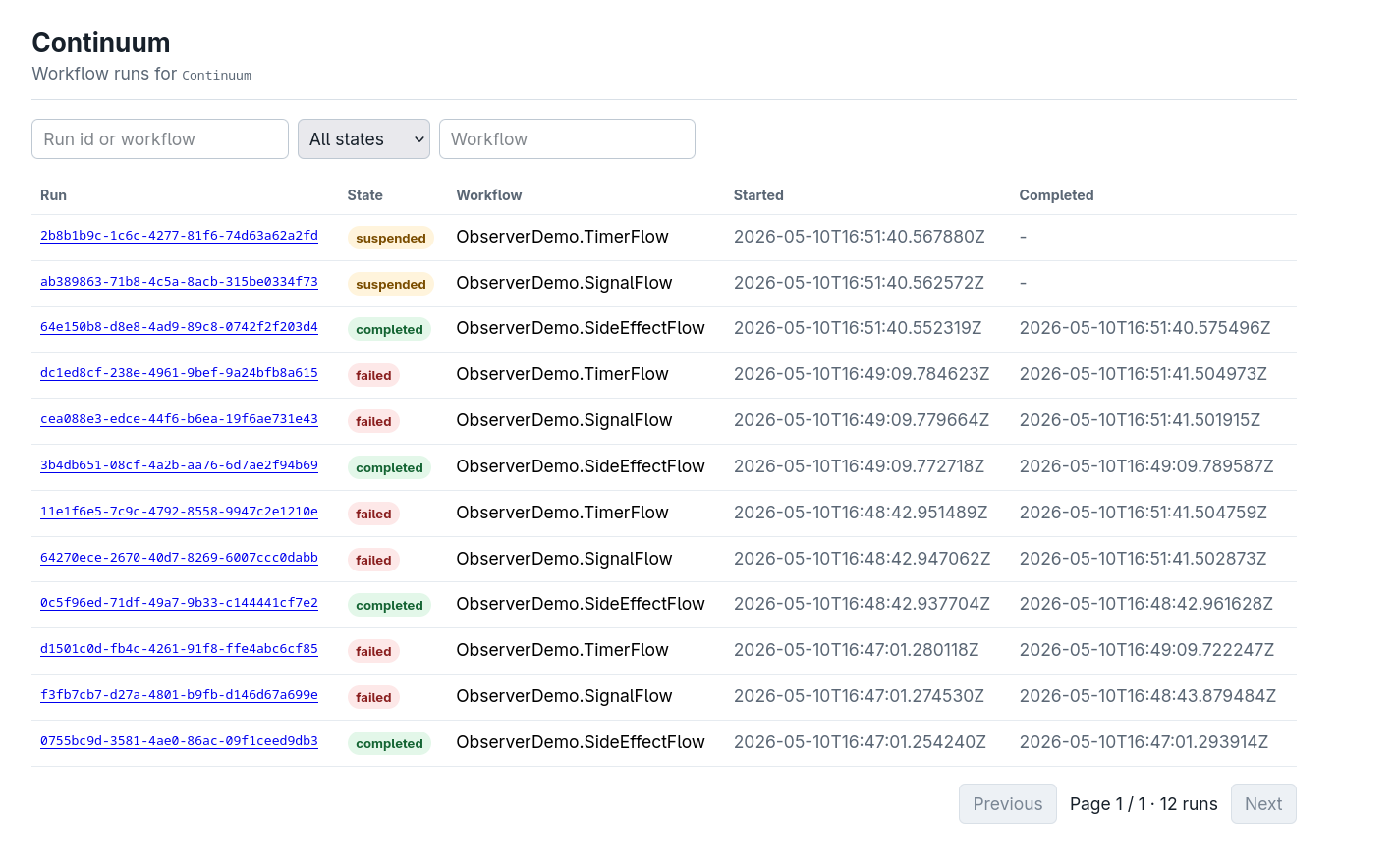
importContinuum.Observer.Routerscope"/admin"dopipe_through[:browser,:authenticate_admin]continuum_observer"/continuum",instance: :myapp_continuumendTo see the UI locally, run the crash demo's read-only Observer node:
docker compose up -d
mix continuum.demo --observer # http://localhost:4000/continuum
Leave it running in one terminal and drive mix continuum.demo /
mix continuum.demo --resume in another: the run appears, stalls with a dead
node's lease on it, and then completes under a different owner. That pane starts
no dispatcher, so it watches rather than resuming the run itself. See
guides/observer.md for production mount instructions.
Full docs are published on HexDocs. The guides cover the entire surface:
- Your first workflow
- Activities, retries, and idempotency · Oban activity executor
- Determinism rules and replay drift
- Sagas and compensation · Child workflows · Long-running workflows
- Patching workflows · Workflow versioning
- Multi-instance Continuum · Clustering · Namespaces
- Search attributes and structured queries
- Operations · Auditing · Observer · Observability (OpenTelemetry) · Snapshots
See examples/continuum_example_orders
for a Phoenix app exercising activity → signal/timeout → compensation,
parent/child batches, continue_as_new, per-workflow snapshots, namespaces,
the Observer, and OpenTelemetry.
Upgrading? See the migration guides.
Continuum is v0.8.1 (pre-1.0). The durable engine, determinism enforcement,
workflow composition, observability, and clustering surface are implemented and
covered by tests, including crash-resume, lease-fencing races, and
property-based replay. APIs may still change before 1.0 — pin to a specific
0.x in production. See CHANGELOG.md for release history.
A docker-compose.yml brings up Postgres for local development and tests.
mix deps.get
docker compose up -d # Postgres on localhost:5433
mix compile --warnings-as-errors
mix test# unit + integration suite
mix test.cluster # real :peer cluster tests (run separately)
mix format
mix continuum.demo --help # the crash-recovery demoCopyright 2026 The Continuum Authors. (yyeger)
Licensed under the Apache License, Version 2.0.