A Software Defined Radio library written in Haskell
See the blog post.
- Write software defined radio applications in Haskell
- Signal processing blocks can be chained together using the Pipes library
- Zero copy design
- Signal processing functions are implemented in both Haskell and C:
- Optimised C implementations of signal processing functions that utilise SIMD instructions
- Performance of Haskell signal processing functions within a factor of 2 of C (without SIMD) thanks to the vector library, stream fusion and ghc's LLVM backend
- Can filter, decimate and resample
- Helper functions for FIR filter design using window functions and plotting of the frequency response
- FFTs using FFTW
- Line and waterfall plots using OpenGL
- FM demodulation
- PulseAudio sound sink
- rtl-sdr and BladeRF based radio sources/sinks supported and other sources are easily added
- Extensive benchmark and test suites of signal processing functions
See sdr-apps for a collection of simple apps built on the library, sdr-demo for a demo application and bladerf-sdr-apps to get started with the BladeRF.
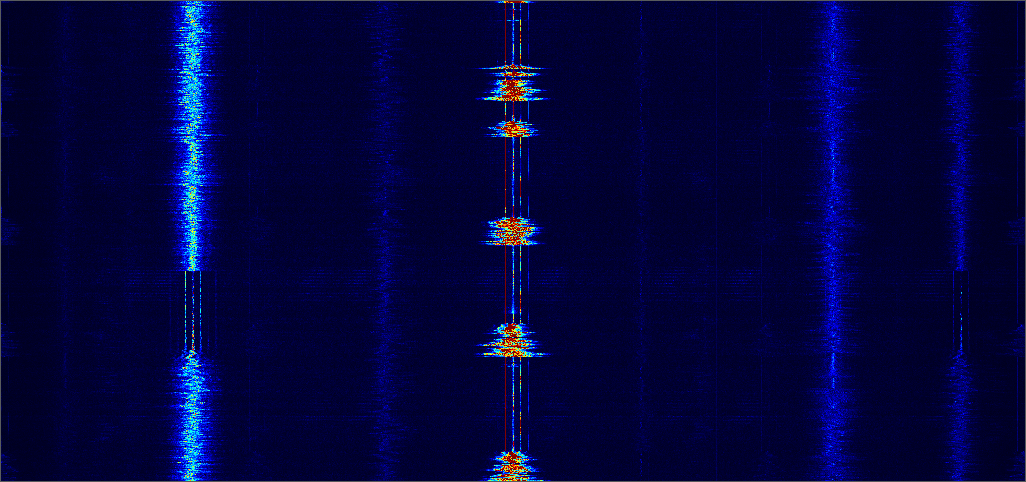
A chunk of the FM broadcast spectrum. Captured with an RTLSDR device and drawn as a waterfall using the Plot module.
This library will only build and run on 64 bit x86 Linux systems.
You can install it from Hackage:
cabal install sdr
If you want to use the BladeRF, you will also need bladerf-pipes and hlibBladeRF.
A collection of simple apps can be found here. These include an FM radio receiver, an OpenGL waterfall plotter and an AM radio receiver that can be used to listen to Airband.
Clone and build:
git clone https://github.com/adamwalker/sdr-apps cd sdr-apps
cabal install
To run the FM receiver:
(Assuming cabal-built binaries are in your path)
fm -f <your favourite station, e.g. 90.2M> To run the waterfall plot:
waterfall -f <center frequency, e.g. 90.2M> -r <sample rate, e.g. 1280M>
To run the AM receiver:
am -f <center frequency, e.g. 124.4M> Documentation is available on Hackage.
An FM receiver:
importControl.Monad.Trans.EitherimportData.Vector.GenericasVGimportPipesimportqualifiedPipes.PreludeasPimportSDR.FilterimportSDR.RTLSDRStreamimportSDR.UtilimportSDR.DemodimportSDR.PulseimportSDR.CPUID--The filter coefficients are stored in another moduleimportCoeffs
samples =8192
frequency =105700000
main = eitherT putStrLnreturn$do
info <- lift getCPUInfo
str <- sdrStream (defaultRTLSDRParams frequency 1280000) 1 (fromIntegral samples *2)
lift $do
sink <- pulseAudioSink
deci <- fastDecimatorC info 8 coeffsRFDecim resp <- fastResamplerR info 310 coeffsAudioResampler
filt <- fastFilterSymR info coeffsAudioFilter
runEffect $ str
>->P.map (interleavedIQUnsignedByteToFloatFast info)
>-> firDecimator deci samples >-> fmDemod
>-> firResampler resp samples >-> firFilter filt samples
>->P.map (VG.map (*0.2)) >-> sinkI started this project to learn about signal processing. I still have no idea what I'm doing.
Only tested on Arch Linux.
If you actually use this library for anything, let me know: adamwalker10@gmail.com