Uh oh!
There was an error while loading. Please reload this page.
Add register_object_store to SessionContext - #55
Conversation
It would be nice to figure out a cleaner abstraction for configuration for the different providers in the Maybe a 3 varant |
matthewmturner
commented
Sep 23, 2022
It's possible things have changed since i was working on the I believe this is needed because you still need to create the Then you could register files like how you showed with A quick peak at the datafusion cookbook example for s3 shows how thats done on the rust side. Take what im saying with a grain of salt though as I havent been as involved lately. |
wseaton
commented
Sep 23, 2022
@matthewmturner I'm not quite sure what changes you are suggesting do you mind elaborating? The PR basically does the equivalent of the cookbook example, except it generates the clients using default credential providers (like ::from_env) and just dispatches based on the URI scheme, this seems like the most straightforward way to do things |
matthewmturner
commented
Sep 23, 2022
@wseaton I thought the function signature would be similar to the rust api. That being said, im not sure how close the existing python function signatures match their equivalent on the rust side so maybe this isnt a design goal of the python bindings. I also think that it would be good to allow users to create |
Yeah, the builder pattern doesn't really map well into Python space. I'll try to do some research to see how it's done elsewhere
MinIO and Ceph (which I need as well) should be supported by setting |
matthewmturner
commented
Sep 23, 2022
Agree on the builder pattern not mapping as well to python. I was focusing more on the signature for If I recall correctly some of the read options and other configs that are used with session context also use builder pattern and its possible some of those are already exposed in our python bindings somewhere and maybe their implementation could be used as inspiration for how to approach creating object store. |
register_object_store to SessionContextregister_object_store to SessionContextturbo1912
commented
Sep 23, 2022
@wseaton have you seen https://github.com/roeap/object-store-python (cc: @roeap) ? Looks like not not all services are fully supported yet, but this project can be used to construct an |
wseaton
commented
Sep 23, 2022
@turbo1912 oh wow! thanks for the heads up, I had just refactored to remove the parse redundancy to externalize some of the config and am catching up on this. It looks like |
The new api from the last commit looks like this: fromdatafusion.storeimportAmazonS3s3=AmazonS3(region="us-west-2", bucket_name="my_bucket", endpoint="https://myendpoint.url")
ctx.register_object_store("s3", "my_bucket", s3)@matthewmturner is this closer to what you were thinking? |
matthewmturner
commented
Sep 23, 2022
@wseaton yes! exactly what i had in mind. a nit would be to have it |
wseaton
commented
Sep 23, 2022
@matthewmturner it'd be pretty easy to do cargo features on our side as each provider is gated behind an |
matthewmturner
commented
Sep 23, 2022
ah thats unfortunate. i suppose the alternative would be a totally separate object_store module but im not even sure that would solve it. do you have an idea how large this makes the datafusion python package? last i checked it was quite large because it was datafusion + pyarrow (which is large) and now were adding the full object_store crate. |
wseaton
commented
Sep 23, 2022
Not sure how scientific this is (just output from Before:Release:Debug:After:Release build:Debug build: |
matthewmturner
commented
Sep 23, 2022
I was referring more to the size after installing the wheel. for example, right now when i pip install datafusion it comes out to 141mb (datafusion itself is only 25mb and the remainder is pyarrow / numpy). so im curious how big datafusion will be now with full featured object store bundled with it. |
wseaton
commented
Sep 26, 2022
@matthewmturner honestly not quite sure how to emulate those numbers locally, when I build with So anywhere from 5-20% bigger would be my guess. Including object storage drivers seems like a good idea and is basically standard for other tools like spark who bundle them with their distributions WRT hadoop (which is in the hundreds of megabytes) |
register_object_store to SessionContextregister_object_store to SessionContextwseaton
commented
Sep 26, 2022
In addition to unifying the API, I also made |
wseaton
commented
Oct 10, 2022
@francis-du@andygrove is there a chance this can get in w/ the 13.0.0 release? |
francis-du
commented
Oct 10, 2022
I think it's okay, but it depends on Andy. |
francis-du
commented
Oct 12, 2022
@wseaton Hi Will, I think you have a |
wseaton
commented
Oct 13, 2022
@francis-du should be good now, lmk how you want to handle the lock conflict |
francis-du
commented
Oct 13, 2022
I usually rebase locally with master branch. |
andygrove
commented
Oct 13, 2022
I would love to release a new version of the Python bindings soon but could use some help. I am not familiar with releasing Python packages. Here is the issue to track releasing the next version (0.7.0 because the version numbers for the Python bindings are independent of the DataFusion version) |
@francis-du should be good now edit: rebasing again after #61 |
francis-du
commented
Oct 13, 2022
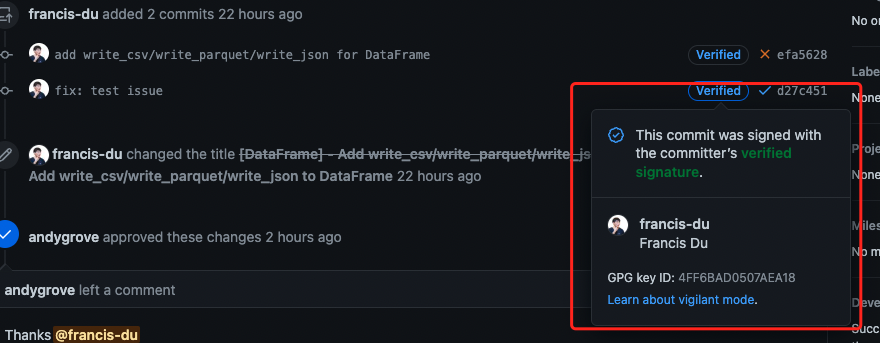
Hi Will. There is a good practice to share with you. If you don't like waiting for maintainers to approval your commit,you can try adding GPG validation. your commit will trigger the CI directly. Like this:
|
wseaton
commented
Oct 13, 2022
@francis-du ah great, I didn't realize it was commit verification that disabled the CI. I'll be sure to set that up for future contributions. |
isidentical
commented
Oct 20, 2022
This PR looks pretty straightforward, amazing work @wseaton 🎊 On the question of testing, another relatively simple approach might be using |
andygrove
commented
Oct 25, 2022
wseaton
commented
Oct 25, 2022
@andygrove done. I can also work on @isidentical's suggestions for testing the |
Related to #22
With this function added I can now (with the proper environment set):
I'm currently unable to test the
gcpintegration, may need some help there.