Uh oh!
There was an error while loading. Please reload this page.
[SPARK-25108][SQL] Fix the show method to display the wide character alignment problem - #22048
[SPARK-25108][SQL] Fix the show method to display the wide character alignment problem#22048xuejianbest wants to merge 11 commits into
Conversation
before:
+---+---------------------------+-------------+
|id |中国 |s2 |
+---+---------------------------+-------------+
|1 |ab |[a] |
|2 |null |[中国, abc] |
|3 |ab1 |[hello world]|
|4 |か行 きゃ(kya) きゅ(kyu) きょ(kyo) |[“中国] |
|5 |中国(你好)a |[“中(国), 312] |
|6 |中国山(东)服务区 |[“中(国)] |
|7 |中国山东服务区 |[中(国)] |
|8 | |[中国] |
+---+---------------------------+-------------+
after:
+---+--------------------------+----------------+
| id| 中国| s2|
+---+--------------------------+----------------+
| 1| ab| [a]|
| 2| null| [中国, abc]|
| 3| ab1| [hello world]|
| 4|か行 きゃ(kya) きゅ(kyu...| [“中国]|
| 5| 中国(你好)a|[“中(国), 312]|
| 6| 中国山(东)服务区| [“中(国)]|
| 7| 中国山东服务区| [中(国)]|
| 8| | [中国]|
+---+--------------------------+----------------+
kiszk
commented
Aug 9, 2018
Since this change does not look minor, could you please create a JIRA entry? |
kiszk
commented
Aug 9, 2018
I created a PR to solve the same problem. |
After testing, it is found that regular expressions are changed to the following. @kiszk |
kiszk
commented
Aug 13, 2018
@xuejianbest Could you please create a JIRA entry and add test cases to this PR? |
xuejianbest
commented
Aug 14, 2018
Below is the display effect I tested on Xshell5. |
xuejianbest
commented
Aug 14, 2018

kiszk
commented
Aug 17, 2018
Thank you for creating a JIRA entry and for putting the result. The test case is not available yet. |
| // We set a minimum column width at '3' | ||
| val minimumColWidth = 3 | ||
| val regex = """[^\x00-\u2e39]""".r |
There was a problem hiding this comment.
This could use a comment and slightly better name for the variable? I also wonder if a regex is a little bit slow for scanning every character.
However it's not clear this definition is accurate enough. According to things like https://stackoverflow.com/questions/13505075/analyzing-full-width-or-half-width-character-in-java we're really looking for the concept of "fullwidth" East Asian characters. The answer there provides a somewhat more precise definition, though others say you need something like icu4j for a proper definition.
Maybe at least adopt the alternative proposed in the SO answer? It's not necessary to be perfect here, as it's a cosmetic issue.
There was a problem hiding this comment.
I agree with @srowen's comment. To make it clear, could you please add tests for more characters?
srowen
commented
Aug 26, 2018
Ping @xuejianbest |
Modify regular expressions to make them more precise.
Modify variable names and add comment.
xuejianbest
commented
Aug 28, 2018
I looked at all the 0x0000-0xFFFF characters (unicode) and showed them under Xshell, then found all the full width characters. Get the latest regular expression. A new version is submitted, and the variable name is changed and an annotation is added. See below. |
kiszk
commented
Aug 28, 2018
@xuejianbest thank you for your update. Would it be possible to commit test cases, too? |
| // We set a minimum column width at '3' | ||
| val minimumColWidth = 3 | ||
| //Regular expression matching full width characters |
There was a problem hiding this comment.
Very small nit that might fail scalastyle -- space after comment slashes
| val minimumColWidth = 3 | ||
| //Regular expression matching full width characters | ||
| val fullWidthRegex = """[\u1100-\u115F\u2E80-\uA4CF\uAC00-\uD7A3\uF900-\uFAFF\uFE10-\uFE19\uFE30-\uFE6F\uFF00-\uFF60\uFFE0-\uFFE6]""".r |
There was a problem hiding this comment.
I wonder if detecting this using a regex for each character is slow? probably not meaningfully enough to care about, but I wonder.
There was a problem hiding this comment.
I generated 1000 strings, each consisting of 1000 characters with a random unicode of 0x0000-0xFFFF. (a total of 1 million characters.)
Then use this regular expression to find the full width character of these strings.
I tested 100 rounds and then averaged.
It takes 49 milliseconds to complete matching all 1000 strings.
| for (row <- rows) { | ||
| for ((cell, i) <- row.zipWithIndex) { | ||
| colWidths(i) = math.max(colWidths(i), cell.length) | ||
| colWidths(i) = math.max(colWidths(i), cell.length + fullWidthRegex.findAllIn(cell).size) |
There was a problem hiding this comment.
What about a utility method for the x.length + fullWidthRegex.findAllIn(x).size expression that recurs here?
There was a problem hiding this comment.
I committed a new version. See if this is appropriate please ?
@srowen
Putting `fullWidthRegex` outside `stringHalfWidth` is to reduce the cost of compiling regular expressions.
Since compilation is expensive, frequently used Regexes should be constructed once.
| // The number of half width of a string | ||
| def stringHalfWidth = (str: String) => { | ||
| str.length + fullWidthRegex.findAllIn(str).size | ||
| } |
There was a problem hiding this comment.
better to move this method into util.Utils or something as a helper function?
There was a problem hiding this comment.
better to add tests for the helper function, too.
There was a problem hiding this comment.
Moved it into util.Utils.
| val minimumColWidth = 3 | ||
| // Regular expression matching full width characters | ||
| val fullWidthRegex = """[\u1100-\u115F\u2E80-\uA4CF\uAC00-\uD7A3\uF900-\uFAFF\uFE10-\uFE19\uFE30-\uFE6F\uFF00-\uFF60\uFFE0-\uFFE6]""".r |
Move the stringHalfWidth method into util.Utils and add tests for it.
xuejianbest
commented
Aug 29, 2018
| * A full width character occupies two half widths | ||
| */ | ||
| def stringHalfWidth(str: String): Int = { | ||
| if(str == null) 0 else str.length + fullWidthRegex.findAllIn(str).size |
| /** | ||
| * Regular expression matching full width characters | ||
| */ | ||
| private lazy val fullWidthRegex = ("""[""" + |
Uh oh!
There was an error while loading. Please reload this page.
Uh oh!
There was an error while loading. Please reload this page.
maropu
commented
Aug 29, 2018
Also, can you add tests in |
Uh oh!
There was an error while loading. Please reload this page.
Uh oh!
There was an error while loading. Please reload this page.
SparkQA
commented
Aug 30, 2018
Test build #4305 has finished for PR 22048 at commit
|
xuejianbest
commented
Aug 31, 2018
Why did it fail? |
xuejianbest
commented
Aug 31, 2018
Please help me @srowen |
srowen
commented
Aug 31, 2018
Have a look at the test results, which show the style problem it flags: So it doesn't like non-ASCII chars after all! I wonder how they exist in the other parts of the source. I checked and other parts just disable the check for sections of code where it's appropriate to use unicode chars. Just wrap these parts of the code in: Sorry, didn't know this was needed. |
maropu
commented
Aug 31, 2018
style errors, we cannot include non-ascii characters in files; |
maropu
commented
Aug 31, 2018
+1 for adding |
To solve style errors because of include non-ascii characters in files.
Disable the check for sections of code where it's appropriate to use unicode chars.
xuejianbest
commented
Aug 31, 2018
I see. A new commit has been done. |
kiszk
commented
Aug 31, 2018
retest this please |
srowen
commented
Aug 31, 2018
Hm! so the warning triggers on unicode escape sequences? That seems like a bug in the style checker. Oh well, yes keep them. I'll retest ... |
SparkQA
commented
Aug 31, 2018
Test build #4329 has finished for PR 22048 at commit
|
kiszk
commented
Aug 31, 2018
LGTM, then let me ask @gatorsmile |
| """\uFE10-\uFE19""" + | ||
| """\uFE30-\uFE6F""" + | ||
| """\uFF00-\uFF60""" + | ||
| """\uFFE0-\uFFE6""" + |
There was a problem hiding this comment.
A general question.
- How to get this Regex list? Any reference? It sounds like this should be a general problem
- What is the performance impact?
Can you answer them and post them in the PR description?
There was a problem hiding this comment.
- How to get this Regex list? Any reference? It sounds like this should be a general problem
I looked at all the 0x0000-0xFFFF characters (unicode) and showed them under Xshell, then found all the full width characters. Get the regular expression.
- What is the performance impact?
I generated 1000 strings, each consisting of 1000 characters with a random unicode of 0x0000-0xFFFF. (a total of 1 million characters.)
Then use this regular expression to find the full width character of these strings.
I tested 100 rounds and then averaged.
It takes 49 milliseconds to complete matching all 1000 strings.
There was a problem hiding this comment.
I looked at all the 0x0000-0xFFFF characters (unicode) and showed them under Xshell, then found all the full width characters. Get the regular expression.
Can you describe them there and put a references to a public unicode document?
See the comment in UTF8String;
https://github.com/apache/spark/blob/master/common/unsafe/src/main/java/org/apache/spark/unsafe/types/UTF8String.java#L65
It takes 49 milliseconds to complete matching all 1000 strings.
How about some additional overheads when calling showString as compared to showString w/o this patch?
There was a problem hiding this comment.
Can you describe them there and put a references to a public unicode document?
This is a regular expression match using unicode, regardless of the specific encoding.
For example, the following string is encoded using gbk instead of utf8, and the match still works:
valbytes=Array[Byte](0xd6.toByte, 0xd0.toByte, 0xB9.toByte, 0xFA.toByte)
vals1=newString(bytes, "gbk") println(s1) //中国 valfullWidthRegex= ("""["""+// scalastyle:off nonascii"""\u1100-\u115F"""+"""\u2E80-\uA4CF"""+"""\uAC00-\uD7A3"""+"""\uF900-\uFAFF"""+"""\uFE10-\uFE19"""+"""\uFE30-\uFE6F"""+"""\uFF00-\uFF60"""+"""\uFFE0-\uFFE6"""+// scalastyle:on nonascii"""]""").r
println(fullWidthRegex.findAllIn(s1).size) //2
This regular expression is obtained experimentally under a specific font.
I don't understand what you are going to do.
How about some additional overheads when calling showString as compared to showString w/o this patch?
I tested a Dataset consisting of 100 rows, each row has two columns, one column is the index (0-99), and the other column is a random string of length 100 characters, and then the showString display is called separately.
The original showString method (w/o this patch) took about 42ms, and the improved time took about 46ms, and the performance was about 10% worse.
There was a problem hiding this comment.
I think this is fine. Just copy a summary of your comments here into the comments in the code. Yes this has nothing to do with UTF8 encoding directly. You are matching UCS2 really, 16bit char values.
There was a problem hiding this comment.
Do I need to merge the above commited into one commit,
Or add another new commit?
Or change the last commit comments ?
@srowen
srowen
commented
Sep 4, 2018
Just add a new commit with a little info about what this does and how you generated it. The commits are squashed anyway. |
…blem
Some characters (called full-width characters) occupy two
ordinary characters (called half-width characters) width
when displayed in a terminal such as Xshell.
Therefore, when the Dataset.show() method is called,
if there are full-width characters and half-width characters
at the same time, alignment problems will occur.
This commit adds a method to calculate the number of half
widths in a given string, so that it can get the correct fill
when calling show method, which gives the display a more
perfect alignment.
Performance impact:
Tested a Dataset consisting of 100 rows, each row has two columns,
one column is the index (0-99), and the other column is a random
string of length 100 characters, and then the showString display
is called separately.
The original show method (w/o this patch) took about 42ms, and the
improved time took about 46ms, the performance was about 10% worse.
xuejianbest
commented
Sep 4, 2018
I see, Thinks. |
srowen
commented
Sep 6, 2018
Merging to master and 2.4, though for some reason I can't back-port with the merge script right now. Will try later. |
srowen
commented
Sep 6, 2018
@dongjoon-hyun could I ask a favor; can you try merging this? the merge script should say it's merged and offer to back-port to 2.4. However I keep getting errors about it not being mergeable, although all upstream branches and my clone all are up to date. |
dongjoon-hyun
commented
Sep 6, 2018
@srowen . Sure. I'll try to backport this. |
dongjoon-hyun
commented
Sep 6, 2018
Ur, it seems that I'm facing the same situation. In this case, should we just cherry-pick to |
…alignment problem This is not a perfect solution. It is designed to minimize complexity on the basis of solving problems. It is effective for English, Chinese characters, Japanese, Korean and so on. ```scala before: +---+---------------------------+-------------+ |id |中国 |s2 | +---+---------------------------+-------------+ |1 |ab |[a] | |2 |null |[中国, abc] | |3 |ab1 |[hello world]| |4 |か行 きゃ(kya) きゅ(kyu) きょ(kyo) |[“中国] | |5 |中国(你好)a |[“中(国), 312] | |6 |中国山(东)服务区 |[“中(国)] | |7 |中国山东服务区 |[中(国)] | |8 | |[中国] | +---+---------------------------+-------------+ after: +---+-----------------------------------+----------------+ |id |中国 |s2 | +---+-----------------------------------+----------------+ |1 |ab |[a] | |2 |null |[中国, abc] | |3 |ab1 |[hello world] | |4 |か行 きゃ(kya) きゅ(kyu) きょ(kyo) |[“中国] | |5 |中国(你好)a |[“中(国), 312]| |6 |中国山(东)服务区 |[“中(国)] | |7 |中国山东服务区 |[中(国)] | |8 | |[中国] | +---+-----------------------------------+----------------+ ``` ## What changes were proposed in this pull request? When there are wide characters such as Chinese characters or Japanese characters in the data, the show method has a alignment problem. Try to fix this problem. ## How was this patch tested? (Please explain how this patch was tested. E.g. unit tests, integration tests, manual tests) 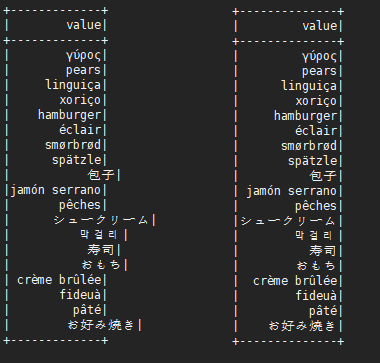 Please review http://spark.apache.org/contributing.html before opening a pull request. Closes#22048 from xuejianbest/master. Authored-by: xuejianbest <384329882@qq.com> Signed-off-by: Sean Owen <sean.owen@databricks.com>

srowen
commented
Sep 6, 2018
OK, it isn't just me. We'll see if it's a broader problem. I manually cherry-picked to branch-2.4 |
This is not a perfect solution. It is designed to minimize complexity on the basis of solving problems.
It is effective for English, Chinese characters, Japanese, Korean and so on.
What changes were proposed in this pull request?
When there are wide characters such as Chinese characters or Japanese characters in the data, the show method has a alignment problem.
Try to fix this problem.
How was this patch tested?
(Please explain how this patch was tested. E.g. unit tests, integration tests, manual tests)
Please review http://spark.apache.org/contributing.html before opening a pull request.