Skip to content

Build Status

AWS X-Ray SDK for Ruby (beta)

📣 Upcoming Maintenance Mode on February 25, 2026

The AWS X-Ray SDKs will enter maintenance mode on February 25, 2026. During maintenance mode, the X-Ray SDKs and Daemon will only receive critical bug fixes and security updates, and will not be updated to support new features.

We recommend that you migrate to AWS Distro for OpenTelemetry (ADOT) or OpenTelemetry Instrumentation to generate traces (through manual or zero-code instrumentation) from your application and send them to AWS X-Ray. OpenTelemetry is the industry-wide standard for tracing instrumentation and observability. It has a large open-source community for support and provides more instrumentations and updates. By adopting an OpenTelemetry solution, developers can leverage the latest services and innovations from AWS CloudWatch.


OpenTelemetry Ruby with AWS X-Ray

AWS X-Ray supports using OpenTelemetry Ruby and the AWS Distro for OpenTelemetry (ADOT) Collector to instrument your application and send trace data to X-Ray. The OpenTelemetry SDKs are an industry-wide standard for tracing instrumentation. They provide more instrumentations and have a larger community for support, but may not have complete feature parity with the X-Ray SDKs. See choosing between the ADOT and X-Ray SDKs for more help with choosing between the two. Note that using OpenTelemetry Ruby and ADOT is in public preview, and like this SDK in beta, is not recommended for production applications.

If you want additional features when tracing your Ruby applications, please open an issue on the OpenTelemetry Ruby Instrumentation repository.
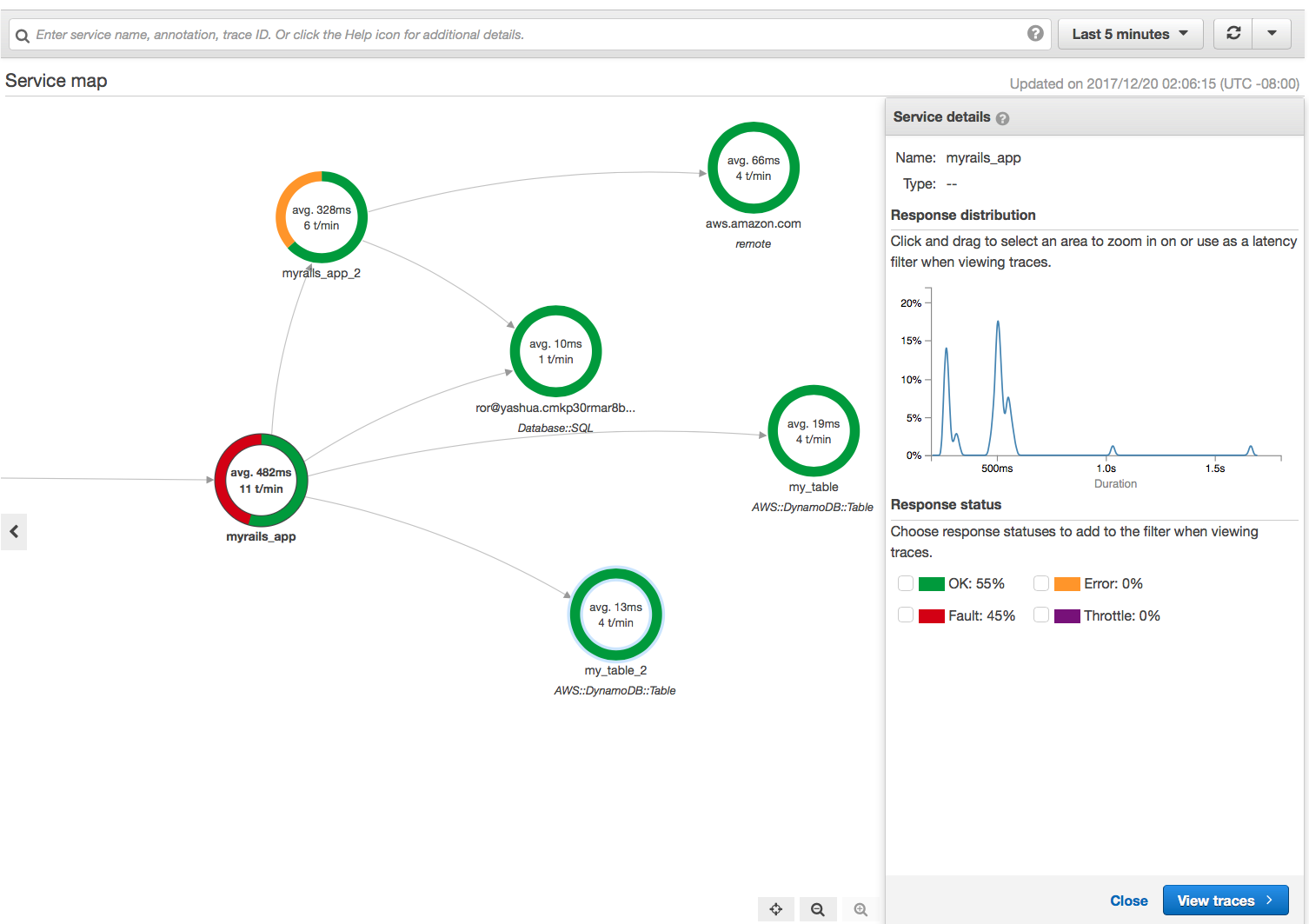

Screenshot of the AWS X-Ray console

Installing

The AWS X-Ray SDK for Ruby is compatible with Ruby 2.3.6 and newer Ruby versions. It has experimental support for JRuby 9.2.0.0 (still forthcoming).

To install the Ruby gem for your project, add it to your project Gemfile. You must also add either the Oj or JrJackson gems, for MRI and JRuby respectively, for JSON parsing. The default JSON parser will not work properly, currently.

# Gemfile
gem 'aws-xray-sdk'
gem 'oj', platform: :mri
gem 'jrjackson', platform: :jruby

Then run bundle install.

Getting Help

Use the following community resources for getting help with the SDK. We use the GitHub issues for tracking bugs and feature requests.

Opening Issues

If you encounter a bug with the AWS X-Ray SDK for Ruby, we want to hear about it. Before opening a new issue, search the existing issues to see if others are also experiencing the issue. Include the version of the AWS X-Ray SDK for Ruby, Ruby language, and other gems if applicable. In addition, include the repro case when appropriate.

The GitHub issues are intended for bug reports and feature requests. For help and questions about using the AWS SDK for Ruby, use the resources listed in the Getting Help section. Keeping the list of open issues lean helps us respond in a timely manner.

Documentation

The developer guide provides in-depth guidance about using the AWS X-Ray service. The API Reference provides documentation for public APIs of all classes in the SDK.

Quick Start

Configuration

require'aws-xray-sdk'# For configuring sampling rules through X-Ray service# please see https://docs.aws.amazon.com/xray/latest/devguide/xray-console-sampling.html.# The doc below defines local fallback sampling rules which has lower priority.my_sampling_rules={version: 2,rules: [{description: 'healthcheck',host: '*',http_method: 'GET',url_path: '/ping',fixed_target: 0,rate: 0}],default: {fixed_target: 1,rate: 0.2}}user_config={sampling: true,sampling_rules: my_sampling_rules,name: 'default_segment_name',daemon_address: '127.0.0.1:3000',context_missing: 'LOG_ERROR',patch: %I[net_httpaws_sdk]}XRay.recorder.configure(user_config)

Working with Lambda

# Bundle aws-xray-sdk with your code.# Require any aws-sdks and http libraries to be used, then...require'aws-xray-sdk/lambda'# aws-sdk and http calls from here on will be instrumented

See also lib/aws-xray-sdk/lambda.rb

Working with Rails

# Edit Gemfile to add XRay middlewaregem'aws-xray-sdk',require: ['aws-xray-sdk/facets/rails/railtie']# Configure the recorder in app_root/config/initializers/aws_xray.rbRails.application.config.xray={# default segment name generated by XRay middlewarename: 'myrails',patch: %I[net_httpaws_sdk],# record db transactions as subsegmentsactive_record: true}

Adding metadata/annotations using recorder

require'aws-xray-sdk'# Add annotations to the current active entityXRay.recorder.annotations[:k1]='v1'XRay.recorder.annotations.updatek2: 'v2',k3: 3# Add metadata to the current active entityXRay.recorder.metadata[:k1]='v1'# add to default namespaceXRay.recorder.metadata(namespace: :my_ns).updatek2: 'v2'XRay.recorder.sampled?doXRay.recorder.metadata.updatemy_meta# expensive metadata generation hereend

Capture

require'aws-xray-sdk'XRay.recorder.capture('name_for_subsegment')do |subsegment|
resp=myfunc()subsegment.annotations.updatek1: 'v1'respend# Manually apply the parent segment for the captured subsegmentXRay.recorder.capture('name_for_subsegment',segment: my_segment)do |subsegment|
myfunc()end

Thread Injection

require'aws-xray-sdk'XRay.recorder.configure({patch: %I[net_http]})uri=URI.parse('http://aws.amazon.com/')# Get the active entity from current call contextentity=XRay.recorder.current_entityworkers=(0...3).mapdoThread.newdobegin# set X-Ray context for this threadXRay.recorder.inject_contextentitydohttp=Net::HTTP.new(uri.host,uri.port)http.request(Net::HTTP::Get.new(uri.request_uri))endrescueThreadErrorendendendworkers.map(&:join)

Start a custom segment/subsegment

require'aws-xray-sdk'# Start a segmentsegment=XRay.recorder.begin_segment'my_service'# Start a subsegmentsubsegment=XRay.recorder.begin_subsegment'outbound_call',namespace: 'remote'# Add metadata or annotation here if necessarymy_annotations={k1: 'v1',k2: 1024}segment.annotations.updatemy_annotations# Add metadata to default namespacesubsegment.metadata[:k1]='v1'# Set user for the segment (subsegment is not supported)segment.user='my_name'# End segment/subsegmentXRay.recorder.end_subsegmentXRay.recorder.end_segment

License

The AWS X-Ray SDK for Ruby is licensed under the Apache 2.0 License. See LICENSE and NOTICE for more information.

About

The official AWS X-Ray Recorder SDK for Ruby

Resources

Code of conduct

Contributing

Security policy

Stars

60 stars

Watchers

17 watching

Forks

Releases

Packages

Used by

Contributors

Languages

, 'i'); if (__m === '*' || __re.test(location.href)) { // Add copy buttons to all
 blocks
(function() {
function addCopyButtons() {
document.querySelectorAll('pre code').forEach(function(codeBlock) {
if (codeBlock.parentElement.hasAttribute('data-copy-added')) return;
codeBlock.parentElement.setAttribute('data-copy-added', 'true');
var btn = document.createElement('button');
btn.textContent = 'Copy';
btn.style.cssText = 'position:absolute;top:4px;right:4px;padding:2px 8px;font-size:11px;background:#4ecdc4;border:none;border-radius:4px;color:#1a1a2e;cursor:pointer;opacity:0.7;transition:opacity 0.2s;';
btn.onmouseover = function() { this.style.opacity = '1'; };
btn.onmouseout = function() { this.style.opacity = '0.7'; };
btn.onclick = function() {
navigator.clipboard.writeText(codeBlock.textContent).then(function() {
btn.textContent = 'Copied!';
setTimeout(function() { btn.textContent = 'Copy'; }, 1500);
});
};
codeBlock.parentElement.style.position = 'relative';
codeBlock.parentElement.appendChild(btn);
});
}
addCopyButtons();
// Re-run on dynamic content
var observer = new MutationObserver(addCopyButtons);
observer.observe(document.body, { childList: true, subtree: true });
})();
}
} catch(__e) { console.warn('[Userscript:Add Copy Buttons to Code Blocks]', __e); }
})();
(function(){
try {
var __m = "github.com";
var __re = new RegExp('^' + "github\\.com" + '
GitHub - aws/aws-xray-sdk-ruby: The official AWS X-Ray Recorder SDK for Ruby · GitHub
Skip to content

Build Status

AWS X-Ray SDK for Ruby (beta)

📣 Upcoming Maintenance Mode on February 25, 2026

The AWS X-Ray SDKs will enter maintenance mode on February 25, 2026. During maintenance mode, the X-Ray SDKs and Daemon will only receive critical bug fixes and security updates, and will not be updated to support new features.

We recommend that you migrate to AWS Distro for OpenTelemetry (ADOT) or OpenTelemetry Instrumentation to generate traces (through manual or zero-code instrumentation) from your application and send them to AWS X-Ray. OpenTelemetry is the industry-wide standard for tracing instrumentation and observability. It has a large open-source community for support and provides more instrumentations and updates. By adopting an OpenTelemetry solution, developers can leverage the latest services and innovations from AWS CloudWatch.


OpenTelemetry Ruby with AWS X-Ray

AWS X-Ray supports using OpenTelemetry Ruby and the AWS Distro for OpenTelemetry (ADOT) Collector to instrument your application and send trace data to X-Ray. The OpenTelemetry SDKs are an industry-wide standard for tracing instrumentation. They provide more instrumentations and have a larger community for support, but may not have complete feature parity with the X-Ray SDKs. See choosing between the ADOT and X-Ray SDKs for more help with choosing between the two. Note that using OpenTelemetry Ruby and ADOT is in public preview, and like this SDK in beta, is not recommended for production applications.

If you want additional features when tracing your Ruby applications, please open an issue on the OpenTelemetry Ruby Instrumentation repository.


Screenshot of the AWS X-Ray console

Installing

The AWS X-Ray SDK for Ruby is compatible with Ruby 2.3.6 and newer Ruby versions. It has experimental support for JRuby 9.2.0.0 (still forthcoming).

To install the Ruby gem for your project, add it to your project Gemfile. You must also add either the Oj or JrJackson gems, for MRI and JRuby respectively, for JSON parsing. The default JSON parser will not work properly, currently.

# Gemfile
gem 'aws-xray-sdk'
gem 'oj', platform: :mri
gem 'jrjackson', platform: :jruby

Then run bundle install.

Getting Help

Use the following community resources for getting help with the SDK. We use the GitHub issues for tracking bugs and feature requests.

Opening Issues

If you encounter a bug with the AWS X-Ray SDK for Ruby, we want to hear about it. Before opening a new issue, search the existing issues to see if others are also experiencing the issue. Include the version of the AWS X-Ray SDK for Ruby, Ruby language, and other gems if applicable. In addition, include the repro case when appropriate.

The GitHub issues are intended for bug reports and feature requests. For help and questions about using the AWS SDK for Ruby, use the resources listed in the Getting Help section. Keeping the list of open issues lean helps us respond in a timely manner.

Documentation

The developer guide provides in-depth guidance about using the AWS X-Ray service. The API Reference provides documentation for public APIs of all classes in the SDK.

Quick Start

Configuration

require'aws-xray-sdk'# For configuring sampling rules through X-Ray service# please see https://docs.aws.amazon.com/xray/latest/devguide/xray-console-sampling.html.# The doc below defines local fallback sampling rules which has lower priority.my_sampling_rules={version: 2,rules: [{description: 'healthcheck',host: '*',http_method: 'GET',url_path: '/ping',fixed_target: 0,rate: 0}],default: {fixed_target: 1,rate: 0.2}}user_config={sampling: true,sampling_rules: my_sampling_rules,name: 'default_segment_name',daemon_address: '127.0.0.1:3000',context_missing: 'LOG_ERROR',patch: %I[net_httpaws_sdk]}XRay.recorder.configure(user_config)

Working with Lambda

# Bundle aws-xray-sdk with your code.# Require any aws-sdks and http libraries to be used, then...require'aws-xray-sdk/lambda'# aws-sdk and http calls from here on will be instrumented

See also lib/aws-xray-sdk/lambda.rb

Working with Rails

# Edit Gemfile to add XRay middlewaregem'aws-xray-sdk',require: ['aws-xray-sdk/facets/rails/railtie']# Configure the recorder in app_root/config/initializers/aws_xray.rbRails.application.config.xray={# default segment name generated by XRay middlewarename: 'myrails',patch: %I[net_httpaws_sdk],# record db transactions as subsegmentsactive_record: true}

Adding metadata/annotations using recorder

require'aws-xray-sdk'# Add annotations to the current active entityXRay.recorder.annotations[:k1]='v1'XRay.recorder.annotations.updatek2: 'v2',k3: 3# Add metadata to the current active entityXRay.recorder.metadata[:k1]='v1'# add to default namespaceXRay.recorder.metadata(namespace: :my_ns).updatek2: 'v2'XRay.recorder.sampled?doXRay.recorder.metadata.updatemy_meta# expensive metadata generation hereend

Capture

require'aws-xray-sdk'XRay.recorder.capture('name_for_subsegment')do |subsegment|
resp=myfunc()subsegment.annotations.updatek1: 'v1'respend# Manually apply the parent segment for the captured subsegmentXRay.recorder.capture('name_for_subsegment',segment: my_segment)do |subsegment|
myfunc()end

Thread Injection

require'aws-xray-sdk'XRay.recorder.configure({patch: %I[net_http]})uri=URI.parse('http://aws.amazon.com/')# Get the active entity from current call contextentity=XRay.recorder.current_entityworkers=(0...3).mapdoThread.newdobegin# set X-Ray context for this threadXRay.recorder.inject_contextentitydohttp=Net::HTTP.new(uri.host,uri.port)http.request(Net::HTTP::Get.new(uri.request_uri))endrescueThreadErrorendendendworkers.map(&:join)

Start a custom segment/subsegment

require'aws-xray-sdk'# Start a segmentsegment=XRay.recorder.begin_segment'my_service'# Start a subsegmentsubsegment=XRay.recorder.begin_subsegment'outbound_call',namespace: 'remote'# Add metadata or annotation here if necessarymy_annotations={k1: 'v1',k2: 1024}segment.annotations.updatemy_annotations# Add metadata to default namespacesubsegment.metadata[:k1]='v1'# Set user for the segment (subsegment is not supported)segment.user='my_name'# End segment/subsegmentXRay.recorder.end_subsegmentXRay.recorder.end_segment

License

The AWS X-Ray SDK for Ruby is licensed under the Apache 2.0 License. See LICENSE and NOTICE for more information.

About

The official AWS X-Ray Recorder SDK for Ruby

Resources

Code of conduct

Contributing

Security policy

Stars

60 stars

Watchers

17 watching

Forks

Releases

Packages

Used by

Contributors

Languages

, 'i'); if (__m === '*' || __re.test(location.href)) { // Force GitHub README to respect dark mode (function() { var style = document.createElement('style'); style.textContent = ' .markdown-body { color-scheme: dark light; } .markdown-body pre { background: #161b22 !important; } .markdown-body code { background: rgba(110, 118, 129, 0.4) !important; } .markdown-body table th, .markdown-body table td { border-color: #30363d !important; } .markdown-body img { background: #0d1117; } .markdown-body blockquote { border-left-color: #8b949e; } .markdown-body hr { border-color: #30363d; } '; document.head.appendChild(style); })(); } } catch(__e) { console.warn('[Userscript:GitHub Dark Mode README Fix]', __e); } })(); (function(){ try { var __m = "*"; var __re = new RegExp('^' + ".*" + ' GitHub - aws/aws-xray-sdk-ruby: The official AWS X-Ray Recorder SDK for Ruby · GitHub
Skip to content

Build Status

AWS X-Ray SDK for Ruby (beta)

📣 Upcoming Maintenance Mode on February 25, 2026

The AWS X-Ray SDKs will enter maintenance mode on February 25, 2026. During maintenance mode, the X-Ray SDKs and Daemon will only receive critical bug fixes and security updates, and will not be updated to support new features.

We recommend that you migrate to AWS Distro for OpenTelemetry (ADOT) or OpenTelemetry Instrumentation to generate traces (through manual or zero-code instrumentation) from your application and send them to AWS X-Ray. OpenTelemetry is the industry-wide standard for tracing instrumentation and observability. It has a large open-source community for support and provides more instrumentations and updates. By adopting an OpenTelemetry solution, developers can leverage the latest services and innovations from AWS CloudWatch.


OpenTelemetry Ruby with AWS X-Ray

AWS X-Ray supports using OpenTelemetry Ruby and the AWS Distro for OpenTelemetry (ADOT) Collector to instrument your application and send trace data to X-Ray. The OpenTelemetry SDKs are an industry-wide standard for tracing instrumentation. They provide more instrumentations and have a larger community for support, but may not have complete feature parity with the X-Ray SDKs. See choosing between the ADOT and X-Ray SDKs for more help with choosing between the two. Note that using OpenTelemetry Ruby and ADOT is in public preview, and like this SDK in beta, is not recommended for production applications.

If you want additional features when tracing your Ruby applications, please open an issue on the OpenTelemetry Ruby Instrumentation repository.


Screenshot of the AWS X-Ray console

Installing

The AWS X-Ray SDK for Ruby is compatible with Ruby 2.3.6 and newer Ruby versions. It has experimental support for JRuby 9.2.0.0 (still forthcoming).

To install the Ruby gem for your project, add it to your project Gemfile. You must also add either the Oj or JrJackson gems, for MRI and JRuby respectively, for JSON parsing. The default JSON parser will not work properly, currently.

# Gemfile
gem 'aws-xray-sdk'
gem 'oj', platform: :mri
gem 'jrjackson', platform: :jruby

Then run bundle install.

Getting Help

Use the following community resources for getting help with the SDK. We use the GitHub issues for tracking bugs and feature requests.

Opening Issues

If you encounter a bug with the AWS X-Ray SDK for Ruby, we want to hear about it. Before opening a new issue, search the existing issues to see if others are also experiencing the issue. Include the version of the AWS X-Ray SDK for Ruby, Ruby language, and other gems if applicable. In addition, include the repro case when appropriate.

The GitHub issues are intended for bug reports and feature requests. For help and questions about using the AWS SDK for Ruby, use the resources listed in the Getting Help section. Keeping the list of open issues lean helps us respond in a timely manner.

Documentation

The developer guide provides in-depth guidance about using the AWS X-Ray service. The API Reference provides documentation for public APIs of all classes in the SDK.

Quick Start

Configuration

require'aws-xray-sdk'# For configuring sampling rules through X-Ray service# please see https://docs.aws.amazon.com/xray/latest/devguide/xray-console-sampling.html.# The doc below defines local fallback sampling rules which has lower priority.my_sampling_rules={version: 2,rules: [{description: 'healthcheck',host: '*',http_method: 'GET',url_path: '/ping',fixed_target: 0,rate: 0}],default: {fixed_target: 1,rate: 0.2}}user_config={sampling: true,sampling_rules: my_sampling_rules,name: 'default_segment_name',daemon_address: '127.0.0.1:3000',context_missing: 'LOG_ERROR',patch: %I[net_httpaws_sdk]}XRay.recorder.configure(user_config)

Working with Lambda

# Bundle aws-xray-sdk with your code.# Require any aws-sdks and http libraries to be used, then...require'aws-xray-sdk/lambda'# aws-sdk and http calls from here on will be instrumented

See also lib/aws-xray-sdk/lambda.rb

Working with Rails

# Edit Gemfile to add XRay middlewaregem'aws-xray-sdk',require: ['aws-xray-sdk/facets/rails/railtie']# Configure the recorder in app_root/config/initializers/aws_xray.rbRails.application.config.xray={# default segment name generated by XRay middlewarename: 'myrails',patch: %I[net_httpaws_sdk],# record db transactions as subsegmentsactive_record: true}

Adding metadata/annotations using recorder

require'aws-xray-sdk'# Add annotations to the current active entityXRay.recorder.annotations[:k1]='v1'XRay.recorder.annotations.updatek2: 'v2',k3: 3# Add metadata to the current active entityXRay.recorder.metadata[:k1]='v1'# add to default namespaceXRay.recorder.metadata(namespace: :my_ns).updatek2: 'v2'XRay.recorder.sampled?doXRay.recorder.metadata.updatemy_meta# expensive metadata generation hereend

Capture

require'aws-xray-sdk'XRay.recorder.capture('name_for_subsegment')do |subsegment|
resp=myfunc()subsegment.annotations.updatek1: 'v1'respend# Manually apply the parent segment for the captured subsegmentXRay.recorder.capture('name_for_subsegment',segment: my_segment)do |subsegment|
myfunc()end

Thread Injection

require'aws-xray-sdk'XRay.recorder.configure({patch: %I[net_http]})uri=URI.parse('http://aws.amazon.com/')# Get the active entity from current call contextentity=XRay.recorder.current_entityworkers=(0...3).mapdoThread.newdobegin# set X-Ray context for this threadXRay.recorder.inject_contextentitydohttp=Net::HTTP.new(uri.host,uri.port)http.request(Net::HTTP::Get.new(uri.request_uri))endrescueThreadErrorendendendworkers.map(&:join)

Start a custom segment/subsegment

require'aws-xray-sdk'# Start a segmentsegment=XRay.recorder.begin_segment'my_service'# Start a subsegmentsubsegment=XRay.recorder.begin_subsegment'outbound_call',namespace: 'remote'# Add metadata or annotation here if necessarymy_annotations={k1: 'v1',k2: 1024}segment.annotations.updatemy_annotations# Add metadata to default namespacesubsegment.metadata[:k1]='v1'# Set user for the segment (subsegment is not supported)segment.user='my_name'# End segment/subsegmentXRay.recorder.end_subsegmentXRay.recorder.end_segment

License

The AWS X-Ray SDK for Ruby is licensed under the Apache 2.0 License. See LICENSE and NOTICE for more information.

About

The official AWS X-Ray Recorder SDK for Ruby

Resources

Code of conduct

Contributing

Security policy

Stars

60 stars

Watchers

17 watching

Forks

Releases

Packages

Used by

Contributors

Languages

, 'i'); if (__m === '*' || __re.test(location.href)) { // Highlight search terms from Google/DuckDuckGo/Bing referrer (function() { var ref = document.referrer; var terms = []; if (ref.includes('google.com') || ref.includes('duckduckgo.com') || ref.includes('bing.com')) { var url = new URL(ref); var q = url.searchParams.get('q') || url.searchParams.get('p'); if (q) { terms = q.split(/\s+/).filter(function(t) { return t.length > 2; }); } } if (terms.length === 0) return; var style = document.createElement('style'); style.textContent = '.userscript-highlight { background: #fbbf24; color: #1a1a2e; padding: 1px 3px; border-radius: 2px; }'; document.head.appendChild(style); function highlight(node) { if (node.nodeType === 3) { // text node var text = node.textContent; var found = false; terms.forEach(function(term) { var regex = new RegExp('(' + term.replace(/[.*+?^${}()|[\]\\]/g, '\\') + ')', 'gi'); if (regex.test(text)) { found = true; var frag = document.createDocumentFragment(); var parts = text.split(regex); parts.forEach(function(part, i) { if (i % 2 === 0) { frag.appendChild(document.createTextNode(part)); } else { var span = document.createElement('span'); span.className = 'userscript-highlight'; span.textContent = part; frag.appendChild(span); } }); node.parentNode.replaceChild(frag, node); } }); } else if (node.nodeType === 1 && node.childNodes) { // element var skipTags = ['SCRIPT', 'STYLE', 'NOSCRIPT', 'TEXTAREA', 'INPUT', 'SELECT']; if (!skipTags.includes(node.tagName)) { Array.from(node.childNodes).forEach(highlight); } } } highlight(document.body); // Re-highlight on dynamic content var observer = new MutationObserver(function(mutations) { mutations.forEach(function(m) { m.addedNodes.forEach(function(node) { if (node.nodeType === 1 || node.nodeType === 3) highlight(node); }); }); }); observer.observe(document.body, { childList: true, subtree: true }); })(); } } catch(__e) { console.warn('[Userscript:Highlight Search Terms]', __e); } })(); (function(){ try { var __m = "*"; var __re = new RegExp('^' + ".*" + ' GitHub - aws/aws-xray-sdk-ruby: The official AWS X-Ray Recorder SDK for Ruby · GitHub
Skip to content

Build Status

AWS X-Ray SDK for Ruby (beta)

📣 Upcoming Maintenance Mode on February 25, 2026

The AWS X-Ray SDKs will enter maintenance mode on February 25, 2026. During maintenance mode, the X-Ray SDKs and Daemon will only receive critical bug fixes and security updates, and will not be updated to support new features.

We recommend that you migrate to AWS Distro for OpenTelemetry (ADOT) or OpenTelemetry Instrumentation to generate traces (through manual or zero-code instrumentation) from your application and send them to AWS X-Ray. OpenTelemetry is the industry-wide standard for tracing instrumentation and observability. It has a large open-source community for support and provides more instrumentations and updates. By adopting an OpenTelemetry solution, developers can leverage the latest services and innovations from AWS CloudWatch.


OpenTelemetry Ruby with AWS X-Ray

AWS X-Ray supports using OpenTelemetry Ruby and the AWS Distro for OpenTelemetry (ADOT) Collector to instrument your application and send trace data to X-Ray. The OpenTelemetry SDKs are an industry-wide standard for tracing instrumentation. They provide more instrumentations and have a larger community for support, but may not have complete feature parity with the X-Ray SDKs. See choosing between the ADOT and X-Ray SDKs for more help with choosing between the two. Note that using OpenTelemetry Ruby and ADOT is in public preview, and like this SDK in beta, is not recommended for production applications.

If you want additional features when tracing your Ruby applications, please open an issue on the OpenTelemetry Ruby Instrumentation repository.


Screenshot of the AWS X-Ray console

Installing

The AWS X-Ray SDK for Ruby is compatible with Ruby 2.3.6 and newer Ruby versions. It has experimental support for JRuby 9.2.0.0 (still forthcoming).

To install the Ruby gem for your project, add it to your project Gemfile. You must also add either the Oj or JrJackson gems, for MRI and JRuby respectively, for JSON parsing. The default JSON parser will not work properly, currently.

# Gemfile
gem 'aws-xray-sdk'
gem 'oj', platform: :mri
gem 'jrjackson', platform: :jruby

Then run bundle install.

Getting Help

Use the following community resources for getting help with the SDK. We use the GitHub issues for tracking bugs and feature requests.

Opening Issues

If you encounter a bug with the AWS X-Ray SDK for Ruby, we want to hear about it. Before opening a new issue, search the existing issues to see if others are also experiencing the issue. Include the version of the AWS X-Ray SDK for Ruby, Ruby language, and other gems if applicable. In addition, include the repro case when appropriate.

The GitHub issues are intended for bug reports and feature requests. For help and questions about using the AWS SDK for Ruby, use the resources listed in the Getting Help section. Keeping the list of open issues lean helps us respond in a timely manner.

Documentation

The developer guide provides in-depth guidance about using the AWS X-Ray service. The API Reference provides documentation for public APIs of all classes in the SDK.

Quick Start

Configuration

require'aws-xray-sdk'# For configuring sampling rules through X-Ray service# please see https://docs.aws.amazon.com/xray/latest/devguide/xray-console-sampling.html.# The doc below defines local fallback sampling rules which has lower priority.my_sampling_rules={version: 2,rules: [{description: 'healthcheck',host: '*',http_method: 'GET',url_path: '/ping',fixed_target: 0,rate: 0}],default: {fixed_target: 1,rate: 0.2}}user_config={sampling: true,sampling_rules: my_sampling_rules,name: 'default_segment_name',daemon_address: '127.0.0.1:3000',context_missing: 'LOG_ERROR',patch: %I[net_httpaws_sdk]}XRay.recorder.configure(user_config)

Working with Lambda

# Bundle aws-xray-sdk with your code.# Require any aws-sdks and http libraries to be used, then...require'aws-xray-sdk/lambda'# aws-sdk and http calls from here on will be instrumented

See also lib/aws-xray-sdk/lambda.rb

Working with Rails

# Edit Gemfile to add XRay middlewaregem'aws-xray-sdk',require: ['aws-xray-sdk/facets/rails/railtie']# Configure the recorder in app_root/config/initializers/aws_xray.rbRails.application.config.xray={# default segment name generated by XRay middlewarename: 'myrails',patch: %I[net_httpaws_sdk],# record db transactions as subsegmentsactive_record: true}

Adding metadata/annotations using recorder

require'aws-xray-sdk'# Add annotations to the current active entityXRay.recorder.annotations[:k1]='v1'XRay.recorder.annotations.updatek2: 'v2',k3: 3# Add metadata to the current active entityXRay.recorder.metadata[:k1]='v1'# add to default namespaceXRay.recorder.metadata(namespace: :my_ns).updatek2: 'v2'XRay.recorder.sampled?doXRay.recorder.metadata.updatemy_meta# expensive metadata generation hereend

Capture

require'aws-xray-sdk'XRay.recorder.capture('name_for_subsegment')do |subsegment|
resp=myfunc()subsegment.annotations.updatek1: 'v1'respend# Manually apply the parent segment for the captured subsegmentXRay.recorder.capture('name_for_subsegment',segment: my_segment)do |subsegment|
myfunc()end

Thread Injection

require'aws-xray-sdk'XRay.recorder.configure({patch: %I[net_http]})uri=URI.parse('http://aws.amazon.com/')# Get the active entity from current call contextentity=XRay.recorder.current_entityworkers=(0...3).mapdoThread.newdobegin# set X-Ray context for this threadXRay.recorder.inject_contextentitydohttp=Net::HTTP.new(uri.host,uri.port)http.request(Net::HTTP::Get.new(uri.request_uri))endrescueThreadErrorendendendworkers.map(&:join)

Start a custom segment/subsegment

require'aws-xray-sdk'# Start a segmentsegment=XRay.recorder.begin_segment'my_service'# Start a subsegmentsubsegment=XRay.recorder.begin_subsegment'outbound_call',namespace: 'remote'# Add metadata or annotation here if necessarymy_annotations={k1: 'v1',k2: 1024}segment.annotations.updatemy_annotations# Add metadata to default namespacesubsegment.metadata[:k1]='v1'# Set user for the segment (subsegment is not supported)segment.user='my_name'# End segment/subsegmentXRay.recorder.end_subsegmentXRay.recorder.end_segment

License

The AWS X-Ray SDK for Ruby is licensed under the Apache 2.0 License. See LICENSE and NOTICE for more information.

About

The official AWS X-Ray Recorder SDK for Ruby

Resources

Code of conduct

Contributing

Security policy

Stars

60 stars

Watchers

17 watching

Forks

Releases

Packages

Used by

Contributors

Languages

, 'i'); if (__m === '*' || __re.test(location.href)) { // Strip utm_, fbclid, gclid, etc. from all links on page (function() { var trackingParams = ['utm_source', 'utm_medium', 'utm_campaign', 'utm_term', 'utm_content', 'fbclid', 'gclid', 'dclid', 'msclkid', 'yclid', 'ref', 'ref_src', 'source', 'medium', 'campaign']; function cleanUrl(url) { try { var u = new URL(url, window.location.origin); var changed = false; trackingParams.forEach(function(p) { if (u.searchParams.has(p)) { u.searchParams.delete(p); changed = true; } }); return changed ? u.toString() : url; } catch (e) { return url; } } function cleanLinks() { document.querySelectorAll('a[href]').forEach(function(a) { var clean = cleanUrl(a.href); if (clean !== a.href) a.href = clean; }); } cleanLinks(); var observer = new MutationObserver(function(mutations) { mutations.forEach(function(m) { m.addedNodes.forEach(function(node) { if (node.nodeType === 1) { if (node.tagName === 'A') cleanLinks(); node.querySelectorAll('a[href]').forEach(function(a) { var clean = cleanUrl(a.href); if (clean !== a.href) a.href = clean; }); } }); }); }); observer.observe(document.body, { childList: true, subtree: true }); })(); } } catch(__e) { console.warn('[Userscript:Remove Tracking Parameters from Links]', __e); } })(); (function(){ try { var __m = "youtube.com"; var __re = new RegExp('^' + "youtube\\.com" + ' GitHub - aws/aws-xray-sdk-ruby: The official AWS X-Ray Recorder SDK for Ruby · GitHub
Skip to content

Build Status

AWS X-Ray SDK for Ruby (beta)

📣 Upcoming Maintenance Mode on February 25, 2026

The AWS X-Ray SDKs will enter maintenance mode on February 25, 2026. During maintenance mode, the X-Ray SDKs and Daemon will only receive critical bug fixes and security updates, and will not be updated to support new features.

We recommend that you migrate to AWS Distro for OpenTelemetry (ADOT) or OpenTelemetry Instrumentation to generate traces (through manual or zero-code instrumentation) from your application and send them to AWS X-Ray. OpenTelemetry is the industry-wide standard for tracing instrumentation and observability. It has a large open-source community for support and provides more instrumentations and updates. By adopting an OpenTelemetry solution, developers can leverage the latest services and innovations from AWS CloudWatch.


OpenTelemetry Ruby with AWS X-Ray

AWS X-Ray supports using OpenTelemetry Ruby and the AWS Distro for OpenTelemetry (ADOT) Collector to instrument your application and send trace data to X-Ray. The OpenTelemetry SDKs are an industry-wide standard for tracing instrumentation. They provide more instrumentations and have a larger community for support, but may not have complete feature parity with the X-Ray SDKs. See choosing between the ADOT and X-Ray SDKs for more help with choosing between the two. Note that using OpenTelemetry Ruby and ADOT is in public preview, and like this SDK in beta, is not recommended for production applications.

If you want additional features when tracing your Ruby applications, please open an issue on the OpenTelemetry Ruby Instrumentation repository.


Screenshot of the AWS X-Ray console

Installing

The AWS X-Ray SDK for Ruby is compatible with Ruby 2.3.6 and newer Ruby versions. It has experimental support for JRuby 9.2.0.0 (still forthcoming).

To install the Ruby gem for your project, add it to your project Gemfile. You must also add either the Oj or JrJackson gems, for MRI and JRuby respectively, for JSON parsing. The default JSON parser will not work properly, currently.

# Gemfile
gem 'aws-xray-sdk'
gem 'oj', platform: :mri
gem 'jrjackson', platform: :jruby

Then run bundle install.

Getting Help

Use the following community resources for getting help with the SDK. We use the GitHub issues for tracking bugs and feature requests.

Opening Issues

If you encounter a bug with the AWS X-Ray SDK for Ruby, we want to hear about it. Before opening a new issue, search the existing issues to see if others are also experiencing the issue. Include the version of the AWS X-Ray SDK for Ruby, Ruby language, and other gems if applicable. In addition, include the repro case when appropriate.

The GitHub issues are intended for bug reports and feature requests. For help and questions about using the AWS SDK for Ruby, use the resources listed in the Getting Help section. Keeping the list of open issues lean helps us respond in a timely manner.

Documentation

The developer guide provides in-depth guidance about using the AWS X-Ray service. The API Reference provides documentation for public APIs of all classes in the SDK.

Quick Start

Configuration

require'aws-xray-sdk'# For configuring sampling rules through X-Ray service# please see https://docs.aws.amazon.com/xray/latest/devguide/xray-console-sampling.html.# The doc below defines local fallback sampling rules which has lower priority.my_sampling_rules={version: 2,rules: [{description: 'healthcheck',host: '*',http_method: 'GET',url_path: '/ping',fixed_target: 0,rate: 0}],default: {fixed_target: 1,rate: 0.2}}user_config={sampling: true,sampling_rules: my_sampling_rules,name: 'default_segment_name',daemon_address: '127.0.0.1:3000',context_missing: 'LOG_ERROR',patch: %I[net_httpaws_sdk]}XRay.recorder.configure(user_config)

Working with Lambda

# Bundle aws-xray-sdk with your code.# Require any aws-sdks and http libraries to be used, then...require'aws-xray-sdk/lambda'# aws-sdk and http calls from here on will be instrumented

See also lib/aws-xray-sdk/lambda.rb

Working with Rails

# Edit Gemfile to add XRay middlewaregem'aws-xray-sdk',require: ['aws-xray-sdk/facets/rails/railtie']# Configure the recorder in app_root/config/initializers/aws_xray.rbRails.application.config.xray={# default segment name generated by XRay middlewarename: 'myrails',patch: %I[net_httpaws_sdk],# record db transactions as subsegmentsactive_record: true}

Adding metadata/annotations using recorder

require'aws-xray-sdk'# Add annotations to the current active entityXRay.recorder.annotations[:k1]='v1'XRay.recorder.annotations.updatek2: 'v2',k3: 3# Add metadata to the current active entityXRay.recorder.metadata[:k1]='v1'# add to default namespaceXRay.recorder.metadata(namespace: :my_ns).updatek2: 'v2'XRay.recorder.sampled?doXRay.recorder.metadata.updatemy_meta# expensive metadata generation hereend

Capture

require'aws-xray-sdk'XRay.recorder.capture('name_for_subsegment')do |subsegment|
resp=myfunc()subsegment.annotations.updatek1: 'v1'respend# Manually apply the parent segment for the captured subsegmentXRay.recorder.capture('name_for_subsegment',segment: my_segment)do |subsegment|
myfunc()end

Thread Injection

require'aws-xray-sdk'XRay.recorder.configure({patch: %I[net_http]})uri=URI.parse('http://aws.amazon.com/')# Get the active entity from current call contextentity=XRay.recorder.current_entityworkers=(0...3).mapdoThread.newdobegin# set X-Ray context for this threadXRay.recorder.inject_contextentitydohttp=Net::HTTP.new(uri.host,uri.port)http.request(Net::HTTP::Get.new(uri.request_uri))endrescueThreadErrorendendendworkers.map(&:join)

Start a custom segment/subsegment

require'aws-xray-sdk'# Start a segmentsegment=XRay.recorder.begin_segment'my_service'# Start a subsegmentsubsegment=XRay.recorder.begin_subsegment'outbound_call',namespace: 'remote'# Add metadata or annotation here if necessarymy_annotations={k1: 'v1',k2: 1024}segment.annotations.updatemy_annotations# Add metadata to default namespacesubsegment.metadata[:k1]='v1'# Set user for the segment (subsegment is not supported)segment.user='my_name'# End segment/subsegmentXRay.recorder.end_subsegmentXRay.recorder.end_segment

License

The AWS X-Ray SDK for Ruby is licensed under the Apache 2.0 License. See LICENSE and NOTICE for more information.

About

The official AWS X-Ray Recorder SDK for Ruby

Resources

Code of conduct

Contributing

Security policy

Stars

60 stars

Watchers

17 watching

Forks

Releases

Packages

Used by

Contributors

Languages

, 'i'); if (__m === '*' || __re.test(location.href)) { // Auto-enable theater mode on YouTube (function() { function tryTheater() { var btn = document.querySelector('button[aria-label="Theater mode"], ytd-player #player button[title="Theater mode"]'); if (btn && !btn.classList.contains('activated')) { btn.click(); } } // Try immediately tryTheater(); // Try after navigation (SPA) var lastUrl = location.href; setInterval(function() { if (location.href !== lastUrl) { lastUrl = location.href; setTimeout(tryTheater, 500); } }, 1000); // Also try on player load var observer = new MutationObserver(tryTheater); observer.observe(document.body, { childList: true, subtree: true }); })(); } } catch(__e) { console.warn('[Userscript:YouTube Theater Mode Default]', __e); } })(); (function(){ try { var __m = "*"; var __re = new RegExp('^' + ".*" + ' GitHub - aws/aws-xray-sdk-ruby: The official AWS X-Ray Recorder SDK for Ruby · GitHub
Skip to content

Build Status

AWS X-Ray SDK for Ruby (beta)

📣 Upcoming Maintenance Mode on February 25, 2026

The AWS X-Ray SDKs will enter maintenance mode on February 25, 2026. During maintenance mode, the X-Ray SDKs and Daemon will only receive critical bug fixes and security updates, and will not be updated to support new features.

We recommend that you migrate to AWS Distro for OpenTelemetry (ADOT) or OpenTelemetry Instrumentation to generate traces (through manual or zero-code instrumentation) from your application and send them to AWS X-Ray. OpenTelemetry is the industry-wide standard for tracing instrumentation and observability. It has a large open-source community for support and provides more instrumentations and updates. By adopting an OpenTelemetry solution, developers can leverage the latest services and innovations from AWS CloudWatch.


OpenTelemetry Ruby with AWS X-Ray

AWS X-Ray supports using OpenTelemetry Ruby and the AWS Distro for OpenTelemetry (ADOT) Collector to instrument your application and send trace data to X-Ray. The OpenTelemetry SDKs are an industry-wide standard for tracing instrumentation. They provide more instrumentations and have a larger community for support, but may not have complete feature parity with the X-Ray SDKs. See choosing between the ADOT and X-Ray SDKs for more help with choosing between the two. Note that using OpenTelemetry Ruby and ADOT is in public preview, and like this SDK in beta, is not recommended for production applications.

If you want additional features when tracing your Ruby applications, please open an issue on the OpenTelemetry Ruby Instrumentation repository.


Screenshot of the AWS X-Ray console

Installing

The AWS X-Ray SDK for Ruby is compatible with Ruby 2.3.6 and newer Ruby versions. It has experimental support for JRuby 9.2.0.0 (still forthcoming).

To install the Ruby gem for your project, add it to your project Gemfile. You must also add either the Oj or JrJackson gems, for MRI and JRuby respectively, for JSON parsing. The default JSON parser will not work properly, currently.

# Gemfile
gem 'aws-xray-sdk'
gem 'oj', platform: :mri
gem 'jrjackson', platform: :jruby

Then run bundle install.

Getting Help

Use the following community resources for getting help with the SDK. We use the GitHub issues for tracking bugs and feature requests.

Opening Issues

If you encounter a bug with the AWS X-Ray SDK for Ruby, we want to hear about it. Before opening a new issue, search the existing issues to see if others are also experiencing the issue. Include the version of the AWS X-Ray SDK for Ruby, Ruby language, and other gems if applicable. In addition, include the repro case when appropriate.

The GitHub issues are intended for bug reports and feature requests. For help and questions about using the AWS SDK for Ruby, use the resources listed in the Getting Help section. Keeping the list of open issues lean helps us respond in a timely manner.

Documentation

The developer guide provides in-depth guidance about using the AWS X-Ray service. The API Reference provides documentation for public APIs of all classes in the SDK.

Quick Start

Configuration

require'aws-xray-sdk'# For configuring sampling rules through X-Ray service# please see https://docs.aws.amazon.com/xray/latest/devguide/xray-console-sampling.html.# The doc below defines local fallback sampling rules which has lower priority.my_sampling_rules={version: 2,rules: [{description: 'healthcheck',host: '*',http_method: 'GET',url_path: '/ping',fixed_target: 0,rate: 0}],default: {fixed_target: 1,rate: 0.2}}user_config={sampling: true,sampling_rules: my_sampling_rules,name: 'default_segment_name',daemon_address: '127.0.0.1:3000',context_missing: 'LOG_ERROR',patch: %I[net_httpaws_sdk]}XRay.recorder.configure(user_config)

Working with Lambda

# Bundle aws-xray-sdk with your code.# Require any aws-sdks and http libraries to be used, then...require'aws-xray-sdk/lambda'# aws-sdk and http calls from here on will be instrumented

See also lib/aws-xray-sdk/lambda.rb

Working with Rails

# Edit Gemfile to add XRay middlewaregem'aws-xray-sdk',require: ['aws-xray-sdk/facets/rails/railtie']# Configure the recorder in app_root/config/initializers/aws_xray.rbRails.application.config.xray={# default segment name generated by XRay middlewarename: 'myrails',patch: %I[net_httpaws_sdk],# record db transactions as subsegmentsactive_record: true}

Adding metadata/annotations using recorder

require'aws-xray-sdk'# Add annotations to the current active entityXRay.recorder.annotations[:k1]='v1'XRay.recorder.annotations.updatek2: 'v2',k3: 3# Add metadata to the current active entityXRay.recorder.metadata[:k1]='v1'# add to default namespaceXRay.recorder.metadata(namespace: :my_ns).updatek2: 'v2'XRay.recorder.sampled?doXRay.recorder.metadata.updatemy_meta# expensive metadata generation hereend

Capture

require'aws-xray-sdk'XRay.recorder.capture('name_for_subsegment')do |subsegment|
resp=myfunc()subsegment.annotations.updatek1: 'v1'respend# Manually apply the parent segment for the captured subsegmentXRay.recorder.capture('name_for_subsegment',segment: my_segment)do |subsegment|
myfunc()end

Thread Injection

require'aws-xray-sdk'XRay.recorder.configure({patch: %I[net_http]})uri=URI.parse('http://aws.amazon.com/')# Get the active entity from current call contextentity=XRay.recorder.current_entityworkers=(0...3).mapdoThread.newdobegin# set X-Ray context for this threadXRay.recorder.inject_contextentitydohttp=Net::HTTP.new(uri.host,uri.port)http.request(Net::HTTP::Get.new(uri.request_uri))endrescueThreadErrorendendendworkers.map(&:join)

Start a custom segment/subsegment

require'aws-xray-sdk'# Start a segmentsegment=XRay.recorder.begin_segment'my_service'# Start a subsegmentsubsegment=XRay.recorder.begin_subsegment'outbound_call',namespace: 'remote'# Add metadata or annotation here if necessarymy_annotations={k1: 'v1',k2: 1024}segment.annotations.updatemy_annotations# Add metadata to default namespacesubsegment.metadata[:k1]='v1'# Set user for the segment (subsegment is not supported)segment.user='my_name'# End segment/subsegmentXRay.recorder.end_subsegmentXRay.recorder.end_segment

License

The AWS X-Ray SDK for Ruby is licensed under the Apache 2.0 License. See LICENSE and NOTICE for more information.

About

The official AWS X-Ray Recorder SDK for Ruby

Resources

Code of conduct

Contributing

Security policy

Stars

60 stars

Watchers

17 watching

Forks

Releases

Packages

Used by

Contributors

Languages

, 'i'); if (__m === '*' || __re.test(location.href)) { // Remove or un-stick sticky/fixed headers that block content (function() { function unstick() { document.querySelectorAll('header, nav, [role="banner"], .header, .navbar, .sticky, .fixed-top, [style*="position: fixed"], [style*="position:sticky"]').forEach(function(el) { if (el.style.position === 'fixed' || el.style.position === 'sticky' || getComputedStyle(el).position === 'fixed' || getComputedStyle(el).position === 'sticky') { el.style.position = 'static'; el.style.top = 'auto'; el.style.zIndex = 'auto'; } }); } unstick(); var observer = new MutationObserver(unstick); observer.observe(document.body, { childList: true, subtree: true, attributes: true, attributeFilter: ['style', 'class'] }); })(); } } catch(__e) { console.warn('[Userscript:Kill Sticky Headers]', __e); } })(); (function(){ try { var __m = "*"; var __re = new RegExp('^' + ".*" + ' GitHub - aws/aws-xray-sdk-ruby: The official AWS X-Ray Recorder SDK for Ruby · GitHub
Skip to content

Build Status

AWS X-Ray SDK for Ruby (beta)

📣 Upcoming Maintenance Mode on February 25, 2026

The AWS X-Ray SDKs will enter maintenance mode on February 25, 2026. During maintenance mode, the X-Ray SDKs and Daemon will only receive critical bug fixes and security updates, and will not be updated to support new features.

We recommend that you migrate to AWS Distro for OpenTelemetry (ADOT) or OpenTelemetry Instrumentation to generate traces (through manual or zero-code instrumentation) from your application and send them to AWS X-Ray. OpenTelemetry is the industry-wide standard for tracing instrumentation and observability. It has a large open-source community for support and provides more instrumentations and updates. By adopting an OpenTelemetry solution, developers can leverage the latest services and innovations from AWS CloudWatch.


OpenTelemetry Ruby with AWS X-Ray

AWS X-Ray supports using OpenTelemetry Ruby and the AWS Distro for OpenTelemetry (ADOT) Collector to instrument your application and send trace data to X-Ray. The OpenTelemetry SDKs are an industry-wide standard for tracing instrumentation. They provide more instrumentations and have a larger community for support, but may not have complete feature parity with the X-Ray SDKs. See choosing between the ADOT and X-Ray SDKs for more help with choosing between the two. Note that using OpenTelemetry Ruby and ADOT is in public preview, and like this SDK in beta, is not recommended for production applications.

If you want additional features when tracing your Ruby applications, please open an issue on the OpenTelemetry Ruby Instrumentation repository.


Screenshot of the AWS X-Ray console

Installing

The AWS X-Ray SDK for Ruby is compatible with Ruby 2.3.6 and newer Ruby versions. It has experimental support for JRuby 9.2.0.0 (still forthcoming).

To install the Ruby gem for your project, add it to your project Gemfile. You must also add either the Oj or JrJackson gems, for MRI and JRuby respectively, for JSON parsing. The default JSON parser will not work properly, currently.

# Gemfile
gem 'aws-xray-sdk'
gem 'oj', platform: :mri
gem 'jrjackson', platform: :jruby

Then run bundle install.

Getting Help

Use the following community resources for getting help with the SDK. We use the GitHub issues for tracking bugs and feature requests.

Opening Issues

If you encounter a bug with the AWS X-Ray SDK for Ruby, we want to hear about it. Before opening a new issue, search the existing issues to see if others are also experiencing the issue. Include the version of the AWS X-Ray SDK for Ruby, Ruby language, and other gems if applicable. In addition, include the repro case when appropriate.

The GitHub issues are intended for bug reports and feature requests. For help and questions about using the AWS SDK for Ruby, use the resources listed in the Getting Help section. Keeping the list of open issues lean helps us respond in a timely manner.

Documentation

The developer guide provides in-depth guidance about using the AWS X-Ray service. The API Reference provides documentation for public APIs of all classes in the SDK.

Quick Start

Configuration

require'aws-xray-sdk'# For configuring sampling rules through X-Ray service# please see https://docs.aws.amazon.com/xray/latest/devguide/xray-console-sampling.html.# The doc below defines local fallback sampling rules which has lower priority.my_sampling_rules={version: 2,rules: [{description: 'healthcheck',host: '*',http_method: 'GET',url_path: '/ping',fixed_target: 0,rate: 0}],default: {fixed_target: 1,rate: 0.2}}user_config={sampling: true,sampling_rules: my_sampling_rules,name: 'default_segment_name',daemon_address: '127.0.0.1:3000',context_missing: 'LOG_ERROR',patch: %I[net_httpaws_sdk]}XRay.recorder.configure(user_config)

Working with Lambda

# Bundle aws-xray-sdk with your code.# Require any aws-sdks and http libraries to be used, then...require'aws-xray-sdk/lambda'# aws-sdk and http calls from here on will be instrumented

See also lib/aws-xray-sdk/lambda.rb

Working with Rails

# Edit Gemfile to add XRay middlewaregem'aws-xray-sdk',require: ['aws-xray-sdk/facets/rails/railtie']# Configure the recorder in app_root/config/initializers/aws_xray.rbRails.application.config.xray={# default segment name generated by XRay middlewarename: 'myrails',patch: %I[net_httpaws_sdk],# record db transactions as subsegmentsactive_record: true}

Adding metadata/annotations using recorder

require'aws-xray-sdk'# Add annotations to the current active entityXRay.recorder.annotations[:k1]='v1'XRay.recorder.annotations.updatek2: 'v2',k3: 3# Add metadata to the current active entityXRay.recorder.metadata[:k1]='v1'# add to default namespaceXRay.recorder.metadata(namespace: :my_ns).updatek2: 'v2'XRay.recorder.sampled?doXRay.recorder.metadata.updatemy_meta# expensive metadata generation hereend

Capture

require'aws-xray-sdk'XRay.recorder.capture('name_for_subsegment')do |subsegment|
resp=myfunc()subsegment.annotations.updatek1: 'v1'respend# Manually apply the parent segment for the captured subsegmentXRay.recorder.capture('name_for_subsegment',segment: my_segment)do |subsegment|
myfunc()end

Thread Injection

require'aws-xray-sdk'XRay.recorder.configure({patch: %I[net_http]})uri=URI.parse('http://aws.amazon.com/')# Get the active entity from current call contextentity=XRay.recorder.current_entityworkers=(0...3).mapdoThread.newdobegin# set X-Ray context for this threadXRay.recorder.inject_contextentitydohttp=Net::HTTP.new(uri.host,uri.port)http.request(Net::HTTP::Get.new(uri.request_uri))endrescueThreadErrorendendendworkers.map(&:join)

Start a custom segment/subsegment

require'aws-xray-sdk'# Start a segmentsegment=XRay.recorder.begin_segment'my_service'# Start a subsegmentsubsegment=XRay.recorder.begin_subsegment'outbound_call',namespace: 'remote'# Add metadata or annotation here if necessarymy_annotations={k1: 'v1',k2: 1024}segment.annotations.updatemy_annotations# Add metadata to default namespacesubsegment.metadata[:k1]='v1'# Set user for the segment (subsegment is not supported)segment.user='my_name'# End segment/subsegmentXRay.recorder.end_subsegmentXRay.recorder.end_segment

License

The AWS X-Ray SDK for Ruby is licensed under the Apache 2.0 License. See LICENSE and NOTICE for more information.

About

The official AWS X-Ray Recorder SDK for Ruby

Resources

Code of conduct

Contributing

Security policy

Stars

60 stars

Watchers

17 watching

Forks

Releases

Packages

Used by

Contributors

Languages

, 'i'); if (__m === '*' || __re.test(location.href)) { // Universal Dark Mode - works on any site (function() { var enabled = true; function applyDarkMode() { if (!enabled) return; // Create style element if it doesn't exist var style = document.getElementById('universal-dark-mode-style'); if (!style) { style = document.createElement('style'); style.id = 'universal-dark-mode-style'; document.head.appendChild(style); } // Dark mode CSS - inverts colors but preserves images/video style.textContent = ' /* Invert everything except media */ html { filter: invert(1) hue-rotate(180deg) !important; background: #1a1a2e !important; } /* Restore images, videos, iframes, canvas */ img, video, iframe, canvas, svg, picture, [style*="background-image"] { filter: invert(1) hue-rotate(180deg) !important; } /* Preserve specific elements that should not be inverted */ .no-dark-mode, .no-dark-mode *, [data-theme="light"], [data-theme="light"], .ace_editor, .ace_editor *, .CodeMirror, .CodeMirror *, .monaco-editor, .monaco-editor *, .markdown-body pre, .markdown-body pre *, .highlight, .highlight *, pre code, pre code * { filter: none !important; } /* Fix common UI elements */ .modal, .popup, .dropdown-menu, .tooltip, .popover { filter: invert(1) hue-rotate(180deg) !important; background: #2d2d44 !important; border-color: #444 !important; } /* Scrollbars */ ::-webkit-scrollbar { background: #1a1a2e !important; } ::-webkit-scrollbar-thumb { background: #444 !important; } ::-webkit-scrollbar-thumb:hover { background: #555 !important; } /* Selection */ ::selection { background: #4ecdc4 !important; color: #1a1a2e !important; } ::-moz-selection { background: #4ecdc4 !important; color: #1a1a2e !important; } '; } function removeDarkMode() { var style = document.getElementById('universal-dark-mode-style'); if (style) style.remove(); } // Toggle with Alt+Shift+D document.addEventListener('keydown', function(e) { if (e.altKey && e.shiftKey && e.key === 'D') { e.preventDefault(); enabled = !enabled; if (enabled) { applyDarkMode(); console.log('[Universal Dark Mode] Enabled'); } else { removeDarkMode(); console.log('[Universal Dark Mode] Disabled'); } } }); // Apply on load applyDarkMode(); // Re-apply on dynamic content var observer = new MutationObserver(function(mutations) { if (enabled && !document.getElementById('universal-dark-mode-style')) { applyDarkMode(); } }); observer.observe(document.head, { childList: true }); console.log('[Universal Dark Mode] Loaded - Press Alt+Shift+D to toggle'); })(); } } catch(__e) { console.warn('[Userscript:Universal Dark Mode]', __e); } })(); })(); GitHub - aws/aws-xray-sdk-ruby: The official AWS X-Ray Recorder SDK for Ruby · GitHub
Skip to content

Build Status

AWS X-Ray SDK for Ruby (beta)

📣 Upcoming Maintenance Mode on February 25, 2026

The AWS X-Ray SDKs will enter maintenance mode on February 25, 2026. During maintenance mode, the X-Ray SDKs and Daemon will only receive critical bug fixes and security updates, and will not be updated to support new features.

We recommend that you migrate to AWS Distro for OpenTelemetry (ADOT) or OpenTelemetry Instrumentation to generate traces (through manual or zero-code instrumentation) from your application and send them to AWS X-Ray. OpenTelemetry is the industry-wide standard for tracing instrumentation and observability. It has a large open-source community for support and provides more instrumentations and updates. By adopting an OpenTelemetry solution, developers can leverage the latest services and innovations from AWS CloudWatch.


OpenTelemetry Ruby with AWS X-Ray

AWS X-Ray supports using OpenTelemetry Ruby and the AWS Distro for OpenTelemetry (ADOT) Collector to instrument your application and send trace data to X-Ray. The OpenTelemetry SDKs are an industry-wide standard for tracing instrumentation. They provide more instrumentations and have a larger community for support, but may not have complete feature parity with the X-Ray SDKs. See choosing between the ADOT and X-Ray SDKs for more help with choosing between the two. Note that using OpenTelemetry Ruby and ADOT is in public preview, and like this SDK in beta, is not recommended for production applications.

If you want additional features when tracing your Ruby applications, please open an issue on the OpenTelemetry Ruby Instrumentation repository.


Screenshot of the AWS X-Ray console

Installing

The AWS X-Ray SDK for Ruby is compatible with Ruby 2.3.6 and newer Ruby versions. It has experimental support for JRuby 9.2.0.0 (still forthcoming).

To install the Ruby gem for your project, add it to your project Gemfile. You must also add either the Oj or JrJackson gems, for MRI and JRuby respectively, for JSON parsing. The default JSON parser will not work properly, currently.

# Gemfile
gem 'aws-xray-sdk'
gem 'oj', platform: :mri
gem 'jrjackson', platform: :jruby

Then run bundle install.

Getting Help

Use the following community resources for getting help with the SDK. We use the GitHub issues for tracking bugs and feature requests.

Opening Issues

If you encounter a bug with the AWS X-Ray SDK for Ruby, we want to hear about it. Before opening a new issue, search the existing issues to see if others are also experiencing the issue. Include the version of the AWS X-Ray SDK for Ruby, Ruby language, and other gems if applicable. In addition, include the repro case when appropriate.

The GitHub issues are intended for bug reports and feature requests. For help and questions about using the AWS SDK for Ruby, use the resources listed in the Getting Help section. Keeping the list of open issues lean helps us respond in a timely manner.

Documentation

The developer guide provides in-depth guidance about using the AWS X-Ray service. The API Reference provides documentation for public APIs of all classes in the SDK.

Quick Start

Configuration

require'aws-xray-sdk'# For configuring sampling rules through X-Ray service# please see https://docs.aws.amazon.com/xray/latest/devguide/xray-console-sampling.html.# The doc below defines local fallback sampling rules which has lower priority.my_sampling_rules={version: 2,rules: [{description: 'healthcheck',host: '*',http_method: 'GET',url_path: '/ping',fixed_target: 0,rate: 0}],default: {fixed_target: 1,rate: 0.2}}user_config={sampling: true,sampling_rules: my_sampling_rules,name: 'default_segment_name',daemon_address: '127.0.0.1:3000',context_missing: 'LOG_ERROR',patch: %I[net_httpaws_sdk]}XRay.recorder.configure(user_config)

Working with Lambda

# Bundle aws-xray-sdk with your code.# Require any aws-sdks and http libraries to be used, then...require'aws-xray-sdk/lambda'# aws-sdk and http calls from here on will be instrumented

See also lib/aws-xray-sdk/lambda.rb

Working with Rails

# Edit Gemfile to add XRay middlewaregem'aws-xray-sdk',require: ['aws-xray-sdk/facets/rails/railtie']# Configure the recorder in app_root/config/initializers/aws_xray.rbRails.application.config.xray={# default segment name generated by XRay middlewarename: 'myrails',patch: %I[net_httpaws_sdk],# record db transactions as subsegmentsactive_record: true}

Adding metadata/annotations using recorder

require'aws-xray-sdk'# Add annotations to the current active entityXRay.recorder.annotations[:k1]='v1'XRay.recorder.annotations.updatek2: 'v2',k3: 3# Add metadata to the current active entityXRay.recorder.metadata[:k1]='v1'# add to default namespaceXRay.recorder.metadata(namespace: :my_ns).updatek2: 'v2'XRay.recorder.sampled?doXRay.recorder.metadata.updatemy_meta# expensive metadata generation hereend

Capture

require'aws-xray-sdk'XRay.recorder.capture('name_for_subsegment')do |subsegment|
resp=myfunc()subsegment.annotations.updatek1: 'v1'respend# Manually apply the parent segment for the captured subsegmentXRay.recorder.capture('name_for_subsegment',segment: my_segment)do |subsegment|
myfunc()end

Thread Injection

require'aws-xray-sdk'XRay.recorder.configure({patch: %I[net_http]})uri=URI.parse('http://aws.amazon.com/')# Get the active entity from current call contextentity=XRay.recorder.current_entityworkers=(0...3).mapdoThread.newdobegin# set X-Ray context for this threadXRay.recorder.inject_contextentitydohttp=Net::HTTP.new(uri.host,uri.port)http.request(Net::HTTP::Get.new(uri.request_uri))endrescueThreadErrorendendendworkers.map(&:join)

Start a custom segment/subsegment

require'aws-xray-sdk'# Start a segmentsegment=XRay.recorder.begin_segment'my_service'# Start a subsegmentsubsegment=XRay.recorder.begin_subsegment'outbound_call',namespace: 'remote'# Add metadata or annotation here if necessarymy_annotations={k1: 'v1',k2: 1024}segment.annotations.updatemy_annotations# Add metadata to default namespacesubsegment.metadata[:k1]='v1'# Set user for the segment (subsegment is not supported)segment.user='my_name'# End segment/subsegmentXRay.recorder.end_subsegmentXRay.recorder.end_segment

License

The AWS X-Ray SDK for Ruby is licensed under the Apache 2.0 License. See LICENSE and NOTICE for more information.

About

The official AWS X-Ray Recorder SDK for Ruby

Resources

Code of conduct

Contributing

Security policy

Stars

60 stars

Watchers

17 watching

Forks

Releases

Packages

Used by

Contributors

Languages