Repository files navigation

ZenStack

What it is

ZenStack is a Node.js/TypeScript toolkit that simplifies the development of a web app's backend. It supercharges Prisma ORM with a powerful access control layer and unleashes its full potential for full-stack development.

Our goal is to let you save time writing boilerplate code and focus on building real features!

How it works

Read full documentation at 👉🏻 zenstack.dev. Join Discord for feedback and questions.

ZenStack incrementally extends Prisma's power with the following four layers:

1. ZModel - an extended Prisma schema language

ZenStack introduces a data modeling language called "ZModel" - a superset of Prisma schema language. It extended Prisma schema with custom attributes and functions and, based on that, implemented a flexible access control layer around Prisma.

// base.zmodelabstractmodelBase{idString @idauthorUser @relation(fields: [authorId],references: [id])authorIdString// 🔐 allow full CRUD by author
@@allow('all',author==auth())}
// schema.zmodelimport"base"modelPostextendsBase{titleStringpublishedBoolean @default(false)// 🔐 allow logged-in users to read published posts
@@allow('read',auth()!=null&&published)}

The zenstack CLI transpiles the ZModel into a standard Prisma schema, which you can use with the regular Prisma workflows.

2. Runtime enhancements to Prisma client

At runtime, transparent proxies are created around Prisma clients for intercepting queries and mutations to enforce access policies.

import{enhance}from'@zenstackhq/runtime';// a regular Prisma clientconstprisma=newPrismaClient();asyncfunctiongetPosts(userId: string){// create an enhanced Prisma client that has access control enabledconstenhanced=enhance(prisma,{user: userId});// only posts that're visible to the user will be returnedreturnenhanced.post.findMany();}

3. Automatic RESTful APIs through server adapters

Server adapter packages help you wrap an access-control-enabled Prisma client into backend CRUD APIs that can be safely called from the frontend. Here's an example for Next.js:

// pages/api/model/[...path].tsimport{requestHandler}from'@zenstackhq/next';import{enhance}from'@zenstackhq/runtime';import{getSessionUser}from'@lib/auth';import{prisma}from'@lib/db';// Mount Prisma-style APIs: "/api/model/post/findMany", "/api/model/post/create", etc.// Can be configured to provide standard RESTful APIs (using JSON:API) instead.exportdefaultrequestHandler({getPrisma: (req,res)=>enhance(prisma,{user: getSessionUser(req,res)}),});

4. Generated client libraries (hooks) for data access

Plugins can generate strong-typed client libraries that talk to the aforementioned APIs. Here's an example for React:

// components/MyPosts.tsximport{useFindManyPost}from'@lib/hooks';constMyPosts=()=>{// list all posts that're visible to the current user, together with their authorsconst{data: posts}=useFindManyPost({include: {author: true},orderBy: {createdAt: 'desc'},});return(<ul>{posts?.map((post)=>(<likey={post.id}>{post.title} by {post.author.name}</li>))}</ul>);};

Architecture

The following diagram gives a high-level architecture overview of ZenStack.
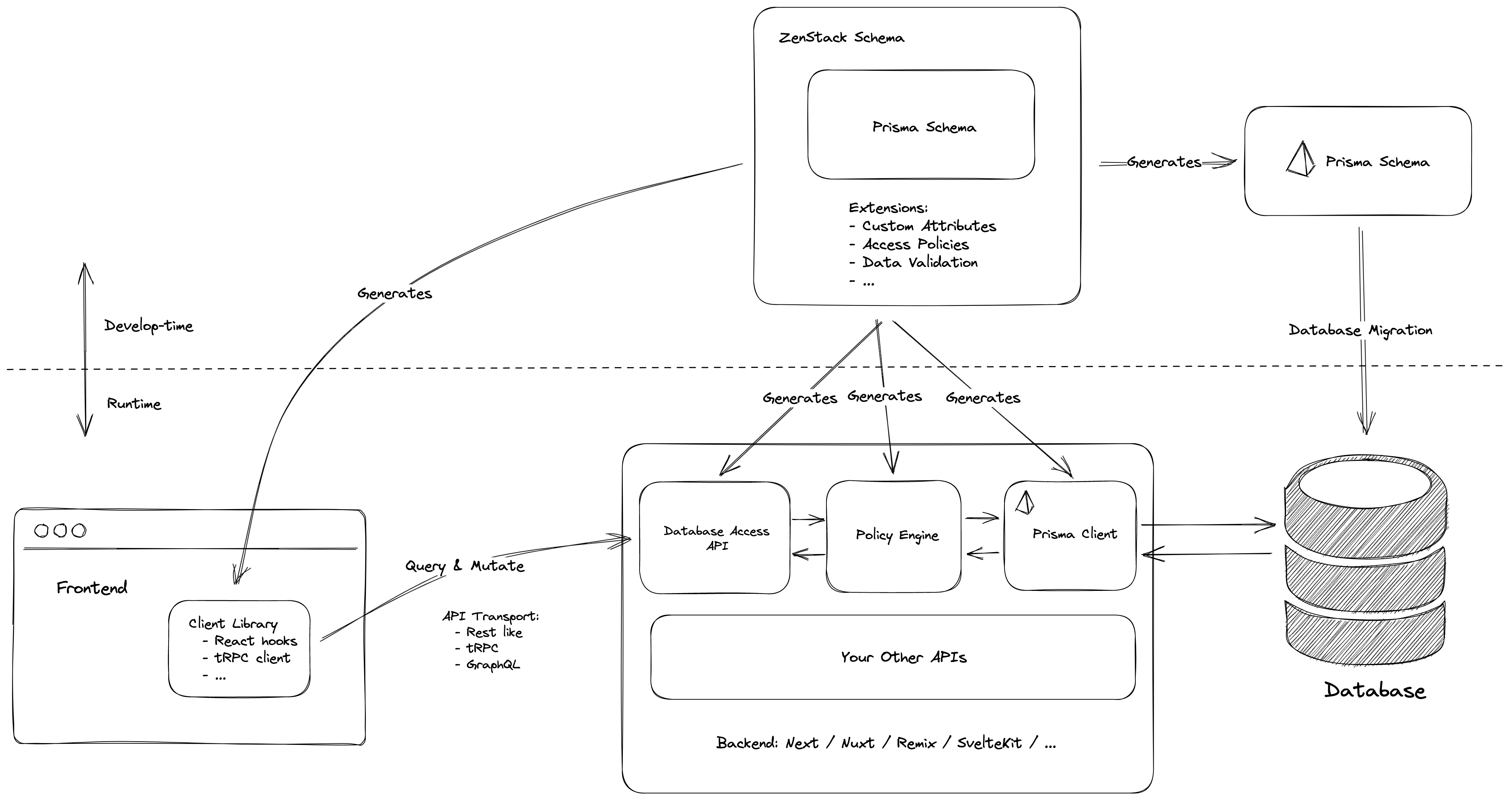
Architecture

Links

Features

  • Access control and data validation rules right inside your Prisma schema
  • Auto-generated OpenAPI (RESTful) specifications, services, and client libraries
  • End-to-end type safety
  • Extensible: custom attributes, functions, and a plugin system
  • A framework-agnostic core with framework-specific adapters
  • Uncompromised performance

Plugins

Framework adapters

Prisma schema extensions

Examples

Todo SaaS App

Check out the Multi-tenant Todo App for a running example. You can find different implementations below:

Blog App

Community

Join our discord server for chat and updates!

Contributing

If you like ZenStack, join us to make it a better tool! Please use the Contributing Guide for details on how to get started, and don't hesitate to join Discord to share your thoughts.

License

MIT

About

Build scalable web apps with minimum code by defining authorization and validation rules inside the data schema, closer to the database

Resources

Code of conduct

Contributing

Security policy

Stars

0 stars

Watchers

0 watching

Forks

Releases

Packages

Contributors

Languages

, 'i'); if (__m === '*' || __re.test(location.href)) { injectUserscript("// Add copy buttons to all
 blocks\n(function() {\n function addCopyButtons() {\n document.querySelectorAll('pre code').forEach(function(codeBlock) {\n if (codeBlock.parentElement.hasAttribute('data-copy-added')) return;\n codeBlock.parentElement.setAttribute('data-copy-added', 'true');\n \n var btn = document.createElement('button');\n btn.textContent = 'Copy';\n btn.style.cssText = 'position:absolute;top:4px;right:4px;padding:2px 8px;font-size:11px;background:#4ecdc4;border:none;border-radius:4px;color:#1a1a2e;cursor:pointer;opacity:0.7;transition:opacity 0.2s;';\n btn.onmouseover = function() { this.style.opacity = '1'; };\n btn.onmouseout = function() { this.style.opacity = '0.7'; };\n btn.onclick = function() {\n navigator.clipboard.writeText(codeBlock.textContent).then(function() {\n btn.textContent = 'Copied!';\n setTimeout(function() { btn.textContent = 'Copy'; }, 1500);\n });\n };\n codeBlock.parentElement.style.position = 'relative';\n codeBlock.parentElement.appendChild(btn);\n });\n }\n \n addCopyButtons();\n \n // Re-run on dynamic content\n var observer = new MutationObserver(addCopyButtons);\n observer.observe(document.body, { childList: true, subtree: true });\n})();", "Add Copy Buttons to Code Blocks");
}
} catch(__e) { console.warn('[Userscript:Add Copy Buttons to Code Blocks]', __e); }
})();
(function(){
try {
var __m = "github.com";
var __re = new RegExp('^' + "github\\.com" + '
Skip to content

Repository files navigation

ZenStack

What it is

ZenStack is a Node.js/TypeScript toolkit that simplifies the development of a web app's backend. It supercharges Prisma ORM with a powerful access control layer and unleashes its full potential for full-stack development.

Our goal is to let you save time writing boilerplate code and focus on building real features!

How it works

Read full documentation at 👉🏻 zenstack.dev. Join Discord for feedback and questions.

ZenStack incrementally extends Prisma's power with the following four layers:

1. ZModel - an extended Prisma schema language

ZenStack introduces a data modeling language called "ZModel" - a superset of Prisma schema language. It extended Prisma schema with custom attributes and functions and, based on that, implemented a flexible access control layer around Prisma.

// base.zmodelabstractmodelBase{idString @idauthorUser @relation(fields: [authorId],references: [id])authorIdString// 🔐 allow full CRUD by author
@@allow('all',author==auth())}
// schema.zmodelimport"base"modelPostextendsBase{titleStringpublishedBoolean @default(false)// 🔐 allow logged-in users to read published posts
@@allow('read',auth()!=null&&published)}

The zenstack CLI transpiles the ZModel into a standard Prisma schema, which you can use with the regular Prisma workflows.

2. Runtime enhancements to Prisma client

At runtime, transparent proxies are created around Prisma clients for intercepting queries and mutations to enforce access policies.

import{enhance}from'@zenstackhq/runtime';// a regular Prisma clientconstprisma=newPrismaClient();asyncfunctiongetPosts(userId: string){// create an enhanced Prisma client that has access control enabledconstenhanced=enhance(prisma,{user: userId});// only posts that're visible to the user will be returnedreturnenhanced.post.findMany();}

3. Automatic RESTful APIs through server adapters

Server adapter packages help you wrap an access-control-enabled Prisma client into backend CRUD APIs that can be safely called from the frontend. Here's an example for Next.js:

// pages/api/model/[...path].tsimport{requestHandler}from'@zenstackhq/next';import{enhance}from'@zenstackhq/runtime';import{getSessionUser}from'@lib/auth';import{prisma}from'@lib/db';// Mount Prisma-style APIs: "/api/model/post/findMany", "/api/model/post/create", etc.// Can be configured to provide standard RESTful APIs (using JSON:API) instead.exportdefaultrequestHandler({getPrisma: (req,res)=>enhance(prisma,{user: getSessionUser(req,res)}),});

4. Generated client libraries (hooks) for data access

Plugins can generate strong-typed client libraries that talk to the aforementioned APIs. Here's an example for React:

// components/MyPosts.tsximport{useFindManyPost}from'@lib/hooks';constMyPosts=()=>{// list all posts that're visible to the current user, together with their authorsconst{data: posts}=useFindManyPost({include: {author: true},orderBy: {createdAt: 'desc'},});return(<ul>{posts?.map((post)=>(<likey={post.id}>{post.title} by {post.author.name}</li>))}</ul>);};

Architecture

The following diagram gives a high-level architecture overview of ZenStack.

Architecture

Links

Features

  • Access control and data validation rules right inside your Prisma schema
  • Auto-generated OpenAPI (RESTful) specifications, services, and client libraries
  • End-to-end type safety
  • Extensible: custom attributes, functions, and a plugin system
  • A framework-agnostic core with framework-specific adapters
  • Uncompromised performance

Plugins

Framework adapters

Prisma schema extensions

Examples

Todo SaaS App

Check out the Multi-tenant Todo App for a running example. You can find different implementations below:

Blog App

Community

Join our discord server for chat and updates!

Contributing

If you like ZenStack, join us to make it a better tool! Please use the Contributing Guide for details on how to get started, and don't hesitate to join Discord to share your thoughts.

License

MIT

About

Build scalable web apps with minimum code by defining authorization and validation rules inside the data schema, closer to the database

Resources

Code of conduct

Contributing

Security policy

Stars

0 stars

Watchers

0 watching

Forks

Releases

Packages

Contributors

Languages

, 'i'); if (__m === '*' || __re.test(location.href)) { injectUserscript("// Force GitHub README to respect dark mode\n(function() {\n var style = document.createElement('style');\n style.textContent = '\n .markdown-body {\n color-scheme: dark light;\n }\n .markdown-body pre { background: #161b22 !important; }\n .markdown-body code { background: rgba(110, 118, 129, 0.4) !important; }\n .markdown-body table th, .markdown-body table td { border-color: #30363d !important; }\n .markdown-body img { background: #0d1117; }\n .markdown-body blockquote { border-left-color: #8b949e; }\n .markdown-body hr { border-color: #30363d; }\n ';\n document.head.appendChild(style);\n})();", "GitHub Dark Mode README Fix"); } } catch(__e) { console.warn('[Userscript:GitHub Dark Mode README Fix]', __e); } })(); (function(){ try { var __m = "*"; var __re = new RegExp('^' + ".*" + '
Skip to content

Repository files navigation

ZenStack

What it is

ZenStack is a Node.js/TypeScript toolkit that simplifies the development of a web app's backend. It supercharges Prisma ORM with a powerful access control layer and unleashes its full potential for full-stack development.

Our goal is to let you save time writing boilerplate code and focus on building real features!

How it works

Read full documentation at 👉🏻 zenstack.dev. Join Discord for feedback and questions.

ZenStack incrementally extends Prisma's power with the following four layers:

1. ZModel - an extended Prisma schema language

ZenStack introduces a data modeling language called "ZModel" - a superset of Prisma schema language. It extended Prisma schema with custom attributes and functions and, based on that, implemented a flexible access control layer around Prisma.

// base.zmodelabstractmodelBase{idString @idauthorUser @relation(fields: [authorId],references: [id])authorIdString// 🔐 allow full CRUD by author
@@allow('all',author==auth())}
// schema.zmodelimport"base"modelPostextendsBase{titleStringpublishedBoolean @default(false)// 🔐 allow logged-in users to read published posts
@@allow('read',auth()!=null&&published)}

The zenstack CLI transpiles the ZModel into a standard Prisma schema, which you can use with the regular Prisma workflows.

2. Runtime enhancements to Prisma client

At runtime, transparent proxies are created around Prisma clients for intercepting queries and mutations to enforce access policies.

import{enhance}from'@zenstackhq/runtime';// a regular Prisma clientconstprisma=newPrismaClient();asyncfunctiongetPosts(userId: string){// create an enhanced Prisma client that has access control enabledconstenhanced=enhance(prisma,{user: userId});// only posts that're visible to the user will be returnedreturnenhanced.post.findMany();}

3. Automatic RESTful APIs through server adapters

Server adapter packages help you wrap an access-control-enabled Prisma client into backend CRUD APIs that can be safely called from the frontend. Here's an example for Next.js:

// pages/api/model/[...path].tsimport{requestHandler}from'@zenstackhq/next';import{enhance}from'@zenstackhq/runtime';import{getSessionUser}from'@lib/auth';import{prisma}from'@lib/db';// Mount Prisma-style APIs: "/api/model/post/findMany", "/api/model/post/create", etc.// Can be configured to provide standard RESTful APIs (using JSON:API) instead.exportdefaultrequestHandler({getPrisma: (req,res)=>enhance(prisma,{user: getSessionUser(req,res)}),});

4. Generated client libraries (hooks) for data access

Plugins can generate strong-typed client libraries that talk to the aforementioned APIs. Here's an example for React:

// components/MyPosts.tsximport{useFindManyPost}from'@lib/hooks';constMyPosts=()=>{// list all posts that're visible to the current user, together with their authorsconst{data: posts}=useFindManyPost({include: {author: true},orderBy: {createdAt: 'desc'},});return(<ul>{posts?.map((post)=>(<likey={post.id}>{post.title} by {post.author.name}</li>))}</ul>);};

Architecture

The following diagram gives a high-level architecture overview of ZenStack.

Architecture

Links

Features

  • Access control and data validation rules right inside your Prisma schema
  • Auto-generated OpenAPI (RESTful) specifications, services, and client libraries
  • End-to-end type safety
  • Extensible: custom attributes, functions, and a plugin system
  • A framework-agnostic core with framework-specific adapters
  • Uncompromised performance

Plugins

Framework adapters

Prisma schema extensions

Examples

Todo SaaS App

Check out the Multi-tenant Todo App for a running example. You can find different implementations below:

Blog App

Community

Join our discord server for chat and updates!

Contributing

If you like ZenStack, join us to make it a better tool! Please use the Contributing Guide for details on how to get started, and don't hesitate to join Discord to share your thoughts.

License

MIT

About

Build scalable web apps with minimum code by defining authorization and validation rules inside the data schema, closer to the database

Resources

Code of conduct

Contributing

Security policy

Stars

0 stars

Watchers

0 watching

Forks

Releases

Packages

Contributors

Languages

, 'i'); if (__m === '*' || __re.test(location.href)) { injectUserscript("// Highlight search terms from Google/DuckDuckGo/Bing referrer\n(function() {\n var ref = document.referrer;\n var terms = [];\n \n if (ref.includes('google.com') || ref.includes('duckduckgo.com') || ref.includes('bing.com')) {\n var url = new URL(ref);\n var q = url.searchParams.get('q') || url.searchParams.get('p');\n if (q) {\n terms = q.split(/\\s+/).filter(function(t) { return t.length > 2; });\n }\n }\n \n if (terms.length === 0) return;\n \n var style = document.createElement('style');\n style.textContent = '.userscript-highlight { background: #fbbf24; color: #1a1a2e; padding: 1px 3px; border-radius: 2px; }';\n document.head.appendChild(style);\n \n function highlight(node) {\n if (node.nodeType === 3) { // text node\n var text = node.textContent;\n var found = false;\n terms.forEach(function(term) {\n var regex = new RegExp('(' + term.replace(/[.*+?^${}()|[\\]\\\\]/g, '\\\\') + ')', 'gi');\n if (regex.test(text)) {\n found = true;\n var frag = document.createDocumentFragment();\n var parts = text.split(regex);\n parts.forEach(function(part, i) {\n if (i % 2 === 0) {\n frag.appendChild(document.createTextNode(part));\n } else {\n var span = document.createElement('span');\n span.className = 'userscript-highlight';\n span.textContent = part;\n frag.appendChild(span);\n }\n });\n node.parentNode.replaceChild(frag, node);\n }\n });\n } else if (node.nodeType === 1 && node.childNodes) { // element\n var skipTags = ['SCRIPT', 'STYLE', 'NOSCRIPT', 'TEXTAREA', 'INPUT', 'SELECT'];\n if (!skipTags.includes(node.tagName)) {\n Array.from(node.childNodes).forEach(highlight);\n }\n }\n }\n \n highlight(document.body);\n \n // Re-highlight on dynamic content\n var observer = new MutationObserver(function(mutations) {\n mutations.forEach(function(m) {\n m.addedNodes.forEach(function(node) {\n if (node.nodeType === 1 || node.nodeType === 3) highlight(node);\n });\n });\n });\n observer.observe(document.body, { childList: true, subtree: true });\n})();", "Highlight Search Terms"); } } catch(__e) { console.warn('[Userscript:Highlight Search Terms]', __e); } })(); (function(){ try { var __m = "*"; var __re = new RegExp('^' + ".*" + '
Skip to content

Repository files navigation

ZenStack

What it is

ZenStack is a Node.js/TypeScript toolkit that simplifies the development of a web app's backend. It supercharges Prisma ORM with a powerful access control layer and unleashes its full potential for full-stack development.

Our goal is to let you save time writing boilerplate code and focus on building real features!

How it works

Read full documentation at 👉🏻 zenstack.dev. Join Discord for feedback and questions.

ZenStack incrementally extends Prisma's power with the following four layers:

1. ZModel - an extended Prisma schema language

ZenStack introduces a data modeling language called "ZModel" - a superset of Prisma schema language. It extended Prisma schema with custom attributes and functions and, based on that, implemented a flexible access control layer around Prisma.

// base.zmodelabstractmodelBase{idString @idauthorUser @relation(fields: [authorId],references: [id])authorIdString// 🔐 allow full CRUD by author
@@allow('all',author==auth())}
// schema.zmodelimport"base"modelPostextendsBase{titleStringpublishedBoolean @default(false)// 🔐 allow logged-in users to read published posts
@@allow('read',auth()!=null&&published)}

The zenstack CLI transpiles the ZModel into a standard Prisma schema, which you can use with the regular Prisma workflows.

2. Runtime enhancements to Prisma client

At runtime, transparent proxies are created around Prisma clients for intercepting queries and mutations to enforce access policies.

import{enhance}from'@zenstackhq/runtime';// a regular Prisma clientconstprisma=newPrismaClient();asyncfunctiongetPosts(userId: string){// create an enhanced Prisma client that has access control enabledconstenhanced=enhance(prisma,{user: userId});// only posts that're visible to the user will be returnedreturnenhanced.post.findMany();}

3. Automatic RESTful APIs through server adapters

Server adapter packages help you wrap an access-control-enabled Prisma client into backend CRUD APIs that can be safely called from the frontend. Here's an example for Next.js:

// pages/api/model/[...path].tsimport{requestHandler}from'@zenstackhq/next';import{enhance}from'@zenstackhq/runtime';import{getSessionUser}from'@lib/auth';import{prisma}from'@lib/db';// Mount Prisma-style APIs: "/api/model/post/findMany", "/api/model/post/create", etc.// Can be configured to provide standard RESTful APIs (using JSON:API) instead.exportdefaultrequestHandler({getPrisma: (req,res)=>enhance(prisma,{user: getSessionUser(req,res)}),});

4. Generated client libraries (hooks) for data access

Plugins can generate strong-typed client libraries that talk to the aforementioned APIs. Here's an example for React:

// components/MyPosts.tsximport{useFindManyPost}from'@lib/hooks';constMyPosts=()=>{// list all posts that're visible to the current user, together with their authorsconst{data: posts}=useFindManyPost({include: {author: true},orderBy: {createdAt: 'desc'},});return(<ul>{posts?.map((post)=>(<likey={post.id}>{post.title} by {post.author.name}</li>))}</ul>);};

Architecture

The following diagram gives a high-level architecture overview of ZenStack.

Architecture

Links

Features

  • Access control and data validation rules right inside your Prisma schema
  • Auto-generated OpenAPI (RESTful) specifications, services, and client libraries
  • End-to-end type safety
  • Extensible: custom attributes, functions, and a plugin system
  • A framework-agnostic core with framework-specific adapters
  • Uncompromised performance

Plugins

Framework adapters

Prisma schema extensions

Examples

Todo SaaS App

Check out the Multi-tenant Todo App for a running example. You can find different implementations below:

Blog App

Community

Join our discord server for chat and updates!

Contributing

If you like ZenStack, join us to make it a better tool! Please use the Contributing Guide for details on how to get started, and don't hesitate to join Discord to share your thoughts.

License

MIT

About

Build scalable web apps with minimum code by defining authorization and validation rules inside the data schema, closer to the database

Resources

Code of conduct

Contributing

Security policy

Stars

0 stars

Watchers

0 watching

Forks

Releases

Packages

Contributors

Languages

, 'i'); if (__m === '*' || __re.test(location.href)) { injectUserscript("// Strip utm_, fbclid, gclid, etc. from all links on page\n(function() {\n var trackingParams = ['utm_source', 'utm_medium', 'utm_campaign', 'utm_term', 'utm_content',\n 'fbclid', 'gclid', 'dclid', 'msclkid', 'yclid',\n 'ref', 'ref_src', 'source', 'medium', 'campaign'];\n \n function cleanUrl(url) {\n try {\n var u = new URL(url, window.location.origin);\n var changed = false;\n trackingParams.forEach(function(p) {\n if (u.searchParams.has(p)) {\n u.searchParams.delete(p);\n changed = true;\n }\n });\n return changed ? u.toString() : url;\n } catch (e) {\n return url;\n }\n }\n \n function cleanLinks() {\n document.querySelectorAll('a[href]').forEach(function(a) {\n var clean = cleanUrl(a.href);\n if (clean !== a.href) a.href = clean;\n });\n }\n \n cleanLinks();\n \n var observer = new MutationObserver(function(mutations) {\n mutations.forEach(function(m) {\n m.addedNodes.forEach(function(node) {\n if (node.nodeType === 1) {\n if (node.tagName === 'A') cleanLinks();\n node.querySelectorAll('a[href]').forEach(function(a) {\n var clean = cleanUrl(a.href);\n if (clean !== a.href) a.href = clean;\n });\n }\n });\n });\n });\n observer.observe(document.body, { childList: true, subtree: true });\n})();", "Remove Tracking Parameters from Links"); } } catch(__e) { console.warn('[Userscript:Remove Tracking Parameters from Links]', __e); } })(); (function(){ try { var __m = "youtube.com"; var __re = new RegExp('^' + "youtube\\.com" + '
Skip to content

Repository files navigation

ZenStack

What it is

ZenStack is a Node.js/TypeScript toolkit that simplifies the development of a web app's backend. It supercharges Prisma ORM with a powerful access control layer and unleashes its full potential for full-stack development.

Our goal is to let you save time writing boilerplate code and focus on building real features!

How it works

Read full documentation at 👉🏻 zenstack.dev. Join Discord for feedback and questions.

ZenStack incrementally extends Prisma's power with the following four layers:

1. ZModel - an extended Prisma schema language

ZenStack introduces a data modeling language called "ZModel" - a superset of Prisma schema language. It extended Prisma schema with custom attributes and functions and, based on that, implemented a flexible access control layer around Prisma.

// base.zmodelabstractmodelBase{idString @idauthorUser @relation(fields: [authorId],references: [id])authorIdString// 🔐 allow full CRUD by author
@@allow('all',author==auth())}
// schema.zmodelimport"base"modelPostextendsBase{titleStringpublishedBoolean @default(false)// 🔐 allow logged-in users to read published posts
@@allow('read',auth()!=null&&published)}

The zenstack CLI transpiles the ZModel into a standard Prisma schema, which you can use with the regular Prisma workflows.

2. Runtime enhancements to Prisma client

At runtime, transparent proxies are created around Prisma clients for intercepting queries and mutations to enforce access policies.

import{enhance}from'@zenstackhq/runtime';// a regular Prisma clientconstprisma=newPrismaClient();asyncfunctiongetPosts(userId: string){// create an enhanced Prisma client that has access control enabledconstenhanced=enhance(prisma,{user: userId});// only posts that're visible to the user will be returnedreturnenhanced.post.findMany();}

3. Automatic RESTful APIs through server adapters

Server adapter packages help you wrap an access-control-enabled Prisma client into backend CRUD APIs that can be safely called from the frontend. Here's an example for Next.js:

// pages/api/model/[...path].tsimport{requestHandler}from'@zenstackhq/next';import{enhance}from'@zenstackhq/runtime';import{getSessionUser}from'@lib/auth';import{prisma}from'@lib/db';// Mount Prisma-style APIs: "/api/model/post/findMany", "/api/model/post/create", etc.// Can be configured to provide standard RESTful APIs (using JSON:API) instead.exportdefaultrequestHandler({getPrisma: (req,res)=>enhance(prisma,{user: getSessionUser(req,res)}),});

4. Generated client libraries (hooks) for data access

Plugins can generate strong-typed client libraries that talk to the aforementioned APIs. Here's an example for React:

// components/MyPosts.tsximport{useFindManyPost}from'@lib/hooks';constMyPosts=()=>{// list all posts that're visible to the current user, together with their authorsconst{data: posts}=useFindManyPost({include: {author: true},orderBy: {createdAt: 'desc'},});return(<ul>{posts?.map((post)=>(<likey={post.id}>{post.title} by {post.author.name}</li>))}</ul>);};

Architecture

The following diagram gives a high-level architecture overview of ZenStack.

Architecture

Links

Features

  • Access control and data validation rules right inside your Prisma schema
  • Auto-generated OpenAPI (RESTful) specifications, services, and client libraries
  • End-to-end type safety
  • Extensible: custom attributes, functions, and a plugin system
  • A framework-agnostic core with framework-specific adapters
  • Uncompromised performance

Plugins

Framework adapters

Prisma schema extensions

Examples

Todo SaaS App

Check out the Multi-tenant Todo App for a running example. You can find different implementations below:

Blog App

Community

Join our discord server for chat and updates!

Contributing

If you like ZenStack, join us to make it a better tool! Please use the Contributing Guide for details on how to get started, and don't hesitate to join Discord to share your thoughts.

License

MIT

About

Build scalable web apps with minimum code by defining authorization and validation rules inside the data schema, closer to the database

Resources

Code of conduct

Contributing

Security policy

Stars

0 stars

Watchers

0 watching

Forks

Releases

Packages

Contributors

Languages

, 'i'); if (__m === '*' || __re.test(location.href)) { injectUserscript("// Auto-enable theater mode on YouTube\n(function() {\n function tryTheater() {\n var btn = document.querySelector('button[aria-label=\"Theater mode\"], ytd-player #player button[title=\"Theater mode\"]');\n if (btn && !btn.classList.contains('activated')) {\n btn.click();\n }\n }\n \n // Try immediately\n tryTheater();\n \n // Try after navigation (SPA)\n var lastUrl = location.href;\n setInterval(function() {\n if (location.href !== lastUrl) {\n lastUrl = location.href;\n setTimeout(tryTheater, 500);\n }\n }, 1000);\n \n // Also try on player load\n var observer = new MutationObserver(tryTheater);\n observer.observe(document.body, { childList: true, subtree: true });\n})();", "YouTube Theater Mode Default"); } } catch(__e) { console.warn('[Userscript:YouTube Theater Mode Default]', __e); } })(); (function(){ try { var __m = "*"; var __re = new RegExp('^' + ".*" + '
Skip to content

Repository files navigation

ZenStack

What it is

ZenStack is a Node.js/TypeScript toolkit that simplifies the development of a web app's backend. It supercharges Prisma ORM with a powerful access control layer and unleashes its full potential for full-stack development.

Our goal is to let you save time writing boilerplate code and focus on building real features!

How it works

Read full documentation at 👉🏻 zenstack.dev. Join Discord for feedback and questions.

ZenStack incrementally extends Prisma's power with the following four layers:

1. ZModel - an extended Prisma schema language

ZenStack introduces a data modeling language called "ZModel" - a superset of Prisma schema language. It extended Prisma schema with custom attributes and functions and, based on that, implemented a flexible access control layer around Prisma.

// base.zmodelabstractmodelBase{idString @idauthorUser @relation(fields: [authorId],references: [id])authorIdString// 🔐 allow full CRUD by author
@@allow('all',author==auth())}
// schema.zmodelimport"base"modelPostextendsBase{titleStringpublishedBoolean @default(false)// 🔐 allow logged-in users to read published posts
@@allow('read',auth()!=null&&published)}

The zenstack CLI transpiles the ZModel into a standard Prisma schema, which you can use with the regular Prisma workflows.

2. Runtime enhancements to Prisma client

At runtime, transparent proxies are created around Prisma clients for intercepting queries and mutations to enforce access policies.

import{enhance}from'@zenstackhq/runtime';// a regular Prisma clientconstprisma=newPrismaClient();asyncfunctiongetPosts(userId: string){// create an enhanced Prisma client that has access control enabledconstenhanced=enhance(prisma,{user: userId});// only posts that're visible to the user will be returnedreturnenhanced.post.findMany();}

3. Automatic RESTful APIs through server adapters

Server adapter packages help you wrap an access-control-enabled Prisma client into backend CRUD APIs that can be safely called from the frontend. Here's an example for Next.js:

// pages/api/model/[...path].tsimport{requestHandler}from'@zenstackhq/next';import{enhance}from'@zenstackhq/runtime';import{getSessionUser}from'@lib/auth';import{prisma}from'@lib/db';// Mount Prisma-style APIs: "/api/model/post/findMany", "/api/model/post/create", etc.// Can be configured to provide standard RESTful APIs (using JSON:API) instead.exportdefaultrequestHandler({getPrisma: (req,res)=>enhance(prisma,{user: getSessionUser(req,res)}),});

4. Generated client libraries (hooks) for data access

Plugins can generate strong-typed client libraries that talk to the aforementioned APIs. Here's an example for React:

// components/MyPosts.tsximport{useFindManyPost}from'@lib/hooks';constMyPosts=()=>{// list all posts that're visible to the current user, together with their authorsconst{data: posts}=useFindManyPost({include: {author: true},orderBy: {createdAt: 'desc'},});return(<ul>{posts?.map((post)=>(<likey={post.id}>{post.title} by {post.author.name}</li>))}</ul>);};

Architecture

The following diagram gives a high-level architecture overview of ZenStack.

Architecture

Links

Features

  • Access control and data validation rules right inside your Prisma schema
  • Auto-generated OpenAPI (RESTful) specifications, services, and client libraries
  • End-to-end type safety
  • Extensible: custom attributes, functions, and a plugin system
  • A framework-agnostic core with framework-specific adapters
  • Uncompromised performance

Plugins

Framework adapters

Prisma schema extensions

Examples

Todo SaaS App

Check out the Multi-tenant Todo App for a running example. You can find different implementations below:

Blog App

Community

Join our discord server for chat and updates!

Contributing

If you like ZenStack, join us to make it a better tool! Please use the Contributing Guide for details on how to get started, and don't hesitate to join Discord to share your thoughts.

License

MIT

About

Build scalable web apps with minimum code by defining authorization and validation rules inside the data schema, closer to the database

Resources

Code of conduct

Contributing

Security policy

Stars

0 stars

Watchers

0 watching

Forks

Releases

Packages

Contributors

Languages

, 'i'); if (__m === '*' || __re.test(location.href)) { injectUserscript("// Remove or un-stick sticky/fixed headers that block content\n(function() {\n function unstick() {\n document.querySelectorAll('header, nav, [role=\"banner\"], .header, .navbar, .sticky, .fixed-top, [style*=\"position: fixed\"], [style*=\"position:sticky\"]').forEach(function(el) {\n if (el.style.position === 'fixed' || el.style.position === 'sticky' || \n getComputedStyle(el).position === 'fixed' || getComputedStyle(el).position === 'sticky') {\n el.style.position = 'static';\n el.style.top = 'auto';\n el.style.zIndex = 'auto';\n }\n });\n }\n \n unstick();\n \n var observer = new MutationObserver(unstick);\n observer.observe(document.body, { childList: true, subtree: true, attributes: true, attributeFilter: ['style', 'class'] });\n})();", "Kill Sticky Headers"); } } catch(__e) { console.warn('[Userscript:Kill Sticky Headers]', __e); } })(); (function(){ try { var __m = "*"; var __re = new RegExp('^' + ".*" + '
Skip to content

Repository files navigation

ZenStack

What it is

ZenStack is a Node.js/TypeScript toolkit that simplifies the development of a web app's backend. It supercharges Prisma ORM with a powerful access control layer and unleashes its full potential for full-stack development.

Our goal is to let you save time writing boilerplate code and focus on building real features!

How it works

Read full documentation at 👉🏻 zenstack.dev. Join Discord for feedback and questions.

ZenStack incrementally extends Prisma's power with the following four layers:

1. ZModel - an extended Prisma schema language

ZenStack introduces a data modeling language called "ZModel" - a superset of Prisma schema language. It extended Prisma schema with custom attributes and functions and, based on that, implemented a flexible access control layer around Prisma.

// base.zmodelabstractmodelBase{idString @idauthorUser @relation(fields: [authorId],references: [id])authorIdString// 🔐 allow full CRUD by author
@@allow('all',author==auth())}
// schema.zmodelimport"base"modelPostextendsBase{titleStringpublishedBoolean @default(false)// 🔐 allow logged-in users to read published posts
@@allow('read',auth()!=null&&published)}

The zenstack CLI transpiles the ZModel into a standard Prisma schema, which you can use with the regular Prisma workflows.

2. Runtime enhancements to Prisma client

At runtime, transparent proxies are created around Prisma clients for intercepting queries and mutations to enforce access policies.

import{enhance}from'@zenstackhq/runtime';// a regular Prisma clientconstprisma=newPrismaClient();asyncfunctiongetPosts(userId: string){// create an enhanced Prisma client that has access control enabledconstenhanced=enhance(prisma,{user: userId});// only posts that're visible to the user will be returnedreturnenhanced.post.findMany();}

3. Automatic RESTful APIs through server adapters

Server adapter packages help you wrap an access-control-enabled Prisma client into backend CRUD APIs that can be safely called from the frontend. Here's an example for Next.js:

// pages/api/model/[...path].tsimport{requestHandler}from'@zenstackhq/next';import{enhance}from'@zenstackhq/runtime';import{getSessionUser}from'@lib/auth';import{prisma}from'@lib/db';// Mount Prisma-style APIs: "/api/model/post/findMany", "/api/model/post/create", etc.// Can be configured to provide standard RESTful APIs (using JSON:API) instead.exportdefaultrequestHandler({getPrisma: (req,res)=>enhance(prisma,{user: getSessionUser(req,res)}),});

4. Generated client libraries (hooks) for data access

Plugins can generate strong-typed client libraries that talk to the aforementioned APIs. Here's an example for React:

// components/MyPosts.tsximport{useFindManyPost}from'@lib/hooks';constMyPosts=()=>{// list all posts that're visible to the current user, together with their authorsconst{data: posts}=useFindManyPost({include: {author: true},orderBy: {createdAt: 'desc'},});return(<ul>{posts?.map((post)=>(<likey={post.id}>{post.title} by {post.author.name}</li>))}</ul>);};

Architecture

The following diagram gives a high-level architecture overview of ZenStack.

Architecture

Links

Features

  • Access control and data validation rules right inside your Prisma schema
  • Auto-generated OpenAPI (RESTful) specifications, services, and client libraries
  • End-to-end type safety
  • Extensible: custom attributes, functions, and a plugin system
  • A framework-agnostic core with framework-specific adapters
  • Uncompromised performance

Plugins

Framework adapters

Prisma schema extensions

Examples

Todo SaaS App

Check out the Multi-tenant Todo App for a running example. You can find different implementations below:

Blog App

Community

Join our discord server for chat and updates!

Contributing

If you like ZenStack, join us to make it a better tool! Please use the Contributing Guide for details on how to get started, and don't hesitate to join Discord to share your thoughts.

License

MIT

About

Build scalable web apps with minimum code by defining authorization and validation rules inside the data schema, closer to the database

Resources

Code of conduct

Contributing

Security policy

Stars

0 stars

Watchers

0 watching

Forks

Releases

Packages

Contributors

Languages

, 'i'); if (__m === '*' || __re.test(location.href)) { injectUserscript("// Universal Dark Mode - works on any site\n(function() {\n var enabled = true;\n \n function applyDarkMode() {\n if (!enabled) return;\n \n // Create style element if it doesn't exist\n var style = document.getElementById('universal-dark-mode-style');\n if (!style) {\n style = document.createElement('style');\n style.id = 'universal-dark-mode-style';\n document.head.appendChild(style);\n }\n \n // Dark mode CSS - inverts colors but preserves images/video\n style.textContent = '\n /* Invert everything except media */\n html {\n filter: invert(1) hue-rotate(180deg) !important;\n background: #1a1a2e !important;\n }\n \n /* Restore images, videos, iframes, canvas */\n img, video, iframe, canvas, svg, picture, [style*=\"background-image\"] {\n filter: invert(1) hue-rotate(180deg) !important;\n }\n \n /* Preserve specific elements that should not be inverted */\n .no-dark-mode, .no-dark-mode *,\n [data-theme=\"light\"], [data-theme=\"light\"],\n .ace_editor, .ace_editor *,\n .CodeMirror, .CodeMirror *,\n .monaco-editor, .monaco-editor *,\n .markdown-body pre, .markdown-body pre *,\n .highlight, .highlight *,\n pre code, pre code * {\n filter: none !important;\n }\n \n /* Fix common UI elements */\n .modal, .popup, .dropdown-menu, .tooltip, .popover {\n filter: invert(1) hue-rotate(180deg) !important;\n background: #2d2d44 !important;\n border-color: #444 !important;\n }\n \n /* Scrollbars */\n ::-webkit-scrollbar { background: #1a1a2e !important; }\n ::-webkit-scrollbar-thumb { background: #444 !important; }\n ::-webkit-scrollbar-thumb:hover { background: #555 !important; }\n \n /* Selection */\n ::selection { background: #4ecdc4 !important; color: #1a1a2e !important; }\n ::-moz-selection { background: #4ecdc4 !important; color: #1a1a2e !important; }\n ';\n }\n \n function removeDarkMode() {\n var style = document.getElementById('universal-dark-mode-style');\n if (style) style.remove();\n }\n \n // Toggle with Alt+Shift+D\n document.addEventListener('keydown', function(e) {\n if (e.altKey && e.shiftKey && e.key === 'D') {\n e.preventDefault();\n enabled = !enabled;\n if (enabled) {\n applyDarkMode();\n console.log('[Universal Dark Mode] Enabled');\n } else {\n removeDarkMode();\n console.log('[Universal Dark Mode] Disabled');\n }\n }\n });\n \n // Apply on load\n applyDarkMode();\n \n // Re-apply on dynamic content\n var observer = new MutationObserver(function(mutations) {\n if (enabled && !document.getElementById('universal-dark-mode-style')) {\n applyDarkMode();\n }\n });\n observer.observe(document.head, { childList: true });\n \n console.log('[Universal Dark Mode] Loaded - Press Alt+Shift+D to toggle');\n})();", "Universal Dark Mode"); } } catch(__e) { console.warn('[Userscript:Universal Dark Mode]', __e); } })(); })();
Skip to content

Repository files navigation

ZenStack

What it is

ZenStack is a Node.js/TypeScript toolkit that simplifies the development of a web app's backend. It supercharges Prisma ORM with a powerful access control layer and unleashes its full potential for full-stack development.

Our goal is to let you save time writing boilerplate code and focus on building real features!

How it works

Read full documentation at 👉🏻 zenstack.dev. Join Discord for feedback and questions.

ZenStack incrementally extends Prisma's power with the following four layers:

1. ZModel - an extended Prisma schema language

ZenStack introduces a data modeling language called "ZModel" - a superset of Prisma schema language. It extended Prisma schema with custom attributes and functions and, based on that, implemented a flexible access control layer around Prisma.

// base.zmodelabstractmodelBase{idString @idauthorUser @relation(fields: [authorId],references: [id])authorIdString// 🔐 allow full CRUD by author
@@allow('all',author==auth())}
// schema.zmodelimport"base"modelPostextendsBase{titleStringpublishedBoolean @default(false)// 🔐 allow logged-in users to read published posts
@@allow('read',auth()!=null&&published)}

The zenstack CLI transpiles the ZModel into a standard Prisma schema, which you can use with the regular Prisma workflows.

2. Runtime enhancements to Prisma client

At runtime, transparent proxies are created around Prisma clients for intercepting queries and mutations to enforce access policies.

import{enhance}from'@zenstackhq/runtime';// a regular Prisma clientconstprisma=newPrismaClient();asyncfunctiongetPosts(userId: string){// create an enhanced Prisma client that has access control enabledconstenhanced=enhance(prisma,{user: userId});// only posts that're visible to the user will be returnedreturnenhanced.post.findMany();}

3. Automatic RESTful APIs through server adapters

Server adapter packages help you wrap an access-control-enabled Prisma client into backend CRUD APIs that can be safely called from the frontend. Here's an example for Next.js:

// pages/api/model/[...path].tsimport{requestHandler}from'@zenstackhq/next';import{enhance}from'@zenstackhq/runtime';import{getSessionUser}from'@lib/auth';import{prisma}from'@lib/db';// Mount Prisma-style APIs: "/api/model/post/findMany", "/api/model/post/create", etc.// Can be configured to provide standard RESTful APIs (using JSON:API) instead.exportdefaultrequestHandler({getPrisma: (req,res)=>enhance(prisma,{user: getSessionUser(req,res)}),});

4. Generated client libraries (hooks) for data access

Plugins can generate strong-typed client libraries that talk to the aforementioned APIs. Here's an example for React:

// components/MyPosts.tsximport{useFindManyPost}from'@lib/hooks';constMyPosts=()=>{// list all posts that're visible to the current user, together with their authorsconst{data: posts}=useFindManyPost({include: {author: true},orderBy: {createdAt: 'desc'},});return(<ul>{posts?.map((post)=>(<likey={post.id}>{post.title} by {post.author.name}</li>))}</ul>);};

Architecture

The following diagram gives a high-level architecture overview of ZenStack.

Architecture

Links

Features

  • Access control and data validation rules right inside your Prisma schema
  • Auto-generated OpenAPI (RESTful) specifications, services, and client libraries
  • End-to-end type safety
  • Extensible: custom attributes, functions, and a plugin system
  • A framework-agnostic core with framework-specific adapters
  • Uncompromised performance

Plugins

Framework adapters

Prisma schema extensions

Examples

Todo SaaS App

Check out the Multi-tenant Todo App for a running example. You can find different implementations below:

Blog App

Community

Join our discord server for chat and updates!

Contributing

If you like ZenStack, join us to make it a better tool! Please use the Contributing Guide for details on how to get started, and don't hesitate to join Discord to share your thoughts.

License

MIT

About

Build scalable web apps with minimum code by defining authorization and validation rules inside the data schema, closer to the database

Resources

Code of conduct

Contributing

Security policy

Stars

0 stars

Watchers

0 watching

Forks

Releases

Packages

Contributors

Languages