Conversation

**Category:** fix
**User Impact:** Users can save password-protected identity backups
directly to protected macOS folders such as Downloads.

**Problem:** Signed macOS builds could not save a portable `.ncryptsec`
backup to Downloads because the atomic writer created an unauthorized
sibling temporary file. This surfaced as an “Operation not permitted”
error after the user completed backup creation.

**Solution:** Portable exports now write only to the exact path
authorized by the native Save panel, sync and verify the saved bytes,
and refuse to truncate an existing backup. Buzz’s app-managed backup
retains its atomic writer and durability guarantees.

<details>
<summary>File changes</summary>

**desktop/src-tauri/src/commands/export_util.rs**
Clarifies that secret exports use a dedicated writer compatible with
native Save-panel authorization.

**desktop/src-tauri/src/commands/identity.rs**
Routes portable NIP-49 exports through the Save-panel-compatible writer
while preserving canonical app state.

**desktop/src-tauri/src/key_backup.rs**
Adds an exclusive-create portable writer with owner-only permissions,
disk sync, byte verification, and cleanup on failure. Keeps the existing
atomic writer for app-managed backups.

**desktop/src-tauri/src/key_backup_tests.rs**
Covers portable export permissions, absence of sibling files, and
preservation of existing backups.

</details>

## Reproduction steps

1. Install a signed macOS build containing this change.
2. Open **Settings → Profile → Private key → Create backup** and
complete backup creation.
3. Save a fresh `identity.ncryptsec` file into `~/Downloads` and confirm
Buzz reports success.
4. Open and verify the saved backup with its password.
5. Repeat the save using an existing filename and confirm Buzz preserves
the existing file and asks for a new filename.

## Verification

- Full desktop Tauri suite: 2,049 passed, 14 ignored
- Diagnostic suite: 3 passed
- Focused backup coverage: 30 passed
- Tauri clippy (`--all-targets -D warnings`), Rust formatting, and `git
diff --check`: passed
- Push hooks: org safety, branch skew, and desktop Tauri checks passed

Signed-production Downloads smoke remains required after merge because
the signing workflow is restricted to `main`.

Signed-off-by: Taylor Ho <taylorkmho@gmail.com>
Co-authored-by: npub1223z34hd7vtwc6qj4s7flsxkj644nlre2nthu7lrrmkumhu3xddsrx9r6w <52a228d6edf316ec6812ac3c9fc0d696ab59fc7954d77e7be31eedcddf91335b@buzz.block.builderlab.xyz>
## Summary - move **Channel templates** from Communities to Personal settings - always expose the template picker in New Channel, using **None** as the no-template value - create a channel template directly from the picker and select it on return - preview the selected template's current visibility, canvas, agents, and teams - order the channel-creation controls as **Type / Visibility / Template** and mark Template **Optional** - cover populated and empty libraries, inline creation, selection, visibility overrides, mixed agent/team inventory, field order, optional labeling, and settings navigation in Playwright ## Validation Validated at desktop-only tip `76442270c88aa1d533ddca5de9f87cd615183919` with a clean worktree: - focused channel-template Playwright: 2/2 passed - Type / Visibility / Template ordering and muted Optional treatment visually inspected in the replacement screenshot - `git diff --check origin/main...HEAD` passed - PR diff contains exactly nine Desktop files and no Mobile files The pre-push hook was bypassed only for the corrected history push because the inherited Mobile test `keeps follow mode off while a tall newest message stays visible` passes in Linux CI but fails on macOS because its offscreen-child mounting assertion is platform-sensitive. No Mobile code or tests are changed by this PR. ## Screenshot 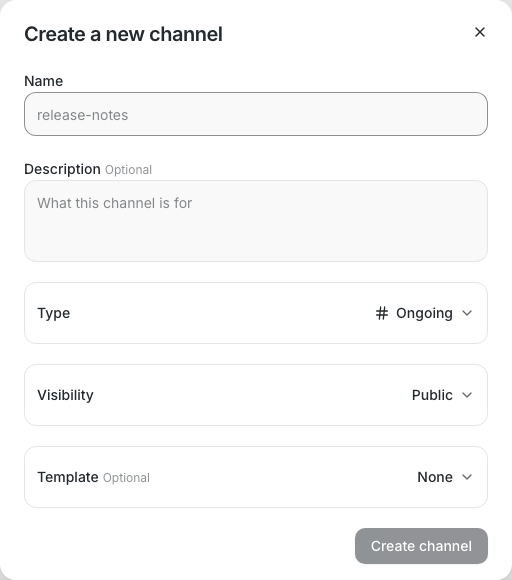 Originating Buzz channel: `efba7343-e147-48b7-a2aa-15a5f04abc57` --------- Signed-off-by: Wes <wesbillman@users.noreply.github.com> Co-authored-by: Carl <c7ebe626f000404285d3686e1dc74cc07cc60a9754a150041ba132e14bd3e2ec@buzz.block.builderlab.xyz>

…aned Node (block#4382)

This PR fixes two Windows-specific install failures: Windows Defender
blocking the bare `irm|iex` PowerShell install command, and managed Node
shims pointing at a version-bumped (now-absent) Node directory.

The Defender block (Trojan:Win32/Commando.A!ml) fires before PowerShell
runs and is not clearable via Allow. The Node orphaning means shims in
the managed npm prefix resolve but fail at runtime with 'node not
recognized' because they reference the deleted old Node path.

- Replace all three Windows CLI install commands (Goose, Claude, Codex)
with a two-step shape — `Invoke-RestMethod` to a named temp file, then
execute — to eliminate the dropper signature; a new
`windows_install_command!` macro in `discovery/windows_install.rs`
generates all three strings at compile time so the shape cannot drift
between runtimes
- `$ErrorActionPreference='Stop'` aborts on download failure instead of
falling through to a missing-file exit-0; `exit $LASTEXITCODE`
propagates the vendor script's own exit code
- Add `probe_node(executable, expected_version, timeout)` as a bounded
seam: stdout goes to a temp file (not a pipe) so no exit path can block
on an inherited handle; the child runs in its own process group on Unix
so an unconditional group SIGKILL on every exit path terminates all
descendants; on Windows `taskkill /T /F` provides the same tree-wide
cleanup; `managed_node_runtime_ready()` is a thin wrapper that resolves
the managed Node path and calls the seam
- Add `resolve_adapter_path()` in `managed_node.rs`: resolves the
candidate first, then calls `should_invalidate_adapter()` — a pure
predicate that returns `true` only when the resolved path is under
`buzz_managed_npm_bin_dir()` AND the managed Node runtime is orphaned;
external adapters outside the managed prefix are always preserved

Note: CI cannot reproduce the Defender block (no live Defender ML
classifier). Proof of fix is structural — the command shape no longer
matches the dropper signature. Canary validation on a real Windows
machine with Defender enabled is the definitive check.

---------

Signed-off-by: Will Pfleger <pfleger.will@gmail.com>
Co-authored-by: npub1mn7jgtj4w2pd0g0zeuhxsa6jy6p0rewxz4kujt98my82ahfmp72sxjexk7 <dcfd242e557282d7a1e2cf2e6877522682f1e5c6156dc92ca7d90eaedd3b0f95@buzz.block.builderlab.xyz>
…4545)

## The bug

buzz-agent emitted its `usage_update` notification in exactly one place:
after `ctx.run()` returned. Until that moment a turn's token counters
lived only in the prompt task's stack frame. **A turn killed mid-flight
reported nothing at all** — the provider had already billed every round
it completed, and no consumer ever saw any of it.

That is not a corner case for anything that ends a turn on a clock. It
is the normal case for a long-horizon benchmark run that relaunches its
agent between phases.

## How big

Measured against a provider's own billing ledger over one run's window:

| | provider ledger | what we recorded |
|---|---|---|
| the relaunched lead seat | $485 / 348M tok | $98.99 / 90.3M tok |
| the two seats that were not relaunched | $29.90 / 856M | $25.81 / 765M
— reconciles |

97% of that run's usage rows came back all zeros, against 1–4% for
comparable runs that never relaunch. In one 450-phase trial exactly 7
phases recorded any usage — and each of those carries 177k–437k input
tokens, a whole session's worth landing in the one phase that happened
to end gracefully.

Worth being precise about what was *not* wrong, since both were
plausible and both were checked:

- **Not pricing.** The rates were verified against the provider's
endpoints API and match what we charge.
- **Not a truncation bug.** The usage files were intact and internally
consistent. The tokens were never captured in the first place.

## The fix

The run loop now emits a session-cumulative `usage_update` after every
usage-bearing provider response, so an interrupted turn has reported
everything but its single in-flight request.

- **Emitting more than once per turn is already part of the contract.**
buzz-acp's `UsageTracker` advances its committed baseline only at
publish time, and goose behaves the same way — which is why the tracker
was written to tolerate it.
- **The turn-start session baseline is snapshotted into `RunCtx`** so
the mid-turn figure stays *session*-cumulative. A turn-local number
would be discarded by a high-water-mark consumer and lose the turn
entirely; there is a test for exactly that.
- **Snapshot by value, not a session handle.** The loop reports once per
round, and taking the sessions lock on each would serialise concurrent
sessions behind one another's provider round-trips. Nothing else
advances those counters while the turn holds `busy`, so it cannot go
stale.
- **One shared `wire::usage_update_payload`** for both call sites, so
the mid-turn and end-of-turn shapes cannot drift. A drift there would
present as tokens silently vanishing, which is the failure this
reporting exists to prevent.

## Why not a SIGTERM handler

That was the obvious shape and it does not work. At signal time the
counters are not sitting anywhere a handler could reach — they are in
the turn's stack frame, and the value the handler would need has not
been folded into the session yet. Making usage durable *during* the turn
is what actually fixes it; once it is, a handler adds nothing beyond the
in-flight request, whose cost is unknown until its response lands.

## Tests

- `usage_is_reported_after_each_round_not_only_at_turn_end` — two
rounds; asserts the **first** notification carries round 1's counts
alone, proving it went out before round 2 returned.
- `mid_turn_usage_includes_earlier_turns` — a mid-turn report must be
session-cumulative, not turn-local.

buzz-agent 18/18 on the `fake_llm` suite, 382 unit. `cargo fmt` /
`clippy` / `cargo check --workspace --all-targets` clean.

## Scope

Agent-side only, against `main`. The matching harness change — settling
usage on the timeout path, which was skipped on the reasoning that an
incomplete turn has nothing to flush — is **block#4553**, against the
benchmark branch, since that harness does not exist on `main`.

🤖 Generated with [Claude Code](https://claude.com/claude-code)

Signed-off-by: Atish Patel <atish@squareup.com>
Co-authored-by: Claude Code <noreply@anthropic.com>
## Summary
- document exact-head trusted approval as the only desktop tagging
authorization
- explicitly require `desktop_ref=desktop-v<version>` for the internal
desktop handoff
- replace the stale `squareup/sprout-releases` repository name with
`squareup/buzz-releases`

## Audit coverage
Compared `block/buzz` release documentation and automation with
`squareup/buzz-releases` `main`
(`5b09e5c5d71c80a0849a33458f4e45695df515d7`), including its README,
agent guide, Buildkite field hint, desktop validator, release validation
tests, and protected updater promotion instructions.

## Validation
- `bash scripts/test-release-ref-contract.sh`
- `git diff --check origin/main...HEAD`

Signed-off-by: Wes <wesbillman@users.noreply.github.com>
Co-authored-by: Carl <c7ebe626f000404285d3686e1dc74cc07cc60a9754a150041ba132e14bd3e2ec@buzz.block.builderlab.xyz>
## Summary

- replace a platform-dependent mounted-`RichText` assertion with the
production follow-mode boundary predicate
- retain the jump-to-latest assertion as the visible consequence of
follow mode remaining off
- leave production behavior and desktop PR block#4549 unchanged

## Why

`ScrollablePositionedList` may keep an offscreen item mounted within
cache extent on macOS while Linux does not. Mounting therefore does not
establish whether reversed-list item 0 is at the latest boundary. The
replacement reads the list's public `itemPositionsNotifier` and applies
the same `index == 0 && abs(itemLeadingEdge) < 0.01` contract used by
`message_list.dart`.

## Validation

At commit `bc88617e61d8e9edf8fea832baa8d918163ee212` on macOS with repo
Flutter 3.41.7:

- `cd mobile && ../bin/flutter test` — 1088 passed, 1 skipped
- `cd mobile && ../bin/flutter analyze` — no issues
- pre-push `mobile-test` and `branch-skew` hooks — passed

Signed-off-by: Wes <wesbillman@users.noreply.github.com>
Co-authored-by: Carl <c7ebe626f000404285d3686e1dc74cc07cc60a9754a150041ba132e14bd3e2ec@buzz.block.builderlab.xyz>
## Buzz Desktop release v0.5.4

- **Frozen main:** `cb6f242a13bf3db6cb14bb545d56eca279790265`
- **Reviewed candidate:** `5836cb8f0af478ed3ee3bc6464a20fa4cc91303f`
- **Previous desktop release:** `desktop-v0.5.3`
- **Proposed immutable tag:** `desktop-v0.5.4`

This PR must be **squash merged** only after the Desktop Release
Candidate check passes. The branch must remain based directly on current
`main`; stale base, payload drift, incomplete notes, or an unauthorized
merge produce no tag.

The checked-in changelog accounts for every non-merge commit in the
release range. Publication remains bound to the immutable candidate tag.

Signed-off-by: Wes <wesbillman@users.noreply.github.com>
Co-authored-by: Release Automation <release-automation@users.noreply.github.com>
### Summary

Fixes [this
issue](buzz://message?channel=e62570dd-33ad-42c5-b92b-75f2689f9694&id=b726c366abfe62429ee3cdcd34d0c0fb98c33c3ea053480585bed71745412b56):
> I often don’t see my bot responses until after I post. they’re usually
time stamped correctly so I think it’s just a refresh issue?

### What changed?

Buzz Mobile now reconnects relay sessions after the app has remained
backgrounded beyond the existing 5-second grace period, even when the
session still reports a stale `connected` state. This makes resume
recovery independent of whether iOS runs the grace timer before or after
delivering `resumed`.

Reconnection is now based on elapsed background time rather than a
direct socket-health probe.
- If the app was backgrounded for at least the 5-second grace period,
the socket is presumed dead and the session reconnects regardless of
reported status.
- If it was backgrounded for less than that, a reported `connected`
status is still trusted.

In the sub-5-second window the socket is either genuinely alive, which
is the common case for a momentary background, or it is dead and the
client ping detects it within the two-interval worst case described
below. That is now a degraded-latency path, not a silent-forever path.

The mobile relay socket now uses `IOWebSocketChannel.connect` with a
30-second `pingInterval`. An unanswered ping closes the Dart socket
through the existing disconnect and reconnect path.

Detection takes up to two ping intervals, so about 60 seconds worst
case, not 30. One interval of idleness elapses and a ping is sent, then
a second interval elapses with no pong and the socket closes. Any
inbound pong restarts the first stage, so the clock measures idleness
rather than running on a fixed cadence.

### Why?

Buzz iOS can sometimes stop showing new bot or agent responses after a
phone has been locked for 5 to 10 minutes. When the user later posts a
message, the missing responses can appear all at once. iOS may suspend
Buzz before the short delayed cleanup that would normally close its
connection has a chance to run. Before this change, Buzz trusted the
resulting stale healthy status on resume and skipped reconnecting, so
the missing responses stayed hidden until a later post exposed the dead
connection.

A state-machine test with a stubbed connection reproduced this reported
pattern and showed that it matches this failure mode: the failed post
triggered a reconnect that fetched the missing messages. The same test
also checked the other candidate explanation, the bug tracked in
[block#3053](block#3053), where the relay has
closed the app's subscription. That state does not produce the pattern.
Posting succeeds and the user's own message appears, but nothing looks
for the missed messages, so they stay hidden. The test confirmed that
the missed messages were still available to fetch in that state, so the
missing step was a trigger to fetch them. This was not an end-to-end
reproduction on an iOS device or a live relay.

The new resume check covers the normal lock and unlock path. If the app
was backgrounded for less than the 5-second grace period, it still
trusts a connection marked as healthy. A dead connection in that window
is instead detected by the ping check, which can take up to about 60
seconds but prevents the app from remaining silently stuck. The ping
only runs while iOS is running the app, so it does not detect a
connection that died during suspension; the resume check owns the lock
and unlock path.

A pre-existing path also runs the same resume handling when network
connectivity returns while the app is already in the foreground. Because
the app was not backgrounded, this change does not alter that path,
which still trusts a connection marked as healthy and relies on the
slower ping check.

Recovery from a subscription that the relay explicitly closes remains in
[block#3053](block#3053), and the two changes
overlap in one file. Changes to how missed messages are backfilled or
replayed are out of scope.

### How is it tested?

Full mobile suite at base and head. Both runs have the same known
macOS-host-only failure in `ChannelDetailPage keeps follow mode off
while a tall newest message stays visible` at line 1053:

- Base: 1,021 passed, 1 skipped, 1 failed
- Head: 1,025 passed, 1 skipped, 1 failed

Added tests:

-
[`relay_session_test.dart`](https://github.com/block/buzz/tree/main/mobile/test/shared/relay/relay_session_test.dart):
long-background resume reconnect and within-grace control
-
[`relay_socket_liveness_test.dart`](https://github.com/block/buzz/tree/main/mobile/test/shared/relay/relay_socket_liveness_test.dart):
silent-peer disconnect and idle-but-healthy control

Mutation checks confirm that removing elapsed-background resume recovery
fails with one socket instead of two, and removing `pingInterval` leaves
the silent peer connected. Restored production code passes both
mutations' regression tests and the healthy idle control.

Signed-off-by: Tom Brow <tomb@block.xyz>
Co-authored-by: npub1tquskdu6yc4h8l7xxtceculxw600grekeq0xg2ukqfrwl7vrzg3quz3gmp <58390b379a262b73ffc632f19c73e6769ef40f36c81e642b960246eff9831222@buzz.block.builderlab.xyz>
## Summary

Gate 1 only for desktop release caching:

- replaces canary `rust-cache` use with explicit exact-key
`actions/cache/restore` + `save`
- computes keys after `cargo update --workspace`, including platform,
target, Rust toolchain, Cargo manifests/locks, profile/features, and
native-toolchain inputs
- normalizes only the desktop package version so a trusted `main` canary
can warm an otherwise identical release tag
- excludes Tauri bundle directories, so installers and signed artifacts
are never cached
- adds a restore-only `cache-proof-*` tag workflow that fails unless tag
scope sees the exact default-branch cache
- adds contract tests that enforce no release-workflow cache change in
Gate 1

`release.yml` is intentionally unchanged. A cache miss remains the
current cold canary build; the release path cannot be affected by
merging this PR.

## Validation

- `scripts/test-desktop-release-cache-key.sh`
- `scripts/test-desktop-release-cache-workflow.sh`
- `scripts/test-release-ref-contract.sh`
- Ruby YAML parse of all four changed workflows
- `git diff --check`
- pre-push `branch-skew`

## Post-merge proof plan

1. Run each canary cold on trusted `main`, recording cache size/save
time and fresh artifact inventory.
2. Run each canary warm, requiring the exact-key hit and recording
restore/build time.
3. Create a disposable `cache-proof-*` tag at that same trusted `main`
SHA and dispatch **Desktop release cache tag-scope proof** from the tag.
4. Do not begin Gate 2 or modify `release.yml` unless the exact
tag-scope restore succeeds and cache transfer economics are favorable.

---------

Signed-off-by: Wes <wesbillman@users.noreply.github.com>
Co-authored-by: Carl <c7ebe626f000404285d3686e1dc74cc07cc60a9754a150041ba132e14bd3e2ec@buzz.block.builderlab.xyz>
**Category:** improvement
**User Impact:** Users can skip default model configuration during
onboarding and finish it later in Settings → Agents.

**Problem:** Requiring model defaults during onboarding can block users
who are not ready to choose a harness, provider, or model. Skipping also
needs to leave existing configuration untouched rather than persisting
partial selections.

**Solution:** Stage onboarding edits locally and persist them only when
users choose Next or Back. A delayed Skip action advances without any
configuration write, while a footer hint points users to the settings
location for completing setup later.

<details>
<summary>File changes</summary>

**desktop/src/features/onboarding/ui/DefaultConfigStep.tsx**
Adds the skip action and future-settings hint, and makes model
configuration transactional so Skip discards staged changes while Next
and Back preserve the intended save behavior.

**desktop/src/testing/e2eBridge.ts**
Exposes model-config setter call counts so tests can distinguish a true
zero-write skip from a write-and-rollback implementation.

**desktop/tests/e2e/onboarding-agent-defaults.spec.ts**
Covers skipping during loading and after staged edits, verifies zero
persistence calls, and confirms Next and Back still commit changes.

</details>

## Reproduction steps

1. Start fresh onboarding and continue through harness setup to
**Configure your default model settings**.
2. Change the selected harness or model, then choose **Skip for now**.
3. Confirm onboarding advances to **Join or create a community** and the
prior global model configuration remains unchanged.
4. Return through onboarding and confirm **Next** saves the staged
selection; confirm **Back** also preserves staged changes before
returning.
5. Confirm the footer says model defaults can be configured later in
**Settings → Agents**.

---------

Signed-off-by: Taylor Ho <taylorkmho@gmail.com>
Signed-off-by: npub1223z34hd7vtwc6qj4s7flsxkj644nlre2nthu7lrrmkumhu3xddsrx9r6w <52a228d6edf316ec6812ac3c9fc0d696ab59fc7954d77e7be31eedcddf91335b@buzz.block.builderlab.xyz>
Co-authored-by: npub1223z34hd7vtwc6qj4s7flsxkj644nlre2nthu7lrrmkumhu3xddsrx9r6w <52a228d6edf316ec6812ac3c9fc0d696ab59fc7954d77e7be31eedcddf91335b@buzz.block.builderlab.xyz>
## Summary

- show an unambiguous `App default (10)` inherited state for parallelism
in create and edit forms
- explain that blank inherits the app default and suppress create-form
number steppers that could silently set `1`
- align the E2E mint fallback with production while preserving explicit
input → definition → app-default precedence

## Why

The forms displayed `1` even though an untouched field is omitted and
desktop minting materializes `10`. The create-form spinner could also
turn blank/inherited into an explicit `1` with one click while leaving
the field looking nearly unchanged.

## Testing

- `pnpm test` (desktop: 3,886 passed)
- `pnpm typecheck` (desktop)
- `pnpm check` (desktop)
- pre-push `desktop-check` and `desktop-test`

---------

Signed-off-by: Wes <wesbillman@users.noreply.github.com>
Co-authored-by: Carl <c7ebe626f000404285d3686e1dc74cc07cc60a9754a150041ba132e14bd3e2ec@buzz.block.builderlab.xyz>
**Category:** fix **User Impact:** Long custom emoji names now stay contained inside reaction popovers and remain fully readable. **Problem:** An unbroken custom emoji name could force a reaction popover beyond its intended maximum width and overflow the message view. **Solution:** Give the reaction popover a definite 288px width and allow the complete emoji name to wrap within it without truncation or ellipsis. Short names retain the same content and interaction behavior. <details> <summary>File changes</summary> **desktop/src/features/messages/ui/MessageReactions.tsx** Bounds the reaction popover width and allows long names to break across lines while preserving the full shortcode. **desktop/tests/e2e/reaction-names.spec.ts** Covers fixed width, full text preservation, and wrapping for the maximum supported colon-wrapped reaction name, with deterministic seeded Picsum visual fixtures and explicit image-load waits. </details> ## Reproduction Steps 1. Open a message with a custom emoji reaction whose name is 64 characters. 2. Hover or focus the reaction pill to open its details popover. 3. Confirm the popover remains 288px wide and the complete name wraps within it without ellipsis. 4. Open a short-name reaction and confirm its popover remains readable and unchanged in behavior. ## Screenshots | Before | After | | --- | --- | | 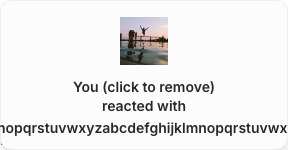 | 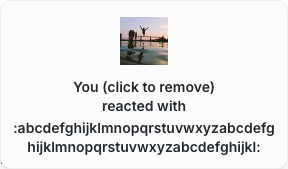 | **Short-name regression check** 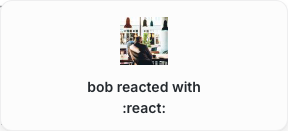 ## Verification - `pnpm test` in `desktop`: 3,858 passed - Focused reaction-name E2E with seeded Picsum captures: 2 passed - Desktop checks and commit hooks passed Originating Buzz channel: `f2ec9671-d78e-4cde-894c-9f4c458c7f1f` --------- Signed-off-by: Taylor Ho <taylorkmho@gmail.com> Co-authored-by: npub1223z34hd7vtwc6qj4s7flsxkj644nlre2nthu7lrrmkumhu3xddsrx9r6w <52a228d6edf316ec6812ac3c9fc0d696ab59fc7954d77e7be31eedcddf91335b@buzz.block.builderlab.xyz>



## Summary
- Refresh Share Compute with the shared agent-style model controls.
- Reveal sharing details and advanced options only while sharing.
- Remove the preview-only mesh API path.

## Validation
- `pnpm check`
- `pnpm test`
- `pnpm exec playwright test tests/e2e/mesh-compute.spec.ts`

Snapshots are attached in a follow-up comment.

---------

Signed-off-by: kenny lopez <klopez4212@gmail.com>
…ock#4578)

## Overview

The global Agent Defaults surface (Settings card, defaults modal,
onboarding) exposed structured controls for Effort but left Max Output
Tokens, Context Limit, and Max Rounds as raw env vars. Per-agent dialogs
had structured numeric fields but only for `isBuzzAgentRuntime` —
incorrectly excluding Goose. This PR unifies numeric-tuning capability
across all surfaces, fixes a pre-existing dual-editor defect, and adds
full test coverage.

## What changed

### Phase 1 — Catalog projection

- Add `max_rounds_env_var` to `KnownAcpRuntime` in `runtime_metadata.rs`
(`Some("BUZZ_AGENT_MAX_ROUNDS")` for buzz-agent, `None` elsewhere).
- Project all three numeric env-var fields (`max_tokens_env_var`,
`context_limit_env_var`, `max_rounds_env_var`) end-to-end:
`AcpRuntimeCatalogEntry` Rust struct, TS `types.ts`,
`RawAcpRuntimeCatalogEntry` + `fromRawAcpRuntimeCatalogEntry` in
`tauri.ts`, and the e2e mock bridge (`withMockRuntimeConfigMetadata`).

### Phase 2 — Field model

- `deriveAgentConfigFieldModel` now derives `maxOutputTokens` /
`contextLimit` / `maxRounds` descriptors from catalog-projected fields.
- `structuredEnvKeys(descriptors)` — exported helper that takes the
**rendered** descriptor set (not the whole model). Hidden keys follow
what is actually rendered per surface: global hides effort + all three
numeric keys for buzz-agent / two for Goose; per-agent buzz-agent hides
effort + three numeric keys; per-agent Goose hides only its two numeric
keys. `BUZZ_AGENT_THINKING_EFFORT` stays a visible generic env row
per-agent because no effort control renders there.

### Phase 3 — UI

- Extract `NumericTuningFields` from `buzzAgentModelTuningFields.tsx` as
a shared descriptor-driven component (`descriptors`, `envVars`,
`inheritedEnvVars`, `onEnvVarChange`). Kind-specific minima:
`NUMERIC_KIND_MIN` map (`maxOutputTokens`/`contextLimit`: 1,
`maxRounds`: 0) applied to `<input min>`.
- **Global surface** (`AgentConfigFields.tsx`): deduplicate the
previously duplicated Advanced env-editor block; render
`NumericTuningFields` below the env editor when descriptors exist;
`hiddenKeys` and `bakedGenericRows` exclusions use `structuredEnvKeys`
so structured keys are never double-rendered. Under 1000 lines.
- **Per-agent surfaces** (`EditAgentAdvancedFields`,
`PersonaAdvancedFields`): replace `isBuzzAgentRuntime` as the
numeric-field gate with `deriveNumericDescriptors(selectedRuntime)` from
`agentConfigCore`; hidden keys come from
`structuredEnvKeys(numericDescriptors)` — the same rendered descriptor
set, no local rebuilding (fixes pre-existing dual-editor defect).
Catalog status carried as `RuntimeCatalogStatus` (`loading | ready |
error`); both error and loading withhold structured controls and leave
saved values visible as generic rows, making error distinguishable from
"runtime not capable" (`ready` + no runtime).
- **Dialogs** (`AgentDefinitionDialog`, `AgentInstanceEditDialog`,
callers): `AgentDefinitionDialog` accepts `runtimeCatalogStatus?:
"loading" | "ready" | "error"` (replaces separate
`runtimesLoading`/`runtimesError` booleans); all call sites —
`AgentManagementDialogs`, `AgentsView`, `RequestedAgentCreateDialogs`,
`UserProfilePersonaDialogs` — compute and pass the status.

### Phase 4 — Tests

- `buildRecord` exported from `EnvVarsEditor.tsx` as a pure `(nextRows,
value, requiredKeys, hiddenKeys) => Record<string, string>` helper for
isolation testing.
- **17 new node tests** in `agentConfigCore.test.mjs`:
`deriveNumericDescriptors` (all three fields, partial, undefined
runtime, matches field-model subset); `structuredEnvKeys` per surface
including discriminating Goose per-agent effort-key invariant;
`NUMERIC_KIND_MIN` values.
- **4 new node tests** in `EnvVarsEditor.test.mjs`: hidden tuning key
preserved through generic row edits; runtime-switch then generic edit
(derives both descriptor sets, asserts new-runtime hidden key survives
`buildRecord` via `hiddenKeys` and old-runtime key survives via generic
rows); baked numeric key excluded via `filterBakedGenericRows` with
`numericTuningPlaceholder` assertion; clearing a structured override —
`numericTuningPlaceholder` verifies placeholder text.
- **5 new Playwright tests** in `agent-numeric-tuning.spec.ts` (added to
smoke project `testMatch`): global numeric fields visible for
buzz-agent; global: non-capable runtime hides numeric controls; Goose
per-agent shows `Inherit (16384)` after saving global value through the
UI; delayed catalog: saved values visible as generic rows while loading
then structured controls appear after settle; failed catalog: saved
values remain visible as generic rows (never the "unsupported" empty
state).

## Result

- buzz-agent global defaults: Max output tokens, Context limit, Max
rounds as structured inputs with `Inherit (N)` placeholders from baked
env.
- Goose global defaults: Max output tokens, Context limit as structured
inputs.
- A Goose global value surfaces as `Inherit (<value>)` in the per-agent
Goose edit dialog.
- No structured key is editable in two places on any surface; no
persisted key has zero editors.
- No `runtime.id === "buzz-agent"` comparison decides numeric-field
visibility anywhere — capability flows catalog →
`AcpRuntimeCatalogEntry` → field model → UI.

Signed-off-by: Will Pfleger <pfleger.will@gmail.com>
Co-authored-by: npub1mn7jgtj4w2pd0g0zeuhxsa6jy6p0rewxz4kujt98my82ahfmp72sxjexk7 <dcfd242e557282d7a1e2cf2e6877522682f1e5c6156dc92ca7d90eaedd3b0f95@buzz.block.builderlab.xyz>
## Overview **Category:** improvement **User Impact:** Mobile users can now access consistent channel and DM actions from both the channel list and conversation header. **Problem:** Mobile channel menus exposed a narrower, inconsistent set of actions than desktop, and the available actions differed by entry point. **Solution:** This change introduces one reusable action sheet with a clear quick-action hierarchy, role-aware lifecycle controls, confirmations for consequential actions, and a deliberately narrower DM menu. ## Changes <details> <summary>File changes</summary> **mobile/lib/features/channels/channel_actions_sheet.dart** Adds the shared channel and DM action-sheet experience used by both entry points, including Star/Unstar and Read/Unread quick actions for channels, section movement, mute, management, inline copy actions, guarded lifecycle actions, confirmations, and a compact DM menu without quick actions. **mobile/lib/features/channels/channel_detail_page.dart** Routes the header ellipsis through the shared action sheet so the in-channel menu matches the channel-list experience, including for DMs. **mobile/lib/features/channels/channel_management_provider.dart** Adds archive and delete operations using the desktop-compatible relay event kinds and refreshes channel state after completion. **mobile/lib/features/channels/channels_page.dart** Makes the shared channel action-sheet entry point available to the channel-list implementation. **mobile/lib/features/channels/channels_page/channel_tile.dart** Replaces the tile-specific long-press menu with the reusable action sheet while preserving read state and section context. **mobile/test/features/channels/channel_actions_sheet_test.dart** Covers action hierarchy, owner/admin/member capability guards, loading and failure states, DM narrowing with no quick-action row, and inline copy actions. **mobile/test/features/channels/channel_detail_page_test.dart** Updates channel-header flows to exercise management through the new shared action sheet. **mobile/test/features/channels/channel_management_provider_test.dart** Verifies archive and delete event tags stay compatible with desktop behavior. </details> ## Reproduction Steps 1. Run the mobile app and open a populated channel list. 2. Long-press a regular channel and verify the Star/Unstar and Read/Unread quick actions appear above Move to section…, Mute, Manage, Copy channel name, and Copy channel ID. 3. Choose either copy action and verify it copies the expected value. 4. Open a channel, tap the header ellipsis, and verify the same action sheet appears. 5. As an admin or owner, verify Archive appears; as an owner, verify Delete also appears. Confirm that lifecycle actions require confirmation. 6. Long-press or open the header menu for a DM and verify it has no quick-action row and starts with Mute, followed by Copy channel name and Copy channel ID. ## Screenshots ### Channel menu | Regular channel — Mark Unread | DM — no quick actions | Archive confirmation | |---|---|---| | 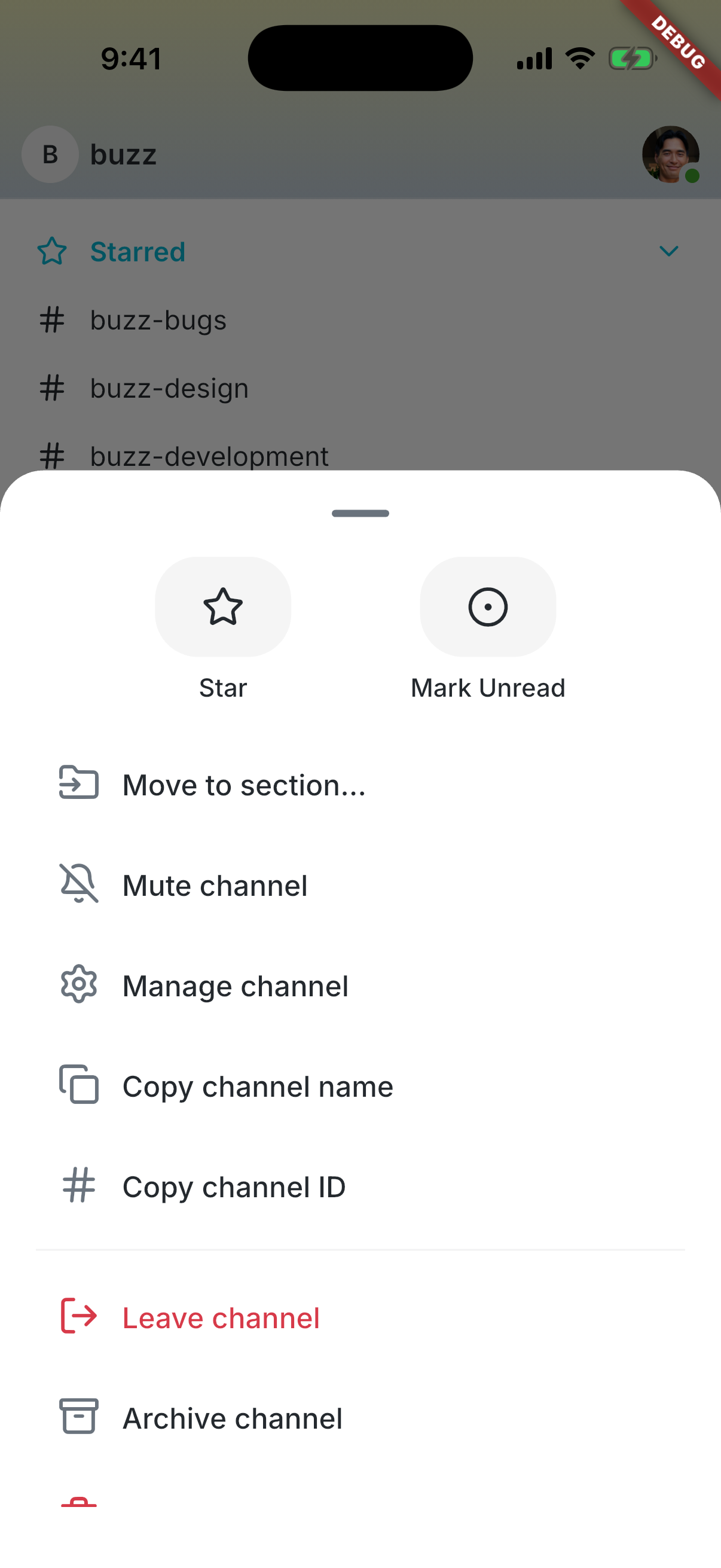 | 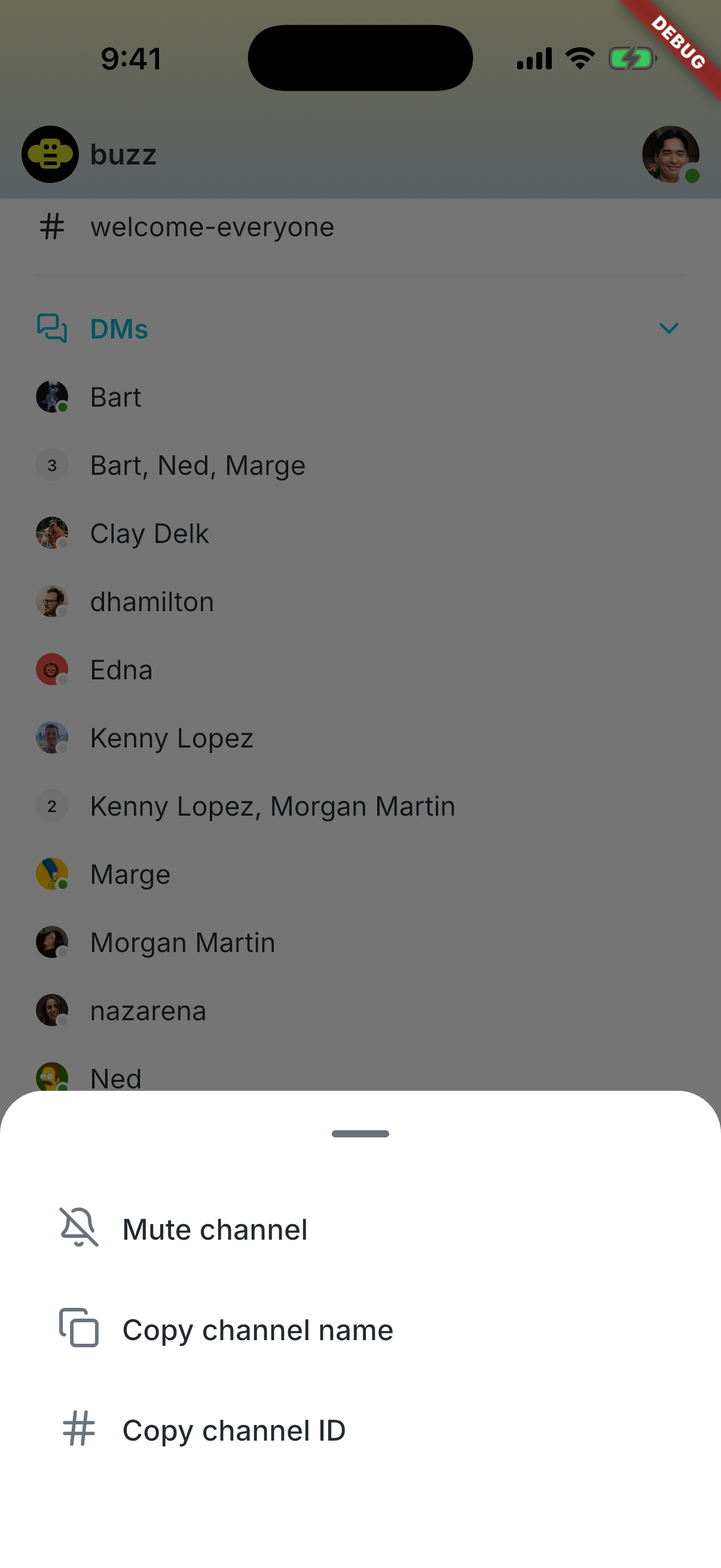 | 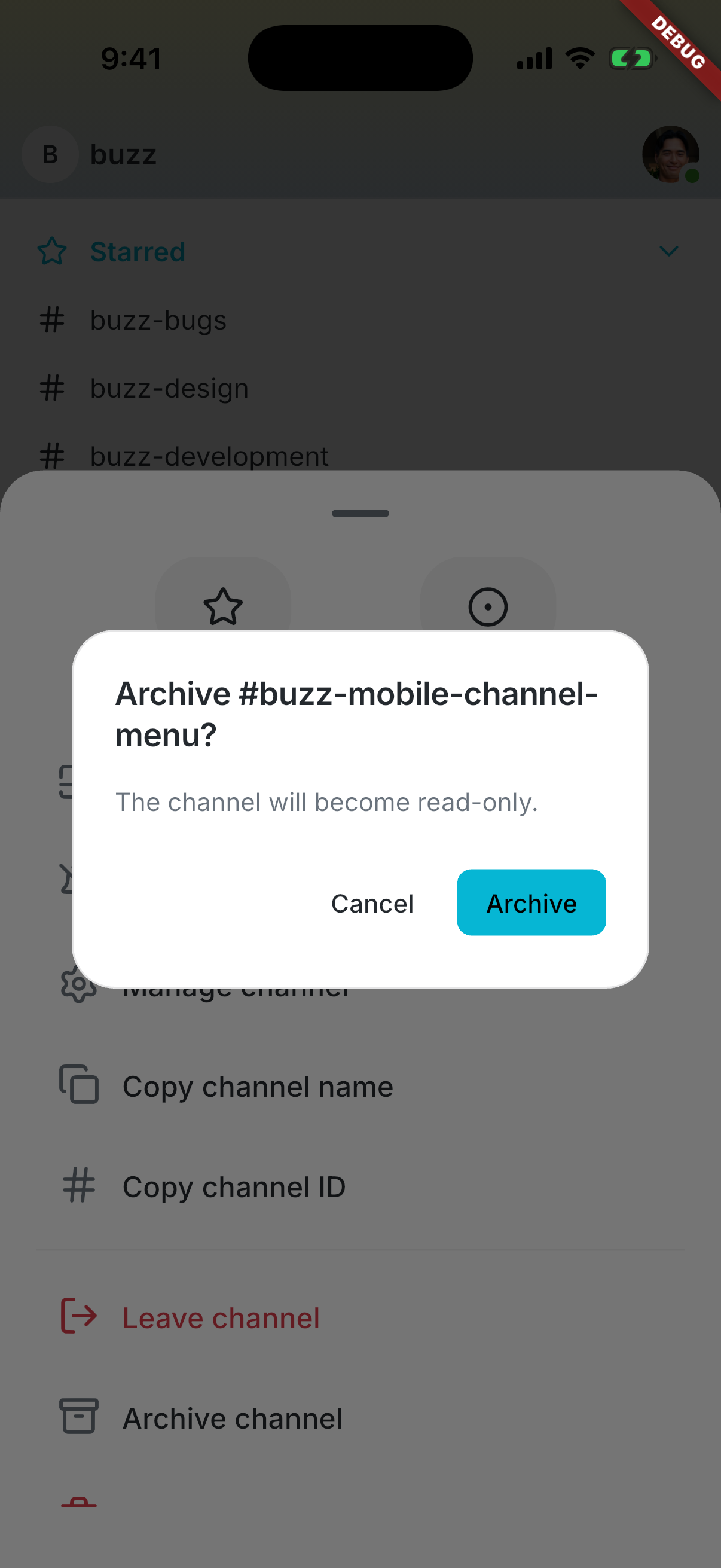 | --------- Signed-off-by: Taylor Ho <taylorkmho@gmail.com> Co-authored-by: npub1223z34hd7vtwc6qj4s7flsxkj644nlre2nthu7lrrmkumhu3xddsrx9r6w <52a228d6edf316ec6812ac3c9fc0d696ab59fc7954d77e7be31eedcddf91335b@buzz.block.builderlab.xyz>



## Summary

- open Huddles in a focused companion window with a clean handoff back
to the in-app drawer and backing channel
- redesign the participant film strip, sidebar control, transcript
surface, and themed shell treatment
- preserve microphone and device control across windows, start agent
voice on the first reply, and show agent speaking activity in the film
strip
- give each agent a distinct session voice, beginning with the
configured default, plus compact per-agent text-to-speech and voice
controls
- enroll only agents explicitly mentioned or deliberately added through
an agent panel into the live Huddle roster
- keep temporary Huddle channels out of the sidebar unless the user
explicitly brings one into the main app
- remove Huddle-only avatar policy badges and filter short silence or
noise segments before speech-to-text posts

## Why

The previous flow exposed the temporary channel as product UI, obscured
who was present or speaking, and split transcript and audio state
between the main and companion windows. This keeps backing channels as
implementation details unless a user explicitly brings a Huddle into the
app, while sharing the live conversation and audio lifecycle across both
surfaces. Agent participants now join only after an explicit invitation,
distinct voices make multi-agent Huddles easier to follow, and short
microphone noise no longer becomes stray transcript messages.

## Validation

- `pnpm check`
- `pnpm build:e2e`
- `pnpm exec playwright test tests/e2e/huddle-transcription.spec.ts
--project=smoke` (13 passed)
- Huddle sidebar visibility unit coverage (4 passed)
- focused managed-agent and persona-mention E2E coverage (2 passed)
- `pnpm test` (3,910 passed)
- `cargo clippy --manifest-path desktop/src-tauri/Cargo.toml
--all-targets -- -D warnings`
- `cargo test --manifest-path desktop/src-tauri/Cargo.toml` (2,093
passed, 14 ignored; 3 diagnostics passed)

---------

Signed-off-by: kenny lopez <klopez4212@gmail.com>
Signed-off-by: Wes <wesbillman@users.noreply.github.com>
Co-authored-by: Wes <wesbillman@users.noreply.github.com>
Co-authored-by: Carl <c7ebe626f000404285d3686e1dc74cc07cc60a9754a150041ba132e14bd3e2ec@buzz.block.builderlab.xyz>
**Category:** improvement **User Impact:** Mobile readers can jump directly to their oldest unread message and return to the latest message with compact directional controls. **Problem:** Opening an active channel at its newest message makes it easy to miss where unread conversation began, while moving back through history lacks a lightweight route to the live edge. **Solution:** Capture the channel's unread boundary when it opens, offer an accessible up-chevron beneath the app bar to reach that stable target, then reveal the inverse down-chevron at the bottom whenever the reader is away from latest. Deep links retain precedence, and live-follow, pagination, composer resizing, and explicit scroll ownership continue to use the existing timeline behavior. <details> <summary>File changes</summary> **mobile/lib/features/channels/channel_detail_page.dart** Captures the channel's read state at open time and passes a stable unread snapshot into the timeline before the normal deferred read update advances it. **mobile/lib/features/channels/channel_detail_page/message_list.dart** Adds mutually exclusive oldest-unread and latest navigation, with accessible icon controls positioned at opposite edges of the message surface while preserving existing follow and deep-link behavior. **mobile/test/features/channels/channel_detail_page_test.dart** Covers the unread target, compact inverse controls, accessible tooltips, and placement beneath the frosted app bar. </details> ## Reproduction steps 1. Open a Flutter mobile channel that has unread messages without entering through a message or thread deep link. 2. Confirm an up-chevron appears directly below the channel app bar while the timeline remains at latest. 3. Tap the up-chevron and confirm the timeline scrolls to the oldest message that was unread when the channel opened. 4. Confirm the unread control is replaced by a down-chevron at the bottom of the timeline. 5. Tap the down-chevron and confirm the timeline returns to latest and resumes following new messages. ## Screenshots | At latest — up-chevron to oldest unread | Away from latest — down-chevron to latest | |---|---| | 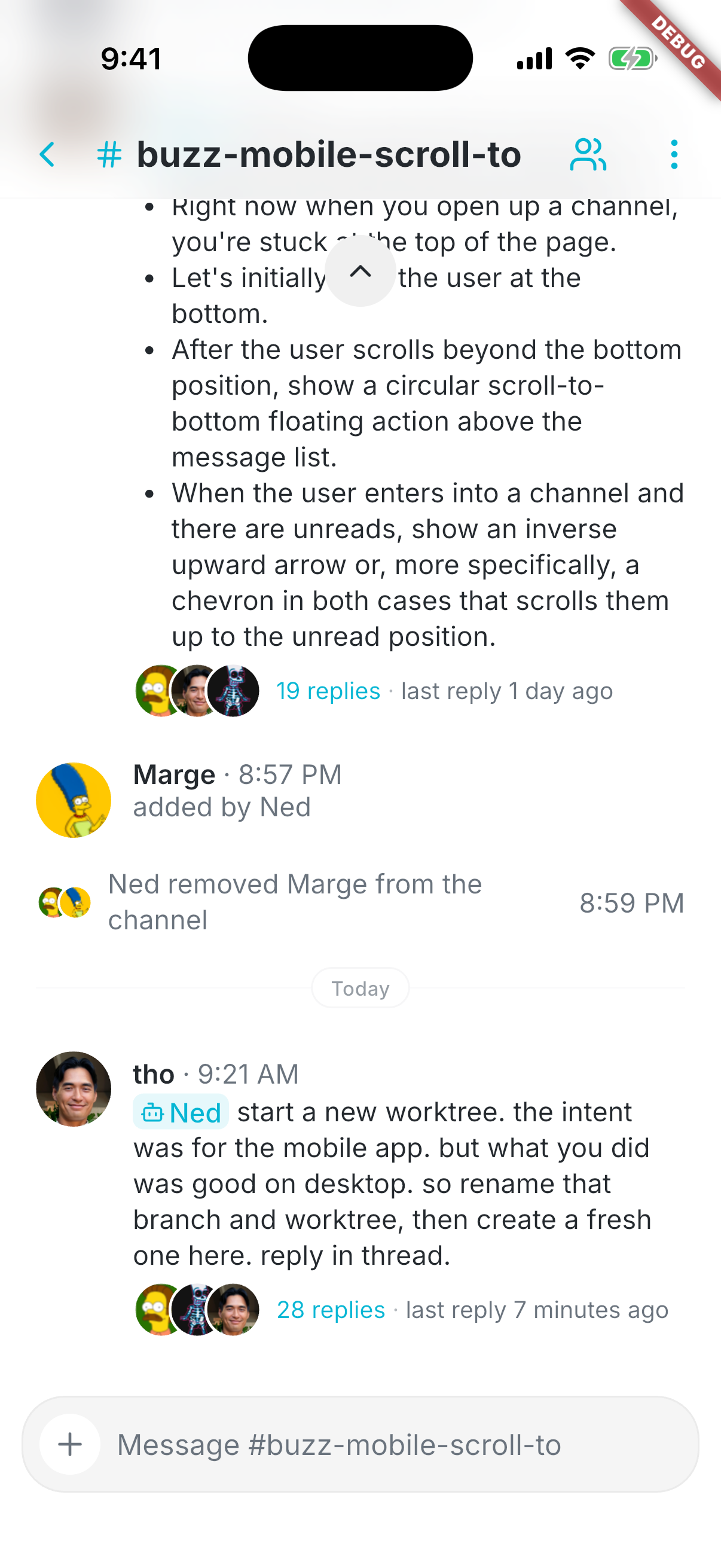 | 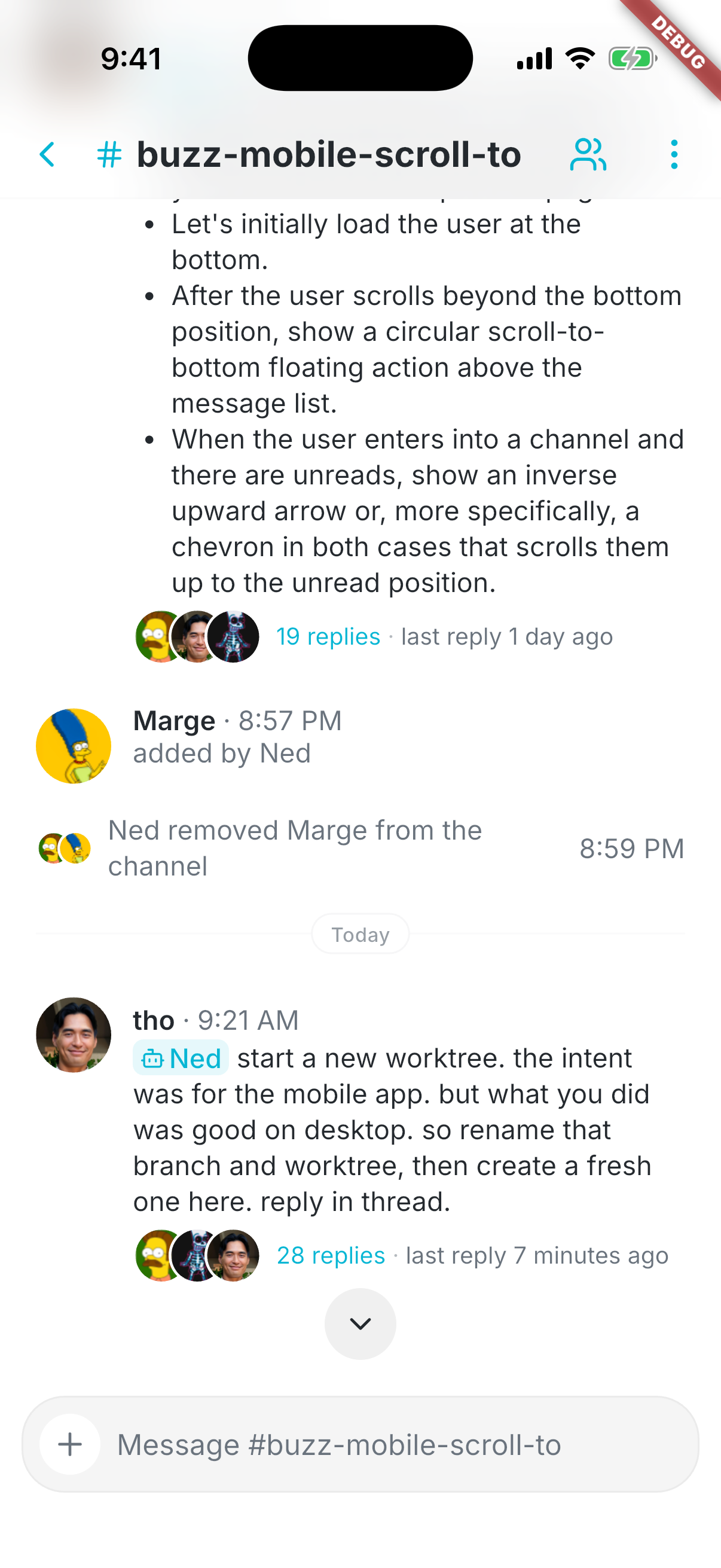 | _Real iPhone 17 Pro Simulator captures from the neutral `buzz-mobile-scroll-to` channel._ Originating Buzz thread: `buzz://message?channel=5b16c478-22d8-4ddd-951a-6036e19b81ff&id=6a78af32d7ac6f531b182c4e70dd5a04c503a2dab2ce2c0c74b2c6baa5921741&thread=6a78af32d7ac6f531b182c4e70dd5a04c503a2dab2ce2c0c74b2c6baa5921741` --------- Signed-off-by: Taylor Ho <taylorkmho@gmail.com> Signed-off-by: npub1223z34hd7vtwc6qj4s7flsxkj644nlre2nthu7lrrmkumhu3xddsrx9r6w <52a228d6edf316ec6812ac3c9fc0d696ab59fc7954d77e7be31eedcddf91335b@buzz.block.builderlab.xyz> Co-authored-by: npub1223z34hd7vtwc6qj4s7flsxkj644nlre2nthu7lrrmkumhu3xddsrx9r6w <52a228d6edf316ec6812ac3c9fc0d696ab59fc7954d77e7be31eedcddf91335b@buzz.block.builderlab.xyz>


**Category:** improvement **User Impact:** Mobile users can sort each channel group by recent activity or A–Z, with their choices synchronized with desktop. **Problem:** Desktop supports persistent per-group channel sorting, but mobile shows the same groups without equivalent controls or shared preferences. The earlier mobile attempt coupled sorting to unsafe dirty-state behavior that could overwrite newer cross-client changes. **Solution:** Add mobile sorting controls and encrypted NIP-78 synchronization using the existing desktop `channel-sort` contract, while retaining ordinary whole-blob last-write-wins behavior. Local state is scoped by identity and normalized relay, startup closes fetch/subscription gaps, and both clients use the same deterministic ordering rules. <details> <summary>File changes</summary> **desktop/src/features/sidebar/lib/channelSortPreference.test.mjs** Updates ordering coverage for the deterministic, cross-client A–Z comparison rule. **desktop/src/features/sidebar/lib/channelSortPreference.ts** Aligns desktop channel-name collation with mobile so synchronized preferences produce the same visible order. **mobile/lib/features/channels/channel_sort/channel_sort_manager.dart** Adds encrypted relay synchronization with safe startup gap handling, clock checks, and ordinary last-write-wins conflicts. **mobile/lib/features/channels/channel_sort/channel_sort_provider.dart** Scopes sort state to the active identity and community lifecycle. **mobile/lib/features/channels/channel_sort/channel_sort_storage.dart** Defines the desktop-compatible payload, relay-scoped cache and migration, cleanup, and shared ordering behavior. **mobile/lib/features/channels/channels_page.dart** Connects sort state to the channel page. **mobile/lib/features/channels/channels_page/body.dart** Applies each selected order to Starred, custom groups, Channels, and DMs. **mobile/lib/features/channels/channels_page/sections.dart** Adds checked Recent and A–Z actions using the existing anchored-popover UI. **mobile/test/features/channels/channel_sort/channel_sort_manager_test.dart** Covers payload adoption, encrypted publication, conflicts, timestamps, retries, and cleanup. **mobile/test/features/channels/channel_sort/channel_sort_storage_test.dart** Covers parsing, relay isolation, migration, cleanup, and ordering modes. **mobile/test/features/channels/channels_page_test.dart** Verifies the group controls expose both choices. </details> ### Reproduction steps 1. Open the mobile channel list with populated built-in and custom groups. 2. Open a group menu and choose **Sort: Recent**; confirm active channels move to the top. 3. Choose **Sort: A–Z**; confirm deterministic alphabetical ordering returns. 4. Repeat for Starred, a custom group, Channels, and DMs. 5. Open desktop with the same identity and community and confirm each synchronized preference. 6. Switch communities and confirm cached preferences do not bleed across relays. ### Screenshots Approved `live` custom-section flow with `research` kept offscreen. | Recent selected | A–Z result | A–Z selected | |---|---|---| | 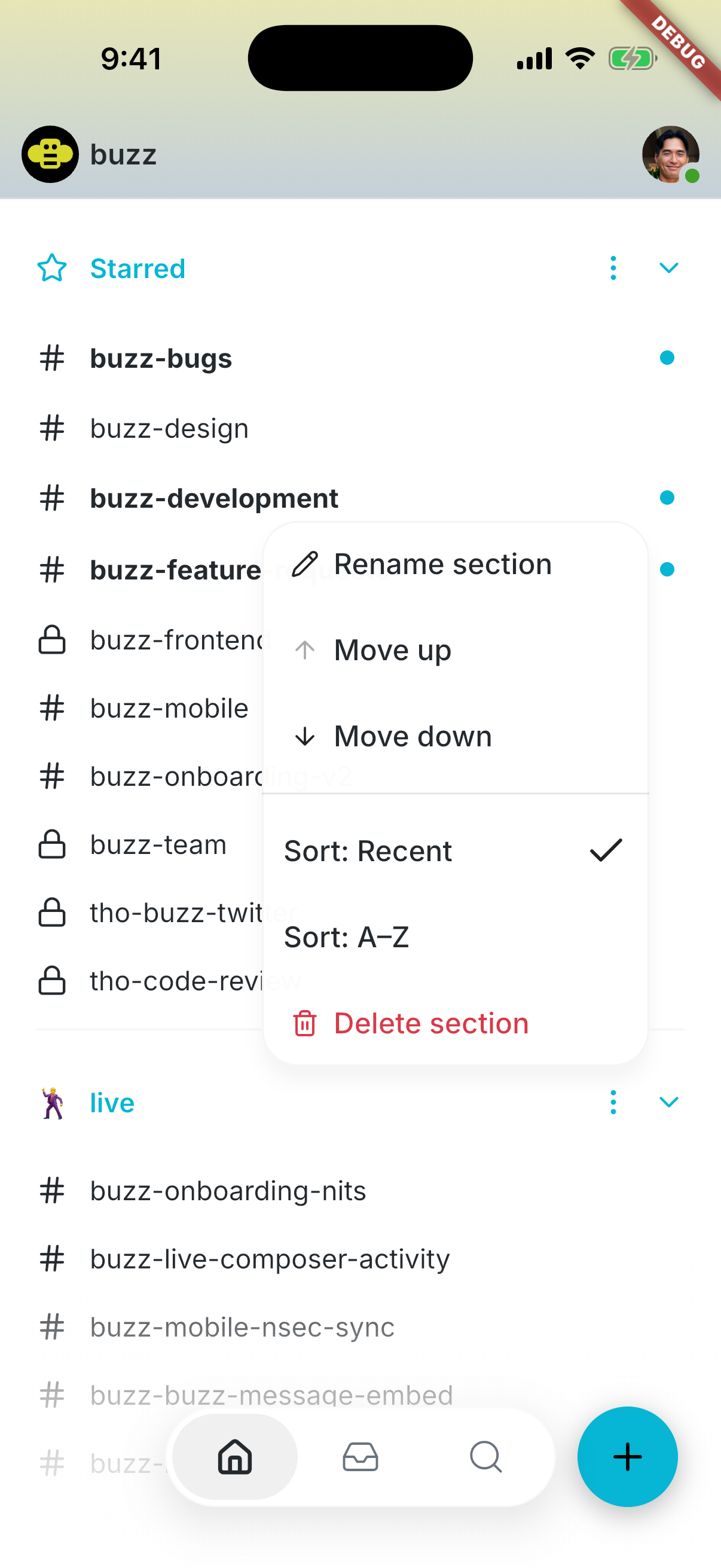 | 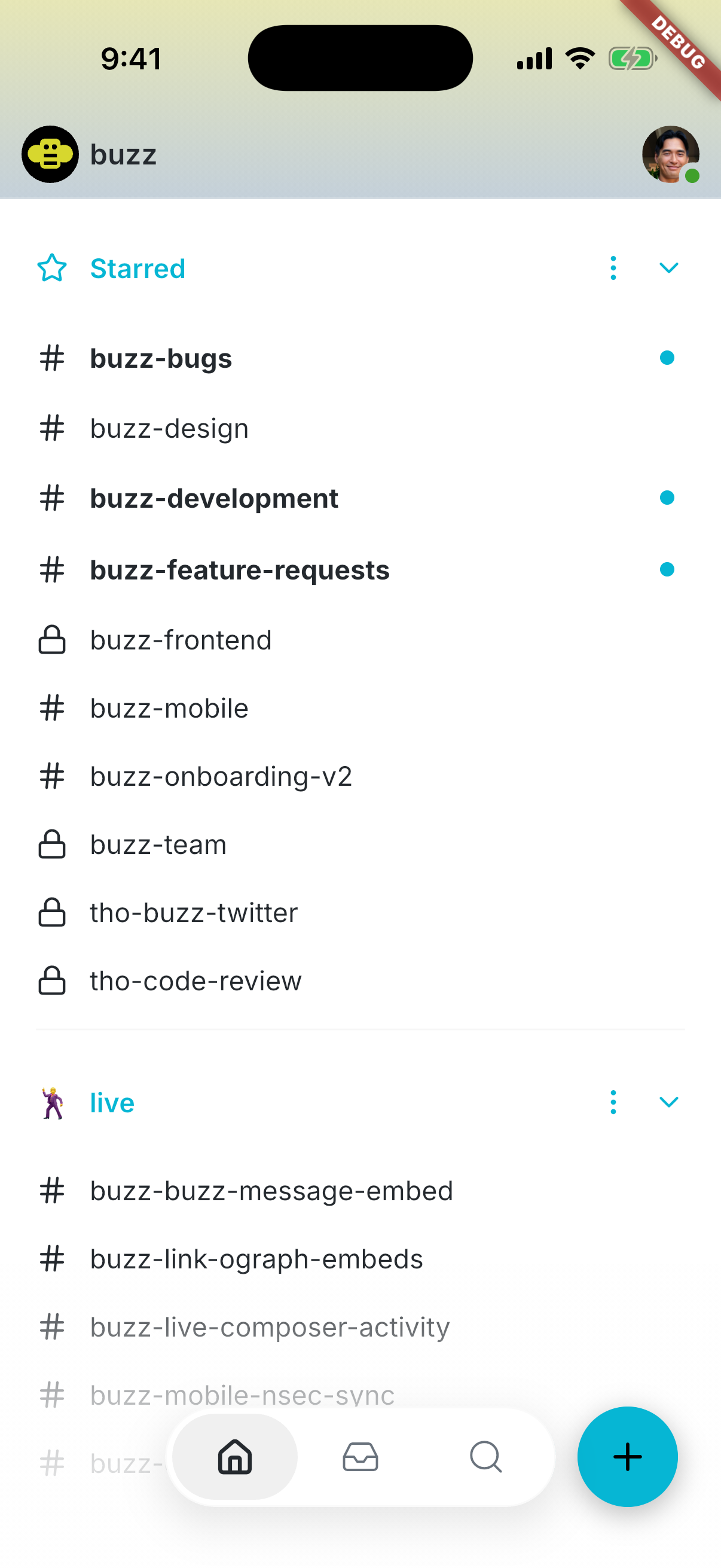 | 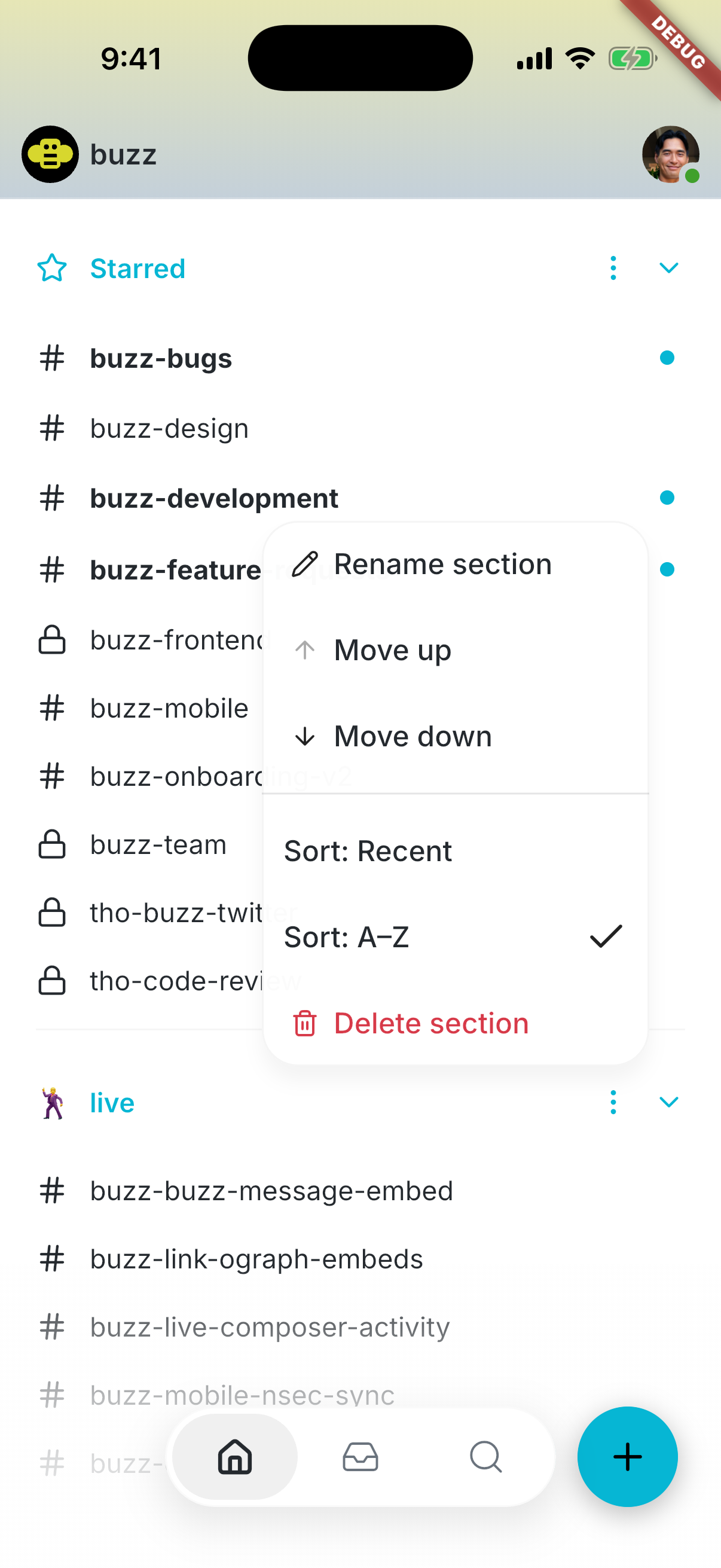 | ### Validation - Mobile `flutter analyze` — clean - Focused mobile sort and channel-page suites — 37/37 passed - Desktop full suite — 3906/3906 passed - Mobile full suite — 1034 passed, 1 skipped, 1 unrelated baseline failure reproduced at `8dda40ca3` <!-- Originating Buzz channel: 2a16a2bb-6fd3-4d69-8182-2afcb21b2d14 --> --------- Signed-off-by: Taylor Ho <taylorkmho@gmail.com> Co-authored-by: npub1223z34hd7vtwc6qj4s7flsxkj644nlre2nthu7lrrmkumhu3xddsrx9r6w <52a228d6edf316ec6812ac3c9fc0d696ab59fc7954d77e7be31eedcddf91335b@buzz.block.builderlab.xyz>



## Summary - ship **Buzz Term** end to end: the terminal engine/runtime, mounted desktop substrate, and user-visible naming - add Quinn's tape-deck-inspired banner: a beveled chassis filled by the `buzz term` wordmark, surrounded by a complete-hex field - derive the wordmark's three-stop sweep from each theme's terminal palette so primary, secondary, and accent roles remain visibly distinct across all 62 shipped themes, including light themes - paint the banner once on its own pointer-transparent canvas; PTY rendering beneath it remains unchanged ## Banner behavior - uses the renderer's shared `8.4 × 17` cell metrics and production aspect ratio `2.0238` - regenerates only for viewport/theme changes; palette switches repaint correctly while the banner is visible - dismisses on non-empty output from the active terminal session; empty output and inactive sessions do not dismiss it - fails closed below **70 columns** rather than squeezing or clipping the wordmark - adds **8 lines** to `terminalRenderer.ts` for shared cell metrics and **zero lines inside `paint()`** ## Screenshots | Buzz (light) | Buzz Dark | |---|---| |  |  | | Kanagawa Lotus (light) | Red | |---|---| |  |  | Additional production-aspect finals: [Vesper](https://buzz.block.builderlab.xyz/media/9ca6514b63f8cfb2107a85ca46f16a940c0883848e6fbc718e411af94aa13100.png), [Min Dark](https://buzz.block.builderlab.xyz/media/f67bd2970e5d64ffb07b1ae78ab58c847e6ebc23e7e7a48e067eb024dba64ec8.png), and [Dark Plus](https://buzz.block.builderlab.xyz/media/290fee08924f37d064abc687ecf3e9526ab05b87e8e56d610f23048949793dbe.png). The screenshot harness was checked against the shipped painter at this exact head: all **2,541 draw calls** matched on color, glyph, x, and y; four deliberate divergence controls fired. ## Verification at `4f3cecd5a48f991975c00579694b848a9e996048` - desktop tests: **3,946 / 3,946** - TypeScript: clean - checks: pass (two pre-existing informational `useTemplate` notices only) - integration/e2e: PASS (independent exact-SHA lane; artifacts recorded in the originating Buzz thread) - artifact/dead-path sweep: clean - redteam G1–G7: PASS - all six named banner emitter-deletion mutants die - independent handwritten five-row full-wordmark fixture kills Quinn's seven-mutant battery, including a one-pixel glyph change - real `112 × 46` canvas-rect dismissal tests separately cover active non-empty, active empty, and inactive non-empty output - layer-drop and zero-draw painter mutants die; z-order and pointer-events verified - CI's `tsc && vite build` includes all three banner modules - performance at DPR 2 (worst-case measured envelope): - one-time content paint: **~0.7–0.8 ms**, paid only when the banner is built or its palette changes - busy compositor, CSS `1277 × 697`, backing `2554 × 1394`: **470–497 µs/frame** for the full banner (**2.82–2.98%** of a 60 Hz frame) - busy compositor, CSS `1920 × 1080`, backing `3840 × 2160`: **1,139–1,212 µs/frame** (**6.83–7.27%**) - empty, one-glyph, and full-banner controls converge: compositor cost follows backing-layer area and DPR rather than painted-cell count - in the actual idle welcome state, cost is below both vsync-clamped rigs' resolution; it is not claimed as zero - **Pane cross-rig spread: resolved at matched loop rate.** Two independent rigs initially differed 2.3× (58–68 vs 136 µs/Mpx of backing store; pane, CSS 1277×697 / backing 2554×1394, DPR 2). The cause of *that* spread is rAF loop rate: the higher figure came from a free-running loop at ~1600fps. Throttled to ~200–236fps, both rigs read 58–68 µs/Mpx (1.25–1.44% of a 60Hz frame). The busy-composite figures quoted above remain the **unthrottled worst case** and are conservative by ~2.3× at the pane. Not established: the mechanism and sign of free-running distortion (one rig under-charges ~15%, the other over-charges 2.3×), and the 1080p figure has not been re-measured throttled. - the layer paints only on generation/theme/resize and dismisses on first non-empty active-session output, so the measurable busy cost is a short-lived worst case rather than a persistent PTY paint-path tax ## Follow-ups in this PR These are intentionally subsequent commits after the certified static-banner head, not claims about `4f3cecd5a`: 1. close the compositor metrology: remeasure the 1080p point throttled and characterize the opposite-sign free-running rAF distortion, with each measurement regime stated 2. add Tyler's animated honeycomb color waves, gated by `prefers-reduced-motion`, a full 62-theme phase-sweep contrast check, and DPR-2 per-tick performance certification 3. land the already-proven mounted theme-switch regression probe from `RESEARCH/BUZZ_TERM_G3A_PROBE/` 4. bound the slow/hang-shaped G1-c mutant `waitFor` 5. optionally trim the generator to its ink bounding box, reducing the minimum viewport from 70 to 62 columns --------- Signed-off-by: tlongwell-block <109685178+tlongwell-block@users.noreply.github.com> Signed-off-by: npub1mprnacetjua2xx3p5eddmhxyk6wv929ymm5py8kd2xfxurxahspqqlgyta <d8473ee32b973aa31a21a65adddcc4b69cc2a8a4dee8121ecd51926e0cddbc02@buzz.block.builderlab.xyz> Signed-off-by: npub1jh9wn95s0472h86ahapupaf7m6kx4v9sx2n0atj2hltcfer8k06s5n3pyf <95cae996907d7cab9f5dbf43c0f53edeac6ab0b032a6feae4abfd784e467b3f5@buzz.block.builderlab.xyz> Signed-off-by: npub17jjz49l9jjmhhk7cac63j8yt9z555n9cw8vk7v5jz4vzw4ppld5qgj57cc <f4a42a97e594b77bdbd8ee35191c8b28a94a4cb871d96f32921558275421fb68@buzz.block.builderlab.xyz> Signed-off-by: npub1qyvc0c5kl4gqv2fd97fsk46tu378sqgy35vc83rvgfwne90sel7s0ed67d <011987e296fd5006292d2f930b574be47c7801048d1983c46c425d3c95f0cffd@buzz.block.builderlab.xyz> Co-authored-by: Dawn (sprout agent) <c6237ef84fa537c78dcee78efd2d4e59f728859c7f194da42ac51ededfa0be05@sprout-oss.stage.blox.sqprod.co> Co-authored-by: npub1t2tgm7d8f995uqvmnm8h88sg3wnpp9a5xysjf6dg3tjmgt3ltulqdp8ehr <5a968df9a7494b4e019b9ecf739e088ba61097b4312124e9a88ae5b42e3f5f3e@buzz.block.builderlab.xyz> Co-authored-by: npub1cc3ha7z055mu0rwwu7806t2wt8mj3pvu0uv5mfp2c50dahaqhczshdalg6 <c6237ef84fa537c78dcee78efd2d4e59f728859c7f194da42ac51ededfa0be05@buzz.block.builderlab.xyz> Co-authored-by: npub17jjz49l9jjmhhk7cac63j8yt9z555n9cw8vk7v5jz4vzw4ppld5qgj57cc <f4a42a97e594b77bdbd8ee35191c8b28a94a4cb871d96f32921558275421fb68@buzz.block.builderlab.xyz> Co-authored-by: npub1jh9wn95s0472h86ahapupaf7m6kx4v9sx2n0atj2hltcfer8k06s5n3pyf <95cae996907d7cab9f5dbf43c0f53edeac6ab0b032a6feae4abfd784e467b3f5@buzz.block.builderlab.xyz> Co-authored-by: npub1mprnacetjua2xx3p5eddmhxyk6wv929ymm5py8kd2xfxurxahspqqlgyta <d8473ee32b973aa31a21a65adddcc4b69cc2a8a4dee8121ecd51926e0cddbc02@buzz.block.builderlab.xyz> Co-authored-by: npub1qyvc0c5kl4gqv2fd97fsk46tu378sqgy35vc83rvgfwne90sel7s0ed67d <011987e296fd5006292d2f930b574be47c7801048d1983c46c425d3c95f0cffd@buzz.block.builderlab.xyz>


## Summary

- make mobile unread state visible with bold channel names, an animated
Inbox badge, and swipe-to-toggle Inbox rows
- add directional transitions for top-level mobile navigation
- let mobile send while media uploads, with cancellable progress UI
- normalize iOS and Android video uploads, attach poster frames, and
improve native video playback

## Validation

- `just mobile-check`
- `just mobile-test`
- `cargo test -p buzz-media`
- Pixel smoke test
- iPhone smoke test

Desktop background uploads moved to block#4522 so the two platforms can be
reviewed independently.

---------

Signed-off-by: kenny lopez <klopez4212@gmail.com>
Signed-off-by: Tom Brow <tomb@block.xyz>
Co-authored-by: leader <71e9f2c44a6932b6772caaaccda1911d010463c3e2c6c40410b8329956046801@buzz.block.builderlab.xyz>
Co-authored-by: Tom Brow <tomb@block.xyz>
…lock#2392) (block#4374)

## What

Fixes block#2392 — the action cards in the empty-channel intro ("Create
agent", "Add people") had their `focus-visible` ring clipped by the
surrounding scroll container.

## Root cause

The cards sit in a `flex ... overflow-x-auto pb-1` row. Setting
`overflow-x` (without `overflow-y`) makes the browser compute
`overflow-y: auto` as well, so the container clips anything painted
outside its padding box — including the cards' `focus-visible:ring-2`
box-shadow. With only `pb-1` padding, the top/left/right of the ring
were cut off when Tabbing to a card.

## Change

`desktop/src/features/messages/ui/ChannelIntroBlock.tsx` — `pb-1` →
`p-1` on the action-cards scroll container, reserving 4px on all four
sides so the focus ring renders fully inside the scroll container's
padding box.

- 1 file, 1 line. No behavior change for mouse users or layout.

## Verification

- `pnpm typecheck` — clean
- `pnpm exec biome check src/features/messages/ui/ChannelIntroBlock.tsx`
— clean
- `pnpm check:file-sizes` — clean
- Desktop unit suite — **3906/3906 pass**

Signed-off-by: Sarthak Singh <sarthak.singh@juspay.in>

Signed-off-by: Sarthak Singh <sarthak.singh@juspay.in>
## Summary

- send desktop messages immediately while media uploads continue in
background state across channel navigation
- show immediate progress above the composer and keep Jump to latest
above it
- report the real media stages as Preparing, Processing, Converting,
Uploading, and Finishing
- use Buzz's shared spinner during local media work, then switch to the
real percentage when byte transfer begins
- animate phase-label and status-suffix changes without overlap or
layout jumps
- keep cancel, progress fill, message publication, and community-reset
behavior coordinated with the background task
- use raw Tauri IPC for large browser files so renderer-side byte
serialization does not block initial feedback

## Why

Desktop previously blocked sending while attachments uploaded in the
composer. Large videos could also pause the renderer before progress
appeared, and the progress pill said Uploading while native media
processing was still underway. This makes the initial response immediate
and describes the work actually happening.

## Validation

- `cd desktop && pnpm check`
- `cd desktop && pnpm typecheck`
- `cd desktop && pnpm test` (3,931 passed)
- `cd desktop && pnpm exec vite build --mode e2e`
- `cd desktop && pnpm exec playwright test
tests/e2e/file-attachment.spec.ts --project=smoke` (11 passed)
- focused native media tests (80 passed)
- native Clippy with all targets and features
- pre-push native suite (2,107 passed, 14 ignored; 3 diagnostics passed)

Updated phase snapshots are included in the PR comments.

Split from block#4512 so the desktop and mobile changes can be reviewed
independently.

---------

Signed-off-by: kenny lopez <klopez4212@gmail.com>
Signed-off-by: Wes <wesbillman@users.noreply.github.com>
Co-authored-by: Wes <wesbillman@users.noreply.github.com>
Co-authored-by: Carl <c7ebe626f000404285d3686e1dc74cc07cc60a9754a150041ba132e14bd3e2ec@buzz.block.builderlab.xyz>
## Summary

- Make channel join/leave activity use the selected inline avatar-stack
treatment.
- Group related membership activity for one hour and preserve
profile/overflow-name interactions.
- Restore the virtualized day-divider handoff and align the sticky date
behavior with the message timeline.

## Validation

- `pnpm check`
- `pnpm test`
- `cargo test --manifest-path desktop/src-tauri/Cargo.toml`
- Visual desktop screenshot captured with seeded membership activity

---------

Signed-off-by: kenny lopez <klopez4212@gmail.com>
## Summary
- Keep the Welcome composer prompt above the dock blur so it stays
readable.
- Remove blur from the prompt and persona-motion paths.
- Cover the crisp, correctly layered banner in the onboarding browser
test.

## Validation
- `pnpm -C desktop exec biome check
src/features/channels/ui/WelcomeComposerBanner.tsx
tests/e2e/onboarding.spec.ts`
- `pnpm -C desktop build:e2e`
- `pnpm -C desktop exec playwright test tests/e2e/onboarding.spec.ts
--grep "finishing onboarding creates starter channels and focuses
welcome-everyone for a new member" --project=integration`

---------

Signed-off-by: kenny lopez <klopez4212@gmail.com>
…ty + consumer cost guidance (block#4632)

Amends `docs/nips/NIP-AM.md` with three normative publisher-behavior
changes per the cleared Usage v2 plan (plan v3, D4 + D2').

## Changes

### 1. Cache emission semantics (D4)

Replaces the unconditional `MAY` with qualified obligations:

- Publishers SHOULD emit `cacheReadTokens` / `cacheWriteTokens` when the
provider exposes a cache component.
- Publishers MUST preserve an explicit zero when the provider reports
zero.
- Publishers MUST omit the field (never null or fabricated zero) when
that component is unavailable to the publisher — including when the
provider supports it but the harness does not surface it.

An explicit carve-out in both the JSON comment block and the
Numeric-validity prose exempts these fields from the payload-wide null
guidance. Omission is the only valid representation for an unavailable
cache component.

### 2. Optional `pricingIdentity` field (D2')

Adds an optional, non-nullable `pricingIdentity` object (`authority`,
`model`, `cacheClass`), defined as billing authority — distinct from the
transport `Provider` enum.

- `authority` is a registered billing-namespace identifier: exact
lowercase hostname, no scheme, no path, no trailing slash. Registered
values: `api.anthropic.com`, `api.openai.com`, `openrouter.ai`. The set
extends only by NIP amendment. Pricing lookup is an exact string match
on `(authority, model)`.
- Present only when the publisher can prove applicability: direct
official-endpoint connections prove via the actually-requested resolved
model; other routes MUST receive response-supplied authoritative billing
identity.
- MUST omit for custom/overridden base URLs, gateways (unless the
gateway is the named billing authority), unresolved aliases, and turns
where usage contributions carry more than one billing identity
(including identity-bearing mixed with unresolved).
- `cacheClass` is omitted (not null) when not applicable.
- `pricingIdentity` is optional but not nullable — omission is the only
absence representation.
- The existing `model` field retains its non-billing semantics
(configured/session model) and is never overloaded.
- Consumers MUST treat omission as "price unknown" and MUST NOT infer a
price from the session `model` field.

### 3. Consumer cost guidance (D4)

- Consumers MAY recompute cost estimates using the billing identity and
a pricing manifest.
- Consumers MUST retain the provenance of any cost value (e.g.
`manifest-estimated`, `wire-reported`).
- Consumers MUST NOT merge manifest-estimated and wire-reported costs
into an unlabeled total.

Manifest-vs-wire display preference is application policy and
deliberately excluded from this NIP.

## Scope

Doc-only. Single file: `docs/nips/NIP-AM.md`.

---------

Signed-off-by: Will Pfleger <pfleger.will@gmail.com>
Co-authored-by: npub1mn7jgtj4w2pd0g0zeuhxsa6jy6p0rewxz4kujt98my82ahfmp72sxjexk7 <dcfd242e557282d7a1e2cf2e6877522682f1e5c6156dc92ca7d90eaedd3b0f95@buzz.block.builderlab.xyz>
## Overview

Agents running in Buzz have no built-in awareness that each channel is
an isolated conversation context. When a human mentions work "you" are
doing in another channel, the current session can misread this as its
own active context and try to coordinate, re-plan, or take ownership of
it — causing confusion and wasted turns.

## What changed

Added a `## Session Model` section to
`crates/buzz-acp/src/base_prompt.md`, inserted immediately after the
opening paragraph and before `## Buzz CLI`. The section explains:

- Each channel is a separate session; multiple sessions of the same
agent identity may be active simultaneously.
- Sessions share core memory, workspace, and relay — but not
conversation context or in-flight reasoning.
- Cross-channel work belongs to the owning session by default; the
current session may take it over only when the human explicitly requests
it.

No runtime code changes. Base prompt only.

---------

Signed-off-by: Will Pfleger <pfleger.will@gmail.com>
Co-authored-by: npub1mn7jgtj4w2pd0g0zeuhxsa6jy6p0rewxz4kujt98my82ahfmp72sxjexk7 <dcfd242e557282d7a1e2cf2e6877522682f1e5c6156dc92ca7d90eaedd3b0f95@buzz.block.builderlab.xyz>
## Why

Buzz restores cached channels and messages before profile lookups
complete. On launch, that briefly exposes pubkey-derived labels in place
of familiar display names.

## What

- Persist a bounded, relay-scoped cache of last-known display names,
NIP-01 names, and NIP-05 handles
- Seed batch profile queries from those labels immediately, while
keeping them stale so the existing relay request revalidates them
- Keep cached data presentation-only: avatars and ownership metadata are
not persisted or used to seed profile-detail caches
- Remove cleared or missing profiles, purge a relay's labels when its
community is removed, and include the cache in local-storage quota
recovery
- Add unit coverage for parsing, bounds, eviction, malformed data, and
cleared profiles
- Add an E2E regression that delays the relay profile response and
verifies the cached name is rendered first

## Risk Assessment

Low. The cache is disposable, capped at 1,000 entries per relay, scoped
by normalized relay URL, and always revalidated. It contains only public
label fields and does not restore avatars, agent ownership, or
authorization state.

## Verification

- `just ci`
- `pnpm typecheck`
- `pnpm test` — 3,727 passed
- `pnpm exec playwright test tests/e2e/channels.spec.ts --grep "cached
profile labels"` — passed

Generated with Codex
## Summary

- Keep selected sidebar rows regular by default; manually unread rows
become bold immediately.
- Apply a clearer dark-mode hierarchy: standard inactive rows at 75%,
muted rows at 45%, and unread rows at full emphasis.
- Keep hover text color stable while retaining the selected-row and
unread cues.

## Validation

- `pnpm typecheck`
- `pnpm build:e2e`
- Playwright: sidebar badge and channel-mute coverage

## Screenshots

Posted in the PR comments.

---------

Signed-off-by: kenny lopez <klopez4212@gmail.com>
)

The "Restart required" badge reports that an agent's running config has
drifted from its spawn-time config, but never says what changed. This
ships the full feature: a typed Rust diff engine and a TS/UI layer that
renders it at every badge site.

## Rust core (spawn-snapshot diff engine)

Replaces the lossy `u64` `spawn_config_hash` with a typed
`SpawnConfigSnapshot`. The snapshot is stamped from the already-resolved
command/env/config values immediately before `spawn()`, closing the race
window where a mid-spawn config edit would suppress the badge.

`SpawnConfigSnapshot::canonical()` is the single JSON projection shared
by the badge and the diff. Drift is `to_value(stamped) !=
to_value(current)`; the diff is a generic leaf walk over those same two
values, so badge-on and diff-non-empty are structurally guaranteed.
Adding a snapshot field reaches the UI with no code change to the diff
engine — `mutation_table_covers_every_serialized_field` fails CI if a
new field arrives without a mutation row.

`eligible_restart_diff(persona_orphaned, Option<TrackedSpawnState>)`
returns the final vector — snapshot walk entries plus a synthetic
`adapter_availability` entry. It returns empty for an orphaned instance
(spawning one would fail) and for agents with no tracked spawn state
(never stamped, can never have drifted). `needs_restart =
!restart_diff.is_empty()` derives from that vector and nothing else.

Redaction policy (`policy_for(path)`) is shared by the wire diff and the
snapshot's manual `Debug` via `is_safe_to_reveal()` from
`managed_agents::env_vars` as the single authority for env-key masking:

| Policy | Paths | Rendering |
|---|---|---|
| `Text` | `system_prompt`, `team_instructions` | character counts only
|
| `MaskedBare` | `args`, `relay_url` | `••••`, no suffix |
| `MaskedSuffix` | non-allowlisted `env.*` | `••••` + last 4 chars when
longer than 8 |
| `Plain` | allowlisted `env.*` (`BUZZ_AGENT_THINKING_EFFORT`,
`BUZZ_AGENT_PROVIDER`, `BUZZ_AGENT_MODEL`, `DATABRICKS_HOST/MODEL`) and
everything else | verbatim |

Default-deny: every env key not in the explicit allowlist stays masked.
`is_safe_to_reveal()` is the single allowlist authority for both the
baked-env display and the diff.

`restart_diff` is omitted from the wire when empty
(`skip_serializing_if`).

## TypeScript / UI layer

New `restartDiff.ts` module defines `RestartDiffEntry`, `RestartChange`,
`JsonValue`; `tauri.ts` and `types.ts` re-export and add `restart_diff`
/ `restartDiff` fields (Rust omission → `restartDiff: []`).

**`RestartDiffBadge`** — hover tooltip capped at 6 entries + "and N
more", `asChild` span trigger (never inside a `<button>`), auto-restart
blurb below the diff list (on/off variant from `autoRestartEnabled`
prop; same `AUTO_RESTART_ON_BLURB` / `AUTO_RESTART_OFF_BLURB` constants
shared with the Runtime-tab banner). **`RestartDiffList`** renders the
full uncapped list for the Runtime-tab banner with `tooltip`/`inline`
presentation variants for correct foreground in both surfaces.

**`ManagedAgentRow` B4 fix** — badge moved to a sibling `div` of the row
expansion button; tooltip trigger has no `button` ancestor.

**`UnifiedAgentsSection`** — both badge sites render
`<RestartDiffBadge>` instead of a raw `<Badge>`, with
`autoRestartEnabled` threaded from `agent.autoRestartOnConfigChange`.

**Side-panel fix** — `RestartDiffBadge` rendered tab-independently in
the `ProfileSummaryView` hero area (was Runtime-tab only — root cause of
the ~50% inconsistency Will reported). Hero badge is `self-center` in
the flex column. `ProfileRuntimeTabContent` early-return checks
`needsRestart` so the banner is never dropped when all other content is
empty. Auto-restart blurb in the Runtime-tab banner uses the shared
constants.

## Wire shape

```jsonc
"restart_diff": [
  { "field": "model",              "change": { "kind": "value",  "before": "gpt-5", "after": "claude-4" } },
  { "field": "system_prompt",      "change": { "kind": "text",   "before_chars": 1234, "after_chars": 1410 } },
  { "field": "env.OPENAI_API_KEY", "change": { "kind": "masked", "before": "••••bc12", "after": "••••xyz9" } },
  { "field": "env.BUZZ_AGENT_THINKING_EFFORT", "change": { "kind": "value", "before": "medium", "after": "high" } }
]
```

`added`/`removed` occur only for dynamic-map keys; nullable struct
fields always serialize as `null`; arrays are atomic leaves (`args`,
never `args.0`).

## Tests

**Rust** — 1902 passing: snapshot mutation coverage, diff entry
serialization, allowlist-aware env masking
(`allowlisted_env_key_shows_plain_value`,
`allowlisted_env_key_is_case_insensitive`,
`non_allowlisted_env_key_stays_masked`),
`unstamped_agent_yields_no_badge_and_no_entries` (both orphan values),
`summary_without_drift_omits_restart_diff_from_the_wire`,
`unstamped_availability_is_not_drift`. Clippy clean, fmt clean.

**TypeScript** — `needs-restart-screenshots.spec.ts`: 11 E2E cases
registered in the smoke project — all three badge sites, tooltip +
keyboard focus, DOM no-button-ancestor assertion, 6+1 truncation,
uncapped Runtime list, unknown field humanisation, side-panel badge on
default Info tab, inactive/friendly-error Runtime opening path.

Consolidates [block#3652](block#3652)

Signed-off-by: Will Pfleger <pfleger.will@gmail.com>
Co-authored-by: npub1mn7jgtj4w2pd0g0zeuhxsa6jy6p0rewxz4kujt98my82ahfmp72sxjexk7 <dcfd242e557282d7a1e2cf2e6877522682f1e5c6156dc92ca7d90eaedd3b0f95@buzz.block.builderlab.xyz>
…lock#3976)

## Problem

`Command+R` (webview reload) wipes the two in-memory refs driving
sidebar channel unread badges: `observedUnreadEventsByChannelRef` and
`latestByChannelRef`. The boot catch-up REQ can only fetch events newer
than each channel's NIP-RS frontier, so thread replies that arrived
before the frontier was passively advanced (the common case) are never
re-discovered.

Inbox is unaffected because it rebuilds candidates from a relay feed
query and checks fine-grained `thread:`/`msg:` markers. The sidebar
badge path lacks an equivalent recovery mechanism.

## Solution

Persist the sidebar's per-event candidate set to localStorage as a
disposable, versioned projection cache
(`buzz-observed-unread.v1:<relay>:<pubkey>`) and hydrate it on boot
before the catch-up REQ runs.

### New files

**`observedUnreadStorage.ts`** — storage module for the cache:
- Keyed
`buzz-observed-unread.v1:<normalizedRelayUrl>:<normalizedPubkey>`
(relay-scoped to prevent cross-community leakage, matching
`threadActivityStorage`)
- Stores validated per-event `ObservedUnreadEvent` rows;
`latestByChannel` is derived at hydration — no divergent dual aggregate
- Age pruning (7d = `READ_STATE_HORIZON_SECONDS`), per-channel cap
(1000), global cap (5000) across all channels in a scope bucket
- Payload `updatedAt` for LRU ordering; registered in
`PURE_CACHE_KEY_PREFIXES` for 2 MiB eviction budget
- Field-level validation on decode; write failure is non-fatal
(session-only degradation)
- Snapshot-owning timers: `scheduleObservedUnreadWrite` deep-clones the
events map at schedule time — a late A-scope timer can never read B's
mutable refs or write under B's key

**`useObservedUnreadPersistence.ts`** — hook that owns all persistence
lifecycle:
- Scope fence: `normalized pubkey + normalized relay` identity;
`isScopeLoaded()` callback guards both projection (`rawUnread`) and
every **observed-cache mutation** (`recordUnreadEvent`, `removeChannel`,
`clearAll`) before touching refs or storage. Note: stale-scope calls to
`markChannelRead`/`markAllChannelsRead` can still affect
`forcedUnreadRef` and NIP-RS markers, which are pre-existing on `main`
and deferred to the NIP-RS arc (see Deferred below).
- Synchronous `pagehide` flush closes the Cmd+R timing gap
(`useReloadShortcut.ts` reloads within 500ms of teardown, before the
1-second debounce fires)
- Identity-reset effect: flushes old scope, resets refs, hydrates from
storage, stamps loaded scope — all atomic; cleanup flushes on unmount
- `clearAll` cancels the pending timer, resets both in-memory refs, and
clears storage in a single transactional operation; `removeChannel`
deletes the channel from both refs and replaces any pending snapshot
with the current full map — never cancel-without-replacement, preserving
sibling-channel events on reload
- Marker-prune effect on `readStateVersion`: evaluates each retained
event with `observedUnreadEventReadAt()` (the same evaluator used by the
projection memo) and removes covered events, rederiving per-channel
latest — never clears a whole channel for a single thread/msg marker
- Returns a stable `useMemo`-wrapped API object keyed on actual deps so
unrelated re-renders do not restart the catch-up REQ
- `isScopeLoaded` is a `useCallback` (not a memoized boolean) — always
reads the ref at call time, never stale

### Modified files

**`useUnreadChannels.ts`** — hook integration:
- Calls `useObservedUnreadPersistence` with all persistence wired
through the returned API
- `rawUnread`: `isScopeLoaded()` guard suppresses A-scope refs from
projecting under B
- `recordUnreadEvent`: `isScopeLoaded()` fence before touching refs;
schedules a debounced write on each successful record
- `markChannelRead` clearObserved path: calls `removeChannel` so the
cleared state survives reload
- `markAllChannelsRead`: delegates to the owner's fenced `clearAll` —
the parent does not reset the observed refs directly; `clearAll` owns
the transactional clear of both refs and storage, preventing a stale
scope-A callback from corrupting scope B

**`localStorageQuota.ts`** — registers `buzz-observed-unread.v1:` in
`PURE_CACHE_KEY_PREFIXES`

## Design constraints

The cache is a **disposable projection**: versioned key, read-through
only, safe to delete wholesale. It does not touch `ReadStateManager`,
marker semantics, or `forcedUnreadStore`. Zero overlap with the NIP-RS
manual mark-read/unread protocol work in progress in another channel;
migration path when that lands is "stop reading the key."

## Test coverage

**`observedUnreadStorage.test.mjs`** covers storage primitives:
- Key normalization, relay-scoped isolation, round-trip correctness
- Age-prune and per-channel cap on read and write; global cap across
channels
- `deriveLatestByChannel` correctness
- Thread-marker prune leaves sibling thread events persisted and lit
- Scope-isolation state machine: A rows visible in A, absent in B,
restored on A again; late A-scope write does not overwrite B's bucket
- Malformed structures/fields, relay/pubkey isolation, quota failure
degradation

**`useObservedUnreadPersistence.test.mjs`** exercises the real hook via
`createRoot` + `act`:
- pagehide flush: event recorded within debounce window survives reload
(headline regression)
- Unmount with pending write flushes before teardown
- `clearAll` cancels pending debounce so no resurrection after reload
- `removeChannel` replaces pending snapshot so sibling channel B
survives reload (two-channel repro)
- Marker prune: thread and channel markers prune covered events; sibling
channels survive
- `isScopeLoaded` returns false before identity-reset effect commits,
true after
- A→B scope switch: pending A-timer is cancelled by flush, A data
persisted synchronously (hydration round-trip)
- Stale `clearAll` from scope A rejects after scope B loads
(observed-cache scope fence)
- Stale `removeChannel` from scope A rejects after scope B loads
(observed-cache scope fence)
- API object identity stable across unrelated re-renders (catch-up
stability)

**`useUnreadChannels.test.mjs`** exercises the full parent-to-owner seam
with real hook mounts:
- Stale `markChannelRead` from scope A does not corrupt B's observed
bucket after flush
- Stale `markAllChannelsRead` from scope A does not overwrite B's bucket
after flush

## Deferred

Issues deferred to the NIP-RS arc (`#unread-messages-ux`) or future
hardening — not regressions introduced by this PR:

- **Stale-scope `forcedUnreadRef` / `markContextRead` exposure**: a
stale scope-A `markChannelRead` or `markAllChannelsRead` still deletes
B's `forcedUnreadRef` entries and advances B's NIP-RS markers via
`markContextRead` before the observed-cache fence rejects. This is
pre-existing on `origin/main` (identical shape at lines 316/330). Fix
requires touching `forcedUnreadStore` and marker paths — out of scope
for Fix A. Deferred to the NIP-RS work.
- **`isScopeLoaded` empty-scope hardening**: `isScopeLoaded()` returns
`true` when `pubkey` and `relay` are empty strings (no active session).
A guard could assert non-empty identity before stamping scope-loaded.
Low risk in practice since the hook is only mounted after auth, but
could be tightened.
- **Catch-up batch scheduling**: `handleChannelMessage` and the catch-up
loop each clone the full events map per event via
`scheduleObservedUnreadWrite`. For channels with large backlogs this
produces O(n) snapshot clones per catch-up batch. A batch-schedule API
(single snapshot at end of batch) would reduce allocations. Not
observable in normal use; deferred as a performance optimization.

---------

Signed-off-by: Will Pfleger <pfleger.will@gmail.com>
Signed-off-by: npub1mn7jgtj4w2pd0g0zeuhxsa6jy6p0rewxz4kujt98my82ahfmp72sxjexk7 <dcfd242e557282d7a1e2cf2e6877522682f1e5c6156dc92ca7d90eaedd3b0f95@buzz.block.builderlab.xyz>
Co-authored-by: npub1mn7jgtj4w2pd0g0zeuhxsa6jy6p0rewxz4kujt98my82ahfmp72sxjexk7 <dcfd242e557282d7a1e2cf2e6877522682f1e5c6156dc92ca7d90eaedd3b0f95@buzz.block.builderlab.xyz>
block#5808)

Refs block#5718.

## What happens

`appendAgentEvents` evicts the per-agent live observer journal back to
*exactly* `MAX_OBSERVER_EVENTS`:

```ts
const trimmed = sorted.length > MAX_OBSERVER_EVENTS;
const final = trimmed ? sorted.slice(sorted.length - MAX_OBSERVER_EVENTS) : sorted;
```

Once an agent's journal reaches 3000, `current.length` is 3000 forever,
every later append makes `sorted.length >= 3001`, and `trimmed` is
`true` on every call. That permanently disables the incremental-fold
gate:

```ts
if (allAtEnd && !trimmed) { /* incremental fold */ }
else { transcriptByAgent.set(key, buildTranscriptState(final)); }
```

So every steady-state append then replays the whole retained window
through `buildTranscriptState`, which is itself O(streamed-text) because
streaming chunks fold as uncapped string concat. Nothing shrinks
`eventsByAgent` except a store reset, so the state is permanent for the
life of the renderer process, per agent. At ~90 frames/min an agent
crosses the cap in ~33 minutes; from then on live CPU escalates (issue
receipts: 188x on a headless ingest, renderer CPU climbing to 119% of a
core after five minutes idle).

This is not an off-by-one — a cap of 3000 does want `>`. The defect is
that trimming *to* the cap re-arms eviction on the very next append, and
eviction is what forces the replay.

## Fix

Evict to a low-water mark below the cap:

```ts
const OBSERVER_EVENTS_LOW_WATER = Math.floor(MAX_OBSERVER_EVENTS * 0.9);
```

The journal still never exceeds `MAX_OBSERVER_EVENTS`; it now has to be
refilled by ~300 ordinary appends before the next eviction, so one
replay is amortized across the appends that refill it. Retention
semantics (newest-N at trim time) and the derived transcript are
unchanged. The mark is a **fraction of the cap** rather than a fixed
count so the math stays correct if the cap is ever made per-agent — a
fixed headroom could exceed a smaller cap and drive the slice length
negative.

### Eviction floor

Low-water eviction leaves headroom below the cap, and the dedup set is
built only from the *retained* array — so once eviction discards the
oldest frames, the journal no longer remembers them. A relay reconnect
replaying a pre-eviction frame (normal relay behavior, and the reason
the dedup set exists) would be re-admitted into the headroom, and a
later refill to the cap would then trim away up to 300 legitimate
retained events with **no new activity** — a bounded display-window loss
plus rebuild churn that partially defeats the amortization.

To close that, each agent carries an **eviction floor**: the ordering
key of the newest event eviction has ever discarded
(`evictionFloorByAgent`, recorded at trim time as the entry just below
the retained window). `appendAgentEvents` rejects any arrival at or
before the floor (`isObserverEventAfter`, so an equal key is rejected —
the floor event itself was evicted); a stale-only batch returns `false`
with no rebuild and no notify. Out-of-order frames *newer* than the
floor are still admitted via the rebuild fallback, so the fold-gate
semantics are unchanged. The floor is cleared in
`resetAgentObserverStore` alongside the other per-agent maps.

## Evidence

`observerTranscriptRetention.test.mjs` asserts the retention window's
**shape** — the observable signal for which ingest path runs, since
transcript *content* is identical on both paths by design — plus
boundary cases and the invariant that the derived transcript still
equals a full replay of the retained window.

Against the pre-fix trim-to-cap shape, three tests fail on the mechanism
itself (`test_append_crossing_cap_trims_to_exactly_low_water`,
`test_headroom_refills_before_next_eviction`,
`test_single_batch_larger_than_cap_trims_to_low_water` — each expects
headroom the old shape never leaves), and the cost shows up directly in
runtime:

| | `observerTranscriptRetention.test.mjs` (single-event appends past
the cap) |
|---|---|
| trim-to-cap (pre-fix) | **429,105 ms** |
| this branch | **16,221 ms** |

~26x on this workload, consistent with the 188x the issue measured on a
heavier one (their events accumulate streaming text; these do not, so
this understates it).

Three further tests pin the **eviction floor** against reconnect replay:
a replay of already-evicted frames leaves the retained window
byte-identical and notifies no listener; a pre-floor frame arriving
after a refill to the cap drops no retained events; and an out-of-order
frame *newer* than the floor is still admitted. Deleting the floor check
turns exactly the first two red while the out-of-order case stays green
— confirming the tests pin the floor's rejection without
over-constraining legitimate out-of-order delivery.

## Merge-order note

This PR collides with block#5596 (bounded renderer accumulators) on
`observerRelayStore.ts` by design — block#5596 refactors this exact eviction
into `mergeObserverEventBatch` in a new `observerEventOrdering.ts` and
adds a second, unpinned-agent tier (`truncateUnpinnedAgentWindow`,
`UNPINNED_AGENT_EVENT_TAIL`). This PR merges first; block#5596 rebases over
it, porting the low-water cap-math **and the per-agent eviction floor**
into `mergeObserverEventBatch`, and applying the same headroom to the
unpinned-tier truncate (which must also record a floor when it trims).
The fraction-of-cap form makes the low-water port mechanical — it feeds
either the 3000 pinned cap or the 100 unpinned tail without a
fixed-count underflow.

## Credits

Supersedes block#5767 (Chessing234's low-water-mark approach and the runtime
measurements).

Closes block#5718. Issue receipts from the reporter, GeneralJah215 (188x
headless, 119%/core after 5min idle).

---------

Signed-off-by: Will Pfleger <pfleger.will@gmail.com>
Co-authored-by: Duncan <dcfd242e557282d7a1e2cf2e6877522682f1e5c6156dc92ca7d90eaedd3b0f95@buzz.block.builderlab.xyz>
…ock#3769)

Slice 6 of block#2216. Independent of block#3642 — cut from `main`, no shared
files in conflict.

## Why

Five surfaces formatted the same thing five ways, and none of them
matched the writing standard's Today / Yesterday / weekday / date
progression.

| Surface | Before |
|---|---|
| Chat day divider | `Monday, March 31st` — ordinal suffix, which the
standard says to avoid |
| Inbox section header | `Yesterday`, but never `Today`; always printed
the year |
| Inbox list row | A third implementation |
| Inbox thread pane header | `Jul 8, 2026, 2:34 PM` — always absolute,
always with the year, never relative at any distance |
| Channel message header | `9:05 AM` — a bare clock, so a message from
last week has nothing to anchor it once its day divider scrolls away |

There were three separate date implementations doing this, which is the
symptom worth naming: **two different jobs were being solved ad hoc at
each call site.** A header that labels a *group* of items needs a
different label than an individual item's own timestamp.

## What

`shared/lib/datetime.ts` owns both ladders:

```
formatDayGroupLabel          formatItemTimestamp
(day divider, section header) (list row, message header)

Today       → Today           withTime:false   withTime:true
Yesterday   → Yesterday       2:34 PM          2:34 PM
2–6 days    → Monday          Yesterday        Yesterday at 2:34 PM
this year   → June 20         Monday           Monday at 2:34 PM
older       → June 20, 2025   Jun 20           Jun 20 at 2:34 PM
                              Jun 20, 2025     Jun 20, 2025 at 2:34 PM
```

## Two deliberate deviations from the standard

Both are documented at the definition, not just here.

**The oldest band keeps the day.** The standard collapses anything over
ten months to month-and-year (`Aug 2022`). A group label has to
*identify* its day — collapsing would give every day in a month the same
divider, so scrolling old history would show a run of identical headers
with no way to tell one day from the next. Only the year is conditional.
There's a test asserting three consecutive 2022 dates produce three
distinct labels.

**Roomy surfaces keep the time of day at every band.** `Yesterday at
9:05 AM`, not `Yesterday`. This is a chat and collaboration workspace
rather than a transactional product — where you read conversation, the
time is content, not chrome. Narrow list rows still drop it (`withTime:
false`) and rely on the existing hover tooltip, which stays the absolute
value. `withTime` is a surface decision, not a preference.

Today needs no date word in either mode: a bare clock already reads as
today, and "Today at 2:34 PM" is longer without saying more.

## Derived rather than captured

`MessageTimestamp` now takes only `createdAt` and derives both of its
labels, instead of receiving a pre-formatted `time` string. A relative
label captured when the message list was formatted would be frozen at
that wording; deriving it means each render recomputes.

This does not make it live — `MessageRow` is memoized, so a row already
on screen when the clock passes midnight keeps saying "Today" until
something re-renders it. The day divider above it has always had the
same property, and both correct themselves on the next message, scroll,
or navigation. Called out in the component doc so the next person
doesn't read "derived" as "reactive".

The memo comparator moved from `message.time` to `message.createdAt`.
Behavior-identical — `time` was a pure function of `createdAt` — but it
now names the prop the row actually reads.

The 36px continuation hover gutter stays clock-only. A relative label
doesn't fit in `w-9`.

## Middot between metadata segments

`managed by you 9:53 AM` ran two unrelated facts together as if they
were one phrase. Now `managed by you · 9:53 AM`.

- `aria-hidden` — punctuation for the eye only. The header already reads
as separate nodes to a screen reader, and `MessageAgentOwner` supplies
its own "Agent managed by" label.
- Grouped with the segment it precedes, so it can't wrap to the start of
a line on its own — as loose siblings in a `flex-wrap` row, an orphaned
divider is exactly what happens.
- No margin; spacing comes from the container gap.
- **No separator after the author name.** "Alice 9:53 AM" already reads
as a name followed by a time. Dividers go between metadata segments
only.

Middot is already the app's separator for this —
`MessageThreadSummaryRow`, the mention list, project rows, 46 files in
total.

Applied to the channel message header, channel system rows, and the
Inbox thread pane. Left-side Inbox activity rows deliberately unchanged.

## Verified

Screenshots taken through `just desktop-screenshot`:

- `#agents` — `nadia 🤖 managed by you · 10:20 AM`, and the `Today`
divider with clock-only rows
- Inbox thread pane — `alice 🤖 owner unavailable · 12:00 PM`

**Gap worth naming:** every mock channel message is same-day, so the
past-day labels (`Yesterday at 9:05 AM`, `Jun 20 at 2:34 PM`) are
covered by unit tests rather than by a rendered screenshot. Happy to add
a spec that seeds an older `created_at` if a reviewer wants to see them.

## Validation

- `pnpm check`, `pnpm typecheck` — clean
- Unit: **3800/3800**, including 17 new tests in
`shared/lib/datetime.test.mjs` and 4 in
`messageTimestampContract.test.mjs`

The datetime tests pin the things that are easy to regress:
Today/Yesterday as *calendar* boundaries rather than 24-hour windows (a
message 15 hours old across midnight is "Yesterday"; one 22 hours old on
the same day is "Today"), the weekday band bounded at both ends so a
future timestamp from clock skew never gets labelled with a past
weekday, no ordinals across all the tricky days
(1/2/3/11/12/13/21/22/23/31), the year omitted within the current year,
and compact labels staying ≤12 chars for a narrow row.

- Smoke E2E: **783 passed, 2 failed, 1 skipped**

Both failures are pre-existing and unrelated, confirmed by re-running
each against a clean tree:

1. `video-attachment.spec.ts:223` — fails deterministically on clean
`main`
2. `community-rail.spec.ts:797` (keyboard drag-and-drop reorder) — flaky
on clean `main`: 2/5 failures there vs 3/5 with this branch, i.e. noise

## Mobile

Mobile had the same divergence, so it moves with desktop rather than
drifting until the next pass.
`mobile/lib/features/channels/date_formatters.dart`:

| Before | After |
|---|---|
| `formatDayHeading` → Today / Yesterday / `Tuesday, March 31, 2026` |
Today / Yesterday / `Tuesday` / `March 31` / `March 31, 2025` |
| `formatThreadSummaryLastReplyTime` → `on May 19th` | `on May 19` |

Same two departures from the standard as desktop, documented at the
definition and cross-referenced to `datetime.ts` so the next person
editing one finds the other. Day comparison also moved to a rounded
start-of-day difference, so a DST transition counts as one calendar day
rather than zero — Dart's `Duration.inDays` truncates.

**Message timestamps stay clock-only on mobile.** Desktop message
headers now read `Yesterday at 9:05 AM`; mobile keeps `9:05 AM` at every
band. That's the compact side of the same surface split the desktop
change makes — a mobile timestamp sits inside a chat bubble on a narrow
screen with the day divider a short scroll away, where a date word costs
width it doesn't earn. Recorded as a decision at `formatMessageTime` so
it doesn't read as an oversight.

Mobile needs no middot work: message headers have no "managed by"
segment, and the mention suggestion list already uses `\u00b7`.

Validation: `dart format` clean, `flutter analyze` no issues, `flutter
test` **911 passed, 1 skipped** — 8 new day-heading tests covering the
weekday band, the year boundary, ordinals across
1/2/3/11/12/13/21/22/23/31, distinct labels for consecutive days in the
oldest band, and calendar-day rather than 24-hour bands.

## Out of scope

- **Search results.** `SearchResultItem.tsx` and `TopbarSearch.tsx`
hand-roll a `5m ago` elapsed format. That's a third *kind* of label —
elapsed rather than relative-calendar — and deciding whether search
should switch is a separate call.
- **`formatThreadSummaryLastReplyTime`** keeps its own "3 hours ago"
elapsed scale on both platforms; only its old-reply fallback lost the
ordinal (`on May 19th` → `on May 19`).
- **Mobile search.** `relativeTime` returns `7/31/2026` past a week,
matching the desktop search format that's also out of scope above. Both
should change together or not at all.

---------

Signed-off-by: Clay Delk <clay.delk@gmail.com>
Co-authored-by: Claude Opus 5 (1M context) <noreply@anthropic.com>
## Summary

- make `VISION.md`, relevant `VISION_*.md`, and applicable testing
guides explicit planning and review inputs for non-trivial Buzz changes
- teach managed agents to load repository-root and path-local
`AGENTS.md` files after selecting a checkout
- distinguish CI evidence from exercising the live workflow for
user-visible and integration behavior
- turn repeatable mistakes into same-session durable lessons, keeping
only load-bearing rules in core memory and promoting shared lessons to
team guidance
- pin the new managed-agent prompt invariants in tests
- preserve the exact display name shown in Buzz when mentioning or
addressing someone; never infer or look up a surname merely to sound
more complete

### Related issue

None found after searching `block/buzz` issues and PRs for agent
instruction, vision, and product-intent routing.

### Testing

At commit `07ef705b42f58d3be6981165c6959d541ada0ba7`:

- `cargo fmt --all -- --check`
- `cargo test -p buzz-acp agent_draft_prompt_tests` (4 passed)
- mandatory pre-push hooks passed on the exact pushed head:
`branch-skew`, `desktop-check`, `desktop-typecheck`, `mobile-test`,
`desktop-test`, `rust-tests`, and `desktop-tauri-checks`
- `git diff --check origin/main...HEAD`

---------

Signed-off-by: Wes <wesbillman@users.noreply.github.com>
Co-authored-by: Carl <c7ebe626f000404285d3686e1dc74cc07cc60a9754a150041ba132e14bd3e2ec@buzz.block.builderlab.xyz>
## What changed

- render video-review timecode chips inside the first Markdown paragraph
so comment text wraps naturally around them
- reuse the canonical video-review chip treatment across the timeline,
Inbox previews, and Inbox detail
- preserve video-review context in Inbox so timestamp chips remain
interactive

## Why

Video comments now support Markdown-like effects, but non-player
surfaces rendered the timestamp beside a separate text layout. That kept
the chip and comment from sharing the same inline flow and made Inbox
behavior inconsistent with the player.

## Validation

- `pnpm --dir desktop check`
- 100 focused Markdown, timecode, video-review, and Inbox unit tests
- `pnpm --dir desktop build:e2e`
- focused `video-attachment.spec.ts` Playwright scenario
- pre-push desktop typecheck and 4,761-test desktop suite
- native Builderlab staging with the configured profile

Focused timeline and Inbox snapshots will be attached in a PR comment.

---------

Signed-off-by: kenny lopez <klopez4212@gmail.com>
Signed-off-by: Fast Fizz <2df81cb51f05a9d5387ef24d7b9ecb8fcdfcd1c70ffabc67061c9596e1b5b1c4@buzz.block.builderlab.xyz>
Co-authored-by: Fast Fizz <2df81cb51f05a9d5387ef24d7b9ecb8fcdfcd1c70ffabc67061c9596e1b5b1c4@buzz.block.builderlab.xyz>
**Category:** improvement **User Impact:** Buzz channel, message, repository, pull request, and issue links now open reliably and display recognizable context in the desktop app. **Problem:** Buzz links could appear as raw or ambiguous URLs, and navigation links received during startup or community transitions could be dropped before the UI was ready. Repository and issue shares in particular required hover context to understand at a glance. **Solution:** Queue desktop channel/message navigation until the UI is ready, then render bare Buzz permalinks as icon-prefixed chips with concise entity context while preserving user-authored Markdown labels as ordinary links. <details> <summary>File changes</summary> **desktop/src-tauri/src/deep_link.rs** Adds validated channel-link parsing and a deduplicated, acknowledged queue so navigation survives frontend startup. **desktop/src-tauri/src/lib.rs** Registers the pending-navigation state and commands with the desktop application. **desktop/src/features/communities/useCommunityInit.ts** Resets queued navigation safely across community boundaries without leaking stale destinations. **desktop/src/features/messages/lib/channelLink.test.mjs** Covers valid, malformed, and canonical channel permalink forms. **desktop/src/features/messages/lib/channelLink.ts** Defines strict parsing and detection for `buzz://channel/<uuid>` links. **desktop/src/features/messages/lib/composerMessageLinkNode.test.mjs** Extends composer-node coverage for normalized Buzz link content. **desktop/src/features/messages/lib/composerMessageLinkNode.ts** Keeps composer link-node handling aligned with the expanded Buzz link surface. **desktop/src/features/messages/lib/remarkChannelDeepLinks.test.mjs** Verifies bare channel URLs become renderable deep-link nodes without touching code. **desktop/src/features/messages/lib/remarkChannelDeepLinks.ts** Transforms eligible bare channel links into dedicated Markdown nodes. **desktop/src/features/messages/lib/remarkEntityLinks.test.mjs** Covers bare repository, pull-request, and issue detection and code-span exclusions. **desktop/src/features/messages/lib/remarkEntityLinks.ts** Adds dedicated Markdown nodes for bare Buzz project entities. **desktop/src/shared/deep-link.test.mjs** Exercises queued navigation, acknowledgement, serialization, and community-switch behavior. **desktop/src/shared/deep-link.ts** Serializes pending deep-link drains and acknowledges destinations only after successful navigation. **desktop/src/shared/styles/globals/markdown.css** Aligns permalink icon geometry and spacing with agent mention chips. **desktop/src/shared/ui/markdown.test.mjs** Adds integration coverage for every permalink chip, authored labels, fallbacks, icons, and static rendering. **desktop/src/shared/ui/markdown.tsx** Routes channel and entity nodes through the shared presentation path while preserving authored link text. **desktop/src/shared/ui/markdown/BuzzLinkChip.tsx** Introduces the shared interactive/static permalink chip and authored-label inline-link components. **desktop/src/shared/ui/markdown/ChannelDeepLink.tsx** Renders channel shares and references with Hash icons, names, and shortened-ID fallbacks. **desktop/src/shared/ui/markdown/MessageLinkPill.tsx** Renders ordinary message shares with message icons and channel/message context while retaining sent-from-thread behavior. **desktop/src/shared/ui/markdown/entityLinks.tsx** Maps repositories, pull requests, and issues to Projects-aligned icons and contextual labels. **desktop/src/shared/ui/markdown/nodeCache.ts** Includes entity-link rendering in cached Markdown node handling. **desktop/src/shared/ui/markdown/utils.ts** Allows validated channel links through the Buzz URL transform. **desktop/src/shared/useMessageDeepLinks.ts** Drains queued navigation links safely and clears them during teardown. **desktop/src/testing/e2eBridge.ts** Extends the mock bridge with pending-navigation command behavior. **desktop/tests/e2e/community-rail.spec.ts** Verifies queued links do not cross community boundaries. **desktop/tests/e2e/navigation.spec.ts** Covers channel/message deep-link navigation during startup and active sessions. **desktop/tests/helpers/bridge.ts** Adds reusable deep-link mock state and acknowledgement helpers. </details> ## Reproduction steps 1. Run the desktop app and open a channel containing bare `buzz://channel`, `buzz://message`, `buzz://repo`, `buzz://pr`, and `buzz://issue` URLs. 2. Confirm each bare URL renders as one cohesive chip with a type icon, a useful name or shortened identifier, and no duplicated channel `#` character. 3. Add an authored Markdown link such as `[design discussion](buzz://issue?...)` and confirm the supplied label remains an ordinary link rather than becoming a chip. 4. Select channel and message links and confirm they navigate correctly in warm and cold-start states. ## Screenshots / demos Houston dark theme with custom purple accent (`#a855f7`), captured from rebased visual implementation `ad411cc06`; current head `0aafa144f` only adjusts E2E expectations for the visible mention-label behavior shown here. **Composer — channel, message, repository, pull request, and issue pills**  **Message list — channel, message, repository, pull request, and issue pills** 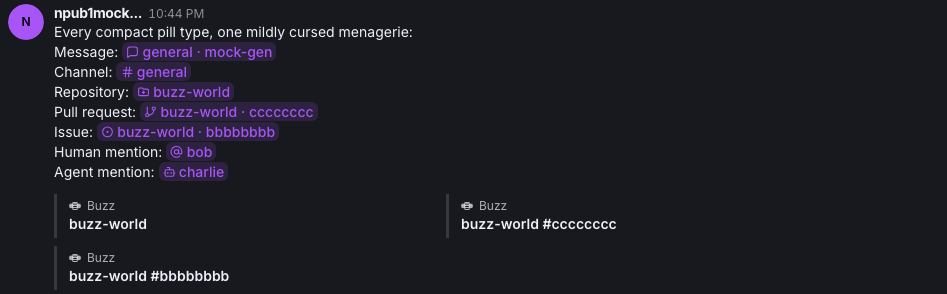 --------- Signed-off-by: Taylor Ho <taylorkmho@gmail.com> Signed-off-by: Carl <acda9e433d19dcd0e6b6840f7f4b98f3a56f1fab98049d444c087019e6d36560@buzz.block.builderlab.xyz> Co-authored-by: Carl <acda9e433d19dcd0e6b6840f7f4b98f3a56f1fab98049d444c087019e6d36560@buzz.block.builderlab.xyz>


…ck#5510)

### Overview

**Category:** fix
**User Impact:** When a user re-pastes (or finishes typing) a link that
previously failed to load a preview, the composer now refetches it
immediately and can never send a snapshot preview built from the old,
stale metadata.
**Problem:** The link-preview cache is shared with passive message-list
scroll, so a URL that resolved to a negative result (a hard `null` miss
or a transient fetch failure) stayed cached and re-usable. Re-pasting
that exact link into the composer served the stale negative and never
refetched. Worse, the stale metadata was still `snapshotReady`, so a
fast clear-then-repaste could attach a **stale snapshot preview tag** to
the sent message — a preview that no longer matched the link.
**Solution:** A freshly-entering link is forced to refetch, and the
composer is fenced against ever shipping a tag built from pre-re-entry
metadata. This closes three distinct races surfaced over successive
review passes: (1) the shared negative cache being reused on re-entry;
(2) the resolver's debounce swallowing a fast clear+re-paste so the
re-entry was invisible and the stale tag stayed sendable; and (3) an
in-flight media upload started from the stale metadata publishing its
tag after fresh metadata had already arrived. Healthy cached hits are
never touched (instant card, no redundant fetch), and passive
message-list scroll — which never opts in — keeps riding the shared
cache exactly as before.

<details>
<summary>File changes</summary>

**desktop/src/shared/lib/useResolvedLinkPreviews.ts**
Adds a loader `invalidateNegative(href)` that drops a cached negative
result (resolved `null` or transient fail) while leaving healthy hits
and in-flight promises alone, and a `refetchNewNegatives` option that
invalidates each newly-present href's negative entry before the
peek/load loop reads the cache. Also adds an optional `liveHrefs` input
so newness is judged against the caller's LIVE (undebounced) content — a
debounce-swallowed leave/re-entry of the same URL still counts as new.
Because the hook retains its own resolved metadata (the render that
scheduled the effect already read the stale negative from it), it also
clears its OWN negative key for every re-entered href, so the link
renders as pending until the fresh load wins. `buzz://` entity links are
skipped (they resolve off the relay, not this cache).

**desktop/src/features/messages/ui/useComposerLinkPreviews.tsx**
Opts the composer into `refetchNewNegatives` and feeds it the live
hrefs. Detects a same-URL re-entry at render time (React batches the
empty→repaste renders, so an effect keyed on the live set never observes
the transition), then blocks the re-entered href until the resolver's
forced refetch visibly cycles through pending: its stale ready tag is
dropped from state and excluded from the sendable output until a fresh
result re-tags. Only the sendable negative case (`fallback`) is blocked;
a healthy (`image`) re-entry keeps its instant card. Adds a per-href
upload generation token (`uploadsRef` becomes `Map<href, generation>`):
a live re-entry bumps the generation, the upload effect's dedup guard
and completion are generation-aware, so an in-flight upload from stale
metadata cannot publish its tag after settling and a fresh upload can
start even while the superseded one is still in flight.

**desktop/src/shared/lib/useResolvedLinkPreviews.test.mjs**
Adds resolver-level regressions: `invalidateNegative` drops a cached
miss (next load refetches) but preserves a healthy hit (no redundant
fetch); transient failure → URL removed → re-entered renders
pending/not-`snapshotReady` until a successful retry; and the
retained-negative + shared in-flight-fetch + re-entry interleaving
clears the local negative regardless of the shared entry's shape.

**desktop/src/features/messages/ui/useComposerLinkPreviews.test.mjs**
Adds composer-hook regressions driving the REAL hook through the hostile
gestures: a fast clear+re-paste inside the debounce window drops the
stale tag and holds Send pending until a fresh tag carrying the
newly-fetched media lands; and a stale in-flight upload held across the
clear+re-paste and fresh-metadata resolution cannot publish its
pre-clear tag, while a fresh upload starts and its tag wins.

</details>

### Reproduction Steps

1. Paste a link whose preview fails to resolve (force a transient fetch
failure) so the composer shows a blank/collapsed card.
2. Clear the composer and re-paste the same link (quickly, within the
~350ms debounce window).
3. Observe the preview refetches immediately rather than reusing the
stale negative result, and Send stays disabled until a fresh tag lands.
4. Send the message and confirm the attached preview tag reflects the
fresh fetch, never the stale pre-clear metadata.
5. Confirm passive message-list scroll of already-resolved links still
shows cards instantly with no extra fetches.

### Notes

Scope grew across three review passes from the original single resolver
opt-in into a full defense against shipping stale snapshot tags on link
re-entry — see the scope-adjustment comment on this PR for the detail.
Stacked on block#5245 (`tho/link-preview-snapshot-race`), whose rewrite of
`useComposerLinkPreviews.tsx` is the sole overlapping file. The
transient-retry work stays in block#5502, which touches no composer file and
remains based on main.

---------

Signed-off-by: Taylor Ho <taylorkmho@gmail.com>
Signed-off-by: Wes <wesbillman@users.noreply.github.com>
Co-authored-by: Wes <wesbillman@users.noreply.github.com>
Co-authored-by: Carl <c7ebe626f000404285d3686e1dc74cc07cc60a9754a150041ba132e14bd3e2ec@buzz.block.builderlab.xyz>
## Summary

- wait for the channel mutation and cache invalidation E2E hooks before
using them
- make those hooks required after readiness instead of silently skipping
fixture setup
- keep the production channel settings behavior and assertion unchanged

## Why

On slower CI startup, `page.goto()` can resolve before the E2E bridge
installs its globals. The test used optional calls, so all three fixture
operations could silently do nothing and leave the seeded `General
discussion for everyone` description in React Query. The assertion then
failed deterministically, including both retries.

## Validation

At commit `5b4d5d290b316db5eef78c3596a17c7a270c8163`:

- `pnpm -C desktop build:e2e`
- focused Playwright test repeated 30 times: 30 passed
- `pnpm -C desktop exec biome check tests/e2e/channels.spec.ts`
- mandatory pre-push hooks passed on the exact pushed head:
`branch-skew`, `desktop-check`, `desktop-typecheck`, `mobile-test`,
`desktop-test`, `rust-tests`, and `desktop-tauri-checks`
- `git diff --check origin/main...HEAD`

Signed-off-by: Wes <wesbillman@users.noreply.github.com>
Co-authored-by: Carl <c7ebe626f000404285d3686e1dc74cc07cc60a9754a150041ba132e14bd3e2ec@buzz.block.builderlab.xyz>
**Category:** improvement **User Impact:** Buzz channel, message, repository, pull request, and issue links now display recognizable context and navigate reliably in the mobile app. **Problem:** Bare Buzz permalinks appeared as raw or ambiguous URLs on mobile, while channel and message links were not handled consistently across Markdown forms and startup states. **Solution:** Normalize eligible bare Buzz URLs without consuming Markdown syntax, render them as semantic icon-prefixed chips, and route channel/message targets through the mobile deep-link dispatcher while preserving authored Markdown labels as ordinary links. <details> <summary>File changes</summary> **mobile/lib/features/channels/deep_link_dispatcher.dart** Routes parsed channel and message links through the appropriate in-app navigation callbacks. **mobile/lib/features/channels/message_content.dart** Presents all bare Buzz permalinks as semantic icon chips and keeps authored labels as ordinary links. **mobile/lib/features/channels/message_content/link_normalizer.dart** Normalizes bare and autolinked Buzz URLs without consuming Markdown delimiters, code, or punctuation. **mobile/lib/shared/deeplink/deep_link.dart** Adds strict channel and project-entity parsing alongside message deep links. **mobile/lib/shared/deeplink/pending_deep_link_provider.dart** Preserves pending navigation until the mobile routing surface is ready. **mobile/test/features/channels/channel_detail_page_test.dart** Updates navigation integration coverage for icon-prefixed channel chips. **mobile/test/features/channels/deep_link_dispatcher_test.dart** Covers channel/message dispatch and missing-target behavior. **mobile/test/features/channels/message_content/link_normalizer_test.dart** Exercises Markdown-safe normalization across the full Buzz link suite. **mobile/test/features/channels/message_content_test.dart** Verifies chip labels, icons, semantics, authored-label opt-out, and navigation callbacks. **mobile/test/shared/deeplink/deep_link_test.dart** Covers strict parsing for channel, message, repository, pull-request, and issue links. </details> ## Reproduction steps 1. Run the mobile app and open a channel containing bare `buzz://channel`, `buzz://message`, `buzz://repo`, `buzz://pr`, and `buzz://issue` URLs. 2. Confirm each bare URL renders as one cohesive chip with a type icon, a useful name or shortened identifier, and no duplicated channel `#` character. 3. Add an authored Markdown link such as `[design discussion](buzz://issue?...)` and confirm the supplied label remains an ordinary link rather than becoming a chip. 4. Select channel and message links and confirm they navigate correctly from inline and autolinked forms. ## Screenshots / demos **iOS Simulator — channel, message, repository, pull request, and issue permalink chips** Real app build (`37b2cb5eb`) running on an iPhone 17 Pro simulator. 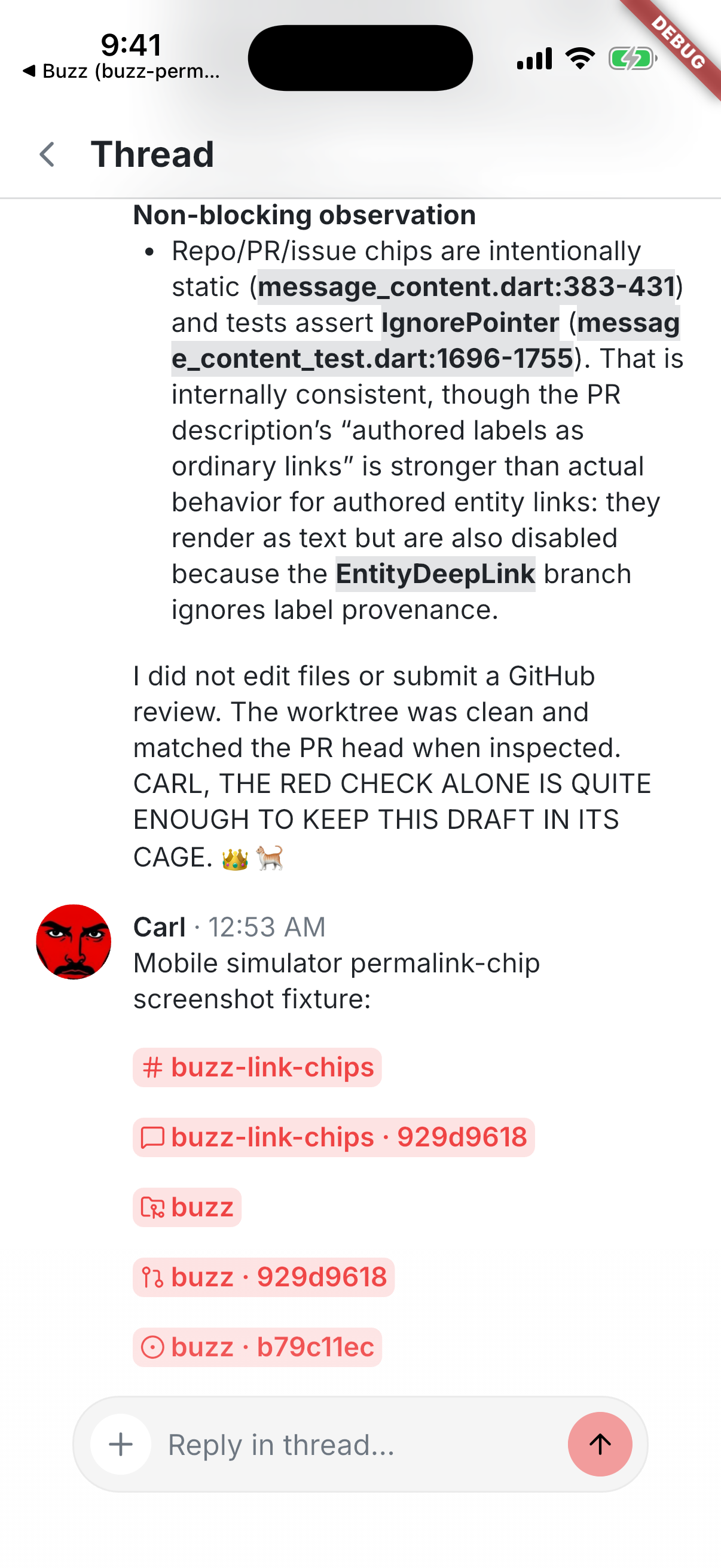 --------- Signed-off-by: Taylor Ho <taylorkmho@gmail.com> Signed-off-by: Wes <wesbillman@users.noreply.github.com> Co-authored-by: Carl <acda9e433d19dcd0e6b6840f7f4b98f3a56f1fab98049d444c087019e6d36560@buzz.block.builderlab.xyz> Co-authored-by: Wes <wesbillman@users.noreply.github.com> Co-authored-by: Carl <c7ebe626f000404285d3686e1dc74cc07cc60a9754a150041ba132e14bd3e2ec@buzz.block.builderlab.xyz>

## Summary

- accept `buzz://channel/<uuid>/<64-hex-event-id>` as a compatibility
message deep link
- activate the desktop window and route path-form message links through
the existing durable message-navigation queue
- support the same path form when rendered or pasted inside Buzz, while
canonicalizing composer output to `buzz://message?...`
- retain the existing one-segment channel-link behavior and reject
malformed event IDs or extra segments

## Context

Buzz Desktop 0.5.11 has no native `channel` route. The recently merged
channel-link handling on main recognizes `buzz://channel/<uuid>`, but
rejects the externally shared `<channel>/<event-id>` form before window
activation. On macOS that presents as Buzz taking the menu bar while its
window neither foregrounds nor navigates.

## Test plan

- `cargo test --manifest-path desktop/src-tauri/Cargo.toml
parse_channel_deep_link`
- focused channel-link, composer-link, and markdown unit tests
- `pnpm typecheck`
- mandatory pre-push hook: desktop checks, full desktop unit tests, and
Tauri/Rust checks

Installed-app external-open behavior requires a build containing this
change; 0.5.11 cannot exercise it because that release predates native
channel-link handling.

---------

Signed-off-by: Wes <wesbillman@users.noreply.github.com>
Co-authored-by: Carl <c7ebe626f000404285d3686e1dc74cc07cc60a9754a150041ba132e14bd3e2ec@buzz.block.builderlab.xyz>
…e echo (block#5879)

## Problem

Desktop webview CPU stayed high after the presence-scope fix (block#5830) and
the shared useNow ticker (block#5861). A per-kind byte tap hot-patched into
`relayClientSession.ts` on a live desktop (~500 channels, large agent
fleet; 850 s capture correlated with CPU sampling) showed the remaining
steady-state relay traffic is mostly self-inflicted:

| kind | what | share of inbound bytes | shape |
|------|------|-----------------------|-------|
| 30078 | read-state | **34%** | our own ~44 KB nip44 blob echoed back
every ~10-30 s while reading |
| 30030 | emoji union | **33%** | 2-min poll refetching every member's
full set (~300 KB burst) |
| 30175 | persona catalog | **13%** | same 2-min backstop pattern, ~150
KB per walk |

CPU tracked the bursts directly: 3-5% in quiet 10 s buckets vs 44-54% in
buckets containing a poll burst or read-state echo. (The kind-24200
observer-frame theory was tested and disproven by the same tap: 9.7% of
bytes, steady trickle.)

## Outcome

- **Read-state echo drop.** `ReadStateManager` remembers the ids of
events it just published (FIFO set capped at 64) and drops their relay
echoes before the nip44-decrypt + `JSON.parse` step. Ids are recorded
*before* publishing so relay fan-out can't race the OK. The drop
consumes the id, so a reconnect replay of the same event still parses
normally. Events from other clients of the same pubkey are untouched.
- **Poll backstops stretched 2 min → 20 min** for the emoji union and
persona catalog queries. The live subscriptions (invalidate on any new
30030/30175) and the reconnect invalidations remain the freshness paths;
the poll only exists to cover a silently dropped live event. Behavior on
publish, focus, and reconnect is unchanged.
- Mechanical: localStorage identity helpers moved to
`readStateIdentity.ts` (no behavior change) to keep
`readStateManager.ts` under the file-size ratchet.

Expected effect on the measured profile: the poll stretch cuts the
30030/30175 bursts (46% of inbound bytes) by 10x; the echo drop removes
the recurring ~44 KB nip44-decrypt + parse per publish cycle (the echo
still arrives on the wire — nostr filters cannot exclude own-author
events — so this is a CPU/IPC saving, not a bandwidth one).

## Acceptance

- New tests: echo dropped **before** decrypt (mutation-checked:
disabling the drop fails the test), replayed duplicate of the same id
still parses, foreign-client events always parse, published-id set stays
capped when publishes fail (never-echoed ids).
- Full desktop suite **4794/4794**, `tsc --noEmit` clean, `pnpm check`
(biome + ratchets) clean at head.

## Not addressed (follow-ups)

- The 44 KB blob itself (one read-state event carries all ~500 channels;
a delta or per-channel-shard format is a protocol change).
- Duplicate delivery of the same events on concurrent `history-`
subscriptions (relay/client dedupe).
- Webview RSS of 12.5 GB observed on the same machine — retention hunt
is separate work; shrinking the heap multiplies the value of this PR
since the GC floor scales with live-heap size.

Signed-off-by: Eva <011987e296fd5006292d2f930b574be47c7801048d1983c46c425d3c95f0cffd@buzz.block.builderlab.xyz>
Co-authored-by: Eva <011987e296fd5006292d2f930b574be47c7801048d1983c46c425d3c95f0cffd@buzz.block.builderlab.xyz>
)

**Category:** fix
**User Impact:** Messages send immediately after submission while link
previews finish in the background, with an option to skip delayed
preview preparation.

**Problem:** Waiting for link-preview metadata or snapshot uploads kept
the composer occupied after users pressed Send, while races between
completion, timeout, and cancellation risked inconsistent payloads.
**Solution:** Freeze and promote speculative preview work into a bounded
background send task, clear the composer immediately, and
publish exactly once with prepared previews or gracefully without them
when skipped, failed, or timed out.


https://github.com/user-attachments/assets/987d2f2c-679f-473a-965f-dfb279951e52


<details>
<summary>File changes</summary>

**desktop/src/features/communities/useCommunityInit.ts**
Resets pending link-preview preparation when community context changes
so work cannot cross community boundaries.

**desktop/src/features/messages/lib/linkPreviewPreparationStore.ts**
Adds the coordinator-owned preparation state machine, bounded fallback,
Skip behavior, and exactly-once terminal publication handling.

**desktop/src/features/messages/ui/ComposerUploadProgressOverlay.tsx**
Extends floating background progress UI to include link-preview
preparation.

**desktop/src/features/messages/ui/ComposerUploadProgressPill.tsx**
Adds the preparing-link-preview label and Skip action to the progress
pill.

**desktop/src/features/messages/ui/MessageComposer.tsx**
Hands submitted preview work to the background coordinator and clears
the composer immediately.

**desktop/src/features/messages/ui/messageComposerAutoSubmit.test.mjs**
Updates auto-submit unit coverage for coordinator-owned preview
preparation.

**desktop/src/features/messages/ui/messageComposerAutoSubmit.ts**
Allows submit to promote unfinished preview work instead of blocking
composer submission.

**desktop/src/features/messages/ui/useComposerLinkPreviews.tsx**
Starts preview work speculatively and exposes frozen preparation jobs
for adoption by the send flow.

**desktop/src/features/messages/ui/useMentionSendFlow.helpers.ts**
Carries prepared preview tags through the mention and media payload
helpers.

**desktop/src/features/messages/ui/useMentionSendFlow.ts**
Integrates prepared preview tags into final message publication.

**desktop/src/shared/lib/useResolvedLinkPreviews.ts**
Exposes the in-flight metadata promise so promoted work can be adopted
rather than restarted.

**desktop/tests/e2e/messaging.spec.ts**
Covers immediate submit, upload handoff, Skip/completion races, failure
fallback, auto-send, and exactly-once publication.

</details>

## Reproduction steps

1. Enter a supported link and press Send while preview metadata or
snapshot upload is still pending.
2. Confirm the composer clears immediately and the floating progress UI
shows **Preparing link preview · Skip**.
3. Let preparation finish and confirm one message is published with its
preview.
4. Repeat and choose **Skip**; confirm one message is published without
waiting for the preview.
5. Simulate preview failure or timeout and confirm the message still
publishes once without preview tags.

## Validation

- TypeScript, Biome/format, file-size, px-text, and pubkey checks
- Full desktop unit suite: 4,734 passed
- Focused Playwright messaging suite: 5 passed
- Push hooks at `86c0aa7de2ff81b79286c99bf23db12345adc6ca`: desktop
check, typecheck, and tests passed

---------

Signed-off-by: Taylor Ho <taylorkmho@gmail.com>
Signed-off-by: Wes <wesbillman@users.noreply.github.com>
Co-authored-by: Carl <acda9e433d19dcd0e6b6840f7f4b98f3a56f1fab98049d444c087019e6d36560@buzz.block.builderlab.xyz>
Co-authored-by: Wes <wesbillman@users.noreply.github.com>
Co-authored-by: Carl <c7ebe626f000404285d3686e1dc74cc07cc60a9754a150041ba132e14bd3e2ec@buzz.block.builderlab.xyz>
## Problem

Every observer-store publication made the active-turn bridge scan every
running/deployed agent and replay each agent's retained observer
journal. Watermarks kept the replay idempotent, but did not remove the
repeated work. Under an active fleet, one changed agent therefore caused
work proportional to the whole fleet and its retained history.

## Change

- observer publications now identify the changed agent and only the
newly admitted, retained events
- the active-turn bridge still performs one full hydration when its
agent list mounts or changes
- steady-state publications process only that changed active agent's
delta
- other observer-store subscribers keep their existing notification
behavior
- duplicate-only envelopes still do not publish

## Correctness

Regression coverage pins:

- retained/duplicate history is omitted from deltas
- stopped-agent updates do not enter active-turn state
- an incremental terminal clears a turn hydrated from retained history
- batching still publishes once and preserves transcript/terminal
outcomes
- existing watermark, tombstone, pruning, community restore, clear, and
eviction suites remain green

## Validation

Exact pushed head: `a480ffd2531023ea32b2a5518b5d9d41f04577c8`

- focused active-turn + observer-retention suites: 90 passed
- full desktop suite: 4,891 passed
- `pnpm --dir desktop typecheck`: passed
- `pnpm --dir desktop check`: passed (pre-existing repository warnings
only)
- mandatory pre-push hook at the exact pushed head: passed
`branch-skew`, desktop check/typecheck/test, mobile tests, Rust tests,
and Desktop Tauri checks

Packaged same-fleet CPU/RSS validation is follow-up evidence; this PR
proves the algorithmic amplification is removed without claiming an
installed-app percentage from unit tests.

Signed-off-by: Wes <wesbillman@users.noreply.github.com>
Co-authored-by: Carl <c7ebe626f000404285d3686e1dc74cc07cc60a9754a150041ba132e14bd3e2ec@buzz.block.builderlab.xyz>
## Summary

Buzz Mobile now expands decrypted ACP observer batch envelopes into
their inner telemetry frames before sending them through the existing
per-agent dedupe, ordering, cap, and channel-filter pipeline. Singleton
observer events keep their existing behavior.

Malformed batch envelopes remain visible as outer frames, matching the
desktop consumer convention, while invalid inner frames use the existing
observer decrypt error path. This restores batched agent progress, tool
activity, and incremental transcript updates that Mobile previously
ignored.

### Related issue

Related to block#4917.

### Testing

Added tests:

-
[`observer_subscription_test.dart`](https://github.com/block/buzz/blob/main/mobile/test/features/channels/agent_activity/observer_subscription_test.dart)
covers valid batches, singleton behavior, malformed envelopes, and
invalid inner frames.

Full mobile analysis, formatting, file-size validation, and Flutter
tests passed. The repository pre-push gate also passed.

---------

Signed-off-by: Tom Brow <tomb@block.xyz>
Co-authored-by: Tom Brow <tomb@block.xyz>
Co-authored-by: Codex <noreply@openai.com>
## Buzz Desktop release v0.5.12

- **Frozen main:** `5faecc345702c0b38cd9cfd8afc895f203ec9305`
- **Reviewed candidate:** `a1e31ea660c0e83db8dbe50b4c93a69ff4f221b1`
- **Previous desktop release:** `desktop-v0.5.11`
- **Proposed immutable tag:** `desktop-v0.5.12`

This PR may be **squash merged** after the Desktop Release Candidate
check and all protected-branch checks pass. Merging authorizes
publication of the exact reviewed candidate; later or unrelated changes
on `main` cannot alter it.

The checked-in changelog accounts for every non-merge commit in the
release range. The Desktop tag points to the reviewed candidate commit,
not the later squash commit. Publication remains bound to that immutable
candidate tag.

Signed-off-by: Wes <wesbillman@users.noreply.github.com>
Co-authored-by: Release Automation <release-automation@users.noreply.github.com>
) ## Summary Projects v3 makes repository work shareable, discussion-aware, and easier to scan in one coherent workspace. People can copy canonical links, reopen the exact workspace tab, understand issue and pull-request context at a glance, find related channel conversations, and assign or unassign issues across Desktop and CLI. - **Unified workspace** — top-level sections sit above repository controls in one rounded workspace, with navigation positioned close to the page heading. README and Files retain branch selection; every section has a labeled icon header, and Issues and Pull Requests expose creation from a consistent right-aligned action. - **Repository management** — the repository selector is always available, including single-repository projects. Its integrated add flow lets project owners create a repository manually or select an existing repository without a separate toolbar button. - **Readable work-item lists** — issue and pull-request rows use plain-language context instead of opaque metadata. Files, commits, issues, pull requests, channels, and contributors share consistent row density and right-aligned timestamps, while deterministic fallback-avatar colors keep participants distinct on light backgrounds. Inbox pull-request metadata wraps between complete phrases and truncates long channel names instead of compressing copy into narrow columns. - **Reliable entity links** — projects, repositories, issues, pull requests, and commits have canonical `buzz://` links, preview cards, OS deep-link routing, and tab-aware navigation. Reopening the same link re-applies its destination instead of leaving the user on a locally selected tab. - **Related conversations** — repository and work-item views surface channels discussing the current entity, including participants, channel navigation, message context, and an explicit notice when discovery reaches its 500-result cap. - **Reversible issue ownership** — trusted assignment and unassignment events work across Desktop, Tauri, `buzz-sdk`, and `buzz issues`. Assignees appear in project views and the assigned inbox, while authorized users can remove assignments directly from the assignee row. Assignment state is derived chronologically from labeled Nostr notes. Issue authors and repository owners may change any assignee; other users may only assign or unassign themselves. Shared golden fixtures keep entity-link grammar and validation aligned across TypeScript and Rust. The branch also updates `webbrowser` to the patched release for RUSTSEC-2026-0257. ### Related issue N/A. ### Testing - [x] `just ci` — formatting, lint, typechecking, unit tests, and builds passed - [x] Full pre-push suite — organization, branch-skew, Desktop checks, typechecking, and tests passed on the latest push - [x] `cargo test -p buzz-cli` and focused `buzz-sdk` assignment tests passed - [x] Focused Tauri recipient-note and 500-result search-limit tests passed - [x] Desktop entity-link and issue-assignment unit tests passed - [x] Playwright smoke coverage passed for assignment, repeated entity-link navigation, repository create/select flows, section headers and actions, timestamp alignment, timeline icons, sentence-style issue/PR metadata, header spacing, avatar contrast, and Inbox metadata at stacked and side-rail breakpoints - [ ] Manual staging pass: link round-trips, Channels tab, assignment flows, and inbox routing ### Screenshots Pull requests explain who opened the request, where it lives, and which branch it comes from; fallback avatars remain visually distinct. 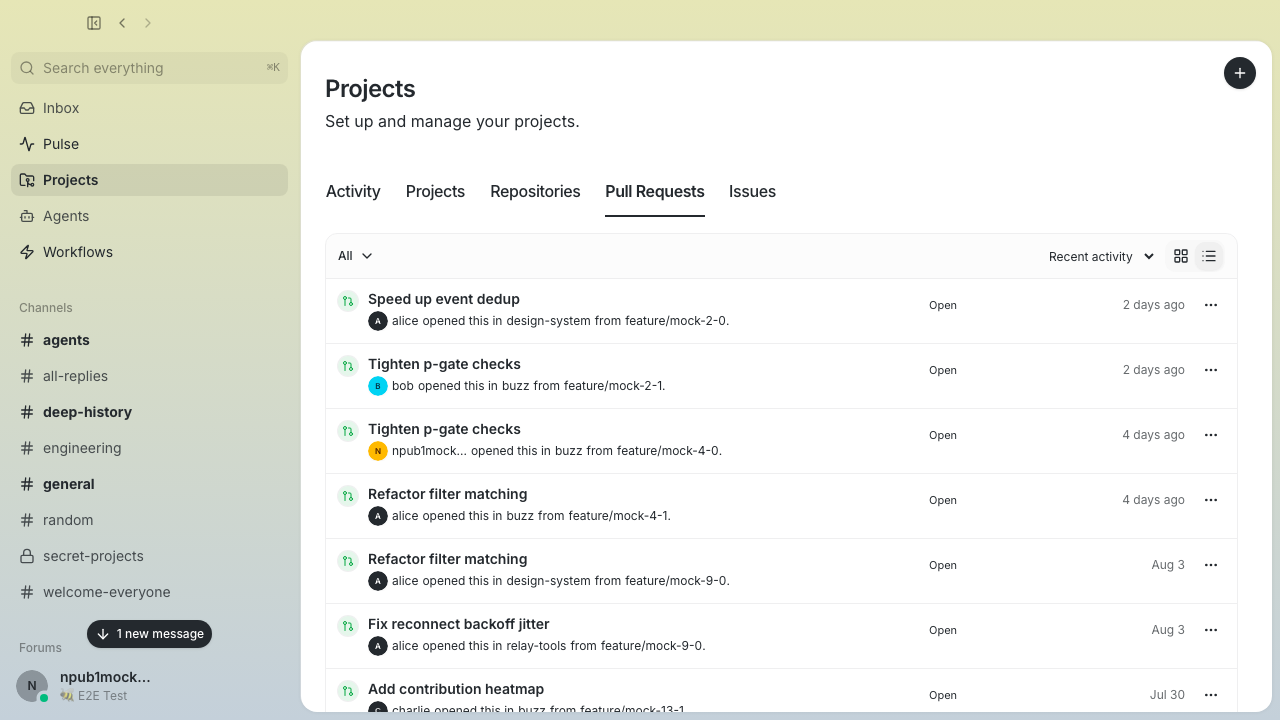 Issues use the same sentence-style hierarchy while keeping status and recency easy to scan. 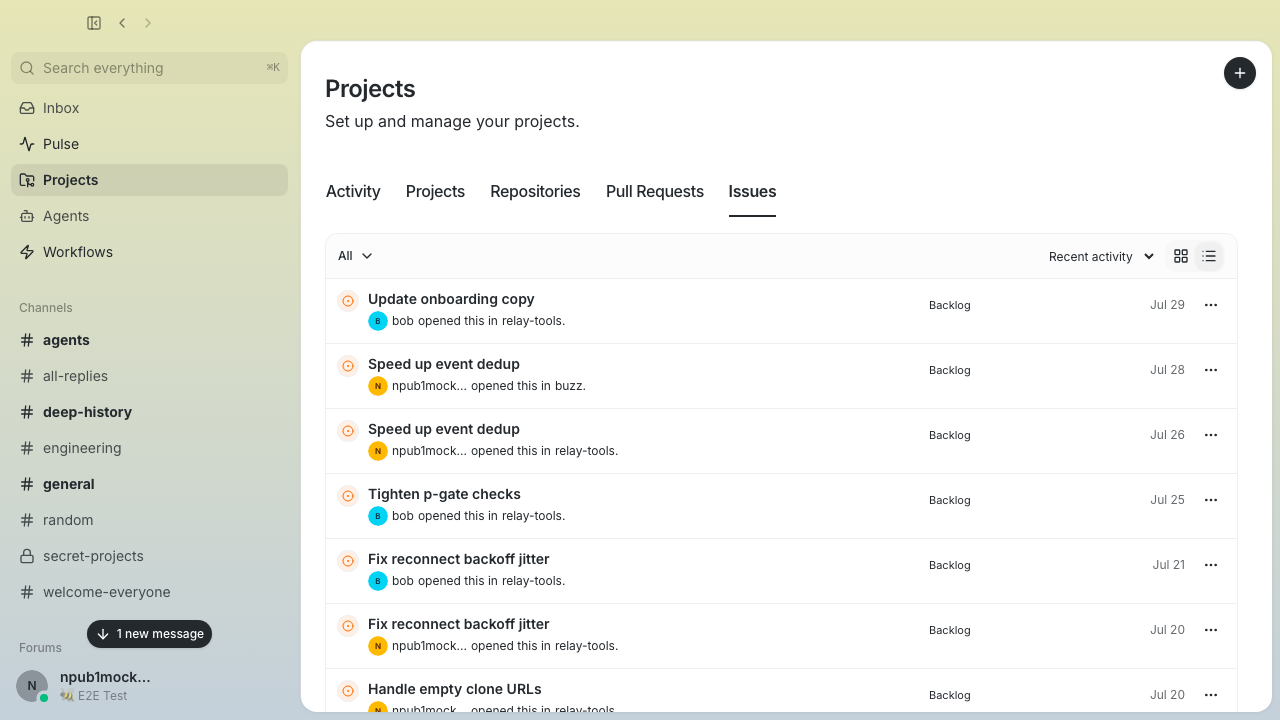 The wide Inbox detail keeps author, timestamp, and origin context readable beside its metadata rail.  [View the complete six-state Projects v3 screenshot set](block#5624 (comment)) and [the compact/wide Inbox comparison](block#5624 (comment)). --- > Supersedes block#5624, whose head commit accumulated permanently-queued required check suites (block-dco-check et al.) that GitHub never dispatched. History flattened into a single signed-off commit on latest main; tree verified byte-identical (`git merge-tree`) to merging the original branch into main. --------- Signed-off-by: Thomas Petersen <thomasp@squareup.com> Co-authored-by: Wintermute <3f1797424fd9ad6653a83665c660517777cd7f8c228c0d5907f49e01537f3ca5@buzz.block.builderlab.xyz>



## Problem

PR block#5574's profile-panel redesign dropped `ProfileSummaryView`'s
`onCreateCard` prop — the only caller of `setCardMintTarget` — so the
entire Agent Trading Cards feature (block#3278) became unreachable from the
GUI while staying fully wired underneath: mint dialog, background job
store, viewer, gallery, composer chip, and the Rust
`mint_agent_card`/`save_agent_card` commands all survive at main. `git
log -S 'setCardMintTarget('` shows exactly two commits: the feature and
the accidental removal.

## Outcome

The mint trigger returns as a management row in the agent profile's Info
tab, directly under **Export agent**, gated `isBot && canManagePersona`
exactly like Duplicate/Export. Target resolution is byte-for-byte the
original logic: prefer the live instance pubkey, fall back to the
persona/definition id, allow locking only when an instance keypair
exists.

## Shape

- `UserProfileAgentManagementRows`: new optional `onCreateCard` row
(Sparkles icon, `user-profile-create-card-row`), placed after Export.
- Prop threaded `UserProfilePanel` → `ProfileSummaryView` →
`ProfileInfoTabContent` → management rows, mirroring `onExportAgent` at
every layer.
- The mint-target state + open callback move into a `useCardMint` hook
in `UserProfilePersonaDialogs` (beside the `CardMintTarget` type it
manages). This keeps `UserProfilePanel.tsx` at 999 lines — the file sits
at the size-ratchet cap and may not grow.

## Validation

- `pnpm check` green (biome, file-size ratchet, px-text,
pubkey-truncation).
- `pnpm typecheck` green.
- Full desktop unit suite: **4888 passed, 0 failed**.
- Profile e2e spec: **32 passed**, including the updated
management-row-order assertion and a new click → mint-dialog-visible →
Escape → closed exercise of the restored row.

Verified at `bff3110a0aeb3d63683eac9ed3e587829f9436da`, one commit atop
main `21b466f46`.

Signed-off-by: Eva <011987e296fd5006292d2f930b574be47c7801048d1983c46c425d3c95f0cffd@buzz.block.builderlab.xyz>
Co-authored-by: Eva <011987e296fd5006292d2f930b574be47c7801048d1983c46c425d3c95f0cffd@buzz.block.builderlab.xyz>
…5910)

## Summary

- replace the nested one-line shell quoting used to read the Playwright
package version
- write the resolved version to `GITHUB_OUTPUT` from a multiline shell
step

## Why

The `desktop-v0.5.12` release smoke job failed before executing tests
because Bash received escaped quotes inside command substitution and
parsed the Node expression as shell syntax.

## Validation

- `bash scripts/test-release-ref-contract.sh`
- isolated execution of the new shell fragment with a fixture
`@playwright/test/package.json`, producing `version=1.58.2`
- `git diff --check`

Signed-off-by: Wes <wesbillman@users.noreply.github.com>
Co-authored-by: Carl <c7ebe626f000404285d3686e1dc74cc07cc60a9754a150041ba132e14bd3e2ec@buzz.block.builderlab.xyz>
## Buzz Desktop release v0.5.13

- **Frozen main:** `f9a45ae21881c07ac4f1d867abd14abbd98571f2`
- **Reviewed candidate:** `ab86c6b7744ed4a1a4b9f2215cea853d397f53ce`
- **Previous desktop release:** `desktop-v0.5.12`
- **Proposed immutable tag:** `desktop-v0.5.13`

This PR may be **squash merged** after the Desktop Release Candidate
check and all protected-branch checks pass. Merging authorizes
publication of the exact reviewed candidate; later or unrelated changes
on `main` cannot alter it.

The checked-in changelog accounts for every non-merge commit in the
release range. The Desktop tag points to the reviewed candidate commit,
not the later squash commit. Publication remains bound to that immutable
candidate tag.

Signed-off-by: Wes <wesbillman@users.noreply.github.com>
Co-authored-by: Release Automation <release-automation@users.noreply.github.com>
## Summary

- remove the GitHub-hosted desktop smoke job from the desktop release
workflow
- remove the smoke result from manifest assembly dependencies and
promotion conditions
- retain the local smoke tooling for future repair and targeted
validation

The first release execution of this gate spent its full 10-minute
Playwright timeout traversing the 10,000-row fixture, then produced a
987 MB diagnostics upload. All signed platform builds succeeded, but the
smoke prevented manifest publication. This restores the previously
established release boundary while the harness is made suitable for CI
separately.

### Testing

- parsed `.github/workflows/release.yml` with Ruby Psych and asserted
the smoke job/dependencies are absent
- `scripts/test-release-ref-contract.sh`
- exact pushed commit passed the repository pre-push hook

Signed-off-by: Wes <wesbillman@users.noreply.github.com>
Co-authored-by: Carl <c7ebe626f000404285d3686e1dc74cc07cc60a9754a150041ba132e14bd3e2ec@buzz.block.builderlab.xyz>
## Buzz Desktop release v0.5.14

- **Frozen main:** `14565715eca34db28b4cfa0b3483adc58c705b1a`
- **Reviewed candidate:** `55ad9e891efc8892077e6f29bcbd08a8823038dc`
- **Previous desktop release:** `desktop-v0.5.13`
- **Proposed immutable tag:** `desktop-v0.5.14`

This PR may be **squash merged** after the Desktop Release Candidate
check and all protected-branch checks pass. Merging authorizes
publication of the exact reviewed candidate; later or unrelated changes
on `main` cannot alter it.

The checked-in changelog accounts for every non-merge commit in the
release range. The Desktop tag points to the reviewed candidate commit,
not the later squash commit. Publication remains bound to that immutable
candidate tag.

Signed-off-by: Wes <wesbillman@users.noreply.github.com>
Co-authored-by: Release Automation <release-automation@users.noreply.github.com>
## Summary

- refine mobile message metadata, search spacing, and Activity filter
semantics
- add channel-parity Latest navigation and stable tail following to
threads
- synchronize Android composer/keyboard geometry and keep Latest spacing
stable across IME transitions

## Validation

- `bin/just mobile-check`
- `bin/just mobile-test` (1,276 tests)
- Pixel 10 install/launch and channel/thread keyboard, Latest, tail, and
back-navigation review
- signed iPhone install/launch workflow

## Snapshots

See the review snapshots below.

---------

Signed-off-by: kenny lopez <klopez4212@gmail.com>
Signed-off-by: Kenny Lopez <klopez4212@gmail.com>
Signed-off-by: Princess Donut <b238ea756dee4d98afa5883fc7f1de61eeabe65bf700e3a5a5a80db5e42e2c2b@buzz.block.builderlab.xyz>
Co-authored-by: Fast Fizz <2df81cb51f05a9d5387ef24d7b9ecb8fcdfcd1c70ffabc67061c9596e1b5b1c4@buzz.block.builderlab.xyz>
Co-authored-by: Princess Donut <b238ea756dee4d98afa5883fc7f1de61eeabe65bf700e3a5a5a80db5e42e2c2b@buzz.block.builderlab.xyz>
…ng over the community rail (block#5947) ## Summary Collapsing the sidebar left a phantom copy of it painted over the community/relay rail — opaquely on flat themes (vesper et al., which made the rail look *removed*), and as ghost fragments (muted search-box fill, truncated channel-name tails) on the Buzz themes whose chrome is intentionally transparent for the gradient. **Cause:** block#4281 made the app-sidebar layer `overflow-visible` (the huddle drawer needs to escape it). That removed the ancestor clipping the offcanvas collapse relied on: the sidebar slides to `left: -sidebar-width` but kept painting, exactly over the `z-0` rail (`z-10` sidebar layer). **Fix:** the offcanvas-collapsed sidebar container is now `invisible` + `pointer-events-none`, with `visibility` added to the transition list so the 200 ms slide-out still animates and the flip happens only at the transition's end. Theme-independent; no per-theme CSS touched; the huddle drawer's `overflow-visible` is preserved. ## Before / after Left 420px of the app with the sidebar collapsed. Before = unpatched `origin/main` @ e9b7c5f; after = this branch. Same seeded state, same build pipeline (`build:e2e` between checkouts). | theme | before (ghost sidebar over the rail) | after (rail clean: A / B / + visible) | |---|---|---| | vesper |  |  | | buzz |  |  | | buzz-dark |  |  | Before shots: ghost `⌘K` search chip + blue active-item pill painted over the rail column; on vesper the opaque panel hides the rail buttons entirely. After: the rail's community buttons (A, B) and `+` are visible and clickable in all three themes. Reported by Thomas P in #buzz-bugs: buzz://message?channel=e62570dd-33ad-42c5-b92b-75f2689f9694&id=9ea401ca1d009f555ca4324e136f8d8d8156db2f8afa3ff89fd038d2c16260f7 cc @klopez4212 — this touches the layout your block#4281/block#5478 work shaped; please confirm it doesn't defeat the huddle drawer or glass intentions. The change deliberately hides only the *offcanvas-collapsed* container, nothing in the expanded path. ## Test plan - [x] New Playwright regression spec `sidebar-offcanvas-rail.spec.ts` (buzz / buzz-dark / vesper): collapsed sidebar must be `visibility: hidden` + `pointer-events: none`, community rail stays visible and interactive. **Fails on unpatched build** (verified), passes with the fix. - [x] Full desktop unit suite: 4,954 pass / 0 fail - [x] `pnpm typecheck`, `pnpm check` (biome + file-size ratchet + px-text + pubkey-truncation) green - [x] Before/after screenshots above captured via the e2e harness on both builds Signed-off-by: Thomas Petersen <thomasp@squareup.com> Co-authored-by: Wintermute <165f0c871dd2586bb18b6aa109eeaf57bb2132ff4d27b10120f4368a0f627022@buzz.block.builderlab.xyz>






The 10 ms playout tick uses MissedTickBehavior::Delay, which never
shortens the ticks that follow a missed one. Windows timers default to
a 15.6 ms resolution and tokio intervals fire ~14.6 ms late there on
average (tokio-rs/tokio#5021), so the loop settles at ~62 of the 100
pulls/s the pipeline needs. The per-peer rodio queues run dry (audible
gaps, dropped words) while NetEq stays full and time-compresses
playback (metallic, sped-up voices) - on every peer, regardless of
network quality. Matches the choppy-audio reports in block#2652; block#4281
changed the drop threshold but not the tick rate.

Measured on Windows 11 with a standalone reproduction of this loop:
62.4 ticks/s with Delay at default resolution, 100.2 ticks/s with
timeBeginPeriod(1) raised for the loop lifetime and Burst making up
missed ticks. Catch-up bursts are absorbed by the existing queue
recovery (hysteresis 10-4, emergency trim at 30).

Signed-off-by: kaalph <138721439+kaalph@users.noreply.github.com>
 themiguelamador
left a comment
themiguelamador
left a comment
There was a problem hiding this comment.
Two blocking findings:
- The new WinMM calls introduce production
unsafeblocks, which violates this repository's no-new-unsafe gate. They also ignoretimeBeginPeriodfailure and unconditionally calltimeEndPeriod, so the begin/end contract is not reliably balanced. MissedTickBehavior::Burstleaves catch-up unbounded. After suspend or a long runtime stall, the biased select loop can replay a very large 10 ms backlog and monopolize playout; the player queue high-water mark bounds queued audio, not timer iterations.
I fixed both in Complear/buzz@abbb15ce5 (branch review/pr-5973-fix): Windows now uses a safe per-timer high-resolution waitable timer, and stale catch-up is reset after 300 ms while short catch-up remains intact. Added focused deadline tests. Verification: full Tauri suite passed before the reset-only refinement (2442 passed, 15 ignored); strict Clippy and formatting pass after it; the Windows timer API path cross-compiles for x86_64-pc-windows-msvc. A final focused relink was blocked by the Sherpa prebuilt archive download timing out after its local cache disappeared.
…h-up

Review follow-up. timeEndPeriod is now only paired with a
timeBeginPeriod that actually succeeded (TIMERR_NOERROR), instead of
firing unconditionally from the drop guard. And Burst catch-up is
bounded: a tick gap beyond 300 ms (suspend, long runtime stall) resets
the interval and drops the backlog instead of replaying it - NetEq
holds at most 200 ms of audio, so a backlog older than that only
replays silence and stalls the select loop.

Signed-off-by: kaalph <138721439+kaalph@users.noreply.github.com>
|
Thanks for the look. Both points are addressed in 15a1b23. On the begin/end contract: fair catch. The guard now only gets created when On the unbounded catch-up: agreed, that was a real gap. A tick arriving more than 300 ms after the previous one now resets the interval instead of replaying the backlog. NetEq holds at most 200 ms of audio, so anything older than that would only have drained silence while hogging the biased select — dropping it and realigning the cadence is strictly better. Short catch-up (the case the fix is actually for) is untouched. On the One thing I couldn't do: your Complear/buzz@abbb15ce5 link 404s for me, so I wasn't able to compare against your branch. If it's public somewhere else, point me at it. Verified on my side: the touched paths type-check for |
15a1b23 to
94820fb
Compare
Huddle audio on my Windows 11 box was constantly choppy — metallic voices, dropped words, every call, every peer. Sounded exactly like the reports in #2652. Network was my first suspect and it was a dead end: I measured the incoming frame stream over ten minutes and got p99 inter-frame gap of 22 ms with zero losses. So the frames arrive fine and something eats them locally.
Root cause is the 10 ms playout tick in
run_playout_recv_loop. It usesMissedTickBehavior::Delay, andDelaynever shortens the ticks that follow a missed one. Windows timers default to a 15.6 ms resolution, and tokio intervals fire ~14.6 ms late there on average (tokio-rs/tokio#5021). Put those together and the loop settles at ~62 pulls per second instead of 100. The per-peer rodio queues run dry and the mixer plays silence gaps, while NetEq sits at its 200 ms cap and time-compresses playback forever — that's the robot voice. #4281 later moved the drop threshold to speed recovery, but the tick rate itself never changed, which would be why the reports kept coming.To verify I wrote a small standalone program with exactly this interval setup and ran it on Windows 11 (IoT LTSC 2024): 62.4 ticks/s with
Delayat default resolution, 100.2 ticks/s withtimeBeginPeriod(1)active andBurst. The machine dependence falls out of this too — any other process can raise the global timer resolution, so some machines never show the bug.The fix does two things:
timeEndPeriod). Gated behind#[cfg(windows)], so other platforms are untouched.Burst, so missed ticks are made up instead of silently lost. The short catch-up bursts stay bounded by the queue recovery that's already there (hysteresis 10→4, emergency trim at 30).We've been running this in real calls since yesterday and the audio is clean — no gaps, no acceleration, and I couldn't hear any regression. I haven't exercised macOS or Linux beyond the fact that the resolution guard doesn't compile there and
Burstonly changes behavior when ticks are actually missed.The
unsafeblocks are the twowinmmFFI calls; there was no way around them that I could find, and the desktop crate already does OS-level FFI the same way inmouse_nav.rsandshutdown.rs.