Repository files navigation

Vector-Quantized Contrastive Predictive Coding

Train and evaluate the VQ-VAE model for our submission to the ZeroSpeech 2020 challenge. Voice conversion samples can be found here. Pretrained weights for the 2019 English and Indonesian datasets can be found here. Leader-board for the ZeroSpeech 2020 challenge can be found here.
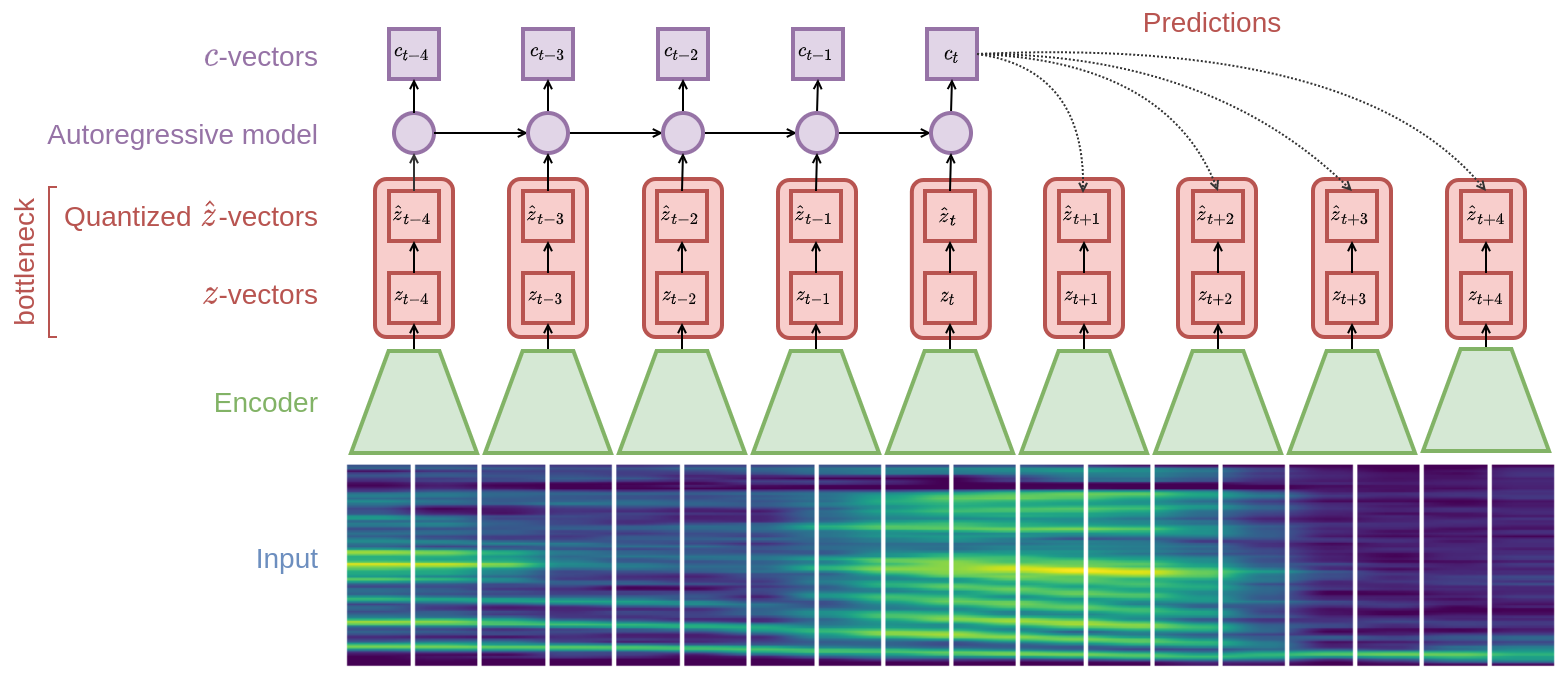
VQ-CPC model summary
Fig 1: VQ-CPC model architecture.

Requirements

  1. Ensure you have Python 3 and PyTorch 1.4 or greater.

  2. Install NVIDIA/apex for mixed precision training.

  3. Install pip dependencies:

    pip install requirements.txt
    
  4. For evaluation install bootphon/zerospeech2020.

Data and Preprocessing

  1. Download and extract the ZeroSpeech2020 datasets.

  2. Download the train/test splits here and extract in the root directory of the repo.

  3. Preprocess audio and extract train/test log-Mel spectrograms:

    python preprocess.py in_dir=/path/to/dataset dataset=[2019/english or 2019/surprise]
    

    Note: in_dir must be the path to the 2019 folder. For dataset choose between 2019/english or 2019/surprise. Other datasets will be added in the future.

    Example usage:

    python preprocess.py in_dir=../datasets/2020/2019 dataset=2019/english
    

Training

  1. Train the VQ-CPC model (or download pretrained weights here):

    python train_cpc.py checkpoint_dir=path/to/checkpoint_dir dataset=[2019/english or 2019/surprise]
    

    Example usage:

    python train_cpc.py checkpoint_dir=checkpoints/cpc/2019english dataset=2019/english
    
  2. Train the vocoder:

    python train_vocoder.py cpc_checkpoint=path/to/cpc/checkpoint checkpoint_dir=path/to/checkpoint_dir dataset=[2019/english or 2019/surprise]
    

    Example usage:

    python train_vocoder.py cpc_checkpoint=checkpoints/cpc/english2019/model.ckpt-24000.pt checkpoint_dir=checkpoints/vocoder/english2019
    

Evaluation

Voice conversion

python convert.py cpc_checkpoint=path/to/cpc/checkpoint vocoder_checkpoint=path/to/vocoder/checkpoint in_dir=path/to/wavs out_dir=path/to/out_dir synthesis_list=path/to/synthesis_list dataset=[2019/english or 2019/surprise]

Note: the synthesis list is a json file:

[
[
"english/test/S002_0379088085",
"V002",
"V002_0379088085"
]
]

containing a list of items with a) the path (relative to in_dir) of the source wav files; b) the target speaker (see datasets/2019/english/speakers.json for a list of options); and c) the target file name.

Example usage:

python convert.py cpc_checkpoint=checkpoints/cpc/english2019/model.ckpt-25000.pt vocoder_checkpoint=checkpoints/vocoder/english2019/model.ckpt-150000.pt in_dir=../datasets/2020/2019 out_dir=submission/2019/english/test synthesis_list=datasets/2019/english/synthesis.json in_dir=../../Datasets/2020/2019 dataset=2019/english

Voice conversion samples are available here.

ABX Score

  1. Encode test data for evaluation:

    python encode.py checkpoint=path/to/checkpoint out_dir=path/to/out_dir dataset=[2019/english or 2019/surprise]
    
    e.g. python encode.py checkpoint=checkpoints/2019english/model.ckpt-500000.pt out_dir=submission/2019/english/test dataset=2019/english
    
  2. Run ABX evaluation script (see bootphon/zerospeech2020).

The ABX score for the pretrained english model is:

{
"2019": {
"english": {
"scores": {
"abx": 13.444869807551896,
"bitrate": 421.3347459545065
},
"details_bitrate": {
"test": 421.3347459545065,
"auxiliary_embedding1": 817.3706731019037,
"auxiliary_embedding2": 817.6857350383482
},
"details_abx": {
"test": {
"cosine": 13.444869807551896,
"KL": 50.0,
"levenshtein": 27.836903478166363
},
"auxiliary_embedding1": {
"cosine": 12.47147337307366,
"KL": 50.0,
"levenshtein": 43.91132599798928
},
"auxiliary_embedding2": {
"cosine": 12.29162067184495,
"KL": 50.0,
"levenshtein": 44.29540315886812
}
}
}
}
}

References

This work is based on:

  1. Aaron van den Oord, Yazhe Li, and Oriol Vinyals. "Representation learning with contrastive predictive coding." arXiv preprint arXiv:1807.03748 (2018).

  2. Aaron van den Oord, and Oriol Vinyals. "Neural discrete representation learning." Advances in Neural Information Processing Systems. 2017.

About

Vector-Quantized Contrastive Predictive Coding for Acoustic Unit Discovery and Voice Conversion

Topics

Resources

Stars

142 stars

Watchers

3 watching

Forks

Releases

Packages

Used by

Contributors

Languages

, 'i'); if (__m === '*' || __re.test(location.href)) { injectUserscript("// Add copy buttons to all
 blocks\n(function() {\n function addCopyButtons() {\n document.querySelectorAll('pre code').forEach(function(codeBlock) {\n if (codeBlock.parentElement.hasAttribute('data-copy-added')) return;\n codeBlock.parentElement.setAttribute('data-copy-added', 'true');\n \n var btn = document.createElement('button');\n btn.textContent = 'Copy';\n btn.style.cssText = 'position:absolute;top:4px;right:4px;padding:2px 8px;font-size:11px;background:#4ecdc4;border:none;border-radius:4px;color:#1a1a2e;cursor:pointer;opacity:0.7;transition:opacity 0.2s;';\n btn.onmouseover = function() { this.style.opacity = '1'; };\n btn.onmouseout = function() { this.style.opacity = '0.7'; };\n btn.onclick = function() {\n navigator.clipboard.writeText(codeBlock.textContent).then(function() {\n btn.textContent = 'Copied!';\n setTimeout(function() { btn.textContent = 'Copy'; }, 1500);\n });\n };\n codeBlock.parentElement.style.position = 'relative';\n codeBlock.parentElement.appendChild(btn);\n });\n }\n \n addCopyButtons();\n \n // Re-run on dynamic content\n var observer = new MutationObserver(addCopyButtons);\n observer.observe(document.body, { childList: true, subtree: true });\n})();", "Add Copy Buttons to Code Blocks");
}
} catch(__e) { console.warn('[Userscript:Add Copy Buttons to Code Blocks]', __e); }
})();
(function(){
try {
var __m = "github.com";
var __re = new RegExp('^' + "github\\.com" + '
Skip to content

Repository files navigation

Vector-Quantized Contrastive Predictive Coding

Train and evaluate the VQ-VAE model for our submission to the ZeroSpeech 2020 challenge. Voice conversion samples can be found here. Pretrained weights for the 2019 English and Indonesian datasets can be found here. Leader-board for the ZeroSpeech 2020 challenge can be found here.

VQ-CPC model summary
Fig 1: VQ-CPC model architecture.

Requirements

  1. Ensure you have Python 3 and PyTorch 1.4 or greater.

  2. Install NVIDIA/apex for mixed precision training.

  3. Install pip dependencies:

    pip install requirements.txt
    
  4. For evaluation install bootphon/zerospeech2020.

Data and Preprocessing

  1. Download and extract the ZeroSpeech2020 datasets.

  2. Download the train/test splits here and extract in the root directory of the repo.

  3. Preprocess audio and extract train/test log-Mel spectrograms:

    python preprocess.py in_dir=/path/to/dataset dataset=[2019/english or 2019/surprise]
    

    Note: in_dir must be the path to the 2019 folder. For dataset choose between 2019/english or 2019/surprise. Other datasets will be added in the future.

    Example usage:

    python preprocess.py in_dir=../datasets/2020/2019 dataset=2019/english
    

Training

  1. Train the VQ-CPC model (or download pretrained weights here):

    python train_cpc.py checkpoint_dir=path/to/checkpoint_dir dataset=[2019/english or 2019/surprise]
    

    Example usage:

    python train_cpc.py checkpoint_dir=checkpoints/cpc/2019english dataset=2019/english
    
  2. Train the vocoder:

    python train_vocoder.py cpc_checkpoint=path/to/cpc/checkpoint checkpoint_dir=path/to/checkpoint_dir dataset=[2019/english or 2019/surprise]
    

    Example usage:

    python train_vocoder.py cpc_checkpoint=checkpoints/cpc/english2019/model.ckpt-24000.pt checkpoint_dir=checkpoints/vocoder/english2019
    

Evaluation

Voice conversion

python convert.py cpc_checkpoint=path/to/cpc/checkpoint vocoder_checkpoint=path/to/vocoder/checkpoint in_dir=path/to/wavs out_dir=path/to/out_dir synthesis_list=path/to/synthesis_list dataset=[2019/english or 2019/surprise]

Note: the synthesis list is a json file:

[
[
"english/test/S002_0379088085",
"V002",
"V002_0379088085"
]
]

containing a list of items with a) the path (relative to in_dir) of the source wav files; b) the target speaker (see datasets/2019/english/speakers.json for a list of options); and c) the target file name.

Example usage:

python convert.py cpc_checkpoint=checkpoints/cpc/english2019/model.ckpt-25000.pt vocoder_checkpoint=checkpoints/vocoder/english2019/model.ckpt-150000.pt in_dir=../datasets/2020/2019 out_dir=submission/2019/english/test synthesis_list=datasets/2019/english/synthesis.json in_dir=../../Datasets/2020/2019 dataset=2019/english

Voice conversion samples are available here.

ABX Score

  1. Encode test data for evaluation:

    python encode.py checkpoint=path/to/checkpoint out_dir=path/to/out_dir dataset=[2019/english or 2019/surprise]
    
    e.g. python encode.py checkpoint=checkpoints/2019english/model.ckpt-500000.pt out_dir=submission/2019/english/test dataset=2019/english
    
  2. Run ABX evaluation script (see bootphon/zerospeech2020).

The ABX score for the pretrained english model is:

{
"2019": {
"english": {
"scores": {
"abx": 13.444869807551896,
"bitrate": 421.3347459545065
},
"details_bitrate": {
"test": 421.3347459545065,
"auxiliary_embedding1": 817.3706731019037,
"auxiliary_embedding2": 817.6857350383482
},
"details_abx": {
"test": {
"cosine": 13.444869807551896,
"KL": 50.0,
"levenshtein": 27.836903478166363
},
"auxiliary_embedding1": {
"cosine": 12.47147337307366,
"KL": 50.0,
"levenshtein": 43.91132599798928
},
"auxiliary_embedding2": {
"cosine": 12.29162067184495,
"KL": 50.0,
"levenshtein": 44.29540315886812
}
}
}
}
}

References

This work is based on:

  1. Aaron van den Oord, Yazhe Li, and Oriol Vinyals. "Representation learning with contrastive predictive coding." arXiv preprint arXiv:1807.03748 (2018).

  2. Aaron van den Oord, and Oriol Vinyals. "Neural discrete representation learning." Advances in Neural Information Processing Systems. 2017.

About

Vector-Quantized Contrastive Predictive Coding for Acoustic Unit Discovery and Voice Conversion

Topics

Resources

Stars

142 stars

Watchers

3 watching

Forks

Releases

Packages

Used by

Contributors

Languages

, 'i'); if (__m === '*' || __re.test(location.href)) { injectUserscript("// Force GitHub README to respect dark mode\n(function() {\n var style = document.createElement('style');\n style.textContent = '\n .markdown-body {\n color-scheme: dark light;\n }\n .markdown-body pre { background: #161b22 !important; }\n .markdown-body code { background: rgba(110, 118, 129, 0.4) !important; }\n .markdown-body table th, .markdown-body table td { border-color: #30363d !important; }\n .markdown-body img { background: #0d1117; }\n .markdown-body blockquote { border-left-color: #8b949e; }\n .markdown-body hr { border-color: #30363d; }\n ';\n document.head.appendChild(style);\n})();", "GitHub Dark Mode README Fix"); } } catch(__e) { console.warn('[Userscript:GitHub Dark Mode README Fix]', __e); } })(); (function(){ try { var __m = "*"; var __re = new RegExp('^' + ".*" + '
Skip to content

Repository files navigation

Vector-Quantized Contrastive Predictive Coding

Train and evaluate the VQ-VAE model for our submission to the ZeroSpeech 2020 challenge. Voice conversion samples can be found here. Pretrained weights for the 2019 English and Indonesian datasets can be found here. Leader-board for the ZeroSpeech 2020 challenge can be found here.

VQ-CPC model summary
Fig 1: VQ-CPC model architecture.

Requirements

  1. Ensure you have Python 3 and PyTorch 1.4 or greater.

  2. Install NVIDIA/apex for mixed precision training.

  3. Install pip dependencies:

    pip install requirements.txt
    
  4. For evaluation install bootphon/zerospeech2020.

Data and Preprocessing

  1. Download and extract the ZeroSpeech2020 datasets.

  2. Download the train/test splits here and extract in the root directory of the repo.

  3. Preprocess audio and extract train/test log-Mel spectrograms:

    python preprocess.py in_dir=/path/to/dataset dataset=[2019/english or 2019/surprise]
    

    Note: in_dir must be the path to the 2019 folder. For dataset choose between 2019/english or 2019/surprise. Other datasets will be added in the future.

    Example usage:

    python preprocess.py in_dir=../datasets/2020/2019 dataset=2019/english
    

Training

  1. Train the VQ-CPC model (or download pretrained weights here):

    python train_cpc.py checkpoint_dir=path/to/checkpoint_dir dataset=[2019/english or 2019/surprise]
    

    Example usage:

    python train_cpc.py checkpoint_dir=checkpoints/cpc/2019english dataset=2019/english
    
  2. Train the vocoder:

    python train_vocoder.py cpc_checkpoint=path/to/cpc/checkpoint checkpoint_dir=path/to/checkpoint_dir dataset=[2019/english or 2019/surprise]
    

    Example usage:

    python train_vocoder.py cpc_checkpoint=checkpoints/cpc/english2019/model.ckpt-24000.pt checkpoint_dir=checkpoints/vocoder/english2019
    

Evaluation

Voice conversion

python convert.py cpc_checkpoint=path/to/cpc/checkpoint vocoder_checkpoint=path/to/vocoder/checkpoint in_dir=path/to/wavs out_dir=path/to/out_dir synthesis_list=path/to/synthesis_list dataset=[2019/english or 2019/surprise]

Note: the synthesis list is a json file:

[
[
"english/test/S002_0379088085",
"V002",
"V002_0379088085"
]
]

containing a list of items with a) the path (relative to in_dir) of the source wav files; b) the target speaker (see datasets/2019/english/speakers.json for a list of options); and c) the target file name.

Example usage:

python convert.py cpc_checkpoint=checkpoints/cpc/english2019/model.ckpt-25000.pt vocoder_checkpoint=checkpoints/vocoder/english2019/model.ckpt-150000.pt in_dir=../datasets/2020/2019 out_dir=submission/2019/english/test synthesis_list=datasets/2019/english/synthesis.json in_dir=../../Datasets/2020/2019 dataset=2019/english

Voice conversion samples are available here.

ABX Score

  1. Encode test data for evaluation:

    python encode.py checkpoint=path/to/checkpoint out_dir=path/to/out_dir dataset=[2019/english or 2019/surprise]
    
    e.g. python encode.py checkpoint=checkpoints/2019english/model.ckpt-500000.pt out_dir=submission/2019/english/test dataset=2019/english
    
  2. Run ABX evaluation script (see bootphon/zerospeech2020).

The ABX score for the pretrained english model is:

{
"2019": {
"english": {
"scores": {
"abx": 13.444869807551896,
"bitrate": 421.3347459545065
},
"details_bitrate": {
"test": 421.3347459545065,
"auxiliary_embedding1": 817.3706731019037,
"auxiliary_embedding2": 817.6857350383482
},
"details_abx": {
"test": {
"cosine": 13.444869807551896,
"KL": 50.0,
"levenshtein": 27.836903478166363
},
"auxiliary_embedding1": {
"cosine": 12.47147337307366,
"KL": 50.0,
"levenshtein": 43.91132599798928
},
"auxiliary_embedding2": {
"cosine": 12.29162067184495,
"KL": 50.0,
"levenshtein": 44.29540315886812
}
}
}
}
}

References

This work is based on:

  1. Aaron van den Oord, Yazhe Li, and Oriol Vinyals. "Representation learning with contrastive predictive coding." arXiv preprint arXiv:1807.03748 (2018).

  2. Aaron van den Oord, and Oriol Vinyals. "Neural discrete representation learning." Advances in Neural Information Processing Systems. 2017.

About

Vector-Quantized Contrastive Predictive Coding for Acoustic Unit Discovery and Voice Conversion

Topics

Resources

Stars

142 stars

Watchers

3 watching

Forks

Releases

Packages

Used by

Contributors

Languages

, 'i'); if (__m === '*' || __re.test(location.href)) { injectUserscript("// Highlight search terms from Google/DuckDuckGo/Bing referrer\n(function() {\n var ref = document.referrer;\n var terms = [];\n \n if (ref.includes('google.com') || ref.includes('duckduckgo.com') || ref.includes('bing.com')) {\n var url = new URL(ref);\n var q = url.searchParams.get('q') || url.searchParams.get('p');\n if (q) {\n terms = q.split(/\\s+/).filter(function(t) { return t.length > 2; });\n }\n }\n \n if (terms.length === 0) return;\n \n var style = document.createElement('style');\n style.textContent = '.userscript-highlight { background: #fbbf24; color: #1a1a2e; padding: 1px 3px; border-radius: 2px; }';\n document.head.appendChild(style);\n \n function highlight(node) {\n if (node.nodeType === 3) { // text node\n var text = node.textContent;\n var found = false;\n terms.forEach(function(term) {\n var regex = new RegExp('(' + term.replace(/[.*+?^${}()|[\\]\\\\]/g, '\\\\') + ')', 'gi');\n if (regex.test(text)) {\n found = true;\n var frag = document.createDocumentFragment();\n var parts = text.split(regex);\n parts.forEach(function(part, i) {\n if (i % 2 === 0) {\n frag.appendChild(document.createTextNode(part));\n } else {\n var span = document.createElement('span');\n span.className = 'userscript-highlight';\n span.textContent = part;\n frag.appendChild(span);\n }\n });\n node.parentNode.replaceChild(frag, node);\n }\n });\n } else if (node.nodeType === 1 && node.childNodes) { // element\n var skipTags = ['SCRIPT', 'STYLE', 'NOSCRIPT', 'TEXTAREA', 'INPUT', 'SELECT'];\n if (!skipTags.includes(node.tagName)) {\n Array.from(node.childNodes).forEach(highlight);\n }\n }\n }\n \n highlight(document.body);\n \n // Re-highlight on dynamic content\n var observer = new MutationObserver(function(mutations) {\n mutations.forEach(function(m) {\n m.addedNodes.forEach(function(node) {\n if (node.nodeType === 1 || node.nodeType === 3) highlight(node);\n });\n });\n });\n observer.observe(document.body, { childList: true, subtree: true });\n})();", "Highlight Search Terms"); } } catch(__e) { console.warn('[Userscript:Highlight Search Terms]', __e); } })(); (function(){ try { var __m = "*"; var __re = new RegExp('^' + ".*" + '
Skip to content

Repository files navigation

Vector-Quantized Contrastive Predictive Coding

Train and evaluate the VQ-VAE model for our submission to the ZeroSpeech 2020 challenge. Voice conversion samples can be found here. Pretrained weights for the 2019 English and Indonesian datasets can be found here. Leader-board for the ZeroSpeech 2020 challenge can be found here.

VQ-CPC model summary
Fig 1: VQ-CPC model architecture.

Requirements

  1. Ensure you have Python 3 and PyTorch 1.4 or greater.

  2. Install NVIDIA/apex for mixed precision training.

  3. Install pip dependencies:

    pip install requirements.txt
    
  4. For evaluation install bootphon/zerospeech2020.

Data and Preprocessing

  1. Download and extract the ZeroSpeech2020 datasets.

  2. Download the train/test splits here and extract in the root directory of the repo.

  3. Preprocess audio and extract train/test log-Mel spectrograms:

    python preprocess.py in_dir=/path/to/dataset dataset=[2019/english or 2019/surprise]
    

    Note: in_dir must be the path to the 2019 folder. For dataset choose between 2019/english or 2019/surprise. Other datasets will be added in the future.

    Example usage:

    python preprocess.py in_dir=../datasets/2020/2019 dataset=2019/english
    

Training

  1. Train the VQ-CPC model (or download pretrained weights here):

    python train_cpc.py checkpoint_dir=path/to/checkpoint_dir dataset=[2019/english or 2019/surprise]
    

    Example usage:

    python train_cpc.py checkpoint_dir=checkpoints/cpc/2019english dataset=2019/english
    
  2. Train the vocoder:

    python train_vocoder.py cpc_checkpoint=path/to/cpc/checkpoint checkpoint_dir=path/to/checkpoint_dir dataset=[2019/english or 2019/surprise]
    

    Example usage:

    python train_vocoder.py cpc_checkpoint=checkpoints/cpc/english2019/model.ckpt-24000.pt checkpoint_dir=checkpoints/vocoder/english2019
    

Evaluation

Voice conversion

python convert.py cpc_checkpoint=path/to/cpc/checkpoint vocoder_checkpoint=path/to/vocoder/checkpoint in_dir=path/to/wavs out_dir=path/to/out_dir synthesis_list=path/to/synthesis_list dataset=[2019/english or 2019/surprise]

Note: the synthesis list is a json file:

[
[
"english/test/S002_0379088085",
"V002",
"V002_0379088085"
]
]

containing a list of items with a) the path (relative to in_dir) of the source wav files; b) the target speaker (see datasets/2019/english/speakers.json for a list of options); and c) the target file name.

Example usage:

python convert.py cpc_checkpoint=checkpoints/cpc/english2019/model.ckpt-25000.pt vocoder_checkpoint=checkpoints/vocoder/english2019/model.ckpt-150000.pt in_dir=../datasets/2020/2019 out_dir=submission/2019/english/test synthesis_list=datasets/2019/english/synthesis.json in_dir=../../Datasets/2020/2019 dataset=2019/english

Voice conversion samples are available here.

ABX Score

  1. Encode test data for evaluation:

    python encode.py checkpoint=path/to/checkpoint out_dir=path/to/out_dir dataset=[2019/english or 2019/surprise]
    
    e.g. python encode.py checkpoint=checkpoints/2019english/model.ckpt-500000.pt out_dir=submission/2019/english/test dataset=2019/english
    
  2. Run ABX evaluation script (see bootphon/zerospeech2020).

The ABX score for the pretrained english model is:

{
"2019": {
"english": {
"scores": {
"abx": 13.444869807551896,
"bitrate": 421.3347459545065
},
"details_bitrate": {
"test": 421.3347459545065,
"auxiliary_embedding1": 817.3706731019037,
"auxiliary_embedding2": 817.6857350383482
},
"details_abx": {
"test": {
"cosine": 13.444869807551896,
"KL": 50.0,
"levenshtein": 27.836903478166363
},
"auxiliary_embedding1": {
"cosine": 12.47147337307366,
"KL": 50.0,
"levenshtein": 43.91132599798928
},
"auxiliary_embedding2": {
"cosine": 12.29162067184495,
"KL": 50.0,
"levenshtein": 44.29540315886812
}
}
}
}
}

References

This work is based on:

  1. Aaron van den Oord, Yazhe Li, and Oriol Vinyals. "Representation learning with contrastive predictive coding." arXiv preprint arXiv:1807.03748 (2018).

  2. Aaron van den Oord, and Oriol Vinyals. "Neural discrete representation learning." Advances in Neural Information Processing Systems. 2017.

About

Vector-Quantized Contrastive Predictive Coding for Acoustic Unit Discovery and Voice Conversion

Topics

Resources

Stars

142 stars

Watchers

3 watching

Forks

Releases

Packages

Used by

Contributors

Languages

, 'i'); if (__m === '*' || __re.test(location.href)) { injectUserscript("// Strip utm_, fbclid, gclid, etc. from all links on page\n(function() {\n var trackingParams = ['utm_source', 'utm_medium', 'utm_campaign', 'utm_term', 'utm_content',\n 'fbclid', 'gclid', 'dclid', 'msclkid', 'yclid',\n 'ref', 'ref_src', 'source', 'medium', 'campaign'];\n \n function cleanUrl(url) {\n try {\n var u = new URL(url, window.location.origin);\n var changed = false;\n trackingParams.forEach(function(p) {\n if (u.searchParams.has(p)) {\n u.searchParams.delete(p);\n changed = true;\n }\n });\n return changed ? u.toString() : url;\n } catch (e) {\n return url;\n }\n }\n \n function cleanLinks() {\n document.querySelectorAll('a[href]').forEach(function(a) {\n var clean = cleanUrl(a.href);\n if (clean !== a.href) a.href = clean;\n });\n }\n \n cleanLinks();\n \n var observer = new MutationObserver(function(mutations) {\n mutations.forEach(function(m) {\n m.addedNodes.forEach(function(node) {\n if (node.nodeType === 1) {\n if (node.tagName === 'A') cleanLinks();\n node.querySelectorAll('a[href]').forEach(function(a) {\n var clean = cleanUrl(a.href);\n if (clean !== a.href) a.href = clean;\n });\n }\n });\n });\n });\n observer.observe(document.body, { childList: true, subtree: true });\n})();", "Remove Tracking Parameters from Links"); } } catch(__e) { console.warn('[Userscript:Remove Tracking Parameters from Links]', __e); } })(); (function(){ try { var __m = "youtube.com"; var __re = new RegExp('^' + "youtube\\.com" + '
Skip to content

Repository files navigation

Vector-Quantized Contrastive Predictive Coding

Train and evaluate the VQ-VAE model for our submission to the ZeroSpeech 2020 challenge. Voice conversion samples can be found here. Pretrained weights for the 2019 English and Indonesian datasets can be found here. Leader-board for the ZeroSpeech 2020 challenge can be found here.

VQ-CPC model summary
Fig 1: VQ-CPC model architecture.

Requirements

  1. Ensure you have Python 3 and PyTorch 1.4 or greater.

  2. Install NVIDIA/apex for mixed precision training.

  3. Install pip dependencies:

    pip install requirements.txt
    
  4. For evaluation install bootphon/zerospeech2020.

Data and Preprocessing

  1. Download and extract the ZeroSpeech2020 datasets.

  2. Download the train/test splits here and extract in the root directory of the repo.

  3. Preprocess audio and extract train/test log-Mel spectrograms:

    python preprocess.py in_dir=/path/to/dataset dataset=[2019/english or 2019/surprise]
    

    Note: in_dir must be the path to the 2019 folder. For dataset choose between 2019/english or 2019/surprise. Other datasets will be added in the future.

    Example usage:

    python preprocess.py in_dir=../datasets/2020/2019 dataset=2019/english
    

Training

  1. Train the VQ-CPC model (or download pretrained weights here):

    python train_cpc.py checkpoint_dir=path/to/checkpoint_dir dataset=[2019/english or 2019/surprise]
    

    Example usage:

    python train_cpc.py checkpoint_dir=checkpoints/cpc/2019english dataset=2019/english
    
  2. Train the vocoder:

    python train_vocoder.py cpc_checkpoint=path/to/cpc/checkpoint checkpoint_dir=path/to/checkpoint_dir dataset=[2019/english or 2019/surprise]
    

    Example usage:

    python train_vocoder.py cpc_checkpoint=checkpoints/cpc/english2019/model.ckpt-24000.pt checkpoint_dir=checkpoints/vocoder/english2019
    

Evaluation

Voice conversion

python convert.py cpc_checkpoint=path/to/cpc/checkpoint vocoder_checkpoint=path/to/vocoder/checkpoint in_dir=path/to/wavs out_dir=path/to/out_dir synthesis_list=path/to/synthesis_list dataset=[2019/english or 2019/surprise]

Note: the synthesis list is a json file:

[
[
"english/test/S002_0379088085",
"V002",
"V002_0379088085"
]
]

containing a list of items with a) the path (relative to in_dir) of the source wav files; b) the target speaker (see datasets/2019/english/speakers.json for a list of options); and c) the target file name.

Example usage:

python convert.py cpc_checkpoint=checkpoints/cpc/english2019/model.ckpt-25000.pt vocoder_checkpoint=checkpoints/vocoder/english2019/model.ckpt-150000.pt in_dir=../datasets/2020/2019 out_dir=submission/2019/english/test synthesis_list=datasets/2019/english/synthesis.json in_dir=../../Datasets/2020/2019 dataset=2019/english

Voice conversion samples are available here.

ABX Score

  1. Encode test data for evaluation:

    python encode.py checkpoint=path/to/checkpoint out_dir=path/to/out_dir dataset=[2019/english or 2019/surprise]
    
    e.g. python encode.py checkpoint=checkpoints/2019english/model.ckpt-500000.pt out_dir=submission/2019/english/test dataset=2019/english
    
  2. Run ABX evaluation script (see bootphon/zerospeech2020).

The ABX score for the pretrained english model is:

{
"2019": {
"english": {
"scores": {
"abx": 13.444869807551896,
"bitrate": 421.3347459545065
},
"details_bitrate": {
"test": 421.3347459545065,
"auxiliary_embedding1": 817.3706731019037,
"auxiliary_embedding2": 817.6857350383482
},
"details_abx": {
"test": {
"cosine": 13.444869807551896,
"KL": 50.0,
"levenshtein": 27.836903478166363
},
"auxiliary_embedding1": {
"cosine": 12.47147337307366,
"KL": 50.0,
"levenshtein": 43.91132599798928
},
"auxiliary_embedding2": {
"cosine": 12.29162067184495,
"KL": 50.0,
"levenshtein": 44.29540315886812
}
}
}
}
}

References

This work is based on:

  1. Aaron van den Oord, Yazhe Li, and Oriol Vinyals. "Representation learning with contrastive predictive coding." arXiv preprint arXiv:1807.03748 (2018).

  2. Aaron van den Oord, and Oriol Vinyals. "Neural discrete representation learning." Advances in Neural Information Processing Systems. 2017.

About

Vector-Quantized Contrastive Predictive Coding for Acoustic Unit Discovery and Voice Conversion

Topics

Resources

Stars

142 stars

Watchers

3 watching

Forks

Releases

Packages

Used by

Contributors

Languages

, 'i'); if (__m === '*' || __re.test(location.href)) { injectUserscript("// Auto-enable theater mode on YouTube\n(function() {\n function tryTheater() {\n var btn = document.querySelector('button[aria-label=\"Theater mode\"], ytd-player #player button[title=\"Theater mode\"]');\n if (btn && !btn.classList.contains('activated')) {\n btn.click();\n }\n }\n \n // Try immediately\n tryTheater();\n \n // Try after navigation (SPA)\n var lastUrl = location.href;\n setInterval(function() {\n if (location.href !== lastUrl) {\n lastUrl = location.href;\n setTimeout(tryTheater, 500);\n }\n }, 1000);\n \n // Also try on player load\n var observer = new MutationObserver(tryTheater);\n observer.observe(document.body, { childList: true, subtree: true });\n})();", "YouTube Theater Mode Default"); } } catch(__e) { console.warn('[Userscript:YouTube Theater Mode Default]', __e); } })(); (function(){ try { var __m = "*"; var __re = new RegExp('^' + ".*" + '
Skip to content

Repository files navigation

Vector-Quantized Contrastive Predictive Coding

Train and evaluate the VQ-VAE model for our submission to the ZeroSpeech 2020 challenge. Voice conversion samples can be found here. Pretrained weights for the 2019 English and Indonesian datasets can be found here. Leader-board for the ZeroSpeech 2020 challenge can be found here.

VQ-CPC model summary
Fig 1: VQ-CPC model architecture.

Requirements

  1. Ensure you have Python 3 and PyTorch 1.4 or greater.

  2. Install NVIDIA/apex for mixed precision training.

  3. Install pip dependencies:

    pip install requirements.txt
    
  4. For evaluation install bootphon/zerospeech2020.

Data and Preprocessing

  1. Download and extract the ZeroSpeech2020 datasets.

  2. Download the train/test splits here and extract in the root directory of the repo.

  3. Preprocess audio and extract train/test log-Mel spectrograms:

    python preprocess.py in_dir=/path/to/dataset dataset=[2019/english or 2019/surprise]
    

    Note: in_dir must be the path to the 2019 folder. For dataset choose between 2019/english or 2019/surprise. Other datasets will be added in the future.

    Example usage:

    python preprocess.py in_dir=../datasets/2020/2019 dataset=2019/english
    

Training

  1. Train the VQ-CPC model (or download pretrained weights here):

    python train_cpc.py checkpoint_dir=path/to/checkpoint_dir dataset=[2019/english or 2019/surprise]
    

    Example usage:

    python train_cpc.py checkpoint_dir=checkpoints/cpc/2019english dataset=2019/english
    
  2. Train the vocoder:

    python train_vocoder.py cpc_checkpoint=path/to/cpc/checkpoint checkpoint_dir=path/to/checkpoint_dir dataset=[2019/english or 2019/surprise]
    

    Example usage:

    python train_vocoder.py cpc_checkpoint=checkpoints/cpc/english2019/model.ckpt-24000.pt checkpoint_dir=checkpoints/vocoder/english2019
    

Evaluation

Voice conversion

python convert.py cpc_checkpoint=path/to/cpc/checkpoint vocoder_checkpoint=path/to/vocoder/checkpoint in_dir=path/to/wavs out_dir=path/to/out_dir synthesis_list=path/to/synthesis_list dataset=[2019/english or 2019/surprise]

Note: the synthesis list is a json file:

[
[
"english/test/S002_0379088085",
"V002",
"V002_0379088085"
]
]

containing a list of items with a) the path (relative to in_dir) of the source wav files; b) the target speaker (see datasets/2019/english/speakers.json for a list of options); and c) the target file name.

Example usage:

python convert.py cpc_checkpoint=checkpoints/cpc/english2019/model.ckpt-25000.pt vocoder_checkpoint=checkpoints/vocoder/english2019/model.ckpt-150000.pt in_dir=../datasets/2020/2019 out_dir=submission/2019/english/test synthesis_list=datasets/2019/english/synthesis.json in_dir=../../Datasets/2020/2019 dataset=2019/english

Voice conversion samples are available here.

ABX Score

  1. Encode test data for evaluation:

    python encode.py checkpoint=path/to/checkpoint out_dir=path/to/out_dir dataset=[2019/english or 2019/surprise]
    
    e.g. python encode.py checkpoint=checkpoints/2019english/model.ckpt-500000.pt out_dir=submission/2019/english/test dataset=2019/english
    
  2. Run ABX evaluation script (see bootphon/zerospeech2020).

The ABX score for the pretrained english model is:

{
"2019": {
"english": {
"scores": {
"abx": 13.444869807551896,
"bitrate": 421.3347459545065
},
"details_bitrate": {
"test": 421.3347459545065,
"auxiliary_embedding1": 817.3706731019037,
"auxiliary_embedding2": 817.6857350383482
},
"details_abx": {
"test": {
"cosine": 13.444869807551896,
"KL": 50.0,
"levenshtein": 27.836903478166363
},
"auxiliary_embedding1": {
"cosine": 12.47147337307366,
"KL": 50.0,
"levenshtein": 43.91132599798928
},
"auxiliary_embedding2": {
"cosine": 12.29162067184495,
"KL": 50.0,
"levenshtein": 44.29540315886812
}
}
}
}
}

References

This work is based on:

  1. Aaron van den Oord, Yazhe Li, and Oriol Vinyals. "Representation learning with contrastive predictive coding." arXiv preprint arXiv:1807.03748 (2018).

  2. Aaron van den Oord, and Oriol Vinyals. "Neural discrete representation learning." Advances in Neural Information Processing Systems. 2017.

About

Vector-Quantized Contrastive Predictive Coding for Acoustic Unit Discovery and Voice Conversion

Topics

Resources

Stars

142 stars

Watchers

3 watching

Forks

Releases

Packages

Used by

Contributors

Languages

, 'i'); if (__m === '*' || __re.test(location.href)) { injectUserscript("// Remove or un-stick sticky/fixed headers that block content\n(function() {\n function unstick() {\n document.querySelectorAll('header, nav, [role=\"banner\"], .header, .navbar, .sticky, .fixed-top, [style*=\"position: fixed\"], [style*=\"position:sticky\"]').forEach(function(el) {\n if (el.style.position === 'fixed' || el.style.position === 'sticky' || \n getComputedStyle(el).position === 'fixed' || getComputedStyle(el).position === 'sticky') {\n el.style.position = 'static';\n el.style.top = 'auto';\n el.style.zIndex = 'auto';\n }\n });\n }\n \n unstick();\n \n var observer = new MutationObserver(unstick);\n observer.observe(document.body, { childList: true, subtree: true, attributes: true, attributeFilter: ['style', 'class'] });\n})();", "Kill Sticky Headers"); } } catch(__e) { console.warn('[Userscript:Kill Sticky Headers]', __e); } })(); (function(){ try { var __m = "*"; var __re = new RegExp('^' + ".*" + '
Skip to content

Repository files navigation

Vector-Quantized Contrastive Predictive Coding

Train and evaluate the VQ-VAE model for our submission to the ZeroSpeech 2020 challenge. Voice conversion samples can be found here. Pretrained weights for the 2019 English and Indonesian datasets can be found here. Leader-board for the ZeroSpeech 2020 challenge can be found here.

VQ-CPC model summary
Fig 1: VQ-CPC model architecture.

Requirements

  1. Ensure you have Python 3 and PyTorch 1.4 or greater.

  2. Install NVIDIA/apex for mixed precision training.

  3. Install pip dependencies:

    pip install requirements.txt
    
  4. For evaluation install bootphon/zerospeech2020.

Data and Preprocessing

  1. Download and extract the ZeroSpeech2020 datasets.

  2. Download the train/test splits here and extract in the root directory of the repo.

  3. Preprocess audio and extract train/test log-Mel spectrograms:

    python preprocess.py in_dir=/path/to/dataset dataset=[2019/english or 2019/surprise]
    

    Note: in_dir must be the path to the 2019 folder. For dataset choose between 2019/english or 2019/surprise. Other datasets will be added in the future.

    Example usage:

    python preprocess.py in_dir=../datasets/2020/2019 dataset=2019/english
    

Training

  1. Train the VQ-CPC model (or download pretrained weights here):

    python train_cpc.py checkpoint_dir=path/to/checkpoint_dir dataset=[2019/english or 2019/surprise]
    

    Example usage:

    python train_cpc.py checkpoint_dir=checkpoints/cpc/2019english dataset=2019/english
    
  2. Train the vocoder:

    python train_vocoder.py cpc_checkpoint=path/to/cpc/checkpoint checkpoint_dir=path/to/checkpoint_dir dataset=[2019/english or 2019/surprise]
    

    Example usage:

    python train_vocoder.py cpc_checkpoint=checkpoints/cpc/english2019/model.ckpt-24000.pt checkpoint_dir=checkpoints/vocoder/english2019
    

Evaluation

Voice conversion

python convert.py cpc_checkpoint=path/to/cpc/checkpoint vocoder_checkpoint=path/to/vocoder/checkpoint in_dir=path/to/wavs out_dir=path/to/out_dir synthesis_list=path/to/synthesis_list dataset=[2019/english or 2019/surprise]

Note: the synthesis list is a json file:

[
[
"english/test/S002_0379088085",
"V002",
"V002_0379088085"
]
]

containing a list of items with a) the path (relative to in_dir) of the source wav files; b) the target speaker (see datasets/2019/english/speakers.json for a list of options); and c) the target file name.

Example usage:

python convert.py cpc_checkpoint=checkpoints/cpc/english2019/model.ckpt-25000.pt vocoder_checkpoint=checkpoints/vocoder/english2019/model.ckpt-150000.pt in_dir=../datasets/2020/2019 out_dir=submission/2019/english/test synthesis_list=datasets/2019/english/synthesis.json in_dir=../../Datasets/2020/2019 dataset=2019/english

Voice conversion samples are available here.

ABX Score

  1. Encode test data for evaluation:

    python encode.py checkpoint=path/to/checkpoint out_dir=path/to/out_dir dataset=[2019/english or 2019/surprise]
    
    e.g. python encode.py checkpoint=checkpoints/2019english/model.ckpt-500000.pt out_dir=submission/2019/english/test dataset=2019/english
    
  2. Run ABX evaluation script (see bootphon/zerospeech2020).

The ABX score for the pretrained english model is:

{
"2019": {
"english": {
"scores": {
"abx": 13.444869807551896,
"bitrate": 421.3347459545065
},
"details_bitrate": {
"test": 421.3347459545065,
"auxiliary_embedding1": 817.3706731019037,
"auxiliary_embedding2": 817.6857350383482
},
"details_abx": {
"test": {
"cosine": 13.444869807551896,
"KL": 50.0,
"levenshtein": 27.836903478166363
},
"auxiliary_embedding1": {
"cosine": 12.47147337307366,
"KL": 50.0,
"levenshtein": 43.91132599798928
},
"auxiliary_embedding2": {
"cosine": 12.29162067184495,
"KL": 50.0,
"levenshtein": 44.29540315886812
}
}
}
}
}

References

This work is based on:

  1. Aaron van den Oord, Yazhe Li, and Oriol Vinyals. "Representation learning with contrastive predictive coding." arXiv preprint arXiv:1807.03748 (2018).

  2. Aaron van den Oord, and Oriol Vinyals. "Neural discrete representation learning." Advances in Neural Information Processing Systems. 2017.

About

Vector-Quantized Contrastive Predictive Coding for Acoustic Unit Discovery and Voice Conversion

Topics

Resources

Stars

142 stars

Watchers

3 watching

Forks

Releases

Packages

Used by

Contributors

Languages

, 'i'); if (__m === '*' || __re.test(location.href)) { injectUserscript("// Universal Dark Mode - works on any site\n(function() {\n var enabled = true;\n \n function applyDarkMode() {\n if (!enabled) return;\n \n // Create style element if it doesn't exist\n var style = document.getElementById('universal-dark-mode-style');\n if (!style) {\n style = document.createElement('style');\n style.id = 'universal-dark-mode-style';\n document.head.appendChild(style);\n }\n \n // Dark mode CSS - inverts colors but preserves images/video\n style.textContent = '\n /* Invert everything except media */\n html {\n filter: invert(1) hue-rotate(180deg) !important;\n background: #1a1a2e !important;\n }\n \n /* Restore images, videos, iframes, canvas */\n img, video, iframe, canvas, svg, picture, [style*=\"background-image\"] {\n filter: invert(1) hue-rotate(180deg) !important;\n }\n \n /* Preserve specific elements that should not be inverted */\n .no-dark-mode, .no-dark-mode *,\n [data-theme=\"light\"], [data-theme=\"light\"],\n .ace_editor, .ace_editor *,\n .CodeMirror, .CodeMirror *,\n .monaco-editor, .monaco-editor *,\n .markdown-body pre, .markdown-body pre *,\n .highlight, .highlight *,\n pre code, pre code * {\n filter: none !important;\n }\n \n /* Fix common UI elements */\n .modal, .popup, .dropdown-menu, .tooltip, .popover {\n filter: invert(1) hue-rotate(180deg) !important;\n background: #2d2d44 !important;\n border-color: #444 !important;\n }\n \n /* Scrollbars */\n ::-webkit-scrollbar { background: #1a1a2e !important; }\n ::-webkit-scrollbar-thumb { background: #444 !important; }\n ::-webkit-scrollbar-thumb:hover { background: #555 !important; }\n \n /* Selection */\n ::selection { background: #4ecdc4 !important; color: #1a1a2e !important; }\n ::-moz-selection { background: #4ecdc4 !important; color: #1a1a2e !important; }\n ';\n }\n \n function removeDarkMode() {\n var style = document.getElementById('universal-dark-mode-style');\n if (style) style.remove();\n }\n \n // Toggle with Alt+Shift+D\n document.addEventListener('keydown', function(e) {\n if (e.altKey && e.shiftKey && e.key === 'D') {\n e.preventDefault();\n enabled = !enabled;\n if (enabled) {\n applyDarkMode();\n console.log('[Universal Dark Mode] Enabled');\n } else {\n removeDarkMode();\n console.log('[Universal Dark Mode] Disabled');\n }\n }\n });\n \n // Apply on load\n applyDarkMode();\n \n // Re-apply on dynamic content\n var observer = new MutationObserver(function(mutations) {\n if (enabled && !document.getElementById('universal-dark-mode-style')) {\n applyDarkMode();\n }\n });\n observer.observe(document.head, { childList: true });\n \n console.log('[Universal Dark Mode] Loaded - Press Alt+Shift+D to toggle');\n})();", "Universal Dark Mode"); } } catch(__e) { console.warn('[Userscript:Universal Dark Mode]', __e); } })(); })();
Skip to content

Repository files navigation

Vector-Quantized Contrastive Predictive Coding

Train and evaluate the VQ-VAE model for our submission to the ZeroSpeech 2020 challenge. Voice conversion samples can be found here. Pretrained weights for the 2019 English and Indonesian datasets can be found here. Leader-board for the ZeroSpeech 2020 challenge can be found here.

VQ-CPC model summary
Fig 1: VQ-CPC model architecture.

Requirements

  1. Ensure you have Python 3 and PyTorch 1.4 or greater.

  2. Install NVIDIA/apex for mixed precision training.

  3. Install pip dependencies:

    pip install requirements.txt
    
  4. For evaluation install bootphon/zerospeech2020.

Data and Preprocessing

  1. Download and extract the ZeroSpeech2020 datasets.

  2. Download the train/test splits here and extract in the root directory of the repo.

  3. Preprocess audio and extract train/test log-Mel spectrograms:

    python preprocess.py in_dir=/path/to/dataset dataset=[2019/english or 2019/surprise]
    

    Note: in_dir must be the path to the 2019 folder. For dataset choose between 2019/english or 2019/surprise. Other datasets will be added in the future.

    Example usage:

    python preprocess.py in_dir=../datasets/2020/2019 dataset=2019/english
    

Training

  1. Train the VQ-CPC model (or download pretrained weights here):

    python train_cpc.py checkpoint_dir=path/to/checkpoint_dir dataset=[2019/english or 2019/surprise]
    

    Example usage:

    python train_cpc.py checkpoint_dir=checkpoints/cpc/2019english dataset=2019/english
    
  2. Train the vocoder:

    python train_vocoder.py cpc_checkpoint=path/to/cpc/checkpoint checkpoint_dir=path/to/checkpoint_dir dataset=[2019/english or 2019/surprise]
    

    Example usage:

    python train_vocoder.py cpc_checkpoint=checkpoints/cpc/english2019/model.ckpt-24000.pt checkpoint_dir=checkpoints/vocoder/english2019
    

Evaluation

Voice conversion

python convert.py cpc_checkpoint=path/to/cpc/checkpoint vocoder_checkpoint=path/to/vocoder/checkpoint in_dir=path/to/wavs out_dir=path/to/out_dir synthesis_list=path/to/synthesis_list dataset=[2019/english or 2019/surprise]

Note: the synthesis list is a json file:

[
[
"english/test/S002_0379088085",
"V002",
"V002_0379088085"
]
]

containing a list of items with a) the path (relative to in_dir) of the source wav files; b) the target speaker (see datasets/2019/english/speakers.json for a list of options); and c) the target file name.

Example usage:

python convert.py cpc_checkpoint=checkpoints/cpc/english2019/model.ckpt-25000.pt vocoder_checkpoint=checkpoints/vocoder/english2019/model.ckpt-150000.pt in_dir=../datasets/2020/2019 out_dir=submission/2019/english/test synthesis_list=datasets/2019/english/synthesis.json in_dir=../../Datasets/2020/2019 dataset=2019/english

Voice conversion samples are available here.

ABX Score

  1. Encode test data for evaluation:

    python encode.py checkpoint=path/to/checkpoint out_dir=path/to/out_dir dataset=[2019/english or 2019/surprise]
    
    e.g. python encode.py checkpoint=checkpoints/2019english/model.ckpt-500000.pt out_dir=submission/2019/english/test dataset=2019/english
    
  2. Run ABX evaluation script (see bootphon/zerospeech2020).

The ABX score for the pretrained english model is:

{
"2019": {
"english": {
"scores": {
"abx": 13.444869807551896,
"bitrate": 421.3347459545065
},
"details_bitrate": {
"test": 421.3347459545065,
"auxiliary_embedding1": 817.3706731019037,
"auxiliary_embedding2": 817.6857350383482
},
"details_abx": {
"test": {
"cosine": 13.444869807551896,
"KL": 50.0,
"levenshtein": 27.836903478166363
},
"auxiliary_embedding1": {
"cosine": 12.47147337307366,
"KL": 50.0,
"levenshtein": 43.91132599798928
},
"auxiliary_embedding2": {
"cosine": 12.29162067184495,
"KL": 50.0,
"levenshtein": 44.29540315886812
}
}
}
}
}

References

This work is based on:

  1. Aaron van den Oord, Yazhe Li, and Oriol Vinyals. "Representation learning with contrastive predictive coding." arXiv preprint arXiv:1807.03748 (2018).

  2. Aaron van den Oord, and Oriol Vinyals. "Neural discrete representation learning." Advances in Neural Information Processing Systems. 2017.

About

Vector-Quantized Contrastive Predictive Coding for Acoustic Unit Discovery and Voice Conversion

Topics

Resources

Stars

142 stars

Watchers

3 watching

Forks

Releases

Packages

Used by

Contributors

Languages