phpMan is an open-source Linux Command MCP Server and Structured JSON API web interface with HTML and markdown format. It provides comprehensive Unix/Linux man pages, perldoc, Python 3 (pydoc3), Ruby (ri), and texinfo, optimized for human developers and LLM AI Agents.
For AI Agents: Query Unix documentation via MCP protocol or REST API. Get structured man pages with parsed flags, examples, and cross-references.
- PHP 8.0 or higher (for SQLite3 with FTS5 support)
- SQLite3 extension (bundled with PHP)
- FTS5 enabled (checked at runtime via PRAGMA compile_options)
- Web server (Apache/Nginx) or PHP built-in server
One command to download and run phpMan on your machine:
curl -fsSL https://raw.githubusercontent.com/chedong/phpman/master/install.sh | bashThen open http://localhost:45678/ in your browser.
macOS users: If
phpis not found, install via Homebrew first:brew install phpDebian/Ubuntu users:
sudo apt-get install -y php-cli php-sqlite3After first launch, build the FTS5 search index for full-text search:
cd~/.phpman && php cli/build-index.phpBatch LLM emoji enhancement (optional — requires API key):
php cli/batch-enhance.php man:ls,tar,grep
| Desktop | Mobile |
|---|---|
 |  |
All settings live in a single file: ~/.phpman/phpman.config.php. The webroot contains no config files — PHPMAN_HOME is baked into phpMan.php at deploy time.
| File | Location | Purpose | Edit? |
|---|---|---|---|
phpman.config.php | ~/.phpman/ | Your settings — API keys, MCP auth, GA tracking, debug mode | Yes |
phpman.config.php.example | ~/.phpman/ (git) | Template — copied by install.sh on first run | No |
Zero config: If ~/.phpman/phpman.config.php doesn't exist, everything works with defaults — no LLM, no MCP auth, no GA tracking.
Minimal config (production):
define('PHPMAN_BASE_URL', 'https://www.example.com/phpMan.php');With emoji enhancement + MCP auth:
define('PHPMAN_BASE_URL', 'https://www.example.com/phpMan.php');
define('LLM_API_KEY', 'sk-xxx');
define('LLM_API_URL', 'https://api.openai.com/v1/chat/completions');
define('LLM_MODEL', 'gpt-4o-mini');
define('MCP_API_KEY', 'your-secret-key-here');Security: API keys are NEVER in webroot. If PHP parsing fails, only
PHPMAN_HOMEand version strings are exposed — no secrets.See
phpman.config.php.examplefor all available options.
- GitHub:https://github.com/chedong/phpman
- Live Demo:https://www.chedong.com/phpMan.php
- Archived at SourceForge:https://sourceforge.net/projects/phpunixman
Development has moved to GitHub. The SourceForge repository is frozen at v2.1 and will not receive further updates.
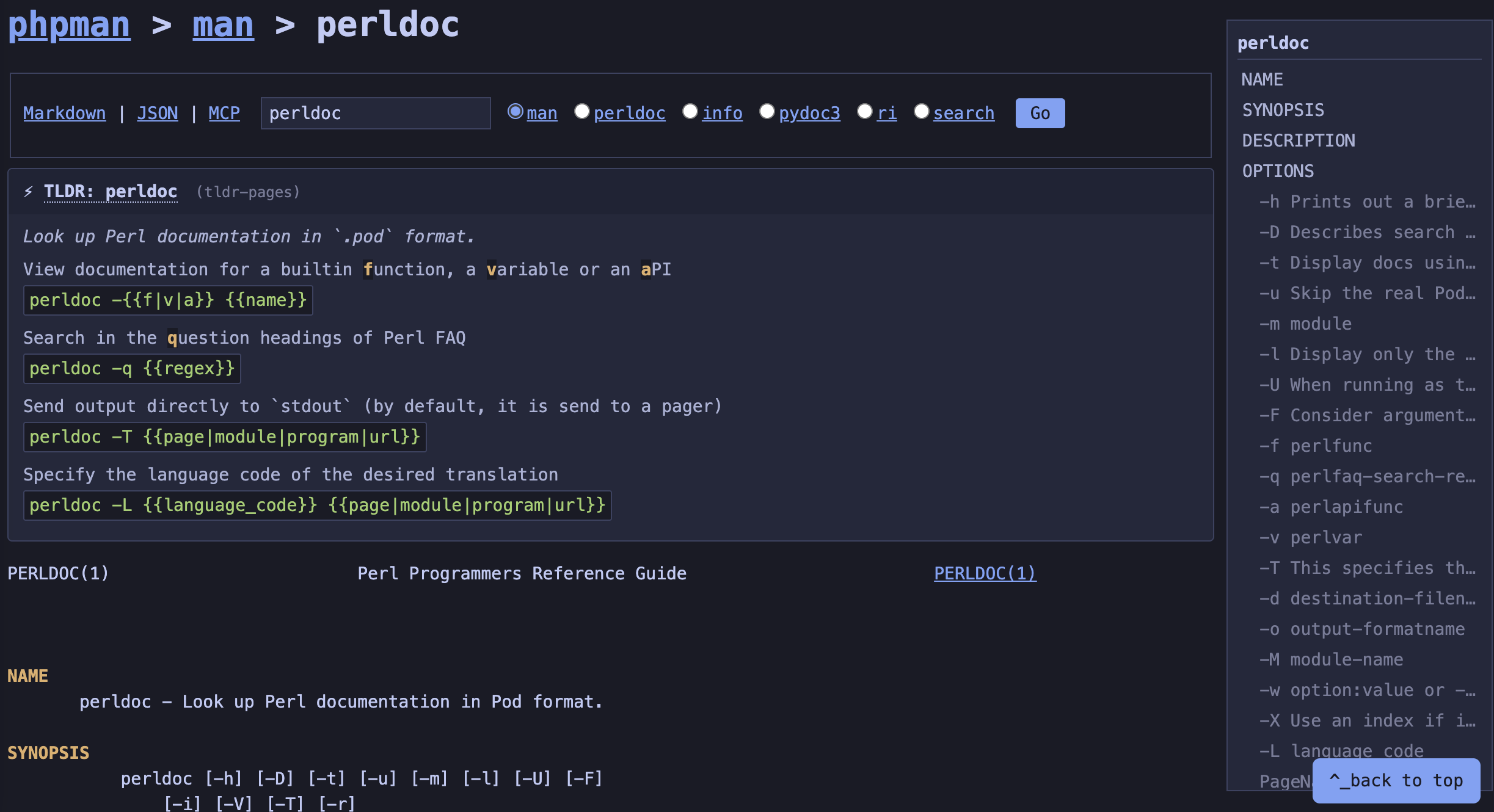
phpMan implements Model Context Protocol (MCP) via Streamable HTTP transport — no local installation or npx wrapper needed. Just point your MCP client at the endpoint URL.
Edit ~/Library/Application Support/Claude/claude_desktop_config.json (macOS) or %APPDATA%\Claude\claude_desktop_config.json (Windows):
{
"mcpServers": {
"phpman": {
"url": "https://www.chedong.com/phpMan.php/mcp"
}
}
}Open Settings → MCP and click Add new MCP server, or edit .cursor/mcp.json in your project root:
{
"mcpServers": {
"phpman": {
"url": "https://www.chedong.com/phpMan.php/mcp"
}
}
}Add to ~/.codex/config.json:
{
"mcp_servers": {
"phpman": {
"url": "https://www.chedong.com/phpMan.php/mcp"
}
}
}claude mcp add --transport http phpman https://www.chedong.com/phpMan.php/mcpAny MCP-compatible client that accepts YAML config:
mcpServers:
phpman:
url: "https://www.chedong.com/phpMan.php/mcp"For clients that don't support MCP, use the REST endpoints directly:
# Get structured man page as JSON
curl "https://www.chedong.com/phpMan.php/man/ls/1/json"# Get MCP-wrapped output (same format as MCP tools/call response)
curl "https://www.chedong.com/phpMan.php/man/ls/1/mcp"phpMan implements the Model Context Protocol (MCP) specification version 2024-11-05 via Streamable HTTP transport.
POST https://www.chedong.com/phpMan.php/mcp
Content-Type: application/json
Returns structured documentation for any Unix command, Perl module, or GNU info page.
Input Schema:
{
"command": "string (required) — Command name (e.g. 'ls', 'git', 'File::Basename')",
"section": "string (optional) — Manual section (e.g. '1', '3pm'). Omit for best-match."
}
Returns:
content[0].text— Full JSON response as string (for LLM parsing)structuredContent— Programmatic access to flags, examples, synopsis, and cross-references
Example:
curl -X POST "https://www.chedong.com/phpMan.php/mcp" \
-H "Content-Type: application/json" \
-d '{ "jsonrpc": "2.0", "id": 1, "method": "tools/call", "params": { "name": "cli_help", "arguments": {"command": "tar", "section": "1"} } }'
Auto-detection:
- Commands containing
::or section3pm/3perl→perldocmode - Commands containing
#→rimode (Ruby) - Commands containing
.(no::) →pydocmode (Python) - Other commands →
manmode
Search across man pages, Python modules, and Ruby classes using FTS5 full-text index with command-line fallback.
Input Schema:
{
"query": "string (required) — Search keyword (e.g. 'recursive delete', 'network', 'cron')",
"section": "string (optional) — Restrict to manual section (e.g. '1', '8')"
}
Returns:
content[0].text— JSON with search resultsstructuredContent— Programmatic access to results array
Example:
curl -X POST "https://www.chedong.com/phpMan.php/mcp" \
-H "Content-Type: application/json" \
-d '{ "jsonrpc": "2.0", "id": 2, "method": "tools/call", "params": { "name": "cli_search", "arguments": {"query": "cron"} } }'1. Initialize (handshake):
{"jsonrpc":"2.0", "id":1, "method":"initialize", "params":{"protocolVersion":"2024-11-05"}}Response includes serverInfo.name = "phpMan", capabilities.tools.listChanged = false
2. List Tools:
{"jsonrpc":"2.0", "id":2, "method":"tools/list"}Returns the two tools above with their inputSchema
3. Call Tool:
{"jsonrpc":"2.0", "id":3, "method":"tools/call", "params":{"name":"cli_help", "arguments":{...}}}4. Notifications (optional):
{"jsonrpc":"2.0", "method":"notifications/initialized"}Server returns HTTP 202 (no-op)
MCP errors follow JSON-RPC 2.0:
{
"jsonrpc": "2.0",
"id": 3,
"error": {
"code": -32603,
"message": "Internal error: Unknown tool: nonexistent"
}
}
Common error codes:
-32700— Parse error (invalid JSON)-32600— Invalid request (missing method)-32601— Method not found-32602— Invalid params-32603— Internal error (tool execution failed)
Both MCP structuredContent and REST /json endpoints return the same schema.
{
"mode": "man",
"parameter": "tar",
"section": "1",
"url": "https://www.chedong.com/phpMan.php/man/tar/1/json",
"generated": "2026-01-15T10:30:00Z",
"synopsis": "tar [OPTION...] [FILE]...",
"summary": "tar - An archiving utility",
"sections": {
"NAME": {
"content": "tar - An archiving utility",
"subsections": []
},
"SYNOPSIS": {
"content": "tar [OPTION...] [FILE]...",
"subsections": []
},
"DESCRIPTION": {
"content": "The GNU tar program...",
"subsections": []
},
"OPTIONS": {
"content": "",
"subsections": [
{
"name": "-c, --create",
"content": "Create a new archive",
"flag": "-c",
"long": "--create",
"arg": null
},
{
"name": "-f, --file=ARCHIVE",
"content": "Use archive file or device ARCHIVE",
"flag": "-f",
"long": "--file",
"arg": "ARCHIVE"
}
]
},
"EXAMPLES": {
"content": "tar -cvf archive.tar file1 file2\ntar -xvf archive.tar",
"subsections": []
}
},
"flags": [
{
"flag": "-c",
"long": "--create",
"arg": null,
"description": "Create a new archive"
},
{
"flag": "-f",
"long": "--file",
"arg": "ARCHIVE",
"description": "Use archive file or device ARCHIVE"
}
],
"examples": [
"tar -cvf archive.tar file1 file2",
"tar -xvf archive.tar"
],
"see_also": [
{
"name": "gzip",
"section": "1",
"url": "https://www.chedong.com/phpMan.php/man/gzip/1/json"
}
]
}| Field | Type | Description |
|---|---|---|
mode | string | "man", "perldoc", "info", "pydoc", "ri", or "search" |
parameter | string | Command or module name |
section | string | Manual section number (e.g. "1", "3pm") |
url | string | Canonical JSON API URL for this page |
generated | string | ISO 8601 timestamp (UTC) |
synopsis | string | Command synopsis (extracted from SYNOPSIS section) |
summary | string | One-line description (extracted from NAME section) |
sections | object | Map of section names → section objects |
sections[name].content | string | Section body text (newline-separated) |
sections[name].subsections | array | Level-2 headings within section |
subsections[].name | string | Subsection heading (e.g. "-c, --create") |
subsections[].content | string | Subsection body text |
subsections[].flag | string|null | Short flag (e.g. "-c") — only for option subsections |
subsections[].long | string|null | Long flag (e.g. "--create") — only for option subsections |
subsections[].arg | string|null | Argument placeholder (e.g. "ARCHIVE") — only for option subsections |
flags | array | Extracted command-line flags with descriptions |
flags[].flag | string | Short flag (e.g. "-c") |
flags[].long | string|null | Long flag (e.g. "--create") |
flags[].arg | string|null | Argument placeholder |
flags[].description | string | Flag description (single line) |
examples | array | Command usage examples (from EXAMPLES section) |
see_also | array | Cross-references to related man pages |
see_also[].name | string | Related command name |
see_also[].section | string | Related command section |
see_also[].url | string | JSON API URL for related command |
Search results aggregate three documentation sources:
{
"mode": "search",
"query": "json",
"count": 26,
"results": [
{"name": "JSON::PP", "section": "3perl", "description": "JSON::XS compatible pure-Perl module"},
{"name": "json_pp", "section": "1", "description": "JSON::PP command utility"}
],
"pydoc_results": [
{"name": "json", "description": "JSON (JavaScript Object Notation)"},
{"name": "json.decoder", "description": "Implementation of JSONDecoder"}
],
"ri_results": [
{"name": "Psych::JSON", "description": "Ruby class/module"},
{"name": "ActiveSupport::JSON", "description": "Ruby class/module"}
]
}| Field | Description |
|---|---|
results | Man page / perldoc matches |
pydoc_results | Python 3 module matches |
ri_results | Ruby class/module matches |
When using /mcp endpoint or MCP POST, the response is wrapped:
{
"content": [
{
"type": "text",
"text": "<full JSON response as string>"
}
],
"structuredContent": {
"command": "tar",
"section": "1",
"mode": "man",
"summary": "tar - An archiving utility",
"synopsis": "tar [OPTION...] [FILE]...",
"flags": [...],
"examples": [...],
"see_also": [...],
"section_outline": [
{
"name": "NAME",
"lines": 1,
"subsections": []
},
{
"name": "OPTIONS",
"lines": 45,
"subsections": [
{"name": "-c, --create", "lines": 3, "flag": "-c", "long": "--create"},
{"name": "-f, --file=ARCHIVE", "lines": 5, "flag": "-f", "long": "--file", "arg": "ARCHIVE"}
]
}
]
}
}
The content[0].text field contains the full JSON response as a string (for LLM consumption). The structuredContent field provides programmatic access to key metadata (for agent tooling).
For clients that don't support MCP, phpMan exposes REST endpoints with identical structured output.
Append /json to any detail page URL, or send Accept: application/json header:
# Man page with structured sections
curl "https://www.chedong.com/phpMan.php/man/ls/1/json"# Apropos search results
curl "https://www.chedong.com/phpMan.php/search/git/json"# Accept header (works on any URL)
curl -H "Accept: application/json""https://www.chedong.com/phpMan.php/man/bash"The /mcp format suffix wraps JSON output in MCP's content array — making REST GET and MCP POST responses identical:
# Same man page, same output format as MCP POST tools/call
curl "https://www.chedong.com/phpMan.php/man/ls/1/mcp"# → {"content":[{"type":"text","text":"..."}],"structuredContent":{...}}# Search with MCP format
curl "https://www.chedong.com/phpMan.php/search/cron/mcp"# Perldoc with MCP format
curl "https://www.chedong.com/phpMan.php/perldoc/Digest::MD5/mcp"
This means any MCP client can GET /man/ls/1/mcp and parse the result identically to POST /mcptools/call.
TLDR cheatsheets are embedded directly in man page detail pages. When viewing a man section 1 command page, phpMan fetches from tldr-pages (with cheat.sh fallback) and caches results in SQLite for 7 days. The TLDR block appears at the top of the man page with collapsible examples.
# TLDR is integrated directly into man page output
curl "https://www.chedong.com/phpMan.php/man/tar/1/markdown"| Format | TLDR location |
|---|---|
| HTML | Collapsible block at top of page |
| Markdown | ## TLDR section before man content |
| JSON | tldr_summary + tldr_examples fields |
| MCP | structuredContent.tldr_summary + tldr_examples |
- Code split — 5660-line monolith → 753-line dispatcher + 22 source files in
src/. Webroot contains onlyphpMan.php+phpman.css+phpman.js+phpman.config.php. - CLI consolidation — All CLI tools under
cli/:build-index.php,batch-enhance.php. Shared bootstrap (_bootstrap.php).enhance.phpmerged intobatch-enhance.phpwith shorthand syntax:php cli/batch-enhance.php man:ls,tar. - Security hardening —
isLocalRequest()restricts to loopback only.cleanEmojiHtml()strips all event-handler quote variants.getSearchPage()gracefully falls back when cache DB unavailable. - Markdown format purity — Search results in Markdown use pure
-list items, no HTML wrappers. - install.sh improvements — Config generated from
.example(single source of truth).--updatechecks for new config options.PHPMAN_VERSIONwritten bymake tag. - MCP search —
cli_searchreturns structured results (mode/search/count/results) via both POST/mcpand GET/search/{query}/mcp.
- TLDR embedded in man pages — TLDR is now integrated directly into man page rendering (HTML/Markdown/JSON/MCP), fetching from tldr-pages + cheat.sh with SQLite 7-day cache. The old
/tldrroute andTLDR_CACHE_DIRenv vars are removed. - FTS5 single-query search — one SQL query covers man/pydoc/ri, routing results by section
- pydoc3 / ri FTS5 indexing — Python and Ruby documentation searchable alongside man pages
- Case-insensitive matching — searching
jsonmatchesJSON::Ext::Parser,Psych::JSON,json.decoder
- perldoc: Uses
pod2text -w Npipeline for consistent output width on Linux and macOS - man (macOS/BSD):
MANWIDTHfallback whengroff -Tutf8is unavailable - man (Linux):
MANROFFOPT=-rLL=Nn+groff -Tutf8for precise width
See docs/PLAN.md for the full project plan:
- pydoc / ri — ✅ Shipped in v3.6 — Python and Ruby documentation support with FTS5 search
- LLM-powered — AI translation (identifier-preserving), cheat sheets, example generation
- Search — ✅ Shipped in v3.6 — FTS5 full-text index with three-source aggregation (man + pydoc + ri)
- MCP — Streaming output, error standardization, dynamic tool discovery
- I18N — LANG-based locale support + AI fallback translation
On shared servers, Ruby gems are typically installed in system directories (e.g. /usr/lib/x86_64-linux-gnu/rubygems-integration/ or /usr/share/rubygems-integration/all/gems/). The gem rdoc command fails silently because it cannot write to those directories, and ri finds no gem documentation. This means ri -l won't list gem classes like JSON::Ext::Parser, ActiveSupport::JSON, etc., and phpMan's FTS5 search won't index them.
The solution is to use rdoc --ri to generate ri data into ~/.local/share/rdoc/, which ri scans by default. After generating, run php cli/build-index.php to rebuild the FTS5 search index with the new ri entries.
# Generate ri docs for all gems across all system gem pathsfordirin \
/usr/lib/x86_64-linux-gnu/rubygems-integration/3.0.0/gems \
/usr/share/rubygems-integration/all/gems \
/var/lib/gems/3.0.0/gems;do
[ -d"$dir" ] ||continueforgemin"$dir"/*/lib;do
[ -d"$gem" ] ||continue
name=$(basename "$(dirname "$gem")")echo"Generating ri for $name..."
RUBYOPT="-Eutf-8:utf-8" rdoc --ri "$gem" -o ~/.local/share/rdoc 2>/dev/null
donedoneri --list-doc-dirs # Should include ~/.local/share/rdoc
ri Nokogiri::HTML # Should show documentation
ri ActiveRecord::Base # Should show documentation- Output directory must be
~/.local/share/rdoc—riauto-discovers this path. Subdirectories within it are not scanned separately. - All gems must write to the same directory —
rdoc --rimerges data incrementally. Don't use per-gem subdirectories;riwon't find them. RUBYOPT="-Eutf-8:utf-8"is needed to avoidinvalid byte sequence in UTF-8errors on some gems.2>/dev/nullsilences per-gem rdoc warnings. Remove it to debug individual failures.cache.riis auto-generated byrdocin the output directory. Ifrican't find classes after a fresh generate, delete~/.local/share/rdoc/cache.riand regenerate.
| Approach | Works on shared servers? | Output location | ri discovers? |
|---|---|---|---|
gem rdoc --all | ❌ Fails silently (no write access to system gem dirs) | System doc dirs | N/A |
gem rdoc <gem> --ri | ❌ Same permission issue | N/A | N/A |
rdoc --ri <lib-dir> -o ~/.local/share/rdoc | ✅ | ~/.local/share/rdoc | ✅ |
To generate ri docs for a single newly installed gem:
RUBYOPT="-Eutf-8:utf-8" rdoc --ri /path/to/gem/lib -o ~/.local/share/rdocTo auto-generate on gem install, add to ~/.gemrc:
gem: --document riThen for system-installed gems, manually run the rdoc --ri command above after install.
Rebuild the FTS5 search index so phpMan's search includes the new ri entries:
php /path/to/phpman/cli/build-index.phpThis adds the newly discovered ri classes to search_fts, making them searchable alongside man pages and pydoc modules.
- Man Pages — Browse any Unix/Linux manual page with
-Tutf8output (SGR bold/underline support) - Perldoc — Read Perl module documentation in-browser
- Python 3 (pydoc3) — Browse Python module documentation via
pydoc3 - Ruby (ri) — Browse Ruby class/module documentation via
ri - Info Pages — View GNU info documentation
- Apropos Search — Full-text search across man pages, Python modules, and Ruby classes (FTS5 + command-line fallback)
- TOC Sidebar — Two-level floating table of contents for navigation
- Markdown Output — Append
/markdownfor machine-readable format - JSON API — Append
/jsonfor structured JSON output with semantic fields - MCP Format — Append
/mcpfor MCP-compatible output - MCP Server — Model Context Protocol endpoint for AI agent integration
- TLDR Integration — Inline cheatsheets from tldr-pages + cheat.sh, cached in SQLite
- SEO Optimized — Canonical URLs, meta description, robots directives
- Clean URLs — PATH_INFO routing:
/man/ls/1
phpMan supports five Unix documentation retrieval methods, each corresponding to different system commands, data sources, and documentation format specifications.
| Item | Description |
|---|---|
| System Command | man -Tutf8 <argument> |
| Data Source | /usr/share/man/, /usr/local/share/man/ — files with .1.gz, .3pm.gz etc. |
| Source Format | troff / groff (AT&T typesetting language), original content contains overstrike sequences (e.g., W^HWA^HAR^HRN^H...) |
| Standard | man-pages(7) — 9 sections: 1=user commands, 2=system calls, 3=C library functions, 4=device files, 5=file formats, 6=games, 7=miscellaneous, 8=system administration, 9=kernel routines |
| Internal Structure | Flat document per page, fixed sections include NAME, SYNOPSIS, DESCRIPTION, OPTIONS, EXAMPLES, SEE ALSO, etc. |
| Subsections | Supports second-level subsections (.SS macro → bold/underline), fully displayed in TOC |
| Item | Description |
|---|---|
| System Command | info <argument> |
| Data Source | /usr/share/info/ — files with .info.gz, .info |
| Source Format | Texinfo (GNU documentation format), original content includes typesetting markers (* Menu:, section numbers 4.1, cross-references (node)) |
| Standard | Texinfo → can generate PDF, HTML, and info. Node is the basic unit, with hypertext links via (node) forming a documentation tree |
| Internal Structure | Tree-like node structure, can contain submenu nodes, supports jump navigation |
| Subsections | Plain text output from info has only section numbers (3.1, 3.2) and indentation, no identifiable explicit heading macros, so TOC shows only first level |
| Item | Description |
|---|---|
| System Command | perldoc <module> → perldoc -f <function> → perldoc -q <regex> (three-level fallback) |
| Data Source | .pod files in Perl installation paths |
| Source Format | POD (Plain Old Documentation), Perl documentation format, uses =head1, =head2, =over, =item markers |
| Standard | perlpod(1) — =head1 for major sections, =head2 for subsections |
| Internal Structure | Flat document with clear =head1 → =head2 hierarchy |
| Subsections | Supports second-level subsections (=head2), fully displayed in TOC |
| Item | Description |
|---|---|
| System Command | pydoc3 <module> for documentation, pydoc3 -k <keyword> for search, pydoc3 modules for index |
| Data Source | Python 3 standard library + installed packages |
| Source Format | Plain text — no overstrike or ANSI, uses ALL CAPS section headers (NAME, DESCRIPTION, CLASSES, FUNCTIONS) |
| Standard | Python docstring conventions (PEP 257) |
| Internal Structure | Flat document with ALL CAPS L1 sections, indented class/function definitions as L2 |
| Subsections | L2 via class Name(Parent) and funcName(args) patterns |
| URL Pattern | /pydoc/{module}, /pydoc/{module}/{format} |
| Item | Description |
|---|---|
| System Command | ri <Class#method> for documentation, ri -l for class index |
| Data Source | Ruby core + installed gem ri data (see Generating ri Documentation for Gems below) |
| Source Format | Overstrike (same as man pages), uses RDoc markers (= Heading, == Subheading) |
| Standard | RDoc — Ruby documentation format |
| Internal Structure | Flat document with = L1 and == L2 headings |
| Subsections | == subheadings, fully displayed in TOC |
| URL Pattern | /ri/{Class}, /ri/{Class#method}/{format} |
| Search | No native ri -k; phpMan uses ri <query> (built-in fuzzy match) + FTS5 index |
| Dimension | man | info | perldoc | pydoc3 | ri |
|---|---|---|---|---|---|
| Ecosystem | BSD / Unix general | GNU project | Perl | Python 3 | Ruby |
| Source Format | troff / groff | Texinfo | POD | Plain text / docstrings | RDoc |
| Overstrike Output | ✅ Yes | ❌ No | ❌ No (ANSI) | ❌ No | ✅ Yes |
| Second-level Headings | .SS → bold | Section number | =head2 | class/func() | == markers |
| TOC Depth | ✅ Full two levels | ❌ First level only | ✅ Full two levels | ✅ Full two levels | ✅ Full two levels |
| Linking | Weak (cross-ref) | Strong (node tree) | Weak (module ref) | Weak (module ref) | Weak (:: ref) |
| Typical Content | Command refs, syscalls | GNU manuals | Perl API refs | Python API refs | Ruby API refs |
git clone https://github.com/chedong/phpman.gitgit clone git@github.com:chedong/phpman.gitThe repository includes a Makefile for CI/CD (staging, release, rollback, cache
management). This is for the phpMan maintainer — requires SSH access to target servers.
For self-hosting, use the install script instead:
curl -fsSL https://raw.githubusercontent.com/chedong/phpman/master/install.sh | bashSite-specific values are loaded from .deploy.mk, which is gitignored.
Create your local deployment config from the example:
cp .deploy.mk.example .deploy.mkThen edit .deploy.mk for your server:
TEST_HOST = user@example.com
TEST_PORT = 22
TEST_PATH = /path/to/example.com/test
TEST_URL = https://example.com/test/phpMan.php
DEMO_HOST = user@example.com
DEMO_PORT = 22
DEMO_PATH = /path/to/example.com
DEMO_URL = https://example.com/phpMan.phpmake testgit add phpMan.php README.md Makefile .deploy.mk.example .gitignore
git commit -m "description of changes"
git push origin mastermake deployThis deploys only phpMan.php to the staging path configured by TEST_PATH.
make release
make deploy-verify
⚠️ Do not overwriteindex.php— only updatephpMan.php.
Tag and create a release on GitHub:
git tag v2.2
git push origin v2.2
gh release create v2.2 --title "v2.2" --notes "Release notes here"
Or upload a release artifact via the Makefile:
make upload-releaseThe search engine uses a SQLite FTS5 index built from system apropos, pydoc3, and ri data.
Rebuild the index when search results become stale or after installing new packages:
# Rebuild index
php cli/build-index.php
# Rebuild index (cron mode with timestamp)
php cli/build-index.php --cron
# Enhance a single page (shorthand: mode:name)
php cli/batch-enhance.php man:ls
php cli/batch-enhance.php man:ls,tar,grep --rebuild
# Batch enhance with full options
php cli/batch-enhance.php --help
php cli/batch-enhance.php --status
php cli/batch-enhance.php --cached-first --skip-errors --yes
Cron example (daily at 3am): 0 3 * * * /usr/bin/php /path/to/phpman/cli/build-index.php --cron
The script clears search_fts + search_index_meta + stale search cache, then
rebuilds from scratch via apropos -s N . for man pages, pydoc3 modules for
Python 3, and ri -l for Ruby. Typically completes in ~10 seconds for ~14,000 entries
(9,600 man + 340 pydoc + 3,900 ri).
GNU General Public License v2.0 — see copyright page.
Che Dong — https://www.chedong.com/