Package provides the direct java conversion of the origin libsvm


Add the following dependency to your POM file:
<dependency>
<groupId>com.github.chen0040</groupId>
<artifactId>java-libsvm</artifactId>
<version>1.0.4</version>
</dependency>
The package use data frame as containers for training and testing data (Please refers to this link on how to create a data frame from file or from scratch)
Below is the code to create and train a one-class SVM:
OneClassSVMalgorithm = newOneClassSVM();
algorithm.fit(training_data)
Below is the code to predict if data point is an outlier:
algorithm.isAnomaly(data_point)Below is the code to create and train a SVR for regression modelling:
SVRalgorithm = newSVR();
algorithm.fit(training_data)
Below is the code to perform data regression prediction:
algorithm.isAnomaly(data_point)Below is the code to create and train a BinarySVC for binary classification:
BinarySVCalgorithm = newBinarySVC();
algorithm.fit(training_data)
Below is the code to perform data binary classification:
algorithm.isInClass(data_point)Below is the code to create and train a OneVsOneSVC for multi-class classification:
BinarySVCalgorithm = newBinarySVC();
algorithm.fit(training_data)
Below is the code to perform multi-class classification:
algorithm.classify(data_point)The data format default is the DataFrame class, which can be used to load csv and libsvm format text file. Please refers to the unit test cases on how they can be used.
Below is a sample code example of the one-class SVM for the example below here:
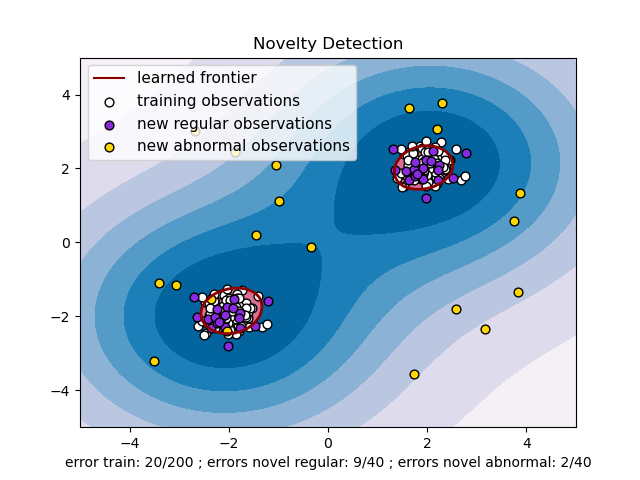
importcom.github.chen0040.data.frame.DataFrame;
importcom.github.chen0040.data.frame.DataQuery;
importcom.github.chen0040.data.frame.Sampler;
importcom.github.chen0040.svmext.oneclass.OneClassSVM;
DataQuery.DataFrameQueryBuilderschema = DataQuery.blank()
.newInput("c1")
.newInput("c2")
.newOutput("anomaly")
.end();
Sampler.DataSampleBuildernegativeSampler = newSampler()
.forColumn("c1").generate((name, index) -> randn() * 0.3 + (index % 2 == 0 ? -2 : 2))
.forColumn("c2").generate((name, index) -> randn() * 0.3 + (index % 2 == 0 ? -2 : 2))
.forColumn("anomaly").generate((name, index) -> 0.0)
.end();
Sampler.DataSampleBuilderpositiveSampler = newSampler()
.forColumn("c1").generate((name, index) -> rand(-4, 4))
.forColumn("c2").generate((name, index) -> rand(-4, 4))
.forColumn("anomaly").generate((name, index) -> 1.0)
.end();
DataFrametrainingData = schema.build();
trainingData = negativeSampler.sample(trainingData, 200);
System.out.println(trainingData.head(10));
DataFramecrossValidationData = schema.build();
crossValidationData = negativeSampler.sample(crossValidationData, 40);
DataFrameoutliers = schema.build();
outliers = positiveSampler.sample(outliers, 40);
finaldoublethreshold = 0.5;
OneClassSVMalgorithm = newOneClassSVM();
algorithm.set_gamma(0.1);
algorithm.set_nu(0.1);
algorithm.thresholdSupplier = () -> 0.0;
algorithm.fit(trainingData);
for(inti = 0; i < crossValidationData.rowCount(); ++i){
booleanpredicted = algorithm.isAnomaly(crossValidationData.row(i));
logger.info("predicted: {}\texpected: {}", predicted, crossValidationData.row(i).target() > threshold);
}
for(inti = 0; i < outliers.rowCount(); ++i){
booleanpredicted = algorithm.isAnomaly(outliers.row(i));
logger.info("outlier predicted: {}\texpected: {}", predicted, outliers.row(i).target() > threshold);
}Below is another complete sample code of the SVR to predict y = 4 + 0.5 * x1 + 0.2 * x2:

importcom.github.chen0040.data.frame.DataFrame;
importcom.github.chen0040.data.frame.DataQuery;
importcom.github.chen0040.data.frame.Sampler;
importcom.github.chen0040.svmext.oneclass.SVR;
DataQuery.DataFrameQueryBuilderschema = DataQuery.blank()
.newInput("x1")
.newInput("x2")
.newOutput("y")
.end();
// y = 4 + 0.5 * x1 + 0.2 * x2Sampler.DataSampleBuildersampler = newSampler()
.forColumn("x1").generate((name, index) -> randn() * 0.3 + index)
.forColumn("x2").generate((name, index) -> randn() * 0.3 + index * index)
.forColumn("y").generate((name, index) -> 4 + 0.5 * index + 0.2 * index * index + randn() * 0.3)
.end();
DataFrametrainingData = schema.build();
trainingData = sampler.sample(trainingData, 200);
System.out.println(trainingData.head(10));
DataFramecrossValidationData = schema.build();
crossValidationData = sampler.sample(crossValidationData, 40);
SVRsvr = newSVR();
svr.fit(trainingData);
for(inti = 0; i < crossValidationData.rowCount(); ++i){
doublepredicted = svr.transform(crossValidationData.row(i));
doubleactual = crossValidationData.row(i).target();
System.out.println("predicted: " + predicted + "\texpected: " + actual);
}Below is another complete sample code of the BinarySVC for binary classification:
importcom.github.chen0040.data.frame.DataFrame;
importcom.github.chen0040.data.frame.DataQuery;
importcom.github.chen0040.data.frame.Sampler;
importcom.github.chen0040.svmext.classifiers.BinarySVC;
DataQuery.DataFrameQueryBuilderschema = DataQuery.blank()
.newInput("c1")
.newInput("c2")
.newOutput("anomaly")
.end();
Sampler.DataSampleBuildernegativeSampler = newSampler()
.forColumn("c1").generate((name, index) -> randn() * 0.3 + (index % 2 == 0 ? -2 : 2))
.forColumn("c2").generate((name, index) -> randn() * 0.3 + (index % 2 == 0 ? -2 : 2))
.forColumn("anomaly").generate((name, index) -> 0.0)
.end();
Sampler.DataSampleBuilderpositiveSampler = newSampler()
.forColumn("c1").generate((name, index) -> rand(-4, 4))
.forColumn("c2").generate((name, index) -> rand(-4, 4))
.forColumn("anomaly").generate((name, index) -> 1.0)
.end();
DataFrametrainingData = schema.build();
trainingData = negativeSampler.sample(trainingData, 200);
trainingData = positiveSampler.sample(trainingData, 200);
System.out.println(trainingData.head(10));
DataFramecrossValidationData = schema.build();
crossValidationData = negativeSampler.sample(crossValidationData, 40);
crossValidationData = positiveSampler.sample(crossValidationData, 40);
BinarySVCalgorithm = newBinarySVC();
algorithm.fit(trainingData);
BinaryClassifierEvaluatorevaluator = newBinaryClassifierEvaluator();
for(inti = 0; i < crossValidationData.rowCount(); ++i){
booleanpredicted = algorithm.isInClass(crossValidationData.row(i));
booleanactual = crossValidationData.row(i).target() > 0.5;
evaluator.evaluate(actual, predicted);
System.out.println("predicted: " + predicted + "\texpected: " + actual);
}
evaluator.report();Below is another complete sample code of the OneVsOneSVC for multi-class classification:
importcom.github.chen0040.data.frame.DataFrame;
importcom.github.chen0040.data.frame.DataQuery;
importcom.github.chen0040.data.frame.Sampler;
importcom.github.chen0040.svmext.classifiers.OneVsOneSVC;
InputStreamirisStream = newFileInputStream("iris.data");
DataFrameirisData = DataQuery.csv(",", false)
.from(irisStream)
.selectColumn(0).asNumeric().asInput("Sepal Length")
.selectColumn(1).asNumeric().asInput("Sepal Width")
.selectColumn(2).asNumeric().asInput("Petal Length")
.selectColumn(3).asNumeric().asInput("Petal Width")
.selectColumn(4).asCategory().asOutput("Iris Type")
.build();
TupleTwo<DataFrame, DataFrame> parts = irisData.shuffle().split(0.9);
DataFrametrainingData = parts._1();
DataFramecrossValidationData = parts._2();
System.out.println(crossValidationData.head(10));
OneVsOneSVCmultiClassClassifier = newOneVsOneSVC();
multiClassClassifier.fit(trainingData);
ClassifierEvaluatorevaluator = newClassifierEvaluator();
for(inti=0; i < crossValidationData.rowCount(); ++i) {
Stringpredicted = multiClassClassifier.classify(crossValidationData.row(i));
Stringactual = crossValidationData.row(i).categoricalTarget();
System.out.println("predicted: " + predicted + "\tactual: " + actual);
evaluator.evaluate(actual, predicted);
}
evaluator.report();