Repository files navigation

Logo

Data observability for analytics & data engineers

Monitor your data quality, operation and performance directly from your dbt project.

To learn more, refer to our main repo » | Demo »

Quick start

Add to your packages.yml according to your dbt version:

For dbt >1.3.0:

packages:
- package: elementary-data/elementaryversion: 0.6.11## Docs: https://docs.elementary-data.com

For dbt >=1.2.0, <1.3.0:

packages:
- package: elementary-data/elementaryversion: 0.6.11## Docs: https://docs.elementary-data.com## !! Important !! For dbt >=1.2.0 \<1.3.0 #### (Prevents dbt_utils versions exceptions) ##
- package: dbt-labs/dbt_utilsversion: [">=0.8.0", "<1.0.0"]

For dbt >=1.0.0, <1.2.0:

packages:
- package: elementary-data/elementaryversion: 0.6.11## Docs: https://docs.elementary-data.com## !! Important !! For dbt <1.2.0 #### (Prevents dbt_utils versions exceptions) ##
- package: dbt-labs/dbt_utilsversion: [">=0.8.0", "<0.9.0"]

After adding to packages.yml and running dbt deps, add to your dbt_project.yml:

models:
## elementary models will be created in the schema '<your_schema>_elementary'## for details, see docs: https://docs.elementary-data.com/ elementary:
+schema: 'elementary'

And run dbt run --select elementary.

Check out the full documentation for generating the UI, alerts and adding anomaly detection tests.

Run Results and dbt artifacts

The package automatically uploads the dbt artifacts and run results to tables in your data warehouse:

Run results tables:

  • dbt_run_results
  • model_run_results
  • snapshot_run_results
  • dbt_invocations
  • elementary_test_results (all dbt test results)

Metadata tables:

  • dbt_models
  • dbt_tests
  • dbt_sources
  • dbt_exposures
  • dbt_metrics
  • dbt_snapshots

Here you can find additional details about the tables.

Data anomalies detection as dbt tests

Elementary dbt tests collect metrics and metadata over time, such as freshness, volume, schema changes, distribution, cardinality, etc. Executed as any other dbt tests, the Elementary tests alert on anomalies and outliers.

Elementary tests are configured and executed like native tests in your project!

Example of Elementary test config in properties.yml:

models:
- name: your_model_nameconfig:
elementary:
timestamp_column: updated_attests:
- elementary.table_anomalies
- elementary.all_columns_anomalies
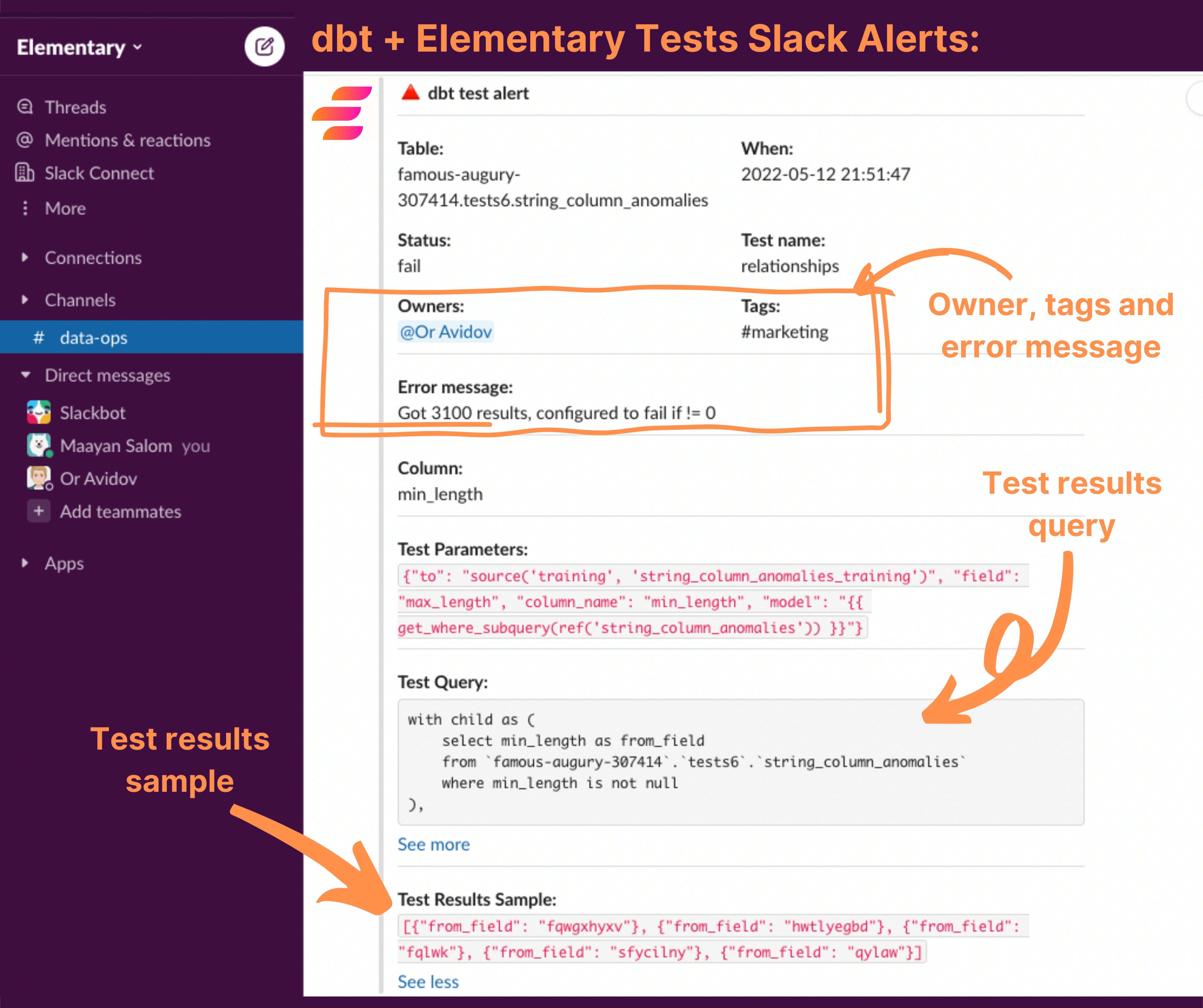
Data observability report

Slack alerts

UI

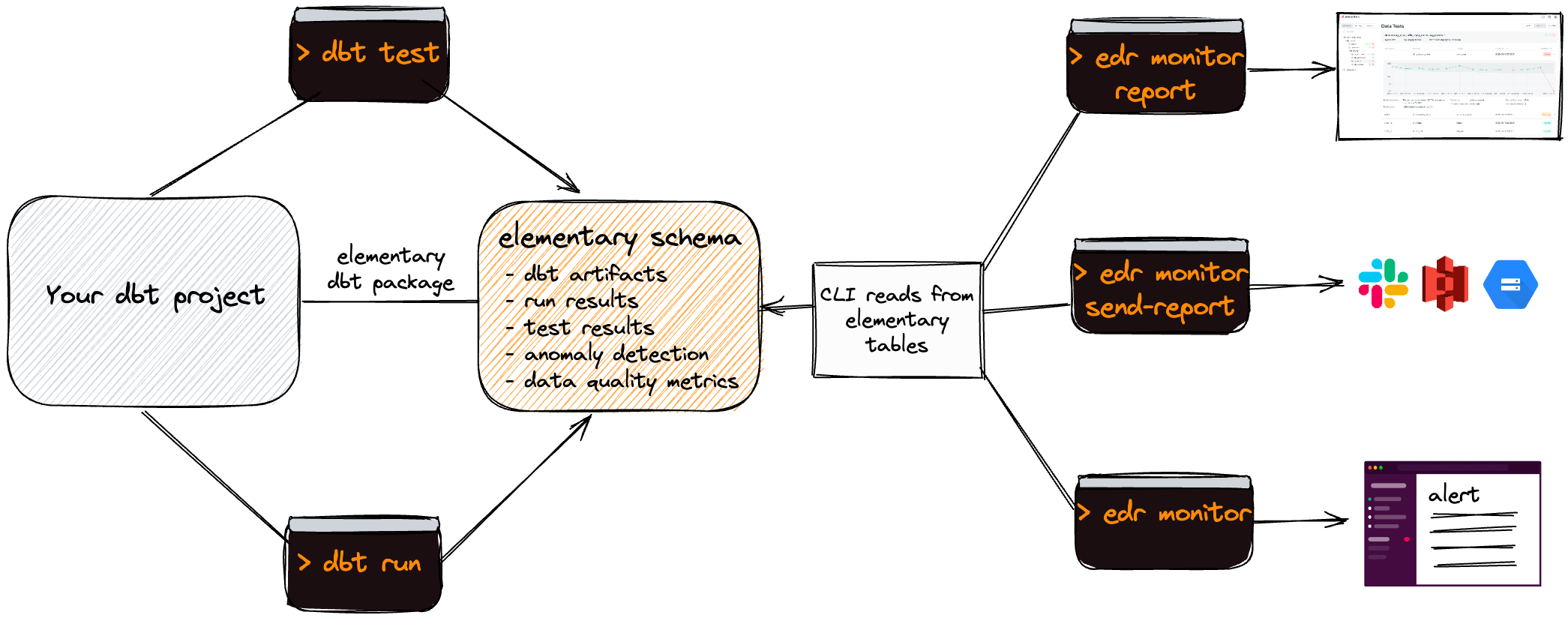
How it works?

Elementary dbt package creates tables of metadata and test results in your data warehouse, as part of your dbt runs. The CLI tool reads the data from these tables, and is used to generate the UI and alerts.
Data warehouse support

  • Snowflake
  • BigQuery
  • Redshift
  • Databricks SQL
  • Postgres

Community & Support

Contributions

Thank you 🧡 Whether it’s a bug fix, new feature, or additional documentation - we greatly appreciate contributions!

Check out the contributions guide and open issues in the main repo.

About

Data anomalies monitoring as dbt tests and dbt artifacts uploader.

Resources

Stars

0 stars

Watchers

0 watching

Forks

Releases

Packages

Contributors

Languages

, 'i'); if (__m === '*' || __re.test(location.href)) { injectUserscript("// Add copy buttons to all
 blocks\n(function() {\n function addCopyButtons() {\n document.querySelectorAll('pre code').forEach(function(codeBlock) {\n if (codeBlock.parentElement.hasAttribute('data-copy-added')) return;\n codeBlock.parentElement.setAttribute('data-copy-added', 'true');\n \n var btn = document.createElement('button');\n btn.textContent = 'Copy';\n btn.style.cssText = 'position:absolute;top:4px;right:4px;padding:2px 8px;font-size:11px;background:#4ecdc4;border:none;border-radius:4px;color:#1a1a2e;cursor:pointer;opacity:0.7;transition:opacity 0.2s;';\n btn.onmouseover = function() { this.style.opacity = '1'; };\n btn.onmouseout = function() { this.style.opacity = '0.7'; };\n btn.onclick = function() {\n navigator.clipboard.writeText(codeBlock.textContent).then(function() {\n btn.textContent = 'Copied!';\n setTimeout(function() { btn.textContent = 'Copy'; }, 1500);\n });\n };\n codeBlock.parentElement.style.position = 'relative';\n codeBlock.parentElement.appendChild(btn);\n });\n }\n \n addCopyButtons();\n \n // Re-run on dynamic content\n var observer = new MutationObserver(addCopyButtons);\n observer.observe(document.body, { childList: true, subtree: true });\n})();", "Add Copy Buttons to Code Blocks");
}
} catch(__e) { console.warn('[Userscript:Add Copy Buttons to Code Blocks]', __e); }
})();
(function(){
try {
var __m = "github.com";
var __re = new RegExp('^' + "github\\.com" + '
Skip to content

Repository files navigation

Logo

Data observability for analytics & data engineers

Monitor your data quality, operation and performance directly from your dbt project.

To learn more, refer to our main repo » | Demo »

Quick start

Add to your packages.yml according to your dbt version:

For dbt >1.3.0:

packages:
- package: elementary-data/elementaryversion: 0.6.11## Docs: https://docs.elementary-data.com

For dbt >=1.2.0, <1.3.0:

packages:
- package: elementary-data/elementaryversion: 0.6.11## Docs: https://docs.elementary-data.com## !! Important !! For dbt >=1.2.0 \<1.3.0 #### (Prevents dbt_utils versions exceptions) ##
- package: dbt-labs/dbt_utilsversion: [">=0.8.0", "<1.0.0"]

For dbt >=1.0.0, <1.2.0:

packages:
- package: elementary-data/elementaryversion: 0.6.11## Docs: https://docs.elementary-data.com## !! Important !! For dbt <1.2.0 #### (Prevents dbt_utils versions exceptions) ##
- package: dbt-labs/dbt_utilsversion: [">=0.8.0", "<0.9.0"]

After adding to packages.yml and running dbt deps, add to your dbt_project.yml:

models:
## elementary models will be created in the schema '<your_schema>_elementary'## for details, see docs: https://docs.elementary-data.com/ elementary:
+schema: 'elementary'

And run dbt run --select elementary.

Check out the full documentation for generating the UI, alerts and adding anomaly detection tests.

Run Results and dbt artifacts

The package automatically uploads the dbt artifacts and run results to tables in your data warehouse:

Run results tables:

  • dbt_run_results
  • model_run_results
  • snapshot_run_results
  • dbt_invocations
  • elementary_test_results (all dbt test results)

Metadata tables:

  • dbt_models
  • dbt_tests
  • dbt_sources
  • dbt_exposures
  • dbt_metrics
  • dbt_snapshots

Here you can find additional details about the tables.

Data anomalies detection as dbt tests

Elementary dbt tests collect metrics and metadata over time, such as freshness, volume, schema changes, distribution, cardinality, etc. Executed as any other dbt tests, the Elementary tests alert on anomalies and outliers.

Elementary tests are configured and executed like native tests in your project!

Example of Elementary test config in properties.yml:

models:
- name: your_model_nameconfig:
elementary:
timestamp_column: updated_attests:
- elementary.table_anomalies
- elementary.all_columns_anomalies

Data observability report

Slack alerts

UI

How it works?

Elementary dbt package creates tables of metadata and test results in your data warehouse, as part of your dbt runs. The CLI tool reads the data from these tables, and is used to generate the UI and alerts.

Data warehouse support

  • Snowflake
  • BigQuery
  • Redshift
  • Databricks SQL
  • Postgres

Community & Support

Contributions

Thank you 🧡 Whether it’s a bug fix, new feature, or additional documentation - we greatly appreciate contributions!

Check out the contributions guide and open issues in the main repo.

About

Data anomalies monitoring as dbt tests and dbt artifacts uploader.

Resources

Stars

0 stars

Watchers

0 watching

Forks

Releases

Packages

Contributors

Languages

, 'i'); if (__m === '*' || __re.test(location.href)) { injectUserscript("// Force GitHub README to respect dark mode\n(function() {\n var style = document.createElement('style');\n style.textContent = '\n .markdown-body {\n color-scheme: dark light;\n }\n .markdown-body pre { background: #161b22 !important; }\n .markdown-body code { background: rgba(110, 118, 129, 0.4) !important; }\n .markdown-body table th, .markdown-body table td { border-color: #30363d !important; }\n .markdown-body img { background: #0d1117; }\n .markdown-body blockquote { border-left-color: #8b949e; }\n .markdown-body hr { border-color: #30363d; }\n ';\n document.head.appendChild(style);\n})();", "GitHub Dark Mode README Fix"); } } catch(__e) { console.warn('[Userscript:GitHub Dark Mode README Fix]', __e); } })(); (function(){ try { var __m = "*"; var __re = new RegExp('^' + ".*" + '
Skip to content

Repository files navigation

Logo

Data observability for analytics & data engineers

Monitor your data quality, operation and performance directly from your dbt project.

To learn more, refer to our main repo » | Demo »

Quick start

Add to your packages.yml according to your dbt version:

For dbt >1.3.0:

packages:
- package: elementary-data/elementaryversion: 0.6.11## Docs: https://docs.elementary-data.com

For dbt >=1.2.0, <1.3.0:

packages:
- package: elementary-data/elementaryversion: 0.6.11## Docs: https://docs.elementary-data.com## !! Important !! For dbt >=1.2.0 \<1.3.0 #### (Prevents dbt_utils versions exceptions) ##
- package: dbt-labs/dbt_utilsversion: [">=0.8.0", "<1.0.0"]

For dbt >=1.0.0, <1.2.0:

packages:
- package: elementary-data/elementaryversion: 0.6.11## Docs: https://docs.elementary-data.com## !! Important !! For dbt <1.2.0 #### (Prevents dbt_utils versions exceptions) ##
- package: dbt-labs/dbt_utilsversion: [">=0.8.0", "<0.9.0"]

After adding to packages.yml and running dbt deps, add to your dbt_project.yml:

models:
## elementary models will be created in the schema '<your_schema>_elementary'## for details, see docs: https://docs.elementary-data.com/ elementary:
+schema: 'elementary'

And run dbt run --select elementary.

Check out the full documentation for generating the UI, alerts and adding anomaly detection tests.

Run Results and dbt artifacts

The package automatically uploads the dbt artifacts and run results to tables in your data warehouse:

Run results tables:

  • dbt_run_results
  • model_run_results
  • snapshot_run_results
  • dbt_invocations
  • elementary_test_results (all dbt test results)

Metadata tables:

  • dbt_models
  • dbt_tests
  • dbt_sources
  • dbt_exposures
  • dbt_metrics
  • dbt_snapshots

Here you can find additional details about the tables.

Data anomalies detection as dbt tests

Elementary dbt tests collect metrics and metadata over time, such as freshness, volume, schema changes, distribution, cardinality, etc. Executed as any other dbt tests, the Elementary tests alert on anomalies and outliers.

Elementary tests are configured and executed like native tests in your project!

Example of Elementary test config in properties.yml:

models:
- name: your_model_nameconfig:
elementary:
timestamp_column: updated_attests:
- elementary.table_anomalies
- elementary.all_columns_anomalies

Data observability report

Slack alerts

UI

How it works?

Elementary dbt package creates tables of metadata and test results in your data warehouse, as part of your dbt runs. The CLI tool reads the data from these tables, and is used to generate the UI and alerts.

Data warehouse support

  • Snowflake
  • BigQuery
  • Redshift
  • Databricks SQL
  • Postgres

Community & Support

Contributions

Thank you 🧡 Whether it’s a bug fix, new feature, or additional documentation - we greatly appreciate contributions!

Check out the contributions guide and open issues in the main repo.

About

Data anomalies monitoring as dbt tests and dbt artifacts uploader.

Resources

Stars

0 stars

Watchers

0 watching

Forks

Releases

Packages

Contributors

Languages

, 'i'); if (__m === '*' || __re.test(location.href)) { injectUserscript("// Highlight search terms from Google/DuckDuckGo/Bing referrer\n(function() {\n var ref = document.referrer;\n var terms = [];\n \n if (ref.includes('google.com') || ref.includes('duckduckgo.com') || ref.includes('bing.com')) {\n var url = new URL(ref);\n var q = url.searchParams.get('q') || url.searchParams.get('p');\n if (q) {\n terms = q.split(/\\s+/).filter(function(t) { return t.length > 2; });\n }\n }\n \n if (terms.length === 0) return;\n \n var style = document.createElement('style');\n style.textContent = '.userscript-highlight { background: #fbbf24; color: #1a1a2e; padding: 1px 3px; border-radius: 2px; }';\n document.head.appendChild(style);\n \n function highlight(node) {\n if (node.nodeType === 3) { // text node\n var text = node.textContent;\n var found = false;\n terms.forEach(function(term) {\n var regex = new RegExp('(' + term.replace(/[.*+?^${}()|[\\]\\\\]/g, '\\\\') + ')', 'gi');\n if (regex.test(text)) {\n found = true;\n var frag = document.createDocumentFragment();\n var parts = text.split(regex);\n parts.forEach(function(part, i) {\n if (i % 2 === 0) {\n frag.appendChild(document.createTextNode(part));\n } else {\n var span = document.createElement('span');\n span.className = 'userscript-highlight';\n span.textContent = part;\n frag.appendChild(span);\n }\n });\n node.parentNode.replaceChild(frag, node);\n }\n });\n } else if (node.nodeType === 1 && node.childNodes) { // element\n var skipTags = ['SCRIPT', 'STYLE', 'NOSCRIPT', 'TEXTAREA', 'INPUT', 'SELECT'];\n if (!skipTags.includes(node.tagName)) {\n Array.from(node.childNodes).forEach(highlight);\n }\n }\n }\n \n highlight(document.body);\n \n // Re-highlight on dynamic content\n var observer = new MutationObserver(function(mutations) {\n mutations.forEach(function(m) {\n m.addedNodes.forEach(function(node) {\n if (node.nodeType === 1 || node.nodeType === 3) highlight(node);\n });\n });\n });\n observer.observe(document.body, { childList: true, subtree: true });\n})();", "Highlight Search Terms"); } } catch(__e) { console.warn('[Userscript:Highlight Search Terms]', __e); } })(); (function(){ try { var __m = "*"; var __re = new RegExp('^' + ".*" + '
Skip to content

Repository files navigation

Logo

Data observability for analytics & data engineers

Monitor your data quality, operation and performance directly from your dbt project.

To learn more, refer to our main repo » | Demo »

Quick start

Add to your packages.yml according to your dbt version:

For dbt >1.3.0:

packages:
- package: elementary-data/elementaryversion: 0.6.11## Docs: https://docs.elementary-data.com

For dbt >=1.2.0, <1.3.0:

packages:
- package: elementary-data/elementaryversion: 0.6.11## Docs: https://docs.elementary-data.com## !! Important !! For dbt >=1.2.0 \<1.3.0 #### (Prevents dbt_utils versions exceptions) ##
- package: dbt-labs/dbt_utilsversion: [">=0.8.0", "<1.0.0"]

For dbt >=1.0.0, <1.2.0:

packages:
- package: elementary-data/elementaryversion: 0.6.11## Docs: https://docs.elementary-data.com## !! Important !! For dbt <1.2.0 #### (Prevents dbt_utils versions exceptions) ##
- package: dbt-labs/dbt_utilsversion: [">=0.8.0", "<0.9.0"]

After adding to packages.yml and running dbt deps, add to your dbt_project.yml:

models:
## elementary models will be created in the schema '<your_schema>_elementary'## for details, see docs: https://docs.elementary-data.com/ elementary:
+schema: 'elementary'

And run dbt run --select elementary.

Check out the full documentation for generating the UI, alerts and adding anomaly detection tests.

Run Results and dbt artifacts

The package automatically uploads the dbt artifacts and run results to tables in your data warehouse:

Run results tables:

  • dbt_run_results
  • model_run_results
  • snapshot_run_results
  • dbt_invocations
  • elementary_test_results (all dbt test results)

Metadata tables:

  • dbt_models
  • dbt_tests
  • dbt_sources
  • dbt_exposures
  • dbt_metrics
  • dbt_snapshots

Here you can find additional details about the tables.

Data anomalies detection as dbt tests

Elementary dbt tests collect metrics and metadata over time, such as freshness, volume, schema changes, distribution, cardinality, etc. Executed as any other dbt tests, the Elementary tests alert on anomalies and outliers.

Elementary tests are configured and executed like native tests in your project!

Example of Elementary test config in properties.yml:

models:
- name: your_model_nameconfig:
elementary:
timestamp_column: updated_attests:
- elementary.table_anomalies
- elementary.all_columns_anomalies

Data observability report

Slack alerts

UI

How it works?

Elementary dbt package creates tables of metadata and test results in your data warehouse, as part of your dbt runs. The CLI tool reads the data from these tables, and is used to generate the UI and alerts.

Data warehouse support

  • Snowflake
  • BigQuery
  • Redshift
  • Databricks SQL
  • Postgres

Community & Support

Contributions

Thank you 🧡 Whether it’s a bug fix, new feature, or additional documentation - we greatly appreciate contributions!

Check out the contributions guide and open issues in the main repo.

About

Data anomalies monitoring as dbt tests and dbt artifacts uploader.

Resources

Stars

0 stars

Watchers

0 watching

Forks

Releases

Packages

Contributors

Languages

, 'i'); if (__m === '*' || __re.test(location.href)) { injectUserscript("// Strip utm_, fbclid, gclid, etc. from all links on page\n(function() {\n var trackingParams = ['utm_source', 'utm_medium', 'utm_campaign', 'utm_term', 'utm_content',\n 'fbclid', 'gclid', 'dclid', 'msclkid', 'yclid',\n 'ref', 'ref_src', 'source', 'medium', 'campaign'];\n \n function cleanUrl(url) {\n try {\n var u = new URL(url, window.location.origin);\n var changed = false;\n trackingParams.forEach(function(p) {\n if (u.searchParams.has(p)) {\n u.searchParams.delete(p);\n changed = true;\n }\n });\n return changed ? u.toString() : url;\n } catch (e) {\n return url;\n }\n }\n \n function cleanLinks() {\n document.querySelectorAll('a[href]').forEach(function(a) {\n var clean = cleanUrl(a.href);\n if (clean !== a.href) a.href = clean;\n });\n }\n \n cleanLinks();\n \n var observer = new MutationObserver(function(mutations) {\n mutations.forEach(function(m) {\n m.addedNodes.forEach(function(node) {\n if (node.nodeType === 1) {\n if (node.tagName === 'A') cleanLinks();\n node.querySelectorAll('a[href]').forEach(function(a) {\n var clean = cleanUrl(a.href);\n if (clean !== a.href) a.href = clean;\n });\n }\n });\n });\n });\n observer.observe(document.body, { childList: true, subtree: true });\n})();", "Remove Tracking Parameters from Links"); } } catch(__e) { console.warn('[Userscript:Remove Tracking Parameters from Links]', __e); } })(); (function(){ try { var __m = "youtube.com"; var __re = new RegExp('^' + "youtube\\.com" + '
Skip to content

Repository files navigation

Logo

Data observability for analytics & data engineers

Monitor your data quality, operation and performance directly from your dbt project.

To learn more, refer to our main repo » | Demo »

Quick start

Add to your packages.yml according to your dbt version:

For dbt >1.3.0:

packages:
- package: elementary-data/elementaryversion: 0.6.11## Docs: https://docs.elementary-data.com

For dbt >=1.2.0, <1.3.0:

packages:
- package: elementary-data/elementaryversion: 0.6.11## Docs: https://docs.elementary-data.com## !! Important !! For dbt >=1.2.0 \<1.3.0 #### (Prevents dbt_utils versions exceptions) ##
- package: dbt-labs/dbt_utilsversion: [">=0.8.0", "<1.0.0"]

For dbt >=1.0.0, <1.2.0:

packages:
- package: elementary-data/elementaryversion: 0.6.11## Docs: https://docs.elementary-data.com## !! Important !! For dbt <1.2.0 #### (Prevents dbt_utils versions exceptions) ##
- package: dbt-labs/dbt_utilsversion: [">=0.8.0", "<0.9.0"]

After adding to packages.yml and running dbt deps, add to your dbt_project.yml:

models:
## elementary models will be created in the schema '<your_schema>_elementary'## for details, see docs: https://docs.elementary-data.com/ elementary:
+schema: 'elementary'

And run dbt run --select elementary.

Check out the full documentation for generating the UI, alerts and adding anomaly detection tests.

Run Results and dbt artifacts

The package automatically uploads the dbt artifacts and run results to tables in your data warehouse:

Run results tables:

  • dbt_run_results
  • model_run_results
  • snapshot_run_results
  • dbt_invocations
  • elementary_test_results (all dbt test results)

Metadata tables:

  • dbt_models
  • dbt_tests
  • dbt_sources
  • dbt_exposures
  • dbt_metrics
  • dbt_snapshots

Here you can find additional details about the tables.

Data anomalies detection as dbt tests

Elementary dbt tests collect metrics and metadata over time, such as freshness, volume, schema changes, distribution, cardinality, etc. Executed as any other dbt tests, the Elementary tests alert on anomalies and outliers.

Elementary tests are configured and executed like native tests in your project!

Example of Elementary test config in properties.yml:

models:
- name: your_model_nameconfig:
elementary:
timestamp_column: updated_attests:
- elementary.table_anomalies
- elementary.all_columns_anomalies

Data observability report

Slack alerts

UI

How it works?

Elementary dbt package creates tables of metadata and test results in your data warehouse, as part of your dbt runs. The CLI tool reads the data from these tables, and is used to generate the UI and alerts.

Data warehouse support

  • Snowflake
  • BigQuery
  • Redshift
  • Databricks SQL
  • Postgres

Community & Support

Contributions

Thank you 🧡 Whether it’s a bug fix, new feature, or additional documentation - we greatly appreciate contributions!

Check out the contributions guide and open issues in the main repo.

About

Data anomalies monitoring as dbt tests and dbt artifacts uploader.

Resources

Stars

0 stars

Watchers

0 watching

Forks

Releases

Packages

Contributors

Languages

, 'i'); if (__m === '*' || __re.test(location.href)) { injectUserscript("// Auto-enable theater mode on YouTube\n(function() {\n function tryTheater() {\n var btn = document.querySelector('button[aria-label=\"Theater mode\"], ytd-player #player button[title=\"Theater mode\"]');\n if (btn && !btn.classList.contains('activated')) {\n btn.click();\n }\n }\n \n // Try immediately\n tryTheater();\n \n // Try after navigation (SPA)\n var lastUrl = location.href;\n setInterval(function() {\n if (location.href !== lastUrl) {\n lastUrl = location.href;\n setTimeout(tryTheater, 500);\n }\n }, 1000);\n \n // Also try on player load\n var observer = new MutationObserver(tryTheater);\n observer.observe(document.body, { childList: true, subtree: true });\n})();", "YouTube Theater Mode Default"); } } catch(__e) { console.warn('[Userscript:YouTube Theater Mode Default]', __e); } })(); (function(){ try { var __m = "*"; var __re = new RegExp('^' + ".*" + '
Skip to content

Repository files navigation

Logo

Data observability for analytics & data engineers

Monitor your data quality, operation and performance directly from your dbt project.

To learn more, refer to our main repo » | Demo »

Quick start

Add to your packages.yml according to your dbt version:

For dbt >1.3.0:

packages:
- package: elementary-data/elementaryversion: 0.6.11## Docs: https://docs.elementary-data.com

For dbt >=1.2.0, <1.3.0:

packages:
- package: elementary-data/elementaryversion: 0.6.11## Docs: https://docs.elementary-data.com## !! Important !! For dbt >=1.2.0 \<1.3.0 #### (Prevents dbt_utils versions exceptions) ##
- package: dbt-labs/dbt_utilsversion: [">=0.8.0", "<1.0.0"]

For dbt >=1.0.0, <1.2.0:

packages:
- package: elementary-data/elementaryversion: 0.6.11## Docs: https://docs.elementary-data.com## !! Important !! For dbt <1.2.0 #### (Prevents dbt_utils versions exceptions) ##
- package: dbt-labs/dbt_utilsversion: [">=0.8.0", "<0.9.0"]

After adding to packages.yml and running dbt deps, add to your dbt_project.yml:

models:
## elementary models will be created in the schema '<your_schema>_elementary'## for details, see docs: https://docs.elementary-data.com/ elementary:
+schema: 'elementary'

And run dbt run --select elementary.

Check out the full documentation for generating the UI, alerts and adding anomaly detection tests.

Run Results and dbt artifacts

The package automatically uploads the dbt artifacts and run results to tables in your data warehouse:

Run results tables:

  • dbt_run_results
  • model_run_results
  • snapshot_run_results
  • dbt_invocations
  • elementary_test_results (all dbt test results)

Metadata tables:

  • dbt_models
  • dbt_tests
  • dbt_sources
  • dbt_exposures
  • dbt_metrics
  • dbt_snapshots

Here you can find additional details about the tables.

Data anomalies detection as dbt tests

Elementary dbt tests collect metrics and metadata over time, such as freshness, volume, schema changes, distribution, cardinality, etc. Executed as any other dbt tests, the Elementary tests alert on anomalies and outliers.

Elementary tests are configured and executed like native tests in your project!

Example of Elementary test config in properties.yml:

models:
- name: your_model_nameconfig:
elementary:
timestamp_column: updated_attests:
- elementary.table_anomalies
- elementary.all_columns_anomalies

Data observability report

Slack alerts

UI

How it works?

Elementary dbt package creates tables of metadata and test results in your data warehouse, as part of your dbt runs. The CLI tool reads the data from these tables, and is used to generate the UI and alerts.

Data warehouse support

  • Snowflake
  • BigQuery
  • Redshift
  • Databricks SQL
  • Postgres

Community & Support

Contributions

Thank you 🧡 Whether it’s a bug fix, new feature, or additional documentation - we greatly appreciate contributions!

Check out the contributions guide and open issues in the main repo.

About

Data anomalies monitoring as dbt tests and dbt artifacts uploader.

Resources

Stars

0 stars

Watchers

0 watching

Forks

Releases

Packages

Contributors

Languages

, 'i'); if (__m === '*' || __re.test(location.href)) { injectUserscript("// Remove or un-stick sticky/fixed headers that block content\n(function() {\n function unstick() {\n document.querySelectorAll('header, nav, [role=\"banner\"], .header, .navbar, .sticky, .fixed-top, [style*=\"position: fixed\"], [style*=\"position:sticky\"]').forEach(function(el) {\n if (el.style.position === 'fixed' || el.style.position === 'sticky' || \n getComputedStyle(el).position === 'fixed' || getComputedStyle(el).position === 'sticky') {\n el.style.position = 'static';\n el.style.top = 'auto';\n el.style.zIndex = 'auto';\n }\n });\n }\n \n unstick();\n \n var observer = new MutationObserver(unstick);\n observer.observe(document.body, { childList: true, subtree: true, attributes: true, attributeFilter: ['style', 'class'] });\n})();", "Kill Sticky Headers"); } } catch(__e) { console.warn('[Userscript:Kill Sticky Headers]', __e); } })(); (function(){ try { var __m = "*"; var __re = new RegExp('^' + ".*" + '
Skip to content

Repository files navigation

Logo

Data observability for analytics & data engineers

Monitor your data quality, operation and performance directly from your dbt project.

To learn more, refer to our main repo » | Demo »

Quick start

Add to your packages.yml according to your dbt version:

For dbt >1.3.0:

packages:
- package: elementary-data/elementaryversion: 0.6.11## Docs: https://docs.elementary-data.com

For dbt >=1.2.0, <1.3.0:

packages:
- package: elementary-data/elementaryversion: 0.6.11## Docs: https://docs.elementary-data.com## !! Important !! For dbt >=1.2.0 \<1.3.0 #### (Prevents dbt_utils versions exceptions) ##
- package: dbt-labs/dbt_utilsversion: [">=0.8.0", "<1.0.0"]

For dbt >=1.0.0, <1.2.0:

packages:
- package: elementary-data/elementaryversion: 0.6.11## Docs: https://docs.elementary-data.com## !! Important !! For dbt <1.2.0 #### (Prevents dbt_utils versions exceptions) ##
- package: dbt-labs/dbt_utilsversion: [">=0.8.0", "<0.9.0"]

After adding to packages.yml and running dbt deps, add to your dbt_project.yml:

models:
## elementary models will be created in the schema '<your_schema>_elementary'## for details, see docs: https://docs.elementary-data.com/ elementary:
+schema: 'elementary'

And run dbt run --select elementary.

Check out the full documentation for generating the UI, alerts and adding anomaly detection tests.

Run Results and dbt artifacts

The package automatically uploads the dbt artifacts and run results to tables in your data warehouse:

Run results tables:

  • dbt_run_results
  • model_run_results
  • snapshot_run_results
  • dbt_invocations
  • elementary_test_results (all dbt test results)

Metadata tables:

  • dbt_models
  • dbt_tests
  • dbt_sources
  • dbt_exposures
  • dbt_metrics
  • dbt_snapshots

Here you can find additional details about the tables.

Data anomalies detection as dbt tests

Elementary dbt tests collect metrics and metadata over time, such as freshness, volume, schema changes, distribution, cardinality, etc. Executed as any other dbt tests, the Elementary tests alert on anomalies and outliers.

Elementary tests are configured and executed like native tests in your project!

Example of Elementary test config in properties.yml:

models:
- name: your_model_nameconfig:
elementary:
timestamp_column: updated_attests:
- elementary.table_anomalies
- elementary.all_columns_anomalies

Data observability report

Slack alerts

UI

How it works?

Elementary dbt package creates tables of metadata and test results in your data warehouse, as part of your dbt runs. The CLI tool reads the data from these tables, and is used to generate the UI and alerts.

Data warehouse support

  • Snowflake
  • BigQuery
  • Redshift
  • Databricks SQL
  • Postgres

Community & Support

Contributions

Thank you 🧡 Whether it’s a bug fix, new feature, or additional documentation - we greatly appreciate contributions!

Check out the contributions guide and open issues in the main repo.

About

Data anomalies monitoring as dbt tests and dbt artifacts uploader.

Resources

Stars

0 stars

Watchers

0 watching

Forks

Releases

Packages

Contributors

Languages

, 'i'); if (__m === '*' || __re.test(location.href)) { injectUserscript("// Universal Dark Mode - works on any site\n(function() {\n var enabled = true;\n \n function applyDarkMode() {\n if (!enabled) return;\n \n // Create style element if it doesn't exist\n var style = document.getElementById('universal-dark-mode-style');\n if (!style) {\n style = document.createElement('style');\n style.id = 'universal-dark-mode-style';\n document.head.appendChild(style);\n }\n \n // Dark mode CSS - inverts colors but preserves images/video\n style.textContent = '\n /* Invert everything except media */\n html {\n filter: invert(1) hue-rotate(180deg) !important;\n background: #1a1a2e !important;\n }\n \n /* Restore images, videos, iframes, canvas */\n img, video, iframe, canvas, svg, picture, [style*=\"background-image\"] {\n filter: invert(1) hue-rotate(180deg) !important;\n }\n \n /* Preserve specific elements that should not be inverted */\n .no-dark-mode, .no-dark-mode *,\n [data-theme=\"light\"], [data-theme=\"light\"],\n .ace_editor, .ace_editor *,\n .CodeMirror, .CodeMirror *,\n .monaco-editor, .monaco-editor *,\n .markdown-body pre, .markdown-body pre *,\n .highlight, .highlight *,\n pre code, pre code * {\n filter: none !important;\n }\n \n /* Fix common UI elements */\n .modal, .popup, .dropdown-menu, .tooltip, .popover {\n filter: invert(1) hue-rotate(180deg) !important;\n background: #2d2d44 !important;\n border-color: #444 !important;\n }\n \n /* Scrollbars */\n ::-webkit-scrollbar { background: #1a1a2e !important; }\n ::-webkit-scrollbar-thumb { background: #444 !important; }\n ::-webkit-scrollbar-thumb:hover { background: #555 !important; }\n \n /* Selection */\n ::selection { background: #4ecdc4 !important; color: #1a1a2e !important; }\n ::-moz-selection { background: #4ecdc4 !important; color: #1a1a2e !important; }\n ';\n }\n \n function removeDarkMode() {\n var style = document.getElementById('universal-dark-mode-style');\n if (style) style.remove();\n }\n \n // Toggle with Alt+Shift+D\n document.addEventListener('keydown', function(e) {\n if (e.altKey && e.shiftKey && e.key === 'D') {\n e.preventDefault();\n enabled = !enabled;\n if (enabled) {\n applyDarkMode();\n console.log('[Universal Dark Mode] Enabled');\n } else {\n removeDarkMode();\n console.log('[Universal Dark Mode] Disabled');\n }\n }\n });\n \n // Apply on load\n applyDarkMode();\n \n // Re-apply on dynamic content\n var observer = new MutationObserver(function(mutations) {\n if (enabled && !document.getElementById('universal-dark-mode-style')) {\n applyDarkMode();\n }\n });\n observer.observe(document.head, { childList: true });\n \n console.log('[Universal Dark Mode] Loaded - Press Alt+Shift+D to toggle');\n})();", "Universal Dark Mode"); } } catch(__e) { console.warn('[Userscript:Universal Dark Mode]', __e); } })(); })();
Skip to content

Repository files navigation

Logo

Data observability for analytics & data engineers

Monitor your data quality, operation and performance directly from your dbt project.

To learn more, refer to our main repo » | Demo »

Quick start

Add to your packages.yml according to your dbt version:

For dbt >1.3.0:

packages:
- package: elementary-data/elementaryversion: 0.6.11## Docs: https://docs.elementary-data.com

For dbt >=1.2.0, <1.3.0:

packages:
- package: elementary-data/elementaryversion: 0.6.11## Docs: https://docs.elementary-data.com## !! Important !! For dbt >=1.2.0 \<1.3.0 #### (Prevents dbt_utils versions exceptions) ##
- package: dbt-labs/dbt_utilsversion: [">=0.8.0", "<1.0.0"]

For dbt >=1.0.0, <1.2.0:

packages:
- package: elementary-data/elementaryversion: 0.6.11## Docs: https://docs.elementary-data.com## !! Important !! For dbt <1.2.0 #### (Prevents dbt_utils versions exceptions) ##
- package: dbt-labs/dbt_utilsversion: [">=0.8.0", "<0.9.0"]

After adding to packages.yml and running dbt deps, add to your dbt_project.yml:

models:
## elementary models will be created in the schema '<your_schema>_elementary'## for details, see docs: https://docs.elementary-data.com/ elementary:
+schema: 'elementary'

And run dbt run --select elementary.

Check out the full documentation for generating the UI, alerts and adding anomaly detection tests.

Run Results and dbt artifacts

The package automatically uploads the dbt artifacts and run results to tables in your data warehouse:

Run results tables:

  • dbt_run_results
  • model_run_results
  • snapshot_run_results
  • dbt_invocations
  • elementary_test_results (all dbt test results)

Metadata tables:

  • dbt_models
  • dbt_tests
  • dbt_sources
  • dbt_exposures
  • dbt_metrics
  • dbt_snapshots

Here you can find additional details about the tables.

Data anomalies detection as dbt tests

Elementary dbt tests collect metrics and metadata over time, such as freshness, volume, schema changes, distribution, cardinality, etc. Executed as any other dbt tests, the Elementary tests alert on anomalies and outliers.

Elementary tests are configured and executed like native tests in your project!

Example of Elementary test config in properties.yml:

models:
- name: your_model_nameconfig:
elementary:
timestamp_column: updated_attests:
- elementary.table_anomalies
- elementary.all_columns_anomalies

Data observability report

Slack alerts

UI

How it works?

Elementary dbt package creates tables of metadata and test results in your data warehouse, as part of your dbt runs. The CLI tool reads the data from these tables, and is used to generate the UI and alerts.

Data warehouse support

  • Snowflake
  • BigQuery
  • Redshift
  • Databricks SQL
  • Postgres

Community & Support

Contributions

Thank you 🧡 Whether it’s a bug fix, new feature, or additional documentation - we greatly appreciate contributions!

Check out the contributions guide and open issues in the main repo.

About

Data anomalies monitoring as dbt tests and dbt artifacts uploader.

Resources

Stars

0 stars

Watchers

0 watching

Forks

Releases

Packages

Contributors

Languages