


MethylSeg is a Python toolkit for identifying methylation domains from whole-genome bisulfite sequencing (WGBS) and microarray methylation data. It supports data preparation, methylation-state model training, genome segmentation, region cleaning, and visualization.
This introduces the standard workflow. For the complete API reference and example notebooks, see the MethylSeg documentation.
Important
Microarray support has currently been tested with Illumina HumanMethylation450 BeadChip (HM450K) data. Other methylation microarrays, such as Illumina HumanMethylation27 and MethylationEPIC, can be used, but array-specific defaults are not yet available and these platforms have not been formally tested.
Memory usage depends on the input data type and dataset size. The following values were observed during testing:
| Data type | Typical memory usage | Recommended system memory |
|---|---|---|
| WGBS | ~12 GB average; up to ~15 GB peak | ≥16 GB |
| HM450K | <1 GB | ≥8 GB |
Note
Numba has known compatibility issues on ARM-based systems. See the Troubleshooting guide for installation guidance.
Install from TestPyPI
python -m pip install \
--index-url https://test.pypi.org/simple/ \
--extra-index-url https://pypi.org/simple/ \
methylseg
or install the current version from GitHub:
python -m pip install "git+https://github.com/clementlab/MethylSeg.git"Three reference samples are available for use in tutorials and testing.
methylseg download_data_filesThe two colon cancer samples were originally generated by Hansen et al. (2011) and were obtained from the data distributed with MethyLasso (Balaramane et al., 2024).
The liver cancer sample, TCGA-BD-A3EP-01A, was obtained from the TCGA-LIHC project through the NCI Genomic Data Commons.
| Sample name | WGBS filename | HM450K filename |
|---|---|---|
WGBS_colon-primary-tumor_1 | WGBS_colon-primary-tumor_1_wgbs.tsv | WGBS_colon-primary-tumor_1_450k.beta |
WGBS_colon-primary-tumor_2 | WGBS_colon-primary-tumor_2_wgbs.tsv | WGBS_colon-primary-tumor_2_450k.beta |
TCGA-BD-A3EP-01A | N/A | TCGA-BD-A3EP-01A_450k.tsv |
- Hansen, K. D., et al. Increased methylation variation in epigenetic domains across cancer types. Nature Genetics43, 768–775 (2011).
- Balaramane, D., Spill, Y. G., Weber, M. & Bardet, A. F. MethyLasso: a segmentation approach to analyze DNA methylation patterns and identify differentially methylated regions from whole-genome datasets. Nucleic Acids Research52, e98 (2024).
Two pretrained models are provided for tutorials, testing, and exploratory analysis:
| Model filename | Training data |
|---|---|
wgbs_colon_model | WGBS_colon-primary-tumor_1_wgbs.tsv |
tcga_hm450k_model | TCGA-BD-A3EP-01A_450k.tsv |
Load a pretrained model with get_pretrained_model:
# WGBS modelwgbs_saved=MethylSegPathway.get_pretrained_model(
out_dir=OUTPUT_DIR,
resolution="wgbs",
)
# HM450K modelhm450k_saved=MethylSegPathway.get_pretrained_model(
out_dir=OUTPUT_DIR,
resolution="450k",
)The default workflow trains a model on your input, segments the sample, cleans the calls, and draws a cleaned methylation state overlay.
Use resolution="wgbs" for WGBS count tables or resolution="450k" for HM450K
beta-value tables. Other microarray platforms may require manually configured
parameters until array-specific defaults are added.
frompathlibimportPathfrommethylsegimportMethylSegPathway, MethylationStatesfrommethylseg.helper_classesimportDATA_DIRreference_dir=DATA_DIR/"reference_files"# WGBS: replace these with your own sample name and count table.# sample_name = "WGBS_colon-primary-tumor_1"# sample_file = reference_dir / "WGBS_colon-primary-tumor_1_wgbs.tsv.gz"# resolution = "wgbs"# TCGA/HM450K alternative:sample_name="TCGA-BD-A3EP-01A"sample_file=reference_dir/"TCGA-BD-A3EP-01A_450k.tsv.gz"resolution="450k"sample_info, removed_df=MethylSegPathway.prepare_sample_info(
sample_name=sample_name,
sample_file=sample_file,
resolution=resolution,
remove_low_coverage_like_cpgs=True,
)
pathway=MethylSegPathway(
train_sample_info=sample_info,
out_dir=Path("out/quickstart") /sample_name,
)
pathway.run_pathway()
fig=pathway.plot_labels(
sample_info=sample_info,
sample_info_removed=removed_df,
chrom="chr1",
region_start=2_200_000,
region_end=3_700_000
)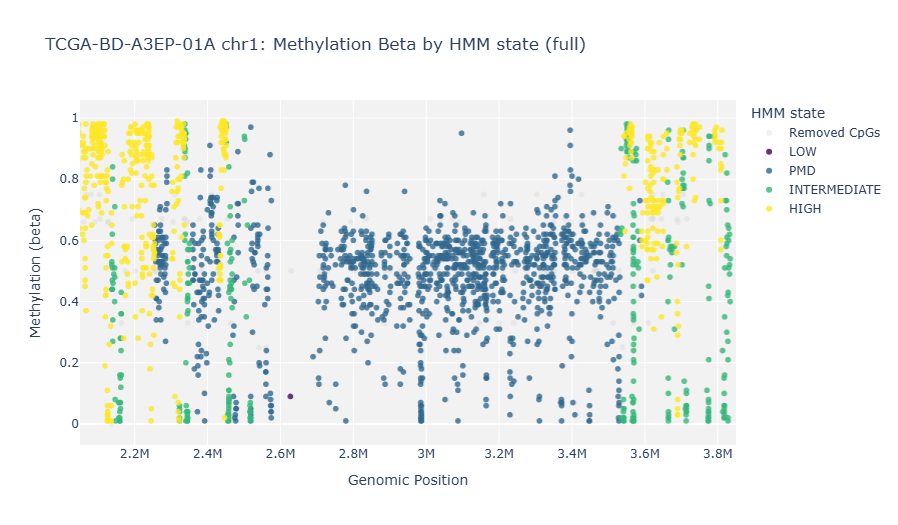
run_pathway(sample_info=sample_info, chroms=["chr1"]) performs fitting,
segmentation, cleaning, and summary-file writing in one call.
MethylSeg accepts tab-delimited .tsv and .tsv.gz files containing DNA methylation measurements. Genomic coordinates must use the 0-based, half-open coordinate system, and chromosome names must be consistent throughout each file.
Two BED-like input formats are supported.
This format can be used for either WGBS or microarray data. It contains four required columns:
- chromosome;
- CpG start position;
- CpG end position; and
- methylation beta value.
For microarray data, an optional fifth column containing the probe identifier may be included. Probe identifiers are retained as metadata.
| CpG_chrm | CpG_beg | CpG_end | beta | probe |
|---|---|---|---|---|
| chr1 | 15864 | 15866 | 0.0 | cg13869341 |
| chr1 | 29406 | 29408 | 0.0 | cg12045430 |
| chr1 | 29424 | 29426 | 0.0 | cg20826792 |
This format contains five required columns:
- chromosome;
- CpG start position;
- CpG end position;
- methylated read count; and
- total read coverage.
MethylSeg calculates the beta value internally as: $ \mathrm{beta} = \frac{\mathrm{methylated\ reads}}{\mathrm{total\ coverage}}. $
| CpG_chrm | CpG_beg | CpG_end | meth | coverage |
|---|---|---|---|---|
| chr1 | 10468 | 10470 | 14 | 15 |
| chr1 | 10470 | 10472 | 10 | 10 |
| chr1 | 10483 | 10485 | 23 | 28 |
The final output of MethylSeg consists primarily of BED files containing the
identified methylation domains. Separate files are generated for each
methylation state: HIGH, INTERMEDIATE, LOW, and PMD.
For each chromosome and state, MethylSeg writes:
| Output | Filename pattern | Description |
|---|---|---|
| Raw regions | segments_{chrom}_{sample_id}_{resolution}_{state}.bed | Regions produced directly by genome segmentation |
| Cleaned regions | clean_regions/segments_cleaned_{chrom}_{sample_id}_{resolution}_{state}.bed | Regions retained after merging and filtering |
| Cleaned metadata | clean_regions/metadata_cleaned_{chrom}_{sample_id}_{resolution}_{state}.tsv | Additional information about the cleaned regions |
After all requested chromosomes have been processed, MethylSeg also creates
genome-wide files for each state under summary_files/:
| Output | Filename pattern |
|---|---|
| Genome-wide raw regions | segments_raw_{state}.bed |
| Genome-wide cleaned regions | segments_cleaned_{state}.bed |
| Genome-wide cleaned metadata | metadata_cleaned_{state}.tsv |
A simplified output directory has the following structure:
methylseg_output/
├── segments_chr1_sample.wgbs_PMD.bed
├── segments_chr1_sample.wgbs_LOW.bed
├── clean_regions/
│ ├── segments_cleaned_chr1_sample.wgbs_PMD.bed
│ ├── segments_cleaned_chr1_sample.wgbs_LOW.bed
│ ├── metadata_cleaned_chr1_sample.wgbs_PMD.tsv
│ └── metadata_cleaned_chr1_sample.wgbs_LOW.tsv
└── summary_files/
├── segments_raw_PMD.bed
├── segments_raw_LOW.bed
├── segments_cleaned_PMD.bed
├── segments_cleaned_LOW.bed
├── metadata_cleaned_PMD.tsv
└── metadata_cleaned_LOW.tsv
Each BED file contains 0-based, half-open genomic coordinates and the assigned methylation state. For example, segments_cleaned_PMD.bed may contain:
| Chromosome | Start | End | State |
|---|---|---|---|
chr1 | 1,261,344 | 1,323,691 | PMD |
chr1 | 2,789,167 | 2,999,312 | PMD |
chr1 | 3,885,138 | 3,916,529 | PMD |
chr1 | 6,167,866 | 6,186,177 | PMD |
The BED files themselves are tab-delimited and do not contain a header.
A manuscript describing MethylSeg is in preparation. Citation information will be added when it becomes available.
- Add defaults for HM27 and EPIC microarray formats
To report a bug, request a feature, or ask a question about MethylSeg, open an issue on the GitHub issue tracker.
When reporting a bug, please include:
- Your MethylSeg version
- Your Python version and operating system
- The complete error message or traceback
- A minimal example that reproduces the problem, when possible
MethylSeg is distributed under the BSD 3-Clause License.