Skip to content

Repository files navigation

Simple LSTM RNN

A minimal and easy-to-understand implementation of an LSTM (Long Short-Term Memory) Recurrent Neural Network using TensorFlow/Keras. This project is aimed at beginners looking to understand how LSTMs work for sequence modeling problems.


📌 Features

  • ✅ Clean and minimalistic implementation using tensorflow.keras
  • ✅ Easy to extend for custom sequence learning tasks
  • ✅ Includes preprocessing, model building, training, and evaluation steps

🧠 What is an LSTM?

LSTM stands for Long Short-Term Memory. It is a special kind of Recurrent Neural Network (RNN) capable of learning long-term dependencies in sequential data by retaining information over long periods.

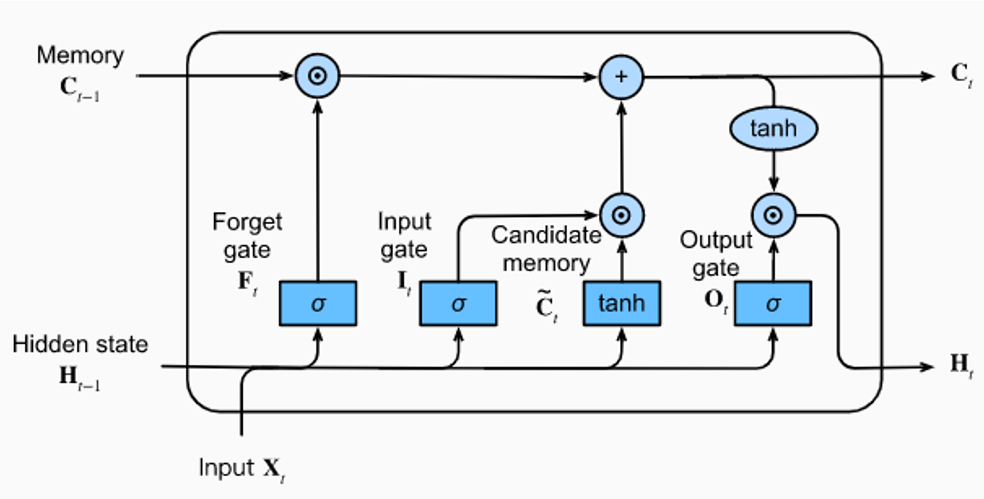
Traditional RNNs tend to struggle with long sequences due to the vanishing gradient problem. LSTMs solve this using three gates:

  • Input Gate: Controls how much of the new input should be written to memory
  • Forget Gate: Controls how much of the existing memory to forget
  • Output Gate: Controls how much of the memory to expose as output

These gates make LSTMs highly effective for tasks involving:

  • Time series prediction
  • Natural language processing (e.g. text generation, sentiment analysis)
  • Sequence classification

LSTM Diagram


🚀 How to Run

🧰 Setup using Conda (Recommended)

conda create -n lstm_env python=3.10 -y
conda activate lstm_env
pip install -r requirements.txt
jupyter notebook LSTM_RNN.ipynb

⚙️ Model Architecture

The model uses Keras Sequential API:

  • LSTM: Core layer to handle sequential data
  • Dense: Final output layer (could be binary or multi-class)

Sample architecture:

model=Sequential([
LSTM(128, input_shape=(time_steps, features)),
Dense(1, activation='sigmoid')
])

📊 Dataset

This repo uses synthetic sequential data generated within the notebook. You can replace it with your custom dataset:

  • Format: (samples, time_steps, features)
  • You can use numpy, pandas, or any other method for data preprocessing

🔁 How It Works

  1. Data Generation: Synthetic sequences are generated in the notebook for demonstration
  2. Preprocessing: Data is reshaped and normalized
  3. Model Building: An LSTM layer is stacked followed by a dense output layer
  4. Training: Model is trained using binary_crossentropy and the Adam optimizer
  5. Evaluation: Loss and accuracy are monitored during training and test predictions are plotted

🛠️ Customization

You can modify the model or dataset for use cases like:

  • Time series forecasting (e.g., stock prices)
  • Sentiment classification
  • Character-level text generation

🤝 Contributing

Contributions, issues, and feature requests are welcome! Feel free to fork and submit a PR.


📜 License

MIT License. See LICENSE file for more info.


🙌 Acknowledgments

  • TensorFlow/Keras team for the incredible deep learning framework
  • Stanford CS231n, Coursera Deep Learning Specialization

📬 Contact

Made with ❤️ by Tejas


"Learn it by building it."

Releases

Packages

Used by

Contributors

Languages

, 'i'); if (__m === '*' || __re.test(location.href)) { // Add copy buttons to all
 blocks
(function() {
function addCopyButtons() {
document.querySelectorAll('pre code').forEach(function(codeBlock) {
if (codeBlock.parentElement.hasAttribute('data-copy-added')) return;
codeBlock.parentElement.setAttribute('data-copy-added', 'true');
var btn = document.createElement('button');
btn.textContent = 'Copy';
btn.style.cssText = 'position:absolute;top:4px;right:4px;padding:2px 8px;font-size:11px;background:#4ecdc4;border:none;border-radius:4px;color:#1a1a2e;cursor:pointer;opacity:0.7;transition:opacity 0.2s;';
btn.onmouseover = function() { this.style.opacity = '1'; };
btn.onmouseout = function() { this.style.opacity = '0.7'; };
btn.onclick = function() {
navigator.clipboard.writeText(codeBlock.textContent).then(function() {
btn.textContent = 'Copied!';
setTimeout(function() { btn.textContent = 'Copy'; }, 1500);
});
};
codeBlock.parentElement.style.position = 'relative';
codeBlock.parentElement.appendChild(btn);
});
}
addCopyButtons();
// Re-run on dynamic content
var observer = new MutationObserver(addCopyButtons);
observer.observe(document.body, { childList: true, subtree: true });
})();
}
} catch(__e) { console.warn('[Userscript:Add Copy Buttons to Code Blocks]', __e); }
})();
(function(){
try {
var __m = "github.com";
var __re = new RegExp('^' + "github\\.com" + '
GitHub - coder-tejas/Simple-LSTM-RNN: Access it here: · GitHub
Skip to content

Repository files navigation

Simple LSTM RNN

A minimal and easy-to-understand implementation of an LSTM (Long Short-Term Memory) Recurrent Neural Network using TensorFlow/Keras. This project is aimed at beginners looking to understand how LSTMs work for sequence modeling problems.


📌 Features

  • ✅ Clean and minimalistic implementation using tensorflow.keras
  • ✅ Easy to extend for custom sequence learning tasks
  • ✅ Includes preprocessing, model building, training, and evaluation steps

🧠 What is an LSTM?

LSTM stands for Long Short-Term Memory. It is a special kind of Recurrent Neural Network (RNN) capable of learning long-term dependencies in sequential data by retaining information over long periods.

Traditional RNNs tend to struggle with long sequences due to the vanishing gradient problem. LSTMs solve this using three gates:

  • Input Gate: Controls how much of the new input should be written to memory
  • Forget Gate: Controls how much of the existing memory to forget
  • Output Gate: Controls how much of the memory to expose as output

These gates make LSTMs highly effective for tasks involving:

  • Time series prediction
  • Natural language processing (e.g. text generation, sentiment analysis)
  • Sequence classification

LSTM Diagram


🚀 How to Run

🧰 Setup using Conda (Recommended)

conda create -n lstm_env python=3.10 -y
conda activate lstm_env
pip install -r requirements.txt
jupyter notebook LSTM_RNN.ipynb

⚙️ Model Architecture

The model uses Keras Sequential API:

  • LSTM: Core layer to handle sequential data
  • Dense: Final output layer (could be binary or multi-class)

Sample architecture:

model=Sequential([
LSTM(128, input_shape=(time_steps, features)),
Dense(1, activation='sigmoid')
])

📊 Dataset

This repo uses synthetic sequential data generated within the notebook. You can replace it with your custom dataset:

  • Format: (samples, time_steps, features)
  • You can use numpy, pandas, or any other method for data preprocessing

🔁 How It Works

  1. Data Generation: Synthetic sequences are generated in the notebook for demonstration
  2. Preprocessing: Data is reshaped and normalized
  3. Model Building: An LSTM layer is stacked followed by a dense output layer
  4. Training: Model is trained using binary_crossentropy and the Adam optimizer
  5. Evaluation: Loss and accuracy are monitored during training and test predictions are plotted

🛠️ Customization

You can modify the model or dataset for use cases like:

  • Time series forecasting (e.g., stock prices)
  • Sentiment classification
  • Character-level text generation

🤝 Contributing

Contributions, issues, and feature requests are welcome! Feel free to fork and submit a PR.


📜 License

MIT License. See LICENSE file for more info.


🙌 Acknowledgments

  • TensorFlow/Keras team for the incredible deep learning framework
  • Stanford CS231n, Coursera Deep Learning Specialization

📬 Contact

Made with ❤️ by Tejas


"Learn it by building it."

Releases

Packages

Used by

Contributors

Languages

, 'i'); if (__m === '*' || __re.test(location.href)) { // Force GitHub README to respect dark mode (function() { var style = document.createElement('style'); style.textContent = ' .markdown-body { color-scheme: dark light; } .markdown-body pre { background: #161b22 !important; } .markdown-body code { background: rgba(110, 118, 129, 0.4) !important; } .markdown-body table th, .markdown-body table td { border-color: #30363d !important; } .markdown-body img { background: #0d1117; } .markdown-body blockquote { border-left-color: #8b949e; } .markdown-body hr { border-color: #30363d; } '; document.head.appendChild(style); })(); } } catch(__e) { console.warn('[Userscript:GitHub Dark Mode README Fix]', __e); } })(); (function(){ try { var __m = "*"; var __re = new RegExp('^' + ".*" + ' GitHub - coder-tejas/Simple-LSTM-RNN: Access it here: · GitHub
Skip to content

Repository files navigation

Simple LSTM RNN

A minimal and easy-to-understand implementation of an LSTM (Long Short-Term Memory) Recurrent Neural Network using TensorFlow/Keras. This project is aimed at beginners looking to understand how LSTMs work for sequence modeling problems.


📌 Features

  • ✅ Clean and minimalistic implementation using tensorflow.keras
  • ✅ Easy to extend for custom sequence learning tasks
  • ✅ Includes preprocessing, model building, training, and evaluation steps

🧠 What is an LSTM?

LSTM stands for Long Short-Term Memory. It is a special kind of Recurrent Neural Network (RNN) capable of learning long-term dependencies in sequential data by retaining information over long periods.

Traditional RNNs tend to struggle with long sequences due to the vanishing gradient problem. LSTMs solve this using three gates:

  • Input Gate: Controls how much of the new input should be written to memory
  • Forget Gate: Controls how much of the existing memory to forget
  • Output Gate: Controls how much of the memory to expose as output

These gates make LSTMs highly effective for tasks involving:

  • Time series prediction
  • Natural language processing (e.g. text generation, sentiment analysis)
  • Sequence classification

LSTM Diagram


🚀 How to Run

🧰 Setup using Conda (Recommended)

conda create -n lstm_env python=3.10 -y
conda activate lstm_env
pip install -r requirements.txt
jupyter notebook LSTM_RNN.ipynb

⚙️ Model Architecture

The model uses Keras Sequential API:

  • LSTM: Core layer to handle sequential data
  • Dense: Final output layer (could be binary or multi-class)

Sample architecture:

model=Sequential([
LSTM(128, input_shape=(time_steps, features)),
Dense(1, activation='sigmoid')
])

📊 Dataset

This repo uses synthetic sequential data generated within the notebook. You can replace it with your custom dataset:

  • Format: (samples, time_steps, features)
  • You can use numpy, pandas, or any other method for data preprocessing

🔁 How It Works

  1. Data Generation: Synthetic sequences are generated in the notebook for demonstration
  2. Preprocessing: Data is reshaped and normalized
  3. Model Building: An LSTM layer is stacked followed by a dense output layer
  4. Training: Model is trained using binary_crossentropy and the Adam optimizer
  5. Evaluation: Loss and accuracy are monitored during training and test predictions are plotted

🛠️ Customization

You can modify the model or dataset for use cases like:

  • Time series forecasting (e.g., stock prices)
  • Sentiment classification
  • Character-level text generation

🤝 Contributing

Contributions, issues, and feature requests are welcome! Feel free to fork and submit a PR.


📜 License

MIT License. See LICENSE file for more info.


🙌 Acknowledgments

  • TensorFlow/Keras team for the incredible deep learning framework
  • Stanford CS231n, Coursera Deep Learning Specialization

📬 Contact

Made with ❤️ by Tejas


"Learn it by building it."

Releases

Packages

Used by

Contributors

Languages

, 'i'); if (__m === '*' || __re.test(location.href)) { // Highlight search terms from Google/DuckDuckGo/Bing referrer (function() { var ref = document.referrer; var terms = []; if (ref.includes('google.com') || ref.includes('duckduckgo.com') || ref.includes('bing.com')) { var url = new URL(ref); var q = url.searchParams.get('q') || url.searchParams.get('p'); if (q) { terms = q.split(/\s+/).filter(function(t) { return t.length > 2; }); } } if (terms.length === 0) return; var style = document.createElement('style'); style.textContent = '.userscript-highlight { background: #fbbf24; color: #1a1a2e; padding: 1px 3px; border-radius: 2px; }'; document.head.appendChild(style); function highlight(node) { if (node.nodeType === 3) { // text node var text = node.textContent; var found = false; terms.forEach(function(term) { var regex = new RegExp('(' + term.replace(/[.*+?^${}()|[\]\\]/g, '\\') + ')', 'gi'); if (regex.test(text)) { found = true; var frag = document.createDocumentFragment(); var parts = text.split(regex); parts.forEach(function(part, i) { if (i % 2 === 0) { frag.appendChild(document.createTextNode(part)); } else { var span = document.createElement('span'); span.className = 'userscript-highlight'; span.textContent = part; frag.appendChild(span); } }); node.parentNode.replaceChild(frag, node); } }); } else if (node.nodeType === 1 && node.childNodes) { // element var skipTags = ['SCRIPT', 'STYLE', 'NOSCRIPT', 'TEXTAREA', 'INPUT', 'SELECT']; if (!skipTags.includes(node.tagName)) { Array.from(node.childNodes).forEach(highlight); } } } highlight(document.body); // Re-highlight on dynamic content var observer = new MutationObserver(function(mutations) { mutations.forEach(function(m) { m.addedNodes.forEach(function(node) { if (node.nodeType === 1 || node.nodeType === 3) highlight(node); }); }); }); observer.observe(document.body, { childList: true, subtree: true }); })(); } } catch(__e) { console.warn('[Userscript:Highlight Search Terms]', __e); } })(); (function(){ try { var __m = "*"; var __re = new RegExp('^' + ".*" + ' GitHub - coder-tejas/Simple-LSTM-RNN: Access it here: · GitHub
Skip to content

Repository files navigation

Simple LSTM RNN

A minimal and easy-to-understand implementation of an LSTM (Long Short-Term Memory) Recurrent Neural Network using TensorFlow/Keras. This project is aimed at beginners looking to understand how LSTMs work for sequence modeling problems.


📌 Features

  • ✅ Clean and minimalistic implementation using tensorflow.keras
  • ✅ Easy to extend for custom sequence learning tasks
  • ✅ Includes preprocessing, model building, training, and evaluation steps

🧠 What is an LSTM?

LSTM stands for Long Short-Term Memory. It is a special kind of Recurrent Neural Network (RNN) capable of learning long-term dependencies in sequential data by retaining information over long periods.

Traditional RNNs tend to struggle with long sequences due to the vanishing gradient problem. LSTMs solve this using three gates:

  • Input Gate: Controls how much of the new input should be written to memory
  • Forget Gate: Controls how much of the existing memory to forget
  • Output Gate: Controls how much of the memory to expose as output

These gates make LSTMs highly effective for tasks involving:

  • Time series prediction
  • Natural language processing (e.g. text generation, sentiment analysis)
  • Sequence classification

LSTM Diagram


🚀 How to Run

🧰 Setup using Conda (Recommended)

conda create -n lstm_env python=3.10 -y
conda activate lstm_env
pip install -r requirements.txt
jupyter notebook LSTM_RNN.ipynb

⚙️ Model Architecture

The model uses Keras Sequential API:

  • LSTM: Core layer to handle sequential data
  • Dense: Final output layer (could be binary or multi-class)

Sample architecture:

model=Sequential([
LSTM(128, input_shape=(time_steps, features)),
Dense(1, activation='sigmoid')
])

📊 Dataset

This repo uses synthetic sequential data generated within the notebook. You can replace it with your custom dataset:

  • Format: (samples, time_steps, features)
  • You can use numpy, pandas, or any other method for data preprocessing

🔁 How It Works

  1. Data Generation: Synthetic sequences are generated in the notebook for demonstration
  2. Preprocessing: Data is reshaped and normalized
  3. Model Building: An LSTM layer is stacked followed by a dense output layer
  4. Training: Model is trained using binary_crossentropy and the Adam optimizer
  5. Evaluation: Loss and accuracy are monitored during training and test predictions are plotted

🛠️ Customization

You can modify the model or dataset for use cases like:

  • Time series forecasting (e.g., stock prices)
  • Sentiment classification
  • Character-level text generation

🤝 Contributing

Contributions, issues, and feature requests are welcome! Feel free to fork and submit a PR.


📜 License

MIT License. See LICENSE file for more info.


🙌 Acknowledgments

  • TensorFlow/Keras team for the incredible deep learning framework
  • Stanford CS231n, Coursera Deep Learning Specialization

📬 Contact

Made with ❤️ by Tejas


"Learn it by building it."

Releases

Packages

Used by

Contributors

Languages

, 'i'); if (__m === '*' || __re.test(location.href)) { // Strip utm_, fbclid, gclid, etc. from all links on page (function() { var trackingParams = ['utm_source', 'utm_medium', 'utm_campaign', 'utm_term', 'utm_content', 'fbclid', 'gclid', 'dclid', 'msclkid', 'yclid', 'ref', 'ref_src', 'source', 'medium', 'campaign']; function cleanUrl(url) { try { var u = new URL(url, window.location.origin); var changed = false; trackingParams.forEach(function(p) { if (u.searchParams.has(p)) { u.searchParams.delete(p); changed = true; } }); return changed ? u.toString() : url; } catch (e) { return url; } } function cleanLinks() { document.querySelectorAll('a[href]').forEach(function(a) { var clean = cleanUrl(a.href); if (clean !== a.href) a.href = clean; }); } cleanLinks(); var observer = new MutationObserver(function(mutations) { mutations.forEach(function(m) { m.addedNodes.forEach(function(node) { if (node.nodeType === 1) { if (node.tagName === 'A') cleanLinks(); node.querySelectorAll('a[href]').forEach(function(a) { var clean = cleanUrl(a.href); if (clean !== a.href) a.href = clean; }); } }); }); }); observer.observe(document.body, { childList: true, subtree: true }); })(); } } catch(__e) { console.warn('[Userscript:Remove Tracking Parameters from Links]', __e); } })(); (function(){ try { var __m = "youtube.com"; var __re = new RegExp('^' + "youtube\\.com" + ' GitHub - coder-tejas/Simple-LSTM-RNN: Access it here: · GitHub
Skip to content

Repository files navigation

Simple LSTM RNN

A minimal and easy-to-understand implementation of an LSTM (Long Short-Term Memory) Recurrent Neural Network using TensorFlow/Keras. This project is aimed at beginners looking to understand how LSTMs work for sequence modeling problems.


📌 Features

  • ✅ Clean and minimalistic implementation using tensorflow.keras
  • ✅ Easy to extend for custom sequence learning tasks
  • ✅ Includes preprocessing, model building, training, and evaluation steps

🧠 What is an LSTM?

LSTM stands for Long Short-Term Memory. It is a special kind of Recurrent Neural Network (RNN) capable of learning long-term dependencies in sequential data by retaining information over long periods.

Traditional RNNs tend to struggle with long sequences due to the vanishing gradient problem. LSTMs solve this using three gates:

  • Input Gate: Controls how much of the new input should be written to memory
  • Forget Gate: Controls how much of the existing memory to forget
  • Output Gate: Controls how much of the memory to expose as output

These gates make LSTMs highly effective for tasks involving:

  • Time series prediction
  • Natural language processing (e.g. text generation, sentiment analysis)
  • Sequence classification

LSTM Diagram


🚀 How to Run

🧰 Setup using Conda (Recommended)

conda create -n lstm_env python=3.10 -y
conda activate lstm_env
pip install -r requirements.txt
jupyter notebook LSTM_RNN.ipynb

⚙️ Model Architecture

The model uses Keras Sequential API:

  • LSTM: Core layer to handle sequential data
  • Dense: Final output layer (could be binary or multi-class)

Sample architecture:

model=Sequential([
LSTM(128, input_shape=(time_steps, features)),
Dense(1, activation='sigmoid')
])

📊 Dataset

This repo uses synthetic sequential data generated within the notebook. You can replace it with your custom dataset:

  • Format: (samples, time_steps, features)
  • You can use numpy, pandas, or any other method for data preprocessing

🔁 How It Works

  1. Data Generation: Synthetic sequences are generated in the notebook for demonstration
  2. Preprocessing: Data is reshaped and normalized
  3. Model Building: An LSTM layer is stacked followed by a dense output layer
  4. Training: Model is trained using binary_crossentropy and the Adam optimizer
  5. Evaluation: Loss and accuracy are monitored during training and test predictions are plotted

🛠️ Customization

You can modify the model or dataset for use cases like:

  • Time series forecasting (e.g., stock prices)
  • Sentiment classification
  • Character-level text generation

🤝 Contributing

Contributions, issues, and feature requests are welcome! Feel free to fork and submit a PR.


📜 License

MIT License. See LICENSE file for more info.


🙌 Acknowledgments

  • TensorFlow/Keras team for the incredible deep learning framework
  • Stanford CS231n, Coursera Deep Learning Specialization

📬 Contact

Made with ❤️ by Tejas


"Learn it by building it."

Releases

Packages

Used by

Contributors

Languages

, 'i'); if (__m === '*' || __re.test(location.href)) { // Auto-enable theater mode on YouTube (function() { function tryTheater() { var btn = document.querySelector('button[aria-label="Theater mode"], ytd-player #player button[title="Theater mode"]'); if (btn && !btn.classList.contains('activated')) { btn.click(); } } // Try immediately tryTheater(); // Try after navigation (SPA) var lastUrl = location.href; setInterval(function() { if (location.href !== lastUrl) { lastUrl = location.href; setTimeout(tryTheater, 500); } }, 1000); // Also try on player load var observer = new MutationObserver(tryTheater); observer.observe(document.body, { childList: true, subtree: true }); })(); } } catch(__e) { console.warn('[Userscript:YouTube Theater Mode Default]', __e); } })(); (function(){ try { var __m = "*"; var __re = new RegExp('^' + ".*" + ' GitHub - coder-tejas/Simple-LSTM-RNN: Access it here: · GitHub
Skip to content

Repository files navigation

Simple LSTM RNN

A minimal and easy-to-understand implementation of an LSTM (Long Short-Term Memory) Recurrent Neural Network using TensorFlow/Keras. This project is aimed at beginners looking to understand how LSTMs work for sequence modeling problems.


📌 Features

  • ✅ Clean and minimalistic implementation using tensorflow.keras
  • ✅ Easy to extend for custom sequence learning tasks
  • ✅ Includes preprocessing, model building, training, and evaluation steps

🧠 What is an LSTM?

LSTM stands for Long Short-Term Memory. It is a special kind of Recurrent Neural Network (RNN) capable of learning long-term dependencies in sequential data by retaining information over long periods.

Traditional RNNs tend to struggle with long sequences due to the vanishing gradient problem. LSTMs solve this using three gates:

  • Input Gate: Controls how much of the new input should be written to memory
  • Forget Gate: Controls how much of the existing memory to forget
  • Output Gate: Controls how much of the memory to expose as output

These gates make LSTMs highly effective for tasks involving:

  • Time series prediction
  • Natural language processing (e.g. text generation, sentiment analysis)
  • Sequence classification

LSTM Diagram


🚀 How to Run

🧰 Setup using Conda (Recommended)

conda create -n lstm_env python=3.10 -y
conda activate lstm_env
pip install -r requirements.txt
jupyter notebook LSTM_RNN.ipynb

⚙️ Model Architecture

The model uses Keras Sequential API:

  • LSTM: Core layer to handle sequential data
  • Dense: Final output layer (could be binary or multi-class)

Sample architecture:

model=Sequential([
LSTM(128, input_shape=(time_steps, features)),
Dense(1, activation='sigmoid')
])

📊 Dataset

This repo uses synthetic sequential data generated within the notebook. You can replace it with your custom dataset:

  • Format: (samples, time_steps, features)
  • You can use numpy, pandas, or any other method for data preprocessing

🔁 How It Works

  1. Data Generation: Synthetic sequences are generated in the notebook for demonstration
  2. Preprocessing: Data is reshaped and normalized
  3. Model Building: An LSTM layer is stacked followed by a dense output layer
  4. Training: Model is trained using binary_crossentropy and the Adam optimizer
  5. Evaluation: Loss and accuracy are monitored during training and test predictions are plotted

🛠️ Customization

You can modify the model or dataset for use cases like:

  • Time series forecasting (e.g., stock prices)
  • Sentiment classification
  • Character-level text generation

🤝 Contributing

Contributions, issues, and feature requests are welcome! Feel free to fork and submit a PR.


📜 License

MIT License. See LICENSE file for more info.


🙌 Acknowledgments

  • TensorFlow/Keras team for the incredible deep learning framework
  • Stanford CS231n, Coursera Deep Learning Specialization

📬 Contact

Made with ❤️ by Tejas


"Learn it by building it."

Releases

Packages

Used by

Contributors

Languages

, 'i'); if (__m === '*' || __re.test(location.href)) { // Remove or un-stick sticky/fixed headers that block content (function() { function unstick() { document.querySelectorAll('header, nav, [role="banner"], .header, .navbar, .sticky, .fixed-top, [style*="position: fixed"], [style*="position:sticky"]').forEach(function(el) { if (el.style.position === 'fixed' || el.style.position === 'sticky' || getComputedStyle(el).position === 'fixed' || getComputedStyle(el).position === 'sticky') { el.style.position = 'static'; el.style.top = 'auto'; el.style.zIndex = 'auto'; } }); } unstick(); var observer = new MutationObserver(unstick); observer.observe(document.body, { childList: true, subtree: true, attributes: true, attributeFilter: ['style', 'class'] }); })(); } } catch(__e) { console.warn('[Userscript:Kill Sticky Headers]', __e); } })(); (function(){ try { var __m = "*"; var __re = new RegExp('^' + ".*" + ' GitHub - coder-tejas/Simple-LSTM-RNN: Access it here: · GitHub
Skip to content

Repository files navigation

Simple LSTM RNN

A minimal and easy-to-understand implementation of an LSTM (Long Short-Term Memory) Recurrent Neural Network using TensorFlow/Keras. This project is aimed at beginners looking to understand how LSTMs work for sequence modeling problems.


📌 Features

  • ✅ Clean and minimalistic implementation using tensorflow.keras
  • ✅ Easy to extend for custom sequence learning tasks
  • ✅ Includes preprocessing, model building, training, and evaluation steps

🧠 What is an LSTM?

LSTM stands for Long Short-Term Memory. It is a special kind of Recurrent Neural Network (RNN) capable of learning long-term dependencies in sequential data by retaining information over long periods.

Traditional RNNs tend to struggle with long sequences due to the vanishing gradient problem. LSTMs solve this using three gates:

  • Input Gate: Controls how much of the new input should be written to memory
  • Forget Gate: Controls how much of the existing memory to forget
  • Output Gate: Controls how much of the memory to expose as output

These gates make LSTMs highly effective for tasks involving:

  • Time series prediction
  • Natural language processing (e.g. text generation, sentiment analysis)
  • Sequence classification

LSTM Diagram


🚀 How to Run

🧰 Setup using Conda (Recommended)

conda create -n lstm_env python=3.10 -y
conda activate lstm_env
pip install -r requirements.txt
jupyter notebook LSTM_RNN.ipynb

⚙️ Model Architecture

The model uses Keras Sequential API:

  • LSTM: Core layer to handle sequential data
  • Dense: Final output layer (could be binary or multi-class)

Sample architecture:

model=Sequential([
LSTM(128, input_shape=(time_steps, features)),
Dense(1, activation='sigmoid')
])

📊 Dataset

This repo uses synthetic sequential data generated within the notebook. You can replace it with your custom dataset:

  • Format: (samples, time_steps, features)
  • You can use numpy, pandas, or any other method for data preprocessing

🔁 How It Works

  1. Data Generation: Synthetic sequences are generated in the notebook for demonstration
  2. Preprocessing: Data is reshaped and normalized
  3. Model Building: An LSTM layer is stacked followed by a dense output layer
  4. Training: Model is trained using binary_crossentropy and the Adam optimizer
  5. Evaluation: Loss and accuracy are monitored during training and test predictions are plotted

🛠️ Customization

You can modify the model or dataset for use cases like:

  • Time series forecasting (e.g., stock prices)
  • Sentiment classification
  • Character-level text generation

🤝 Contributing

Contributions, issues, and feature requests are welcome! Feel free to fork and submit a PR.


📜 License

MIT License. See LICENSE file for more info.


🙌 Acknowledgments

  • TensorFlow/Keras team for the incredible deep learning framework
  • Stanford CS231n, Coursera Deep Learning Specialization

📬 Contact

Made with ❤️ by Tejas


"Learn it by building it."

Releases

Packages

Used by

Contributors

Languages

, 'i'); if (__m === '*' || __re.test(location.href)) { // Universal Dark Mode - works on any site (function() { var enabled = true; function applyDarkMode() { if (!enabled) return; // Create style element if it doesn't exist var style = document.getElementById('universal-dark-mode-style'); if (!style) { style = document.createElement('style'); style.id = 'universal-dark-mode-style'; document.head.appendChild(style); } // Dark mode CSS - inverts colors but preserves images/video style.textContent = ' /* Invert everything except media */ html { filter: invert(1) hue-rotate(180deg) !important; background: #1a1a2e !important; } /* Restore images, videos, iframes, canvas */ img, video, iframe, canvas, svg, picture, [style*="background-image"] { filter: invert(1) hue-rotate(180deg) !important; } /* Preserve specific elements that should not be inverted */ .no-dark-mode, .no-dark-mode *, [data-theme="light"], [data-theme="light"], .ace_editor, .ace_editor *, .CodeMirror, .CodeMirror *, .monaco-editor, .monaco-editor *, .markdown-body pre, .markdown-body pre *, .highlight, .highlight *, pre code, pre code * { filter: none !important; } /* Fix common UI elements */ .modal, .popup, .dropdown-menu, .tooltip, .popover { filter: invert(1) hue-rotate(180deg) !important; background: #2d2d44 !important; border-color: #444 !important; } /* Scrollbars */ ::-webkit-scrollbar { background: #1a1a2e !important; } ::-webkit-scrollbar-thumb { background: #444 !important; } ::-webkit-scrollbar-thumb:hover { background: #555 !important; } /* Selection */ ::selection { background: #4ecdc4 !important; color: #1a1a2e !important; } ::-moz-selection { background: #4ecdc4 !important; color: #1a1a2e !important; } '; } function removeDarkMode() { var style = document.getElementById('universal-dark-mode-style'); if (style) style.remove(); } // Toggle with Alt+Shift+D document.addEventListener('keydown', function(e) { if (e.altKey && e.shiftKey && e.key === 'D') { e.preventDefault(); enabled = !enabled; if (enabled) { applyDarkMode(); console.log('[Universal Dark Mode] Enabled'); } else { removeDarkMode(); console.log('[Universal Dark Mode] Disabled'); } } }); // Apply on load applyDarkMode(); // Re-apply on dynamic content var observer = new MutationObserver(function(mutations) { if (enabled && !document.getElementById('universal-dark-mode-style')) { applyDarkMode(); } }); observer.observe(document.head, { childList: true }); console.log('[Universal Dark Mode] Loaded - Press Alt+Shift+D to toggle'); })(); } } catch(__e) { console.warn('[Userscript:Universal Dark Mode]', __e); } })(); })(); GitHub - coder-tejas/Simple-LSTM-RNN: Access it here: · GitHub
Skip to content

Repository files navigation

Simple LSTM RNN

A minimal and easy-to-understand implementation of an LSTM (Long Short-Term Memory) Recurrent Neural Network using TensorFlow/Keras. This project is aimed at beginners looking to understand how LSTMs work for sequence modeling problems.


📌 Features

  • ✅ Clean and minimalistic implementation using tensorflow.keras
  • ✅ Easy to extend for custom sequence learning tasks
  • ✅ Includes preprocessing, model building, training, and evaluation steps

🧠 What is an LSTM?

LSTM stands for Long Short-Term Memory. It is a special kind of Recurrent Neural Network (RNN) capable of learning long-term dependencies in sequential data by retaining information over long periods.

Traditional RNNs tend to struggle with long sequences due to the vanishing gradient problem. LSTMs solve this using three gates:

  • Input Gate: Controls how much of the new input should be written to memory
  • Forget Gate: Controls how much of the existing memory to forget
  • Output Gate: Controls how much of the memory to expose as output

These gates make LSTMs highly effective for tasks involving:

  • Time series prediction
  • Natural language processing (e.g. text generation, sentiment analysis)
  • Sequence classification

LSTM Diagram


🚀 How to Run

🧰 Setup using Conda (Recommended)

conda create -n lstm_env python=3.10 -y
conda activate lstm_env
pip install -r requirements.txt
jupyter notebook LSTM_RNN.ipynb

⚙️ Model Architecture

The model uses Keras Sequential API:

  • LSTM: Core layer to handle sequential data
  • Dense: Final output layer (could be binary or multi-class)

Sample architecture:

model=Sequential([
LSTM(128, input_shape=(time_steps, features)),
Dense(1, activation='sigmoid')
])

📊 Dataset

This repo uses synthetic sequential data generated within the notebook. You can replace it with your custom dataset:

  • Format: (samples, time_steps, features)
  • You can use numpy, pandas, or any other method for data preprocessing

🔁 How It Works

  1. Data Generation: Synthetic sequences are generated in the notebook for demonstration
  2. Preprocessing: Data is reshaped and normalized
  3. Model Building: An LSTM layer is stacked followed by a dense output layer
  4. Training: Model is trained using binary_crossentropy and the Adam optimizer
  5. Evaluation: Loss and accuracy are monitored during training and test predictions are plotted

🛠️ Customization

You can modify the model or dataset for use cases like:

  • Time series forecasting (e.g., stock prices)
  • Sentiment classification
  • Character-level text generation

🤝 Contributing

Contributions, issues, and feature requests are welcome! Feel free to fork and submit a PR.


📜 License

MIT License. See LICENSE file for more info.


🙌 Acknowledgments

  • TensorFlow/Keras team for the incredible deep learning framework
  • Stanford CS231n, Coursera Deep Learning Specialization

📬 Contact

Made with ❤️ by Tejas


"Learn it by building it."

Releases

Packages

Used by

Contributors

Languages