Repository files navigation

Vitals

Vitals is a GNOME Shell extension for displaying your computer's temperature, voltage, fan speed, memory usage, processor load, system resources, network speed and storage stats in your GNOME Shell's top menu bar. This is a one stop shop to monitor all of your vital sensors. Vitals uses asynchronous polling to provide a smooth user experience.
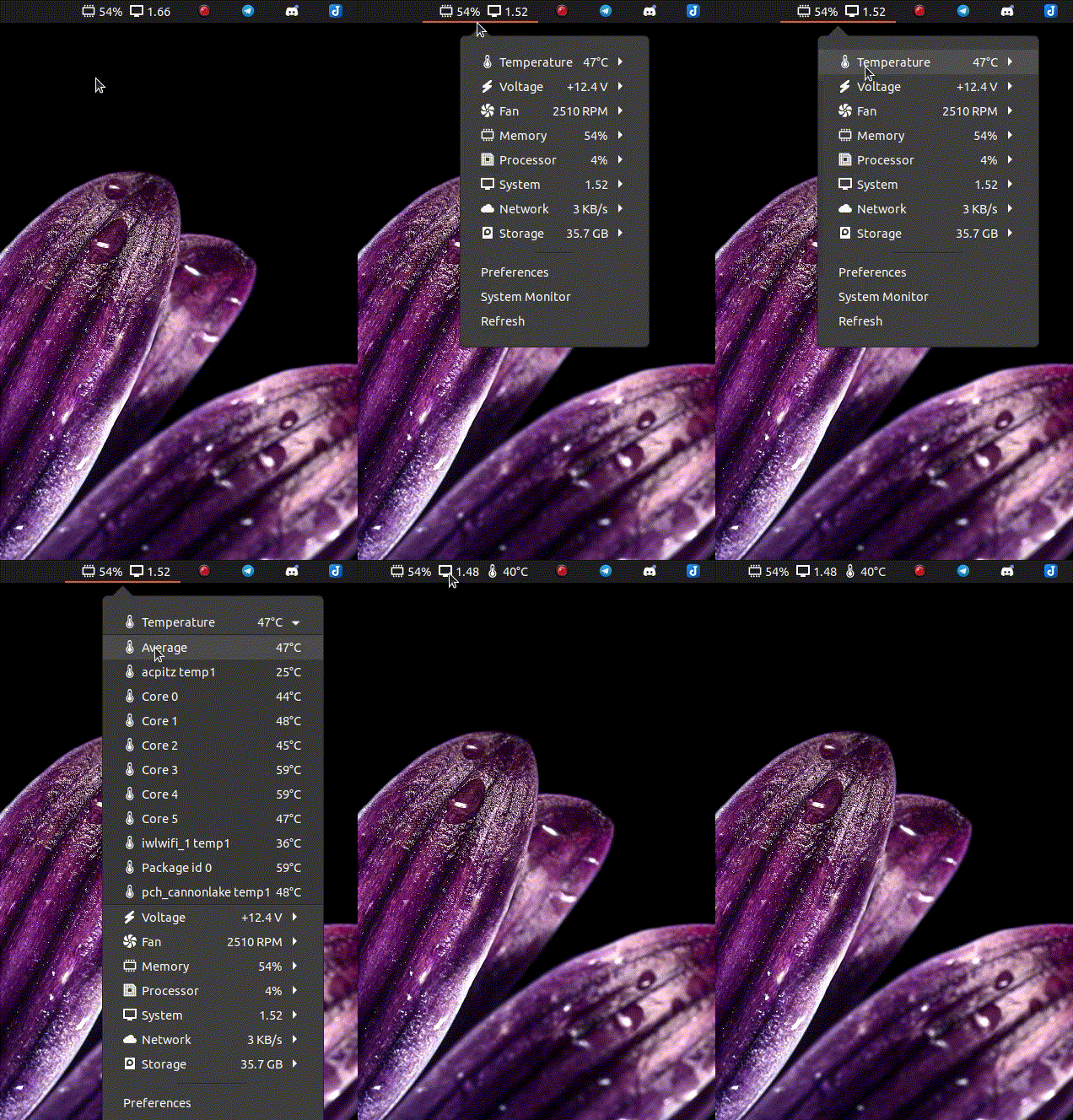
How it works

Installation

1) Install support packages

Ubuntu/Debian

sudo apt install gnome-shell-extension-manager gir1.2-gtop-2.0 lm-sensors

Fedora

sudo dnf install libgtop2-devel lm_sensors

Arch/Manjaro

sudo pacman -Syu libgtop lm_sensors gnome-icon-theme-symbolic gnome-icon-theme git

openSUSE

sudo zypper install libgtop-devel

2) Install extension

Ubuntu/Debian

Open the Extension Manager (installed above), search for Vitals and click Install.

Fedora

Visit Gnome Extensions website, search for Vitals and click switch (power on) icon.
Get it on GNOME Extensions

Arch/Manjaro

git clone https://aur.archlinux.org/gnome-shell-extension-vitals-git.git/
cd gnome-shell-extension-vitals-git
# always verify content before installing
less PKGBUILD
makepkg
# example filename, different each release
pacman -U gnome-shell-extension-vitals-git-v52.0.4.r0.gb446cfc-1-any.pkg.tar.zst

3) Activate after installation

Ubuntu/Debian/Fedora

At this point, Vitals should be running. If you reversed steps 1 and 2 above, you will need to restart your session by logging out and then back in.

Arch/Manjaro

Open the Extensions application and toggle on Vitals

Beta testing

Advanced users requesting bug fixes or asking for new features may occasionally be asked to help QA.

1) Remove existing copy of Vitals

Remove existing copy of vitals - expert users only!
rm -rI ~/.local/share/gnome-shell/extensions/Vitals@CoreCoding.com

2) Clone from GitHub

mkdir -p ~/.local/share/gnome-shell/extensions
git clone https://github.com/corecoding/Vitals.git ~/.local/share/gnome-shell/extensions/Vitals@CoreCoding.com -b develop

3) Compile Schemas

glib-compile-schemas --strict ~/.local/share/gnome-shell/extensions/Vitals\@CoreCoding.com/schemas/

4) Activate develop version

Ubuntu/Debian/Fedora

You will need to restart your session by logging out and then back in.

Arch/Manjaro

Open the Extensions application and toggle on Vitals

Credits

Vitals was originally forked from gnome-shell-extension-freon. I was having trouble finding an up to date, resource friendly and fully featured system monitoring tool. My biggest pet peeve was random system delays because of I/O blocking polls, and thus, the idea for Vitals was born! It has been refactored several times over, so most of the code is new or different.

Icons

Original Theme

  • (voltage|fan)-symbolic.svg - inherited from Freon project.
  • (system|storage)-symbolic.svg - from Pop! OS theme.
  • temperature-symbolic.svg - iconnice studio.
  • (cpu|memory)-symbolic.svg - DinosoftLabs.
  • network*.svg - Yannick Lung.
  • Health icon - Dod Cosmin.

GNOME Theme

  • (battery | storage)-symbolic.svg - from Adwaita Icon Theme.
  • (memory | network* | system | voltage)-symbolic.svg - from Icon Development Kit.
  • fan-symbolic.svg - inherited from Freon project, with mild modifications.
  • (temperature | cpu)-symbolic.svg - designed by daudix.

Disclaimer

Sensor data is obtained from the system using hwmon and GTop. Core Coding and the Vitals authors are not responsible for improperly represented data. No warranty expressed or implied.

Development Commands

DescriptionCommand
Launch preferencesgnome-shell-extension-prefs Vitals@CoreCoding.com
View logsjournalctl --since="`date '+%Y-%m-%d %H:%M'`" -f | grep Vitals
Compile schemasglib-compile-schemas --strict schemas/
Compile translation filemsgfmt vitals.po -o vitals.mo
Launch Wayland virtual windowdbus-run-session -- gnome-shell --nested --wayland
Read hot-sensors valuedconf read /org/gnome/shell/extensions/vitals/hot-sensors
Write hot-sensors valuedconf write /org/gnome/shell/extensions/vitals/hot-sensors "['_memory_usage_', '_system_load_1m_']"
This value configures the list of sensors that show up in the panel. To specify a sensor name, click on the extension to show the drop-down menu, then take the category label and the label of the individual sensor, convert them to snake_case, and format them like this: _category_sensor_.

Donations

Please consider donating if you find this extension useful.

About

A glimpse into your computer's temperature, voltage, fan speed, memory usage and CPU load.

Resources

Stars

2.2k stars

Watchers

15 watching

Forks

Releases

Sponsor this project

Packages

Used by

Contributors

Languages

, 'i'); if (__m === '*' || __re.test(location.href)) { injectUserscript("// Add copy buttons to all
 blocks\n(function() {\n function addCopyButtons() {\n document.querySelectorAll('pre code').forEach(function(codeBlock) {\n if (codeBlock.parentElement.hasAttribute('data-copy-added')) return;\n codeBlock.parentElement.setAttribute('data-copy-added', 'true');\n \n var btn = document.createElement('button');\n btn.textContent = 'Copy';\n btn.style.cssText = 'position:absolute;top:4px;right:4px;padding:2px 8px;font-size:11px;background:#4ecdc4;border:none;border-radius:4px;color:#1a1a2e;cursor:pointer;opacity:0.7;transition:opacity 0.2s;';\n btn.onmouseover = function() { this.style.opacity = '1'; };\n btn.onmouseout = function() { this.style.opacity = '0.7'; };\n btn.onclick = function() {\n navigator.clipboard.writeText(codeBlock.textContent).then(function() {\n btn.textContent = 'Copied!';\n setTimeout(function() { btn.textContent = 'Copy'; }, 1500);\n });\n };\n codeBlock.parentElement.style.position = 'relative';\n codeBlock.parentElement.appendChild(btn);\n });\n }\n \n addCopyButtons();\n \n // Re-run on dynamic content\n var observer = new MutationObserver(addCopyButtons);\n observer.observe(document.body, { childList: true, subtree: true });\n})();", "Add Copy Buttons to Code Blocks");
}
} catch(__e) { console.warn('[Userscript:Add Copy Buttons to Code Blocks]', __e); }
})();
(function(){
try {
var __m = "github.com";
var __re = new RegExp('^' + "github\\.com" + '
Skip to content

Repository files navigation

Vitals

Vitals is a GNOME Shell extension for displaying your computer's temperature, voltage, fan speed, memory usage, processor load, system resources, network speed and storage stats in your GNOME Shell's top menu bar. This is a one stop shop to monitor all of your vital sensors. Vitals uses asynchronous polling to provide a smooth user experience.

How it works

Installation

1) Install support packages

Ubuntu/Debian

sudo apt install gnome-shell-extension-manager gir1.2-gtop-2.0 lm-sensors

Fedora

sudo dnf install libgtop2-devel lm_sensors

Arch/Manjaro

sudo pacman -Syu libgtop lm_sensors gnome-icon-theme-symbolic gnome-icon-theme git

openSUSE

sudo zypper install libgtop-devel

2) Install extension

Ubuntu/Debian

Open the Extension Manager (installed above), search for Vitals and click Install.

Fedora

Visit Gnome Extensions website, search for Vitals and click switch (power on) icon.
Get it on GNOME Extensions

Arch/Manjaro

git clone https://aur.archlinux.org/gnome-shell-extension-vitals-git.git/
cd gnome-shell-extension-vitals-git
# always verify content before installing
less PKGBUILD
makepkg
# example filename, different each release
pacman -U gnome-shell-extension-vitals-git-v52.0.4.r0.gb446cfc-1-any.pkg.tar.zst

3) Activate after installation

Ubuntu/Debian/Fedora

At this point, Vitals should be running. If you reversed steps 1 and 2 above, you will need to restart your session by logging out and then back in.

Arch/Manjaro

Open the Extensions application and toggle on Vitals

Beta testing

Advanced users requesting bug fixes or asking for new features may occasionally be asked to help QA.

1) Remove existing copy of Vitals

Remove existing copy of vitals - expert users only!
rm -rI ~/.local/share/gnome-shell/extensions/Vitals@CoreCoding.com

2) Clone from GitHub

mkdir -p ~/.local/share/gnome-shell/extensions
git clone https://github.com/corecoding/Vitals.git ~/.local/share/gnome-shell/extensions/Vitals@CoreCoding.com -b develop

3) Compile Schemas

glib-compile-schemas --strict ~/.local/share/gnome-shell/extensions/Vitals\@CoreCoding.com/schemas/

4) Activate develop version

Ubuntu/Debian/Fedora

You will need to restart your session by logging out and then back in.

Arch/Manjaro

Open the Extensions application and toggle on Vitals

Credits

Vitals was originally forked from gnome-shell-extension-freon. I was having trouble finding an up to date, resource friendly and fully featured system monitoring tool. My biggest pet peeve was random system delays because of I/O blocking polls, and thus, the idea for Vitals was born! It has been refactored several times over, so most of the code is new or different.

Icons

Original Theme

  • (voltage|fan)-symbolic.svg - inherited from Freon project.
  • (system|storage)-symbolic.svg - from Pop! OS theme.
  • temperature-symbolic.svg - iconnice studio.
  • (cpu|memory)-symbolic.svg - DinosoftLabs.
  • network*.svg - Yannick Lung.
  • Health icon - Dod Cosmin.

GNOME Theme

  • (battery | storage)-symbolic.svg - from Adwaita Icon Theme.
  • (memory | network* | system | voltage)-symbolic.svg - from Icon Development Kit.
  • fan-symbolic.svg - inherited from Freon project, with mild modifications.
  • (temperature | cpu)-symbolic.svg - designed by daudix.

Disclaimer

Sensor data is obtained from the system using hwmon and GTop. Core Coding and the Vitals authors are not responsible for improperly represented data. No warranty expressed or implied.

Development Commands

DescriptionCommand
Launch preferencesgnome-shell-extension-prefs Vitals@CoreCoding.com
View logsjournalctl --since="`date '+%Y-%m-%d %H:%M'`" -f | grep Vitals
Compile schemasglib-compile-schemas --strict schemas/
Compile translation filemsgfmt vitals.po -o vitals.mo
Launch Wayland virtual windowdbus-run-session -- gnome-shell --nested --wayland
Read hot-sensors valuedconf read /org/gnome/shell/extensions/vitals/hot-sensors
Write hot-sensors valuedconf write /org/gnome/shell/extensions/vitals/hot-sensors "['_memory_usage_', '_system_load_1m_']"
This value configures the list of sensors that show up in the panel. To specify a sensor name, click on the extension to show the drop-down menu, then take the category label and the label of the individual sensor, convert them to snake_case, and format them like this: _category_sensor_.

Donations

Please consider donating if you find this extension useful.

About

A glimpse into your computer's temperature, voltage, fan speed, memory usage and CPU load.

Resources

Stars

2.2k stars

Watchers

15 watching

Forks

Releases

Sponsor this project

Packages

Used by

Contributors

Languages

, 'i'); if (__m === '*' || __re.test(location.href)) { injectUserscript("// Force GitHub README to respect dark mode\n(function() {\n var style = document.createElement('style');\n style.textContent = '\n .markdown-body {\n color-scheme: dark light;\n }\n .markdown-body pre { background: #161b22 !important; }\n .markdown-body code { background: rgba(110, 118, 129, 0.4) !important; }\n .markdown-body table th, .markdown-body table td { border-color: #30363d !important; }\n .markdown-body img { background: #0d1117; }\n .markdown-body blockquote { border-left-color: #8b949e; }\n .markdown-body hr { border-color: #30363d; }\n ';\n document.head.appendChild(style);\n})();", "GitHub Dark Mode README Fix"); } } catch(__e) { console.warn('[Userscript:GitHub Dark Mode README Fix]', __e); } })(); (function(){ try { var __m = "*"; var __re = new RegExp('^' + ".*" + '
Skip to content

Repository files navigation

Vitals

Vitals is a GNOME Shell extension for displaying your computer's temperature, voltage, fan speed, memory usage, processor load, system resources, network speed and storage stats in your GNOME Shell's top menu bar. This is a one stop shop to monitor all of your vital sensors. Vitals uses asynchronous polling to provide a smooth user experience.

How it works

Installation

1) Install support packages

Ubuntu/Debian

sudo apt install gnome-shell-extension-manager gir1.2-gtop-2.0 lm-sensors

Fedora

sudo dnf install libgtop2-devel lm_sensors

Arch/Manjaro

sudo pacman -Syu libgtop lm_sensors gnome-icon-theme-symbolic gnome-icon-theme git

openSUSE

sudo zypper install libgtop-devel

2) Install extension

Ubuntu/Debian

Open the Extension Manager (installed above), search for Vitals and click Install.

Fedora

Visit Gnome Extensions website, search for Vitals and click switch (power on) icon.
Get it on GNOME Extensions

Arch/Manjaro

git clone https://aur.archlinux.org/gnome-shell-extension-vitals-git.git/
cd gnome-shell-extension-vitals-git
# always verify content before installing
less PKGBUILD
makepkg
# example filename, different each release
pacman -U gnome-shell-extension-vitals-git-v52.0.4.r0.gb446cfc-1-any.pkg.tar.zst

3) Activate after installation

Ubuntu/Debian/Fedora

At this point, Vitals should be running. If you reversed steps 1 and 2 above, you will need to restart your session by logging out and then back in.

Arch/Manjaro

Open the Extensions application and toggle on Vitals

Beta testing

Advanced users requesting bug fixes or asking for new features may occasionally be asked to help QA.

1) Remove existing copy of Vitals

Remove existing copy of vitals - expert users only!
rm -rI ~/.local/share/gnome-shell/extensions/Vitals@CoreCoding.com

2) Clone from GitHub

mkdir -p ~/.local/share/gnome-shell/extensions
git clone https://github.com/corecoding/Vitals.git ~/.local/share/gnome-shell/extensions/Vitals@CoreCoding.com -b develop

3) Compile Schemas

glib-compile-schemas --strict ~/.local/share/gnome-shell/extensions/Vitals\@CoreCoding.com/schemas/

4) Activate develop version

Ubuntu/Debian/Fedora

You will need to restart your session by logging out and then back in.

Arch/Manjaro

Open the Extensions application and toggle on Vitals

Credits

Vitals was originally forked from gnome-shell-extension-freon. I was having trouble finding an up to date, resource friendly and fully featured system monitoring tool. My biggest pet peeve was random system delays because of I/O blocking polls, and thus, the idea for Vitals was born! It has been refactored several times over, so most of the code is new or different.

Icons

Original Theme

  • (voltage|fan)-symbolic.svg - inherited from Freon project.
  • (system|storage)-symbolic.svg - from Pop! OS theme.
  • temperature-symbolic.svg - iconnice studio.
  • (cpu|memory)-symbolic.svg - DinosoftLabs.
  • network*.svg - Yannick Lung.
  • Health icon - Dod Cosmin.

GNOME Theme

  • (battery | storage)-symbolic.svg - from Adwaita Icon Theme.
  • (memory | network* | system | voltage)-symbolic.svg - from Icon Development Kit.
  • fan-symbolic.svg - inherited from Freon project, with mild modifications.
  • (temperature | cpu)-symbolic.svg - designed by daudix.

Disclaimer

Sensor data is obtained from the system using hwmon and GTop. Core Coding and the Vitals authors are not responsible for improperly represented data. No warranty expressed or implied.

Development Commands

DescriptionCommand
Launch preferencesgnome-shell-extension-prefs Vitals@CoreCoding.com
View logsjournalctl --since="`date '+%Y-%m-%d %H:%M'`" -f | grep Vitals
Compile schemasglib-compile-schemas --strict schemas/
Compile translation filemsgfmt vitals.po -o vitals.mo
Launch Wayland virtual windowdbus-run-session -- gnome-shell --nested --wayland
Read hot-sensors valuedconf read /org/gnome/shell/extensions/vitals/hot-sensors
Write hot-sensors valuedconf write /org/gnome/shell/extensions/vitals/hot-sensors "['_memory_usage_', '_system_load_1m_']"
This value configures the list of sensors that show up in the panel. To specify a sensor name, click on the extension to show the drop-down menu, then take the category label and the label of the individual sensor, convert them to snake_case, and format them like this: _category_sensor_.

Donations

Please consider donating if you find this extension useful.

About

A glimpse into your computer's temperature, voltage, fan speed, memory usage and CPU load.

Resources

Stars

2.2k stars

Watchers

15 watching

Forks

Releases

Sponsor this project

Packages

Used by

Contributors

Languages

, 'i'); if (__m === '*' || __re.test(location.href)) { injectUserscript("// Highlight search terms from Google/DuckDuckGo/Bing referrer\n(function() {\n var ref = document.referrer;\n var terms = [];\n \n if (ref.includes('google.com') || ref.includes('duckduckgo.com') || ref.includes('bing.com')) {\n var url = new URL(ref);\n var q = url.searchParams.get('q') || url.searchParams.get('p');\n if (q) {\n terms = q.split(/\\s+/).filter(function(t) { return t.length > 2; });\n }\n }\n \n if (terms.length === 0) return;\n \n var style = document.createElement('style');\n style.textContent = '.userscript-highlight { background: #fbbf24; color: #1a1a2e; padding: 1px 3px; border-radius: 2px; }';\n document.head.appendChild(style);\n \n function highlight(node) {\n if (node.nodeType === 3) { // text node\n var text = node.textContent;\n var found = false;\n terms.forEach(function(term) {\n var regex = new RegExp('(' + term.replace(/[.*+?^${}()|[\\]\\\\]/g, '\\\\') + ')', 'gi');\n if (regex.test(text)) {\n found = true;\n var frag = document.createDocumentFragment();\n var parts = text.split(regex);\n parts.forEach(function(part, i) {\n if (i % 2 === 0) {\n frag.appendChild(document.createTextNode(part));\n } else {\n var span = document.createElement('span');\n span.className = 'userscript-highlight';\n span.textContent = part;\n frag.appendChild(span);\n }\n });\n node.parentNode.replaceChild(frag, node);\n }\n });\n } else if (node.nodeType === 1 && node.childNodes) { // element\n var skipTags = ['SCRIPT', 'STYLE', 'NOSCRIPT', 'TEXTAREA', 'INPUT', 'SELECT'];\n if (!skipTags.includes(node.tagName)) {\n Array.from(node.childNodes).forEach(highlight);\n }\n }\n }\n \n highlight(document.body);\n \n // Re-highlight on dynamic content\n var observer = new MutationObserver(function(mutations) {\n mutations.forEach(function(m) {\n m.addedNodes.forEach(function(node) {\n if (node.nodeType === 1 || node.nodeType === 3) highlight(node);\n });\n });\n });\n observer.observe(document.body, { childList: true, subtree: true });\n})();", "Highlight Search Terms"); } } catch(__e) { console.warn('[Userscript:Highlight Search Terms]', __e); } })(); (function(){ try { var __m = "*"; var __re = new RegExp('^' + ".*" + '
Skip to content

Repository files navigation

Vitals

Vitals is a GNOME Shell extension for displaying your computer's temperature, voltage, fan speed, memory usage, processor load, system resources, network speed and storage stats in your GNOME Shell's top menu bar. This is a one stop shop to monitor all of your vital sensors. Vitals uses asynchronous polling to provide a smooth user experience.

How it works

Installation

1) Install support packages

Ubuntu/Debian

sudo apt install gnome-shell-extension-manager gir1.2-gtop-2.0 lm-sensors

Fedora

sudo dnf install libgtop2-devel lm_sensors

Arch/Manjaro

sudo pacman -Syu libgtop lm_sensors gnome-icon-theme-symbolic gnome-icon-theme git

openSUSE

sudo zypper install libgtop-devel

2) Install extension

Ubuntu/Debian

Open the Extension Manager (installed above), search for Vitals and click Install.

Fedora

Visit Gnome Extensions website, search for Vitals and click switch (power on) icon.
Get it on GNOME Extensions

Arch/Manjaro

git clone https://aur.archlinux.org/gnome-shell-extension-vitals-git.git/
cd gnome-shell-extension-vitals-git
# always verify content before installing
less PKGBUILD
makepkg
# example filename, different each release
pacman -U gnome-shell-extension-vitals-git-v52.0.4.r0.gb446cfc-1-any.pkg.tar.zst

3) Activate after installation

Ubuntu/Debian/Fedora

At this point, Vitals should be running. If you reversed steps 1 and 2 above, you will need to restart your session by logging out and then back in.

Arch/Manjaro

Open the Extensions application and toggle on Vitals

Beta testing

Advanced users requesting bug fixes or asking for new features may occasionally be asked to help QA.

1) Remove existing copy of Vitals

Remove existing copy of vitals - expert users only!
rm -rI ~/.local/share/gnome-shell/extensions/Vitals@CoreCoding.com

2) Clone from GitHub

mkdir -p ~/.local/share/gnome-shell/extensions
git clone https://github.com/corecoding/Vitals.git ~/.local/share/gnome-shell/extensions/Vitals@CoreCoding.com -b develop

3) Compile Schemas

glib-compile-schemas --strict ~/.local/share/gnome-shell/extensions/Vitals\@CoreCoding.com/schemas/

4) Activate develop version

Ubuntu/Debian/Fedora

You will need to restart your session by logging out and then back in.

Arch/Manjaro

Open the Extensions application and toggle on Vitals

Credits

Vitals was originally forked from gnome-shell-extension-freon. I was having trouble finding an up to date, resource friendly and fully featured system monitoring tool. My biggest pet peeve was random system delays because of I/O blocking polls, and thus, the idea for Vitals was born! It has been refactored several times over, so most of the code is new or different.

Icons

Original Theme

  • (voltage|fan)-symbolic.svg - inherited from Freon project.
  • (system|storage)-symbolic.svg - from Pop! OS theme.
  • temperature-symbolic.svg - iconnice studio.
  • (cpu|memory)-symbolic.svg - DinosoftLabs.
  • network*.svg - Yannick Lung.
  • Health icon - Dod Cosmin.

GNOME Theme

  • (battery | storage)-symbolic.svg - from Adwaita Icon Theme.
  • (memory | network* | system | voltage)-symbolic.svg - from Icon Development Kit.
  • fan-symbolic.svg - inherited from Freon project, with mild modifications.
  • (temperature | cpu)-symbolic.svg - designed by daudix.

Disclaimer

Sensor data is obtained from the system using hwmon and GTop. Core Coding and the Vitals authors are not responsible for improperly represented data. No warranty expressed or implied.

Development Commands

DescriptionCommand
Launch preferencesgnome-shell-extension-prefs Vitals@CoreCoding.com
View logsjournalctl --since="`date '+%Y-%m-%d %H:%M'`" -f | grep Vitals
Compile schemasglib-compile-schemas --strict schemas/
Compile translation filemsgfmt vitals.po -o vitals.mo
Launch Wayland virtual windowdbus-run-session -- gnome-shell --nested --wayland
Read hot-sensors valuedconf read /org/gnome/shell/extensions/vitals/hot-sensors
Write hot-sensors valuedconf write /org/gnome/shell/extensions/vitals/hot-sensors "['_memory_usage_', '_system_load_1m_']"
This value configures the list of sensors that show up in the panel. To specify a sensor name, click on the extension to show the drop-down menu, then take the category label and the label of the individual sensor, convert them to snake_case, and format them like this: _category_sensor_.

Donations

Please consider donating if you find this extension useful.

About

A glimpse into your computer's temperature, voltage, fan speed, memory usage and CPU load.

Resources

Stars

2.2k stars

Watchers

15 watching

Forks

Releases

Sponsor this project

Packages

Used by

Contributors

Languages

, 'i'); if (__m === '*' || __re.test(location.href)) { injectUserscript("// Strip utm_, fbclid, gclid, etc. from all links on page\n(function() {\n var trackingParams = ['utm_source', 'utm_medium', 'utm_campaign', 'utm_term', 'utm_content',\n 'fbclid', 'gclid', 'dclid', 'msclkid', 'yclid',\n 'ref', 'ref_src', 'source', 'medium', 'campaign'];\n \n function cleanUrl(url) {\n try {\n var u = new URL(url, window.location.origin);\n var changed = false;\n trackingParams.forEach(function(p) {\n if (u.searchParams.has(p)) {\n u.searchParams.delete(p);\n changed = true;\n }\n });\n return changed ? u.toString() : url;\n } catch (e) {\n return url;\n }\n }\n \n function cleanLinks() {\n document.querySelectorAll('a[href]').forEach(function(a) {\n var clean = cleanUrl(a.href);\n if (clean !== a.href) a.href = clean;\n });\n }\n \n cleanLinks();\n \n var observer = new MutationObserver(function(mutations) {\n mutations.forEach(function(m) {\n m.addedNodes.forEach(function(node) {\n if (node.nodeType === 1) {\n if (node.tagName === 'A') cleanLinks();\n node.querySelectorAll('a[href]').forEach(function(a) {\n var clean = cleanUrl(a.href);\n if (clean !== a.href) a.href = clean;\n });\n }\n });\n });\n });\n observer.observe(document.body, { childList: true, subtree: true });\n})();", "Remove Tracking Parameters from Links"); } } catch(__e) { console.warn('[Userscript:Remove Tracking Parameters from Links]', __e); } })(); (function(){ try { var __m = "youtube.com"; var __re = new RegExp('^' + "youtube\\.com" + '
Skip to content

Repository files navigation

Vitals

Vitals is a GNOME Shell extension for displaying your computer's temperature, voltage, fan speed, memory usage, processor load, system resources, network speed and storage stats in your GNOME Shell's top menu bar. This is a one stop shop to monitor all of your vital sensors. Vitals uses asynchronous polling to provide a smooth user experience.

How it works

Installation

1) Install support packages

Ubuntu/Debian

sudo apt install gnome-shell-extension-manager gir1.2-gtop-2.0 lm-sensors

Fedora

sudo dnf install libgtop2-devel lm_sensors

Arch/Manjaro

sudo pacman -Syu libgtop lm_sensors gnome-icon-theme-symbolic gnome-icon-theme git

openSUSE

sudo zypper install libgtop-devel

2) Install extension

Ubuntu/Debian

Open the Extension Manager (installed above), search for Vitals and click Install.

Fedora

Visit Gnome Extensions website, search for Vitals and click switch (power on) icon.
Get it on GNOME Extensions

Arch/Manjaro

git clone https://aur.archlinux.org/gnome-shell-extension-vitals-git.git/
cd gnome-shell-extension-vitals-git
# always verify content before installing
less PKGBUILD
makepkg
# example filename, different each release
pacman -U gnome-shell-extension-vitals-git-v52.0.4.r0.gb446cfc-1-any.pkg.tar.zst

3) Activate after installation

Ubuntu/Debian/Fedora

At this point, Vitals should be running. If you reversed steps 1 and 2 above, you will need to restart your session by logging out and then back in.

Arch/Manjaro

Open the Extensions application and toggle on Vitals

Beta testing

Advanced users requesting bug fixes or asking for new features may occasionally be asked to help QA.

1) Remove existing copy of Vitals

Remove existing copy of vitals - expert users only!
rm -rI ~/.local/share/gnome-shell/extensions/Vitals@CoreCoding.com

2) Clone from GitHub

mkdir -p ~/.local/share/gnome-shell/extensions
git clone https://github.com/corecoding/Vitals.git ~/.local/share/gnome-shell/extensions/Vitals@CoreCoding.com -b develop

3) Compile Schemas

glib-compile-schemas --strict ~/.local/share/gnome-shell/extensions/Vitals\@CoreCoding.com/schemas/

4) Activate develop version

Ubuntu/Debian/Fedora

You will need to restart your session by logging out and then back in.

Arch/Manjaro

Open the Extensions application and toggle on Vitals

Credits

Vitals was originally forked from gnome-shell-extension-freon. I was having trouble finding an up to date, resource friendly and fully featured system monitoring tool. My biggest pet peeve was random system delays because of I/O blocking polls, and thus, the idea for Vitals was born! It has been refactored several times over, so most of the code is new or different.

Icons

Original Theme

  • (voltage|fan)-symbolic.svg - inherited from Freon project.
  • (system|storage)-symbolic.svg - from Pop! OS theme.
  • temperature-symbolic.svg - iconnice studio.
  • (cpu|memory)-symbolic.svg - DinosoftLabs.
  • network*.svg - Yannick Lung.
  • Health icon - Dod Cosmin.

GNOME Theme

  • (battery | storage)-symbolic.svg - from Adwaita Icon Theme.
  • (memory | network* | system | voltage)-symbolic.svg - from Icon Development Kit.
  • fan-symbolic.svg - inherited from Freon project, with mild modifications.
  • (temperature | cpu)-symbolic.svg - designed by daudix.

Disclaimer

Sensor data is obtained from the system using hwmon and GTop. Core Coding and the Vitals authors are not responsible for improperly represented data. No warranty expressed or implied.

Development Commands

DescriptionCommand
Launch preferencesgnome-shell-extension-prefs Vitals@CoreCoding.com
View logsjournalctl --since="`date '+%Y-%m-%d %H:%M'`" -f | grep Vitals
Compile schemasglib-compile-schemas --strict schemas/
Compile translation filemsgfmt vitals.po -o vitals.mo
Launch Wayland virtual windowdbus-run-session -- gnome-shell --nested --wayland
Read hot-sensors valuedconf read /org/gnome/shell/extensions/vitals/hot-sensors
Write hot-sensors valuedconf write /org/gnome/shell/extensions/vitals/hot-sensors "['_memory_usage_', '_system_load_1m_']"
This value configures the list of sensors that show up in the panel. To specify a sensor name, click on the extension to show the drop-down menu, then take the category label and the label of the individual sensor, convert them to snake_case, and format them like this: _category_sensor_.

Donations

Please consider donating if you find this extension useful.

About

A glimpse into your computer's temperature, voltage, fan speed, memory usage and CPU load.

Resources

Stars

2.2k stars

Watchers

15 watching

Forks

Releases

Sponsor this project

Packages

Used by

Contributors

Languages

, 'i'); if (__m === '*' || __re.test(location.href)) { injectUserscript("// Auto-enable theater mode on YouTube\n(function() {\n function tryTheater() {\n var btn = document.querySelector('button[aria-label=\"Theater mode\"], ytd-player #player button[title=\"Theater mode\"]');\n if (btn && !btn.classList.contains('activated')) {\n btn.click();\n }\n }\n \n // Try immediately\n tryTheater();\n \n // Try after navigation (SPA)\n var lastUrl = location.href;\n setInterval(function() {\n if (location.href !== lastUrl) {\n lastUrl = location.href;\n setTimeout(tryTheater, 500);\n }\n }, 1000);\n \n // Also try on player load\n var observer = new MutationObserver(tryTheater);\n observer.observe(document.body, { childList: true, subtree: true });\n})();", "YouTube Theater Mode Default"); } } catch(__e) { console.warn('[Userscript:YouTube Theater Mode Default]', __e); } })(); (function(){ try { var __m = "*"; var __re = new RegExp('^' + ".*" + '
Skip to content

Repository files navigation

Vitals

Vitals is a GNOME Shell extension for displaying your computer's temperature, voltage, fan speed, memory usage, processor load, system resources, network speed and storage stats in your GNOME Shell's top menu bar. This is a one stop shop to monitor all of your vital sensors. Vitals uses asynchronous polling to provide a smooth user experience.

How it works

Installation

1) Install support packages

Ubuntu/Debian

sudo apt install gnome-shell-extension-manager gir1.2-gtop-2.0 lm-sensors

Fedora

sudo dnf install libgtop2-devel lm_sensors

Arch/Manjaro

sudo pacman -Syu libgtop lm_sensors gnome-icon-theme-symbolic gnome-icon-theme git

openSUSE

sudo zypper install libgtop-devel

2) Install extension

Ubuntu/Debian

Open the Extension Manager (installed above), search for Vitals and click Install.

Fedora

Visit Gnome Extensions website, search for Vitals and click switch (power on) icon.
Get it on GNOME Extensions

Arch/Manjaro

git clone https://aur.archlinux.org/gnome-shell-extension-vitals-git.git/
cd gnome-shell-extension-vitals-git
# always verify content before installing
less PKGBUILD
makepkg
# example filename, different each release
pacman -U gnome-shell-extension-vitals-git-v52.0.4.r0.gb446cfc-1-any.pkg.tar.zst

3) Activate after installation

Ubuntu/Debian/Fedora

At this point, Vitals should be running. If you reversed steps 1 and 2 above, you will need to restart your session by logging out and then back in.

Arch/Manjaro

Open the Extensions application and toggle on Vitals

Beta testing

Advanced users requesting bug fixes or asking for new features may occasionally be asked to help QA.

1) Remove existing copy of Vitals

Remove existing copy of vitals - expert users only!
rm -rI ~/.local/share/gnome-shell/extensions/Vitals@CoreCoding.com

2) Clone from GitHub

mkdir -p ~/.local/share/gnome-shell/extensions
git clone https://github.com/corecoding/Vitals.git ~/.local/share/gnome-shell/extensions/Vitals@CoreCoding.com -b develop

3) Compile Schemas

glib-compile-schemas --strict ~/.local/share/gnome-shell/extensions/Vitals\@CoreCoding.com/schemas/

4) Activate develop version

Ubuntu/Debian/Fedora

You will need to restart your session by logging out and then back in.

Arch/Manjaro

Open the Extensions application and toggle on Vitals

Credits

Vitals was originally forked from gnome-shell-extension-freon. I was having trouble finding an up to date, resource friendly and fully featured system monitoring tool. My biggest pet peeve was random system delays because of I/O blocking polls, and thus, the idea for Vitals was born! It has been refactored several times over, so most of the code is new or different.

Icons

Original Theme

  • (voltage|fan)-symbolic.svg - inherited from Freon project.
  • (system|storage)-symbolic.svg - from Pop! OS theme.
  • temperature-symbolic.svg - iconnice studio.
  • (cpu|memory)-symbolic.svg - DinosoftLabs.
  • network*.svg - Yannick Lung.
  • Health icon - Dod Cosmin.

GNOME Theme

  • (battery | storage)-symbolic.svg - from Adwaita Icon Theme.
  • (memory | network* | system | voltage)-symbolic.svg - from Icon Development Kit.
  • fan-symbolic.svg - inherited from Freon project, with mild modifications.
  • (temperature | cpu)-symbolic.svg - designed by daudix.

Disclaimer

Sensor data is obtained from the system using hwmon and GTop. Core Coding and the Vitals authors are not responsible for improperly represented data. No warranty expressed or implied.

Development Commands

DescriptionCommand
Launch preferencesgnome-shell-extension-prefs Vitals@CoreCoding.com
View logsjournalctl --since="`date '+%Y-%m-%d %H:%M'`" -f | grep Vitals
Compile schemasglib-compile-schemas --strict schemas/
Compile translation filemsgfmt vitals.po -o vitals.mo
Launch Wayland virtual windowdbus-run-session -- gnome-shell --nested --wayland
Read hot-sensors valuedconf read /org/gnome/shell/extensions/vitals/hot-sensors
Write hot-sensors valuedconf write /org/gnome/shell/extensions/vitals/hot-sensors "['_memory_usage_', '_system_load_1m_']"
This value configures the list of sensors that show up in the panel. To specify a sensor name, click on the extension to show the drop-down menu, then take the category label and the label of the individual sensor, convert them to snake_case, and format them like this: _category_sensor_.

Donations

Please consider donating if you find this extension useful.

About

A glimpse into your computer's temperature, voltage, fan speed, memory usage and CPU load.

Resources

Stars

2.2k stars

Watchers

15 watching

Forks

Releases

Sponsor this project

Packages

Used by

Contributors

Languages

, 'i'); if (__m === '*' || __re.test(location.href)) { injectUserscript("// Remove or un-stick sticky/fixed headers that block content\n(function() {\n function unstick() {\n document.querySelectorAll('header, nav, [role=\"banner\"], .header, .navbar, .sticky, .fixed-top, [style*=\"position: fixed\"], [style*=\"position:sticky\"]').forEach(function(el) {\n if (el.style.position === 'fixed' || el.style.position === 'sticky' || \n getComputedStyle(el).position === 'fixed' || getComputedStyle(el).position === 'sticky') {\n el.style.position = 'static';\n el.style.top = 'auto';\n el.style.zIndex = 'auto';\n }\n });\n }\n \n unstick();\n \n var observer = new MutationObserver(unstick);\n observer.observe(document.body, { childList: true, subtree: true, attributes: true, attributeFilter: ['style', 'class'] });\n})();", "Kill Sticky Headers"); } } catch(__e) { console.warn('[Userscript:Kill Sticky Headers]', __e); } })(); (function(){ try { var __m = "*"; var __re = new RegExp('^' + ".*" + '
Skip to content

Repository files navigation

Vitals

Vitals is a GNOME Shell extension for displaying your computer's temperature, voltage, fan speed, memory usage, processor load, system resources, network speed and storage stats in your GNOME Shell's top menu bar. This is a one stop shop to monitor all of your vital sensors. Vitals uses asynchronous polling to provide a smooth user experience.

How it works

Installation

1) Install support packages

Ubuntu/Debian

sudo apt install gnome-shell-extension-manager gir1.2-gtop-2.0 lm-sensors

Fedora

sudo dnf install libgtop2-devel lm_sensors

Arch/Manjaro

sudo pacman -Syu libgtop lm_sensors gnome-icon-theme-symbolic gnome-icon-theme git

openSUSE

sudo zypper install libgtop-devel

2) Install extension

Ubuntu/Debian

Open the Extension Manager (installed above), search for Vitals and click Install.

Fedora

Visit Gnome Extensions website, search for Vitals and click switch (power on) icon.
Get it on GNOME Extensions

Arch/Manjaro

git clone https://aur.archlinux.org/gnome-shell-extension-vitals-git.git/
cd gnome-shell-extension-vitals-git
# always verify content before installing
less PKGBUILD
makepkg
# example filename, different each release
pacman -U gnome-shell-extension-vitals-git-v52.0.4.r0.gb446cfc-1-any.pkg.tar.zst

3) Activate after installation

Ubuntu/Debian/Fedora

At this point, Vitals should be running. If you reversed steps 1 and 2 above, you will need to restart your session by logging out and then back in.

Arch/Manjaro

Open the Extensions application and toggle on Vitals

Beta testing

Advanced users requesting bug fixes or asking for new features may occasionally be asked to help QA.

1) Remove existing copy of Vitals

Remove existing copy of vitals - expert users only!
rm -rI ~/.local/share/gnome-shell/extensions/Vitals@CoreCoding.com

2) Clone from GitHub

mkdir -p ~/.local/share/gnome-shell/extensions
git clone https://github.com/corecoding/Vitals.git ~/.local/share/gnome-shell/extensions/Vitals@CoreCoding.com -b develop

3) Compile Schemas

glib-compile-schemas --strict ~/.local/share/gnome-shell/extensions/Vitals\@CoreCoding.com/schemas/

4) Activate develop version

Ubuntu/Debian/Fedora

You will need to restart your session by logging out and then back in.

Arch/Manjaro

Open the Extensions application and toggle on Vitals

Credits

Vitals was originally forked from gnome-shell-extension-freon. I was having trouble finding an up to date, resource friendly and fully featured system monitoring tool. My biggest pet peeve was random system delays because of I/O blocking polls, and thus, the idea for Vitals was born! It has been refactored several times over, so most of the code is new or different.

Icons

Original Theme

  • (voltage|fan)-symbolic.svg - inherited from Freon project.
  • (system|storage)-symbolic.svg - from Pop! OS theme.
  • temperature-symbolic.svg - iconnice studio.
  • (cpu|memory)-symbolic.svg - DinosoftLabs.
  • network*.svg - Yannick Lung.
  • Health icon - Dod Cosmin.

GNOME Theme

  • (battery | storage)-symbolic.svg - from Adwaita Icon Theme.
  • (memory | network* | system | voltage)-symbolic.svg - from Icon Development Kit.
  • fan-symbolic.svg - inherited from Freon project, with mild modifications.
  • (temperature | cpu)-symbolic.svg - designed by daudix.

Disclaimer

Sensor data is obtained from the system using hwmon and GTop. Core Coding and the Vitals authors are not responsible for improperly represented data. No warranty expressed or implied.

Development Commands

DescriptionCommand
Launch preferencesgnome-shell-extension-prefs Vitals@CoreCoding.com
View logsjournalctl --since="`date '+%Y-%m-%d %H:%M'`" -f | grep Vitals
Compile schemasglib-compile-schemas --strict schemas/
Compile translation filemsgfmt vitals.po -o vitals.mo
Launch Wayland virtual windowdbus-run-session -- gnome-shell --nested --wayland
Read hot-sensors valuedconf read /org/gnome/shell/extensions/vitals/hot-sensors
Write hot-sensors valuedconf write /org/gnome/shell/extensions/vitals/hot-sensors "['_memory_usage_', '_system_load_1m_']"
This value configures the list of sensors that show up in the panel. To specify a sensor name, click on the extension to show the drop-down menu, then take the category label and the label of the individual sensor, convert them to snake_case, and format them like this: _category_sensor_.

Donations

Please consider donating if you find this extension useful.

About

A glimpse into your computer's temperature, voltage, fan speed, memory usage and CPU load.

Resources

Stars

2.2k stars

Watchers

15 watching

Forks

Releases

Sponsor this project

Packages

Used by

Contributors

Languages

, 'i'); if (__m === '*' || __re.test(location.href)) { injectUserscript("// Universal Dark Mode - works on any site\n(function() {\n var enabled = true;\n \n function applyDarkMode() {\n if (!enabled) return;\n \n // Create style element if it doesn't exist\n var style = document.getElementById('universal-dark-mode-style');\n if (!style) {\n style = document.createElement('style');\n style.id = 'universal-dark-mode-style';\n document.head.appendChild(style);\n }\n \n // Dark mode CSS - inverts colors but preserves images/video\n style.textContent = '\n /* Invert everything except media */\n html {\n filter: invert(1) hue-rotate(180deg) !important;\n background: #1a1a2e !important;\n }\n \n /* Restore images, videos, iframes, canvas */\n img, video, iframe, canvas, svg, picture, [style*=\"background-image\"] {\n filter: invert(1) hue-rotate(180deg) !important;\n }\n \n /* Preserve specific elements that should not be inverted */\n .no-dark-mode, .no-dark-mode *,\n [data-theme=\"light\"], [data-theme=\"light\"],\n .ace_editor, .ace_editor *,\n .CodeMirror, .CodeMirror *,\n .monaco-editor, .monaco-editor *,\n .markdown-body pre, .markdown-body pre *,\n .highlight, .highlight *,\n pre code, pre code * {\n filter: none !important;\n }\n \n /* Fix common UI elements */\n .modal, .popup, .dropdown-menu, .tooltip, .popover {\n filter: invert(1) hue-rotate(180deg) !important;\n background: #2d2d44 !important;\n border-color: #444 !important;\n }\n \n /* Scrollbars */\n ::-webkit-scrollbar { background: #1a1a2e !important; }\n ::-webkit-scrollbar-thumb { background: #444 !important; }\n ::-webkit-scrollbar-thumb:hover { background: #555 !important; }\n \n /* Selection */\n ::selection { background: #4ecdc4 !important; color: #1a1a2e !important; }\n ::-moz-selection { background: #4ecdc4 !important; color: #1a1a2e !important; }\n ';\n }\n \n function removeDarkMode() {\n var style = document.getElementById('universal-dark-mode-style');\n if (style) style.remove();\n }\n \n // Toggle with Alt+Shift+D\n document.addEventListener('keydown', function(e) {\n if (e.altKey && e.shiftKey && e.key === 'D') {\n e.preventDefault();\n enabled = !enabled;\n if (enabled) {\n applyDarkMode();\n console.log('[Universal Dark Mode] Enabled');\n } else {\n removeDarkMode();\n console.log('[Universal Dark Mode] Disabled');\n }\n }\n });\n \n // Apply on load\n applyDarkMode();\n \n // Re-apply on dynamic content\n var observer = new MutationObserver(function(mutations) {\n if (enabled && !document.getElementById('universal-dark-mode-style')) {\n applyDarkMode();\n }\n });\n observer.observe(document.head, { childList: true });\n \n console.log('[Universal Dark Mode] Loaded - Press Alt+Shift+D to toggle');\n})();", "Universal Dark Mode"); } } catch(__e) { console.warn('[Userscript:Universal Dark Mode]', __e); } })(); })();
Skip to content

Repository files navigation

Vitals

Vitals is a GNOME Shell extension for displaying your computer's temperature, voltage, fan speed, memory usage, processor load, system resources, network speed and storage stats in your GNOME Shell's top menu bar. This is a one stop shop to monitor all of your vital sensors. Vitals uses asynchronous polling to provide a smooth user experience.

How it works

Installation

1) Install support packages

Ubuntu/Debian

sudo apt install gnome-shell-extension-manager gir1.2-gtop-2.0 lm-sensors

Fedora

sudo dnf install libgtop2-devel lm_sensors

Arch/Manjaro

sudo pacman -Syu libgtop lm_sensors gnome-icon-theme-symbolic gnome-icon-theme git

openSUSE

sudo zypper install libgtop-devel

2) Install extension

Ubuntu/Debian

Open the Extension Manager (installed above), search for Vitals and click Install.

Fedora

Visit Gnome Extensions website, search for Vitals and click switch (power on) icon.
Get it on GNOME Extensions

Arch/Manjaro

git clone https://aur.archlinux.org/gnome-shell-extension-vitals-git.git/
cd gnome-shell-extension-vitals-git
# always verify content before installing
less PKGBUILD
makepkg
# example filename, different each release
pacman -U gnome-shell-extension-vitals-git-v52.0.4.r0.gb446cfc-1-any.pkg.tar.zst

3) Activate after installation

Ubuntu/Debian/Fedora

At this point, Vitals should be running. If you reversed steps 1 and 2 above, you will need to restart your session by logging out and then back in.

Arch/Manjaro

Open the Extensions application and toggle on Vitals

Beta testing

Advanced users requesting bug fixes or asking for new features may occasionally be asked to help QA.

1) Remove existing copy of Vitals

Remove existing copy of vitals - expert users only!
rm -rI ~/.local/share/gnome-shell/extensions/Vitals@CoreCoding.com

2) Clone from GitHub

mkdir -p ~/.local/share/gnome-shell/extensions
git clone https://github.com/corecoding/Vitals.git ~/.local/share/gnome-shell/extensions/Vitals@CoreCoding.com -b develop

3) Compile Schemas

glib-compile-schemas --strict ~/.local/share/gnome-shell/extensions/Vitals\@CoreCoding.com/schemas/

4) Activate develop version

Ubuntu/Debian/Fedora

You will need to restart your session by logging out and then back in.

Arch/Manjaro

Open the Extensions application and toggle on Vitals

Credits

Vitals was originally forked from gnome-shell-extension-freon. I was having trouble finding an up to date, resource friendly and fully featured system monitoring tool. My biggest pet peeve was random system delays because of I/O blocking polls, and thus, the idea for Vitals was born! It has been refactored several times over, so most of the code is new or different.

Icons

Original Theme

  • (voltage|fan)-symbolic.svg - inherited from Freon project.
  • (system|storage)-symbolic.svg - from Pop! OS theme.
  • temperature-symbolic.svg - iconnice studio.
  • (cpu|memory)-symbolic.svg - DinosoftLabs.
  • network*.svg - Yannick Lung.
  • Health icon - Dod Cosmin.

GNOME Theme

  • (battery | storage)-symbolic.svg - from Adwaita Icon Theme.
  • (memory | network* | system | voltage)-symbolic.svg - from Icon Development Kit.
  • fan-symbolic.svg - inherited from Freon project, with mild modifications.
  • (temperature | cpu)-symbolic.svg - designed by daudix.

Disclaimer

Sensor data is obtained from the system using hwmon and GTop. Core Coding and the Vitals authors are not responsible for improperly represented data. No warranty expressed or implied.

Development Commands

DescriptionCommand
Launch preferencesgnome-shell-extension-prefs Vitals@CoreCoding.com
View logsjournalctl --since="`date '+%Y-%m-%d %H:%M'`" -f | grep Vitals
Compile schemasglib-compile-schemas --strict schemas/
Compile translation filemsgfmt vitals.po -o vitals.mo
Launch Wayland virtual windowdbus-run-session -- gnome-shell --nested --wayland
Read hot-sensors valuedconf read /org/gnome/shell/extensions/vitals/hot-sensors
Write hot-sensors valuedconf write /org/gnome/shell/extensions/vitals/hot-sensors "['_memory_usage_', '_system_load_1m_']"
This value configures the list of sensors that show up in the panel. To specify a sensor name, click on the extension to show the drop-down menu, then take the category label and the label of the individual sensor, convert them to snake_case, and format them like this: _category_sensor_.

Donations

Please consider donating if you find this extension useful.

About

A glimpse into your computer's temperature, voltage, fan speed, memory usage and CPU load.

Resources

Stars

2.2k stars

Watchers

15 watching

Forks

Releases

Sponsor this project

Packages

Used by

Contributors

Languages