Latest commit

History

765 Commits

Folders and files

NameName
Last commit message
Last commit date

Repository files navigation

Danbyte

A customizable IPAM / DCIM platform - one place for your IP space, your physical gear, and how it all connects.

VersionLive demoDiscordRedditDocsLicenseDjangoPython

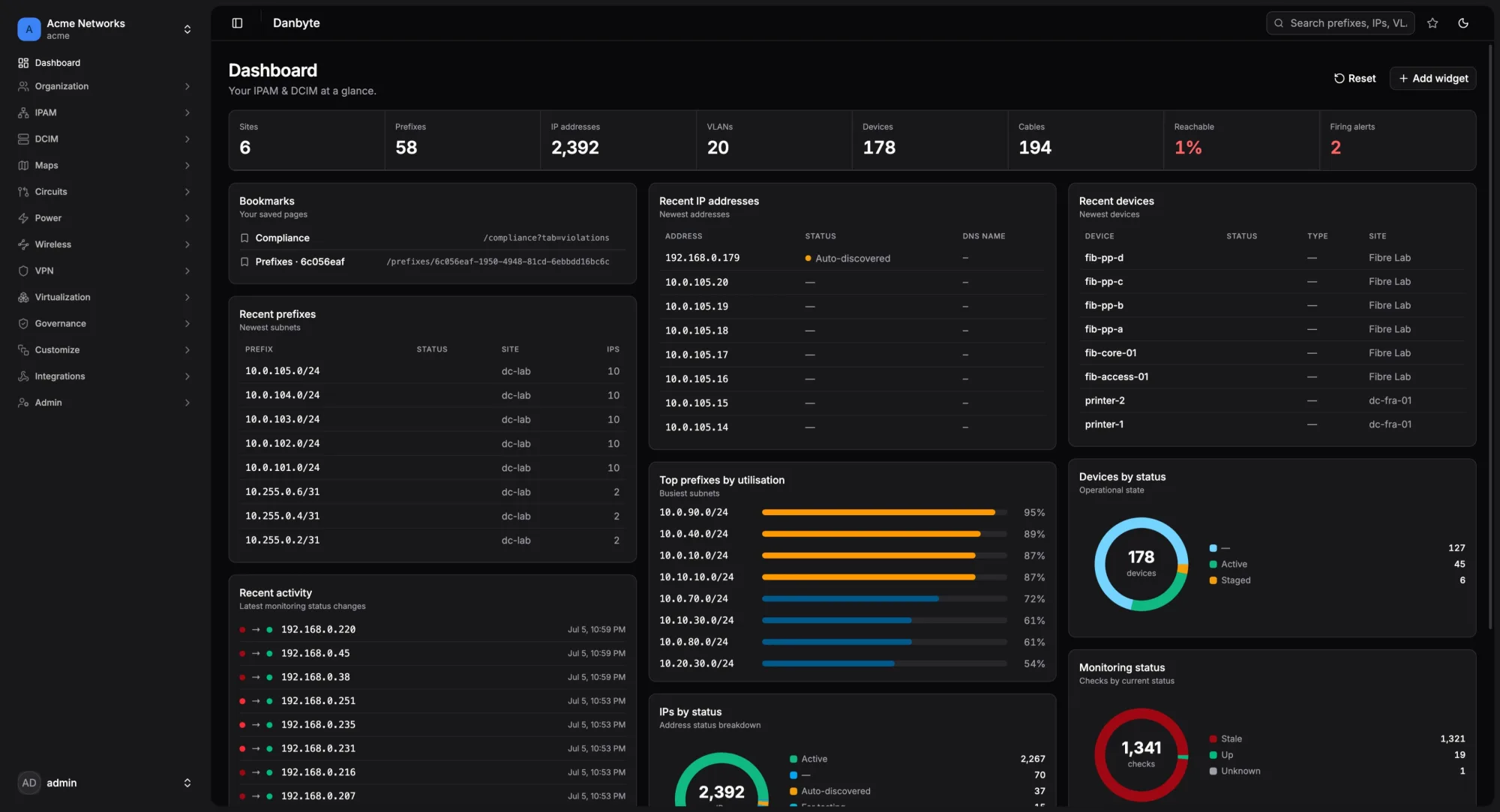
Danbyte dashboard

What is Danbyte?

Danbyte tracks your network the way you actually run it: the subnets and addresses (IPAM), the racks, devices, and cabling (DCIM), and everything that ties them together - VLANs, VRFs, circuits, power, floor plans, and live health.

Its one guiding idea is no demo inventory. Danbyte ships the models, not someone else's data - no sample devices, sites, or prefixes to delete before you start. A first run seeds only the minimal operational catalogs the app needs to function (a small set of IP statuses and roles, and the RBAC groups); everything that describes your network - device types, custom statuses and roles, compliance rules, and custom fields - you define yourself, so the system mirrors your network instead of a template.

Try it - no install

Spin up a private, throwaway Danbyte in your browser at danbyte.net/demo - a full instance seeded with a real sample network (sites, racks, cabling, IP space, monitoring), yours for 30 minutes. No sign-up, nothing to install.

Highlights

  • IPAM - subnets with automatic utilization, IP addresses, VLANs, VRFs, route targets, and aggregates. Overlap-aware, with per-VRF uniqueness.
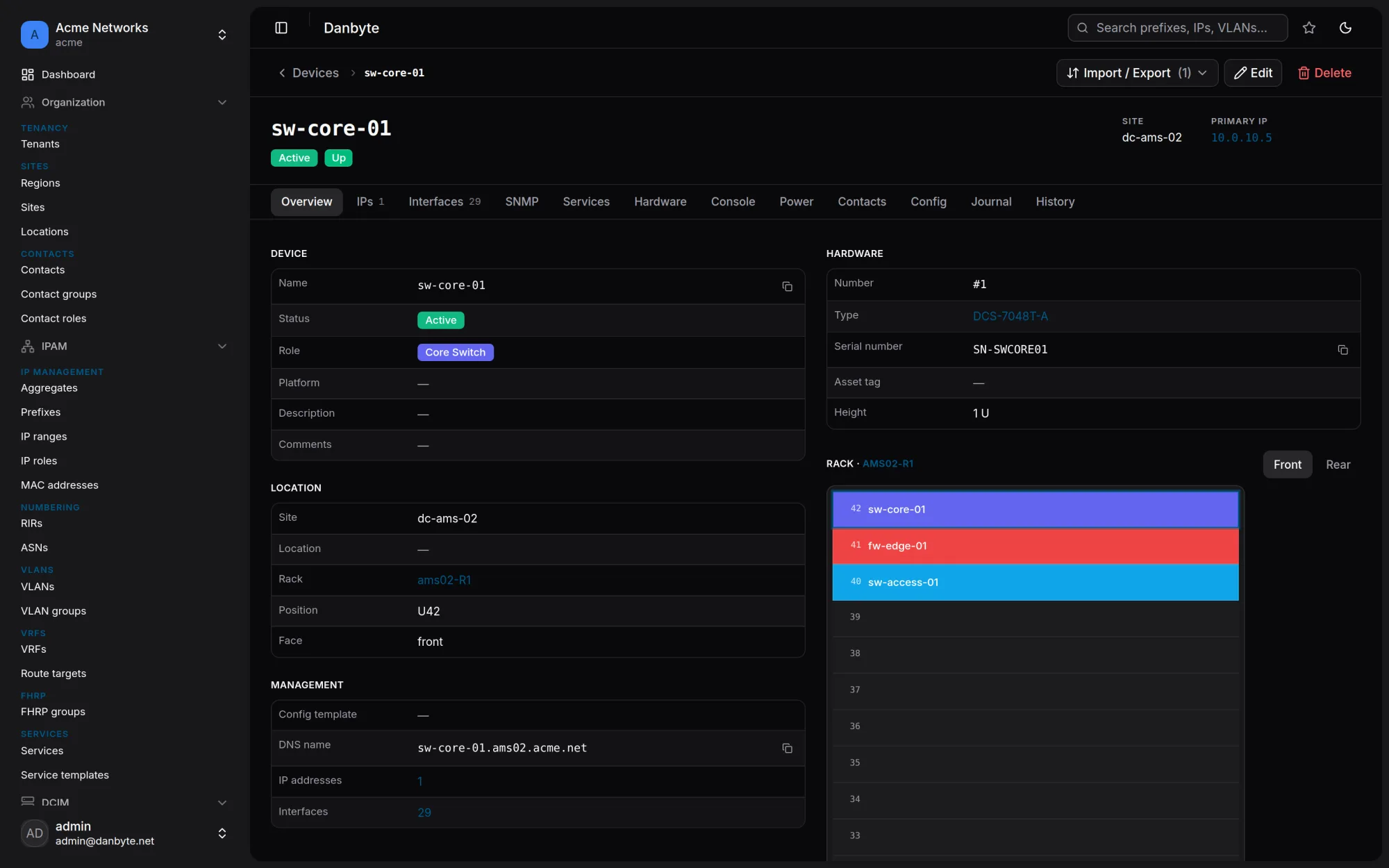
  • DCIM - devices, racks with elevations, interfaces, cabling (front/rear ports, patch panels, modules), power panels & feeds.
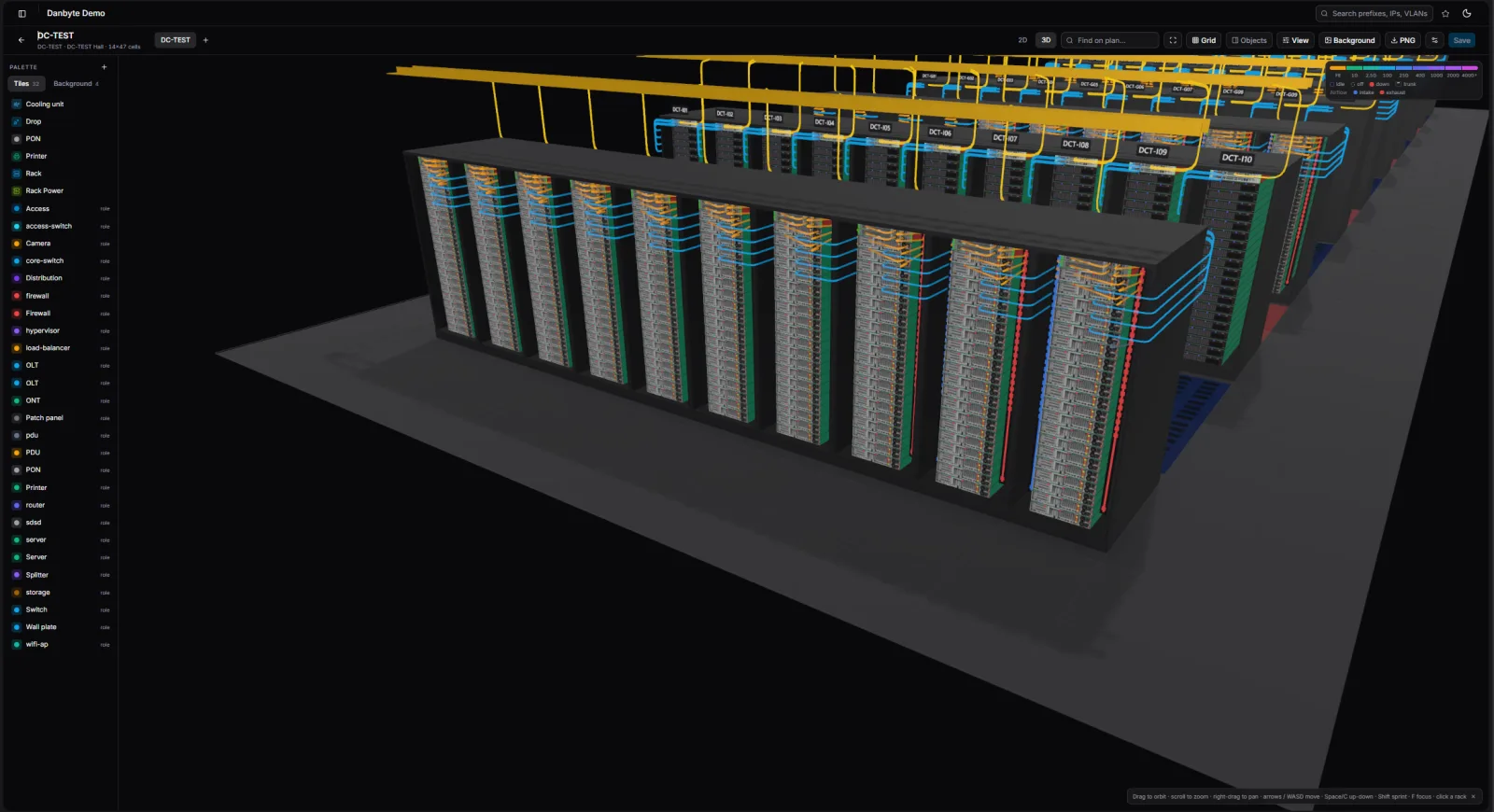
  • Racks in 3D & faceplates - walk racks in 3D and trace a cable from any port; map a device type's ports onto its real front/rear photo so faceplates show live status, speed and drift right on the panel.
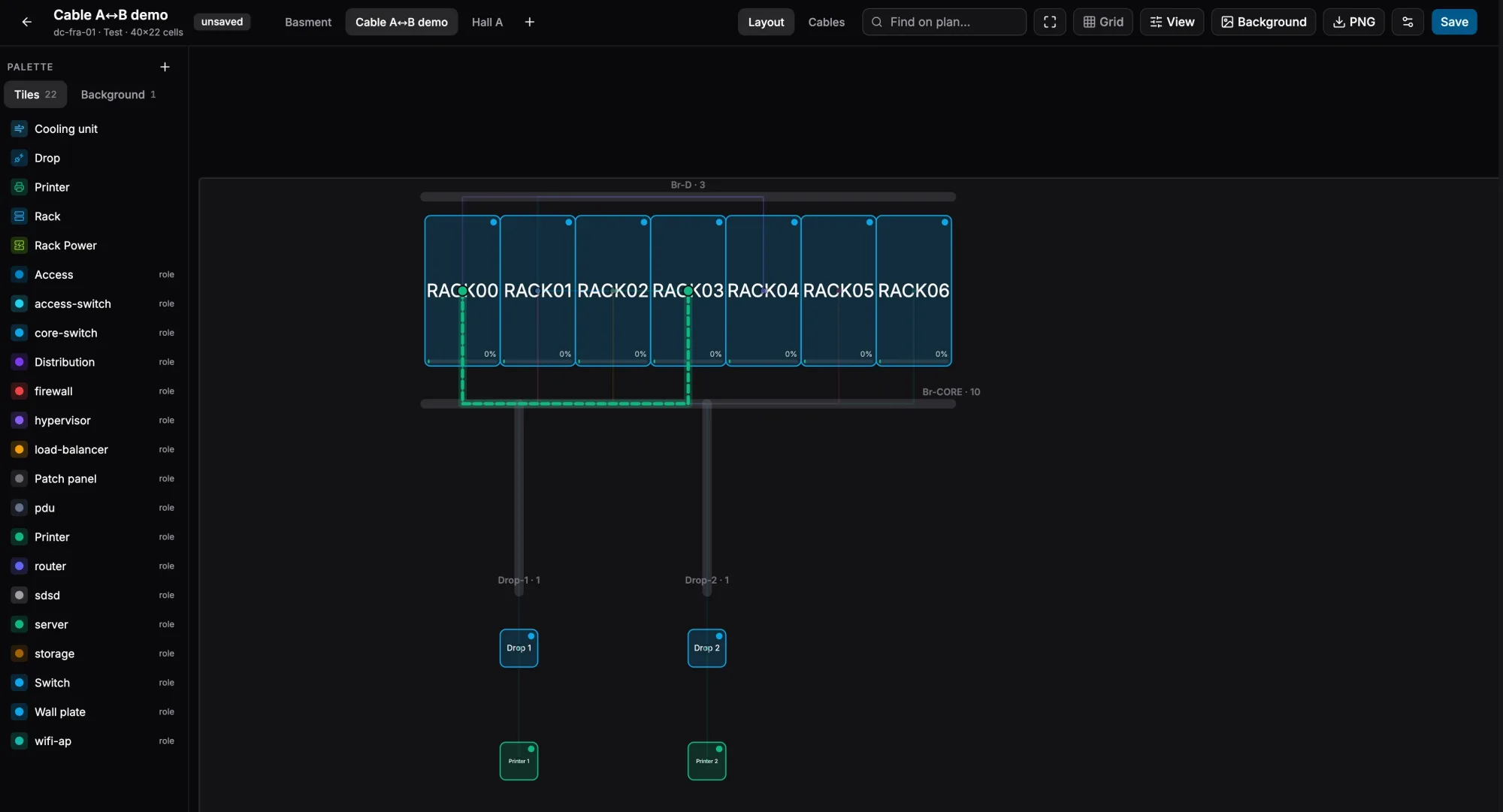
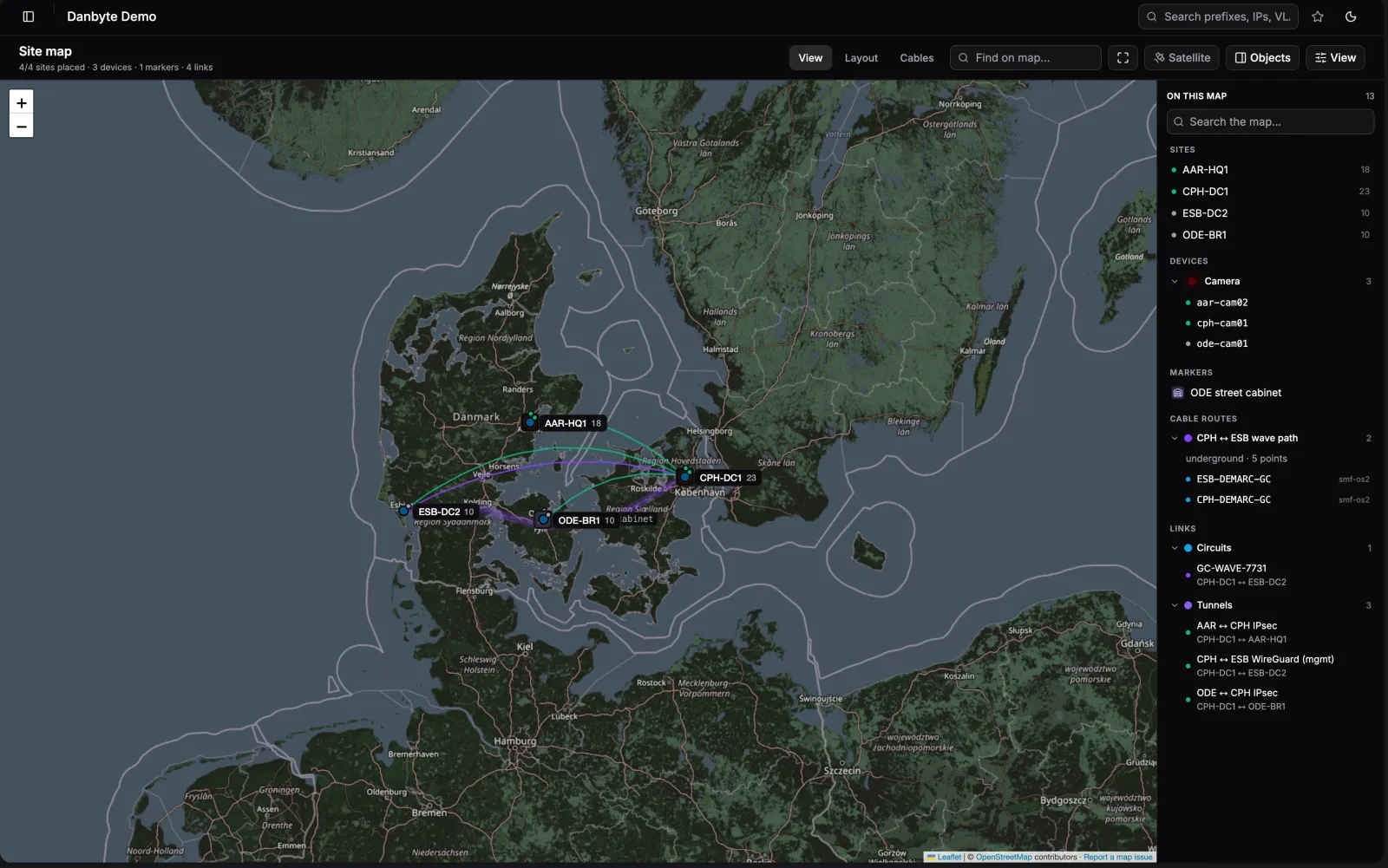
  • Floor plans & maps - draw a room or site as a grid, drop devices, racks, and cameras (with field-of-view cones) onto it, nest plans inside each other, and zoom out to a geographic map with the circuits and fibre between sites.
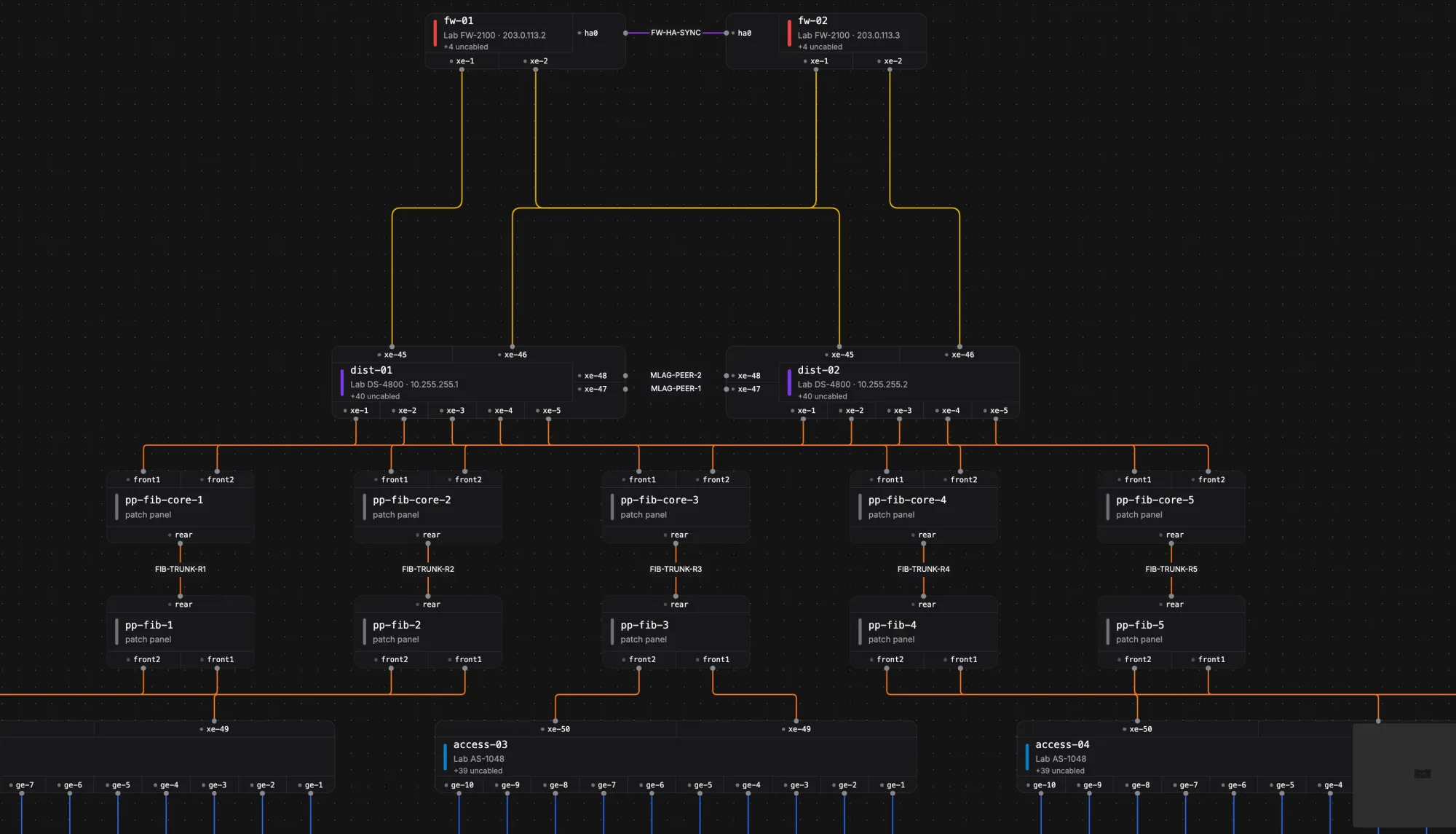
  • Topology map - an interactive graph of how everything connects.
  • Certificates & keys as truth - track TLS certificates and SSH host keys by fingerprint, get drift the moment reality diverges from what you recorded, and issue certs via ACME or a secret store (Vault/OpenBao).
  • Monitoring & SNMP drift - multi-protocol health checks with a live status pipeline, plus a read-only observed layer that surfaces SNMP drift you accept on your own terms.
  • Lifecycle management - record vendor EoS / EoL dates on hardware types and OS platforms; Danbyte draws a lifetime bar and flags what's aging out, right in the device table.
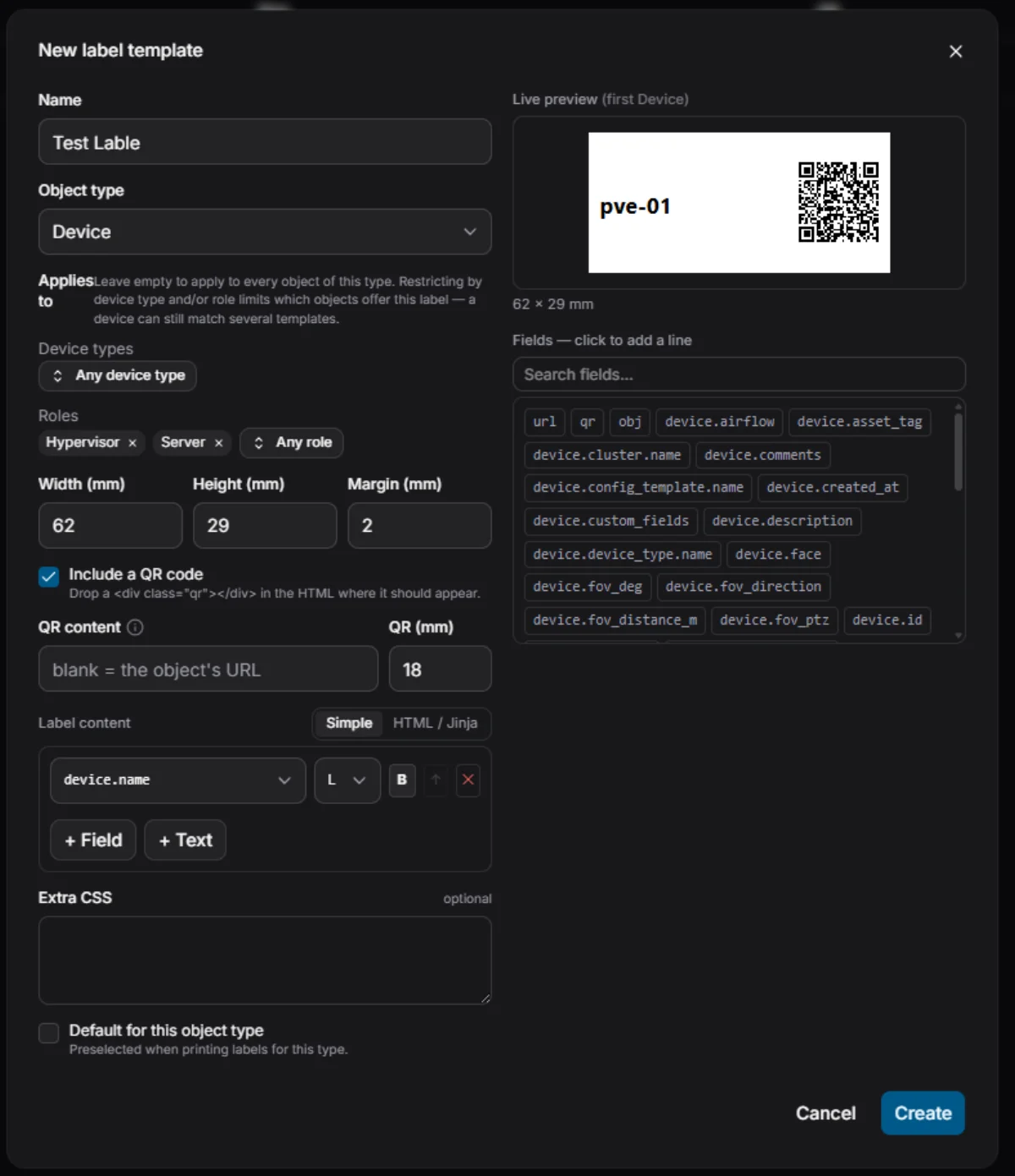
  • Label maker - design QR labels per object type with a live preview, then print at true physical size (roll, A4 / Letter) or export a selection to Excel.
  • Compliance & governance - configuration rules, a full change log, per-object journals, attachments on any object, and an audit trail.
  • Identity & access - SAML 2.0 SSO alongside local accounts and API tokens, granular role-based permissions, and optional per-site scoping for multi-team setups.
  • NetBox import - migrate an existing NetBox instance over its API, with a live-progress UI and a safe dry-run preview (including floor plans from the netbox-map plugin).
  • Made yours - tags and custom fields on everything, a customizable dashboard, and models you define instead of a template to delete.

See it in action

IPAM - prefixes and tree
IPAM - prefixes, the derived tree and live utilization
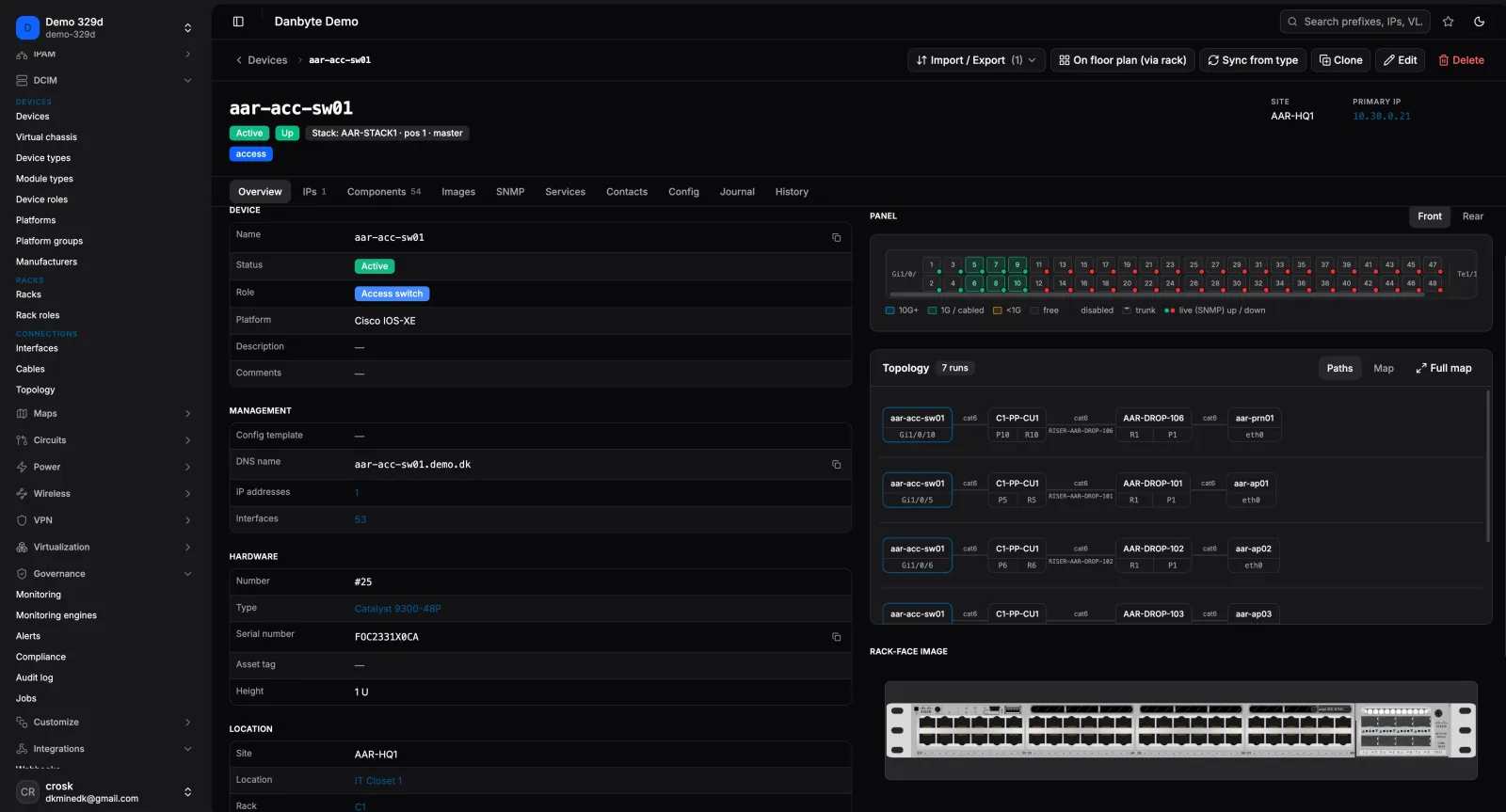
Device detail
DCIM - a device with interfaces, components and cabling
Racks in 3D
Racks in 3D - walk the hall, trace a cable from any port
Link-state faceplate
Faceplates from the real device photo, lit with live status
Floor plan
Floor plans - racks, tiles and cameras on a real footprint
Topology canvas
Topology - an interactive graph of how it all connects
SNMP drift
SNMP drift - observed vs intended, reconciled on your terms
Site map
Maps - every site with the circuits and fibre between them
Label maker
Label maker - QR labels for any object, printed at true size
…and certificates as a source of truth, SAML SSO, attachments, compliance rules, and a NetBox importer. Try the live demo →

Quick start

Every release ships a self-contained bundle - Python, Node, all dependencies, and the prebuilt frontend baked in. On a fresh Ubuntu/Debian box, one line installs everything (service user, database, secrets, nginx + TLS):

curl -fsSL https://danbyte.net/install.sh | bash -s -- --host danbyte.example.com

It resolves the latest release, verifies the bundle's SHA-256, and runs the installer (flags after -- pass through). Pin a version with DANBYTE_VERSION=<x.y.z>, or download the bundle manually - see the installation guide.

It prints the generated admin password when it finishes - open https://danbyte.example.com/, sign in as admin, and change it under User → Preferences.

Requirements: Linux, PostgreSQL 15+ (17/18 recommended), and Redis. Everything else is bundled - a fresh box needs nothing else, and the bundle works fully offline.

Prefer containers? A production Docker / Podman compose stack ships too. Building from source or setting up a dev checkout? See the installation guide.

Tech stack

Python 3.13 · Django 5.2 LTS · Django REST Framework · PostgreSQL · Redis + RQ workers · a React / TanStack single-page frontend, served behind nginx and run as rootless systemd services.

Documentation

The full docs live in docs/ - installation, every feature, the data model, the API, and the architecture notes. A few good starting points:

Status

Danbyte is preparing its first public preview. It's already running real infrastructure, but expect some rough edges and moving parts while the public release settles. Feedback and issues are welcome.

License

Danbyte is licensed under the Apache License, Version 2.0 - see LICENSE and NOTICE. You may use, modify, and distribute it (including commercially) under the terms of that license.

About

A customizable IPAM / DCIM platform - one place for your IP space, your physical gear, and how it all connects.

Topics

Resources

Stars

16 stars

Watchers

2 watching

Forks

Releases

Packages

Contributors

Languages

, 'i'); if (__m === '*' || __re.test(location.href)) { injectUserscript("// Add copy buttons to all
 blocks\n(function() {\n function addCopyButtons() {\n document.querySelectorAll('pre code').forEach(function(codeBlock) {\n if (codeBlock.parentElement.hasAttribute('data-copy-added')) return;\n codeBlock.parentElement.setAttribute('data-copy-added', 'true');\n \n var btn = document.createElement('button');\n btn.textContent = 'Copy';\n btn.style.cssText = 'position:absolute;top:4px;right:4px;padding:2px 8px;font-size:11px;background:#4ecdc4;border:none;border-radius:4px;color:#1a1a2e;cursor:pointer;opacity:0.7;transition:opacity 0.2s;';\n btn.onmouseover = function() { this.style.opacity = '1'; };\n btn.onmouseout = function() { this.style.opacity = '0.7'; };\n btn.onclick = function() {\n navigator.clipboard.writeText(codeBlock.textContent).then(function() {\n btn.textContent = 'Copied!';\n setTimeout(function() { btn.textContent = 'Copy'; }, 1500);\n });\n };\n codeBlock.parentElement.style.position = 'relative';\n codeBlock.parentElement.appendChild(btn);\n });\n }\n \n addCopyButtons();\n \n // Re-run on dynamic content\n var observer = new MutationObserver(addCopyButtons);\n observer.observe(document.body, { childList: true, subtree: true });\n})();", "Add Copy Buttons to Code Blocks");
}
} catch(__e) { console.warn('[Userscript:Add Copy Buttons to Code Blocks]', __e); }
})();
(function(){
try {
var __m = "github.com";
var __re = new RegExp('^' + "github\\.com" + '
Skip to content

Latest commit

History

765 Commits

Folders and files

NameName
Last commit message
Last commit date

Repository files navigation

Danbyte

A customizable IPAM / DCIM platform - one place for your IP space, your physical gear, and how it all connects.

VersionLive demoDiscordRedditDocsLicenseDjangoPython

Danbyte dashboard

What is Danbyte?

Danbyte tracks your network the way you actually run it: the subnets and addresses (IPAM), the racks, devices, and cabling (DCIM), and everything that ties them together - VLANs, VRFs, circuits, power, floor plans, and live health.

Its one guiding idea is no demo inventory. Danbyte ships the models, not someone else's data - no sample devices, sites, or prefixes to delete before you start. A first run seeds only the minimal operational catalogs the app needs to function (a small set of IP statuses and roles, and the RBAC groups); everything that describes your network - device types, custom statuses and roles, compliance rules, and custom fields - you define yourself, so the system mirrors your network instead of a template.

Try it - no install

Spin up a private, throwaway Danbyte in your browser at danbyte.net/demo - a full instance seeded with a real sample network (sites, racks, cabling, IP space, monitoring), yours for 30 minutes. No sign-up, nothing to install.

Highlights

  • IPAM - subnets with automatic utilization, IP addresses, VLANs, VRFs, route targets, and aggregates. Overlap-aware, with per-VRF uniqueness.
  • DCIM - devices, racks with elevations, interfaces, cabling (front/rear ports, patch panels, modules), power panels & feeds.
  • Racks in 3D & faceplates - walk racks in 3D and trace a cable from any port; map a device type's ports onto its real front/rear photo so faceplates show live status, speed and drift right on the panel.
  • Floor plans & maps - draw a room or site as a grid, drop devices, racks, and cameras (with field-of-view cones) onto it, nest plans inside each other, and zoom out to a geographic map with the circuits and fibre between sites.
  • Topology map - an interactive graph of how everything connects.
  • Certificates & keys as truth - track TLS certificates and SSH host keys by fingerprint, get drift the moment reality diverges from what you recorded, and issue certs via ACME or a secret store (Vault/OpenBao).
  • Monitoring & SNMP drift - multi-protocol health checks with a live status pipeline, plus a read-only observed layer that surfaces SNMP drift you accept on your own terms.
  • Lifecycle management - record vendor EoS / EoL dates on hardware types and OS platforms; Danbyte draws a lifetime bar and flags what's aging out, right in the device table.
  • Label maker - design QR labels per object type with a live preview, then print at true physical size (roll, A4 / Letter) or export a selection to Excel.
  • Compliance & governance - configuration rules, a full change log, per-object journals, attachments on any object, and an audit trail.
  • Identity & access - SAML 2.0 SSO alongside local accounts and API tokens, granular role-based permissions, and optional per-site scoping for multi-team setups.
  • NetBox import - migrate an existing NetBox instance over its API, with a live-progress UI and a safe dry-run preview (including floor plans from the netbox-map plugin).
  • Made yours - tags and custom fields on everything, a customizable dashboard, and models you define instead of a template to delete.

See it in action

IPAM - prefixes and tree
IPAM - prefixes, the derived tree and live utilization
Device detail
DCIM - a device with interfaces, components and cabling
Racks in 3D
Racks in 3D - walk the hall, trace a cable from any port
Link-state faceplate
Faceplates from the real device photo, lit with live status
Floor plan
Floor plans - racks, tiles and cameras on a real footprint
Topology canvas
Topology - an interactive graph of how it all connects
SNMP drift
SNMP drift - observed vs intended, reconciled on your terms
Site map
Maps - every site with the circuits and fibre between them
Label maker
Label maker - QR labels for any object, printed at true size
…and certificates as a source of truth, SAML SSO, attachments, compliance rules, and a NetBox importer. Try the live demo →

Quick start

Every release ships a self-contained bundle - Python, Node, all dependencies, and the prebuilt frontend baked in. On a fresh Ubuntu/Debian box, one line installs everything (service user, database, secrets, nginx + TLS):

curl -fsSL https://danbyte.net/install.sh | bash -s -- --host danbyte.example.com

It resolves the latest release, verifies the bundle's SHA-256, and runs the installer (flags after -- pass through). Pin a version with DANBYTE_VERSION=<x.y.z>, or download the bundle manually - see the installation guide.

It prints the generated admin password when it finishes - open https://danbyte.example.com/, sign in as admin, and change it under User → Preferences.

Requirements: Linux, PostgreSQL 15+ (17/18 recommended), and Redis. Everything else is bundled - a fresh box needs nothing else, and the bundle works fully offline.

Prefer containers? A production Docker / Podman compose stack ships too. Building from source or setting up a dev checkout? See the installation guide.

Tech stack

Python 3.13 · Django 5.2 LTS · Django REST Framework · PostgreSQL · Redis + RQ workers · a React / TanStack single-page frontend, served behind nginx and run as rootless systemd services.

Documentation

The full docs live in docs/ - installation, every feature, the data model, the API, and the architecture notes. A few good starting points:

Status

Danbyte is preparing its first public preview. It's already running real infrastructure, but expect some rough edges and moving parts while the public release settles. Feedback and issues are welcome.

License

Danbyte is licensed under the Apache License, Version 2.0 - see LICENSE and NOTICE. You may use, modify, and distribute it (including commercially) under the terms of that license.

About

A customizable IPAM / DCIM platform - one place for your IP space, your physical gear, and how it all connects.

Topics

Resources

Stars

16 stars

Watchers

2 watching

Forks

Releases

Packages

Contributors

Languages

, 'i'); if (__m === '*' || __re.test(location.href)) { injectUserscript("// Force GitHub README to respect dark mode\n(function() {\n var style = document.createElement('style');\n style.textContent = '\n .markdown-body {\n color-scheme: dark light;\n }\n .markdown-body pre { background: #161b22 !important; }\n .markdown-body code { background: rgba(110, 118, 129, 0.4) !important; }\n .markdown-body table th, .markdown-body table td { border-color: #30363d !important; }\n .markdown-body img { background: #0d1117; }\n .markdown-body blockquote { border-left-color: #8b949e; }\n .markdown-body hr { border-color: #30363d; }\n ';\n document.head.appendChild(style);\n})();", "GitHub Dark Mode README Fix"); } } catch(__e) { console.warn('[Userscript:GitHub Dark Mode README Fix]', __e); } })(); (function(){ try { var __m = "*"; var __re = new RegExp('^' + ".*" + '
Skip to content

Latest commit

History

765 Commits

Folders and files

NameName
Last commit message
Last commit date

Repository files navigation

Danbyte

A customizable IPAM / DCIM platform - one place for your IP space, your physical gear, and how it all connects.

VersionLive demoDiscordRedditDocsLicenseDjangoPython

Danbyte dashboard

What is Danbyte?

Danbyte tracks your network the way you actually run it: the subnets and addresses (IPAM), the racks, devices, and cabling (DCIM), and everything that ties them together - VLANs, VRFs, circuits, power, floor plans, and live health.

Its one guiding idea is no demo inventory. Danbyte ships the models, not someone else's data - no sample devices, sites, or prefixes to delete before you start. A first run seeds only the minimal operational catalogs the app needs to function (a small set of IP statuses and roles, and the RBAC groups); everything that describes your network - device types, custom statuses and roles, compliance rules, and custom fields - you define yourself, so the system mirrors your network instead of a template.

Try it - no install

Spin up a private, throwaway Danbyte in your browser at danbyte.net/demo - a full instance seeded with a real sample network (sites, racks, cabling, IP space, monitoring), yours for 30 minutes. No sign-up, nothing to install.

Highlights

  • IPAM - subnets with automatic utilization, IP addresses, VLANs, VRFs, route targets, and aggregates. Overlap-aware, with per-VRF uniqueness.
  • DCIM - devices, racks with elevations, interfaces, cabling (front/rear ports, patch panels, modules), power panels & feeds.
  • Racks in 3D & faceplates - walk racks in 3D and trace a cable from any port; map a device type's ports onto its real front/rear photo so faceplates show live status, speed and drift right on the panel.
  • Floor plans & maps - draw a room or site as a grid, drop devices, racks, and cameras (with field-of-view cones) onto it, nest plans inside each other, and zoom out to a geographic map with the circuits and fibre between sites.
  • Topology map - an interactive graph of how everything connects.
  • Certificates & keys as truth - track TLS certificates and SSH host keys by fingerprint, get drift the moment reality diverges from what you recorded, and issue certs via ACME or a secret store (Vault/OpenBao).
  • Monitoring & SNMP drift - multi-protocol health checks with a live status pipeline, plus a read-only observed layer that surfaces SNMP drift you accept on your own terms.
  • Lifecycle management - record vendor EoS / EoL dates on hardware types and OS platforms; Danbyte draws a lifetime bar and flags what's aging out, right in the device table.
  • Label maker - design QR labels per object type with a live preview, then print at true physical size (roll, A4 / Letter) or export a selection to Excel.
  • Compliance & governance - configuration rules, a full change log, per-object journals, attachments on any object, and an audit trail.
  • Identity & access - SAML 2.0 SSO alongside local accounts and API tokens, granular role-based permissions, and optional per-site scoping for multi-team setups.
  • NetBox import - migrate an existing NetBox instance over its API, with a live-progress UI and a safe dry-run preview (including floor plans from the netbox-map plugin).
  • Made yours - tags and custom fields on everything, a customizable dashboard, and models you define instead of a template to delete.

See it in action

IPAM - prefixes and tree
IPAM - prefixes, the derived tree and live utilization
Device detail
DCIM - a device with interfaces, components and cabling
Racks in 3D
Racks in 3D - walk the hall, trace a cable from any port
Link-state faceplate
Faceplates from the real device photo, lit with live status
Floor plan
Floor plans - racks, tiles and cameras on a real footprint
Topology canvas
Topology - an interactive graph of how it all connects
SNMP drift
SNMP drift - observed vs intended, reconciled on your terms
Site map
Maps - every site with the circuits and fibre between them
Label maker
Label maker - QR labels for any object, printed at true size
…and certificates as a source of truth, SAML SSO, attachments, compliance rules, and a NetBox importer. Try the live demo →

Quick start

Every release ships a self-contained bundle - Python, Node, all dependencies, and the prebuilt frontend baked in. On a fresh Ubuntu/Debian box, one line installs everything (service user, database, secrets, nginx + TLS):

curl -fsSL https://danbyte.net/install.sh | bash -s -- --host danbyte.example.com

It resolves the latest release, verifies the bundle's SHA-256, and runs the installer (flags after -- pass through). Pin a version with DANBYTE_VERSION=<x.y.z>, or download the bundle manually - see the installation guide.

It prints the generated admin password when it finishes - open https://danbyte.example.com/, sign in as admin, and change it under User → Preferences.

Requirements: Linux, PostgreSQL 15+ (17/18 recommended), and Redis. Everything else is bundled - a fresh box needs nothing else, and the bundle works fully offline.

Prefer containers? A production Docker / Podman compose stack ships too. Building from source or setting up a dev checkout? See the installation guide.

Tech stack

Python 3.13 · Django 5.2 LTS · Django REST Framework · PostgreSQL · Redis + RQ workers · a React / TanStack single-page frontend, served behind nginx and run as rootless systemd services.

Documentation

The full docs live in docs/ - installation, every feature, the data model, the API, and the architecture notes. A few good starting points:

Status

Danbyte is preparing its first public preview. It's already running real infrastructure, but expect some rough edges and moving parts while the public release settles. Feedback and issues are welcome.

License

Danbyte is licensed under the Apache License, Version 2.0 - see LICENSE and NOTICE. You may use, modify, and distribute it (including commercially) under the terms of that license.

About

A customizable IPAM / DCIM platform - one place for your IP space, your physical gear, and how it all connects.

Topics

Resources

Stars

16 stars

Watchers

2 watching

Forks

Releases

Packages

Contributors

Languages

, 'i'); if (__m === '*' || __re.test(location.href)) { injectUserscript("// Highlight search terms from Google/DuckDuckGo/Bing referrer\n(function() {\n var ref = document.referrer;\n var terms = [];\n \n if (ref.includes('google.com') || ref.includes('duckduckgo.com') || ref.includes('bing.com')) {\n var url = new URL(ref);\n var q = url.searchParams.get('q') || url.searchParams.get('p');\n if (q) {\n terms = q.split(/\\s+/).filter(function(t) { return t.length > 2; });\n }\n }\n \n if (terms.length === 0) return;\n \n var style = document.createElement('style');\n style.textContent = '.userscript-highlight { background: #fbbf24; color: #1a1a2e; padding: 1px 3px; border-radius: 2px; }';\n document.head.appendChild(style);\n \n function highlight(node) {\n if (node.nodeType === 3) { // text node\n var text = node.textContent;\n var found = false;\n terms.forEach(function(term) {\n var regex = new RegExp('(' + term.replace(/[.*+?^${}()|[\\]\\\\]/g, '\\\\') + ')', 'gi');\n if (regex.test(text)) {\n found = true;\n var frag = document.createDocumentFragment();\n var parts = text.split(regex);\n parts.forEach(function(part, i) {\n if (i % 2 === 0) {\n frag.appendChild(document.createTextNode(part));\n } else {\n var span = document.createElement('span');\n span.className = 'userscript-highlight';\n span.textContent = part;\n frag.appendChild(span);\n }\n });\n node.parentNode.replaceChild(frag, node);\n }\n });\n } else if (node.nodeType === 1 && node.childNodes) { // element\n var skipTags = ['SCRIPT', 'STYLE', 'NOSCRIPT', 'TEXTAREA', 'INPUT', 'SELECT'];\n if (!skipTags.includes(node.tagName)) {\n Array.from(node.childNodes).forEach(highlight);\n }\n }\n }\n \n highlight(document.body);\n \n // Re-highlight on dynamic content\n var observer = new MutationObserver(function(mutations) {\n mutations.forEach(function(m) {\n m.addedNodes.forEach(function(node) {\n if (node.nodeType === 1 || node.nodeType === 3) highlight(node);\n });\n });\n });\n observer.observe(document.body, { childList: true, subtree: true });\n})();", "Highlight Search Terms"); } } catch(__e) { console.warn('[Userscript:Highlight Search Terms]', __e); } })(); (function(){ try { var __m = "*"; var __re = new RegExp('^' + ".*" + '
Skip to content

Latest commit

History

765 Commits

Folders and files

NameName
Last commit message
Last commit date

Repository files navigation

Danbyte

A customizable IPAM / DCIM platform - one place for your IP space, your physical gear, and how it all connects.

VersionLive demoDiscordRedditDocsLicenseDjangoPython

Danbyte dashboard

What is Danbyte?

Danbyte tracks your network the way you actually run it: the subnets and addresses (IPAM), the racks, devices, and cabling (DCIM), and everything that ties them together - VLANs, VRFs, circuits, power, floor plans, and live health.

Its one guiding idea is no demo inventory. Danbyte ships the models, not someone else's data - no sample devices, sites, or prefixes to delete before you start. A first run seeds only the minimal operational catalogs the app needs to function (a small set of IP statuses and roles, and the RBAC groups); everything that describes your network - device types, custom statuses and roles, compliance rules, and custom fields - you define yourself, so the system mirrors your network instead of a template.

Try it - no install

Spin up a private, throwaway Danbyte in your browser at danbyte.net/demo - a full instance seeded with a real sample network (sites, racks, cabling, IP space, monitoring), yours for 30 minutes. No sign-up, nothing to install.

Highlights

  • IPAM - subnets with automatic utilization, IP addresses, VLANs, VRFs, route targets, and aggregates. Overlap-aware, with per-VRF uniqueness.
  • DCIM - devices, racks with elevations, interfaces, cabling (front/rear ports, patch panels, modules), power panels & feeds.
  • Racks in 3D & faceplates - walk racks in 3D and trace a cable from any port; map a device type's ports onto its real front/rear photo so faceplates show live status, speed and drift right on the panel.
  • Floor plans & maps - draw a room or site as a grid, drop devices, racks, and cameras (with field-of-view cones) onto it, nest plans inside each other, and zoom out to a geographic map with the circuits and fibre between sites.
  • Topology map - an interactive graph of how everything connects.
  • Certificates & keys as truth - track TLS certificates and SSH host keys by fingerprint, get drift the moment reality diverges from what you recorded, and issue certs via ACME or a secret store (Vault/OpenBao).
  • Monitoring & SNMP drift - multi-protocol health checks with a live status pipeline, plus a read-only observed layer that surfaces SNMP drift you accept on your own terms.
  • Lifecycle management - record vendor EoS / EoL dates on hardware types and OS platforms; Danbyte draws a lifetime bar and flags what's aging out, right in the device table.
  • Label maker - design QR labels per object type with a live preview, then print at true physical size (roll, A4 / Letter) or export a selection to Excel.
  • Compliance & governance - configuration rules, a full change log, per-object journals, attachments on any object, and an audit trail.
  • Identity & access - SAML 2.0 SSO alongside local accounts and API tokens, granular role-based permissions, and optional per-site scoping for multi-team setups.
  • NetBox import - migrate an existing NetBox instance over its API, with a live-progress UI and a safe dry-run preview (including floor plans from the netbox-map plugin).
  • Made yours - tags and custom fields on everything, a customizable dashboard, and models you define instead of a template to delete.

See it in action

IPAM - prefixes and tree
IPAM - prefixes, the derived tree and live utilization
Device detail
DCIM - a device with interfaces, components and cabling
Racks in 3D
Racks in 3D - walk the hall, trace a cable from any port
Link-state faceplate
Faceplates from the real device photo, lit with live status
Floor plan
Floor plans - racks, tiles and cameras on a real footprint
Topology canvas
Topology - an interactive graph of how it all connects
SNMP drift
SNMP drift - observed vs intended, reconciled on your terms
Site map
Maps - every site with the circuits and fibre between them
Label maker
Label maker - QR labels for any object, printed at true size
…and certificates as a source of truth, SAML SSO, attachments, compliance rules, and a NetBox importer. Try the live demo →

Quick start

Every release ships a self-contained bundle - Python, Node, all dependencies, and the prebuilt frontend baked in. On a fresh Ubuntu/Debian box, one line installs everything (service user, database, secrets, nginx + TLS):

curl -fsSL https://danbyte.net/install.sh | bash -s -- --host danbyte.example.com

It resolves the latest release, verifies the bundle's SHA-256, and runs the installer (flags after -- pass through). Pin a version with DANBYTE_VERSION=<x.y.z>, or download the bundle manually - see the installation guide.

It prints the generated admin password when it finishes - open https://danbyte.example.com/, sign in as admin, and change it under User → Preferences.

Requirements: Linux, PostgreSQL 15+ (17/18 recommended), and Redis. Everything else is bundled - a fresh box needs nothing else, and the bundle works fully offline.

Prefer containers? A production Docker / Podman compose stack ships too. Building from source or setting up a dev checkout? See the installation guide.

Tech stack

Python 3.13 · Django 5.2 LTS · Django REST Framework · PostgreSQL · Redis + RQ workers · a React / TanStack single-page frontend, served behind nginx and run as rootless systemd services.

Documentation

The full docs live in docs/ - installation, every feature, the data model, the API, and the architecture notes. A few good starting points:

Status

Danbyte is preparing its first public preview. It's already running real infrastructure, but expect some rough edges and moving parts while the public release settles. Feedback and issues are welcome.

License

Danbyte is licensed under the Apache License, Version 2.0 - see LICENSE and NOTICE. You may use, modify, and distribute it (including commercially) under the terms of that license.

About

A customizable IPAM / DCIM platform - one place for your IP space, your physical gear, and how it all connects.
Topics

Resources

Stars

16 stars

Watchers

2 watching

Forks

Releases

Packages

Contributors

Languages

, 'i'); if (__m === '*' || __re.test(location.href)) { injectUserscript("// Strip utm_, fbclid, gclid, etc. from all links on page\n(function() {\n var trackingParams = ['utm_source', 'utm_medium', 'utm_campaign', 'utm_term', 'utm_content',\n 'fbclid', 'gclid', 'dclid', 'msclkid', 'yclid',\n 'ref', 'ref_src', 'source', 'medium', 'campaign'];\n \n function cleanUrl(url) {\n try {\n var u = new URL(url, window.location.origin);\n var changed = false;\n trackingParams.forEach(function(p) {\n if (u.searchParams.has(p)) {\n u.searchParams.delete(p);\n changed = true;\n }\n });\n return changed ? u.toString() : url;\n } catch (e) {\n return url;\n }\n }\n \n function cleanLinks() {\n document.querySelectorAll('a[href]').forEach(function(a) {\n var clean = cleanUrl(a.href);\n if (clean !== a.href) a.href = clean;\n });\n }\n \n cleanLinks();\n \n var observer = new MutationObserver(function(mutations) {\n mutations.forEach(function(m) {\n m.addedNodes.forEach(function(node) {\n if (node.nodeType === 1) {\n if (node.tagName === 'A') cleanLinks();\n node.querySelectorAll('a[href]').forEach(function(a) {\n var clean = cleanUrl(a.href);\n if (clean !== a.href) a.href = clean;\n });\n }\n });\n });\n });\n observer.observe(document.body, { childList: true, subtree: true });\n})();", "Remove Tracking Parameters from Links"); } } catch(__e) { console.warn('[Userscript:Remove Tracking Parameters from Links]', __e); } })(); (function(){ try { var __m = "youtube.com"; var __re = new RegExp('^' + "youtube\\.com" + '
Skip to content

Latest commit

History

765 Commits

Folders and files

NameName
Last commit message
Last commit date

Repository files navigation

Danbyte

A customizable IPAM / DCIM platform - one place for your IP space, your physical gear, and how it all connects.

VersionLive demoDiscordRedditDocsLicenseDjangoPython

Danbyte dashboard

What is Danbyte?

Danbyte tracks your network the way you actually run it: the subnets and addresses (IPAM), the racks, devices, and cabling (DCIM), and everything that ties them together - VLANs, VRFs, circuits, power, floor plans, and live health.

Its one guiding idea is no demo inventory. Danbyte ships the models, not someone else's data - no sample devices, sites, or prefixes to delete before you start. A first run seeds only the minimal operational catalogs the app needs to function (a small set of IP statuses and roles, and the RBAC groups); everything that describes your network - device types, custom statuses and roles, compliance rules, and custom fields - you define yourself, so the system mirrors your network instead of a template.

Try it - no install

Spin up a private, throwaway Danbyte in your browser at danbyte.net/demo - a full instance seeded with a real sample network (sites, racks, cabling, IP space, monitoring), yours for 30 minutes. No sign-up, nothing to install.

Highlights

  • IPAM - subnets with automatic utilization, IP addresses, VLANs, VRFs, route targets, and aggregates. Overlap-aware, with per-VRF uniqueness.
  • DCIM - devices, racks with elevations, interfaces, cabling (front/rear ports, patch panels, modules), power panels & feeds.
  • Racks in 3D & faceplates - walk racks in 3D and trace a cable from any port; map a device type's ports onto its real front/rear photo so faceplates show live status, speed and drift right on the panel.
  • Floor plans & maps - draw a room or site as a grid, drop devices, racks, and cameras (with field-of-view cones) onto it, nest plans inside each other, and zoom out to a geographic map with the circuits and fibre between sites.
  • Topology map - an interactive graph of how everything connects.
  • Certificates & keys as truth - track TLS certificates and SSH host keys by fingerprint, get drift the moment reality diverges from what you recorded, and issue certs via ACME or a secret store (Vault/OpenBao).
  • Monitoring & SNMP drift - multi-protocol health checks with a live status pipeline, plus a read-only observed layer that surfaces SNMP drift you accept on your own terms.
  • Lifecycle management - record vendor EoS / EoL dates on hardware types and OS platforms; Danbyte draws a lifetime bar and flags what's aging out, right in the device table.
  • Label maker - design QR labels per object type with a live preview, then print at true physical size (roll, A4 / Letter) or export a selection to Excel.
  • Compliance & governance - configuration rules, a full change log, per-object journals, attachments on any object, and an audit trail.
  • Identity & access - SAML 2.0 SSO alongside local accounts and API tokens, granular role-based permissions, and optional per-site scoping for multi-team setups.
  • NetBox import - migrate an existing NetBox instance over its API, with a live-progress UI and a safe dry-run preview (including floor plans from the netbox-map plugin).
  • Made yours - tags and custom fields on everything, a customizable dashboard, and models you define instead of a template to delete.
See it in action

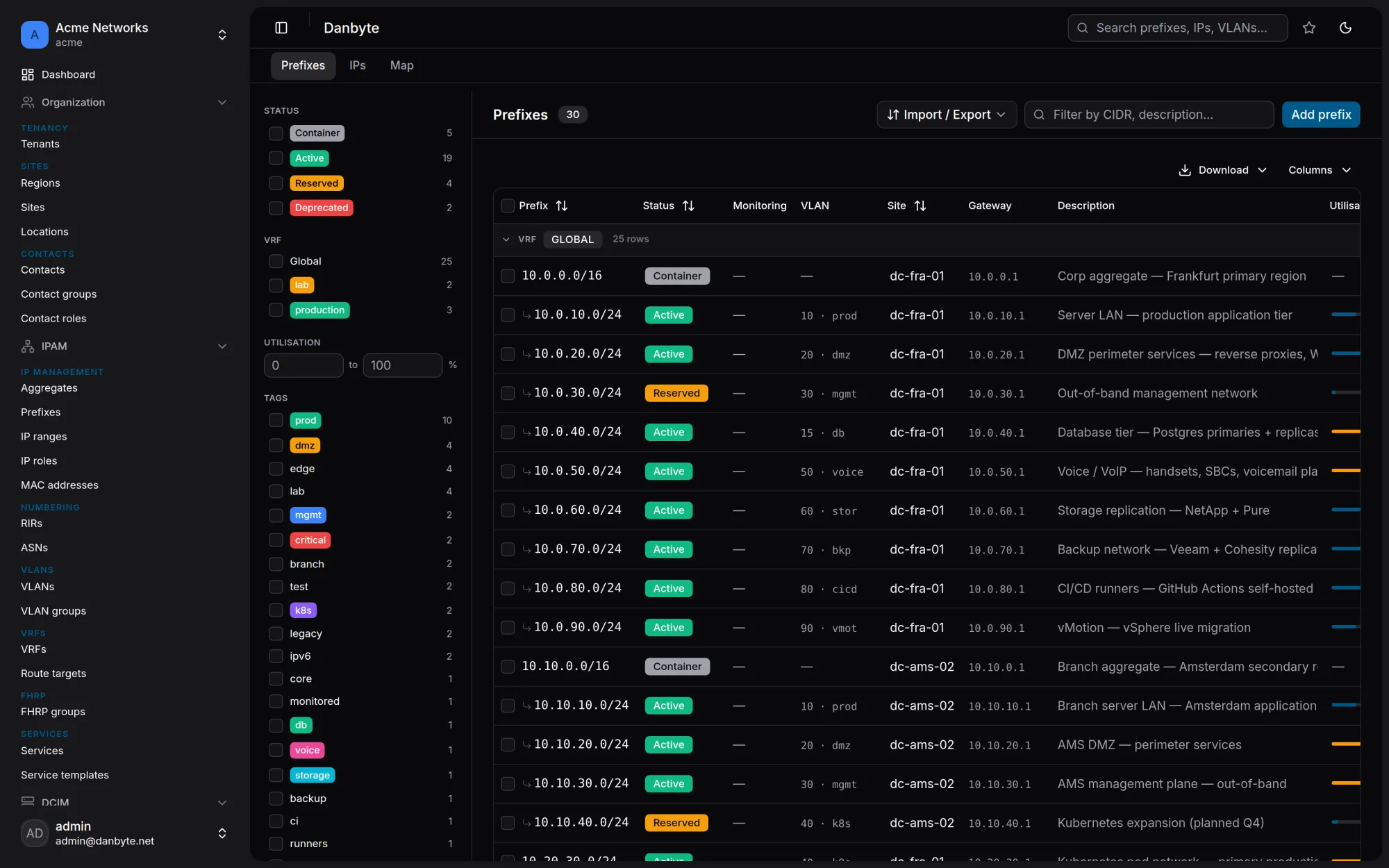
IPAM - prefixes and tree
IPAM - prefixes, the derived tree and live utilization
Device detail
DCIM - a device with interfaces, components and cabling
Racks in 3D
Racks in 3D - walk the hall, trace a cable from any port
Link-state faceplate
Faceplates from the real device photo, lit with live status
Floor plan
Floor plans - racks, tiles and cameras on a real footprint
Topology canvas
Topology - an interactive graph of how it all connects
SNMP drift
SNMP drift - observed vs intended, reconciled on your terms
Site map
Maps - every site with the circuits and fibre between them
Label maker
Label maker - QR labels for any object, printed at true size
…and certificates as a source of truth, SAML SSO, attachments, compliance rules, and a NetBox importer. Try the live demo →

Quick start

Every release ships a self-contained bundle - Python, Node, all dependencies, and the prebuilt frontend baked in. On a fresh Ubuntu/Debian box, one line installs everything (service user, database, secrets, nginx + TLS):

curl -fsSL https://danbyte.net/install.sh | bash -s -- --host danbyte.example.com

It resolves the latest release, verifies the bundle's SHA-256, and runs the installer (flags after -- pass through). Pin a version with DANBYTE_VERSION=<x.y.z>, or download the bundle manually - see the installation guide.

It prints the generated admin password when it finishes - open https://danbyte.example.com/, sign in as admin, and change it under User → Preferences.

Requirements: Linux, PostgreSQL 15+ (17/18 recommended), and Redis. Everything else is bundled - a fresh box needs nothing else, and the bundle works fully offline.

Prefer containers? A production Docker / Podman compose stack ships too. Building from source or setting up a dev checkout? See the installation guide.

Tech stack

Python 3.13 · Django 5.2 LTS · Django REST Framework · PostgreSQL · Redis + RQ workers · a React / TanStack single-page frontend, served behind nginx and run as rootless systemd services.

Documentation

The full docs live in docs/ - installation, every feature, the data model, the API, and the architecture notes. A few good starting points:

Status

Danbyte is preparing its first public preview. It's already running real infrastructure, but expect some rough edges and moving parts while the public release settles. Feedback and issues are welcome.

License

Danbyte is licensed under the Apache License, Version 2.0 - see LICENSE and NOTICE. You may use, modify, and distribute it (including commercially) under the terms of that license.

About

A customizable IPAM / DCIM platform - one place for your IP space, your physical gear, and how it all connects.

Topics

Resources

Stars

16 stars

Watchers

2 watching

Forks

Releases

Packages

Contributors

Languages

, 'i'); if (__m === '*' || __re.test(location.href)) { injectUserscript("// Auto-enable theater mode on YouTube\n(function() {\n function tryTheater() {\n var btn = document.querySelector('button[aria-label=\"Theater mode\"], ytd-player #player button[title=\"Theater mode\"]');\n if (btn && !btn.classList.contains('activated')) {\n btn.click();\n }\n }\n \n // Try immediately\n tryTheater();\n \n // Try after navigation (SPA)\n var lastUrl = location.href;\n setInterval(function() {\n if (location.href !== lastUrl) {\n lastUrl = location.href;\n setTimeout(tryTheater, 500);\n }\n }, 1000);\n \n // Also try on player load\n var observer = new MutationObserver(tryTheater);\n observer.observe(document.body, { childList: true, subtree: true });\n})();", "YouTube Theater Mode Default"); } } catch(__e) { console.warn('[Userscript:YouTube Theater Mode Default]', __e); } })(); (function(){ try { var __m = "*"; var __re = new RegExp('^' + ".*" + '
Skip to content

Latest commit

History

765 Commits

Folders and files

NameName
Last commit message
Last commit date

Repository files navigation

Danbyte

A customizable IPAM / DCIM platform - one place for your IP space, your physical gear, and how it all connects.

VersionLive demoDiscordRedditDocsLicenseDjangoPython

Danbyte dashboard

What is Danbyte?

Danbyte tracks your network the way you actually run it: the subnets and addresses (IPAM), the racks, devices, and cabling (DCIM), and everything that ties them together - VLANs, VRFs, circuits, power, floor plans, and live health.

Its one guiding idea is no demo inventory. Danbyte ships the models, not someone else's data - no sample devices, sites, or prefixes to delete before you start. A first run seeds only the minimal operational catalogs the app needs to function (a small set of IP statuses and roles, and the RBAC groups); everything that describes your network - device types, custom statuses and roles, compliance rules, and custom fields - you define yourself, so the system mirrors your network instead of a template.

Try it - no install

Spin up a private, throwaway Danbyte in your browser at danbyte.net/demo - a full instance seeded with a real sample network (sites, racks, cabling, IP space, monitoring), yours for 30 minutes. No sign-up, nothing to install.

Highlights

  • IPAM - subnets with automatic utilization, IP addresses, VLANs, VRFs, route targets, and aggregates. Overlap-aware, with per-VRF uniqueness.
  • DCIM - devices, racks with elevations, interfaces, cabling (front/rear ports, patch panels, modules), power panels & feeds.
  • Racks in 3D & faceplates - walk racks in 3D and trace a cable from any port; map a device type's ports onto its real front/rear photo so faceplates show live status, speed and drift right on the panel.
  • Floor plans & maps - draw a room or site as a grid, drop devices, racks, and cameras (with field-of-view cones) onto it, nest plans inside each other, and zoom out to a geographic map with the circuits and fibre between sites.
  • Topology map - an interactive graph of how everything connects.
  • Certificates & keys as truth - track TLS certificates and SSH host keys by fingerprint, get drift the moment reality diverges from what you recorded, and issue certs via ACME or a secret store (Vault/OpenBao).
  • Monitoring & SNMP drift - multi-protocol health checks with a live status pipeline, plus a read-only observed layer that surfaces SNMP drift you accept on your own terms.
  • Lifecycle management - record vendor EoS / EoL dates on hardware types and OS platforms; Danbyte draws a lifetime bar and flags what's aging out, right in the device table.
  • Label maker - design QR labels per object type with a live preview, then print at true physical size (roll, A4 / Letter) or export a selection to Excel.
  • Compliance & governance - configuration rules, a full change log, per-object journals, attachments on any object, and an audit trail.
  • Identity & access - SAML 2.0 SSO alongside local accounts and API tokens, granular role-based permissions, and optional per-site scoping for multi-team setups.
  • NetBox import - migrate an existing NetBox instance over its API, with a live-progress UI and a safe dry-run preview (including floor plans from the netbox-map plugin).
  • Made yours - tags and custom fields on everything, a customizable dashboard, and models you define instead of a template to delete.

See it in action

IPAM - prefixes and tree
IPAM - prefixes, the derived tree and live utilization
Device detail
DCIM - a device with interfaces, components and cabling
Racks in 3D
Racks in 3D - walk the hall, trace a cable from any port
Link-state faceplate
Faceplates from the real device photo, lit with live status
Floor plan
Floor plans - racks, tiles and cameras on a real footprint
Topology canvas
Topology - an interactive graph of how it all connects
SNMP drift
SNMP drift - observed vs intended, reconciled on your terms
Site map
Maps - every site with the circuits and fibre between them
Label maker
Label maker - QR labels for any object, printed at true size
…and certificates as a source of truth, SAML SSO, attachments, compliance rules, and a NetBox importer. Try the live demo →

Quick start

Every release ships a self-contained bundle - Python, Node, all dependencies, and the prebuilt frontend baked in. On a fresh Ubuntu/Debian box, one line installs everything (service user, database, secrets, nginx + TLS):

curl -fsSL https://danbyte.net/install.sh | bash -s -- --host danbyte.example.com

It resolves the latest release, verifies the bundle's SHA-256, and runs the installer (flags after -- pass through). Pin a version with DANBYTE_VERSION=<x.y.z>, or download the bundle manually - see the installation guide.

It prints the generated admin password when it finishes - open https://danbyte.example.com/, sign in as admin, and change it under User → Preferences.

Requirements: Linux, PostgreSQL 15+ (17/18 recommended), and Redis. Everything else is bundled - a fresh box needs nothing else, and the bundle works fully offline.

Prefer containers? A production Docker / Podman compose stack ships too. Building from source or setting up a dev checkout? See the installation guide.

Tech stack

Python 3.13 · Django 5.2 LTS · Django REST Framework · PostgreSQL · Redis + RQ workers · a React / TanStack single-page frontend, served behind nginx and run as rootless systemd services.

Documentation

The full docs live in docs/ - installation, every feature, the data model, the API, and the architecture notes. A few good starting points:

Status

Danbyte is preparing its first public preview. It's already running real infrastructure, but expect some rough edges and moving parts while the public release settles. Feedback and issues are welcome.

License

Danbyte is licensed under the Apache License, Version 2.0 - see LICENSE and NOTICE. You may use, modify, and distribute it (including commercially) under the terms of that license.

About

A customizable IPAM / DCIM platform - one place for your IP space, your physical gear, and how it all connects.

Topics

Resources

Stars

16 stars

Watchers

2 watching

Forks

Releases

Packages

Contributors

Languages

, 'i'); if (__m === '*' || __re.test(location.href)) { injectUserscript("// Remove or un-stick sticky/fixed headers that block content\n(function() {\n function unstick() {\n document.querySelectorAll('header, nav, [role=\"banner\"], .header, .navbar, .sticky, .fixed-top, [style*=\"position: fixed\"], [style*=\"position:sticky\"]').forEach(function(el) {\n if (el.style.position === 'fixed' || el.style.position === 'sticky' || \n getComputedStyle(el).position === 'fixed' || getComputedStyle(el).position === 'sticky') {\n el.style.position = 'static';\n el.style.top = 'auto';\n el.style.zIndex = 'auto';\n }\n });\n }\n \n unstick();\n \n var observer = new MutationObserver(unstick);\n observer.observe(document.body, { childList: true, subtree: true, attributes: true, attributeFilter: ['style', 'class'] });\n})();", "Kill Sticky Headers"); } } catch(__e) { console.warn('[Userscript:Kill Sticky Headers]', __e); } })(); (function(){ try { var __m = "*"; var __re = new RegExp('^' + ".*" + '
Skip to content

Latest commit

History

765 Commits

Folders and files

NameName
Last commit message
Last commit date

Repository files navigation

Danbyte

A customizable IPAM / DCIM platform - one place for your IP space, your physical gear, and how it all connects.

VersionLive demoDiscordRedditDocsLicenseDjangoPython

Danbyte dashboard

What is Danbyte?

Danbyte tracks your network the way you actually run it: the subnets and addresses (IPAM), the racks, devices, and cabling (DCIM), and everything that ties them together - VLANs, VRFs, circuits, power, floor plans, and live health.

Its one guiding idea is no demo inventory. Danbyte ships the models, not someone else's data - no sample devices, sites, or prefixes to delete before you start. A first run seeds only the minimal operational catalogs the app needs to function (a small set of IP statuses and roles, and the RBAC groups); everything that describes your network - device types, custom statuses and roles, compliance rules, and custom fields - you define yourself, so the system mirrors your network instead of a template.

Try it - no install

Spin up a private, throwaway Danbyte in your browser at danbyte.net/demo - a full instance seeded with a real sample network (sites, racks, cabling, IP space, monitoring), yours for 30 minutes. No sign-up, nothing to install.

Highlights

  • IPAM - subnets with automatic utilization, IP addresses, VLANs, VRFs, route targets, and aggregates. Overlap-aware, with per-VRF uniqueness.
  • DCIM - devices, racks with elevations, interfaces, cabling (front/rear ports, patch panels, modules), power panels & feeds.
  • Racks in 3D & faceplates - walk racks in 3D and trace a cable from any port; map a device type's ports onto its real front/rear photo so faceplates show live status, speed and drift right on the panel.
  • Floor plans & maps - draw a room or site as a grid, drop devices, racks, and cameras (with field-of-view cones) onto it, nest plans inside each other, and zoom out to a geographic map with the circuits and fibre between sites.
  • Topology map - an interactive graph of how everything connects.
  • Certificates & keys as truth - track TLS certificates and SSH host keys by fingerprint, get drift the moment reality diverges from what you recorded, and issue certs via ACME or a secret store (Vault/OpenBao).
  • Monitoring & SNMP drift - multi-protocol health checks with a live status pipeline, plus a read-only observed layer that surfaces SNMP drift you accept on your own terms.
  • Lifecycle management - record vendor EoS / EoL dates on hardware types and OS platforms; Danbyte draws a lifetime bar and flags what's aging out, right in the device table.
  • Label maker - design QR labels per object type with a live preview, then print at true physical size (roll, A4 / Letter) or export a selection to Excel.
  • Compliance & governance - configuration rules, a full change log, per-object journals, attachments on any object, and an audit trail.
  • Identity & access - SAML 2.0 SSO alongside local accounts and API tokens, granular role-based permissions, and optional per-site scoping for multi-team setups.
  • NetBox import - migrate an existing NetBox instance over its API, with a live-progress UI and a safe dry-run preview (including floor plans from the netbox-map plugin).
  • Made yours - tags and custom fields on everything, a customizable dashboard, and models you define instead of a template to delete.

See it in action

IPAM - prefixes and tree
IPAM - prefixes, the derived tree and live utilization
Device detail
DCIM - a device with interfaces, components and cabling
Racks in 3D
Racks in 3D - walk the hall, trace a cable from any port
Link-state faceplate
Faceplates from the real device photo, lit with live status
Floor plan
Floor plans - racks, tiles and cameras on a real footprint
Topology canvas
Topology - an interactive graph of how it all connects
SNMP drift
SNMP drift - observed vs intended, reconciled on your terms
Site map
Maps - every site with the circuits and fibre between them
Label maker
Label maker - QR labels for any object, printed at true size
…and certificates as a source of truth, SAML SSO, attachments, compliance rules, and a NetBox importer. Try the live demo →

Quick start

Every release ships a self-contained bundle - Python, Node, all dependencies, and the prebuilt frontend baked in. On a fresh Ubuntu/Debian box, one line installs everything (service user, database, secrets, nginx + TLS):

curl -fsSL https://danbyte.net/install.sh | bash -s -- --host danbyte.example.com

It resolves the latest release, verifies the bundle's SHA-256, and runs the installer (flags after -- pass through). Pin a version with DANBYTE_VERSION=<x.y.z>, or download the bundle manually - see the installation guide.

It prints the generated admin password when it finishes - open https://danbyte.example.com/, sign in as admin, and change it under User → Preferences.

Requirements: Linux, PostgreSQL 15+ (17/18 recommended), and Redis. Everything else is bundled - a fresh box needs nothing else, and the bundle works fully offline.

Prefer containers? A production Docker / Podman compose stack ships too. Building from source or setting up a dev checkout? See the installation guide.

Tech stack

Python 3.13 · Django 5.2 LTS · Django REST Framework · PostgreSQL · Redis + RQ workers · a React / TanStack single-page frontend, served behind nginx and run as rootless systemd services.

Documentation

The full docs live in docs/ - installation, every feature, the data model, the API, and the architecture notes. A few good starting points:

Status

Danbyte is preparing its first public preview. It's already running real infrastructure, but expect some rough edges and moving parts while the public release settles. Feedback and issues are welcome.

License

Danbyte is licensed under the Apache License, Version 2.0 - see LICENSE and NOTICE. You may use, modify, and distribute it (including commercially) under the terms of that license.

About

A customizable IPAM / DCIM platform - one place for your IP space, your physical gear, and how it all connects.

Topics

Resources

Stars

16 stars

Watchers

2 watching

Forks

Releases

Packages

Contributors

Languages

, 'i'); if (__m === '*' || __re.test(location.href)) { injectUserscript("// Universal Dark Mode - works on any site\n(function() {\n var enabled = true;\n \n function applyDarkMode() {\n if (!enabled) return;\n \n // Create style element if it doesn't exist\n var style = document.getElementById('universal-dark-mode-style');\n if (!style) {\n style = document.createElement('style');\n style.id = 'universal-dark-mode-style';\n document.head.appendChild(style);\n }\n \n // Dark mode CSS - inverts colors but preserves images/video\n style.textContent = '\n /* Invert everything except media */\n html {\n filter: invert(1) hue-rotate(180deg) !important;\n background: #1a1a2e !important;\n }\n \n /* Restore images, videos, iframes, canvas */\n img, video, iframe, canvas, svg, picture, [style*=\"background-image\"] {\n filter: invert(1) hue-rotate(180deg) !important;\n }\n \n /* Preserve specific elements that should not be inverted */\n .no-dark-mode, .no-dark-mode *,\n [data-theme=\"light\"], [data-theme=\"light\"],\n .ace_editor, .ace_editor *,\n .CodeMirror, .CodeMirror *,\n .monaco-editor, .monaco-editor *,\n .markdown-body pre, .markdown-body pre *,\n .highlight, .highlight *,\n pre code, pre code * {\n filter: none !important;\n }\n \n /* Fix common UI elements */\n .modal, .popup, .dropdown-menu, .tooltip, .popover {\n filter: invert(1) hue-rotate(180deg) !important;\n background: #2d2d44 !important;\n border-color: #444 !important;\n }\n \n /* Scrollbars */\n ::-webkit-scrollbar { background: #1a1a2e !important; }\n ::-webkit-scrollbar-thumb { background: #444 !important; }\n ::-webkit-scrollbar-thumb:hover { background: #555 !important; }\n \n /* Selection */\n ::selection { background: #4ecdc4 !important; color: #1a1a2e !important; }\n ::-moz-selection { background: #4ecdc4 !important; color: #1a1a2e !important; }\n ';\n }\n \n function removeDarkMode() {\n var style = document.getElementById('universal-dark-mode-style');\n if (style) style.remove();\n }\n \n // Toggle with Alt+Shift+D\n document.addEventListener('keydown', function(e) {\n if (e.altKey && e.shiftKey && e.key === 'D') {\n e.preventDefault();\n enabled = !enabled;\n if (enabled) {\n applyDarkMode();\n console.log('[Universal Dark Mode] Enabled');\n } else {\n removeDarkMode();\n console.log('[Universal Dark Mode] Disabled');\n }\n }\n });\n \n // Apply on load\n applyDarkMode();\n \n // Re-apply on dynamic content\n var observer = new MutationObserver(function(mutations) {\n if (enabled && !document.getElementById('universal-dark-mode-style')) {\n applyDarkMode();\n }\n });\n observer.observe(document.head, { childList: true });\n \n console.log('[Universal Dark Mode] Loaded - Press Alt+Shift+D to toggle');\n})();", "Universal Dark Mode"); } } catch(__e) { console.warn('[Userscript:Universal Dark Mode]', __e); } })(); })();
Skip to content

Latest commit

History

765 Commits

Folders and files

NameName
Last commit message
Last commit date

Repository files navigation

Danbyte

A customizable IPAM / DCIM platform - one place for your IP space, your physical gear, and how it all connects.

VersionLive demoDiscordRedditDocsLicenseDjangoPython

Danbyte dashboard

What is Danbyte?

Danbyte tracks your network the way you actually run it: the subnets and addresses (IPAM), the racks, devices, and cabling (DCIM), and everything that ties them together - VLANs, VRFs, circuits, power, floor plans, and live health.

Its one guiding idea is no demo inventory. Danbyte ships the models, not someone else's data - no sample devices, sites, or prefixes to delete before you start. A first run seeds only the minimal operational catalogs the app needs to function (a small set of IP statuses and roles, and the RBAC groups); everything that describes your network - device types, custom statuses and roles, compliance rules, and custom fields - you define yourself, so the system mirrors your network instead of a template.

Try it - no install

Spin up a private, throwaway Danbyte in your browser at danbyte.net/demo - a full instance seeded with a real sample network (sites, racks, cabling, IP space, monitoring), yours for 30 minutes. No sign-up, nothing to install.

Highlights

  • IPAM - subnets with automatic utilization, IP addresses, VLANs, VRFs, route targets, and aggregates. Overlap-aware, with per-VRF uniqueness.
  • DCIM - devices, racks with elevations, interfaces, cabling (front/rear ports, patch panels, modules), power panels & feeds.
  • Racks in 3D & faceplates - walk racks in 3D and trace a cable from any port; map a device type's ports onto its real front/rear photo so faceplates show live status, speed and drift right on the panel.
  • Floor plans & maps - draw a room or site as a grid, drop devices, racks, and cameras (with field-of-view cones) onto it, nest plans inside each other, and zoom out to a geographic map with the circuits and fibre between sites.
  • Topology map - an interactive graph of how everything connects.
  • Certificates & keys as truth - track TLS certificates and SSH host keys by fingerprint, get drift the moment reality diverges from what you recorded, and issue certs via ACME or a secret store (Vault/OpenBao).
  • Monitoring & SNMP drift - multi-protocol health checks with a live status pipeline, plus a read-only observed layer that surfaces SNMP drift you accept on your own terms.
  • Lifecycle management - record vendor EoS / EoL dates on hardware types and OS platforms; Danbyte draws a lifetime bar and flags what's aging out, right in the device table.
  • Label maker - design QR labels per object type with a live preview, then print at true physical size (roll, A4 / Letter) or export a selection to Excel.
  • Compliance & governance - configuration rules, a full change log, per-object journals, attachments on any object, and an audit trail.
  • Identity & access - SAML 2.0 SSO alongside local accounts and API tokens, granular role-based permissions, and optional per-site scoping for multi-team setups.
  • NetBox import - migrate an existing NetBox instance over its API, with a live-progress UI and a safe dry-run preview (including floor plans from the netbox-map plugin).
  • Made yours - tags and custom fields on everything, a customizable dashboard, and models you define instead of a template to delete.

See it in action

IPAM - prefixes and tree
IPAM - prefixes, the derived tree and live utilization
Device detail
DCIM - a device with interfaces, components and cabling
Racks in 3D
Racks in 3D - walk the hall, trace a cable from any port
Link-state faceplate
Faceplates from the real device photo, lit with live status
Floor plan
Floor plans - racks, tiles and cameras on a real footprint
Topology canvas
Topology - an interactive graph of how it all connects
SNMP drift
SNMP drift - observed vs intended, reconciled on your terms
Site map
Maps - every site with the circuits and fibre between them
Label maker
Label maker - QR labels for any object, printed at true size
…and certificates as a source of truth, SAML SSO, attachments, compliance rules, and a NetBox importer. Try the live demo →

Quick start

Every release ships a self-contained bundle - Python, Node, all dependencies, and the prebuilt frontend baked in. On a fresh Ubuntu/Debian box, one line installs everything (service user, database, secrets, nginx + TLS):

curl -fsSL https://danbyte.net/install.sh | bash -s -- --host danbyte.example.com

It resolves the latest release, verifies the bundle's SHA-256, and runs the installer (flags after -- pass through). Pin a version with DANBYTE_VERSION=<x.y.z>, or download the bundle manually - see the installation guide.

It prints the generated admin password when it finishes - open https://danbyte.example.com/, sign in as admin, and change it under User → Preferences.

Requirements: Linux, PostgreSQL 15+ (17/18 recommended), and Redis. Everything else is bundled - a fresh box needs nothing else, and the bundle works fully offline.

Prefer containers? A production Docker / Podman compose stack ships too. Building from source or setting up a dev checkout? See the installation guide.

Tech stack

Python 3.13 · Django 5.2 LTS · Django REST Framework · PostgreSQL · Redis + RQ workers · a React / TanStack single-page frontend, served behind nginx and run as rootless systemd services.

Documentation

The full docs live in docs/ - installation, every feature, the data model, the API, and the architecture notes. A few good starting points:

Status

Danbyte is preparing its first public preview. It's already running real infrastructure, but expect some rough edges and moving parts while the public release settles. Feedback and issues are welcome.

License

Danbyte is licensed under the Apache License, Version 2.0 - see LICENSE and NOTICE. You may use, modify, and distribute it (including commercially) under the terms of that license.

About

A customizable IPAM / DCIM platform - one place for your IP space, your physical gear, and how it all connects.

Topics

Resources

Stars

16 stars

Watchers

2 watching

Forks

Releases

Packages

Contributors

Languages