Uh oh!
There was an error while loading. Please reload this page.
OpenAPI CLI - #357
Conversation
Uh oh!
There was an error while loading. Please reload this page.
Uh oh!
There was an error while loading. Please reload this page.
| func init() { | ||
| Cmd.AddCommand({{.CamelName}}Cmd) | ||
| {{if .Wait}} | ||
| {{.CamelName}}Cmd.Flags().BoolVar(&{{.CamelName}}NoWait, "no-wait", {{.CamelName}}NoWait, `do not wait to reach {{range $i, $e := .Wait.Success}}{{if $i}} or {{end}}{{.Content}}{{end}} state`) |
There was a problem hiding this comment.
Double negative is bad UX. If the default is to wait, then let's have --wait=true and to skip waiting --wait=false. Cobra may actually emit a --no-wait itself if the flag is binary.
There was a problem hiding this comment.
cobra treats booleans as binary flags 🤷
Usage:
bricks clusters start CLUSTER_ID [flags]
Flags:
-h, --help helpfor start
--no-wait do not wait to reach RUNNING state
--timeout duration maximum amount of time to reach RUNNING state (default 20m0s)
if double negation in the generated code is the concern, I've fixed it. I don't think that anything else than --no-wait makes sense from UX perspective 🤷♂️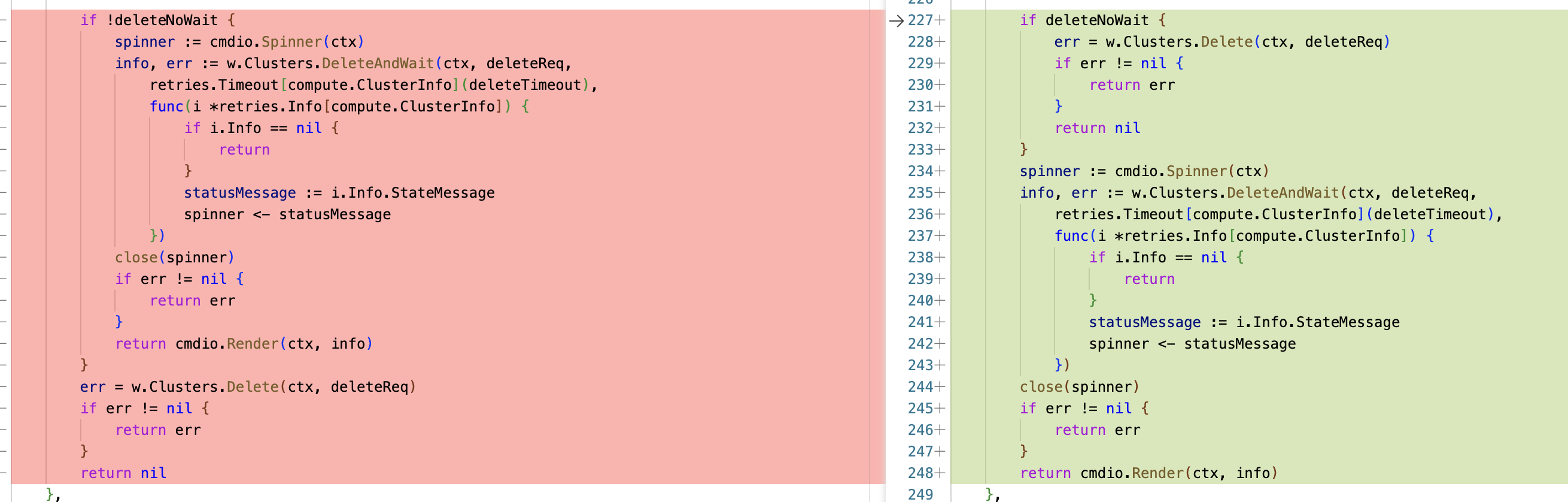
Uh oh!
There was an error while loading. Please reload this page.
| if err != nil { | ||
| return fmt.Errorf("invalid BUDGET: %s", args[0]) | ||
| } | ||
| createReq.BudgetId = args[1] |
There was a problem hiding this comment.
Mandatory args but they don't show up in the usage string of the command.
| // NullColor: color.New(), | ||
| return jsoncolor.MarshalIndentWithFormatter(v, "", " ", f) | ||
| } |
There was a problem hiding this comment.
Why do this? Can pipe to jq if folks want to work with json.
There was a problem hiding this comment.
not all machines have jq installed.
Uh oh!
There was an error while loading. Please reload this page.
Uh oh!
There was an error while loading. Please reload this page.
| for k, v := range names { | ||
| stringNames[k] = fmt.Sprint(v) | ||
| } | ||
| return c.Select(stringNames, label) |
There was a problem hiding this comment.
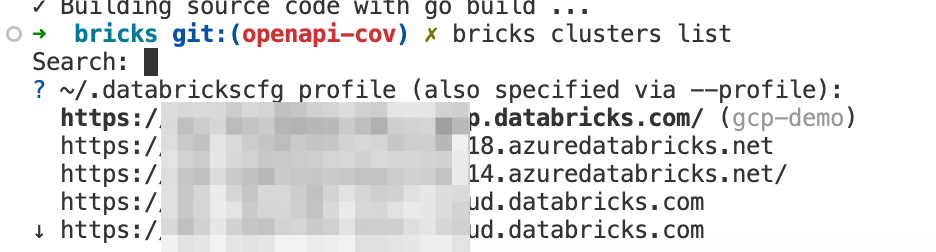
I can imagine ordering sometimes matters when showing a select box (e.g. order of profiles in ~/.databrickscfg) and then this should take a slice and return an index. Also removes the need for alphabetical sorting in the Select function.
There was a problem hiding this comment.
the UX with cmdio.Select for profiles is not great. I want to keep the UX of the current PR. let's address unification in a separate PR.
| "blue": color.BlueString, | ||
| "yellow": color.YellowString, | ||
| "magenta": color.MagentaString, | ||
| "cyan": color.CyanString, |
There was a problem hiding this comment.
Colors or not when rendering a template depends on stdout. For spinner it depends on stderr. The constant color.NoColor depends on stdout alone.
There was a problem hiding this comment.
github.com/fatih/color performs these checks already and is properly skipping render in the non-tty outputs
There was a problem hiding this comment.
Please add a todo to make this check depend on w being a TTY or not to make this generic. The implied assumption is that w is equal to stdout for check in color to work here.
 pietern
left a comment
pietern
left a comment
There was a problem hiding this comment.
Good to merge bar the final set of comments. Please take a look.
Uh oh!
There was an error while loading. Please reload this page.
Uh oh!
There was an error while loading. Please reload this page.
Uh oh!
There was an error while loading. Please reload this page.
Uh oh!
There was an error while loading. Please reload this page.
| "blue": color.BlueString, | ||
| "yellow": color.YellowString, | ||
| "magenta": color.MagentaString, | ||
| "cyan": color.CyanString, |
There was a problem hiding this comment.
Please add a todo to make this check depend on w being a TTY or not to make this generic. The implied assumption is that w is equal to stdout for check in color to work here.
| } | ||
| func renderJson(w io.Writer, v any) error { | ||
| pretty, err := fancyJSON(v) |
There was a problem hiding this comment.
JSON fancification must only happen if w is a TTY.
Uh oh!
There was an error while loading. Please reload this page.

This PR adds the following command groups:
## Workspace-level command groups
* `bricks alerts` - The alerts API can be used to perform CRUD operations on alerts.
* `bricks catalogs` - A catalog is the first layer of Unity Catalog’s three-level namespace.
* `bricks cluster-policies` - Cluster policy limits the ability to configure clusters based on a set of rules.
* `bricks clusters` - The Clusters API allows you to create, start, edit, list, terminate, and delete clusters.
* `bricks current-user` - This API allows retrieving information about currently authenticated user or service principal.
* `bricks dashboards` - In general, there is little need to modify dashboards using the API.
* `bricks data-sources` - This API is provided to assist you in making new query objects.
* `bricks experiments` - MLflow Experiment tracking.
* `bricks external-locations` - An external location is an object that combines a cloud storage path with a storage credential that authorizes access to the cloud storage path.
* `bricks functions` - Functions implement User-Defined Functions (UDFs) in Unity Catalog.
* `bricks git-credentials` - Registers personal access token for Databricks to do operations on behalf of the user.
* `bricks global-init-scripts` - The Global Init Scripts API enables Workspace administrators to configure global initialization scripts for their workspace.
* `bricks grants` - In Unity Catalog, data is secure by default.
* `bricks groups` - Groups simplify identity management, making it easier to assign access to Databricks Workspace, data, and other securable objects.
* `bricks instance-pools` - Instance Pools API are used to create, edit, delete and list instance pools by using ready-to-use cloud instances which reduces a cluster start and auto-scaling times.
* `bricks instance-profiles` - The Instance Profiles API allows admins to add, list, and remove instance profiles that users can launch clusters with.
* `bricks ip-access-lists` - IP Access List enables admins to configure IP access lists.
* `bricks jobs` - The Jobs API allows you to create, edit, and delete jobs.
* `bricks libraries` - The Libraries API allows you to install and uninstall libraries and get the status of libraries on a cluster.
* `bricks metastores` - A metastore is the top-level container of objects in Unity Catalog.
* `bricks model-registry` - MLflow Model Registry commands.
* `bricks permissions` - Permissions API are used to create read, write, edit, update and manage access for various users on different objects and endpoints.
* `bricks pipelines` - The Delta Live Tables API allows you to create, edit, delete, start, and view details about pipelines.
* `bricks policy-families` - View available policy families.
* `bricks providers` - Databricks Providers REST API.
* `bricks queries` - These endpoints are used for CRUD operations on query definitions.
* `bricks query-history` - Access the history of queries through SQL warehouses.
* `bricks recipient-activation` - Databricks Recipient Activation REST API.
* `bricks recipients` - Databricks Recipients REST API.
* `bricks repos` - The Repos API allows users to manage their git repos.
* `bricks schemas` - A schema (also called a database) is the second layer of Unity Catalog’s three-level namespace.
* `bricks secrets` - The Secrets API allows you to manage secrets, secret scopes, and access permissions.
* `bricks service-principals` - Identities for use with jobs, automated tools, and systems such as scripts, apps, and CI/CD platforms.
* `bricks serving-endpoints` - The Serving Endpoints API allows you to create, update, and delete model serving endpoints.
* `bricks shares` - Databricks Shares REST API.
* `bricks storage-credentials` - A storage credential represents an authentication and authorization mechanism for accessing data stored on your cloud tenant.
* `bricks table-constraints` - Primary key and foreign key constraints encode relationships between fields in tables.
* `bricks tables` - A table resides in the third layer of Unity Catalog’s three-level namespace.
* `bricks token-management` - Enables administrators to get all tokens and delete tokens for other users.
* `bricks tokens` - The Token API allows you to create, list, and revoke tokens that can be used to authenticate and access Databricks REST APIs.
* `bricks users` - User identities recognized by Databricks and represented by email addresses.
* `bricks volumes` - Volumes are a Unity Catalog (UC) capability for accessing, storing, governing, organizing and processing files.
* `bricks warehouses` - A SQL warehouse is a compute resource that lets you run SQL commands on data objects within Databricks SQL.
* `bricks workspace` - The Workspace API allows you to list, import, export, and delete notebooks and folders.
* `bricks workspace-conf` - This API allows updating known workspace settings for advanced users.
## Account-level command groups
* `bricks account billable-usage` - This API allows you to download billable usage logs for the specified account and date range.
* `bricks account budgets` - These APIs manage budget configuration including notifications for exceeding a budget for a period.
* `bricks account credentials` - These APIs manage credential configurations for this workspace.
* `bricks account custom-app-integration` - These APIs enable administrators to manage custom oauth app integrations, which is required for adding/using Custom OAuth App Integration like Tableau Cloud for Databricks in AWS cloud.
* `bricks account encryption-keys` - These APIs manage encryption key configurations for this workspace (optional).
* `bricks account groups` - Groups simplify identity management, making it easier to assign access to Databricks Account, data, and other securable objects.
* `bricks account ip-access-lists` - The Accounts IP Access List API enables account admins to configure IP access lists for access to the account console.
* `bricks account log-delivery` - These APIs manage log delivery configurations for this account.
* `bricks account metastore-assignments` - These APIs manage metastore assignments to a workspace.
* `bricks account metastores` - These APIs manage Unity Catalog metastores for an account.
* `bricks account networks` - These APIs manage network configurations for customer-managed VPCs (optional).
* `bricks account o-auth-enrollment` - These APIs enable administrators to enroll OAuth for their accounts, which is required for adding/using any OAuth published/custom application integration.
* `bricks account private-access` - These APIs manage private access settings for this account.
* `bricks account published-app-integration` - These APIs enable administrators to manage published oauth app integrations, which is required for adding/using Published OAuth App Integration like Tableau Cloud for Databricks in AWS cloud.
* `bricks account service-principals` - Identities for use with jobs, automated tools, and systems such as scripts, apps, and CI/CD platforms.
* `bricks account storage` - These APIs manage storage configurations for this workspace.
* `bricks account storage-credentials` - These APIs manage storage credentials for a particular metastore.
* `bricks account users` - User identities recognized by Databricks and represented by email addresses.
* `bricks account vpc-endpoints` - These APIs manage VPC endpoint configurations for this account.
* `bricks account workspace-assignment` - The Workspace Permission Assignment API allows you to manage workspace permissions for principals in your account.
* `bricks account workspaces` - These APIs manage workspaces for this account.
This PR adds the following command groups:
Workspace-level command groups
bricks alerts- The alerts API can be used to perform CRUD operations on alerts.bricks catalogs- A catalog is the first layer of Unity Catalog’s three-level namespace.bricks cluster-policies- Cluster policy limits the ability to configure clusters based on a set of rules.bricks clusters- The Clusters API allows you to create, start, edit, list, terminate, and delete clusters.bricks current-user- This API allows retrieving information about currently authenticated user or service principal.bricks dashboards- In general, there is little need to modify dashboards using the API.bricks data-sources- This API is provided to assist you in making new query objects.bricks experiments- MLflow Experiment tracking.bricks external-locations- An external location is an object that combines a cloud storage path with a storage credential that authorizes access to the cloud storage path.bricks functions- Functions implement User-Defined Functions (UDFs) in Unity Catalog.bricks git-credentials- Registers personal access token for Databricks to do operations on behalf of the user.bricks global-init-scripts- The Global Init Scripts API enables Workspace administrators to configure global initialization scripts for their workspace.bricks grants- In Unity Catalog, data is secure by default.bricks groups- Groups simplify identity management, making it easier to assign access to Databricks Workspace, data, and other securable objects.bricks instance-pools- Instance Pools API are used to create, edit, delete and list instance pools by using ready-to-use cloud instances which reduces a cluster start and auto-scaling times.bricks instance-profiles- The Instance Profiles API allows admins to add, list, and remove instance profiles that users can launch clusters with.bricks ip-access-lists- IP Access List enables admins to configure IP access lists.bricks jobs- The Jobs API allows you to create, edit, and delete jobs.bricks libraries- The Libraries API allows you to install and uninstall libraries and get the status of libraries on a cluster.bricks metastores- A metastore is the top-level container of objects in Unity Catalog.bricks model-registry- MLflow Model Registry commands.bricks permissions- Permissions API are used to create read, write, edit, update and manage access for various users on different objects and endpoints.bricks pipelines- The Delta Live Tables API allows you to create, edit, delete, start, and view details about pipelines.bricks policy-families- View available policy families.bricks providers- Databricks Providers REST API.bricks queries- These endpoints are used for CRUD operations on query definitions.bricks query-history- Access the history of queries through SQL warehouses.bricks recipient-activation- Databricks Recipient Activation REST API.bricks recipients- Databricks Recipients REST API.bricks repos- The Repos API allows users to manage their git repos.bricks schemas- A schema (also called a database) is the second layer of Unity Catalog’s three-level namespace.bricks secrets- The Secrets API allows you to manage secrets, secret scopes, and access permissions.bricks service-principals- Identities for use with jobs, automated tools, and systems such as scripts, apps, and CI/CD platforms.bricks serving-endpoints- The Serving Endpoints API allows you to create, update, and delete model serving endpoints.bricks shares- Databricks Shares REST API.bricks storage-credentials- A storage credential represents an authentication and authorization mechanism for accessing data stored on your cloud tenant.bricks table-constraints- Primary key and foreign key constraints encode relationships between fields in tables.bricks tables- A table resides in the third layer of Unity Catalog’s three-level namespace.bricks token-management- Enables administrators to get all tokens and delete tokens for other users.bricks tokens- The Token API allows you to create, list, and revoke tokens that can be used to authenticate and access Databricks REST APIs.bricks users- User identities recognized by Databricks and represented by email addresses.bricks volumes- Volumes are a Unity Catalog (UC) capability for accessing, storing, governing, organizing and processing files.bricks warehouses- A SQL warehouse is a compute resource that lets you run SQL commands on data objects within Databricks SQL.bricks workspace- The Workspace API allows you to list, import, export, and delete notebooks and folders.bricks workspace-conf- This API allows updating known workspace settings for advanced users.Account-level command groups
bricks account billable-usage- This API allows you to download billable usage logs for the specified account and date range.bricks account budgets- These APIs manage budget configuration including notifications for exceeding a budget for a period.bricks account credentials- These APIs manage credential configurations for this workspace.bricks account custom-app-integration- These APIs enable administrators to manage custom oauth app integrations, which is required for adding/using Custom OAuth App Integration like Tableau Cloud for Databricks in AWS cloud.bricks account encryption-keys- These APIs manage encryption key configurations for this workspace (optional).bricks account groups- Groups simplify identity management, making it easier to assign access to Databricks Account, data, and other securable objects.bricks account ip-access-lists- The Accounts IP Access List API enables account admins to configure IP access lists for access to the account console.bricks account log-delivery- These APIs manage log delivery configurations for this account.bricks account metastore-assignments- These APIs manage metastore assignments to a workspace.bricks account metastores- These APIs manage Unity Catalog metastores for an account.bricks account networks- These APIs manage network configurations for customer-managed VPCs (optional).bricks account o-auth-enrollment- These APIs enable administrators to enroll OAuth for their accounts, which is required for adding/using any OAuth published/custom application integration.bricks account private-access- These APIs manage private access settings for this account.bricks account published-app-integration- These APIs enable administrators to manage published oauth app integrations, which is required for adding/using Published OAuth App Integration like Tableau Cloud for Databricks in AWS cloud.bricks account service-principals- Identities for use with jobs, automated tools, and systems such as scripts, apps, and CI/CD platforms.bricks account storage- These APIs manage storage configurations for this workspace.bricks account storage-credentials- These APIs manage storage credentials for a particular metastore.bricks account users- User identities recognized by Databricks and represented by email addresses.bricks account vpc-endpoints- These APIs manage VPC endpoint configurations for this account.bricks account workspace-assignment- The Workspace Permission Assignment API allows you to manage workspace permissions for principals in your account.bricks account workspaces- These APIs manage workspaces for this account.