

Tiny async queue with concurrency control. Like p-limit or fastq, but smaller and faster. Optional time-based rate limiting also available. See comparisons and benchmarks below.
Works with:





Create a queue with the newQueue function. Then add async functions - or promise returning functions - to your queue with the add method.
You can use queue.done() to wait for the queue to be empty.
import{newQueue}from'@henrygd/queue'// create a new queue with a concurrency of 2constqueue=newQueue(2)constpokemon=['ditto','hitmonlee','pidgeot','poliwhirl','golem','charizard']for(constnameofpokemon){queue.add(async()=>{constres=awaitfetch(`https://pokeapi.co/api/v2/pokemon/${name}`)constjson=awaitres.json()console.log(`${json.name}: ${json.height*10}cm | ${json.weight/10}kg`)})}console.log('running')awaitqueue.done()console.log('done')The return value of queue.add is the same as the return value of the supplied function.
constresponse=awaitqueue.add(()=>fetch("https://pokeapi.co/api/v2/pokemon"));console.log(response.ok,response.status,response.headers);queue.all is like Promise.all with concurrency control:
import{newQueue}from"@henrygd/queue";constqueue=newQueue(2);consttasks=["ditto","hitmonlee","pidgeot","poliwhirl"].map((name)=>async()=>{constres=awaitfetch(`https://pokeapi.co/api/v2/pokemon/${name}`);returnawaitres.json();});// Process all tasks concurrently (limited by queue concurrency) and wait for all to completeconstresults=awaitqueue.all(tasks);console.log(results);// [{ name: 'ditto', ... }, { name: 'hitmonlee', ... }, ...]You can also mix existing promises and function wrappers.
constexistingPromise=fetch("https://pokeapi.co/api/v2/pokemon/ditto").then((r)=>r.json());constresults=awaitqueue.all([existingPromise,()=>fetch("https://pokeapi.co/api/v2/pokemon/pidgeot").then((r)=>r.json()),]);Note that only the wrapper functions are queued, since existing promises start running as soon as you create them.
If you need to limit not just concurrency (how many tasks run simultaneously) but also rate (how many tasks can start within a time window), use @henrygd/queue/rl.
This is useful when working with APIs that have rate limits.
import{newQueue}from'@henrygd/queue/rl'// max 10 concurrent requests, but only 3 can start per secondconstqueue=newQueue(10,3,1000)conststart=Date.now()for(leti=1;i<=10;i++){queue.add(async()=>console.log(`Task ${i} started at ${Date.now()-start}ms`))}awaitqueue.done()The signature is: newQueue(concurrency, rate?, interval?).
concurrency- Maximum number of tasks running simultaneouslyrate- Maximum number of tasks that can start within theinterval(optional)interval- Time window in milliseconds for rate limiting (optional)
If you omit rate and interval, it works exactly like the main package (just concurrency limiting).
Tip
If you need support for Node's AsyncLocalStorage, import @henrygd/queue/async-storage instead.
/** Add an async function / promise wrapper to the queue */queue.add<T>(promiseFunction: ()=>PromiseLike<T>): Promise<T>/** Adds promises (or wrappers) to the queue and resolves like Promise.all */queue.all<T>(promiseFunctions: Array<PromiseLike<T>|(()=>PromiseLike<T>)>): Promise<T[]>/** Returns a promise that resolves when the queue is empty */queue.done(): Promise<void>/** Empties the queue - pending promises are rejected, active promises continue */queue.clear(): void/** Returns the number of promises currently running */queue.active(): number/** Returns the total number of promises in the queue */queue.size(): number| Library | Version | Bundle size (B) | Weekly downloads |
|---|---|---|---|
| @henrygd/queue | 1.2.0 | 472 | hundreds :) |
| @henrygd/queue/rl | 1.2.0 | 685 | - |
| p-limit | 5.0.0 | 1,763 | 118,953,973 |
| async.queue | 3.2.5 | 6,873 | 53,645,627 |
| fastq | 1.17.1 | 3,050 | 39,257,355 |
| queue | 7.0.0 | 2,840 | 4,259,101 |
| promise-queue | 2.2.5 | 2,200 | 1,092,431 |
All libraries run the exact same test. Each operation measures how quickly the queue can resolve 1,000 async functions. The function just increments a counter and checks if it has reached 1,000.1
We check for completion inside the function so that promise-queue and p-limit are not penalized by having to use Promise.all (they don't provide a promise that resolves when the queue is empty).
This test was run in Chromium. Chrome and Edge are the same. Firefox and Safari are slower and closer, with @henrygd/queue just edging out promise-queue. I think both are hitting the upper limit of what those browsers will allow.
You can run or tweak for yourself here: https://jsbm.dev/TKyOdie0sbpOh
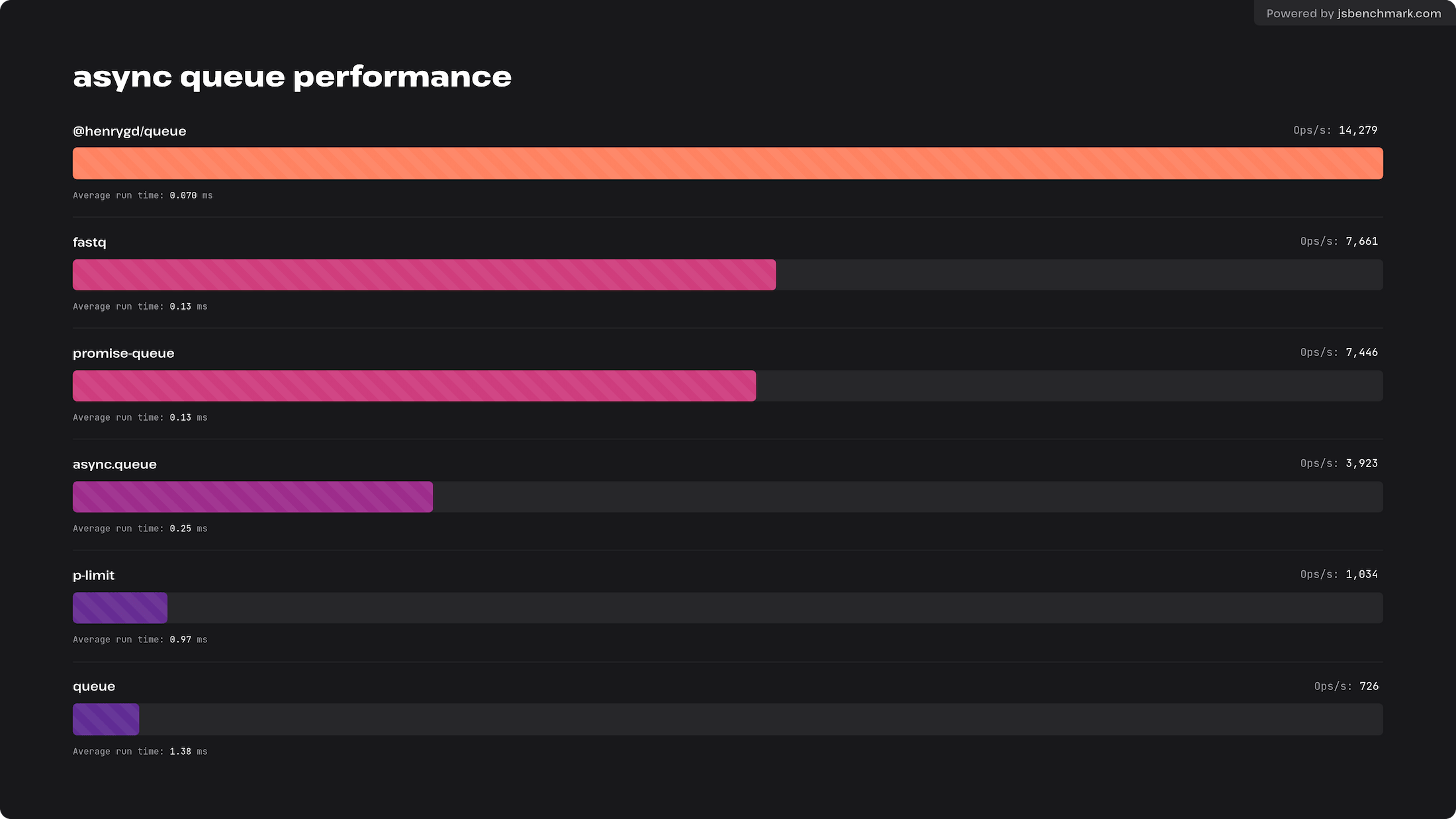
Note:
p-limit6.1.0 now places betweenasync.queueandqueuein Node and Deno.
Ryzen 5 4500U | 8GB RAM | Node 22.3.0
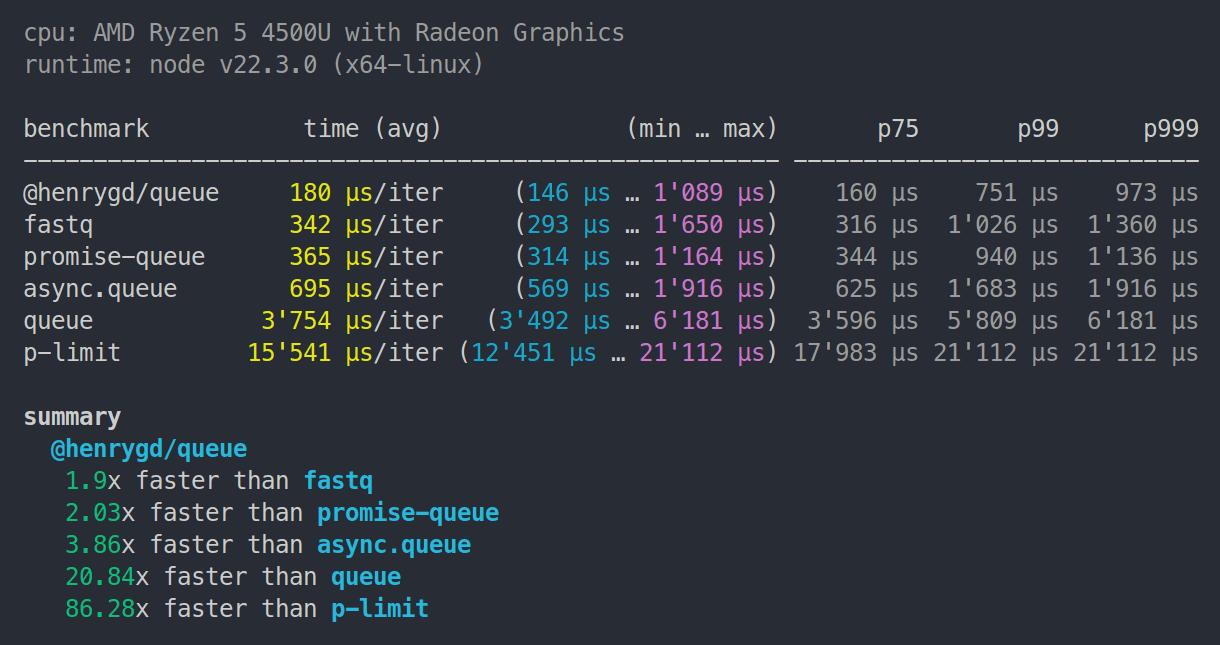
Ryzen 7 6800H | 32GB RAM | Node 22.3.0
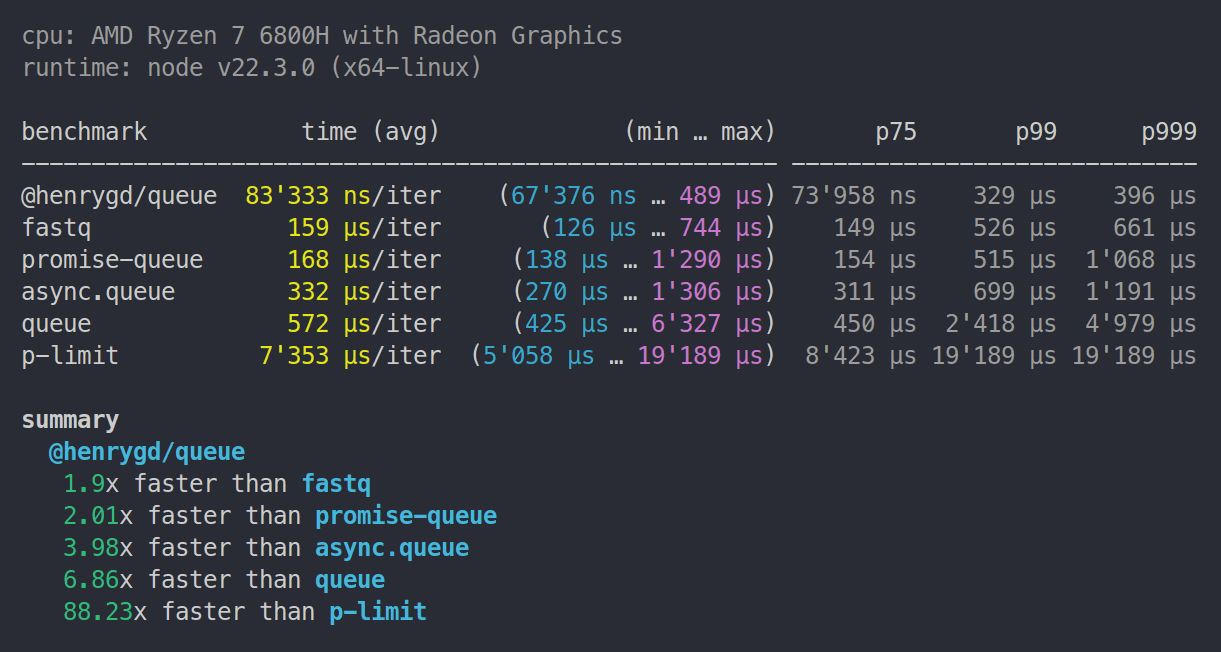
Note:
p-limit6.1.0 now places betweenasync.queueandqueuein Node and Deno.
Ryzen 5 4500U | 8GB RAM | Deno 1.44.4
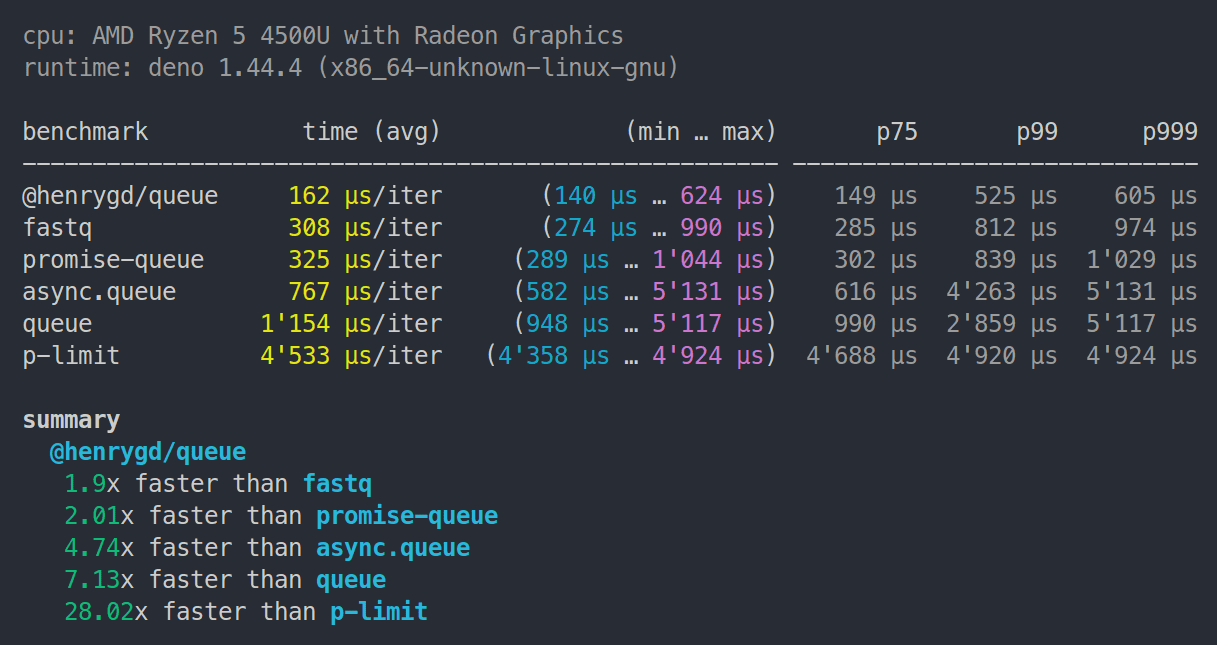
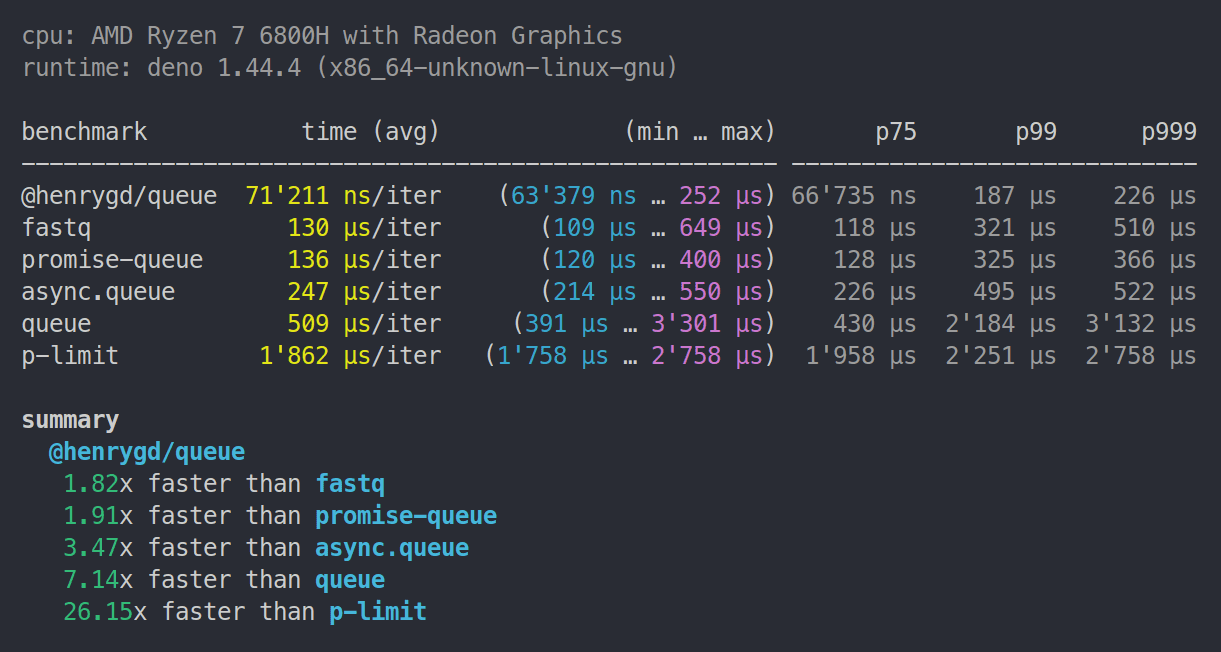
Ryzen 7 6800H | 32GB RAM | Deno 1.44.4
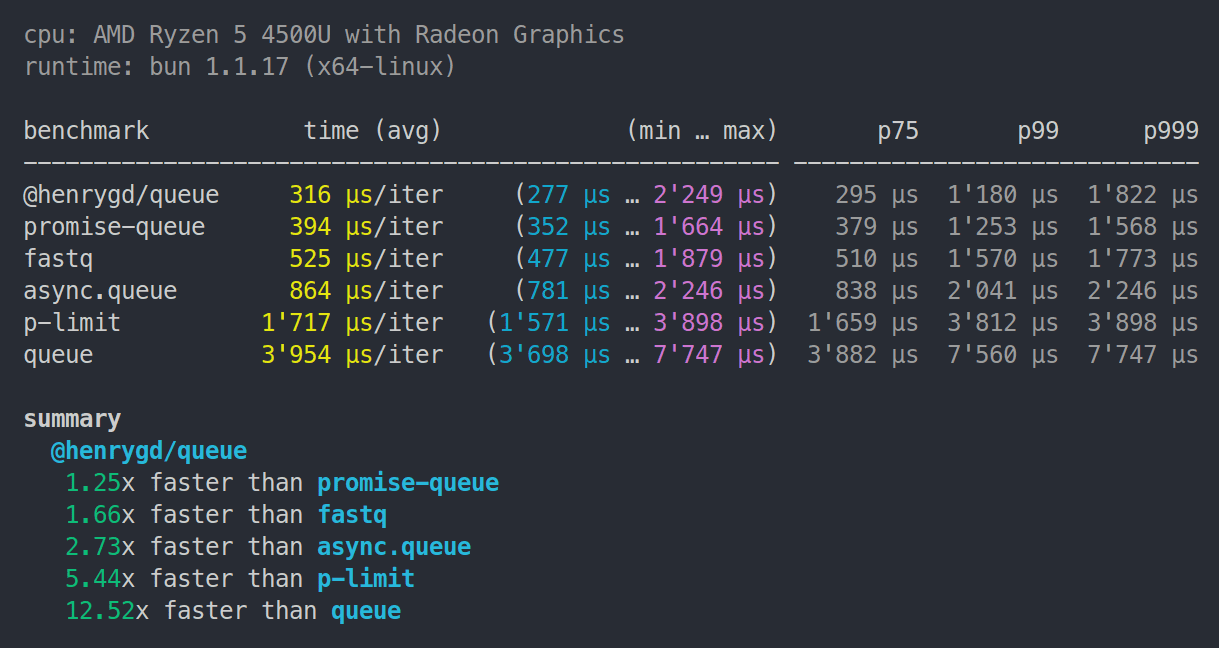
Ryzen 5 4500U | 8GB RAM | Bun 1.1.17
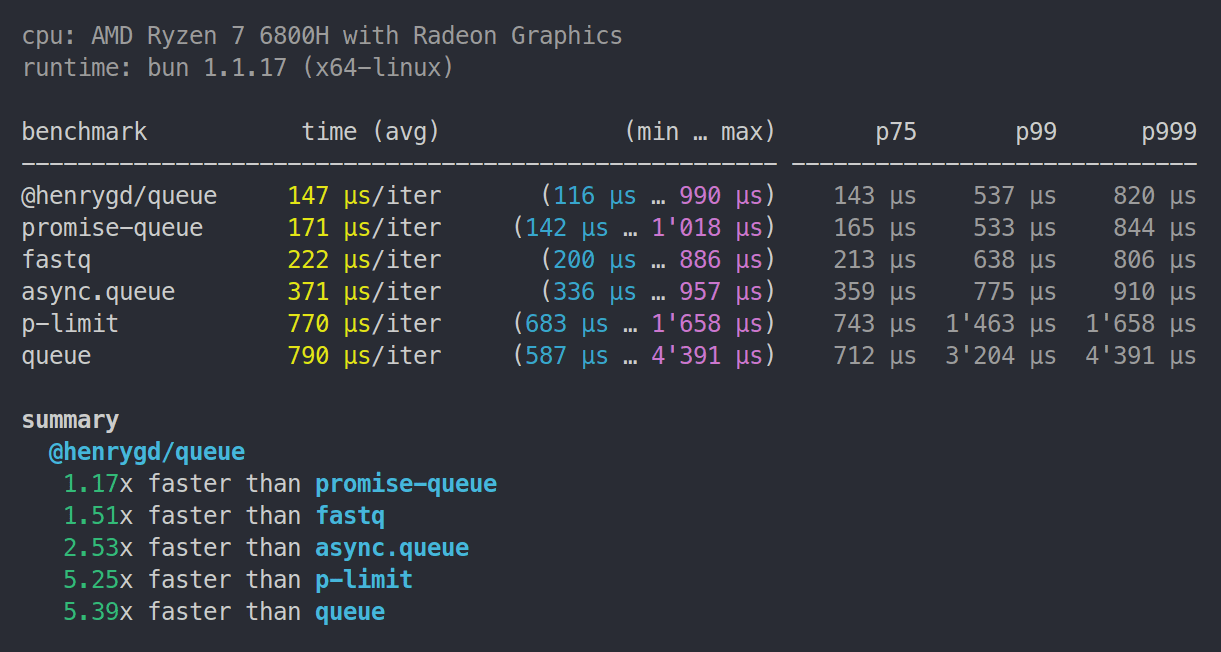
Ryzen 7 6800H | 32GB RAM | Bun 1.1.17
Uses oha to make 1,000 requests to each worker. Each request creates a queue and resolves 5,000 functions.
This was run locally using Wrangler on a Ryzen 7 6800H laptop. Wrangler uses the same workerd runtime as workers deployed to Cloudflare, so the relative difference should be accurate. Here's the repository for this benchmark.
| Library | Requests/sec | Total (sec) | Average | Slowest |
|---|---|---|---|---|
| @henrygd/queue | 816.1074 | 1.2253 | 0.0602 | 0.0864 |
| promise-queue | 647.2809 | 1.5449 | 0.0759 | 0.1149 |
| fastq | 336.7031 | 3.0877 | 0.1459 | 0.2080 |
| async.queue | 198.9986 | 5.0252 | 0.2468 | 0.3544 |
| queue | 85.6483 | 11.6757 | 0.5732 | 0.7629 |
| p-limit | 77.7434 | 12.8628 | 0.6316 | 0.9585 |
@henrygd/semaphore - Fastest javascript inline semaphores and mutexes using async / await.
Footnotes
In real applications, you may not be running so many jobs at once, and your jobs will take much longer to resolve. So performance will depend more on the jobs themselves. ↩