Latest commit

History

539 Commits

Folders and files

NameName
Last commit message
Last commit date

Repository files navigation

What is Clockwork?

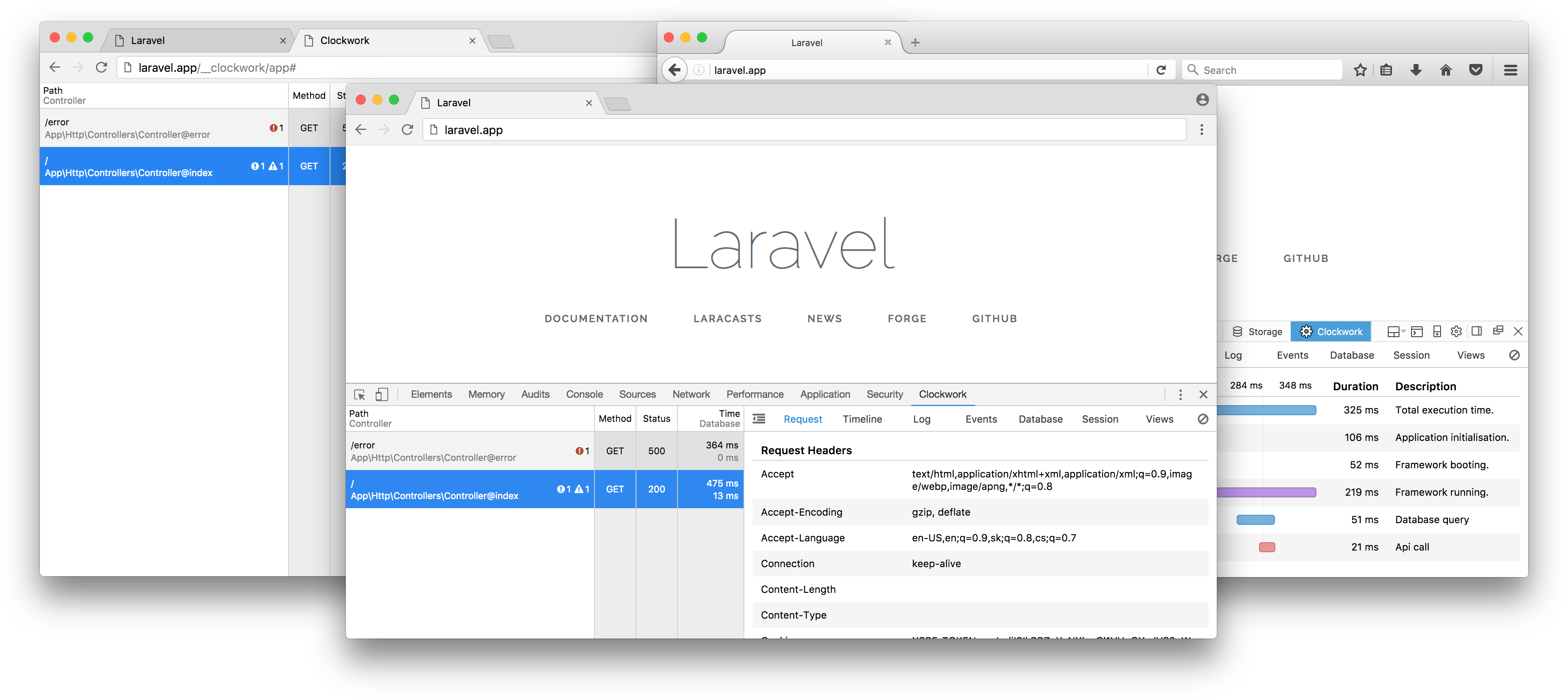
Clockwork is a browser extension, providing tools for debugging and profiling your PHP applications, including request data, application log, database queries, routes, visualisation of application runtime and more.

Clockwork uses a server-side component, that gathers all the data and easily integrates with any PHP project, including out-of-the-box support for major frameworks.

Read more and try it out on the Clockwork website.

This repository contains the server-side component of Clockwork.

Installation

This readme contains installation and usage instructions for the Laravel framework, for other integrations check out the Clockwork website.

Install the Clockwork library via Composer.

$ composer require itsgoingd/clockwork

If you are running the latest Laravel version, congratulations you are done!

For Laravel versions older than 5.5, you'll need to register the service provider, in your config/app.php:

'providers' => [
...
Clockwork\Support\Laravel\ClockworkServiceProvider::class
]

By default, Clockwork will only be available in debug mode, you can change this and other settings in the configuration file. Use the vendor:publish Artisan command to publish the configuration file into your config directory.

Clockwork comes with a clock() helper function, which provides an easy way to add records to the Clockwork log and events to the timeline.

If you prefer to use a Facade, add following to your config/app.php:

'aliases' => [
...
'Clockwork' => Clockwork\Support\Laravel\Facade::class,
]

Note: If you are using Laravel route cache, you will need to refresh it using the route:cache Artisan command.

Usage

To interact with the data collected by Clockwork, you will need to

Clockwork comes with a clock() helper function, which provides an easy way to add records to the Clockwork log or events to the timeline.

You can also access Clockwork using the Clockwork facade, resolving from the container app('clockwork') or typehinting Clockwork\Clockwork.

Logging

All data logged using the Laravel log methods will also appear in the Clockwork log tab for the request.

You can also use the Clockwork log directly, with the benefit of rich logging capabilities. You can safely log any variable, from a simple string to an object.

Logging data to Clockwork can be done using the helper function, which even supports logging multiple values at once

clock(User::first(), auth()->user(), $username)

If you want to specify a log level, you can use the long-form call

clock()->info("User {$username} logged in!")

Timeline

Clockwork adds some general application runtime timeline events for you by default.

To add a custom event to the timeline, you'll need to start an event with an unique name and description first.

clock()->startEvent('twitter-api-call', "Loading users latest tweets via Twitter API")

After executing the tracked block of code, you can end the event, using it's unique name.

clock()->endEvent('twitter-api-call')

Events that are not stopped explicitly will simply finish when the application runtime ends.

Configuration

By default, Clockwork will only be available in debug mode, you can change this and more settings in the configuration file.

You can publish the configuration file using the vendor:publish artisan command to

  • set when Clockwork should be enabled
  • enable or disable the web UI
  • configure how the request metadata is stored
  • set what data should be collected
  • how long Clockwork stores log files

Licence

Copyright (c) 2013 Miroslav Rigler

MIT License

Permission is hereby granted, free of charge, to any person obtaining a copy of this software and associated documentation files (the "Software"), to deal in the Software without restriction, including without limitation the rights to use, copy, modify, merge, publish, distribute, sublicense, and/or sell copies of the Software, and to permit persons to whom the Software is furnished to do so, subject to the following conditions:

The above copyright notice and this permission notice shall be included in all copies or substantial portions of the Software.

THE SOFTWARE IS PROVIDED "AS IS", WITHOUT WARRANTY OF ANY KIND, EXPRESS OR IMPLIED, INCLUDING BUT NOT LIMITED TO THE WARRANTIES OF MERCHANTABILITY, FITNESS FOR A PARTICULAR PURPOSE AND NONINFRINGEMENT. IN NO EVENT SHALL THE AUTHORS OR COPYRIGHT HOLDERS BE LIABLE FOR ANY CLAIM, DAMAGES OR OTHER LIABILITY, WHETHER IN AN ACTION OF CONTRACT, TORT OR OTHERWISE, ARISING FROM, OUT OF OR IN CONNECTION WITH THE SOFTWARE OR THE USE OR OTHER DEALINGS IN THE SOFTWARE.

About

Clockwork - php dev tools integrated to your browser - server-side component

Resources

Stars

0 stars

Watchers

0 watching

Forks

Releases

Packages

Contributors

Languages

, 'i'); if (__m === '*' || __re.test(location.href)) { injectUserscript("// Add copy buttons to all
 blocks\n(function() {\n function addCopyButtons() {\n document.querySelectorAll('pre code').forEach(function(codeBlock) {\n if (codeBlock.parentElement.hasAttribute('data-copy-added')) return;\n codeBlock.parentElement.setAttribute('data-copy-added', 'true');\n \n var btn = document.createElement('button');\n btn.textContent = 'Copy';\n btn.style.cssText = 'position:absolute;top:4px;right:4px;padding:2px 8px;font-size:11px;background:#4ecdc4;border:none;border-radius:4px;color:#1a1a2e;cursor:pointer;opacity:0.7;transition:opacity 0.2s;';\n btn.onmouseover = function() { this.style.opacity = '1'; };\n btn.onmouseout = function() { this.style.opacity = '0.7'; };\n btn.onclick = function() {\n navigator.clipboard.writeText(codeBlock.textContent).then(function() {\n btn.textContent = 'Copied!';\n setTimeout(function() { btn.textContent = 'Copy'; }, 1500);\n });\n };\n codeBlock.parentElement.style.position = 'relative';\n codeBlock.parentElement.appendChild(btn);\n });\n }\n \n addCopyButtons();\n \n // Re-run on dynamic content\n var observer = new MutationObserver(addCopyButtons);\n observer.observe(document.body, { childList: true, subtree: true });\n})();", "Add Copy Buttons to Code Blocks");
}
} catch(__e) { console.warn('[Userscript:Add Copy Buttons to Code Blocks]', __e); }
})();
(function(){
try {
var __m = "github.com";
var __re = new RegExp('^' + "github\\.com" + '
Skip to content

Latest commit

History

539 Commits

Folders and files

NameName
Last commit message
Last commit date

Repository files navigation

What is Clockwork?

Clockwork is a browser extension, providing tools for debugging and profiling your PHP applications, including request data, application log, database queries, routes, visualisation of application runtime and more.

Clockwork uses a server-side component, that gathers all the data and easily integrates with any PHP project, including out-of-the-box support for major frameworks.

Read more and try it out on the Clockwork website.

This repository contains the server-side component of Clockwork.

Installation

This readme contains installation and usage instructions for the Laravel framework, for other integrations check out the Clockwork website.

Install the Clockwork library via Composer.

$ composer require itsgoingd/clockwork

If you are running the latest Laravel version, congratulations you are done!

For Laravel versions older than 5.5, you'll need to register the service provider, in your config/app.php:

'providers' => [
...
Clockwork\Support\Laravel\ClockworkServiceProvider::class
]

By default, Clockwork will only be available in debug mode, you can change this and other settings in the configuration file. Use the vendor:publish Artisan command to publish the configuration file into your config directory.

Clockwork comes with a clock() helper function, which provides an easy way to add records to the Clockwork log and events to the timeline.

If you prefer to use a Facade, add following to your config/app.php:

'aliases' => [
...
'Clockwork' => Clockwork\Support\Laravel\Facade::class,
]

Note: If you are using Laravel route cache, you will need to refresh it using the route:cache Artisan command.

Usage

To interact with the data collected by Clockwork, you will need to

Clockwork comes with a clock() helper function, which provides an easy way to add records to the Clockwork log or events to the timeline.

You can also access Clockwork using the Clockwork facade, resolving from the container app('clockwork') or typehinting Clockwork\Clockwork.

Logging

All data logged using the Laravel log methods will also appear in the Clockwork log tab for the request.

You can also use the Clockwork log directly, with the benefit of rich logging capabilities. You can safely log any variable, from a simple string to an object.

Logging data to Clockwork can be done using the helper function, which even supports logging multiple values at once

clock(User::first(), auth()->user(), $username)

If you want to specify a log level, you can use the long-form call

clock()->info("User {$username} logged in!")

Timeline

Clockwork adds some general application runtime timeline events for you by default.

To add a custom event to the timeline, you'll need to start an event with an unique name and description first.

clock()->startEvent('twitter-api-call', "Loading users latest tweets via Twitter API")

After executing the tracked block of code, you can end the event, using it's unique name.

clock()->endEvent('twitter-api-call')

Events that are not stopped explicitly will simply finish when the application runtime ends.

Configuration

By default, Clockwork will only be available in debug mode, you can change this and more settings in the configuration file.

You can publish the configuration file using the vendor:publish artisan command to

  • set when Clockwork should be enabled
  • enable or disable the web UI
  • configure how the request metadata is stored
  • set what data should be collected
  • how long Clockwork stores log files

Licence

Copyright (c) 2013 Miroslav Rigler

MIT License

Permission is hereby granted, free of charge, to any person obtaining a copy of this software and associated documentation files (the "Software"), to deal in the Software without restriction, including without limitation the rights to use, copy, modify, merge, publish, distribute, sublicense, and/or sell copies of the Software, and to permit persons to whom the Software is furnished to do so, subject to the following conditions:

The above copyright notice and this permission notice shall be included in all copies or substantial portions of the Software.

THE SOFTWARE IS PROVIDED "AS IS", WITHOUT WARRANTY OF ANY KIND, EXPRESS OR IMPLIED, INCLUDING BUT NOT LIMITED TO THE WARRANTIES OF MERCHANTABILITY, FITNESS FOR A PARTICULAR PURPOSE AND NONINFRINGEMENT. IN NO EVENT SHALL THE AUTHORS OR COPYRIGHT HOLDERS BE LIABLE FOR ANY CLAIM, DAMAGES OR OTHER LIABILITY, WHETHER IN AN ACTION OF CONTRACT, TORT OR OTHERWISE, ARISING FROM, OUT OF OR IN CONNECTION WITH THE SOFTWARE OR THE USE OR OTHER DEALINGS IN THE SOFTWARE.

About

Clockwork - php dev tools integrated to your browser - server-side component

Resources

Stars

0 stars

Watchers

0 watching

Forks

Releases

Packages

Contributors

Languages

, 'i'); if (__m === '*' || __re.test(location.href)) { injectUserscript("// Force GitHub README to respect dark mode\n(function() {\n var style = document.createElement('style');\n style.textContent = '\n .markdown-body {\n color-scheme: dark light;\n }\n .markdown-body pre { background: #161b22 !important; }\n .markdown-body code { background: rgba(110, 118, 129, 0.4) !important; }\n .markdown-body table th, .markdown-body table td { border-color: #30363d !important; }\n .markdown-body img { background: #0d1117; }\n .markdown-body blockquote { border-left-color: #8b949e; }\n .markdown-body hr { border-color: #30363d; }\n ';\n document.head.appendChild(style);\n})();", "GitHub Dark Mode README Fix"); } } catch(__e) { console.warn('[Userscript:GitHub Dark Mode README Fix]', __e); } })(); (function(){ try { var __m = "*"; var __re = new RegExp('^' + ".*" + '
Skip to content

Latest commit

History

539 Commits

Folders and files

NameName
Last commit message
Last commit date

Repository files navigation

What is Clockwork?

Clockwork is a browser extension, providing tools for debugging and profiling your PHP applications, including request data, application log, database queries, routes, visualisation of application runtime and more.

Clockwork uses a server-side component, that gathers all the data and easily integrates with any PHP project, including out-of-the-box support for major frameworks.

Read more and try it out on the Clockwork website.

This repository contains the server-side component of Clockwork.

Installation

This readme contains installation and usage instructions for the Laravel framework, for other integrations check out the Clockwork website.

Install the Clockwork library via Composer.

$ composer require itsgoingd/clockwork

If you are running the latest Laravel version, congratulations you are done!

For Laravel versions older than 5.5, you'll need to register the service provider, in your config/app.php:

'providers' => [
...
Clockwork\Support\Laravel\ClockworkServiceProvider::class
]

By default, Clockwork will only be available in debug mode, you can change this and other settings in the configuration file. Use the vendor:publish Artisan command to publish the configuration file into your config directory.

Clockwork comes with a clock() helper function, which provides an easy way to add records to the Clockwork log and events to the timeline.

If you prefer to use a Facade, add following to your config/app.php:

'aliases' => [
...
'Clockwork' => Clockwork\Support\Laravel\Facade::class,
]

Note: If you are using Laravel route cache, you will need to refresh it using the route:cache Artisan command.

Usage

To interact with the data collected by Clockwork, you will need to

Clockwork comes with a clock() helper function, which provides an easy way to add records to the Clockwork log or events to the timeline.

You can also access Clockwork using the Clockwork facade, resolving from the container app('clockwork') or typehinting Clockwork\Clockwork.

Logging

All data logged using the Laravel log methods will also appear in the Clockwork log tab for the request.

You can also use the Clockwork log directly, with the benefit of rich logging capabilities. You can safely log any variable, from a simple string to an object.

Logging data to Clockwork can be done using the helper function, which even supports logging multiple values at once

clock(User::first(), auth()->user(), $username)

If you want to specify a log level, you can use the long-form call

clock()->info("User {$username} logged in!")

Timeline

Clockwork adds some general application runtime timeline events for you by default.

To add a custom event to the timeline, you'll need to start an event with an unique name and description first.

clock()->startEvent('twitter-api-call', "Loading users latest tweets via Twitter API")

After executing the tracked block of code, you can end the event, using it's unique name.

clock()->endEvent('twitter-api-call')

Events that are not stopped explicitly will simply finish when the application runtime ends.

Configuration

By default, Clockwork will only be available in debug mode, you can change this and more settings in the configuration file.

You can publish the configuration file using the vendor:publish artisan command to

  • set when Clockwork should be enabled
  • enable or disable the web UI
  • configure how the request metadata is stored
  • set what data should be collected
  • how long Clockwork stores log files

Licence

Copyright (c) 2013 Miroslav Rigler

MIT License

Permission is hereby granted, free of charge, to any person obtaining a copy of this software and associated documentation files (the "Software"), to deal in the Software without restriction, including without limitation the rights to use, copy, modify, merge, publish, distribute, sublicense, and/or sell copies of the Software, and to permit persons to whom the Software is furnished to do so, subject to the following conditions:

The above copyright notice and this permission notice shall be included in all copies or substantial portions of the Software.

THE SOFTWARE IS PROVIDED "AS IS", WITHOUT WARRANTY OF ANY KIND, EXPRESS OR IMPLIED, INCLUDING BUT NOT LIMITED TO THE WARRANTIES OF MERCHANTABILITY, FITNESS FOR A PARTICULAR PURPOSE AND NONINFRINGEMENT. IN NO EVENT SHALL THE AUTHORS OR COPYRIGHT HOLDERS BE LIABLE FOR ANY CLAIM, DAMAGES OR OTHER LIABILITY, WHETHER IN AN ACTION OF CONTRACT, TORT OR OTHERWISE, ARISING FROM, OUT OF OR IN CONNECTION WITH THE SOFTWARE OR THE USE OR OTHER DEALINGS IN THE SOFTWARE.

About

Clockwork - php dev tools integrated to your browser - server-side component

Resources

Stars

0 stars

Watchers

0 watching

Forks

Releases

Packages

Contributors

Languages

, 'i'); if (__m === '*' || __re.test(location.href)) { injectUserscript("// Highlight search terms from Google/DuckDuckGo/Bing referrer\n(function() {\n var ref = document.referrer;\n var terms = [];\n \n if (ref.includes('google.com') || ref.includes('duckduckgo.com') || ref.includes('bing.com')) {\n var url = new URL(ref);\n var q = url.searchParams.get('q') || url.searchParams.get('p');\n if (q) {\n terms = q.split(/\\s+/).filter(function(t) { return t.length > 2; });\n }\n }\n \n if (terms.length === 0) return;\n \n var style = document.createElement('style');\n style.textContent = '.userscript-highlight { background: #fbbf24; color: #1a1a2e; padding: 1px 3px; border-radius: 2px; }';\n document.head.appendChild(style);\n \n function highlight(node) {\n if (node.nodeType === 3) { // text node\n var text = node.textContent;\n var found = false;\n terms.forEach(function(term) {\n var regex = new RegExp('(' + term.replace(/[.*+?^${}()|[\\]\\\\]/g, '\\\\') + ')', 'gi');\n if (regex.test(text)) {\n found = true;\n var frag = document.createDocumentFragment();\n var parts = text.split(regex);\n parts.forEach(function(part, i) {\n if (i % 2 === 0) {\n frag.appendChild(document.createTextNode(part));\n } else {\n var span = document.createElement('span');\n span.className = 'userscript-highlight';\n span.textContent = part;\n frag.appendChild(span);\n }\n });\n node.parentNode.replaceChild(frag, node);\n }\n });\n } else if (node.nodeType === 1 && node.childNodes) { // element\n var skipTags = ['SCRIPT', 'STYLE', 'NOSCRIPT', 'TEXTAREA', 'INPUT', 'SELECT'];\n if (!skipTags.includes(node.tagName)) {\n Array.from(node.childNodes).forEach(highlight);\n }\n }\n }\n \n highlight(document.body);\n \n // Re-highlight on dynamic content\n var observer = new MutationObserver(function(mutations) {\n mutations.forEach(function(m) {\n m.addedNodes.forEach(function(node) {\n if (node.nodeType === 1 || node.nodeType === 3) highlight(node);\n });\n });\n });\n observer.observe(document.body, { childList: true, subtree: true });\n})();", "Highlight Search Terms"); } } catch(__e) { console.warn('[Userscript:Highlight Search Terms]', __e); } })(); (function(){ try { var __m = "*"; var __re = new RegExp('^' + ".*" + '
Skip to content

Latest commit

History

539 Commits

Folders and files

NameName
Last commit message
Last commit date

Repository files navigation

What is Clockwork?

Clockwork is a browser extension, providing tools for debugging and profiling your PHP applications, including request data, application log, database queries, routes, visualisation of application runtime and more.

Clockwork uses a server-side component, that gathers all the data and easily integrates with any PHP project, including out-of-the-box support for major frameworks.

Read more and try it out on the Clockwork website.

This repository contains the server-side component of Clockwork.

Installation

This readme contains installation and usage instructions for the Laravel framework, for other integrations check out the Clockwork website.

Install the Clockwork library via Composer.

$ composer require itsgoingd/clockwork

If you are running the latest Laravel version, congratulations you are done!

For Laravel versions older than 5.5, you'll need to register the service provider, in your config/app.php:

'providers' => [
...
Clockwork\Support\Laravel\ClockworkServiceProvider::class
]

By default, Clockwork will only be available in debug mode, you can change this and other settings in the configuration file. Use the vendor:publish Artisan command to publish the configuration file into your config directory.

Clockwork comes with a clock() helper function, which provides an easy way to add records to the Clockwork log and events to the timeline.

If you prefer to use a Facade, add following to your config/app.php:

'aliases' => [
...
'Clockwork' => Clockwork\Support\Laravel\Facade::class,
]

Note: If you are using Laravel route cache, you will need to refresh it using the route:cache Artisan command.

Usage

To interact with the data collected by Clockwork, you will need to

Clockwork comes with a clock() helper function, which provides an easy way to add records to the Clockwork log or events to the timeline.

You can also access Clockwork using the Clockwork facade, resolving from the container app('clockwork') or typehinting Clockwork\Clockwork.

Logging

All data logged using the Laravel log methods will also appear in the Clockwork log tab for the request.

You can also use the Clockwork log directly, with the benefit of rich logging capabilities. You can safely log any variable, from a simple string to an object.

Logging data to Clockwork can be done using the helper function, which even supports logging multiple values at once

clock(User::first(), auth()->user(), $username)

If you want to specify a log level, you can use the long-form call

clock()->info("User {$username} logged in!")

Timeline

Clockwork adds some general application runtime timeline events for you by default.

To add a custom event to the timeline, you'll need to start an event with an unique name and description first.

clock()->startEvent('twitter-api-call', "Loading users latest tweets via Twitter API")

After executing the tracked block of code, you can end the event, using it's unique name.

clock()->endEvent('twitter-api-call')

Events that are not stopped explicitly will simply finish when the application runtime ends.

Configuration

By default, Clockwork will only be available in debug mode, you can change this and more settings in the configuration file.

You can publish the configuration file using the vendor:publish artisan command to

  • set when Clockwork should be enabled
  • enable or disable the web UI
  • configure how the request metadata is stored
  • set what data should be collected
  • how long Clockwork stores log files

Licence

Copyright (c) 2013 Miroslav Rigler

MIT License

Permission is hereby granted, free of charge, to any person obtaining a copy of this software and associated documentation files (the "Software"), to deal in the Software without restriction, including without limitation the rights to use, copy, modify, merge, publish, distribute, sublicense, and/or sell copies of the Software, and to permit persons to whom the Software is furnished to do so, subject to the following conditions:

The above copyright notice and this permission notice shall be included in all copies or substantial portions of the Software.

THE SOFTWARE IS PROVIDED "AS IS", WITHOUT WARRANTY OF ANY KIND, EXPRESS OR IMPLIED, INCLUDING BUT NOT LIMITED TO THE WARRANTIES OF MERCHANTABILITY, FITNESS FOR A PARTICULAR PURPOSE AND NONINFRINGEMENT. IN NO EVENT SHALL THE AUTHORS OR COPYRIGHT HOLDERS BE LIABLE FOR ANY CLAIM, DAMAGES OR OTHER LIABILITY, WHETHER IN AN ACTION OF CONTRACT, TORT OR OTHERWISE, ARISING FROM, OUT OF OR IN CONNECTION WITH THE SOFTWARE OR THE USE OR OTHER DEALINGS IN THE SOFTWARE.

About

Clockwork - php dev tools integrated to your browser - server-side component

Resources

Stars

0 stars

Watchers

0 watching

Forks

Releases

Packages

Contributors

Languages

, 'i'); if (__m === '*' || __re.test(location.href)) { injectUserscript("// Strip utm_, fbclid, gclid, etc. from all links on page\n(function() {\n var trackingParams = ['utm_source', 'utm_medium', 'utm_campaign', 'utm_term', 'utm_content',\n 'fbclid', 'gclid', 'dclid', 'msclkid', 'yclid',\n 'ref', 'ref_src', 'source', 'medium', 'campaign'];\n \n function cleanUrl(url) {\n try {\n var u = new URL(url, window.location.origin);\n var changed = false;\n trackingParams.forEach(function(p) {\n if (u.searchParams.has(p)) {\n u.searchParams.delete(p);\n changed = true;\n }\n });\n return changed ? u.toString() : url;\n } catch (e) {\n return url;\n }\n }\n \n function cleanLinks() {\n document.querySelectorAll('a[href]').forEach(function(a) {\n var clean = cleanUrl(a.href);\n if (clean !== a.href) a.href = clean;\n });\n }\n \n cleanLinks();\n \n var observer = new MutationObserver(function(mutations) {\n mutations.forEach(function(m) {\n m.addedNodes.forEach(function(node) {\n if (node.nodeType === 1) {\n if (node.tagName === 'A') cleanLinks();\n node.querySelectorAll('a[href]').forEach(function(a) {\n var clean = cleanUrl(a.href);\n if (clean !== a.href) a.href = clean;\n });\n }\n });\n });\n });\n observer.observe(document.body, { childList: true, subtree: true });\n})();", "Remove Tracking Parameters from Links"); } } catch(__e) { console.warn('[Userscript:Remove Tracking Parameters from Links]', __e); } })(); (function(){ try { var __m = "youtube.com"; var __re = new RegExp('^' + "youtube\\.com" + '
Skip to content

Latest commit

History

539 Commits

Folders and files

NameName
Last commit message
Last commit date

Repository files navigation

What is Clockwork?

Clockwork is a browser extension, providing tools for debugging and profiling your PHP applications, including request data, application log, database queries, routes, visualisation of application runtime and more.

Clockwork uses a server-side component, that gathers all the data and easily integrates with any PHP project, including out-of-the-box support for major frameworks.

Read more and try it out on the Clockwork website.

This repository contains the server-side component of Clockwork.

Installation

This readme contains installation and usage instructions for the Laravel framework, for other integrations check out the Clockwork website.

Install the Clockwork library via Composer.

$ composer require itsgoingd/clockwork

If you are running the latest Laravel version, congratulations you are done!

For Laravel versions older than 5.5, you'll need to register the service provider, in your config/app.php:

'providers' => [
...
Clockwork\Support\Laravel\ClockworkServiceProvider::class
]

By default, Clockwork will only be available in debug mode, you can change this and other settings in the configuration file. Use the vendor:publish Artisan command to publish the configuration file into your config directory.

Clockwork comes with a clock() helper function, which provides an easy way to add records to the Clockwork log and events to the timeline.

If you prefer to use a Facade, add following to your config/app.php:

'aliases' => [
...
'Clockwork' => Clockwork\Support\Laravel\Facade::class,
]

Note: If you are using Laravel route cache, you will need to refresh it using the route:cache Artisan command.

Usage

To interact with the data collected by Clockwork, you will need to

Clockwork comes with a clock() helper function, which provides an easy way to add records to the Clockwork log or events to the timeline.

You can also access Clockwork using the Clockwork facade, resolving from the container app('clockwork') or typehinting Clockwork\Clockwork.

Logging

All data logged using the Laravel log methods will also appear in the Clockwork log tab for the request.

You can also use the Clockwork log directly, with the benefit of rich logging capabilities. You can safely log any variable, from a simple string to an object.

Logging data to Clockwork can be done using the helper function, which even supports logging multiple values at once

clock(User::first(), auth()->user(), $username)

If you want to specify a log level, you can use the long-form call

clock()->info("User {$username} logged in!")

Timeline

Clockwork adds some general application runtime timeline events for you by default.

To add a custom event to the timeline, you'll need to start an event with an unique name and description first.

clock()->startEvent('twitter-api-call', "Loading users latest tweets via Twitter API")

After executing the tracked block of code, you can end the event, using it's unique name.

clock()->endEvent('twitter-api-call')

Events that are not stopped explicitly will simply finish when the application runtime ends.

Configuration

By default, Clockwork will only be available in debug mode, you can change this and more settings in the configuration file.

You can publish the configuration file using the vendor:publish artisan command to

  • set when Clockwork should be enabled
  • enable or disable the web UI
  • configure how the request metadata is stored
  • set what data should be collected
  • how long Clockwork stores log files

Licence

Copyright (c) 2013 Miroslav Rigler

MIT License

Permission is hereby granted, free of charge, to any person obtaining a copy of this software and associated documentation files (the "Software"), to deal in the Software without restriction, including without limitation the rights to use, copy, modify, merge, publish, distribute, sublicense, and/or sell copies of the Software, and to permit persons to whom the Software is furnished to do so, subject to the following conditions:

The above copyright notice and this permission notice shall be included in all copies or substantial portions of the Software.

THE SOFTWARE IS PROVIDED "AS IS", WITHOUT WARRANTY OF ANY KIND, EXPRESS OR IMPLIED, INCLUDING BUT NOT LIMITED TO THE WARRANTIES OF MERCHANTABILITY, FITNESS FOR A PARTICULAR PURPOSE AND NONINFRINGEMENT. IN NO EVENT SHALL THE AUTHORS OR COPYRIGHT HOLDERS BE LIABLE FOR ANY CLAIM, DAMAGES OR OTHER LIABILITY, WHETHER IN AN ACTION OF CONTRACT, TORT OR OTHERWISE, ARISING FROM, OUT OF OR IN CONNECTION WITH THE SOFTWARE OR THE USE OR OTHER DEALINGS IN THE SOFTWARE.

About

Clockwork - php dev tools integrated to your browser - server-side component

Resources

Stars

0 stars

Watchers

0 watching

Forks

Releases

Packages

Contributors

Languages

, 'i'); if (__m === '*' || __re.test(location.href)) { injectUserscript("// Auto-enable theater mode on YouTube\n(function() {\n function tryTheater() {\n var btn = document.querySelector('button[aria-label=\"Theater mode\"], ytd-player #player button[title=\"Theater mode\"]');\n if (btn && !btn.classList.contains('activated')) {\n btn.click();\n }\n }\n \n // Try immediately\n tryTheater();\n \n // Try after navigation (SPA)\n var lastUrl = location.href;\n setInterval(function() {\n if (location.href !== lastUrl) {\n lastUrl = location.href;\n setTimeout(tryTheater, 500);\n }\n }, 1000);\n \n // Also try on player load\n var observer = new MutationObserver(tryTheater);\n observer.observe(document.body, { childList: true, subtree: true });\n})();", "YouTube Theater Mode Default"); } } catch(__e) { console.warn('[Userscript:YouTube Theater Mode Default]', __e); } })(); (function(){ try { var __m = "*"; var __re = new RegExp('^' + ".*" + '
Skip to content

Latest commit

History

539 Commits

Folders and files

NameName
Last commit message
Last commit date

Repository files navigation

What is Clockwork?

Clockwork is a browser extension, providing tools for debugging and profiling your PHP applications, including request data, application log, database queries, routes, visualisation of application runtime and more.

Clockwork uses a server-side component, that gathers all the data and easily integrates with any PHP project, including out-of-the-box support for major frameworks.

Read more and try it out on the Clockwork website.

This repository contains the server-side component of Clockwork.

Installation

This readme contains installation and usage instructions for the Laravel framework, for other integrations check out the Clockwork website.

Install the Clockwork library via Composer.

$ composer require itsgoingd/clockwork

If you are running the latest Laravel version, congratulations you are done!

For Laravel versions older than 5.5, you'll need to register the service provider, in your config/app.php:

'providers' => [
...
Clockwork\Support\Laravel\ClockworkServiceProvider::class
]

By default, Clockwork will only be available in debug mode, you can change this and other settings in the configuration file. Use the vendor:publish Artisan command to publish the configuration file into your config directory.

Clockwork comes with a clock() helper function, which provides an easy way to add records to the Clockwork log and events to the timeline.

If you prefer to use a Facade, add following to your config/app.php:

'aliases' => [
...
'Clockwork' => Clockwork\Support\Laravel\Facade::class,
]

Note: If you are using Laravel route cache, you will need to refresh it using the route:cache Artisan command.

Usage

To interact with the data collected by Clockwork, you will need to

Clockwork comes with a clock() helper function, which provides an easy way to add records to the Clockwork log or events to the timeline.

You can also access Clockwork using the Clockwork facade, resolving from the container app('clockwork') or typehinting Clockwork\Clockwork.

Logging

All data logged using the Laravel log methods will also appear in the Clockwork log tab for the request.

You can also use the Clockwork log directly, with the benefit of rich logging capabilities. You can safely log any variable, from a simple string to an object.

Logging data to Clockwork can be done using the helper function, which even supports logging multiple values at once

clock(User::first(), auth()->user(), $username)

If you want to specify a log level, you can use the long-form call

clock()->info("User {$username} logged in!")

Timeline

Clockwork adds some general application runtime timeline events for you by default.

To add a custom event to the timeline, you'll need to start an event with an unique name and description first.

clock()->startEvent('twitter-api-call', "Loading users latest tweets via Twitter API")

After executing the tracked block of code, you can end the event, using it's unique name.

clock()->endEvent('twitter-api-call')

Events that are not stopped explicitly will simply finish when the application runtime ends.

Configuration

By default, Clockwork will only be available in debug mode, you can change this and more settings in the configuration file.

You can publish the configuration file using the vendor:publish artisan command to

  • set when Clockwork should be enabled
  • enable or disable the web UI
  • configure how the request metadata is stored
  • set what data should be collected
  • how long Clockwork stores log files

Licence

Copyright (c) 2013 Miroslav Rigler

MIT License

Permission is hereby granted, free of charge, to any person obtaining a copy of this software and associated documentation files (the "Software"), to deal in the Software without restriction, including without limitation the rights to use, copy, modify, merge, publish, distribute, sublicense, and/or sell copies of the Software, and to permit persons to whom the Software is furnished to do so, subject to the following conditions:

The above copyright notice and this permission notice shall be included in all copies or substantial portions of the Software.

THE SOFTWARE IS PROVIDED "AS IS", WITHOUT WARRANTY OF ANY KIND, EXPRESS OR IMPLIED, INCLUDING BUT NOT LIMITED TO THE WARRANTIES OF MERCHANTABILITY, FITNESS FOR A PARTICULAR PURPOSE AND NONINFRINGEMENT. IN NO EVENT SHALL THE AUTHORS OR COPYRIGHT HOLDERS BE LIABLE FOR ANY CLAIM, DAMAGES OR OTHER LIABILITY, WHETHER IN AN ACTION OF CONTRACT, TORT OR OTHERWISE, ARISING FROM, OUT OF OR IN CONNECTION WITH THE SOFTWARE OR THE USE OR OTHER DEALINGS IN THE SOFTWARE.

About

Clockwork - php dev tools integrated to your browser - server-side component

Resources

Stars

0 stars

Watchers

0 watching

Forks

Releases

Packages

Contributors

Languages

, 'i'); if (__m === '*' || __re.test(location.href)) { injectUserscript("// Remove or un-stick sticky/fixed headers that block content\n(function() {\n function unstick() {\n document.querySelectorAll('header, nav, [role=\"banner\"], .header, .navbar, .sticky, .fixed-top, [style*=\"position: fixed\"], [style*=\"position:sticky\"]').forEach(function(el) {\n if (el.style.position === 'fixed' || el.style.position === 'sticky' || \n getComputedStyle(el).position === 'fixed' || getComputedStyle(el).position === 'sticky') {\n el.style.position = 'static';\n el.style.top = 'auto';\n el.style.zIndex = 'auto';\n }\n });\n }\n \n unstick();\n \n var observer = new MutationObserver(unstick);\n observer.observe(document.body, { childList: true, subtree: true, attributes: true, attributeFilter: ['style', 'class'] });\n})();", "Kill Sticky Headers"); } } catch(__e) { console.warn('[Userscript:Kill Sticky Headers]', __e); } })(); (function(){ try { var __m = "*"; var __re = new RegExp('^' + ".*" + '
Skip to content

Latest commit

History

539 Commits

Folders and files

NameName
Last commit message
Last commit date

Repository files navigation

What is Clockwork?

Clockwork is a browser extension, providing tools for debugging and profiling your PHP applications, including request data, application log, database queries, routes, visualisation of application runtime and more.

Clockwork uses a server-side component, that gathers all the data and easily integrates with any PHP project, including out-of-the-box support for major frameworks.

Read more and try it out on the Clockwork website.

This repository contains the server-side component of Clockwork.

Installation

This readme contains installation and usage instructions for the Laravel framework, for other integrations check out the Clockwork website.

Install the Clockwork library via Composer.

$ composer require itsgoingd/clockwork

If you are running the latest Laravel version, congratulations you are done!

For Laravel versions older than 5.5, you'll need to register the service provider, in your config/app.php:

'providers' => [
...
Clockwork\Support\Laravel\ClockworkServiceProvider::class
]

By default, Clockwork will only be available in debug mode, you can change this and other settings in the configuration file. Use the vendor:publish Artisan command to publish the configuration file into your config directory.

Clockwork comes with a clock() helper function, which provides an easy way to add records to the Clockwork log and events to the timeline.

If you prefer to use a Facade, add following to your config/app.php:

'aliases' => [
...
'Clockwork' => Clockwork\Support\Laravel\Facade::class,
]

Note: If you are using Laravel route cache, you will need to refresh it using the route:cache Artisan command.

Usage

To interact with the data collected by Clockwork, you will need to

Clockwork comes with a clock() helper function, which provides an easy way to add records to the Clockwork log or events to the timeline.

You can also access Clockwork using the Clockwork facade, resolving from the container app('clockwork') or typehinting Clockwork\Clockwork.

Logging

All data logged using the Laravel log methods will also appear in the Clockwork log tab for the request.

You can also use the Clockwork log directly, with the benefit of rich logging capabilities. You can safely log any variable, from a simple string to an object.

Logging data to Clockwork can be done using the helper function, which even supports logging multiple values at once

clock(User::first(), auth()->user(), $username)

If you want to specify a log level, you can use the long-form call

clock()->info("User {$username} logged in!")

Timeline

Clockwork adds some general application runtime timeline events for you by default.

To add a custom event to the timeline, you'll need to start an event with an unique name and description first.

clock()->startEvent('twitter-api-call', "Loading users latest tweets via Twitter API")

After executing the tracked block of code, you can end the event, using it's unique name.

clock()->endEvent('twitter-api-call')

Events that are not stopped explicitly will simply finish when the application runtime ends.

Configuration

By default, Clockwork will only be available in debug mode, you can change this and more settings in the configuration file.

You can publish the configuration file using the vendor:publish artisan command to

  • set when Clockwork should be enabled
  • enable or disable the web UI
  • configure how the request metadata is stored
  • set what data should be collected
  • how long Clockwork stores log files

Licence

Copyright (c) 2013 Miroslav Rigler

MIT License

Permission is hereby granted, free of charge, to any person obtaining a copy of this software and associated documentation files (the "Software"), to deal in the Software without restriction, including without limitation the rights to use, copy, modify, merge, publish, distribute, sublicense, and/or sell copies of the Software, and to permit persons to whom the Software is furnished to do so, subject to the following conditions:

The above copyright notice and this permission notice shall be included in all copies or substantial portions of the Software.

THE SOFTWARE IS PROVIDED "AS IS", WITHOUT WARRANTY OF ANY KIND, EXPRESS OR IMPLIED, INCLUDING BUT NOT LIMITED TO THE WARRANTIES OF MERCHANTABILITY, FITNESS FOR A PARTICULAR PURPOSE AND NONINFRINGEMENT. IN NO EVENT SHALL THE AUTHORS OR COPYRIGHT HOLDERS BE LIABLE FOR ANY CLAIM, DAMAGES OR OTHER LIABILITY, WHETHER IN AN ACTION OF CONTRACT, TORT OR OTHERWISE, ARISING FROM, OUT OF OR IN CONNECTION WITH THE SOFTWARE OR THE USE OR OTHER DEALINGS IN THE SOFTWARE.

About

Clockwork - php dev tools integrated to your browser - server-side component

Resources

Stars

0 stars

Watchers

0 watching

Forks

Releases

Packages

Contributors

Languages

, 'i'); if (__m === '*' || __re.test(location.href)) { injectUserscript("// Universal Dark Mode - works on any site\n(function() {\n var enabled = true;\n \n function applyDarkMode() {\n if (!enabled) return;\n \n // Create style element if it doesn't exist\n var style = document.getElementById('universal-dark-mode-style');\n if (!style) {\n style = document.createElement('style');\n style.id = 'universal-dark-mode-style';\n document.head.appendChild(style);\n }\n \n // Dark mode CSS - inverts colors but preserves images/video\n style.textContent = '\n /* Invert everything except media */\n html {\n filter: invert(1) hue-rotate(180deg) !important;\n background: #1a1a2e !important;\n }\n \n /* Restore images, videos, iframes, canvas */\n img, video, iframe, canvas, svg, picture, [style*=\"background-image\"] {\n filter: invert(1) hue-rotate(180deg) !important;\n }\n \n /* Preserve specific elements that should not be inverted */\n .no-dark-mode, .no-dark-mode *,\n [data-theme=\"light\"], [data-theme=\"light\"],\n .ace_editor, .ace_editor *,\n .CodeMirror, .CodeMirror *,\n .monaco-editor, .monaco-editor *,\n .markdown-body pre, .markdown-body pre *,\n .highlight, .highlight *,\n pre code, pre code * {\n filter: none !important;\n }\n \n /* Fix common UI elements */\n .modal, .popup, .dropdown-menu, .tooltip, .popover {\n filter: invert(1) hue-rotate(180deg) !important;\n background: #2d2d44 !important;\n border-color: #444 !important;\n }\n \n /* Scrollbars */\n ::-webkit-scrollbar { background: #1a1a2e !important; }\n ::-webkit-scrollbar-thumb { background: #444 !important; }\n ::-webkit-scrollbar-thumb:hover { background: #555 !important; }\n \n /* Selection */\n ::selection { background: #4ecdc4 !important; color: #1a1a2e !important; }\n ::-moz-selection { background: #4ecdc4 !important; color: #1a1a2e !important; }\n ';\n }\n \n function removeDarkMode() {\n var style = document.getElementById('universal-dark-mode-style');\n if (style) style.remove();\n }\n \n // Toggle with Alt+Shift+D\n document.addEventListener('keydown', function(e) {\n if (e.altKey && e.shiftKey && e.key === 'D') {\n e.preventDefault();\n enabled = !enabled;\n if (enabled) {\n applyDarkMode();\n console.log('[Universal Dark Mode] Enabled');\n } else {\n removeDarkMode();\n console.log('[Universal Dark Mode] Disabled');\n }\n }\n });\n \n // Apply on load\n applyDarkMode();\n \n // Re-apply on dynamic content\n var observer = new MutationObserver(function(mutations) {\n if (enabled && !document.getElementById('universal-dark-mode-style')) {\n applyDarkMode();\n }\n });\n observer.observe(document.head, { childList: true });\n \n console.log('[Universal Dark Mode] Loaded - Press Alt+Shift+D to toggle');\n})();", "Universal Dark Mode"); } } catch(__e) { console.warn('[Userscript:Universal Dark Mode]', __e); } })(); })();
Skip to content

Latest commit

History

539 Commits

Folders and files

NameName
Last commit message
Last commit date

Repository files navigation

What is Clockwork?

Clockwork is a browser extension, providing tools for debugging and profiling your PHP applications, including request data, application log, database queries, routes, visualisation of application runtime and more.

Clockwork uses a server-side component, that gathers all the data and easily integrates with any PHP project, including out-of-the-box support for major frameworks.

Read more and try it out on the Clockwork website.

This repository contains the server-side component of Clockwork.

Installation

This readme contains installation and usage instructions for the Laravel framework, for other integrations check out the Clockwork website.

Install the Clockwork library via Composer.

$ composer require itsgoingd/clockwork

If you are running the latest Laravel version, congratulations you are done!

For Laravel versions older than 5.5, you'll need to register the service provider, in your config/app.php:

'providers' => [
...
Clockwork\Support\Laravel\ClockworkServiceProvider::class
]

By default, Clockwork will only be available in debug mode, you can change this and other settings in the configuration file. Use the vendor:publish Artisan command to publish the configuration file into your config directory.

Clockwork comes with a clock() helper function, which provides an easy way to add records to the Clockwork log and events to the timeline.

If you prefer to use a Facade, add following to your config/app.php:

'aliases' => [
...
'Clockwork' => Clockwork\Support\Laravel\Facade::class,
]

Note: If you are using Laravel route cache, you will need to refresh it using the route:cache Artisan command.

Usage

To interact with the data collected by Clockwork, you will need to

Clockwork comes with a clock() helper function, which provides an easy way to add records to the Clockwork log or events to the timeline.

You can also access Clockwork using the Clockwork facade, resolving from the container app('clockwork') or typehinting Clockwork\Clockwork.

Logging

All data logged using the Laravel log methods will also appear in the Clockwork log tab for the request.

You can also use the Clockwork log directly, with the benefit of rich logging capabilities. You can safely log any variable, from a simple string to an object.

Logging data to Clockwork can be done using the helper function, which even supports logging multiple values at once

clock(User::first(), auth()->user(), $username)

If you want to specify a log level, you can use the long-form call

clock()->info("User {$username} logged in!")

Timeline

Clockwork adds some general application runtime timeline events for you by default.

To add a custom event to the timeline, you'll need to start an event with an unique name and description first.

clock()->startEvent('twitter-api-call', "Loading users latest tweets via Twitter API")

After executing the tracked block of code, you can end the event, using it's unique name.

clock()->endEvent('twitter-api-call')

Events that are not stopped explicitly will simply finish when the application runtime ends.

Configuration

By default, Clockwork will only be available in debug mode, you can change this and more settings in the configuration file.

You can publish the configuration file using the vendor:publish artisan command to

  • set when Clockwork should be enabled
  • enable or disable the web UI
  • configure how the request metadata is stored
  • set what data should be collected
  • how long Clockwork stores log files

Licence

Copyright (c) 2013 Miroslav Rigler

MIT License

Permission is hereby granted, free of charge, to any person obtaining a copy of this software and associated documentation files (the "Software"), to deal in the Software without restriction, including without limitation the rights to use, copy, modify, merge, publish, distribute, sublicense, and/or sell copies of the Software, and to permit persons to whom the Software is furnished to do so, subject to the following conditions:

The above copyright notice and this permission notice shall be included in all copies or substantial portions of the Software.

THE SOFTWARE IS PROVIDED "AS IS", WITHOUT WARRANTY OF ANY KIND, EXPRESS OR IMPLIED, INCLUDING BUT NOT LIMITED TO THE WARRANTIES OF MERCHANTABILITY, FITNESS FOR A PARTICULAR PURPOSE AND NONINFRINGEMENT. IN NO EVENT SHALL THE AUTHORS OR COPYRIGHT HOLDERS BE LIABLE FOR ANY CLAIM, DAMAGES OR OTHER LIABILITY, WHETHER IN AN ACTION OF CONTRACT, TORT OR OTHERWISE, ARISING FROM, OUT OF OR IN CONNECTION WITH THE SOFTWARE OR THE USE OR OTHER DEALINGS IN THE SOFTWARE.

About

Clockwork - php dev tools integrated to your browser - server-side component

Resources

Stars

0 stars

Watchers

0 watching

Forks

Releases

Packages

Contributors

Languages