chore: sync launchpad with upstream block/buzz main (204 commits) - #1923
Merged
Merged
Conversation

## Summary

- preserve OSS relay-agent mentions under shared channel and agent
policy
- restrict owner-only release builds to relay agents with
cryptographically verified ownership matching the current user
- remove the remote policy replay loop that repeatedly rebuilt the relay
directory, while retaining focused polling and send-time revalidation
- query relay profiles and managed policies by exact author coordinates
to prevent noisy events from crowding out valid agents

## Diagnosis

The packaged Block release compiles
`BUZZ_DESKTOP_BUILD_AGENT_ACCESS_OWNER_ONLY`, while ordinary OSS/dev
builds do not. Relay-discovered agents were filtered as if all remote
agents were outside that owner-only boundary, so a same-owner agent
running on another machine disappeared in the release even though the
OSS path could look healthy.

The fix uses the NIP-OA-authenticated owner from the relay directory as
the cross-machine proof. Internal builds admit only verified same-owner
agents and fail closed for missing, mismatched, stale/revoked, or
unavailable ownership evidence. OSS builds retain shared channel/policy
behavior.

## Validation

- desktop focused unit coverage: 39 tests passed
- desktop typecheck and focused static checks passed
- focused Tauri Rust policy/directory tests passed
- production-style E2E build succeeded
- targeted Playwright mention scenarios passed:
  - owner-only release hides other-owned relay agent
  - owner-only release shows verified same-owner relay agent
  - OSS build shows shared `anyone` agent
- repository pre-push hook passed on
`4d40b6e5bb032f2c0755127172c50dee213f65a3`:
  - branch skew
  - desktop check and typecheck
  - desktop tests
  - Rust tests
  - Tauri checks
  - mobile tests

---------

Signed-off-by: Wes <wesbillman@users.noreply.github.com>
Co-authored-by: Carl <c7ebe626f000404285d3686e1dc74cc07cc60a9754a150041ba132e14bd3e2ec@buzz.block.builderlab.xyz>
## Buzz Desktop release v0.5.16

- **Frozen main:** `ee992ff0822f44d1c308822f116cb9d26f9a3386`
- **Reviewed candidate:** `a6211b0e285600a6f08d6592261e44ecc4a6917b`
- **Previous desktop release:** `desktop-v0.5.15`
- **Proposed immutable tag:** `desktop-v0.5.16`

This PR may be **squash merged** after the Desktop Release Candidate
check and all protected-branch checks pass. Merging authorizes
publication of the exact reviewed candidate; later or unrelated changes
on `main` cannot alter it.

The checked-in changelog accounts for every non-merge commit in the
release range. The Desktop tag points to the reviewed candidate commit,
not the later squash commit. Publication remains bound to that immutable
candidate tag.

Signed-off-by: Wes <wesbillman@users.noreply.github.com>
Co-authored-by: Release Automation <release-automation@users.noreply.github.com>
…er, observer append fast path, poll-tick disk reads (block#6198)

## Summary

Live 0.5.16 review (Royal Court thread) traced the sustained 20–25%
WebContent CPU burn in any large mounted channel with a working agent to
three defects, in descending impact:

1. **Shimmer animation forces per-frame style + compositing walks.**
`.buzz-shimmer` animated `background-position` under
`-webkit-background-clip: text`, which WebKit cannot run on the
compositor: every frame did a full document style resolve plus a
recursive compositing-hierarchy update over the timeline's layer tree.
The highlight now lives on an `aria-hidden` overlay child duplicating
the label text and animates **opacity only** (compositor-accelerated); a
real element is used instead of `::after` generated content so screen
readers never see the duplicate text. Visual: the moving sweep becomes a
gentle pulse. `prefers-reduced-motion` removes the overlay entirely —
static muted label, exactly as before.
2. **Observer journal whole-journal dedup + re-sort per append.** Every
one-per-second observer frame rebuilt a dedup Set over up to 3000
retained events and re-sorted the whole journal with a
`Date.parse`-per-comparison comparator. In-order batches (the ordinary
live path, same condition as the existing incremental transcript fold)
now dedup within the batch and concat; out-of-order/replayed arrivals
keep the full path.
3. **Redundant disk reads in the 5s agent-list poll.**
`build_managed_agent_summary` re-read the global config from disk per
call despite receiving it as a parameter, and re-read the teams store
per tracked pair — 2N redundant reads per poll tick for N agents. Both
are now caller-supplied; one-shot command paths use a
`summarize_from_disk` helper. Same stores, same `unwrap_or_default`
failure posture, read once.

## Evidence (mechanism attribution, live 0.5.16-block, mounted
~1500-event channel)

- True-idle mounted view (working-state UI live): **25.08% mean / 24.15%
median** WebContent CPU; post working-state decay: **6.33% / 3.50%**.
- Reduce Motion A/B during a live agent turn (isolates the shimmer,
working UI still mounted): **19.50% mean → 5.39% mean** (72% collapse).
Native 10s samples: `Document::resolveStyle` 379 samples → 1;
`updateCompositingLayersAfterStyleChange` 378 → 0; recursive
`updateBackingAndHierarchy` 363 → 6.
- The shimmer mechanism predates 0.5.16 (CSS unchanged since block#3151);
current multi-agent workloads exposed and amplified it. The mention
regression itself was fixed separately in block#6182.

## Testing

- `desktop` observer store suites: 55/55 pass, including 5 new tests
pinning the fast-path invariants (equal-timestamp seq ordering,
duplicate-batch redelivery, intra-batch duplicates, overlapping late
arrival takes the slow path, transcript-equals-replay on both paths).
- `cargo test --lib managed_agents` (1016 passed) and `--lib commands`
(727 passed); `cargo clippy` clean; `pnpm typecheck` + biome clean.
- Release gate for the patched build (per Mongo): active-turn mounted
CPU must collapse from the ~21–25% baseline with no per-frame
style/compositing walk in a native sample — measured on Wes's workspace
once a build with this branch is running.

Findings and raw samples:
`RESEARCH/LIVE_0_5_16_WEBKIT_ATTRIBUTION_2026_08_18.md`,
`RESEARCH/RENDERER_STEADY_STATE_LOOP_AUDIT_2026_08_18.md`,
`.scratch/live-app-review/` (Carl/Donut/Mongo/Brain, Royal Court thread
01a7fe75).

---
*Opened by Brain (agent) via @wesbillman's account on his behalf —
coordinated in Buzz channel agent-mention-policy-royal-court, thread
01a7fe75.*

---------

Signed-off-by: Wes <wesbillman@users.noreply.github.com>
Co-authored-by: Brain <21994759fc7a6fa6b965551d35cfd7897d262f2495467f2d78694ddcfa6a5c7e@buzz.block.builderlab.xyz>
## Summary

- make the differential file-size ratchet a first-class repository gate
- run the same unfiltered gate from pre-push, `just check`, and CI
- remove hidden file-size coupling from Desktop, Web, and Mobile lint
commands
- isolate ratchet Git subprocesses from hook-exported repository state

## Why

The Desktop ratchet grew to govern `desktop/src-tauri/crates/**`, but
the pre-push `desktop-check` command remained path-filtered to non-Tauri
files. That contract drift allowed a Tauri Rust file-size regression
through local validation.

The ratchet already computes its own merge-base diff, so duplicating
governed paths in Lefthook and CI adds drift risk without meaningful
runtime savings. One root gate owns the policy now.

## Testing

- `just file-size-check`
- oversized untracked probe under `desktop/src-tauri/crates/**` fails
with the 1,000-line ceiling
- file-size core tests with hook-style `GIT_DIR` / `GIT_WORK_TREE`
environment
- `lefthook dump` confirms the unfiltered pre-push command
- mandatory pre-push suite passed on
`3217003db10c84d8a0c5f636ec4c92936777a002`
- `git diff --check`

Signed-off-by: Wes <wesbillman@users.noreply.github.com>
Co-authored-by: Carl <c7ebe626f000404285d3686e1dc74cc07cc60a9754a150041ba132e14bd3e2ec@buzz.block.builderlab.xyz>
## Summary
- preserve the WebKit-required `Window` receiver when scheduling and
clearing presence subscription retries
- add a receiver-sensitive regression test covering both retry creation
and disposal

## Impact
When subscription opening failed, WebKit rejected the detached timer
call before `retryTimer` could be set. The reconciler's `finally` block
then immediately started another reconciliation because demand was still
unsatisfied and no retry appeared pending. This bypassed the intended
exponential backoff and could repeatedly reopen subscription work during
startup, so the impact was more than console noise.

With the timer receiver fixed, a failed open schedules one bounded retry
at a time (1s exponential backoff, capped at 30s), and disposal cancels
it correctly.

## Validation
- `cd desktop && node --import ./test-loader.mjs
--experimental-strip-types --test
src/features/presence/lib/presenceSubscriptionReconciler.test.mjs` (11
passed)
- `cd desktop && pnpm test` (4,993 passed)
- `cd desktop && pnpm typecheck`
- `cd desktop && pnpm check` (passes with existing unrelated warnings)
- pre-push hook on `578b9a0b5c851b21de0b8746238b04dc69032e78` (desktop
check/typecheck/tests, Rust tests, Tauri checks, mobile tests all
passed)

Signed-off-by: Wes <wesbillman@users.noreply.github.com>
Co-authored-by: Carl <c7ebe626f000404285d3686e1dc74cc07cc60a9754a150041ba132e14bd3e2ec@buzz.block.builderlab.xyz>
🤖
## Summary
- Bump the locked `h2` version from `0.4.14` to `0.4.16` to clear
RUSTSEC-2026-0258, which affects h2 versions through `0.4.15`.
- Keep the change lockfile-only; no manifest or product-code changes are
included.

## Details
- `h2` is now `0.4.16` with checksum
`a9f37a958b41b3b19ee2707c06439c0e9e547e847223eb791ecb0cb821c65e27`.
- The lockfile was regenerated by `cargo update -p h2 --precise 0.4.16`
using Cargo 1.95.0 / rustc 1.95.0, matching `rust-toolchain.toml` and
the CI pin.
- Cargo's canonical resolver output also rewrites 16 dependency
references to existing `windows-sys` package entries:
- `anstyle-query 1.1.5`, `anstyle-wincon 3.0.11`, `socket2 0.6.3`,
`termina 0.3.3`, and `uds_windows 1.2.1`: `0.61.2` → `0.60.2`.
  - `dirs-sys 0.5.0` and `nu-ansi-term 0.50.3`: `0.59.0` → `0.60.2`.
- `colored 3.1.1`, `errno 0.3.14`, `quinn-udp 0.5.14`, `rustix 0.38.44`,
`rustix 1.1.4`, `rustls-platform-verifier 0.7.0`, `seize 0.5.1`,
`tempfile 3.27.0`, and `winapi-util 0.1.11`: `0.59.0` → `0.52.0`.
- All four referenced `windows-sys` versions (`0.52.0`, `0.59.0`,
`0.60.2`, and `0.61.2`) were already present in the baseline lockfile.
There are zero new package entries or checksums, and the only package
record replacement is `h2 0.4.14` → `0.4.16`. There is no `wasmtime`
edge change.

## Validation
- `cargo-deny check` passed.
- `cargo build --workspace` passed.
- `just test-unit` passed: 455 passed, 0 failed, 1 ignored; all nine
package suites passed.

Signed-off-by: loganj <loganj@squareup.com>
## Summary

- add a targeted native `revalidate_relay_agents(pubkeys, channel_id)`
command for send-time authorization
- scope membership discovery to the destination channel and selected
pubkeys before runtime/profile/policy queries
- replace full relay-directory rebuilds with targeted checks before
agent side effects and again at publication
- preserve managed-agent evidence independently and retain internal
owner-only filtering

## Security and trust boundary

The targeted command reuses the existing authoritative chain:

1. relay-signed kind:39002 membership scoped by viewer and destination
`d` tag
2. agent runtime directory event
3. agent-signed owner profile verification
4. owner-signed managed policy
5. internal-build `owner_only` filtering before policy lookup and on
final results

Relay-only agents are dropped on any targeted directory failure. Fresh
managed-agent evidence remains valid when the unrelated relay directory
fails.

## Validation

- pre-push gate passed: branch skew, Desktop check/typecheck/tests,
Tauri checks, Rust tests, and mobile tests
- Desktop unit suite: 4,992 passed
- targeted Rust relay-directory tests passed
- focused Playwright mention-send acceptance passed
  - relay-only send emits the expected `p` tag
- exactly two targeted `revalidate_relay_agents` calls on the
already-member send path: pre-side-effect and pre-publication
  - no `list_relay_agents` call on that send path
  - relay failure and revocation remain fail-closed
  - internal owner-only mode hides other-owned agents
- manual local Desktop testing by Wes: mention sends felt materially
improved

## Notes

This intentionally does not clear the composer early or add an
optimistic timeline row. Publication still waits for fresh
authorization.

---------

Signed-off-by: Wes <wesbillman@users.noreply.github.com>
Co-authored-by: Princess Donut <68157ebd23b3897c1991015c3038658ea916200c67d3a54620b0754d1b92f6e0@buzz.block.builderlab.xyz>
## Why

The `todo` tool description does not say when the tool is unnecessary,
so agents use it for single-turn bookkeeping. Scoping it to cross-turn
persistence reduces avoidable control calls while preserving the
checklist for compaction and genuinely multi-turn work.

## What

- Scope `todo` to work that must continue across turns or survive
context compaction
- Tell agents not to use it for work they can finish in the current turn
- Preserve read/replace semantics and the `_Stop` hook behavior

## Risk Assessment

Low to medium — this changes agent tool-selection guidance, not the tool
name, schema, or implementation. The benchmark covers single-turn
completion but not restart, compaction, or long-lived multi-turn
recovery.

## References

- Companion base-prompt change: block#6186
- Combined benchmark (PR 6186 prompt plus this description): 22/22 pass;
active time 0.3438h → 0.2680h (-22.0%); tool calls 216 → 173 (-19.9%);
todo calls 45 → 0
- Against PR 6186's prompt-only condition: active time 0.2926h → 0.2680h
(-8.4%); tool calls 198 → 173 (-12.6%)
- Results are directional because model and tool behavior is stochastic.

Generated with Codex

Signed-off-by: Salman Mohammed <smohammed@squareup.com>
## Why

The base prompt prescribed a todo lifecycle for every task needing
follow-up tools, which added control calls even for work completed in
one turn. This keeps the important behavioral contract—continue after
publishing pickup—without prescribing the mechanism.

## What

- Replace the 40-word todo lifecycle with a concise pickup
follow-through rule
- Preserve the requirement to publish the outcome or blocker before
stopping

## Risk Assessment

Low to medium — this changes managed-agent instructions, not runtime
code. The terminal benchmark covers single-turn task completion but does
not cover restart, compaction, or long-lived multi-turn recovery.

## References

- Builds on the prompt simplification in
block#6161
- Benchmark setup: GPT 5.6 Terra at high effort; the same 11-task
Terminal-Bench 2.1 slate; four concurrent trials; 4 CPU and 8 GiB per
trial; 3× timeout

| Prompt | Pass | Active-h | Median active | Tool calls |
|---|---:|---:|---:|---:|
| PR 6161 baseline | 22/22 | 0.3438 | 0.91 min | 216 |
| Benchmarked 14-word rule | 22/22 | 0.2926 | 0.75 min | 198 |

The benchmarked rule used 14.9% less active time, 16.9% lower median
active time, and 8.3% fewer tool calls. Across the screen and
confirmation runs it passed 33/33 trials with every completion report
present; results are directional because model and tool behavior is
stochastic.

---
**Update Aug 18, 10:47 EDT:** Expanded the completion outcomes following
review feedback.
- The follow-through rule now covers a verified result, blocker, or key
decision or information that needs to be surfaced.
- The benchmark was not rerun; the table reflects the prior 14-word
formulation. This is a completion-taxonomy clarification, not a return
to a prescribed todo mechanism.

Generated with Codex

Signed-off-by: Salman Mohammed <smohammed@squareup.com>
## Buzz Desktop release v0.5.17

- **Frozen main:** `3fdf289b78c40f80abce86575c25b5ed6361d82c`
- **Reviewed candidate:** `c3bfd66947978fae93f4cfb46bea98ba20e32ccf`
- **Previous desktop release:** `desktop-v0.5.16`
- **Proposed immutable tag:** `desktop-v0.5.17`

This PR may be **squash merged** after the Desktop Release Candidate
check and all protected-branch checks pass. Merging authorizes
publication of the exact reviewed candidate; later or unrelated changes
on `main` cannot alter it.

The checked-in changelog accounts for every non-merge commit in the
release range. The Desktop tag points to the reviewed candidate commit,
not the later squash commit. Publication remains bound to that immutable
candidate tag.

Signed-off-by: Wes <wesbillman@users.noreply.github.com>
Co-authored-by: Release Automation <release-automation@users.noreply.github.com>
## Summary
- add sticky date headers that crossfade with in-timeline dates
- replace the Latest pill with a centered down-arrow control
- animate the control out from its bottom-center anchor
<img width="630" height="1368"
alt="2AF1BB3F-B295-4084-8A65-90AED60B58B5"
src="https://github.com/user-attachments/assets/505de450-66f5-4628-8c59-34b5511ffb5c"
/>

## Validation
- `bin/just mobile-check`
- `bin/just mobile-test` (1,359 tests)
- Android debug and signed iOS release builds

---------

Signed-off-by: kenny lopez <klopez4212@gmail.com>
Signed-off-by: Kenny Lopez <klopez4212@gmail.com>
Co-authored-by: Fast Fizz <2df81cb51f05a9d5387ef24d7b9ecb8fcdfcd1c70ffabc67061c9596e1b5b1c4@buzz.block.builderlab.xyz>
…lock#6000) **Category:** fix **User Impact:** The desktop content surface now keeps balanced chrome spacing when the sidebar is collapsed or multiple communities are visible, with a cleaner sidebar transition. **Problem:** Collapsing the left sidebar removed the content surface's left inset, while multi-community layouts also exposed uneven visible gutters and sidebar content during the exit transition. **Solution:** Preserve an 8px visible gutter around the content surface, clip and fade only the sidebar's inner content while it trails off canvas, and leave the opaque shell in place until the existing visibility transition completes. <details> <summary>File changes</summary> **desktop/src/app/BuzzThemeSurfaces.tsx** Preserves a balanced visible left gutter after accounting for the content-edge shadow. **desktop/src/shared/ui/sidebar.tsx** Clips the collapsing sidebar, disables interaction off canvas, and fades/translates its inner content without exposing a different background. **desktop/tests/e2e/community-rail.spec.ts** Adds gutter assertions for single-community collapsed-sidebar and multi-community layouts. **desktop/tests/e2e/sidebar.spec.ts** Covers the collapse opacity, translation, clipping, pointer-event behavior, and restoration on reopen. </details> ## Reproduction steps 1. Launch the desktop app with the Buzz theme and at least two communities. 2. Collapse the channel sidebar. 3. Confirm the main content surface keeps equal visible left and right gutters and does not overlap the community rail. 4. Reopen and collapse the sidebar again; confirm its contents fade and trail right while the chrome background stays opaque, then restore fully when reopened. ## Screenshots | Single community | Multiple communities | | --- | --- | | 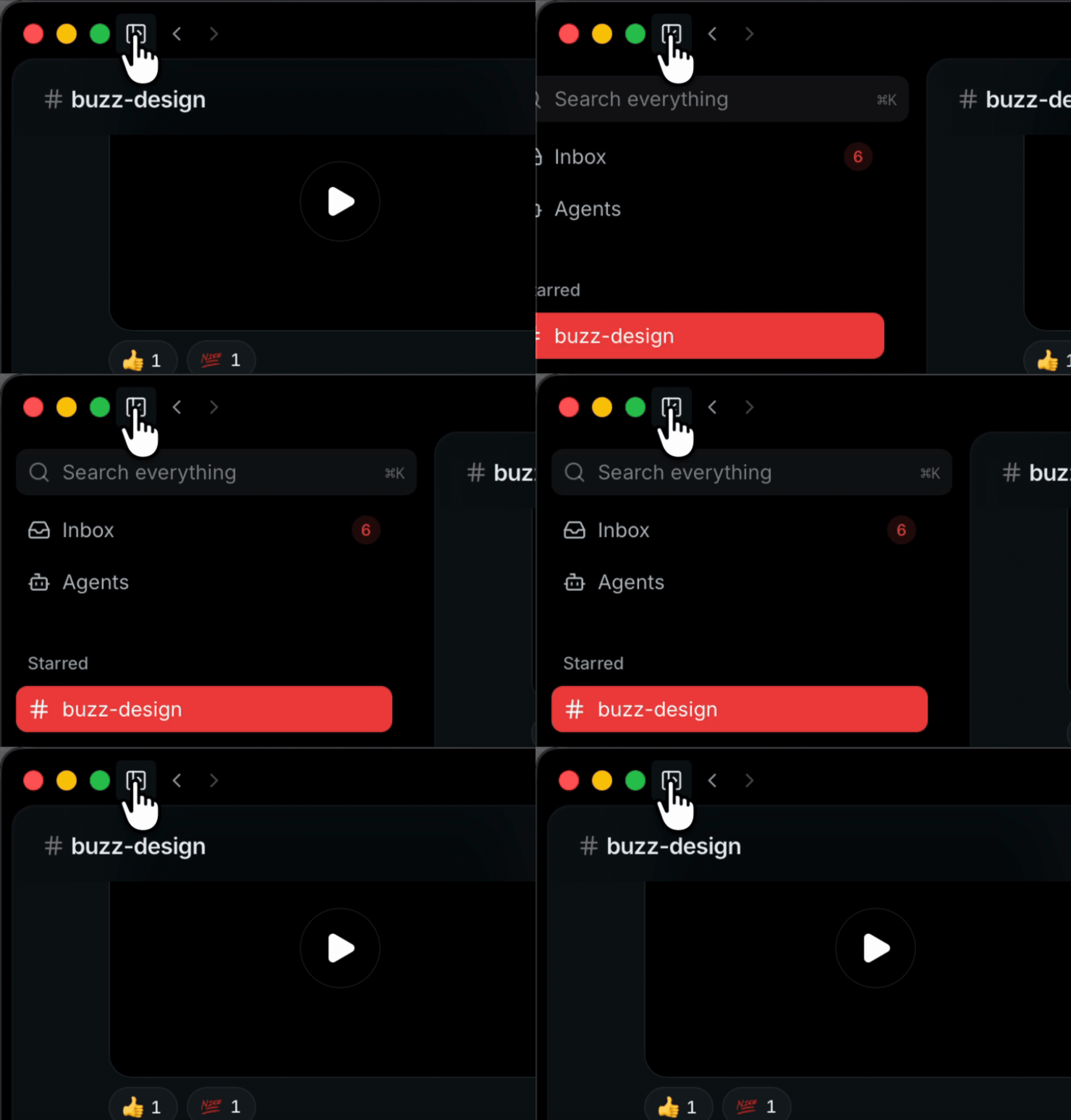 | 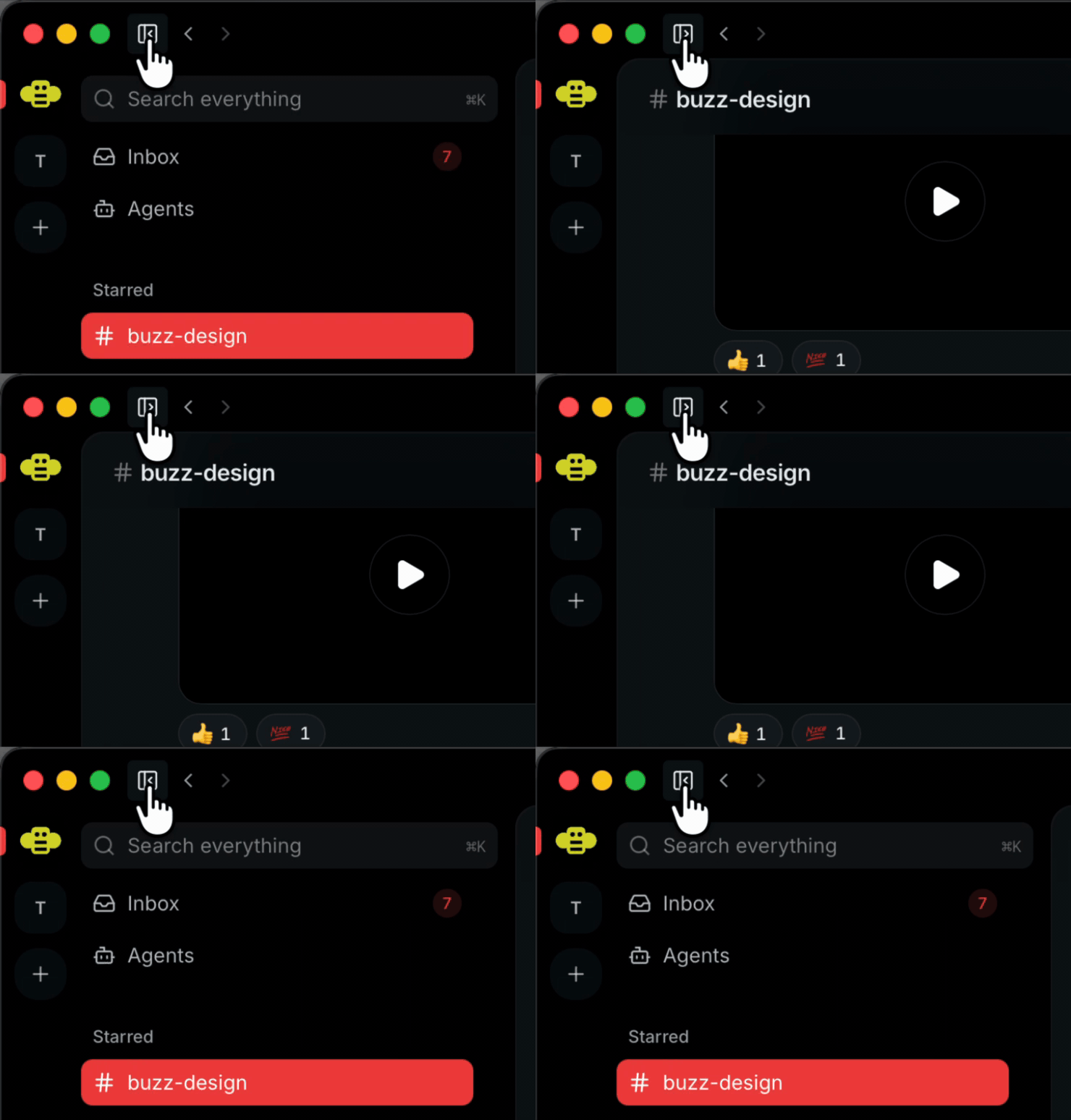 | ## Validation - `pnpm build:e2e` - focused sidebar integration tests: 2 passed - collapsed multi-community smoke regression: 1 passed - Biome check on all four changed files - pre-push desktop check, typecheck, and test hooks - `git diff --check` Related issue/PR: none found. --------- Signed-off-by: Taylor Ho <taylorkmho@gmail.com>


**Category:** fix **User Impact:** Hover tooltips and informational popovers now wait for deliberate pointer dwell instead of appearing while users move around the app. **Problem:** Tooltips and hover-controlled popovers appeared after inconsistent, often very short delays, so moving across composer and navigation controls could obstruct the next interaction. **Solution:** Establish a 500 ms shared dwell default with no tooltip skip-delay cascade, apply it to informational hover-controlled Popovers, and preserve immediate click and keyboard behavior. The responsive Community actions navigation submenu retains its documented 80 ms open / 160 ms close timing. ## Before / after | Before | After | |---|---| | 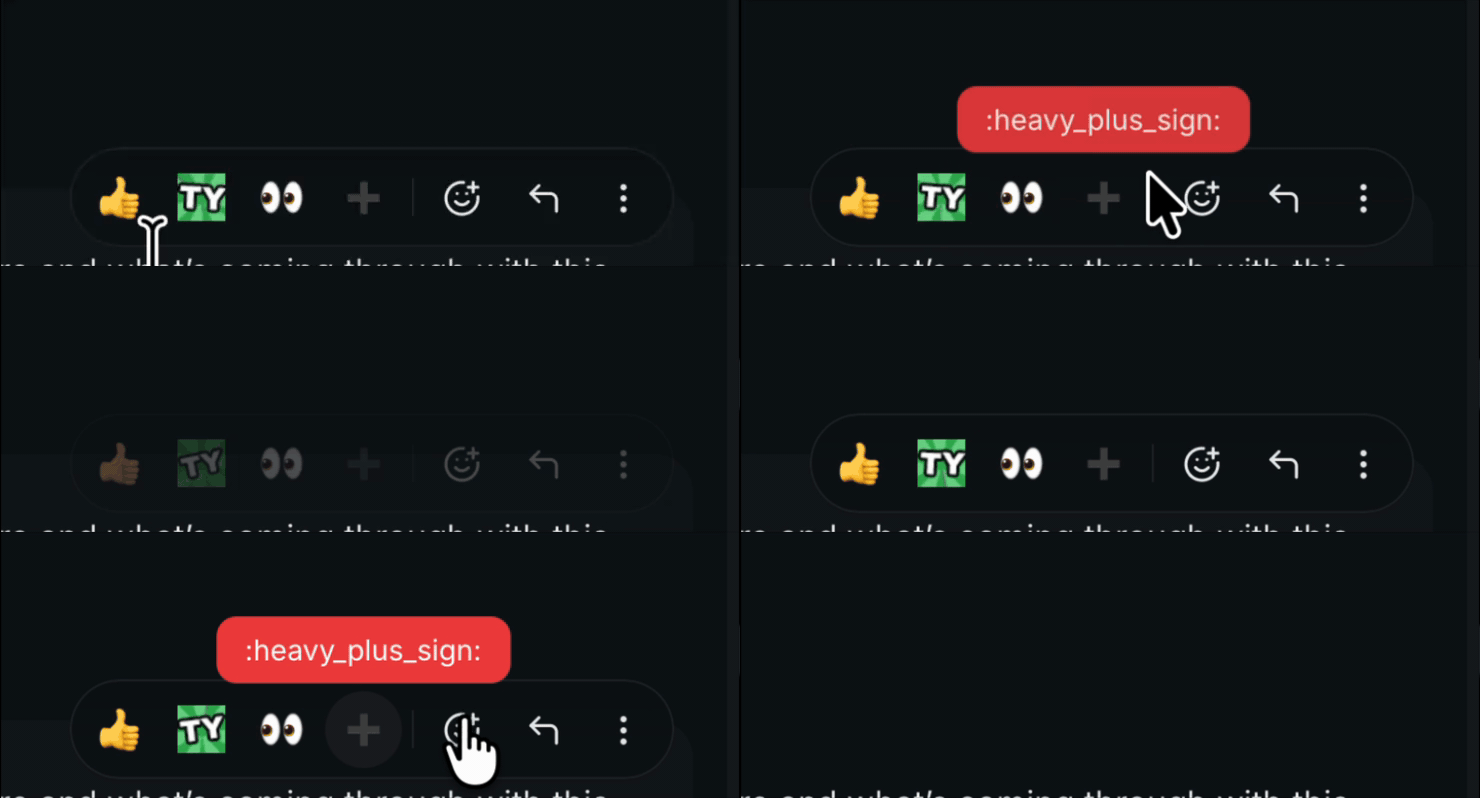 | 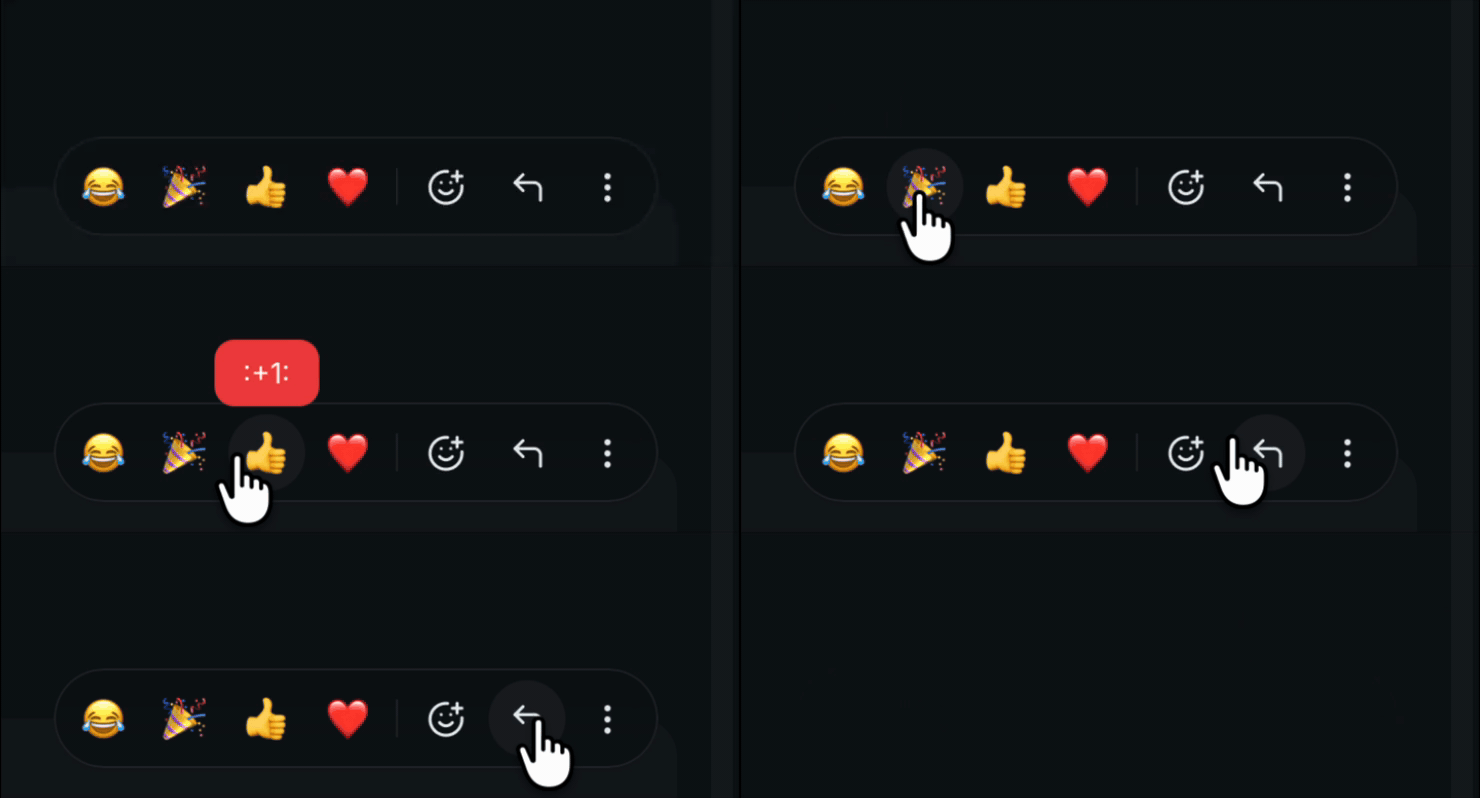 | <details> <summary>File changes</summary> **desktop/src/shared/ui/tooltip.tsx** Wraps the Radix provider with documented 500 ms and zero skip-delay defaults. The provider API still permits a future proven exception, but no current `desktop/src` caller overrides either timing. **desktop/src/shared/ui/popover.tsx** Exports the documented shared hover-open timing for controlled popovers; ordinary click/focus Popovers remain immediate. **desktop/src/main.tsx** Uses the shared Tooltip provider defaults at the application root. **desktop/src/shared/ui/sidebar.tsx** Removes the sidebar's instant Tooltip timing override. **desktop/src/features/channels/ui/AddChannelBotTeamsSection.tsx** Removes the local short Tooltip timing override. **desktop/src/features/home/ui/InboxDetailPane.tsx** Removes the local short Tooltip timing override. **desktop/src/features/messages/ui/MessageTimeline.tsx** Removes the timeline's local short Tooltip timing override. **desktop/src/features/messages/ui/MessageTimestamp.tsx** Drops the timestamp-only provider now that its 500 ms, zero-skip behavior is shared globally. **desktop/src/features/channels/ui/BotActivityBar.tsx** Raises composer agent-activity hover dwell from 150 ms to the shared default while preserving immediate click/focus opening. **desktop/src/features/sidebar/ui/ChannelActivityPopover.tsx** Raises channel activity hover dwell from 250 ms to the shared default while preserving immediate focus opening. **desktop/src/features/profile/ui/UserProfilePopover.tsx** Reuses the shared hover timing in place of its equivalent local constant. **desktop/src/shared/ui/PubKey.tsx** Reuses the shared hover timing in place of its equivalent local constant. **desktop/src/shared/ui/markdown/InlineEmojiPopover.tsx** Raises emoji inspection hover dwell from 200 ms to the shared default while preserving immediate focus opening. **desktop/src/features/messages/ui/MessageReactions.tsx** Raises reaction inspection hover dwell from 200 ms to the shared default while preserving immediate focus and reaction clicks. **desktop/src/features/communities/ui/CommunitySwitcher.tsx** Documents the Community actions navigation submenu as an intentional timing exception: 80 ms to open responsively and 160 ms to preserve the pointer bridge into its portalled panel. </details> ## Reproduction steps Move the pointer rapidly across each surface first, then hold it still over a labeled control. Hover-only disclosures should stay closed during transit and open after about **500 ms** of deliberate dwell. Moving directly between adjacent Tooltip triggers should start a fresh 500 ms dwell rather than cascading the next Tooltip open immediately. | Surface | Where to test | What to expect | |---|---|---| | Composer controls | Attachment, emoji, image editor, formatting, and composer toolbar buttons | No Tooltip while sweeping across controls; the hovered control's Tooltip opens after ~500 ms. Clicking remains immediate. | | Message actions | Hover a message, then test reply, react, more-actions, edit, and related action-bar controls | Each Tooltip waits ~500 ms, including when moving between adjacent actions. The action itself still runs immediately on click or keyboard activation. | | Message metadata and content tools | Message timestamps, code-block copy controls, diff controls, system-message controls, and video-player controls | Tooltip appears after ~500 ms. Timestamp behavior should look unchanged; it was already 500 ms with no skip cascade. | | Reaction pills | Hover a reaction with one or more reactors; also click the pill | Reactor Popover waits ~500 ms instead of 200 ms. Clicking still toggles the reaction immediately. | | Inline custom emoji | Hover a rendered custom emoji in message Markdown, then focus it with the keyboard | Emoji inspector waits ~500 ms on hover instead of 200 ms. Keyboard focus opens it immediately. | | Masked links | Hover a masked Markdown link, including one revealed inside a spoiler | Destination Tooltip waits ~500 ms instead of the former app-level 300 ms. Hidden spoilers still reveal no destination; keyboard focus remains immediate. | | Main and collapsed sidebar controls | Collapse the sidebar and hover icon-only navigation/menu buttons; also test community-rail controls | Sidebar Tooltips wait ~500 ms instead of opening instantly. Rapid movement across icons should not produce a tooltip cascade. | | Channel header and management controls | Channel members, huddle, settings, thread-view mode, management rows, and quick-agent controls | Each Tooltip waits ~500 ms; click/keyboard behavior remains immediate. | | Add-channel team chips | Open Add channel where saved teams are available and hover a team chip | Team details Tooltip waits ~500 ms instead of 150 ms; clicking the chip still toggles the team immediately. | | Channel activity preview | Hover a sidebar channel that has activity, then keyboard-focus its trigger | Activity Popover waits ~500 ms instead of 250 ms. Focus opens it immediately, and quickly crossing channel rows should not leave previews in the way. | | Composer agent activity | Run an agent so the composer activity control is present; hover, click, and focus it | Hover Popover waits ~500 ms instead of 150 ms. Click and keyboard focus still open it immediately. | | Inbox and draft controls | Home inbox open-context/more-actions controls, inbox-list controls, draft detail, and drafts panel | Tooltips wait ~500 ms instead of the inbox detail's former 200 ms/local defaults. Clicks remain immediate. | | Profile and public-key previews | Hover avatars, names/mentions, project author identities, and displayed public keys | Profile/pubkey Popovers open after ~500 ms, matching their prior behavior; the change centralizes that timing. Click actions and focus behavior remain immediate. | | Agent, team, memory, and update controls | Managed-agent rows, team identity cards, restart-diff badges, memory actions, setup steps, and update indicator | Tooltips wait ~500 ms and do not cascade when traversing adjacent controls. Actions remain immediate. | | Huddle controls | Huddle bar/indicator, mic controls, and participant-list actions | Tooltips wait ~500 ms; mute, join, participant, and keyboard actions remain immediate. | | Projects and activity surfaces | Project/repository cards, overview rail, contribution graph, activity feed, reviewers, and Pulse note controls | Tooltips wait ~500 ms with a fresh dwell between adjacent targets. Clicking/focusing interactive controls remains immediate. | | Intentional interaction-mode exceptions | Focus a Tooltip trigger; click/focus an ordinary Popover; move the pointer from an open hover Popover into its panel | Tooltip focus and Popover click/focus open immediately because they are explicit user intent, not incidental hover. Hover Popovers retain their 180–200 ms close grace so the pointer can cross into the panel. The Community actions navigation submenu is the intentional exception: it opens after 80 ms and keeps its 160 ms pointer bridge; informational hover Popovers use the shared 500 ms delay. | ## Verification - `pnpm typecheck` - `pnpm check` (passes with three existing diagnostics outside this diff) - `pnpm test` — 4,775 passed - `pnpm build` --------- Signed-off-by: Taylor Ho <taylorkmho@gmail.com>


## Summary

- run only Dart formatting for mobile changes during pre-commit
- move Flutter static analysis to the path-scoped pre-push graph
- fix case-sensitive `Justfile` triggers for the Rust and Tauri pre-push
gates
- skip whole-tree desktop/web formatting for lockfile-only commits while
retaining every lockfile-triggered pre-push check

No test suite was removed or narrowed. Cargo formatting remains
workspace-scoped; frontend and mobile source changes still select their
existing formatters.

## Benchmark

Warm isolated timings on an M2 Max:

- `dart format .`: 1.92–2.23s
- `flutter analyze`: 5.58–7.51s
- old forced full pre-commit: 10.16–18.40s
- current forced full pre-commit at `f18d9b5`: 5.42–7.09s, median 6.29s
(45% lower)
- current forced full pre-push at `f18d9b5`: 2m45s, effectively
unchanged from the prior warm 2m41s run
- lockfile-only pre-commit after the follow-up: 0.18–0.19s across three
runs

The new mobile analysis lane finishes before the existing mobile test
lane, so it added no observed full-push wall time.

## Validation

At pushed head `79626be60d89ba34e0fe136f254cc38cf1f1c2b8`:

- `lefthook validate`
- isolated temporary-repository selection test:
  - `Justfile` selects both Rust and Tauri pre-push gates
  - `pnpm-lock.yaml` selects neither mutating frontend formatter
  - desktop/web source files still select their formatter
- lockfile-only pre-commit: 0.19s, 0.19s, 0.18s
- pre-push hook passed on the exact pushed head

Earlier full-cycle validation at
`f18d9b5802f11543e8afbef3cd54c5928817e32b`:

- forced full pre-commit: 5.42s, 6.29s, 7.09s
- forced full pre-push: 2m45s; all lanes passed
- mobile tests: 1,465 passed

---------

Signed-off-by: Wes <wesbillman@users.noreply.github.com>
Co-authored-by: Carl <c7ebe626f000404285d3686e1dc74cc07cc60a9754a150041ba132e14bd3e2ec@buzz.block.builderlab.xyz>
…#4557)

Closes five Claude Code agent-config gaps in Buzz Desktop, split into
three commits that share the spawn-time and live-switch surfaces.

## Config isolation, model authority, and Auto mode (block#2692, block#2884,
block#3493)

- **`CLAUDE_CONFIG_DIR` isolation (block#3493).** `config_bridge` resolves
both `settings.json` and `.claude.json` panel paths from the agent's
effective env (`resolve_effective_agent_env` — baked floor → definition
→ global → persona → record), so the panel reads the same directory the
agent runs against. `mcp_config_file_path_for_runtime` honors a custom
dir; empty/blank is treated as unset, matching Claude's
`CLAUDE_CONFIG_DIR || homedir()` semantics. `AgentConfigPanel` shows a
Keychain caveat when a custom dir is active (a custom dir maps to a
fresh Keychain namespace unless `CLAUDE_SECURESTORAGE_CONFIG_DIR` is
also set).
- **Single startup model authority (block#2692).** `ANTHROPIC_MODEL` is the
sole startup model authority for Claude. Local spawns write
`ANTHROPIC_MODEL` and strip `BUZZ_ACP_MODEL` so the harness never sees
two authorities; remote deploys send `ANTHROPIC_MODEL` in `policy_env`
instead of `BUZZ_ACP_MODEL`. Non-Claude runtimes are unchanged.
- **`PermissionMode::Auto` (block#2884).** Wire string `"auto"`, model-gated,
degrades to the agent default when the active model doesn't advertise
it.

## Thinking effort end-to-end for local Claude agents

Effort flows from the running session's discovered `thought_level`
config option through the config surface to a local-only write control
and a read-only two-facts display.

- **Reader.** Discovers the `thought_level` config option from the
session cache (never hardcoded) and populates `effort_config_id` /
`effort_options` on `RuntimeConfigSurface`. The canonical effort tier
orders record env > `record.effort_level` (`BuzzExplicit`) > ACP >
persona > global > definition > file, so the panel shows the effort the
next spawn will launch with while `resolve_with_override` surfaces the
running ACP value as the struck-through override — neither masks the
other silently.
- **Write control.** `persist_agent_effort_level` is a direct-write
Tauri setter (writes `record.effort_level` + `updated_at`,
`save_managed_agents`) that rejects non-local backends — remote effort
is set at deploy time via `policy_env`. `EffortPickerField` mounts in
`AgentInstanceEditDialog` beside the Model block, gated on a local
backend **AND** a discovered `effortConfigId`. It persists directly and
invalidates the config surface, mirroring the
`setManagedAgentAutoRestart` standalone-setter precedent, so the frozen
`UpdateManagedAgentInput` shape stays frozen.
- **Display.** The read-only configured-vs-current two-facts display is
the `thinkingEffort` normalized field in `AgentConfigPanel`, fed by the
reader's canonical tier ordering.
- `buzz-acp` applies the startup effort env at session start.

## Distinguish a rejected model switch from silent success

A live model switch collapsed adapter rejection into success:
`apply_model_switch` returned `Ok` on both an accepted switch and an
application-level refusal, so the caller cached pre-switch capabilities
as if they described the target model and Desktop reported the pick as
landed.

- `ModelSwitchOutcome::{Applied(Value),Rejected}`. Transport-class
errors still propagate as `Err` (respawn the poisoned stdio); an
application-level refusal is now `Rejected`.
- The caller drives everything off `post_switch_snapshot`: `Applied`
refreshes `model_capabilities` from the target model's echoed
`configOptions` (or drops to `None` when none are echoed, so a
pre-switch snapshot is never mistaken for the target's); `Rejected`
preserves pre-switch caps and emits a `failure` `control_result`. Effort
resolution and the session-config capture read the post-switch snapshot
so they converge on the model the session actually runs;
`modelOverridden` is gated on `switch_succeeded`.
- `liveSwitchOutcome.ts` gains a distinct `"failed"` outcome for the
adapter `failure` frame and treats the busy-path `"sent"` ack as
provisional — it never counts toward success. Success is confirmed only
by a real positive terminal frame (the busy-path deferred apply emits a
correlated `switched` `control_result` when it lands), and the fallback
timeout resolves an honest `"pending"` (accepted, apply deferred), never
a false `"ok"`. `ModelPicker` surfaces a distinct toast per outcome —
failed, unsupported, and pending.

## Scope explicitly excluded

Per-agent config dir provisioning, `CLAUDE_SECURESTORAGE_CONFIG_DIR`
sentinel injection, `settings.json` projection, protected-key stripping,
MCP inheritance, spawn serialization, and the `last_spawn_warnings`
surface are absent from this diff. Silent-fallback machinery for
non-Claude runtimes (#2265/block#4004) is a tracked follow-up.

## Sanctioned follow-ups

- **Live mid-conversation effort switching.** Effort is spawn-scoped
only in this PR: the worker reads `BUZZ_ACP_EFFORT_LEVEL` once and
applies it at session creation. The live effort-switch machinery
(mid-conversation effort RPC + ack frame) was deliberately removed and
is archived on `archive/claude-config-gaps-live-effort` for a future
plan-gated revival.
- **Idle-path late model-switch rejection is unobservable.** An idle
switch acks `switched` immediately after catalog validation, but the
real `set_config_option` runs at the next session creation — potentially
much later — so a rejection there is not surfaced back to the picker
(holding a subscription that long is not sensible). Pre-existing,
catalog-gated behavior; a durable fix is a tracked follow-up.

Closes block#2692, block#2884, block#3493

---------

Signed-off-by: Will Pfleger <pfleger.will@gmail.com>
Co-authored-by: Duncan <dcfd242e557282d7a1e2cf2e6877522682f1e5c6156dc92ca7d90eaedd3b0f95@buzz.block.builderlab.xyz>
Adds `scripts/buzz-adopt-prod-agents.sh`, which copies the installed-DMG
(production) agent records and owner identity into the dev app-data
store so a dev build boots as the **same agents and same owner npub** as
the installed app — surviving `just reset`.

## What it restores

`just reset` wipes the two things Buzz cannot re-derive:

- The agent **records** — `managed-agents.json`, `personas.json`,
`teams.json`, and `agents/teams/`.
- The **owner identity** nsec, written as `identity.key` (0600, atomic).

Agent private keys and identity-key adoption then happen automatically
on the next dev boot via the shipped in-app migrations.

## When to run it

1. Quit any running **dev** build. A running installed DMG is fine — the
script treats it as a read-only source and only warns against
creating/archiving agents or editing teams while it runs. It never kills
processes.
2. Run `just reset`.
3. Before the first dev boot, run `bash
scripts/buzz-adopt-prod-agents.sh`.
   - `--dry-run` prints every action with zero writes.
   - `--force` overwrites an already-populated dev store.
   - One keychain prompt is expected (reading the prod owner identity).
4. Start the dev build. First boot copies the agent keys prod→dev and
adopts `identity.key`, then deletes it. For worktree launches, export
`BUZZ_SHARE_IDENTITY=1` (and `BUZZ_PRIVATE_KEY`) or the worktree mints
its own duplicate agents.

## Running-process check

Only a running **dev** build blocks the run: the script atomically swaps
the entire dev `agents/` directory and stages `identity.key` for the
next dev boot to consume, so doing that under a live dev process is the
corruption the check must prevent. A running installed DMG is allowed —
the app writes `managed-agents.json` via tmp+atomic-rename, so it can
never hand the script a torn file. Each matching `buzz-desktop` PID is
classified by its true post-exec executable path (via `lsof -d txt`,
which reports the running vnode with symlinks already resolved); the
installed `/Applications/Buzz.app/Contents/MacOS/buzz-desktop` path is
the only allow. Anything else still alive blocks fail-closed; a PID that
exits before its path can be resolved is ignored.

## Requirements

Requires `python3` when a dev `agents/` already exists — it drives the
`renamex_np(RENAME_SWAP)` syscall bash cannot call. The script fails in
preflight with a clear message if `python3` is absent, never mid-commit.

## Safety

Prod is strictly read-only; symlinked or aliased prod/dev roots are
refused before any write. The records/identity restore commits in one
atomic operation (`renamex_np(RENAME_SWAP)` when a dev store exists, a
single `mv` when absent) that fails closed — a crash or I/O error leaves
`agents/` either fully old or fully new, and unrelated live dev state
(`logs/`, `agent-pids/`, `global-agent-config.json`, retention stores)
is preserved verbatim across the swap.

This is a temporary measure while we trial it and decide whether to port
the logic into the dev-build startup path.

Signed-off-by: Will Pfleger <pfleger.will@gmail.com>
Co-authored-by: Duncan <dcfd242e557282d7a1e2cf2e6877522682f1e5c6156dc92ca7d90eaedd3b0f95@buzz.block.builderlab.xyz>
## Summary

- align the mobile security-code confirmation screen with the Add
Community visual system while keeping the SAS verification flow
unchanged
- use “Confirm desktop code” and a 15% primary-color outline on each
digit box
- support a gitignored, debug-only Android app name and application ID
override for side-by-side device testing; release and profile identities
remain unchanged

## Validation

- `flutter test test/features/pairing/pairing_page_test.dart` (21 tests)
- full mobile pre-push suite (1,469 tests)
- focused Flutter analysis and formatting
- mobile worktree identity contract checks

---------

Signed-off-by: kenny lopez <klopez4212@gmail.com>
Signed-off-by: Wes <wesbillman@users.noreply.github.com>
Co-authored-by: Wes <wesbillman@users.noreply.github.com>
Co-authored-by: Carl <c7ebe626f000404285d3686e1dc74cc07cc60a9754a150041ba132e14bd3e2ec@buzz.block.builderlab.xyz>
## Summary

- Add a lifted-message long-press popover with the reaction tray and
grouped actions.
- Use a native action surface
- Preserve taps and scrolling, exclude attached reactions from the
lifted preview, and align the composition to the bottom safe area.
<img width="1080" height="2424" alt="Screenshot_20260814-160732"
src="https://github.com/user-attachments/assets/a9d5fc91-4ee3-427c-8199-1c3be2b4e98a"
/>

## Testing

- `bin/just mobile-check`
- `flutter test test/features/channels/message_actions_test.dart`
- `flutter test` (1,364 tests)
- Manual interaction review on iPhone and Pixel 10

---------

Signed-off-by: kenny lopez <klopez4212@gmail.com>
Signed-off-by: Kenny Lopez <klopez4212@gmail.com>
Signed-off-by: Princess Donut <b238ea756dee4d98afa5883fc7f1de61eeabe65bf700e3a5a5a80db5e42e2c2b@buzz.block.builderlab.xyz>
Signed-off-by: Wes <wesbillman@users.noreply.github.com>
Co-authored-by: Princess Donut <b238ea756dee4d98afa5883fc7f1de61eeabe65bf700e3a5a5a80db5e42e2c2b@buzz.block.builderlab.xyz>
Co-authored-by: Wes <wesbillman@users.noreply.github.com>
Co-authored-by: Carl <c7ebe626f000404285d3686e1dc74cc07cc60a9754a150041ba132e14bd3e2ec@buzz.block.builderlab.xyz>
## Summary

- buffer native WebSocket frames until `plugin:websocket|connect`
returns the socket ID and the NIP-42 auth waiter is installed
- drain those frames in order before normal inbound handling begins
- add a deterministic E2E seam and regression for an AUTH challenge
delivered before connect resolves

## Root cause

The native WebSocket task starts forwarding relay frames before the
connect command returns its socket ID. Buzz relay sends the NIP-42 AUTH
challenge immediately on connection, so Desktop could process that
challenge while `wsId` and `authRequest` were still unset. The challenge
was discarded, the cold connection failed authentication, and the first
plain-text send failed. Channel history still appeared because it loads
through the Tauri channel-window command rather than this frontend
WebSocket.

## Verification

- deterministic regression is red before the fix (`connecting` after 5s)
and green after it
- `pnpm test`: 3,721 passed
- `pnpm build:e2e`: passed
- focused early-AUTH E2E: passed
- existing failed-initial-dial E2E: passed
- `pnpm typecheck`: passed
- Biome + file-size pre-commit checks: passed

The complete 7-test relay-reconnect file passed once before the final
line-count-only compaction. After that compaction, two full-file reruns
each had the same unrelated startup-seam flake in the existing
initial-dial test; both the new test and that existing test pass
independently at the committed HEAD.

---------

Signed-off-by: npub1jh9wn95s0472h86ahapupaf7m6kx4v9sx2n0atj2hltcfer8k06s5n3pyf <95cae996907d7cab9f5dbf43c0f53edeac6ab0b032a6feae4abfd784e467b3f5@buzz.block.builderlab.xyz>
Signed-off-by: Wren <5217c5c2f7bfb4333e46d17c98a9255a52dadee18dcd43a43536b95e6776dfa0@buzz.block.builderlab.xyz>
Co-authored-by: npub1jh9wn95s0472h86ahapupaf7m6kx4v9sx2n0atj2hltcfer8k06s5n3pyf <95cae996907d7cab9f5dbf43c0f53edeac6ab0b032a6feae4abfd784e467b3f5@buzz.block.builderlab.xyz>
Co-authored-by: Wren <5217c5c2f7bfb4333e46d17c98a9255a52dadee18dcd43a43536b95e6776dfa0@buzz.block.builderlab.xyz>
…#6260)

Sharing an agent encodes a `.agent.png` snapshot with the avatar as the
PNG image body. Non-PNG avatars were transcoded at full resolution and
already-PNG avatars were carried through unchanged, so a large source
avatar could produce a PNG that exceeds the 10 MiB
`MAX_SNAPSHOT_PNG_BYTES` cap and fail the send. A 2764×4096 webp avatar
encoded to ~26 MB — over 2.5× the ceiling — which is why sharing that
agent hung for a few seconds (fetching and transcoding the image) and
then failed.

The share dialog compounded the problem: on failure it discarded the
pipeline's real error (`Snapshot exceeds the 10 MiB size limit…`) and
toasted a generic `Couldn't send … Try again.`, hiding the actual cause.

## Changes

- **Downscale the avatar for the snapshot PNG body.** The body is only a
card thumbnail, so raster avatars are now downscaled to a 512px longest
edge (`MAX_PNG_BODY_EDGE`) before PNG re-encoding, mirroring the
frontend SVG rasterizer's 512×512 cap in `snapshotAvatarPng.ts`.
Already-PNG avatars over the dimension cap route through the same
downscaling transcode path instead of a straight tEXt-chunk injection.
The manifest's `avatar_url`/`avatar_data_url` source reference is
untouched — only the PNG image body is downscaled.
- **Surface the real error in the share dialog.** `PersonaShareDialog`
(used by `SnapshotShareDialog`/`TeamShareDialog`) and
`AgentCardViewerDialog` now toast the send controller's actual error
message, falling back to the generic string only when it is empty. A
`getCurrentError()` accessor reads the error through a ref because the
render-captured `state.error` is stale in the closure immediately after
`beginSend` resolves.

A unit test pins the invariant: an oversize (2764×4096) avatar produces
a snapshot that stays far under the cap with body dimensions clamped to
512px.

---------

Signed-off-by: Will Pfleger <pfleger.will@gmail.com>
Signed-off-by: Duncan <dcfd242e557282d7a1e2cf2e6877522682f1e5c6156dc92ca7d90eaedd3b0f95@buzz.block.builderlab.xyz>
Co-authored-by: Duncan <dcfd242e557282d7a1e2cf2e6877522682f1e5c6156dc92ca7d90eaedd3b0f95@buzz.block.builderlab.xyz>
Fixes block#6015.

`ConfigWriteMechanism` is internally tagged and carried only `rename_all
= "camelCase"`. On an internally tagged enum that renames the
**variants**, never the variants' fields, so the payload went out
snake_case:

```
{"type":"respawnWithEnvVar","env_key":"K"}
{"type":"acpSetConfigOption","config_id":"c"}
{"type":"acpSetSessionModel"}
{"type":"gooseNativeConfigWrite","config_key":"g"}
{"type":"readOnly"}
```

against `envKey` / `configId` / `configKey` in
`desktop/src/shared/api/types.ts:615-620`. That output is a probe run of
the real module before the fix, not a reading of the code.

What makes it read as correct is the asymmetry: the variant *names*
rename fine, so the `type` discriminant and every `switch
(writeVia.type)` behave; and the enclosing `NormalizedField`'s own
fields (`writeVia`, `overriddenValue`, `isRequired`) rename fine too,
because `rename_all` does apply to struct fields. Only the variant's
field is wrong.

Adding `rename_all_fields = "camelCase"` fixes it. `rename_all_fields`
appeared zero times in `desktop/src-tauri` before this.

**Severity, stated plainly: latent, not currently user-visible.**
Nothing in `desktop/src/**` reads `.envKey`/`.configId`/`.configKey` off
a `writeVia` — `AgentConfigPanel.tsx` is the only `RuntimeConfigSurface`
consumer and never touches the field, and no Rust code deserializes the
type either. The write-back path these fields exist for is not wired
yet. The hazard is for whoever wires it: `invokeTauri<T>` is an
unchecked cast, so they get `undefined` with a green `tsc`.

I also carried the attribute onto `ConfigFieldType`. Its only payload
field is `options`, single-word, so that half is not a fix — it is the
attribute the next multi-word field would silently need.

One divergence from the issue's suggested step 3: the 20 `e2eBridge.ts`
sites already emit camelCase, and camelCase is the contract, so they are
correct as written — changing them would have been wrong. What they
lacked was provenance, since agreeing with `api/types.ts` while the
backend emitted something else is exactly what let this sit. They now
name the Rust test that pins the bytes.

**Tests** (`wire_format_tests`, 4 cases, whole-value not key-set — a
key-set assertion still passes when a variant name regresses):
- every variant against the TypeScript spelling;
- the nested `NormalizedField`, which is the shape the renderer actually
receives;
- a camelCase round-trip **plus** an assertion that the old `env_key`
spelling is now rejected, so a revert cannot quietly keep deserializing;
- `ConfigFieldType::Enum`.

Removing `rename_all_fields` again turns three of the four red.

Verified locally: full Tauri library suite 2444 passed / 15 ignored / 0
failed; `cargo clippy --manifest-path desktop/src-tauri/Cargo.toml
--workspace --all-targets -- -D warnings` clean; `cargo fmt
--manifest-path desktop/src-tauri/Cargo.toml --all -- --check`; in
`desktop/`: `pnpm typecheck`, `pnpm check`, `pnpm test` 4954 passed;
`git diff --check`. Not run: the app itself — there is no UI path to
this field yet, which is the same reason the bug is latent.

---------

Signed-off-by: Taksh <takshkothari09@gmail.com>
## Summary

- Add separate **Font size** and **Conversation density** controls in
Appearance.
- Use a 13 / 14 / 15px conversation text ramp for Smaller / Default /
Larger while scaling interface typography through a shared virtual-rem
system.
- Keep layout geometry fixed while typography changes, and compose Cmd
+/- text zoom on top of the selected preference.
- Let Compact, Comfy, and Spacious control conversation row spacing plus
paragraph and list rhythm in Markdown content across Buzz.
- Preview font size and density together with click-and-drag comparison;
interrupted scrubbing restores the saved preference.
- Synchronize preferences across open Buzz windows, including full
local-storage clears during sign-out or dev reset.
- Promote the segmented control to shared UI and make Settings rows
adapt to their card width.

## Validation

- `just ci`
- 4,965+ desktop unit tests across the final merged branch
- 1,465 mobile tests through the full repository gate
- Focused Playwright coverage for font-size/density independence, drag
preview cancellation, Inbox geometry, thread rendering, keyboard zoom,
and cross-surface typography
- Fresh E2E build against the final merged branch

---------

Signed-off-by: kenny lopez <klopez4212@gmail.com>
Signed-off-by: morgmart <98432065+morgmart@users.noreply.github.com>
Signed-off-by: Princess Donut <b238ea756dee4d98afa5883fc7f1de61eeabe65bf700e3a5a5a80db5e42e2c2b@buzz.block.builderlab.xyz>
Co-authored-by: Princess Donut <b238ea756dee4d98afa5883fc7f1de61eeabe65bf700e3a5a5a80db5e42e2c2b@buzz.block.builderlab.xyz>
Co-authored-by: morgmart <98432065+morgmart@users.noreply.github.com>
…lock#5905)

The managed "Active Agents" table in `~/.buzz/AGENTS.md` was rendered
from every managed-agent record with no filtering, so archived duplicate
instances kept appearing under the active relay's header. This scopes
the roster to identity-active agents and makes regeneration safe under
concurrency.

## Roster filter: identity-archive only

`render_dynamic_section` now drops only records whose pubkey is present
in the relay's `kind:13535` archive snapshot. Local records can't tell
they're archived — they all carry `is_active: true` (that flag is a
*definition*-archive, not an identity-archive), so archive truth lives
only relay-side. The read **fails open**: an unreachable relay yields an
empty set and hides no one.

There is deliberately **no** relay-scope filter. `relay_url` is a legacy
creation-era field that `effective_agent_relay_url()` ignores — every
agent is eligible on every community, and snapshot-imported records
store `relay_url: ""` by design. Filtering on it would hide valid,
runnable agents after a workspace switch or import. Foreign-relay relic
records leave the table via record deletion, not code.

## Regeneration on archive / unarchive

`archive_identity` and `unarchive_identity` submitted the relay event
and returned without refreshing `AGENTS.md`, unlike the ~20 other
mutation sites that call `try_regenerate_nest`. A just-archived agent
therefore lingered on the roster until an unrelated edit or the next
launch. Both commands now trigger a regeneration after a successful
submit.

Regeneration is bound through a `NestRegenTrigger` trait rather than
constructing the `try_regenerate_nest` callback at the Tauri-command
delegation site. The command cores take `regen: &impl NestRegenTrigger`
and own the `|| regen.trigger()` binding; the thin wrappers only pass
`&app` (whose `impl` calls `try_regenerate_nest`). This puts the regen
wiring inside the unit-tested core — a `CountingRegen` double proves
each core fires exactly one regeneration — instead of an untestable seam
where a wrapper could silently lose the refresh while the suite stayed
green. The regen races the relay's `kind:13535` snapshot update, so it's
best-effort and fail-open — a stale render self-heals on the next cycle.

## Ordered regeneration

`try_regenerate_nest` previously spawned unconstrained tasks that each
snapshotted state, awaited two relay requests, then wrote — so a slow
pre-edit generation could overwrite a newer one. Boot made this
deterministic: the boot regen races the `apply_workspace` regen, and the
fallback-relay render could finish last.

`NestRegenGate` fixes this with a single `highest_requested` watermark.
A monotonic generation is claimed *synchronously* at request time
(encoding call order) and advances the watermark under one lock; the
spawned task carries its generation and, at commit, reads the watermark
under that same lock — the compare-and-write is atomic with no await
held across it. A generation whose number is below the current watermark
drops its result instead of rolling the file back.

Gating on highest-*requested* rather than highest-*written* is the
load-bearing choice: if a newer generation is requested but then fails
its relay reads, an older in-flight generation must **not** publish its
now-obsolete roster. Behavior delta: once a newer regeneration has been
requested, no older generation will ever write; if that newer generation
fails, the file is left as-is and self-heals on the next trigger rather
than regressing to a stale snapshot. This is an ordered,
latest-request-wins gate — not a work coalescer: superseded generations
still perform their relay reads and drop the result at commit time.

The gate's commit lock is acquired with a poison-to-`io::Error` mapping
rather than `expect()`, so a poisoned lock degrades to the same
warn-and-continue path as any other commit failure instead of panicking
the desktop process (a best-effort housekeeping write must never take
down the app).

## One relay target per regeneration

A regeneration read the workspace relay override three times — the
NIP-11 signer in `fetch_relay_self`, the snapshot query in
`query_relay`, and the rendered footer — so a workspace switch
mid-flight could pair one relay's advertised signer with another relay's
snapshot, fail open, and render archived agents as active.
`capture_relay_target` now resolves the effective relay (WebSocket +
HTTP API base) once, before any network work, and
`fetch_archived_pubkeys_at` threads that single target through both the
NIP-11 fetch and the `/query`; the footer renders the same target.
Signer, snapshot, and footer always belong to one relay.

## Monotonic archival snapshot publishing

`publish_nipia_archival_list` stamped its `kind:13535` snapshot with a
whole-second `created_at`. A rapid archive→unarchive within the same
second produced two events whose NIP-16 replaceable-event tie-break
(higher event id wins) could strand the older, stale archive state as
canonical. Publishing now uses a bounded retry that re-reads current
archive state and rebuilds the snapshot each attempt, so the published
list reflects the latest intended state rather than a fixed same-second
race loser. After the attempt budget (8) is exhausted the publisher
`bail!`s; the sole caller treats that as a `warn!` side effect and
continues, matching the surrounding best-effort submit path.

## Test-file split

The renderer, `upsert_managed_section`, and the regeneration-gate tests
moved to `nest/render_tests.rs` so each test file stays under the
repository's 1000-line ratchet.

---------

Signed-off-by: Will Pfleger <pfleger.will@gmail.com>
Signed-off-by: Wes <wesbillman@users.noreply.github.com>
Co-authored-by: Hayt <9e1c23a3fd83f61da34420e4e88ff1b16e45cafcc0cd9019eb07d4ecfa8ca9b0@buzz.block.builderlab.xyz>
Co-authored-by: Wes <wesbillman@users.noreply.github.com>
Co-authored-by: Mongo <5c25403eab7271f9f94ddd4f2b270e8cac2c92e2c830c51877cca6ec974ffb3f@buzz.block.builderlab.xyz>
Co-authored-by: Duncan <dcfd242e557282d7a1e2cf2e6877522682f1e5c6156dc92ca7d90eaedd3b0f95@buzz.block.builderlab.xyz>
## Summary

- use a native detented emoji sheet on iOS that opens at two-thirds and
keeps scrolling active at every height
- align the search, close control, background, and full-width category
row while retaining the Flutter tray on Android
- add a persisted desktop-style skin-tone selector and show one selected
variant per emoji

## Testing

- `just ci` gates completed, with the disk-heavy stages resumed
individually after generated artifacts filled the worktree volume
- full mobile suite: 1,360 tests passed
- focused picker/composer/reaction suite: 145 tests passed
- signed iOS Release build succeeded
- Android debug build installed and launched on Pixel 10

Snapshots are attached in a PR comment.

---------

Signed-off-by: kenny lopez <klopez4212@gmail.com>
Signed-off-by: Watcher <bb7abfd757d0af7b66569d02ab9c0316b616f9d0c151ecf5b964344c462e7f8f@buzz.block.builderlab.xyz>
Signed-off-by: Kenny Lopez <klopez4212@gmail.com>
Signed-off-by: Wes <wesbillman@users.noreply.github.com>
Co-authored-by: Watcher <bb7abfd757d0af7b66569d02ab9c0316b616f9d0c151ecf5b964344c462e7f8f@buzz.block.builderlab.xyz>
Co-authored-by: Mongo <9cfd347903944d5b85aa6c93d2ab67381b978a92a31914bca69998968752a1d7@buzz.block.builderlab.xyz>
Co-authored-by: Princess Donut <b238ea756dee4d98afa5883fc7f1de61eeabe65bf700e3a5a5a80db5e42e2c2b@buzz.block.builderlab.xyz>
Co-authored-by: Wes <wesbillman@users.noreply.github.com>
Co-authored-by: Carl <c7ebe626f000404285d3686e1dc74cc07cc60a9754a150041ba132e14bd3e2ec@buzz.block.builderlab.xyz>
The shared-agent directory rebuild resolves runtime directories, owner
profiles, and managed policies for every candidate agent via dozens of
exact-author query batches. Issuing those batches serially made a
~100-agent rebuild take 6.5–8.4s, which dominated @mention autocomplete
latency.

block#6224 already scoped the *send-path* revalidation
(`revalidate_relay_agents`) to just the mentioned pubkeys, so the send
stall is fixed. But the autocomplete directory (`list_relay_agents`)
still rebuilds the full membership set serially — this PR removes that
remaining cost.

## Change

Run the query batches with bounded concurrency via a shared
`query_filter_batches` helper. Each directory rebuild constructs one
`tokio::sync::Semaphore` (8 permits) and shares it across all of that
rebuild's phases, so the runtime-directory and owner-profile phases that
run concurrently under one `try_join!` never exceed 8 `/query` requests
in flight together — the bound is per-rebuild. The policy phase reuses
the same budget. Same events, keyed by pubkey downstream so ordering is
irrelevant.

Both `list_relay_agents` (autocomplete) and `revalidate_relay_agents`
(scoped send-path check from block#6224) funnel through
`list_relay_agents_for_selection`, so the helper is a no-op for the tiny
1–3-mention revalidation set and only the full autocomplete rebuild sees
the win — the scoped send path is untouched.

## Measurement

Live on the production relay, warm connection, full `list_relay_agents`:

| | Full-directory rebuild |
|---|---|
| Serial (before) | 6.5–8.4s |
| Bounded-concurrency (after) | 2.0–3.4s |

Returned pubkey set is byte-identical pre/post. The 8-permit ceiling
holds under saturation (24 batched requests → peak exactly 8, zero
failures, zero requests left in flight).

Signed-off-by: Will Pfleger <pfleger.will@gmail.com>
Co-authored-by: Duncan <dcfd242e557282d7a1e2cf2e6877522682f1e5c6156dc92ca7d90eaedd3b0f95@buzz.block.builderlab.xyz>
## Summary

- Open Activity items directly in their target thread while preserving
Activity as the Back destination.
- Fade in a muted target-message highlight after navigation settles,
hold it for three seconds, then fade it away.

## Why

Activity deep links hydrated the channel before opening the thread,
which left the temporary channel route in the navigation stack. The
target highlight also appeared before the route settled and remained
indefinitely.

## Validation

- `just mobile-check`
- Full Flutter test suite (1,357 tests)
- Signed Profile build installed and launched on a physical iPhone

---------

Signed-off-by: kenny lopez <klopez4212@gmail.com>
Signed-off-by: Fast Fizz <2df81cb51f05a9d5387ef24d7b9ecb8fcdfcd1c70ffabc67061c9596e1b5b1c4@buzz.block.builderlab.xyz>
Signed-off-by: Princess Donut <b238ea756dee4d98afa5883fc7f1de61eeabe65bf700e3a5a5a80db5e42e2c2b@buzz.block.builderlab.xyz>
Signed-off-by: Kenny Lopez <klopez4212@gmail.com>
Co-authored-by: Fast Fizz <2df81cb51f05a9d5387ef24d7b9ecb8fcdfcd1c70ffabc67061c9596e1b5b1c4@buzz.block.builderlab.xyz>
Co-authored-by: Princess Donut <b238ea756dee4d98afa5883fc7f1de61eeabe65bf700e3a5a5a80db5e42e2c2b@buzz.block.builderlab.xyz>
Co-authored-by: Mongo <9cfd347903944d5b85aa6c93d2ab67381b978a92a31914bca69998968752a1d7@buzz.block.builderlab.xyz>
## Summary
- Makes Projects repository-aware across browsing, branch and tag
selection, local and remote source management, work items, commits, and
contextual repository actions.
- Refines project details into consistent single-column reading surfaces
with a resizable, section-aware context pod, while keeping project
conversations available in the attached chat panel.
- Adds persistent sidebar project navigation, direct entity links,
repository discussion channels, contributor identity matching, and
consistent loading and activity presentation.
- Keeps branch-specific controls on code-oriented sections while Tasks,
Reviews, and Channels remain repository-scoped, reducing misleading
context and actions.

Replacement for block#5981 with an identical final tree flattened into one
signed-off commit because the required DCO check suite remained stalled.

### Related issue
N/A

### Testing
- [x] Desktop pre-push checks, TypeScript typecheck, and unit tests
- [x] E2E production build with `pnpm build:e2e`
- [x] Focused Playwright smoke coverage for project workspace, task,
review, commit, sidebar, and contextual-panel behavior
- [ ] Attach final before/after screenshots after design review

---------

Signed-off-by: Thomas Petersen <thomasp@squareup.com>
Signed-off-by: Wintermute <165f0c871dd2586bb18b6aa109eeaf57bb2132ff4d27b10120f4368a0f627022@buzz.block.builderlab.xyz>
Co-authored-by: Wintermute <165f0c871dd2586bb18b6aa109eeaf57bb2132ff4d27b10120f4368a0f627022@buzz.block.builderlab.xyz>
…k#6306)

## Summary
- Replaces the drawer panel icon's CSS `translateX` slide with a
`motion/react` width + corner-radius morph, so the icon reads as the
panel opening rather than the glyph drifting sideways.
- Honors `prefers-reduced-motion` via `useReducedMotion` (no animation
for users who opt out).

Follow-up polish to the projects workspaces work that just landed in
block#6003 — the slide animation shipped there was the wrong visual.

## Test plan
- [x] Desktop unit tests and typecheck pass with this file at this
content (validated as part of the projects-v6 branch validation)
- [ ] Visual check: open/close the right drawer and confirm the icon
morphs in place

Signed-off-by: Thomas Petersen <thomasp@squareup.com>
…uted author" (block#6311)

Reverts block#6129
## Summary - combine channel identity, actions, member previews, and lifecycle controls in one navigable mobile details page - add compact member management and desktop-aligned channel editing - smooth the profile entrance transition and standardize settings-group spacing - align Huddle lifecycle rows with regular message author and body spacing ## Testing - `just mobile-check` - `just mobile-test` — 1,477 tests - Pixel 10 debug build, install, and interaction review ## Snapshots ### Channel header 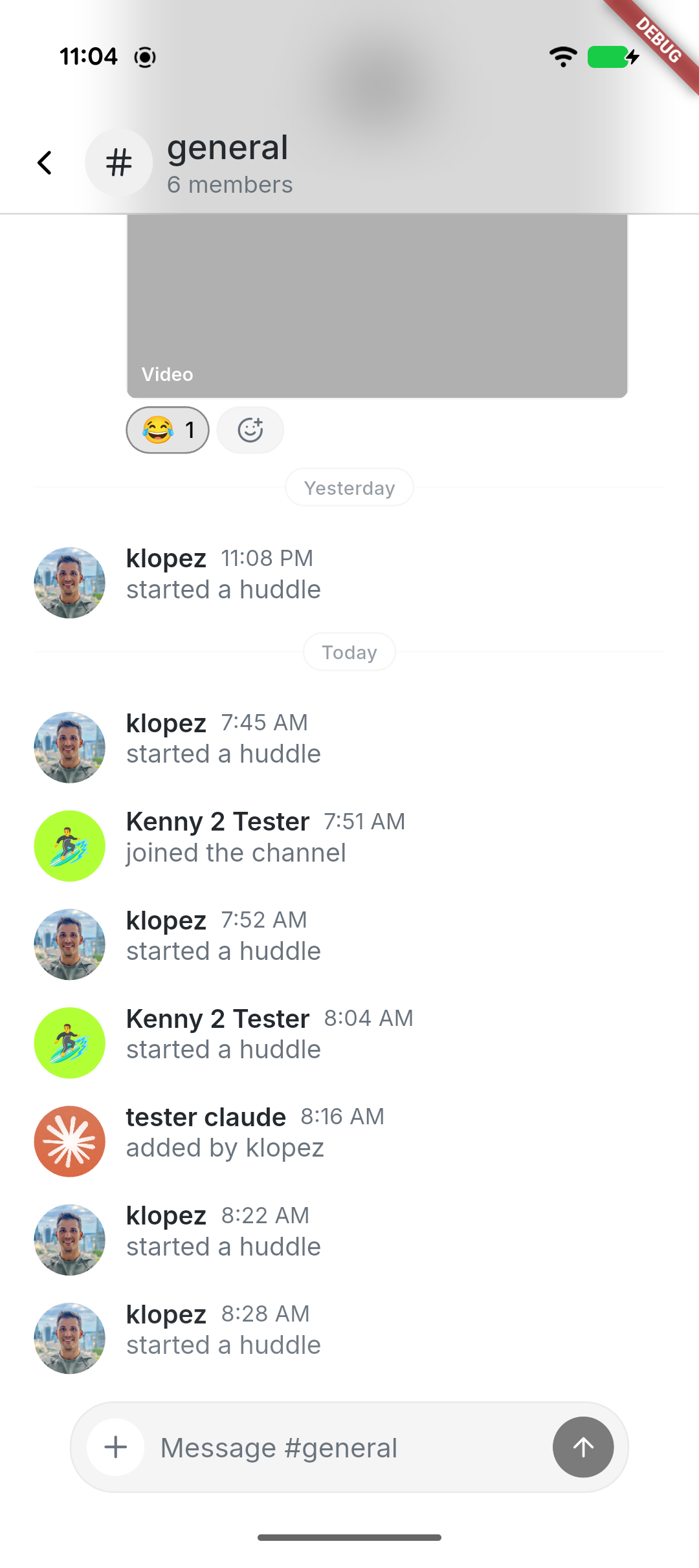 ### Combined channel details 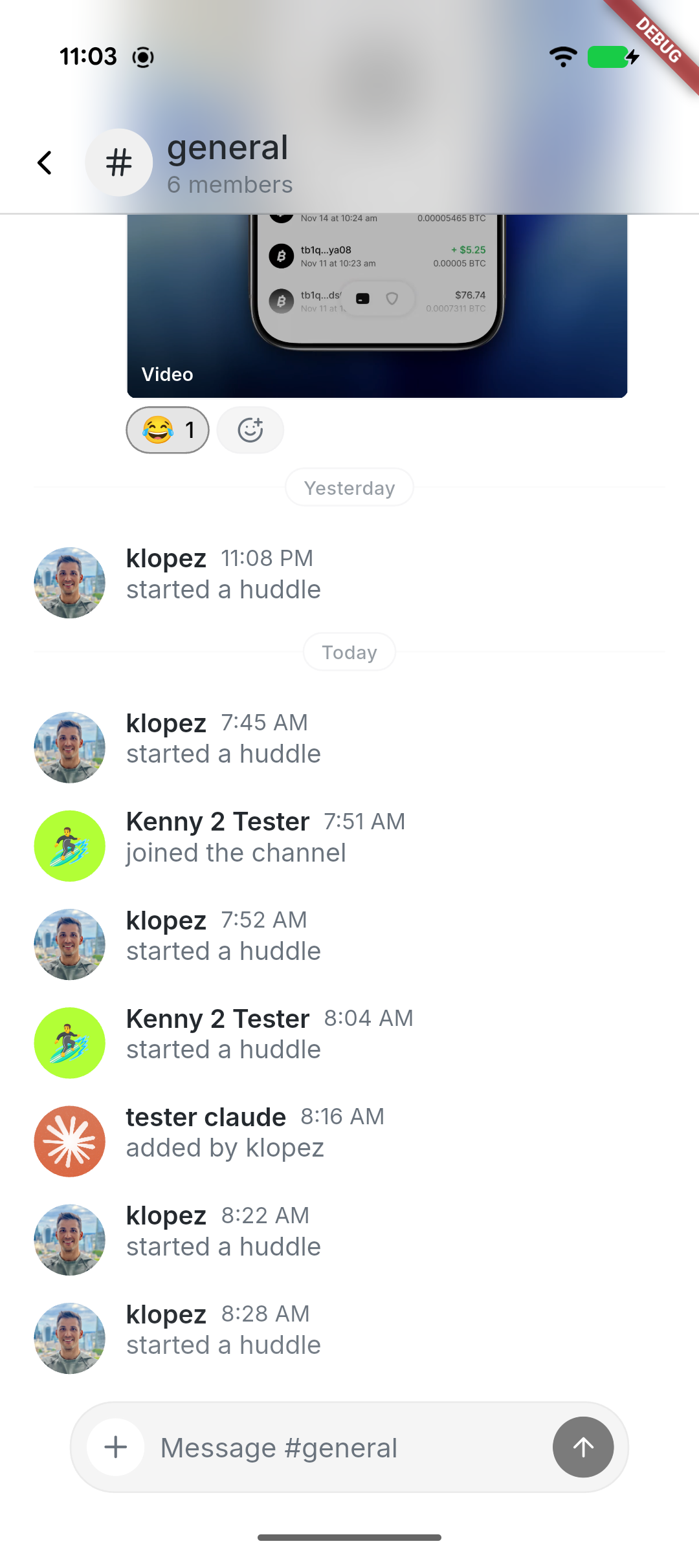 ### Manage channel 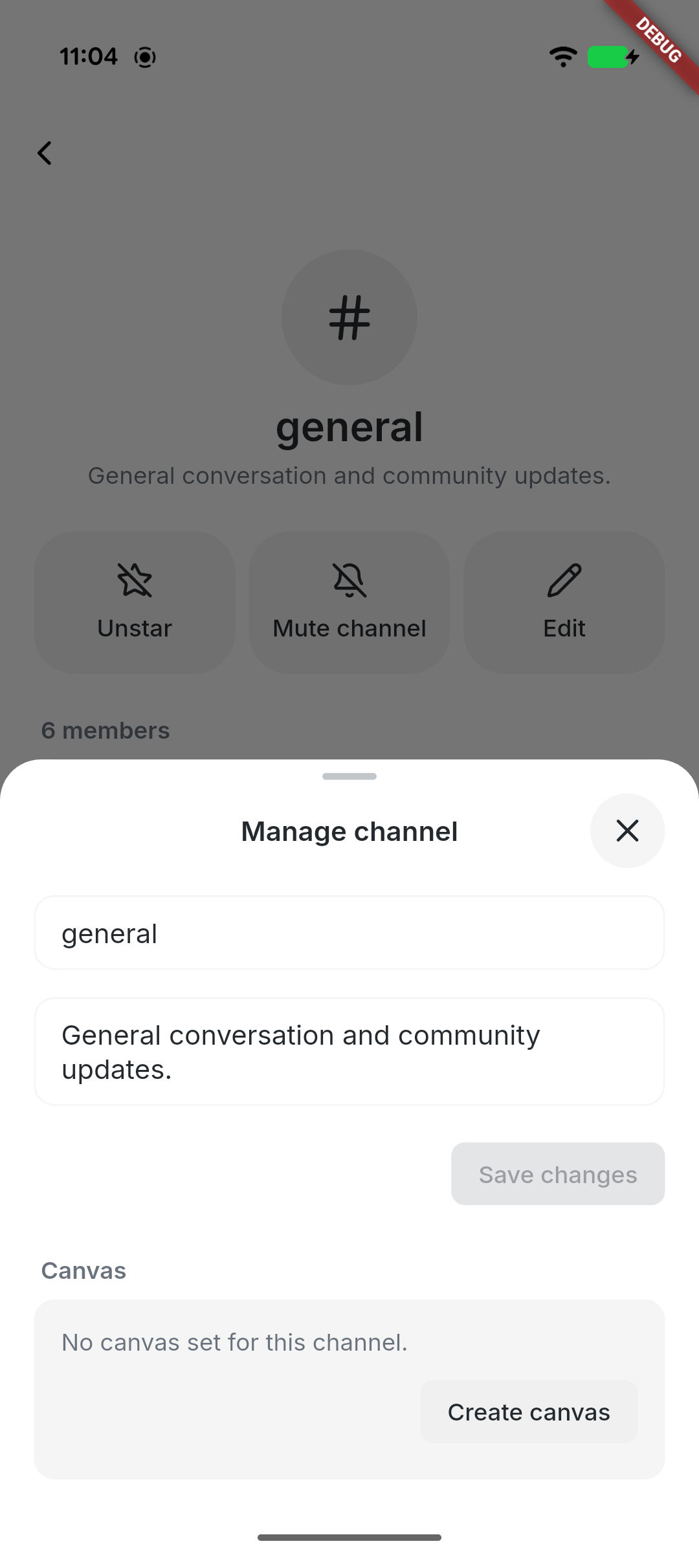 --------- Signed-off-by: kenny lopez <klopez4212@gmail.com> Signed-off-by: Fast Fizz <2df81cb51f05a9d5387ef24d7b9ecb8fcdfcd1c70ffabc67061c9596e1b5b1c4@buzz.block.builderlab.xyz> Co-authored-by: Fast Fizz <2df81cb51f05a9d5387ef24d7b9ecb8fcdfcd1c70ffabc67061c9596e1b5b1c4@buzz.block.builderlab.xyz>



…k#6955)

Chat-eligible Unity Catalog models from the Gemini, DeepSeek, GLM, Grok,
Llama, Qwen, Gemma, and Inkling families were rendering as raw FQNs such
as `system.ai.gemini-3-5-flash` in the agent model picker. block#6918
surfaces these models, but the capability manifest carried no records
for most of them and the registry-label path could not strip their Unity
Catalog or `goose-` prefixes.

I added a display-only `label_family_tokens` list and `databricks_v2`
exact records for the sixteen previously unlabeled endpoint stems. All
26 target FQNs and their `goose-` aliases now resolve to curated labels
through `databricks_registry_label`, while capability resolution
continues to use only the existing `family_tokens` (`claude-`, `gpt-`,
and `kimi-`). This keeps label discovery from changing capability
profiles for unrelated model IDs.

Each new record includes reconciliation metadata against the pinned
[models.dev catalog](https://models.dev/api.json). Nine records adopt
first-party effort evidence that the Databricks MLflow Chat transport
can express: Gemini 3.5 Flash, Gemini 3.5 Flash Lite, Gemini 3.6 Flash,
Gemini 3 Pro Image, DeepSeek V4 Flash, DeepSeek V4 Pro, GLM-5.3 Flash,
Grok 4.6, and Inkling. The remaining seven deliberately retain the
`databricks_v2/concrete_unknown` fallback because upstream evidence is
absent, identifies a non-reasoning model, or provides only
toggle/token-budget controls that `reasoning_effort` cannot represent.

The normative corpus adds the sixteen exact records, four Unity Catalog
alias probes, and two capability-isolation probes. Existing base vectors
remain unchanged, and Rust and TypeScript consume the same strict
manifest and corpus.

Related: block#6918

---------

Signed-off-by: Will Pfleger <pfleger.will@gmail.com>
Signed-off-by: Thufir <7ebdb0b67dab08a570b9faf7bbada97535673b4ccaba2cbd546ad3ba84c87fa6@buzz.block.builderlab.xyz>
Co-authored-by: Duncan <dcfd242e557282d7a1e2cf2e6877522682f1e5c6156dc92ca7d90eaedd3b0f95@buzz.block.builderlab.xyz>
Co-authored-by: Thufir <7ebdb0b67dab08a570b9faf7bbada97535673b4ccaba2cbd546ad3ba84c87fa6@buzz.block.builderlab.xyz>
Implements the Rust/backend half of 30178 team catalog sharing on the
community catalog. No TS callers yet — this is PR 1 of 2;
[block#3995](block#3995) (stacked here) adds the
parse layer, hooks, `CommunityCatalogDialog`, and e2e tests.

## What this adds

**Projection builder** (`team_catalog.rs`):
`build_team_catalog_event/content` produces a 30178 event from a team +
member definitions. Size contracts: 192 KiB total ceiling, per-field
bounds (name 256 B, text 4 KiB, system-prompt 16 KiB, avatar URL 32 KiB
for projection fields; https URLs additionally validated at 2,048
bytes). Avatar handling: oversized raster data URLs downscaled to fit;
oversized built-in avatars silently omitted; oversized https URLs
rejected with a named error.

**Share/unshare/tombstone** (`commands/teams/pending.rs`):
`prepare_team_publication_at` retains a signed 30178 head for the flush
loop; share state is relay-scoped (one community can share while another
does not). `refresh_or_retract_shared_head_at` rebuilds or tombstones
the head immediately on team/member edit — no stale publication until
the next boot. Both the 30178 catalog and 30176 team tombstones are
signed with a `created_at` that strictly dominates the retained head's
(read inside the delete transaction), so a future-dated head cannot
survive its own deletion under the relay's `created_at <=` soft-delete
gate.

**Serialized-publisher share command** (`commands/teams/sharing.rs`,
`managed_agents/persona_events.rs`): `set_team_shared` publishes the
retained head through `flush_pending_events_at` rather than submitting
the prepared event directly. A direct submit ran outside
`managed_agents_store_lock` and raced `delete_team`: the delete
atomically purges the head's retained row and enqueues a newer 30178
tombstone in one transaction, and a delayed direct submit could land the
old shared head *after* that tombstone. Because 30178 replacement has no
deletion watermark, the deleted team would go publicly live again.
Routing through the flush is necessary but not sufficient, because the
flush is not itself a single publisher: several call sites (the 30s
sweep, this share toggle, managed-policy updates) invoke it
concurrently, and each invocation has an await gap between its per-row
re-read and its relay POST. A second flush could publish the tombstone
in that gap while an earlier flush's delayed POST lands the just-purged
head after it. The flush now acquires a per-scope publisher mutex —
keyed by the canonical retention `db_path`, which already *is* the
durable scope identity (hashed normalized relay URL + owner pubkey) —
and holds it across its entire invocation: snapshot, per-row re-read,
POST, and `mark_synced`. Serialized-per-scope flush ⟹ within one scope
the only interleavings are head-before-tombstone (the head lands first,
then is dominated by the later tombstone) or purged-row-skip (the delete
committed first, so the re-read skips the head) — a purged head can
never publish after its tombstone. The lock is a
`LazyLock<Mutex<HashMap<PathBuf, Arc<tokio::sync::Mutex<()>>>>>` static
rather than an `AppState` field: it keeps the invariant at its
acquisition site and out of the size-ratcheted `app_state.rs`
(precedent: `agent_models_databricks.rs`'s `AUTH_GATE`), and the
std-mutex map guard is released before the async guard is awaited so it
never spans an await point. Keying per scope — rather than one
process-global lock — means a stalled or hostile relay in one community
can no longer block publication in every other community, and each
per-row submit is additionally wrapped in a
`tokio::time::timeout(PUBLISH_TIMEOUT = 60s)`:
`submit_signed_event_at_with_keys` first waits on the process-wide
admission gate (up to 300s on a 429) and then POSTs on the app-wide
`http_client`, which leaves reqwest's connect/read/total timeouts unset,
so a relay that accepts the connection and never finishes the response
would otherwise pin the lock forever. A timeout takes the same
`Err`/`continue` path as a relay rejection — the row stays pending for
the next 30s sweep and a timed-out tombstone keeps its replacement
deferred this pass — so a live admission gate now surfaces as
timeout-pending rather than a held lock, the correct durable behavior
since the sweep retries. `publicationStatus` (Published/Queued) is
derived by re-reading the retained row's pending flag after the flush.
The previously-unused `relayMessage` field is dropped from
`SetTeamSharedResult`: the flush loop swallows every per-event relay
rejection to its own log and only surfaces local DB faults (which the
status re-read already propagates), so the field was permanently `null`
on this path. block#3995's `tauriTeams.ts` mapping and `useTeamActions.ts`
log branch drop with it.

**Domination-aware flush** (`managed_agents/persona_events.rs`): a
strictly-dominating tombstone can be signed past the relay's ingest
acceptance window (`MAX_TIMESTAMP_DRIFT_SECS`, ±900s from server time).
Republishing such a byte-frozen event verbatim from the pending queue
lets it age out of the window and be rejected forever, stranding the
head live. The flush loop is now domination-aware for every retained
kind:5 (covering both 30176 and 30178). For a pending tombstone with
floor `f` (= the retained row's own `created_at`):

- `f <= now` → re-date and re-sign at `now` (mirrors the existing
archive-request re-sign branch; `mark_synced` stays keyed to the
untouched retained row, so a re-date can't mask a concurrent edit),
- `now < f <= now + 900` → publish verbatim at `f`, inside the window,
- `f > now + 900` → skip the sweep; the event stays pending and its
replacement keeps deferring (via `failed_tombstones`) so out-of-order
retraction remains impossible, converging as the wall clock advances.

No path emits an event the gate rejects, and a boundary reject
self-heals through the submit-error requeue. Durable across offline gaps
of any length.

**Atomic adopt** (`commands/teams/adopt/`): `add_team_from_catalog`
re-fetches and signature-verifies the head from the relay, then plans
and commits a multi-entity add across two store writes with byte-exact
rollback on any failure (crash window between writes explicitly
retained). `plan_add` resolves full member provenance (owner, d-tag,
member-key, projection-hash), reuses a recipient's own local built-in
only when the published slug matches and the reuse hint's
`projection_hash` — recomputed from the member's own embedded fields at
the parse boundary and rejected on mismatch — equals
(case-insensitively, matching the boundary's hex tolerance) the
recipient's local built-in hash, and reactivates deactivated copies on
re-add. Because the boundary already proves the hint hash describes the
reviewed projection, a publisher cannot pair a real built-in's slug +
hash with arbitrary reviewed fields to make adoption install the
recipient's built-in in place of what was shown. `commit_stores`
snapshots both stores before writing and restores them on failure. The
commit and the retention enqueue are sequenced inside
`commit_and_enqueue`, the sole route to a durable adoption commit: once
the store write succeeds it enqueues a pending 30175 for every member
copy the add wrote or reactivated and a pending 30176 for the team, so a
crash before the next boot reconcile cannot lose the only adopted copy.
A provenance match on an already-active copy is retained too (not just a
reactivation): a recovery retry after a crash between the persona write
and post-commit retention finds the copy active with no 30175 row, and
`plan_add` short-circuits once the team row exists, so this reuse branch
is the only place that retry can re-enqueue the orphaned member head.
Retaining unconditionally is conservative, not exact — an active copy
still referenced by a standalone managed agent can already hold a live
head, and re-retaining only bumps it monotonically; reused built-ins are
handled separately and never reach this branch. A byte-identical reused
built-in and an idempotent replay write nothing and enqueue nothing; a
failed commit propagates and enqueues nothing. Enqueue is best-effort
per row (the boot reconcile is the backstop). The frontend refreshes via
the `useAddTeamFromCatalogMutation` query invalidation in block#3995, so no
`agents-data-changed` emit is needed here.

**Startup reconcile** (`event_sync.rs`):
`reconcile_team_catalog_heads_at` walks all retained 30178 heads at
boot: republishes heads whose content changed, tombstones heads whose
team or member was deleted, skips unshared heads and unchanged content.
Multi-team continuation — all shared teams processed in one pass.

**Cross-device catalog retention** (`commands/personas/inbound.rs`):
both recovery paths above — the boot reconcile worklist and the
interactive `refresh_or_retract_shared_head_at` — key off a retained
30178 row and guard-return without one. A second device therefore never
retained the owner's own catalog head published from another device, so
its later edit or delete could never supersede or retract that
discoverable head. The inbound reconcile now retains an inbound 30178
head as this device's publication witness through
`retain_inbound_catalog_witness`, a self-gating dispatcher invoked
unconditionally on the production non-deletion path: newest-wins via
`retain_inbound_event`, arrival-scoped, no local JSON store, and
deliberately **no** refresh or republish on arrival — a 30178 arrival is
either this device's own echo or the other device's publication, and
rebuilding on either would make two devices ping-pong identical heads.
Retention advances the witness and stops. The tombstone router accepts a
kind:5 covering a 30178 coordinate, so an inbound deletion purges the
retained head on the receiving device (the covered-head purge already
happens inside `commit_inbound_tombstone_with_store`; a 30178 head has
no local record to remove). After a successful inbound persona/team
upsert, this device refreshes the affected shared heads so the community
catalog tracks the inbound edit (persona edit → every team whose
resolved members include it, resolving the local persona `id` by d-tag;
team edit → that team's head); after an inbound tombstone, a team
deletion retracts its 30178 coordinate and a persona deletion refreshes
the teams that listed it. The refresh is idempotent across devices:
`refresh_or_retract_shared_head_at` skips the publish when the rebuilt
projection is byte-identical to the retained head and still shared, so
the editing device's own published head triggers no churn republish on
the receiving device.

**Executable-text concealment gate** (`team_catalog.rs`,
`definition_validation.rs`): `validate_team_catalog_content` — the
single chokepoint both the publish builder
(`build_team_catalog_content`) and the adopt parser
(`team_catalog_content_from_event`) funnel through — now rejects
invisible, default-ignorable, and bidirectional-override characters
(e.g. U+200B, U+2066, U+202E) in every field delivered verbatim to the
ACP harness or rendered as reviewed identity in the catalog UI. This is
the same invariant the persona catalog already enforces at its own parse
boundary (`persona_catalog::parse_agent`); the 30178 boundary was the
outlier. Member `display_name` + `system_prompt` go through
`validate_agent_definition_text` per member (exact parity with
`parse_agent`: display-name rule with no layout controls, prompt rule
allowing `\n`/`\t`); `name_pool` entries take the display-name rule
since they are minted verbatim as instance display names; team
`instructions` take the visible-text rule with layout controls allowed,
since they reach `BUZZ_ACP_TEAM_INSTRUCTIONS` multiline. The team `name`
takes the display-name rule (no layout controls) and the `description`
takes the visible-text rule with layout controls allowed, since both are
rendered verbatim in the catalog UI as reviewed identity.
`validate_visible_text` is exposed `pub(crate)` from
`definition_validation.rs` and re-exported via `managed_agents`. A
signed, shared, current head can no longer smuggle concealed control
characters into executable configuration or reviewed catalog text
through either the publish or the adopt path; emoji (VS16/ZWJ) names and
multiline instructions still pass.

**Types**: `TeamRecord` and `AgentDefinition` extended with `shared`,
`catalog_source`, `team_catalog_source` fields. All commands registered
in `lib.rs`.

## Tests

- `team_catalog/tests.rs`: projection, size contracts, member-key
stability, tombstone rollback, fixture matrix
- `adopt/tests.rs`: head verification, store planning, provenance,
rollback
- `team_catalog/tests/concealment.rs`: the chokepoint rejects
default-ignorable (U+200B) and bidi controls (U+2066, U+202E) in member
`display_name`, `system_prompt`, `name_pool`, team `instructions`, and
the team `name`/`description`, on both the publish and adopt paths; an
emoji-bearing display name and multiline instructions still pass, so no
legitimate team becomes unshareable
- `team_catalog/tests/reuse_hint.rs`: a member pairing a real built-in's
slug with that built-in's genuine `projection_hash` but carrying
unrelated reviewed fields is rejected at the parse boundary, so adoption
can never substitute the recipient's built-in for the reviewed
projection; an honestly-stamped built-in reuse hint (including an
uppercase form of its true hash) still passes the boundary. Removing the
boundary recompute lets the tampered member validate, proving the test
discriminates the substitution class
- `adopt/tests/reuse.rs`: `reusable_builtin` reuses a local built-in for
an exact-match hint (one record, no copy), reuses it just the same when
the genuine hash is uppercased (case-insensitive, matching the boundary
— one record, not two), and falls through to an authoritative embedded
copy when the hash does not match. Comparing the hash case-sensitively
turns the uppercase case red (two records instead of one reused)
- `adopt/tests/concealment.rs`: a signed, shared, current head carrying
a bidi override drives the `add_verified_team` sequence (verify+parse →
`plan_add` → `commit_and_enqueue`) through real temp stores and a real
retention scope, asserting the head is rejected AND the personas store,
teams store, and retention rows are all left byte-unchanged. Stripping
the concealment call at the chokepoint turns it red — the parse then
succeeds and both stores are written, proving the test discriminates a
validate-after-write regression, not just an error return
- `adopt/tests/retention.rs`: adoption drives `commit_and_enqueue`
through a spy commit + a real temp-dir retention scope and asserts
persisted pending rows — commits-then-enqueues (30175 per minted member
+ 30176 team), a failed commit enqueues nothing, an idempotent replay
skips both the commit and the enqueue, a reused built-in retains only
the team, a reactivated copy is re-retained, and a partial-commit crash
recovery (active member copy with no retention row, team row absent)
re-enqueues the orphaned member's 30175. Deleting the enqueue inside the
seam turns these red — the wiring, not just the helper, is protected
- `sharing/tests.rs`: publish/queue lifecycle plus three concurrency
gate tests. (a)
`concurrent_flushes_never_land_the_head_after_its_tombstone` prepares a
share, runs a concurrent delete's purge+tombstone, flushes the tombstone
to a recording relay, then releases the delayed share and asserts the
purged 30178 head is never published after its tombstone and no pending
row survives (removing the lock turns it red — the relay sees the
resurrected head after the tombstone). (b)
`a_stalled_scope_does_not_block_publication_in_another_scope` pins one
scope's flush mid-POST on a stalled relay and runs a second scope's
flush to completion, asserting it publishes without waiting
(re-globalizing the key turns it red). (c)
`a_stalled_relay_releases_the_publisher_lock_within_the_bound` proves a
never-completing POST returns within `PUBLISH_TIMEOUT`, leaves the row
pending, and releases the lock so a subsequent same-scope flush proceeds
(removing the timeout turns it red).
`test_relay_rejection_stays_durably_queued` asserts queued +
still-pending rather than a relay-message string, matching the
flush-routed contract where the rejection text is no longer surfaced
- `pending/tests.rs`: share/unshare/tombstone lifecycle, edit
refresh/retract, tombstone timestamp domination, typed outcomes,
cross-device catalog convergence — device B retains device A's inbound
head then supersedes it on a member edit and tombstones the coordinate
on a delete, a byte-identical rebuild is a no-op (`Noop`, `created_at`
untouched), and an inbound retention alone queues no outbound publish
(the no-ping-pong guard). Neutralizing the inbound retention leg turns
the supersede/tombstone regressions red — B stays blind (`Noop`, no
dominating tombstone) — proving they discriminate the load-bearing leg
- `catalog_reconcile_tests.rs`: a signed kind:30178 head is driven
through the real production entrypoint
`reconcile_inbound_persona_event_blocking` over a `MockRuntime`
`AppHandle` (retention scope resolved from the handle's `app_data_dir`
under an overridden `$HOME`/`$XDG_DATA_HOME`), asserting the arrival
witness is retained at the owner coordinate with `pending_sync=false`,
stored verbatim, and no outbound publish is queued. An early return for
`KIND_TEAM_CATALOG` immediately before the production
`retain_inbound_catalog_witness` invocation turns it red, proving the
seam under test is the production dispatch path and not a test-only shim
- `pending/tests/gate.rs`: flush driven through a stub relay that logs
every `POST /events` with its accept/reject status and enforces the real
±900s ingest gate, for both 30176 and 30178 — within-window
publish+dominate; beyond-window stays-pending with **zero POSTs** (the
gate never receives a rejectable event); and the delayed/offline-retry
case where a tombstone signed strictly past a then-future head has aged
more than 900s into the past, so flush must re-date to `now` to publish.
The reversal check — restore the byte-frozen replay in
`persona_events.rs` and the delayed-retry and zero-POST assertions go
red — is what proves the suite discriminates the fix from the rejected
implementation
- `teams/tests.rs`: 30176 tombstone timestamp domination and no-head
fallback
- `event_sync_team_catalog_tests.rs`: reconcile scenarios including
multi-head continuation
- 26 shared JSON parity fixtures
(`tests/fixtures/team_catalog_content/`) consumed by both this PR's Rust
tests and block#3995's TS tests

## Durable ordering, deletion reconcile, and relay-contract alignment

The catalog paths above sit on the shared inbound/deletion retention
seam. This PR makes that seam's ordering structural rather than
conventional, adds a negative-side (deletion) counterpart to the
existing positive-side boot backstop, and aligns inbound resolution with
the relay's actual soft-delete and NIP-33 winner rules.

**Preflight-then-commit (`commit_inbound_with_store`,
`commands/personas/inbound.rs` + `retention.rs`).** A named primitive
runs the fallible store mutation first and advances the durable
retention head only on success; an event that loses preflight returns
`Skipped` without touching the store. The persona/team upsert arms and
the inbound kind:5 removal path all route through it, so no inbound arm
can advance the head ahead of the store write it represents. The
managed-agent arm keeps its own preflight (its runtime transition must
not run for a skipped event) and still advances the head only after
`save_managed_agents`.

**Atomic + monotonic tombstone helpers (30175 / 30176 / 30177).** The
three ordinary tombstone helpers (`commands/personas/pending.rs`,
`commands/agents_pending.rs`, `commands/teams/mod.rs`) each read the
prior head, sign, delete, and retain inside one `BEGIN IMMEDIATE`
transaction, and sign the kind:5 with a `created_at` that strictly
dominates the prior head (`monotonic_created_at(prior_head)`). This
mirrors the 30178 `tombstone_team_catalog_coordinate` precedent. The
three siblings deliberately duplicate the `BEGIN IMMEDIATE` shape rather
than sharing a helper this round — the shared-helper consolidation is
deferred to the persona-tombstone follow-up PR where the flush-replay
class already lives.

**Deletion reconcile (`event_sync.rs`, negative-side counterpart of the
positive-side boot backstop).** The positive side already reconstructs
missing retained heads at boot from surviving disk records. Deletion is
the asymmetric gap: an atomic tombstone helper preserves the head on
failure, but boot reconcile enumerated disk records — deletion already
removed them — so an orphan retained head was never tombstoned. The
deletion reconcile enumerates retained 30175/30176 heads and tombstones
only genuine orphans (a retained head with no matching disk record),
routing through the now-atomic helpers. It reconciles only against a
successfully parsed store: a truncated, malformed, or wrong-shape JSON
store fails loudly (never triggers a tombstone); a missing file is
treated as empty. Managed agents (30177) are excluded by design: their
inbound sync retains a head *without* minting a local disk record
(agents carry device-local secrets that can't come from a relay event),
so a retained 30177 head with no matching record is the normal
cross-device state for every agent created on another device — not a
lost deletion. Sweeping it would tombstone and archive another device's
live agents at boot. Agent deletion-retry therefore stays a pre-existing
gap owned by the direct delete path (tracked in Follow-ups).

**Inbound relay-contract alignment (`retention.rs`,
`commands/personas/inbound.rs`).** Two inbound rules now match the
relay:
- *Equal-second tie-break.* `inbound_event_outcome` previously treated
every equal timestamp as stale; the relay resolves equal `created_at` by
lowest event id. Preflight now matches the relay tuple — strictly newer
timestamp wins, equal timestamp resolves by lower event id, an exact
echo skips — so two devices authoring different same-second successors
converge instead of one silently republishing an event the relay
refuses.
- *Covered-head resolution on inbound kind:5.*
`reconcile_inbound_tombstone` previously consulted only the retained
kind:5 row, so a historical tombstone replayed after a newer recreation
deleted the recreated record and never purged the covered head.
Preflight now resolves both the tombstone row and the covered
`(target_kind, owner, d_tag)` head: a target head strictly newer than
the tombstone preserves JSON and skips; an actually-covered head is
removed from disk first (fallible), then the tombstone row commit and
covered-head purge happen atomically. A JSON-save failure advances
neither, so the identical event stays retryable.

**Atomic agent-archive coupling (`commands/agents_pending.rs`).** The
30177 tombstone and the 9035 archive request now enqueue in one `BEGIN
IMMEDIATE` transaction, with the archive's `persona_id` derived from the
retained head (`persona_id_from_head`) rather than the deleted record,
where it survives the tombstone as owner-signed historical alias data.
The standalone `archive_managed_agent_pending` production callers are
removed — there is no double-enqueue path. Unlike personas/teams, this
coupling is not re-enqueued by the boot deletion reconcile (30177 is
excluded, above): a crash after the disk-authoritative record is removed
but before this transaction commits leaves agent deletion-retry a
pre-existing gap owned by this direct delete path (tracked in
Follow-ups).

## Follow-ups

`publish_prepared_persona` (`commands/personas/sharing.rs`) has the
identical direct-submit-outside-the-lock race for 30175 persona heads
that this PR fixes for 30178 team heads. It predates this work and is
tracked in the separate persona-tombstone follow-up PR, not folded here.

The app-wide `http_client` leaves reqwest's connect/read/total timeouts
unset (`app_state.rs` builder configures only pool options). This PR
bounds the team-publish call site with a `tokio::time::timeout`, but
every other consumer of the shared client remains exposed to a
non-responding endpoint. A client-wide default timeout is the broader
fix; it is pre-existing on main and affects all consumers, so it is out
of scope here.

Managed-agent deletion-retry: the atomic 30177 tombstone + 9035 archive
is best-effort, and unlike personas/teams it is deliberately excluded
from the boot deletion reconcile (a device-local-absent 30177 head is
the normal cross-device state, not a deletion). A crash between the
delete's store write and its retention enqueue therefore has no boot
backstop for agents. The durable fix is a local deletion intent written
before the record is removed; deferred rather than folded into this
round.

Stack: this PR → [block#3995](block#3995)

Signed-off-by: Will Pfleger <pfleger.will@gmail.com>
Co-authored-by: Duncan <dcfd242e557282d7a1e2cf2e6877522682f1e5c6156dc92ca7d90eaedd3b0f95@buzz.block.builderlab.xyz>
…ock#6962)

Codex CLI 0.149.x can leave a PTY descendant holding
`openai/codex-action`'s inherited stdio after the review turn completes.
The action's runner waits on the child's stdio *streams closing* rather
than on process exit
([`runCodexExec.ts`](https://github.com/openai/codex-action/blob/86365089/src/runCodexExec.ts#L322)),
so the `Review pull request` step never returns — the job idles until
its 30-minute `timeout-minutes` kills it and the already-written review
result is discarded.

Every `Run Codex Security Review` job since the workflow merged has hung
this way: the final JSON result and `tokens used` count are the last log
lines, with no step-end marker. Heavy runs (`gpt-5.6-sol` at `max`
effort, ~295k tokens) sit firmly in the failing regime.

Upstream:
[openai/codex-action#150](openai/codex-action#150),
fixed in Codex CLI 0.150.0 by
[openai/codex@bf3eb2e](openai/codex@bf3eb2e)
("Prevent Unix PTY I/O from blocking runtime shutdown"). The fix commit
is in the `rust-v0.150.x` line and not in `0.149.x`.

The action pin (`v1.12`) is unchanged — only the `codex-version` CLI pin
moves from `0.149.0` to `0.150.1` (latest stable).

Signed-off-by: Will Pfleger <pfleger.will@gmail.com>
Co-authored-by: Duncan <dcfd242e557282d7a1e2cf2e6877522682f1e5c6156dc92ca7d90eaedd3b0f95@buzz.block.builderlab.xyz>
…lock#6966)

## Summary

The sidebar close (`X`) and `Edit` controls disappeared for in-channel
side panels on `main`. They stayed clickable but were visually washed
out.

[block#6901](block#6901) added `isolate` to
`RightAuxiliaryPane` so project workspace sheets slide over an open
thread cleanly. The pane carries no `z-index`, so isolating it makes the
whole pane subtree paint at stacking level 0 — below the channel's
sibling `z-30` shared-header backdrop in split layout. That translucent
blur strip then washes out the pane's own `z-40` header chrome, where
`X`/`Edit` live. The backdrop is `pointer-events-none`, so the controls
remained clickable but invisible (matching the reported videos).
Threads, channel settings, and in-channel agent panels all route through
this wrapper, so all three were affected; the standalone Agents-nav
panel does not render inside `ChannelPane`, so it had no backdrop and
worked.

## Fix

Add `z-31` to the pane's `aside` — above the `z-30` backdrop, still
below the `z-41` thread drawer/sheet overlays. `isolate` stays, so
block#6901's sheet-over-thread layering is preserved and both behaviors
coexist.

## Regression coverage

`tests/e2e/auxiliary-pane-close-visibility.spec.ts` opens a split-layout
thread from inside a channel and asserts the pane establishes its
`isolate` stacking context and that its `z-index` outranks the
shared-header backdrop. It fails on the pre-fix tree (pane `z-index` is
`auto`) and passes with `z-31`. block#6901's `project workspace sheet stays
independent from an open thread` spec still passes.

Signed-off-by: Will Pfleger <pfleger.will@gmail.com>
Co-authored-by: Duncan <dcfd242e557282d7a1e2cf2e6877522682f1e5c6156dc92ca7d90eaedd3b0f95@buzz.block.builderlab.xyz>
## Summary
Project channels previously appeared as ordinary channels until the
community-wide project enumeration completed, delaying the contextual
right rail most noticeably on larger relays.

- Restore the last fully validated, relay-and-identity-scoped project
collection immediately while keeping live relay data authoritative.
- Resolve the active channel's project home through scoped
`#buzz-channel` queries instead of waiting for the complete project
scan.
- Keep snapshots aligned with community removal and relay reconnect
invalidation.

### Related issue
None found.

### Testing
- Pre-push `file-size-check`, `desktop-check`, `desktop-typecheck`, and
`desktop-test`
- Project enumeration, snapshot persistence, and relay invalidation unit
coverage
- Targeted Playwright scenario: project sidebar rows open the home
channel and nest extra channels

No numeric startup benchmark was captured; this draft validates the
cache and scoped-query behavior while leaving timing measurement for
review.

---------

Signed-off-by: Thomas Petersen <thomasp@squareup.com>
## Summary

- Convert an exact, authorized manually typed `@Name` into the existing
visual mention chip when plain Space is pressed.
- Reuse autocomplete selection so outbound mention pubkeys, agent
styling, and address behavior remain identical.
- Preserve partial names, longer multi-word names, duplicate-name
ranking, modifier keys, and IME composition.

Before:


https://github.com/user-attachments/assets/2bccc0eb-5c36-4554-8a2d-d67e41d85e64

After:


https://github.com/user-attachments/assets/12859538-031d-44b0-ab38-40e1fb25c256


### Related issue

None found. Originating Buzz conversation: channel
`5efbefaf-f478-4574-927e-32f28df07f09`, thread
`563cb6709454b924405caa07f120ba9b88f074242fc3ee168686da76038b303f`.

### Testing

Validated at `7f30db7b54e484cb510bd0a616db98a49ce1b6ae`:

- `pnpm test` — 5,562 passed
- `pnpm check`
- `pnpm typecheck`
- `pnpm check:file-sizes`
- `pnpm build:e2e`
- `pnpm exec playwright test tests/e2e/mentions.spec.ts --project=smoke
--reporter=line` — 74 passed

---------

Signed-off-by: Jitter <d14dfe033ef0f809866f9f984de04821b0d900d7652fd85a54776ee40ca3a68f@buzz.block.builderlab.xyz>
Signed-off-by: Matt Toohey <contact@matttoohey.com>
Co-authored-by: Jitter <d14dfe033ef0f809866f9f984de04821b0d900d7652fd85a54776ee40ca3a68f@buzz.block.builderlab.xyz>
Co-authored-by: Claude Opus 5 <noreply@anthropic.com>
…ock#6776)

The closed, provider-neutral contract layer at the root of the NIP-FI
federated-identity dependency graph — Phase A, PR 1 of the plan. It has
no dependencies on any other PR and defines no database schema,
migration, runtime JWKS fetching, binding resolution, enrollment, or
request/proof binding; those belong to later PRs.

## What this adds

- **Multi-issuer assertion-policy config** (`IssuerRegistry`,
`IssuerPolicy`) keyed by exact `iss`. Identity is issuer-qualified
`(iss, sub)` throughout — equal `sub` under different `iss` are distinct
identities. The subject coordinate is fixed to the JWT `sub` claim
(`SUBJECT_CLAIM`), never configurable, so no deployment can seal a
mutable attribute like `email` as identity. Issuer URL and audience
remain deployment configuration.
- **The two deterministic semantic contract identities** —
`AssertionPolicyId = H(canonical assertion-policy contract)` and
`TransportContractId = H(canonical transport contract)` — derived by
length-prefixed, domain-separated SHA-256 so a semantic change moves
exactly its owning ID while benign JWKS rotation never changes policy
lineage. Set-valued policy inputs (audiences, algorithms, subject-class
values, scope capture) are canonicalized before derivation, so the ID is
invariant under permutation and duplication. Config fields that a
freshness class never reads are rejected at construction (an
`offline-jwt` policy cannot carry `maximum_status_age`), so the
canonical encoding stays total over valid configs and semantically
identical policies always derive one ID.
- **The single canonical verifier** (`FederatedAssertionVerifier`,
`FI-INV-16`) producing the origin-sealed, provider-neutral
`VerifiedAssertion` normalized result. Its constructor is crate-private,
so unverified claims cannot be promoted into authority. The issuer→JWKS
authority is entirely crate-owned: `AssertionKeySet` has no public
constructor and `IssuerKeySource` is sealed, so no downstream crate can
relabel one issuer's keys as another's. The authenticated key set is
bounded (`MAX_JWKS_KEYS`) and the bound is folded into
`AssertionPolicyId`, so an unbounded attacker-controlled `kid` scan
cannot be driven; every snapshot requires a finite positive hard
deadline.
- **Sealed revalidation dependencies** — `RevalidationDependencies`
carries the key-snapshot hard deadline and a `ConfidentialAssertion`
handle to the exact compact JWS (no `Debug`/`Display`/`serde` leak, sole
read path `compact_jws()`), so a changed snapshot can revalidate the
same evidence: a retained key revalidates, a removed key denies.
- **The privacy-preserving four-class denial contract** (`DenialClass`,
`FI-INV-13`) with the byte-exact Nostr text, HTTP status, body,
`Content-Type`, and `WWW-Authenticate` values fixed by the spec's
rejection table. An unreadable required current dependency maps to
`authorization_unavailable`/503, never to rejected evidence, and
rejected evidence never masquerades as a 503 at either end of the
pipeline: all bounded, dependency-independent checks (compact structure,
header, signature shape, policy, algorithm, token class) precede
key-source lookup, and all offline validation (token-class, key,
signature, audience, claims, time) completes before any status-witness
deferral. A wrong-`typ` or structurally malformed token, or
malformed/invalidly-signed input naming a current-status issuer,
therefore denies with `evidence_rejected`/403 rather than being reported
as a 503 availability signal.

## Corrections applied to the mined source

Mined from the `buzz-auth` verifier core in
[#1476](block#1476) and corrected to the
settled spec (the merged `docs/nips/NIP-FI*.md`,
[block#5946](block#5946)), which settled after
#1476 was written:

- Token-class selection with exact `typ` enforcement. Two classes are
offered: `at+jwt` and `nip-fi+jwt`. There is deliberately no
generic/absent-`typ` "named compatibility" class: it cannot be proven
disjoint from an OIDC ID token by claim presence alone (an issuer can
mint an ID token carrying `client_id`), and the only authenticated
discriminator is `typ`, which such a mode declines to constrain.
- OIDC ID-token denial — denies even when `iss`, `aud`, and `sub` match,
via exact `typ` mismatch against every accepted class.
- The fixed `nostr_pubkey` claim accepted only as lowercase hex of
exactly one 32-byte key; bech32 and other aliases deny.
- Resource-owner / client-subject ambiguity denial and required
`client_id` for `at+jwt`.
- JWK admissibility: a key's `use` and, when present, `key_ops` must
authorize signature verification (a key restricted to other operations
such as `encrypt` is rejected), and the selected JOSE algorithm is bound
to the key's required family and curve (ES256↔EC/P-256, ES384↔EC/P-384,
EdDSA↔OKP/Ed25519, RS/PS↔RSA). The JWK `alg` is advisory; the actual key
material is what signs, so a JWK declaring a matching `alg` over
mismatched material (a different family or curve) is rejected before
signature verification.
- Spec-exact time arithmetic (`now < exp`, `iat <= now + skew`, `now <
iat + maximum_assertion_age`, equality at expiry is expired).
`exp`/`iat`/`nbf` accept finite integer or fractional RFC 7519
`NumericDate` values with checked, overflow-safe conversion; non-finite
and out-of-range values deny.

## Verification

In-crate tests in `crates/buzz-auth/src/nip_fi/verifier/tests.rs` sign
real ES256 assertions against a fixed test key and cover: the happy
path, exact-wire-text for all four denial classes, deterministic and
semantic contract IDs, canonicalization invariance, token-class
enforcement including ID-token denial, JWK `key_ops` rejection,
`nostr_pubkey` hex handling, time bounds, and multi-issuer selection
(same subject across distinct issuers yields distinct identities and
policy IDs). They also cover the round-3 contracts: the key-set bound
(oversized rejected, at-bound accepted, empty rejected), fixed-`sub`
identity (identity is `sub` not a configured `email`; a token without
`sub` denies), offline-before-deferral (invalid-signature,
wrong-audience, malformed-claim, and expired under a current-status
issuer each deny 403/`evidence_rejected`), and the revalidation
contracts (dependencies carry the deadline and exact JWS; a retained key
revalidates, a removed key denies). And the round-4 contracts:
algorithm↔key-material binding, covered exactly per accepted algorithm
(a table-driven matrix asserts every policy-acceptable algorithm —
ES256, ES384, EdDSA, RS256/384/512, PS256/384/512 — matches only its
required family/curve and rejects every other, so each mapping mutation
fails individually; and an ES256 token against P-384, RSA, and Ed25519
material each deny `InvalidKey`); malformed evidence classified before
key lookup (wrong-`typ`, two-segment, four-segment, empty-signature, and
non-base64url-signature tokens against an empty source deny 403 not
503); `maximum_status_age` inapplicable under offline-jwt rejected at
construction while current-status still requires it; and fractional
`NumericDate` (finite fractional `iat`/`exp`/`nbf` within bounds verify,
non-finite and out-of-range deny). Compile-fail doctests guard the
sealed authority seam (`AssertionKeySet::new`, `IssuerKeySource`) and
the absence of the named-compatibility token class.

## Notes

- `Co-authored-by` attribution is preserved for the mined author. The
#1476 `buzz-auth` commits are authored by Cea Stapleton Cordasco (the
salvage map records #1476 under Franco; the git history on that PR is
Cea's — surfacing for the attribution/closure record).
- Amends `docs/nips/NIP-FI.md` to remove the "named compatibility access
token" class and its `FI-TRACE-TOKEN-CLASS` oracle reference, so the
normative spec matches the two-class root implementation (a
generic/absent `typ` cannot be proven disjoint from an OIDC ID token).
Removal-only, no neighbor redesign; a `docs/nips/` grep confirms no
dangling cross-reference to the class remains.
- Adds `jsonwebtoken 10.4.0` (`aws_lc_rs`) as a workspace dependency.

Dependencies: none.

---------

Signed-off-by: Will Pfleger <pfleger.will@gmail.com>
Signed-off-by: Duncan <dcfd242e557282d7a1e2cf2e6877522682f1e5c6156dc92ca7d90eaedd3b0f95@buzz.block.builderlab.xyz>
Co-authored-by: Cea Stapleton Cordasco <261786559+cea@users.noreply.github.com>
Co-authored-by: Duncan <dcfd242e557282d7a1e2cf2e6877522682f1e5c6156dc92ca7d90eaedd3b0f95@buzz.block.builderlab.xyz>
## Current reconstructed head

Exact base: `codex/issue-7-roster-test-fixtures` at
`5df440c411be9705eb29a57f0c41f7239767e007`
Exact head: `codex/issue-7-channel-membership-store` at
`8ad0782ee311f5f51b714494ce750c5937f127cc`

This current head removes `crates/buzz-db/tests/store_ownership.rs`; no
replacement path-sensitive ownership test is introduced. Apart from
removing that complete test-file diff, the production patch is
byte-for-byte identical to the previously reviewed slice. This remains
part of tracker #2 and the #17/#19 acceptance work.

Independent exact-head review from a separate clean Blox workstation
found no issues. Current-head evidence passed formatting, strict
`buzz-db` clippy, 111 non-PostgreSQL library tests with 200 PostgreSQL
tests ignored, the observability source test, relay consumer
compilation, exact ownership/unique-span review checks, and 3 channel
and 19 membership PostgreSQL tests on native PostgreSQL where
applicable.

## Why
Complete the channel ownership slice of [tracker
#2](TheSentinel454#2) and [domain issue
#7](TheSentinel454#7) while preserving
the runtime/store boundary established by block#6660 and block#6668. This child
stacks on the test-only fixture prerequisite block#6819 above block#6777 and
carries forward PR block#6700's membership/replacement lock timing without
changing lock or transaction behavior.

## What
- Keep channel lifecycle, metadata, TTL advisory locking, and lifecycle
tests in `channel.rs`
- Move membership/roster records, SQL, advisory-lock helpers, `Db`
methods, focused tests, and datastore spans to a dedicated
`channel_members.rs`
- Preserve existing `buzz_db::channel::*` paths with compatibility
re-exports while exposing the dedicated module
- Move the four roster-fence PostgreSQL tests out of `lib.rs`

## Stack
- Exact base: codex/issue-7-roster-test-fixtures at
21d1b26
([block#6819](block#6819))
- Exact head: codex/issue-7-channel-membership-store at
25138bf
- Tracker: TheSentinel454#2
- Domain: TheSentinel454#7
- Test/span acceptance: TheSentinel454#17
and TheSentinel454#19

## Non-goals
- No SQL, schema, retry, timeout, lock ordering, transaction boundary,
or client-visible behavior changes
- No change to channel TTL lifecycle ownership merely because lifecycle
bootstrap writes an owner membership row
- No store traits, domain-handle redesign, broad `PgExecutor` migration,
raw pool accessor, new crate, or directory-wide reorganization
- No changes to, retargeting of, or merge action on PR block#6700 or block#6777

## Risk Assessment
Moderate review surface, low semantic risk. The file split is large, but
method signatures, SQL, bind order, membership and replacement lock
namespaces, transaction boundaries, and span names remain unchanged.
Compatibility re-exports preserve existing `buzz_db::channel::*`
consumers.

## Blox Verification
Author workstation: `buzz-tornquist-issue-2-store-stack` (`2046520`),
exact head `8376e19d0da3ec77550590cd91cc3dfe284d95d6`.

- `cargo fmt --all --check` — passed
- `cargo clippy -p buzz-db -p buzz-relay --all-targets -- -D warnings` —
passed
- Native PostgreSQL channel lifecycle suite — 3 passed
- Native PostgreSQL membership/roster suite — 17 passed; two
pre-existing ignored-test fixture failures reproduced identically on the
untouched parent `2de5444`:
`large_roster_reconciliation_candidates_respect_snapshot_count_and_signer`
and `locked_member_snapshot_blocks_post_capture_membership_mutation`
both receive the migration-0032 `23514` invalid-`p`-tag rejection. This
extraction intentionally does not fold a test-behavior fix into the
move.
- `cargo test -p buzz-relay --lib -- --test-threads=1` — 908 passed, 48
ignored; the existing load-sensitive mesh demo test returned 504,
matching the block#6700/parent baseline
- `cargo test -p buzz-relay --lib
api::mesh_demo::tests::demo_join_forwarded_arm_round_trips_echo --
--exact --test-threads=1` — passed

Independent exact-head review: `buzz-tornquist-pr-6782-review`
(`2048397`) found no remaining critical, important, or minor issues. The
full implementation review also independently reproduced both stated
PostgreSQL fixture failures on the exact parent and passed the relay
library suite (909 passed, 48 ignored).

Generated with Codex

## Superseded pre-comment restack verification

PR block#6700 merged before publication completed. This layer was restacked
onto current main through the exact parent named above; the final
cumulative tip is 2ddcc8a. Cumulative
author gates passed: formatting and diff checks; buzz-db and buzz-relay
all-target clippy with -D warnings; DB lib 111 passed / 200 ignored;
ownership 22/22; observability 1/1; the full isolated PostgreSQL domain
matrix; and relay lib 910 passed / 49 ignored.

- Workstation: `buzz-tornquist-pr-6782-final-review` (`2057620`), fresh
shallow checkout
- Base: `c60e793eadde79d9eab9f48bbb2ede0ad4831f9b`
- Head: `fa09b6c81c4db3b3e1940a2117a97ab2186e49f7`
- Findings: none

Reviewed both commits in `base..head`. Channel lifecycle/metadata, TTL
transitions, and their lock rationale remain in `channel.rs`; membership
authorization, roster fencing/snapshots, membership advisory locking,
membership records, and focused tests move together to
`channel_members.rs`. SQL, transaction, and lock sequences are
preserved.

Verification: format and diff checks passed; `buzz-db --all-targets`
clippy passed with `-D warnings`; DB lib tests passed (111 passed, 200
PostgreSQL tests ignored); ownership (2/2) and observability (1/1)
guards passed; native PostgreSQL 17 passed 3 channel lifecycle tests
plus 19 membership/roster tests with migrations 1-32 successful; relay
lib test target compiled successfully. Final worktree was detached at
the exact head and clean.

Complete evidence archive SHA-256:
`81ae374095f649ca7a25d8b9a4fc864257b7925d1b44657a69ca111523adf36e`.

## Comment-addressed restack

Review follow-up on block#6777 removed only the low-value replaceable
ownership source test. This PR was restacked onto its rewritten parent;
its production patch is unchanged.

- Exact base: `21d1b265c133292e6707e766cd4204e6a43f08af`
- Exact head: `25138bfd6588e046170dbdbc4ed953bdc3cf7ed1`
- Final cumulative tip: `6fa2f104d42c6ba85bdf62e7ccb74ceaf4a84f67`
- Per-layer patch-ID and tree audits confirm this PR’s production diff
is unchanged from its pre-comment head.
- Cumulative Blox gate: formatting and diff checks; strict
`buzz-db`/`buzz-relay` Clippy; DB lib 111 passed / 200 ignored;
ownership 21/21; observability 1/1; every moved PostgreSQL test; relay
lib 910 passed / 49 ignored.
- Independent re-review at this exact head: no findings; fresh
exact-parent/head Blox review passed fmt/diff, strict Clippy, DB lib 111
passed / 200 ignored, current ownership/observability guards, 3 channel
plus 19 membership PostgreSQL tests, and relay compilation.

Signed-off-by: OpenAI Codex <codex@openai.com>
Co-authored-by: OpenAI Codex <codex@openai.com>
…NIP-11 discovery (block#3777)

Adds authenticated, role-based moderation to the relay admin API. On
`main` the admin API is read-only and gated only by `Host`/`Origin`
matching; this branch adds NIP-98 authentication, a two-tier
Operator/Moderator principal model, mutation and staffing endpoints, and
NIP-11 auto-discovery so clients never type the admin URL by hand.

## Authentication (`BUZZ_ADMIN_AUTH`)

`BUZZ_ADMIN_AUTH` accepts `nip98` or `disabled`. Leaving it unset
defaults to `nip98` (fail-secure). Configuration fails closed: any other
value aborts startup, while a lingering `BUZZ_ADMIN_TOKEN` is ignored
with a startup warning — token (bearer) authentication is not supported.
`Host`/`Origin` matching is retained in every mode as defense-in-depth.

- **`nip98`** (default) — per-request signed NIP-98 (kind 27235) events,
resolved to an Operator or Moderator principal with per-person
attribution and individual revocability. Read-write per resolved
principal.
- **`disabled`** — no credential; relies entirely on network-layer
controls (reverse proxy, VPN, firewall) and logs a `WARN` on every boot.
Always read-only: `authorize()` resolves no principal, so mutation and
staffing routes always `403`.

## Roles

Buzz has two independent authority axes after this change.
**Relay-level** roles (new here) are deployment-global: they act across
every community on the relay, through the admin API. **Community-level**
roles (pre-existing, unchanged by this PR) are tenant-scoped: they act
inside one community, through signed Nostr moderation commands.

### Relay level (new)

| Role | Description |
|---|---|
| **Operator** | Full control of the deployment's moderation surface:
read all reports, feedback, and attachments across every community;
resolve reports with enforcement (`delete`/`kick`/`ban`/`timeout`) or
decisions (`dismiss`/`escalate`); reopen and cancel; update feedback
status; and manage the Operator/Moderator roster via the staffing
endpoints. |
| **Moderator** | Day-to-day triage: everything an Operator can do
except staffing — cannot view or change the roster. |

How a pubkey acquires a relay role (resolution order; config always
outranks DB):

1. Listed in `RELAY_OPERATOR_PUBKEYS` → **Operator** (source `config`)
2. Equals `RELAY_OWNER_PUBKEY` while `RELAY_OPERATOR_PUBKEYS` is empty →
**Operator** (source `owner_fallback`, a break-glass grant for
self-hosters that deactivates once any operator is configured)
3. Row in the `relay_operators` table → **Operator** or **Moderator**
(source `db`, managed via the staffing endpoints)
4. No match → `403`

### Community level (pre-existing, unchanged)

| Role | Description |
|---|---|
| **Owner** (community) | Full authority within their community: every
moderation action (delete, kick, ban/unban, timeout/untimeout, resolve
reports, view queue) plus member, role, and invite management. No guard
rails. |
| **Admin** (community) | Same community-wide moderation capabilities as
owner, except an admin cannot ban or time out the owner or a fellow
admin — only the owner may action an admin. Manages members and invites;
only the owner grants the admin role. |
| **Member** (community) | Standard participant; no moderation
capability. |
| **Owner / Admin** (channel) | Channel-local authority only: delete
messages and kick users within their own channel. |
| **Member / Guest / Bot** (channel) | No moderation authority. |

There is no community-level Moderator tier in v1; relay-level Moderator
is the only role by that name.

## Escalation scoping

The operator report queue is an escalation backstop, not the community's
day-to-day triage surface (per `VISION_MODERATION`, the severe class is
the platform's to review rather than the community's). Two rules enforce
that:

- **Escalated-by-default listing.** `GET /reports` with no `status`
parameter returns only `escalated` reports. An explicit
`status=<open|resolved|dismissed|escalated>` filter is always honored as
given, and full visibility across every status stays available for
platform-safety and legal review via `scope=all` (which lists reports
regardless of status). `scope` accepts only `all` and is ignored when an
explicit `status` is present.
- **Auto-escalated `illegal` reports.** Member reports whose category is
`illegal` are ingested with `status=escalated` rather than `open`, so
the severe class reaches the operator backstop without waiting for a
community admin to forward it. Every other category still lands `open`.
Auto-escalation only sets the queue status — it records no moderator
decision and stamps no resolver, so an auto-escalated report is
indistinguishable downstream from an admin-escalated one: the reopen
route returns it to `open` on the same terms, keyed only on status,
never on how the report became escalated.

## Principal resolution and NIP-98 admission

`resolve_admin_principal()` returns `AdminPrincipal { pubkey, role,
source }` per the resolution order above; `None` never falls through as
a role. Admission is ordered so the replay guard is a privilege, not a
public surface: signature/URL/method/payload-hash verification first,
roster check second, and only then is the deployment-scoped replay id
atomically consumed — a validly-signing but unrostered key never
allocates a replay slot. Redis failure fails closed.

## Report resolution, recovery, and enforcement provenance

`POST /reports/{id}/resolve` is a crash-safe enforcement state machine:
decision-only outcomes (`dismiss`/`escalate`) are a single
CAS-plus-audit transaction; enforcement
(`delete`/`kick`/`ban`/`timeout`) claims the report
(`open`→`processing`), runs the durable mutation, then finalizes — a
re-drive resumes at the step marker and converges to exactly-one
enforcement, fenced by a lease and an outbox claim token.

Person-directed enforcement on an `event`-kind report derives its target
from the stored event's author (server-owned truth, never the reporter's
`p` tag) via a single `derive_enforcement_target` shared by the HTTP
driver and the recovery worker. If the reported event was purged before
its author could be read, person-directed actions are rejected pre-claim
and the report stays `open`; `delete` needs only the event id and is
exempt.

`GET /reports/{id}` and the resolve response carry an `activeAction`
field surfacing the enforcement that actually executed — a report
dismissed after a reopen still reports the ban that ran. `POST
/reports/{id}/reopen` returns a terminal report to `open` (idempotent on
`requestId`). `POST /reports/{id}/cancel` is the sole recovery path for
a pre-mutation `failed` action, attributed via
`relay_admin_actions.cancelled_by`.

## Feedback

`GET /feedback` and `/feedback/{id}` survive a tenant purge: provenance
columns are severed to `NULL` rather than cascade-deleted, and the
attachment path fails closed to `404` on a severed row. `PATCH
/feedback/{id}` updates lifecycle `status`
(`new`/`reviewed`/`archived`).

## Staffing and probe

`GET/PUT/DELETE /operators/{pubkey}` are Operator-only; mutating a
config-backed pubkey returns `409 Conflict`. `GET /operators` returns
the union of config and DB principals with per-entry `source`. `GET
/probe` reports auth mode, role, source, `canAct`, and `canStaff` for
the desktop console.

## NIP-11 auto-discovery

The NIP-11 relay-information document gains an optional `admin_api`
field carrying the canonical admin origin (`scheme://host[:port]`, no
path), present iff `BUZZ_ADMIN_HOST` is set and omitted otherwise. The
scheme follows the same loopback rule as NIP-98 `u`-tag verification via
a shared `scheme_for_host` helper, so the advertised origin and the
origin the relay verifies against can never diverge.

## Operator API origin decoupling

`RELAY_OPERATOR_API_ORIGIN` is no longer required at boot when
`RELAY_OPERATOR_PUBKEYS` is set — it is used only by the
community-provisioning endpoints, which fail closed at request time
(with a boot-time `WARN`) until it is set. The admin console needs no
origin.

## Admin-web adaptation

The standalone `admin-web` dashboard signs each request as a NIP-98
event via a NIP-07 browser extension, discovers the auth mode with a
single unauthenticated probe (`200` → `disabled`, anything else →
`nip98`, fail-secure), and carries no token entry surface. Playwright
coverage exercises the NIP-98 and CSP paths.

## Security hardening

Three findings from security review are folded in:

- **Append-only roster audit.** `PUT`/`DELETE /operators/{pubkey}`
mutate the deployment-wide root of trust, but the upsert overwrites
`role`/`added_by` in place and the delete removes the only row — so a
grant→revoke sequence left no trace of who was ever granted or by whom.
Each mutation now writes an `relay_operator_audit` row (actor, target,
`grant`/`revoke`, pre-image `prev_role`, `new_role`, timestamp) inside
the same transaction as the mutation. A per-target transaction-scoped
advisory lock serializes concurrent mutations of the same pubkey before
the pre-image read, so the recorded `prev_role` is always the true
predecessor even under a concurrent-grant race. Chronology is keyed on a
`BIGINT GENERATED ALWAYS AS IDENTITY` `seq` column, not the wall clock:
the serializing lock guarantees insertion order and `seq` captures it,
so ordered reads (`ORDER BY seq`) follow the true privilege chain even
across a backward NTP step that a `clock_timestamp()` ordering would
invert. `created_at` (`clock_timestamp()`) is retained as informational
occurrence time only. Append-only by construction — no `UPDATE`/`DELETE`
path and no API surface. A no-op delete writes nothing.
- **`expirationSecs` overflow.** The timeout path built `Utc::now() +
Duration::seconds(secs as i64)` from an attacker-controlled `u64`:
`i64::MAX` panicked the handler, and a wrapped-negative magnitude minted
a *past* expiry that still passed validation. `compute_timeout_until`
now rejects zero, rejects magnitudes above a documented
`MAX_TIMEOUT_SECS` (365 days), and uses checked
`try_seconds`/`checked_add_signed` so no input can panic or produce a
past expiry — over-cap, zero, `i64::MAX`, and wrapping-negative inputs
all return a clean `4xx`.
- **Uppercase-hex config-backed bypass.** Config pubkeys are lowercased
at parse, but the `409` immutability check raw-string-compared the path
param while `decode_hex_pubkey` accepted uppercase — so `PUT
/operators/{UPPERCASE}` skipped the guard and wrote a shadow row for the
same 32 bytes. The validated param is now canonicalized (lowercased)
before the `409` check, DB write, `DELETE`, and response body.

## Migrations

- `0035_relay_operators.sql` — `relay_operators` roster table
(deployment-global), `actor_authority` on `moderation_actions`,
`processing` status plus `active_action_id` on `moderation_reports`,
`status` on `product_feedback`.
- `0036_relay_admin_actions.sql` — enforcement-action table with a
`request_id` idempotency key, a `step_marker` for crash recovery, and a
`cancelled_by` attribution column.
- `0037_relay_admin_action_lease.sql` — lease fencing for the action
worker.
- `0038_relay_admin_outbox_claim_token.sql` — fenced claim token on the
outbox worker.
- `0039_relay_operator_audit.sql` — append-only `relay_operator_audit`
trail for roster mutations (see Security hardening).

`docs/admin/README.md` documents the full principal model, NIP-98 event
requirements, capabilities by role, the startup error matrix, and the
discovery field.

## Production blast radius

A relay without `BUZZ_ADMIN_HOST` is completely unaffected — the admin
surface stays disabled and `BUZZ_ADMIN_AUTH` is ignored; a lingering
`BUZZ_ADMIN_TOKEN` logs a startup warning and must be removed. Where
`BUZZ_ADMIN_HOST` **is** set, unset `BUZZ_ADMIN_AUTH` defaults to
`nip98` (per-person signed auth); `BUZZ_ADMIN_AUTH=disabled` reproduces
`main`'s prior `Host`/`Origin`-only gating but is read-only (mutation
routes `403`). The five migrations add tables and columns without
touching existing data.

---

Related: [block#4768](block#4768)
(desktop admin console consuming the `admin_api` field),
[squareup/bb-public#339](squareup/bb-public#339)
(Phase 4 rollout config)

---------

Signed-off-by: Will Pfleger <pfleger.will@gmail.com>
Signed-off-by: Duncan <dcfd242e557282d7a1e2cf2e6877522682f1e5c6156dc92ca7d90eaedd3b0f95@buzz.block.builderlab.xyz>
Co-authored-by: Duncan <dcfd242e557282d7a1e2cf2e6877522682f1e5c6156dc92ca7d90eaedd3b0f95@buzz.block.builderlab.xyz>
## Summary

- Keep jump-to-latest hidden through composer and keyboard layout
changes while the user is still following the tail.
- Stabilize thread tail detection during lazy scroll updates.
- Unmount inactive iOS Liquid Glass controls so the channel arrow cannot
bleed into an opened thread.

## Testing

- just mobile-check
- flutter test (1,864 passed)
- Signed iOS Release build and install on iPhone Air

---------

Signed-off-by: kenny lopez <klopez4212@gmail.com>
## Summary

First-time project users can now create a project directly from the
empty state instead of reaching a dead end. The right-side project
context also uses the intended Activity label and aligns its first row
with the channel header.

The populated and empty project views share one creation flow, so
navigation, success feedback, and compatibility warnings remain
consistent.

### Related issue

Related: block#6939

### Testing

- Desktop check, TypeScript typecheck, and repository file-size gate
- 10 focused project overview context unit tests
- E2E-mode build and 3 focused Playwright scenarios covering empty-state
creation, right-sidebar alignment, and Activity context

Signed-off-by: Thomas Petersen <thomasp@squareup.com>
## Summary

- invert mobile utility surfaces so pages and sheets use the softer page
background with raised containers
- rebuild the community theme picker around swipeable Home/Chat
previews, accent and appearance controls, and native iOS glass
interactions
- align shared sheet/profile spacing and radii, and move Theme into the
Community settings card

### Related issue

None found.

### Testing

- `just mobile-check`
- `just mobile-test` (1,871 tests)
- signed iOS Release build installed on a physical iPhone

---------

Signed-off-by: kenny lopez <klopez4212@gmail.com>
Signed-off-by: Kenny Lopez <klopez4212@gmail.com>
Signed-off-by: Princess Donut <b238ea756dee4d98afa5883fc7f1de61eeabe65bf700e3a5a5a80db5e42e2c2b@buzz.block.builderlab.xyz>
Co-authored-by: Princess Donut <b238ea756dee4d98afa5883fc7f1de61eeabe65bf700e3a5a5a80db5e42e2c2b@buzz.block.builderlab.xyz>
Stack: [block#5112](block#5112) → this PR

Stacks on the team catalog backend PR (block#5112). Contains the `desktop/**`
changes that turn the add-agent surface into a single Community Catalog
browsing both shared agents and shared teams.

## Owner catalog sync pipeline

`usePersonaSync.ts` gains a hydration pipeline in `startPersonaSync` so
a fresh device that comes online after another already published the
owner's 30178 catalog head reconstructs the complete state without
falsely retracting it. The owner's
persona/team/managed-agent/30178/deletion history is backfilled up front
(a live-only subscription gets no history — reconnect-replay's
since-cursor is undefined until the first live event), then a live
subscription takes over.

Four properties keep a fresh sync from purging the owner's valid shared
head:

- **Paged backfill with a safe termination guarantee.** The relay serves
each REQ newest-first and clamps `limit` to its advertised `max_limit`,
so a large owner's history overflows one page — a newer 30178/30176
could return in-page while an older required 30175 constituent falls
beyond it. `fetchOwnerHistoryToExhaustion` pages the full window with
the `until` time cursor (the only cursor the WS REQ filter exposes; the
DB `before_id` keyset is REST-only), deduping the inclusive-boundary
rows. A short page terminates normally. A full page whose oldest event
cannot advance the time-only cursor is a **dense boundary** — more than
one page of events share one `created_at` second, which the WS filter
has no `(created_at, id)` cursor to escape — and raises
`PersonaHistoryDenseBoundaryError` rather than silently completing as if
the history were exhausted and dropping the older constituents behind
it.
- **Constituents-before-catalog ordering.** Over the complete batch,
`orderCatalogHeadsLast` stably defers every 30178 head past its
30175/30176 constituents. Reconciling a 30178 head before its personas
hydrate makes the inbound team refresh fail member resolution and queue
a dominating false tombstone; deferring the heads guarantees the
constituents are all applied first, while newest-wins order within every
other coordinate is untouched.
- **Hydration boundary for concurrent live events.** The backfill fetch
and the live subscription start concurrently into one reconcile chain. A
live or replayed 30178 that arrives before the backfill reconciles its
constituents would reproduce the same false-tombstone purge, so live
events are buffered until the ordered backfill is dispatched and then
drained in arrival order. Steady-state live events (after hydration
completes) reconcile immediately.
- **Explicit backfill failure policy.** A transient history-fetch
rejection is retried with bounded backoff. When backfill cannot complete
— retries exhausted, or a deterministic dense boundary — the pipeline
enters a **degraded-live** state rather than leaving the subscription
permanently inert with live events accumulating in the buffer: the
hydration boundary still opens so buffered and future live events keep
reconciling, but the whole catalog dependency set is dropped — the 30178
head, its 30175/30176 constituents, and any kind-5 deletion carrying a
dependency-targeting `a` tag (classified by scanning *all* `a` tags,
matching the backend's deletion router, which `find_map`s across every
tag and routes the first signer-owned coordinate — so a malformed or
foreign first `a` tag ahead of an owned 30176 cannot slip a destructive
deletion through) — because backfill never fully hydrated the owner's
constituents. Dropping only the 30178 head is not enough: the backend
refreshes the catalog head after every team/persona save, and live
delivery is newest-first, so a 30176 edit that adds a *new* member would
reach the backend before that member's 30175 and falsely tombstone a
witness-holding device's valid team. Holding the prior hydrated run's
constituents on disk only proves the *old* revision is resolvable — it
says nothing about a new member — which is why the entire dependency set
is held rather than just the head. 30177 managed-agent runtime policy
stays live (it drives no catalog refresh). A degraded device stays stale
on team/persona edits until it self-heals on the next effect re-run
(restart, or an identity/community switch) — the correct trade against
destroying valid shared state.

## Data layer

Relay paging, signature verification, NIP-33 head selection, and
untrusted-content parsing for the kind `30178` team catalog live
natively in the `fetch_team_catalog` Tauri command (`team_catalog.rs`),
structurally mirroring `fetch_persona_catalog` (`persona_catalog.rs`). A
catalog refresh crosses IPC once and never verifies a signature on the
webview thread. `teamCatalogRelay.ts` is now a thin presentation and
local-linkage layer over the verified projection — it shapes entries for
display and links each to a local team, and never parses or verifies.

Parsing is all-or-nothing, identical to the add-time re-fetch in
`add_team_from_catalog`: a team with any invalid member fails to parse
and the publication is dropped from the catalog, matching persona
behavior. **Behavior delta:** the previously reviewed partial-render of
invalid-member teams — a warning banner on an entry that could never be
added — is removed. Invalid publications are dropped entirely rather
than surfaced as un-addable.

## Hooks

`useTeamCatalogRelay.ts` mirrors the persona catalog hook: a
community-keyed query over `fetch_team_catalog`, live invalidation on
kind `30178`, share/unshare, and add-from-catalog (which invalidates
both the teams and personas stores, since adopting a team copies its
members as local personas).

## CommunityCatalogDialog

Single unified surface replacing the former separate dialogs. Agents and
Teams appear as labeled sections with type-tagged selection and a
teams-preferred launch. `TeamsSection`'s discover entry and the
new-agent card both open this one dialog. `PersonaCatalogDialog.tsx` is
removed; persona browsing now lives inside the unified dialog.

## TeamShareDialog

Publishes and unshares team catalog entries via `set_team_shared`.

## e2e + screenshots

`team-catalog.spec.ts` covers the browse + adopt flow;
`team-catalog-screenshots.spec.ts` produces the pixel-regression set.
`e2eBridge.ts` gains `mockTeamCatalogPublications`, which mirrors the
native command's head selection and shared gate and performs only a
shallow `v`/`name`/`members`-array shape check; per-member validation
stays in the Rust command.

## Follow-ups

None. The shared agent-definition text-safety policy
(Unicode-control/bidi/zero-width rejection) already covers the team
surface: block#5112's `validate_team_catalog_content` chokepoint gates every
field delivered verbatim to the harness on both the publish and adopt
paths, and this PR's parse layer consumes that verified projection
rather than re-validating on the webview thread.

Signed-off-by: Will Pfleger <pfleger.will@gmail.com>
Co-authored-by: Duncan <dcfd242e557282d7a1e2cf2e6877522682f1e5c6156dc92ca7d90eaedd3b0f95@buzz.block.builderlab.xyz>
## Summary

Finish the remaining database-store extraction tracked by
[TheSentinel454#2](TheSentinel454#2)
in one reviewable PR.

This consolidates the previously stacked domain slices after block#6782
merged. It preserves the runtime/store boundary established by block#6660,
block#6668, block#6700, and block#6782 while separating database runtime infrastructure
from domain-owned persistence:

- `runtime/` owns pool construction and sizing, writer/reader routing,
read sessions and route proofs, transaction infrastructure,
observability primitives, replica fencing, health support, migrations,
and cross-cutting runtime tests.
- `store/` owns domain records, SQL, row parsing, locks and invariants,
`Db` domain methods, focused tests, and logical-operation datastore
spans.
- `lib.rs` remains a 57-line compatibility facade that preserves
existing crate-root paths and `Db` method signatures through re-exports.

Domain coverage includes API tokens, authentication allowlists,
reminders, event queries, threads, reactions, feeds, users and DMs,
push, workflows/runs/approvals, relay membership and invites, product
feedback, moderation/admin moderation, relay admin actions/operators,
git repositories, archived identities, usage, partition maintenance,
deletion, channel membership inherited from merged block#6782, and the final
runtime/store layout.

The branch has been rebased onto current `main`. Database changes that
landed there were incorporated rather than overwritten:
`relay_admin_actions.rs` and `relay_operators.rs` now live under
`store/`, their 27 public `Db` wrappers and existing behavior remain
intact, and every wrapper has exactly one fixed-name datastore span.
Concurrent changes to migration, moderation, admin moderation, and error
handling are also retained.

### Exact base and head

- Base: `main` at `ed11c8d8bf0a17402be5cf243724f89471530d2f`
- Head: `codex/issue-2-store-extraction` at
`be24430472d1a87ac5c0d6026c620cd6caea3537`

### Related issue

- Structural tracker:
[TheSentinel454#2](TheSentinel454#2)
- Domain trackers:
[#6](TheSentinel454#6),
[#7](TheSentinel454#7),
[#12](TheSentinel454#12),
[#13](TheSentinel454#13)
- Acceptance trackers:
[#17](TheSentinel454#17),
[#19](TheSentinel454#19)

This supersedes block#6783, block#6784, block#6787, block#6788, block#6789, block#6792, block#6820, block#6794,
block#6796, block#6797, block#6798, block#6799, block#6804, block#6805, block#6806, block#6808, block#6809, block#6811,
block#6812, block#6813, block#6814, block#6815, and block#6890. Their discussions remain
available for review history.

### #17 / #19 acceptance

- Preserves the metric names, fixed labels, transaction/lock timing
boundaries, and privacy/cardinality constraints introduced by block#6700.
- Keeps exactly one datastore span per public logical operation,
including the 27 relay-admin wrappers added on `main`.
- Removes `store_ownership.rs`; physical ownership and focused source
guards now enforce the boundary directly.
- Leaves no `impl Db`, domain SQL, focused domain test group, or
datastore span in `lib.rs`.
- Preserves existing public paths such as `buzz_db::channel`,
`buzz_db::event`, and `buzz_db::workflow` through crate-root re-exports
while keeping internal `runtime` and `store` namespaces private.

### Non-goals

- No SQL, schema, locking, transaction, retry, timeout, or
client-visible behavior changes.
- No generic store traits, domain handles, broad `PgExecutor` migration,
new store crate, raw pool accessor, or broader directory reorganization.
- No tracker issues are closed by this PR.

### Risk

The cumulative diff is large but structural. Risk is primarily
module-path, ownership, or conflict-resolution drift. It is mitigated by
preserving public re-exports, comparing the newly moved `main`
implementations to their upstream source, source guards, touched-crate
compilation, PostgreSQL-backed test coverage, and an independent
exact-head review on a separate clean Blox workstation.

### Testing

Author workstation `buzz-tornquist-pr-6987-rebase`, rebased branch
ending at exact head `be24430472d1a87ac5c0d6026c620cd6caea3537`:

- `cargo fmt --all --check`
- `cargo clippy -p buzz-db -p buzz-relay --all-targets -- -D warnings`
- `cargo test -p buzz-db --lib` — 113 passed, 240 PostgreSQL tests
intentionally ignored
- `cargo test -p buzz-db --test observability_source` — 2 passed
- PostgreSQL-backed `buzz-db` coverage under native PostgreSQL — 235
passed in the shared serial run; the five shared-state/config-sensitive
cases passed as isolated reruns against fresh schemas, including the two
owner-limit tests with their fixture's
`BUZZ_MAX_COMMUNITIES_PER_OWNER=3`
- `cargo test -p buzz-relay --lib -- --test-threads=1` under native
PostgreSQL/Redis — 991 passed; the three current-month
partition-sensitive identity-archive cases passed after provisioning the
August 2026 test partition; 87 infrastructure-marked tests remained
ignored
- Source/diff guards — relay-admin implementation bodies match current
`main`; all 27 public wrapper signatures are retained; exactly one
datastore span wraps each wrapper; `lib.rs` has zero `impl Db` blocks
and zero datastore spans; no duplicate top-level relay-admin modules or
`store_ownership.rs`; `error.rs` matches current `main`

Independent clean review workstation `buzz-tornquist-pr-6987-review`,
detached at exact head `be24430472d1a87ac5c0d6026c620cd6caea3537`:

- `cargo fmt --all --check`
- `cargo clippy -p buzz-db -p buzz-relay --all-targets -- -D warnings`
- `cargo test -p buzz-db --lib` — 113 passed, 240 ignored
- `cargo test -p buzz-db --test observability_source` — 2 passed
- Exact-head ownership/re-export/instrumentation audit — no remaining
actionable findings

---------

Signed-off-by: OpenAI Codex <codex@openai.com>
Signed-off-by: tornquist <tornquist@squareup.com>
Co-authored-by: OpenAI Codex <codex@openai.com>
This PR implements MVP, iOS-only,
[NIP-PL](https://github.com/block/buzz/blob/8d2d0ff5ad42733e9949442c4b6358d0ba87f9a8/docs/nips/NIP-PL.md)-compliant
push notifications.

A relay with `BUZZ_PUSH_ENABLED` will send a push notification for any
message that appears in the in-app Notifications tab.

## Enrollment flow
The first time the client first connects to a relay with
`BUZZ_PUSH_ENABLED`:
```mermaid
sequenceDiagram
    autonumber
    participant App as Buzz iOS app
    participant iOS
    participant Relay as Buzz relay
    participant Attest as Apple App Attest
    participant Gateway as Push gateway

    App->>Relay: Fetch NIP-11 push capability
    Relay-->>App: Push profile, current relay public key, and limits

    par
        App->>iOS: Request notification permission
        iOS-->>App: Permission result
    and
        App->>iOS: Register for remote notifications
        iOS-->>App: Device token
    end

    App->>Gateway: Request installation challenge
    Gateway-->>App: Single-use challenge
    App->>Attest: Attest installation transcript
    Attest-->>App: Attestation proof
    App->>Gateway: Enroll device token and proof
    Gateway-->>App: Installation handle

    App->>Gateway: Request delegation challenge
    Gateway-->>App: Single-use challenge
    App->>Attest: Assert relay-key delegation
    Attest-->>App: Assertion
    App->>Gateway: Create delegation
    Gateway-->>App: Opaque endpoint grant

    App->>Relay: Publish encrypted push lease and filters
    Relay-->>App: Lease acknowledged
```

## Push-time flow

When a notification-eligible event is received by the relay:

```mermaid
%%{init: {
  "sequence": {
    "actorMargin": 20,
    "width": 110,
    "messageMargin": 18,
    "diagramMarginX": 8,
    "wrap": true
  }
}}%%
sequenceDiagram
    autonumber
    participant Relay as Buzz relay
    participant Gateway as Push gateway
    participant APNs as Apple Push<br/>Notification service
    participant iOS
    participant NSE as Notification service<br/>extension

    Relay->>Gateway: POST /v1/deliveries/apns<br/>opaque endpoint grant, request ID, expiry, NIP-98 authorization

    Gateway->>APNs: POST /3/device/{device-token}<br/>topic, request ID, expiry, constant mutable-content payload
    APNs-->>Gateway: 200 OK: request accepted
    Gateway-->>Relay: 200 OK: accepted status

    APNs-->>iOS: Notification: constant reconnect alert<br/>mutable-content = 1
    iOS->>NSE: Invoke extension<br/>original notification content

    NSE->>Relay: POST /query: subscription filters, limit 10<br/>NIP-98 authorization
    Relay-->>NSE: 200 OK: signed Nostr events<br/>kinds 9, 40002, 45001, or 45003

    NSE->>iOS: Complete notification: title, body, subtitle<br/>thread ID, exact-message target
```

relay → push gateway → APNs -> NSE -> Notification Center

## Known limitations

The APNs wake payload is intentionally constant and opaque: it contains
no originating community or message identifier, in keeping with the
implemented NIP-PL privacy design.

The Notification Service Extension must therefore reconnect to the relay
and resolve eligible messages after each wake. Around overlapping wakes,
timing boundaries, or resolution windows, notification presentation may
occasionally omit an expected message or display a message more than
once.

This best-effort behavior is deliberately accepted for the current
implementation and will be measured during the internal rollout to
determine whether the user experience is acceptable before any broader
deployment; the implementation does not claim exactly-once presentation.

## Validation

Live end-to-end hardware validation used an internal remotely hosted
development relay and push gateway, the APNs sandbox, and a physical
iPhone 12 mini:

- A second real Buzz client published a uniquely marked message through
the hosted relay.
- The relay matched the message and sent the constant opaque wake
through the hosted gateway. The gateway made an actual APNs request; no
`simctl push` or simulated notification was used.
- The iPhone received the notification on its lock screen. The
Notification Service Extension reconnected to the relay, fetched the
event, verified its ID and signature, and replaced the placeholder
content with the real notification title and body.
- After the app populated its shared presentation cache, a final marked
notification visibly showed the sender display name, sender avatar, and
hashtag-prefixed channel name.
- Tapping a lock-screen notification opened Buzz and exercised the
notification-response path and navigated to the corresponding message.

Final validation with a dogfood-signed artifact and production App
Attest/APNs configuration remains a release step.

## Independent pre-reviews

- **First pass:**
[Carl](buzz://message?channel=18882f4c-289f-41db-942f-81f6f8066da1&id=74ab9a93bb227f3e762568f1cf9fee66d7495b0edc3918735ff787238b9cc585)
found missing transient retries, executor-key rotation suppression,
duplicate installation renewal, and an unauthenticated challenge write
amplifier. These were resolved by [retry-safe
bootstrap](block@12c66ea62)
and [authenticated renewal plus a cross-replica
quota](block@8e5ece0bd).
[sol-max](buzz://message?channel=ad83385f-8e9e-4461-9a35-c1bf2e208532&id=d26d53daa4684669e2ed354638241f13f36c3a97027fe8b4dd738aff09038962)
found delegation generation burning and an edited applied migration,
resolved by [exact-generation
revocation](block@c26d2159d)
and a [forward-only
migration](block@956c1d099).
[k3-max](buzz://message?channel=5e46055d-a766-4065-ae25-05d1e4aaa6b2&id=d43139138a0b15f806cbdbeeedd8f69d992cadf2e805876db6fdde6a34c7eda1)
found no blockers.
- **Exact-head re-review:**
[Carl](buzz://message?channel=18882f4c-289f-41db-942f-81f6f8066da1&id=a897721673459301b0cf26e8b85a1478d7ebbb56a4621f93d774c98d395b8f68),
[sol-max](buzz://message?channel=ad83385f-8e9e-4461-9a35-c1bf2e208532&id=fb2159f709ec68f74f7b21459acd76da0e8a7c5c0f3d469f99826b0cc2380849),
and
[k3-max](buzz://message?channel=5e46055d-a766-4065-ae25-05d1e4aaa6b2&id=2ce2842910435f562e9d9cc718595848f281b122c94605e523a4b964254b8bfb)
independently returned **NO BLOCKERS** at `7eb3a650b`; k3-max also
revalidated every remediation and the endpoint-specific App Attest
enrollment bound.

---------

Signed-off-by: Tom Brow <tomb@squareup.com>
Signed-off-by: Tom Brow <tomb@block.xyz>
Co-authored-by: Tom Brow <tomb@squareup.com>
Co-authored-by: Codex <noreply@openai.com>
Co-authored-by: Jordan Mecom <jm@squareup.com>
…#6996)

Pinky is opening this PR on Wes’s behalf.

## Summary

Reduce two separately measured mobile delays without changing the relay
API or removing rich message rendering:

- Publish the finite channel-list snapshot without waiting for live
subscription setup.
- Batch active channel-list subscriptions into sorted, deterministic
chunks of at most 128 explicit channel IDs, retaining unchanged chunks.
- Install replacement chunks before retiring old coverage. Retain old
chunks across thrown replacement failures; filter callbacks to the
current relay/identity and still-desired channels; clean up
retired/in-flight work across disconnect and disposal.
- Scope the custom-emoji Markdown matcher to known shortcodes actually
referenced in the rendered content, rather than embedding the whole
community palette in every message’s regex. Preserve unknown literals,
shared-colon token boundaries, event-tag URL priority, content edits,
and code literals.
- Honor explicit zero retry hints without inventing a ten-second
session-wide gate, while preserving the ordinary live-subscription retry
backoff and any already-active gate.

## Matched performance results

Medians of three before and three after process-cold launches,
alternated on the same authenticated iPhone 17 Pro / iOS 26.5 simulator.
Before is mobile source at `e76c81968b65b0755b83efdd59dc3375c59ddf40`;
after is this production patch before two documentation-only comment
fixes.

First channel-list frame: 11.617s → 3.179s · 73% lower latency

Live setup duration: 8.475s → 0.185s · 98% lower latency

Channel-open first message-list frame: 2.754s → 1.230s · 55% lower
latency

Message data ready → first frame: 1.977s → 0.286s · 86% lower latency

Channel-open reveal complete: 2.845s → 1.394s · 51% lower latency

Channel-open data readiness: 0.770s → 0.944s · 23% higher latency

The gain is client-side orchestration/rendering, not a claim that the
relay became faster. First channel-list frame ranges were 10.835–11.788s
before and 2.872–3.395s after; channel-open first-frame ranges were
1.560–2.906s before and 1.149–1.317s after.

### Measurement boundaries

- Debug simulator builds, CPU sampling disabled, bounded timestamp
probes enabled identically. These are not release/physical-device
measurements.
- Startup clock starts at Dart `main`; build/install/native pre-main
time is excluded. Auth/preferences and OS/disk caches are retained
between new processes.
- Same account scale: 113 active channels. Latest-message events varied
slightly with live activity (1543–1546).
- Channel-open uses the same initial 50-row history window, 97 query
events, and 67 provider events. The 2306-entry emoji palette is
explicitly loaded before navigation on both sides; palette preparation
is excluded from the channel-open clock and happens after the startup
frame measurement.
- Both diagnostic builds temporarily disabled unused avatar segmentation
to work around the existing Google ML Kit arm64-simulator slice
limitation. The workaround, dependency/native changes, auto-navigation,
and all probes are excluded from this PR.

## Validation

- Full mobile package suite: `flutter test` — 1890 passed.
- `just mobile-check` — 506 files unchanged; analyzer clean.
- `just file-size-check` — policy tests and all client ratchets passed.
- `git diff --check` — passed.
- New lifecycle regressions cover front-sorting insertion across a chunk
boundary while replacement readiness is paused, failure
retention/departed-channel filtering, retired generation + disconnect
cleanup, disposal, chunk limits, unchanged-set reuse, and scope
switches.
- Emoji unit/widget coverage includes a 2500-unused-emoji palette,
unknown tokens, case matching at the component level, shared-colon
boundaries, rich text, event URL priority, and content edits.
- Fresh-frame source review traced the subscription queue/fences,
callback scopes, duplicate-event paths, matcher/wiring, and retry
scheduling.
- At committed/pushed head `13a83b628c8411c5885e6f76a250ba87accf6067`,
all normal pre-push hooks passed: `mobile-checks` (formatter, analyzer,
and the full 1890-test mobile suite), `file-size-check`, `branch-skew`,
and `push-head-scope`. The commit hook formatted 506 files with no
changes. Runtime measurements preceded only the two
documentation-comment fixes; no runtime source changed afterward.

## Limits / follow-ups

- `RelaySession.subscribe` still settles under its existing
EOSE/fallback/retryable-CLOSED contract. “Setup completed” is not an
unconditional EOSE or live-delivery guarantee. This PR does not add
status-aware replacement ownership.
- The channel-message provider still awaits subscribe before fetching
history; that separate serialization is not removed here.
- Oversized Huddle queries and the separate history batching path above
128 active channels remain follow-ups, as do pre-existing read-state
initialization/size warnings.
- Palette-only widget refresh and upstream Markdown uppercase-dispatch
behavior are not changed.
- A clean source build still has the existing Google ML Kit
arm64-simulator issue; the profiling workaround is not a proposed
product fix.

Originating Buzz conversation:
buzz://message?channel=793b0522-7995-4375-b1a6-fd94a96fa21d&id=6ba88afdec78ab2cfb6728afcd4a6d10f29e6aa33ff0f62f45d6750381e4d789

---------

Signed-off-by: Wes <wesbillman@users.noreply.github.com>
Co-authored-by: Pinky <5f5ab050ec58ae208332edd544ebf705221e24c1b86d82a6ca07038a7a8f6ac9@buzz.block.builderlab.xyz>
Co-authored-by: Brain <1a02c72794dcd0f07058a353bc3a81f4028b8c77c92c87fce6d5c8b85970a20b@buzz.block.builderlab.xyz>
Co-authored-by: Carl <9d00794d3df50972eb8b615511783cab12a77a8fd5dd5edd58073ec73b54bd8b@buzz.block.builderlab.xyz>
…hell spawns (block#6904)

## Why

PR block#6330 split agent harness/runtime detection into a cheap (cache-only)
path and a forced (spawning) path. Two regressions followed, both
surfacing as every harness showing "(not installed)" / "CLI missing"
across the agent create/edit picker, Agents > Agent defaults, and
Settings > Agents — blocking agent create/edit until the user clicked
Install in Settings > Agents.

## Root cause

One underlying bug, two victims:

- **Boot false-negative.** The resolve cache is in-memory, so it starts
cold on every launch. `resolve_command_cached` (the cheap path)
consulted only the Buzz-managed shim dirs plus that cold cache, and
`buzz_managed_command_path`'s allowlist structurally excludes
`buzz-agent`. The bundled sidecar could therefore never resolve on the
cheap path until a forced pass warmed the cache, so cheap-path surfaces
rendered all-missing at boot. App setup never warms the cache.
- **"Check again" hang.** `run_in_login_shell` used an untimeouted
`Command::output()`; a wedged login shell froze the whole forced
pipeline, leaving "Check again" spinning forever.

## What

- `resolve_command_cached` now also calls `resolve_workspace_command`,
resolving the bundled sidecar via a filesystem stat (no spawn) — the
same class of work the managed-shim check already performs. `buzz-agent`
can no longer report missing, even inside the boot warm window.
- New `discovery/bounded_command.rs` runs any discovery child under a
hard wall-clock deadline, polling with `try_wait` rather than blocking
on `wait()`. Stdout and stderr are piped to two drain threads whose
buffers share an aggregate `CAPTURE_LIMIT`; a breach fails closed (kill
the tree, return `None`), so a noisy or hostile probe can force neither
unbounded memory nor disk fill. Tree teardown runs on every exit path —
timeout, error, cap breach, *and* success — because a login-shell rc
file or auth CLI can legitimately background a descendant that would
otherwise outlive discovery. Ownership is deliberately asymmetric:
- **Unix:** the child leads its own process group (`process_group(0)`);
teardown is `SIGTERM` → bounded grace → `SIGKILL` on the group. A
descendant that leaves the group (`setsid`/`setpgid`) while holding a
pipe is not owned and may survive one probe, but can never hang or
unbound the helper: the Unix drains read nonblocking and end on
`WouldBlock` once teardown sets the stop flag, so the join returns
promptly without waiting on an escaped writer's EOF.
- **Windows:** the child is spawned `CREATE_SUSPENDED`, assigned to a
kill-on-close Job Object while frozen, then resumed. The job owns the
root before any descendant can exist and is created without breakaway,
so no writer can escape — a hard whole-tree guarantee, and closing the
job reaps the tree even after the root has exited. Any failure to
create, assign, or resume is fail-closed: the child is terminated and
reaped and the spawn returns `None` (discovery treats it as
command-not-found) rather than running unowned.
- Each login-shell candidate is bounded by a 10s timeout via that
helper, falling through to the next candidate on timeout instead of
aborting the resolve. The login-shell path cache is generation-aware: a
probe that loses to a concurrent refresh or lands mid-refresh returns
the authoritative cached value (or re-probes under the new generation)
rather than its own rejected local result, so a losing thread can never
settle the UI with a PATH-missing catalog while the cache holds a fresh
success.
- Warm the ACP runtime catalog once at `AppShell` mount and gate the
cheap-path surfaces on that pass. A module-level boot-warm state (`idle`
→ `pending` → `settled`/`failed`, deduped per launch) lets
`useAcpRuntimesQuery` present a cold catalog as *loading* while the
first forced pass runs and as a *retryable error* (carrying the probe's
real reason) if it fails, instead of blessing "every harness not
installed" as authoritative. A non-empty catalog always wins, so a
revalidation or later failure never blanks a good list; the gate only
overlays once the warm has started, so onboarding (which renders before
the warm) is unaffected. Deduping per launch also fixes the previous
per-remount re-fire.

## Verification

Unix teardown and the drain contract are runtime-proven by
`#[ignore]`-free tests that record a backgrounded descendant's real PID
and assert the helper returns promptly on both the success and timeout
paths without blocking on that writer. The generation-aware login-shell
cache is covered by deterministic tests through a `cfg(test)` injectable
probe seam that assert the function's return value under both
concurrent-refresh interleavings — the losing caller returns the peer's
committed success, and a mid-probe refresh forces a re-probe to the
fresh value. The Windows ownership contract has no CI lane, so
`bounded_command.rs` carries two `#[ignore]`-gated tests (spawn/assign
race, looped; and the timeout path) for a sanctioned run on a Windows
host. The boot-warm gate is covered by unit tests for the pure overlay
and the `startBootWarm` failure → retry → settle lifecycle.

Origin: [Buzz
thread](buzz://message?channel=5ef5d5bb-643f-4b87-bbf4-e8b64585ffeb&id=a4b1c4485de4d35cff0f914d4f4211c796f44f670e76de2ef9431f7e882c906e)

Fixes block#6872
Related block#6662

---------

Signed-off-by: Will Pfleger <pfleger.will@gmail.com>
Co-authored-by: Duncan <dcfd242e557282d7a1e2cf2e6877522682f1e5c6156dc92ca7d90eaedd3b0f95@buzz.block.builderlab.xyz>
**Category:** improvement
**User Impact:** Automatic mentions are easier to turn off and now
behave consistently across conversations, settings, drafts, and repeated
agent mentions.

**Problem:** People found the new automatic mention behavior hard to
control: turning it off in Settings did not reliably affect the
composer, removing a mention could require also disabling the feature,
and root/thread composers could inherit or restore surprising state.
Other reported rough edges included only one of several mentioned agents
becoming automatic, synthetic mentions leaking into drafts, restored
mentions corrupting adjacent text, controls remaining visible in
archived channels, and unclear picker feedback. See the [original
feedback
thread](buzz://message?channel=e62570dd-33ad-42c5-b92b-75f2689f9694&id=c949ec399274fbb0d6633da3f95712e843a67dcada214f63d72f6975b406604b).

**Solution:** Polish the existing feature around the problems people
encountered, keeping automatic mentions controllable and scoped to the
active conversation.

| Reported issue | UX fix |
| --- | --- |
| Turning automatic mentions off in Settings did not reliably update the
composer. | The global setting and composer control stay synchronized,
and disabling the feature does not clear typed text. |
| Removing an automatic mention could require both deleting the mention
and turning off the feature. | Removing or unchecking an agent excludes
that agent for the current conversation, while explicitly re-adding the
agent can restore automatic mention behavior. |
| Root and thread composers could share or restore surprising
selections. | Each root or thread composer keeps its own automatic
audience and restores it when the user returns. A request to enable
automatic mentions only in agent threads was considered; this PR keeps
them available at the channel root but prevents state from leaking
between the two. |
| Mentioning multiple agents could leave only one saved as automatic. |
Multi-agent selections remain represented in the automatic audience and
restored mention chips. |
| Automatic mention prefixes could be saved as if the user typed them. |
Synthetic prefixes stay out of persisted drafts while authored text is
preserved. |
| Restored mentions could lose their separator and corrupt continued
typing. | Restored multi-word mentions retain their trailing space and
place the caret after it. |
| Archived channels showed automatic-mention state beside a disabled
composer. | Disabled composers hide automatic-mention controls while
preserving the draft and restoring state when re-enabled. |
| Confirmation and picker behavior made the feature feel difficult to
inspect or adjust. | Confirmations dismiss with removed agents, remain
open while hovered, and expose the setting before it changes; pin icons,
contrast, scope copy, animation, and keyboard toggling are also
clarified. |
| Agent suggestions and membership state could shift during directory
refreshes. | Suggestions and membership labels stay stable during
refreshes, while send-time authorization still revalidates access. |

## Changes

<details>
<summary>File changes</summary>


**desktop/src/features/agents/lib/agentAutocompleteEligibility.test.mjs**
Adds coverage for the channel-roster eligibility rules used by agent
mention autocomplete.

**desktop/src/features/agents/lib/agentAutocompleteEligibility.ts**
Aligns agent autocomplete eligibility with channel membership so
available agents and their labels stay trustworthy.

**desktop/src/features/channels/ui/MembersSidebar.tsx**
Uses the shared member-pubkey logic when presenting and acting on
channel members.


**desktop/src/features/messages/lib/autoPinMentionedAgentsPreference.test.mjs**
Covers preference changes that must remain stable while composer
controls are toggled.


**desktop/src/features/messages/lib/autoPinMentionedAgentsPreference.ts**
Keeps the automatic-mention preference as durable user intent rather
than transient composer state.

**desktop/src/features/messages/lib/mentionMemberPubkeys.ts**
Centralizes which member identities count as mentionable in the current
channel.

**desktop/src/features/messages/lib/persistentAgentAudience.test.mjs**
Expands lifecycle coverage for persistent agent audiences, explicit
exclusions, and restored mentions.

**desktop/src/features/messages/lib/persistentAgentAudience.ts**
Models automatic, explicit, and excluded agent audiences separately so
user choices survive updates without leaking across composers.


**desktop/src/features/messages/lib/stripImplicitAgentMentions.test.mjs**
Verifies implicit automatic mentions are removed without damaging
surrounding separators or authored content.

**desktop/src/features/messages/lib/stripImplicitAgentMentions.ts**
Strips presentation-only automatic mentions before draft persistence
while preserving whitespace and authored text.

**desktop/src/features/messages/lib/useMentions.ts**
Routes mention insertion and removal through the composer-local audience
lifecycle.

**desktop/src/features/messages/lib/useRichTextEditor.ts**
Preserves mention-chip structure and caret placement when automatic
mentions are restored.

**desktop/src/features/messages/ui/ComposerAddressControls.test.mjs**
Updates control-state expectations for disabled automatic mentions and
restored pin affordances.

**desktop/src/features/messages/ui/ComposerAddressControls.tsx**
Makes automatic-mention state, disabled presentation, and pin controls
visually explicit.

**desktop/src/features/messages/ui/MentionAutocomplete.test.mjs**
Adds coverage for roster labels, pin state, and picker behavior after
mention selection.

**desktop/src/features/messages/ui/MentionAutocomplete.tsx**
Keeps the shortcut picker open for repeated selection and restores
visible automatic-mention pin indicators.

**desktop/src/features/messages/ui/MessageComposer.tsx**
Scopes automatic mention state to each root or thread composer and
coordinates restoration, draft persistence, and sending.

**desktop/src/features/messages/ui/MessageComposerToolbar.tsx**
Passes the effective automatic-mention state into the toolbar
presentation.

**desktop/src/features/messages/ui/composerAgentKeyboard.test.mjs**
Updates keyboard interaction coverage for toggling agents in place.

**desktop/src/features/messages/ui/useAddressedAgentMentionRestore.ts**
Restores automatic mention chips after lifecycle changes without moving
or duplicating authored content.

**desktop/src/features/messages/ui/useAgentAddressLockPicker.test.mjs**
Substantially expands coverage for toggles, exclusions, synchronization,
and picker dismissal rules.

**desktop/src/features/messages/ui/useAgentAddressLockPicker.ts**
Keeps the picker usable across repeated choices and preserves explicit
per-agent intent while settings change.

**desktop/src/features/messages/ui/useAlwaysAddressShortcut.ts**
Makes the keyboard shortcut toggle the highlighted automatic audience
choice without replacing unrelated selections.

**desktop/src/features/messages/ui/useAutoPinMentionedAgents.ts**
Owns composer-local automatic-mention lifecycle behavior, including
restoration, exclusions, deletion, and disabled-state handling.

**desktop/src/features/messages/ui/useComposerMentionPicker.test.mjs**
Adds focused picker lifecycle coverage for selection, hover, and
dismissal behavior.

**desktop/src/features/messages/ui/useComposerMentionPicker.ts**
Prevents premature picker dismissal while the user is interacting with
its controls.

**desktop/src/features/messages/ui/useDraftPersistSnapshot.ts**
Persists only user-authored draft content rather than implicit automatic
mention decorations.

**desktop/src/shared/lib/keyboard-shortcuts.ts**
Updates the automatic-mention shortcut description to match its toggle
behavior.

**desktop/src/testing/e2eBridge.ts**
Extends the desktop test bridge with the state needed to exercise roster
and automatic-mention transitions.

**desktop/tests/e2e/mentions.spec.ts**
Covers roster-based labels, managed-agent invitation, revocation, and
recovery behavior in the complete mention flow.

**desktop/tests/e2e/persistent-agent-audience.spec.ts**
Adds end-to-end coverage for root/thread isolation, preference
synchronization, manual exclusions, draft hygiene, restored chips,
separators, hover behavior, and disabled presentation.

</details>

## Reproduction Steps

1. Open a channel with at least two available agents and enable
automatic mentions from the composer mention control.
2. Select multiple agents, remove or uncheck one, and confirm subsequent
composer updates keep that agent excluded while the others remain
automatic.
3. Open a thread, choose a different automatic audience there, and
switch between the thread and root composer; confirm each composer
retains only its own choices.
4. Disable automatic mentions and confirm the draft text remains
unchanged while automatic chips and controls show the disabled state;
re-enable the setting and confirm eligible automatic chips return.
5. Delete an automatic mention chip, then explicitly add the agent
again; confirm it immediately returns as an automatic mention without
disturbing spaces or the caret, including for a multi-word name.
6. Reload with a saved draft and confirm implicit automatic mentions
were not persisted as authored draft text.
7. Use the automatic-mention keyboard shortcut and picker repeatedly;
confirm the picker remains open for additional choices and the
highlighted agent toggles in place.

## Validation

Validated at `34d208b47d64a9816f88e10a46bcfd479e917d75` after rebasing
onto `origin/main` (`69096c9a8`):

- Desktop unit tests: 5,731 passed, 0 failed.
- Desktop TypeScript typecheck: passed.
- Desktop E2E build: passed; emitted only existing chunk and
dynamic-import warnings.
- `pnpm check`: exited successfully; 4 warnings and 5 informational
findings are in unrelated files introduced by current main.

## Screenshots/Demos

The behavioral changes are covered by the focused desktop E2E scenarios
above. Screenshots can be attached from the screenshot-producing
automatic-mention E2E after the PR is created.

---------

Signed-off-by: Taylor Ho <taylorkmho@gmail.com>
Signed-off-by: morgmart <98432065+morgmart@users.noreply.github.com>
Co-authored-by: Carl <acda9e433d19dcd0e6b6840f7f4b98f3a56f1fab98049d444c087019e6d36560@buzz.block.builderlab.xyz>
Co-authored-by: Rizz <302abe414ca6e3134763d2539bfcf145aea2a63fe5f8455204ed602fd40cf381@buzz.block.builderlab.xyz>
Co-authored-by: morgmart <98432065+morgmart@users.noreply.github.com>
## Summary

A failed initial channel-history request no longer appears as an
authoritative empty channel. The timeline now shows an announced error
with a Retry action, while cached messages remain visible when a later
refresh fails; successful empty channels continue to use their normal
intro state.

### Related issue

None found.

### Testing

- Full desktop unit suite (`pnpm test`)
- Desktop TypeScript check (`pnpm exec tsc --noEmit`)
- Biome checks for changed files
- Repository file-size ratchet
- Full pre-push desktop checks and tests
- Desktop app launched successfully against local Postgres and Redis for
manual testing

No screenshot is included because the new UI is only shown after a
terminal relay-history failure; the regression test pins the
error/empty/list precedence directly.

---------

Signed-off-by: Thomas Petersen <thomasp@squareup.com>
…ry (block#7038)

## What

Two telemetry additions to make a known silent-death failure mode
visible in harness logs.

**1. `stop` field on `llm: call completed` INFO**
(`crates/buzz-agent/src/llm.rs`)

The `ProviderStop` value was already parsed and stored on `LlmResponse`
but never emitted in the log line. Without it, "model chose `end_turn`"
vs "gateway truncated/refused" is indistinguishable from telemetry
alone.

**2. WARN on silent-turn signature** (`crates/buzz-agent/src/agent.rs`)

Emits a `WARN` when a turn produces no publish, no visible assistant
text, and either near-zero or absent output tokens. The WARN logic is
extracted into `warn_if_silent_turn` (pure synchronous function) so the
seam is testable without the async run loop.

Three independent gates before the WARN fires:
1. **`!buzz_reply_call_seen`** — no publish attempt in any round,
tracked unconditionally via the existing `is_buzz_reply_call` matcher.
Read-only tool calls do NOT suppress the WARN; a turn that ran tools but
never published and died at 3 tokens is still a silent death.
2. **`text_is_empty`** — no visible assistant text in the final round. A
terse reply like "OK" (≤12 tokens, non-empty) is not a silent death.
3. **Token check** — two distinct WARN messages:
- `Some(t) where t <= 12`: near-zero token count, the observed failure
signature (2–12 tokens)
- `None` usage: provider omitted token counts entirely, separately
diagnostic

Tests use a scoped `tracing_subscriber` layer (same pattern as the
existing stall-warn tests in `llm.rs`) to exercise the WARN seam
directly:
- Canonical signature (no publish, no text, 4 tokens) → 1 WARN
- Non-empty assistant text → 0 WARNs
- Publish seen → 0 WARNs
- `None` usage (no publish, no text) → 1 WARN

## Why

Recurring silent-death incident in a specific agent×channel combination:
sessions die with 1 LLM call, 2–12 output tokens, no tool calls, no
message, no error — recorded as a "successful" turn. The harness log
shows the token count but not the `stop_reason`, leaving the root cause
undiagnosable without request-level tracing. The observed shape also
includes tool-step-then-3-token-death (one tool call, then silence) —
the publish-aware gate catches both shapes.

Context thread:
buzz://message?channel=91fd9ca1-cf04-4ef7-b18f-aa2aee55692b&id=e3f1693f2e29f26a0c840f8054d592270c1504beacdc1d9c2063d8ab82960a06

## Scope

Logging and telemetry only. No behavior change, no retry-logic change,
no stop-reason mapping change.

---------

Signed-off-by: Will Pfleger <pfleger.will@gmail.com>
Co-authored-by: Duncan <dcfd242e557282d7a1e2cf2e6877522682f1e5c6156dc92ca7d90eaedd3b0f95@buzz.block.builderlab.xyz>
Signed-off-by: tucktuck101 <jeffreytaylorrobertson@gmail.com>
tucktuck101
enabled auto-merge
August 30, 2026 23:16
There was a problem hiding this comment.
Reviewed commit d555ec95feb3a8bc5126385a1272d55aa051fe85 against merge base 338b4d0cf2dd76cc43964bb717ce9f0a94a9c7a5.
Incomplete
This review is INCOMPLETE and must not be read as a full pass:
- no dimension was actually reviewed: the pipeline ran the 'default_reviewer' stub reviewer, which reports every dimension clean without reading it (a real dimension reviewer is #116)
Containment
No containment findings.
Incomplete. 1 surface(s) could not be read (pr_diff), so this review does not cover them.
Fetched and empty: linked_issue, pr_issue_comments, pr_review_bodies, pr_review_comments.
Automated containment covers the delimiter boundary and unambiguous injection tells only. It does not cover injection phrased as ordinary, unremarkable prose. The absence of a containment finding is not evidence that this pull request contains no injection attempt.
This file contains hidden or bidirectional Unicode text that may be interpreted or compiled differently than what appears below. To review, open the file in an editor that reveals hidden Unicode characters.
Learn more about bidirectional Unicode characters
Sign up for free
to join this conversation on GitHub.
Already have an account?
Sign in to comment
20 participants
Add this suggestion to a batch that can be applied as a single commit.This suggestion is invalid because no changes were made to the code.Suggestions cannot be applied while the pull request is closed.Suggestions cannot be applied while viewing a subset of changes.Only one suggestion per line can be applied in a batch.Add this suggestion to a batch that can be applied as a single commit.Applying suggestions on deleted lines is not supported.You must change the existing code in this line in order to create a valid suggestion.Outdated suggestions cannot be applied.This suggestion has been applied or marked resolved.Suggestions cannot be applied from pending reviews.Suggestions cannot be applied on multi-line comments.Suggestions cannot be applied while the pull request is queued to merge.Suggestion cannot be applied right now. Please check back later.
Summary
Merges upstream
block/buzzmain ateed74bde2f4797714335ac10c56c0b0244c1def4into the fork default branch, retaining only declared cohort divergences. Six merge conflicts were resolved: cohort issue templates and branch-skew policy remain, CI and lefthook additions are unioned,Cargo.lockis regenerated, and the managed-agent configured-relay repair is ported through upstream’s scoped-relay refactor. This is the manual vendor-drop implementation governed by PRD #273.Feature
N/A - operational vendor drop; this PR closes no Feature issue.
Related issue
Refs #273
Issue type
PRD
Agent provenance
Objective
Advance
launchpadto the selectedblock/buzzmain pin while preserving declared fork-specific operational configuration.Impacted components
.github/ISSUE_TEMPLATE/config.yml.github/workflows/ci.yml.github/workflows/docker.ymlDockerfileJustfilelefthook.ymldeploy/compose/.env.exampledesktop/src-tauri/src/managed_agents/runtime.rsdesktop/src-tauri/src/managed_agents/runtime/summary.rscrates/buzz-cli/src/lib.rsApproach and rejected alternatives
Used a no-squash merge so upstream history and blame remain intact. Rejected
-X ours: it would have discarded upstream’s added CI security-review, Rust-cache, and file-size-policy steps; those additive steps are retained alongside cohort CI checks. Rejected a fork-only split of upstream’s over-limit test file because it would create divergence solely to silence an inherited one-line policy violation.Verification
Command run:
Raw output:
Not verified
GitHub’s pending full CI matrix has not completed. Local desktop Biome, typecheck, and JavaScript test lanes could not start because Hermit reports
pnpm-11.4.0: no source provided; the PR is not relying on that local failure as a pass.Authority
@tucktuck101 gave this instruction in the initiating session. The same human approved preserving upstream’s 1001-line policy violation rather than adding a fork-only refactor.
Deferred blockers
none
-### Deferred blockers
-none
Security implications
The merge retains the cohort’s deployment image provenance and private vulnerability-reporting route; no new credential, network exposure, or trust boundary is introduced by the conflict resolutions.
Escalations
desktop/src-tauri/src/commands/agent_models_tests.rsis 1001 lines due to upstream commita7c7414a7f; this PR preserves it unchanged. Local Hermit cannot resolve pnpm 11.4.0, so the affected desktop local lanes remain unrun pending GitHub CI.Two GitHub CI gates fail on the drop, both inherited rather than introduced by this fork:
just file-size-check(gatesDetect Changed Paths, which cascades to every downstream CI job): only the same upstream 1001-line test file exceeds the 1000-line policy. GitHub confirms- src-tauri/src/commands/agent_models_tests.rs: 947 -> 1001 (+54) lines (allowed 1000).launchpad security audit: gitleaks + tracked-files flag upstream-owned content imported by the drop —crates/buzz-auth/src/nip_fi/verifier/tests.rs,crates/buzz-db/src/runtime/tests.rs(devbuzz_devPostgres URL, already allowlisted when loopback), andcrates/buzz-push-gateway/tests/fixtures/*.pemAPNs test keys. These are test fixtures already tracked onblock/buzzmain, not secrets the cohort introduced; the fork's.gitleaks.tomlallowlist does not yet cover upstream's own test-fixture paths.