

Repository files navigation

for Deep Learning

Build StatusDocumentation StatusGitHub license

banner

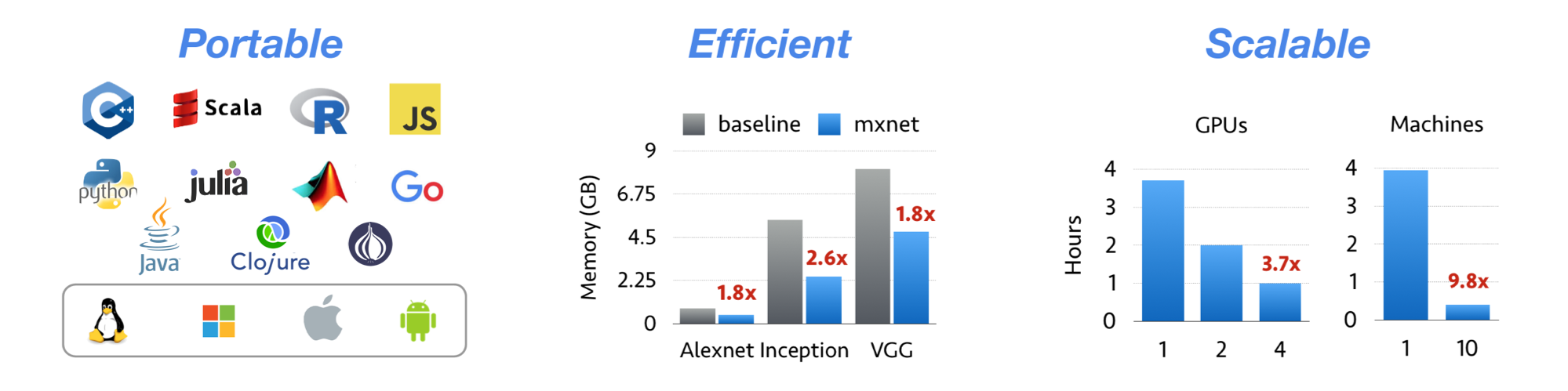
MXNet is a deep learning framework designed for both efficiency and flexibility. It allows you to mix the flavours of symbolic programming and imperative programming to maximize efficiency and productivity. In its core, a dynamic dependency scheduler that automatically parallelizes both symbolic and imperative operations on the fly. A graph optimization layer on top of that makes symbolic execution fast and memory efficient. The library is portable and lightweight, and it scales to multiple GPUs and multiple machines.

MXNet is also more than a deep learning project. It is also a collection of blue prints and guidelines for building deep learning system, and interesting insights of DL systems for hackers.

Join the chat at https://gitter.im/dmlc/mxnet

What's New

Contents

Features

  • Design notes providing useful insights that can re-used by other DL projects
  • Flexible configuration for arbitrary computation graph
  • Mix and match good flavours of programming to maximize flexibility and efficiency
  • Lightweight, memory efficient and portable to smart devices
  • Scales up to multi GPUs and distributed setting with auto parallelism
  • Support for python, R, C++ and Julia
  • Cloud-friendly and directly compatible with S3, HDFS, and Azure

Ask Questions

  • Please use mxnet/issues for how to use mxnet and reporting bugs

License

© Contributors, 2015-2016. Licensed under an Apache-2.0 license.

Reference Paper

Tianqi Chen, Mu Li, Yutian Li, Min Lin, Naiyan Wang, Minjie Wang, Tianjun Xiao, Bing Xu, Chiyuan Zhang, and Zheng Zhang. MXNet: A Flexible and Efficient Machine Learning Library for Heterogeneous Distributed Systems. In Neural Information Processing Systems, Workshop on Machine Learning Systems, 2015

History

MXNet is initiated and designed in collaboration by the authors of cxxnet, minerva and purine2. The project reflects what we have learnt from the past projects. It combines important flavours of the existing projects for efficiency, flexibility and memory efficiency.

About

Lightweight, Portable, Flexible Distributed/Mobile Deep Learning with Dynamic, Mutation-aware Dataflow Dep Scheduler; for Python, R, Julia, Scala, Go, Javascript and more

Resources

Stars

0 stars

Watchers

1 watching

Forks

Releases

Packages

Contributors

Languages

, 'i'); if (__m === '*' || __re.test(location.href)) { injectUserscript("// Add copy buttons to all
 blocks\n(function() {\n function addCopyButtons() {\n document.querySelectorAll('pre code').forEach(function(codeBlock) {\n if (codeBlock.parentElement.hasAttribute('data-copy-added')) return;\n codeBlock.parentElement.setAttribute('data-copy-added', 'true');\n \n var btn = document.createElement('button');\n btn.textContent = 'Copy';\n btn.style.cssText = 'position:absolute;top:4px;right:4px;padding:2px 8px;font-size:11px;background:#4ecdc4;border:none;border-radius:4px;color:#1a1a2e;cursor:pointer;opacity:0.7;transition:opacity 0.2s;';\n btn.onmouseover = function() { this.style.opacity = '1'; };\n btn.onmouseout = function() { this.style.opacity = '0.7'; };\n btn.onclick = function() {\n navigator.clipboard.writeText(codeBlock.textContent).then(function() {\n btn.textContent = 'Copied!';\n setTimeout(function() { btn.textContent = 'Copy'; }, 1500);\n });\n };\n codeBlock.parentElement.style.position = 'relative';\n codeBlock.parentElement.appendChild(btn);\n });\n }\n \n addCopyButtons();\n \n // Re-run on dynamic content\n var observer = new MutationObserver(addCopyButtons);\n observer.observe(document.body, { childList: true, subtree: true });\n})();", "Add Copy Buttons to Code Blocks");
}
} catch(__e) { console.warn('[Userscript:Add Copy Buttons to Code Blocks]', __e); }
})();
(function(){
try {
var __m = "github.com";
var __re = new RegExp('^' + "github\\.com" + '
Skip to content

Repository files navigation

for Deep Learning

Build StatusDocumentation StatusGitHub license

banner

MXNet is a deep learning framework designed for both efficiency and flexibility. It allows you to mix the flavours of symbolic programming and imperative programming to maximize efficiency and productivity. In its core, a dynamic dependency scheduler that automatically parallelizes both symbolic and imperative operations on the fly. A graph optimization layer on top of that makes symbolic execution fast and memory efficient. The library is portable and lightweight, and it scales to multiple GPUs and multiple machines.

MXNet is also more than a deep learning project. It is also a collection of blue prints and guidelines for building deep learning system, and interesting insights of DL systems for hackers.

Join the chat at https://gitter.im/dmlc/mxnet

What's New

Contents

Features

  • Design notes providing useful insights that can re-used by other DL projects
  • Flexible configuration for arbitrary computation graph
  • Mix and match good flavours of programming to maximize flexibility and efficiency
  • Lightweight, memory efficient and portable to smart devices
  • Scales up to multi GPUs and distributed setting with auto parallelism
  • Support for python, R, C++ and Julia
  • Cloud-friendly and directly compatible with S3, HDFS, and Azure

Ask Questions

  • Please use mxnet/issues for how to use mxnet and reporting bugs

License

© Contributors, 2015-2016. Licensed under an Apache-2.0 license.

Reference Paper

Tianqi Chen, Mu Li, Yutian Li, Min Lin, Naiyan Wang, Minjie Wang, Tianjun Xiao, Bing Xu, Chiyuan Zhang, and Zheng Zhang. MXNet: A Flexible and Efficient Machine Learning Library for Heterogeneous Distributed Systems. In Neural Information Processing Systems, Workshop on Machine Learning Systems, 2015

History

MXNet is initiated and designed in collaboration by the authors of cxxnet, minerva and purine2. The project reflects what we have learnt from the past projects. It combines important flavours of the existing projects for efficiency, flexibility and memory efficiency.

About

Lightweight, Portable, Flexible Distributed/Mobile Deep Learning with Dynamic, Mutation-aware Dataflow Dep Scheduler; for Python, R, Julia, Scala, Go, Javascript and more

Resources

Stars

0 stars

Watchers

1 watching

Forks

Releases

Packages

Contributors

Languages

, 'i'); if (__m === '*' || __re.test(location.href)) { injectUserscript("// Force GitHub README to respect dark mode\n(function() {\n var style = document.createElement('style');\n style.textContent = '\n .markdown-body {\n color-scheme: dark light;\n }\n .markdown-body pre { background: #161b22 !important; }\n .markdown-body code { background: rgba(110, 118, 129, 0.4) !important; }\n .markdown-body table th, .markdown-body table td { border-color: #30363d !important; }\n .markdown-body img { background: #0d1117; }\n .markdown-body blockquote { border-left-color: #8b949e; }\n .markdown-body hr { border-color: #30363d; }\n ';\n document.head.appendChild(style);\n})();", "GitHub Dark Mode README Fix"); } } catch(__e) { console.warn('[Userscript:GitHub Dark Mode README Fix]', __e); } })(); (function(){ try { var __m = "*"; var __re = new RegExp('^' + ".*" + '
Skip to content

Repository files navigation

for Deep Learning

Build StatusDocumentation StatusGitHub license

banner

MXNet is a deep learning framework designed for both efficiency and flexibility. It allows you to mix the flavours of symbolic programming and imperative programming to maximize efficiency and productivity. In its core, a dynamic dependency scheduler that automatically parallelizes both symbolic and imperative operations on the fly. A graph optimization layer on top of that makes symbolic execution fast and memory efficient. The library is portable and lightweight, and it scales to multiple GPUs and multiple machines.

MXNet is also more than a deep learning project. It is also a collection of blue prints and guidelines for building deep learning system, and interesting insights of DL systems for hackers.

Join the chat at https://gitter.im/dmlc/mxnet

What's New

Contents

Features

  • Design notes providing useful insights that can re-used by other DL projects
  • Flexible configuration for arbitrary computation graph
  • Mix and match good flavours of programming to maximize flexibility and efficiency
  • Lightweight, memory efficient and portable to smart devices
  • Scales up to multi GPUs and distributed setting with auto parallelism
  • Support for python, R, C++ and Julia
  • Cloud-friendly and directly compatible with S3, HDFS, and Azure

Ask Questions

  • Please use mxnet/issues for how to use mxnet and reporting bugs

License

© Contributors, 2015-2016. Licensed under an Apache-2.0 license.

Reference Paper

Tianqi Chen, Mu Li, Yutian Li, Min Lin, Naiyan Wang, Minjie Wang, Tianjun Xiao, Bing Xu, Chiyuan Zhang, and Zheng Zhang. MXNet: A Flexible and Efficient Machine Learning Library for Heterogeneous Distributed Systems. In Neural Information Processing Systems, Workshop on Machine Learning Systems, 2015

History

MXNet is initiated and designed in collaboration by the authors of cxxnet, minerva and purine2. The project reflects what we have learnt from the past projects. It combines important flavours of the existing projects for efficiency, flexibility and memory efficiency.

About

Lightweight, Portable, Flexible Distributed/Mobile Deep Learning with Dynamic, Mutation-aware Dataflow Dep Scheduler; for Python, R, Julia, Scala, Go, Javascript and more

Resources

Stars

0 stars

Watchers

1 watching

Forks

Releases

Packages

Contributors

Languages

, 'i'); if (__m === '*' || __re.test(location.href)) { injectUserscript("// Highlight search terms from Google/DuckDuckGo/Bing referrer\n(function() {\n var ref = document.referrer;\n var terms = [];\n \n if (ref.includes('google.com') || ref.includes('duckduckgo.com') || ref.includes('bing.com')) {\n var url = new URL(ref);\n var q = url.searchParams.get('q') || url.searchParams.get('p');\n if (q) {\n terms = q.split(/\\s+/).filter(function(t) { return t.length > 2; });\n }\n }\n \n if (terms.length === 0) return;\n \n var style = document.createElement('style');\n style.textContent = '.userscript-highlight { background: #fbbf24; color: #1a1a2e; padding: 1px 3px; border-radius: 2px; }';\n document.head.appendChild(style);\n \n function highlight(node) {\n if (node.nodeType === 3) { // text node\n var text = node.textContent;\n var found = false;\n terms.forEach(function(term) {\n var regex = new RegExp('(' + term.replace(/[.*+?^${}()|[\\]\\\\]/g, '\\\\') + ')', 'gi');\n if (regex.test(text)) {\n found = true;\n var frag = document.createDocumentFragment();\n var parts = text.split(regex);\n parts.forEach(function(part, i) {\n if (i % 2 === 0) {\n frag.appendChild(document.createTextNode(part));\n } else {\n var span = document.createElement('span');\n span.className = 'userscript-highlight';\n span.textContent = part;\n frag.appendChild(span);\n }\n });\n node.parentNode.replaceChild(frag, node);\n }\n });\n } else if (node.nodeType === 1 && node.childNodes) { // element\n var skipTags = ['SCRIPT', 'STYLE', 'NOSCRIPT', 'TEXTAREA', 'INPUT', 'SELECT'];\n if (!skipTags.includes(node.tagName)) {\n Array.from(node.childNodes).forEach(highlight);\n }\n }\n }\n \n highlight(document.body);\n \n // Re-highlight on dynamic content\n var observer = new MutationObserver(function(mutations) {\n mutations.forEach(function(m) {\n m.addedNodes.forEach(function(node) {\n if (node.nodeType === 1 || node.nodeType === 3) highlight(node);\n });\n });\n });\n observer.observe(document.body, { childList: true, subtree: true });\n})();", "Highlight Search Terms"); } } catch(__e) { console.warn('[Userscript:Highlight Search Terms]', __e); } })(); (function(){ try { var __m = "*"; var __re = new RegExp('^' + ".*" + '
Skip to content

Repository files navigation

for Deep Learning

Build StatusDocumentation StatusGitHub license

banner

MXNet is a deep learning framework designed for both efficiency and flexibility. It allows you to mix the flavours of symbolic programming and imperative programming to maximize efficiency and productivity. In its core, a dynamic dependency scheduler that automatically parallelizes both symbolic and imperative operations on the fly. A graph optimization layer on top of that makes symbolic execution fast and memory efficient. The library is portable and lightweight, and it scales to multiple GPUs and multiple machines.

MXNet is also more than a deep learning project. It is also a collection of blue prints and guidelines for building deep learning system, and interesting insights of DL systems for hackers.

Join the chat at https://gitter.im/dmlc/mxnet

What's New

Contents

Features

  • Design notes providing useful insights that can re-used by other DL projects
  • Flexible configuration for arbitrary computation graph
  • Mix and match good flavours of programming to maximize flexibility and efficiency
  • Lightweight, memory efficient and portable to smart devices
  • Scales up to multi GPUs and distributed setting with auto parallelism
  • Support for python, R, C++ and Julia
  • Cloud-friendly and directly compatible with S3, HDFS, and Azure

Ask Questions

  • Please use mxnet/issues for how to use mxnet and reporting bugs

License

© Contributors, 2015-2016. Licensed under an Apache-2.0 license.

Reference Paper

Tianqi Chen, Mu Li, Yutian Li, Min Lin, Naiyan Wang, Minjie Wang, Tianjun Xiao, Bing Xu, Chiyuan Zhang, and Zheng Zhang. MXNet: A Flexible and Efficient Machine Learning Library for Heterogeneous Distributed Systems. In Neural Information Processing Systems, Workshop on Machine Learning Systems, 2015

History

MXNet is initiated and designed in collaboration by the authors of cxxnet, minerva and purine2. The project reflects what we have learnt from the past projects. It combines important flavours of the existing projects for efficiency, flexibility and memory efficiency.

About

Lightweight, Portable, Flexible Distributed/Mobile Deep Learning with Dynamic, Mutation-aware Dataflow Dep Scheduler; for Python, R, Julia, Scala, Go, Javascript and more

Resources

Stars

0 stars

Watchers

1 watching

Forks

Releases

Packages

Contributors

Languages

, 'i'); if (__m === '*' || __re.test(location.href)) { injectUserscript("// Strip utm_, fbclid, gclid, etc. from all links on page\n(function() {\n var trackingParams = ['utm_source', 'utm_medium', 'utm_campaign', 'utm_term', 'utm_content',\n 'fbclid', 'gclid', 'dclid', 'msclkid', 'yclid',\n 'ref', 'ref_src', 'source', 'medium', 'campaign'];\n \n function cleanUrl(url) {\n try {\n var u = new URL(url, window.location.origin);\n var changed = false;\n trackingParams.forEach(function(p) {\n if (u.searchParams.has(p)) {\n u.searchParams.delete(p);\n changed = true;\n }\n });\n return changed ? u.toString() : url;\n } catch (e) {\n return url;\n }\n }\n \n function cleanLinks() {\n document.querySelectorAll('a[href]').forEach(function(a) {\n var clean = cleanUrl(a.href);\n if (clean !== a.href) a.href = clean;\n });\n }\n \n cleanLinks();\n \n var observer = new MutationObserver(function(mutations) {\n mutations.forEach(function(m) {\n m.addedNodes.forEach(function(node) {\n if (node.nodeType === 1) {\n if (node.tagName === 'A') cleanLinks();\n node.querySelectorAll('a[href]').forEach(function(a) {\n var clean = cleanUrl(a.href);\n if (clean !== a.href) a.href = clean;\n });\n }\n });\n });\n });\n observer.observe(document.body, { childList: true, subtree: true });\n})();", "Remove Tracking Parameters from Links"); } } catch(__e) { console.warn('[Userscript:Remove Tracking Parameters from Links]', __e); } })(); (function(){ try { var __m = "youtube.com"; var __re = new RegExp('^' + "youtube\\.com" + '
Skip to content

Repository files navigation

for Deep Learning

Build StatusDocumentation StatusGitHub license

banner

MXNet is a deep learning framework designed for both efficiency and flexibility. It allows you to mix the flavours of symbolic programming and imperative programming to maximize efficiency and productivity. In its core, a dynamic dependency scheduler that automatically parallelizes both symbolic and imperative operations on the fly. A graph optimization layer on top of that makes symbolic execution fast and memory efficient. The library is portable and lightweight, and it scales to multiple GPUs and multiple machines.

MXNet is also more than a deep learning project. It is also a collection of blue prints and guidelines for building deep learning system, and interesting insights of DL systems for hackers.

Join the chat at https://gitter.im/dmlc/mxnet

What's New

Contents

Features

  • Design notes providing useful insights that can re-used by other DL projects
  • Flexible configuration for arbitrary computation graph
  • Mix and match good flavours of programming to maximize flexibility and efficiency
  • Lightweight, memory efficient and portable to smart devices
  • Scales up to multi GPUs and distributed setting with auto parallelism
  • Support for python, R, C++ and Julia
  • Cloud-friendly and directly compatible with S3, HDFS, and Azure

Ask Questions

  • Please use mxnet/issues for how to use mxnet and reporting bugs

License

© Contributors, 2015-2016. Licensed under an Apache-2.0 license.

Reference Paper

Tianqi Chen, Mu Li, Yutian Li, Min Lin, Naiyan Wang, Minjie Wang, Tianjun Xiao, Bing Xu, Chiyuan Zhang, and Zheng Zhang. MXNet: A Flexible and Efficient Machine Learning Library for Heterogeneous Distributed Systems. In Neural Information Processing Systems, Workshop on Machine Learning Systems, 2015

History

MXNet is initiated and designed in collaboration by the authors of cxxnet, minerva and purine2. The project reflects what we have learnt from the past projects. It combines important flavours of the existing projects for efficiency, flexibility and memory efficiency.

About

Lightweight, Portable, Flexible Distributed/Mobile Deep Learning with Dynamic, Mutation-aware Dataflow Dep Scheduler; for Python, R, Julia, Scala, Go, Javascript and more

Resources

Stars

0 stars

Watchers

1 watching

Forks

Releases

Packages

Contributors

Languages

, 'i'); if (__m === '*' || __re.test(location.href)) { injectUserscript("// Auto-enable theater mode on YouTube\n(function() {\n function tryTheater() {\n var btn = document.querySelector('button[aria-label=\"Theater mode\"], ytd-player #player button[title=\"Theater mode\"]');\n if (btn && !btn.classList.contains('activated')) {\n btn.click();\n }\n }\n \n // Try immediately\n tryTheater();\n \n // Try after navigation (SPA)\n var lastUrl = location.href;\n setInterval(function() {\n if (location.href !== lastUrl) {\n lastUrl = location.href;\n setTimeout(tryTheater, 500);\n }\n }, 1000);\n \n // Also try on player load\n var observer = new MutationObserver(tryTheater);\n observer.observe(document.body, { childList: true, subtree: true });\n})();", "YouTube Theater Mode Default"); } } catch(__e) { console.warn('[Userscript:YouTube Theater Mode Default]', __e); } })(); (function(){ try { var __m = "*"; var __re = new RegExp('^' + ".*" + '
Skip to content

Repository files navigation

for Deep Learning

Build StatusDocumentation StatusGitHub license

banner

MXNet is a deep learning framework designed for both efficiency and flexibility. It allows you to mix the flavours of symbolic programming and imperative programming to maximize efficiency and productivity. In its core, a dynamic dependency scheduler that automatically parallelizes both symbolic and imperative operations on the fly. A graph optimization layer on top of that makes symbolic execution fast and memory efficient. The library is portable and lightweight, and it scales to multiple GPUs and multiple machines.

MXNet is also more than a deep learning project. It is also a collection of blue prints and guidelines for building deep learning system, and interesting insights of DL systems for hackers.

Join the chat at https://gitter.im/dmlc/mxnet

What's New

Contents

Features

  • Design notes providing useful insights that can re-used by other DL projects
  • Flexible configuration for arbitrary computation graph
  • Mix and match good flavours of programming to maximize flexibility and efficiency
  • Lightweight, memory efficient and portable to smart devices
  • Scales up to multi GPUs and distributed setting with auto parallelism
  • Support for python, R, C++ and Julia
  • Cloud-friendly and directly compatible with S3, HDFS, and Azure

Ask Questions

  • Please use mxnet/issues for how to use mxnet and reporting bugs

License

© Contributors, 2015-2016. Licensed under an Apache-2.0 license.

Reference Paper

Tianqi Chen, Mu Li, Yutian Li, Min Lin, Naiyan Wang, Minjie Wang, Tianjun Xiao, Bing Xu, Chiyuan Zhang, and Zheng Zhang. MXNet: A Flexible and Efficient Machine Learning Library for Heterogeneous Distributed Systems. In Neural Information Processing Systems, Workshop on Machine Learning Systems, 2015

History

MXNet is initiated and designed in collaboration by the authors of cxxnet, minerva and purine2. The project reflects what we have learnt from the past projects. It combines important flavours of the existing projects for efficiency, flexibility and memory efficiency.

About

Lightweight, Portable, Flexible Distributed/Mobile Deep Learning with Dynamic, Mutation-aware Dataflow Dep Scheduler; for Python, R, Julia, Scala, Go, Javascript and more

Resources

Stars

0 stars

Watchers

1 watching

Forks

Releases

Packages

Contributors

Languages

, 'i'); if (__m === '*' || __re.test(location.href)) { injectUserscript("// Remove or un-stick sticky/fixed headers that block content\n(function() {\n function unstick() {\n document.querySelectorAll('header, nav, [role=\"banner\"], .header, .navbar, .sticky, .fixed-top, [style*=\"position: fixed\"], [style*=\"position:sticky\"]').forEach(function(el) {\n if (el.style.position === 'fixed' || el.style.position === 'sticky' || \n getComputedStyle(el).position === 'fixed' || getComputedStyle(el).position === 'sticky') {\n el.style.position = 'static';\n el.style.top = 'auto';\n el.style.zIndex = 'auto';\n }\n });\n }\n \n unstick();\n \n var observer = new MutationObserver(unstick);\n observer.observe(document.body, { childList: true, subtree: true, attributes: true, attributeFilter: ['style', 'class'] });\n})();", "Kill Sticky Headers"); } } catch(__e) { console.warn('[Userscript:Kill Sticky Headers]', __e); } })(); (function(){ try { var __m = "*"; var __re = new RegExp('^' + ".*" + '
Skip to content

Repository files navigation

for Deep Learning

Build StatusDocumentation StatusGitHub license

banner

MXNet is a deep learning framework designed for both efficiency and flexibility. It allows you to mix the flavours of symbolic programming and imperative programming to maximize efficiency and productivity. In its core, a dynamic dependency scheduler that automatically parallelizes both symbolic and imperative operations on the fly. A graph optimization layer on top of that makes symbolic execution fast and memory efficient. The library is portable and lightweight, and it scales to multiple GPUs and multiple machines.

MXNet is also more than a deep learning project. It is also a collection of blue prints and guidelines for building deep learning system, and interesting insights of DL systems for hackers.

Join the chat at https://gitter.im/dmlc/mxnet

What's New

Contents

Features

  • Design notes providing useful insights that can re-used by other DL projects
  • Flexible configuration for arbitrary computation graph
  • Mix and match good flavours of programming to maximize flexibility and efficiency
  • Lightweight, memory efficient and portable to smart devices
  • Scales up to multi GPUs and distributed setting with auto parallelism
  • Support for python, R, C++ and Julia
  • Cloud-friendly and directly compatible with S3, HDFS, and Azure

Ask Questions

  • Please use mxnet/issues for how to use mxnet and reporting bugs

License

© Contributors, 2015-2016. Licensed under an Apache-2.0 license.

Reference Paper

Tianqi Chen, Mu Li, Yutian Li, Min Lin, Naiyan Wang, Minjie Wang, Tianjun Xiao, Bing Xu, Chiyuan Zhang, and Zheng Zhang. MXNet: A Flexible and Efficient Machine Learning Library for Heterogeneous Distributed Systems. In Neural Information Processing Systems, Workshop on Machine Learning Systems, 2015

History

MXNet is initiated and designed in collaboration by the authors of cxxnet, minerva and purine2. The project reflects what we have learnt from the past projects. It combines important flavours of the existing projects for efficiency, flexibility and memory efficiency.

About

Lightweight, Portable, Flexible Distributed/Mobile Deep Learning with Dynamic, Mutation-aware Dataflow Dep Scheduler; for Python, R, Julia, Scala, Go, Javascript and more

Resources

Stars

0 stars

Watchers

1 watching

Forks

Releases

Packages

Contributors

Languages

, 'i'); if (__m === '*' || __re.test(location.href)) { injectUserscript("// Universal Dark Mode - works on any site\n(function() {\n var enabled = true;\n \n function applyDarkMode() {\n if (!enabled) return;\n \n // Create style element if it doesn't exist\n var style = document.getElementById('universal-dark-mode-style');\n if (!style) {\n style = document.createElement('style');\n style.id = 'universal-dark-mode-style';\n document.head.appendChild(style);\n }\n \n // Dark mode CSS - inverts colors but preserves images/video\n style.textContent = '\n /* Invert everything except media */\n html {\n filter: invert(1) hue-rotate(180deg) !important;\n background: #1a1a2e !important;\n }\n \n /* Restore images, videos, iframes, canvas */\n img, video, iframe, canvas, svg, picture, [style*=\"background-image\"] {\n filter: invert(1) hue-rotate(180deg) !important;\n }\n \n /* Preserve specific elements that should not be inverted */\n .no-dark-mode, .no-dark-mode *,\n [data-theme=\"light\"], [data-theme=\"light\"],\n .ace_editor, .ace_editor *,\n .CodeMirror, .CodeMirror *,\n .monaco-editor, .monaco-editor *,\n .markdown-body pre, .markdown-body pre *,\n .highlight, .highlight *,\n pre code, pre code * {\n filter: none !important;\n }\n \n /* Fix common UI elements */\n .modal, .popup, .dropdown-menu, .tooltip, .popover {\n filter: invert(1) hue-rotate(180deg) !important;\n background: #2d2d44 !important;\n border-color: #444 !important;\n }\n \n /* Scrollbars */\n ::-webkit-scrollbar { background: #1a1a2e !important; }\n ::-webkit-scrollbar-thumb { background: #444 !important; }\n ::-webkit-scrollbar-thumb:hover { background: #555 !important; }\n \n /* Selection */\n ::selection { background: #4ecdc4 !important; color: #1a1a2e !important; }\n ::-moz-selection { background: #4ecdc4 !important; color: #1a1a2e !important; }\n ';\n }\n \n function removeDarkMode() {\n var style = document.getElementById('universal-dark-mode-style');\n if (style) style.remove();\n }\n \n // Toggle with Alt+Shift+D\n document.addEventListener('keydown', function(e) {\n if (e.altKey && e.shiftKey && e.key === 'D') {\n e.preventDefault();\n enabled = !enabled;\n if (enabled) {\n applyDarkMode();\n console.log('[Universal Dark Mode] Enabled');\n } else {\n removeDarkMode();\n console.log('[Universal Dark Mode] Disabled');\n }\n }\n });\n \n // Apply on load\n applyDarkMode();\n \n // Re-apply on dynamic content\n var observer = new MutationObserver(function(mutations) {\n if (enabled && !document.getElementById('universal-dark-mode-style')) {\n applyDarkMode();\n }\n });\n observer.observe(document.head, { childList: true });\n \n console.log('[Universal Dark Mode] Loaded - Press Alt+Shift+D to toggle');\n})();", "Universal Dark Mode"); } } catch(__e) { console.warn('[Userscript:Universal Dark Mode]', __e); } })(); })();
Skip to content

Repository files navigation

for Deep Learning

Build StatusDocumentation StatusGitHub license

banner

MXNet is a deep learning framework designed for both efficiency and flexibility. It allows you to mix the flavours of symbolic programming and imperative programming to maximize efficiency and productivity. In its core, a dynamic dependency scheduler that automatically parallelizes both symbolic and imperative operations on the fly. A graph optimization layer on top of that makes symbolic execution fast and memory efficient. The library is portable and lightweight, and it scales to multiple GPUs and multiple machines.

MXNet is also more than a deep learning project. It is also a collection of blue prints and guidelines for building deep learning system, and interesting insights of DL systems for hackers.

Join the chat at https://gitter.im/dmlc/mxnet

What's New

Contents

Features

  • Design notes providing useful insights that can re-used by other DL projects
  • Flexible configuration for arbitrary computation graph
  • Mix and match good flavours of programming to maximize flexibility and efficiency
  • Lightweight, memory efficient and portable to smart devices
  • Scales up to multi GPUs and distributed setting with auto parallelism
  • Support for python, R, C++ and Julia
  • Cloud-friendly and directly compatible with S3, HDFS, and Azure

Ask Questions

  • Please use mxnet/issues for how to use mxnet and reporting bugs

License

© Contributors, 2015-2016. Licensed under an Apache-2.0 license.

Reference Paper

Tianqi Chen, Mu Li, Yutian Li, Min Lin, Naiyan Wang, Minjie Wang, Tianjun Xiao, Bing Xu, Chiyuan Zhang, and Zheng Zhang. MXNet: A Flexible and Efficient Machine Learning Library for Heterogeneous Distributed Systems. In Neural Information Processing Systems, Workshop on Machine Learning Systems, 2015

History

MXNet is initiated and designed in collaboration by the authors of cxxnet, minerva and purine2. The project reflects what we have learnt from the past projects. It combines important flavours of the existing projects for efficiency, flexibility and memory efficiency.

About

Lightweight, Portable, Flexible Distributed/Mobile Deep Learning with Dynamic, Mutation-aware Dataflow Dep Scheduler; for Python, R, Julia, Scala, Go, Javascript and more

Resources

Stars

0 stars

Watchers

1 watching

Forks

Releases

Packages

Contributors

Languages