



🤗 Diffusers provides pretrained diffusion models across multiple modalities, such as vision and audio, and serves as a modular toolbox for inference and training of diffusion models.
More precisely, 🤗 Diffusers offers:
- State-of-the-art diffusion pipelines that can be run in inference with just a couple of lines of code (see src/diffusers/pipelines).
- Various noise schedulers that can be used interchangeably for the prefered speed vs. quality trade-off in inference (see src/diffusers/schedulers).
- Multiple types of models, such as UNet, that can be used as building blocks in an end-to-end diffusion system (see src/diffusers/models).
- Training examples to show how to train the most popular diffusion models (see examples).
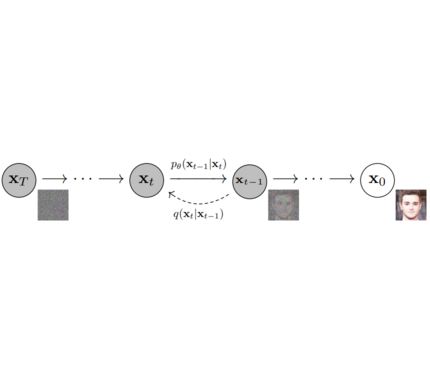
Models: Neural network that models p_θ(x_t-1|x_t) (see image below) and is trained end-to-end to denoise a noisy input to an image. Examples: UNet, Conditioned UNet, 3D UNet, Transformer UNet
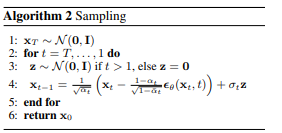
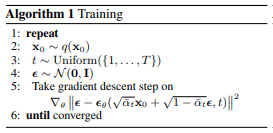
Schedulers: Algorithm class for both inference and training. The class provides functionality to compute previous image according to alpha, beta schedule as well as predict noise for training. Examples: DDPM, DDIM, PNDM, DEIS
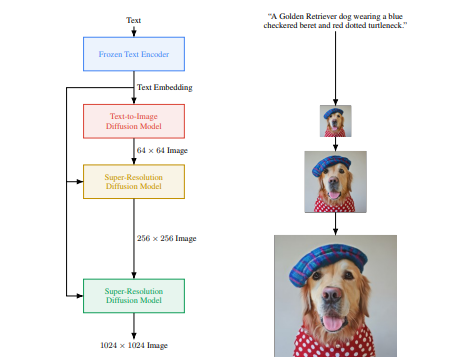
Diffusion Pipeline: End-to-end pipeline that includes multiple diffusion models, possible text encoders, ... Examples: GLIDE, Latent-Diffusion, Imagen, DALL-E 2
- Readability and clarity is prefered over highly optimized code. A strong importance is put on providing readable, intuitive and elementary code desgin. E.g., the provided schedulers are separated from the provided models and provide well-commented code that can be read alongside the original paper.
- Diffusers is modality independent and focusses on providing pretrained models and tools to build systems that generate continous outputs, e.g. vision and audio.
- Diffusion models and schedulers are provided as consise, elementary building blocks whereas diffusion pipelines are a collection of end-to-end diffusion systems that can be used out-of-the-box, should stay as close as possible to their original implementation and can include components of other library, such as text-encoders. Examples for diffusion pipelines are Glide and Latent Diffusion.
pip install diffusers # should install diffusers 0.0.4
diffusers is more modularized than transformers. The idea is that researchers and engineers can use only parts of the library easily for the own use cases.
It could become a central place for all kinds of models, schedulers, training utils and processors that one can mix and match for one's own use case.
Both models and schedulers should be load- and saveable from the Hub.
For more examples see schedulers and models
Example for DDPM:
importtorchfromdiffusersimportUNetModel, DDPMSchedulerimportPILimportnumpyasnpimporttqdmgenerator=torch.manual_seed(0)
torch_device="cuda"iftorch.cuda.is_available() else"cpu"# 1. Load modelsnoise_scheduler=DDPMScheduler.from_config("fusing/ddpm-lsun-church", tensor_format="pt")
unet=UNetModel.from_pretrained("fusing/ddpm-lsun-church").to(torch_device)
# 2. Sample gaussian noiseimage=torch.randn(
(1, unet.in_channels, unet.resolution, unet.resolution),
generator=generator,
)
image=image.to(torch_device)
# 3. Denoisenum_prediction_steps=len(noise_scheduler)
fortintqdm.tqdm(reversed(range(num_prediction_steps)), total=num_prediction_steps):
# predict noise residualwithtorch.no_grad():
residual=unet(image, t)
# predict previous mean of image x_t-1pred_prev_image=noise_scheduler.step(residual, image, t)
# optionally sample variancevariance=0ift>0:
noise=torch.randn(image.shape, generator=generator).to(image.device)
variance=noise_scheduler.get_variance(t).sqrt() *noise# set current image to prev_image: x_t -> x_t-1image=pred_prev_image+variance# 5. process image to PILimage_processed=image.cpu().permute(0, 2, 3, 1)
image_processed= (image_processed+1.0) *127.5image_processed=image_processed.numpy().astype(np.uint8)
image_pil=PIL.Image.fromarray(image_processed[0])
# 6. save imageimage_pil.save("test.png")
Example for DDIM:
importtorchfromdiffusersimportUNetModel, DDIMSchedulerimportPILimportnumpyasnpimporttqdmgenerator=torch.manual_seed(0)
torch_device="cuda"iftorch.cuda.is_available() else"cpu"# 1. Load modelsnoise_scheduler=DDIMScheduler.from_config("fusing/ddpm-celeba-hq", tensor_format="pt")
unet=UNetModel.from_pretrained("fusing/ddpm-celeba-hq").to(torch_device)
# 2. Sample gaussian noiseimage=torch.randn(
(1, unet.in_channels, unet.resolution, unet.resolution),
generator=generator,
)
image=image.to(torch_device)
# 3. Denoise num_inference_steps=50eta=0.0# <- deterministic samplingfortintqdm.tqdm(reversed(range(num_inference_steps)), total=num_inference_steps):
# 1. predict noise residualorig_t=noise_scheduler.get_orig_t(t, num_inference_steps)
withtorch.no_grad():
residual=unet(image, orig_t)
# 2. predict previous mean of image x_t-1pred_prev_image=noise_scheduler.step(residual, image, t, num_inference_steps, eta)
# 3. optionally sample variancevariance=0ifeta>0:
noise=torch.randn(image.shape, generator=generator).to(image.device)
variance=noise_scheduler.get_variance(t).sqrt() *eta*noise# 4. set current image to prev_image: x_t -> x_t-1image=pred_prev_image+variance# 5. process image to PILimage_processed=image.cpu().permute(0, 2, 3, 1)
image_processed= (image_processed+1.0) *127.5image_processed=image_processed.numpy().astype(np.uint8)
image_pil=PIL.Image.fromarray(image_processed[0])
# 6. save imageimage_pil.save("test.png")For more examples see pipelines.
fromdiffusersimportPNDM, UNetModel, PNDMSchedulerimportPIL.Imageimportnumpyasnpimporttorchmodel_id="fusing/ddim-celeba-hq"model=UNetModel.from_pretrained(model_id)
scheduler=PNDMScheduler()
# load model and schedulerpndm=PNDM(unet=model, noise_scheduler=scheduler)
# run pipeline in inference (sample random noise and denoise)withtorch.no_grad():
image=pndm()
# process image to PILimage_processed=image.cpu().permute(0, 2, 3, 1)
image_processed= (image_processed+1.0) /2image_processed=torch.clamp(image_processed, 0.0, 1.0)
image_processed=image_processed*255image_processed=image_processed.numpy().astype(np.uint8)
image_pil=PIL.Image.fromarray(image_processed[0])
# save imageimage_pil.save("test.png")Note: To use latent diffusion install transformers from this branch.
fromdiffusersimportDiffusionPipelineldm=DiffusionPipeline.from_pretrained("fusing/latent-diffusion-text2im-large")
generator=torch.manual_seed(42)
prompt="A painting of a squirrel eating a burger"image=ldm([prompt], generator=generator, eta=0.3, guidance_scale=6.0, num_inference_steps=50)
image_processed=image.cpu().permute(0, 2, 3, 1)
image_processed=image_processed*255.image_processed=image_processed.numpy().astype(np.uint8)
image_pil=PIL.Image.fromarray(image_processed[0])
# save imageimage_pil.save("test.png")Follow the instructions here to load tacotron2 model.
importtorchfromdiffusersimportBDDM, DiffusionPipelinetorch_device="cuda"# load the BDDM pipelinebddm=DiffusionPipeline.from_pretrained("fusing/diffwave-vocoder-ljspeech")
# load tacotron2 to get the mel spectogramstacotron2=torch.hub.load('NVIDIA/DeepLearningExamples:torchhub', 'nvidia_tacotron2', model_math='fp16')
tacotron2=tacotron2.to(torch_device).eval()
text="Hello world, I missed you so much."utils=torch.hub.load('NVIDIA/DeepLearningExamples:torchhub', 'nvidia_tts_utils')
sequences, lengths=utils.prepare_input_sequence([text])
# generate mel spectograms using textwithtorch.no_grad():
mel_spec, _, _=tacotron2.infer(sequences, lengths)
# generate the speech by passing mel spectograms to BDDM pipelinegenerator=torch.manual_seed(0)
audio=bddm(mel_spec, generator, torch_device)
# save generated audiofromscipy.io.wavfileimportwriteaswavwritesampling_rate=22050wavwrite("generated_audio.wav", sampling_rate, audio.squeeze().cpu().numpy())- Create common API for models [ ]
- Add tests for models [ ]
- Adapt schedulers for training [ ]
- Write google colab for training [ ]
- Write docs / Think about how to structure docs [ ]
- Add tests to circle ci [ ]
- Add more vision models [ ]
- Add more speech models [ ]
- Add RL model [ ]