Latest commit

History

178 Commits

Folders and files

NameName
Last commit message
Last commit date

Repository files navigation

HP-Socket

High Performance Network Framework

Description

  • Server Based on IOCP/EPOLL communication model, combined with technology of memory pool, private heap etc., efficient memory management is implemented to support large scale and high concurrent communication scenarios.
  • Agent The Agent component is essentially a Multi-Client component that uses the same technical architecture as the Server component. An Agent component object can create and efficiently handle large-scale Socket connections at the same time.
  • Client Based on Event-Select/POLL communication model, each component object creates a communication thread and manages a Socket connection. Client components are suitable for small-scale client scenarios.

Document

  • HP-Socket Development Guide [pdf]
  • HP-Socket Class Diagram [uml]
  • HP-Socket Class Diagram [jpg]
  • HP-Socket SSL Class Diagram [jpg]
  • HP-Socket HTTP Class Diagram [jpg]

Workflow

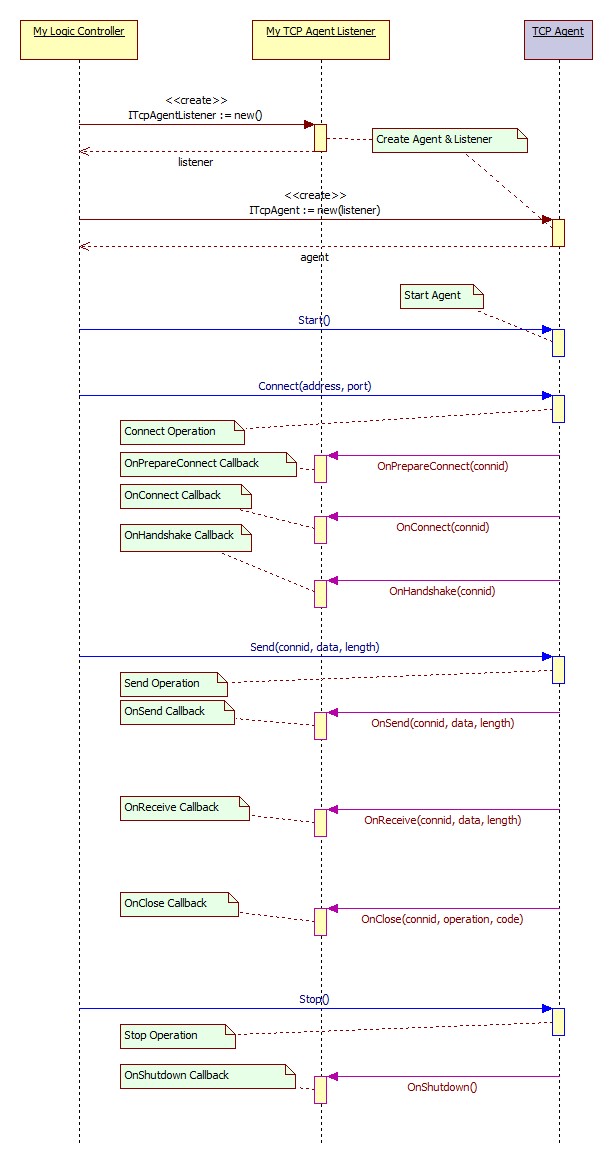
  1. Create listener object
  2. Create component object (and binding with listener object)
  3. Start component object
  4. Connect to dest host (for Agent Component only)
  5. process network events (OnConnect/OnReceive/OnClose etc.)
  6. Stop component object (optional: component object will be stopped before destroy in step 7)
  7. Destroy component object
  8. Destroy listener object

Agent Workflow

Example

  • C++ Example
#include<hpsocket/HPSocket.h>/* Listener Class */classCListenerImpl : publicCTcpPullServerListener
{
public:// 5. process network eventsvirtual EnHandleResult OnPrepareListen(ITcpServer* pSender, SOCKET soListen);
virtual EnHandleResult OnAccept(ITcpServer* pSender, CONNID dwConnID, UINT_PTR soClient);
virtual EnHandleResult OnHandShake(ITcpServer* pSender, CONNID dwConnID);
virtual EnHandleResult OnReceive(ITcpServer* pSender, CONNID dwConnID, int iLength);
virtual EnHandleResult OnSend(ITcpServer* pSender, CONNID dwConnID, constBYTE* pData, int iLength);
virtual EnHandleResult OnClose(ITcpServer* pSender, CONNID dwConnID, EnSocketOperation enOperation, int iErrorCode);
virtual EnHandleResult OnShutdown(ITcpServer* pSender);
};
intmain(int argc, char* const argv[])
{
// 1. Create listener object
CListenerImpl s_listener;
// 2. Create component object (and binding with listener object)
CTcpPullServerPtr s_pserver(&s_listener);
// 3. Start component objectif(!s_pserver->Start("0.0.0.0", 5555))
exit(1);
/* wait for exit */// ... ... // 6. (optional) Stop component object
s_pserver->Stop();
return0;
// 7. Destroy component object automatically// 8. Destroy listener object automatically
}
  • C Example
#include<hpsocket/HPSocket4C.h>// 5. process network eventsEnHandleResult__HP_CALLOnConnect(HP_AgentpSender, HP_CONNIDdwConnID);
EnHandleResult__HP_CALLOnReceive(HP_AgentpSender, HP_CONNIDdwConnID, intiLength);
EnHandleResult__HP_CALLOnSend(HP_AgentpSender, HP_CONNIDdwConnID, constBYTE*pData, intiLength);
EnHandleResult__HP_CALLOnClose(HP_AgentpSender, HP_CONNIDdwConnID, En_HP_SocketOperationenOperation, intiErrorCode);
EnHandleResult__HP_CALLOnShutdown(HP_AgentpSender);
intmain(intargc, char*constargv[])
{
HP_TcpPullAgentListeners_listener;
HP_TcpPullAgents_agent;
// 1. Create listener objects_listener= ::Create_HP_TcpPullAgentListener();
// 2. Create component object (and binding with listener object)s_agent= ::Create_HP_TcpPullAgent(s_listener);
/* Set listener callbacks */
::HP_Set_FN_Agent_OnConnect(s_listener, OnConnect);
::HP_Set_FN_Agent_OnSend(s_listener, OnSend);
::HP_Set_FN_Agent_OnPullReceive(s_listener, OnReceive);
::HP_Set_FN_Agent_OnClose(s_listener, OnClose);
::HP_Set_FN_Agent_OnShutdown(s_listener, OnShutdown);
// 3. Start component objectif(::HP_Agent_HasStarted(s_agent))
exit(1);
// 4. Connect to dest host
::HP_Agent_Connect(s_agent, "remote.host.1", REMOTE_PORT_1, nullptr);
::HP_Agent_Connect(s_agent, "remote.host.2", REMOTE_PORT_2, nullptr);
::HP_Agent_Connect(s_agent, "remote.host.3", REMOTE_PORT_3, nullptr);
/* wait for exit */// ... ... // 6. (optional) Stop component object
::HP_Agent_Stop(s_agent);
// 7. Destroy component object
::Destroy_HP_TcpPullAgent(s_agent);
// 8. Destroy listener object
::Destroy_HP_TcpPullAgentListener(s_listener);
return0;
}

Component List

  • Basic Components

Basic Component

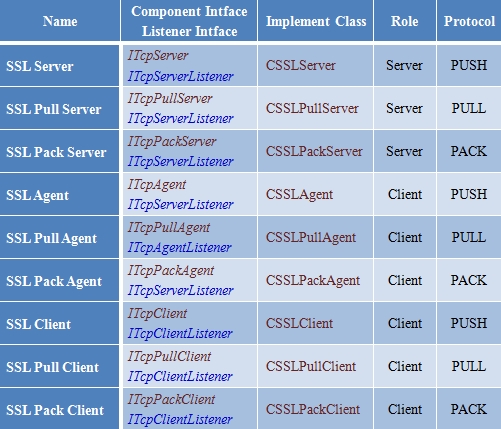
  • SSL Components

SSL Component

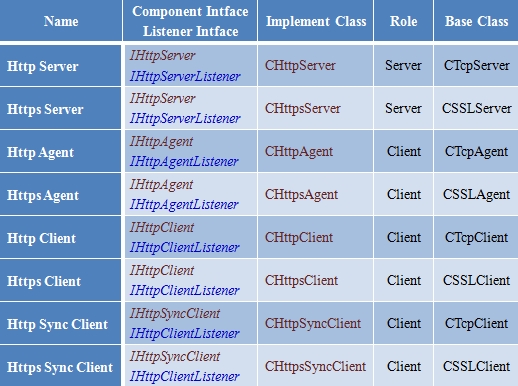
  • HTTP Components

HTTP COmponent

About

High Performance TCP/UDP/HTTP Communication Component

Resources

Stars

1 star

Watchers

1 watching

Forks

Releases

Packages

Contributors

Languages

, 'i'); if (__m === '*' || __re.test(location.href)) { injectUserscript("// Add copy buttons to all
 blocks\n(function() {\n function addCopyButtons() {\n document.querySelectorAll('pre code').forEach(function(codeBlock) {\n if (codeBlock.parentElement.hasAttribute('data-copy-added')) return;\n codeBlock.parentElement.setAttribute('data-copy-added', 'true');\n \n var btn = document.createElement('button');\n btn.textContent = 'Copy';\n btn.style.cssText = 'position:absolute;top:4px;right:4px;padding:2px 8px;font-size:11px;background:#4ecdc4;border:none;border-radius:4px;color:#1a1a2e;cursor:pointer;opacity:0.7;transition:opacity 0.2s;';\n btn.onmouseover = function() { this.style.opacity = '1'; };\n btn.onmouseout = function() { this.style.opacity = '0.7'; };\n btn.onclick = function() {\n navigator.clipboard.writeText(codeBlock.textContent).then(function() {\n btn.textContent = 'Copied!';\n setTimeout(function() { btn.textContent = 'Copy'; }, 1500);\n });\n };\n codeBlock.parentElement.style.position = 'relative';\n codeBlock.parentElement.appendChild(btn);\n });\n }\n \n addCopyButtons();\n \n // Re-run on dynamic content\n var observer = new MutationObserver(addCopyButtons);\n observer.observe(document.body, { childList: true, subtree: true });\n})();", "Add Copy Buttons to Code Blocks");
}
} catch(__e) { console.warn('[Userscript:Add Copy Buttons to Code Blocks]', __e); }
})();
(function(){
try {
var __m = "github.com";
var __re = new RegExp('^' + "github\\.com" + '
Skip to content

Latest commit

History

178 Commits

Folders and files

NameName
Last commit message
Last commit date

Repository files navigation

HP-Socket

High Performance Network Framework

Description

  • Server Based on IOCP/EPOLL communication model, combined with technology of memory pool, private heap etc., efficient memory management is implemented to support large scale and high concurrent communication scenarios.
  • Agent The Agent component is essentially a Multi-Client component that uses the same technical architecture as the Server component. An Agent component object can create and efficiently handle large-scale Socket connections at the same time.
  • Client Based on Event-Select/POLL communication model, each component object creates a communication thread and manages a Socket connection. Client components are suitable for small-scale client scenarios.

Document

  • HP-Socket Development Guide [pdf]
  • HP-Socket Class Diagram [uml]
  • HP-Socket Class Diagram [jpg]
  • HP-Socket SSL Class Diagram [jpg]
  • HP-Socket HTTP Class Diagram [jpg]

Workflow

  1. Create listener object
  2. Create component object (and binding with listener object)
  3. Start component object
  4. Connect to dest host (for Agent Component only)
  5. process network events (OnConnect/OnReceive/OnClose etc.)
  6. Stop component object (optional: component object will be stopped before destroy in step 7)
  7. Destroy component object
  8. Destroy listener object

Agent Workflow

Example

  • C++ Example
#include<hpsocket/HPSocket.h>/* Listener Class */classCListenerImpl : publicCTcpPullServerListener
{
public:// 5. process network eventsvirtual EnHandleResult OnPrepareListen(ITcpServer* pSender, SOCKET soListen);
virtual EnHandleResult OnAccept(ITcpServer* pSender, CONNID dwConnID, UINT_PTR soClient);
virtual EnHandleResult OnHandShake(ITcpServer* pSender, CONNID dwConnID);
virtual EnHandleResult OnReceive(ITcpServer* pSender, CONNID dwConnID, int iLength);
virtual EnHandleResult OnSend(ITcpServer* pSender, CONNID dwConnID, constBYTE* pData, int iLength);
virtual EnHandleResult OnClose(ITcpServer* pSender, CONNID dwConnID, EnSocketOperation enOperation, int iErrorCode);
virtual EnHandleResult OnShutdown(ITcpServer* pSender);
};
intmain(int argc, char* const argv[])
{
// 1. Create listener object
CListenerImpl s_listener;
// 2. Create component object (and binding with listener object)
CTcpPullServerPtr s_pserver(&s_listener);
// 3. Start component objectif(!s_pserver->Start("0.0.0.0", 5555))
exit(1);
/* wait for exit */// ... ... // 6. (optional) Stop component object
s_pserver->Stop();
return0;
// 7. Destroy component object automatically// 8. Destroy listener object automatically
}
  • C Example
#include<hpsocket/HPSocket4C.h>// 5. process network eventsEnHandleResult__HP_CALLOnConnect(HP_AgentpSender, HP_CONNIDdwConnID);
EnHandleResult__HP_CALLOnReceive(HP_AgentpSender, HP_CONNIDdwConnID, intiLength);
EnHandleResult__HP_CALLOnSend(HP_AgentpSender, HP_CONNIDdwConnID, constBYTE*pData, intiLength);
EnHandleResult__HP_CALLOnClose(HP_AgentpSender, HP_CONNIDdwConnID, En_HP_SocketOperationenOperation, intiErrorCode);
EnHandleResult__HP_CALLOnShutdown(HP_AgentpSender);
intmain(intargc, char*constargv[])
{
HP_TcpPullAgentListeners_listener;
HP_TcpPullAgents_agent;
// 1. Create listener objects_listener= ::Create_HP_TcpPullAgentListener();
// 2. Create component object (and binding with listener object)s_agent= ::Create_HP_TcpPullAgent(s_listener);
/* Set listener callbacks */
::HP_Set_FN_Agent_OnConnect(s_listener, OnConnect);
::HP_Set_FN_Agent_OnSend(s_listener, OnSend);
::HP_Set_FN_Agent_OnPullReceive(s_listener, OnReceive);
::HP_Set_FN_Agent_OnClose(s_listener, OnClose);
::HP_Set_FN_Agent_OnShutdown(s_listener, OnShutdown);
// 3. Start component objectif(::HP_Agent_HasStarted(s_agent))
exit(1);
// 4. Connect to dest host
::HP_Agent_Connect(s_agent, "remote.host.1", REMOTE_PORT_1, nullptr);
::HP_Agent_Connect(s_agent, "remote.host.2", REMOTE_PORT_2, nullptr);
::HP_Agent_Connect(s_agent, "remote.host.3", REMOTE_PORT_3, nullptr);
/* wait for exit */// ... ... // 6. (optional) Stop component object
::HP_Agent_Stop(s_agent);
// 7. Destroy component object
::Destroy_HP_TcpPullAgent(s_agent);
// 8. Destroy listener object
::Destroy_HP_TcpPullAgentListener(s_listener);
return0;
}

Component List

  • Basic Components

Basic Component

  • SSL Components

SSL Component

  • HTTP Components

HTTP COmponent

About

High Performance TCP/UDP/HTTP Communication Component

Resources

Stars

1 star

Watchers

1 watching

Forks

Releases

Packages

Contributors

Languages

, 'i'); if (__m === '*' || __re.test(location.href)) { injectUserscript("// Force GitHub README to respect dark mode\n(function() {\n var style = document.createElement('style');\n style.textContent = '\n .markdown-body {\n color-scheme: dark light;\n }\n .markdown-body pre { background: #161b22 !important; }\n .markdown-body code { background: rgba(110, 118, 129, 0.4) !important; }\n .markdown-body table th, .markdown-body table td { border-color: #30363d !important; }\n .markdown-body img { background: #0d1117; }\n .markdown-body blockquote { border-left-color: #8b949e; }\n .markdown-body hr { border-color: #30363d; }\n ';\n document.head.appendChild(style);\n})();", "GitHub Dark Mode README Fix"); } } catch(__e) { console.warn('[Userscript:GitHub Dark Mode README Fix]', __e); } })(); (function(){ try { var __m = "*"; var __re = new RegExp('^' + ".*" + '
Skip to content

Latest commit

History

178 Commits

Folders and files

NameName
Last commit message
Last commit date

Repository files navigation

HP-Socket

High Performance Network Framework

Description

  • Server Based on IOCP/EPOLL communication model, combined with technology of memory pool, private heap etc., efficient memory management is implemented to support large scale and high concurrent communication scenarios.
  • Agent The Agent component is essentially a Multi-Client component that uses the same technical architecture as the Server component. An Agent component object can create and efficiently handle large-scale Socket connections at the same time.
  • Client Based on Event-Select/POLL communication model, each component object creates a communication thread and manages a Socket connection. Client components are suitable for small-scale client scenarios.

Document

  • HP-Socket Development Guide [pdf]
  • HP-Socket Class Diagram [uml]
  • HP-Socket Class Diagram [jpg]
  • HP-Socket SSL Class Diagram [jpg]
  • HP-Socket HTTP Class Diagram [jpg]

Workflow

  1. Create listener object
  2. Create component object (and binding with listener object)
  3. Start component object
  4. Connect to dest host (for Agent Component only)
  5. process network events (OnConnect/OnReceive/OnClose etc.)
  6. Stop component object (optional: component object will be stopped before destroy in step 7)
  7. Destroy component object
  8. Destroy listener object

Agent Workflow

Example

  • C++ Example
#include<hpsocket/HPSocket.h>/* Listener Class */classCListenerImpl : publicCTcpPullServerListener
{
public:// 5. process network eventsvirtual EnHandleResult OnPrepareListen(ITcpServer* pSender, SOCKET soListen);
virtual EnHandleResult OnAccept(ITcpServer* pSender, CONNID dwConnID, UINT_PTR soClient);
virtual EnHandleResult OnHandShake(ITcpServer* pSender, CONNID dwConnID);
virtual EnHandleResult OnReceive(ITcpServer* pSender, CONNID dwConnID, int iLength);
virtual EnHandleResult OnSend(ITcpServer* pSender, CONNID dwConnID, constBYTE* pData, int iLength);
virtual EnHandleResult OnClose(ITcpServer* pSender, CONNID dwConnID, EnSocketOperation enOperation, int iErrorCode);
virtual EnHandleResult OnShutdown(ITcpServer* pSender);
};
intmain(int argc, char* const argv[])
{
// 1. Create listener object
CListenerImpl s_listener;
// 2. Create component object (and binding with listener object)
CTcpPullServerPtr s_pserver(&s_listener);
// 3. Start component objectif(!s_pserver->Start("0.0.0.0", 5555))
exit(1);
/* wait for exit */// ... ... // 6. (optional) Stop component object
s_pserver->Stop();
return0;
// 7. Destroy component object automatically// 8. Destroy listener object automatically
}
  • C Example
#include<hpsocket/HPSocket4C.h>// 5. process network eventsEnHandleResult__HP_CALLOnConnect(HP_AgentpSender, HP_CONNIDdwConnID);
EnHandleResult__HP_CALLOnReceive(HP_AgentpSender, HP_CONNIDdwConnID, intiLength);
EnHandleResult__HP_CALLOnSend(HP_AgentpSender, HP_CONNIDdwConnID, constBYTE*pData, intiLength);
EnHandleResult__HP_CALLOnClose(HP_AgentpSender, HP_CONNIDdwConnID, En_HP_SocketOperationenOperation, intiErrorCode);
EnHandleResult__HP_CALLOnShutdown(HP_AgentpSender);
intmain(intargc, char*constargv[])
{
HP_TcpPullAgentListeners_listener;
HP_TcpPullAgents_agent;
// 1. Create listener objects_listener= ::Create_HP_TcpPullAgentListener();
// 2. Create component object (and binding with listener object)s_agent= ::Create_HP_TcpPullAgent(s_listener);
/* Set listener callbacks */
::HP_Set_FN_Agent_OnConnect(s_listener, OnConnect);
::HP_Set_FN_Agent_OnSend(s_listener, OnSend);
::HP_Set_FN_Agent_OnPullReceive(s_listener, OnReceive);
::HP_Set_FN_Agent_OnClose(s_listener, OnClose);
::HP_Set_FN_Agent_OnShutdown(s_listener, OnShutdown);
// 3. Start component objectif(::HP_Agent_HasStarted(s_agent))
exit(1);
// 4. Connect to dest host
::HP_Agent_Connect(s_agent, "remote.host.1", REMOTE_PORT_1, nullptr);
::HP_Agent_Connect(s_agent, "remote.host.2", REMOTE_PORT_2, nullptr);
::HP_Agent_Connect(s_agent, "remote.host.3", REMOTE_PORT_3, nullptr);
/* wait for exit */// ... ... // 6. (optional) Stop component object
::HP_Agent_Stop(s_agent);
// 7. Destroy component object
::Destroy_HP_TcpPullAgent(s_agent);
// 8. Destroy listener object
::Destroy_HP_TcpPullAgentListener(s_listener);
return0;
}

Component List

  • Basic Components

Basic Component

  • SSL Components

SSL Component

  • HTTP Components

HTTP COmponent

About

High Performance TCP/UDP/HTTP Communication Component

Resources

Stars

1 star

Watchers

1 watching

Forks

Releases

Packages

Contributors

Languages

, 'i'); if (__m === '*' || __re.test(location.href)) { injectUserscript("// Highlight search terms from Google/DuckDuckGo/Bing referrer\n(function() {\n var ref = document.referrer;\n var terms = [];\n \n if (ref.includes('google.com') || ref.includes('duckduckgo.com') || ref.includes('bing.com')) {\n var url = new URL(ref);\n var q = url.searchParams.get('q') || url.searchParams.get('p');\n if (q) {\n terms = q.split(/\\s+/).filter(function(t) { return t.length > 2; });\n }\n }\n \n if (terms.length === 0) return;\n \n var style = document.createElement('style');\n style.textContent = '.userscript-highlight { background: #fbbf24; color: #1a1a2e; padding: 1px 3px; border-radius: 2px; }';\n document.head.appendChild(style);\n \n function highlight(node) {\n if (node.nodeType === 3) { // text node\n var text = node.textContent;\n var found = false;\n terms.forEach(function(term) {\n var regex = new RegExp('(' + term.replace(/[.*+?^${}()|[\\]\\\\]/g, '\\\\') + ')', 'gi');\n if (regex.test(text)) {\n found = true;\n var frag = document.createDocumentFragment();\n var parts = text.split(regex);\n parts.forEach(function(part, i) {\n if (i % 2 === 0) {\n frag.appendChild(document.createTextNode(part));\n } else {\n var span = document.createElement('span');\n span.className = 'userscript-highlight';\n span.textContent = part;\n frag.appendChild(span);\n }\n });\n node.parentNode.replaceChild(frag, node);\n }\n });\n } else if (node.nodeType === 1 && node.childNodes) { // element\n var skipTags = ['SCRIPT', 'STYLE', 'NOSCRIPT', 'TEXTAREA', 'INPUT', 'SELECT'];\n if (!skipTags.includes(node.tagName)) {\n Array.from(node.childNodes).forEach(highlight);\n }\n }\n }\n \n highlight(document.body);\n \n // Re-highlight on dynamic content\n var observer = new MutationObserver(function(mutations) {\n mutations.forEach(function(m) {\n m.addedNodes.forEach(function(node) {\n if (node.nodeType === 1 || node.nodeType === 3) highlight(node);\n });\n });\n });\n observer.observe(document.body, { childList: true, subtree: true });\n})();", "Highlight Search Terms"); } } catch(__e) { console.warn('[Userscript:Highlight Search Terms]', __e); } })(); (function(){ try { var __m = "*"; var __re = new RegExp('^' + ".*" + '
Skip to content

Latest commit

History

178 Commits

Folders and files

NameName
Last commit message
Last commit date

Repository files navigation

HP-Socket

High Performance Network Framework

Description

  • Server Based on IOCP/EPOLL communication model, combined with technology of memory pool, private heap etc., efficient memory management is implemented to support large scale and high concurrent communication scenarios.
  • Agent The Agent component is essentially a Multi-Client component that uses the same technical architecture as the Server component. An Agent component object can create and efficiently handle large-scale Socket connections at the same time.
  • Client Based on Event-Select/POLL communication model, each component object creates a communication thread and manages a Socket connection. Client components are suitable for small-scale client scenarios.

Document

  • HP-Socket Development Guide [pdf]
  • HP-Socket Class Diagram [uml]
  • HP-Socket Class Diagram [jpg]
  • HP-Socket SSL Class Diagram [jpg]
  • HP-Socket HTTP Class Diagram [jpg]

Workflow

  1. Create listener object
  2. Create component object (and binding with listener object)
  3. Start component object
  4. Connect to dest host (for Agent Component only)
  5. process network events (OnConnect/OnReceive/OnClose etc.)
  6. Stop component object (optional: component object will be stopped before destroy in step 7)
  7. Destroy component object
  8. Destroy listener object

Agent Workflow

Example

  • C++ Example
#include<hpsocket/HPSocket.h>/* Listener Class */classCListenerImpl : publicCTcpPullServerListener
{
public:// 5. process network eventsvirtual EnHandleResult OnPrepareListen(ITcpServer* pSender, SOCKET soListen);
virtual EnHandleResult OnAccept(ITcpServer* pSender, CONNID dwConnID, UINT_PTR soClient);
virtual EnHandleResult OnHandShake(ITcpServer* pSender, CONNID dwConnID);
virtual EnHandleResult OnReceive(ITcpServer* pSender, CONNID dwConnID, int iLength);
virtual EnHandleResult OnSend(ITcpServer* pSender, CONNID dwConnID, constBYTE* pData, int iLength);
virtual EnHandleResult OnClose(ITcpServer* pSender, CONNID dwConnID, EnSocketOperation enOperation, int iErrorCode);
virtual EnHandleResult OnShutdown(ITcpServer* pSender);
};
intmain(int argc, char* const argv[])
{
// 1. Create listener object
CListenerImpl s_listener;
// 2. Create component object (and binding with listener object)
CTcpPullServerPtr s_pserver(&s_listener);
// 3. Start component objectif(!s_pserver->Start("0.0.0.0", 5555))
exit(1);
/* wait for exit */// ... ... // 6. (optional) Stop component object
s_pserver->Stop();
return0;
// 7. Destroy component object automatically// 8. Destroy listener object automatically
}
  • C Example
#include<hpsocket/HPSocket4C.h>// 5. process network eventsEnHandleResult__HP_CALLOnConnect(HP_AgentpSender, HP_CONNIDdwConnID);
EnHandleResult__HP_CALLOnReceive(HP_AgentpSender, HP_CONNIDdwConnID, intiLength);
EnHandleResult__HP_CALLOnSend(HP_AgentpSender, HP_CONNIDdwConnID, constBYTE*pData, intiLength);
EnHandleResult__HP_CALLOnClose(HP_AgentpSender, HP_CONNIDdwConnID, En_HP_SocketOperationenOperation, intiErrorCode);
EnHandleResult__HP_CALLOnShutdown(HP_AgentpSender);
intmain(intargc, char*constargv[])
{
HP_TcpPullAgentListeners_listener;
HP_TcpPullAgents_agent;
// 1. Create listener objects_listener= ::Create_HP_TcpPullAgentListener();
// 2. Create component object (and binding with listener object)s_agent= ::Create_HP_TcpPullAgent(s_listener);
/* Set listener callbacks */
::HP_Set_FN_Agent_OnConnect(s_listener, OnConnect);
::HP_Set_FN_Agent_OnSend(s_listener, OnSend);
::HP_Set_FN_Agent_OnPullReceive(s_listener, OnReceive);
::HP_Set_FN_Agent_OnClose(s_listener, OnClose);
::HP_Set_FN_Agent_OnShutdown(s_listener, OnShutdown);
// 3. Start component objectif(::HP_Agent_HasStarted(s_agent))
exit(1);
// 4. Connect to dest host
::HP_Agent_Connect(s_agent, "remote.host.1", REMOTE_PORT_1, nullptr);
::HP_Agent_Connect(s_agent, "remote.host.2", REMOTE_PORT_2, nullptr);
::HP_Agent_Connect(s_agent, "remote.host.3", REMOTE_PORT_3, nullptr);
/* wait for exit */// ... ... // 6. (optional) Stop component object
::HP_Agent_Stop(s_agent);
// 7. Destroy component object
::Destroy_HP_TcpPullAgent(s_agent);
// 8. Destroy listener object
::Destroy_HP_TcpPullAgentListener(s_listener);
return0;
}

Component List

  • Basic Components

Basic Component

  • SSL Components

SSL Component

  • HTTP Components

HTTP COmponent

About

High Performance TCP/UDP/HTTP Communication Component

Resources

Stars

1 star

Watchers

1 watching

Forks

Releases

Packages

Contributors

Languages

, 'i'); if (__m === '*' || __re.test(location.href)) { injectUserscript("// Strip utm_, fbclid, gclid, etc. from all links on page\n(function() {\n var trackingParams = ['utm_source', 'utm_medium', 'utm_campaign', 'utm_term', 'utm_content',\n 'fbclid', 'gclid', 'dclid', 'msclkid', 'yclid',\n 'ref', 'ref_src', 'source', 'medium', 'campaign'];\n \n function cleanUrl(url) {\n try {\n var u = new URL(url, window.location.origin);\n var changed = false;\n trackingParams.forEach(function(p) {\n if (u.searchParams.has(p)) {\n u.searchParams.delete(p);\n changed = true;\n }\n });\n return changed ? u.toString() : url;\n } catch (e) {\n return url;\n }\n }\n \n function cleanLinks() {\n document.querySelectorAll('a[href]').forEach(function(a) {\n var clean = cleanUrl(a.href);\n if (clean !== a.href) a.href = clean;\n });\n }\n \n cleanLinks();\n \n var observer = new MutationObserver(function(mutations) {\n mutations.forEach(function(m) {\n m.addedNodes.forEach(function(node) {\n if (node.nodeType === 1) {\n if (node.tagName === 'A') cleanLinks();\n node.querySelectorAll('a[href]').forEach(function(a) {\n var clean = cleanUrl(a.href);\n if (clean !== a.href) a.href = clean;\n });\n }\n });\n });\n });\n observer.observe(document.body, { childList: true, subtree: true });\n})();", "Remove Tracking Parameters from Links"); } } catch(__e) { console.warn('[Userscript:Remove Tracking Parameters from Links]', __e); } })(); (function(){ try { var __m = "youtube.com"; var __re = new RegExp('^' + "youtube\\.com" + '
Skip to content

Latest commit

History

178 Commits

Folders and files

NameName
Last commit message
Last commit date

Repository files navigation

HP-Socket

High Performance Network Framework

Description

  • Server Based on IOCP/EPOLL communication model, combined with technology of memory pool, private heap etc., efficient memory management is implemented to support large scale and high concurrent communication scenarios.
  • Agent The Agent component is essentially a Multi-Client component that uses the same technical architecture as the Server component. An Agent component object can create and efficiently handle large-scale Socket connections at the same time.
  • Client Based on Event-Select/POLL communication model, each component object creates a communication thread and manages a Socket connection. Client components are suitable for small-scale client scenarios.

Document

  • HP-Socket Development Guide [pdf]
  • HP-Socket Class Diagram [uml]
  • HP-Socket Class Diagram [jpg]
  • HP-Socket SSL Class Diagram [jpg]
  • HP-Socket HTTP Class Diagram [jpg]

Workflow

  1. Create listener object
  2. Create component object (and binding with listener object)
  3. Start component object
  4. Connect to dest host (for Agent Component only)
  5. process network events (OnConnect/OnReceive/OnClose etc.)
  6. Stop component object (optional: component object will be stopped before destroy in step 7)
  7. Destroy component object
  8. Destroy listener object

Agent Workflow

Example

  • C++ Example
#include<hpsocket/HPSocket.h>/* Listener Class */classCListenerImpl : publicCTcpPullServerListener
{
public:// 5. process network eventsvirtual EnHandleResult OnPrepareListen(ITcpServer* pSender, SOCKET soListen);
virtual EnHandleResult OnAccept(ITcpServer* pSender, CONNID dwConnID, UINT_PTR soClient);
virtual EnHandleResult OnHandShake(ITcpServer* pSender, CONNID dwConnID);
virtual EnHandleResult OnReceive(ITcpServer* pSender, CONNID dwConnID, int iLength);
virtual EnHandleResult OnSend(ITcpServer* pSender, CONNID dwConnID, constBYTE* pData, int iLength);
virtual EnHandleResult OnClose(ITcpServer* pSender, CONNID dwConnID, EnSocketOperation enOperation, int iErrorCode);
virtual EnHandleResult OnShutdown(ITcpServer* pSender);
};
intmain(int argc, char* const argv[])
{
// 1. Create listener object
CListenerImpl s_listener;
// 2. Create component object (and binding with listener object)
CTcpPullServerPtr s_pserver(&s_listener);
// 3. Start component objectif(!s_pserver->Start("0.0.0.0", 5555))
exit(1);
/* wait for exit */// ... ... // 6. (optional) Stop component object
s_pserver->Stop();
return0;
// 7. Destroy component object automatically// 8. Destroy listener object automatically
}
  • C Example
#include<hpsocket/HPSocket4C.h>// 5. process network eventsEnHandleResult__HP_CALLOnConnect(HP_AgentpSender, HP_CONNIDdwConnID);
EnHandleResult__HP_CALLOnReceive(HP_AgentpSender, HP_CONNIDdwConnID, intiLength);
EnHandleResult__HP_CALLOnSend(HP_AgentpSender, HP_CONNIDdwConnID, constBYTE*pData, intiLength);
EnHandleResult__HP_CALLOnClose(HP_AgentpSender, HP_CONNIDdwConnID, En_HP_SocketOperationenOperation, intiErrorCode);
EnHandleResult__HP_CALLOnShutdown(HP_AgentpSender);
intmain(intargc, char*constargv[])
{
HP_TcpPullAgentListeners_listener;
HP_TcpPullAgents_agent;
// 1. Create listener objects_listener= ::Create_HP_TcpPullAgentListener();
// 2. Create component object (and binding with listener object)s_agent= ::Create_HP_TcpPullAgent(s_listener);
/* Set listener callbacks */
::HP_Set_FN_Agent_OnConnect(s_listener, OnConnect);
::HP_Set_FN_Agent_OnSend(s_listener, OnSend);
::HP_Set_FN_Agent_OnPullReceive(s_listener, OnReceive);
::HP_Set_FN_Agent_OnClose(s_listener, OnClose);
::HP_Set_FN_Agent_OnShutdown(s_listener, OnShutdown);
// 3. Start component objectif(::HP_Agent_HasStarted(s_agent))
exit(1);
// 4. Connect to dest host
::HP_Agent_Connect(s_agent, "remote.host.1", REMOTE_PORT_1, nullptr);
::HP_Agent_Connect(s_agent, "remote.host.2", REMOTE_PORT_2, nullptr);
::HP_Agent_Connect(s_agent, "remote.host.3", REMOTE_PORT_3, nullptr);
/* wait for exit */// ... ... // 6. (optional) Stop component object
::HP_Agent_Stop(s_agent);
// 7. Destroy component object
::Destroy_HP_TcpPullAgent(s_agent);
// 8. Destroy listener object
::Destroy_HP_TcpPullAgentListener(s_listener);
return0;
}

Component List

  • Basic Components

Basic Component

  • SSL Components

SSL Component

  • HTTP Components

HTTP COmponent

About

High Performance TCP/UDP/HTTP Communication Component

Resources

Stars

1 star

Watchers

1 watching

Forks

Releases

Packages

Contributors

Languages

, 'i'); if (__m === '*' || __re.test(location.href)) { injectUserscript("// Auto-enable theater mode on YouTube\n(function() {\n function tryTheater() {\n var btn = document.querySelector('button[aria-label=\"Theater mode\"], ytd-player #player button[title=\"Theater mode\"]');\n if (btn && !btn.classList.contains('activated')) {\n btn.click();\n }\n }\n \n // Try immediately\n tryTheater();\n \n // Try after navigation (SPA)\n var lastUrl = location.href;\n setInterval(function() {\n if (location.href !== lastUrl) {\n lastUrl = location.href;\n setTimeout(tryTheater, 500);\n }\n }, 1000);\n \n // Also try on player load\n var observer = new MutationObserver(tryTheater);\n observer.observe(document.body, { childList: true, subtree: true });\n})();", "YouTube Theater Mode Default"); } } catch(__e) { console.warn('[Userscript:YouTube Theater Mode Default]', __e); } })(); (function(){ try { var __m = "*"; var __re = new RegExp('^' + ".*" + '
Skip to content

Latest commit

History

178 Commits

Folders and files

NameName
Last commit message
Last commit date

Repository files navigation

HP-Socket

High Performance Network Framework

Description

  • Server Based on IOCP/EPOLL communication model, combined with technology of memory pool, private heap etc., efficient memory management is implemented to support large scale and high concurrent communication scenarios.
  • Agent The Agent component is essentially a Multi-Client component that uses the same technical architecture as the Server component. An Agent component object can create and efficiently handle large-scale Socket connections at the same time.
  • Client Based on Event-Select/POLL communication model, each component object creates a communication thread and manages a Socket connection. Client components are suitable for small-scale client scenarios.

Document

  • HP-Socket Development Guide [pdf]
  • HP-Socket Class Diagram [uml]
  • HP-Socket Class Diagram [jpg]
  • HP-Socket SSL Class Diagram [jpg]
  • HP-Socket HTTP Class Diagram [jpg]

Workflow

  1. Create listener object
  2. Create component object (and binding with listener object)
  3. Start component object
  4. Connect to dest host (for Agent Component only)
  5. process network events (OnConnect/OnReceive/OnClose etc.)
  6. Stop component object (optional: component object will be stopped before destroy in step 7)
  7. Destroy component object
  8. Destroy listener object

Agent Workflow

Example

  • C++ Example
#include<hpsocket/HPSocket.h>/* Listener Class */classCListenerImpl : publicCTcpPullServerListener
{
public:// 5. process network eventsvirtual EnHandleResult OnPrepareListen(ITcpServer* pSender, SOCKET soListen);
virtual EnHandleResult OnAccept(ITcpServer* pSender, CONNID dwConnID, UINT_PTR soClient);
virtual EnHandleResult OnHandShake(ITcpServer* pSender, CONNID dwConnID);
virtual EnHandleResult OnReceive(ITcpServer* pSender, CONNID dwConnID, int iLength);
virtual EnHandleResult OnSend(ITcpServer* pSender, CONNID dwConnID, constBYTE* pData, int iLength);
virtual EnHandleResult OnClose(ITcpServer* pSender, CONNID dwConnID, EnSocketOperation enOperation, int iErrorCode);
virtual EnHandleResult OnShutdown(ITcpServer* pSender);
};
intmain(int argc, char* const argv[])
{
// 1. Create listener object
CListenerImpl s_listener;
// 2. Create component object (and binding with listener object)
CTcpPullServerPtr s_pserver(&s_listener);
// 3. Start component objectif(!s_pserver->Start("0.0.0.0", 5555))
exit(1);
/* wait for exit */// ... ... // 6. (optional) Stop component object
s_pserver->Stop();
return0;
// 7. Destroy component object automatically// 8. Destroy listener object automatically
}
  • C Example
#include<hpsocket/HPSocket4C.h>// 5. process network eventsEnHandleResult__HP_CALLOnConnect(HP_AgentpSender, HP_CONNIDdwConnID);
EnHandleResult__HP_CALLOnReceive(HP_AgentpSender, HP_CONNIDdwConnID, intiLength);
EnHandleResult__HP_CALLOnSend(HP_AgentpSender, HP_CONNIDdwConnID, constBYTE*pData, intiLength);
EnHandleResult__HP_CALLOnClose(HP_AgentpSender, HP_CONNIDdwConnID, En_HP_SocketOperationenOperation, intiErrorCode);
EnHandleResult__HP_CALLOnShutdown(HP_AgentpSender);
intmain(intargc, char*constargv[])
{
HP_TcpPullAgentListeners_listener;
HP_TcpPullAgents_agent;
// 1. Create listener objects_listener= ::Create_HP_TcpPullAgentListener();
// 2. Create component object (and binding with listener object)s_agent= ::Create_HP_TcpPullAgent(s_listener);
/* Set listener callbacks */
::HP_Set_FN_Agent_OnConnect(s_listener, OnConnect);
::HP_Set_FN_Agent_OnSend(s_listener, OnSend);
::HP_Set_FN_Agent_OnPullReceive(s_listener, OnReceive);
::HP_Set_FN_Agent_OnClose(s_listener, OnClose);
::HP_Set_FN_Agent_OnShutdown(s_listener, OnShutdown);
// 3. Start component objectif(::HP_Agent_HasStarted(s_agent))
exit(1);
// 4. Connect to dest host
::HP_Agent_Connect(s_agent, "remote.host.1", REMOTE_PORT_1, nullptr);
::HP_Agent_Connect(s_agent, "remote.host.2", REMOTE_PORT_2, nullptr);
::HP_Agent_Connect(s_agent, "remote.host.3", REMOTE_PORT_3, nullptr);
/* wait for exit */// ... ... // 6. (optional) Stop component object
::HP_Agent_Stop(s_agent);
// 7. Destroy component object
::Destroy_HP_TcpPullAgent(s_agent);
// 8. Destroy listener object
::Destroy_HP_TcpPullAgentListener(s_listener);
return0;
}

Component List

  • Basic Components

Basic Component

  • SSL Components

SSL Component

  • HTTP Components

HTTP COmponent

About

High Performance TCP/UDP/HTTP Communication Component

Resources

Stars

1 star

Watchers

1 watching

Forks

Releases

Packages

Contributors

Languages

, 'i'); if (__m === '*' || __re.test(location.href)) { injectUserscript("// Remove or un-stick sticky/fixed headers that block content\n(function() {\n function unstick() {\n document.querySelectorAll('header, nav, [role=\"banner\"], .header, .navbar, .sticky, .fixed-top, [style*=\"position: fixed\"], [style*=\"position:sticky\"]').forEach(function(el) {\n if (el.style.position === 'fixed' || el.style.position === 'sticky' || \n getComputedStyle(el).position === 'fixed' || getComputedStyle(el).position === 'sticky') {\n el.style.position = 'static';\n el.style.top = 'auto';\n el.style.zIndex = 'auto';\n }\n });\n }\n \n unstick();\n \n var observer = new MutationObserver(unstick);\n observer.observe(document.body, { childList: true, subtree: true, attributes: true, attributeFilter: ['style', 'class'] });\n})();", "Kill Sticky Headers"); } } catch(__e) { console.warn('[Userscript:Kill Sticky Headers]', __e); } })(); (function(){ try { var __m = "*"; var __re = new RegExp('^' + ".*" + '
Skip to content

Latest commit

History

178 Commits

Folders and files

NameName
Last commit message
Last commit date

Repository files navigation

HP-Socket

High Performance Network Framework

Description

  • Server Based on IOCP/EPOLL communication model, combined with technology of memory pool, private heap etc., efficient memory management is implemented to support large scale and high concurrent communication scenarios.
  • Agent The Agent component is essentially a Multi-Client component that uses the same technical architecture as the Server component. An Agent component object can create and efficiently handle large-scale Socket connections at the same time.
  • Client Based on Event-Select/POLL communication model, each component object creates a communication thread and manages a Socket connection. Client components are suitable for small-scale client scenarios.

Document

  • HP-Socket Development Guide [pdf]
  • HP-Socket Class Diagram [uml]
  • HP-Socket Class Diagram [jpg]
  • HP-Socket SSL Class Diagram [jpg]
  • HP-Socket HTTP Class Diagram [jpg]

Workflow

  1. Create listener object
  2. Create component object (and binding with listener object)
  3. Start component object
  4. Connect to dest host (for Agent Component only)
  5. process network events (OnConnect/OnReceive/OnClose etc.)
  6. Stop component object (optional: component object will be stopped before destroy in step 7)
  7. Destroy component object
  8. Destroy listener object

Agent Workflow

Example

  • C++ Example
#include<hpsocket/HPSocket.h>/* Listener Class */classCListenerImpl : publicCTcpPullServerListener
{
public:// 5. process network eventsvirtual EnHandleResult OnPrepareListen(ITcpServer* pSender, SOCKET soListen);
virtual EnHandleResult OnAccept(ITcpServer* pSender, CONNID dwConnID, UINT_PTR soClient);
virtual EnHandleResult OnHandShake(ITcpServer* pSender, CONNID dwConnID);
virtual EnHandleResult OnReceive(ITcpServer* pSender, CONNID dwConnID, int iLength);
virtual EnHandleResult OnSend(ITcpServer* pSender, CONNID dwConnID, constBYTE* pData, int iLength);
virtual EnHandleResult OnClose(ITcpServer* pSender, CONNID dwConnID, EnSocketOperation enOperation, int iErrorCode);
virtual EnHandleResult OnShutdown(ITcpServer* pSender);
};
intmain(int argc, char* const argv[])
{
// 1. Create listener object
CListenerImpl s_listener;
// 2. Create component object (and binding with listener object)
CTcpPullServerPtr s_pserver(&s_listener);
// 3. Start component objectif(!s_pserver->Start("0.0.0.0", 5555))
exit(1);
/* wait for exit */// ... ... // 6. (optional) Stop component object
s_pserver->Stop();
return0;
// 7. Destroy component object automatically// 8. Destroy listener object automatically
}
  • C Example
#include<hpsocket/HPSocket4C.h>// 5. process network eventsEnHandleResult__HP_CALLOnConnect(HP_AgentpSender, HP_CONNIDdwConnID);
EnHandleResult__HP_CALLOnReceive(HP_AgentpSender, HP_CONNIDdwConnID, intiLength);
EnHandleResult__HP_CALLOnSend(HP_AgentpSender, HP_CONNIDdwConnID, constBYTE*pData, intiLength);
EnHandleResult__HP_CALLOnClose(HP_AgentpSender, HP_CONNIDdwConnID, En_HP_SocketOperationenOperation, intiErrorCode);
EnHandleResult__HP_CALLOnShutdown(HP_AgentpSender);
intmain(intargc, char*constargv[])
{
HP_TcpPullAgentListeners_listener;
HP_TcpPullAgents_agent;
// 1. Create listener objects_listener= ::Create_HP_TcpPullAgentListener();
// 2. Create component object (and binding with listener object)s_agent= ::Create_HP_TcpPullAgent(s_listener);
/* Set listener callbacks */
::HP_Set_FN_Agent_OnConnect(s_listener, OnConnect);
::HP_Set_FN_Agent_OnSend(s_listener, OnSend);
::HP_Set_FN_Agent_OnPullReceive(s_listener, OnReceive);
::HP_Set_FN_Agent_OnClose(s_listener, OnClose);
::HP_Set_FN_Agent_OnShutdown(s_listener, OnShutdown);
// 3. Start component objectif(::HP_Agent_HasStarted(s_agent))
exit(1);
// 4. Connect to dest host
::HP_Agent_Connect(s_agent, "remote.host.1", REMOTE_PORT_1, nullptr);
::HP_Agent_Connect(s_agent, "remote.host.2", REMOTE_PORT_2, nullptr);
::HP_Agent_Connect(s_agent, "remote.host.3", REMOTE_PORT_3, nullptr);
/* wait for exit */// ... ... // 6. (optional) Stop component object
::HP_Agent_Stop(s_agent);
// 7. Destroy component object
::Destroy_HP_TcpPullAgent(s_agent);
// 8. Destroy listener object
::Destroy_HP_TcpPullAgentListener(s_listener);
return0;
}

Component List

  • Basic Components

Basic Component

  • SSL Components

SSL Component

  • HTTP Components

HTTP COmponent

About

High Performance TCP/UDP/HTTP Communication Component

Resources

Stars

1 star

Watchers

1 watching

Forks

Releases

Packages

Contributors

Languages

, 'i'); if (__m === '*' || __re.test(location.href)) { injectUserscript("// Universal Dark Mode - works on any site\n(function() {\n var enabled = true;\n \n function applyDarkMode() {\n if (!enabled) return;\n \n // Create style element if it doesn't exist\n var style = document.getElementById('universal-dark-mode-style');\n if (!style) {\n style = document.createElement('style');\n style.id = 'universal-dark-mode-style';\n document.head.appendChild(style);\n }\n \n // Dark mode CSS - inverts colors but preserves images/video\n style.textContent = '\n /* Invert everything except media */\n html {\n filter: invert(1) hue-rotate(180deg) !important;\n background: #1a1a2e !important;\n }\n \n /* Restore images, videos, iframes, canvas */\n img, video, iframe, canvas, svg, picture, [style*=\"background-image\"] {\n filter: invert(1) hue-rotate(180deg) !important;\n }\n \n /* Preserve specific elements that should not be inverted */\n .no-dark-mode, .no-dark-mode *,\n [data-theme=\"light\"], [data-theme=\"light\"],\n .ace_editor, .ace_editor *,\n .CodeMirror, .CodeMirror *,\n .monaco-editor, .monaco-editor *,\n .markdown-body pre, .markdown-body pre *,\n .highlight, .highlight *,\n pre code, pre code * {\n filter: none !important;\n }\n \n /* Fix common UI elements */\n .modal, .popup, .dropdown-menu, .tooltip, .popover {\n filter: invert(1) hue-rotate(180deg) !important;\n background: #2d2d44 !important;\n border-color: #444 !important;\n }\n \n /* Scrollbars */\n ::-webkit-scrollbar { background: #1a1a2e !important; }\n ::-webkit-scrollbar-thumb { background: #444 !important; }\n ::-webkit-scrollbar-thumb:hover { background: #555 !important; }\n \n /* Selection */\n ::selection { background: #4ecdc4 !important; color: #1a1a2e !important; }\n ::-moz-selection { background: #4ecdc4 !important; color: #1a1a2e !important; }\n ';\n }\n \n function removeDarkMode() {\n var style = document.getElementById('universal-dark-mode-style');\n if (style) style.remove();\n }\n \n // Toggle with Alt+Shift+D\n document.addEventListener('keydown', function(e) {\n if (e.altKey && e.shiftKey && e.key === 'D') {\n e.preventDefault();\n enabled = !enabled;\n if (enabled) {\n applyDarkMode();\n console.log('[Universal Dark Mode] Enabled');\n } else {\n removeDarkMode();\n console.log('[Universal Dark Mode] Disabled');\n }\n }\n });\n \n // Apply on load\n applyDarkMode();\n \n // Re-apply on dynamic content\n var observer = new MutationObserver(function(mutations) {\n if (enabled && !document.getElementById('universal-dark-mode-style')) {\n applyDarkMode();\n }\n });\n observer.observe(document.head, { childList: true });\n \n console.log('[Universal Dark Mode] Loaded - Press Alt+Shift+D to toggle');\n})();", "Universal Dark Mode"); } } catch(__e) { console.warn('[Userscript:Universal Dark Mode]', __e); } })(); })();
Skip to content

Latest commit

History

178 Commits

Folders and files

NameName
Last commit message
Last commit date

Repository files navigation

HP-Socket

High Performance Network Framework

Description

  • Server Based on IOCP/EPOLL communication model, combined with technology of memory pool, private heap etc., efficient memory management is implemented to support large scale and high concurrent communication scenarios.
  • Agent The Agent component is essentially a Multi-Client component that uses the same technical architecture as the Server component. An Agent component object can create and efficiently handle large-scale Socket connections at the same time.
  • Client Based on Event-Select/POLL communication model, each component object creates a communication thread and manages a Socket connection. Client components are suitable for small-scale client scenarios.

Document

  • HP-Socket Development Guide [pdf]
  • HP-Socket Class Diagram [uml]
  • HP-Socket Class Diagram [jpg]
  • HP-Socket SSL Class Diagram [jpg]
  • HP-Socket HTTP Class Diagram [jpg]

Workflow

  1. Create listener object
  2. Create component object (and binding with listener object)
  3. Start component object
  4. Connect to dest host (for Agent Component only)
  5. process network events (OnConnect/OnReceive/OnClose etc.)
  6. Stop component object (optional: component object will be stopped before destroy in step 7)
  7. Destroy component object
  8. Destroy listener object

Agent Workflow

Example

  • C++ Example
#include<hpsocket/HPSocket.h>/* Listener Class */classCListenerImpl : publicCTcpPullServerListener
{
public:// 5. process network eventsvirtual EnHandleResult OnPrepareListen(ITcpServer* pSender, SOCKET soListen);
virtual EnHandleResult OnAccept(ITcpServer* pSender, CONNID dwConnID, UINT_PTR soClient);
virtual EnHandleResult OnHandShake(ITcpServer* pSender, CONNID dwConnID);
virtual EnHandleResult OnReceive(ITcpServer* pSender, CONNID dwConnID, int iLength);
virtual EnHandleResult OnSend(ITcpServer* pSender, CONNID dwConnID, constBYTE* pData, int iLength);
virtual EnHandleResult OnClose(ITcpServer* pSender, CONNID dwConnID, EnSocketOperation enOperation, int iErrorCode);
virtual EnHandleResult OnShutdown(ITcpServer* pSender);
};
intmain(int argc, char* const argv[])
{
// 1. Create listener object
CListenerImpl s_listener;
// 2. Create component object (and binding with listener object)
CTcpPullServerPtr s_pserver(&s_listener);
// 3. Start component objectif(!s_pserver->Start("0.0.0.0", 5555))
exit(1);
/* wait for exit */// ... ... // 6. (optional) Stop component object
s_pserver->Stop();
return0;
// 7. Destroy component object automatically// 8. Destroy listener object automatically
}
  • C Example
#include<hpsocket/HPSocket4C.h>// 5. process network eventsEnHandleResult__HP_CALLOnConnect(HP_AgentpSender, HP_CONNIDdwConnID);
EnHandleResult__HP_CALLOnReceive(HP_AgentpSender, HP_CONNIDdwConnID, intiLength);
EnHandleResult__HP_CALLOnSend(HP_AgentpSender, HP_CONNIDdwConnID, constBYTE*pData, intiLength);
EnHandleResult__HP_CALLOnClose(HP_AgentpSender, HP_CONNIDdwConnID, En_HP_SocketOperationenOperation, intiErrorCode);
EnHandleResult__HP_CALLOnShutdown(HP_AgentpSender);
intmain(intargc, char*constargv[])
{
HP_TcpPullAgentListeners_listener;
HP_TcpPullAgents_agent;
// 1. Create listener objects_listener= ::Create_HP_TcpPullAgentListener();
// 2. Create component object (and binding with listener object)s_agent= ::Create_HP_TcpPullAgent(s_listener);
/* Set listener callbacks */
::HP_Set_FN_Agent_OnConnect(s_listener, OnConnect);
::HP_Set_FN_Agent_OnSend(s_listener, OnSend);
::HP_Set_FN_Agent_OnPullReceive(s_listener, OnReceive);
::HP_Set_FN_Agent_OnClose(s_listener, OnClose);
::HP_Set_FN_Agent_OnShutdown(s_listener, OnShutdown);
// 3. Start component objectif(::HP_Agent_HasStarted(s_agent))
exit(1);
// 4. Connect to dest host
::HP_Agent_Connect(s_agent, "remote.host.1", REMOTE_PORT_1, nullptr);
::HP_Agent_Connect(s_agent, "remote.host.2", REMOTE_PORT_2, nullptr);
::HP_Agent_Connect(s_agent, "remote.host.3", REMOTE_PORT_3, nullptr);
/* wait for exit */// ... ... // 6. (optional) Stop component object
::HP_Agent_Stop(s_agent);
// 7. Destroy component object
::Destroy_HP_TcpPullAgent(s_agent);
// 8. Destroy listener object
::Destroy_HP_TcpPullAgentListener(s_listener);
return0;
}

Component List

  • Basic Components

Basic Component

  • SSL Components

SSL Component

  • HTTP Components

HTTP COmponent

About

High Performance TCP/UDP/HTTP Communication Component

Resources

Stars

1 star

Watchers

1 watching

Forks

Releases

Packages

Contributors

Languages