Repository files navigation

FingerTree

A pure Elixir implementation of the Finger Tree data structure. Finger Tree is a functional sequence data structure with amortized constant-time access and appending to the front and end of the sequence. It provides logarithmic time concatenation and random access.

OperationCostAmortized
headO(1)O(1)
tailO(log n)O(1)
consO(log n)O(1)
conjO(log n)O(1)
lastO(1)O(1)
butlastO(log n)O(1)
newO(log n)O(1)
concatO(log n)O(log n)
countO(1)O(1)

Finger trees combine several features that make them pretty versatile:

  • Purity. This is purely functional data structure
  • Flexibility. Finger tree can hold any Elixir data structure. But also, you can build your own abstractions with described amortized complexity based on finger tree. See Seq and SortedSet
  • Efficiency. Finger trees have efficient random-access and tree (sequence) split complexity. Also, O(1) count measurement.

The best graphical representation of Finger Trees presented is in the paper: finger tree
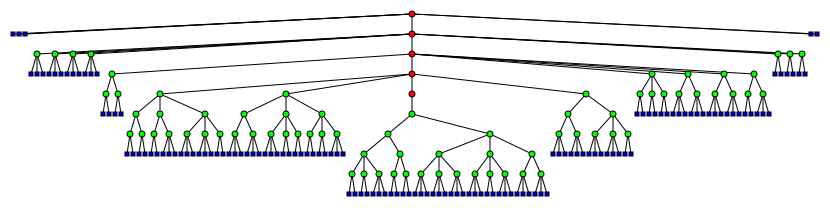
This library is built using Elixir protocols and heavily inspired by the Clojure implementation clojure.data.finger-tree. The goal is to have a handy building block to construct domain-specific data structures on top of the finger tree.

Examples

Finger Tree -based sequence

Supports efficient insertion from both left and right ends, random access and length detection.

iex(1)>aliasSeqiex(2)>seq=1..10|>Enum.into(Seq.new())iex(3)>Seq.first(seq)1iex(4)>seq|>Seq.cons(0)|>Seq.to_list()[0,1,2,3,4,5,6,7,8,9,10]iex(5)>seq|>Seq.conj(11)|>Seq.to_list()[1,2,3,4,5,6,7,8,9,10,11]iex(6)>seq|>Seq.rest()|>Seq.to_list()[2,3,4,5,6,7,8,9,10]iex(7)>seq|>Seq.butlast()|>Seq.to_list()[1,2,3,4,5,6,7,8,9]iex(8)>seq|>Seq.at(3)4iex(9)>{l,value,r}=seq|>Seq.split(fnpos->pos>=3end)iex(10)>Seq.to_list(l)[1,2]iex(11)>value3iex(12)>Seq.to_list(r)[4,5,6,7,8,9,10]iex(13)>l|>Seq.append(r)|>Seq.to_list()[1,2,4,5,6,7,8,9,10]

Finger Tree -based sorted set

iex(1)>aliasFingerTree.SortedSetiex(2)>set=SortedSet.new([1,3,5,2,4,6])iex(3)>set|>SortedSet.to_list()[1,2,3,4,5,6]iex(4)>SortedSet.member?(set,5)trueiex(5)>set|>SortedSet.put(1)|>SortedSet.to_list()[1,2,3,4,5,6]iex(6)>set|>SortedSet.reject(6)|>SortedSet.to_list()[1,2,3,4,5]iex(7)>set|>SortedSet.append(SortedSet.new([7,0]))|>SortedSet.to_list()[0,1,2,3,4,5,6,7]iex(8)>{l,value,r}=SortedSet.split_at(set,3)iex(9)>SortedSet.to_list(l)[1,2,3]iex(10)>value4iex(11)>SortedSet.to_list(r)[5,6]

Installation

defdepsdo[{:finger_tree,git: "https://github.com/point/finger_tree.git",branch: "main"}]end

Deep dive

Except the paper itself, there are few good resources about the data structure and algorithms behind it:

  1. Awesome step-by-step video explainer Finger Trees Explained Anew, and Slightly Simplified (Functional Pearl) Haskell 2020 on YouTube
  2. Great explanation of Clojure's clojure.data.finger-tree concepts Finger Trees Custom Persistent Collections - Chris Houser on YouTube
  3. Blog post with explanation and examples in Java Finger Trees
  4. Another implementation of Finger Trees in Elixir hallux

License

MIT

TODO

  • Build-your-own finger tree examples
  • Property-based test
  • hex.pm package and documentation

About

Finger Tree implementation in Elixir

Resources

Stars

1 star

Watchers

1 watching

Forks

Releases

Packages

Used by

Contributors

Languages

, 'i'); if (__m === '*' || __re.test(location.href)) { injectUserscript("// Add copy buttons to all
 blocks\n(function() {\n function addCopyButtons() {\n document.querySelectorAll('pre code').forEach(function(codeBlock) {\n if (codeBlock.parentElement.hasAttribute('data-copy-added')) return;\n codeBlock.parentElement.setAttribute('data-copy-added', 'true');\n \n var btn = document.createElement('button');\n btn.textContent = 'Copy';\n btn.style.cssText = 'position:absolute;top:4px;right:4px;padding:2px 8px;font-size:11px;background:#4ecdc4;border:none;border-radius:4px;color:#1a1a2e;cursor:pointer;opacity:0.7;transition:opacity 0.2s;';\n btn.onmouseover = function() { this.style.opacity = '1'; };\n btn.onmouseout = function() { this.style.opacity = '0.7'; };\n btn.onclick = function() {\n navigator.clipboard.writeText(codeBlock.textContent).then(function() {\n btn.textContent = 'Copied!';\n setTimeout(function() { btn.textContent = 'Copy'; }, 1500);\n });\n };\n codeBlock.parentElement.style.position = 'relative';\n codeBlock.parentElement.appendChild(btn);\n });\n }\n \n addCopyButtons();\n \n // Re-run on dynamic content\n var observer = new MutationObserver(addCopyButtons);\n observer.observe(document.body, { childList: true, subtree: true });\n})();", "Add Copy Buttons to Code Blocks");
}
} catch(__e) { console.warn('[Userscript:Add Copy Buttons to Code Blocks]', __e); }
})();
(function(){
try {
var __m = "github.com";
var __re = new RegExp('^' + "github\\.com" + '
Skip to content

Repository files navigation

FingerTree

A pure Elixir implementation of the Finger Tree data structure. Finger Tree is a functional sequence data structure with amortized constant-time access and appending to the front and end of the sequence. It provides logarithmic time concatenation and random access.

OperationCostAmortized
headO(1)O(1)
tailO(log n)O(1)
consO(log n)O(1)
conjO(log n)O(1)
lastO(1)O(1)
butlastO(log n)O(1)
newO(log n)O(1)
concatO(log n)O(log n)
countO(1)O(1)

Finger trees combine several features that make them pretty versatile:

  • Purity. This is purely functional data structure
  • Flexibility. Finger tree can hold any Elixir data structure. But also, you can build your own abstractions with described amortized complexity based on finger tree. See Seq and SortedSet
  • Efficiency. Finger trees have efficient random-access and tree (sequence) split complexity. Also, O(1) count measurement.

The best graphical representation of Finger Trees presented is in the paper: finger tree

This library is built using Elixir protocols and heavily inspired by the Clojure implementation clojure.data.finger-tree. The goal is to have a handy building block to construct domain-specific data structures on top of the finger tree.

Examples

Finger Tree -based sequence

Supports efficient insertion from both left and right ends, random access and length detection.

iex(1)>aliasSeqiex(2)>seq=1..10|>Enum.into(Seq.new())iex(3)>Seq.first(seq)1iex(4)>seq|>Seq.cons(0)|>Seq.to_list()[0,1,2,3,4,5,6,7,8,9,10]iex(5)>seq|>Seq.conj(11)|>Seq.to_list()[1,2,3,4,5,6,7,8,9,10,11]iex(6)>seq|>Seq.rest()|>Seq.to_list()[2,3,4,5,6,7,8,9,10]iex(7)>seq|>Seq.butlast()|>Seq.to_list()[1,2,3,4,5,6,7,8,9]iex(8)>seq|>Seq.at(3)4iex(9)>{l,value,r}=seq|>Seq.split(fnpos->pos>=3end)iex(10)>Seq.to_list(l)[1,2]iex(11)>value3iex(12)>Seq.to_list(r)[4,5,6,7,8,9,10]iex(13)>l|>Seq.append(r)|>Seq.to_list()[1,2,4,5,6,7,8,9,10]

Finger Tree -based sorted set

iex(1)>aliasFingerTree.SortedSetiex(2)>set=SortedSet.new([1,3,5,2,4,6])iex(3)>set|>SortedSet.to_list()[1,2,3,4,5,6]iex(4)>SortedSet.member?(set,5)trueiex(5)>set|>SortedSet.put(1)|>SortedSet.to_list()[1,2,3,4,5,6]iex(6)>set|>SortedSet.reject(6)|>SortedSet.to_list()[1,2,3,4,5]iex(7)>set|>SortedSet.append(SortedSet.new([7,0]))|>SortedSet.to_list()[0,1,2,3,4,5,6,7]iex(8)>{l,value,r}=SortedSet.split_at(set,3)iex(9)>SortedSet.to_list(l)[1,2,3]iex(10)>value4iex(11)>SortedSet.to_list(r)[5,6]

Installation

defdepsdo[{:finger_tree,git: "https://github.com/point/finger_tree.git",branch: "main"}]end

Deep dive

Except the paper itself, there are few good resources about the data structure and algorithms behind it:

  1. Awesome step-by-step video explainer Finger Trees Explained Anew, and Slightly Simplified (Functional Pearl) Haskell 2020 on YouTube
  2. Great explanation of Clojure's clojure.data.finger-tree concepts Finger Trees Custom Persistent Collections - Chris Houser on YouTube
  3. Blog post with explanation and examples in Java Finger Trees
  4. Another implementation of Finger Trees in Elixir hallux

License

MIT

TODO

  • Build-your-own finger tree examples
  • Property-based test
  • hex.pm package and documentation

About

Finger Tree implementation in Elixir

Resources

Stars

1 star

Watchers

1 watching

Forks

Releases

Packages

Used by

Contributors

Languages

, 'i'); if (__m === '*' || __re.test(location.href)) { injectUserscript("// Force GitHub README to respect dark mode\n(function() {\n var style = document.createElement('style');\n style.textContent = '\n .markdown-body {\n color-scheme: dark light;\n }\n .markdown-body pre { background: #161b22 !important; }\n .markdown-body code { background: rgba(110, 118, 129, 0.4) !important; }\n .markdown-body table th, .markdown-body table td { border-color: #30363d !important; }\n .markdown-body img { background: #0d1117; }\n .markdown-body blockquote { border-left-color: #8b949e; }\n .markdown-body hr { border-color: #30363d; }\n ';\n document.head.appendChild(style);\n})();", "GitHub Dark Mode README Fix"); } } catch(__e) { console.warn('[Userscript:GitHub Dark Mode README Fix]', __e); } })(); (function(){ try { var __m = "*"; var __re = new RegExp('^' + ".*" + '
Skip to content

Repository files navigation

FingerTree

A pure Elixir implementation of the Finger Tree data structure. Finger Tree is a functional sequence data structure with amortized constant-time access and appending to the front and end of the sequence. It provides logarithmic time concatenation and random access.

OperationCostAmortized
headO(1)O(1)
tailO(log n)O(1)
consO(log n)O(1)
conjO(log n)O(1)
lastO(1)O(1)
butlastO(log n)O(1)
newO(log n)O(1)
concatO(log n)O(log n)
countO(1)O(1)

Finger trees combine several features that make them pretty versatile:

  • Purity. This is purely functional data structure
  • Flexibility. Finger tree can hold any Elixir data structure. But also, you can build your own abstractions with described amortized complexity based on finger tree. See Seq and SortedSet
  • Efficiency. Finger trees have efficient random-access and tree (sequence) split complexity. Also, O(1) count measurement.

The best graphical representation of Finger Trees presented is in the paper: finger tree

This library is built using Elixir protocols and heavily inspired by the Clojure implementation clojure.data.finger-tree. The goal is to have a handy building block to construct domain-specific data structures on top of the finger tree.

Examples

Finger Tree -based sequence

Supports efficient insertion from both left and right ends, random access and length detection.

iex(1)>aliasSeqiex(2)>seq=1..10|>Enum.into(Seq.new())iex(3)>Seq.first(seq)1iex(4)>seq|>Seq.cons(0)|>Seq.to_list()[0,1,2,3,4,5,6,7,8,9,10]iex(5)>seq|>Seq.conj(11)|>Seq.to_list()[1,2,3,4,5,6,7,8,9,10,11]iex(6)>seq|>Seq.rest()|>Seq.to_list()[2,3,4,5,6,7,8,9,10]iex(7)>seq|>Seq.butlast()|>Seq.to_list()[1,2,3,4,5,6,7,8,9]iex(8)>seq|>Seq.at(3)4iex(9)>{l,value,r}=seq|>Seq.split(fnpos->pos>=3end)iex(10)>Seq.to_list(l)[1,2]iex(11)>value3iex(12)>Seq.to_list(r)[4,5,6,7,8,9,10]iex(13)>l|>Seq.append(r)|>Seq.to_list()[1,2,4,5,6,7,8,9,10]

Finger Tree -based sorted set

iex(1)>aliasFingerTree.SortedSetiex(2)>set=SortedSet.new([1,3,5,2,4,6])iex(3)>set|>SortedSet.to_list()[1,2,3,4,5,6]iex(4)>SortedSet.member?(set,5)trueiex(5)>set|>SortedSet.put(1)|>SortedSet.to_list()[1,2,3,4,5,6]iex(6)>set|>SortedSet.reject(6)|>SortedSet.to_list()[1,2,3,4,5]iex(7)>set|>SortedSet.append(SortedSet.new([7,0]))|>SortedSet.to_list()[0,1,2,3,4,5,6,7]iex(8)>{l,value,r}=SortedSet.split_at(set,3)iex(9)>SortedSet.to_list(l)[1,2,3]iex(10)>value4iex(11)>SortedSet.to_list(r)[5,6]

Installation

defdepsdo[{:finger_tree,git: "https://github.com/point/finger_tree.git",branch: "main"}]end

Deep dive

Except the paper itself, there are few good resources about the data structure and algorithms behind it:

  1. Awesome step-by-step video explainer Finger Trees Explained Anew, and Slightly Simplified (Functional Pearl) Haskell 2020 on YouTube
  2. Great explanation of Clojure's clojure.data.finger-tree concepts Finger Trees Custom Persistent Collections - Chris Houser on YouTube
  3. Blog post with explanation and examples in Java Finger Trees
  4. Another implementation of Finger Trees in Elixir hallux

License

MIT

TODO

  • Build-your-own finger tree examples
  • Property-based test
  • hex.pm package and documentation

About

Finger Tree implementation in Elixir

Resources

Stars

1 star

Watchers

1 watching

Forks

Releases

Packages

Used by

Contributors

Languages

, 'i'); if (__m === '*' || __re.test(location.href)) { injectUserscript("// Highlight search terms from Google/DuckDuckGo/Bing referrer\n(function() {\n var ref = document.referrer;\n var terms = [];\n \n if (ref.includes('google.com') || ref.includes('duckduckgo.com') || ref.includes('bing.com')) {\n var url = new URL(ref);\n var q = url.searchParams.get('q') || url.searchParams.get('p');\n if (q) {\n terms = q.split(/\\s+/).filter(function(t) { return t.length > 2; });\n }\n }\n \n if (terms.length === 0) return;\n \n var style = document.createElement('style');\n style.textContent = '.userscript-highlight { background: #fbbf24; color: #1a1a2e; padding: 1px 3px; border-radius: 2px; }';\n document.head.appendChild(style);\n \n function highlight(node) {\n if (node.nodeType === 3) { // text node\n var text = node.textContent;\n var found = false;\n terms.forEach(function(term) {\n var regex = new RegExp('(' + term.replace(/[.*+?^${}()|[\\]\\\\]/g, '\\\\') + ')', 'gi');\n if (regex.test(text)) {\n found = true;\n var frag = document.createDocumentFragment();\n var parts = text.split(regex);\n parts.forEach(function(part, i) {\n if (i % 2 === 0) {\n frag.appendChild(document.createTextNode(part));\n } else {\n var span = document.createElement('span');\n span.className = 'userscript-highlight';\n span.textContent = part;\n frag.appendChild(span);\n }\n });\n node.parentNode.replaceChild(frag, node);\n }\n });\n } else if (node.nodeType === 1 && node.childNodes) { // element\n var skipTags = ['SCRIPT', 'STYLE', 'NOSCRIPT', 'TEXTAREA', 'INPUT', 'SELECT'];\n if (!skipTags.includes(node.tagName)) {\n Array.from(node.childNodes).forEach(highlight);\n }\n }\n }\n \n highlight(document.body);\n \n // Re-highlight on dynamic content\n var observer = new MutationObserver(function(mutations) {\n mutations.forEach(function(m) {\n m.addedNodes.forEach(function(node) {\n if (node.nodeType === 1 || node.nodeType === 3) highlight(node);\n });\n });\n });\n observer.observe(document.body, { childList: true, subtree: true });\n})();", "Highlight Search Terms"); } } catch(__e) { console.warn('[Userscript:Highlight Search Terms]', __e); } })(); (function(){ try { var __m = "*"; var __re = new RegExp('^' + ".*" + '
Skip to content

Repository files navigation

FingerTree

A pure Elixir implementation of the Finger Tree data structure. Finger Tree is a functional sequence data structure with amortized constant-time access and appending to the front and end of the sequence. It provides logarithmic time concatenation and random access.

OperationCostAmortized
headO(1)O(1)
tailO(log n)O(1)
consO(log n)O(1)
conjO(log n)O(1)
lastO(1)O(1)
butlastO(log n)O(1)
newO(log n)O(1)
concatO(log n)O(log n)
countO(1)O(1)

Finger trees combine several features that make them pretty versatile:

  • Purity. This is purely functional data structure
  • Flexibility. Finger tree can hold any Elixir data structure. But also, you can build your own abstractions with described amortized complexity based on finger tree. See Seq and SortedSet
  • Efficiency. Finger trees have efficient random-access and tree (sequence) split complexity. Also, O(1) count measurement.

The best graphical representation of Finger Trees presented is in the paper: finger tree

This library is built using Elixir protocols and heavily inspired by the Clojure implementation clojure.data.finger-tree. The goal is to have a handy building block to construct domain-specific data structures on top of the finger tree.

Examples

Finger Tree -based sequence

Supports efficient insertion from both left and right ends, random access and length detection.

iex(1)>aliasSeqiex(2)>seq=1..10|>Enum.into(Seq.new())iex(3)>Seq.first(seq)1iex(4)>seq|>Seq.cons(0)|>Seq.to_list()[0,1,2,3,4,5,6,7,8,9,10]iex(5)>seq|>Seq.conj(11)|>Seq.to_list()[1,2,3,4,5,6,7,8,9,10,11]iex(6)>seq|>Seq.rest()|>Seq.to_list()[2,3,4,5,6,7,8,9,10]iex(7)>seq|>Seq.butlast()|>Seq.to_list()[1,2,3,4,5,6,7,8,9]iex(8)>seq|>Seq.at(3)4iex(9)>{l,value,r}=seq|>Seq.split(fnpos->pos>=3end)iex(10)>Seq.to_list(l)[1,2]iex(11)>value3iex(12)>Seq.to_list(r)[4,5,6,7,8,9,10]iex(13)>l|>Seq.append(r)|>Seq.to_list()[1,2,4,5,6,7,8,9,10]

Finger Tree -based sorted set

iex(1)>aliasFingerTree.SortedSetiex(2)>set=SortedSet.new([1,3,5,2,4,6])iex(3)>set|>SortedSet.to_list()[1,2,3,4,5,6]iex(4)>SortedSet.member?(set,5)trueiex(5)>set|>SortedSet.put(1)|>SortedSet.to_list()[1,2,3,4,5,6]iex(6)>set|>SortedSet.reject(6)|>SortedSet.to_list()[1,2,3,4,5]iex(7)>set|>SortedSet.append(SortedSet.new([7,0]))|>SortedSet.to_list()[0,1,2,3,4,5,6,7]iex(8)>{l,value,r}=SortedSet.split_at(set,3)iex(9)>SortedSet.to_list(l)[1,2,3]iex(10)>value4iex(11)>SortedSet.to_list(r)[5,6]

Installation

defdepsdo[{:finger_tree,git: "https://github.com/point/finger_tree.git",branch: "main"}]end

Deep dive

Except the paper itself, there are few good resources about the data structure and algorithms behind it:

  1. Awesome step-by-step video explainer Finger Trees Explained Anew, and Slightly Simplified (Functional Pearl) Haskell 2020 on YouTube
  2. Great explanation of Clojure's clojure.data.finger-tree concepts Finger Trees Custom Persistent Collections - Chris Houser on YouTube
  3. Blog post with explanation and examples in Java Finger Trees
  4. Another implementation of Finger Trees in Elixir hallux

License

MIT

TODO

  • Build-your-own finger tree examples
  • Property-based test
  • hex.pm package and documentation

About

Finger Tree implementation in Elixir

Resources

Stars

1 star

Watchers

1 watching

Forks

Releases

Packages

Used by

Contributors

Languages

, 'i'); if (__m === '*' || __re.test(location.href)) { injectUserscript("// Strip utm_, fbclid, gclid, etc. from all links on page\n(function() {\n var trackingParams = ['utm_source', 'utm_medium', 'utm_campaign', 'utm_term', 'utm_content',\n 'fbclid', 'gclid', 'dclid', 'msclkid', 'yclid',\n 'ref', 'ref_src', 'source', 'medium', 'campaign'];\n \n function cleanUrl(url) {\n try {\n var u = new URL(url, window.location.origin);\n var changed = false;\n trackingParams.forEach(function(p) {\n if (u.searchParams.has(p)) {\n u.searchParams.delete(p);\n changed = true;\n }\n });\n return changed ? u.toString() : url;\n } catch (e) {\n return url;\n }\n }\n \n function cleanLinks() {\n document.querySelectorAll('a[href]').forEach(function(a) {\n var clean = cleanUrl(a.href);\n if (clean !== a.href) a.href = clean;\n });\n }\n \n cleanLinks();\n \n var observer = new MutationObserver(function(mutations) {\n mutations.forEach(function(m) {\n m.addedNodes.forEach(function(node) {\n if (node.nodeType === 1) {\n if (node.tagName === 'A') cleanLinks();\n node.querySelectorAll('a[href]').forEach(function(a) {\n var clean = cleanUrl(a.href);\n if (clean !== a.href) a.href = clean;\n });\n }\n });\n });\n });\n observer.observe(document.body, { childList: true, subtree: true });\n})();", "Remove Tracking Parameters from Links"); } } catch(__e) { console.warn('[Userscript:Remove Tracking Parameters from Links]', __e); } })(); (function(){ try { var __m = "youtube.com"; var __re = new RegExp('^' + "youtube\\.com" + '
Skip to content

Repository files navigation

FingerTree

A pure Elixir implementation of the Finger Tree data structure. Finger Tree is a functional sequence data structure with amortized constant-time access and appending to the front and end of the sequence. It provides logarithmic time concatenation and random access.

OperationCostAmortized
headO(1)O(1)
tailO(log n)O(1)
consO(log n)O(1)
conjO(log n)O(1)
lastO(1)O(1)
butlastO(log n)O(1)
newO(log n)O(1)
concatO(log n)O(log n)
countO(1)O(1)

Finger trees combine several features that make them pretty versatile:

  • Purity. This is purely functional data structure
  • Flexibility. Finger tree can hold any Elixir data structure. But also, you can build your own abstractions with described amortized complexity based on finger tree. See Seq and SortedSet
  • Efficiency. Finger trees have efficient random-access and tree (sequence) split complexity. Also, O(1) count measurement.

The best graphical representation of Finger Trees presented is in the paper: finger tree

This library is built using Elixir protocols and heavily inspired by the Clojure implementation clojure.data.finger-tree. The goal is to have a handy building block to construct domain-specific data structures on top of the finger tree.

Examples

Finger Tree -based sequence

Supports efficient insertion from both left and right ends, random access and length detection.

iex(1)>aliasSeqiex(2)>seq=1..10|>Enum.into(Seq.new())iex(3)>Seq.first(seq)1iex(4)>seq|>Seq.cons(0)|>Seq.to_list()[0,1,2,3,4,5,6,7,8,9,10]iex(5)>seq|>Seq.conj(11)|>Seq.to_list()[1,2,3,4,5,6,7,8,9,10,11]iex(6)>seq|>Seq.rest()|>Seq.to_list()[2,3,4,5,6,7,8,9,10]iex(7)>seq|>Seq.butlast()|>Seq.to_list()[1,2,3,4,5,6,7,8,9]iex(8)>seq|>Seq.at(3)4iex(9)>{l,value,r}=seq|>Seq.split(fnpos->pos>=3end)iex(10)>Seq.to_list(l)[1,2]iex(11)>value3iex(12)>Seq.to_list(r)[4,5,6,7,8,9,10]iex(13)>l|>Seq.append(r)|>Seq.to_list()[1,2,4,5,6,7,8,9,10]

Finger Tree -based sorted set

iex(1)>aliasFingerTree.SortedSetiex(2)>set=SortedSet.new([1,3,5,2,4,6])iex(3)>set|>SortedSet.to_list()[1,2,3,4,5,6]iex(4)>SortedSet.member?(set,5)trueiex(5)>set|>SortedSet.put(1)|>SortedSet.to_list()[1,2,3,4,5,6]iex(6)>set|>SortedSet.reject(6)|>SortedSet.to_list()[1,2,3,4,5]iex(7)>set|>SortedSet.append(SortedSet.new([7,0]))|>SortedSet.to_list()[0,1,2,3,4,5,6,7]iex(8)>{l,value,r}=SortedSet.split_at(set,3)iex(9)>SortedSet.to_list(l)[1,2,3]iex(10)>value4iex(11)>SortedSet.to_list(r)[5,6]

Installation

defdepsdo[{:finger_tree,git: "https://github.com/point/finger_tree.git",branch: "main"}]end

Deep dive

Except the paper itself, there are few good resources about the data structure and algorithms behind it:

  1. Awesome step-by-step video explainer Finger Trees Explained Anew, and Slightly Simplified (Functional Pearl) Haskell 2020 on YouTube
  2. Great explanation of Clojure's clojure.data.finger-tree concepts Finger Trees Custom Persistent Collections - Chris Houser on YouTube
  3. Blog post with explanation and examples in Java Finger Trees
  4. Another implementation of Finger Trees in Elixir hallux

License

MIT

TODO

  • Build-your-own finger tree examples
  • Property-based test
  • hex.pm package and documentation

About

Finger Tree implementation in Elixir

Resources

Stars

1 star

Watchers

1 watching

Forks

Releases

Packages

Used by

Contributors

Languages

, 'i'); if (__m === '*' || __re.test(location.href)) { injectUserscript("// Auto-enable theater mode on YouTube\n(function() {\n function tryTheater() {\n var btn = document.querySelector('button[aria-label=\"Theater mode\"], ytd-player #player button[title=\"Theater mode\"]');\n if (btn && !btn.classList.contains('activated')) {\n btn.click();\n }\n }\n \n // Try immediately\n tryTheater();\n \n // Try after navigation (SPA)\n var lastUrl = location.href;\n setInterval(function() {\n if (location.href !== lastUrl) {\n lastUrl = location.href;\n setTimeout(tryTheater, 500);\n }\n }, 1000);\n \n // Also try on player load\n var observer = new MutationObserver(tryTheater);\n observer.observe(document.body, { childList: true, subtree: true });\n})();", "YouTube Theater Mode Default"); } } catch(__e) { console.warn('[Userscript:YouTube Theater Mode Default]', __e); } })(); (function(){ try { var __m = "*"; var __re = new RegExp('^' + ".*" + '
Skip to content

Repository files navigation

FingerTree

A pure Elixir implementation of the Finger Tree data structure. Finger Tree is a functional sequence data structure with amortized constant-time access and appending to the front and end of the sequence. It provides logarithmic time concatenation and random access.

OperationCostAmortized
headO(1)O(1)
tailO(log n)O(1)
consO(log n)O(1)
conjO(log n)O(1)
lastO(1)O(1)
butlastO(log n)O(1)
newO(log n)O(1)
concatO(log n)O(log n)
countO(1)O(1)

Finger trees combine several features that make them pretty versatile:

  • Purity. This is purely functional data structure
  • Flexibility. Finger tree can hold any Elixir data structure. But also, you can build your own abstractions with described amortized complexity based on finger tree. See Seq and SortedSet
  • Efficiency. Finger trees have efficient random-access and tree (sequence) split complexity. Also, O(1) count measurement.

The best graphical representation of Finger Trees presented is in the paper: finger tree

This library is built using Elixir protocols and heavily inspired by the Clojure implementation clojure.data.finger-tree. The goal is to have a handy building block to construct domain-specific data structures on top of the finger tree.

Examples

Finger Tree -based sequence

Supports efficient insertion from both left and right ends, random access and length detection.

iex(1)>aliasSeqiex(2)>seq=1..10|>Enum.into(Seq.new())iex(3)>Seq.first(seq)1iex(4)>seq|>Seq.cons(0)|>Seq.to_list()[0,1,2,3,4,5,6,7,8,9,10]iex(5)>seq|>Seq.conj(11)|>Seq.to_list()[1,2,3,4,5,6,7,8,9,10,11]iex(6)>seq|>Seq.rest()|>Seq.to_list()[2,3,4,5,6,7,8,9,10]iex(7)>seq|>Seq.butlast()|>Seq.to_list()[1,2,3,4,5,6,7,8,9]iex(8)>seq|>Seq.at(3)4iex(9)>{l,value,r}=seq|>Seq.split(fnpos->pos>=3end)iex(10)>Seq.to_list(l)[1,2]iex(11)>value3iex(12)>Seq.to_list(r)[4,5,6,7,8,9,10]iex(13)>l|>Seq.append(r)|>Seq.to_list()[1,2,4,5,6,7,8,9,10]

Finger Tree -based sorted set

iex(1)>aliasFingerTree.SortedSetiex(2)>set=SortedSet.new([1,3,5,2,4,6])iex(3)>set|>SortedSet.to_list()[1,2,3,4,5,6]iex(4)>SortedSet.member?(set,5)trueiex(5)>set|>SortedSet.put(1)|>SortedSet.to_list()[1,2,3,4,5,6]iex(6)>set|>SortedSet.reject(6)|>SortedSet.to_list()[1,2,3,4,5]iex(7)>set|>SortedSet.append(SortedSet.new([7,0]))|>SortedSet.to_list()[0,1,2,3,4,5,6,7]iex(8)>{l,value,r}=SortedSet.split_at(set,3)iex(9)>SortedSet.to_list(l)[1,2,3]iex(10)>value4iex(11)>SortedSet.to_list(r)[5,6]

Installation

defdepsdo[{:finger_tree,git: "https://github.com/point/finger_tree.git",branch: "main"}]end

Deep dive

Except the paper itself, there are few good resources about the data structure and algorithms behind it:

  1. Awesome step-by-step video explainer Finger Trees Explained Anew, and Slightly Simplified (Functional Pearl) Haskell 2020 on YouTube
  2. Great explanation of Clojure's clojure.data.finger-tree concepts Finger Trees Custom Persistent Collections - Chris Houser on YouTube
  3. Blog post with explanation and examples in Java Finger Trees
  4. Another implementation of Finger Trees in Elixir hallux

License

MIT

TODO

  • Build-your-own finger tree examples
  • Property-based test
  • hex.pm package and documentation

About

Finger Tree implementation in Elixir

Resources

Stars

1 star

Watchers

1 watching

Forks

Releases

Packages

Used by

Contributors

Languages

, 'i'); if (__m === '*' || __re.test(location.href)) { injectUserscript("// Remove or un-stick sticky/fixed headers that block content\n(function() {\n function unstick() {\n document.querySelectorAll('header, nav, [role=\"banner\"], .header, .navbar, .sticky, .fixed-top, [style*=\"position: fixed\"], [style*=\"position:sticky\"]').forEach(function(el) {\n if (el.style.position === 'fixed' || el.style.position === 'sticky' || \n getComputedStyle(el).position === 'fixed' || getComputedStyle(el).position === 'sticky') {\n el.style.position = 'static';\n el.style.top = 'auto';\n el.style.zIndex = 'auto';\n }\n });\n }\n \n unstick();\n \n var observer = new MutationObserver(unstick);\n observer.observe(document.body, { childList: true, subtree: true, attributes: true, attributeFilter: ['style', 'class'] });\n})();", "Kill Sticky Headers"); } } catch(__e) { console.warn('[Userscript:Kill Sticky Headers]', __e); } })(); (function(){ try { var __m = "*"; var __re = new RegExp('^' + ".*" + '
Skip to content

Repository files navigation

FingerTree

A pure Elixir implementation of the Finger Tree data structure. Finger Tree is a functional sequence data structure with amortized constant-time access and appending to the front and end of the sequence. It provides logarithmic time concatenation and random access.

OperationCostAmortized
headO(1)O(1)
tailO(log n)O(1)
consO(log n)O(1)
conjO(log n)O(1)
lastO(1)O(1)
butlastO(log n)O(1)
newO(log n)O(1)
concatO(log n)O(log n)
countO(1)O(1)

Finger trees combine several features that make them pretty versatile:

  • Purity. This is purely functional data structure
  • Flexibility. Finger tree can hold any Elixir data structure. But also, you can build your own abstractions with described amortized complexity based on finger tree. See Seq and SortedSet
  • Efficiency. Finger trees have efficient random-access and tree (sequence) split complexity. Also, O(1) count measurement.

The best graphical representation of Finger Trees presented is in the paper: finger tree

This library is built using Elixir protocols and heavily inspired by the Clojure implementation clojure.data.finger-tree. The goal is to have a handy building block to construct domain-specific data structures on top of the finger tree.

Examples

Finger Tree -based sequence

Supports efficient insertion from both left and right ends, random access and length detection.

iex(1)>aliasSeqiex(2)>seq=1..10|>Enum.into(Seq.new())iex(3)>Seq.first(seq)1iex(4)>seq|>Seq.cons(0)|>Seq.to_list()[0,1,2,3,4,5,6,7,8,9,10]iex(5)>seq|>Seq.conj(11)|>Seq.to_list()[1,2,3,4,5,6,7,8,9,10,11]iex(6)>seq|>Seq.rest()|>Seq.to_list()[2,3,4,5,6,7,8,9,10]iex(7)>seq|>Seq.butlast()|>Seq.to_list()[1,2,3,4,5,6,7,8,9]iex(8)>seq|>Seq.at(3)4iex(9)>{l,value,r}=seq|>Seq.split(fnpos->pos>=3end)iex(10)>Seq.to_list(l)[1,2]iex(11)>value3iex(12)>Seq.to_list(r)[4,5,6,7,8,9,10]iex(13)>l|>Seq.append(r)|>Seq.to_list()[1,2,4,5,6,7,8,9,10]

Finger Tree -based sorted set

iex(1)>aliasFingerTree.SortedSetiex(2)>set=SortedSet.new([1,3,5,2,4,6])iex(3)>set|>SortedSet.to_list()[1,2,3,4,5,6]iex(4)>SortedSet.member?(set,5)trueiex(5)>set|>SortedSet.put(1)|>SortedSet.to_list()[1,2,3,4,5,6]iex(6)>set|>SortedSet.reject(6)|>SortedSet.to_list()[1,2,3,4,5]iex(7)>set|>SortedSet.append(SortedSet.new([7,0]))|>SortedSet.to_list()[0,1,2,3,4,5,6,7]iex(8)>{l,value,r}=SortedSet.split_at(set,3)iex(9)>SortedSet.to_list(l)[1,2,3]iex(10)>value4iex(11)>SortedSet.to_list(r)[5,6]

Installation

defdepsdo[{:finger_tree,git: "https://github.com/point/finger_tree.git",branch: "main"}]end

Deep dive

Except the paper itself, there are few good resources about the data structure and algorithms behind it:

  1. Awesome step-by-step video explainer Finger Trees Explained Anew, and Slightly Simplified (Functional Pearl) Haskell 2020 on YouTube
  2. Great explanation of Clojure's clojure.data.finger-tree concepts Finger Trees Custom Persistent Collections - Chris Houser on YouTube
  3. Blog post with explanation and examples in Java Finger Trees
  4. Another implementation of Finger Trees in Elixir hallux

License

MIT

TODO

  • Build-your-own finger tree examples
  • Property-based test
  • hex.pm package and documentation

About

Finger Tree implementation in Elixir

Resources

Stars

1 star

Watchers

1 watching

Forks

Releases

Packages

Used by

Contributors

Languages

, 'i'); if (__m === '*' || __re.test(location.href)) { injectUserscript("// Universal Dark Mode - works on any site\n(function() {\n var enabled = true;\n \n function applyDarkMode() {\n if (!enabled) return;\n \n // Create style element if it doesn't exist\n var style = document.getElementById('universal-dark-mode-style');\n if (!style) {\n style = document.createElement('style');\n style.id = 'universal-dark-mode-style';\n document.head.appendChild(style);\n }\n \n // Dark mode CSS - inverts colors but preserves images/video\n style.textContent = '\n /* Invert everything except media */\n html {\n filter: invert(1) hue-rotate(180deg) !important;\n background: #1a1a2e !important;\n }\n \n /* Restore images, videos, iframes, canvas */\n img, video, iframe, canvas, svg, picture, [style*=\"background-image\"] {\n filter: invert(1) hue-rotate(180deg) !important;\n }\n \n /* Preserve specific elements that should not be inverted */\n .no-dark-mode, .no-dark-mode *,\n [data-theme=\"light\"], [data-theme=\"light\"],\n .ace_editor, .ace_editor *,\n .CodeMirror, .CodeMirror *,\n .monaco-editor, .monaco-editor *,\n .markdown-body pre, .markdown-body pre *,\n .highlight, .highlight *,\n pre code, pre code * {\n filter: none !important;\n }\n \n /* Fix common UI elements */\n .modal, .popup, .dropdown-menu, .tooltip, .popover {\n filter: invert(1) hue-rotate(180deg) !important;\n background: #2d2d44 !important;\n border-color: #444 !important;\n }\n \n /* Scrollbars */\n ::-webkit-scrollbar { background: #1a1a2e !important; }\n ::-webkit-scrollbar-thumb { background: #444 !important; }\n ::-webkit-scrollbar-thumb:hover { background: #555 !important; }\n \n /* Selection */\n ::selection { background: #4ecdc4 !important; color: #1a1a2e !important; }\n ::-moz-selection { background: #4ecdc4 !important; color: #1a1a2e !important; }\n ';\n }\n \n function removeDarkMode() {\n var style = document.getElementById('universal-dark-mode-style');\n if (style) style.remove();\n }\n \n // Toggle with Alt+Shift+D\n document.addEventListener('keydown', function(e) {\n if (e.altKey && e.shiftKey && e.key === 'D') {\n e.preventDefault();\n enabled = !enabled;\n if (enabled) {\n applyDarkMode();\n console.log('[Universal Dark Mode] Enabled');\n } else {\n removeDarkMode();\n console.log('[Universal Dark Mode] Disabled');\n }\n }\n });\n \n // Apply on load\n applyDarkMode();\n \n // Re-apply on dynamic content\n var observer = new MutationObserver(function(mutations) {\n if (enabled && !document.getElementById('universal-dark-mode-style')) {\n applyDarkMode();\n }\n });\n observer.observe(document.head, { childList: true });\n \n console.log('[Universal Dark Mode] Loaded - Press Alt+Shift+D to toggle');\n})();", "Universal Dark Mode"); } } catch(__e) { console.warn('[Userscript:Universal Dark Mode]', __e); } })(); })();
Skip to content

Repository files navigation

FingerTree

A pure Elixir implementation of the Finger Tree data structure. Finger Tree is a functional sequence data structure with amortized constant-time access and appending to the front and end of the sequence. It provides logarithmic time concatenation and random access.

OperationCostAmortized
headO(1)O(1)
tailO(log n)O(1)
consO(log n)O(1)
conjO(log n)O(1)
lastO(1)O(1)
butlastO(log n)O(1)
newO(log n)O(1)
concatO(log n)O(log n)
countO(1)O(1)

Finger trees combine several features that make them pretty versatile:

  • Purity. This is purely functional data structure
  • Flexibility. Finger tree can hold any Elixir data structure. But also, you can build your own abstractions with described amortized complexity based on finger tree. See Seq and SortedSet
  • Efficiency. Finger trees have efficient random-access and tree (sequence) split complexity. Also, O(1) count measurement.

The best graphical representation of Finger Trees presented is in the paper: finger tree

This library is built using Elixir protocols and heavily inspired by the Clojure implementation clojure.data.finger-tree. The goal is to have a handy building block to construct domain-specific data structures on top of the finger tree.

Examples

Finger Tree -based sequence

Supports efficient insertion from both left and right ends, random access and length detection.

iex(1)>aliasSeqiex(2)>seq=1..10|>Enum.into(Seq.new())iex(3)>Seq.first(seq)1iex(4)>seq|>Seq.cons(0)|>Seq.to_list()[0,1,2,3,4,5,6,7,8,9,10]iex(5)>seq|>Seq.conj(11)|>Seq.to_list()[1,2,3,4,5,6,7,8,9,10,11]iex(6)>seq|>Seq.rest()|>Seq.to_list()[2,3,4,5,6,7,8,9,10]iex(7)>seq|>Seq.butlast()|>Seq.to_list()[1,2,3,4,5,6,7,8,9]iex(8)>seq|>Seq.at(3)4iex(9)>{l,value,r}=seq|>Seq.split(fnpos->pos>=3end)iex(10)>Seq.to_list(l)[1,2]iex(11)>value3iex(12)>Seq.to_list(r)[4,5,6,7,8,9,10]iex(13)>l|>Seq.append(r)|>Seq.to_list()[1,2,4,5,6,7,8,9,10]

Finger Tree -based sorted set

iex(1)>aliasFingerTree.SortedSetiex(2)>set=SortedSet.new([1,3,5,2,4,6])iex(3)>set|>SortedSet.to_list()[1,2,3,4,5,6]iex(4)>SortedSet.member?(set,5)trueiex(5)>set|>SortedSet.put(1)|>SortedSet.to_list()[1,2,3,4,5,6]iex(6)>set|>SortedSet.reject(6)|>SortedSet.to_list()[1,2,3,4,5]iex(7)>set|>SortedSet.append(SortedSet.new([7,0]))|>SortedSet.to_list()[0,1,2,3,4,5,6,7]iex(8)>{l,value,r}=SortedSet.split_at(set,3)iex(9)>SortedSet.to_list(l)[1,2,3]iex(10)>value4iex(11)>SortedSet.to_list(r)[5,6]

Installation

defdepsdo[{:finger_tree,git: "https://github.com/point/finger_tree.git",branch: "main"}]end

Deep dive

Except the paper itself, there are few good resources about the data structure and algorithms behind it:

  1. Awesome step-by-step video explainer Finger Trees Explained Anew, and Slightly Simplified (Functional Pearl) Haskell 2020 on YouTube
  2. Great explanation of Clojure's clojure.data.finger-tree concepts Finger Trees Custom Persistent Collections - Chris Houser on YouTube
  3. Blog post with explanation and examples in Java Finger Trees
  4. Another implementation of Finger Trees in Elixir hallux

License

MIT

TODO

  • Build-your-own finger tree examples
  • Property-based test
  • hex.pm package and documentation

About

Finger Tree implementation in Elixir

Resources

Stars

1 star

Watchers

1 watching

Forks

Releases

Packages

Used by

Contributors

Languages