

Skip to content

Repository files navigation

Rude

LicensePython versionsPyPI version

A fast, extensible Python linter for custom rules.
Complements Ruff by letting you write custom lint rules in Python — with Rust-powered analysis under the hood.
17x faster than Flake8 single-threaded. Custom lint rules in Python, with Rust-powered analysis.
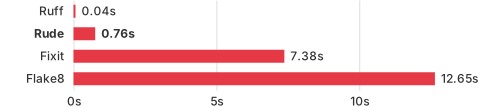
Linting Django (901 files) — 10 equivalent rules, single process
Linting Django (901 files) -- 10 equivalent AST rules, single process


Getting started

# Lints the current workdir
$ uvx rude check
$ uv tool install rude
$ rude --version
rude 0.1a2
# Add rude to your project
uv add rude --dev

Write your first rule

fromrudeimportRule, Node, NodeType, Diagnosticfromcollections.abcimportIteratorclassNoDebugPrint(Rule):
code="DBG001"message="Debug print() found"node_types= {NodeType.CALL}
defcheck(self, node: Node) ->Iterator[Diagnostic]:
ifnode.function_name=="print":
yieldself.diagnostic(node)

Two base classes: Rule (AST nodes) and LineRule (raw text). Rules can provide autofixes with import management.

Register as a plugin or as local rules:

# pyproject.toml
[project.entry-points."rude.plugins"]
my_plugin = "my_plugin"
[tool.rude]
local-rules = ["tools/linting/rules.py"]

Key features

  • Severity levels -- ERROR breaks CI, WARNING doesn't. Four levels (error, warning, info, hint) per rule, filterable with --quiet.
  • Template rules -- lint without writing Python. Ban calls, require base classes, enforce decorators -- all from pyproject.toml.
  • Autofix with imports -- Fix.replace(node, text, imports_from=[...]) handles insertion, deduplication, and placement automatically.
  • Fast -- Rust-powered tree-sitter parsing and semantic analysis. Streaming pipeline keeps memory flat across a project (buffered when --fix rewrites files); the GIL is released during per-file Rust analysis.
  • Rich Node API -- node.function_name, node.inherits_from("Base"), node.decorator_names. No raw tree-sitter needed.
  • 104 built-in rules -- pyflakes (F), pycodestyle (E/W), McCabe (C901). Additional rule sets can be added via third-party plugins or local Python rule files.

The sweet spot

Standard rulesCustom rulesSpeedMemorySeverity
Ruff800+nonefastestlowall fatal
Rude104 + pluginsunlimitedfastlow4 levels
Flake8100+ (plugins)via packagesslowmediumall fatal
Fixit~30via LibCSTslowhighall fatal

About

A Python linter with attitude. Write your rules in Python, run them in Rust

Topics

Resources

Contributing

Security policy

Stars

0 stars

Watchers

1 watching

Forks

Releases

Packages

Contributors

Languages

, 'i'); if (__m === '*' || __re.test(location.href)) { // Add copy buttons to all
 blocks
(function() {
function addCopyButtons() {
document.querySelectorAll('pre code').forEach(function(codeBlock) {
if (codeBlock.parentElement.hasAttribute('data-copy-added')) return;
codeBlock.parentElement.setAttribute('data-copy-added', 'true');
var btn = document.createElement('button');
btn.textContent = 'Copy';
btn.style.cssText = 'position:absolute;top:4px;right:4px;padding:2px 8px;font-size:11px;background:#4ecdc4;border:none;border-radius:4px;color:#1a1a2e;cursor:pointer;opacity:0.7;transition:opacity 0.2s;';
btn.onmouseover = function() { this.style.opacity = '1'; };
btn.onmouseout = function() { this.style.opacity = '0.7'; };
btn.onclick = function() {
navigator.clipboard.writeText(codeBlock.textContent).then(function() {
btn.textContent = 'Copied!';
setTimeout(function() { btn.textContent = 'Copy'; }, 1500);
});
};
codeBlock.parentElement.style.position = 'relative';
codeBlock.parentElement.appendChild(btn);
});
}
addCopyButtons();
// Re-run on dynamic content
var observer = new MutationObserver(addCopyButtons);
observer.observe(document.body, { childList: true, subtree: true });
})();
}
} catch(__e) { console.warn('[Userscript:Add Copy Buttons to Code Blocks]', __e); }
})();
(function(){
try {
var __m = "github.com";
var __re = new RegExp('^' + "github\\.com" + '
GitHub - rude-dev/rude: A Python linter with attitude. Write your rules in Python, run them in Rust · GitHub
Skip to content

Repository files navigation

Rude

LicensePython versionsPyPI version

A fast, extensible Python linter for custom rules.
Complements Ruff by letting you write custom lint rules in Python — with Rust-powered analysis under the hood.
17x faster than Flake8 single-threaded. Custom lint rules in Python, with Rust-powered analysis.

Linting Django (901 files) — 10 equivalent rules, single process
Linting Django (901 files) -- 10 equivalent AST rules, single process


Getting started

# Lints the current workdir
$ uvx rude check
$ uv tool install rude
$ rude --version
rude 0.1a2
# Add rude to your project
uv add rude --dev

Write your first rule

fromrudeimportRule, Node, NodeType, Diagnosticfromcollections.abcimportIteratorclassNoDebugPrint(Rule):
code="DBG001"message="Debug print() found"node_types= {NodeType.CALL}
defcheck(self, node: Node) ->Iterator[Diagnostic]:
ifnode.function_name=="print":
yieldself.diagnostic(node)

Two base classes: Rule (AST nodes) and LineRule (raw text). Rules can provide autofixes with import management.

Register as a plugin or as local rules:

# pyproject.toml
[project.entry-points."rude.plugins"]
my_plugin = "my_plugin"
[tool.rude]
local-rules = ["tools/linting/rules.py"]

Key features

  • Severity levels -- ERROR breaks CI, WARNING doesn't. Four levels (error, warning, info, hint) per rule, filterable with --quiet.
  • Template rules -- lint without writing Python. Ban calls, require base classes, enforce decorators -- all from pyproject.toml.
  • Autofix with imports -- Fix.replace(node, text, imports_from=[...]) handles insertion, deduplication, and placement automatically.
  • Fast -- Rust-powered tree-sitter parsing and semantic analysis. Streaming pipeline keeps memory flat across a project (buffered when --fix rewrites files); the GIL is released during per-file Rust analysis.
  • Rich Node API -- node.function_name, node.inherits_from("Base"), node.decorator_names. No raw tree-sitter needed.
  • 104 built-in rules -- pyflakes (F), pycodestyle (E/W), McCabe (C901). Additional rule sets can be added via third-party plugins or local Python rule files.

The sweet spot

Standard rulesCustom rulesSpeedMemorySeverity
Ruff800+nonefastestlowall fatal
Rude104 + pluginsunlimitedfastlow4 levels
Flake8100+ (plugins)via packagesslowmediumall fatal
Fixit~30via LibCSTslowhighall fatal

About

A Python linter with attitude. Write your rules in Python, run them in Rust

Topics

Resources

Contributing

Security policy

Stars

0 stars

Watchers

1 watching

Forks

Releases

Packages

Contributors

Languages

, 'i'); if (__m === '*' || __re.test(location.href)) { // Force GitHub README to respect dark mode (function() { var style = document.createElement('style'); style.textContent = ' .markdown-body { color-scheme: dark light; } .markdown-body pre { background: #161b22 !important; } .markdown-body code { background: rgba(110, 118, 129, 0.4) !important; } .markdown-body table th, .markdown-body table td { border-color: #30363d !important; } .markdown-body img { background: #0d1117; } .markdown-body blockquote { border-left-color: #8b949e; } .markdown-body hr { border-color: #30363d; } '; document.head.appendChild(style); })(); } } catch(__e) { console.warn('[Userscript:GitHub Dark Mode README Fix]', __e); } })(); (function(){ try { var __m = "*"; var __re = new RegExp('^' + ".*" + ' GitHub - rude-dev/rude: A Python linter with attitude. Write your rules in Python, run them in Rust · GitHub
Skip to content

Repository files navigation

Rude

LicensePython versionsPyPI version

A fast, extensible Python linter for custom rules.
Complements Ruff by letting you write custom lint rules in Python — with Rust-powered analysis under the hood.
17x faster than Flake8 single-threaded. Custom lint rules in Python, with Rust-powered analysis.

Linting Django (901 files) — 10 equivalent rules, single process
Linting Django (901 files) -- 10 equivalent AST rules, single process


Getting started

# Lints the current workdir
$ uvx rude check
$ uv tool install rude
$ rude --version
rude 0.1a2
# Add rude to your project
uv add rude --dev

Write your first rule

fromrudeimportRule, Node, NodeType, Diagnosticfromcollections.abcimportIteratorclassNoDebugPrint(Rule):
code="DBG001"message="Debug print() found"node_types= {NodeType.CALL}
defcheck(self, node: Node) ->Iterator[Diagnostic]:
ifnode.function_name=="print":
yieldself.diagnostic(node)

Two base classes: Rule (AST nodes) and LineRule (raw text). Rules can provide autofixes with import management.

Register as a plugin or as local rules:

# pyproject.toml
[project.entry-points."rude.plugins"]
my_plugin = "my_plugin"
[tool.rude]
local-rules = ["tools/linting/rules.py"]

Key features

  • Severity levels -- ERROR breaks CI, WARNING doesn't. Four levels (error, warning, info, hint) per rule, filterable with --quiet.
  • Template rules -- lint without writing Python. Ban calls, require base classes, enforce decorators -- all from pyproject.toml.
  • Autofix with imports -- Fix.replace(node, text, imports_from=[...]) handles insertion, deduplication, and placement automatically.
  • Fast -- Rust-powered tree-sitter parsing and semantic analysis. Streaming pipeline keeps memory flat across a project (buffered when --fix rewrites files); the GIL is released during per-file Rust analysis.
  • Rich Node API -- node.function_name, node.inherits_from("Base"), node.decorator_names. No raw tree-sitter needed.
  • 104 built-in rules -- pyflakes (F), pycodestyle (E/W), McCabe (C901). Additional rule sets can be added via third-party plugins or local Python rule files.

The sweet spot

Standard rulesCustom rulesSpeedMemorySeverity
Ruff800+nonefastestlowall fatal
Rude104 + pluginsunlimitedfastlow4 levels
Flake8100+ (plugins)via packagesslowmediumall fatal
Fixit~30via LibCSTslowhighall fatal

About

A Python linter with attitude. Write your rules in Python, run them in Rust

Topics

Resources

Contributing

Security policy

Stars

0 stars

Watchers

1 watching

Forks

Releases

Packages

Contributors

Languages

, 'i'); if (__m === '*' || __re.test(location.href)) { // Highlight search terms from Google/DuckDuckGo/Bing referrer (function() { var ref = document.referrer; var terms = []; if (ref.includes('google.com') || ref.includes('duckduckgo.com') || ref.includes('bing.com')) { var url = new URL(ref); var q = url.searchParams.get('q') || url.searchParams.get('p'); if (q) { terms = q.split(/\s+/).filter(function(t) { return t.length > 2; }); } } if (terms.length === 0) return; var style = document.createElement('style'); style.textContent = '.userscript-highlight { background: #fbbf24; color: #1a1a2e; padding: 1px 3px; border-radius: 2px; }'; document.head.appendChild(style); function highlight(node) { if (node.nodeType === 3) { // text node var text = node.textContent; var found = false; terms.forEach(function(term) { var regex = new RegExp('(' + term.replace(/[.*+?^${}()|[\]\\]/g, '\\') + ')', 'gi'); if (regex.test(text)) { found = true; var frag = document.createDocumentFragment(); var parts = text.split(regex); parts.forEach(function(part, i) { if (i % 2 === 0) { frag.appendChild(document.createTextNode(part)); } else { var span = document.createElement('span'); span.className = 'userscript-highlight'; span.textContent = part; frag.appendChild(span); } }); node.parentNode.replaceChild(frag, node); } }); } else if (node.nodeType === 1 && node.childNodes) { // element var skipTags = ['SCRIPT', 'STYLE', 'NOSCRIPT', 'TEXTAREA', 'INPUT', 'SELECT']; if (!skipTags.includes(node.tagName)) { Array.from(node.childNodes).forEach(highlight); } } } highlight(document.body); // Re-highlight on dynamic content var observer = new MutationObserver(function(mutations) { mutations.forEach(function(m) { m.addedNodes.forEach(function(node) { if (node.nodeType === 1 || node.nodeType === 3) highlight(node); }); }); }); observer.observe(document.body, { childList: true, subtree: true }); })(); } } catch(__e) { console.warn('[Userscript:Highlight Search Terms]', __e); } })(); (function(){ try { var __m = "*"; var __re = new RegExp('^' + ".*" + ' GitHub - rude-dev/rude: A Python linter with attitude. Write your rules in Python, run them in Rust · GitHub
Skip to content

Repository files navigation

Rude

LicensePython versionsPyPI version

A fast, extensible Python linter for custom rules.
Complements Ruff by letting you write custom lint rules in Python — with Rust-powered analysis under the hood.
17x faster than Flake8 single-threaded. Custom lint rules in Python, with Rust-powered analysis.

Linting Django (901 files) — 10 equivalent rules, single process
Linting Django (901 files) -- 10 equivalent AST rules, single process


Getting started

# Lints the current workdir
$ uvx rude check
$ uv tool install rude
$ rude --version
rude 0.1a2
# Add rude to your project
uv add rude --dev

Write your first rule

fromrudeimportRule, Node, NodeType, Diagnosticfromcollections.abcimportIteratorclassNoDebugPrint(Rule):
code="DBG001"message="Debug print() found"node_types= {NodeType.CALL}
defcheck(self, node: Node) ->Iterator[Diagnostic]:
ifnode.function_name=="print":
yieldself.diagnostic(node)

Two base classes: Rule (AST nodes) and LineRule (raw text). Rules can provide autofixes with import management.

Register as a plugin or as local rules:

# pyproject.toml
[project.entry-points."rude.plugins"]
my_plugin = "my_plugin"
[tool.rude]
local-rules = ["tools/linting/rules.py"]

Key features

  • Severity levels -- ERROR breaks CI, WARNING doesn't. Four levels (error, warning, info, hint) per rule, filterable with --quiet.
  • Template rules -- lint without writing Python. Ban calls, require base classes, enforce decorators -- all from pyproject.toml.
  • Autofix with imports -- Fix.replace(node, text, imports_from=[...]) handles insertion, deduplication, and placement automatically.
  • Fast -- Rust-powered tree-sitter parsing and semantic analysis. Streaming pipeline keeps memory flat across a project (buffered when --fix rewrites files); the GIL is released during per-file Rust analysis.
  • Rich Node API -- node.function_name, node.inherits_from("Base"), node.decorator_names. No raw tree-sitter needed.
  • 104 built-in rules -- pyflakes (F), pycodestyle (E/W), McCabe (C901). Additional rule sets can be added via third-party plugins or local Python rule files.

The sweet spot

Standard rulesCustom rulesSpeedMemorySeverity
Ruff800+nonefastestlowall fatal
Rude104 + pluginsunlimitedfastlow4 levels
Flake8100+ (plugins)via packagesslowmediumall fatal
Fixit~30via LibCSTslowhighall fatal

About

A Python linter with attitude. Write your rules in Python, run them in Rust

Topics

Resources

Contributing

Security policy

Stars

0 stars

Watchers

1 watching

Forks

Releases

Packages

Contributors

Languages

, 'i'); if (__m === '*' || __re.test(location.href)) { // Strip utm_, fbclid, gclid, etc. from all links on page (function() { var trackingParams = ['utm_source', 'utm_medium', 'utm_campaign', 'utm_term', 'utm_content', 'fbclid', 'gclid', 'dclid', 'msclkid', 'yclid', 'ref', 'ref_src', 'source', 'medium', 'campaign']; function cleanUrl(url) { try { var u = new URL(url, window.location.origin); var changed = false; trackingParams.forEach(function(p) { if (u.searchParams.has(p)) { u.searchParams.delete(p); changed = true; } }); return changed ? u.toString() : url; } catch (e) { return url; } } function cleanLinks() { document.querySelectorAll('a[href]').forEach(function(a) { var clean = cleanUrl(a.href); if (clean !== a.href) a.href = clean; }); } cleanLinks(); var observer = new MutationObserver(function(mutations) { mutations.forEach(function(m) { m.addedNodes.forEach(function(node) { if (node.nodeType === 1) { if (node.tagName === 'A') cleanLinks(); node.querySelectorAll('a[href]').forEach(function(a) { var clean = cleanUrl(a.href); if (clean !== a.href) a.href = clean; }); } }); }); }); observer.observe(document.body, { childList: true, subtree: true }); })(); } } catch(__e) { console.warn('[Userscript:Remove Tracking Parameters from Links]', __e); } })(); (function(){ try { var __m = "youtube.com"; var __re = new RegExp('^' + "youtube\\.com" + ' GitHub - rude-dev/rude: A Python linter with attitude. Write your rules in Python, run them in Rust · GitHub
Skip to content

Repository files navigation

Rude

LicensePython versionsPyPI version

A fast, extensible Python linter for custom rules.
Complements Ruff by letting you write custom lint rules in Python — with Rust-powered analysis under the hood.
17x faster than Flake8 single-threaded. Custom lint rules in Python, with Rust-powered analysis.

Linting Django (901 files) — 10 equivalent rules, single process
Linting Django (901 files) -- 10 equivalent AST rules, single process


Getting started

# Lints the current workdir
$ uvx rude check
$ uv tool install rude
$ rude --version
rude 0.1a2
# Add rude to your project
uv add rude --dev

Write your first rule

fromrudeimportRule, Node, NodeType, Diagnosticfromcollections.abcimportIteratorclassNoDebugPrint(Rule):
code="DBG001"message="Debug print() found"node_types= {NodeType.CALL}
defcheck(self, node: Node) ->Iterator[Diagnostic]:
ifnode.function_name=="print":
yieldself.diagnostic(node)

Two base classes: Rule (AST nodes) and LineRule (raw text). Rules can provide autofixes with import management.

Register as a plugin or as local rules:

# pyproject.toml
[project.entry-points."rude.plugins"]
my_plugin = "my_plugin"
[tool.rude]
local-rules = ["tools/linting/rules.py"]

Key features

  • Severity levels -- ERROR breaks CI, WARNING doesn't. Four levels (error, warning, info, hint) per rule, filterable with --quiet.
  • Template rules -- lint without writing Python. Ban calls, require base classes, enforce decorators -- all from pyproject.toml.
  • Autofix with imports -- Fix.replace(node, text, imports_from=[...]) handles insertion, deduplication, and placement automatically.
  • Fast -- Rust-powered tree-sitter parsing and semantic analysis. Streaming pipeline keeps memory flat across a project (buffered when --fix rewrites files); the GIL is released during per-file Rust analysis.
  • Rich Node API -- node.function_name, node.inherits_from("Base"), node.decorator_names. No raw tree-sitter needed.
  • 104 built-in rules -- pyflakes (F), pycodestyle (E/W), McCabe (C901). Additional rule sets can be added via third-party plugins or local Python rule files.

The sweet spot

Standard rulesCustom rulesSpeedMemorySeverity
Ruff800+nonefastestlowall fatal
Rude104 + pluginsunlimitedfastlow4 levels
Flake8100+ (plugins)via packagesslowmediumall fatal
Fixit~30via LibCSTslowhighall fatal

About

A Python linter with attitude. Write your rules in Python, run them in Rust

Topics

Resources

Contributing

Security policy

Stars

0 stars

Watchers

1 watching

Forks

Releases

Packages

Contributors

Languages

, 'i'); if (__m === '*' || __re.test(location.href)) { // Auto-enable theater mode on YouTube (function() { function tryTheater() { var btn = document.querySelector('button[aria-label="Theater mode"], ytd-player #player button[title="Theater mode"]'); if (btn && !btn.classList.contains('activated')) { btn.click(); } } // Try immediately tryTheater(); // Try after navigation (SPA) var lastUrl = location.href; setInterval(function() { if (location.href !== lastUrl) { lastUrl = location.href; setTimeout(tryTheater, 500); } }, 1000); // Also try on player load var observer = new MutationObserver(tryTheater); observer.observe(document.body, { childList: true, subtree: true }); })(); } } catch(__e) { console.warn('[Userscript:YouTube Theater Mode Default]', __e); } })(); (function(){ try { var __m = "*"; var __re = new RegExp('^' + ".*" + ' GitHub - rude-dev/rude: A Python linter with attitude. Write your rules in Python, run them in Rust · GitHub
Skip to content

Repository files navigation

Rude

LicensePython versionsPyPI version

A fast, extensible Python linter for custom rules.
Complements Ruff by letting you write custom lint rules in Python — with Rust-powered analysis under the hood.
17x faster than Flake8 single-threaded. Custom lint rules in Python, with Rust-powered analysis.

Linting Django (901 files) — 10 equivalent rules, single process
Linting Django (901 files) -- 10 equivalent AST rules, single process


Getting started

# Lints the current workdir
$ uvx rude check
$ uv tool install rude
$ rude --version
rude 0.1a2
# Add rude to your project
uv add rude --dev

Write your first rule

fromrudeimportRule, Node, NodeType, Diagnosticfromcollections.abcimportIteratorclassNoDebugPrint(Rule):
code="DBG001"message="Debug print() found"node_types= {NodeType.CALL}
defcheck(self, node: Node) ->Iterator[Diagnostic]:
ifnode.function_name=="print":
yieldself.diagnostic(node)

Two base classes: Rule (AST nodes) and LineRule (raw text). Rules can provide autofixes with import management.

Register as a plugin or as local rules:

# pyproject.toml
[project.entry-points."rude.plugins"]
my_plugin = "my_plugin"
[tool.rude]
local-rules = ["tools/linting/rules.py"]

Key features

  • Severity levels -- ERROR breaks CI, WARNING doesn't. Four levels (error, warning, info, hint) per rule, filterable with --quiet.
  • Template rules -- lint without writing Python. Ban calls, require base classes, enforce decorators -- all from pyproject.toml.
  • Autofix with imports -- Fix.replace(node, text, imports_from=[...]) handles insertion, deduplication, and placement automatically.
  • Fast -- Rust-powered tree-sitter parsing and semantic analysis. Streaming pipeline keeps memory flat across a project (buffered when --fix rewrites files); the GIL is released during per-file Rust analysis.
  • Rich Node API -- node.function_name, node.inherits_from("Base"), node.decorator_names. No raw tree-sitter needed.
  • 104 built-in rules -- pyflakes (F), pycodestyle (E/W), McCabe (C901). Additional rule sets can be added via third-party plugins or local Python rule files.

The sweet spot

Standard rulesCustom rulesSpeedMemorySeverity
Ruff800+nonefastestlowall fatal
Rude104 + pluginsunlimitedfastlow4 levels
Flake8100+ (plugins)via packagesslowmediumall fatal
Fixit~30via LibCSTslowhighall fatal

About

A Python linter with attitude. Write your rules in Python, run them in Rust

Topics

Resources

Contributing

Security policy

Stars

0 stars

Watchers

1 watching

Forks

Releases

Packages

Contributors

Languages

, 'i'); if (__m === '*' || __re.test(location.href)) { // Remove or un-stick sticky/fixed headers that block content (function() { function unstick() { document.querySelectorAll('header, nav, [role="banner"], .header, .navbar, .sticky, .fixed-top, [style*="position: fixed"], [style*="position:sticky"]').forEach(function(el) { if (el.style.position === 'fixed' || el.style.position === 'sticky' || getComputedStyle(el).position === 'fixed' || getComputedStyle(el).position === 'sticky') { el.style.position = 'static'; el.style.top = 'auto'; el.style.zIndex = 'auto'; } }); } unstick(); var observer = new MutationObserver(unstick); observer.observe(document.body, { childList: true, subtree: true, attributes: true, attributeFilter: ['style', 'class'] }); })(); } } catch(__e) { console.warn('[Userscript:Kill Sticky Headers]', __e); } })(); })(); GitHub - rude-dev/rude: A Python linter with attitude. Write your rules in Python, run them in Rust · GitHub
Skip to content

Repository files navigation

Rude

LicensePython versionsPyPI version

A fast, extensible Python linter for custom rules.
Complements Ruff by letting you write custom lint rules in Python — with Rust-powered analysis under the hood.
17x faster than Flake8 single-threaded. Custom lint rules in Python, with Rust-powered analysis.

Linting Django (901 files) — 10 equivalent rules, single process
Linting Django (901 files) -- 10 equivalent AST rules, single process


Getting started

# Lints the current workdir
$ uvx rude check
$ uv tool install rude
$ rude --version
rude 0.1a2
# Add rude to your project
uv add rude --dev

Write your first rule

fromrudeimportRule, Node, NodeType, Diagnosticfromcollections.abcimportIteratorclassNoDebugPrint(Rule):
code="DBG001"message="Debug print() found"node_types= {NodeType.CALL}
defcheck(self, node: Node) ->Iterator[Diagnostic]:
ifnode.function_name=="print":
yieldself.diagnostic(node)

Two base classes: Rule (AST nodes) and LineRule (raw text). Rules can provide autofixes with import management.

Register as a plugin or as local rules:

# pyproject.toml
[project.entry-points."rude.plugins"]
my_plugin = "my_plugin"
[tool.rude]
local-rules = ["tools/linting/rules.py"]

Key features

  • Severity levels -- ERROR breaks CI, WARNING doesn't. Four levels (error, warning, info, hint) per rule, filterable with --quiet.
  • Template rules -- lint without writing Python. Ban calls, require base classes, enforce decorators -- all from pyproject.toml.
  • Autofix with imports -- Fix.replace(node, text, imports_from=[...]) handles insertion, deduplication, and placement automatically.
  • Fast -- Rust-powered tree-sitter parsing and semantic analysis. Streaming pipeline keeps memory flat across a project (buffered when --fix rewrites files); the GIL is released during per-file Rust analysis.
  • Rich Node API -- node.function_name, node.inherits_from("Base"), node.decorator_names. No raw tree-sitter needed.
  • 104 built-in rules -- pyflakes (F), pycodestyle (E/W), McCabe (C901). Additional rule sets can be added via third-party plugins or local Python rule files.

The sweet spot

Standard rulesCustom rulesSpeedMemorySeverity
Ruff800+nonefastestlowall fatal
Rude104 + pluginsunlimitedfastlow4 levels
Flake8100+ (plugins)via packagesslowmediumall fatal
Fixit~30via LibCSTslowhighall fatal

About

A Python linter with attitude. Write your rules in Python, run them in Rust

Topics

Resources

Contributing

Security policy

Stars

0 stars

Watchers

1 watching

Forks

Releases

Packages

Contributors

Languages