



Skip to content

Repository files navigation

BuildTestcodecovLicensePyPIPython VersionRead the Docspre-commit

Squidpy - Spatial Single Cell Analysis in Python

Squidpy is the scverse toolkit for scalable analysis and visualization of spatial molecular data. It builds on scanpy and anndata, providing streamlined APIs for feature extraction, spatial statistics, and interactive exploration of tissue sections together with microscopy images.
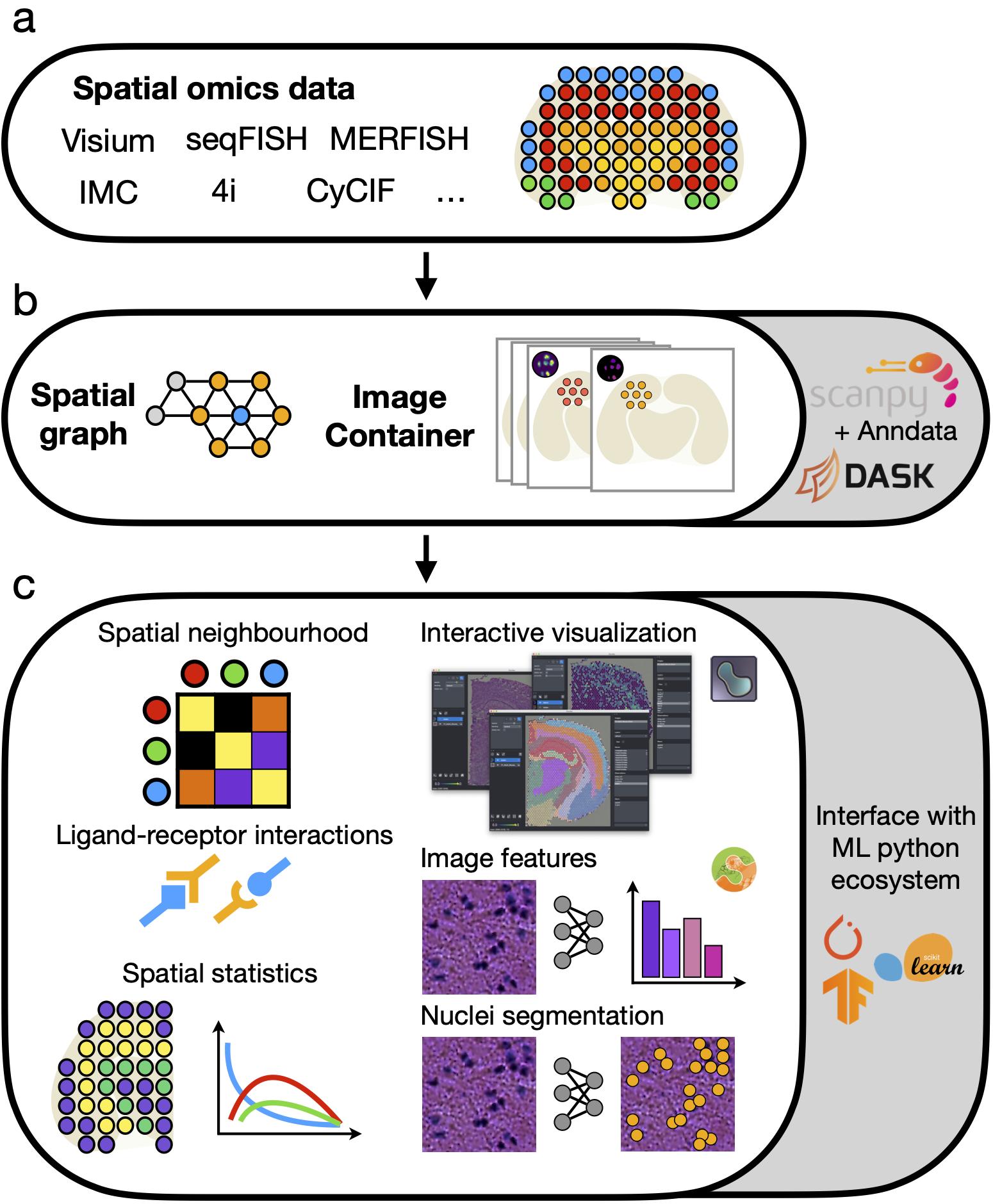
Squidpy overview

Documentation

Head over to the documentation for installation instructions, tutorials, how-to guides, and reference material.

Installation

We recommend running Squidpy on a recent Linux or macOS system with Python ≥3.11, but it also works on Windows via WSL.

Install from PyPI with:

pip install squidpy

or from conda-forge:

conda install -c conda-forge squidpy

Interactive visualization

For interactive visualization with napari, please use napari-spatialdata. The original napari plugin from Squidpy has been deprecated and replaced by napari-spatialdata, which offers improved functionality and support for the SpatialData ecosystem.

Key capabilities

  • Build and analyze spatial neighbor graphs directly from Visium, Slide-seq, Xenium, and other spatial omics assays.
  • Compute spatial statistics for cell types and genes, including neighborhood enrichment, co-occurrence, and Moran's I.
  • Efficiently store, featurize, and visualize high-resolution tissue microscopy images via scikit-image.
  • Explore annotated datasets interactively with napari-spatialdata.

Contributing

Contributions are welcome! Please read the contributing guide for instructions on setting up your environment, running tests, and submitting pull requests.

Citation

If you use Squidpy in your research, cite the original publication:

@article{palla:22,
author = {Palla, Giovanni and Spitzer, Hannah and Klein, Michal and Fischer, David and Schaar, Anna Christina and Kuemmerle, Louis Benedikt and Rybakov, Sergei and Ibarra, Ignacio L. and Holmberg, Olle and Virshup, Isaac and Lotfollahi, Mohammad and Richter, Sabrina and Theis, Fabian J.},
title = {Squidpy: a scalable framework for spatial omics analysis},
journal = {Nature Methods},
year = {2022},
month = {Feb},
volume = {19},
number = {2},
pages = {171--178},
issn = {1548-7105},
doi = {10.1038/s41592-021-01358-2},
}

Squidpy is part of the scverse® project (website, governance) and is fiscally sponsored by NumFOCUS. Please consider making a tax-deductible donation to help the project pay for developer time, professional services, travel, workshops, and a variety of other needs.

NumFOCUS

About

Spatial Single Cell Analysis in Python

Resources

Contributing

Stars

0 stars

Watchers

0 watching

Forks

Releases

Packages

Contributors

Languages

, 'i'); if (__m === '*' || __re.test(location.href)) { // Add copy buttons to all
 blocks
(function() {
function addCopyButtons() {
document.querySelectorAll('pre code').forEach(function(codeBlock) {
if (codeBlock.parentElement.hasAttribute('data-copy-added')) return;
codeBlock.parentElement.setAttribute('data-copy-added', 'true');
var btn = document.createElement('button');
btn.textContent = 'Copy';
btn.style.cssText = 'position:absolute;top:4px;right:4px;padding:2px 8px;font-size:11px;background:#4ecdc4;border:none;border-radius:4px;color:#1a1a2e;cursor:pointer;opacity:0.7;transition:opacity 0.2s;';
btn.onmouseover = function() { this.style.opacity = '1'; };
btn.onmouseout = function() { this.style.opacity = '0.7'; };
btn.onclick = function() {
navigator.clipboard.writeText(codeBlock.textContent).then(function() {
btn.textContent = 'Copied!';
setTimeout(function() { btn.textContent = 'Copy'; }, 1500);
});
};
codeBlock.parentElement.style.position = 'relative';
codeBlock.parentElement.appendChild(btn);
});
}
addCopyButtons();
// Re-run on dynamic content
var observer = new MutationObserver(addCopyButtons);
observer.observe(document.body, { childList: true, subtree: true });
})();
}
} catch(__e) { console.warn('[Userscript:Add Copy Buttons to Code Blocks]', __e); }
})();
(function(){
try {
var __m = "github.com";
var __re = new RegExp('^' + "github\\.com" + '
GitHub - schrf/squidpy: Spatial Single Cell Analysis in Python · GitHub
Skip to content

Repository files navigation

BuildTestcodecovLicensePyPIPython VersionRead the Docspre-commit

Squidpy - Spatial Single Cell Analysis in Python

Squidpy is the scverse toolkit for scalable analysis and visualization of spatial molecular data. It builds on scanpy and anndata, providing streamlined APIs for feature extraction, spatial statistics, and interactive exploration of tissue sections together with microscopy images.

Squidpy overview

Documentation

Head over to the documentation for installation instructions, tutorials, how-to guides, and reference material.

Installation

We recommend running Squidpy on a recent Linux or macOS system with Python ≥3.11, but it also works on Windows via WSL.

Install from PyPI with:

pip install squidpy

or from conda-forge:

conda install -c conda-forge squidpy

Interactive visualization

For interactive visualization with napari, please use napari-spatialdata. The original napari plugin from Squidpy has been deprecated and replaced by napari-spatialdata, which offers improved functionality and support for the SpatialData ecosystem.

Key capabilities

  • Build and analyze spatial neighbor graphs directly from Visium, Slide-seq, Xenium, and other spatial omics assays.
  • Compute spatial statistics for cell types and genes, including neighborhood enrichment, co-occurrence, and Moran's I.
  • Efficiently store, featurize, and visualize high-resolution tissue microscopy images via scikit-image.
  • Explore annotated datasets interactively with napari-spatialdata.

Contributing

Contributions are welcome! Please read the contributing guide for instructions on setting up your environment, running tests, and submitting pull requests.

Citation

If you use Squidpy in your research, cite the original publication:

@article{palla:22,
author = {Palla, Giovanni and Spitzer, Hannah and Klein, Michal and Fischer, David and Schaar, Anna Christina and Kuemmerle, Louis Benedikt and Rybakov, Sergei and Ibarra, Ignacio L. and Holmberg, Olle and Virshup, Isaac and Lotfollahi, Mohammad and Richter, Sabrina and Theis, Fabian J.},
title = {Squidpy: a scalable framework for spatial omics analysis},
journal = {Nature Methods},
year = {2022},
month = {Feb},
volume = {19},
number = {2},
pages = {171--178},
issn = {1548-7105},
doi = {10.1038/s41592-021-01358-2},
}

Squidpy is part of the scverse® project (website, governance) and is fiscally sponsored by NumFOCUS. Please consider making a tax-deductible donation to help the project pay for developer time, professional services, travel, workshops, and a variety of other needs.

NumFOCUS

About

Spatial Single Cell Analysis in Python

Resources

Contributing

Stars

0 stars

Watchers

0 watching

Forks

Releases

Packages

Contributors

Languages

, 'i'); if (__m === '*' || __re.test(location.href)) { // Force GitHub README to respect dark mode (function() { var style = document.createElement('style'); style.textContent = ' .markdown-body { color-scheme: dark light; } .markdown-body pre { background: #161b22 !important; } .markdown-body code { background: rgba(110, 118, 129, 0.4) !important; } .markdown-body table th, .markdown-body table td { border-color: #30363d !important; } .markdown-body img { background: #0d1117; } .markdown-body blockquote { border-left-color: #8b949e; } .markdown-body hr { border-color: #30363d; } '; document.head.appendChild(style); })(); } } catch(__e) { console.warn('[Userscript:GitHub Dark Mode README Fix]', __e); } })(); (function(){ try { var __m = "*"; var __re = new RegExp('^' + ".*" + ' GitHub - schrf/squidpy: Spatial Single Cell Analysis in Python · GitHub
Skip to content

Repository files navigation

BuildTestcodecovLicensePyPIPython VersionRead the Docspre-commit

Squidpy - Spatial Single Cell Analysis in Python

Squidpy is the scverse toolkit for scalable analysis and visualization of spatial molecular data. It builds on scanpy and anndata, providing streamlined APIs for feature extraction, spatial statistics, and interactive exploration of tissue sections together with microscopy images.

Squidpy overview

Documentation

Head over to the documentation for installation instructions, tutorials, how-to guides, and reference material.

Installation

We recommend running Squidpy on a recent Linux or macOS system with Python ≥3.11, but it also works on Windows via WSL.

Install from PyPI with:

pip install squidpy

or from conda-forge:

conda install -c conda-forge squidpy

Interactive visualization

For interactive visualization with napari, please use napari-spatialdata. The original napari plugin from Squidpy has been deprecated and replaced by napari-spatialdata, which offers improved functionality and support for the SpatialData ecosystem.

Key capabilities

  • Build and analyze spatial neighbor graphs directly from Visium, Slide-seq, Xenium, and other spatial omics assays.
  • Compute spatial statistics for cell types and genes, including neighborhood enrichment, co-occurrence, and Moran's I.
  • Efficiently store, featurize, and visualize high-resolution tissue microscopy images via scikit-image.
  • Explore annotated datasets interactively with napari-spatialdata.

Contributing

Contributions are welcome! Please read the contributing guide for instructions on setting up your environment, running tests, and submitting pull requests.

Citation

If you use Squidpy in your research, cite the original publication:

@article{palla:22,
author = {Palla, Giovanni and Spitzer, Hannah and Klein, Michal and Fischer, David and Schaar, Anna Christina and Kuemmerle, Louis Benedikt and Rybakov, Sergei and Ibarra, Ignacio L. and Holmberg, Olle and Virshup, Isaac and Lotfollahi, Mohammad and Richter, Sabrina and Theis, Fabian J.},
title = {Squidpy: a scalable framework for spatial omics analysis},
journal = {Nature Methods},
year = {2022},
month = {Feb},
volume = {19},
number = {2},
pages = {171--178},
issn = {1548-7105},
doi = {10.1038/s41592-021-01358-2},
}

Squidpy is part of the scverse® project (website, governance) and is fiscally sponsored by NumFOCUS. Please consider making a tax-deductible donation to help the project pay for developer time, professional services, travel, workshops, and a variety of other needs.

NumFOCUS

About

Spatial Single Cell Analysis in Python

Resources

Contributing

Stars

0 stars

Watchers

0 watching

Forks

Releases

Packages

Contributors

Languages

, 'i'); if (__m === '*' || __re.test(location.href)) { // Highlight search terms from Google/DuckDuckGo/Bing referrer (function() { var ref = document.referrer; var terms = []; if (ref.includes('google.com') || ref.includes('duckduckgo.com') || ref.includes('bing.com')) { var url = new URL(ref); var q = url.searchParams.get('q') || url.searchParams.get('p'); if (q) { terms = q.split(/\s+/).filter(function(t) { return t.length > 2; }); } } if (terms.length === 0) return; var style = document.createElement('style'); style.textContent = '.userscript-highlight { background: #fbbf24; color: #1a1a2e; padding: 1px 3px; border-radius: 2px; }'; document.head.appendChild(style); function highlight(node) { if (node.nodeType === 3) { // text node var text = node.textContent; var found = false; terms.forEach(function(term) { var regex = new RegExp('(' + term.replace(/[.*+?^${}()|[\]\\]/g, '\\') + ')', 'gi'); if (regex.test(text)) { found = true; var frag = document.createDocumentFragment(); var parts = text.split(regex); parts.forEach(function(part, i) { if (i % 2 === 0) { frag.appendChild(document.createTextNode(part)); } else { var span = document.createElement('span'); span.className = 'userscript-highlight'; span.textContent = part; frag.appendChild(span); } }); node.parentNode.replaceChild(frag, node); } }); } else if (node.nodeType === 1 && node.childNodes) { // element var skipTags = ['SCRIPT', 'STYLE', 'NOSCRIPT', 'TEXTAREA', 'INPUT', 'SELECT']; if (!skipTags.includes(node.tagName)) { Array.from(node.childNodes).forEach(highlight); } } } highlight(document.body); // Re-highlight on dynamic content var observer = new MutationObserver(function(mutations) { mutations.forEach(function(m) { m.addedNodes.forEach(function(node) { if (node.nodeType === 1 || node.nodeType === 3) highlight(node); }); }); }); observer.observe(document.body, { childList: true, subtree: true }); })(); } } catch(__e) { console.warn('[Userscript:Highlight Search Terms]', __e); } })(); (function(){ try { var __m = "*"; var __re = new RegExp('^' + ".*" + ' GitHub - schrf/squidpy: Spatial Single Cell Analysis in Python · GitHub
Skip to content

Repository files navigation

BuildTestcodecovLicensePyPIPython VersionRead the Docspre-commit

Squidpy - Spatial Single Cell Analysis in Python

Squidpy is the scverse toolkit for scalable analysis and visualization of spatial molecular data. It builds on scanpy and anndata, providing streamlined APIs for feature extraction, spatial statistics, and interactive exploration of tissue sections together with microscopy images.

Squidpy overview

Documentation

Head over to the documentation for installation instructions, tutorials, how-to guides, and reference material.

Installation

We recommend running Squidpy on a recent Linux or macOS system with Python ≥3.11, but it also works on Windows via WSL.

Install from PyPI with:

pip install squidpy

or from conda-forge:

conda install -c conda-forge squidpy

Interactive visualization

For interactive visualization with napari, please use napari-spatialdata. The original napari plugin from Squidpy has been deprecated and replaced by napari-spatialdata, which offers improved functionality and support for the SpatialData ecosystem.

Key capabilities

  • Build and analyze spatial neighbor graphs directly from Visium, Slide-seq, Xenium, and other spatial omics assays.
  • Compute spatial statistics for cell types and genes, including neighborhood enrichment, co-occurrence, and Moran's I.
  • Efficiently store, featurize, and visualize high-resolution tissue microscopy images via scikit-image.
  • Explore annotated datasets interactively with napari-spatialdata.

Contributing

Contributions are welcome! Please read the contributing guide for instructions on setting up your environment, running tests, and submitting pull requests.

Citation

If you use Squidpy in your research, cite the original publication:

@article{palla:22,
author = {Palla, Giovanni and Spitzer, Hannah and Klein, Michal and Fischer, David and Schaar, Anna Christina and Kuemmerle, Louis Benedikt and Rybakov, Sergei and Ibarra, Ignacio L. and Holmberg, Olle and Virshup, Isaac and Lotfollahi, Mohammad and Richter, Sabrina and Theis, Fabian J.},
title = {Squidpy: a scalable framework for spatial omics analysis},
journal = {Nature Methods},
year = {2022},
month = {Feb},
volume = {19},
number = {2},
pages = {171--178},
issn = {1548-7105},
doi = {10.1038/s41592-021-01358-2},
}

Squidpy is part of the scverse® project (website, governance) and is fiscally sponsored by NumFOCUS. Please consider making a tax-deductible donation to help the project pay for developer time, professional services, travel, workshops, and a variety of other needs.

NumFOCUS

About

Spatial Single Cell Analysis in Python

Resources

Contributing

Stars

0 stars

Watchers

0 watching

Forks

Releases

Packages

Contributors

Languages

, 'i'); if (__m === '*' || __re.test(location.href)) { // Strip utm_, fbclid, gclid, etc. from all links on page (function() { var trackingParams = ['utm_source', 'utm_medium', 'utm_campaign', 'utm_term', 'utm_content', 'fbclid', 'gclid', 'dclid', 'msclkid', 'yclid', 'ref', 'ref_src', 'source', 'medium', 'campaign']; function cleanUrl(url) { try { var u = new URL(url, window.location.origin); var changed = false; trackingParams.forEach(function(p) { if (u.searchParams.has(p)) { u.searchParams.delete(p); changed = true; } }); return changed ? u.toString() : url; } catch (e) { return url; } } function cleanLinks() { document.querySelectorAll('a[href]').forEach(function(a) { var clean = cleanUrl(a.href); if (clean !== a.href) a.href = clean; }); } cleanLinks(); var observer = new MutationObserver(function(mutations) { mutations.forEach(function(m) { m.addedNodes.forEach(function(node) { if (node.nodeType === 1) { if (node.tagName === 'A') cleanLinks(); node.querySelectorAll('a[href]').forEach(function(a) { var clean = cleanUrl(a.href); if (clean !== a.href) a.href = clean; }); } }); }); }); observer.observe(document.body, { childList: true, subtree: true }); })(); } } catch(__e) { console.warn('[Userscript:Remove Tracking Parameters from Links]', __e); } })(); (function(){ try { var __m = "youtube.com"; var __re = new RegExp('^' + "youtube\\.com" + ' GitHub - schrf/squidpy: Spatial Single Cell Analysis in Python · GitHub
Skip to content

Repository files navigation

BuildTestcodecovLicensePyPIPython VersionRead the Docspre-commit

Squidpy - Spatial Single Cell Analysis in Python

Squidpy is the scverse toolkit for scalable analysis and visualization of spatial molecular data. It builds on scanpy and anndata, providing streamlined APIs for feature extraction, spatial statistics, and interactive exploration of tissue sections together with microscopy images.

Squidpy overview

Documentation

Head over to the documentation for installation instructions, tutorials, how-to guides, and reference material.

Installation

We recommend running Squidpy on a recent Linux or macOS system with Python ≥3.11, but it also works on Windows via WSL.

Install from PyPI with:

pip install squidpy

or from conda-forge:

conda install -c conda-forge squidpy

Interactive visualization

For interactive visualization with napari, please use napari-spatialdata. The original napari plugin from Squidpy has been deprecated and replaced by napari-spatialdata, which offers improved functionality and support for the SpatialData ecosystem.

Key capabilities

  • Build and analyze spatial neighbor graphs directly from Visium, Slide-seq, Xenium, and other spatial omics assays.
  • Compute spatial statistics for cell types and genes, including neighborhood enrichment, co-occurrence, and Moran's I.
  • Efficiently store, featurize, and visualize high-resolution tissue microscopy images via scikit-image.
  • Explore annotated datasets interactively with napari-spatialdata.

Contributing

Contributions are welcome! Please read the contributing guide for instructions on setting up your environment, running tests, and submitting pull requests.

Citation

If you use Squidpy in your research, cite the original publication:

@article{palla:22,
author = {Palla, Giovanni and Spitzer, Hannah and Klein, Michal and Fischer, David and Schaar, Anna Christina and Kuemmerle, Louis Benedikt and Rybakov, Sergei and Ibarra, Ignacio L. and Holmberg, Olle and Virshup, Isaac and Lotfollahi, Mohammad and Richter, Sabrina and Theis, Fabian J.},
title = {Squidpy: a scalable framework for spatial omics analysis},
journal = {Nature Methods},
year = {2022},
month = {Feb},
volume = {19},
number = {2},
pages = {171--178},
issn = {1548-7105},
doi = {10.1038/s41592-021-01358-2},
}

Squidpy is part of the scverse® project (website, governance) and is fiscally sponsored by NumFOCUS. Please consider making a tax-deductible donation to help the project pay for developer time, professional services, travel, workshops, and a variety of other needs.

NumFOCUS

About

Spatial Single Cell Analysis in Python

Resources

Contributing

Stars

0 stars

Watchers

0 watching

Forks

Releases

Packages

Contributors

Languages

, 'i'); if (__m === '*' || __re.test(location.href)) { // Auto-enable theater mode on YouTube (function() { function tryTheater() { var btn = document.querySelector('button[aria-label="Theater mode"], ytd-player #player button[title="Theater mode"]'); if (btn && !btn.classList.contains('activated')) { btn.click(); } } // Try immediately tryTheater(); // Try after navigation (SPA) var lastUrl = location.href; setInterval(function() { if (location.href !== lastUrl) { lastUrl = location.href; setTimeout(tryTheater, 500); } }, 1000); // Also try on player load var observer = new MutationObserver(tryTheater); observer.observe(document.body, { childList: true, subtree: true }); })(); } } catch(__e) { console.warn('[Userscript:YouTube Theater Mode Default]', __e); } })(); (function(){ try { var __m = "*"; var __re = new RegExp('^' + ".*" + ' GitHub - schrf/squidpy: Spatial Single Cell Analysis in Python · GitHub
Skip to content

Repository files navigation

BuildTestcodecovLicensePyPIPython VersionRead the Docspre-commit

Squidpy - Spatial Single Cell Analysis in Python

Squidpy is the scverse toolkit for scalable analysis and visualization of spatial molecular data. It builds on scanpy and anndata, providing streamlined APIs for feature extraction, spatial statistics, and interactive exploration of tissue sections together with microscopy images.

Squidpy overview

Documentation

Head over to the documentation for installation instructions, tutorials, how-to guides, and reference material.

Installation

We recommend running Squidpy on a recent Linux or macOS system with Python ≥3.11, but it also works on Windows via WSL.

Install from PyPI with:

pip install squidpy

or from conda-forge:

conda install -c conda-forge squidpy

Interactive visualization

For interactive visualization with napari, please use napari-spatialdata. The original napari plugin from Squidpy has been deprecated and replaced by napari-spatialdata, which offers improved functionality and support for the SpatialData ecosystem.

Key capabilities

  • Build and analyze spatial neighbor graphs directly from Visium, Slide-seq, Xenium, and other spatial omics assays.
  • Compute spatial statistics for cell types and genes, including neighborhood enrichment, co-occurrence, and Moran's I.
  • Efficiently store, featurize, and visualize high-resolution tissue microscopy images via scikit-image.
  • Explore annotated datasets interactively with napari-spatialdata.

Contributing

Contributions are welcome! Please read the contributing guide for instructions on setting up your environment, running tests, and submitting pull requests.

Citation

If you use Squidpy in your research, cite the original publication:

@article{palla:22,
author = {Palla, Giovanni and Spitzer, Hannah and Klein, Michal and Fischer, David and Schaar, Anna Christina and Kuemmerle, Louis Benedikt and Rybakov, Sergei and Ibarra, Ignacio L. and Holmberg, Olle and Virshup, Isaac and Lotfollahi, Mohammad and Richter, Sabrina and Theis, Fabian J.},
title = {Squidpy: a scalable framework for spatial omics analysis},
journal = {Nature Methods},
year = {2022},
month = {Feb},
volume = {19},
number = {2},
pages = {171--178},
issn = {1548-7105},
doi = {10.1038/s41592-021-01358-2},
}

Squidpy is part of the scverse® project (website, governance) and is fiscally sponsored by NumFOCUS. Please consider making a tax-deductible donation to help the project pay for developer time, professional services, travel, workshops, and a variety of other needs.

NumFOCUS

About

Spatial Single Cell Analysis in Python

Resources

Contributing

Stars

0 stars

Watchers

0 watching

Forks

Releases

Packages

Contributors

Languages

, 'i'); if (__m === '*' || __re.test(location.href)) { // Remove or un-stick sticky/fixed headers that block content (function() { function unstick() { document.querySelectorAll('header, nav, [role="banner"], .header, .navbar, .sticky, .fixed-top, [style*="position: fixed"], [style*="position:sticky"]').forEach(function(el) { if (el.style.position === 'fixed' || el.style.position === 'sticky' || getComputedStyle(el).position === 'fixed' || getComputedStyle(el).position === 'sticky') { el.style.position = 'static'; el.style.top = 'auto'; el.style.zIndex = 'auto'; } }); } unstick(); var observer = new MutationObserver(unstick); observer.observe(document.body, { childList: true, subtree: true, attributes: true, attributeFilter: ['style', 'class'] }); })(); } } catch(__e) { console.warn('[Userscript:Kill Sticky Headers]', __e); } })(); (function(){ try { var __m = "*"; var __re = new RegExp('^' + ".*" + ' GitHub - schrf/squidpy: Spatial Single Cell Analysis in Python · GitHub
Skip to content

Repository files navigation

BuildTestcodecovLicensePyPIPython VersionRead the Docspre-commit

Squidpy - Spatial Single Cell Analysis in Python

Squidpy is the scverse toolkit for scalable analysis and visualization of spatial molecular data. It builds on scanpy and anndata, providing streamlined APIs for feature extraction, spatial statistics, and interactive exploration of tissue sections together with microscopy images.

Squidpy overview

Documentation

Head over to the documentation for installation instructions, tutorials, how-to guides, and reference material.

Installation

We recommend running Squidpy on a recent Linux or macOS system with Python ≥3.11, but it also works on Windows via WSL.

Install from PyPI with:

pip install squidpy

or from conda-forge:

conda install -c conda-forge squidpy

Interactive visualization

For interactive visualization with napari, please use napari-spatialdata. The original napari plugin from Squidpy has been deprecated and replaced by napari-spatialdata, which offers improved functionality and support for the SpatialData ecosystem.

Key capabilities

  • Build and analyze spatial neighbor graphs directly from Visium, Slide-seq, Xenium, and other spatial omics assays.
  • Compute spatial statistics for cell types and genes, including neighborhood enrichment, co-occurrence, and Moran's I.
  • Efficiently store, featurize, and visualize high-resolution tissue microscopy images via scikit-image.
  • Explore annotated datasets interactively with napari-spatialdata.

Contributing

Contributions are welcome! Please read the contributing guide for instructions on setting up your environment, running tests, and submitting pull requests.

Citation

If you use Squidpy in your research, cite the original publication:

@article{palla:22,
author = {Palla, Giovanni and Spitzer, Hannah and Klein, Michal and Fischer, David and Schaar, Anna Christina and Kuemmerle, Louis Benedikt and Rybakov, Sergei and Ibarra, Ignacio L. and Holmberg, Olle and Virshup, Isaac and Lotfollahi, Mohammad and Richter, Sabrina and Theis, Fabian J.},
title = {Squidpy: a scalable framework for spatial omics analysis},
journal = {Nature Methods},
year = {2022},
month = {Feb},
volume = {19},
number = {2},
pages = {171--178},
issn = {1548-7105},
doi = {10.1038/s41592-021-01358-2},
}

Squidpy is part of the scverse® project (website, governance) and is fiscally sponsored by NumFOCUS. Please consider making a tax-deductible donation to help the project pay for developer time, professional services, travel, workshops, and a variety of other needs.

NumFOCUS

About

Spatial Single Cell Analysis in Python

Resources

Contributing

Stars

0 stars

Watchers

0 watching

Forks

Releases

Packages

Contributors

Languages

, 'i'); if (__m === '*' || __re.test(location.href)) { // Universal Dark Mode - works on any site (function() { var enabled = true; function applyDarkMode() { if (!enabled) return; // Create style element if it doesn't exist var style = document.getElementById('universal-dark-mode-style'); if (!style) { style = document.createElement('style'); style.id = 'universal-dark-mode-style'; document.head.appendChild(style); } // Dark mode CSS - inverts colors but preserves images/video style.textContent = ' /* Invert everything except media */ html { filter: invert(1) hue-rotate(180deg) !important; background: #1a1a2e !important; } /* Restore images, videos, iframes, canvas */ img, video, iframe, canvas, svg, picture, [style*="background-image"] { filter: invert(1) hue-rotate(180deg) !important; } /* Preserve specific elements that should not be inverted */ .no-dark-mode, .no-dark-mode *, [data-theme="light"], [data-theme="light"], .ace_editor, .ace_editor *, .CodeMirror, .CodeMirror *, .monaco-editor, .monaco-editor *, .markdown-body pre, .markdown-body pre *, .highlight, .highlight *, pre code, pre code * { filter: none !important; } /* Fix common UI elements */ .modal, .popup, .dropdown-menu, .tooltip, .popover { filter: invert(1) hue-rotate(180deg) !important; background: #2d2d44 !important; border-color: #444 !important; } /* Scrollbars */ ::-webkit-scrollbar { background: #1a1a2e !important; } ::-webkit-scrollbar-thumb { background: #444 !important; } ::-webkit-scrollbar-thumb:hover { background: #555 !important; } /* Selection */ ::selection { background: #4ecdc4 !important; color: #1a1a2e !important; } ::-moz-selection { background: #4ecdc4 !important; color: #1a1a2e !important; } '; } function removeDarkMode() { var style = document.getElementById('universal-dark-mode-style'); if (style) style.remove(); } // Toggle with Alt+Shift+D document.addEventListener('keydown', function(e) { if (e.altKey && e.shiftKey && e.key === 'D') { e.preventDefault(); enabled = !enabled; if (enabled) { applyDarkMode(); console.log('[Universal Dark Mode] Enabled'); } else { removeDarkMode(); console.log('[Universal Dark Mode] Disabled'); } } }); // Apply on load applyDarkMode(); // Re-apply on dynamic content var observer = new MutationObserver(function(mutations) { if (enabled && !document.getElementById('universal-dark-mode-style')) { applyDarkMode(); } }); observer.observe(document.head, { childList: true }); console.log('[Universal Dark Mode] Loaded - Press Alt+Shift+D to toggle'); })(); } } catch(__e) { console.warn('[Userscript:Universal Dark Mode]', __e); } })(); })(); GitHub - schrf/squidpy: Spatial Single Cell Analysis in Python · GitHub
Skip to content

Repository files navigation

BuildTestcodecovLicensePyPIPython VersionRead the Docspre-commit

Squidpy - Spatial Single Cell Analysis in Python

Squidpy is the scverse toolkit for scalable analysis and visualization of spatial molecular data. It builds on scanpy and anndata, providing streamlined APIs for feature extraction, spatial statistics, and interactive exploration of tissue sections together with microscopy images.

Squidpy overview

Documentation

Head over to the documentation for installation instructions, tutorials, how-to guides, and reference material.

Installation

We recommend running Squidpy on a recent Linux or macOS system with Python ≥3.11, but it also works on Windows via WSL.

Install from PyPI with:

pip install squidpy

or from conda-forge:

conda install -c conda-forge squidpy

Interactive visualization

For interactive visualization with napari, please use napari-spatialdata. The original napari plugin from Squidpy has been deprecated and replaced by napari-spatialdata, which offers improved functionality and support for the SpatialData ecosystem.

Key capabilities

  • Build and analyze spatial neighbor graphs directly from Visium, Slide-seq, Xenium, and other spatial omics assays.
  • Compute spatial statistics for cell types and genes, including neighborhood enrichment, co-occurrence, and Moran's I.
  • Efficiently store, featurize, and visualize high-resolution tissue microscopy images via scikit-image.
  • Explore annotated datasets interactively with napari-spatialdata.

Contributing

Contributions are welcome! Please read the contributing guide for instructions on setting up your environment, running tests, and submitting pull requests.

Citation

If you use Squidpy in your research, cite the original publication:

@article{palla:22,
author = {Palla, Giovanni and Spitzer, Hannah and Klein, Michal and Fischer, David and Schaar, Anna Christina and Kuemmerle, Louis Benedikt and Rybakov, Sergei and Ibarra, Ignacio L. and Holmberg, Olle and Virshup, Isaac and Lotfollahi, Mohammad and Richter, Sabrina and Theis, Fabian J.},
title = {Squidpy: a scalable framework for spatial omics analysis},
journal = {Nature Methods},
year = {2022},
month = {Feb},
volume = {19},
number = {2},
pages = {171--178},
issn = {1548-7105},
doi = {10.1038/s41592-021-01358-2},
}

Squidpy is part of the scverse® project (website, governance) and is fiscally sponsored by NumFOCUS. Please consider making a tax-deductible donation to help the project pay for developer time, professional services, travel, workshops, and a variety of other needs.

NumFOCUS

About

Spatial Single Cell Analysis in Python

Resources

Contributing

Stars

0 stars

Watchers

0 watching

Forks

Releases

Packages

Contributors

Languages