
The complete color library for Python. Parse, convert, manipulate, mix, measure, and visualize color across 11 color spaces - with zero required dependencies and a single fluent Color API.


fromhexcraftimportColorc=Color("oklch(0.7 0.15 250)")
c.hex# '#5e91d8'c.contrast(Color("white")) # 2.83c.lighter(5) # [Color, Color, Color, Color, Color]c.material_palette() # {0..100: Color} Material You tonal scalec.simulate("deuteranopia") # color as seen by red-green color-blind viewers- hexcraft
- Table of contents
- Installation
- Quick start
- Examples
- Parsing
- Color spaces
- Reading components
- Manipulation
- Mixing and blending
- Palettes and harmonies
- Tonal scales (Material You, Tailwind)
- Perceptual colormaps
- Accessibility (WCAG, APCA)
- Color difference (ΔE)
- Gamut mapping
- Color blindness simulation and daltonization
- Color temperature (Kelvin)
- Closest match in a palette
- Display-P3 and chromatic adaptation
- CMYK
- Numpy arrays and images
- Command-line interface
- API reference
- License
pip install hexcraft # core, zero dependencies
pip install 'hexcraft[numpy]'# vectorized array ops + image utilities
pip install 'hexcraft[science]'# full color-science integration (reserved)
pip install 'hexcraft[dev]'# tests, ruff, mypy
Requires Python 3.10 or newer.
fromhexcraftimportColor# Parse anything CSS Color 4 supportsc=Color("oklch(0.7 0.15 250)")
# Read in any spacec.hex# '#5e91d8'c.rgb# (94, 145, 216)c.hsl# (213.16, 0.59, 0.61)c.lab# (58.5, -3.5, -38.7)c.oklch# (0.7, 0.15, 250.0)# Manipulate (immutable - every method returns a new Color)c.lighten(0.1)
c.rotate(60)
c.with_alpha(0.5)
# Mix in any spacec.mix(Color("red")) # OKLab by defaultc.mix(Color("red"), 0.3, space="oklch") # shortest-hue interpolation# Accessibilityc.contrast(Color("white")) # WCAG ratioc.accessible_against(Color("white")) # auto-shift to meet 4.5:1# Generate palettesc.tints(5) # 5 steps to whitec.material_palette() # 13-stop Material You scalec.tailwind() # 11-stop Tailwind 50–950c.triadic() # 3 colors 120° apart# CSS outputc.css("hex") # '#5e91d8'c.css("oklch") # 'oklch(0.7 0.15 250)'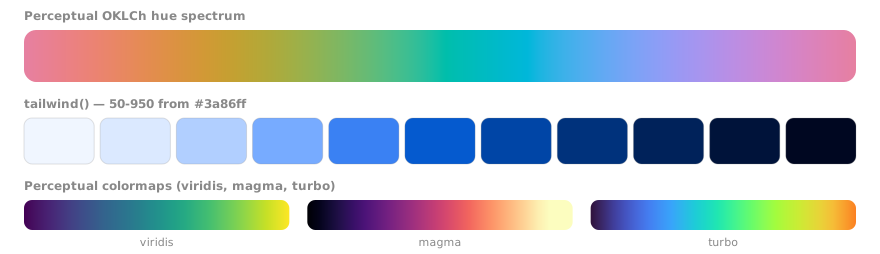
Twelve runnable scripts in examples/ cover the full feature
surface, with ANSI 24-bit color output so the gradients, palettes, and
accessibility checks are visible in any modern terminal:
python examples/01_quickstart.py| # | File | Demonstrates |
|---|---|---|
| 01 | 01_quickstart.py | Parse, convert, manipulate, contrast, mix - the 60-second tour |
| 02 | 02_parsing_anything.py | Every CSS Color 4 syntax, hex variant, unit, and named color |
| 03 | 03_perceptual_vs_naive_mixing.py | Same gradient interpolated in 5 spaces - sRGB muddies, OKLab doesn't |
| 04 | 04_palette_harmonies.py | Every classic harmony plus tints / shades / tones / monochromatic |
| 05 | 05_design_system.py | Material You + Tailwind 50-950 scales from one brand color |
| 06 | 06_accessibility_audit.py | WCAG / APCA pass-fail with auto-suggested fixes |
| 07 | 07_color_blindness.py | Simulate + daltonize a palette per CVD type |
| 08 | 08_perceptual_colormaps.py | All 11 bundled colormaps sampled side-by-side |
| 09 | 09_color_temperature.py | Kelvin temperatures from candle flame to deep sky |
| 10 | 10_brand_color_match.py | closest_from for normalizing input to a brand palette |
| 11 | 11_image_palette.py(numpy) | Extract dominant colors from an image via OKLab k-means |
| 12 | 12_theme_generator.py | Full light + dark theme tokens with WCAG-checked text pairings |
See examples/README.md for the same table with a
viewing-tips section.
See it:
02_parsing_anything.py
Color(value) accepts every CSS Color 4 syntax, all 148 CSS named colors, hex with optional alpha, and existing Color objects:
Color("#ff0000")
Color("#f00") # 3-digitColor("#f008") # 4-digit (with alpha)Color("#ff000080") # 8-digit (with alpha)Color("rgb(255, 0, 0)")
Color("rgb(255 0 0)") # space-separated CSS Color 4Color("rgb(100%, 0%, 0%)")
Color("rgba(255, 0, 0, 0.5)")
Color("rgb(255 0 0 / 50%)")
Color("hsl(0, 100%, 50%)")
Color("hsl(120deg 100% 50%)")
Color("hsl(0.333turn 100% 50%)")
Color("hsla(0, 100%, 50%, 0.5)")
Color("hwb(0 0% 0%)")
Color("lab(54 81 70)")
Color("lch(54 100 41)")
Color("oklab(0.628 0.225 0.126)")
Color("oklch(0.628 0.258 29.234)")
Color("color(srgb 1 0 0)")
Color("color(srgb-linear 1 0 0)")
Color("color(display-p3 1 0 0)")
Color("color(xyz 0.412 0.213 0.019)")
Color("rebeccapurple") # any of 148 CSS named colorsColor("transparent") # also valid; alpha = 0Color(other_color) # copy
Hue accepts deg (default), rad, turn, or grad units. none is treated as 0. Errors raise hexcraft.ColorParseError.
fromhexcraftimportparse, ColorParseErrortry:
c=Color("not-a-color")
exceptColorParseErrorase:
print(e) # could not parse color: 'not-a-color'# Direct parser if you need the intermediate representation:parse("oklch(0.7 0.15 250)") # Parsed(space='oklch', components=(0.7, 0.15, 250.0), alpha=1.0)hexcraft works canonically in linear sRGB and converts to any space on demand. Out-of-gamut and HDR values pass through; gamut mapping is applied at output.
| Space | Property | Constructor |
|---|---|---|
| sRGB (gamma) | c.rgb, c.srgb, c.hex | Color.from_rgb8(255, 0, 0) |
| Linear sRGB | c.linear_rgb | Color.from_linear_rgb(1, 0, 0) |
| HSL | c.hsl | Color.from_hsl(0, 1, 0.5) |
| HSV | c.hsv | Color.from_hsv(0, 1, 1) |
| HWB | c.hwb | Color.from_hwb(0, 0, 0) |
| CIE XYZ (D65) | c.xyz | Color.from_xyz(0.412, 0.213, 0.019) |
| CIE Lab | c.lab | Color.from_lab(54, 81, 70) |
| CIE LCh | c.lch | Color.from_lch(54, 107, 41) |
| OKLab | c.oklab | Color.from_oklab(0.63, 0.22, 0.13) |
| OKLCh | c.oklch | Color.from_oklch(0.63, 0.26, 29) |
| Display-P3 | c.p3 | Color.from_p3(1, 0, 0) |
| CMYK (naive) | c.cmyk | Color.from_cmyk(0, 1, 1, 0) |
| Kelvin (CCT) | c.kelvin | Color.from_kelvin(2700) |
hsl/hsv/hwb use degrees for hue; lab/lch/oklab/oklch use the CIE/OK natural units. Hue is in [0, 360). CMYK is naive algebraic - see CMYK for caveats.
c=Color("#3498db")
c.alpha# 1.0c.rgb# (52, 152, 219)c.rgba# (52, 152, 219, 1.0)c.srgb# (0.204, 0.596, 0.859) - gamma-encoded, clampedc.srgb_unclamped# same but allows out-of-gamutc.linear_rgb# (0.034, 0.318, 0.708)c.hsl# (204.1, 0.70, 0.53)c.hsv# (204.1, 0.76, 0.86)c.hwb# (204.1, 0.20, 0.14)c.xyz# (0.222, 0.247, 0.700)c.lab# (56.9, -2.4, -39.0)c.lch# (56.9, 39.0, 266.5)c.oklab# (0.65, -0.06, -0.12)c.oklch# (0.65, 0.13, 242.7)c.p3# (0.252, 0.589, 0.851)c.cmyk# (0.76, 0.31, 0.0, 0.14)c.kelvin# ~10500 (or None for non-blackbody chromaticities)c.luminance# 0.281 - WCAG relative luminancec.name# 'dodgerblue' - closest CSS named colorc.in_gamut() # True/False - within sRGB
linear_rgb and srgb_unclamped may contain values outside [0, 1] to faithfully represent wide-gamut and HDR colors. Use c.to_gamut() to fold back into sRGB.
Every method is immutable and returns a new Color. Operations work in OKLCh by default for perceptual uniformity.
c=Color("#3498db")
c.lighten(0.1) # +0.1 in OKLab Lc.darken(0.1)
c.saturate(0.2) # +chroma in OKLChc.desaturate(0.2)
c.rotate(60) # rotate hue by 60°c.complement() # rotate(180)c.grayscale() # collapse chroma to 0c.invert() # 1 - rgb in linear sRGBc.with_alpha(0.5)
Equality and hashing use linear-sRGB tolerance (≈ 1e-6) and are well-behaved across round-trips:
Color("red") ==Color("#ff0000") ==Color("rgb(255, 0, 0)") # True
{Color("red"), Color("#ff0000")} # set of size 1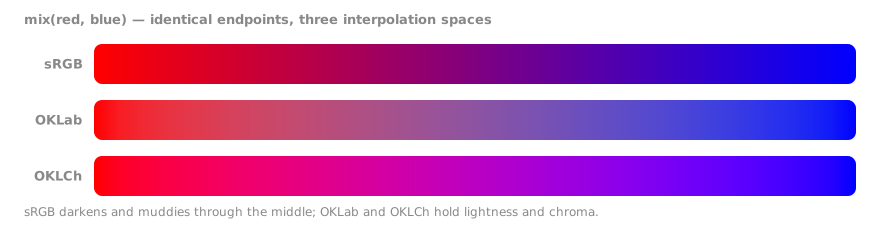
See it:
03_perceptual_vs_naive_mixing.py
mix interpolates two colors in any space; the default is OKLab for smooth, hue-faithful results. Hue spaces (hsl, hsv, hwb, lch, oklch) automatically take the shortest-arc path.
fromhexcraftimportColor, mix, blendmix(Color("red"), Color("blue")) # OKLab midpointmix(Color("red"), Color("blue"), 0.3) # 30% toward bluemix(Color("red"), Color("blue"), 0.5, space="oklch") # different perceptual pathmix(Color("red"), Color("blue"), 0.5, space="srgb") # naive sRGB lerp# Method form (always defaults to OKLab):Color("red").mix(Color("blue"), 0.5)blend does Porter-Duff "over" composite in linear sRGB, the gamma-correct way to alpha-composite:
fg=Color("blue").with_alpha(0.5)
bg=Color("red")
blend(bg, fg) # red showing through 50% blue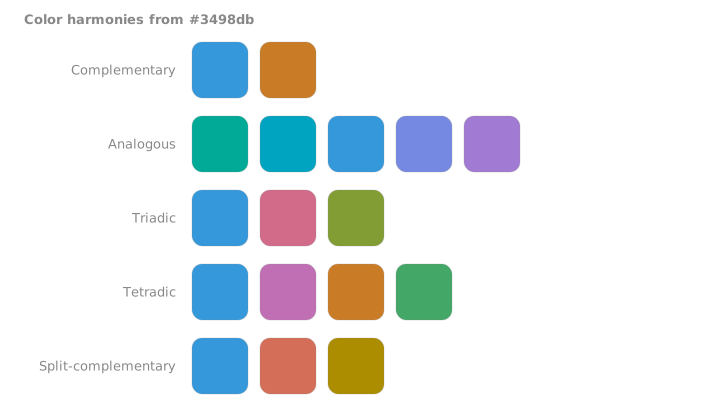
See it:
04_palette_harmonies.py
Module-level functions return a list of Color. Equivalent methods on Color return the same lists:
fromhexcraftimport (
complementary, analogous, triadic, tetradic, split_complementary,
monochromatic, shades, tints, tones, scale, stops,
)
c=Color("#3498db")
complementary(c) # [c, c.rotate(180)]triadic(c) # 3 colors 120° aparttetradic(c) # 4 colors 90° apartsplit_complementary(c) # base + 2 colors flanking the complementanalogous(c, count=5, spread=20) # N colors spaced by 20° hueshades(c, count=5) # toward blacktints(c, count=5) # toward whitetones(c, count=5) # toward equal-lightness graymonochromatic(c, count=7) # full lightness ramp at fixed hue/chroma# Method-style (return type-stable lists):c.tints(10)
c.lighter(10) # alias for .tints()c.darker(10) # alias for .shades()c.triadic()
c.analogous(count=5)
Two-color and multi-stop scales:
scale(Color("red"), Color("blue"), steps=10, space="oklab")
stops([Color("red"), Color("green"), Color("blue")], steps=20, space="oklab")
steps includes both endpoints. space accepts any mixing space.
See it:
05_design_system.py,12_theme_generator.py
c=Color("#3498db")
c.material_palette()
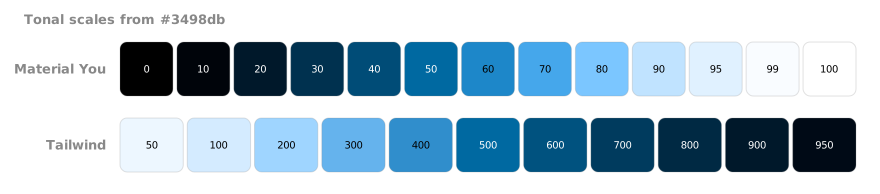
# {0: '#000000', 10: '#00040a', 20: '#00182a', 30: '#00314f', 40: '#004c77',# 50: '#0069a1', 60: '#1d87c9', 70: '#45a7eb', 80: '#7bc6ff', 90: '#c0e3ff',# 95: '#e0f1ff', 99: '#f9fcff', 100: '#ffffff'}c.tailwind()
# {50: '#edf7ff', 100: '#d4ebff', 200: '#9fd5ff', 300: '#65b3ed', 400: '#308ecc',# 500: '#0069a1', 600: '#00527f', 700: '#003b5e', 800: '#002943', 900: '#00182a',# 950: '#000a16'}
Both implementations build on OKLCh - they preserve the source hue, hold chroma roughly constant for Material, and ramp chroma for Tailwind so the extreme stops stay legible. Out-of-gamut points are folded back into sRGB via OKLCh chroma reduction.
fromhexcraftimport (
material_tonal_palette, tailwind_scale,
MATERIAL_TONES, TAILWIND_STOPS,
)
material_tonal_palette(c) # equivalent to c.material_palette()tailwind_scale(c) # equivalent to c.tailwind()MATERIAL_TONES# (0, 10, 20, ..., 100)TAILWIND_STOPS# (50, 100, 200, ..., 950)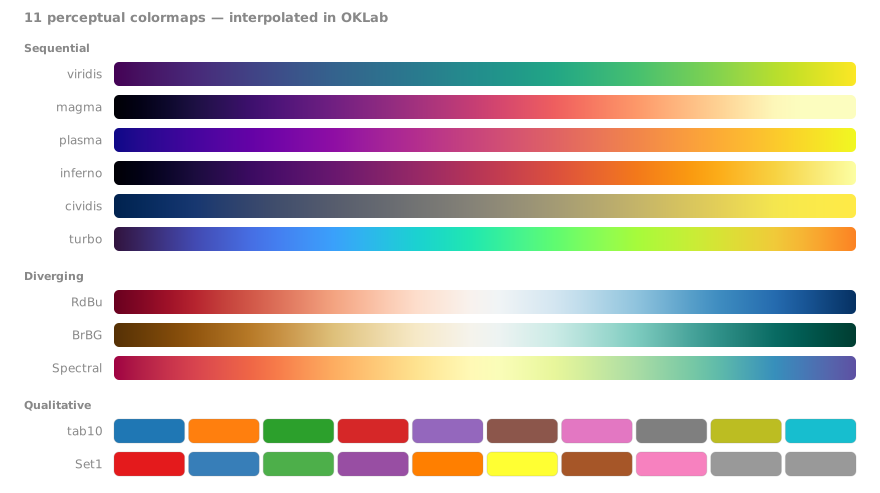
See it:
08_perceptual_colormaps.py
Eleven named colormaps are bundled, each interpolated in OKLab so that any sample size stays perceptually uniform.
| Name | Type | Notes |
|---|---|---|
viridis | sequential | Purple → yellow, default for matplotlib |
magma | sequential | Black → cream, warm |
plasma | sequential | Purple → yellow, more saturated than viridis |
inferno | sequential | Black → cream, hotter than magma |
cividis | sequential | Color-blind friendly dark blue → yellow |
turbo | rainbow | Blue → red, replaces jet |
rdbu | diverging | ColorBrewer Red–Blue |
brbg | diverging | ColorBrewer Brown–Bluegreen |
spectral | diverging | ColorBrewer Spectral |
tab10 | qualitative | matplotlib's Tableau 10 |
set1 | qualitative | ColorBrewer Set1 |
Each map is callable and exposes a .colors(n) discrete sampler:
fromhexcraftimportviridis, magma, rdbu, tab10, colormapviridis(0.5) # Color at midpointviridis.colors(8) # 8 evenly spaced Colorsmagma(0.0).hex# '#000004' (deep black)magma(1.0).hex# '#fcfdbf' (cream)rdbu(0.0) # red endrdbu(0.5) # neutral midpointrdbu(1.0) # blue endtab10.colors() # all 10 categorical colorstab10.colors(15) # extends with interpolation if you ask for morecolormap("viridis")(0.5) # lookup by stringMaps are also grouped:
fromhexcraftimportSEQUENTIAL_MAPS, DIVERGING_MAPS, QUALITATIVE_MAPS, ALL_MAPSlist(SEQUENTIAL_MAPS) # ['viridis', 'magma', ..., 'turbo']ALL_MAPS["RdBu"](0.7)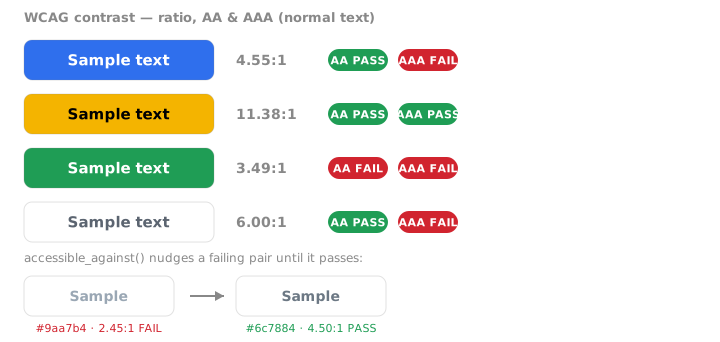
See it:
06_accessibility_audit.py
fromhexcraftimport (
Color, wcag_ratio, passes_wcag, apca_lc,
find_accessible_pair, best_text_color,
)
wcag_ratio(Color("white"), Color("black")) # 21.0wcag_ratio(Color("#777"), Color("#fff")) # 4.48passes_wcag(Color("#777"), Color("#fff")) # False (AA, normal text)passes_wcag(Color("#777"), Color("#fff"), large=True) # True (AA, large text)passes_wcag(Color("#777"), Color("#fff"), level="AAA") # Falseapca_lc(Color("black"), Color("white")) # 106.04 (dark on light → positive)apca_lc(Color("white"), Color("black")) # -107.88 (light on dark → negative)apca_lc(Color("#888"), Color("white")) # 63.06
find_accessible_pair walks lightness in OKLCh until a target ratio is met:
fg=Color("#888888")
bg=Color("white")
fixed=find_accessible_pair(fg, bg, ratio=4.5)
# fixed = Color('#777777') - minimal nudge, still close to original# Method formColor("#888").accessible_against(Color("white"), ratio=4.5)
# Specify directionfind_accessible_pair(fg, bg, ratio=7.0, direction="darken")
For a quick "black or white?" decision:
best_text_color(Color("#3498db")) # Color('#000000')best_text_color(Color("#222")) # Color('#ffffff')WCAG ratios are symmetric, in [1, 21]. APCA Lc is signed (matching the APCA-W3 polarity convention): positive for dark text on light backgrounds, negative for light on dark. Magnitude is what you compare against the published readability tables (e.g. Lc 60 for body text).
fromhexcraftimportdelta_edelta_e(a, b, method="76") # CIE76 - Euclidean in Lab, fastestdelta_e(a, b, method="94") # CIE94 - graphic-arts weightingdelta_e(a, b, method="2000") # CIEDE2000 - current CIE recommendation (default)delta_e(a, b, method="cmc") # CMC(l:c) with l=2 c=1, textile standarddelta_e(a, b, method="ok") # Euclidean in OKLab, modern alternative# Method formColor("red").delta_e(Color("orangered"))Rough thresholds for CIEDE2000: <1 imperceptible, 1–2 perceptible to a trained eye, >5 clearly different.
When a color exceeds sRGB (e.g., oklch(0.7 0.4 30) is more saturated than sRGB can show), to_gamut() reduces its OKLCh chroma until it fits, preserving lightness and hue (CSS Color 4 algorithm):
wide=Color.from_oklch(0.7, 0.4, 30)
wide.in_gamut() # Falsemapped=wide.to_gamut()
mapped.in_gamut() # Truemapped.hex# '#ff6551'# Cheaper alternative: per-channel clip in linear sRGBfromhexcraftimportclipclip(wide).hex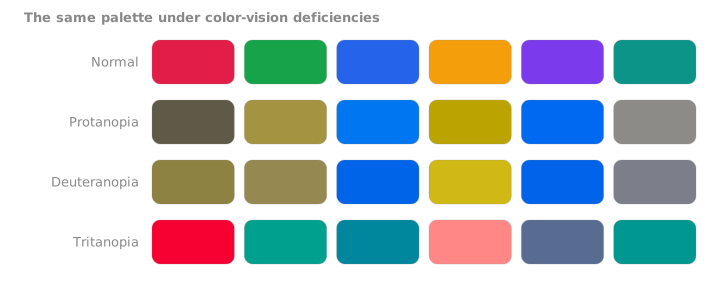
See it:
07_color_blindness.py
fromhexcraftimportColor, simulate, daltonizered=Color("red")
simulate(red, "protanopia") # red as protans (red-blind) see itsimulate(red, "deuteranopia") # red as deutans (green-blind) see itsimulate(red, "tritanopia") # red as tritans (blue-blind) see itsimulate(red, "deuteranopia", severity=0.5) # interpolate to anomalous trichromacydaltonize(red, "deuteranopia") # adjust the color so deutans can distinguish it# Method formsred.simulate("deuteranopia")
red.daltonize("deuteranopia")
Simulation uses Machado/Oliveira/Fernandes (2009) physiologically-based matrices; severity interpolates between full vision (0.0) and complete dichromacy (1.0). Daltonization uses Fidaner-style error redistribution onto channels the viewer can still perceive.
# Concrete example: red and green look similar to deutans → daltonize for a UIbutton_a=Color("#10b981") # success greenbutton_b=Color("#ef4444") # error redbutton_a.daltonize("deuteranopia") # shifted green so it remains distinguishablebutton_b.daltonize("deuteranopia")
See it:
09_color_temperature.py
fromhexcraftimportColorColor.from_kelvin(2700).hex# '#ffa757' warm tungstenColor.from_kelvin(5500).hex# '#ffedde' daylightColor.from_kelvin(6500).hex# '#fffefa' D65 (sRGB white point)Color.from_kelvin(9000).hex# '#d2dfff' cool bluec=Color("#fffefa")
c.kelvin# ~6300 K (returns None outside ~2000–25000 K)
Forward direction uses Tanner Helland's piecewise approximation. Inverse (CCT from a color) uses McCamy's cubic in CIE xy chromaticity. Both are visualization-grade, not photometric.
See it:
10_brand_color_match.py
fromhexcraftimportColor, closest_from, closest_n_frombrand= [
Color("#3b82f6"), # blueColor("#10b981"), # greenColor("#ef4444"), # redColor("#f59e0b"), # amber
]
closest_from(Color("#ee5544"), brand)
# Color('#ef4444') - best perceptual match by CIEDE2000closest_n_from(Color("#ee5544"), brand, n=2)
# [Color('#ef4444'), Color('#f59e0b')] - sorted by ΔE# Use a different metric for image-scale workclosest_from(target, brand, method="ok")
The default metric is "2000" (CIEDE2000). Use "ok" for fast batch matching and "cmc" for textile/print contexts.
red_p3=Color("color(display-p3 1 0 0)")
red_p3.hex# '#ff0000' (out-of-gamut clipped to sRGB red)red_p3.p3# (1.0, 0.0, 0.0) - round-trips through P3c=Color("#3498db")
c.p3# gamma-encoded P3 in [0, 1]Color.from_p3(0.252, 0.589, 0.851)
For converting XYZ between white points (e.g., D65 ↔ D50 for ICC v4 work):
fromhexcraftimportadapt, D50, D65fromhexcraftimportD55, D75, A# also availableadapt((0.5, 0.6, 0.7), D65, D50) # Bradford (default)adapt((0.5, 0.6, 0.7), D65, D50, method="cat16")
adapt((0.5, 0.6, 0.7), D65, D50, method="xyz") # simplest, von Kries XYZ scalingColor("red").cmyk# (0.0, 1.0, 1.0, 0.0)Color.from_cmyk(0.5, 0.2, 0.0, 0.1)This is the algebraic CMYK that browsers and design tools display when no profile is attached. It is not color-accurate for press output - real print workflows go through ICC profiles (SWOP, FOGRA, GRACoL, etc.). Use it for quick previews and color picker UI only.
See it:
11_image_palette.py
hexcraft.arrays (requires numpy) provides vectorized conversions for image-scale work:
importnumpyasnpfromhexcraft.arraysimport (
srgb_decode, srgb_encode,
linear_rgb_to_xyz, xyz_to_linear_rgb,
linear_rgb_to_oklab, oklab_to_linear_rgb,
srgb_to_oklab, oklab_to_srgb,
relative_luminance, wcag_ratio, delta_e_ok,
)
img=np.random.rand(1024, 1024, 3) # gamma sRGB imageok=srgb_to_oklab(img) # (H, W, 3) in OKLabluma=relative_luminance(img) # (H, W) WCAG relative luminanceratios=wcag_ratio(img, np.array([1, 1, 1])) # contrast against whitediffs=delta_e_ok(img, np.array([1, 0, 0])) # per-pixel OKLab ΔE vs red
hexcraft.image provides higher-level image utilities:
importnumpyasnpfromhexcraft.imageimportdominant_colors, average_colorimg=np.array(...).astype(np.uint8) # or float in [0, 1]; (H, W, 3) or (H, W, 4)# k-means clustering in OKLab space (perceptually meaningful)top5=dominant_colors(img, n=5)
# [Color('#3a8fd2'), Color('#f4ecd0'), Color('#221d18'), ...]# ordered by cluster size (most-common first)# Median-cut alternative (faster, less perceptual)top5=dominant_colors(img, n=5, method="median_cut")
# For very large images, dominant_colors subsamples to 50_000 pixels by default;# pass sample=None to use every pixel, or sample=N to control:dominant_colors(img, n=5, sample=10_000, seed=42)
# Gamma-correct meanaverage_color(img)Installing hexcraft registers a hexcraft console script. Output uses ANSI 24-bit color blocks when stdout is a TTY.
$ hexcraft inspect "#3498db"
#3498db
hex #3498db
rgb rgb(52, 152, 219)
hsl hsl(204.1 69.9% 53.1%)
lab lab(60.2 -6.1 -42.2)
oklch oklch(0.653 0.135 242.7)
cmyk 76.3% 30.6% 0.0% 14.1%
luma 0.2830
kelvin ~10500 K
name dodgerblue
in sRGB True
$ hexcraft convert red --to oklch
oklch(0.628 0.258 29.23)
$ hexcraft palette "#3498db" --type material
0 #000000
10 #00040a
20 #00182a
...
100 #ffffff
$ hexcraft palette red --type triadic
0 #ff0000
1 #00ae00
2 #4f6fff
$ hexcraft contrast "#888" white
fg #888888
bg #ffffff
WCAG ratio 3.54:1
AA FAIL (large: PASS)
AAA FAIL (large: FAIL)
APCA Lc -63.1
→ try fg #777777 for AA
$ hexcraft closest "#ee5544" "#3b82f6" "#10b981" "#ef4444" "#f59e0b"
target #ee5544
match #ef4444
Subcommands:
| Command | Purpose |
|---|---|
inspect | Show all common representations + closest CSS name + CCT |
convert | Render a color as a CSS string in any space |
palette | Emit a palette of any type to stdout |
contrast | WCAG ratio + AA/AAA pass + APCA Lc + suggested fix on fail |
closest | Find the closest entry in a palette by ΔE |
Use hexcraft <command> --help for full options.
Constructors
| Method | Notes |
|---|---|
Color(value) | string / Color / (r,g,b) or (r,g,b,a) tuple |
Color.parse(s) | same as Color(s); raises ColorParseError |
Color.from_rgb(r, g, b, a=1) | gamma-encoded sRGB, 0–1 floats (wide-gamut allowed) |
Color.from_rgb8(r, g, b, a=1) | gamma-encoded sRGB, 0–255 integers |
Color.from_hex(value) | |
Color.from_linear_rgb(r, g, b, a=1) | |
Color.from_hsl(h, s, l, a=1) | h in degrees, s/l in [0, 1] |
Color.from_hsv(h, s, v, a=1) | |
Color.from_hwb(h, w, b, a=1) | |
Color.from_lab(L, a, b, alpha=1) | L [0, 100], a/b roughly [-128, 128] |
Color.from_lch(L, c, h, a=1) | |
Color.from_oklab(L, a, b, alpha=1) | L [0, 1], a/b roughly [-0.4, 0.4] |
Color.from_oklch(L, c, h, a=1) | |
Color.from_xyz(x, y, z, a=1) | D65 reference white |
Color.from_p3(r, g, b, a=1, gamma=True) | |
Color.from_cmyk(c, m, y, k, a=1) | naive (no profile) |
Color.from_kelvin(temperature, a=1) | Helland approximation |
Properties
alpha, rgb, rgba, hex, srgb, srgb_unclamped, linear_rgb, hsl, hsv, hwb, xyz, lab, lch, oklab, oklch, p3, p3_unclamped, cmyk, kelvin, luminance, name.
Methods
| Method | Returns |
|---|---|
with_alpha(a) | Color |
lighten(amount) / darken(amount) | Color |
saturate(amount) / desaturate(amount) | Color |
rotate(degrees) | Color |
complement() | Color |
grayscale() / invert() | Color |
mix(other, t=0.5, space="oklab") | Color |
contrast(other, method="wcag") | float |
delta_e(other, method="2000") | float |
simulate(kind, severity=1.0) | Color |
daltonize(kind) | Color |
accessible_against(other, ratio=4.5) | Color | None |
to_gamut(space="srgb") | Color |
in_gamut(space="srgb") | bool |
tints(count=5) / lighter(count=5) | list[Color] |
shades(count=5) / darker(count=5) | list[Color] |
tones(count=5) | list[Color] |
monochromatic(count=5) | list[Color] |
analogous(count=3, spread=30) | list[Color] |
complementary(), triadic(), tetradic(), split_complementary(spread=30) | list[Color] |
material_palette() | dict[int, Color] |
tailwind() | dict[int, Color] |
css(fmt="hex") | str - "hex", "rgb", "hsl", "hwb", "lab", "lch", "oklab", "oklch" |
fromhexcraftimport (
parse, ColorParseError, # parsingmix, blend, # mixingwcag_ratio, passes_wcag, apca_lc, # contrastfind_accessible_pair, best_text_color, # accessibilitydelta_e, closest_from, closest_n_from, # differencemap_to_gamut, clip, # gamutsimulate, daltonize, # CVDmaterial_tonal_palette, tailwind_scale, # tonal palettescomplementary, analogous, triadic, tetradic, # harmoniessplit_complementary, square,
monochromatic, shades, tints, tones,
scale, stops, # gradientskelvin_to_rgb, rgb_to_kelvin, # temperatureadapt, D65, D50, D55, D75, A, # chromatic adaptationviridis, magma, plasma, inferno, cividis, # colormapsturbo, rdbu, brbg, spectral, tab10, set1,
colormap, ALL_MAPS,
SEQUENTIAL_MAPS, DIVERGING_MAPS, QUALITATIVE_MAPS,
)| Module | Purpose |
|---|---|
hexcraft.spaces | Low-level pure-function space conversions |
hexcraft.arrays | Numpy-vectorized conversions and metrics (numpy required) |
hexcraft.image | Dominant color extraction, average color (numpy required) |
hexcraft.cli | Console-script entry point |
hexcraft.adapt | Chromatic adaptation, white-point constants |
hexcraft.colormaps | Colormap objects |
hexcraft.temperature | Kelvin / CCT helpers |
hexcraft.tonal | Material You and Tailwind tonal generators |
hexcraft.cvd | Color vision deficiency simulation and daltonization |
hexcraft.accessibility | High-level helpers built on contrast metrics |
MIT.