


It provides functional macros to reuse fields from Struct and Enum definition.
[dependencies]
born = { git = "https://github.com/steadylearner/born", branch = "master" }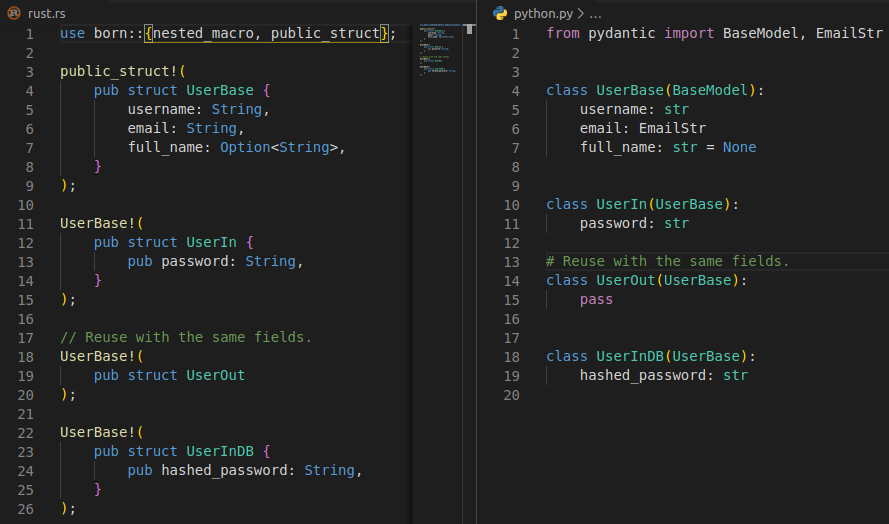
You can define common fields in Rust struct and enum once and reuse them to remove code duplication. Use it when you want to reuse the same fields for the structs like the example below.
use born::{
nested_macro,
public_struct,};public_struct!(pubstructUserBase{
username:String,
email:String,
full_name:Option<String>,});UserBase!(pubstructUserIn{pub password:String,});// Reuse with the same fields.UserBase!(pubstructUserOut);UserBase!(pubstructUserInDB{pub hashed_password:String,});
Compare it with Python code below from FAST API that inspired this library.
frompydanticimportBaseModel, EmailStrclassUserBase(BaseModel):
username: stremail: EmailStrfull_name: str=NoneclassUserIn(UserBase):
password: str# Reuse with the same fields.classUserOut(UserBase):
passclassUserInDB(UserBase):
hashed_password: str
You can see almost same thing is done here to remove code duplication in both parts.
But, different from Python, there is no inheritance of fields with macros from born. It is lazily built(born) by your first struct or enum definition.
Everything made from them are completely irrelevant to each other except they share the same definition. There is no memory share or something like that.
The macros from this library are lazy struct and enum builders to remove code duplication. It is possible with the power of the Rust macro.
Here, macros to build public struct and enum are used.
If you want to build private struct and enum, just use macros that start with private and shouldn't use pub inside.
Say you build a simple demo web server to send private messages.
use born::{
nested_macro,
public_struct,};public_struct!(// pub is required here before structpubstructMessageBase{pub text:String// pub text: String // , is not required for the struct definition.});MessageBase!(
#[derive(Debug,Clone,PartialEq)]pubstructMessage{pub read:bool,// read: bool, // pub is optional.});implMessage{fnupdate_text(&mutself,new_message:String){self.text = new_message
}fnread(&mutself){ifself.read == false{self.read = true;}}}MessageBase!(
#[derive(Debug,Clone,PartialEq)]pubstructMessageCreateRequest);MessageBase!(// #[derive(Debug, Clone, PartialEq)]pubstructMessageUpdateRequest);fnmain(){let message_create_request = MessageCreateRequest{text:"I am Steadylearner and 'born' is the crate name.".into(),};letmut message = Message{text: message_create_request.text,read:false,};println!("{:#?}",&message);assert_eq!(message, message.clone());let message_update_request = MessageUpdateRequest{text:"Reuse fields with macros from 'born'.".into(),};
message.update_text(message_update_request.text);println!("{:#?}",&message);
message.read();println!("{:#?}",&message);}
You can also use the public_struct! and private_struct! with serde derive. For example, you can rename fields to camelCase with #[serde(rename_all = "camelCase")] etc.
// Cargo.toml// born = { git = "https://github.com/steadylearner/born", branch = "master" }use born::{
nested_macro,
public_struct,};use serde::{Serialize,Deserialize};public_struct!(pubstructPostBase{pub user_id:i8,pub title:String,pub body:String,});PostBase!(
#[derive(Serialize,Deserialize,Debug)]
#[serde(rename_all = "camelCase")]pubstructPost{pub id:i8,});Compare it with the code example from the Rust documenation.
use born::{
nested_macro,
private_enum,};private_enum!(enumWebEventBase{PageLoad,PageUnload,// , here is required if you want to extend it.});WebEventBase!(// #[derive(Debug, Clone, PartialEq)]enumWebEvent{KeyPress(char),Click{ x:i64, y:i64},Paste(String),});fninspect(event:WebEvent){match event {WebEvent::PageLoad => println!("page loaded"),WebEvent::PageUnload => println!("page unloaded"),WebEvent::KeyPress(c) => println!("pressed '{}'.", c),WebEvent::Paste(s) => println!("pasted \"{}\".", s),WebEvent::Click{ x, y } => {println!("clicked at x={}, y={}.", x, y);},}}fnmain(){let pressed = WebEvent::KeyPress('x');let pasted = WebEvent::Paste("my text".to_owned());let click = WebEvent::Click{x:20,y:80};let load = WebEvent::PageLoad;let unload = WebEvent::PageUnload;inspect(pressed);inspect(pasted);inspect(click);inspect(load);inspect(unload);}Each struct and enum created from the macros are completely unrelevant to each other except they are built(born) from the same definition.
When you use
private_struct!andprivate_enum!, you can't use pub keyword in it and others use them. It wouldn't be logical if a private struct or private enum can have public fields.nested_macro!is required to use the other macros from this crate. It is used to make a macro that creates other macros.
macro_rules! nested_macro {($($body:tt)*) => {
macro_rules! __nested_macro { $($body)+ }
__nested_macro!($);}}- You can also use attributes for the common parts.
// Cargo.toml// born = { git = "https://github.com/steadylearner/born", branch = "master" }use born::{nested_macro, public_struct};use serde::{Serialize,Deserialize};public_struct!(
#[derive(Deserialize,Serialize,Debug)]pubstructPersonBase{
#[serde(rename = "person_email")]
email:String,});PersonBase!(pubstructPerson);// You have to call it to use.PersonBase!(pubstructPersonWithName{
#[serde(rename = "person_name")]
name:String,});
// Cargo.toml// born = { git = "https://github.com/steadylearner/born", branch = "master" }use born::{nested_macro, public_enum};use serde::{Serialize,Deserialize};public_enum!(
#[derive(Debug,Serialize,Deserialize)]pubenumPersonBase{
#[serde(rename = "person_type_struct")]TypeStruct{ email:String, name:String},Type,});PersonBase!(pubenumPerson{TypeExtension});PersonBase!(pubenumPersonSerde{
#[serde(rename = "person_type_extension")]TypeExtensionWithSerde});You can reuse the fields with attribute macro also. But, you need some dependencies.
If you want more, please read the official documenation about procedural macros.
$git clone git@github.com:steadylearner/born.git && cargo test pass$cargo install cargo-expandand$cargo test passto run passing tests.$cargo test failto run failing tests. You need to install trybuild first.
If you want to see how the macros from this package expand, use $cargo test macros. You need to install rustfmt and cargo-expand to use it before.
When you use serde or others with it, cargo-expand command might show errors but that doesn't mean that the code from this package will fail.
$rustup component add rustfmt && cargo install cargo-expandmacrotest is based on trybuild. They are not that compatible to test with a single command and take long time.
They make cargo to redownload the dependendencies and recompile everytime. For that reason, there are commands to test them separately.
You can also test an example that works with axum with these commands.
$cargo run --example axum_exampleThen, use this CURL command to see it work.
$curl -X POST \ -H "Content-Type: application/json" \ -d '{ "username": "username" }' \ http://localhost:3000/usersYou can also use the blog example. You can visit the Steadylearner website based on it also.
Licensed under either of Apache License, Version 2.0 or MIT license at your option.Unless you explicitly state otherwise, any contribution intentionally submitted for inclusion in this crate by you, as defined in the Apache-2.0 license, shall be dual licensed as above, without any additional terms or conditions.