Uh oh!
There was an error while loading. Please reload this page.
timer: Align SOF timer API with Zephyr - #5393
Conversation
lgirdwood
commented
Feb 18, 2022
@kkarask partial CI result, are we good to merge ? |
lgirdwood
commented
Feb 18, 2022
SOFCI TEST |
wszypelt
commented
Feb 20, 2022
@lgirdwood We had a problem with one machine, the rerun is already going, after it it will be known if everything is ok. |
 lyakh
left a comment
lyakh
left a comment
There was a problem hiding this comment.
Sorry, maybe you could sketch approximately what next steps would be for the migration to the Zephyr timer API, maybe then it would be easier to understand where these changes are leading to?
Uh oh!
There was an error while loading. Please reload this page.
Uh oh!
There was an error while loading. Please reload this page.
Uh oh!
There was an error while loading. Please reload this page.
lgirdwood
commented
Feb 21, 2022
@softwarecki lets also try and see how we can partition the xtos related APIs (as a code move) to src/arch/xtensa/xtos/. This way we can keep the generic code space clean. This could be a separate PR though, lets discuss it tomorrow. |
lgirdwood
commented
Feb 23, 2022
@softwarecki can we not use some of these directly in this PR and create a wrapper for xtos (that calls the old APIs) ? This should simplify some of the other updates too (since they will be native APIs and be near xtos directory). |
8a6cdb1 to
76f4ac6Compareda4f10b to
5ed9d7cCompareIntel and MTK (and possible others) have 64bit timers alongside the xtensa CCOUNT 32bit timer. The Zephyr timer API is mostly 32bit today, but it uses the 64bit timer driver on Intel. I think there may be plans for full 64bit timer API on Zephyr @andyross ?. |
lgirdwood
commented
Apr 6, 2022
ok, ignore me ;) Things are moving fast, I think it fully 64 bit now, but I don't know if that also includes other APIs like scheduler that use time. |
i see the CCOUNT register is 32bit what i use |

dbaluta
commented
Apr 6, 2022
I see. I think SOF / Zephyr uses 64 bit timers. if CCOUNT overflows then we increment the high 32 bits. See: sof/src/arch/xtensa/drivers/timer.c arch_timer_get_system |
Yes, but when i use So i think we should update xtensa_sys_timer.c this file, and add |
softwarecki
commented
Apr 6, 2022
@lenghonglin you can use |
dbaluta
commented
Apr 6, 2022
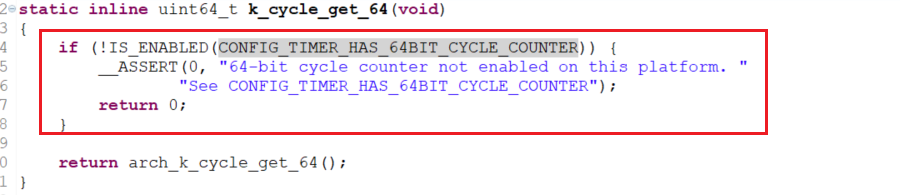
I understand your concern, and having a second look at it i might have my doubts too. Did you see any problems with the current implementation? For what I understand SOF generic layer uses k_cycle_get_64 and that's fine. But we need to understand how does that translates for IMX. Looking at zephyr: include/arch/xtensa/arch/arch.h we have: but I couldn't find the implementation of sys_clock_cycle_get_64. It must be there because the code compiles. I don't I understand what you are suggesting with adding sys_clock_cycle_get_32 |
hlleng
commented
Apr 6, 2022
Yes, it can be compiled, and I couldn't find the implementation of sys_clock_cycle_get_64 too, |
There is a question, see zephyrproject-rtos/zephyr#39935 this PR, though zephyr support 64 bit timer api , but the most important is the hardware should support 64bit timer register, or it should not be work. For |
hlleng
commented
Apr 6, 2022
Yes, I think should be support both |
dbaluta
commented
Apr 6, 2022
Yes, but the common SOF code uses k_cycle_get_64 and it looks like this translates into nothing for IMX. Am i right, @lenghonglin |
hlleng
commented
Apr 6, 2022
|
paulstelian97
commented
Apr 6, 2022
We are looking into it, right now we don't know yet.
I believe, but still need to double check, that it is 32-bit. What kind of issues do you see/predict right now? |
hlleng
commented
Apr 6, 2022
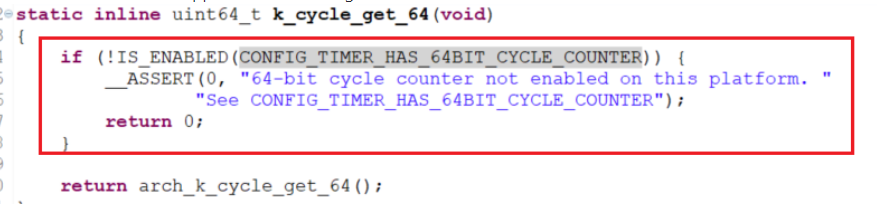
I mean if the hardware not support |
andyross
commented
Apr 7, 2022
Sorry, just catching up here. To answer the questions above: Zephyr's app-facing timeout API is selectable via CONFIG_TIMER_64BIT. If that is set to y (it's on by default), then all kernel timeouts are stored internally in a 64 bit count of ticks. The Zephyr driver interface remains mostly 32 bit internally, meaning that the longest delay between any two announced ticks must fit in a signed 32 bit integer. There hasn't been desire to augment this on any current platforms (rollover on the 38.4 MHz clock would be almost a full minute, for example), but if there's desire for that it would be easy to do. Finally the hardware cycle API, which is on top of the driver but parallel to the timeout system, is required to be only 32 bit. Recently we've seen drivers that want to expose the full counter via k_cycle_get_64(), which is what CONFIG_TIMER_HAS_64BIT_CYCLE_COUNTER is for. The cavs_timer driver for the HDA wall clock supports that just fine too. |
hlleng
commented
Apr 11, 2022
Yes, for support 32bit timer, I think it should better support |
@andyross @lenghonglin OK, Xtensa hifi4 only has 32bit timer register and for calls to Would it be possible to add support for k_cycle_get_64 by just keeping track of when ccount register overflows? e.g this implementation is used with SOF. SOF core code assumes that |
hlleng
commented
Apr 18, 2022
This way maybe cause confusion for developer. #if defined(__ZEPHYR__)
#ifdefTIMER_HAS_64BIT_CYCLE_COUNTER#definesof_timer k_cycle_get_64
#else#definesof_timer k_cycle_get_32
#endif#endif |
lgirdwood
commented
Apr 19, 2022
@lenghonglin we should not be using any native SOF API call for RTOS functions (like timers) but use Zephyr conditional logic (at build time or runtime) like you have above to get the correct Zephyr native timer call. |
A regression bug was introduced by thesofprojectgh-5393 pull request.
As a source of high precision CPU timestamp (aka "system" timer)
this fix uses arch_timing_counter_get() for builds with Zephyr and
timer_get_system(cpu_timer_get()) for SOF only builds.
Note: arch_timing_counter_get() might not be implemented for your
Zephyr platform. In this case k_cycle_get_64() is used instead.
This will result in both "platform" and "cpu" timestamps to be equal.
Signed-off-by: Serhiy Katsyuba <serhiy.katsyuba@intel.com>
A regression bug was introduced by gh-5393 pull request.
As a source of high precision CPU timestamp (aka "system" timer)
this fix uses arch_timing_counter_get() for builds with Zephyr and
timer_get_system(cpu_timer_get()) for SOF only builds.
Note: arch_timing_counter_get() might not be implemented for your
Zephyr platform. In this case k_cycle_get_64() is used instead.
This will result in both "platform" and "cpu" timestamps to be equal.
Signed-off-by: Serhiy Katsyuba <serhiy.katsyuba@intel.com>
A regression bug was introduced by gh-5393 pull request.
As a source of high precision CPU timestamp (aka "system" timer)
this fix uses arch_timing_counter_get() for builds with Zephyr and
timer_get_system(cpu_timer_get()) for SOF only builds.
Note: arch_timing_counter_get() might not be implemented for your
Zephyr platform. In this case k_cycle_get_64() is used instead.
This will result in both "platform" and "cpu" timestamps to be equal.
Signed-off-by: Serhiy Katsyuba <serhiy.katsyuba@intel.com>
(cherry picked from commit 8e59c96)
The purpose of this PR is to prepare the SOF to use zephyr timer API.
Added functions platform_timer_ticks_to_ms and platform_timer_ticks_to_us which allows convert the time expressed in ticks to seconds.
Waiting for a certain time has been simplified by adding a functions wait_delay_ms and wait_delay_us. Previously now, its required a conversion between time to ticks using clock_ms_to_ticks.
New functions platform_timer_timeout_calc_ms and platform_timer_timeout_calc_us simplify the timeout calculation.