
- Small footprint, no dependency, 0.7K minimized+gzip!
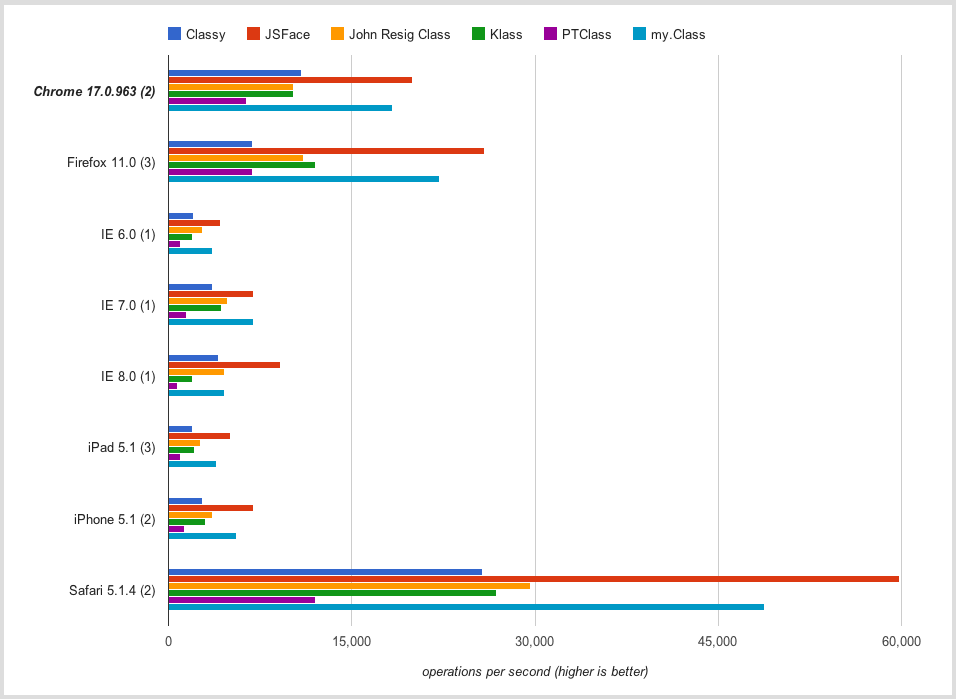
- Super fast! See benchmark.
- Work on both server and client side.
- Support CommonJS.
- Support getter/setter, constant, main, singleton, mixin, private properties, Aspect Oriented Programming.
- Plugins mechanism to extend itself.
JSFace supports both server side (CommonJS) and client side JavaScript (browser).
bower install jsface<scriptsrc="bower_components/jsface/jsface.js"></script><scriptsrc="https://cdn.jsdelivr.net/jsface/2.4.9/jsface.min.js"></script><scriptsrc="jsface.js"></script>First install JSFace via npm:
npm install jsfaceThen use its APIs, for example:
varjsface=require("jsface"),Class=jsface.Class,extend=jsface.extend;varPerson=Class({constructor: function(name,age){this.name=name;this.age=age;},// Getter/Setteraddress: {get: function(){returnthis._address;},set: function(value){this._address=value;}},toString: function(){returnthis.name+"/"+this.age;}});varperson=newPerson("Rika",20);person.toString();// "Rika/20"varStudent=Class(Person,{constructor: function(id,name,age){this.id=id;Student.$super.call(this,name,age);// Call parent's constructor},toString: function(){returnthis.id+"/"+Student.$superp.toString.call(this);// Call parent's toString method}});varstudent=newStudent(1,"Rika",20);student.toString();// "1/Rika/20"JSFace supports a special method named main(). main() is executed right after the class is created.
Class({constructor: function(name){this.name=name;},getName: function(){returnthis.name;},main: function(Person){// Class is passed to main() as its first argumentvarp=newPerson("Rika");p.getName();// "Rika"}});varUtil=Class({$singleton: true,echo: function(obj){returnobj;}});Util.echo(2012);// 2012varPerson=Class({$statics: {MIN_AGE: 1,MAX_AGE: 150,isValidAge: function(age){returnage>=this.MIN_AGE&&age<=this.MAX_AGE;}},constructor: function(name,age){this.name=name;this.age=age;}});Person.MIN_AGE===1;// truePerson.MAX_AGE===150;// truePerson.isValidAge(0);// falseConstants work the same as static properties. The only different is they are immutable.
varPerson=Class({$const: {MIN_AGE: 1,MAX_AGE: 150},constructor: function(name,age){this.name=name;this.age=age;}});Person.MIN_AGE=-1;Person.MIN_AGE===1;// true, MIN_AGE is immutableJSFace supports private static properties, meaning the properties are shared over instances.
varPerson=Class(function(){varMIN_AGE=1,// private variablesMAX_AGE=150;functionisValidAge(age){// private methodreturnage>=MIN_AGE&&age<=MAX_AGE;}return{constructor: function(name,age){if(!isValidAge(age)){throw"Invalid parameter";}this.name=name;this.age=age;}};});JSFace provides a powerful mechanism to support mixins. Reusable code can be mixed into almost anything.
Mixin can be bound when you define classes:
varOptions=Class({setOptions: function(opts){this.opts=opts;}});varEvents=Class({bind: function(event,fn){returntrue;},unbind: function(event,fn){returnfalse;}});varPerson=Class({constructor: function(name,age){this.name=name;this.age=age;}});// Student inherits Person and extends properties from Options and EventsvarStudent=Class([Person,Options,Events],{constructor: function(id,name,age){}});varstudent=newStudent(1,"Rika",20);student.setOptions({foo: true});// student.opts === { foo: true }student.bind();// truestudent.unbind();// falseOr after defining classes:
varStudent=Class(Person,{constructor: function(id,name,age){});extend(Student,[Options,Events]);Mixin with instance:
varperson=newPerson("Rika",20);extend(person,Options);person.setOptions({foo: true});Mixin with native classes:
extend(String.prototype,{trim: function(){returnthis.replace(/^\s+|\s+$/g,"");}});" Hello World ".trim();// "Hello World"In browser environment, you might be using another library which also introduces the global namespace Class. JSFace can return the original Class back to the library claims it with a call to jsface.noConflict().
jsface.noConflict();// Code that uses other library's Class can follow here// ...// Define classes by using jsface.Class directlyvarPerson=jsface.Class({});JSFace supports Aspect Oriented Programming (AOP) via simple before/after mechanism. You can apply pointcuts over class constructors, class methods, singleton methods, instance methods. You can even apply pointcuts over native classes.
AOP support is implemented as a standalone plugin.
Browser:
<scriptsrc="jsface.pointcut.js"></script>then in your code, make an alias to jsface.pointcut:
varpointcut=jsface.pointcut;NodeJS:
varpointcut=require("jsface.pointcut");In JSFace, an advisor is a set of pointcuts you want to apply to a subject. You can apply as many advisors as you want.
Person=Class({constructor: function(name){this.name=name;this.counter=0;},foo: function(n){},bar: function(n){}});varadvisor={constructor: {before: function(){this.age=20;},after: function(){this.email="rika@sample.com";}},foo: function(n){// sugar syntax, foo:beforethis.counter++;},bar: {before: function(n){this.counter++;},after: function(n){this.counter++;}}};Person=pointcut(Person,advisor);varperson=newPerson("Rika");person.foo();person.bar();person.name==="Rika";// trueperson.age===20;// trueperson.email==="rika@sample.com";// trueperson.counter===3;// trueUsing previous apply pointcut example:
// remove all pointcuts bound to constructor and fooPerson=poincut(Person,"remove constructor foo");// remove advisor, other advisors remainedPerson=poincut(Person,"remove",advisor);// remove all advisors, restore the fresh version of PersonPerson=poincut(Person,"remove");$ready plugin is designed to help a parent class to intercept their subclasses' creation.
varService=Class({$ready: function(clazz,parent,api){vartype=(this!==clazz)&&api.type;// (this !== clazz) means this comes from a sub-classswitch(type){case"session":
// do something with subclass clazz when its type is sessionbreak;case"application":
// do something with subclass clazz when its type is applicationbreak;}}});varSessionService=Class(Service,{type: "session"});varApplicationService=Class(Service,{type: "application"});Have a bug? Please create an issue here on GitHub!
Copyright (c) Tan Nhu
Permission is hereby granted, free of charge, to any person obtaining a copy of this software and associated documentation files (the "Software"), to deal in the Software without restriction, including without limitation the rights to use, copy, modify, merge, publish, distribute, sublicense, and/or sell copies of the Software, and to permit persons to whom the Software is furnished to do so, subject to the following conditions:
The above copyright notice and this permission notice shall be included in all copies or substantial portions of the Software.
THE SOFTWARE IS PROVIDED "AS IS", WITHOUT WARRANTY OF ANY KIND, EXPRESS OR IMPLIED, INCLUDING BUT NOT LIMITED TO THE WARRANTIES OF MERCHANTABILITY, FITNESS FOR A PARTICULAR PURPOSE AND NONINFRINGEMENT. IN NO EVENT SHALL THE AUTHORS OR COPYRIGHT HOLDERS BE LIABLE FOR ANY CLAIM, DAMAGES OR OTHER LIABILITY, WHETHER IN AN ACTION OF CONTRACT, TORT OR OTHERWISE, ARISING FROM, OUT OF OR IN CONNECTION WITH THE SOFTWARE OR THE USE OR OTHER DEALINGS IN THE SOFTWARE.