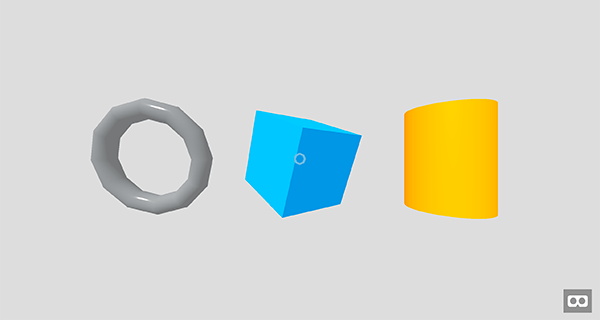
npm install --save aframe react-aframe-ar react react-dom
yarn add aframe react-aframe-ar react react-dom
- Basic example
import'aframe';importReactfrom'react';importReactDOMfrom'react-dom';import{Box,Sphere,Cylinder,Plane,Sky,Text,Scene}from'react-aframe-ar';classAppSceneextendsReact.Component{render(){return(<Scene><Boxposition="-1 0.5 -3"rotation="0 45 0"color="#4CC3D9"shadow/><Sphereposition="0 1.25 -5"radius="1.25"color="#EF2D5E"shadow/><Cylinderposition="1 0.75 -3"radius="0.5"height="1.5"color="#FFC65D"shadow/><Planeposition="0 0 -4"rotation="-90 0 0"width="4"height="4"color="#7BC8A4"shadow/><Skycolor="#ECECEC"/><Textvalue="Hello world, react-aframe-ar!"align="center"position="0 2.3 -1.5"color="#7BC8A4"/></Scene>);}}ReactDOM.render(<AppScene/>,document.querySelector('#sceneContainer'));- Checkout react-aframe-starter for easily boilerplate!
react-aframe-ar is a very thin layer on top of React to bridge with A-Frame.
It passes React props to directly A-Frame using refs and .setAttribute(), bypassing the DOM.
This works since A-Frame's .setAttribute()s are able to take non-string data such as objects,
arrays, or elements and synchronously modify underlying 3D scene graph.
// react-aframe-ar's <Entity/> React Component<Entitygeometry={{primitive: 'box',width: 5}}position="0 0 -5"/>// renders<a-entity>// and then applies the data directly to the underlying 3D scene graph, bypassing the DOM.<a-entity>.setAttribute('geometry', {primitive: 'box',width: 5});
<a-entity>.setAttribute('position', '0 0 -5');
react-aframe-ar provides the best of both worlds between A-Frame and React, the
3D and VR-oriented entity-component architecture of A-Frame, and the view and
state management ergonomics of React, without penalties of attempting to use
React for a VR application.
A-Frame is a web framework for building virtual reality experiences. Since A-Frame is built on top of the DOM, web libraries such as React, Vue.js, Angular, Ember.js, d3.js are able to sit cleanly on top of A-Frame.
A-Frame is an entity-component-system (ECS) framework exposed through
HTML. ECS is a pattern used in game development that
favors composability over inheritance, which is more naturally suited to 3D
scenes where objects are built of complex appearance, behavior, and
functionality. In A-Frame, HTML attributes map to components which are
composable modules that are plugged into <a-entity>s to attach appearance,
behavior, and functionality.